Handing Interviews & Group Discussions
Workshop Objectives

After completing this program participants will be able to:


• Define an Interview and explain a behavioral interview.
• List steps of a Good Interview
• List the most sought out competencies by employers
• Describe the essentials in a resume
• List good practices to employ before, during and after an interview.
• Describe professional attire, verbal and non verbal gestures for making a good impression
• Describe a Group Discussion and list the skills that are observation
• List the dos and don’ts of a Group Discussion


                                                                                              2
                                                                                    2
What Is An Interview?

  A selection procedure designed to predict future job performance on the basis of applicants
  oral responses to oral enquiries
  Behavioral interviewing is a methodology built on the premise that “the best indicator of what a
  person will do tomorrow is what he or she did yesterday.”
  The interview focuses on specific experiences of candidates, as opposed to “what-if”
  scenarios.


  How Can I Prepare for Behavioral Interviewing?
• Know yourself.
• Know why you are a STAR!
• Know your “customer.”
• Know what you have that your customer wants.
• Ask great questions.
• Close the interview.
• Follow-up.


                                                                                                3
                                                                                       3
Seven Steps for a Great Interview

Step 1: Be Prepared
Step 2: Build Confidence
Step 3: Make A Great 1st Impression
Step 4: Establish Credibility
Step 5: Answer Questions
Step 6: Ask Questions
Step 7 : Close and Follow-up


                                          4
                                      4
Activity: Know Yourself

Activity: Individual Self Assessment- Know Yourself


Time: 10 Mins


Reference: Page 1 of Participant Handout


                                                          5
                                                      5
Know Your Prospective Employer

 PREPARE FOR THEM
 Research the company and the industry
 Find out about the position
 Understand what they are looking for in an employee
 Match your strengths with what they need
 Prepare possible questions from your resume
 Have quality questions ready


 SOURCES OF INFORMATION
 Google it
 Press releases
 Annual reports
 Understand markets served

                                                            6
                                                        6
Research Your Customer

         The Company                                         The Industry
  What are the company goals
                                                      Know your industry like the back of
  What are the Company current                        your hand. Be an SME
   events
                                                      Be aware of any emerging
  Services and/or products                            technology or trends
  New launches
                                                      Remain current on any issues and
  Sales: Any large increase or                        developments
   decrease and why
                                                      Know about the latest mergers or
  Competition                                         takeovers in your industry
  International operations                           Read trade journals or professional
  Any media information on the                        publications
   company in the last year


             Knowledge of the company & industry creates a good impression


                                                                                          7
                                                                                7
Your Resume: Stand Out From The Crowd

Your resume is your marketing tool
• Does it effectively describe your background?
• Does it accentuate the positives & accomplishments?
• Does it focus on your value to your previous employers?
• Perfection counts
• Is it honest and accurate?
• Is it a successful marketing piece?
• Does it make you stand out from the crowd?


                                                                8
                                                            8
Interviewers Look Out For

   Organization Of Events
   Clarity Of Depiction
   Completeness: Are dates and/or descriptions omitted.
   Unexplained Breaks In Service And Education
   Extent Of Customization To The Job Applied
   Quality Of The Resume – Mode, Spelling Errors, Verbosity
   Complete Contact Information
   Remember to omit personal information unrelated to the job


                                                                     9
                                                                 9
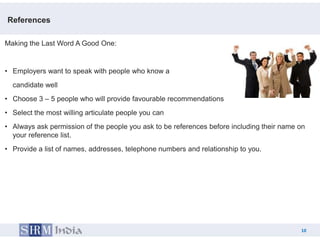
References

Making the Last Word A Good One:


• Employers want to speak with people who know a
  candidate well
• Choose 3 – 5 people who will provide favourable recommendations
• Select the most willing articulate people you can
• Always ask permission of the people you ask to be references before including their name on
  your reference list.
• Provide a list of names, addresses, telephone numbers and relationship to you.


                                                                                           10
                                                                                   10
Interview Pre-Work


                 Logistics:                        Important Documents
  •   Confirm location and time of meeting   •   Carry your CV with additional copies
  • Determine estimated travel time          • Copies of Letters of
  • Have the name and contact number of        Recommendations
    the person you are meeting at hand       • Portfolio of writing samples or other
                                               professional work
                                             • Personal ID - a passport, driver’s
                                               license
                                             • Other material relevant to the
                                               interview
                                             • Pen and paper.


                                                                                    11
                                                                           11
When You Arrive…

• Arrive early at the venue.
• Remember Your interview really begins as soon as you arrive at
  the place of the interview.
• When asked to wait keep calm, and take the opportunity to go
  over your answers to some of the questions you think you might be asked.
• Making a good impression in the waiting room is just as important as when the interview
  begins.
• In the waiting area don’t use slang, chewing gum or smoke
  cigarettes.
• Standard politeness is important


                                                                                            12
                                                                                   12
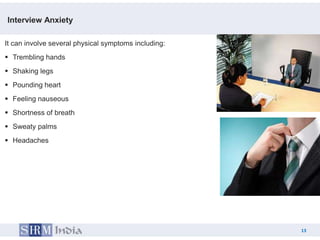
Interview Anxiety

It can involve several physical symptoms including:
 Trembling hands
 Shaking legs
 Pounding heart
 Feeling nauseous
 Shortness of breath
 Sweaty palms
 Headaches


                                                           13
                                                      13
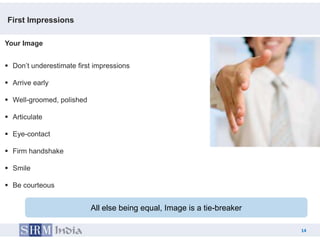
First Impressions

Your Image


 Don’t underestimate first impressions

 Arrive early

 Well-groomed, polished

 Articulate

 Eye-contact

 Firm handshake

 Smile

 Be courteous


                           All else being equal, Image is a tie-breaker

                                                                               14
                                                                          14
During The Interview: Making A Lasting Impression

• Prepare your Introduction & Key points.
• Listen carefully to what the interviewer is saying
• Stress on what you can contribute to the organisation
• Be crisp in what you want to say.
• Complete your sentences. Don’t answer just "yes" or "no"
• Use the STAR format for framing your responses
• Be specific. Do not be vague.
• If you don’t understand the question, ask for clarification.
• What you don’t know can be learned. Tell them if you don’t know something, but give
  instances of how quick a learner you are.
• Switch off your cell phone
• Strike a balance between what you are and who you want to be. Don’t portray yourself as
  somebody who isn't concerned about money, social status, etc.
• Send a Thank You letter outlining your interest in the job.


                                                                                            15
                                                                                   15
12 Most Sought After Competencies

•    Communication
•    Achievement Orientation
•    Customer Focus
•    Team Work
•    Leadership
•    Planning And Organizing
•    Commercial Awareness
•    Flexibility
•    Developing Others
•    Problem Solving
•    Analytical Thinking
•    Building Relationships


                                             16
                                        16
Interview Faux Pas

• Don’t be over confident
• Don’t boast
• Do not bad mouth your previous employer
• Don’t get personal
• Don’t talk about your personal problems
• Don’t be in a hurry to complete the interview
• If the interviewer is interrupted, do not scan the settings or pick up papers and start reading
• Don’t answer your cell phone.


                                                                                                    17
                                                                                         17
Your Questions for The Interviewer

 What will be my most difficult challenge in my first six months?


 What will I be contributing to your group or organization?


 What is your corporate culture?


                                                                          18
                                                                     18
Never Say The Following

1.   How much does the job pay?
2.   What does your company make or do?
3.   Do not use slang words or phrases
4.   What can you do for me?
5.   No profanity or cursing.
6.   No stereotypical language.
7.   Do not criticize any former employer
8.   If you are asked whether you have any questions don’t say no.
9.   Don’t say – I don’t have any weaknesses
10. Don’t tell them your life story


                                                                          19
                                                                     19
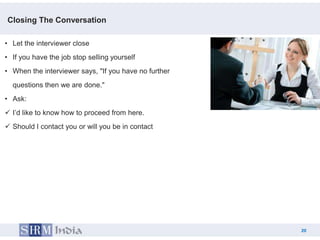
Closing The Conversation

• Let the interviewer close
• If you have the job stop selling yourself
• When the interviewer says, "If you have no further
  questions then we are done."
• Ask:
 I’d like to know how to proceed from here.
 Should I contact you or will you be in contact


                                                            20
                                                       20
Activity: Mock Interview

Activity: Mock Interview


Time: 20 Minutes


                                21
                           21
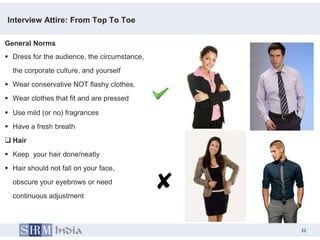
Interview Attire: From Top To Toe

General Norms
 Dress for the audience, the circumstance,
  the corporate culture, and yourself
 Wear conservative NOT flashy clothes.
 Wear clothes that fit and are pressed

 Use mild (or no) fragrances
 Have a fresh breath
 Hair
 Keep your hair done/neatly
 Hair should not fall on your face,
  obscure your eyebrows or need
  continuous adjustment


                                                   22
                                              22
Dressing Right- Donts

 Wear dress shoes. Don’t wear sneakers or casuals.
 Use deodorant/antiperspirant. Don’t use too much scent.
 Use makeup sparingly. Don’t use evening makeup.
 Limit your jewellery. Don’t wear too many earrings or rings.
 Avoid shiny tie pins, clips or big belt buckles
 Avoid trends. Stick to classic looks.


                                                                      23
                                                                 23
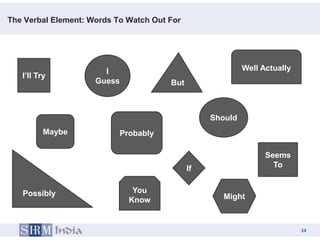
The Verbal Element: Words To Watch Out For


                       I                                   Well Actually
   I’ll Try
                     Guess             But


                                                  Should
          Maybe            Probably

                                                                 Seems
                                             If                    To


   Possibly                   You
                             Know                    Might


                                                                           24
                                                                   24
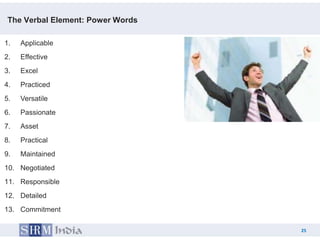
The Verbal Element: Power Words

1.   Applicable
2.   Effective
3.   Excel
4.   Practiced
5.   Versatile
6.   Passionate
7.   Asset
8.   Practical
9.   Maintained
10. Negotiated
11. Responsible
12. Detailed
13. Commitment

                                        25
                                   25
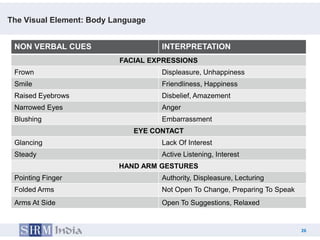
The Visual Element: Body Language


 NON VERBAL CUES                    INTERPRETATION
                          FACIAL EXPRESSIONS
 Frown                              Displeasure, Unhappiness
 Smile                              Friendliness, Happiness
 Raised Eyebrows                    Disbelief, Amazement
 Narrowed Eyes                      Anger
 Blushing                           Embarrassment
                              EYE CONTACT
 Glancing                           Lack Of Interest
 Steady                             Active Listening, Interest
                          HAND ARM GESTURES
 Pointing Finger                    Authority, Displeasure, Lecturing
 Folded Arms                        Not Open To Change, Preparing To Speak
 Arms At Side                       Open To Suggestions, Relaxed


                                                                             26
                                                                        26
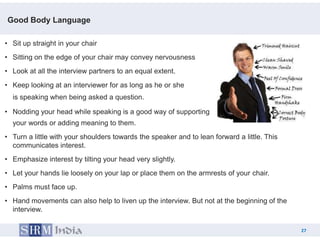
Good Body Language

• Sit up straight in your chair
• Sitting on the edge of your chair may convey nervousness
• Look at all the interview partners to an equal extent.
• Keep looking at an interviewer for as long as he or she
  is speaking when being asked a question.

• Nodding your head while speaking is a good way of supporting
  your words or adding meaning to them.
• Turn a little with your shoulders towards the speaker and to lean forward a little. This
  communicates interest.
• Emphasize interest by tilting your head very slightly.
• Let your hands lie loosely on your lap or place them on the armrests of your chair.
• Palms must face up.
• Hand movements can also help to liven up the interview. But not at the beginning of the
  interview.

                                                                                              27
                                                                                         27
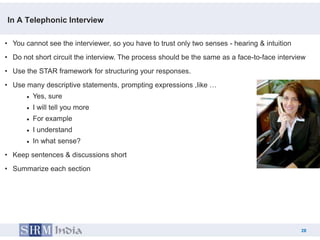
In A Telephonic Interview

• You cannot see the interviewer, so you have to trust only two senses - hearing & intuition
• Do not short circuit the interview. The process should be the same as a face-to-face interview
• Use the STAR framework for structuring your responses.
• Use many descriptive statements, prompting expressions ,like …
        Yes, sure
        I will tell you more
        For example
        I understand
        In what sense?
• Keep sentences & discussions short
• Summarize each section


                                                                                               28
                                                                                      28
Activity: Group Discussion

Activity: Group Discussion


Time: 20 Minutes


Topic: Chose any one.
• Rules are meant to be broken
• A Ship Docked in Harbour cannot face the Storms
• Capitalism is a very Flawed System but the others are so much worse


                                                                             29
                                                                        29
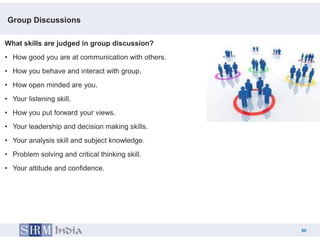
Group Discussions

What skills are judged in group discussion?
• How good you are at communication with others.
• How you behave and interact with group.
• How open minded are you.
• Your listening skill.
• How you put forward your views.
• Your leadership and decision making skills.
• Your analysis skill and subject knowledge.
• Problem solving and critical thinking skill.
• Your attitude and confidence.


                                                        30
                                                   30
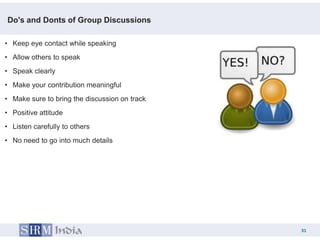
Do's and Donts of Group Discussions

• Keep eye contact while speaking
• Allow others to speak
• Speak clearly
• Make your contribution meaningful
• Make sure to bring the discussion on track
• Positive attitude
• Listen carefully to others
• No need to go into much details


                                                    31
                                               31
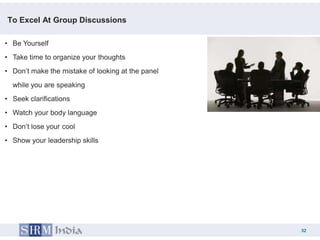
To Excel At Group Discussions

• Be Yourself
• Take time to organize your thoughts
• Don’t make the mistake of looking at the panel
  while you are speaking
• Seek clarifications
• Watch your body language
• Don’t lose your cool
• Show your leadership skills


                                                        32
                                                   32
Your Thoughts

• What went well?


• What could we do more of?


• What should we do less of?


• What could be done differently?


                                         33
                                    33
®


                Leading People. Leading Organizations.


    Thank you


                                                     34
                                      34

Handling interviews & group discussion

  • 1.
    Handing Interviews &Group Discussions
  • 2.
    Workshop Objectives After completingthis program participants will be able to: • Define an Interview and explain a behavioral interview. • List steps of a Good Interview • List the most sought out competencies by employers • Describe the essentials in a resume • List good practices to employ before, during and after an interview. • Describe professional attire, verbal and non verbal gestures for making a good impression • Describe a Group Discussion and list the skills that are observation • List the dos and don’ts of a Group Discussion 2 2
  • 3.
    What Is AnInterview? A selection procedure designed to predict future job performance on the basis of applicants oral responses to oral enquiries Behavioral interviewing is a methodology built on the premise that “the best indicator of what a person will do tomorrow is what he or she did yesterday.” The interview focuses on specific experiences of candidates, as opposed to “what-if” scenarios. How Can I Prepare for Behavioral Interviewing? • Know yourself. • Know why you are a STAR! • Know your “customer.” • Know what you have that your customer wants. • Ask great questions. • Close the interview. • Follow-up. 3 3
  • 4.
    Seven Steps fora Great Interview Step 1: Be Prepared Step 2: Build Confidence Step 3: Make A Great 1st Impression Step 4: Establish Credibility Step 5: Answer Questions Step 6: Ask Questions Step 7 : Close and Follow-up 4 4
  • 5.
    Activity: Know Yourself Activity:Individual Self Assessment- Know Yourself Time: 10 Mins Reference: Page 1 of Participant Handout 5 5
  • 6.
    Know Your ProspectiveEmployer  PREPARE FOR THEM  Research the company and the industry  Find out about the position  Understand what they are looking for in an employee  Match your strengths with what they need  Prepare possible questions from your resume  Have quality questions ready  SOURCES OF INFORMATION  Google it  Press releases  Annual reports  Understand markets served 6 6
  • 7.
    Research Your Customer The Company The Industry  What are the company goals  Know your industry like the back of  What are the Company current your hand. Be an SME events  Be aware of any emerging  Services and/or products technology or trends  New launches  Remain current on any issues and  Sales: Any large increase or developments decrease and why  Know about the latest mergers or  Competition takeovers in your industry  International operations  Read trade journals or professional  Any media information on the publications company in the last year Knowledge of the company & industry creates a good impression 7 7
  • 8.
    Your Resume: StandOut From The Crowd Your resume is your marketing tool • Does it effectively describe your background? • Does it accentuate the positives & accomplishments? • Does it focus on your value to your previous employers? • Perfection counts • Is it honest and accurate? • Is it a successful marketing piece? • Does it make you stand out from the crowd? 8 8
  • 9.
    Interviewers Look OutFor  Organization Of Events  Clarity Of Depiction  Completeness: Are dates and/or descriptions omitted.  Unexplained Breaks In Service And Education  Extent Of Customization To The Job Applied  Quality Of The Resume – Mode, Spelling Errors, Verbosity  Complete Contact Information  Remember to omit personal information unrelated to the job 9 9
  • 10.
    References Making the LastWord A Good One: • Employers want to speak with people who know a candidate well • Choose 3 – 5 people who will provide favourable recommendations • Select the most willing articulate people you can • Always ask permission of the people you ask to be references before including their name on your reference list. • Provide a list of names, addresses, telephone numbers and relationship to you. 10 10
  • 11.
    Interview Pre-Work Logistics: Important Documents • Confirm location and time of meeting • Carry your CV with additional copies • Determine estimated travel time • Copies of Letters of • Have the name and contact number of Recommendations the person you are meeting at hand • Portfolio of writing samples or other professional work • Personal ID - a passport, driver’s license • Other material relevant to the interview • Pen and paper. 11 11
  • 12.
    When You Arrive… •Arrive early at the venue. • Remember Your interview really begins as soon as you arrive at the place of the interview. • When asked to wait keep calm, and take the opportunity to go over your answers to some of the questions you think you might be asked. • Making a good impression in the waiting room is just as important as when the interview begins. • In the waiting area don’t use slang, chewing gum or smoke cigarettes. • Standard politeness is important 12 12
  • 13.
    Interview Anxiety It caninvolve several physical symptoms including:  Trembling hands  Shaking legs  Pounding heart  Feeling nauseous  Shortness of breath  Sweaty palms  Headaches 13 13
  • 14.
    First Impressions Your Image Don’t underestimate first impressions  Arrive early  Well-groomed, polished  Articulate  Eye-contact  Firm handshake  Smile  Be courteous All else being equal, Image is a tie-breaker 14 14
  • 15.
    During The Interview:Making A Lasting Impression • Prepare your Introduction & Key points. • Listen carefully to what the interviewer is saying • Stress on what you can contribute to the organisation • Be crisp in what you want to say. • Complete your sentences. Don’t answer just "yes" or "no" • Use the STAR format for framing your responses • Be specific. Do not be vague. • If you don’t understand the question, ask for clarification. • What you don’t know can be learned. Tell them if you don’t know something, but give instances of how quick a learner you are. • Switch off your cell phone • Strike a balance between what you are and who you want to be. Don’t portray yourself as somebody who isn't concerned about money, social status, etc. • Send a Thank You letter outlining your interest in the job. 15 15
  • 16.
    12 Most SoughtAfter Competencies • Communication • Achievement Orientation • Customer Focus • Team Work • Leadership • Planning And Organizing • Commercial Awareness • Flexibility • Developing Others • Problem Solving • Analytical Thinking • Building Relationships 16 16
  • 17.
    Interview Faux Pas •Don’t be over confident • Don’t boast • Do not bad mouth your previous employer • Don’t get personal • Don’t talk about your personal problems • Don’t be in a hurry to complete the interview • If the interviewer is interrupted, do not scan the settings or pick up papers and start reading • Don’t answer your cell phone. 17 17
  • 18.
    Your Questions forThe Interviewer  What will be my most difficult challenge in my first six months?  What will I be contributing to your group or organization?  What is your corporate culture? 18 18
  • 19.
    Never Say TheFollowing 1. How much does the job pay? 2. What does your company make or do? 3. Do not use slang words or phrases 4. What can you do for me? 5. No profanity or cursing. 6. No stereotypical language. 7. Do not criticize any former employer 8. If you are asked whether you have any questions don’t say no. 9. Don’t say – I don’t have any weaknesses 10. Don’t tell them your life story 19 19
  • 20.
    Closing The Conversation •Let the interviewer close • If you have the job stop selling yourself • When the interviewer says, "If you have no further questions then we are done." • Ask:  I’d like to know how to proceed from here.  Should I contact you or will you be in contact 20 20
  • 21.
    Activity: Mock Interview Activity:Mock Interview Time: 20 Minutes 21 21
  • 22.
    Interview Attire: FromTop To Toe General Norms  Dress for the audience, the circumstance, the corporate culture, and yourself  Wear conservative NOT flashy clothes.  Wear clothes that fit and are pressed  Use mild (or no) fragrances  Have a fresh breath  Hair  Keep your hair done/neatly  Hair should not fall on your face, obscure your eyebrows or need continuous adjustment 22 22
  • 23.
    Dressing Right- Donts Wear dress shoes. Don’t wear sneakers or casuals.  Use deodorant/antiperspirant. Don’t use too much scent.  Use makeup sparingly. Don’t use evening makeup.  Limit your jewellery. Don’t wear too many earrings or rings.  Avoid shiny tie pins, clips or big belt buckles  Avoid trends. Stick to classic looks. 23 23
  • 24.
    The Verbal Element:Words To Watch Out For I Well Actually I’ll Try Guess But Should Maybe Probably Seems If To Possibly You Know Might 24 24
  • 25.
    The Verbal Element:Power Words 1. Applicable 2. Effective 3. Excel 4. Practiced 5. Versatile 6. Passionate 7. Asset 8. Practical 9. Maintained 10. Negotiated 11. Responsible 12. Detailed 13. Commitment 25 25
  • 26.
    The Visual Element:Body Language NON VERBAL CUES INTERPRETATION FACIAL EXPRESSIONS Frown Displeasure, Unhappiness Smile Friendliness, Happiness Raised Eyebrows Disbelief, Amazement Narrowed Eyes Anger Blushing Embarrassment EYE CONTACT Glancing Lack Of Interest Steady Active Listening, Interest HAND ARM GESTURES Pointing Finger Authority, Displeasure, Lecturing Folded Arms Not Open To Change, Preparing To Speak Arms At Side Open To Suggestions, Relaxed 26 26
  • 27.
    Good Body Language •Sit up straight in your chair • Sitting on the edge of your chair may convey nervousness • Look at all the interview partners to an equal extent. • Keep looking at an interviewer for as long as he or she is speaking when being asked a question. • Nodding your head while speaking is a good way of supporting your words or adding meaning to them. • Turn a little with your shoulders towards the speaker and to lean forward a little. This communicates interest. • Emphasize interest by tilting your head very slightly. • Let your hands lie loosely on your lap or place them on the armrests of your chair. • Palms must face up. • Hand movements can also help to liven up the interview. But not at the beginning of the interview. 27 27
  • 28.
    In A TelephonicInterview • You cannot see the interviewer, so you have to trust only two senses - hearing & intuition • Do not short circuit the interview. The process should be the same as a face-to-face interview • Use the STAR framework for structuring your responses. • Use many descriptive statements, prompting expressions ,like … Yes, sure I will tell you more For example I understand In what sense? • Keep sentences & discussions short • Summarize each section 28 28
  • 29.
    Activity: Group Discussion Activity:Group Discussion Time: 20 Minutes Topic: Chose any one. • Rules are meant to be broken • A Ship Docked in Harbour cannot face the Storms • Capitalism is a very Flawed System but the others are so much worse 29 29
  • 30.
    Group Discussions What skillsare judged in group discussion? • How good you are at communication with others. • How you behave and interact with group. • How open minded are you. • Your listening skill. • How you put forward your views. • Your leadership and decision making skills. • Your analysis skill and subject knowledge. • Problem solving and critical thinking skill. • Your attitude and confidence. 30 30
  • 31.
    Do's and Dontsof Group Discussions • Keep eye contact while speaking • Allow others to speak • Speak clearly • Make your contribution meaningful • Make sure to bring the discussion on track • Positive attitude • Listen carefully to others • No need to go into much details 31 31
  • 32.
    To Excel AtGroup Discussions • Be Yourself • Take time to organize your thoughts • Don’t make the mistake of looking at the panel while you are speaking • Seek clarifications • Watch your body language • Don’t lose your cool • Show your leadership skills 32 32
  • 33.
    Your Thoughts • Whatwent well? • What could we do more of? • What should we do less of? • What could be done differently? 33 33
  • 34.
    ® Leading People. Leading Organizations. Thank you 34 34

Editor's Notes

  • #6 Take the time to do a self assessmentKnow yourself and what you want to do.What are your genuine strengths and competencies?What are your areas of improvement?Think of examples and explanations.Visualize what will happen.Familiarize yourself with the language of the industry.Practice out loud.
  • #15 Facilitators demonstrate and have participants practice the 5 types of handshakesPumperDead FishSqueezerTwo handedEqual, with direct eye contact
  • #31 Many companies and institutes are making group discussion as the first criteria for screening the candidates for face-to-face interviews. And there is reason too for giving huge importance for Group Discussion. First thing Group Discussion is used for mass elimination! And second thing group discussion selection criteria’s are based on actual company requirements.
  • #33 http://www.successcds.net/MBA-Admission/Group-discussion-GD-Tips.html