Apache
Cassandra:
A Brief History:
Dive into the Dynamo whitepaper
About me
@Shehaaz
I love hacking on Wearable/iOT devices.
Topics Today
● History and Dynamo
● Time series data modeling
● Example App
History
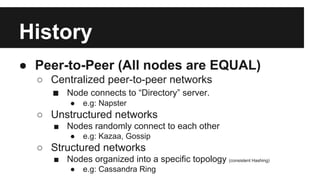
● Peer-to-Peer (All nodes are EQUAL)
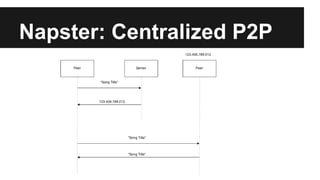
○ Centralized peer-to-peer networks
■ Node connects to “Directory” server.
● e.g: Napster
○ Unstructured networks
■ Nodes randomly connect to each other
● e.g: Kazaa, Gossip
○ Structured networks
■ Nodes organized into a specific topology (consistent Hashing)
● e.g: Cassandra Ring
Napster: Centralized P2P
Road to Cassandra
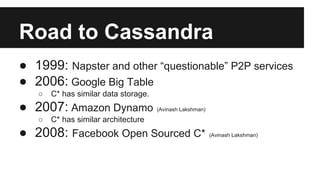
● 1999: Napster and other “questionable” P2P services
● 2006: Google Big Table
○ C* has similar data storage.
● 2007: Amazon Dynamo (Avinash Lakshman)
○ C* has similar architecture
● 2008: Facebook Open Sourced C* (Avinash Lakshman)
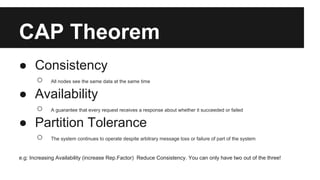
CAP Theorem
● Consistency
○ All nodes see the same data at the same time
● Availability
○ A guarantee that every request receives a response about whether it succeeded or failed
● Partition Tolerance
○ The system continues to operate despite arbitrary message loss or failure of part of the system
e.g: Increasing Availability (increase Rep.Factor) Reduce Consistency. You can only have two out of the three!
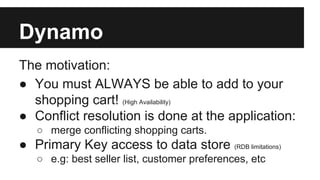
Dynamo
The motivation:
● You must ALWAYS be able to add to your
shopping cart! (High Availability)
● Conflict resolution is done at the application:
○ merge conflicting shopping carts.
● Primary Key access to data store (RDB limitations)
○ e.g: best seller list, customer preferences, etc
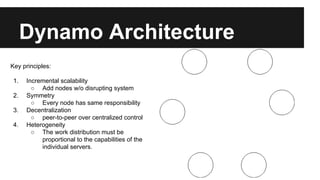
Dynamo Architecture
Key principles:
1. Incremental scalability
○ Add nodes w/o disrupting system
2. Symmetry
○ Every node has same responsibility
3. Decentralization
○ peer-to-peer over centralized control
4. Heterogeneity
○ The work distribution must be
proportional to the capabilities of the
individual servers.
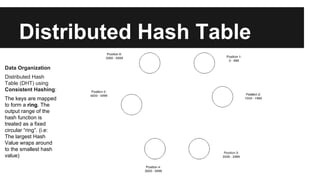
Distributed Hash Table
Data Organization
Distributed Hash
Table (DHT) using
Consistent Hashing:
The keys are mapped
to form a ring. The
output range of the
hash function is
treated as a fixed
circular “ring”. (i.e:
The largest Hash
Value wraps around
to the smallest hash
value)
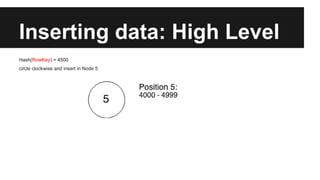
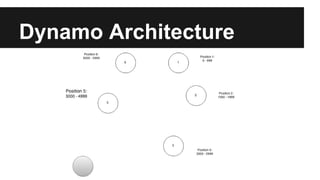
Inserting data: High Level
Hash(RowKey) = 4500
circle clockwise and insert in Node 5
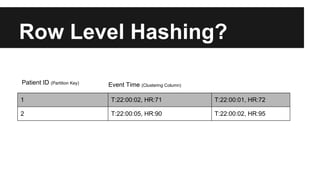
Row Level Hashing?
1 T:22:00:02, HR:71 T:22:00:01, HR:72
2 T:22:00:05, HR:90 T:22:00:02, HR:95
Patient ID (Partition Key)
Event Time (Clustering Column)
Dynamo Architecture
Consistent Hashing
● Advantage:
○ Departure or Arrival of a node only affects immediate
neighbors. Every node is in charge of the previous node clockwise.
○ Only K/N nodes need to be remapped when a node
drops. K= #keys N= #Nodes
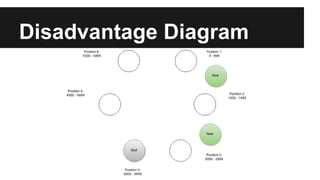
● Disadvantage:
○ ?
Dynamo Architecture
Dynamo Architecture
Consistent Hashing
● Disadvantage?
Dynamo Architecture
Consistent Hashing
● Disadvantage
○ Random Node position assignment leads to non-
uniform data and load distribution
○ Some nodes could simply suck
Disadvantage Diagram
Virtual nodes to rescue!
● Instead of mapping a node to a single
point in the ring, each node gets assigned
to multiple locations in the ring….(what
does that mean?)
Virtual Nodes!
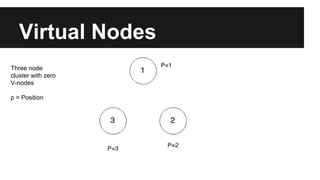
Virtual Nodes
Three node
cluster with zero
V-nodes
p = Position
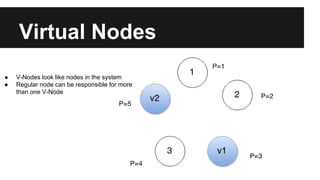
Virtual Nodes
● V-Nodes look like nodes in the system
● Regular node can be responsible for more
than one V-Node
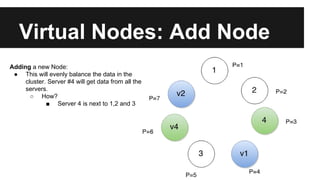
Virtual Nodes: Add Node
Adding a new Node:
● This will evenly balance the data in the
cluster. Server #4 will get data from all the
servers.
○ How?
■ Server 4 is next to 1,2 and 3
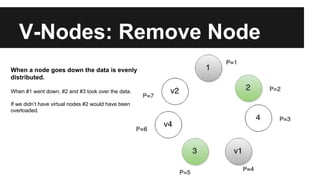
V-Nodes: Remove Node
When a node goes down the data is evenly
distributed.
When #1 went down, #2 and #3 took over the data.
If we didn’t have virtual nodes #2 would have been
overloaded.
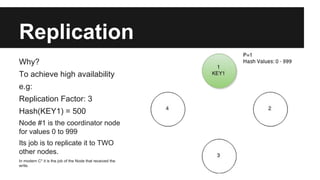
Replication
Why?
To achieve high availability
e.g:
Replication Factor: 3
Hash(KEY1) = 500
Node #1 is the coordinator node
for values 0 to 999
Its job is to replicate it to TWO
other nodes.
In modern C* it is the job of the Node that received the
write.
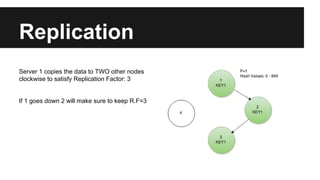
Replication
Server 1 copies the data to TWO other nodes
clockwise to satisfy Replication Factor: 3
If 1 goes down 2 will make sure to keep R.F=3
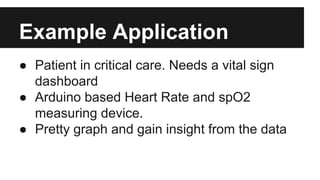
Example Application
● Patient in critical care. Needs a vital sign
dashboard
● Arduino based Heart Rate and spO2
measuring device.
● Pretty graph and gain insight from the data
Arduino + e-Health PCB
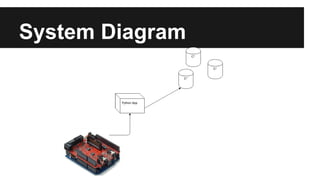
System Diagram
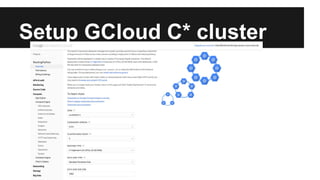
Setup GCloud C* cluster
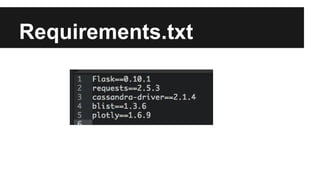
Requirements.txt
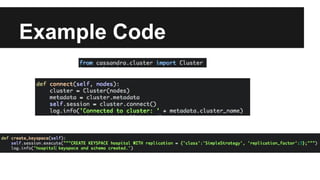
Example Code
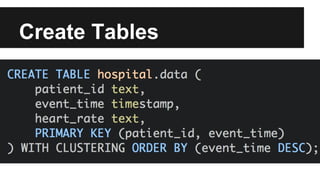
Create Tables
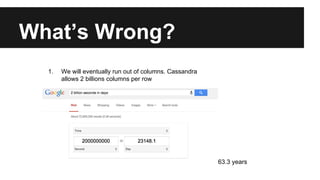
What’s Wrong?
1. We will eventually run out of columns. Cassandra
allows 2 billions columns per row
63.3 years
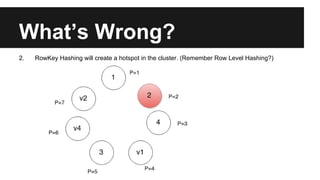
What’s Wrong?
2. RowKey Hashing will create a hotspot in the cluster. (Remember Row Level Hashing?)
Data modeling in C*
Time Series data modeling.
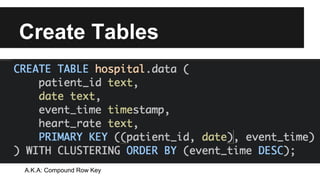
Create Tables
A.K.A: Compound Row Key
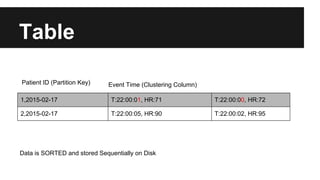
Table
1,2015-02-17 T:22:00:01, HR:71 T:22:00:00, HR:72
2,2015-02-17 T:22:00:05, HR:90 T:22:00:02, HR:95
Patient ID (Partition Key) Event Time (Clustering Column)
Data is SORTED and stored Sequentially on Disk
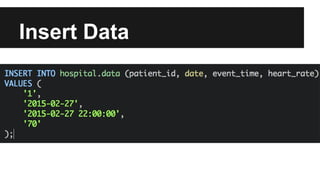
Insert Data
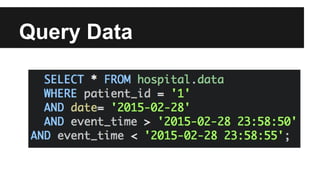
Query Data
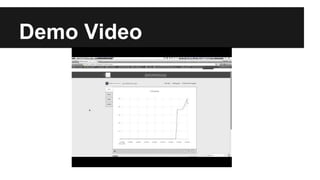
Demo Video
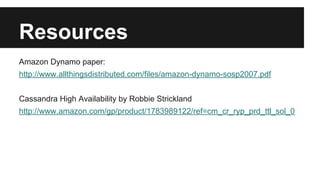
Resources
Amazon Dynamo paper:
http://www.allthingsdistributed.com/files/amazon-dynamo-sosp2007.pdf
Cassandra High Availability by Robbie Strickland
http://www.amazon.com/gp/product/1783989122/ref=cm_cr_ryp_prd_ttl_sol_0

Apache cassandra an introduction