DR. SHAKIR HUSSAIN
PG 2ND YEAR
DEFINITION
 A Handicapped child is one who has a Mental, Physical, Medical or
Social condition that prevents him or her from achieving full
potential as compared to other children of the same age including
those of a social, recreational, educational and vocational nature.
(WHO 1980).
 According to AAPD 1996 that a person should be considered
dentally handicapped if there is pain, infection or lack of functional
dentition that affects him or her as follows:
1. Restricts consumption of a diet adequate to support growth and
energy needs.
2. Delays or alters growth and development.
3. Inhibits major life activity like work, learning, communication and
recreation.
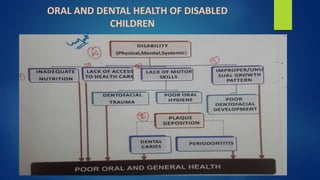
ORAL AND DENTAL HEALTH OF DISABLED
CHILDREN
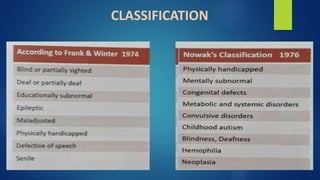
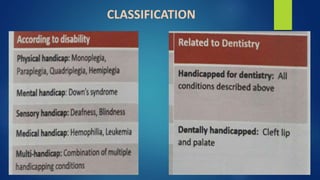
CLASSIFICATION
CLASSIFICATION
ASSESSMENT AND DIAGNOSIS
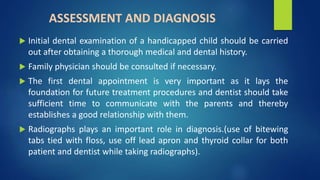
 Initial dental examination of a handicapped child should be carried
out after obtaining a thorough medical and dental history.
 Family physician should be consulted if necessary.
 The first dental appointment is very important as it lays the
foundation for future treatment procedures and dentist should take
sufficient time to communicate with the parents and thereby
establishes a good relationship with them.
 Radiographs plays an important role in diagnosis.(use of bitewing
tabs tied with floss, use off lead apron and thyroid collar for both
patient and dentist while taking radiographs).
AIMS AND OBJECTIVES OF TREATMENT
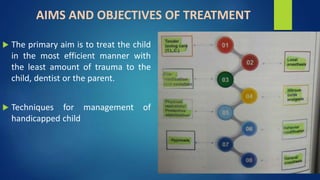
 The primary aim is to treat the child
in the most efficient manner with
the least amount of trauma to the
child, dentist or the parent.
 Techniques for management of
handicapped child
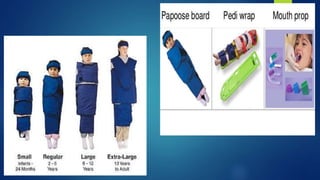
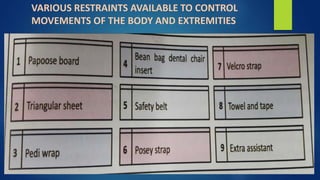
PHYSICAL RESTRAINTS
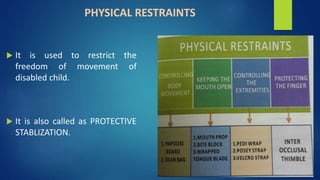
 It is used to restrict the
freedom of movement of
disabled child.
 It is also called as PROTECTIVE
STABLIZATION.
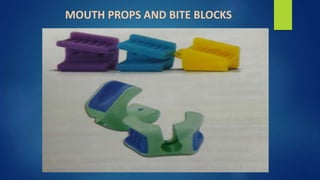
MOUTH PROPS AND BITE BLOCKS
VARIOUS RESTRAINTS AVAILABLE TO CONTROL
MOVEMENTS OF THE BODY AND EXTREMITIES
DENTAL HOME FOR CHILDREN WITH SPECIAL
HEALTH CARE NEEDS
 It includes all aspects of oral health that result from the interaction
of the child, parents and pediatric dentist.
 SHCN Patients who have dental home receives appropriate
preventive and routine care and reduces the child's risk of oral
diseases.
 In 1999 Nowak described the term in relation to the desired
recurrence of preventive oral health supervisory services as
propagated by the AAPD.
 Doykos suggests that early association with a dentist has the
benefit of reduced cost of care as compared to those who delay
the first dental visit.
 Home dental care should begin during infancy.
 The dental surgeon should advice the parents to gently
clean the incisors with a soft cloth or an infant
toothbrush.
 For older children who are unwilling or physically
unable to cooperate, the dentist should teach the
correct tooth brushing techniques to the parent or
guardian.
PLAQUE CONTROL PROGRAMME
 Plaque control programme is essential in monitoring oral hygiene
status.
 The brushing technique for disabled patients having limited ability
to brush should be effective and simple.
 Horizontal scrub method is recommended as it is easy to perform
and provides good results. The technique consists of gentle
horizontal strokes on buccal, lingual and occlusal surfaces of all
teeth.
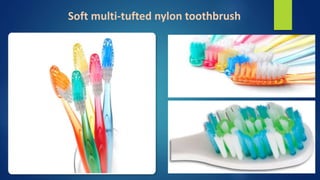
 A soft multi-tufted nylon toothbrush should be used.
Soft multi-tufted nylon toothbrush
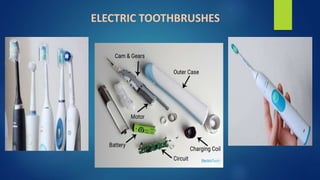
ELECTRIC TOOTHBRUSHES
FLUORIDE EXPOSURE
 Systemic fluoride supplementation in
the form of drops and tablets.
 A night time 0.4% stannous fluoride
“brush on gel” in reducing dental
caries.
PREVENTIVE RESTORATIONS
 Pit and fissure sealants to reduce
occlusal caries.
 For severe bruxism and interproximal
caries…..stainless steel crown.
REGULAR PROFESSIONAL SUPERVISION
 Recall after 6 months for professional
prophylaxis, examination and topical
fluoride application.
VARIOUS DISABLITIES AND THEIR MANAGEMENT
MENTALLY CHALLENGED OR SUBNORMAL CHILDREN:
 According to American Association of Mental Deficiency
(AAMD) it is defined as sub-average general intellectual
functioning which originates during the developmental
period and is associated with impairment in adaptive
behaviour.
 Various intelligence tests used to assess the intellectual
development of child.
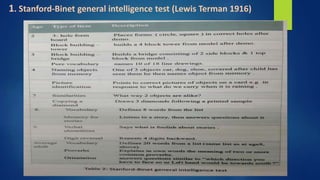
1. Stanford-Binet general intelligence test
2. Wechsler intelligence scale for children
1. Stanford-Binet general intelligence test (Lewis Terman 1916)
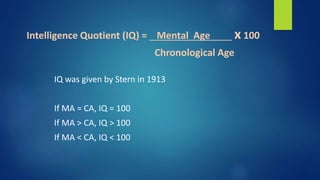
Intelligence Quotient (IQ) = Mental Age x 100
Chronological Age
IQ was given by Stern in 1913
If MA = CA, IQ = 100
If MA > CA, IQ > 100
If MA < CA, IQ < 100
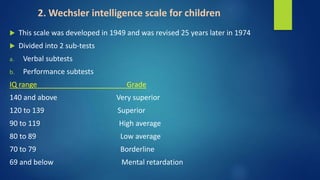
2. Wechsler intelligence scale for children
 This scale was developed in 1949 and was revised 25 years later in 1974
 Divided into 2 sub-tests
a. Verbal subtests
b. Performance subtests
IQ range Grade
140 and above Very superior
120 to 139 Superior
90 to 119 High average
80 to 89 Low average
70 to 79 Borderline
69 and below Mental retardation
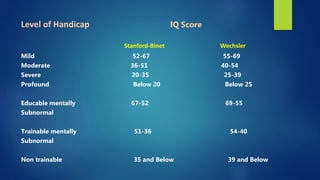
Level of Handicap IQ Score
Stanford-Binet Wechsler
Mild 52-67 55-69
Moderate 36-51 40-54
Severe 20-35 25-39
Profound Below 20 Below 25
Educable mentally 67-52 69-55
Subnormal
Trainable mentally 51-36 54-40
Subnormal
Non trainable 35 and Below 39 and Below
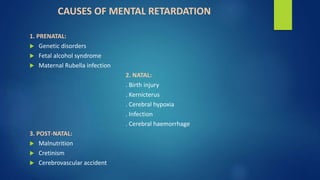
CAUSES OF MENTAL RETARDATION
1. PRENATAL:
 Genetic disorders
 Fetal alcohol syndrome
 Maternal Rubella infection
2. NATAL:
. Birth injury
. Kernicterus
. Cerebral hypoxia
. Infection
. Cerebral haemorrhage
3. POST-NATAL:
 Malnutrition
 Cretinism
 Cerebrovascular accident
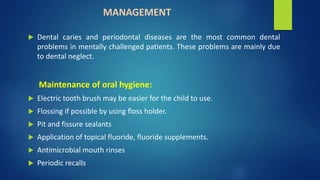
MANAGEMENT
 Dental caries and periodontal diseases are the most common dental
problems in mentally challenged patients. These problems are mainly due
to dental neglect.
Maintenance of oral hygiene:
 Electric tooth brush may be easier for the child to use.
 Flossing if possible by using floss holder.
 Pit and fissure sealants
 Application of topical fluoride, fluoride supplements.
 Antimicrobial mouth rinses
 Periodic recalls
DR SHAKIR Handicapped child

DR SHAKIR Handicapped child

  • 1.
  • 2.
    DEFINITION  A Handicappedchild is one who has a Mental, Physical, Medical or Social condition that prevents him or her from achieving full potential as compared to other children of the same age including those of a social, recreational, educational and vocational nature. (WHO 1980).  According to AAPD 1996 that a person should be considered dentally handicapped if there is pain, infection or lack of functional dentition that affects him or her as follows: 1. Restricts consumption of a diet adequate to support growth and energy needs. 2. Delays or alters growth and development. 3. Inhibits major life activity like work, learning, communication and recreation.
  • 3.
    ORAL AND DENTALHEALTH OF DISABLED CHILDREN
  • 4.
  • 5.
  • 6.
    ASSESSMENT AND DIAGNOSIS Initial dental examination of a handicapped child should be carried out after obtaining a thorough medical and dental history.  Family physician should be consulted if necessary.  The first dental appointment is very important as it lays the foundation for future treatment procedures and dentist should take sufficient time to communicate with the parents and thereby establishes a good relationship with them.  Radiographs plays an important role in diagnosis.(use of bitewing tabs tied with floss, use off lead apron and thyroid collar for both patient and dentist while taking radiographs).
  • 7.
    AIMS AND OBJECTIVESOF TREATMENT  The primary aim is to treat the child in the most efficient manner with the least amount of trauma to the child, dentist or the parent.  Techniques for management of handicapped child
  • 8.
    PHYSICAL RESTRAINTS  Itis used to restrict the freedom of movement of disabled child.  It is also called as PROTECTIVE STABLIZATION.
  • 10.
    MOUTH PROPS ANDBITE BLOCKS
  • 11.
    VARIOUS RESTRAINTS AVAILABLETO CONTROL MOVEMENTS OF THE BODY AND EXTREMITIES
  • 12.
    DENTAL HOME FORCHILDREN WITH SPECIAL HEALTH CARE NEEDS  It includes all aspects of oral health that result from the interaction of the child, parents and pediatric dentist.  SHCN Patients who have dental home receives appropriate preventive and routine care and reduces the child's risk of oral diseases.  In 1999 Nowak described the term in relation to the desired recurrence of preventive oral health supervisory services as propagated by the AAPD.  Doykos suggests that early association with a dentist has the benefit of reduced cost of care as compared to those who delay the first dental visit.
  • 13.
     Home dentalcare should begin during infancy.  The dental surgeon should advice the parents to gently clean the incisors with a soft cloth or an infant toothbrush.  For older children who are unwilling or physically unable to cooperate, the dentist should teach the correct tooth brushing techniques to the parent or guardian.
  • 14.
    PLAQUE CONTROL PROGRAMME Plaque control programme is essential in monitoring oral hygiene status.  The brushing technique for disabled patients having limited ability to brush should be effective and simple.  Horizontal scrub method is recommended as it is easy to perform and provides good results. The technique consists of gentle horizontal strokes on buccal, lingual and occlusal surfaces of all teeth.  A soft multi-tufted nylon toothbrush should be used.

  • 15.
  • 16.
  • 17.
    FLUORIDE EXPOSURE  Systemicfluoride supplementation in the form of drops and tablets.  A night time 0.4% stannous fluoride “brush on gel” in reducing dental caries.
  • 18.
    PREVENTIVE RESTORATIONS  Pitand fissure sealants to reduce occlusal caries.  For severe bruxism and interproximal caries…..stainless steel crown.
  • 19.
    REGULAR PROFESSIONAL SUPERVISION Recall after 6 months for professional prophylaxis, examination and topical fluoride application.
  • 20.
    VARIOUS DISABLITIES ANDTHEIR MANAGEMENT MENTALLY CHALLENGED OR SUBNORMAL CHILDREN:  According to American Association of Mental Deficiency (AAMD) it is defined as sub-average general intellectual functioning which originates during the developmental period and is associated with impairment in adaptive behaviour.  Various intelligence tests used to assess the intellectual development of child. 1. Stanford-Binet general intelligence test 2. Wechsler intelligence scale for children
  • 21.
    1. Stanford-Binet generalintelligence test (Lewis Terman 1916)
  • 22.
    Intelligence Quotient (IQ)= Mental Age x 100 Chronological Age IQ was given by Stern in 1913 If MA = CA, IQ = 100 If MA > CA, IQ > 100 If MA < CA, IQ < 100
  • 23.
    2. Wechsler intelligencescale for children  This scale was developed in 1949 and was revised 25 years later in 1974  Divided into 2 sub-tests a. Verbal subtests b. Performance subtests IQ range Grade 140 and above Very superior 120 to 139 Superior 90 to 119 High average 80 to 89 Low average 70 to 79 Borderline 69 and below Mental retardation
  • 24.
    Level of HandicapIQ Score Stanford-Binet Wechsler Mild 52-67 55-69 Moderate 36-51 40-54 Severe 20-35 25-39 Profound Below 20 Below 25 Educable mentally 67-52 69-55 Subnormal Trainable mentally 51-36 54-40 Subnormal Non trainable 35 and Below 39 and Below
  • 25.
    CAUSES OF MENTALRETARDATION 1. PRENATAL:  Genetic disorders  Fetal alcohol syndrome  Maternal Rubella infection 2. NATAL: . Birth injury . Kernicterus . Cerebral hypoxia . Infection . Cerebral haemorrhage 3. POST-NATAL:  Malnutrition  Cretinism  Cerebrovascular accident
  • 26.
    MANAGEMENT  Dental cariesand periodontal diseases are the most common dental problems in mentally challenged patients. These problems are mainly due to dental neglect. Maintenance of oral hygiene:  Electric tooth brush may be easier for the child to use.  Flossing if possible by using floss holder.  Pit and fissure sealants  Application of topical fluoride, fluoride supplements.  Antimicrobial mouth rinses  Periodic recalls