Formal Specification and
Documentation using Z:
  A Case Study Approach


      Jonathan Bowen


     Revised 2003
FORMAL
SPECIFICATION
AND
DOCUMENTATION
USING
Z

                                                 X
A
CASE
STUDY
APPROACH     Jonathan Bowen


                              transputer


                                           DCS


           UNIX
documentation All material that serves primarily to describe a system and make it
  more understandable, rather than to contribute in some way to the actual operation
  of the system. . . .

  formal specification 1. A specification written and approved in accordance with
  established standards.
     2. A specification written in a formal notation, such as VDM or Z.

  Z A formal notation based on set algebra and predicate calculus for the specifica-
  tion of computing systems. It was developed at the Programming Research Group,
  Oxford University. Z specifications have a modular structure. . . .

                                                     Dictionary of Computing [221]


CICS and IBM are trademarks of International Business Machines Corporation.
DEC, VAX and MicroVAX are trademarks of Digital Equipment Corporation.
Inmos and Occam are trademarks of SGS-Thomson Microelectronics.
MC68000 is a trademark of Motorola Computer Systems.
P OST S CRIPT is a trademark of Adobe, Inc.
Sun is a trademark of Sun Microsystems, Inc.
UNIX is a registered trademark in the USA and other countries licensed through
X/Open Company Ltd.
X Window System is a trademark of X Consortium, Inc.
To Jane, Alice and Emma
Contents


Foreword                                    ix

Preface                                     xi

I   Introduction                             1

1 Formal Specification using Z                3
  1.1 Introduction                           3
  1.2 Formal Specification                    4
  1.3 Case Studies                           7
  1.4 Conclusions                           10

2 Industrial Use of Formal Methods          15
  2.1 Introduction                          15
  2.2 Technology Transfer Problems          16
  2.3 Industrial-scale Usage                18
  2.4 Motivation for Use                    20
  2.5 Guidelines for Use                    22
  2.6 Future Developments                   26

3 A Brief Introduction to Z                 29
  3.1 Introduction                          29
  3.2 Predicate Logic                       29
  3.3 Sets and Relations                    31
  3.4 Functions and Toolkit Operators       41
  3.5 Numbers and Sequences                 44
  3.6 Schemas                               54
  3.7 Conclusion                            63

II Network Services                         65

4 Documentation using Z                     67
  4.1 Introduction                          67

                                        v
vi    Contents

      4.2   Motivation                                  68
      4.3   Service Specification                        69
      4.4   Service Documentation                       71
      4.5   Reservation Service – User Manual           72
      4.6   Reservation Service – Implementor Manual    79
      4.7   Experience                                  83
      4.8   Conclusions                                 87

5 A File Storage Service                                89
  5.1 Service State                                     89
  5.2 Error Reports                                     92
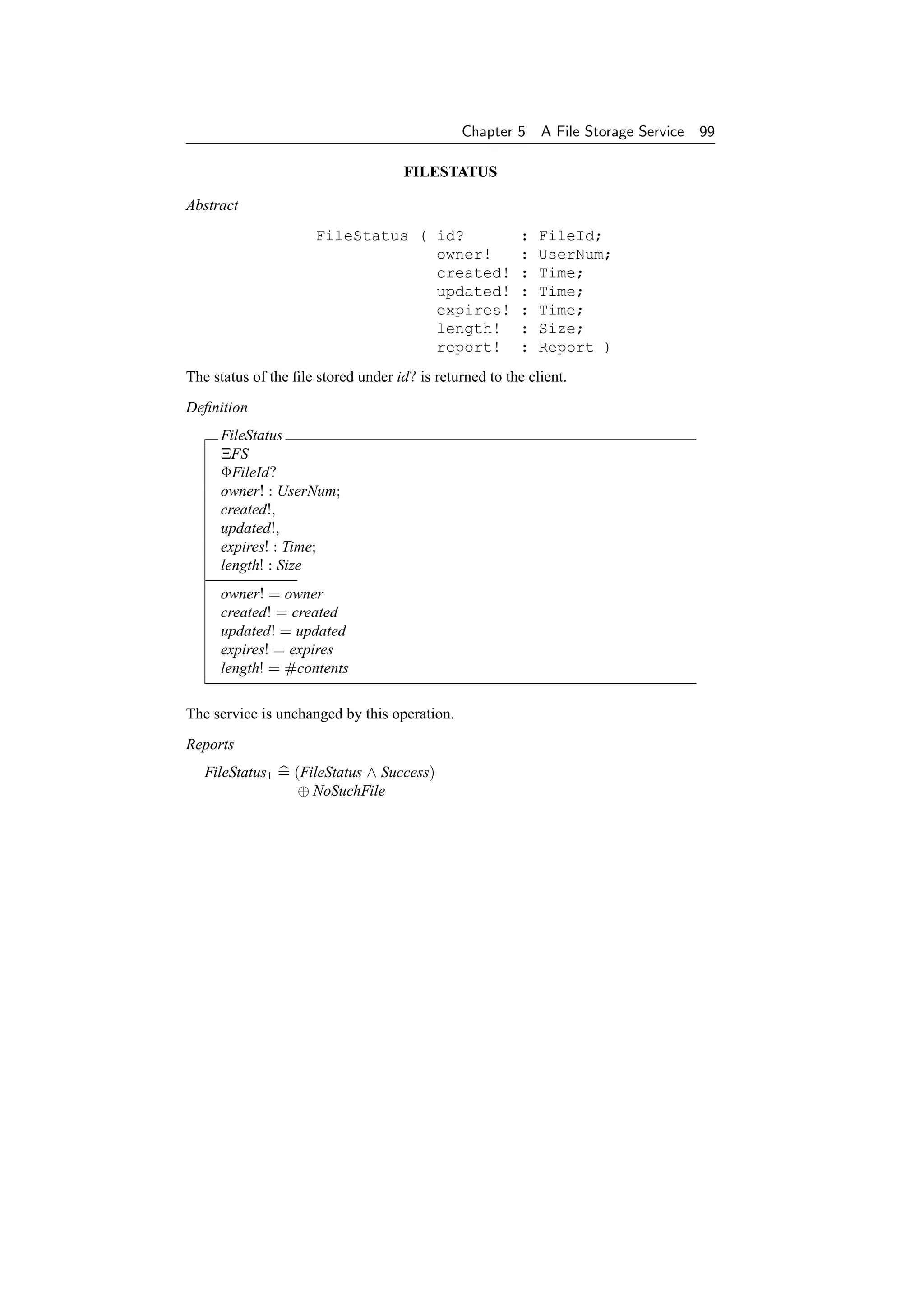
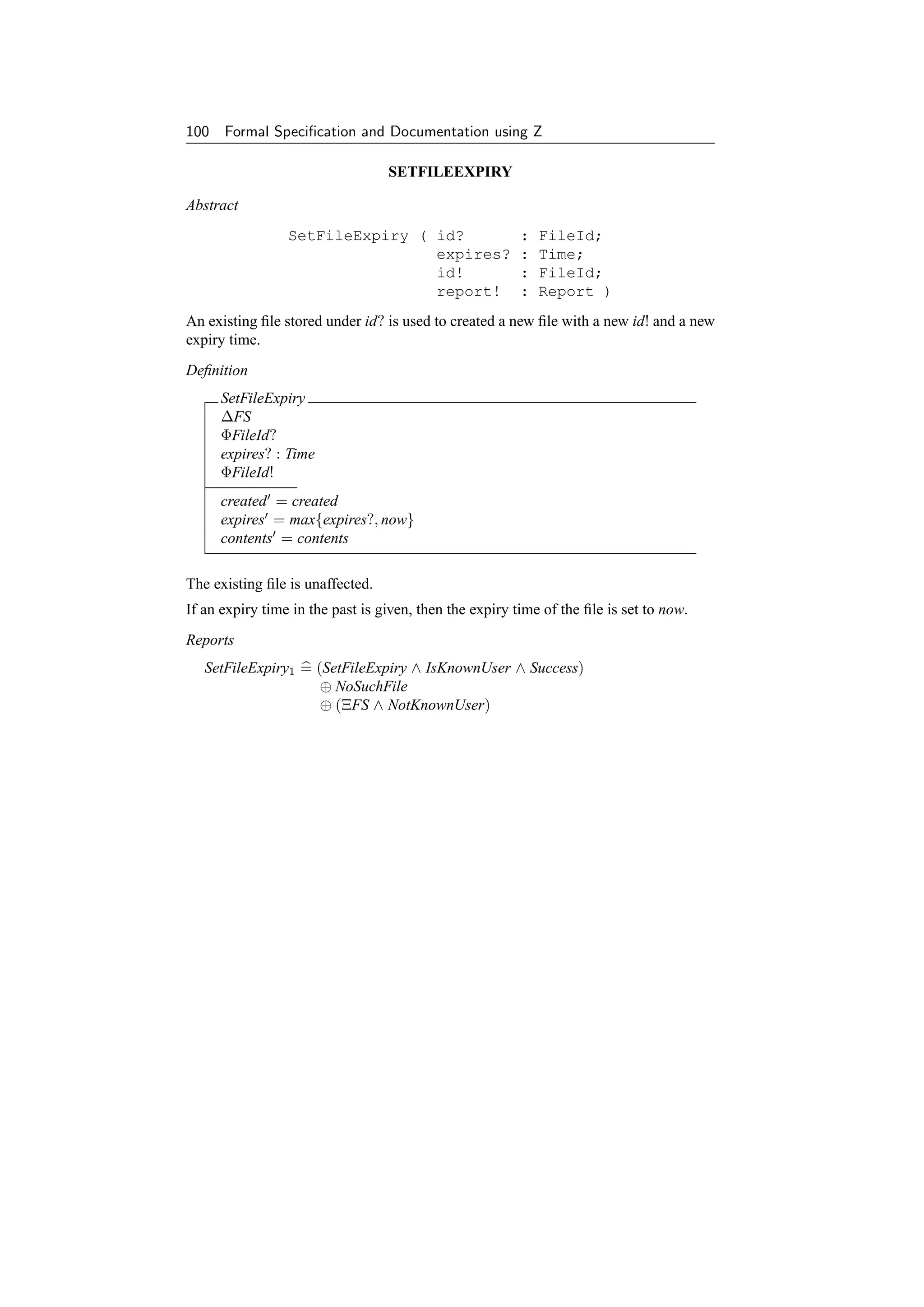
  5.3 Service Operations                                94
  5.4 Costs and Accounting                             102
  5.5 Total Operations                                 103
  5.6 Security                                         103

III   UNIX Software                                    107

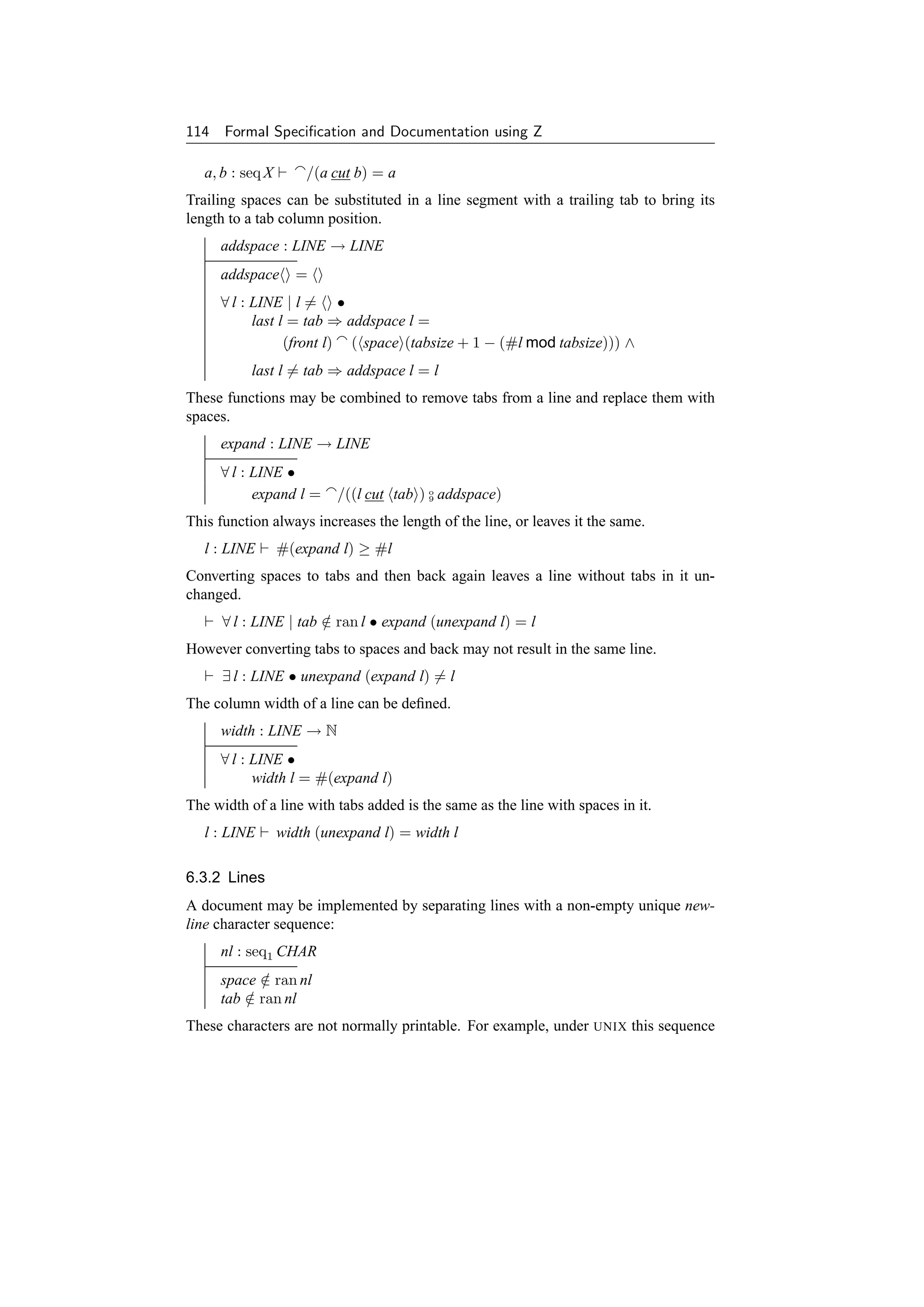
6 A Text Formatting Tool                               109
  6.1 Basic Concepts                                   109
  6.2 Processing the Input                             110
  6.3 Implementation Details                           112
  6.4 Files                                            115
  6.5 Conclusion                                       116
  6.6 UNIX Manual Page                                 117

7 An Event-based Input System                          119
  7.1 Motivation                                       119
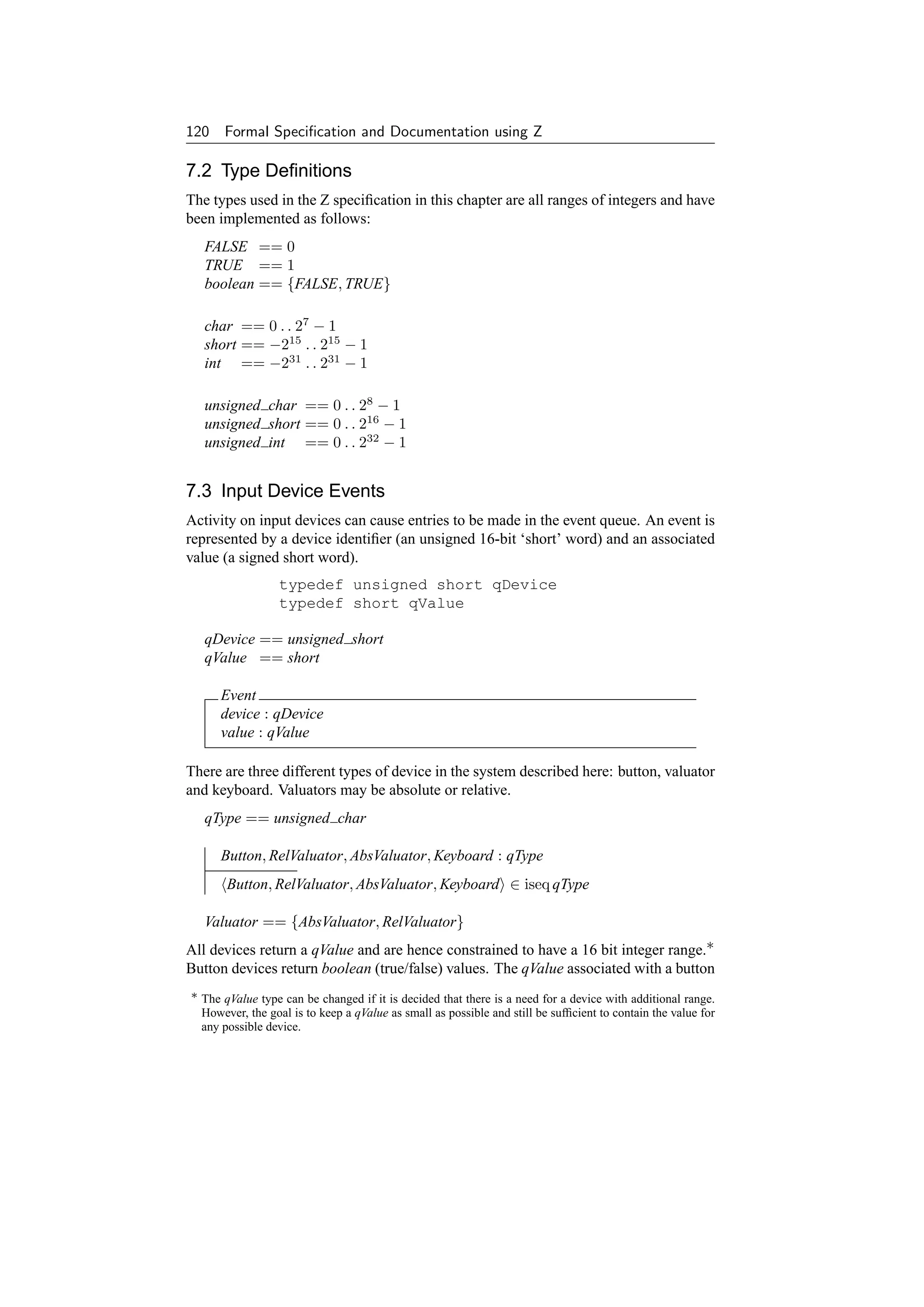
  7.2 Type Definitions                                  120
  7.3 Input Device Events                              120
  7.4 Abstract State                                   121
  7.5 Changes of State                                 122
  7.6 System Operations                                124
  7.7 Implementation Notes                             131
  7.8 Types Revisited                                  131

IV Instruction Sets                                    133

8 Machine Words                                        135
  8.1 Word Organization                                135
  8.2 Operations on Words                              137
  8.3 Hexadecimal Notation                             141

9 The Transputer Instruction Set                       143
  9.1 Instructions                                     143
  9.2 Machine State                                    144
  9.3 Instructions                                     149
Contents vii

    9.4 Power-up and Bootstrapping                          163
    9.5 Combined Operations and Instructions                164
    9.6 Conclusions                                         164

V   Graphics                                                167

10 Basic Graphical Concepts                                 169
   10.1 Background                                          169
   10.2 Pixels                                              169
   10.3 Windows                                             173

11 Raster-Op Functions                                      175
   11.1 Pixel Operations                                    175
   11.2 Display Operations                                  178
   11.3 An Example – Swapping Pixel Maps                    179
   11.4 Conclusion                                          180

VI Window Systems                                           181

12 The ITC ‘WM’ Window Manager                              183
   12.1 System State                                        183
   12.2 Window Operations                                   186
   12.3 Errors                                              189
   12.4 The ITC Network                                     190
   12.5 Simplifications and Assumptions                      192
   12.6 Comments                                            192

13 Blit Windows                                             195
   13.1 System State                                        195
   13.2 System Operations                                   198
   13.3 Errors                                              201
   13.4 Simplifications, Assumptions and Comments            202

14 The X Window System                                      203
   14.1 System State                                        203
   14.2 Window Operations                                   206
   14.3 Errors                                              212
   14.4 Simplifications and Assumptions                      213
   14.5 Comments and Inconsistencies                        214

15 Formal Specification of Existing Systems                  215
   15.1 Comparison of Window Systems                        215
   15.2 Case Study Experience                               216
   15.3 General Conclusions                                 217

Acknowledgements                                            219
viii   Contents

Appendices                                            221

A Information on Z                                    223
  A.1 Electronic Newsgroup                            223
  A.2 Electronic Mailing List                         223
  A.3 Postal Mailing List                             224
  A.4 Subscribing to the Newsgroup and Mailing List   224
  A.5 Electronic Z Archive                            224
  A.6 Z Tools                                         225
  A.7 Courses on Z                                    226
  A.8 Publications                                    227
  A.9 Object-oriented Z                               229
  A.10 Executable Z                                   229
  A.11 Meetings                                       229
  A.12 Z User Group                                   230
  A.13 Draft Z Standard                               230
  A.14 Related Organizations                          230
  A.15 Comparisons of VDM and Z                       231
  A.16 Corrections                                    231

B Z Glossary                                          233

C Literature Guide                                    239
  C.1 Introduction                                    239
  C.2 Management, Style, and Method                   239
  C.3 Application Areas                               241
  C.4 Textbooks on Z                                  244
  C.5 Language Details                                244
  C.6 Collections of papers                           248
  C.7 Tools                                           249
  C.8 Object-Oriented Approaches                      249
  C.9 On-line Information                             250

Bibliography                                          253

Index                                                 285
Foreword


The formal methods community has, in writing about the use of discrete mathematics
for system specification, committed a number of serious errors. The main one is to
concentrate on problems which are too small, for example it has elevated the stack
to a level of importance not dreamt of by its inventors. While there is a good reason
for using small examples at the beginning of a book or a tutorial, the need becomes
progressively less important as one progresses towards teaching students and industrial
staff topics such as structuring and modelling. Too many books have given up the fight
after presenting small examples and have, I believe, contributed greatly to the lack of
take-up of this technology. Staff and students who have read introductory materials on
formal methods such as Z and VDM have had their hopes raised by small examples
which have given the impression that formal specification is merely the writing down
of some simple mathematical statements which define the behaviour of a system. What
small examples do is to hide one of the most difficult tasks of specification: the process
of selecting an adequate model.
   Jonathan Bowen is a formal methods researcher who I have a great deal of respect
for. Almost all his work has concentrated on the application of this technology to
real-life problems – not just stacks and queues. His book teaches through the medium
of case studies which are realistic but not too large that they overwhelm the reader.
They range from the specification of the Transputer instruction set to that of a tool for
formatting free text. All the case studies contain excellent examples of the power of
Z: its ability to structure large specifications into chunks which can be read, validated
and developed in relative isolation.
   The formal methods community still have a long way to go in convincing many
industrialists of the power of discrete mathematics; I would regard this book as a
major contribution to doing so.

                                                                          Darrel Ince
                                                                  The Open University


                                                                                     ix
Preface


Formal methods are becoming more accepted in both academia and industry as one
possible way in which to help improve the quality of both software and hardware
systems. It should be remembered however that they are not a panacea, but rather one
more weapon in the armoury against making design mistakes. To quote from Prof.
Tony Hoare:
   Of course, there is no fool-proof methodology or magic formula that will ensure a
   good, efficient, or even feasible design. For that, the designer needs experience,
   insight, flair, judgement, invention. Formal methods can only stimulate, guide, and
   discipline our human inspiration, clarify design alternatives, assist in exploring
   their consequences, formalize and communicate design decisions, and help to en-
   sure that they are correctly carried out.
                                                                    C.A.R. Hoare, 1988
Thus we should not expect too much from formal methods, but rather use them to
advantage where appropriate.
    Even within the formal methods community, there are many camps: for example,
those that believe that a formally correct system must be proved correct mechanically,
one small step at a time, and those who use the term formal to mean mathematical, us-
ing high-level pencil-and-paper style proofs to verify a design is ‘correct’ with respect
to its specification. Sometimes the latter method is known as ‘rigorous’ to differentiate
it from the former; and of course there are positions between these two extremes.
    Even if a system is proved correct, there are still many assumptions which may be
invalid. The specification must be ‘obviously right.’ There is no way that this can be
formally verified to be what is wanted. It must be simple enough to be understandable
and should be acceptable to both the designer and the customer.
    This book presents an even more pragmatic view of the use of formal methods
than that held by some academics: that is that formal specification alone can still be
beneficial (and is much more cost effective in general) than attempting proofs in many
cases. While the cost of proving a system correct may be justified in safety-critical
systems where lives are at risk, many systems are less critical, but could still benefit
from formalization earlier on in the design process than is normally the case in much
industrial practice.
    Ultimately the computer system will be communicating with the outside world. In
a control system, we will probably be dealing with physical laws, continuous math-

                                                                                      xi
xii Formal Specification and Documentation using Z

ematics (e.g., differential equations), etc. This will have to be converted into digital
values and approximations will have to be made. In many cases, a Human-Computer
Interface will be involved. Great engineering skill will be needed to ensure that any
assumptions made are correct and will not invalidate any formally verified design. It is
very important to apportion responsibility between the engineers associated with each
design task. Mutually agreed interfaces must be drawn up. Ideally these should be
formalized to reduce the risk of ambiguity and misunderstanding on each side of the
interfaces.
   This book presents the use of one notation in the accumulation of available mathe-
matical techniques to help ensure the correctness of computer-based systems, namely
the Z notation (pronounced ‘zed’), intended for the specification of such systems. The
formal notation Z is based on set theory and predicate calculus, and has been devel-
oped at the Oxford University Computing Laboratory since the late 1970’s.
   The use of a formal notation early on in the design process helps to remove many
errors that would not otherwise be discovered until a later stage. The book includes
specification of a number of digital systems in a variety of areas to help demonstrate
the scope of the notation. Most of the specifications are of real systems that have been
built, either commercially or experimentally. It is hoped that the variety of examples
in this book will encourage more developers to attempt to specify their systems in a
more formal manner before they attempt the development or programming stage.
   In Part I, the first two chapters give an introduction to formal specification, using Z
in particular, and also to the issues concerning the practical take-up and use of formal
methods in industry. Chapter 2 gives an overview of some industrial issues, for those
contemplating the use of formal methods as part of the software development process.
Some guidelines to help with successful use are given. Finally a brief tutorial is given
in Chapter 3, which introduces Z for those who have not seen the notation before, but
who wish to tackle the rest of the book. However, it should be noted that this is not
a substitute for a fuller treatment, which if required should be sought from one of the
numerous Z textbooks now available.
   Z has been designed to be read by (suitably trained) humans, rather than by comput-
ers, and as such may be included in manuals documenting computer-based systems.
Part II gives some examples, using network services designed and built at Oxford Uni-
versity. Two types of manual have been developed, one of the user of a service, giving
an idealized external abstract view, and one for potential implementors, giving more
details of the suggested internal structure of the service.
   In Part III, Chapter 6 details the specification of a text formatting tool designed for
using under the UNIX operating system. The structure of UNIX files is discussed in
this context. A specification of a mouse-based input system for UNIX workstations is
also presented in Chapter 7.
   Although Z has mainly been applied to software systems, it is also applicable to
hardware. In Part IV, a number of aspects important in the specification of machine
instruction sets are discussed. Chapter 8 formally defines some concepts which are
useful in the specification of any microprocessor. Building of this, a part of a specific
instruction set, namely that of the Transputer, is then presented in Chapter 9.
   Part V details some graphical concepts. Chapter 10 introduces general concepts
useful for specifying pixel maps and window systems. Chapter 11 defines the raster-
op function which is fundamental to many graphics operations.
Preface   xiii

   Window systems are now one of the most popular interfaces for computers. Part VI
builds on the ideas presented in Part V and gives details of three window systems,
including the highly successful X Window System. Chapter 15 remarks on experience
gained by formally specifying the three window systems and other case studies.
   Appendix A gives some indications on how to obtain further up-to-date information
on Z. A glossary of the Z notation may be found in Appendix B. A literature guide
in Appendix C together with a substantial bibliography at the end of the book are
included to allow readers to follow up on another aspect of Z and formal methods
that are of special interest. Finally an index, particularly of names of definitions in
the specifications presented in the book, will aid the reader in navigating the text,
especially the formal parts.
   It is hoped that the specifications presented here will help students and industrial
practitioners alike to produce better specifications of their designs, be they large or
small. Even if no proofs or refinement of a system are attempted, mere formalization
early on in the design process will help to clarify a designer’s thoughts (especially
when undertaken as part of a team) and remove many errors before they become im-
plemented, and therefore much more difficult and expensive to rectify.
   For further on-line information related to this book, held as part of the distributed
World Wide Web (WWW) Virtual Library, the reader is referred to the following URL
(Uniform Resource Locator):
   http://www.afm.sbu.ac.uk/zbook/


                                                                                 J.P.B.
                                                                             June 1995
I

Introduction


In Chapter 1, the use of the Z notation for the formal specification of computer-based
systems is introduced. Chapter 2 considers industrial concerns in the application of
formal methods such as the use of Z. Finally a brief tutorial introduction to the formal
notation of Z is given in Chapter 3.
Chapter 1

Formal Specification
using Z
   This chapter provides an introduction to formal methods, in general, and formal
   specification in particular: what they are, and how and why they should be used,
   with an emphasis on the Z notation. It provides some motivation for the use of for-
   mal specification, a brief introduction to some example applications as presented
   in more detail in the rest of the book, and some conclusions on the suitability or
   otherwise for the use of Z for system specification. The chapter is informal in na-
   ture and suitable for those who may not wish to read the later more detailed case
   study chapters.


1.1 Introduction
Many design and documentation methods make use of informal techniques. For exam-
ple, natural language and diagrams are often used alone to describe computer systems
and software. A more formal approach can result in a simpler design and more thor-
ough documentation. This book presents a general specification language, Z (‘zed’),
based on set theory and developed at the Oxford University Computing Laboratory
(OUCL), as a possible solution to this problem. The notation is useful (once it has
been learned) to organize the thoughts and aid the communication of ideas within a
design team. It is also readable enough to be used as a documentation tool in a manual.
Of course, natural language should also be included to give an informal description of
the system and to relate the mathematical description to the real world.
   A major advantage of a formal notation is that it is precise and unambiguous and
thus the formal notation always provides the definitive description in the case of any
misunderstanding. A number of examples are discussed, including network services,
software for UNIX, microprocessor instruction sets, computer graphics, and window
systems. Full formal descriptions of these in Z are included in the book in later chap-
ters.
   This chapter is split into two main parts. The first half deals with the nature of for-
mal specification and why it should be used. Additionally, a brief introduction to Z and
how it is used is also presented in general terms, without covering the notation itself.
The second half of the chapter deals with the experience gained using Z for the design
and documentation of network services and during some case studies of existing sys-
tems. Finally some conclusions are drawn about the advantages and disadvantages of
using a formal approach.

                                                                                      3
4   Formal Specification and Documentation using Z

1.2 Formal Specification
A formal specification is simply a description of a system using a mathematical no-
tation. The advantage of using mathematics is that it is precise, unlike the more am-
biguous natural language and diagrams which are often used for specifications. The
disadvantage is the barrier of the notation. More people understand natural language
than mathematics. The specification language must first be learned, and then experi-
ence in its use needs to be gained before its full benefits can be attained.
   A specification language may be used as a design tool and, if the notation is read-
able enough, as a documentation tool. The actual process of designing a system may
be undertaken using a formal notation to communicate ideas between members of a
design team. Once the design has been finished, it can then form the basis for a manual
describing the system.
   Note that in the context of this book, the initial ‘design’ is considered to be the
interface specification of the system with the outside world and the ‘implementation’
is considered to be the refinement of this design into a working system.


1.2.1 The Z notation
Z has been developed at Oxford University since the late 1970’s by members of the
Programming Research Group (PRG) within the Computing Laboratory [203, 336,
376, 381]. It is a typed language based on set theory and first order predicate logic.
There is nothing very unusual about the mathematics employed, although a few oper-
ators have been added as experience has been gained in its use.
   The problem with using mathematics alone is that large specifications very quickly
become unmanageable and unreadable. Hence as well as the basic mathematical no-
tation, Z includes a schema notation to aid the structuring of specifications. This
provides the framework for a textual combination of sections of mathematics (known
as schemas) using schema operators. Many of these match equivalent operators in the
mathematical notation.
   As well as the formal text, a Z specification should contain English (or some other
natural language) to explain the mathematical description. Ideally, the informal de-
scription should remain readable even if the formal sections are removed from the
document. However, if there is a conflict between the two descriptions, the mathemat-
ics is the final arbiter since it provides a more precise specification.
   The idea of an abstract Z specification is to describe what a system does rather than
how it does it. Imperative programming languages are specifications, but these con-
centrate on how the result is to be achieved. Functional programming languages are
more like specification languages since these describe what result is required. How-
ever they are designed to be executable. Z can be used in a functional style. However
it is possible (and sometimes desirable) to write non-deterministic specifications in
Z. This means the exact execution of the specification cannot be determined. The
Z notation is designed to be expressive and understandable (by humans) rather than
executable (by computers).
   Some specification languages are designed to be executable (although very ineffi-
ciently) so that rapid prototyping of the system is possible. However in such specifi-
cations, the designers often have to think about making the specification executable in
Chapter 1    Formal Specification using Z 5

a feasible amount of time, possibly to the detriment of the design. Even though a Z
specification is not in general executable by computer, by passing it round members
of a design team it may be mentally executed and checked far more reliably than an
equivalent informal specification.
   Note that Z is a formal specification notation rather than a formal method although
the term method is sometimes used rather loosely in this context.


1.2.2 Why use formal specification?

As previously mentioned, a formal specification is precise. This means that even if
such a specification is wrong (i.e., not what the customer wanted), it is easier to tell
where it is wrong and correct it. Since an informal specification is often ambiguous, it
is more difficult to detect errors and subsequently put them right.
   Using a formal notation increases the understanding of the operation of a system,
especially early in a design. It helps to organize the thoughts of a designer, making
clearer, simpler designs possible. Additionally, it is possible to formally reason about
a system by stating and proving theorems about it. These provide a check that the
system will behave as expected by the designer.
   The use of formal methods can help to explore design choices. Such methods aid the
design team in thinking about the operation of the system before its implementation.
Missing parts of an incomplete specification become more obvious. The remaining
parts of a design can be identified and alternative possibilities considered. In particular,
error conditions can be checked by calculating the precondition of an operation, and
then dealing with the errors to ensure that the precondition of the complete operation
is true (i.e., that all possible error conditions have been covered). When using informal
methods, it is easy to gloss over such details until the implementation stage.
   The likelyhood of errors in a design is reduced. Errors may be pinpointed more eas-
ily as a result of the points above. The number of times round the design–implementation–
testing cycle should be reduced since more errors will be found and corrected at the
design stage.
   The quality of documentation of the system can be improved. By using the formal
design as a basis for the manual for a system, it is likely that less information will be
left out. The final document should include a prose description relating the formal text
to the real world.
   Finally, and most importantly in industry, the overall cost should be lowered. Errors
corrected at the design stage can be up to two orders of magnitude cheaper to correct
than if they are found later. The initial barrier to using formal methods is the notation,
which may contain unfamiliar symbols, and will require designers to attend training
courses. However, in general the notation is no worse than learning a new style of
programming language (for example, a functional language if the trainee is used to
imperative programming).


1.2.3 How is Z used?

A Z specification may be written in a variety of styles (e.g., a functional style, as
mentioned previously). However, it has been found convenient to use a state or model
6   Formal Specification and Documentation using Z

based approach in many cases. A system may be considered to be modelled as an
abstract state and a sequence of operations on this state.
   First some basic sets (e.g., file identifiers) may be introduced. At this stage, it is
not necessary to elaborate on the description. More precise details which relate to the
implementation rather than the abstract specification may be left till later. It may also
be useful to introduce some extra operators for a particular specification to make it
more readable. These may be defined as the design progresses.
   Next an abstract state is defined in terms of sets, relations, functions, sequences, etc.
This should not be influenced by implementation considerations, but rather should be
designed to make the specification as understandable as possible to the reader. This
may well be modified during the design to make the specification of operations on
the system more clear. Extra components which are redundant in that they are related
to other state components may be included if this increases the overall clarity of the
specification. The aim is not necessarily to make the formal description as short as
possible, but rather to make it as understandable as possible.
   An initial state (i.e., the state after initialization, at the start of the program, power-
up, or whatever) should be specified. This is defined in terms of the abstract state and
some extra predicates defining the initial conditions of the system.
   Operations on the system will cause a change of state. There will be a before state
and an after state. There may be invariants which relate the before and after states for
all operations on the system. These may be included as predicates in a schema defining
a general change of state of the system. Sometimes the after state will be the same as
the before state (e.g., for status operations). Also a group of operations may only
affect a particular part of the state. It is convenient to define schemas which partially
specify such cases. This information may then be included in subsequent definitions
of operations. This avoids having to cover common details more than once.
   For each operation, a number of predicates will specify exactly what it is required
to do. Inputs and outputs may also be included. Other temporary state components
can be added if this is convenient to aid the clarity of the specification. An operation
may be non-deterministic – i.e., there may be more than one possible outcome for
the operation. For example, the system could provide a file identifier from a pool of
available identifiers. The designer may not care which identifier is chosen. In such
cases, it is left to the implementor to select the most convenient choice for a particular
implementation.
   Operations are considered to be atomic (i.e., one operation cannot break in while
another is in progress). At the outermost level of the specification, the system is con-
sidered to be modelled by the initial state followed by an arbitrary sequence of legal
operations. If any of the operations include preconditions, it is up to the implemen-
tor to ensure that the operation can only be executed when these are satisfied. If the
preconditions for all the operations are true then a completely arbitrary sequence of
operations may occur.
   Once a design has been formulated, it is useful to state and prove theorems about
the system. This helps to verify the design and check for mistakes. (For example,
we could check that the creation followed by the deletion of a file leaves the state
unchanged.) This process can be tedious, particularly if done completely by hand, but
it is very worthwhile to reduce errors and gain understanding about the operation of
the system before it is implemented.
Chapter 1     Formal Specification using Z 7

   Finally it is possible to refine an abstract design towards the concrete implemen-
tation by a series of state and operation refinement steps. For example, a set in an
abstract state may not be immediately, or efficiently, implementable in a particular
programming language. It could be implemented as an array, hash table, binary tree
or other convenient data structure. Each refinement step is related to the previous
one by a mathematical relation. There are a number of rules or proof obligations
governing valid refinement steps. This refinement process will also make any non-
determinism in the abstract specification deterministic in the final implementation by
making implementation-dependent design choices.


1.3 Case Studies
Besides the work on the theoretical underpinning of Z, many case studies using the no-
tation have also been undertaken to ensure its applicability in a practical environment.
This section gives an overview of the case studies presented later in the book.


1.3.1 Network services

The Distributed Computing Software (DCS) project at the Oxford University Com-
puting Laboratory designed a number of network services using the Z language. The
results have been documented in several monographs [55, 56, 172]. The designs have
formed the basis for manuals for each of the services. Two different types of man-
ual have been produced. User Manuals have been designed to describe each service
from the point of view of a client program using the service via Remote Procedure
Calls (RPCs) over a network. In addition, Implementor Manuals have been produced
for some services. These describe how the service may be implemented internally. Z
is still used for this description, although it is assumed that an imperative sequential
programming language will be used for the final implementation. As well as the User
and Implementor Manuals, a Common Service Framework manual has been produced.
This describes common parts of services to avoid repetition in individual manuals.
Significant effort was expended in the presentation of the manuals to make them as
readable as possible while still employing a formal notation.

A User Manual

A user will normally be interested in how a service reacts with the outside world rather
than with the detailed inner workings of the service. Thus the manual can provide an
abstract view of the service. This may be based directly on the original abstract design.
Indeed, the initial design of the network services which have been produced during the
project have consisted of a skeleton version of the User Manual. This has subsequently
been tidied up and improved for the final version of the manual, thus greatly reducing
the amount of time spent producing documentation.
  Each User Manual is split into a number of sections. After a general introduction,
the abstract state of the service is presented. Next common parameters shared by
a number of service operations are covered (for example, all operations produce an
output report). A section details the result of operations when an error occurs and the
8   Formal Specification and Documentation using Z

reports which a returned. Each error condition is described as a Z schema which may
subsequently be included by individual operations as required.
   Each operation is normally allocated a page for its description, although occasion-
ally this can spill over onto a second page for more complicated operations. The de-
scription is split into three sections. An Abstract section describes how the operation
may appear as a procedure heading in some programming language. This includes
all the explicit input and output parameters of the operation. A Definition section
provides a formal description of the operation (as a Z schema) when it is performed
successfully. Finally, a Reports section formally defines the specific errors which may
occur when the operation is invoked by combining the schema in the previous section
with error schemas. These three sections are accompanied by informal description as
required.
   The problem of accounting has also been addressed. This is often of secondary
interest to a user, so it is included in a separate section. The charge for each operation
(which may vary depending on the amount of data transferred, for example) is formally
defined in a single ‘tariff’ schema. Finally all the operations and the tariff schema are
combined, together with features from the Common Service Framework (see later) as
desired to produce a complete specification of the service.

An Implementor Manual

Unlike a User Manual, an Implementor Manual does need to concentrate on the in-
ternal operation of a service. Thus a more concrete description of the service must
be presented. When an Implementor Manual is produced, a number of design deci-
sions must be taken. In the Implementor Manuals produced by the DCS project, it has
been assumed that the service will be implemented using a sequential imperative pro-
gramming language. (In fact, Modula-2 has been used for the actual implementations
which have been produced.) However the manuals have still used Z rather than some
pseudo-code to describe the operations. A small number of extra schema operators
have been defined to allow descriptions of iteration, etc.
   The outline for the Implementor Manuals is similar to that for the User Manuals.
However a concrete state and concrete operations are presented, together with sub-
operations and sub-states for subsystems as required by a particular service.
   Of course, an Implementor Manual should be proved correct with respect to the
corresponding User Manual. This has only been done for a simple service. Even
for a modestly large service, this becomes intractable relately quickly if the process
is undertaken by hand. Hopefully this may be alleviated by machine assistance in
the future. In any case, the Implementor Manuals have been designed to convey the
design to a programmer, rather than to aid a proof of correctness by defining its rela-
tionship with the User Manual (although this relationship is included formally in the
Implementor Manual).

The Common Service Framework

Some parts of a network service service will inevitably be the same or similar to parts
of all or a number of other services. In addition the general outline for the description
of an individual service tends to follow a common pattern. Hence it is convenient to
Chapter 1     Formal Specification using Z 9

group such aspects of the services in a separate document for use in the description of
each specific service.
   The Common Service Framework covers such features. First an example of a gen-
eralized service is presented, including all common features which may be used by
a particular service. Then a number of common subsystems are formally described.
These include extra operations to deal with concerns like time, accounting, statistics
and access control. Any combination of these subsystems may be included in a given
service. This will increase the number of operations which may be performed on that
service.
   Next, it is shown how all the services in the distributed system may be formally com-
bined to produce a specification of the complete system. Network attributes, including
authentication, and client attributes (e.g., identification) are also covered. Finally a
summary of the common sets and data types used by the services is given.
   Part II provides some actual examples of network service manuals. Chapter 4
presents some more detailed motivation and a very simple service by way of example.
Chapter 5 takes the form of a more substantial user manual.


1.3.2 Other case studies
As well as designing and documenting network services, a number of case studies
of existing systems in real use have been undertaken. Parts of the systems under
investigation were specified in Z to gain a greater understanding of their operation.

UNIX software
The UNIX [37] file system was used as one of the earliest examples of the specification
of a real system, demonstrating the structuring feature know as the schema calculus
that is provided as part of Z to enable large specifications to be tackled [298]. Part III
of this book provides further examples of more detailed software that has been imple-
mented under UNIX. Chapter 6 presents a text formatting tool, useful for justifying
ASCII text in a file [44]. A matching UNIX manual page is provided for comparison by
the reader. Chapter 7 gives a specification for a library of C routines that implement
an event-based input system for UNIX workstations [80].

Instruction sets
Z is not necessarily restricted to the specification of software-based systems. Any sys-
tem which may be viewed as an abstract state on which a number of operations may
be performed can be conveniently specified in Z. For example, Z has proved partic-
ularly good for specifying instruction sets. The Motorola 6800 8-bit microprocessor
instruction set has been completely specified as an exercise [39, 38]. Additionally,
large parts of the Inmos (now SGS-Thomson) Transputer [224] and Motorola 68000
16/32-bit microprocessor instruction sets have also been specified in Z [45, 149, 350].
Z scales up to these larger instruction sets with few problems, mainly because of the
schema notation.
   Part IV of the book gives an introduction to the formal specification of instruction
sets in Z. Chapter 8 presents some general concepts concerning operations on micro-
10   Formal Specification and Documentation using Z

processor words, consisting of fixed length sequences of bits. Next, Chapter 9 gives a
portion of a real microprocessor instruction set, namely that of the Transputer.

Graphics and window systems
As a case study, a number of existing window systems have been studied [43, 47].
Originally it had been intended to compare parts of a number of distributed systems
using Z. However, the authors of potential systems for investigation could only supply
academic papers (not enough information) or the source code (too much information).
What was required was some form of informal documentation for the system. Because
window systems are used directly by users, there seems to be more readable docu-
mentation for such systems. Hence it was decided to attempt to produce a high-level
specification for three window systems. The specifications could be used to contrast
the systems and test the documentation for completeness.
   The three systems chosen were X (a distributed window system from MIT, and
now widely used), WM (part of Andrew, a distributed system developed at Carnegie-
Mellon University) and the Blit, including mux (developed at Bell Laboratories, Mur-
ray Hill). In each case, omissions and ambiguities in the documentation were discov-
ered by attempting to formalize the system. Where necessary, intelligent guesses were
made about the actual operation. These were usually correct, but not always. Using
such specifications, it would be a simple matter to update existing documentation, or
even rewrite it from scratch.
   Although Z has been developed as a design tool, it is also well suited for post hoc
specifications of existing systems, and for detecting errors and anomalies in the docu-
mentation of such systems.
   Window systems make use of basic graphical concepts such as pixels (short for
‘picture elements’), and operations on these elements. Part V formalizes some of these
ideas in Z. Chapter 10 defines the basic graphical concepts and Chapter 11 uses these
to define ‘raster-op’ functions, useful for manipulating pixel maps. Part VI builds on
these to specify parts of three existing window systems mentioned above, namely WM
(Chapter 12), the Blit (Chapter 13), and X (Chapter 14).


1.4 Conclusions
Z is one of a number of specification languages which are being developed around
the world. It is a general purpose specification language. For example, Z could be
specified using itself [376, 79]. It could also be used to specify a more special pur-
pose language such as CSP [215], which is designed to handle concurrency. Z itself is
cumbersome for specifying parallel systems. Its use will produce a much longer spec-
ification than if CSP is used. Hence it is more convenient to use a language like CSP
in such cases. Work has been undertaken to attempt to combine some of the features
of CSP with Z [28, 239, 438].
   Z has direct competitors. The most mature of these is probably VDM, advocated
by Jones [233]. This is also based on set theory and predicates, and is similar to Z in
a number of respects. Its differences include explicitly stating which components are
read and written by an operation, and explicitly separating the preconditions, involv-
ing only the before state, and postconditions, also involving the after state. A more
Chapter 1     Formal Specification using Z 11

advanced toolset is available for VDM, although the situation is being rectified for
Z. The notation is arguably less readable that Z. It lacks an equivalent to the schema
notation of Z which is so useful for aiding the structuring and readability of specifi-
cations. Subsequently, a more comprehensive set of notations, with tool support, has
been produced in the form of RAISE [343].
  Another approach to formal specification is that of algebraic specification (e.g.,
Larch [183] and OBJ [176]). These uses abstract data types in which the allowed
operators on types are specified rather than the types themselves. This approach is
theoretically very attractive but problems can occur in scaling up specifications for
industrially sized examples.


1.4.1 Z – advantages

Z may be used to produce readable specifications. It has been designed to be read by
humans rather than computers. Thus it can form the basis for documentation.
   Large specifications are manageable in Z, using the schema notation for structur-
ing. It is possible to produce hierarchical specifications. A part of a system may be
specified in isolation, and then this may be put into a global context.
   Z is liked by users. Many methods are foisted on designers in industry by managers
attempting to improve efficiency. From the feedback which has been obtained, it seems
that the use of Z is one of the few specification techniques which has not been received
with reluctance by industrial users.
   The notation is gradually gaining acceptance in industry, at least in the United King-
dom and is taught in many computer science curricula [314]. A regular Z User Meet-
ing series (see page 229) has been established. Large companies (such as IBM and
British Telecom) are particularly interested in investigating the use of Z in an indus-
trial environment. The bigger the company, the more it has to gain by the use of
formal methods. The largest project (known to the author) to use Z so far is the
IBM Customer Information Control System (CICS) at Hursley Park in the UK (see
page 241). This has produced about 2000 pages of Z specifications and designs from
which around 37,000 lines of code (14%) have been developed having been fully spec-
ified and around 11,000 lines (4%) which were partially specified with an estimated
9% decrease in total development cost [247].
   Courses are available both from academia and industry. Many introductory books
have been published – see page 244 – and still more are likely to follow. An electronic
newsgroup and associated Z FORUM [449] mailing list∗ is also distributed to those
interested in Z, including open discussion and information on developments, tools,
meetings, publications in a monthly message. An electronic Z archive is also main-
tained [448]. An international ISO standard is in preparation [79], under the auspices
of ISO/IEC JTC1/SC22, which should help acceptance by industry. The ANSI X3J21
committee on Formal Description Techniques (FDTs), such as Z and VDM, is also
involved.


∗ To join the distribution list, contact zforum-request@comlab.ox.ac.uk via electronic mail or
  read the comp.specification.z newsgroup.
12   Formal Specification and Documentation using Z

1.4.2 Z – disadvantages
Z is not ideal for all problems. For example, as mentioned previously, dealing with
concurrency is clumsy. However, Z is good for systems which may be modelled as a
sequence of operations on an abstract state. This book aims to demonstrate a range of
applications where Z is useful.
   In general formal techniques require a significant amount of training effort and prac-
tical experience to be applied successfully. They require the dedication and commit-
ment of all those involved, managers and engineers alike. In the past, management
and software engineers have not received appropriate training for their use, although
the situation is changing with regard to many university computer science courses,
especially in the UK [314]. However, once trained, especially if done on the job, engi-
neers can apply for more attractive posts elsewhere, which can be a very real deterrent
for industry to train their employees.
   The toolset for Z is still not very advanced by industrial standards. Perhaps the best
type-checker available is the f UZZ system [380] which is intended for use with the
widely available LTEX document preparation system [251] and is compatible with the
                   A

main Z reference manual in current use [381]. Some theorem proving support is now
available (e.g., ProofPower [236] from ICL, based on HOL [178]) but is still not yet
widely used. In general Z is still used for specification rather than proof in industry
[22]. [326] provides some information on available tools.


1.4.3 General conclusions
Z can be used to succinctly specify real systems. The examples given in this book
and other case studies undertaken at Oxford and elsewhere lend support to this asser-
tion. The extensively reported IBM CICS work (see page 241) is probably the largest
project to have have used Z. Z has also been used successfully in initial specification
for the development of the microcode for the floating-point unit of the Inmos Trans-
puter [24, 281, 282, 367, 368]. A formal notation is useful for the design of systems,
allowing better understanding before implementation, and reducing the number of er-
rors. This design can subsequently form the basis of a manual since the notation is
readable [224].
   Z can also help in refinement towards an implementation by mathematically relating
the abstract and concrete states. Reasoning about the system is possible using mathe-
matical logic. Tools are being developed for machine assistance with the checking of
Z specifications [326]. Such tools will make the use of formal methods more feasible
in an industrial environment. Formal refinement is not normally cost effective (or even
tractable) for most software systems of an industrial scale [18, 105, 106]. However ba-
sic research in this area could help change this in the future. At some point during the
development of an implementation, a change of notation will normally be necessary
as a more imperative style is normally required [295, 299]. The related B-Method and
its associated B-Tool [3, 4, 5] has proved to be successful in the development of sys-
tems on an industrial scale [91, 182] and an experimental tool for Z support has been
developed using this [311].
   This book only provides a brief introduction to the Z notation itself in Chapter 3;
the subject is adequately covered in the references given in the bibliography for those
Chapter 1    Formal Specification using Z 13

who wish to learn more about Z (e.g., [336] is recommended). The bibliography,
together with the associated literature guide in Appendix C, provide a comprehensive
and categorized list of references on Z, including other examples of significant systems
specified in the Z notation which help to demonstrate that it can be advantageously
applied to industrially sized problems.
   Formal techniques such as Z are now sufficiently well established and supported for
the software industry to gain significant benefits from their use. In practice this has
only happened to a very limited extent so far despite a number of well publicized suc-
cessful examples. In the future, the advantages are likely to be even greater and those
that do not keep up with developments are likely to be left behind. Other more mature
engineering disciplines make use of mathematics as a matter of course to describe,
verify and test their products. It is time for all practising software engineers to learn
to do likewise if computing is to come of age.
   For further on-line information about the Z notation, held as part of the distributed
World Wide Web (WWW) Virtual Library, the reader is referred to the following URL
(Uniform Resource Locator):
   http://www.zuser.org/z/
  The next chapter addresses industrial concerns in particular when using formal
methods for development of computer-based system, with some general guidelines
on the application of formal methods in practice.
Chapter 2

Industrial Use of
Formal Methods
   Formal methods are propounded by many academics but eschewed by many indus-
   trial practitioners. Despite some successes, formal methods are still little used in
   industry at large, and are seen as esoteric by many managers. In order for the tech-
   niques to become widely used, the gap between theorists and practitioners must be
   bridged effectively. In particular, safety-critical systems, where there is a potential
   risk of injury or death if the system operates incorrectly, offer an application area
   where formal methods may be engaged usefully to the benefit of all. This chap-
   ter discusses some of the issues concerned with the general acceptance of formal
   methods and gives some guidance for their practical use. The chapter is informal
   and suitable for those without a mathematical knowledge of the formal methods
   involved.


2.1 Introduction

The software used in computers has become progressively more complex as the size of
computers has increased and their price has decreased [335]. Unfortunately software
development techniques have not kept pace with the rate of software production and
improvements in hardware. Errors in software are renowned and software manufac-
turers have in general issued their products with outrageous disclaimers that would not
be acceptable in any other more established industrial engineering sector [170].
   It has been suggested that formal methods are a possible solution to help reduce
errors in software. Sceptics claim that the methods are infeasible for any realistically
sized problem. Sensible proponents recommend that they should be applied selectively
where they can be used to advantage. More controversially, it has been claimed that
formal methods, despite their apparent added complexity in the design process, can
actually reduce the overall cost of software. The reasoning is that while the cost of
the specification and design of the software is increased, this is a small part of the
total cost, and time spent in testing and maintenance may be considerably reduced.
If formal methods are used, many more errors should be eliminated earlier in the
design process and subsequent changes should be easier because the software is better
documented and understood.

                                                                                      15
16     Formal Specification and Documentation using Z

2.2 Technology Transfer Problems
The following extract from the BBC television programme Arena broadcast in the UK
during October 1990 graphically illustrates the publicly demonstrated gap between
much of the computing and electronics industry, and the formal methods community,
in the context of safety-critical systems where human lives may be at stake; these,
arguably, have the most potential benefit to gain from the use of formal methods [26].
     Narrator: [On Formal Methods] ‘. . . this concentration on a relatively immature
     science has been criticized as impractical.’ Phil Bennett, IEE: ‘Well we do face
     the problem today that we are putting in ever increasing numbers of these systems
     which we need to assess. The engineers have to use what tools are available to
     them today and tools which they understand. Unfortunately the mathematical base
     of formal methods is such that most engineers that are in safety-critical systems do
     not have the familiarity to make full benefit of them.’
     Martyn Thomas, Chairman, Praxis plc: ‘If you can’t write down a mathematical
     description of the behaviour of the system you are designing then you don’t un-
     derstand it. If the mathematics is not advanced enough to support your ability to
     write it down, what it actually means is that there is no mechanism whereby you
     can write down precisely that behaviour. If that is the case, what are you doing
     entrusting people’s lives to that system because by definition you don’t understand
     how it’s going to behave under all circumstances? . . . The fact that we can build
     over-complex safety-critical systems is no excuse for doing so.’
This repartee is typical not only of the substantial technology transfer problems, but
also of the debate between the ‘reformist’ (pro ‘real world’) and the ‘radical’ (pro
formal methods) camps in software engineering [404].
   Formal methods have a reputation for being oversold by their proponents. To quote
Prof. C.A.R. Hoare, as reported in Computing [327]:
     Advocates of formal methods must preserve, refine and teach the valuable knowl-
     edge we have gained for assisting some key areas of software engineering. But we
     should be more modest in our aims and very much more modest in our claims than
     we have sometimes been in the past.
This book aims to impart some of that knowledge, but readers should bear the above
quotation in mind at all times, despite the sometimes enthusiastic nature of the material
in this volume. Formal methods are not a panacea, but another technique available in
the battle against the introduction of errors in computer systems.


2.2.1 Misconceptions and barriers
Unfortunately formal methods is sometimes misunderstood and relevant terms are
even misused in industry (at least, in the eyes of the formal methods community). For
example, the following two alternative definitions for formal specification are taken
from a glossary issued by the IEEE [220]:
1. A specification written and approved in accordance with established standards.
2. A specification written in a formal notation, often for use in proof of correctness.
The meaning of ‘formal notation’ is not elaborated further in the glossary, although
‘proof of correctness’ is defined in general terms.
Chapter 2    Industrial Use of Formal Methods        17

   Some confuse formal methods with ‘structured methods’. While research is under-
way to link the two and provide a formal basis to structured methods (e.g., see [241]),
the two communities have, at least until now, been sharply divided apart from a few
notable exceptions. Many so-called formal ‘methods’ have concentrated on notations
and/or tools and have not addressed how they should be slotted into existing industrial
best practice. On the other hand, structured methods provide techniques for devel-
oping software from requirements to code, normally using diagrams to document the
design. While the data structures are often well defined (and easily formalized), the
relationships between these structures are often left more hazy and are only defined
using informal text (natural language).
   Industry has been understandably reluctant to use formal methods while they have
been largely untried in practice. There are many methods being touted around the
market place and formal methods are just one form of them. When trying out any of
these new techniques for the first time, the cost of failure could be prohibitive and the
initial cost of training is likely to be very high. For formal methods in particular, few
engineers, programmers and managers currently have the skills to apply the techniques
beneficially (although many have the ability).
   Unfortunately, software adds so much complexity to a system that with today’s
formal techniques and mechanical tools, it is intractable to analyze all but the simplest
systems exhaustively. In addition, the normal concept of tolerance in engineering
cannot be applied to software. Merely changing one bit in the object code of a program
may have a catastrophic and unpredictable effect. However, software provides such
versatility that it is the only viable means of developing many products.
   Formal methods have been a topic of research for many years in the theoretical
computer science community. However they are still a relatively novel concept for
most people in the computing industry. While industrial research laboratories are in-
vestigating formal methods, there are not many examples of the use of formal methods
in real commercial projects. Even in companies where formal methods are used, it is
normally only to a limited extent and is often resisted (at least initially) by engineers,
programmers and managers. [184] is an excellent article that helps to dispel some of
the unfounded notions and beliefs about formal methods (see Section 2.5).
   Up until quite recently it has widely been considered infeasible to use formal tech-
niques to verify software in an industrial setting. Now that a number of case studies
and examples of real use are available, formal methods are becoming more acceptable
in some industrial circles [182, 212, 218]. Some of the most notable of these are men-
tioned in [73], particularly those where a quantitative indication of the benefits gained
have been published.

2.2.2 Modes of use
Formal methods may be characterized at a number of levels of usage and these pro-
vide different levels of assurance for the resulting software that is developed. This
is sometimes misunderstood by antagonists (and even enthusiasts) who assume that
using formal methods means that everything has to be proved correct. In fact much
current industrial use of formal methods involves no, or minimal, proofs [22].
   At a basic level, formal methods may simply be used for a high-level specification
of the system to be designed (e.g., using the Z notation). The next level of usage is
18   Formal Specification and Documentation using Z

to apply formal methods to the development process (e.g., VDM [233]), using a set
of rules or a design calculus that allows stepwise refinement of the operations and
data structures in the specification to an efficiently executable program. At the most
rigorous level, the whole process of proof may be mechanized. Hand proofs or design
inevitably lead to human errors occurring for all but the simplest systems.
   Mechanical theorem provers such as HOL [178] and the Boyer-Moore system have
been used to verify significant implementations, but need to be operated by people
with skills that very few engineers possess today. Such tools are difficult to use, even
for experts, and great improvements will need to be made in the usability of these tools
before they can be widely accepted in the computing industry. Tools are now becoming
commercially available (e.g., the B-Tool and Lambda) but there is still little interest
in industry at large. Eventually commercial pressures should improve these and other
similar tools which up until now have mainly been used in research environments.
In particular, the user interface and the control of proofs using strategies or ‘tactics’,
while improving, are areas that require considerable further research and development
effort.

2.2.3 Cost considerations
The prerequisite for industrial uptake of formal techniques is a formalism which can
adequately deal with the pertinent aspects of computer-based systems. However, the
existence of such a formalism is not sufficient; the relevant technology must also be
able to address the problems of the industry by integrating with currently used tech-
niques [422], and must do so in a way that is commercially advantageous.
    It should be noted that despite the mathematical basis of formal methods, errors
are still possible because of the fallibility of humans and, for mechanical verification,
computers. However formal methods have been demonstrated to reduce errors (and
even costs and time to market) if used appropriately [218, 281]. In general though,
formal development does increase costs [71, 72].
    Even if the use of formal methods incurs higher development costs, this is unlikely
to be the predominant factor. The critical considerations to a greater or lesser extent
(depending on market growth rates) are development speed and final product cost. Is
it, therefore, evident that formal methods can deliver cheaper products rapidly? Given
the current technology, the over-zealous use of formal methods can easily slow down
rather than speed up the process, although the reverse is also possible if formal meth-
ods are used selectively. It is however the case that in specialized markets such as the
high integrity sector, where the correctness of the software and overall system safety
are very important, other factors such as product quality may be the overriding con-
cern. A further consideration must be whether formal methods can enhance product
quality, and even company prestige.


2.3 Industrial-scale Usage
As has previously been mentioned, the take up of formal methods is not yet great
in industry, but their use has normally been successful when they have been applied
appropriately [403]. Some companies have managed to specialize in providing formal
methods expertise (e.g., CLInc in the US, ORA in Canada and Praxis in the UK),
Chapter 2     Industrial Use of Formal Methods        19

although such examples are exceptional. A recent international investigation of the use
of formal methods in industry [106, 105] provides a view of the current situation by
comparing some significant projects which have made serious use of such techniques.
[18] is another survey worthy of mention, which suggests that Z is one of the leading
formal method in use within industry.
   [73] provides a survey of selected projects and companies that have used formal
methods in the design of safety-critical systems and [102] gives an overall view of this
industrial sector in the UK. In critical systems, reliability and safety are paramount to
reduce the risk of loss of life or injury. Extra cost involved in the use of formal methods
is acceptable because of the potential savings later, and the use of mechanization for
formal proofs may be worthwhile for critical sections of the software. In other cases,
the total cost and time to market is of highest importance. For such projects, formal
methods should be used more selectively, perhaps only using informal proofs or just
specification alone. Formal documentation (i.e., formal specification with adequate
accompanying informal explanation) of key components may provide significant ben-
efits to the development of many industrial software-based systems without excessive
and sometimes demonstrably decreased overall cost (e.g., see [212, 218]).

2.3.1 Application areas and techniques
Formal methods are applicable in a wide variety of contexts to both software and hard-
ware [213]. They are useful at a number of levels of abstraction in the development
process from requirements capture, through to specification, design, coding, compi-
lation and the underlying digital hardware itself. Some research projects have been
investigating the formal relationships between these different levels [54, 51], which
are all important to avoid errors.
   The Cleanroom approach is a technique that could easily incorporate the use of ex-
isting formal notations to produce highly reliable software by means of non execution-
based program development [145]. This technique has been applied very successfully
using rigorous software development techniques with a proven track record of reduc-
ing errors by a significant factor, in both safety-critical and non-critical applications.
The programs are developed separately using informal (often just mental) proofs be-
fore they are certified (rather than tested). If too many errors are found, the process
rather than the program must be changed. The pragmatic view is that real programs
are too large to be formally proved correct, so they must be written correctly in the first
place! The possibility of combining Cleanroom techniques and formal methods have
been investigated [323], although with inconclusive results. Further attempts could be
worthwhile.
   There is considerable research into object-oriented extensions of existing formal
notations such as Z and VDM [387, 388] and the subject is under active discussion
in both communities. Object-oriented techniques have had considerable success in
their take-up by industry, and such research may eventually lead to a practical method
combining the two techniques. However there are currently a large number of different
dialects and some rationalization needs to occur before industry is likely to embrace
any of the notations to a large degree.
   An important but often neglected part of a designed system is its documentation,
particularly if subsequent changes are made. Formalizing the documentation leads to
20   Formal Specification and Documentation using Z

less ambiguity and thus less likelyhood of errors [41]. Formal specification alone has
proved beneficial in practice in many cases [22]. Such use allows the possibility of
formal development subsequently as experience is gained.
   The Human-Computer Interface (HCI) is an increasingly important component of
most software-based systems. Errors often occur due to misunderstandings caused by
poorly constructed interfaces [261]. Formalizing an HCI in a realistic and useful man-
ner is a difficult task, but progress is being made in categorizing features of interfaces
that may help to ensure their reliability in the future. There seems to be considerable
scope for further research in this area, which also spans many other disparate disci-
plines, particularly with application to safety-critical systems where human errors can
easily cause death and injury [192].
   Security is an area related to safety-critical systems. Security applications have
in some cases been very heavy users of formal methods. However, it is normally
extremely difficult to obtain hard information on such projects because of the nature of
the work. Thus there is comparatively little widely published literature on the practical
application and experience of formal methods in this field, with a few exceptions (e.g.,
see [35]).


2.4 Motivation for Use
2.4.1 Standards
Up until relatively recently there have been few standards concerned specifically with
formal notations and methods. Formal notations are eschewed in many software-
related standards for describing semantics, although BNF-style descriptions are uni-
versally accepted for describing syntax. The case for the use of formal notations in
standards is now mounting as formalisms become increasingly understood and ac-
cepted by the relevant readership [34]. Hopefully this will produce more precise and
less ambiguous standards in the future, although there is still considerable debate on
the subject and widely differing views across different countries [122]. Formal nota-
tions themselves have now reached the level of maturity that some of them are being
standardized (e.g., LOTOS, VDM and Z) [48].
   An important trigger for the exploitation of research into formal methods could
be the interest of regulatory bodies or standardization committees (e.g., the Interna-
tional Electrotechnical Commission). Many emerging safety-related standards are at
the discussion stage [414]. A major impetus has already been provided in the UK
by promulgation of the Ministry of Defence (MoD) Interim Defence Standard 00-55
[291], which mandates the use of formal methods and languages with sound formal
semantics.
   It is important that standards should not be prescriptive, or that parts that are should
be clearly separated and marked as such. Goals should be set and the onus should be
on the software supplier that their methods achieve the required level of confidence.
If particular methods are recommended or mandated, it is possible for the supplier
to assume that the method will produce the desired results and blame the standards
body if it does not. This reduces the responsibility and accountability of the supplier.
Some guidance is worthwhile, but is likely to date quickly. As a result, it may be
best to include it as a separate document or appendix so that it can be updated more
Chapter 2    Industrial Use of Formal Methods        21

frequently to reflect the latest available techniques and best practice. For example,
00-55 includes a separate guidance section.

2.4.2 Legislation
Governmental legislation is likely to provide increasing motivation to apply appro-
priate techniques in the development of safety-critical systems. For example, a new
piece of European Commission (EC) legislation, the Machine Safety Directive, came
into effect on 1st January 1993 [121]. This encompasses software and if there is an
error in the machine’s logic that results in injury then a claim can be made under civil
law against the supplier. If negligence can be proved during the product’s design or
manufacture then criminal proceedings may be taken against the director or manager
in charge. There is a maximum penalty of three months in jail or a large fine [306].
Suppliers have to demonstrate that they are using best working practice. This could
include, for example, the use of formal methods. However the explicit mention of
software in [121] is very scant. Subsection 1.2.8 on Software in Annex B on p. 21 is
so short that it can be quoted in full here: ‘Interactive software between the operator
and the command or control system of a machine must be user-friendly.’ Software
correctness, reliability and risk are not covered as separate issues.
   Care should be taken in not overstating the effectiveness of formal methods. In
particular, the term formal proof has been used quite loosely sometimes, and this has
even led to litigation in the law courts over the Viper microprocessor, although the
case was ended before a court ruling was pronounced [270]. If extravagant claims are
made, it is quite possible that a similar case could occur again. 00-55 differentiates be-
tween formal proof and rigorous argument (informal proof), preferring the former, but
sometimes accepting the latter with a correspondingly lower level of design assurance.
Definitions in such standards could affect court rulings in the future.

2.4.3 Education and certification
Most modern comprehensive standard textbooks on software engineering now include
a section on formal methods. Many computing science courses, especially in Europe,
are now including a significant portion of basic relevant mathematical training (e.g.,
discrete mathematics such as set theory and predicate logic). In this respect, education
in the US seems to be lagging behind, although there are some notable exceptions
(e.g., see [162]). It is particularly important that the techniques, once assimilated, are
used in practice as part of an integrated course, but this has not always been the case
in the past.
   [340] discusses the accreditation of software engineers by professional institutions.
It is suggested that training is as important as experience in that both are necessary.
In addition, software engineers should be responsible for their mistakes if they occur
through negligence rather than genuine error. Safety-critical software is identified as
an area of utmost importance where such ideas should be applied first because of the
possible gravity of errors if they do occur.
   A major barrier to the acceptance of formal methods is that many engineers and
programmers do not have the appropriate training to make use of them and many
managers do not know when and how they can be applied. This is gradually be-
22   Formal Specification and Documentation using Z

ing alleviated as the necessary mathematics is being taught increasingly in computing
science curricula. In the past it has been necessary for companies to provide their
own training or seek specialist help, although formal methods courses are now quite
widely available from both industry and academia in some countries (e.g., for the UK,
see [314]). It appears that Europe is leading the US and the rest of the world in this
particular battle, and in the use of formal methods in general, so this may be a good
sign for the long term development and reliability of software emanating from within
Europe.
   Some standards and draft standards are now recognizing the problems and rec-
ommending that appropriate personnel should be used, especially on safety-critical
projects. There are suggestions that some sort of certification of developers should be
introduced. This is still an active topic of discussion, but there are possible drawbacks
as well as benefits by introducing such a ‘closed shop’ since suitably able and qualified
engineers may be inappropriately excluded (and vice versa).

2.4.4 Bridging the gap
Technology transfer is often fraught with difficulties and is inevitably – and rightly – a
lengthy process. Problems at any stage can lead to overall failure [85]. A technology
such as formal methods should be well established before it is applied, especially in
critical applications where safety is paramount. Awareness of the benefits of formal
methods must be publicized to a wide selection of both technical and non-technical
people, especially outside the formal methods community (e.g., as in [384]), and the
possibilities and limitations of the techniques available must be well understood by
the relevant personnel to avoid costly mistakes.
   Unfortunately, the rapid advances and reduction in cost of computers in recent years
has meant that time is not on our side. However, formal techniques are now sufficiently
advanced that they should be considered for selective use in software development,
provided the problems of education can be overcome. It is likely that there will be a
skills shortage in this area for the foreseeable future and significant difficulties remain
to be overcome [93].
   Software standards, especially those concerning safety, are likely to provide a mo-
tivating force for the use of formal methods, and it is vital that sensible and realistic
approaches are suggested in emerging and future standards. 00-55 [291] seems to
provide such an example and is recommended as guidance for other forward-looking
proposed standards in this area [48, 63].


2.5 Guidelines for Use
2.5.1 Some myths
In a classic paper, Anthony Hall presented Seven Myths of Formal methods [184].
These are briefly presented here:
Myth 1: Formal Methods can guarantee that software is perfect.
  One should remember that any technique is fallible. Even if a correct mathematical
  proof is achieved, the assumption that the mathematics models reality correctly is
  still prone to error.
Chapter 2    Industrial Use of Formal Methods        23

Myth 2: They work by proving that programs are correct.
  It is not necessary to undertake proofs to gain benefit from the use of formal meth-
  ods; indeed much if not most industrial use of formal methods does not involve
  proofs [22]. Major gains can be achieved just be formally specifying the system
  being designed since this process alone can expose flaws, and in a much more cost-
  effective manner. Proofs may be worthwhile in highly critical systems where the
  extra cost can be justified.
Myth 3: Only highly critical systems benefit from their use.
  A range of formal methods have been applied to many types of system, some of
  greater, others of lesser criticality. The extent of and type of application will depend
  on the level of criticality, which is ultimately a case of engineering and financial
  judgement.
Myth 4: They involve complex mathematics.
  The mathematic required (and desired!) for formal specification is of a level that
  could be taught at school. After all, a major goal of a specification is to be easily
  understandable, so using esoteric terminology is in nobody’s interest. Unfortu-
  nately, although relatively simple, it is a fact that many software engineers have not
  received the requisite training in the past.
Myth 5: They increase the cost of development.
  Proofs do increase the cost of development in general, but formal specifications do
  not if used appropriately. This is because they allow many errors to be discovered
  earlier on in the design process when they are still relatively cheap to correct.
Myth 6: They are incomprehensible to clients.
  The mathematics may not be readable by an untrained client, but a formal specifi-
  cation helps produce a much clearer natural language description of the system as
  well. This should be presented to the client, giving a much less ambiguous descrip-
  tion of the system than is often the case.
Myth 7: Nobody uses them for real projects.
  There are now a number of examples of actual use of formal methods, with demon-
  strably beneficial results [213]. Two recommended examples which used Z, and
  both of which won UK Queen’s Awards for Technological Achievement in 1990
  and 1992, are the Inmos Transputer Floating Point Unit microcode design [281]
  and the IBM CICS Transaction Processing System [247].
Seven more myths are presented in [64, 68]. These may be summarized as follows:
Myth 8: Formal methods delay the development process.
  Some projects using formal methods have been seriously delayed in the past, but
  this has been as much to do with the problem of introducing any new technique
  into the design process as to do with formal methods per se. The over-use of
  formal methods does delay the development process. Certainly full proofs are a
  time-consuming activity which may not be (indeed, normally will not be) worth-
  while. However the use of formal specification (e.g., on the IBM CICS project)
  and even formal development with appropriate personnel and tools (e.g., for the
  Inmos Transputer Floating Point Unit microcode) – see Myth 7 – as part of the
  development process have been demonstrated to be worthwhile, giving measurable
  improvements in cost and time.
24   Formal Specification and Documentation using Z

Myth 9: They do not have tools.
  There are now some significant tools supporting formal methods, many of which
  have been put to serious industrial use. Large toolsets worthy of mention include
  the B-Tool [3], and the associated B-Toolkit from B-Core (UK) Limited, for the B-
  Method [4, 5]; the RAISE (Rigorous Approach to Industrial Software Engineering)
  development method, a more comprehensive successor to VDM, and its associated
  toolset available from CRI (Computer Resources International) in Denmark [343];
  the VDM Toolbox from IFAD, Denmark. Some theorem provers, such as EVES
  (based on ZF – Zermelo-Fraenkel – set theory) [110], HOL (based on higher order
  logic) [178], LP (the Larch Prover, for algebraic specifications [183]), Nqthm (a
  successor to the Boyer-Moore theorem prover, from CLInc in Austin, Texas), OBJ
  [176] and PVS (a more recent Prototype Verification System from SRI in Califor-
  nia, based on higher order logic), have been used for significant proofs. Some can
  provide support for Z (e.g., see [58, 352]). A number of tools for Z are listed in
  page 225, together with relevant contact information.
Myth 10: Their use means forsaking traditional engineering design methods.
  Formal methods should not be used to replace the existing development process.
  Rather they should be slotted into the process in an appropriate and thoughtful
  manner. This can be a tricky issue which needs serious consideration by the project
  manager and all concerned. Considerable goodwill is required for this to be done
  in a smooth way. Method integration is an important issue, e.g., for structured
  and formal techniques [364]. One example is the combination of SSADM and Z to
  produce SAZ [274, 332, 334]. Formal methods can also be used effectly to augment
  an existing design process by providing extra feedback to correct errors early in
  the design process [17]. Cleanroom [145] is another approach which could be
  combined with formal methods. See also further information on method integration
  on page 240.
Myth 11: They only apply to software.
  Formal methods are used for hardware development as well as software. The In-
  mos Transputer work mentioned in Myth 7 is one example [367]. Z has also been
  applied to microprocessor instruction sets (see [38, 39, 45] and Chapter 9), os-
  cilloscopes [120], etc. For further examples, see page 241. Hardware/software
  co-design is a rapidly developing area and formal methods could be useful in clar-
  ifying this difficult area [217].
Myth 12: They are not required.
  Increasingly, standards will mandate, or at least highly recommend, the use of for-
  mal methods for systems of the highest integrity, such as those that are safety-
  critical [48, 63]. See Section 2.4.1 (on page 20) for further information on stan-
  dards.
Myth 13: They are not supported.
  There are now many books on formal methods (including this one!), conferences,
  courses, etc. For pointers specifically concerned with Z, see Appendix A. A num-
  ber of companies now specialize in formal methods (e.g., B-Core (UK) Limited,
  Computational Logic Inc., CRI, DST, Formal Systems (Europe) Limited, IFAD,
  Praxis). A range of formal methods tools are commercially marketed (e.g., the
  FDR model checker from Formal Systems, the LAMBDA toolset from Abstract
Chapter 2    Industrial Use of Formal Methods        25

   Hardware Limited, ProofPower by ICL, etc.). The literature guide in Appendix C
   may also be helpful.
Myth 14: Formal methods people always use formal methods.
  While formal methods can be useful, they are not always appropriate. Even those
  well versed in the use of formal methods do not always used them. This can be
  particularly useful to communicate design ideas within a team. Thus in a design
  team of one for a small project they may not be worthwhile.


2.5.2 Some suggestions
This section provides some guidance for the use of formal methods. It summarizes an
article entitled Ten commandments of Formal Methods [68], but should not be taken
as ‘gospel’ despite the title! Rather it should be used to augment the reader’s own
experience.
1st commandment: Thou shalt choose an appropriate notation.
   Z is appropriate if you wish to undertake formal specification as part of a design
   team. Other formal notations and methods have different strengths and weaknesses
   depending on what is required of the method in the development process. For
   example, the B-Method [5] is more suitable than Z if formal development with tool
   support is to be undertaken. Many factors will affect the selection of a notation, not
   least of which is the background and expertise of the team involved. Learning a new
   notation is a time-consuming process which should be avoided if an appropriate
   (enough) notation is already know by the team.
2nd commandment: Thou shalt formalize but not over-formalize.
  This relates to Myth 14. In addition, getting the right level of abstraction is very im-
  portant in a specification. This will affect its readability, the ease with which proofs
  can be undertaken, and the number of design choices left open for the developer.
  The level of abstraction should be as high as possible, but no higher; otherwise
  important information may be omitted.
3rd commandment: Thou shalt estimate costs.
  This is perhaps one of the most difficult things to do for any software product,
  whatever the development approach. Unfortunately the estimation technique used
  in many other engineering disciplines break down for software. The complexity
  of the solution is very difficult to estimate before it has been undertaken. Long
  experience can help to give some insight, but estimates are still difficult. Formal
  methods may help to quantify the estimation, since a formal description of the
  problem is obtained early in the design process. However, the effort to produce the
  final implementation may be difficult to determine from the formal specification.
4th commandment: Thou shalt have a formal methods guru on call.
   Formal methods do require significant mathematical ability and training. These are
   not beyond the level obtainable by the average engineer, but it is still worthwhile
   having an expert with several year’s experience of formal methods available, at
   least on an easily accessible consultancy basis, especially if many of the design
   team are relatively new to formal methods. This could well avoid a great deal of
   unnecessarily wasted time and cost.
26   Formal Specification and Documentation using Z

5th commandment: Thou shalt not abandon thy traditional development methods.
   This relates to Myth 10. Formal methods should be used as an extra technique in
   the armoury available for the elimination of errors. Certainly they will not catch all
   the errors, so other techniques should also be used (e.g., see the 9th commandment
   below).
6th commandment: Thou shalt document sufficiently.
   Much of this book is dedicated to this subject, hopefully demonstrating that a for-
   mal notation like Z can be used in a beneficial way for system documentation. Even
   if the formal specification is omitted from the final documentation, its production
   is likely to make the informal documentation clearer and less ambiguous.
7th commandment: Thou shalt not compromise thy quality standards.
   Software quality standards such as ISO 9000 need to be met, whatever the develop-
   ment techniques that are used. Formal methods can help in this respect if applied
   sensibly, but the project manager should ensure that they do help rather than hinder
   in practice.
8th commandment: Thou shalt not be dogmatic.
   Absolute correctness in the real world can never be achieved. Mathematical models
   can be verified with a good level of certainty, but these models might not correspond
   with reality correctly. When applying formal methods, the level of use should al-
   ways be determined beforehand and monitored while in progress. A project man-
   ager should always be prepared to adjust the level of use if required.
9th commandment: Thou shalt test, test, and test again.
   Formal methods will never replace testing; rather they will reduce the number of
   errors found through testing. Formal development and testing tend to avoid and
   discover different types of error, so the two are complementary to some extent.
10th commandment: Thou shalt reuse.
   Formal specifications can be written in a reusable manner, with some thought. As
   an example, Z includes a ‘toolkit’ of definitions, defined in Z itself, which have
   proved to be useful for many different specifications. The core of the toolkit is
   accepted as standard by most people who use Z for specification. In this book, the
   Common Service Framework mentioned in Part II, the machine word definitions in
   Chapter 8, and the graphics definitions in Part V, could all be reused – indeed, have
   been reused – for other specifications.
The above ‘commandments’ will hopeful provide basic guidance in the use of formal
methods in practice. For further details, see [68]. For a number of examples of the
realistic application of formal methods, see [213].


2.6 Future Developments
To secure the successful future of formal methods, a number of developments are
desirable. These include:
• Taking an engineering approach to formal specification and verification. Formal
  methods must be integrated smoothly into existing best industrial practice in a man-
  ner which causes as little disruption as possible [268].
Chapter 2    Industrial Use of Formal Methods       27

• Better tools. Most formal methods tools so far have resulted from formal methods
  research projects, and associated spin-off companies, rather than mainstream tools
  developers. As a result, their usability, and sometimes robustness, can often leave a
  lot to be desired. Unfortunately the formal methods tools market is still fairly small
  and raising capital to invest in serious production quality tools may be difficult.
  Raising commercial venture capital is likely to be difficult because the banks will
  be more interested in the size of the market rather than the potential improvement
  in software quality!
• Investment in technology transfer. The transfer of technology like formal methods
  is a time consuming and costly business. The effects and benefits of formal methods
  are less palpable than some of the other more popular techniques that come and go
  with fashion. The investment in learning and using formal methods is large, but
  the returns in the long term can be commensurate with this. Most people who have
  made the investment have not regretted it afterwards, and would not go back to
  their old ways.
• Unification and harmonization of engineering practices involved in building high
  integrity systems. While the use of formal methods may seem to run perpendicular
  and even counter to some other concerns on software engineering projects, such
  friction should be minimized. It is important that all those involved, be it managers
  or engineers, and whether the personnel involved fully understand the techniques
  or not, at least understand the way the techniques slot into the overall framework.
  It can be galling to some managers that the use of formal methods considerably
  delays the start of production of code in the life-cycle. However it considerably
  speeds up and improves its production when it is generated.
• More practical experience of industrial use of the methods. A number of signifi-
  cant projects have now been undertaken using formal methods [213], but more are
  needed to gain a better insight into the general applicability of such techniques.
  Most successful formal methods project have had the help of an expert on call in
  case of difficultly. It remains to be seen if formal methods can be successfully ap-
  plied when less expert help is at hand. Fortunately computer science undergraduate
  courses (in Europe at least) do now provide some suitable grounding for many soft-
  ware engineers who are now entering the profession. However, the effects will take
  some time to filter through in practice.
• Assessment and measurement of the effectiveness of formal methods. Metrics are
  a problematic area. It would obviously be helpful and commercially advantageous
  to know the effect of the use of formal methods on the productivity, error rates,
  etc., in software (and hardware) development. However these can be hard and ex-
  pensive to obtain, and even if hard numbers are available, these may not actually
  measure the aspect that is of real interest. It is also difficult to extract such com-
  mercially sensitive into the public domain, which hampers academic study of and
  potential solutions to the problems. Metrics should be treated with caution, but
  improvements in such techniques would be worthwhile.
  The actual formal methods, etc., available at any given time, can and will of course
vary, and hopefully improve. For further up-to-date on-line information on formal
methods, notations, and tools, held as part of the distributed World Wide Web (WWW)
28    Formal Specification and Documentation using Z

Virtual Library, the reader is referred to the following URL (Uniform Resource Loca-
tor):
     http://www.afm.sbu.ac.uk/
   This chapter has considered the practical use of formal methods in general. The rest
of the book concentrates on the use of Z in particular, providing a brief introduction
in the next chapter, followed by a number of case studies, and appendices of related
information.
Chapter 3

A Brief Introduction to Z
   This chapter provides a brief guide to the main features of Z. In the space available
   here, it is only possible to present a flavour of the notation. Rather than give a
   sketchy presentation of all of Z, some parts are presented in considerably greater
   detail than others. Some lesser used features are omitted altogether. This eclectic
   description is no substitute for a full tutorial introduction to Z. There are many
   textbooks which already provide such introductions.
   Some basic knowledge of predicate logic and set theory is highly desirable before
   attempting this chapter, and most of the rest of the main part of the book. If required,
   the reader is referred to the comprehensive list of Z textbooks collected together on
   page 244 in Appendix C. Many of these include a grounding in the mathematics
   involved before tackling the specific notation of Z. One that is widely used for Z
   courses is [336]. Readers already familiar with Z may skip this chapter.


3.1 Introduction
In summary, Z [381] is a typed formal specification notation based on first order pred-
icate logic and Zermelo-Fraenkel (ZF) set theory [376]. It is a typed language which
allows a certain amount of static machine checking of specifications to avoid ‘obvious’
errors (e.g., using the f UZZ [380] or ZTC [444] type-checking tools). The notation was
originated and inspired by Jean-Raymond Abrial while visiting the Oxford University
Computing Laboratory, and was subsequently further developed by Hayes, Morgan,
Sørensen, Spivey, Sufrin and others [78]. Z is popular with governments, academics
and parts of industry [18], especially those developing critical systems where the re-
duction of errors and quality of software is extremely important [73]. It is undergo-
ing international standardization under ISO/IEC JTC1/SC22 [79]. A thriving Z User
Group organizes regular meetings (e.g., see the ZUM’95 proceedings [69]).


3.2 Predicate Logic
The formal basis for Z is first order predicate logic extended with type set theory. Here
we introduce logic only very briefly, since in practice many Z specifications actually
use very few logic symbols. These tend to be hidden away by various conventions
which mean that the reader can concentrate on the specification rather than the logic.
  There are two logical constants in predicate logic, namely true and false. In Z, un-

                                                                                       29
30   Formal Specification and Documentation using Z

like VDM [233] for example, predicates have one or other of these values. There is no
third ‘undefined’ value, which helps considerably in minimizing the complexity of the
interpretation of the language. If the result of a predicate cannot be established (for
example, because of an undefined expression within the predicate), then the predicate
may be interpreted as being either true or false, but the value is impossible to deter-
mine. This contrasts with some other logics which sometimes add a third ‘undefined’
value to handle such cases. This extra value can add considerable complexity, and the
Z approach is a compromise to try to keep things as simple as possible.

3.2.1 Propositional Logic
Propositional logic is a subset of full predicate logic. It has a number of connec-
tives which act on existing predicates. The simplest is the unary logical negation
operator ‘¬ p’ that takes a predicate value (true/false) and returns the opposite value
(false/true).
   There are a number of standard infix binary connectives:
 • Logical conjunction ‘p ∧ q’ returns true if both p and q are true, otherwise false is
   returned.
 • Logical disjunction ‘p ∨ q’ returns true if either of p or q are true, otherwise false.
 • Logical implication ‘p ⇒ q’ is defined to be the same as ‘¬ p ∨ q’. Intuitively, if p
   is true then q must also be true, otherwise q may take any value.
 • Logical equivalence ‘p ⇔ q’ is the same as p ⇒ q ∧ q ⇒ p. Intuitively, p and q
   must both have the same value for the resulting predicate to be true, otherwise false
   is returned.

3.2.2 Quantification
Full predicate logic augments propositional logic with quantification over a list of
variables X, including type information in the case of Z:
 • Universal quantification ∀ X • q is only true when the predicate q is true for all
    possible values of X.
 • Existential quantification ∃ X • q is true if there is any (at least one) set of values
    for X possible which make q true. There may be more than one value; indeed all
    possible values, as required for universal quantification, would still be valid.
 • Unique existential quantification ∃1 X • q is a special but useful case of the more
    general existential quantification which only allows X to take a single value, not an
    arbitrary (non-zero) number of values.
   X may be one or more variables, with type declarations in each of the above cases.
The scope of the variables listed in X is bounded by the clause q in the examples above.
Thus the same names may be reused outside the clause to stand for different variables
if desired.

3.2.3 Laws
There is a rich set of algebraic laws for transforming predicates when performing
proofs about specifications. A good selection of these is presented in [297]. Only a
Chapter 3   A Brief Introduction to Z 31

very cursory introduction to predicate logic has been given here. For more informa-
tion, see almost any of the Z textbooks listed on page 244.


3.3 Sets and Relations
First order predicate logic forms the logical foundations of Z. Another important as-
pect of Z is set theory. In combination these areas of discrete mathematics are helpful
in formally describing computer-based systems. This is presented in more detail here.
   Z includes the concept of types. In this section we first discuss why the use of types
is important in specifications. We then introduce the notion of sets and the operations
which may be performed on sets. Finally we consider relations between elements of
sets.

3.3.1 Types
Z is a typed language; that is to say, every variable in Z has a particular type (i.e., set
from which it is drawn) associated with it which must match appropriately when it is
combined with other variables.
   The question arises, why fuss about types? They introduce a lot of extra complex-
ity to a specification. However this proves to be well worthwhile for the following
reasons:
1. It helps to structure specifications.
   We can specify the set of possible values from which a variable can be drawn, and
   we can then further constrain the variable using a predicate if required. For example
   in the (English) statement:
      x is a path of least cost from A to B
   we could give x a type:
      x : Path
   and constrain it further with a predicate:
      least cost x

2. We wish to refine the specification into code.
   Eventually, each variable in a specification will need to be implemented using some
   data type in a programming language. It is worth thinking about this earlier than at
   the coding stage. By adding the discipline of types, more thought must be put into
   the specification. This means more errors are likely to be ironed out at this early
   stage rather than later on when mistakes are more expensive to correct.
3. It helps avoid nonsense specifications.
   The use of types means the specification can more easily be checked for consis-
   tency, either manually by human inspection, or automatically using the machine as-
   sistance of a type-checker. For example, given Z : Methods and Jonathan : People,
   it would be meaningless to say
      Z = Jonathan
32     Formal Specification and Documentation using Z

Consider the introduction of predicates in specifications (using a schema box):

       A, B : People
       x : Likes
       Predicate(x)

The first part of this is a signature (of variables including types) and the second part is
a predicate. The parts of the signature after the colons specify the types of the variables
before the colons, much like definitions in a programming language such as Pascal.
   How can we build up types and what are the variables in predicates? For this, we
need to explore the world of set theory.


3.3.2 Sets
Mathematicians early in the 20th century discovered how to construct a world of sets,
powerful enough to describe anything we meet in practice.
   A set is a collection of objects or elements of some type. Here are some examples
of the notation used in Z to describe sets:
∅        This denotes the empty set – i.e., the set with no elements in it. This can also
     be denoted as {}.
{Jane, Alice, Emma}         This is a set of people containing three elements. Note that
   the types of Jane, Alice and Emma must be compatible!
{0, 1, 2} = {0, 0, 1, 0, 2, 1} = {1, 2, 0}        All three of these represent a three ele-
   ment set of numbers. An important property of sets is that there is no inherent
   ordering in its elements (unlike in a list for example). Thus the numbers above may
   be specified in any order, and repeated elements simply map on top of one another.
{0, 1, 2, 3, . . .}    This is the set of natural numbers, or integers ranging from zero
   upwards. Note that this set contains an infinite number of elements. The ‘. . . ’ in
   this definition is informal (i.e., not part of the Z language). We cannot write out all
   the elements of this set using this notation. Later we shall introduce a method for
   overcoming this. Since the set of natural numbers is a very important set in many
   Z specifications, it is normally denoted N for brevity.
{∅} = ∅      It is important to understand that the set containing the empty set is
  not the same as the empty set itself. It is a set containing one element (namely,
  the empty set). Thus it is possible to have sets containing other sets (which may
  themselves contain sets), and so on. We will look at this again later.
Note that every set must be drawn from some basic type (or given set) in Z. This even
applies to the empty set, ∅. I.e., there is a different empty set for each type. When
the empty set is used in Z, its type should be obvious from the context. If not, there
is probably something wrong with the specification. To avoid confusion, the notation
∅[T] may be used to indicate the empty set drawn from type T.
   It is often important to be able to say that an element belongs to (‘is a member of ’)
a particular set. In set theory, we write ‘x is an element of S’ as:
     x∈S
Chapter 3   A Brief Introduction to Z 33

This is a predicate (extra constraint) on x and S. Note that x and S must be type-
compatible for this to be meaningful. Here are some examples of this notation:

0 ∈ {0, 1, 2}       This is patently true since 0 is one of the elements in the set con-
   taining 0, 1 and 2.
∅ ∈ {∅}       The empty set (of a particular type) is a member of the set containing
   just the empty set of that type. In fact it is the only member.
0∈∅
 /          This is another way of writing ‘¬ (0 ∈ ∅)’ – i.e., 0 is not a member of the
  empty set (of numbers). This is true because no element can be a member of the
  empty set; there are no elements in it by definition. In fact, for any x, we can say
  x ∈ ∅. A special notation is used for ‘is not a member of ’ since this occurs quite
    /
  often in specifications.
William ∈ {Jonathan, Jane, Alice, Emma}
        /
   The set being checked by ∈ need not be empty for a predicate using it to be true.
                              /
   For example, the set of people given here does not include William, so the predicate
   is true.

Question: Is {0} ∈ {{0, 1, 2}} true?

Operations on sets
So far, we have discovered how to denote (finite) sets as a number of elements and
how to specify membership and non-membership of sets. However, to manipulate sets
usefully, we need a richer collection of operators on sets. We shall now look at a
number of such operators.
The following operators two sets and return a new one:

P∪Q          ‘P union Q’         – union.
   This returns a set containing all elements which are either a member of P or a
   member of Q (or both). Pictorially, we may view this as a Venn diagram:
                             ' '               $ $


                             P              P    ∪    Q          Q


                                 & &% %

   Note that the notation {a, b, c, . . .} is effectively shorthand for
      {a} ∪ {b} ∪ {c} ∪ . . .

P∩Q          ‘P intersect Q’       – intersection.
   This gives a set containing elements which are both a member of P and a member
   of Q.
34    Formal Specification and Documentation using Z
                                ' '$ $

                                             P
                            P                ∩                Q
                                             Q
                                & &% %
PQ        ‘P minus Q’       – difference.
  This gives the set with elements which are contained in P, but are not members of
  Q.
                             ' '              $ $


                            P    PQ                QP       Q


                                & &% %
 The following are predicates on sets (or expressions representing sets):
P=Q        ‘P equals Q’     – identity of sets.
 The sets P and Q each contain exactly the same elements. As we have seen before,
               {Alice} = {Alice, Alice, Alice}
       {Alice, Emma} = {Emma, Alice}
     You can see from the previous three Venn diagrams that
       (P  Q) ∪ (P ∩ Q) ∪ (Q  P) = P ∪ Q
 Often we wish the say the negation of P = Q – i.e., P and Q do not contain the same
 elements. This may be written as ‘P = Q’ (which is equivalent to ‘¬ (P = Q)’).
P⊆Q         ‘P contained in Q’       – subset.
 All the elements of P are in Q. Note that it may be the case that P = Q. To specify a
 strict subset, we use the notation ‘P ⊂ Q’. This is shorthand for ‘P ⊆ Q ∧ P = Q’.
                                   '                  $
                                         #

                                             P          Q
                                         "!
                                    &                  %
  The following operator takes a set and returns another set:
 −
P        ‘complement P’         – complementation.
  Set theory includes the idea of the complement of a set – i.e., all the elements not
  in the set. Because Z is typed, this means all the elements of the same type not in
  the set. This is not a part of Spivey’s ‘toolkit’ of operators [381], but can easily be
  defined in terms of the ‘’ operator. For a type T where P ⊆ T,
       P− = T  P
Chapter 3   A Brief Introduction to Z 35
                                      '                 $
                                            #

                                      P−       P        T
                                            "!
                                      &                 %
                 −                −
   Note that T       = ∅[T] and ∅[T] = T.
For completeness, we include our concept of set membership here:
x∈P        ‘x belongs to P’      – membership.
  x is one of the elements in P; and conversely, ‘x ∈ P’ means x is not one of the
                                                    /
  elements in P (i.e., ‘¬ (x ∈ P)’).
Question: Simplify:
1. (P  Q)  P
2. (P  Q) ∪ (P ∩ Q)

Generalized set operations
Set union and intersectiongeneralized intersection my be generalized to act on a set of
sets rather than just a pair of sets. Informally:
     {A, B, C, . . .} = A ∪ B ∪ C ∪ . . .
     {A, B, C, . . .} = A ∩ B ∩ C ∩ . . .

Set comprehension
So far we have defined sets in terms of individual members of that set. This is a rather
restrictive (although often useful) method of defining sets. For any set containing more
than a few elements, it is going to be a very cumbersome way of specifying sets. For
infinite sets, it fails completely since we would require an infinitely long document to
describe such sets.
   What we need is a more general way of specifying sets. For this, we use a construc-
tion known as set comprehension. This ‘comprehensive form’ of set definition takes
the following form:
   {x : Type | Predicate(x)}
or more generally {Signature | Predicate}, where the signature may include may than
one variable.
   Here are some examples of the use of set comprehension:
{x : N | x is prime}        (= {2, 3, 5, 7, 11, 13, . . .}).
   This defines the set of all prime numbers (provided is prime is defined appropri-
   ately). This is, of course, an infinite set.
{x : Path | least cost(x)}
   This is the set of paths between A and B such that the cost is minimized. There
   could be more than one such path if two or more paths have equally low cost; or
   the set could be empty if there are no paths between A and B.
36     Formal Specification and Documentation using Z

{x : Methods | Jonathan uses x}
   This will define the set of all methods which Jonathan uses. This could be the
   empty set, or it could be one or more methods depending on ‘uses’ and Jonathan.
   (It is unlikely to be an infinite set, but may be large if, for instance, the number of
   formal methods continues to proliferate!) Note that underlining is sometimes used
   in Z to clarify infix operators like uses here.
Question: How could we write a definition for ∅ using set comprehension?

Subsets
We have introduced the idea of a subset – i.e., a set contained within another set. Let
us look at a few examples of this in use:
A⊆B           Each element of A is also an element of B.
∅⊆A           This is always true. Every set contains at least the empty set (of compati-
   ble type).
A⊆A           Every set ‘contains’ itself.
{0, 1} ⊆ N
   The numbers 0 and 1 make up a subset of the natural numbers.
{x : N | x is prime ∧ x = 2} ⊆ {x : N | x is odd}
   The set of prime numbers (not including the number 2) is a subset of the odd num-
   bers.

Sets and predicates
Sets and predicates are similar in some respects. Each set operator has a corresponding
logical connective which may be associated with it. For example, set intersection (∩)
and logical conjunction (∧) are connected as follows, where p and q are predicates,
typically involving x:
     {x : T | p} ∩ {x : T | q} = {x : T | p ∧ q}
A similar equivalence holds for union (∪) and disjunction (∨):
     {x : T | p} ∪ {x : T | q} = {x : T | p ∨ q}
Complementing a set is like negating a predicate:
     {x : T | p}− = {x : T | ¬ p}
Note that in the above case, it is important that T is a basic type.
  The notion of a subset (⊆) matches that of implication (⇒):
     {x : T | p} ⊆ {x : T | q} iff p ⇒ q
Set equality (=) matches logical equivalence (⇔):
     {x : T | p} = {x : T | q} iff p ⇔ q
The empty set (of a particular type T) is equivalent to the false predicate:
     ∅[T] = {x : T | false}
Chapter 3    A Brief Introduction to Z 37

The entire set of a given type is equivalent to the true predicate:
   T = {x : T | true}

Set operations
Consider the subset operator ⊆. This has a number of mathematical properties. For
sets P, Q and R, drawn from the type T (i.e., P ⊆ T, Q ⊆ T and R ⊆ T):
 ⊆ is reflexive:                P⊆P
 ⊆ is transitive:              (P ⊆ Q ∧ Q ⊆ R) ⇒ P ⊆ R
 ⊆ is antisymmetric:           (P ⊆ Q ∧ Q ⊆ P) ⇒ P = Q
 ∅[T] is the minimum of T:     ∅[T] ⊆ P
Similarly, set intersection (∩) also has a number of properties:
• ∩ is the greatest lower bound of ⊆:
      R ⊆ P ∧ R ⊆ Q ⇔ R ⊆ (P ∩ Q)
   P ∩ Q is the largest subset of both P and Q.
• ∩ is idempotent       P∩P=P
       symmetric        P∩Q=Q∩P
       associative      (P ∩ Q) ∩ R = P ∩ (Q ∩ R)
       monotonic        P ⊆ Q ⇒ (R ∩ P) ⊆ (R ∩ Q)
We can write P− for the complement of P (with respect to its type!). Complementing
a set is involutive:
   (P− )− = P
Compare the following with contrapositive in predicate logic:
   P ⊆ Q ⇔ Q− ⊆ P−
(¬ ). Note that
   P ⊆ Q ⇔ P ∩ Q− = ∅
We normally write P ∪ Q for (P− ∩ Q− )− (one of De Morgan’s laws). We could list
further properties of ∪, etc. See [381] for a more comprehensive collection of laws.

Cartesian product
Sometimes it is useful to associate two or more sets together in order to build up more
complex types. If T and U are types then the Cartesian product
   T ×U
denotes the type of ordered pairs
   (t, u)
with t : T and u : U. If P and Q are subsets of types T and U respectively then
   P × Q = {p : T; q : U | p ∈ P ∧ q ∈ Q}
38     Formal Specification and Documentation using Z

The notation may be generalized to an ordered n-tuple and any valid expression may
be used for the types:
     E1 × E2 × . . . × En
Here are some examples of the notation of tuples (. . .) and Cartesian products in use:
(Z, Jonathan) ∈ Methods × People
     A method has been associated with a person as an ordered pair or 2-tuple, perhaps
     because they approve of it.
(Oxford, Cambridge) ∈ Places × Places
     Two places are associated with each other (in some sense!). Here the types are the
     same. This could be useful when specifying some relationship between places, for
     example.
(Jonathan, Oxford, 1956) ∈ People × Places × N
     This could be specifying the place and year of birth, as a 3-tuple.
 Sometimes it is useful to extract the first or second element from an ordered pair.
We use the following notation for this:
        first(t, u) = t

     second(t, u) = u
For an ordered pair t, the following law applies:
     (first t, second t) = t
Question: Is X × Y × Z equivalent to (X × Y) × Z or X × (Y × Z) ?

Set comprehension revisited
Recall that set comprehension takes the form:
     { Signature | Predicate }
For example:
     {x : Methods; y : People | Jonathan uses x ∧ x approved by y}
The signature forms an ordered tuple of type Methods × People. Note that the order
of the signature is important. I.e., here:
     x : Methods; y : People           is not the same as           y : People; x : Methods
The latter would give a tuple in the opposite order from the first.
   Sometimes it is desirable to extract only parts of the signature to define a set using
set comprehension. More generally:
     {x1 : T1 ; . . . ; xn : Tn | Predicate}
is the same as
     {x1 : T1 ; . . . ; xn : Tn | Predicate • (x1 , . . . , xn )}
Chapter 3     A Brief Introduction to Z 39

This notation permits us to write other, more complex, sets. For example, the set of
squares of primes may be defined as:
   {x : N | x is prime • x ∗ x}
Here the expression x ∗ x acts as the defining term for the set.
  In general the last term after the ‘•’ may be any valid expression:
   { Signature | Predicate • Expression }
The signature declares any variables required for the set comprehension definition, the
predicate constrains them as required, and the expression returns the elements in the
desired set. We may omit this last expression when it is simply a tuple formed from
the components of the signature. We can omit the predicate if it is simply true.

Power set
When defining a variable which is itself a set, its type will be a set of sets. Since many
variables in Z specifications are sets, we use a special notation for this. If S is a set,
P S denotes the set of all subsets of S, or the power set of S. Note that
   X ∈ PS ⇔ X ⊆ S
Also ∅ ∈ P S, so P S = ∅. Here are some examples of power sets:
P∅        This set just contains the empty set of a given type (i.e., P ∅ = {∅}).
P{a} = {∅, {a}}
   The power set of a singleton set is a set consisting of the empty set and the singleton
   set.
PN        This is the set of all possible sets of natural numbers. This is infinite of
  course.
P Path       Set of all sets of paths from A to B.
P(N × N)        Sets of pairs of numbers. The Cartesian product may be used as
  required in the definition of power sets.
S == P((Places × Places) × Path)
   This is an abbreviation definition. X == Y means ‘replace X by Y’ where X is used
   subsequently.
   Here brackets have been used to group and nest Cartesian products. This can be
   done to an arbitrary depth, but it is best to limit such usage to aid readability.

   Given the definition above, we can say           - ∈ S. The under scores are place-

   holders for parameters; i.e., - is an infix operator here of type (Places×Places)
   to the left and Path to the right.
   A power set can include infinite subsets. For example, N ∈ P N. If we are specifi-
cally interested in finite subsets, then Z has a special notation for this. If S is a set, F S
denotes the set of all finite subsets of S. We will explore exactly what ‘finite’ means
later.
40     Formal Specification and Documentation using Z

  Sometimes we are interested in non-empty subsets. For these, we use the notation
P1 (non-empty power set) or F1 (non-empty set of finite subsets):
     P1 S     == P S  {∅}
     F1 S     == F S  {∅}


3.3.3 Relations
Sometimes individual elements in one set are related to particular elements in another
set. For example,
R1 :        Places ‘A’ and ‘B’ are adjacent.
R2 :        Path x costs y to traverse.

R3 :        (A, B)   -P            (P is a path from A to B of least cost.)
These are all examples of relationships (two-place predicates). A relation R between
sets P and Q is a subset of P × Q:
     R⊆P×Q
Taking the three examples above, we can be slightly more formal:
            (A, B) ∈ R1      iff    A,B adjacent.
            (x, y) ∈ R2      iff    path x costs y.
     ((A, B), P) ∈ R3        iff    P of least cost A to B.
If R is a relation from P to Q, we often write
     pRq         instead of        (p, q) ∈ R

(For example, ‘s          - t’.) We can write R for relation R to indicate that it is an infix

relation (as in        - ). We can also use the maplet notation

     p→q
instead of (p, q) as a more graphical indication that p is related to q (although the
mathematical meaning is identical). Here are some examples of relations:


       ≤       = {x, y : N | (∃ z : N • x + z = y)}
       uses = {Jonathan → Z, Peter → VDM, Peter → RAISE}
If T, U are types,
     T ↔ U == P(T × U)
denotes the set of all relations from T to U.
       ≤       ∈ N↔N
       uses ∈ {Jonathan, Mike, Peter} ↔ Methods
Chapter 3    A Brief Introduction to Z 41

Every relation has a domain and range. The domain of a relation R : T ↔ U is the set
of all elements in T which are related to at least one element in U by R. The range is
all elements in U related to at least one in T. Formally:
    dom R = {x : T | (∃ y : U • (x, y) ∈ R)}
     ran R = {y : U | (∃ x : T • (x, y) ∈ R)}
Every relation also has an inverse. The inverse of a relation is another relation with all
its tuples (x, y) reversed (i.e., (y, x)). Again, formally we have:
    R∼ = {x : T; y : U | (x, y) ∈ R • (y, x)}
          = {x : T; y : U | (x, y) ∈ R • y → x}
          = {y : U; x : T | (x, y) ∈ R}
If R is of type T ↔ U, then its inverse R∼ is of type U ↔ T. Note that R∼ may also
be written as R−1 .
   As an example, for the ‘uses’ relation we have:
    dom uses = {Jonathan, Peter}
     ran uses = {Z, VDM, RAISE}
       uses∼ = {Z → Jonathan, VDM → Peter, RAISE → Peter}
Pictorially, we may view the ‘uses’ relation as follows:

                                   uses -
                       ' People  $ Methods
                                        '                         $
                       Jonathan        - Z
          dom uses
                          Peter XX
                                X X
                                yX      - VDM                         ran uses
                                     XXX
                                     XX z RAISE
                          Alice
                          Emma                       B-Method
                              ...                    ...
                                     %                      %
Here is another example:
   ran ≤       = dom ≤
               = N
            ∼
    ( ≤ )      =     ≥
The following laws concerning dom, ran and ∼ are relevant when reasoning about
relations:
     ran(R∼ ) = dom R
   dom(R∼ ) = ran R
       (R∼ )∼ = R
Otherwise, reasoning about relations is as for sets.


3.4 Functions and Toolkit Operators
We have explored the world of sets and relations, particularly with respect to the Z no-
tation. Next we consider an important class of relations known as functions, and some
operators which are useful for manipulating both relations in general, and functions in
particular.
42    Formal Specification and Documentation using Z

3.4.1 Functions
In Z, functions are a special case of relations in which each element in the domain has
at most one value associated with it. For example, a partial function ‘→’ is defined
using set comprehension in terms of a more general relation ‘↔’ as follows, using an
‘abbreviation definition’:
     X → Y ==
        { f : X ↔ Y | (∀ x : X; y1 , y2 : Y •
                             (x → y1 ) ∈ f ∧ (x → y2 ) ∈ f ⇒ y1 = y2 ) }
I.e., any element x in the domain can only map to a single value in the range of the
function, not to two (or more) different ones. X and Y are identifiers which repre-
sent arbitrary formal generic parameters. These are local to the right hand side of
the definition. → is an infix symbol, and here ‘X → Y’ is actually a short form for
‘( → )[X, Y]’ where the underlines indicate positions of the parameters. The generic
parameters may be explicitly given in square brackets when → and other similar con-
structs are used, but they are normally omitted since in most cases they can be inferred
from the context and clutter the specification unnecessarily.
   There are a number of special types of function in Z, each given there own unique
type of arrow. For example, total functions, as indicated by ‘→’ have a domain con-
sisting of all the possible allowed values.
   Here is a list of the other standard types of function available in Z:
• X     Y – Partial injections, in which there is a one-to-one mapping between ele-
  ments in the domain and the range. Different values in the domain map to different
  values in the range. Thus the inverse is also a function.
• X     Y – Total injections, where the function is a partial injective in which the
  domain completely populates the set X. I.e., if a function is defined as f : X   Y,
  then dom f = X.
• X → Y – Partial surjections, where the range completely populates the set Y. I.e.,
      →
  if a function is defined as f : X → Y, then ran f = Y.
                                   →
• X → Y – Total surjections, where both the domain and the range completely pop-
     →
  ulate X and Y respectively. Here, if a function is defined as f : X → Y, then
                                                                     →
  dom f = X and ran f = Y.
• X → Y – Bijections, one-to-one total injective and surjective functions. Again,
  with a function defined as f : X → Y, dom f = X and ran f = Y, but in addition,
                                      →
  the inverse is also a total function (i.e., f ∼ ∈ Y → X).
• X → Y – Finite partial functions, where the domain of the function (and hence the
  also range which can never be larger than the domain for a function) must be finite.
  This is a subset of all partial functions on X and Y, and also of F(X × Y).
• X     Y – Finite partial injections, which as well as being finite are also one-to-one.
  This is the same as the intersection of finite functions and partial injections on X
  and Y.
All these different types of function are formally defined on pages 105 and 112 of
[381].
Chapter 3     A Brief Introduction to Z 43

   Function application is written in the standard mathematical manner in Z; for exam-
ple, f (x) applies the element x to the function f . It is permissible to omit the brackets
if desired; e.g., ‘f x’ is the same as f (x). Brackets should be used in Z when they help
with clarity, and are often omited in practice when they are not necessary.


3.4.2 Toolkit operators
There are many operators on relations and functions which help make up a mathemat-
ical ‘toolkit’ of Z. A widely accepted set of such definitions are presented in full in
[381], together with many relevant laws. These are also summarized as part of the Z
Glossary in Appendix B; in particular, see page 234. However, note that the proposed
Z standard [79] may affect which operators are considered ‘standard’ in future. Some
of the generally accepted main operators are briefly presented informally here:
• id A – Identity relation, in which each element in the domain is mapped onto itself
  (and only itself) in the range, and vice versa.
• Q o R – Forward relational composition, where elements that match in the range of
    9

  the first relation and the domain of the second relation are joined together to form a
  new binary relation. In the resulting relation, the domain is a subset of the domain
  of the first original relation and the range is a subset of the range of the second
  original relation. In Z, this is often just known as ‘relational composition’.
• Q ◦ R – Backward relational composition. This is the same as forward relational
  composition with the parameters reversed: R o Q. Forward relational composition is
                                              9

  more widely used in Z than backward relational composition for stylistic reasons.
• A R – Domain restriction. The set on the left hand side is used to restrict the re-
  sulting relation to be just the mappings in the original relation which have a member
  of that set as the first element in each tuple.
• A − R – Domain anti-restriction. Here the complement of the set is used to restrict
  the relation.
• R A – Range restriction. This is similar to domain restriction, but the range of the
  relation is restricted by the set instead.
• R − A – Range anti-restriction. Hopefully you can work out what this does from
  the three previous operators!
• R(| A |) – Relational image. Here the relation R is restricted in a similar manner to
  domain restriction
• iter n R – Relational iteration. The relation R is composed n times with itself. This
  is often written as Rn in Z for brevity. The relation must have a type-compatible
  domain and range (say A). Then iter 0 R (R0 ) is the same as id A, iter 1 R is the
  same as R, iter 2 R is the same as R o R, iter 3 R is the same as R o R o R, and so on.
                                       9                              9   9

• R∼ – Inverse of relation. All tuples in the relation are reversed. Thus the domain
  becomes the range and vice versa. In the case where the domain and range have
  the same type (i.e., the relation is homogeneous), this is the same as R−1 , defined
  using relational iteration as presented above. More precisely, ∼ may be applied to
  any relation R : X ↔ Y, but R−1 may only be used if the relation R has a type of
  the form X ↔ X.
44     Formal Specification and Documentation using Z

• R∗ – Reflexive-transitive closure consists of the union of all possible non-negative
  iterations of R – i.e., R0 ∪ R1 ∪ R2 ∪ . . . In Z, this is often just known as ‘transitive
  closure’.

• R+ – Irreflexive-transitive closure. This is similar to reflexive-transitive closure,
  but for strictly positive iterations only. I.e., it does not include the identity relation
  R0 . Thus R+ = R∗  R0 .

• Q ⊕ R – Overriding. For each tuple in the right hand relation R, any tuples with
  a matching first element in the left hand relation Q are omitted and the tuple is
  included in the resulting relation. If no such tuple exists for a given tuple in Q,
  then it is included in the resulting relation. More formally, Q ⊕ R is the same as
  (dom R − Q) ∪ R. Note that ⊕ is often applied to functions where part of the left
  hand function needs to be modified by the right hand function (often typically a
  single tuple), but in the general case in may be applied to a pair of relations.


3.5 Numbers and Sequences
Two important concepts in many specifications are numbers and sequences, and we
will give more details of these here. Z provides integers and natural numbers (inte-
gers from zero up) as sets in its standard toolkit, together with many of the standard
operators on these. Numbers are also useful for defining sequences.
   Sets provide a method of describing a collection of unindexed objects. However,
sometimes we do wish to index the objects in some way. Since this is often important
in specifications, and particularly as a first step in data refinement (e.g. implementing a
set as an array), Z provides the notion of a sequence, in which the objects are ‘labelled’
with a natural number. A number of operators and functions for the manipulation of
sequences are also included in the standard Z toolkit. These, and other operators are
covered in this section.


3.5.1 Numbers

Let us consider sets of numbers which could be useful in defining sequences. The set
of integers

     Z = {. . . , −2, −1, 0, 1, 2, . . .}

and particularly the set of natural numbers

     N = {n : Z | n ≥ 0} = {0, 1, 2, . . .}

are often used in Z specifications.

Arithmetic

The following operators on integers are assumed and may be used in expressions as
required:
Chapter 3   A Brief Introduction to Z 45

   addition                 +           2+2=4
   subtraction              −           4−2=2
   multiplication           ∗            2∗2=4
   division                div         5 div 2 = 2
   modulo arithmetic       mod       5 mod 2 = 1
   negation                 −         −(−2) = 2
Brackets may be used for grouping (as they may in any Z expression). For example,
2 ∗ (4 + 5) = 18. The standard comparison relations are available:
   less than                        2  3, ¬ 3  2
   less than or equal        ≤                2≤2
   greater than                     ab⇔ba
   greater than or equal     ≥       a≥b⇔b≤a

The maximum and minimum values of a (non-empty) set of numbers can be deter-
mined.
   maximum of a set max{1, 2, 3} = 3
   minimum of a set min{1, 2, 3} = 1

Care should be taken to ensure that the set supplied to max or min is non-empty.
Otherwise the result will be undefined.
   Extra operators may easily be added if required. For example, the function which
returns the absolute value of an integer may be defined using an axiomatic description:

      abs : Z → Z
      ∀n : Z •
           n ≤ 0 ⇒ abs n = −n ∧
           n ≥ 0 ⇒ abs n = n
Note that ran abs = N.
Question: Can you suggest an alternative definition for abs?
  An axiomatic description is available for use globally in the rest of a specification.
Such a description may be a loose specification in that there may be more than one
possible model for the specification. E.g., for the description
      n:N
      n ≤ 10
any integer value of n from 0 to 10 is allowable.
Sometimes strictly positive (non-zero) natural numbers are of interest. The notation
   N1 = N  {0} = {1, 2, 3, . . .}
is used for this.
Exercise: Write definitions for:
1. the square of an integer,
2. the factorial of a natural number.
46     Formal Specification and Documentation using Z

The successor function succ returns the next number when applied to a natural number:


     succ = {0 → 1, 1 → 2, 2 → 3, . . .}
Thus ran succ = N1 . The successor function is often useful in specifications. Some-
times the inverse predecessor function is also useful. If this is so, we could define


     pred == succ∼
The following laws apply:
            succ = N ( + 1)
                 = ( + 1) N1

            pred    = N1 ( − 1)
                    = ( − 1) N

     succ o succ = N ( + 2)
          9

                 = ( + 2) (N1  {1})

     succ o pred
          9         = id N

     pred o succ = id N1
          9


Iteration
Sometimes we wish to compose a relation R : X ↔ X (i.e., one in which the types of
the domain and range match) a certain number of times, n. As previously mentioned,
we normally write this as Rn . Informally we have
     Rn = R o R o . . . o R
            9   9       9      k times
Using succ : N → N as a specific example, we can consider the following cases:
succ0 = id N           Composing a relation zero times simply gives the identity relation.
   It is as if the relation is not there, so elements are just mapped onto themselves
succ1 = succ            Composing a relation once is the same as the relation itself.
      2
succ = succ o succ
            9                 This is the same as composing the relation with itself.
succn = N ( + n) = ( + n) {i : N | i ≥ n}
   For any n : N, the above law applies.
succ−1 = succ∼        The inverse of a relation is a special case of iteration. As pre-
   viously mentioned, the notations R∼ and R−1 may be used interchangeably if the
   domain and range have the same type.
Exercise: Provide another way of writing:
1. Rm o Rn
      9


2. (Rm )n
Chapter 3   A Brief Introduction to Z 47

Number range
A number range (a set of numbers) between two integers a, b : Z is denoted as
   a . . b = {a, a + 1, a + 2, . . . , b − 2, b − 1, b}
or more formally
   a . . b = {n : Z | a ≤ n ≤ b}
If a  b then a . . b = ∅. Also a . . a = {a}.

Cardinality
The cardinality of a (finite) set is the number of elements in that set, or the size of the
set. The cardinality of a set s ∈ F T (the set of all finite subsets of T – see page 39) is
denoted:
   #s
Thus #∅ = 0, #{a} = 1, #{a, b} = 2 (if a = b) and so on. For a number range
a . . b,
   #a . . b = 1 + b − a         if a ≤ b
            = 0                 if a  b
            = max{0, 1 + b − a}
   For a set to be ‘finite’, it must be possible to map from a natural number in the range
1 . . n uniquely onto each element in that set. n is then the cardinality or size of the
set. This mapping can be done with a suitable finite partial injective function. For
example, the set a . . b (where a ≤ b) may be mapped using the function f : N              Z
such that f = succa−1 a . . b. The range (ran f ) is a . . b, and the domain (dom f ) is
a − (a − 1) . . b − (a − 1) or 1 . . 1 + b − a. Thus the cardinality is 1 + b − a, as stated
above.
   Pictorially we have:
    1       2     3   ··· b − a 1 + b − a
    –       –     –   ···   –       –
    ↓       ↓     ↓         ↓       ↓
    a     a + 1 a + 2 ··· b − 1     b

3.5.2 Types revisited
In Z, integers (Z) are normally supplied as a basic type (although see below) together
with standard arithmetic operators. The natural numbers N (0, 1, 2 . . .) are defined as a
subset of the integers. Thus it is not a true type; rather the type of n : N is Z and n has
the extra constraint that it must be greater than or equal to zero. For more information
on determining types, see the beginning of Chapter 2 in [381].
   By convention, R is sometimes used to denote real numbers if these are needed
[411], although these are not defined in Spivey’s Z toolkit [381]. They may be defined
in the proposed Z standard [79]. However many applications for which Z is used do
not involve real numbers. As well as numbers, we can also define our own types.
   Sometimes we are not particularly interested in the exact values of a set, just the
48     Formal Specification and Documentation using Z

fact that it exists. We introduce such sets as a basic type (or given set):
     [ Places ]
or for several sets,
     [ A, B, C ]
If one particular place is of interest, we could define
       London : Places
or for more than one place (for example):
       Oxford, Cambridge : Places
       Oxford = Cambridge
It is important to specify that Oxford = Cambridge here if we want to ensure that the
two are distinct. Otherwise they could be the same place with different names (heaven
forbid!).
   If we wish to be more precise we can use a data type definition. For example,
Methods could be defined as
     Methods ::= Z | VDM | RAISE | B-Method
Here, the type Methods may take one of four unique values. More complicated data
types are possible. For example, we could define
     N ::= zero | succ N
This is equivalent to defining
     [N]


       zero : N
       succ : N    N
       {zero} ∩ ran succ = ∅
       {zero} ∪ ran succ = N
   Functions such as succ here are known as constructors. Such complications are
often not needed for many specifications. You are referred to Section 3.10 starting on
page 82 of [381] for more information on such free type definitions.
Question: What is the type of {i, j : N | i  j} ?

3.5.3 Sequences
Lists, arrays, files, sequences, trace histories are all different names for a single im-
portant data type. The important characterization is that the elements are indexed and
normally contiguously numbered.
  Consider how we might store, for any pair (A, B) ∈ Places × Places, the least cost
paths from A to B, (i.e., the relation (A, B)    - path). A common way to do this is
Chapter 3   A Brief Introduction to Z 49

to store it as a sequence, say under key (A, B), ordered lexically to aid in fast access.
This is an example of data refinement. A sequence has a 1st element, a 2nd element,
3rd element, etc. . . Sequence elements are numbered from 1 rather than 0 in Z since
this is usually more natural. If T is a set, we define the set of (finite) sequences with
elements of type T as follows:
     seq T == {s : N → T | dom s = 1 . . #s}
This denotes the set of (partial) functions from N to T whose domain is a finite segment
1 . . k of N. ‘. .’ denotes a number range as defined previously:
     a . . b = {n : N | a ≤ n ≤ b}
We call such sequences T-valued sequences, or T sequences. Note that sequences
must have a finite (although arbitrary) length. If s ∈ seq T, the length of s is simply
the cardinality, #s, of s considered as a function. The empty sequence, s = ∅ has
#s = 0 and is normally written as
              – the empty sequence
Like the empty set ∅, the empty sequence is typed.
 If non-empty sequences are required, we use the notation
     seq1 T == seq T  { }
If injective sequences (i.e., sequences which contain no repetitions of elements in their
range) are needed, we use
     iseq T == seq T ∩ (N          T)
     The sequence containing just one element, s = {1 → x}, has #s = 1 and is written
as
      x         – a singleton sequence
In general the sequence {1 → x1 , 2 → x2 , . . . , n → xn } is written in a shorthand form
as
      x1 , x2 , . . . , xn   – a multi-element sequence
Here are some examples of sequences using this notation:
 11, 29, 3, 7 ∈ seq primes
     Some of the prime numbers, in no particular order. Perhaps they are ready to be
     sorted into numerical order.
 J, O, N, A, T, H, A, N ∈ seq CHAR
     A string of characters. Note that unlike for sets enumerated using the (similar)
     {a, b, c, . . .} notation, the two occurrences of ‘N’ are each distinct. The two ‘N’
     elements of the set are in fact the maplets 3 → N and 8 → N which form dif-
     ferent elements in the set representing the sequence. The same applies to the two
     occurrences of ‘A’.
         - -
       6 ,
       ,            ∈ seq Path
     A list of possible paths between A and B.
50       Formal Specification and Documentation using Z

The length (and thus cardinality) of the three sequences above is 4, 7 and 3 respec-
tively.
   Note that unlike sets, sequences can have several repeated elements. E.g.:
     Emma = Emma, Emma, Emma
Also, the order is significant:
     Alice, Emma = Emma, Alice

Concatenation
We concatenate sequences s, t ∈ seq T (or append t to the end of s) by
     s    t    – the function 1 . . (#s + #t) → T with elements
                             s(j)        if 1 ≤ j ≤ #s
                     j→
                             t(j − #s) if #s  j ≤ (#s + #t)
More formally, we could define concatenation as
     s    t = s ∪ ( − #s) o t
                          9


For another equivalent definition, see page 116 of [381].
  Consider the concatenation of two sequences of length 5 and 3:
                                       s   t

     Diagrammatically:
                                    s             t
                                  #s = 5       #t = 3

Note that #(s      t) = #s + #t = 5 + 3 = 8. Here is an examples of concatenation of
sequences:
     A        L, I, C, E = A, L      I, C, E = A, L, I, C, E

  So a, b, c, . . . is effectively shorthand for a      b    c    ...

Laws

        s = s    = s
     r (s t) = (r s) t
     (r s = r t) ⇒ s = t

Prefix
Note that for s, t ∈ seq T, s ⊆ t is equivalent to ∃ r : seq T • s r = t. Thus ⊆ applied
to a pair of sequences effectively checks that the left hand sequence is a prefix of the
right hand sequence. For example:
      M, A ⊆ M, A, N        (Freud’s theorem!)
       ⊆s                     is always a prefix of any sequence.
     s⊆s                    A sequence is always a prefix of itself.
Chapter 3     A Brief Introduction to Z 51

Laws

If one sequence is the prefix of another and vice versa, the two sequences are identical:

   (s ⊆ t ∧ t ⊆ s) ⇒ s = t

If a sequence is the prefix of a sequence which is the prefix of yet another sequence,
then the first sequence is also a prefix of this other sequence:

   (r ⊆ s ∧ s ⊆ t) ⇒ r ⊆ t

If two sequences are a prefix of another sequence, then one of the two sequences must
be a prefix of the other. Note that these laws also apply to sets:

   (r ⊆ t ∧ s ⊆ t) ⇒ (r ⊆ s ∨ s ⊆ r)

  In Z, the relation s prefix t, defined in the Z toolkit (page 119 of [381]) can also be
used to check for a sequence prefix.

Other sequence operations

It is often useful to be able to extract the first or last element from a sequence in
specifications. The rest of the sequence may also be of interest. Four functions are
available for these operations. If s ∈ seq T and s = (i.e., s ∈ seq1 T):
   head s    = s(1)                •◦◦◦◦◦     first element of sequence
   last s    = s(#s)               ◦◦◦◦◦•     last element of sequence
   tail s    = succ o ({1} − s)
                    9              ◦•••••     sequence without first element
   front s   = {#s} − s            •••••◦     sequence without last element
It is best to avoid applying these functions to an empty sequence; for example, head
is undefined.
    As an example, if the sequence s is C, O, D, E (which is {1 → C, 2 → O, 3 →
D, 4 → E} then
   head s = C

   last s = E

   tail s = {0 → 1, 1 → 2, 2 → 3, 3 → 4, . . .} o {2 → O, 3 → D, 4 → E}
                                                9

          = {1 → O, 2 → D, 3 → E}
          = O, D, E

   front s = {4} − {1 → C, 2 → O, 3 → D, 4 → E}
           = {1 → C, 2 → O, 3 → D}
           = C, O, D
Exercise: State some laws concerning these operations. Try not to refer to [381]!
  We could construct more general versions of front and tail if required for a particular
application, allowing the length of sequence required to be specified, using generic
construction:
52     Formal Specification and Documentation using Z

       [T]
         for ,
         after : (seq T) × N → (seq T)
       ∀ s : seq T; n : N •
             s for n = (1 . . n) s ∧
             s after n = ({0} − succn ) o s
                                        9


For example, these could be useful in extracting portions of files considered as a se-
quence of bytes. Note that for s ∈ seq1 T,
  front s = s for (#s − 1)
    tail s = s after 1
Here are some laws:

           s for 0 =
      s for #s = s
      s after 0 = s
     s after #s =

Reversal
If s ∈ seq T, the reverse of s is given by rev s. For example, the sequence, D, O, G is
converted to G, O, D using the rev function!

Laws

          rev   =
        rev x = x
     rev(rev s) = s
     rev(s       t) = (rev t)       (rev s)


For example

     rev( a, b       c, d ) = d, c         b, a

Distributed operations
Sometimes the concatenation of a sequence of sequences is useful:

       /     =
       / a, b, . . . , n = a    b    ...      n

More formally,         / : seq(seq T) → seq T satisfies

       /( a       s) = a       ( / s)
Chapter 3    A Brief Introduction to Z 53

and also

       /(s    a ) = ( / s)         a

For the actual formal definition of          /, see page 121 of [381].
Question: What is rev( / N, A, H , T, A , N, O , J )?
Other distributed operators can also be defined for sequences if required for a particu-
lar specification. For example, a session of updating a database results in a sequence
of partial functions. We could define a distributed overriding operator in terms of the
standard dyadic overriding operator to generalize the overriding of a relation. See for
example, a definition on page 172. Informally:
   ⊕/ a, b, . . . , n = a ⊕ b ⊕ . . . ⊕ n
Exercise: The composition operator ‘o’ may also be generalized to a distributed com-
                                       9

position operator ‘o/’. Again, informally:
                   9


   o
   9/ a, b, . . . , n = a o b o . . . o n
                          9   9       9


Write a formal definition for this. Can you think of an application for this operator in
a specification?

Disjointness and partitioning
A sequence of sets is considered ‘disjoint’ if none of the sets in its range intersect.
Formally:
   ∀ S : seq P T •
         disjoint S ⇔ (∀ i, j : dom S | i = j • (S i) ∩ (S j) = ∅)
 The empty and singleton sequences of sets are always disjoint since there are no two
distinct elements to consider. I.e., disjoint and disjoint x are always true.
   For a two-element sequence, disjoint S is equivalent to:
   S(1) ∩ S(2) = ∅
For a three-element sequence, disjoint S is
   S(1) ∩ S(2) = ∅ ∧ S(2) ∩ S(3) = ∅ ∧ S(3) ∩ S(1) = ∅
and so on.
   We can extend this idea to consider the generalized union of all the sets in the range
of the sequence. If it is equal to a particular set, the sequence is said to ‘partition’ that
set. Formally:
   ∀ S : seq P T; P : P T •
         S partition P ⇔ ( disjoint S ∧ P =          {i : dom S • S i} )


Disjointness and partitioning may be generalized from sequences to any indexed set
(i.e., S : I → P T instead of S : seq P T).
54    Formal Specification and Documentation using Z

3.5.4 Orders
The Z toolkit can be extended as required for a particular application. For example, a
partial order, which is reflexive, antisymmetric, and transitive, may be a useful concept
in some specifications:
     partial order[X] ==
          { R : X ↔ X | ( ∀ x, y, z : X •
               xRx∧
               (x R y ∧ y R x) ⇒ x = y ∧
               (x R y ∧ y R z) ⇒ x R z ) }
This can be extended to define a total order, in which all elements are related:
     total order[X] ==
          { R : partial order[X] | ( ∀ x, y : X •
               x R y ∨ y R x)}
For example, it may be useful to model time as a total order in a particular specifica-
tion.


3.5.5 Summary
We have briefly covered numbers and then used these to define the notion of se-
quences, an important data structure in many specifications and data refinement. We
have also looked at ways in which Z lets us manipulate sequences.
   This concludes the introduction to the mathematical notation of Z. Some lesser used
parts of Z (such as bags) have not been covered here, but are included from page 124
onwards in [381]. As you gain confidence in writing Z specifications, you should
investigate these other features of Z.
   Using mathematics for specification is all very well for small examples, but for
more realistically sized problems, things start to get out of hand. To deal with this,
Z includes the schema notation to aid the structuring and modularization of specifica-
tions. We have seen an example of a schema box in passing. In the next section we
shall see how to combine such schemas to produce larger specifications.


3.6 Schemas
A boxed notation called ‘schemas’ is used for structuring Z specifications. This has
been found to be necessary to handle the information in a specification of any size.
We saw a brief example on page 32. Here is another example of a schema:
       Book
       author : People
       title : seq CHAR
       readership : P People
       rating : People → 0 . . 10
       readership = dom rating
Chapter 3       A Brief Introduction to Z 55

This defines a single author, a book title, and a number of people who make up the
readership of a book (a set of people, as indicated by the ‘power set’ operator P in the
type declaration), together with their rating of the book (out of 10). The bottom half
of a schema optionally introduces extra constraints between the variables in the form
of predicates. Here, the readership is the same as the domain of the rating function.
   The top half of the Book schema box defines a number of named variables with
associated constraints from which the type information can be mechanically derived.
Here seq CHAR is a subset of N → CHAR (see the definition of seq on page 115 of
[381]), which itself is a subset of Z ↔ CHAR. This is the same as P(Z × CHAR) (see
page 95 of [381]). The expression 0 . . 10 implies a type of integer Z with the extra
constraint that the rating must take a value between 0 and 10. In fact this schema may
be ‘normalized’ into the following form:
      Book
      author : People
      title : P(Z × CHAR)
      readership : P People
      rating : P(People × Z)
      title ∈ seq CHAR
      rating ∈ People → 0 . . 10
      readership = dom rating

Note that the predicates on separate lines in the second half of the schema above
are conjoined together by default. Here, the declarations use the most general types
possible for the components. These are the actual types for these components, which
could be used for type-checking purposes if required. Mentally calculating such types
can be a useful aid in understanding a specification.
   Schemas are primarily used to specify state spaces and operations for the mathe-
matical modelling of systems. For example, here is a schema called StateSpace:
      StateSpace
      x1 : S1
      x2 : S2
            .
            .
            .
      xn : Sn
      Inv(x1 , . . . , xn )

This can also be written as follows to save space if desired:
      StateSpace
      x1 : S1 ; . . . ; xn : Sn
      Inv(x1 , . . . , xn )

Even more space can be saved using a horizontal formal of schema definition, which
is typically used if the entire definition can conveniently fit on a single line. E.g.:
   StateSpace = [x1 : S1 ; . . . ; xn : Sn | Inv(x1 , . . . , xn )]
56    Formal Specification and Documentation using Z

This schema specifies a state space in which x1 , . . . , xn are the state variables and
S1 , . . . , Sn are expressions from which their types may be systematically derived. Z
types are sets – x1 , . . . , xn should not occur free in S1 , . . . , Sn , or if they do, they refer
instead to other occurrences of these variables already in scope (e.g., globally defined
variables). Inv(x1 , . . . , xn ) is the state invariant, relating the variables in some way for
all possible allowed states of the system during its lifetime.
   Note that unlike in an ordered tuple, the variables in a schema are essentially un-
ordered – reordering them would give the same schema – and the variable names do
not come into scope until the bottom half of the schema. Thus any interdependencies
must be defined here. (A common mistake by initial users of Z is to define interdepen-
dencies in the declaration part, but a type-checker will very quickly detect this.)


3.6.1 Example specification


The ‘Birthday Book’ is a well known example from Chapter 1 of Spivey’s widely used
book on Z [381]. It is a system for recording birthdays. It uses the following basic
types (or given sets):

     [NAME, DATE]


The state space of the Birthday Book is specified by:

       BirthdayBook
       known : P NAME
       birthday : NAME → DATE
       known = dom birthday


The state variables are known (a number of people’s names) and birthday (unique
dates associated with each known person’s name). The ‘invariant’ property of this
schema is:

     known = dom birthday


I.e., every known person has a birth date associated with them.
   Z makes use of identifier decorations to encode intended interpretations. A state
variable with no decoration represents the current (before) state and a state variable
ending with a prime ( ) represents the next (after) state. A variable ending with a
question mark (?) represents an input and a variable ending with an exclamation mark
(!) represents an output. A typical schema specifying a state change is the following
operation schema:
Chapter 3           A Brief Introduction to Z 57

      Operation
      x1 : S1 ; . . . ; xn : Sn
      x1 : S1 ; . . . ; xn : Sn
      i1 ? : T1 ; . . . ; im ? : Tm
      o1 ! : U1 ; . . . ; op ! : Up
      Pre(i1 ?, . . . , im ?, x1 , . . . , xn )
      Inv(x1 , . . . , xn )
      Inv(x1 , . . . , xn )
      Op(i1 ?, . . . , im ?, x1 , . . . , xn , x1 , . . . , xn , o1 !, . . . , op !)

The inputs are i1 ?, . . . , im ?; the outputs are o1 !, . . . , op !; the precondition is:
   Pre(i1 ?, . . . , im ?, x1 , . . . , xn )
The state change (x1 , . . . , xn ) to (x1 , . . . , xn ) is specified by:
   Op(i1 ?, . . . , im ?, x1 , . . . , xn , x1 , . . . , xn , o1 !, . . . , op !)
Note that before and after states which are not constrained may take any allowed
value. Thus, unlike most programming languages, after states are unconstrained by
their matching before states unless explicitly stated to do so. Thus it is necessary to
include the predicate x1 = x1 if x1 is to retain the same value after the operation.
This convention can be confusing to some programmers, but is extremely useful in
specifications. If required, there is a convention for constraining a number of state
components to remain the same, as we shall see shortly.
   As a more specific example of a operation schema, consider the adding of a birthday
to the birthday book:
      AddBirthday
      known : P NAME
      birthday : NAME → DATE
      known : P NAME
      birthday : NAME → DATE
      name? : NAME
      date? : DATE
      name? ∈ known
             /
      known = dom birthday
      known = dom birthday
      birthday = birthday ∪ {name? → date?}

The entire state with its invariant is repeated for both the before (undashed) and after
(dashed) states. Fortunately schemas may be ‘included’ in other schemas, so this may
be written much more concisely than above in a real specification, reducing six lines to
a single included schema in the specification above in Spivey’s original specification
(see page 4 of [381]).
58    Formal Specification and Documentation using Z

  The precondition of AddBirthday is name? ∈ known. The operation part of the
                                           /
specification is the predicate
     birthday = birthday ∪ {name? → date?}
which specifies that in the state after the operation AddBirthday is performed, the new
value (birthday ) of the state variable birthday is birthday ∪ {name? → date?}.
  Z schemas can be specified using other schemas with the ∆ and Ξ conventions when
specifying operations that respectively change the state or leave the state unchanged.
Given a state space schema:
       StateSpace
       x1 : S1 ; . . . ; xn : Sn
       Inv(x1 , . . . , xn )

then the schema:
       Operation
       ∆StateSpace
       i1 ? : T1 ; . . . ; im ? : Tm
       o1 ! : U1 ; . . . ; op ! : Up
       Pre(i1 ?, . . . , im ?, x1 , . . . , xn )
       Op(i1 ?, . . . , im ?, x1 , . . . , xn , x1 , . . . , xn , o1 !, . . . , op !)

abbreviates:
       Operation
       x1 : S1 ; . . . ; xn : Sn
       x1 : S1 ; . . . ; xn : Sn
       i1 ? : T1 ; . . . ; im ? : Tm
       Pre(i1 ?, . . . , im ?, x1 , . . . , xn )
       Inv(x1 , . . . , xn )
       Inv(x1 , . . . , xn )
       Op(i1 ?, . . . , im ?, x1 , . . . , xn , x1 , . . . , xn , o1 !, . . . , op !)

This use of one schema (∆StateSpace here) within another schema is called schema
inclusion, and is a useful and widely use structuring technique in Z. It adds all the state
components and the associated constraining predicates to the including schema. If any
component names match those already declared elsewhere, then their types must be
compatible and they map in top of each other. This can be useful for sharing of com-
ponents in the specification. The use of schema inclusion allows detailed declarations
of state components to be hidden in subsequent parts of a specification once they have
been declared and explained beforehand.
Chapter 3   A Brief Introduction to Z 59

  As a more concrete example of schema inclusion, AddBirthday can be specified
using ∆BirthdayBook:
      AddBirthday
      ∆BirthdayBook
      name? : NAME
      date? : DATE
      name? ∈ known
             /
      birthday = birthday ∪ {name? → date?}

This abbreviates the version of the AddBirthday schema presented previously.
   Some operations access the state, but do not change it (e.g., status operations, re-
turning an output depending on the state). For example:
      Operation
      x1 : S1 ; . . . ; xn : Sn
      x1 : S1 ; . . . ; xn : Sn
      i1 ? : T1 ; . . . ; im ? : Tm
      o1 ! : U1 ; . . . ; op ! : Up
      Pre(i1 ?, . . . , im ?, x1 , . . . , xn )
      Inv(x1 , . . . , xn )
      (x1 = x1 ∧ . . . ∧ xn = xn )
      Op(i1 ?, . . . , im ?, x1 , . . . , xn , o1 !, . . . , op !)

Strictly, Inv(x1 , . . . , xn ) is also included as a predicate, but this is redundant because
of the second and third predicate clauses above.
   An example of such a status operation is FindBirthday, which looks up a birthday
for a given name:
      FindBirthday
      known : P NAME
      birthday : NAME → DATE
      known : P NAME
      birthday : NAME → DATE
      name? : NAME
      date! : DATE
      name? ∈ known
      known = dom birthday
      known = known
      birthday = birthday
      date! = birthday(name?)

The precondition is name? ∈ known and the the operation part of the predicate is
date! = birthday(name?).
60   Formal Specification and Documentation using Z

  Ξ-inclusion is used to compactly specify such operations. This is similar to ∆-
inclusion, together with the extra constraint that the state components do not change
their values between the before and after states.
  Consider a state space schema:

     StateSpace
     x1 : S1 ; . . . ; xn : Sn
     Inv(x1 , . . . , xn )

Then the schema operation

     Operation
     ΞStateSpace
     i1 ? : T1 ; . . . ; im ? : Tm
     o1 ! : U1 ; . . . ; op ! : Up
     Pre(i1 ?, . . . , im ?, x1 , . . . , xn )
     Op(i1 ?, . . . , im ?, x1 , . . . , xn , x1 , . . . , xn , o1 !, . . . , op !)

abbreviates the following expanded schema:

     Operation
     x1 : S1 ; . . . ; xn : Sn
     x1 : S1 ; . . . ; xn : Sn
     i1 ? : T1 ; . . . ; im ? : Tm
     o1 ! : U1 ; . . . ; op ! : Up
     Pre(i1 ?, . . . , im ?, x1 , . . . , xn )
     Inv(x1 , . . . , xn )
     (x1 = x1 ∧ . . . ∧ xn = xn )
     Op(i1 ?, . . . , im ?, x1 , . . . , xn , x1 , . . . , xn , o1 !, . . . , op !)

For example, FindBirthday can be specified using ΞBirthdayBook:

     FindBirthday
     ΞBirthdayBook
     name? : NAME
     date! : DATE
     name? ∈ known
     date! = birthday(name?)

This just abbreviates the previous version of FindBirthday.
Chapter 3   A Brief Introduction to Z 61

3.6.2 Schema operators
There are schema operators matching the logical connectives on predicates, such as
¬ , ∧, ∨, ⇒ and ⇔, as well as quantification using ∀, ∃ and ∃1 . The schemas are
first normalized. For the binary connectives to be used, there must be no conflicting
declarations in the schemas being combined. For schema negation, the normalization
is particularly important to ensure any hidden predicate constraints in the declarations
are also negated. For binary operators, the declarations are merged in the resulting
schema (remember that the order of the declarations is not important) and the predicate
parts are combined depending on the operation involved. See [200] for a discussion of
the issues involved, and pages 32 to 34 of [381] for further explanation and examples.
   It is possible to declare a schema as a type (e.g., state : StateSpace). If such a dec-
laration is in scope then a component may be selected from the schema. For example
state.x1 would return the component x1 , and so on.
   It is also useful to return a schema tuple,tuple:of a schema which is similar to an
ordered tuple, except the components are unordered, and named instead. The notation
θStateSpace is used to return the schema tuple for the StateSpace, for example. All
the named components x1 , . . . , xn are included in the schema tuple. As an example, a
schema following the Ξ convention may be defined as follows:
   ΞStateSpace = [∆StateSpace | θStateSpace = θStateSpace]
   One or more components of a schema may be hidden (i.e., existentially quantified)
using a schema hiding. For example, StateSpace  (x1 , x2 ) is the same as ∃ x1 :
S1 ; x2 : S2 • StateSpace.
   Conversely, schema components can be projected using components defined by
a second schema using schema projection. For example, if ProjectSpace = [x1 :
S1 ; x2 : S2 ] then StateSpace ProjectSpace hides all the components of StateSpace
except x1 and x2 .
   Components of a schema may be renamed using schema renaming. For example,
StateSpace[y1 /x1 , y2 /x2 ] returns a new schema with the x1 component replaced by y1
and the x2 component replaced by y2 . This can be useful if there is a clash of names
in a specification for some reason.
   Z provides a ‘pre’ operator which may be used to return the precondition of a
schema. pre Operation existentially quantifies all after state and output components.
I.e.,
   ∃ x1 : S1 ; . . . ; xn : Sn ; o1 ! : T1 ; . . . ; op ! : Tp • Operation
  Another more complicated schema operation is sequential composition (‘o’). If
                                                                        9

Operation1 and Operation2 are two operation schemas such as:
      Operation1
      x1 : S1 ; . . . ; xp : Sp
      z1 : U1 ; . . . ; zn : Un
      z1 : U1 ; . . . ; zn : Un
      Op1(x1 , . . . , xp , z1 , . . . , zn , z1 , . . . , zn )
62    Formal Specification and Documentation using Z

and


      Operation2
      y1 : T1 ; . . . ; yq : Tq
      z1 : U1 ; . . . ; zn : Un
      z1 : U1 ; . . . ; zn : Un
      Op2(y1 , . . . , yq , z1 , . . . , zn , z1 , . . . , zn )


then Operation1 o Operation2 is
                9


      Operation1 o Operation2
                      9

      x1 : S1 ; . . . ; xp : Sp
      y1 : T1 ; . . . ; yq : Tq
      z1 : U1 ; . . . ; zn : Un
      z1 : U1 ; . . . ; zn : Un
      ∃ z1 : U1 ; · · · ; zn : Un •
           Op1(x1 , . . . , xp , z1 , . . . , zn , z1 , . . . , zn ) ∧
           Op2(y1 , . . . , yq , z1 , . . . , zn , z1 , . . . , zn )


All the z1 , . . . , zn after states in Operation1 which match z1 , . . . , zn before states in
Operation2 are combined and existentially quantified as a new intermediate state
z1 . . . zn . The x1 , . . . , xp components in Operation1 and the y1 , . . . , yq components
in Operation2 are those do not match in this way (including any input and output
components). If any of these components match in a type-compatible way, they are
merged as for other standard schema operators such as conjunction.

  Thus, AddBirthday o FindBirthday expands as:
                    9
Chapter 3    A Brief Introduction to Z 63

     AddThenFindBirthday
     known : P NAME
     birthday : NAME → DATE
     known : P NAME
     birthday : NAME → DATE
     name? : NAME
     date? : DATE
     date! : DATE
     ∃ known : P NAME; birthday : NAME → DATE •
          known = dom birthday ∧
          known = dom birthday ∧
          name? ∈ known ∧
                 /
          birthday = birthday ∪ {name? → date?} ∧
          known = dom birthday ∧
          known = known ∧
          birthday = birthday ∧
          name? ∈ known ∧
          date! = birthday (name?)

There is a similar schema piping operator in Z which matches the outputs of the first
schema to the inputs of the second schema instead of the state components.


3.6.3 Properties

An example of a simple property that one might want to prove is:
   AddThenFindBirthday       date! = date?

I.e., a FindBirthday operation after an AddBirthday, with the same name input to both,
outputs the same date as that input to the AddBirthday operation. This is the sort of
property that, if proved, provides an extra level of confidence that a specification is
correct, since it confirms our intuitions about the properties of the specifications that
we expect to hold. If a given desired property cannot be proved, this may well indicate
a flaw in the specification, which can then be rectified at an early stage before any
implementation has been started. Using informal design techniques, such errors are
not normally discovered until a later stage, such as coding, testing, or even after the
system has been delivered, with all the extra costs that this involves.
   Note that Z as defined by Spivey [381] includes no standard way to write theo-
rems. In this book, we adopt the convention of writing p where p is some predicate.
Alternatively, d p is sometimes used to include universally quantified declarations
d.


3.7 Conclusion
This chapter has provided an extremely brief introduction to Z. Readers who still have
reservations about their understanding of Z would be well advised to read an introduc-
64   Formal Specification and Documentation using Z

tory textbook on Z before tackling the formal case studies presented in the rest of this
book. See page 244 for a list of such books.
   The Z notation includes set-theoretic definitions in the form of an extensive mathe-
matical ‘toolkit’ as comprehensively presented in [381]. Much of Z as it is normally
used is defined using itself in this toolkit, and it is forming the main basis for the
proposed Z standard [79]. In addition, in may be desirable to create further toolkit
libraries for certain applications. For example, the inclusion of real numbers has been
considered [411].
   It is important to remember than Z is based on first order logic. A common mistake
of novice Z users is to attempt to form relations and functions on predicates. This is
not legal in Z. In fact there is no predefined Boolean type in Z since it is normally
unnecessary. It is possible to define a binary valued type in Z if required, but often
there is a better way of approaching the specification if a developer finds him/herself
tempted to do this, unless it is explicitly needed in a certain application (e.g., see
Chapter 8). A Z type-checker will quickly discover any attempt by a specifier to bend
the rules of Z and try to use it in a higher order manner, as in HOL [178] for example.
However, unfortunately there are some untype-checked Z specifications are incorrect
because of this problem.
   Z has been a relatively fluid language during its lifetime. The lack of tools in the
early days of its development was a positive asset since it allowed new ideas to be tried
experimentally with little overhead. However as Z has become more established, and
used increasingly in industry, the need for a standard notation to allow mechanical tool
support has increased. The current de facto standard widely used by academics and
industrial users alike, is that laid down in Spivey’s Z Notation: A Reference Manual
(often know as the Z Reference Manual, or ‘ZRM’ for short). This is now in its 2nd
edition [381]. This is the notation generally used in this book. The development
of an international Z standard is in progress [79]. Once this is accepted it is likely
to supersede [381] since tool builders will probably then adopt it as the notation of
choice.
   This completes the introductory part of the book. As previously mentioned, a com-
prehensive introduction to Z is impossible in a single chapter. If you still require
further grounding in the use of Z, please consult one or more of the numerous Z text-
books available (as listed on page 244) before proceeding with the rest of the book.
Subsequent the chapters present a number of case studies of specifications in Z, nearly
all of implemented (and hopefully useful!) systems.
II

Network Services


The use of the Z notation to document network services in a formal and precise manner
is presented. In Chapter 4, a general introduction to User and Implementor Manuals
is given, using a simple service as an example. A manual for a more substantial file
system service is included in Chapter 5.
Chapter 4

Documentation using Z

   The Z notation has been applied to the formal specification of resource managers
   or ‘services’ within a distributed system. A formal description gives a more precise
   understanding of the behaviour of a service and, when combined with informal text,
   is sufficiently readable for the specification to be used for documentation purposes.
   Two types of manual have been produced, one presenting the external view of the
   service (for users) and another describing the internal view (for implementors).
   A common service framework deals with standard aspects of services. Parts of a
   simple User and Implementor Manual are presented as an example.


4.1 Introduction
The aim of this chapter is to introduce and illustrate a formal style of specifying and
documenting system components. The components considered in the study are ser-
vices within a distributed computing system [57].
   First an introduction to the style of specification is presented. It considers how a
service can be modelled in the Z specification language, and the way in which such
specifications can be used in documenting both the user’s and the implementor’s view
of a service. Next an example of a service specification is given. This example de-
scribes a very simple service, the Reservation Service, and serves to demonstrate the
style of User Manual developed by the project. Additionally a simple example of an
implementation-oriented specification in the form of an Implementor Manual for the
Reservation Service is presented. Finally some experience gained from the work is
discussed.
   More complex services have been documented and implemented but these are not
presented here to keep the length to a manageable size. Chapter 5 presents a single
more realistically sized manual.
   The Reservation Service was developed as a part of the Distributed Computing Soft-
ware (DCS) Project at the Programming Research Group within the Oxford University
Computing Laboratory. The goal of the project was to investigate the use of formal
techniques in the design and documentation of services for a loosely-coupled dis-
tributed operating system, based on the model of autonomous clients having access to
a number of shared facilities. Several services have been designed and documented in
the manner described here, and implementations of them have been provided for, and
used by, members of the Programming Research Group.

                                                                                   67
68   Formal Specification and Documentation using Z

  A number of monographs were produced by the project [55, 56, 172]. These pro-
vide more information for those interested in the details of the work of the project.
In particular, the User and Implementor Manuals for the Reservation Service and a
(much larger) Block Storage Service, together with the Common Service Framework,
covering standard facilities such as authentication and accounting, are presented in
their entirety.


4.2 Motivation
It is fundamental to the design of any complex artefact, and of computer systems in
particular, that an appropriate means of describing and communicating the design is
used.
   A very important line of communication is between the designer and the user of the
system. It is only if this communication is accomplished satisfactorily that the designer
can have any expectation of meeting the requirements of the user and, likewise, the
user have any expectation of being able to make proper use of the finished product.
   No less important is the communication from the designer to the implementor of
the system. This is necessary to ensure that the finished product does indeed have the
characteristics that the designer specified.
   The aim of the work described here is the improved communication between de-
signer, user and implementor which can be achieved by the use of formal specification
in the design and documentation of computer systems.


4.2.1 Formal specification
Satisfactory communication relies firstly on the production of an unambiguous de-
scription. If a description is sufficiently precise, it can act as a contract between the
designer, user and implementor, to ensure that they agree on what is to be provided.
   A fundamental objective of the Distributed Computing Software Project has been
to make use of mathematical techniques for program specification to assist the design,
development and presentation of distributed system services.
   The formal notation Z was used throughout the project. The Distributed Computing
Software Project tested the application of the theoretical ideas behind Z to a realistic
and practical system. As a result of this, the project was influential in the development
of notational techniques which have now become a standard part of the Z style of
specification.
   The use of formal specification techniques, because of their rigour, tends to guide
designs towards the conceptually simple. This has the advantage of making the designs
easier to understand, but the possible disadvantage of making them harder to imple-
ment efficiently, since the simplest ideas do not necessarily have the most straightfor-
ward realization.
   Formal techniques encourage a level of abstraction that is important in avoiding
the introduction of unnecessary implementation bias into designs. In the initial de-
sign, implementation bias simply restricts the range of possible implementations. It is
usually an indication that the designer allowed unnecessary knowledge of a potential
implementation to become visible at the user level.
Chapter 4     Documentation using Z 69

4.2.2 Documentation

Conventionally, various pieces of documentation are the main means of communica-
tion between designer and user. In order that the rigour of the specifications should
not be lost, it was felt to be of great importance that the system documentation should
incorporate the full formalism used in the design. However, it was also important to
ensure that, as for any documentation, readability and accessibility were not sacrificed
in the process.
   A significant amount of effort has therefore been spent on developing a manual
style which combines informal and formal text. The presentation of the User Manuals
emphasizes the effect of each user-invoked operation on a service. The Implementor
Manuals, on the other hand, concentrate on identifying the subcomponents from which
an implementation of the service can be built.


4.3 Service Specification
A service of a distributed computing system can be modelled in much the same way
as a component in a centralized system.
   A service can be described in terms of a service state and a set of operations which
will change the state in a well-defined way. Consider a service with a state S. The
effect on the service of a given operation OP can be described in terms of the preceding
state S and the subsequent state S . (The dash is used by convention in Z to denote the
state after an operation.) Thus, at any given time, the current state of the service
can be determined from knowledge of the initial service state and of the sequence of
operations executed in the lifetime of the service so far.
   Two small but significant differences can exist in a distributed system, as compared
to a centralized system. The first is that the individual services will usually be at least
partly involved in tasks such as accounting, user authentication and access control,
which would be more easily separable in a centralized system. Secondly, it is a char-
acteristic feature of a distributed system that components in the system may continue
to work after others have failed, so that the error notification and handling provided by
services becomes important.


4.3.1 User’s view

A user will in general be interested only in the externally observable behaviour of a
service. In the case of a file storage service, for instance, a user will be concerned with
files, file names and file contents, but will not be interested in details of how these
items are represented and stored by the service. When specifying the requirements
and the user interface for a service, it is useful to do so in terms of an abstract (i.e., not
implementation specific) service state and corresponding abstract operations.
   If the user’s view of the (abstract) service state is AS, then each abstract operation
will be described in terms of the preceding and subsequent abstract states AS and AS .
In order for the state of the service to be defined at all times, the initial state of the
service InitAS also needs to be established.
70    Formal Specification and Documentation using Z

4.3.2 Implementor’s view
Unlike a user, an implementor will need a much more detailed view of a service and
will specifically be interested in the internal behaviour of the service. In the case of a
file storage service for instance, the implementor will have to deal with items such as
index blocks and data blocks.
   If the implementor’s view of the (concrete) service state is CS, then concrete oper-
ations are expressed in terms of the before and after states CS and CS . As before, the
initial state of the concrete service InitCS must be well-defined.


4.3.3 Common framework
In a distributed system consisting of a number of separate services connected by a
network, it is useful for the services to have certain characteristics in common. These
will include such facilities as service access, user authentication, accounting, accu-
mulation of statistics and error reporting. Making the provision of such facilities the
same across the collection of services means that the system as a whole will appear
more homogeneous to the user and therefore easier to use. Also, the specification and
implementation of the services becomes simpler since some parts are common to all
services.
   These common aspects of services have been collected together into a set of defi-
nitions known as the Common Service Framework. When required, these definitions
can be incorporated into specifications of individual services in a standard way.


4.3.4 Correctness of implementation
In order to verify that the implementor’s view of a service is compatible with the user’s
view of the same service, formal correctness arguments can be used.
   These arguments depend on giving a formal definition of how the concrete and
abstract representations of the service state relate to each other. In the following, Rel
denotes the relation between CS and AS, and Rel the same relation between CS and
AS .
   In order for the concrete service state to be capable of representing the state of the
abstract service, it needs to have at least one concrete state for each possible abstract
state:
     ∀ AS • ∃ CS • Rel
The initial concrete service state must specifically represent the initial abstract service
state:
     ∀ CS • InitCS ⇒ (∃ AS • InitAS ∧ Rel )
Note that in this book it is assumed that the initial state (defined in InitAS and InitCS
above) is dashed since it is the state after initialization.
   For each abstract operation AOP, we must supply a corresponding concrete opera-
tion COP which is applicable in the corresponding domain to the abstract operation
and which will produce a result that satisfies the abstract specification. In other words,
if AOP changes the abstract state from AS to AS , then the corresponding concrete
Chapter 4    Documentation using Z 71


                                            AOP
             User view:         AS                       - AS


                          Rel                            Rel


                                            COP
     Implementor view:          CS                       - CS


Figure 4.1 Relationship between abstract and concrete views.


operation COP must, given an initial state CS which relates to AS according to Rel,
produce a new state CS which relates to AS according to Rel . This can be expressed
more formally as:
   ∀ AS; CS • pre AOP ∧ Rel ⇒ pre COP
   ∀ AS; CS; CS • pre AOP ∧ COP ∧ Rel ⇒ (∃ AS • AOP ∧ Rel )
Note that input and output variables have been ignored in the above for simplicity of
presentation. For a fuller treatment, see page 138 of [381].
   The ‘pre ’ schema operator gives the precondition of a schema in which all the after
(dashed) state and output components (ending with ‘!’) are existentially quantified.
   The concrete state is thus considered as a data refinement of the abstract state, and
each of the concrete operations must model the same behaviour on the concrete state
as the corresponding abstract operation does on the abstract state.
   The relationships between the two models can be illustrated as in Figure 4.1.


4.4 Service Documentation
In this section an outline of the structure adopted for the documentation of a service
is presented. The documentation consists of two main parts, a User Manual and an
Implementor Manual.
   The manuals use Z throughout, and thus some effort is still required to transform the
presented implementation into final code. Note that an Implementor Manual presents
only one possible implementation, reflecting a particular set of design decisions. A
programmer could choose to implement a service differently, provided it still satisfied
the specification given in the user manual.
   As an illustration of the manual style adopted by the project, some extended excerpts
from the manuals for a very simple service are now presented. Occasional footnotes
have been added to aid those not familiar with the Z notation. Some familiarity with set
theory and first order predicate calculus (upon which Z is based) is assumed. Reading
an introductory textbook such as [336] or one of those listed on page 244 beforehand
is recommended if possible.
72     Formal Specification and Documentation using Z

   The manuals make use of some definitions from the Common Service Framework.
In particular, some given sets of data values are not formally elaborated further:
     [UserNum, Report]
UserNum is the set of numbers which identify system users; Report is the set of re-
ports showing the outcome of an operation. Two individual unique special users are
assumed:
       ManagerNum, GuestNum : UserNum
       ManagerNum = GuestNum
   ManagerNum is the identity of the manager of a service; GuestNum is the identity
of the guest (unauthenticated) user.
   Time and intervals of time may be modelled are natural numbers for convenience,
to allow standard arithmetic operations to be available on them:
     Time        == N
     Interval    == N
     ZeroInterval == 0
Time is the set of date/time instants and Interval is the set of time intervals between
such instants. ZeroInterval is a interval with no duration.


4.5 Reservation Service – User Manual
The Reservation Service allows clients to notify a manager how long they may require
use of a system resource such as another service. A client may make a reservation for
a specified period. Subsequently the reservation may be cancelled by the holder by
requesting a reservation of zero interval. At any one time, there may be a number of
client reservations.
   The service manager may inspect the reservations whenever required. The man-
ager may also set a shutdown time after which the availability of the resource being
managed is no longer guaranteed (for example, because of maintenance). If any client
reservations are threatened by the shutdown time, the manager will be notified, and
can then negotiate with the clients concerned or set a new shutdown time. Note that a
client cannot make a reservation past the current shutdown time.
   Normally a client will make a reservation for some reasonable period before using
the managed resource. However a client may still use the resource without making a
reservation. In this case there is no guarantee about the availability of the resource.


4.5.1 Service state
A reservation records the user number (public identity) of the client who made it and
the time at which it will expire. A number of reservations may exist at any one time.
Each user may only have one reservation, and there is a limit on the total number of
reservations (Capacity).
       Capacity : N1
Chapter 4     Documentation using Z 73

   Reservations == {r : UserNum → Time | #r ≤ Capacity}
(The above is an abbreviation definition, using a finite partial function from UserNum
to Time.)
   The state of the Reservation Service records the shutdown time most recently set by
the service manager (shutdown) and the set of current reservations (resns). The guest
user cannot make reservations.
     RS
     shutdown : Time
     resns : Reservations
     GuestNum ∈ dom resns
              /

(RS is a schema with two declarations and a single predicate. This is a method of
textually collecting together pieces of mathematics to aid structuring of specifications.)
   Initially the shutdown is set to a default value and there are no reservations.
     InitShutdownTime : Time

     InitRS
     RS
     shutdown = InitShutdownTime
     resns = ∅

(Schemas may be included in other schemas. Declarations are merged (matching dec-
larations combine into one), and predicates are conjoined. If a schema name is deco-
rated (e.g., the above), all the components are also decorated. Note that predicates
on successive lines in a schema are conjoined by default.)
   The service is in its initial state every time it is powered up.


4.5.2 Operation parameters
For each operation requested by clients there is an output parameter reporting the
outcome of the operation (report!). Additionally the current time (now) and the user
number of the client (clientnum) are available.
     ΦBasicParams
     report! : Report
     now : Time
     clientnum : UserNum

(‘!’ signifies outputs and ‘?’ signifies inputs. Φ is just part of the name of the schema,
used here to indicate an incomplete specification.)
   Operations may change the state of the Reservation Service.
   ∆RS = RS ∧ RS ∧ ΦBasicParams
(∆RS is defined as a horizontal as opposed to a vertical schema definition here. ∆
74    Formal Specification and Documentation using Z

conventionally indicates a change of state in Z. Here ∧ is being applied to schemas
and acts in much the same way as schema inclusion as described previously.)
Some operations may leave the state of the service unchanged.
     ΞRS = [ ∆RS | θRS = θRS ]
(Again, the use of Ξ is a convention. θ indicates a tuple formed from a schema’s
components. Here the definition could be omitted since this is the default definition
assumed by a Z specification if no explicit definition is made.)
  Operations can return finite sets of users, the following definition is made for the
convenience of subsequent specifications:
     Users == {u : F UserNum | #u ≤ Capacity}


4.5.3 Reports
There are a number of possible error reports from the operations, all of which have
different values:
       SuccessReport,
       NotAvailableReport,
       TooManyUsersReport,
       NotManagerReport,
       NotKnownUserReport : Report
        SuccessReport, NotAvailableReport, TooManyUsersReport,
           NotManagerReport, NotKnownUserReport ∈ iseq Report
  The report! output parameter of each operation indicates either that the operation
succeeded or suggests why it failed.
  Success indicates successful completion of an operation.
       Success
       report! : Report
       report! = SuccessReport

   If a reservation cannot be made due to early shutdown, the shutdown time itself is
returned in until!. Note that a reservation of zero interval will not cause this error.
       NotAvailable
       ΞRS
       interval? : Interval
       until! : Time
       interval? = ZeroInterval
       shutdown  now + interval?
       until! = shutdown
       report! = NotAvailableReport
Chapter 4     Documentation using Z 75

  The service has finite capacity for recording reservations; the report TooManyUsers
occurs when that capacity would be exceeded. The report cannot occur if the client
has a reservation (since it is overwritten by the new one).
     TooManyUsers
     ΞRS
     #resns = Capacity
     clientnum ∈ dom resns
               /
     report! = TooManyUsersReport

  Some operations can only be executed by the service manager, and return an error
otherwise:
     NotManager
     clientnum : UserNum
     report! : Report
     clientnum = ManagerNum
     report! = NotManagerReport

  The guest user cannot make reservations, and an error is returned if this user tries to
do so:
     NotKnownUser
     clientnum : UserNum
     report! : Report
     clientnum = GuestNum
     report! = NotKnownUserReport


4.5.4 Service operations
Four operations are provided by the service. Reserve, which may be performed by
any authentic client, is used to make or clear a reservation. SetShutdown and Status,
which may be performed only by the service manager, set the shutdown time or allow
the current reservations to be reviewed. Scavenge, which is performed by the service
itself, removes expired reservations.
   The description of each operation has three sections, entitled Abstract, Definition
and Reports.
   The Abstract section gives a procedure heading for the operation, with formal pa-
rameters, as it might appear in some programming language. The correspondence
between this procedure heading and an implementation of it in some real program-
ming language is designed to be obvious and direct. A short informal description of
the operation may accompany the procedure heading.
   The Definition section mathematically defines the successful behaviour of the op-
eration. It does this by giving a schema which includes as a component every formal
76   Formal Specification and Documentation using Z

parameter of the procedure heading, either explicitly or as components of included
subschemas (such as ∆RS). A short explanation may accompany the schema.
  The Reports section summarizes the report values which can be returned by the
operation. This gives the definition of the total operation including the behaviour in
the case of errors.
  Only the definition of the Reserve operation is included here.
Chapter 4        Documentation using Z 77

                                              RESERVE

Abstract
              Reserve ( interval? : Interval;
                        until!    : Time;
                        report!   : Report )
A reservation is made for a period of time (interval?), and returns the expiry time of
the new reservation (until!).
A client can cancel a reservation by making a new reservation in which interval? is
zero; this will then be removed by the next scavenge.
Definition ∗
      Reservesuccess
      ∆RS
      interval? : Interval
      until! : Time
      until! = now + interval?
      shutdown = shutdown
      resns = resns ⊕ {clientnum → until!}

Reports †
   Reserve = (Reservesuccess ∧ Success)
              ⊕ TooManyUsers
              ⊕ NotAvailable
              ⊕ NotKnownUser


The client cannot be a guest user.
The reservation must expire before the shutdown time or be for a zero interval.
There may be no space for new reservations.


∗ In the Definition section, ⊕ is used for relational overriding. Any existing entry under clientnum in resns
  is removed and a new entry with value until! is added.
† In the Reports section, ⊕ is applied to schemas for schema overriding. Mathematically, this can be
  defined as A ⊕ B = (A ∧ ¬ pre B) ∨ B, where pre B is the precondition of the B schema in which all
  after state and output components have been existentially quantified. In practice this means that the error
  conditions are ‘checked’ in reverse order.
78    Formal Specification and Documentation using Z

4.5.5 Service charges
The basic parameters are supplemented by two hidden parameters, an operation iden-
tifier op? and the cost of executing the operation cost!. The latter can conveniently be
defined in terms of natural numbers.
     [Op]

     Money == N

       ΦParams
       ΦBasicParams
       op? : Op
       cost! : Money

There is a fixed cost for each different successful operation. All clients who make a
reservation will also be charged an amount depending on the requested interval.
       ReserveOp, SetShutdownOp, StatusOp : Op
       ReserveCost, TimeCost, SetShutdownCost,
       StatusCost, ErrorCost : Money
        ReserveOp, SetShutdownOp, StatusOp ∈ iseq Op

       RSTariff
       ΦParams
       interval? : Interval
       op? = ReserveOp ⇒ cost! = ReserveCost + (TimeCost ∗ interval?)
       op? = SetShutdownOp ⇒ cost! = SetShutdownCost
       op? = StatusOp ⇒ cost! = StatusCost

If an error occurs, a fixed amount may still be charged.
     ErrorTariff = [ ΦParams | cost! = ErrorCost ]
These two schemas combine to form an overall ‘tariff’ schema.
     ΦRSTariff = Success ⇒ RSTariff ∧ ¬ Success ⇒ ErrorTariff


4.5.6 Complete service
The definition of the Reservation Service is completed by combining the definitions
of the Reserve operation with the other operations and the tariff schema. In addition,
components from the Common Service Framework are included to handle the service
clock, accounting and statistics. Finally, the effect of invoking a non-existent service
operation, or of a network error are specified.
   The additional components needed to define the complete service are omitted in this
overview but may be found in [55].
Chapter 4    Documentation using Z 79

4.6 Reservation Service – Implementor Manual
In the Implementor Manual, the abstract specification of the User Manual is refined
into a concrete specification of a possible implementation of the service. First the con-
crete state of the service is defined and then the concrete error and operation schemas
are defined in terms of the concrete state components. Optimizations are included
where desirable. The justification that the given concrete specification is a correct
implementation of the abstract specification is discussed.
   The specification given in the Implementor Manual is still not directly implementable.
Predicates in schemas are given broadly in the order in which the corresponding state-
ments of a procedure in a sequential programming language might be written, as a
hint to the implementor. This is something that should be avoided in a truly abstract
specification, but the Implementor Manual presents a more concrete internal view of
the system. A particular programming language must be chosen by the implementor
and then this design must be refined into that language. Even with the advent of the
use of formal specification in the design of computer based systems, it is anticipated
that the job of the programmer is safe for some time to come.

4.6.1 Concrete state
In the abstract state, the reservations are modelled as a partial function. We shall
assume that the number of clients with reservations at any particular time is relatively
small compared to the total number of clients (i.e., the function is sparse).
   Hence in the concrete state, this partial function will be implemented as a pair of
arrays containing matching user numbers and reservation times at corresponding array
indices. Since not all entries in these arrays need be in use at any given moment, a
special user number is needed to indicate an empty entry. The guest user is not allowed
to make reservations, and cannot appear as a user number in the reservation table, so
it may be used to denote unused entries in the array.
     Unused : UserNum
     Unused = GuestNum
Note that this design decision means that we cannot easily change our mind about
whether guests can make reservations in this implementation. Thus a change in the re-
quirements specification at a later date could necessitate a significant redesign. Design
choices should bear such issues in mind if changes in the system are likely.
  The arrays have indices limited to a maximum upper bound Capacity which deter-
mines the number of clients for whom the service can hold reservations simultane-
ously. This limit must be determined by the implementor according to the estimated
usage of the service.
   Index       == 1 . . Capacity
   UserArray == Index → UserNum
   TimeArray == Index → Time
  The shutdown time may easily be implemented as a single variable (shutd), so that
the concrete implemented service state consists of three components.
80    Formal Specification and Documentation using Z

       cRS
       shutd : Time
       users : UserArray
       times : TimeArray
       (users − {Unused}) ∈ (Index       UserNum)


(− performs range anti-restriction of a function (in this case, all Unused entries are
removed from the users array), and      indicates a partial injection or one-to-one func-
tion.)
   Each authentic client can have at most one entry in the users array, all other entries
being unused.
   Initially the shutdown time has the default value and all the entries in the user array
are unused. (It will not matter what values are held in the time array.)

       cInitRS
       cRS
       shutd = InitShutdownTime
       users = (λ s : Index • Unused)


  Operations may change the state of the Reservation Service implementation:

     ∆cRS = cRS ∧ cRS ∧ ΦBasicParams

Some operations may leave the state of the service unchanged:

     ΞcRS = [ ∆cRS | θcRS = θcRS ]

This completes the specification of the concrete state, its initialization. and its change
of state in general terms.


4.6.2 Operation implementations

The four service operations are redefined in this manual in terms of the refined con-
crete state. As in the User Manual, the description of each operation has three sections,
entitled Abstract, Definition and Reports.
   Each schema definition may be conveniently implemented as a procedure in the
final program. Again, only the definition of the Reserve operation is included here.
Note that the TooManyUsers report schema has been directly incorporated in the im-
plementation of this operation.
   The other error reports remain similar, except that the abstract state is replaced by
the concrete state:
Chapter 4   Documentation using Z 81

cNotAvailable
ΞcRS
interval? : Interval
until! : Time
interval? = ZeroInterval
shutd  now + interval?
until! = shutd
report! = NotAvailableReport


cNotKnownUser
ΞRS
clientnum = GuestNum
report! = NotKnownUserReport
82    Formal Specification and Documentation using Z


Abstract                               RESERVE

             Reserve ( interval? : Interval;
                       until!    : Time;
                       report!   : Report )
Definition
In the concrete form of this operation, the Success and TooManyUsers report cases are
optimized into a combined ‘available’ definition.
       cReserveavail
       ∆cRS
       interval? : Interval
       until! : Time
       i, j : Index
       shutd = shutd
       until! = now + interval?
       clientnum ∈ ran users ⇒
            users(i) = clientnum
            users = users
            times = times ⊕ {i → until!}
            report! = SuccessReport
       clientnum ∈ ran users ⇒
                 /
            Unused ∈ ran users ⇒
                users(j) = Unused
                users = users ⊕ {j → clientnum}
                times = times ⊕ {j → until!}
                report! = SuccessReport
            Unused ∈ ran users ⇒
                   /
                users = users
                times = times
                report! = TooManyUsersReport

The shutdown time is unaffected.
A check is made to see whether an entry for the client already exists in the users array.
If a client already has a reservation entry, then that entry in the array (with index i) is
used. Otherwise, if there are any unused entries in the array, one of them (with index
j) is used.
If the client does not have an existing entry and there are no unused entries, the state
remains unchanged and an error report is given.
Reports
     cReserve = cReserveavail ⊕ cNotAvailable ⊕ cNotKnownUser
Chapter 4     Documentation using Z 83

4.7 Experience
The Reservation Service is one of a number of services designed by the project. Other
services include a Time Service, a Block Storage Service and a File Service. Ser-
vices can act as clients to other services if required. For example, the File Service is
designed to make use of the Block Storage Service. Each service is designed to be
simple and to perform one function. Taking the File Service again, this does not sup-
ply human readable file names or any file organization. If this is needed, a Directory
Service could be used.
   This section details some of the experiences of the project. Problems and advantages
of using formal methods, and Z in particular, are discussed.


4.7.1 Manual format
The style of the User Manuals has evolved during the project. For comparison, an
earlier version of the Reservation Service is presented in [203]. Since then, error
conditions have been more exactly specified in the Reports section for each operation,
using the schema overriding operator (⊕) to define an order of checking for error
conditions:
   S ⊕ T = (S ∧ ¬ pre T) ∨ T
   The cost of performing operations has been gathered together in a tariff schema
after the operations themselves have been presented. The cost of an operation is of-
ten of secondary interest to understanding what the operation does, and clutters its
specification.
   At the end of each manual, the operations specific to the service are combined
with those incorporated from the Common Service Framework to produce an overall
specification of the operations available in the service.
   The initial state is now included formally for each service. The state of a service at
any given time is the result of the initial state transformed by all the operations which
have been performed to date.


4.7.2 Service implementation
With the introduction of Implementor Manuals, it has been possible to present an
implementor’s view of a service, showing how the abstract user’s view can be refined
towards a concrete implementation.
   A significant amount of effort has been spent on the presentation of these manuals,
since it is all too easy for them to become swamped by detail. The implementor manual
for the Reservation Service, included here, is a relatively straightforward example
because of the simplicity of the service itself. For a more realistically sized service,
the reader is referred to [172] and to Chapter 5.
   The ultimate goal of such specifications is to consider the refinement of the imple-
mentation of a service all the way down to the code of a particular programming lan-
guage. Refinement, though better understood in theory [208, 230, 299], still requires
the development of styles and techniques to manage the necessary mathematical ma-
nipulations in practice [295]. There has been much work on operation refinement
84   Formal Specification and Documentation using Z

using Z [171, 246, 248, 308, 400, 423, 429, 431, 440, 441] and also data refinement
[208, 238, 294]. Parallel refinement, linked with CSP [215], has also been consid-
ered [427, 438], as have object-oriented aspects [19, 257, 420]. The correctness of
real programming languages, such as Ada, with respect to a Z specification is also
an important issue [366]. In the case of safety-critical applications, timing can be-
come an important issue for hard real-time systems where it is an essential part of the
specification that the deadlines be met [271, 272].
   Work at Oxford and elsewhere has considered the step from specification into pro-
gramming language in more detail [295, 299]. For example, the Reserve operation has
been systematically refined into Dijkstra’s language of weakest preconditions [296].
The DCS project concentrated on the ‘architectural’ aspects of system design, taking
a top-down approach in which the structure of the implementation was of greatest
concern.

4.7.3 Representation of parameters
The types of parameters of service operations have been presented as Z sets. These
can either be given sets, assumed to be unstructured, such as Time or Report, or they
can be defined in Z as a set, sequence or other more complicated structure.
   The issue of how such types will be represented in a specific programming language
has been postponed. Clearly, at the lowest level, the parameter values must be trans-
mitted over the network between client and service in some bit pattern. Since there is
no assumption that all client applications and service code will be written in the same
programming language, there would need to be a clear specification of the representa-
tion at this level so that data conversion functions could be applied if necessary.
   Take, as an example, the set of Reservations which is returned by the Status oper-
ation of the Reservation Service. This consists of a partial function (of limited size)
from UserNum to Time. Most programming languages would not be able to implement
this directly. Typically it could be implemented as an array with elements consisting
of a record containing a user number and associated time. The ordering of the array
could be arbitrary, or it may be ordered by user number or time.
   Parameter refinement is an important topic which has received relatively little at-
tention [355]. It could be considered as a relation between abstract and concrete pa-
rameters in a similar manner to the way abstract and concrete states are related. It
would therefore form a second, orthogonal, dimension of refinement to that of the im-
plementation of a service. It is crucial to investigate techniques that help avoid errors
at interfaces since this is the point at which many problems that are difficult to detect
beforehand occur.

4.7.4 Common service framework
The introduction of the Common Service Framework allows a number of definitions
common to several services to be grouped together in one document. This means that
the specifications of individual services can be made that much simpler.
   The specification of the common service framework has illustrated how separate
subsystems can be defined, with their own state and operations, and then incorporated
into the definition of a complete service. It has addressed, at the specification level,
Chapter 4     Documentation using Z 85

the issues of errors in the implementation of services or in the network over which
they are accessed.

4.7.5 Service and network errors
There are two kinds of errors specified in the common framework which are non-
deterministic. In other words, they do not arise because of some predicate which
the client’s parameters have failed to satisfy, but because of an error arising in the
underlying implementation. Service errors are caused by a failure in the service im-
plementation, such as a disk error in a storage service. Network errors are caused by a
failure in communication over the network.
   Both kinds of error have been made visible to the client through the return of cor-
responding error report values. It is left to the client’s application to take appropriate
action in the event of such errors arising. At a higher level of abstraction, it might be
possible to hide transient errors from the client by automatically retrying operations
until they achieved a definite result (i.e success, or a specific error report).
   The specification of these non-deterministic errors is a problem. When a service
error occurs, the state of the service is specified to remain unchanged. This may be
hard to achieve in practice. For example, if a disk crashes and loses some of its data,
the service will clearly not be able to maintain that part of its state. To keep within its
specification, it would be obliged to return a service error for any subsequent operation
which depended on information in the lost part of the state, effectively rendering it
invisible to any client.
   When a network error occurs, it is specified that either the state of the service re-
mains unchanged or that the operation has been completed (though the result is not
visible to the client). These two cases correspond to a communication failure in trans-
mitting the operation request or reply respectively. On receiving such an error report,
the client may re-attempt the operation. However, if the operation is not idempotent,
such as one which creates or deletes a component in the service state, this will pro-
duce unwanted side-effects. A stricter specification might eliminate the second case,
so that this error could be handled in the same way as a service error. The network
implementation would then be obliged to provide a mechanism to recover from loss
of operation replies.

4.7.6 Operators on basic sets
One area which is of concern in many Z specifications involves dealing with the partial
nature of some of the underlying operators.
  Operators such as addition, subtraction and comparison are assumed to exist for
some of the sets, such as Time and Money, introduced in the Common Service Frame-
work. These operators are defined to be total in the abstract specification to avoid
having to introduce error checks and reports when they are invoked outside their do-
main.
  Since these sets are to be implemented they must be finite. Hence ‘overflow’ or
‘underflow’ (i.e., the required result lies outside the defined range) could occur when
adding or subtracting some values. Many arithmetic implementations in hardware
simply wrap round when this occurs, producing undetectable invalid results. A more
86    Formal Specification and Documentation using Z

sensible approach is to return some standard error value in these cases. Output param-
eters may be checked for this value by the client if desired.


4.7.7 A problem discovered
The Reservation Service was one of the first services to be implemented, and its origi-
nal User Manual has been published previously [173, 174, 203]. However an error was
discovered during the use of the service which was not anticipated during the design
stage. This has led to a small revision in the specification of one of the error schemas
for the service.
   The problem arose when a client made a reservation successfully and subsequently
tried to clear it by making a reservation of zero-interval in the normal way. However
the service reported that it was ‘Not Available’ and hence the reservation could not be
removed.
   The specification in the User Manual was examined to see how this state of affairs
might transpire. To obtain the ‘Not Available’ report, the following precondition in the
NotAvailable schema had to hold:
     shutdown  now + interval?
With interval? being zero, this implied that the shutdown time was set earlier than the
current time. Given that the client had earlier successfully made a reservation that was
still in force (and hence needed to be cleared), this implied that the shutdown time had
been brought forward by the service manager, threatening the pending reservation. In
fact, the client was a laser printing service which was known always to make half-hour
reservations. The manager had set a shutdown time earlier than the end of the print-
ing service’s reservation time, assuming that it could clear its current reservation but
not make any new reservations. The manager was prepared to wait until the reserva-
tion was cleared as an indication that the printer had finished its current job; but the
reservation was never cleared.


4.7.8 The problem solved
To prevent the problem of not being able to cancel reservations after the shutdown
time, two solutions were proposed. The choice between them illustrates the kind of
design choice in which additional complexity in a single operation may be balanced
against the use of an additional operation. A first solution involves adding an extra
precondition to the original NotAvailable schema:
     interval? = ZeroInterval
This means that a call to the Reserve operation with a ZeroInterval can no longer return
with a NotAvailableReport.
   This is the solution presented in the previous sections in which the Reserve opera-
tion serves the dual purpose of making a reservation (when interval? = ZeroInterval)
and also clearing a reservation (when interval? = ZeroInterval).
   An alternative solution to this would be to provide a new Cancel operation for clear-
ing a reservation. This complicates the service by providing an extra operation, which
Chapter 4    Documentation using Z 87

is the reason it was not included in the original version of the service. However it is
likely that its inclusion would have prevented the problem just described from arising.

4.7.9 Proof of correctness
For the Reservation Service, the design in the Implementor Manual has been proven
correct with respect to the User Manual [407]. However, the proofs are quite long,
even for such a simple service. The document also shows how the operations can then
be programmed in Dijkstra’s guarded command language to meet the specifications in
the Implementor Manual.


4.8 Conclusions
It is possible to use a formal specification language successfully both to guide the
design of system components and also to document the resultant design. The specifi-
cation language Z, after some experimentation to devise an appropriate style of man-
ual presentation, has been used in both User and Implementor Manuals for system
services.
   As well as being more precise than conventional informal documentation, such for-
mal designs are necessary if the correctness of implementations are of concern, though
proof of correctness is still laborious.
   The initial desire to present the formal specifications as part of the manuals for the
services has forced the designs to be simple, and has concentrated our attention on
easing the presentation of formal notation.
   In Chapter 5, immediately following this chapter, a more substantial example of a
User Manual is provided.
Chapter 5

A File Storage Service

   This chapter presents the User Manual for a more substantial network service
   along the lines described in Chapter 4. The service provides file storage facilities to
   clients via a number of remote procedure calls. These are modelled as operations
   in the Z specification provided here.


5.1 Service State
The file storage service stores files on behalf of its clients. A client may submit some
data consisting of an arbitrary sequence of byte values up to a maximum size:
   [ByteVal]


     MaxFileSize : N


   Data == {s : seq ByteVal | #s ≤ MaxFileSize}
The service will store this data within a file:
     File
     owner : UserNum
     created,
     updated,
     expires : Time
     contents : Data
     created ≤ updated
     created ≤ expires

As well as containing the client’s data, the file records as its owner the user number
of the client who submitted it, and it records the time of its original creation and last
update. Whenever a file is created, an expiry time must be given by the client; it is the
time until which the service is obliged to store the file. After this time, a file is said
to have expired, and can be discarded by the service without notification of the client.

                                                                                     89
90     Formal Specification and Documentation using Z

This expiry time may be changed later if required. The creation time, last update time
and expiry time are always ordered:
         ≤      : Time ↔ Time
       ( ≤ ) ∈ total order
Here total order defines a total order on Time (see page 54).
   A file identifier will be issued by the service when the file is created, chosen from a
set of such identifiers:
     [FileId]
This becomes the client’s reference to the file. Any subsequent operations on the file
will require this identifier. Operations which update the file contents will return a new
name. Hence files are immutable in the sense that a known valid file identifier will
either access a single fixed file or return an error if it has been destroyed.
   The service contains a mapping from file identifiers to files; it also contains a finite
set of new file identifiers which have not yet been issued. When a new identifier is
issued, it is taken from this set. There is a special NullFileId which is never issued by
the service.
       NullFileId : FileId

       FS
       files : FileId → File
       newids : F FileId
       newids ∩ dom files = ∅
       NullFileId ∈ newids
                  /

NullFileId can be used by clients’ applications to indicate ‘no file’ (similarly to the use
of the nil pointer in a programming language).
   Initially there are no files, and all identifiers except the NullFileId are potentially
available:
       InitFS
       FS
       files = ∅
       newids = FileId  {NullFileId}

Each file storage service operation can only be performed by an authentic client:
     clientnum : UserNum
During an operation, the service can ask the time service for the current time:
     now : Time
Every operation the service can perform for a client provides a report as output, nor-
mally SuccessReport (see later):
     report! : Report
Chapter 5    A File Storage Service    91

Finally, any identifier issued by an operation is removed from the set of new ids, and
so can never be issued again:
   newids = newids  dom files
These general aspects of operations on the file storage service are gathered together in
a single schema:
     ∆FS
     FS
     FS
     clientnum : UserNum
     now : Time
     report! : Report
     newids = newids  dom files

Sometimes the state of the file storage service is left unaffected by an operation, par-
ticularly if an error is detected or it is a status operation:
   ΞFS = [∆FS | θFS = θFS]
Many file storage service operations require an existing file id? to be supplied by the
user. The File details are then available to the operation. A partially specified schema
is used to include this information for all operations which take an id? as input:
     ΦFileId?
     ∆FS
     id? : FileId
     File
     θFile = files id?

All operations which create a new file return a new file id!. The new File details are
then available to the operation. Guest users cannot create files. The client owns the
new file which has been updated now. The file is added to the set of files stored by
the service. Another partial schema includes all this information for operations which
produce a file id! as output:
     ΦFileId!
     ∆FS
     id! : FileId
     File
     clientnum = GuestNum
     owner = clientnum
     updated = now
     id! ∈ newids
     files = files ∪ {id! → θFile }

Some of the file operations access sections of the file contents. Three functions are
useful for these definitions:
92    Formal Specification and Documentation using Z

       [B]
         after ,
         for : (seq B) × N → (seq B)
         shifted : (seq B) × N → (N → B)
       ∀ s : seq B; n : N •
             s after n = ({0} − succn ) o s ∧
                                        9

             s for n = (1 . . n) s ∧
             s shifted n = succ−n o s
                                  9


Intuitively, an operation may access the contents of a file after a certain position, for
a given number of bytes. Additionally, it is possible to update the contents of a file
using data which has been shifted by a specified offset.
   It is possible for ‘holes’ to be created in a file’s contents which have never been
previously set to any value if data is written to a file at a position after its current
length or the file length is set to be greater than the current length. A Background
value will be supplied by the service if such a location is accessed subsequently.
       Background : ByteVal
       holes : seq ByteVal
       dom holes = 1 . . MaxFileSize
       ran holes = {Background}
Note that a file size ranges from zero up to a maximum size.
     Size == 0 . . MaxFileSize


5.2 Error Reports
The report! parameter of each operation indicates either that the operation succeeded
or suggests why it failed using different reports with unique values:
       SuccessReport,
       NoSuchFileReport,
       NoSpaceReport,
       NotOwnerReport,
       NotKnownUserReport,
       BadOperationReport : Report
        SuccessReport, NoSuchFileReport, NoSpaceReport, NotOwnerReport,
           NotKnownUserReport, BadOperationReport ∈ iseq Report
   In most cases, failure leaves the service unchanged.
   An operation can return only the report values listed in the Reports section of its
definition. If it returns the value Success, it must satisfy its defining schema. If it
returns any other value, it must satisfy instead the appropriate schema below.


NoSuchFile
Chapter 5   A File Storage Service   93

     NoSuchFile
     ΞFS
     id? : FileId
     id? ∈ dom files
         /
     report! = NoSuchFileReport

This report is given if there is no file stored under id?; note that this may be because
the file expired and has been scavenged.


NoSpace

     NoSpace
     ΞFS
     report! = NoSpaceReport

A new file cannot be created when the service’s storage capacity is exhausted. The file
storage service capacity is not modelled here, but it is guaranteed that the state of the
service will be unaffected in this case.


NotOwner

     NotOwner
     ΞFS
     owner : UserNum
     owner = clientnum
     report! = NotOwnerReport

A client operations which destroys a file must be performed by the owner of the file.


NotKnownUser

This is defined in the Common Service Framework document [55].∗ In addition, the
Common Service Framework defines:

   BadOperation = [report! : Report | report! = BadOperationReport]

together with IsKnownUser:

     IsKnownUser
     clientnum : UserNum
     clientnum = GuestNum

∗ Also on page 75 in this book for convenience.
94    Formal Specification and Documentation using Z

5.3 Service Operations
5.3.1 Client operations
There are a number of operations which a client may ask the service to perform:
     Null – null operation (detailed in the Common Service Framework document [55]).
     NewFile – create a new file of zero length.
     WriteFile – write data to a stored file.
     ReadFile – read data from a stored file.
     DestroyFile – remove a stored file from the service.
     FileStatus – obtain the complete status of a stored file.
     SetFileExpiry – set the expiry time of a stored file.
     SetFileLength – set the length of a stored file.
The following pages contain descriptions of each of the service specific operations.
The descriptions have three sections, entitled Abstract, Definition and Reports.
   The Abstract section gives a procedure heading for the operation, with formal pa-
rameters, as it might appear in a programming language. The correspondence between
this procedure, and an implementation of it in a real programming language, must be
obvious and direct.
   Each formal parameter is given a name ending with either ? or !. Those ending with
? are inputs, and those ending with ! are outputs by convention. A short description
accompanies the procedure heading.
   The Definition section mathematically defines the operation, by giving a schema
which includes as a component every formal parameter of the procedure heading;
within the schema also appears a subschema (∆FS or ΞFS) whose components in-
clude the service state before (FS) and after (FS ) the operation. Partial schemas may
also appear here. These partial schemas contain components appearing in the schema
which are local to the operation (that is, temporary) and may assume any values con-
sistent with the predicates.
   The client is directly aware only of the components which are formal parameters of
the procedure heading. A short description accompanies the schema.
   The Reports section given the definition of the total operation including all the
possible (success or failure reporting) values which the report! formal parameter may
assume. These are effectively given in reverse order, the last error report schema over-
riding the previous ones and so on back through the list. Section 5.2 discusses report
values in more detail by giving a mathematical definition of each of their occurrences.
   Section 5.4 details the costs involved in performing operations. Section 5.5 gives
schema definitions for total operations taking into account all possible file storage
service errors. These sections use some generally available schema definitions which
are defined in the Common Service Framework document [55].
Chapter 5    A File Storage Service       95

                                       NEWFILE

Abstract
                           NewFile ( expires? : Time;
                                     id!      : FileId;
                                     report! : Report )
A file is formed with a specified expiry time, and is stored by the service under the
new file id!. The new file contains no data.
Definition
     NewFile
     ∆FS
     expires? : Time
     ΦFileId!
     created = now
     expires = max{expires?, now}
     contents =

The owner of the file is the client. Guest users cannot create new files.
If an expiry time in the past is given, then the expiry time of the file is set to now.
A new identifier is chosen which has never before been issued, and the new empty file
is stored under that id.
Reports
   NewFile1 = (NewFile ∧ IsKnownUser ∧ Success)
               ⊕ NoSpace
               ⊕ (ΞFS ∧ NotKnownUser)
96    Formal Specification and Documentation using Z

                                     WRITEFILE

Abstract
                        WriteFile ( id?                :   FileId;
                                    offset?            :   Size;
                                    data?              :   Data;
                                    id!                :   FileId;
                                    report!            :   Report )
An existing file with the given id? is updated with the new data? at the specified offset?
in the file to produce a new file with a new id!. The original file is unaffected.
Definition
       WriteFile
       ∆FS
       ΦFileId?
       offset? : Size
       data? : Data
       ΦFileId!
       created = created
       expires = expires
       contents = (holes for offset?)⊕
                          contents⊕
                          Size (data? shifted offset?)

The creation and expiry times of the updated file are the same as the original file.
Any client apart from the guest user may write to a file. The owner of the new file is
the client.
A new identifier is chosen which has never previously been issued, and the new file is
stored under that id.
The new file will contain ‘holes’ if the offset given is past the end of the existing file.
Reports
     WriteFile1 = (WriteFile ∧ IsKnownUser ∧ Success)
                   ⊕ NoSpace
                   ⊕ NoSuchFile
                   ⊕ (ΞFS ∧ NotKnownUser)
Chapter 5     A File Storage Service     97

                                      READFILE

Abstract
                         ReadFile ( id?                :   FileId;
                                    offset?            :   Size;
                                    length?            :   Size;
                                    data!              :   Data;
                                    report!            :   Report )
Data at the specified offset? and of the given length? in the file called id? is returned.
Definition
     ReadFile
     ΞFS
     ΦFileId?
     offset?,
     length? : Size
     data! : Data
     data! = contents after offset? for length?

The service is unchanged by this operation.
Any client, including the guest user, may read a file if they know its file id.
No error is reported if the requested section lies partially or totally outside the bounds
of the file. In this case the data returned will simply have a length of less than the
requested length?.
Reports
   ReadFile1 = (ReadFile ∧ Success)
                ⊕ NoSuchFile
98    Formal Specification and Documentation using Z

                                 DESTROYFILE

Abstract
                     DestroyFile ( id?     : FileId;
                                   report! : Report )
The file stored under id? is removed from the service.
Definition
       DestroyFile
       ∆FS
       ΦFileId?
       clientnum = owner
       files = {id?} − files

A file may be destroyed only by its owner.
Reports
     DestroyFile1 = (DestroyFile ∧ IsKnownUser ∧ Success)
                     ⊕ NotOwner
                     ⊕ NoSuchFile
                     ⊕ (ΞFS ∧ NotKnownUser)
Chapter 5    A File Storage Service   99

                                     FILESTATUS

Abstract
                      FileStatus ( id?                  :   FileId;
                                   owner!               :   UserNum;
                                   created!             :   Time;
                                   updated!             :   Time;
                                   expires!             :   Time;
                                   length!              :   Size;
                                   report!              :   Report )
The status of the file stored under id? is returned to the client.
Definition
     FileStatus
     ΞFS
     ΦFileId?
     owner! : UserNum;
     created!,
     updated!,
     expires! : Time;
     length! : Size
     owner! = owner
     created! = created
     updated! = updated
     expires! = expires
     length! = #contents

The service is unchanged by this operation.
Reports
   FileStatus1 = (FileStatus ∧ Success)
                  ⊕ NoSuchFile
100 Formal Specification and Documentation using Z

                                  SETFILEEXPIRY

Abstract
                 SetFileExpiry ( id?                     :   FileId;
                                 expires?                :   Time;
                                 id!                     :   FileId;
                                 report!                 :   Report )
An existing file stored under id? is used to created a new file with a new id! and a new
expiry time.
Definition
     SetFileExpiry
     ∆FS
     ΦFileId?
     expires? : Time
     ΦFileId!
     created = created
     expires = max{expires?, now}
     contents = contents

The existing file is unaffected.
If an expiry time in the past is given, then the expiry time of the file is set to now.
Reports
   SetFileExpiry1 = (SetFileExpiry ∧ IsKnownUser ∧ Success)
                     ⊕ NoSuchFile
                     ⊕ (ΞFS ∧ NotKnownUser)
Chapter 5     A File Storage Service   101

                                SETFILELENGTH

Abstract
                SetFileLength ( id?                  :   FileId;
                                length?              :   Size;
                                id!                  :   FileId;
                                report!              :   Report )
The length of the file stored under id? is changed to length?.
Definition
     SetFileLength
     ∆FS
     ΦFileId?
     length? : Size
     ΦFileId!
     created = created
     expires = expires
     contents = (holes ⊕ contents) for length?

A new identifier is chosen which has never previously been issued, and the new file is
stored under that identifier.
The new file contains ‘holes’ after the previous contents if the new length? is greater
than the previous length of the file.
Reports
   SetFileLength1 = (SetFileLength ∧ IsKnownUser ∧ Success)
                     ⊕ NoSpace
                     ⊕ NoSuchFile
                     ⊕ (ΞFS ∧ NotKnownUser)
102 Formal Specification and Documentation using Z

5.3.2 Manager operations
There is a service manager who has several special operations available to help with
the running of the service:
   Enable – enable file storage service.
   Disable – disable file storage service.
These are described in the Common Service Framework document [55].

5.3.3 Implementation operations
Some operations are needed because of the implementation of the file storage service.
For example, there is a scavenge operation which the service may perform at any time:
it cannot, however, be requested by clients.
                                 SCAVENGEFILE
ScavengeFile – remove an expired file.
Abstract
                 ScavengeFile ( id? : FileId )
The file stored under id? is removed from the service; only expired files may be scav-
enged.
A scavenge may be invoked by the file service at any time; it can never be invoked by
clients.
     FileService : UserNum

Definition
     ScavengeFile
     ΦFileId?
     clientnum = FileService
     expires  now
     files = {id?} − files


5.4 Costs and Accounting
Costs Every operation which can be performed by a client costs a certain amount
of money, which may have two components. One is the overhead of performing the
operation itself:
     NewFileCost,
     WriteFileCost,
     ReadFileCost,
     DestroyFileCost,
     FileStatusCost,
     SetFileExpiryCost,
     SetFileLengthCost : Money
Chapter 5   A File Storage Service     103

If an error occurs, a small cost will still be charged:
      FSErrorCost : Money
The other component, if present, is related to the service requested by the operation.
For example, the WriteFile operation charges in advance for the storage of the data
submitted, and the DestroyFile operation may give a rebate (negative expense) if the
file is destroyed before its expiry time.
  The expense of storing data in a file is determined by applying a tariff function using
the file’s update and expiry times. Similar tariff functions apply to reading data and
obtaining file identifiers. There are various constants involved with this.
      StoreByteCost,
      ReadByteCost,
      GetIdCost : Money
The tariff schema in Figure 5.1 defines the costs involved when a client performs file
storage service operations. These are described using the constants introduced above
and the scheme outlined in the Common Service Framework document [55].

5.4.1 Accounting policy
The values of NewFileCost, etc., and of the tariff functions may be varied; their precise
values at any time will be published separately. Expenditure will be recorded in a log,
and clients will be expected to observe any limits placed upon them.


5.5 Total Operations
This section provides a full definition of all the total operations which clients may
request the file storage service to perform. This definition uses schemas which are
defined in this document as well as those which check authentication etc., as defined
in the Common Service Framework document [55].
   ΦOp = [op? : Op]

      NewFileOp, WriteFileOp, ReadFileOp, DestroyFileOp,
      FileStatusOp, SetFileExpiryOp, SetFileLengthOp : Op
       NewFileOp, WriteFileOp, ReadFileOp, DestroyFileOp,
          FileStatusOp, SetFileExpiryOp, SetFileLengthOp ∈ iseq Op
The set of operations implemented by the file storage service for clients is given in
Figure 5.2.


5.6 Security
The service provides limited security in two areas; in both cases it depends on certain
values being chosen from such a large set that they are hard to guess.
   A client may not access a file unless he knows its id, and file ids are hard to guess.
The identifier of any file is initially known only to its creator; the service will never
tell any client the identifier of a file he does not own.
104 Formal Specification and Documentation using Z


     Tariff
     ∆FS
     op? : Op
     ΦFileId?
     ΦFileId!
     data! : Data
     idset! : F FileId
     cost! : Money
     report! = SuccessReport ⇒
          op? = NewFileOp ⇒ cost! = NewFileCost
          op? = WriteFileOp ⇒ cost! = WriteFileCost
                   + StoreByteCost ∗ (expires − updated ) ∗ #contents
          op? = ReadFileOp ⇒ cost! = ReadFileCost + ReadByteCost ∗ #data!
          op? = DestroyFileOp ⇒ cost! = DestroyFileCost
                   − StoreByteCost ∗ (expires − updated ) ∗ #contents
          op? = FileStatusOp ⇒ cost! = FileStatusCost
          op? = SetFileExpiryOp ⇒ cost! = SetFileExpiryCost
                   + StoreByteCost ∗ (expires − expires) ∗ #contents
          op? = SetFileLengthOp ⇒ cost! = SetFileLengthCost
                   + StoreByteCost ∗ (expires − updated )
                        ∗ (#contents − #contents)
     report! ∈ {NoSuchFileReport, NoSpaceReport, NotOwnerReport,
                   NotKnownUserReport} ⇒ cost! = FSErrorCost


Figure 5.1 File Storage Service tarriff schema.

  Ops = Tariff ∧ ((ΞFS ∧ BadOperation) ⊕
      ([NewFile1 ; ΦOp | op? = NewFileOp] ∨
      [WriteFile1 ; ΦOp | op? = WriteFileOp] ∨
      [ReadFile1 ; ΦOp | op? = ReadFileOp] ∨
      [DestroyFile1 ; ΦOp | op? = DestroyFileOp] ∨
      [FileStatus1 ; ΦOp | op? = FileStatusOp] ∨
      [SetFileExpiry1 ; ΦOp | op? = SetFileExpiryOp] ∨
      [SetFileLength1 ; ΦOp | op? = SetFileLengthOp]))


Figure 5.2 Combined file system operations.
Chapter 5    A File Storage Service    105

   Files may be destroyed only by their owners, and user identifiers are hard to guess.
Files may be updated, but this creates a new file with a new file id. The original file
is left unaffected. Files are only removed from the service when they are destroyed or
after their expiry time has passed.
III

UNIX Software


The UNIX operating system is widely used on workstations throughout the world.
Here, two pieces of software designed to run under UNIX are presented. In Chap-
ter 6 a text justification tool is formalized. An event-based input system designed for
workstations is presented in Chapter 7.
Chapter 6

A Text Formatting Tool
   In this chapter a simple text processing tool which allows left, centred and right
   justification of lines within an ASCII text file is formalized in Z. Implementation
   details such as the use of tab characters and newline sequences are covered. The
   program has been implemented under the widely used UNIX operating system [37].
   Readers may like to peruse the UNIX manual page for the tool, reproduced on
   page 118, before reading the chapter.


6.1 Basic Concepts
The UNIX filing system has been specified in Z elsewhere (see [298]). Here we con-
sider individual UNIX text files which consist of ASCII characters. We denote the set
of characters under consideration as CHAR.
   [ CHAR ]
One of these characters is a blank space.
     space : CHAR
Characters are organized as lines in a text file. A complete text file, or document,
consists of a number of lines of characters.
   LINE == seq CHAR
   DOC == seq LINE
We have modelled a line as a sequence of characters and a document as a sequence
of lines above. Suppose a sequence needs to be repeated a certain number of times.
The Z specification language may be extended, as done in its mathematical ‘toolkit’
for many operators, by defining a generic function to do this.
     [X]
           : (seq X) × N → seq X
     ∀ s : seq X; n : N1 •
           s0 = ∧

            sn = s   (s(n − 1))


                                                                                109
110 Formal Specification and Documentation using Z

This definition will prove useful in the subsequent specification in this chapter. A
number of theorems apply to rep:


            s : seq X       s0 =
            s : seq X       s1 = s
                n:N           n=
    s : seq X; n : N        #(sn) = #s ∗ n
   s : seq X; n : N1        ran(sn) = ran s
    s : seq X; n : N        ∀m : N | m  n •
                              (sn) after (#s ∗ m) for n = s


6.2 Processing the Input
6.2.1 Lines
Consider a function which removes all leading spaces (if any) from a line:
     clipleft : LINE → LINE
     clipleft   =
     ∀ l : LINE | l = •
           head l = space ⇒ clipleft l = l ∧
           head l = space ⇒ clipleft l = clipleft (tail l)
All the trailing spaces may be removed by reversing the line, repeating the function
above and then reversing the line back again:
     clipright : LINE → LINE
     clipright = rev o clipleft o rev
                     9          9


To clip both leading and trailing spaces, these functions may be combined as follows:
     clip : LINE → LINE
     clip = clipleft o clipright
                     9


Note that the functions may be combined in either order with the same effect:
      clipleft o clipright = clipright o clipleft
               9                       9


The left-hand end of a line may be indented to a given column position.
     left0 : N → LINE → LINE
     ∀ n : N; l : LINE •
           left0 n l = ( space n)       l
The line could be centred on a given column position if the line is not too long. If it is
too long, the line is left unaffected.
Chapter 6     A Text Formatting Tool         111

     centre0 : N → LINE → LINE
     ∀ n : N; l : LINE •
           #l ≤ 2 ∗ n ⇒ centre0 n l = ( space (n − (#l div 2)))         l∧
           #l  2 ∗ n ⇒ centre0 n l = l

Similarly the right-hand end of the line can be aligned, again if it is not too long.

     right0 : N → LINE → LINE
     ∀ n : N; l : LINE •
           #l ≤ n ⇒ right0 n l = ( space (n − #l))         l∧
           #l  n ⇒ right0 n l = l

Corresponding functions which clip the line first may also be defined.

     left,
     centre,
     right : N → LINE → LINE
     ∀ n : N; l : LINE •
           left n l = left0 n (clip l) ∧
           centre n l = centre0 n (clip l) ∧
           right n l = right0 n (clip l)


6.2.2 Documents

Operations will be applied to a particular text file document, defined as a named
schema.

     TEXT
     text : DOC


During operations, changes in this document need to be recorded as a change of state:

   ∆TEXT = TEXT ∧ TEXT

The left, centre and right functions may be combined and selected using an option to
define which operation is required.

   Option ::= LeftOption | CentreOption | RightOption
112 Formal Specification and Documentation using Z

     POS0
     ∆TEXT
     option? : Option
     column? : N
     option? = LeftOption ⇒ text = text o (left column?)
                                        9


     option? = CentreOption ⇒ text = text o (centre column?)
                                          9


     option? = RightOption ⇒ text = text o (right column?)
                                         9


   This defines an operation which takes as input (actually as command arguments
under UNIX) an option specifying the type of operation required (left, centered, or
right justification), and a column position to be used for the justification of the text.


6.3 Implementation Details

In the previous section, it has been assumed that all the characters in lines are printable
characters (of the same printing width). In practice, an additional tab character is often
used for horizontal tabbing.


6.3.1 Tabs

The horizontal tab may be included in the character set as a new unique character:

     tab : CHAR
     tab = space

The visual effect of this special tab character is to ‘tabulate’ to the next tab column
position from the current position. This normally occurs at, for example, every eighth
column under UNIX. The distance between tab column positions is always greater than
one character position. Otherwise it would be equivalent to a space, and thus of little
use.

     tabsize : N
     tabsize  1

The tab character introduces additional complication into the specification of manip-
ulation of text files. We shall now consider some functions useful for specifying such
manipulation.
   Below is a generic function which splits a sequence into a series of segments of a
given non-zero length. Flattening these segments gives the original sequence. The last
segment may be of smaller size than the rest.
Chapter 6       A Text Formatting Tool   113

     [X]
       split       : (seq X) × N1 → seq(seq X)
     ∀ s : seq1 X; n : N1 ; ss : seq1 (seq1 X) •
             split n = ∧
             s split n = ss ⇔
                     / ss = s ∧
                   (∀ t : seq X | t ∈ ran(front ss) • #t = n) ∧
                   0  #(last ss) ≤ n

The trailing spaces of a line segment can be converted to a tab if the line segment
has the length of the distance between tab column positions. There should also be
more than one trailing space since this will reduce the length of the line and make the
substitution using a tab character worthwhile.
     addtab : LINE → LINE
     ∀ l : LINE | tab ∈ ran l •
                      /
           (#l = tabsize ∧ #(clipright l)  #l − 1) ⇒
               addtab l = (clipright l)   tab ∧
             (#l = tabsize ∨ #(clipright l) ≥ #l − 1) ⇒
                 addtab l = l
These functions may be combined together to convert spaces in a line to tabs where
appropriate:
     unexpand : LINE → LINE
     ∀ l : LINE | tab ∈ ran l •
                      /
           unexpand l = /((l split tabsize) o addtab)
                                            9


This function should only be applied to lines not containing tabs and in this case
always reduces the length of the line, or leaves it the same.
     ∀ l : LINE | tab ∈ ran l • #(unexpand l) ≤ #l
                      /
Now consider a function to cut a sequence into a series of segments after each occur-
rence of a non-empty pattern.
     [X]
       cut        : (seq X) × (seq1 X) → seq(seq X)

     ∀ p : seq1 X; s, t : seq X | ¬ (p ⊆ front(s        p)) •
             cut p = ∧
             s=         ⇒ s cut p = s ∧

             (s     p    t) cut p = s   p   (t cut p)

Note that combining these segments back together again results in the original se-
quence:
114 Formal Specification and Documentation using Z

   a, b : seq X       /(a cut b) = a
Trailing spaces can be substituted in a line segment with a trailing tab to bring its
length to a tab column position.
     addspace : LINE → LINE
     addspace       =
     ∀ l : LINE | l = •
           last l = tab ⇒ addspace l =
                 (front l) ( space (tabsize + 1 − (#l mod tabsize))) ∧
           last l = tab ⇒ addspace l = l
These functions may be combined to remove tabs from a line and replace them with
spaces.
     expand : LINE → LINE
     ∀ l : LINE •
           expand l =      /((l cut tab ) o addspace)
                                          9


This function always increases the length of the line, or leaves it the same.
   l : LINE       #(expand l) ≥ #l
Converting spaces to tabs and then back again leaves a line without tabs in it un-
changed.
      ∀ l : LINE | tab ∈ ran l • expand (unexpand l) = l
                       /
However converting tabs to spaces and back may not result in the same line.
      ∃ l : LINE • unexpand (expand l) = l
The column width of a line can be defined.
     width : LINE → N
     ∀ l : LINE •
           width l = #(expand l)
The width of a line with tabs added is the same as the line with spaces in it.
   l : LINE       width (unexpand l) = width l

6.3.2 Lines
A document may be implemented by separating lines with a non-empty unique new-
line character sequence:
     nl : seq1 CHAR
     space ∈ ran nl
           /
     tab ∈ ran nl
         /
These characters are not normally printable. For example, under     UNIX   this sequence
Chapter 6       A Text Formatting Tool   115

normally consists of the ASCII line-feed ‘control’ character. Under some other op-
erating systems it can consist of a combination of the carriage return and line-feed
characters. The characters should not occur within any line.
   Consider a function which combines a sequence of segments using another se-
quence as a terminator for each of the segments.

     [X]
       comb : (seq(seq X)) × (seq X) → seq X
     ∀ s, p : seq X; ss : seq(seq X) •
              comb p = ∧

           s comb p = s      p∧

          (s     ss) comb p = s     p    (ss comb p)

By using a terminator rather than a separator the empty sequence (e.g., an empty
document) and a sequence containing the empty sequence (e.g. a document containing
a single empty line) may be differentiated.

   p : seq X     comb p =


   p : seq X       comb p = p

Conversely, consider a function to separate a sequence into a series of segments using
a non-empty pattern.

     [X]
       sep : (seq X) × (seq1 X) → seq(seq X)
     ∀ s : seq X; p : seq1 X; ss : seq(seq X) •
           s sep p = ss ⇔
                ss comb p = s ∧
               ( ∀ t : seq X | t ∈ ran ss • ¬ (p ⊆ t) )

Note that the sequence to be separated must be terminated with the pattern or be empty
to be valid.


6.4 Files
A UNIX file is implemented as a sequence of characters [298], possibly containing tab
characters and newline sequences.

   FILE == seq CHAR

On input, a number of such files are to be converted into a single document without
tab characters or newline sequences.
116 Formal Specification and Documentation using Z

     PrePOS0
     TEXT
     input? : seq FILE

     text = (( / input?) sep nl) o expand
                                 9


On output, a single document is produced. Blanks may optionally be converted to tabs
when this reduces the size of the document.

   Blanks ::= Yes | No

     PostPOS0
     blanks? : Blanks
     output! : FILE
     TEXT
     blanks? = Yes ⇒ output! = text comb nl
     blanks? = No ⇒ output! = (text     o
                                        9   unexpand) comb nl

These schemas may be combined to produce a new specification for the behaviour of
an implementation of the tool under UNIX.

   POS = PrePOS0 ∧ POS0 ∧ PostPOS0


6.5 Conclusion
This specification is based on a simple text processing tool which was written in the
programming language C [244] for use under the UNIX operating system. There are
some differences, but these and the manual page for this tool are included on page 118
for comparison.
   Of course, normally a formal specification should be written before an implemen-
tation is produced. In this case this was not so because the author was not enlightened
when he wrote the original program some years ago. However there are still bene-
fits in producing a post hoc specification. This can be useful if a product is to be
re-engineered [319]. It can also help in improving the documentation of an existing
system [41, 80].
   This chapter shows that text processing concepts may be documented using a for-
mal notation. By formalizing a system, ambiguity and misunderstanding are reduced.
Additionally, reasoning about the properties of the system becomes easier and can be
done with more confidence. Software developed from formal specifications is likely
to contain less errors. Studies on industrially sized examples of software development
have confirmed this view [247]. For these reasons, it is hoped that formal specifica-
tion will become more widely used in the field of practical software engineering in the
future.
   The specification was previous published as an article [44]; it is included by kind
permission of the Institution of Electrical Engineers (IEE), UK.
Chapter 6    A Text Formatting Tool       117

6.6 UNIX Manual Page
The manual entry for the actual UNIX tool on which this specification is based is
included here to allow the reader to compare the Z specification with a more familiar
English style description. Note however that the specification given and the UNIX
tool described are not identical. If the tool had originally been designed using Z then
it would have undoubtedly been more like the specification given in this chapter. The
main differences may be summarized as follows:
• Pos allows the positioning to be optionally determined by the position of the first
  line in each input file.
• Pos does not format lines with a ‘.’ in the first column.
• Only the leading spaces are converted to tabs on output by pos.
It would be a relatively mundane matter to update the specification presented here
to match pos exactly, but this would increase its length unduly and is thus left as an
exercise for the interested reader. For this reason, the specification and the program do
not correspond exactly. It is unlikely that the program will be updated in this instance
since modifications would affect users unduly; the study was undertaken as an exercise
in clear specification rather than re-engineering.
118 Formal Specification and Documentation using Z

POS(1)                             UNIX Manual                                 POS(1)
NAME
  pos – simple text column positioning
SYNOPSIS
  pos [ –b ] [ column ] [ file ... ]
DESCRIPTION
  Pos is a simple text formatter which reads the concatenation of input files (or stan-
  dard input if none are given) and produces on standard output a version of its input
  with lines positioned according to the column parameter. Column is a number
  specifying a column position starting from column 1. If it is unsigned then text is
  centered about that position. If it is negative, -column then the left hand margin
  of the text is positioned at the specified column. If it is signed positive, +column
  then the right hand margin of the text is positioned at that column. If the column
  parameter is ‘–’, ‘+’ or ‘0’ then the positioning is calculated from the first line in
  each file. The default value for column is 40.
  All tabs are converted to spaces, although tabs are used for leading space where
  appropriate unless the –b option is used in which case only spaces are used on
  output. Interword spacing on each line is preserved. If a line is too long then it is
  simply outputted with its leading white spaces removed so that no non-blank text
  is lost. Lines starting with a ‘.’ are not formatted but are simply outputted as read.
  Pos is meant to format headings and other short pieces of text. For instance, within
  visual mode of the ex editor (e.g., vi) the command
      !}pos
  will center a paragraph.
AUTHOR
  Jonathan Bowen, Oxford University
SEE ALSO
  colrm(1), expand(1), fmt(1), nroff(1)
BUGS
  The program is designed to be simple and fast – for more complex operations, the
  standard text processors are likely to be more appropriate. Control characters other
  than tabs will confuse pos.
Chapter 7

An Event-based Input
System
   In this chapter a design is given for an event-based input system for use on graphics
   workstations that overcomes problems associated with some earlier designs. An
   interface is specified which allows a client to select events to be queued from the set
   of those available, get events from the input queue, put events in the input queue,
   flush the input queue, and connect a set of polled events to a queued event. The
   system has been designed with the intention of being implementable on a number
   of systems and has also been formally specified using the Z specification language.
   The system has been implemented on UNIX workstations.


7.1 Motivation
Many existing input systems have been based on the design of a particular device or
subsystem and/or have been specialized to the needs of a particular window system.
This has several problems which are discussed in [80]. The event queue system is
independent of any particular application or window system. It provides a set of gen-
eral purpose interfaces and is extensible to accommodate new input devices and event
types. This results in a system that is useful to a diverse range of applications.
   The event queue is a system module analogous to the UNIX operating system [37]
tty handler for dealing with the standard ASCII terminal user interface. It provides
a set of procedures and data structures which a physical device driver, or client (user
process) may access. The event queue provides a set of logical devices with fixed
semantics. A given logical device abstracts from the large variety of physical devices
which may possibly implement it. The event queue system was first implemented
under UNIX on a large VAX system (11/785) with a large variety of attached input
devices, and later on MicroVAX II workstations [80].
   Several existing systems were considered in the design of the present system. Short-
comings of existing input systems (such as those associated with the X Window Sys-
tem [357, 358, 359]) influenced this design.
   In this chapter, Z is used to describe the operation of the system formally. An ab-
stract state of the system is presented, and then the effect of individual library routines
on the state is given. In addition, the corresponding C programming language [244]
declarations are included in italics before the formal description where appropriate to
aid those familiar with the C programming language.

                                                                                      119
120 Formal Specification and Documentation using Z

7.2 Type Definitions
The types used in the Z specification in this chapter are all ranges of integers and have
been implemented as follows:
   FALSE == 0
   TRUE == 1
   boolean == {FALSE, TRUE}

   char == 0 . . 27 − 1
   short == −215 . . 215 − 1
   int == −231 . . 231 − 1

   unsigned char == 0 . . 28 − 1
   unsigned short == 0 . . 216 − 1
   unsigned int == 0 . . 232 − 1


7.3 Input Device Events
Activity on input devices can cause entries to be made in the event queue. An event is
represented by a device identifier (an unsigned 16-bit ‘short’ word) and an associated
value (a signed short word).
                  typedef unsigned short qDevice
                  typedef short qValue

   qDevice == unsigned short
   qValue == short

      Event
      device : qDevice
      value : qValue

There are three different types of device in the system described here: button, valuator
and keyboard. Valuators may be absolute or relative.
   qType == unsigned char

      Button, RelValuator, AbsValuator, Keyboard : qType
       Button, RelValuator, AbsValuator, Keyboard ∈ iseq qType

   Valuator == {AbsValuator, RelValuator}
All devices return a qValue and are hence constrained to have a 16 bit integer range.∗
Button devices return boolean (true/false) values. The qValue associated with a button
∗ The qValue type can be changed if it is decided that there is a need for a device with additional range.
  However, the goal is to keep a qValue as small as possible and still be sufficient to contain the value for
  any possible device.
Chapter 7    An Event-based Input System 121

event will be either 0 indicating that the button went up, or 1 indicating that the button
went down. Valuator devices have a range value associated with them. For example
MOUSEX, TABLETY, KNOB15, or CLOCK are valuator devices. Valuator devices
may be relative or absolute. For example we might have a MOUSEX device which
returns absolute mouse x positions, or a MOUSEDX device which returns relative
mouse x positions (deltas) or both. Keyboard devices return character code values.
For example, the device ASCIIKEYBOARD is a device which returns ASCII values in
the low order 7 bits of qValue.


7.4 Abstract State


The conceptual state of the system is introduced briefly here. Each component is
covered more fully when the operations are introduced.
  The state of the system includes a finite number of devices. Each of these has a type
and a value. Valuator devices also have a delta resolution.


     Device
     type : qType
     value : qValue
     delta : short


The devices may be enabled. A sequence of events awaits processing by the client.
A number of devices may be bound to a device. A pair of devices may be associated
with the x and y coordinates of the cursor.


     State
     devices : qDevice → Device
     enabled : F qDevice
     events : seq Event
     bindings : qDevice → seq qDevice
     cursor : qDevice × qDevice
     enabled ⊆ dom devices
     dom bindings = dom devices
     0 ∈ dom devices
       /


  Initially, much of the state is zero or empty. A number of devices are configured in
the system, but there are no enabled or bound devices.
122 Formal Specification and Documentation using Z

     InitState
     State
     devices = ∅
     enabled = ∅
     events =
     ran bindings = { }
     cursor = (0, 0)
     ∀ dev : qDevice | dev ∈ dom devices •
          (devices dev).value = 0 ∧
          (devices dev).delta = 0


7.5 Changes of State
Operations change the state of the system. However the device types always remain
the same. They depend on their values at initialization time.

     ∆State
     State
     State
     dom devices = dom devices
     ∀ dev : qDevice | dev ∈ dom devices •
          (devices dev).type = (devices dev).type

Some operations do not affect the state. (Note that in practice the actual device values
change asynchronously but this does not affect the abstract specification.)

   ΞState = [∆State | θState = θState]

For most operations, only a small part of the state is changed. The following schemas
are useful in the definition of subsequent operations, by specifying that all but one of
the state components is unaffected.

   ΦDevice = ∆State ∧ ( ΞState  (devices) )
   ΦEnable = ∆State ∧ ( ΞState  (enabled) )
   ΦEvent = ∆State ∧ ( ΞState  (events) )
   ΦBinding = ∆State ∧ ( ΞState  (bindings) )
   ΦCursor = ∆State ∧ ( ΞState  (cursor) )


7.5.1 Asynchronous events

Device values may change asynchronously. Button values can only be 0 and 1. For
valuator devices, the change must be greater than the delta resolution of the device.
Keyboards only return ASCII characters.
Chapter 7   An Event-based Input System 123

     AsyncChange
     ΦDevice
     device : qDevice
     Device
     Device
     θDevice = devices(device)
     type = type
     delta = delta
     type = Button ⇒ value = {0 → 1, 1 → 0}value
     type = AbsValuator ⇒ abs(value − value) ≥ delta
     type = RelValuator ⇒ value ≥ delta
     type = Keyboard ⇒ value ∈ char
     devices = devices ⊕ {device → θDevice }

If the device is enabled, this causes an event. This is added to the end of the event
queue together with any associated enabled bound device events. The corresponding
current device value is recorded in each event.
     QueueEvent
     ΦEvent
     Event
     bound devs : seq qDevice
     bound events : seq Event
     device ∈ enabled
     value = (devices device).value
     events = events     θEvent     bound events
     bound devs = bindings(device) enabled
     #bound events = #bound devs
     ∀ i : N | i ∈ dom bound devs •
           (bound events i).device = bound devs(i) ∧
           (bound events i).value = (devices (bound devs i)).value

An asynchronous event consists of an asynchronous change in a value of a device
followed by the addition of the event and bound events if the device is enabled.
  AsyncEvent = AsyncChange o (ΞState ⊕ QueueEvent)
                           9


The notation AsyncEvent∗ is used to denote an arbitrary number of consecutive asyn-
chronous events connected using schema composition. We can define
  AsyncEvent0 = ΞState
  AsyncEvent1 = AsyncEvent
  AsyncEvent2 = AsyncEvent o AsyncEvent
                           9


and so on. Using these definitions,
124 Formal Specification and Documentation using Z

   AsyncEvent∗ = AsyncEvent0 ∨ AsyncEvent1 ∨ AsyncEvent2 ∨ . . .
These asynchronous events may be thought of as occurring in sequence with opera-
tions invoked by the client. Each operation can be considered as being atomic.


7.6 System Operations
7.6.1 Device types
Each device has an associated identifier. It is possible to determine the type of the
device with the use of the following requests:
               boolean isbutton(device)
                   qDevice device;

               boolean isvaluator(device)
                   qDevice device;

               boolean isrelative(device)
                   qDevice device;

               boolean isabsolute(device)
                   qDevice device;

               boolean iskeyboard(device)
                   qDevice device;
  A partially specified schema may be used to capture the general features of these
operations. Then each operation may be defined in terms of this schema.
     ΦIs
     ΞState
     device? : qDevice
     qtype : F qType
     is : boolean
     (devices device?).type ∈ qtype ⇒ is = TRUE
     (devices device?).type ∈ qtype ⇒ is = FALSE
                            /


   IsButton    = [ ΦIs[isbutton!/is] | qtype = {Button} ]
   IsValuator = [ ΦIs[isvaluator!/is] | qtype = Valuator ]
   IsRelative = [ ΦIs[isrelative!/is] | qtype = {RelValuator} ]
   IsAbsolute = [ ΦIs[isabsolute!/is] | qtype = {AbsValuator} ]
   IsKeyboard = [ ΦIs[iskeyboard!/is] | qtype = {Keyboard} ]
The client will know how to interpret the value associated with an event, based on the
type of device and perhaps the detailed device identifier. The semantics of the value
are device dependent.
Chapter 7    An Event-based Input System 125

7.6.2 Queuing and dequeuing input events

When a device value changes, an event is entered in the input event-queue if this device
has been selected for queuing by the client with a qdevice() request.


             int qdevice(device)
                 qDevice device;


     QDevice
     ΦEnable
     device? : qDevice
     enabled = enabled ∪ {device?}


Once a device has been selected by qdevice() an event will be placed in the event
queue whenever the device changes value. Devices which have not been queued will
not cause events to be entered in the event queue.
  Events which are presently being queued may be deselected for queuing with the
unqdevice() request.


             int unqdevice(device)
                  qDevice device;


     UnqDevice
     ΦEnable
     device? : qDevice
     enabled = enabled  {device?}


7.6.3 Event filtering

Certain devices such as MOUSEX or CLOCK are either high resolution or ‘noisy’ and
may thus generate more events than the client actually wishes to see. The threshold()
interface allows the client to specify that a minimum change must occur in the device’s
value before an event is entered in the queue.


             int threshold(device, delta)
                  qDevice device;
                  short delta;
126 Formal Specification and Documentation using Z

     Threshold
     ΦDevice
     device? : qDevice
     delta? : short
     Device
     Device
     θDevice = devices(device?)
     type = type
     value = value
     delta = delta?
     devices = devices ⊕ {device? → θDevice }

If the device has been selected for queuing by qdevice() then a change of at least delta
must occur on its associated value before an event will be placed in the queue.†


7.6.4 Reading events
The client obtains the next input event from the event queue with the getevent() re-
quest.
               qDevice getevent(pValue)
                    qValue *pValue;

     GetEvent
     ΦEvent
     pValue! : qValue
     getevent! : qDevice
     Event
     θEvent = head events
     pValue! = value
     getevent! = device
     events = tail events

This operation blocks until an event is available. Hence a number of events may be
necessary beforehand.
   GetEvent1 = [AsyncEvent∗ | #events  0] o GetEvent
                                           9


Recall that an input event consists of two values – one identifying the device which
generated the event and one giving the value associated with the device at the time of
the event. getevent() returns the device identifier, and places the value associated with
the device for this event in the location pointed to by pValue. The client’s usage is:
               short        value;
† This interface only really makes sense for valuator type devices. There is also a problem for devices
  which are relative versus absolute as this interface implies that the system knows how to determine what
  is a change as opposed to an absolute value from the device.
Chapter 7     An Event-based Input System 127

              qDevice device;
                   ...
              device = getevent(value);

   For efficiency we are often interested in reading a number of events in one procedure
invocation. The getevents() request performs this function.


              qDevice getevents(count, EventArray)
                   int count;
                   struct {
                       qDevice Device;
                       qValue Value;
                   } EventArray[count];


     GetEvents
     ΦEvent
     count? : int
     EventArray! : int → Event
     getevents! : qDevice
     EventArray! = succ o (events for count?)
                         9

     getevents! = (head events).device
     events = events after count?


getevents returns the device associated with the first event and returns an array of count
events in EventArray. getevents() does not return until all count requested events have
been returned.
  Similarly to getevent(), a number of events may be necessary beforehand.

   GetEvents1 =
       [AsyncEvent∗ ; count? : int | #events ≥ count?] o GetEvents
                                                       9


7.6.5 Posting input events

Events may be ‘posted’ (i.e., placed) at the end of the input queue with the postevent
request.


              int postevent(count, pDevice, pValue)
                   int count;
                   qDevice *pDevice;
                   qValue *pValue;
128 Formal Specification and Documentation using Z

     PostEvent
     ΦEvent
     count? : int
     pDevice? : int → qDevice
     pValue? : int → qValue

     events = events      ( µ s : seq Event | #s = count? ∧
                                 ( ∀ i : 1 . . count? •
                                        (s i).device = pDevice?(i − 1) ∧
                                        (s i).value = pValue?(i − 1) ) )

count events are entered in the event queue with device id’s given by the list pDevice
and values given in the list pValue. postevent() allows a client to simulate physical
or virtual events generated by some other device, or to implement a pseudo-device to
synthesize some new class of events (e.g., for a window manager or other software
process). It is important that the client be able to enter several events into the queue
as an atomic action. postevent() assures that the list of events passed in will be placed
contiguously in the event queue, uninterrupted by other events which may occur during
the call.


7.6.6 Testing the input queue
Since the getevent() request is synchronous (i.e., it will suspend the caller until there
is an event in the input queue to be read), the client may not wish to use it. The qtest()
request allows the client to determine whether there is an event in the queue.
                qDevice qtest()

     QTest
     ΞState
     qtest! : qDevice
     events =     ⇒ qtest! = (head events).device
     events =     ⇒ qtest! = 0

qtest() returns the device identifier associated with the first input event in the queue,
or 0 if the queue is empty. The client may use qtest() to provide a non-blocking use
of the input queue. This is implemented by using qtest() to see that there is an event
and only then performing a getevent() or getevents() if input is available.


7.6.7 Grouping input events
It is often necessary to observe the state of several devices when a particular event
occurs. With the connectevent() request the client directs the system that another
input event is to be placed in the event queue when a particular event occurs.
              int     connectevent(device, bound_device)
                      qDevice device, bound_device;
Chapter 7       An Event-based Input System 129

     MaxBindings : N1

     ConnectEvent
     ΦBinding
     device?,
     bound device? : qDevice
     connectevent! : int
     bound devs : seq qDevice
     bound devs = bindings(device?)
     #bound devs  MaxBindings ⇒
        bindings =
             bindings ⊕ {device? → bound devs                       bound device? } ∧
        connectevent!  0
     #bound devs ≥ MaxBindings ⇒
        bindings = bindings ∧
        connectevent!  0

The bound device will be examined and register an event whenever the device device
generates an event. When an event occurs on device, an event will be placed in the
event queue for that device, and for each device bound to this device by connectevent().
   This interface allows the client to cause the information associated with several de-
vices to be entered in the event queue whenever a certain event occurs. connectevent()
is simply called more than once, once for each device to be bound to the queued device.
Devices which have been bound to a queued device by connectevent() will cause the
system to enter events associated with the bound devices immediately after the queued
event, without any intervening events, and in the order established by the invocations
to connectevent(). There is an implementation limit on the number of devices which
can be bound to another device with connectevent().‡ connectevent() returns an error
code less than 0 if it was unable to honour the request, positive non-zero if successful.
   The association created between device and bound device by connectevent() is di-
rected. That is, if we bind TABLETX to BUTTON156 with:
               connectevent( BUTTON156, TABLETX );
This establishes that when BUTTON156 changes we also produce a TABLETX event,
but not the converse. We may of course establish the other relationship with:
               connectevent( TABLETX, BUTTON156 );
  The relationships may be thought of as a depth-one directed graph with device as
the root node and the bound device(s) as the related leaf node(s).
   An example of the use of connectevent() is as follows – we wish to note the mouse’s
x and y position whenever the mouse’s left button is depressed. We do not wish to
know the mouse’s position at any other time but when the left button is depressed, and
‡ This should be some reasonable number such as 8 or 16, based on the type of devices, and the things that
  clients are likely to want to do. These implementation limits may be changed as application requirements
  direct.
130 Formal Specification and Documentation using Z

therefore do not wish to select input events based on MOUSEX or MOUSEY. We will
select to queue the mouse left button and then bind the mouse x value and mouse y
value to it with connectevent():
             qdevice( MOUSELEFT );
             connectevent( MOUSELEFT, MOUSEX );
             connectevent( MOUSELEFT, MOUSEY );
  It may be necessary to undo the binding between two devices. This function is
performed by the disconnectevent() request.
             int disconnectevent(device, bound_device)
                  qDevice device, bound_device;

     DisconnectEvent
     ΦBinding
     device?,
     bound device? : qDevice
     disconnectevent! : int
     bound devs : seq qDevice
     bound devs = bindings(device?)
     bound device? ∈ ran bound devs ⇒
         bindings = bindings ⊕
              {device? → bound devs (qDevice  {bound device?})} ∧
         disconnectevent! = 0
     bound device? ∈ ran bound devs ⇒
                   /
         bindings = bindings ∧
         disconnectevent! = 0

The request returns non-zero on success, and 0 for failure. Failure will be due to the
fact that the bound device referred to was not bound to the device.

7.6.8 Cursor position
The cursor is closely related to the event queue mechanism. The cursor must derive its
current position (CURSORX and CURSORY) based on two input devices with range
value (tablet x and y, knobs, mouse x and y, or the like). The attachcsr() request
allows the client to determine which pair of valuators will be used to determine the
cursor position.
             int attachcsr(xdevice, ydevice)
                  qDevice xdevice, ydevice;

     AttachCsr
     ΦCursor
     xdevice?,
     ydevice? : qDevice
     cursor = (xdevice?, ydevice?)
Chapter 7     An Event-based Input System 131

CURSORX and CURSORY are devices in their own right and may be queued with
qdevice like any other device.


7.7 Implementation Notes
Pseudo-devices and extensibility of the event-queue system: ASCIIKEYBOARD is
implemented as a ‘pseudo-device’ in the system. That is, it is implemented as a simple
software finite state machine running on top of an array of buttons (the buttons of the
raw up-down encoded keyboard). The system is easily extensible both by adding
new devices of the existing classes or by implementing new pseudo-devices. If a
new pseudo-device is to be built in the system the appropriate software module which
implements it must be added. In addition, for new devices added to the system a device
identifier should be placed (defined) in the system file (qevent.h). Pseudo-devices
may also be implemented by the client. This may be done either as a layer on top of
the system’s queue mechanism, or by the client entering events into the system event
queue. This is true since the interfaces described above allow the client to enter events
into the system event queue as well as get them. Although the system implements the
ASCII keyboard device, it would be equally easy for a client layer to implement it. To
do this the client would queue all of the button devices associated with the keyboard
and then implement the keyboard state machine as a layer on top of the system’s queue
mechanism. It would in turn present a queue mechanism to a higher level client. All of
the system defined events would be passed through to the higher level queue as usual.
Implementation issues for connectevent() and client devices: In order for a device
to be bound to another device with connectevent() it must be possible for the system
to poll the bound device. For a client-implemented pseudo-device this has the impli-
cation that it may not be possible for the system to bind that pseudo-device to another
device with connectevent(). There would have to be a mechanism for the system to
obtain a value for the given pseudo-device. One possible solution is to have the sys-
tem keep track of the last value for non system-implemented devices which have had
entries made with postevent(). The system could then use this value at the time of an
event for which that pseudo-device had been bound. Another scenario is to have the
pseudo-device implementation provide a routine which the system can call to obtain
its value on demand (a polling routine). Implementing pseudo-devices which integrate
with the system level queue is similar to writing system device drivers in any case.


7.8 Types Revisited
In this chapter, qValue has been implemented as a signed short integer. A more flexible
approach would be to allow qValue either to be a single value, or a sequence of values.
We could define qValue as a labelled disjoint union and update the specification given
accordingly.
   qValue ::= val short | str seq char
In practice, this could consist of Boolean flag (in the sign bit) followed by a 15-bit
value or a 15-bit length (in 8-bit bytes) optionally followed by a byte string.
IV

Instruction Sets


Hardware as well as software can be specified using the Z notation. The basic con-
cepts concerning machine words and their manipulation are given in Chapter 8. These
definitions are used in Chapter 9 to specify part of the instruction set for the Inmos
Transputer microprocessor family.
Chapter 8

Machine Words
   Generic operations on machine words are described at the bit-level that are useful
   in the specification of microprocessors at the instruction set level and below. These
   definitions are used for the specification of part of an instruction set in Chapter 9.


8.1 Word Organization
The basic unit of data manipulated by a microprocessor is the bit.
   Bit ::= 0 | 1


These are organized into words. Bit positions within a word are numbered consecu-
tively from zero upwards:
   Word == { w : N → Bit | #w  0 ∧ dom w = 0 . . #w − 1 }
The values of the least significant bit (LSB) and the most significant bit (MSB) of a
word are often of special interest.
     LSB, MSB : Word → Bit
     ∀ w : Word •
          LSB w = w 0 ∧
          MSB w = w (#w − 1)
Bit values correspond to numeric values:
     bitval : Bit    N
     bitval = { 0 → 0, 1 → 1 }
The unsigned value of a word may be defined by:
     val : Word → N
     ∀ w : Word •
          #w = 1 ⇒ val w = bitval(LSB w) ∧
          #w  1 ⇒ val w = bitval(LSB w) + 2 ∗ val(succ o w)
                                                        9


In general, val is not an injective function for words of variable size:

                                                                                  135
136 Formal Specification and Documentation using Z

      ∃ w1 , w2 : Word | w1 = w2 • val w1 = val w2
However if attention is restricted to words of a fixed size, the restricted function is
injective. Thus a word may be characterized by specifying its value and its size.
      ∀ w1 , w2 : Word | #w1 = #w2 • val w1 = val w2 ⇒ w1 = w2
All the bits in a word may be set to a particular value:
       set   : Word × Bit → Word
      ∀ w : Word; b : Bit •
           w set b = w o { 0 → b, 1 → b }
                       9


Often this value is zero:
      zero : Word → Word
      ∀ w : Word •
           zero w = w set 0
The maximum unsigned value that may be stored in a word is given by maxval:
      maxval : Word → N
      ∀ w : Word •
           maxval w = val(w set 1)
It is convenient to define a function to generate words containing a particular value.
      wrd : N1 → Z          Word
      ∀ size : N1 ; value : Z; w : Word •
           wrd size value = w ⇔
                 ( #w = size ∧
                  ( ∃1 v : Z • val w = value + succ(maxval w) ∗ v ) )
If a value which is too large or too small (i.e., negative) is provided, it is adjusted by a
multiple of one more than the greatest unsigned value that the word will hold so that
it will fit.
   As well as the successor function succ, the inverse predecessor function pred is
often useful:
   pred == succ∼
Words may be concatenated to produce a longer word.
             : Word × Word → Word
      ∀ w1 , w2 : Word •
            w1 w2 = w1 ∪ (pred#w1 o w2 )
                                  9


Note that this definition of concatenation together with the definition of LSB given ear-
lier mean that the machine is ‘little-endian’; for words of any size the least significant
bit is always the 0th bit of the word.
   Generalized concatenation allows a (non-empty) sequence of words to be concate-
nated into one word.
Chapter 8    Machine Words 137

          / : seq1 Word → Word

     ∀ w : Word •    / w =w
     ∀ s, t : seq1 Word •
              /(s t) = ( / s)     ( / t)
Sometimes the highest (most significant) bit set in a word is of interest:
     HighestSetBit : Word → N
     ∀ w : Word •
          val w = 0 ⇒ HighestSetBit w = 0 ∧
          val w = 0 ⇒ HighestSetBit w = max(dom(w            {1}))
The Transputer described in Chapter 9 operates on 8-bit bytes of data and also on
words each consisting of a small number of bytes. The constant BytesPerWord is left
undefined here.
     BytesPerWord : N
From this the number of bits in a word may be derived:
     WordLength : N
     WordLength = 8 ∗ BytesPerWord
Bytes and Transputer words may be defined by:
   Byte     == { w : Word | #w = 8 }
   Tword == { w : Word | #w = WordLength }
Sometimes it is convenient to construct words with a particular value using the fol-
lowing abbreviation:
   Twrd == (wrd WordLength)
It is helpful to give names to the largest positive and smallest negative signed integers
and other commonly used values that can be represented in a Tword.
     MostNeg, -1, 0, 1, MostPos : Tword
     MostNeg = Twrd(−2WordLength−1 )
     -1 = Twrd(−1)
     0 = Twrd(0)
     1 = Twrd(1)
     MostPos = Twrd(2WordLength−1 − 1)


8.2 Operations on Words
8.2.1 Bitwise logical functions
‘∼’ simply complements a bit (logical NOT).
138 Formal Specification and Documentation using Z

     ∼ : Bit → Bit
     ∼ = {0 → 1, 1 → 0 }

Bits may be combined by logical AND (‘•’), bitwise logical (inclusive) OR (‘ + ’) and
bitwise logical (exclusive) XOR (‘ + ’).

      • , + ,         : Bit × Bit → Bit
                            +


     ( • ) = { (0, 0) → 0, (0, 1) → 0, (1, 0) → 0, (1, 1) → 1 }
     (    +       ) = { (0, 0) → 0, (0, 1) → 1, (1, 0) → 1, (1, 1) → 1 }
     (    +
                  ) = { (0, 0) → 0, (0, 1) → 1, (1, 0) → 1, (1, 1) → 0 }


These definitions are easily upgraded to bitwise logical operations on words. The
one’s complement of a word is given by inverting all its bits:

     ∼ : Word → Word
     ∀ w : Word •
          ∼w = w o ∼
                  9


For dyadic operators, pairs of bits must be considered:

   WordPair == { w : N → (Bit × Bit) | #w  0 ∧ dom w = 0 . . #w − 1 }


         pair       : Word × Word → WordPair
     ∀ w1 , w2 : Word •
           w1 pair w2 = { i : N | i ∈ dom w1 ∩ dom w2 • i → (w1 i, w2 i) }


         •    ,     +   ,   +
                                : Word × Word → Word
     ∀ w1 , w2 : Word •
           w1 • w2 = (w1 pair w2 ) o (
                                   9        •    )∧
           w1 + w2 = (w1 pair w2 ) o (
                                   9
                                            +    )∧
           w1 + w2 = (w1 pair w2 ) o (
                                   9
                                             +
                                                 )

The logical values false and true are represented by Twords with values 0 and 1 re-
spectively:

   False == 0
   True == 1


8.2.2 Shift functions

A word may be shifted left or right. Zeroes are shifted into the vacant positions.
Chapter 8   Machine Words 139

            : Word × N → Word
            : Word × N → Word
     ∀ w : Word •
          w    0=w∧
          w    0=w∧
          w    1 = ({ #w } − pred o w) ∪ { 0 → 0 } ∧
                                  9

          w    1 = { #w − 1 → 0 } ∪ (succ o w) ∧
                                            9


          (∀n : N •
              w     (n + 1) = (w        n)     1∧
              w     (n + 1) = (w        n)     1)


8.2.3 Arithmetic functions
Most instruction sets include instructions to handle the standard arithmetic operations
on integers.
  A word may be incremented or decremented:
     inc : Word → Word
     dec : Word → Word
     ∀ w : Word •
          inc w = wrd (#w) ((succ ⊕ { maxval w → 0 })(val w)) ∧
          dec w = wrd (#w) (({ 0 → maxval w } ∪ pred)(val w))
Incrementing and decrementing a word leaves it unchanged:
     inc o dec = dec o inc = id Word
         9           9


Every word may be expressed as a multiply incremented all-zero word:
     ∀ w : Word • w = incval w (zero w)
Addition and subtraction may be defined in terms of repeated incrementing or decre-
menting.
       + : Word × N → Word
       - : Word × N → Word
     ∀ w : Word; n : N •
          w + n = incn w ∧
          w - n = decn w
Similarly these can be applied to two words:
       + : Word × Word → Word
       - : Word × Word → Word
     ∀ w1 , w2 : Word •
           w1 + w2 = w1 + (val w2 ) ∧
           w1 - w2 = w1 - (val w2 )
140 Formal Specification and Documentation using Z


Note that addition is not commutative in the general case for words of differing length
since the word size of the result is determined by the size of the first work to be added:
     ∃ w1 , w2 : Word • w1 + w2 = w2 + w1
However if attention is restricted to words of a fixed size the commutativity property
does hold:
     ∀ w1 , w2 : Word | #w1 = #w2 • w1 + w2 = w2 + w1
Multiplication may be defined inductively in terms of addition.
       * : Word × N → Word
     ∀ w : Word •
          w * 0 = zero w ∧
          ( ∀ n : N • w * n = w + w * (n − 1) )

       * : Word × Word → Word
     ∀ w1 , w2 : Word •
           w1 * w2 = w1 * (val w2 )
The same restricted form of commutativity holds for multiplication as for addition:
     ∀ w1 , w2 : Word | #w1 = #w2 • w1 * w2 = w2 * w1
The two’s complement of a word is defined by:
     - : Word → Word
     ∀ w : Word •
          - w = (zero w) - w
Words have absolute values:
     abs : Word → N
     ∀ w : Word •
          MSB w = 0 ⇒ abs w = val w ∧
          MSB w = 1 ⇒ abs w = val(- w)
Integer division is defined by:
       ÷ : Word × Word → Word
     ∀ w1 , w2 : Word | val(w2 ) = 0 •
           abs(w1 )  abs(w2 ) ⇒ w1 + w2 = zero w1 ∧
           abs(w1 )  abs(w2 ) ⇒
                (abs(w1 ÷ w2 ) = 1 + (abs w1 − abs w2 ) div abs w2 ∧
                MSB(w1 ÷ w2 ) = MSB w1 + MSB w2 )
The remainder function is defined in terms of division.
       rem    : Word × Word → Word
     ∀ w1 , w2 : Word | val(w2 ) = 0 • w1 rem w2 = w1 - (w2 * (w1 ÷ w2 ))
Chapter 8    Machine Words 141


8.2.4 Signed integers
The function val maps words to unsigned integers. Some instructions use signed inte-
gers. The function num is used to map a word to a signed integer.
     num : Word      Z
     ∀ w : Word •
          MSB w = 0 ⇒ num w = val(w) ∧
          MSB w = 1 ⇒ num w = −(val(- w))
Signed numbers in a word are rounded off depending on the word length.
       roundoff   : Z × N1 → Z
     ∀ n : Z; l : N1 •
           n roundoff l = (n + 2l−1 ) mod 2l − 2l−1
Hence the standard signed arithmetic operators can be defined on Twords.
       +s , −s , ∗s : Tword × Tword → Tword
       ÷s , |s : Tword × Tword → Tword
     ∀ w1 , w2 : Tword •
           num(w1 +s w2 ) = (num(w1 ) + num(w2 )) roundoff WordLength ∧
          num(w1 −s w2 ) = (num(w1 ) − num(w2 )) roundoff WordLength ∧
          num(w1 ∗s w2 ) = (num(w1 ) ∗ num(w2 )) roundoff WordLength ∧
          w2 = 0 ⇒
              num(w1 ÷s w2 ) =
                  (num(w1 ) div num(w2 )) roundoff WordLength ∧
          w2 = 0 ⇒
              num(w1 |s w2 ) = (num(w1 ) mod num(w2 )) roundoff WordLength


8.3 Hexadecimal Notation
Hexadecimal notation is traditionally used in computer documentation since it has
base a power of 2 and is more concise than binary notation. Hexadecimal digits are
drawn from the set of characters HEXCHAR.
  HEXCHAR ::= 0 | 1 | 2 | 3 | 4 | 5 | 6 | 7 | 8 | 9 | A | B | C | D | E | F
Each hexadecimal digit maps onto a unique numerical value:
     hex : HEXCHAR        N
     hex = { 0 → 0, 1 → 1, 2 → 2, 3 → 3, 4 → 4, 5 → 5, 6 → 6, 7 → 7,
              8 → 8, 9 → 9, A → 10, B → 11, C → 12, D → 13, E → 14, F → 15 }
142 Formal Specification and Documentation using Z

For convenience the following postfix function is used to distinguish hexadecimal and
decimal number strings.
       H : seq HEXCHAR → N
        H=0∧
     ( ∀ x : HEXCHAR; s : seq HEXCHAR •
           (s   x ) H = 16 ∗ s H + hex x )

  In Chapter 9, the formal definitions provided in this chapter are used as a basis for
defining some of the instructions in the Inmos Transputer instruction set.
Chapter 9

The Transputer Instruction
Set
   In this chapter, a subset of the Transputer processor instruction set is presented,
   building on the basic definitions given in Chapter 8. The Transputer is a com-
   mercial microprocessor family developed and marketed by Inmos Limited (now
   SGS-Thomson Microelectronics) [224]. This specification is based on a partial
   specification of the Transputer instruction set in Z [149]. This itself is based on a
   Z specification of the Motorola 6800 microprocessor [38, 39] and a description of
   the Transputer instruction set using a Z-like notation produced by Inmos [224].


9.1 Instructions
The following Transputer instructions are covered in this chapter:
• pfix val – prefix value.
• nfix val – negative prefix value.
• ldc con – load constant.
• ldl adr – load local from memory address.
• stl adr – store local to memory address.
• ldlp adr – load local pointer.
• adc con – add constant.
• eqc con – equals constant.
• cj adr – conditional jump to a memory address.
• j adr – unconditional jump to a memory address.
• opr – arithmetic and other operations.
Note that a sequence of pfix and nfix instructions is used to increase the size of
constant or address available to the next instruction. They are not used at the Assembly
Language level.
  The opr instruction above performs a number of arithmetic and logical operations,
and also the following operations:
• gt – greater than test.
• rev – reverse registers.
• in – input a message from a channel.

                                                                                   143
144 Formal Specification and Documentation using Z

• out – output a message to a channel.
• seterr – set error flag true.
• testerr – test error flag and clear it.
• stoperr – stop if error flag is set.
• stopp – stop process.


9.2 Machine State
The state of the parts of the Transputer modelled here consists of several components:
1. Registers
2. Memory
3. System clock
4. Error flag
5. Status
These components are required for almost all instructions. Other state components of
a more specialized nature are introduced in the sections in which they are used.


9.2.1 Registers
The Transputer has six principle working registers. Other special purpose registers
are introduced when required. Three of the working registers form an evaluation stack
which is used as a workspace by most instructions.
     EVALUATION STACK
     Areg : Tword
     Breg : Tword
     Creg : Tword

  The other three working registers are the instruction pointer, which points to the
next instruction to be executed, the operand register, which is described in a later
section, and the workspace pointer. The process running on the Transputer has a
workspace in memory and the workspace pointer references the workspace of the ex-
ecuting process.
     REGISTERS
     EVALUATION STACK
     Oreg : Tword
     Wptr : Tword
     Iptr : Tword

As with a conventional stack, the basic operations on the evaluation stack are pushes
and pops.
Chapter 9    The Transputer Instruction Set        145

     PUSH
     ∆EVALUATION STACK
     Breg = Areg
     Creg = Breg


     POP
     ∆EVALUATION STACK
     Areg = Breg
     Breg = Creg


The Areg is at the top of the stack and the result is normally returned in this register as
Areg .

9.2.2 Memory
The memory of the Transputer may be regarded as a function from addresses to bytes.
An address is a Tword. Each address is composed of a word address component and
a byte selector component. The byte selector selects a byte within a machine word.
To allow each byte within a word to be addressed the number of bits within a Tword
allocated to the byte selector is the smallest power of 2 which is at least as large as
BytesPerWord. The byte selector occupies the least significant end of the word.
   The number of bits in a word allocated to the byte selector is determined as follows:
     ByteSelectLength : N
     2ByteSelectLength−1  BytesPerWord ≤ 2ByteSelectLength
Using this the functions ByteSelector and WordAddress can be defined:
     ByteSelector : Tword → Word
     ∀ w : Tword •
          ByteSelector w = (0 . . ByteSelectLength − 1)        w

     WordAddress : Tword → Word
     ∀ w : Tword •
          WordAddress w = succByteSelectLength o w
                                               9


Using these definitions Address may be defined:
   Address == { w : Word | #w = WordLength ∧
               val(ByteSelector w)  BytesPerWord }
A subset of these addresses are on word boundaries:
   TwordAddress == { a : Address | val(ByteSelector a) = 0 }
Each Address is thus composed of a WordAddress part and a ByteSelector part:
146 Formal Specification and Documentation using Z

     ∀ a : Address • a = (WordAddress a)      (ByteSelector a)
A consequence of this definition is that if BytesPerWord is not a power of 2 then there
are Tword values which are not Addresses. In this case addresses are not continuous
across word boundaries. Two functions, Index and ByteIndex are used to increment
through addresses taking account of this feature. Index takes a base address and cal-
culates a new address at a given word offset:
     Index : TwordAddress → Z → Address
     ∀ z : Z; a : TwordAddress •
           WordAddress(Index a z) = (WordAddress a) + z ∧
           val(ByteSelector(Index a z)) = 0
It is convenient to define a similar function with the second parameter a word instead
of an integer:
     Index : TwordAddress → Word → Address
     ∀ w : Word; a : TwordAddress •
          Index a w = Index a (num w)
  ByteIndex takes a base address and calculates a new address at a given byte offset.
In calculating a byte offset account must be taken of possible ‘holes’ as described
above. ByteInc describes the byte at an offset of +1 byte:
     ByteInc : Address → Address
     ∀ a : Address •
           val(ByteSelector a)  BytesPerWord − 1 ⇒ ByteInc a = a + 1 ∧
          val(ByteSelector a) = BytesPerWord − 1 ⇒
               ( WordAddress(ByteInc a) = (WordAddress a) + 1 ∧
                val(ByteSelector(ByteInc a)) = 0 )

     ByteIndex : Address → Z → Address
     ∀ a : Address; z : Z •
           ByteIndex a z = ByteIncz a
Again the same function may be defined with the second parameter a word instead of
an integer:
     ByteIndex : Address → Word → Address
     ∀ a : Address; w : Word •
           ByteIndex a w = ByteIndex a (num w)
  Most instructions consider memory to consist of words and so it is convenient to
include both a byte representation and a word representation of memory in the for-
mal definition. Clearly these two definitions must be linked. The link is established
by noting that a Tword is a sequence of bytes. Then /(Bytes a) can be seen to be
equivalent to WordMem a.
Chapter 9    The Transputer Instruction Set    147

     MEMORY REP
     ByteMem : Address → Byte
     WordMem : TwordAddress → Tword
     Bytes : TwordAddress → seq Byte
     ∀ a : TwordAddress •
           Bytes a = { n : N | n  BytesPerWord •
                          n + 1 → ByteMem (ByteIndex a n) } ∧

          WordMem a =      /(Bytes a)

An operation changing memory need only update WordMem or ByteMem as appropri-
ate and the other representation of memory gets updated automatically through this
schema.
   Occasionally it is convenient to refer to word memory relative to the workspace
pointer Wptr. The function WorkSpace allows this:
     MEMORY REP
     MEMORY REP
     WorkSpace : Tword → Tword
     Wptr : Tword
     val(ByteSelector Wptr) = 0
     dom WorkSpace = { a : Tword | val(a)  2WordLength−ByteSelectLength }
     ( ∀ a : dom WorkSpace •
               WorkSpace a = WordMem(Index Wptr a) )

Note that Wptr must always point to a word boundary.
   A final point to note about memory is that the address space will be divided into
areas such as ROM, on-chip and off-chip RAM, and memory mapped peripherals
(e.g., I/O channels).
     MEMORY MAP
     RAM, ROM : F1 Address
     onchipRAM, offchipRAM : F Address
     RAM ∩ ROM = ∅
     onchipRAM ∩ offchipRAM = ∅
     onchipRAM ∪ offchipRAM = RAM

The ROM area will normally hold the program code and the RAM area will normally
hold the program variables.
  Combining the structure and the representation of memory together gives:
  MEMORY = MEMORY REP ∧ MEMORY MAP
When memory is updated, the memory map (i.e., the RAM and ROM addresses) are
unaffected. In addition, the contents of ROM is always left unchanged. Some instruc-
tions write to memory; these update ByteMem below which only updates areas of
memory address space which contain RAM. Areas outside ROM and RAM contain
undefined values.
148 Formal Specification and Documentation using Z

     ∆MEMORY
     MEMORY
     MEMORY
     ΞMEMORY MAP
     MEMORY REP
     offchipRAM = offchipRAM
     onchipRAM = onchipRAM
     ROM ByteMem = ROM ByteMem
     RAM ByteMem = RAM ByteMem
     Wptr = Wptr

Sometimes the contents of RAM is also left unchanged.
   ΞMEMORY =
      [ ∆MEMORY | RAM            ByteMem = RAM         ByteMem ]

9.2.3 System clock
The machine contains a clock which controls the timing of the microprocessor. This
consists of a sequence of pulses and may be modelled by the number of clock pulses
which have occurred since the machine was powered up:
     CLOCK
     Clk : N

  When an instruction is executed it takes a certain number of clock cycles:
     ∆CLOCK
     CLOCK
     CLOCK
     Cycles : N
     Clk = Clk + Cycles

   Inclusion of a clock is not strictly necessary in the specification but it allows rea-
soning about the timing of combinations of instructions, should this be desirable in the
future. The clock cycles given for subsequent instructions are taken from [224].

9.2.4 Errors
The Transputer provides a single error flag which may be set by a number of instruc-
tions.
     ERROR
     ErrorFlag : Bit

  The error flag may take the values Clear or Set:
   Clear == 0
   Set   == 1
Chapter 9    The Transputer Instruction Set      149

9.2.5 Status
The machine may be running or stopped.
   Mode ::= running | stopped


     STATUS
     Status : Mode

  For an instruction to be executed, the machine must be running:
     ∆STATUS
     STATUS
     STATUS
     Status = running

After an instruction, the machine may be running or stopped depending on the instruc-
tion itself. Most instructions leave the processor running:
     ΞSTATUS
     ∆STATUS
     Status = Status


9.2.6 Combined state
Combining the separate state component schema gives:
   TRANS =
      REGISTERS ∧ MEMORY ∧ CLOCK ∧ ERROR ∧ STATUS
provides a simplified description of the Transputer.
  The change of state is defined as:
   ∆TRANS = TRANS ∧ TRANS ∧
            ∆REGISTERS ∧ ∆MEMORY ∧ ∆CLOCK ∧ ∆STATUS
  Many instructions leave the memory and error flag and status unaffected:
   ΞTRANS = ∆TRANS ∧ ΞMEMORY ∧ ΞERROR ∧ ΞSTATUS


9.3 Instructions
The following basic instructions are included in the Transputer:
   Instruction ::=
        pfix | nfix | ldc | adc | ldl | stl | ldlp | j | cj | eqc | opr
The opr instruction allows further ALU and other operations which can be expanded
as required. For the Transputer instruction set defined here, the following are specified:
150 Formal Specification and Documentation using Z

   Operation ::=
       add | sub | mul | div | rem | sum | diff | prod | gt | rev |
       and | or | xor | not | shl | shr | in | out |
       seterr | testerr | stoperr | stopp

Each instruction and operation is allocated some unique op-code, here defined using
hexadecimal notation:

     InstructionOpCode : Instruction        N
     OperationOpCode : Operation         N
     InstructionOpCode =
          { pfix → 2 H, nfix → 6 H, ldc → 4 H, adc → 8 H,
           ldl → 7 H, stl → D H, ldlp → 1 H,
           j → 0 H, cj → A H, eqc → C H, opr → F H }
     OperationOpCode =
         { add → 0, 5 H, sub → 0, C H, mul → 5, 3 H, div → 2, C H,
          rem → 1, F H, sum → 5, 2 H, diff → 0, 4 H, prod → 0, 8 H,
          gt → 0, 9 H, rev → 0, 0 H, and → 4, 6 H, or → 4, B H,
          xor → 3, 3 H, not → 3, 2 H, shl → 4, 1 H, shr → 4, 0 H,
          seterr → 1, 0 H, testerr → 2, 9 H, stoperr → 5, 5 H,
          in → 0, 7 H, out → 0, B H, stopp → 1, 5 H }

All Transputer instructions are single bytes. The most significant 4 bits of the byte
form an op-code and the least significant 4 bits form an operand.

     OpCode, Operand : Byte → N
     ∀ b : Byte •
           OpCode b = val(succ4 o b) ∧
                                   9

           Operand b = val( (0 . . 3) b )

This design of instruction leads to only 16 instructions being available. Other func-
tions are invoked by means of the OPR instruction and are thus operations rather than
instructions.
   The operand is not operated on directly but instead it is added into the Operand
Register (Oreg). The instruction then operates on the contents of Oreg:

     DECODE
     REGISTERS
     MEMORY
     Orego : Tword
     Orego = Oreg + Twrd(Operand(ByteMem Iptr))


It is now possible to define partial schema definitions for instructions and operations.
Chapter 9    The Transputer Instruction Set      151

     ΦINSTRUCTION
     ∆TRANS
     Instr : Instruction
     DECODE
     OpCode(ByteMem Iptr) = InstructionOpCode Instr


     ΦOPERATION
     ΦINSTRUCTION
     Opr : Operation
     Instr = opr
     Orego = Twrd(OperationOpCode Opr)

   The instruction pointer (Iptr) points to the current instruction to be executed. Most
instructions simply increment Iptr on completion. As was noted previously addresses
are not necessarily continuous and so the function NextInst increments Iptr to the next
value which is a valid address.
     NextInst : Address → Address
     ∀ a : Address •
           NextInst a = ByteIndex a 1
Simple instructions are classified as those which increment Iptr and leave Wptr un-
changed and set Oreg to 0:
     ΦSIMPLE
     ∆REGISTERS
     Oreg = 0
     Wptr = Wptr
     Iptr = NextInst Iptr


   ΦSIMPLE INSTRUCTION = ΦSIMPLE ∧ ΦINSTRUCTION
   ΦSIMPLE OPERATION            = ΦSIMPLE ∧ ΦOPERATION


9.3.1 Instructions using the evaluation stack
Simple manipulation of the evaluation stack using PUSH and POP has been covered in
an earlier section. Depending on the number of operands an instruction has it may per-
form a sequence of POPs and PUSHes. Some of these sequences are common enough
to define general partially specified schemas for inclusion in subsequent definitions.

Single operand instructions
Some instructions take one parameter from the evaluation stack, perform some oper-
ation on the parameter and return a result to the evaluation stack. These instructions
are characterized by ΦSINGLE.
152 Formal Specification and Documentation using Z

  ΦSINGLE = POP o PUSH
                9


Expanding this schema shows how the registers comprising the evaluation stack are
affected:

     ΦSINGLE
     Areg, Breg, Creg : Tword
     Areg , Breg , Creg : Tword
     Breg = Breg
     Creg = Creg


Double operand instructions

Double operand instructions take two parameters from the evaluation stack, perform
some operation on them and return a result to the evaluation stack.

  ΦDOUBLE = POP o POP o PUSH
                9     9


This expands to:

     ΦDOUBLE
     Areg, Breg, Creg : Tword
     Areg , Breg , Creg : Tword
     Breg = Creg


Creg is not constrained by the predicate and is therefore undefined.


9.3.2 Operation creation instructions

The OPR instruction uses the contents of Oreg to determine which operation to exe-
cute. Two instructions are provided to manipulate Oreg and set up these operations.

     PFIX
     ΦINSTRUCTION
     ΞEVALUATION STACK
     ΞTRANS
     Oreg = Orego       4
     Wptr = Wptr
     Iptr = Iptr + 1
     Cycles = 1
     Instr = pfix
Chapter 9      The Transputer Instruction Set   153

     NFIX
     ΦINSTRUCTION
     ΞEVALUATION STACK
     ΞTRANS
     Oreg = (∼ Orego )        4
     Wptr = Wptr
     Iptr = Iptr + 1
     Cycles = 1
     Instr = nfix


9.3.3 Memory access instructions

This section describes those instructions which load values from memory to the eval-
uation stack or store values from the evaluation stack into memory. The timings for
instructions which read from or write to memory are applicable to on-chip RAM only.

ldc con instruction

LDC loads a constant into the evaluation stack.
     LDC
     ΦSIMPLE INSTRUCTION
     PUSH
     ΞTRANS
     Areg = Orego
     Cycles = 1
     Instr = ldc


ldl adr instruction

LDL loads a local variable into the evaluation stack. A local variable is addressed by
its offset from Wptr.
     LDL
     ΦSIMPLE INSTRUCTION
     PUSH
     ΞTRANS
     Areg = WorkSpace Orego
     (Wptr + Orego ) ∈ onchipRAM ⇒ Cycles = 2
     Instr = ldl


stl adr instruction

STL stores the value at the top of the evaluation stack into a local variable.
154 Formal Specification and Documentation using Z

     STL
     ΦSIMPLE INSTRUCTION
     POP
     ΞERROR
     ΞSTATUS
     Orego ∈ dom WorkSpace ⇒
         WorkSpace = WorkSpace ⊕ {Orego → Areg }
     (Wptr + Orego ) ∈ onchipRAM ⇒ Cycles = 1
     Instr = stl


ldlp adr instruction
LDLP loads a local pointer into the evaluation stack.
     LDLP
     ΦSIMPLE INSTRUCTION
     PUSH
     ΞTRANS
     Areg = Index Wptr Orego
     Cycles = 1
     Instr = ldlp


9.3.4 Integer arithmetic instructions
Arithmetic operations may lead to overflows. Many of the instructions in this section
check for overflow and set the ErrorFlag if required. Instructions make use of the
dyadic arithmetic operators defined earlier:
   dyad[X] == X × X → X
  A one-to-one mapping from the arithmetic operators on words is made to the corre-
sponding operators on integers:
     ArithOp : dyad[Tword]  dyad[Z]
     WordOp : P dyad[Tword]
     ArithOp = { ( +s ) → ( + ), ( −s ) → ( − ), ( ∗s ) → ( ∗ ) }
     WordOp = dom ArithOp
The set of arithmetic word operators is also useful.
  InRange checks for arithmetic overflow:
     InRange : P(Tword × WordOp × Tword)
     ∀ w1 , w2 : Tword; op : WordOp •
           (w1 , op, w2 ) ∈ InRange ⇔
                 (ArithOp op)(val w1 , val w2 ) = val( op(w1 , w2 ) )
This is used to set the error flag appropriately after arithmetic instructions.
Chapter 9     The Transputer Instruction Set   155

adc con instruction

ADC adds a constant to the value at the top of the evaluation stack.

     ADC
     ΦSIMPLE INSTRUCTION
     ΦSINGLE
     ΞMEMORY
     ΞSTATUS
     Areg = Areg +s Orego
     Cycles = 1
     Instr = adc
     (Areg, ( +s ), Orego ) ∈ InRange ⇒ ErrorFlag = ErrorFlag
     (Areg, ( +s ), Orego ) ∈ InRange ⇒ ErrorFlag = Set
                            /


add operation

ADD sums Areg and Breg writing the result to Areg.

     ADD
     ΦSIMPLE OPERATION
     ΦDOUBLE
     ΞMEMORY
     ΞSTATUS
     Areg = Breg +s Areg
     Cycles = 1
     Opr = add
     (Areg, ( +s ), Breg) ∈ InRange ⇒ ErrorFlag = ErrorFlag
     (Areg, ( +s ), Breg) ∈ InRange ⇒ ErrorFlag = Set
                          /


sub operation

SUB subtracts Areg from Breg writing the result to Areg.

     SUB
     ΦSIMPLE OPERATION
     ΦDOUBLE
     ΞMEMORY
     ΞSTATUS
     Areg = Breg −s Areg
     Cycles = 1
     Opr = sub
     (Breg, ( −s ), Areg) ∈ InRange ⇒ ErrorFlag = ErrorFlag
     (Breg, ( −s ), Areg) ∈ InRange ⇒ ErrorFlag = Set
                          /
156 Formal Specification and Documentation using Z

mul operation


MUL multiplies Areg and Breg writing the result to Areg.


     MUL
     ΦSIMPLE OPERATION
     ΦDOUBLE
     ΞMEMORY
     ΞSTATUS
     Areg = Breg ∗s Areg
     Cycles = WordLength + 6
     Opr = mul
     (Breg, ( ∗s ), Areg) ∈ InRange ⇒ ErrorFlag = ErrorFlag
     (Breg, ( ∗s ), Areg) ∈ InRange ⇒ ErrorFlag = Set
                          /


div operation


DIV performs an integer division of Breg by Areg. The case Areg = 0 leads to an
error. An error also occurs if Areg = -1 and Breg = MostNeg since MostNeg ÷s -1 =
MostPos +s 1 which is not representable in a Tword.


     DIV
     ΦSIMPLE OPERATION
     ΦDOUBLE
     ΞMEMORY
     ΞSTATUS
     (Areg = 0) ∧ (Areg = -1 ∨ Breg = MostNeg) ⇒
         ( Areg = Breg ÷s Areg ∧ ErrorFlag = ErrorFlag )
     (Areg = 0) ∨ (Areg = -1 ∧ Breg = MostNeg) ⇒
         ErrorFlag = Set
     Cycles = WordLength + 7
     Opr = div


rem operation


REM gives the remainder when Breg is divided by Areg. The error cases are the same
as for DIV.
Chapter 9    The Transputer Instruction Set    157

     REM
     ΦSIMPLE OPERATION
     ΦDOUBLE
     ΞMEMORY
     ΞSTATUS
     (Areg = 0) ∧ (Areg = -1 ∨ Breg = MostNeg) ⇒
         ( Areg = Breg |s Areg ∧ ErrorFlag = ErrorFlag )
     (Areg = 0) ∨ (Areg = -1 ∧ Breg = MostNeg) ⇒
         ErrorFlag = Set
     Cycles = WordLength + 5
     Opr = rem

SUM, DIFF and PROD do the same as ADD, SUB and MUL respectively except that
they never set ErrorFlag. PROD can also be faster than MUL in certain circumstances.

sum operation
     SUM
     ΦSIMPLE OPERATION
     ΦDOUBLE
     ΞTRANS
     Areg = Breg +s Areg
     Cycles = 1
     Opr = sum

diff operation
     DIFF
     ΦSIMPLE OPERATION
     ΦDOUBLE
     ΞTRANS
     Areg = Breg −s Areg
     Cycles = 1
     Opr = diff

prod operation
     PROD
     ΦSIMPLE OPERATION
     ΦDOUBLE
     ΞTRANS
     Areg = Breg ∗s Areg
     Cycles = (HighestSetBit Areg) + 4
     Opr = prod
158 Formal Specification and Documentation using Z

9.3.5 Bitwise logical instructions
Four bitwise logical operations are provided which invoke the usual bitwise logical
functions of AND, OR and NOT.

and operation
     AND
     ΦSIMPLE OPERATION
     ΦDOUBLE
     ΞTRANS
     Areg = Breg • Areg
     Cycles = 1
     Opr = and


or operation
     OR
     ΦSIMPLE OPERATION
     ΦDOUBLE
     ΞTRANS
     Areg = Breg   +   Areg
     Cycles = 1
     Opr = or


xor operation
     XOR
     ΦSIMPLE OPERATION
     ΦDOUBLE
     ΞTRANS
     Areg = Breg   +
                       Areg
     Cycles = 1
     Opr = xor


not operation
     NOT
     ΦSIMPLE OPERATION
     ΦSINGLE
     ΞTRANS
     Areg = ∼ Areg
     Cycles = 1
     Opr = not
Chapter 9    The Transputer Instruction Set      159

9.3.6 Shift instructions

Two shift instructions are provided. Both shift zeroes into the vacated positions. Other
kinds of shift must be manufactured from a combination of shift and logical instruc-
tions.

shl operation

     SHL
     ΦSIMPLE OPERATION
     ΦDOUBLE
     ΞTRANS
     Areg = Breg     (val Areg)
     Cycles = (val Areg) + 2
     Opr = shl


shr operation

     SHR
     ΦSIMPLE OPERATION
     ΦDOUBLE
     ΞTRANS
     Areg = Breg     (val Areg)
     Cycles = (val Areg) + 2
     Opr = shr


9.3.7 Simple test instructions

This section describes a variety of instructions which return Boolean values according
to the result obtained from their operations.

eqc con instruction

EQC tests Areg against the operand in Orego , returning the result in Areg.

     EQC
     ΦSIMPLE INSTRUCTION
     ΦSINGLE
     ΞTRANS
     Areg = Orego ⇒ Areg = True
     Areg = Orego ⇒ Areg = False
     Cycles = 2
     Instr = eqc
160 Formal Specification and Documentation using Z

gt operation
GT tests Breg against Areg returning the result in Areg. The operands are treated as
signed integers.
     GT
     ΦSIMPLE OPERATION
     ΦDOUBLE
     ΞTRANS
     num Breg  num Areg ⇒ Areg = True
     num Breg ≤ num Areg ⇒ Areg = False
     Cycles = 1
     Opr = gt


9.3.8 Error instructions
seterr operation
SETERR sets the ErrorFlag.
     SETERR
     ΦOPERATION
     ΞEVALUATION STACK
     ΞMEMORY
     ΞSTATUS
     ErrorFlag = Set
     Cycles = 1
     Opr = seterr


testerr operation
TESTERR tests the ErrorFlag returning the result on the evaluation stack.
     TESTERR
     ΦSIMPLE OPERATION
     PUSH
     ΞTRANS
     ΞSTATUS
     ErrorFlag = Set ⇒ (ErrorFlag = Clear ∧ Areg = False)
     ErrorFlag = Clear ⇒ (ErrorFlag = Set ∧ Areg = True)
     Cycles = 3
     Opr = testerr


stoperr operation
STOPERR stops the machine if the ErrorFlag is set.
Chapter 9    The Transputer Instruction Set     161

     STOPERR
     ΦOPERATION
     ΞEVALUATION STACK
     ΞMEMORY
     ΞERROR
     ErrorFlag = Set ⇒ Status = stopped
     ErrorFlag = Clear ⇒ Status = Status
     Cycles = 2
     Opr = stoperr


9.3.9 Branch instructions

This section describes the branch instructions. Since all the branch instructions po-
tentially cause a discontinuity in the value of Iptr the schema ΦSIMPLE is no longer
appropriate. Instead the schema ΦBRANCH is defined.

     ΦBRANCH
     ΦINSTRUCTION
     ΞTRANS
     JumpAddr : Address
     Wptr = Wptr
     Oreg = 0
     JumpAddr = ByteIndex(NextInst Iptr) Orego


j adr instruction

J jumps to an address specified as a byte offset from the instruction following the J
instruction.

     J
     ΦBRANCH
     ΞEVALUATION STACK
     Iptr = JumpAddr
     Cycles = 3
     Instr = j


cj adr instruction

CJ causes a jump to a byte offset from the instruction following the CJ instruction if
Areg is 0.
162 Formal Specification and Documentation using Z

     CJ
     ΦBRANCH
     Areg = 0 ⇒
         ( ΞEVALUATION STACK ∧ Iptr = JumpAddr ∧ Cycles = 4 )
     Areg = 0 ⇒
         ( POP ∧ Iptr = NextInst Iptr ∧ Cycles = 2 )
     Instr = cj


9.3.10 Communication instructions
Communication at the instruction set level is carried out using high level links. The
method of communication is based on CSP [215] and avoids the need for complicated
communications protocols common in other microprocessors. Four hard links are
provided on the Transputer allowing external communication. The links provide two
channels, one in each direction.
     InChannels, OutChannels : F TwordAddress
     #InChannels = 4
     #OutChannels = 4

in instruction
IN reads a sequence of bytes into memory starting at the address specified by Creg.
Areg specifies the length of the sequence. Breg defines the channel address being used.
     IN
     ΦSIMPLE OPERATION
     ΞERROR
     ΞSTATUS
     Input? : seq Byte
     chan! : TwordAddress
     #Input? = val Areg
     Breg ∈ InChannels
     chan! = Breg
     ByteMem = ByteMem ⊕
         { i : N | i ∈ 1 . . val Areg • (ByteIndex Creg (i − 1)) → (Input? i) }
     Cycles ≥ 2 ∗ ((#Input? + WordLength − 1) div WordLength) + 18
     Opr = in

Note that Areg , Breg and Creg are undefined.

out instruction
OUT writes a sequence of bytes from memory starting at the address specified by Creg.
Areg specifies the length of the sequence. Breg defines the channel address being used.
Chapter 9    The Transputer Instruction Set     163

     OUT
     ΦSIMPLE OPERATION
     ΞTRANS
     Output! : seq Byte
     chan! : TwordAddress
     Breg ∈ OutChannels
     chan! = Breg
     Output! =
         { i : N | i ∈ 1 . . val Areg • i → ByteMem(ByteIndex Creg (i − 1)) }
     Cycles ≥ 2 ∗ ((#Output! + WordLength − 1) div WordLength) + 20
     Opr = out


9.3.11 Miscellaneous instructions
rev operation
REV reverses the registers Areg and Breg.
     REV
     ΦSIMPLE OPERATION
     ΞTRANS
     Areg = Breg
     Breg = Areg
     Creg = Creg
     Cycles = 1
     Opr = rev


stopp operation
STOPP stops the processor. Iptr is saved in the work space so it can be analyzed later
if required.
     STOPP
     ΦSIMPLE OPERATION
     ΞEVALUATION STACK
     ΞERROR
     Status = stopped
     WorkSpace = WorkSpace ⊕ {Twrd(−1) → Iptr }
     Cycles = 11
     Opr = stopp


9.4 Power-up and Bootstrapping
The start of memory and the reset code are at standard addresses:
164 Formal Specification and Documentation using Z

     MemStart : TwordAddress
     ResetCode : Address
These should normally be in RAM and ROM respectively for useful operation of the
Transputer.
  After start-up, the clock is initialized to zero for convenience and the processor is
running.
     InitTRANS
     TRANS
     Oreg = 0
     Wptr = MemStart
     Iptr = ResetCode
     Clk = 0
     Status = running

Note in particular that the ErrorFlag is not initialized.
   It is assumed that a short bootstrap program is available in ROM to attain the above
initialization conditions in an actual Transputer. Some instructions which are not in
the instruction set defined here will be needed. For example, clrhalterr must be
executed to disable halt-on-error mode. Further details of bootstrapping can be found
in [224].


9.5 Combined Operations and Instructions
The Transputer operations defined here are:
   OPR = ADD ∨ SUB ∨ MUL ∨ DIV ∨ REM ∨ SUM ∨ DIFF ∨ PROD ∨
         AND ∨ OR ∨ XOR ∨ NOT ∨ SHL ∨ SHR ∨ GT ∨ REV ∨
         IN ∨ OUT ∨ SETERR ∨ TESTERR ∨ STOPERR ∨ STOPP
The Transputer instructions included here are:
   INSTRUCTION =
       PFIX ∨ NFIX ∨ ADC ∨ LDL ∨ STL ∨ LDLP ∨ J ∨ CJ ∨ EQC ∨ OPR
When the state changes, only the main state components of the machine are of interest.
   EXEC = INSTRUCTION           (TRANS ∧ TRANS )
The operation of the Transputer consists of the initial state InitTRANS followed by
a sequence of such instructions controlled by the contents of the memory currently
pointed to by the instruction pointer before the execution of each instruction. The se-
quence continues until the processor is stopped by a STOPP or STOPERR instruction.


9.6 Conclusions
This specification is perhaps rather baroque for the number of processor instructions
which it describes. This is because it has been produced from a more complete de-
scription of the actual Transputer instruction set [149]. The technique of factoring out
common portions of specification becomes more effective for larger instruction sets.
Chapter 9    The Transputer Instruction Set      165

   Additionally the instructions are specified to the bit level. While this is useful for
those wishing to refine this description further down into the levels of hardware, the
compiler writer may prefer a more abstract description in a notation more akin to the
description of the high-level programming language [62, 216].
   Since arithmetic operations are defined in terms of words here, overflow conditions
are easily detected. This is an aspect which is easily overlooked in more abstract
specifications, but one which can often cause errors in practice. All resources in a real
machine are finite whereas in a specification it is easy to include infinite objects (e.g.,
natural numbers).
V

Graphics


Some basic graphical concepts concerning pixels (‘picture elements’) are presented in
Chapter 10. These are used to specify the raster-op function, an important graphical
operation, in Chapter 11, and also a number of window systems later in the book.
Chapter 10

Basic Graphical Concepts
   This chapter gives a formal framework to aid the description of pixels, their or-
   ganization into pixel maps and a number of windows. These definitions are used
   subsequently in Chapter 11 and Part VI.


10.1 Background
The interest in formalizing aspects of computer graphics and interactive systems is
gradually increasing [132]. For example, parts of the ISO/IEC GKS graphics standard
have been formalized using Z [12, 13]. Early attempts have demonstrated the necessity
of chosing an appropriate notation for the job [175]. Some formal notations have been
designed with computer processing in mind [114] and readability can be a secondary
consideration. However, in the case of standards, the latter becomes a much more
important factor than the former.
   The Human-Computer Interface (HCI) is an important part of most software sys-
tems, and window systems are currently the standard interface for the vast majority of
workstations. Formalizing an HCI in a realistic and useful manner is a difficult task,
but progress is being made in categorizing features of interfaces that may help to en-
sure their reliability in the future [128, 193]. There seems to be considerable scope for
further work in this area.


10.2 Pixels
10.2.1 Pixel positions
A raster graphics display is made up of a set of pixels with positions or coordinates.
These are normally defined in X–Y coordinate space. The display is a fixed size
bounded rectangle in the X–Y plane.
     Xsize, Ysize : N1
  The offset in a particular direction is specified from zero up by convention. The
position of a pixel may be specified by a pair of X–Y coordinates.
   Xrange == 0 . . Xsize − 1
   Yrange == 0 . . Ysize − 1
   Pixel   == Xrange × Yrange

                                                                                    169
170 Formal Specification and Documentation using Z

The pixel at (0, 0) is normally at the upper left-hand corner of the display and the
pixel at (Xsize − 1, Ysize − 1) is at the bottom right by convention on most graphical
computer-based window systems.
  Many operations are applied to pairs of pixels.
     PixelPair
     pix1 , pix2 : Pixel
     x1 , x2 : Xrange
     y1 , y2 : Yrange
     pix1 = (x1 , y1 )
     pix2 = (x2 , y2 )

  The ‘+’, ‘−’ and ‘≤’ operators may be overloaded to apply to pixel positions. ‘+’
and ‘−’ may be used for moving pixel areas around the display. ‘≤’ can be used to
define pixel ordering from the top left to bottom right.
       + ,
       − : (Pixel × Pixel) → Pixel
       ≤ : Pixel ↔ Pixel
     ∀ PixelPair •
          (x1 + x2  Xsize ∧ y1 + y2  Ysize) ⇒
               pix1 +pix2 = (x1 + x2 , y1 + y2 ) ∧
           (x2 ≤ x1 ∧ y2 ≤ y1 ) ⇒
                pix1 −pix2 = (x1 − x2 , y1 − y2 ) ∧
           pix1 ≤pix2 ⇔ x1 ≤ x2 ∧ y1 ≤ y2

  We can define the offset between any two pixel positions as a pixel offset. This is
defined to wrap round the edge of the pixel area and thus is a total function.
     offset : Pixel → Pixel → Pixel
     ∀ PixelPair •
          offset pix1 pix2 = ((x1 + x2 ) mod Xsize, (y1 + y2 ) mod Ysize)

We can also overload the ‘. .’ operator to define a rectangular area of pixels.
       . . : (Pixel × Pixel) → F Pixel
     ∀ PixelPair •
          pix1 . .pix2 = (x1 . . x2 ) × (y1 . . y2 )

   pix1 , pix2 : Pixel     pix1 . .pix2 = {p : Pixel | pix1 ≤p ∧ p≤pix2 }

   A rectangular area of pixels can defined using any two opposing corners (e.g., re-
turned using an attached mouse to sweep between the two). The following functions
return the upper left and lower right pixel positions from two such pixel positions
respectively.
Chapter 10     Basic Graphical Concepts 171

       min ,
       max : (Pixel × Pixel) → Pixel
     ∀ PixelPair •
          pix1 min pix2 = (min{x1 , x2 }, min{y1 , y2 }) ∧
            pix1 max pix2 = (max{x1 , x2 }, max{y1 , y2 })


10.2.2 Pixel maps
A raster graphics display has a number of bit-planes. This may be considered as the Z
direction of the display.
     Zsize : N1
Each bit in a bit-plane has one of two values (cleared or set).
   ClearVal == 0
   SetVal == 1
   BitVal     == {ClearVal, SetVal}
The value of a pixel at a particular position may be modelled as a function from bit-
plane number to bit value.
   Zrange == 0 . . Zsize − 1
   Value == Zrange → BitVal
If all the bits are clear the ‘Value’ is considered ‘Black’ and if they are all set it is
considered ‘White’.
   Black == ( µ val : Value | ran val = {ClearVal} )
   White == ( µ val : Value | ran val = {SetVal} )
Note that if there is only one bit-plane (i.e., Zsize = 1) then pixel values can only be
Black or White.
     Zsize = 1 ⇒ Value = {Black, White}
  A pixel map consists of a (partial) function from pixel positions to the value of the
pixel contents. This can be used to describe part of a display, such as a window.
   Pixmap == Pixel → Value
Non-empty pixel maps may be of special interest.
   Pixmap1 == Pixmap  {∅}
Pixel maps are often rectangular in area. We can define such pixel maps using their
bottom left and top right pixel positions.
   Rectangle ==
       {map : Pixmap1 | ∃1 p1 , p2 : Pixel • dom map = p1 . .p2 }
  Sometimes it is desirable to set all the range of a pixel map to a particular value, for
172 Formal Specification and Documentation using Z

example when clearing a window down to the background colour. A function to set
the range of a relation to a particular value is useful for this.

     [P, V]
     setval : V → (P → V) → (P → V)
     ∀ v : V; p : P → V •
           setval v p = ( µ m : P → V | (dom m = dom p ∧ ran m = {v}) )

The following laws apply:
  p : Pixmap; v : Value          (setval v)+ p = setval v p
              v : Value          setval v ∅[Pixel × Value] = ∅
  Two pixel maps may overlap. For example, one window may obscured by another.
This can be captured as a relation between pixel maps:

     [P, V]
       overlaps : (P → V) ↔ (P → V)
     ∀ p1 , p2 : P → V •
           p1 overlaps p2 ⇔ dom p1 ∩ dom p2 = ∅

  A sequence of pixel maps may be overlaid in the order given by the sequence. It is
convenient to define a distributed overriding operator for this.

     [P, V]
     ⊕/ : seq(P → V) → (P → V)
     ⊕/    =∅
     ∀ p : P → V • ⊕/ p = p

     ∀ s, t : seq(P → V) • ⊕/(s      t) = (⊕/s) ⊕ (⊕/t)

Distributed overriding is particularly useful for defining the view on a screen of a
display, given a sequence of possibly overlapping pixel maps.
   The following laws apply for the distributed overriding operator:
              p1 , p2 : Pixmap        ⊕/ p1 , p2 = p1 ⊕ p2
  p : Pixmap; s : seq Pixmap          ⊕/(s     p ) = (⊕/s) ⊕ p
  p : Pixmap; s : seq Pixmap          ⊕/( p    s) = p ⊕ (⊕/s)
             s : seq1 Pixmap          ⊕/s = (⊕/(front s)) ⊕ (last s)
                                          = (head s) ⊕ (⊕/(tail s))
                s : seq Pixmap        dom(⊕/s) = dom(        (ran s))
                s : seq Pixmap        ran(⊕/s) ⊆ ran(      (ran s))
                s : seq Pixmap           (ran s) = ∅ ⇒ ⊕/s =          (ran s)
Chapter 10    Basic Graphical Concepts 173

10.3 Windows
A series of windows on a display screen may be viewed as a sequence in which each
window is laid on the screen in the order defined by the sequence (bottom first, top
last). If some of the windows are removed from a sequence, it is sometimes desirable
to ‘squash’ the remaining windows into a sequence again, keeping the windows in the
same order, but ensuring that they are numbered sequentially from one upwards. The
standard Z toolkit squash function (see page 118 of [381]) can be used to perform this
operation.
   If the windows in a sequence overlap, it is useful to be able to move selected win-
dows so that their contents may be viewed (or hidden). This is analogous to shuffling
a pile of sheets of paper (windows) on a desk (screen). Note that the sheets of paper
may be of different sizes and in different positions on the desk.
   We can define functions to ‘select’ and ‘remove’ a set of windows from a sequence
using their identifiers rather than their position in the pile.
     [W]
      select ,
      remove : seq W × P W → seq W
     ∀ s : seq W; w : P W •
           s select w = squash(s w) ∧
           s remove w = squash(s − w)

We can then ‘raise’ or ‘lower’ these windows to the end or beginning of the sequence
as required.
     [W]
      raise ,
      lower : seq W × P W → seq W
     ∀ s : seq W; w : P W •
           s raise w = (s remove w) (s select w) ∧
           s lower w = (s select w) (s remove w)

    Every window in a system usually has an identifier, denoted ‘Window’, which allows
it to be accessed uniquely.
   [Window]
The generic functions defined in this section will normally be applied to such identi-
fiers.
   Windows often contain text. Thus, a text string is needed sometimes (e.g., for a title
of a window). This is denoted as ‘String’. The string may be empty.
   [String]

     ‘’ : String
This concludes the basic definitions which will be used as required in Chapter 11 and
Part VI.
Chapter 11

Raster-Op Functions

   Raster-op functions are useful when moving areas of pixels (e.g., parts of windows)
   around the screen on graphics display systems. Raster-op is now widely used in
   graphics systems, in particular for window systems. This chapter formally specifies
   raster-op functions and gives an example of its use. It makes use of some of the
   basic graphic concepts formalized in Chapter 10. Readers not familiar with ‘raster-
   op’ may prefer to do some background reading first (e.g., see [158, 312]).


11.1 Pixel Operations
11.1.1 Pixel values

Given two pixel values, we may perform a bit-wise ‘NAND’ (‘not and’) on the two
values to produce a new value. If both bits are set then the result is clear; if either bit
is clear then the result is set.

       NAND : (Value × Value) → Value
     ∀ val1 , val2 , val : Value •
          val1 NAND val2 = val ⇔
                 ( ∀ n : Zrange •
                       (val1 n = SetVal ∧ val2 n = SetVal) ⇒ val n = ClearVal ∧
                     (val1 n = ClearVal ∨ val2 n = ClearVal) ⇒ val n = SetVal )

All the other binary and unary logical functions may be defined in terms of this func-
tion. For example, we can define a unary ‘NOT’ function.

     NOT : Value → Value
     ∀ val : Value •
          NOT val = val NAND val

We can also define binary ‘AND’, ‘OR’ and ‘XOR’ functions.

                                                                                      175
176 Formal Specification and Documentation using Z

       AND ,
       OR ,
       XOR : (Value × Value) → Value
     ∀ val1 , val2 : Value •
          val1 AND val2 = NOT(val1 NAND val2 ) ∧
          val1 OR val2 = (NOT val1 ) NAND (NOT val2 ) ∧
          val1 XOR val2 = (val1 OR val2 ) AND (val1 NAND val2 )

11.1.2 Pixel maps
A pixel map is considered to have the same shape as another if it can be ‘moved’ using
a unique one-to-one function ((offset pix0 ) in the definition below) to give it the same
domain. Intuitively this implies that each of the pixel maps could be moved en masse
about the domain space so that its domain is exactly the same as the other map.
       sameshape : Pixmap ↔ Pixmap
     ∀ map1 , map2 : Pixmap •
         map1 sameshape map2 ⇔
               ( ∃ pix0 : Pixel •
                     dom((offset pix0 ) o map1 ) = dom map2 )
                                        9


Consider a pair of (possibly overlapping) pixel maps which have the same shape.
     MapPair
     map1 ,
     map2 : Pixmap
     map1 sameshape map2

    Two pixels in a pair of pixel maps with the same shape are considered to have the
same position if the same offset function which relates the two maps also relates the
two pixels. This is captured in ‘samepos’ relation below. If the relation is true then
it implies that the two pixels are in the same relative position within two pixel maps
with the same shape. That is to say, if one of the pixel maps were to be moved on top
of the other then one pixel would be exactly on top of the other.
       samepos : (Pixel × Pixmap) ↔ (Pixel × Pixmap)
     ∀ pix1 , pix2 : Pixel; MapPair |
          pix1 ∈ dom map1 ∧ pix2 ∈ dom map2 •
                 (pix1 , map1 ) samepos (pix2 , map2 ) ⇔
                      ( ∃ pix0 : Pixel •
                            dom((offset pix0 ) o map1 ) = dom map2 ∧
                                               9


                          pix1 → pix2 ∈ offset pix0 )
We may define operations similar to the bit-wise operations on values to apply to pixel
maps. In this case by convention, the last operand of the function has the same domain
as the result of the function. We start by defining the ‘nand’ function.
Chapter 11     Raster-Op Functions     177

       nand    : (Pixmap × Pixmap) → Pixmap
     ∀ MapPair; map : Pixmap •
         map1 nand map2 = map ⇔
             dom map = dom map2 ∧
                ( ∀ pix1 : dom map1 ; pix2 : dom map2 |
                      (pix1 , map1 ) samepos (pix2 , map2 ) •
                           map1 (pix1 ) NAND map2 (pix2 ) = map pix2 )

Note that this operation is not commutative, unlike ‘NAND’ since the second operand
defines the domain of the result of the function. Specifically, if the domains of the
pixel maps differ, the ordering is important. If the domains are the same then the
ordering is unimportant.

   MapPair      dom map1 = dom map2 ⇒
                     map1 nand map2 = map2 nand map1

   Using the basic ‘nand’ function, we may define fifteen further operations. Four of
these degenerate to monadic functions. ‘noop’ leaves a pixel map unaffected, ‘not’
inverts all bits, ‘clear’ clears all the bits and ‘set’ sets all the bits.

     noop,
     not,
     clear,
     set : Pixmap → Pixmap
     ∀ map : Pixmap •
         noop map = map ∧
         not map = map nand map ∧
         clear map = map nand (not map) ∧
         set map = not(clear map)

There are five more important operators. These correspond to standard logical opera-
tions except ‘copy’ which is extremely useful for moving pixel maps.

       and ,
       or ,
       xor ,
       nor ,
       copy : (Pixmap × Pixmap) → Pixmap
     ∀ MapPair •
         map1 and map2 = not(map1 nand map2 ) ∧
         map1 or map2 = (not map1 ) nand (not map2 ) ∧
         map1 xor map2 = (map1 or map2 ) and (map1 nand map2 ) ∧
         map1 nor map2 = not(map1 or map2 ) ∧
         map1 copy map2 = map1 or (clear map2 )

The rest of the operations are used less often but are detailed here for completeness.
178 Formal Specification and Documentation using Z

       copyInverted ,
       andReverse ,
       andInverted ,
       orReverse ,
       orInverted ,
       equiv : (Pixmap × Pixmap) → Pixmap
     ∀ MapPair •
         map1 copyInverted map2 = (not map1 ) or (clear map2 ) ∧
         map1 andReverse map2 = map1 and (not map2 ) ∧
         map1 andInverted map2 = (not map1 ) and map2 ∧
         map1 orReverse map2 = map1 or (not map2 ) ∧
         map1 orInverted map2 = (not map1 ) or map2 ∧
         map1 equiv map2 = (not map1 ) xor map2

This covers the sixteen possible raster-op Boolean functions on two values.


11.2 Display Operations

A display screen consists of a pixel map.

     Display
     screen : Pixmap


During changes to the screen, its size does not change although the pixel values dis-
played on the screen may be updated.

     ∆Display
     Display
     Display
     dom screen = dom screen


The screen may be updated using one of the raster-op functions previously defined.
Some functions require a source and destination area while others degenerate into a
single area.

     RasterOp1
     ∆Display
     area? : P Pixel
     op? : Pixmap → Pixmap
     screen = screen ⊕ op?(area?       screen)
Chapter 11   Raster-Op Functions      179

     RasterOp2
     ∆Display
     area? : P Pixel
     from? : Pixel
     op? : (Pixmap × Pixmap) → Pixmap
     screen = screen ⊕
          op? ( ((offset from?)(| area? |))   screen , area?   screen )


11.3 An Example – Swapping Pixel Maps
Consider two separate non-overlapping pixel maps with the same shape.
     SepPair
     MapPair
     ¬ map1 overlaps map2

   ∆SepPair = SepPair ∧ SepPair
We may swap a pair of pixel maps with the same shape using the ‘copy’ operation.
     CopySwap
     ∆SepPair
     map1 = map2 copy map1
     map2 = map1 copy map2

In practice, these two ‘copy’ operations cannot be carried out simultaneously. A third
copy is necessary and additionally a temporary pixel map area is required. This can
easily be expressed by using three schemas, one for each operation, and then combin-
ing them using the schema composition operator (‘o’). This is left as a exercise for the
                                                     9

reader.
   Alternatively, the ‘xor’ raster-op function may be used. Three sequential operations
are still necessary, but the use of a temporary buffer area is eliminated. The following
two schemas ‘xor’ one or other of a pair of pixel maps with its opposite number.
     Xor1
     ∆SepPair
     map1 = map2 xor map1
     map2 = map2

     Xor2
     ∆SepPair
     map1 = map1
     map2 = map1 xor map2
180 Formal Specification and Documentation using Z

A swap may be achieved between the two pixel maps by applying ‘xor’ three times
sequentially as follows.
  XorSwap = Xor1 o Xor2 o Xor1
                 9      9


By symmetry, the following is also true.
  ∆SepPair      XorSwap ⇔ (Xor2 o Xor1 o Xor2 )
                                9      9


The XorSwap operation has exactly the same effect as using the ‘copy’ operator twice
simultaneously, as in the CopySwap operation.
  ∆SepPair      CopySwap ⇔ XorSwap


11.4 Conclusion
In this chapter we have formally specified the raster-op function and how this may
be applied to a graphics display. We have given an example of its use for swapping
areas of a display. By defining operations performed on rectangular areas, we have
specified some of the underlying operations necessary for a window system. Three
different window systems are formalized in Part VI.
VI

Window Systems


A number of operations for three window systems are formally specified using Z,
namely WM in Chapter 12, the Blit in Chapter 13, and the widely used X window
system in Chapter 14. The specifications make use of some of the graphical definitions
in Part V. Finally, Chapter 15 briefly compares the three window systems and draws
some general conclusions about the use of Z for specifying realistically sized systems.
Chapter 12

The ITC ‘WM’ Window
Manager
   WM, part of the ‘Andrew’ distributed system, is a window manager developed at
   the Information Technology Center (ITC) at Carnegie-Mellon University (CMU)
   [356, 415]. This runs on UNIX workstations designed to be networked on a very
   large scale (c5,000–10,000 nodes for the entire campus at CMU). Because of the
   distributed file system, any authorized person may also use any other workstation
   on the network, and indeed create windows on other workstations remotely. Sub-
   sequently this was implemented as the Andrew Toolkit under the X window system
   [325]. This chapter, and the following two chapters on the Blit and X window
   systems respectively, make use of graphical concepts defined in Part V.


12.1 System State
The state of the system is introduced in stages. In this model we consider a single
machine for simplicity since we are concerned with how the window manager works
rather than how the network operates. Operations over the network will be detailed
later.
   Each window has a number of pieces of information associated with it. These in-
clude a header area for titles and other information, and a separate body area to hold
the actual contents of the window. These do not overlap and together they make up the
pixel map of the displayed window. In practice, the header is a thin rectangular area
just above its associated body.
     Map
     header, body, map : Pixmap
     area : P Pixel
      header, body partition map
     area = dom map

The user can request a window to lie within a specified range of dimensions and can
also explicitly ask for a window body to be hidden from view or exposed on the screen.
Each window has a title which can be set by the user. This information is used by the
window manager to lay out the window on the screen, although there is no guarantee
that what the user asks for is what the user gets!

                                                                                 183
184 Formal Specification and Documentation using Z

  HideExpose ::= Hide | Expose

     Control
     title : String
     control : HideExpose
     xylimits : Pixel × Pixel
     (first xylimits)≤(second xylimits)

Together these make up the information describing a particular window.
  Info = Map ∧ Control
There are a finite number of windows on a particular screen. One of these is consid-
ered to be the currently selected window. This may be ‘undefined’ sometimes. Most
WM library functions take effect on the currently selected window. Each window has
information, including a pixel map, associated with it.
     Undefined : Window

     WM0
     windows : F Window
     current : Window
     contents : Window → Info
     Undefined ∈ windows
              /
     windows = dom contents
     current ∈ windows ∪ {Undefined}

The display screen consists of the background overlaid with windows. The window
pixel maps do not overlap. All windows are contained within the background area.
     WM1
     WM0
     maps : Window → Pixmap
     areas : Window → (P Pixel)
     screen, background : Pixmap
     maps = contents o (λ Info • map)
                     9


     areas = contents o (λ Info • area)
                      9


     disjoint areas
       (ran areas) ⊆ dom background
     screen = background ⊕      (ran maps)

You can have as many windows as you need, subject to the restriction that the WM
process can handle at most 20 windows, including hidden windows and windows re-
quested by other programs, at one time.
Chapter 12   The ITC ‘WM’ Window Manager          185

     MaxWindows : N
     MaxWindows = 20
We can include this limitation in our model of the state.
   WM2 = [ WM1 | #windows ≤ MaxWindows ]
The size of a window on the user’s display is one of the resources that the Window
Manager allocates. A program can request a given size, and WM will take the re-
quested size into account when making decisions, but it does not guarantee a particular
size. This process is modelled as a function of the system. The number of windows is
not changed by this function. Additionally, control information supplied by the user is
left unchanged.
   WINDOWS == Window → Info

     WM
     WM2
     adjust : WINDOWS → WINDOWS
     ∀ w, w : WINDOWS | w = adjust w •
          #w = #w ∧
          w   o
              9   (λ Info • θControl) = w o (λ Info • θControl)
                                          9


Initially there are no windows and the current window is undefined.
     InitWM
     WM
     windows = ∅
     current = Undefined

Operations change the state of the system. However the background and hence the
size of the screen remains constant. Additionally the algorithm to adjust the size of
windows does not change.
     ∆WM
     WM
     WM
     background = background
     adjust = adjust

Sometimes the state of the system is unaffected during an operation.
   ΞWM = [ ∆WM | θWM = θWM ]
Many operations are concerned with the current window. Hence we define a schema
giving a partial specification covering all common aspects of such operations. This
186 Formal Specification and Documentation using Z

can be used to shorten subsequence specifications of these operations and reduce rep-
etition. The names of such schemas are prepended with ‘Φ’ to distinguish these from
actual operations.
     ΦCurrent
     ∆WM
     Info
     Info
     current ∈ windows
     current = current
     θInfo = contents current
     contents = adjust (contents ⊕ {current → θInfo })

This leaves a valid current window the same, but updates the information associated
with it in some (as yet unspecified) way.


12.2 Window Operations
12.2.1 Creation and deletion
When a window is created, the system adjusts all the windows in the system appro-
priately. The window body is exposed when it is created. In practice, the operation
also takes the name of a host as input since a window may be created anywhere on the
network of workstations. However this is detailed later.
     NewWindow
     ∆WM
     w! : Window
     Info
     #windows  MaxWindows
     w! ∈ windows ∪ {Undefined}
        /
     current = w!
     control = Expose
     contents = adjust (contents ∪ {w! → θInfo})

The currently selected window can be deleted.
     DeleteWindow
     ∆WM
     current ∈ windows
     current = Undefined
     contents = adjust ({current} − contents)
Chapter 12     The ITC ‘WM’ Window Manager           187

12.2.2 Window size
A program can request a given size range, and WM will take the requested size into
account when making decisions, but it does not guarantee a particular size. The rest
of the window information is unaffected. The windows will be adjusted by the system
as necessary (i.e., any or all of the displayed windows may change shape as a result of
setting the size of one particular window).
     SetDimensions
     ΦCurrent
     minxy?, maxxy? : Pixel
     map = map
     title = title
     control = control
     xylimits = (minxy?, maxxy?)

The size of the body of the currently selected window can be returned. If the window
is actually hidden (i.e., WM has adjusted the window to display the header only), then
the returned size is empty.
     GetDimensions
     ΦCurrent
     wh! : Pixel
     xy1 , xy2 : Pixel
     θInfo = θInfo
     dom body = xy1 . .xy2
     wh! = xy2 −xy1


12.2.3 Windows visibility
A window is considered ‘visible’ when both its header and its body are displayed and
‘hidden’ when only its header is displayed. Windows are visible when they are first
created and remain so unless the user hides them. A program can also control window
visibility. A visible window may be hidden.
     HideMe
     ΦCurrent
     map = map
     title = title
     control = Hide
     xylimits = xylimits

Similarly, a hidden window may be exposed.
188 Formal Specification and Documentation using Z

     ExposeMe
     ΦCurrent
     map = map
     title = title
     control = Expose
     xylimits = xylimits


Note that the state of ‘control’ before the operation has not been checked above, so
HideMe0 will leave a hidden window hidden and ExposeMe0 will leave a visible win-
dow exposed.


12.2.4 Other operations


A window may be explicitly selected as the current window, until another window is
selected or created. All output will be sent to the selected window.

     SelectWindow
     ∆WM
     w? : Window
     w? ∈ windows
     current = w?
     contents = contents


The title of a window may be set. This involves placing a text string in the header
section of the window contents.

     SetTitle
     ΦCurrent
     s? : String
     map = map
     title = s?
     control = control
     xylimits = xylimits


The body of the currently selected window may be set to white.
Chapter 12     The ITC ‘WM’ Window Manager           189

     ClearWindow
     ΦCurrent
     header = header
     body = setval White body
     title = title
     control = control
     xylimits = xylimits

Other operations supplied by the WM library include line, text and string drawing,
raster operations, operations to save and restore parts of the picture, input handling,
menus, mouse input, etc. In addition, new operations may be added; at the time that
this specification was originally formulated WM was still under development.


12.3 Errors
There is a Null window identifier which is never a valid window.
     Null : Window

   WMerr = [ WM | Null ∈ windows ]
                       /
∆WM and ΞWM are redefined appropriately.
  Some operations return a window identifier. If this is non-null then the operation is
successful.
     SuccessWM
     ∆WMerr
     w! : Window
     w! = Null

Alternatively a error may occur. There is a limit on the number of windows which
WM can handle. This could cause an error when creating a new window.
     TooManyWindows
     ΞWMerr
     w! : Window
     #windows ≥ MaxWindows
     w! = Null

We can now make the operation to create a new window total.
   NewWindow1 = (NewWindow ∧ SuccessWM )
                 ∨ TooManyWindows
The current window may be undefined when one is required:
190 Formal Specification and Documentation using Z

     NoCurrentWindow
     ΞWMerr
     current = Undefined

Many operations may return with this error:
  DeleteWindow1 = DeleteWindow ∨ NoCurrentWindow
  SetDimensions1 = SetDimensions ∨ NoCurrentWindow
  GetDimensions1 = GetDimensions ∨ NoCurrentWindow
  SetTitle1        = SetTitle ∨ NoCurrentWindow
  ClearWindow1 = ClearWindow ∨ NoCurrentWindow
An invalid window may be selected:
     InvalidWindow
     ΞWMerr
     w? : Window
     w? ∈ windows
        /


  SelectWindow1 = SelectWindow ∨ InvalidWindow
A window may always be hidden or exposed, even if this does not affect its state, so
no error schemas are required for the HideMe and ExposeMe operations.


12.4 The ITC Network
In practice, as mentioned previously, there are many window managers, each running
on a host workstation on a large network. Some hosts are running WM. All work-
stations have unique host names and all windows have unique identifiers across the
network.
     ITC
     hosts : P String
     wms : String → WM
     dom wms ⊆ hosts
     disjoint (wms o (λ WM • windows))
                   9


Initially there are no hosts (and hence no window managers) on the network.
  InitITC = [ ITC | hosts = ∅ ]
Operations cause changes on the network.
  ∆ITC = ITC ∧ ITC
Hosts can be added to the system (e.g., booting up) and removed (e.g., crashing or
powering down).
Chapter 12   The ITC ‘WM’ Window Manager          191

     AddHost
     ∆ITC
     host? : String
     host? ∈ hosts ∪ {‘’}
           /
     hosts = hosts ∪ {host?}
     wms = wms


     RemoveHost
     ∆ITC
     host? : String
     host? ∈ hosts
     hosts = hosts  {host?}
     wms = {host?}        wms

Operations can be initiated on a particular ‘local’ host. These do not affect the host
names on the network.

     ΦHost
     ∆ITC
     localhost : String
     hosts = hosts
     localhost ∈ hosts

For example, WM may be executed on a host, and may be subsequently killed.

     ExecWM
     ΦHost
     initwm : WM
     localhost ∈ dom wms
               /
     wms = wms ∪ {localhost → initwm}


     KillWM
     ΦHost
     localhost ∈ dom wms
     wms = {localhost} − wms

WM operations can be modelled in the global context of the network by updating the
state of WM on a particular local host which is already running WM.
192 Formal Specification and Documentation using Z

     ΦWM
     ΦHost
     ∆WM
     host : String
     θWM = wms host
     θWM = wms host

The Window Manager on the local host can be requested to create new windows on
any machine on the ITC network that is running a WM process by supplying the appro-
priate host name. Alternatively, specifying a null host parameter results in a request
for a window on the local machine. This is the normal mode of operation.
     NewWindowITC
     NewWindow1
     ΦWM
     host? : String
     host? = ‘’ ⇒ host = localhost
     host? = ‘’ ⇒ host = host?

Other window operations discussed previously may be described in the global network
context. For example:
   DeleteWindowITC = DeleteWindow1 ∧ ΦWM
If the current window is on the local machine, then the operation is executed locally,
otherwise it is carried out over the network.


12.5 Simplifications and Assumptions
For the purposes of brevity, the pop-up menus supplied by WM have been ignored
in the description given. These could easily be added to the state specification by
including them as extra window information in a schema called Menu.
   InfoMenu = Info ∧ Menu
In practice, windows are not adjusted immediately, but when the Window Manager
next makes a size decision (e.g., when the user requests WM to proportion the win-
dows). This is not modelled here. In addition, the way in which the windows are
proportioned is not specified since this is not covered in the original documentation
used to formulate this specification.


12.6 Comments
The WM window manager provides a simple system with non-overlapping windows.
Hence no notion of window ordering is required. The idea of a ‘current’ window for
each process using WM means that this information is held as part of the state of the
system and need not be specified as input to many window operations. Windows are
Chapter 12    The ITC ‘WM’ Window Manager        193

automatically reduced in size by the system when there is not enough space on the
screen. This simplifies the task of organizing windows for the user.
   The next chapter considers another window system, the Blit.
Chapter 13

Blit Windows


   The Blit [16, 329], developed at Bell Labs, Murray Hill, is more like an intelligent
   terminal than a workstation. It is diskless and, at the time of its design, interacted
   with a remote host running the Bell Labs Eighth Edition UNIX via a 9600 baud
   (slow) RS-232 serial line. It has its own simple process scheduler and a bit-mapped
   display. Programs can be run on the Blit (downloaded from the remote host), on
   the remote host itself using a standard window terminal emulator process on the
   Blit, or on both using two special purpose programs which interact with each other
   over the serial line. Deciding how to split a program between the Blit and remote
   host is a tricky but interesting problem.


13.1 System State

The Blit contains ‘layers’ which are analogous to windows on most other systems.
However there is no protection between layers. Each layer has an rectangular region
on the screen associated with it. Here we model this simply as a partial function from
pixel points to values.

   Layer == Window
   Point == Pixel

Each pixel point is two-valued – i.e., each window is a simple bit map.

   Zsize = 1

Several layers (with associated rectangular windows) may exist simultaneously. The
layers are ordered as a sequence for reasons that will be seen in a moment. There is
an invalid null layer for error returns (see later).

     NullLayer : Layer


                                                                                    195
196 Formal Specification and Documentation using Z

     Blit0
     layers : seq Layer
     windows : Layer → Rectangle
     rects : seq Rectangle
     ran layers = dom windows
     NullLayer ∈ ran layers
               /
     rects = layers o windows
                    9


Several processes may also exist simultaneously in the Blit. Each process has an
associated program and state. A process may be disabled or enabled. However the
rest of this specification is not concerned with the state of processes, but it is included
here for completeness. Each process is normally associated with a layer. Creating a
process without a layer or vice versa is dangerous.
   [Program, StateInfo]

     Proc
     prog : Program
     state : StateInfo
     l : Layer

The Blit includes no window ‘manager’ as such since any process has access to the
entire screen. There are a series of processes in the system each identified uniquely by
a process id. There is a null invalid id which is returned by operations to indicate an
error. One of the processes may be assigned to receive mouse and keyboard events.
   [Id]

     NullId : Id

     Blit1
     Blit0
     procs : Id → Proc
     receiver : Id
     NullId ∈ dom procs
            /
     receiver ∈ dom procs ∪ {NullId}
     ∀ proc : ran procs • proc.l ∈ ran layers ∪ {NullLayer}

A process may be associated with a default terminal emulation program if desired.
   Blit2 = [ Blit1 ; default : Program ]
The background may be considered as another layer which defines the size of the
screen. The display consists of all the layers overlaid on top of the background. All
layers are contained within the background. The order is determined from the position
in the sequence (first at the bottom, last on top).
Chapter 13   Blit Windows 197

     Blit
     Blit2
     screen, background : Rectangle
     dom(⊕/rects) ⊆ dom background
     screen = background ⊕ (⊕/rects)

Initially there are no layers or processes in the system.
     InitBlit
     Blit
     layers =
     procs = ∅
     receiver = NullId

Operations do not change the default terminal program or the background of the dis-
play.
     ∆Blit
     Blit
     Blit
     default = default
     background = background

Some operations do not affect the state of the Blit.
   ΞBlit = [ ∆Blit | θBlit = θBlit ]
Often operations only affect layers and all the processes in the system are left unaf-
fected.
     ΦLayer
     ∆Blit
     procs = procs
     receiver = receiver

Similarly, processes are often changed while leaving all the layers in the system unaf-
fected.
     ΦProc
     ∆Blit
     layers = layers
     windows = windows
198 Formal Specification and Documentation using Z

13.2 System Operations
13.2.1 New layers
A layer may be created in a specified rectangle in the physical display bit-map. The
address of the layer is returned.
     NewLayer
     ΦLayer
     r? : Rectangle
     l! : Layer
     dom r? ⊆ dom background
     l! ∈ ran layers
        /

     layers = layers      l!
     windows = windows ∪ {l! → r?}

A layer may also be de-allocated. The associated process should also be freed for
safety, but this is a separate operation.
     DelLayer
     ΦLayer
     l? : Layer
     l? ∈ ran layers
     layers = layers remove {l?}
     windows = {l?} − windows


13.2.2 New processes
A new process can be allocated. A handle on the process is returned. Note that the
associated layer is undefined. The process program is often the default terminal emu-
lation program and in practice this is specified using a null argument.
     NewProc
     ΦProc
     f ? : Program
     id! : Id
     proc : Proc
     proc.prog = f ?
     procs = procs ∪ {id! → proc}
     receiver = receiver

A process may be created using the standard user interface to select the rectangle for
the process’s layer. This associates the process with the layer.
Chapter 13    Blit Windows 199

   NewWindow0 = NewProc o NewLayer
                        9


   NewWindowBlit = [ NewWindow0 | l! = proc.l ]
A layer may be selected so that the process in that layer becomes the receiver of mouse
and keyboard events.
     ToLayer
     ΦProc
     l? : Layer
     proc : Proc
     proc ∈ ran procs
     l? = proc.l
     procs = procs
     receiver = procs∼ proc

The process whose layer is indicated by the mouse may be returned.
     GetProc
     ΞBlit
     l? : Layer
     proc! : Proc
     proc! ∈ ran procs
     proc!.l = l?

Alternatively, a handle on all the processes in the system may be returned.
     GetProcTab
     ΞBlit
     procs! : Id → Proc
     procs! = procs


13.2.3 Mouse operations
The Blit includes a mouse. This controls the position of a cursor on the screen. Ad-
ditionally, any combination of the three buttons on the mouse may be pressed at any
time.
   Buttons ::= Button1 | Button2 | Button3

     Mouse
     xy : Point
     buttons : P Buttons

Some pixel positions on the display screen may be associated with a particular layer.
200 Formal Specification and Documentation using Z

This is the layer which is visible at that particular pixel. Otherwise the background is
visible at that point. The gun-sight cursor is used to find a particular layer.
     Gunsight
     ΞBlit
     pos? : Mouse
     l! : Layer
     pos?.xy ∈ dom(⊕/rects) ⇒
         l! = layers(max{n : dom rects | pos?.xy ∈ dom(rects n)})
     pos?.xy ∈ dom(⊕/rects) ⇒
             /
         l! = NullLayer

We can now give a more complete definition for GetProc.
   GetProc1 = GunsightGetProc
The box cursor is used to pick out a rectangular area. This is done by sweeping out a
rectangle while button 3 is depressed.
     Box
     ΞBlit
     pos1?, pos2? : Mouse
     r! : Rectangle
     pos1?.buttons = {Button3}
     pos2?.buttons = ∅
     dom r! = (dom background) ∩
              ((pos1?.xy min pos2?.xy). .(pos1?.xy max pos2?.xy))


13.2.4 The ‘mux’ multiplexer
The underlying library routines available for the Blit do not include all the basic op-
erations necessary for a complete window manager. However a program called mux
may be downloaded from the host system. This manages asynchronous windows, or
layers, on the Blit terminal. Each layer is essentially a separate terminal. Layers are
created, deleted, and rearranged using the mouse. Depressing mouse button 3 acti-
vates a menu of layer operations and releasing the button selects an operation. Some
of these operations are covered here.
   A new layer containing a terminal emulator process may be created by sweeping
out a rectangle with the mouse while button 3 is depressed.
   New = BoxNewWindowBlit
The size and location of a layer on the screen may be changed. A gun-sight cursor to
select the layer and a box cursor to select the new position are presented to the user.
The domain of the layer’s rectangular area is updated.
   Reshape = (GunsightDelLayer) o (Box
                                  9      NewLayer)
Chapter 13    Blit Windows 201

A non-current layer may be selected using button 1. The layer is pulled to the front of
the screen and made the current layer for keyboard and mouse input.
     Top
     ΦLayer
     l? : Layer
     layers = layers raise {l?}
     windows = windows


   CurrentTop = Gunsight(ToLayer o Top)
                                    9


13.3 Errors
Successful operations can be reported.
     SuccessBlit
     ∆Blit
     l! : Layer
     l! = NullLayer

Similarly, failures can also be reported. This could be because there is not enough
memory for example.
     Failure
     ΞBlit
     l! : Layer
     l! = NullLayer

A rectangle not within the background area could be given in error.
     InvalidRect
     ΞBlit
     r? : Rectangle
     ¬ (dom r? ⊆ dom background)

For example, the operations to create a new layer or process may fail because of an
invalid rectangle or lack of memory.
   NewLayerone1 = (NewLayer ∧ SuccessBlit ) ∨
                  (InvalidRect ∧ Failure) ∨ Failure

   NewProcone1      = (NewProc ∧ SuccessBlit ) ∨ Failure

   NewWindowBlit1 = (NewWindowBlit ∧ SuccessBlit ) ∨ Failure
Sometimes an invalid layer may be specified as input.
202 Formal Specification and Documentation using Z

     InvalidLayer
     ΞBlit
     l? : Layer
     l? ∈ ran layers
        /

A layer must exist to delete it or make it the current receiver.
   DelLayer1 = DelLayer ∨ InvalidLayer
   ToLayer1 = ToLayer ∨ InvalidLayer
Some operations return no errors.
   GetProcTab1 = GetProcTab


13.4 Simplifications, Assumptions and Comments
Many cursor and mouse operations and other graphics operations have been ignored
for brevity.
   The documentation [16] states that the associated process must be freed when a
layer is de-allocated. However it does not make it clear how to do this so this has not
been specified.
   The Blit is different from most other window systems in that it is a diskless intel-
ligent terminal which interacts with a remote host in normal operation. In addition
there is no protection between processes and layers within the Blit. Hence care must
be exercised when programming it, but in return this allows greater flexibility and
versatility.
   While the Blit was an interesting research exercise, it never achieved widespread
use. In the next chapter, we consider another window system that has come to domi-
nate the UNIX-based workstation market, namely X.
Chapter 14

The X Window System
   X [357, 358, 359] is a network transparent windowing system developed at the
   Massachusetts Institute of Technology (MIT) and designed to run under UNIX. The
   X display server distributes user input to, and accepts output requests from vari-
   ous client programs either on the same machine or over a network. This chapter
   documents (an early version of) some of the C library calls available to X users
   [360]. Some of the graphical operations available under X have been documented
   elsewhere [144]. X has subsequently become an important window system in the
   UNIX workstation market, and is being developed further by the X Consortium, an
   independent not-for-profit company formed in 1993 as a successor to the MIT X
   Consortium.


14.1 System State
The state of the X system is introduced in simple stages in order to build up the con-
cepts involved. This is done by redefining a state schema called X in terms of itself
and a series of manageably sized state definition fragments.
  All the windows in an X server are arranged in a strict hierarchy. At the top of the
hierarchy is the ‘root’ window. Each window has a parent except the root window.
Child windows may in turn have their own children. Each window, including the root
window, may be considered to consist of a pixel map in this simple description.
     X0
     root : Window
     children : P Window
     parents : Window → Window
     subwindows : Window ↔ Window
     windows : Window → Pixmap
     root ∈ children
          /
     children = dom parents
     subwindows = parents∼
     dom windows = children ∪ {root}

Subwindows are displayed in a particular order within their parent window. This may

                                                                                 203
204 Formal Specification and Documentation using Z

be modelled as a sequence of uniquely identified windows in ascending order of dis-
play. These consist of all the child windows.
     X1
     X0
     order : Window → iseq Window
     dom order = dom windows
     ( ∀ w1 , w2 : dom order | w1 = w2 •
          ran(order w1 ) ∩ ran(order w2 ) = ∅ )
       {w : dom order • ran(order w)} = children
     ( ∀ w : dom windows • ran(order w) = subwindows(| {w} |) )

Windows must be ‘mapped’ before they can be displayed. The root window is always
mapped. All of a window’s ancestors (if any) must also be mapped for it to be viewable
on the display. Unviewable windows are mapped but have some ancestor which is
unmapped.
     X2
     X1
     mapped, viewable, unviewable : P Window
     mapped ⊆ dom windows
     root ∈ mapped
     viewable = {c : children | parents∗ (| {c} |) ⊆ mapped} ∪ {root}
     unviewable = {c : children | c ∈ (mapped  viewable)}

Each viewable window has an associated visible pixel map which consists of the pixel
map of the window overlaid with its subwindows (in order) if any. These are ‘clipped’
to the size of the parent window.
   The root window covers the entire background of the display screen. The screen
displays the pixel map visible from the root window.
     X
     X2
     visible : Window → Pixmap
     screen, background : Pixmap
     dom visible = viewable
     ( ∀ w : viewable •
          visible w = (windows w) ⊕ (dom(windows w)
                        ⊕/(squash((order w) o visible))) )
                                            9


     background = windows root
     screen = visible root
Chapter 14     The X Window System 205

Initially there are no children and only the root window is mapped. Hence only the
background is displayed.

     InitX
     X
     windows = {root → background }
     order = {root →        }
     mapped = {root }


Thus there are no child windows:

   InitX     children = ∅

Proof:

   InitX
   {predicate in InitX}
    ⇒ windows = {root → background }
   {law of ‘dom’}
    ⇒ dom windows = {root }
   {predicate in X }
    ⇒ children ∪ {root } = {root }
   {since root ∈ children from X }
                /
    ⇒ children = ∅

Such reasoning is normally only done informally in a designer’s head; confirming such
properties serves to increase the confidence that a specification does actually describe
what is wanted.
  Consider changes in the window system. The root window identifier and the back-
ground of the screen do not change.

     ∆X
     X
     X
     root = root
     background = background


Sometimes the state of the system is unaffected during an operation.

   ΞX = [ ∆X | θX = θX ]

We can now consider operations on the state of the system; initially, error-free opera-
tions will be presented for simplicity. Error conditions are covered later.
206 Formal Specification and Documentation using Z

14.2 Window Operations
14.2.1 Creating and destroying windows
Firstly, we wish to be able to create windows. For these operations we have to supply
the parent window under which the new window is to reside in the window hierarchy.
The position, size and background of the window must also be specified. Here these
are defined by ‘bgnd?’ for simplicity. Note that the created window will not actually
be displayed until it is ‘mapped’ (see later).
     CreateWindow
     ∆X
     parent? : Window
     bgnd? : Pixmap
     w! : Window
     parent? ∈ dom windows
     w! ∈ dom windows
        /
     windows = windows ∪ {w! → bgnd?}

     order = order ⊕ {parent? → (order parent?)         w! }
     mapped = mapped

Note that the predicates in the schema above fully define the state after the operation
since all the other state components may be derived from those given above. The other
components are included in the state definition to allow us to have different views of
the system, depending on the manner in which we wish to access the state.
   Sometimes it is convenient to create several windows at once under a single parent
window. Note that not all the windows requested may be created, but this is indicated
by the information returned. This consists of a partial injection obtained from the
sequence numbers of the windows which are actually created to the window identifiers
which they are allocated.
     CreateWindows
     ∆X
     parent? : Window
     defs? : seq Pixmap
     defs! : N    Window
     parent? ∈ dom windows
     dom defs! ⊆ dom defs?
     ran defs! ∩ dom windows = ∅
     windows = windows ∪ (defs!∼ o defs?)
                                 9


     order = order ⊕ {parent? → (order parent?)        (squash defs!)}
     mapped = mapped
Chapter 14    The X Window System 207

We also wish to destroy windows. Given a particular window, we may wish to destroy
a set of windows which are associated with it. We can define a partial specification to
do this as a schema. Exactly which windows are to be destroyed is not specified for
the present.
     ΦDestroy
     ∆X
     w? : Window
     destroy : P Window
     w? ∈ children
     windows = destroy − windows
     ( ∀ w : dom windows • order w = (order w) remove destroy )
     mapped = mapped  destroy

We may wish all subwindows, as well as the window itself, to be destroyed.
   DestroyWindow = [ ΦDestroy | destroy = subwindows∗ (| {w?} |) ]
Alternatively, we may wish to just destroy the subwindows under the specified win-
dow.
   DestroySubwindows = [ ΦDestroy | destroy = subwindows+ (| {w?} |) ]
Note that the ‘root’ background window cannot be destroyed using these operations.
Only child windows may be destroyed.
   DestroyWindow      root ∈ dom windows
Proof: directly from the invariant dom windows = children ∪ {root} in the schema
X0 . However, we may wish to investigate this further, to see what preconditions are
introduced by such a constraint.

14.2.2 Manipulating windows
A window, and all its ancestors, must be ‘mapped’ to be visible on the screen. However
a mapped window may still be invisible if it is obscured by a sibling window.
   Mapping operations require a child window to be specified. The hierarchical rela-
tionships between windows and the contents of the windows are left unaffected.
     ΦMap
     ∆X
     w? : Window
     w? ∈ children
     windows = windows

Mapping a window raises the window and all its subwindows which have had map
requests. Mapping a window which is already mapped has no effect on the screen – it
does not raise it.
208 Formal Specification and Documentation using Z

     MapWindow
     ΦMap
     parent : Window
     parent = parents w?
     w? ∈ mapped ⇒
        /
         order = order ⊕ {parent → ((order parent) raise {w?})}
     w? ∈ mapped ⇒
         order = order
     mapped = mapped ∪ {w?}

All the unmapped subwindows of a given window can be mapped together. The order
in which they are mapped is chosen by the system rather than the caller.

     MapSubwindows
     ΦMap
     neworder : iseq Window
     newmapped : P Window
     newmapped = subwindows(| {w?} |)  mapped
     ran neworder = newmapped

     order = order ⊕ {w? → ((order w?) remove newmapped)            neworder}
     mapped = mapped ∪ newmapped

A window can be unmapped. The window will disappear from view if it was visible.

     UnmapWindow
     ΦMap
     order = order
     mapped = mapped  {w?}

All subwindows of a specified window can be unmapped.

     UnmapSubwindows
     ΦMap
     order = order
     mapped = mapped  subwindows(| {w?} |)

Windows may be manipulated in various ways. Given a window, its pixel map may be
updated. It is also raised to the top of the display. We can define a general schema to
simplify the definition of such operations.
Chapter 14    The X Window System 209

     ΦWindow
     ∆X
     w? : Window
     map : Pixmap
     parent : Window
     parent = parents w?
     windows = windows ⊕ {w? → map}
     order = order ⊕ {parent → ((order parent) raise {w?})}
     mapped = mapped


(Note that parent = parents w? implies that w? ∈ children.)
  A window may be moved and raised without changing its size. Moving a mapped
window may or may not lose its contents, depending on various circumstances.

     MoveWindow
     ΦWindow
     xy? : Pixel
     dom map = dom((offset xy?) o (windows w?))
                                9


The size of a window may be changed without changing its upper left coordinate. A
new width and height are given. The window is always raised. Changing the size of a
mapped window loses its contents.

     ChangeWindow
     ΦWindow
     wdht? : Pixel
     pix1 , pix2 : Pixel
     dom(windows w?) = pix1 . .pix2
     dom map = pix1 . .(pix1 +wdht?)


The size and location of a window may be configured together by combining the last
two operations. The window is raised and the contents are lost.

  ConfigureWindow =
      (MoveWindow ∆X) o (ChangeWindow ∆X)
                      9


   Some operations explicitly affect the order in which the windows are displayed. A
child window is specified, and window relationships, the windows themselves, and the
set of mapped windows remain unchanged.
210 Formal Specification and Documentation using Z

     ΦOrder
     ∆X
     w? : Window
     parent : Window
     suborder, suborder : seq Window
     parent = parents w?
     windows = windows
     suborder = order parent
     order = order ⊕ {parent → suborder }
     mapped = mapped


(Note that as for the ΦWindow schema, parent = parents w? implies that w? ∈
children.)
   A window may be ‘raised’ so that no sibling window obscures it. If the windows
are regarded as overlapping sheets of paper stacked on a desk, then raising a window
is analogous to moving the sheet to the top of the stack, while leaving its position on
the desk the same.


   RaiseWindow =
       [ ΦOrder | suborder = suborder raise {w?} ]


A window may also be ‘lowered’ in a complementary fashion. If the windows are
regarded as overlapping sheets of paper stacked on a desk, then lowering a window is
analogous to moving the sheet to the bottom of the stack, while leaving its position on
the desk the same.


   LowerWindow =
       [ ΦOrder | suborder = suborder lower {w?} ]


Overlapping mapped subwindows of a particular window may be raised or lowered
in a circular manner. The set of these windows is identified. If it is non-empty, the
ordering of the window’s children is updated; otherwise it is left unchanged.
Chapter 14     The X Window System 211

     ΦCirc
     ∆X
     w? : Window
     submapped, circ : P Window
     suborder, suborder : seq Window
     w? ∈ children
     submapped = subwindows(| {w?} |) ∩ mapped
     circ = {w : submapped |
           ( ∃ w2 : submapped • w2 = w ∧ (visible w2 ) overlaps (visible w) )}
     windows = windows
     suborder = order w?
     circ = ∅ ⇒ order = order ⊕ {w? → suborder }
     circ = ∅ ⇒ order = order
     mapped = mapped

For a particular window, the lowest mapped child that is partially obscured by another
child may be raised. Repeated executions lead to round robin raising.
     CircWindowUp
     ΦCirc
     circ = ∅ ⇒
          suborder = suborder raise {suborder(min(dom(suborder circ)))}

Similarly, the highest mapped child of a particular window that (partially) obscures
another child may be lowered. Repeated executions lead to round robin lowering.
     CircWindowDown
     ΦCirc
     circ = ∅ ⇒
          suborder = suborder lower
                       {suborder(max(dom(suborder circ)))}


14.2.3 Other operations
We can ask for information about a particular window. As well as the size, posi-
tion, etc., of the window, details about the mapped state of the window are returned.
‘IsUnmapped’ indicates that the window is unmapped, ‘IsMapped’ indicates that it
is mapped and displayed (i.e., all of its ancestors are also mapped), and ‘IsInvisible’
implies that it is mapped but some ancestor is not mapped.
   MappedState ::= IsUnmapped | IsMapped | IsInvisible
212 Formal Specification and Documentation using Z

     QueryWindow
     ΞX
     w? : Window
     info! : Pixmap
     mapped! : MappedState
     w? ∈ children
     info! = windows w?
     w? ∈ mapped ⇒
        /
         mapped! = IsUnmapped
     parents∗ (| {w?} |) ⊆ mapped ⇒
         mapped! = IsMapped
     w? ∈ mapped ∧ ¬ (parents+ (| {w?} |) ⊆ mapped) ⇒
         mapped! = IsInvisible

We can also find out the window identifiers of the parent and all the children (and
hence the number of children) for a particular window. The children are listed in
current stacking order, from bottommost (first) to topmost (last).
     QueryTree
     ΞX
     w? : Window
     parent! : Window
     children! : seq Window
     parent! = parents w?
     children! = order w?

The X system includes many other operations. These include more detailed window
operations, mouse operations, graphics for line drawing and fill operations, screen
raster operations, moving bits and pixels to and from the screen, storing and freeing bit
maps and pixel maps, cursor definition, colour operations, font manipulation routines,
text output to a window, and so on. However the operations covered give an indication
of the basic windowing facilities available under the X system.


14.3 Errors
Many operations return a status report signalling success or failure of the operation.
Let this be denoted ‘Status’. Often a ‘NULL’ status indicates success and a non-NULL
status indicates failure.
   [Status]

     NULL : Status
The operations covered so far detail what should happen in the event of no errors. In
this case we also wish to report the fact that the operation was successful.
Chapter 14    The X Window System 213

     SuccessX
     status! : Status
     status! = NULL

If errors do occur, then these need to be reported as well. For example, an invalid
parent window may be specified.
     InvalidParent
     ΞX
     parent? : Window
     status! : Status
     parent? ∈ dom windows
             /
     status! = NULL

Alternatively, an invalid child window could be given as input.
     InvalidWindowX
     ΞX
     w? : Window
     status! : Status
     w? ∈ children
        /
     status! = NULL

We may include these errors with the previously defined operations which ignored
error conditions, to produce total operations.
   CreateWindow1 = (CreateWindow ∧ SuccessX ) ∨ InvalidParent
All the other operations covered take the following form:
   DestroyWindow1 = (DestroyWindow ∧ SuccessX ) ∨ InvalidWindowX


14.4 Simplifications and Assumptions
In the description given, only ‘opaque’ windows have been considered. The actual X
system includes ‘transparent’ windows, mainly used for menus, and ‘icon’ windows
which may be associated with opaque windows, but these have been ignored in this
description for simplicity. These could be included in the state of the system. The
operation specifications would need to be updated appropriately.
     Xext
     X
     transparent, opaque : P Window
     icon : Window     Window
      transparent, opaque, ran icon partition children
     dom icon ⊆ opaque
214 Formal Specification and Documentation using Z

Windows have other information associated with them besides their pixel maps and
their mapping status, such as border information. However this is not covered here.
Exposure events that result from window operations are also ignored.
   The informal description used to formulate this specification was not completely
clear on a number of points. For example, the exact ordering of windows and their
subwindows is not made explicitly clear after operations which affect this. In partic-
ular, it has been assumed here that raising and lowering a window implies that all its
subwindows are also raised or lowered. Where necessary, an educated guess has been
made as to the behaviour of the system.


14.5 Comments and Inconsistencies
The X Window System is relatively complicated. It includes a number of basic con-
cepts, several of which could not be included here fully because of lack of space. The
hierarchical structure makes it very versatile.
   Perhaps surprisingly, X has no notion of a ‘current’ window. Hence a large number
of the library routines need a window identifier as input (including all those covered
here). This is rather cumbersome and could introduce some unnecessary overhead
in application programs using the system. However this is advantageous if a number
of windows are being updated simultaneously since then there are effectively several
current windows.
   An earlier version of this specification was sent to MIT with annotations, raising
questions about areas which were not well understood from the original documenta-
tion. A number of inconsistencies in the formal specification (compared to the imple-
mentation of X) were discovered from the feedback obtained. The major errors were
as follows:
• Children are always on top of their parent, and the hierarchies of two siblings never
  interleave. In the original specification, an overall order (order : seq Window) was
  included as part of the state; it did not preclude the above. Here the ordering is
  defined on a per window basis, for just the immediate children.
• The contents of unmapped and invisible parts of windows are lost. For example,
  in the schema ΦMap, the predicate ‘windows = windows’ is actually incorrect
  since the contents of the window w? will be lost if it is unmapped. However the
  specification has not been changed in this respect since exposure events are ignored
  here, and these would typically restore the contents of re-exposed windows. If
  exposure events were added to this specification then this should be changed.
These points were missed from the original documentation. They would probably have
been discovered if an implementation of X had been available for ‘testing’ purposes.
The documentation could be improved in these areas to avoid misunderstanding.
   This concludes the descriptions of window systems in Z included in this book. The
next chapter compares the WM, Blit and X window systems, based on the experience
of formalizing each of them.
Chapter 15

Formal Specification of
Existing Systems
   A high level description of three existing window systems has been presented in
   chapters 12, 13 and 14. Only a few operations for each system have been covered.
   A complete description would require a manual for each of the systems; a formal
   specification does not necessarily reduce the size of a description using informal
   methods. However it does make it much more precise. Because of this, it is possible
   to reason about a system and detect inconsistencies in it far more easily than the
   case where only an informal specification is available. Even if formal specification
   is not used in the final documentation, its use will clarify points which can then be
   described informally to the user.


15.1 Comparison of Window Systems
Of the three window systems investigated in chapters 12 to 14, X provides the most
comprehensive features. WM is a much simpler system with no overlapping windows
or hierarchical structure. However it does automatically adjust the size of windows
when necessary. The Blit is a ‘raw’ machine onto which window management func-
tions can be loaded if desired. The following table gives a comparison of the features
available on each system.

          Window      Overlapping     Hierarchical    Automatic    Current
          system       windows         structure       sizing      window
                                                         √           √
           WM             ×
                          √                ×                         √
           Blit            √               ×
                                           √              ×
            X                                             ×           ×

  The X window system was originally investigated first. It turned out to be the most
complicated system and took a significant amount of time to formalize. Subsequently,
the specification of WM and the Blit system were comparatively easy.
  Since the original specification, Version 11 of X (or X11 as it is normally known)
has become an industry standard and is available on many workstations. The other
two systems are not so widely used. X now includes a library interface built on top of
the main X interface that implements almost all of WM. Hence most WM applications
will run under X without source modification.

                                                                                  215
216 Formal Specification and Documentation using Z

15.2 Case Study Experience


The specifications of the window systems presented here were originally undertaken
as part of the Distributed Computing Software (DCS) Project at the Programming
Research Group within the Oxford University Computing Laboratory [43, 47]. As
well as designing and documenting network services using a formal notation, part of
the brief of the DCS project was to undertake case studies of existing systems and to
formally specify parts of them in Z to gain a greater understanding of their operation.
  Originally it had been hoped to compare parts of a number of distributed systems
using Z. However, the authors of potential systems for investigation could only supply
academic papers (not enough information) or the source code (too much information).
What was required was some form of informal documentation for the system. Be-
cause window systems are used directly by users, there seems to be more readable
documentation for such systems.
   In each case, omissions and ambiguities in the documentation were discovered by
attempting to formalize the system. Where necessary, intelligent guesses were made
about the actual operation. These were usually correct, but not always.
   Subsequently, the formal specifications could be used to update the existing docu-
mentation, or even rewrite it from scratch. Although Z has been developed as a design
tool, it is also well suited for post hoc specifications of existing systems, and for de-
tecting and correcting errors and anomalies in the documentation of such systems [41].
   The most important stage of formalizing a system is selecting the right level of
abstraction for modelling its state. This is normally an iterative process. On attempting
to specify an operation one often needs to backtrack to change the abstract state of the
system. In particular, extra state components can be convenient to provide different
views of the system depending on the operation involved.
   There are likely to be some inconsistencies between the specifications given in
chapters 12 to 14 and the actual operation of the systems described. This is due to
impreciseness and misunderstanding of the informal documentation used to formulate
these specifications. This illustrates one of the reasons for using formal specifica-
tion techniques – to avoid ambiguity or vagueness and to aid precise communication
of ideas. Because of this, formal notation forces issues to the surface much earlier
in the design process than when using informal description techniques such as natu-
ral language and diagrams. Difficult areas of the design cannot be ignored until the
implementation stage. This reduces the number of backtracks necessary round the
design/implementation cycle.
   Additionally, using formal specification techniques should reduce maintenance costs
since more of the errors in a system will be discovered before it is released into the
field. Although specification and design costs will be increased, implementation and
maintenance costs should be lower, reducing overall costs.
   Formally specifying an existing system could be particularly useful if it is to be
re-engineered to comply with modern software engineering standards. In such cases
there could be costs benefits by taking such an approach [319].
Chapter 15 Formal Specification of Existing Systems          217

15.3 General Conclusions
The Z notation can be used to succinctly specify real systems. The examples given
here and other case studies undertaken in academia and industry lend support to this
assertion.
   Z may be used to produce readable specifications. It has been designed to be read
by humans rather than computers. Thus it can form the basis for documentation.
   Large specifications are manageable in Z, using the schema notation for structur-
ing. It is possible to produce hierarchical specifications. A part of a system may be
specified in isolation, and then this may be put into a global context.
   The appendices provide further general information on the Z notation. Appendix A
gives pointers to further sources of information on Z, especially available on-line. A
glossary of Z notation is given in Appendix B. A comprehensive literature guide in
included in Appendix C, together with a substantial bibliography and index.
Acknowledgements


The work for the book was largely supported by the UK Science and Engineering
Research Council (SERC) and its successor, the Engineering and Physical Sciences
Research Council (EPSRC). The author was funded by the SERC on the Distributed
Computing Software project (grant number GR/C/9786.6) from 1985 to 1987, on the
Software Engineering project (on an SERC rolling grant) from 1987 to 1989, on the
collaborative Information Engineering Directorate safemos project (GR/F36491)
from 1989 to 1993 and is currently funded on EPSRC grant number GR/J15186 in-
vestigating Provably Correct Hardware/Software Co-design.
   Many people have provided inspiration for and have contributed further over the
years to the material presented here. These include: Rosalind Barden, Peter Breuer,
Stephen Brien, David Brown, Jim Davies, Neil Dunlop, Jim Farr, Roger Gimson, Tim
Gleeson, Mike Gordon, Anthony Hall, Ian Hayes, He Jifeng, Mike Hinchey, Tony
Hoare, Darrel Ince, Steve King, Kevin Lano, Carroll Morgan, John Nicholls, Paritosh
Pandya, Philip Rose, Jeff Sanders, Jane Sinclair, Ib Sørensen, Mike Spivey, Victoria
Stavridou, Susan Stepney, Bernard Sufrin, Stig Topp-Jørgensen and Jim Woodcock.
Please forgive me if I have inadvertently omitted anyone; I am extremely grateful to
the above for providing such a rich environment at Oxford and elsewhere.
   Mike Gordon helped in particular with the section on schemas in Chapter 3. Car-
roll Morgan and Roger Gimson were the original team on the Distributed Computing
Software Project, as reported in Chapter 4. David Brown designed the example in
Chapter 7. Jim Farr undertook an MSc. project under my supervision, on which the
specification of the Transputer instruction set presented in Chapter 9 is partially based.
Rob Pike (ATT), Jim Gettys (DEC), C. Neuwirth (CMU), Dave Presotto (ATT),
David Rosenthal (CMU), Mahadev Satyanarayanan (CMU), Bob Scheifler (MIT) and
Bill Weihl (MIT) helped provide material, information and access to the window sys-
tems described in Part VI. Susan Stepney and Rosalind Barden of Logica Cambridge
Limited initiated the literature guide in Appendix C as part of the collaborative ZIP
project. Jane Sinclair read the manuscript as it neared completion and gave some
valuable comments.
   The book has been formatted using Leslie Lamport’s LTEX document preparation
                                                            A

system [251]. The Z notation has been formatted and type-checked throughout, using
Mike Spivey’s f UZZ package [380].
   Finally, thank you to my family, Jane, Alice and Emma, for being so patient and
providing a wonderful environment at home.

                                                                                    219
Appendices


Appendix A gives some general pointers for further information on Z, especially that
which is available on-line. A glossary of the Z notation is provided in Appendix B.
Finally, Appendix C surveys the generally available literature on Z, in conjunction
with a comprehensive bibliography.
Appendix A

Information on Z
   This appendix provides some details on how to access information on Z, particu-
   larly electronically. It has been adapted from a message that is updated and sent
   out monthly on international computer networks.
   A more recent version of this information is available on-line on the following
   World Wide Web (WWW) hypertext page where it is split into convenient sections:
      http://www.faqs.org/faqs/z-faq/


A.1 Electronic Newsgroup
The comp.specification.z electronic USENET newsgroup was established in
June 1991 and is intended to handle messages concerned with the formal specification
notation Z (pronounced “zed”). It has an estimated readership of around 30,000 people
worldwide. Z, based on set theory and first order predicate logic, has been developed
by members of the Programming Research Group at the Oxford University Computing
Laboratory (OUCL) and elsewhere since the late 1970s. It is now used by industry
as part of the software (and hardware) development process in both the UK and the
US. It is undergoing international ISO standardization. Comp.specification.z
provides a convenient forum for messages concerned with recent developments and
the use of Z. Pointers to and reviews of recent books and articles are particularly
encouraged. These will be included in the Z bibliography (see Section A.8) if they
appear in comp.specification.z.


A.2 Electronic Mailing List
There is an associated Z FORUM electronic mailing list that was initiated in January
1986 by Ruaridh Macdonald, RSRE (now the Defence Research Agency, DRA), UK.
Articles are now automatically cross-posted between comp.specification.z
and the mailing list for those whose do not have access to USENET news. This may
apply especially to industrial Z users who are particularly encouraged to subscribe and
post their experiences, comments and requests to the list. Please contact the email ad-
dress zforum-request@comlab.ox.ac.uk with your name, address and email
address to join the mailing list (or if you change your email address or wish to be re-
moved from the list).

                                                                                  223
224 Formal Specification and Documentation using Z

   Readers are strongly urged to read the comp.specification.z newsgroup
rather than the Z FORUM mailing list if possible. Messages for submission to the Z
FORUM mailing list and the comp.specification.z newsgroup may be emailed
to zforum@comlab.ox.ac.uk. This method of posting is particularly recom-
mended for important messages like announcements of meetings since not all mes-
sages posted on comp.specification.z reach the OUCL.
   A mailing list for the Z User Meeting educational issues session has been set by
Neville Dean, Anglia Polytechnic University, UK. Anyone interested may join by
emailing zugeis-request@comlab.ox.ac.uk with your contact details.


A.3 Postal Mailing List
If you wish to join the postal Z mailing list, please send your address to Amanda
Kingscote, Praxis plc, 20 Manvers Street, Bath BA1 1PX, UK (tel +44-1225-444700,
fax +44-1225-465205, email ark@praxis.co.uk). This will ensure you receive
details of Z meetings, etc., particularly for people without access to electronic mail.


A.4 Subscribing to the Newsgroup and Mailing List
If you use Z, you are welcome to introduce yourself to the newsgroup and Z FORUM
list by describing your work with Z or raising any questions you might have about
Z which are not answered here. You may also advertize publications concerning Z
which you or your colleagues produce. These may then be added to the master Z
bibliography maintained at the OUCL (see Section A.8).


A.5 Electronic Z Archive
Information on the World Wide Web (WWW) is available under the following page:
   http://www.zuser.org/z/
See also the following page on formal methods in general:
  http://www.afm.sbu.ac.uk/
The WWW global hypertext system is accessible using the netscape, mosaic or lynx
programs for example. Contact your system manager if WWW access is not available
on your system.
   Some of the archive is also available via anonymous FTP on the Internet under
the ftp://ftp.comlab.ox.ac.uk/pub/Zforum directory. Type the com-
mand ‘ftp ftp.comlab.ox.ac.uk’ (or alternatively ‘ftp 163.1.27.2’ if
this does not work) and use ‘anonymous’ as the login id and your email address as
the password when prompted. The FTP command ‘cd pub/Zforum’ will get you
into the Z archive directory.
   In ftp://ftp.comlab.ox.ac.uk/pub/Zforum/README there is some gen-
eral information and 00index in the same directory gives a list of the files. Retrieve
these using the FTP command ‘get README’, for example.
   There is an automatic electronic mail-based electronic archive server which allows
access to some of the archive such as most messages on comp.specification.z
Appendix A Information on Z 225

and Z FORUM, as well as a selection of other Z-related text files. Send an email mes-
sage containing the command ‘help’ to archive-server@comlab.ox.ac.uk
for further information on how to use the server. A command of ‘index z’ will list
the Z-related files. If you have serious trouble accessing the archive server, please
contact the address archive-management@comlab.ox.ac.uk.

A.6 Z Tools
Various tools for formatting, type-checking and aiding proofs in Z are available. A
free LTEX style file and documentation can be obtained from the OUCL archive
       A

server. Access ftp://ftp.comlab.ox.ac.uk/pub/Zforum/zed.sty and
the zguide.tex file in the same directory via anonymous FTP. The newer styles
‘csp zed.sty’ which uses the new font selection scheme and ‘zed-csp.sty’
which supports LTEX2e handle CSP and Z symbols, and are available in the same
                   A

location. A style for Object-Z ‘oz.sty’ with a guide ‘oz.tex’ is also accessible.
   The f UZZ package [380], a syntax and type-checker with a LTEX style option and
                                                                 A

fonts, is available from the Spivey Partnership, 10 Warneford Road, Oxford OX4 1LU,
UK. It is compatible with the second edition of Spivey’s Z Reference Manual [381].
Contact Mike Spivey (email Mike.Spivey@comlab.oxford.ac.uk) for fur-
ther information. Alternatively send the command ‘send z fuzz’ to the OUCL
archive server or access ftp://ftp.comlab.ox.ac.uk/pub/Zforum/fuzz
for brief information and an order form.
   CADiZ [237], a UNIX-based suite of tools for checking and typesetting Z specifica-
tions. CADiZ also supports previewing and interactive investigation of specifications.
It is available from York Software Engineering, University of York, York YO1 5DD,
UK (tel +44-1904-433741, fax +44-1904-433744). CADiZ supports a language like
that of the Z Base Standard (Version 1.0). A particular extension allows one speci-
fication document to import another, including the mathematical toolkit as one such
document. Typesetting support is available for both troff and for LTEX. Browsing
                                                                      A

operations include display of information deduced by the type-checker (e.g. types of
expressions and uses of variables), expansion of schemas, pre- and postcondition cal-
culation, and simplification by the one-point rule. Work is on-going to provide support
for refinement of Z specifications to Ada programs through a literate program devel-
opment method and integrated proof facilities. Further information is available from
David Jordan at York on yse@minster.york.ac.uk.
   ProofPower [236] is a suite of tools supporting specification and proof in Higher
Order Logic (HOL) and in Z. Short courses on ProofPower-Z are available as demand
arises. Information about ProofPower can be obtained automatically from ProofPower-
server@win.icl.co.uk. Contact Roger Jones, International Computers Ltd,
Eskdale Road, Winnersh, Wokingham, Berkshire RG11 5TT, UK (tel +44-1734-693131
ext 6536, fax +44-1734-697636, email rbj@win.icl.co.uk) for further details.
   Zola is a tool that supports the production and typesetting of Z specifications, in-
cluding a type-checker and a Tactical Proof System. The tool is sold commercially and
available to academic users at a special discount. For further information, contact K.
Ashoo, Imperial Software Technology, 62–74 Burleigh Street, Cambridge CB1 1DJ,
UK (tel +44-1223-462400, fax +44-1223-462500, email ka@ist.co.uk).
   ZTC [444] is a Z type-checker available free of charge for educational and non-
226 Formal Specification and Documentation using Z

profit uses. It is intended to be compliant with the 2nd edition of Spivey’s Z Reference
Manual [381]. It accepts LTEX with zed or oz styles, and ZSL – an ASCII version
                             A

of Z. ZANS is a research prototype Z animator. Both ZTC and ZANS run on Linux,
SunOS 4.x, Solaris 2.x, HP-UX 9.0, DOS, and extended DOS. They are available
via anonymous FTP under ftp://ise.cs.depaul.edu/pub in the directories
ZANS-x.xx and ZTC-x.xx, where x.xx are version numbers. Contact Xiaoping Jia
jia@cs.depaul.edu. for further information.
   Formaliser is a syntax-directed WYSIWYG Z editor and interactive type-checker,
running under Microsoft Windows, available from Logica. Contact Susan Stepney,
Logica UK Limited, Cambridge Division, Betjeman House, 104 Hills Road, Cam-
bridge CB2 1LQ, UK (email susan@logcam.co.uk, tel +44-1223-366343, fax
+44-1223-251001) for further information.
   DST-f UZZ is a set of tools based on the f UZZ package by Mike Spivey, supplying
a Motif based user interface for LTEX based pretty printing, syntax and type check-
                                   A

ing. A CASE tool interface allows basic functionality for combined application of
Z together with structured specifications. The tools are integrated into SoftBench.
For further information contact Hans-Martin Hoercher, DST Deutsche System-Techik
GmbH, Edisonstrasse 3, D-24145 Kiel, Germany (tel +49-431-7109-478, fax +49-
431-7109-503, email hmh@informatik.uni-kiel.d400.de).
   The B-Tool can be used to check proofs concerning parts of Z specifications. The
B-Toolkit is a set of integrated tools which fully supports the B-Method for formal
software development and is available from B-Core (UK) Limited, Magdalen Cen-
tre, The Oxford Science Park, Oxford OX4 4GA, UK. For further details, contact Ib
Sørensen (email Ib.Sorensen@comlab.ox.ac.uk, tel +44-1865-784520, fax
+44-1865-784518).
   Z fonts for Microsoft Windows and Macintosh are available on-line. For hyperlinks
to these and other Z tool resources see the WWW Z page tools section:
    http://www.zuser.org/z/#tools

A.7 Courses on Z
There are a number of courses on Z run by industry and academia. Oxford Uni-
versity offers industrial short courses in the use Z. As well as introductory courses,
recent newly developed material includes advanced Z-based courses on proof and
refinement, partly based around the B-Tool. Courses are held in Oxford, or else-
where (e.g., on a company’s premises) if there is enough demand. For further infor-
mation, contact Jim Woodcock (tel +44-1865-283514, fax +44-1865-273839, email
Jim.Woodcock@comlab.ox.ac.uk).
   Logica offer a five day course on Z at company sites. Contact Rosalind Barden
(email rosalind@logcam.co.uk, tel +44-1223-366343 ext 4860, fax +44-1223-
322315) at Logica UK Limited, Betjeman House, 104 Hills Road, Cambridge CB2
1LQ, UK.
   Praxis Systems plc runs a range of Z (and other formal methods) courses. For details
contact Anthony Hall on +44-1225-444700 or jah@praxis.co.uk.
   Formal Systems (Europe) Limited run a range of Z, CSP and other formal methods
courses, primarily in the US and with such lecturers as Jim Woodcock and Bill Roscoe
(both lecturers at the OUCL). For dates and prices contact Kate Pearson (tel +44-1865-
Appendix A Information on Z 227

728460, fax +44-1865-201114) at Formal Systems (Europe) Limited, 3 Alfred Street,
Oxford OX1 4EH, UK.
  DST Deutsche System-Technik runs a collection of courses for either Z or CSP,
mainly in Germany. These courses range from half day introductions to formal meth-
ods and Z to one week introductory or advanced courses, held either at DST, or else-
where. For further information contact Hans-Martin Hoercher, DST Deutsche System-
Techik GmbH, Edisonstrasse 3, D-24145 Kiel, Germany (tel +49-431-7109-478, fax
+49-431-7109-503, email hmh@informatik.uni-kiel.d400.de).


A.8 Publications
A searchable on-line Z bibliography is available on the World Wide Web under
   http://www.zuser.org/z/bib.html
in B IBTEX format. For those without WWW access, an older compressed version is
available via anonymous FTP, together with a formatted compressed P OST S CRIPT
version:
   ftp://ftp.comlab.ox.ac.uk/pub/Zforum/z.bib.Z
   ftp://ftp.comlab.ox.ac.uk/pub/Zforum/z.ps.Z
Information on Oxford University Programming Research Group (PRG) Technical
Monographs and Reports, including many on Z, is available from the librarian (tel
+44-1865-273837, fax +44-1865-273839, email library@comlab.ox.ac.uk).
   Formal Methods: A Survey by S. Austin  G. I. Parkin, March 1993 [18] includes
information on the use and teaching of Z in industry and academia. Contact DITC
Office, Formal Methods Survey, National Laboratory, Teddington, Middlesex TW11
0LW, UK (tel +44-181-943-7002, fax +44-181-977-7091) for a copy.
   The following books largely concerning Z have been or are due to be published (in
approximate chronological order):
• I. Hayes (ed.), Specification Case Studies, Prentice Hall International Series in
  Computer Science, 1987. (2nd ed., 1993)
• J. M. Spivey, Understanding Z: A specification language and its formal semantics,
  Cambridge University Press, 1988.
• D. Ince, An Introduction to Discrete Mathematics, Formal System Specification
  and Z, Oxford University Press, 1988. (2nd ed., 1993)
• J. C. P. Woodcock  M. Loomes, Software Engineering Mathematics, Addison-
  Wesley, 1989.
• J. M. Spivey, The Z Notation: A reference manual, Prentice Hall International
  Series in Computer Science, 1989. (2nd ed., 1992)
  Widely used as the current de facto standard for Z.
• A. Diller, Z: An introduction to formal methods, Wiley, 1990.
• J. E. Nicholls (ed.), Z user workshop, Oxford 1989, Springer-Verlag, Workshops in
  Computing, 1990.
• B. Potter, J. Sinclair  D. Till, An Introduction to Formal Specification and Z,
  Prentice Hall International Series in Computer Science, 1991.
• D. Lightfoot, Formal Specification using Z, MacMillan, 1991.
228 Formal Specification and Documentation using Z

• A. Norcliffe  G. Slater, Mathematics for Software Construction, Ellis Horwood,
  1991.
• J. E. Nicholls (ed.), Z User Workshop, Oxford 1990, Springer-Verlag, Workshops
  in Computing, 1991.
• I. Craig, The Formal Specification of Advanced AI Architectures, Ellis Horwood,
  1991.
• M. Imperato, An Introduction to Z, Chartwell-Bratt, 1991.
• J. B. Wordsworth, Software Development with Z, Addison-Wesley, 1992.
• S. Stepney, R. Barden  D. Cooper (eds.), Object Orientation in Z, Springer-Verlag,
  Workshops in Computing, August 1992.
• J. E. Nicholls (ed.), Z User Workshop, York 1991, Springer-Verlag, Workshops in
  Computing, 1992.
• D. Edmond, Information Modeling: Specification and implementation, Prentice
  Hall, 1992.
• J. P. Bowen  J. E. Nicholls (eds.), Z User Workshop, London 1992, Springer-
  Verlag, Workshops in Computing, 1993.
• S. Stepney, High Integrity Compilation: A case study, Prentice Hall, 1993.
• M. McMorran  S. Powell, Z Guide for Beginners, Blackwell Scientific, 1993.
• K. C. Lano  H. Haughton (eds.), Object-oriented Specification Case Studies,
  Prentice Hall International Object-Oriented Series, 1993.
• B. Ratcliff, Introducing Specification using Z: A practical case study approach,
  McGraw-Hill, 1994.
• A. Diller, Z: An introduction to formal methods, 2nd ed., Wiley, 1994.
• J. P. Bowen  J. A. Hall (eds.), Z User Workshop, Cambridge 1994, Springer-
  Verlag, Workshops in Computing, 1994.
• R. Barden, S. Stepney  D. Cooper, Z in Practice, Prentice Hall BCS Practitioner
  Series, 1994.
• D. Rann, J. Turner  J. Whitworth, Z: A beginner’s guide. Chapman  Hall, 1994.
• D. Heath, D. Allum  L. Dunckley, Introductory Logic and Formal Methods.
  A. Waller, Henley-on-Thames, 1994.
• L. Bottaci and J. Jones, Formal Specification using Z: A modelling approach. In-
  ternational Thomson Publishing, London, 1995.
• D. Sheppard, An Introduction to Formal Specification with Z and VDM. McGraw
  Hill International Series in Software Engineering, 1995.
• J. P. Bowen  M. G. Hinchey (eds.), ZUM’95: The Z formal specification nota-
  tion, 9th International Conference of Z Users, Springer-Verlag, Lecture Notes in
  Computer Science, 1995.
Appendix A Information on Z 229

A.9 Object-oriented Z
Several object-oriented extensions to or versions of Z have been proposed. The book
Object Orientation in Z [387], is a collection of papers describing various OOZ ap-
proaches – Hall, ZERO, MooZ, Object-Z, OOZE, Schuman  Pitt, Z++ , ZEST and
Fresco (an OO VDM method) – in the main written by the methods’ inventors, and
all specifying the same two examples. A more recent book entitled Object Oriented
Specification Case Studies [258] surveys the principal methods and languages for for-
mal object-oriented specification, including Z-based approaches. For a fuller list of
relevant publications, see page 249.


A.10 Executable Z
Z is a (non-executable in general) specification language, so there is no such thing as a
Z compiler/linker/etc. as you would expect for a programming language. Some people
have looked at animating subsets of Z for rapid prototyping purposes, using logic and
functional programming for example, but this work is preliminary and is not really the
major point of Z, which is to increase human understandability of the specified sys-
tem and allow the possibility of formal reasoning and development. However, Prolog
seems to be the main favoured language for Z prototyping and some references may
be found in the Z bibliography (see Section A.8) and on page 246.


A.11 Meetings
Regular Z User Meetings (ZUM), now known as the International Conference of Z
Users, have been held for a number of years. Details are issued on the newsgroup
comp.specification.z and sent out on the Z User Group mailing list mentioned
in Section A.12. Information on Z User Meetings is available via WWW under:
   http://www.zuser.org/zum/
The proceedings for Z User Meetings have been published in the Springer-Verlag
Workshops in Computing series from the 4th meeting in 1989 until the 8th meeting
in 1994. The proceedings are now published in the Lecture Notes in Computer Sci-
ence series by the same publisher. See page 248 for further information on published
proceedings.
   The Refinement Workshop is another relevant series, organized by BCS-FACS in
the UK. The proceedings for these workshops are mainly published in the Springer-
Verlag Workshops in Computing series.
   The FME Symposium, the successor to the VDM-Europe series of conferences, is
organized by Formal Methods Europe. The proceedings are published in the Springer-
Verlag Lecture Notes in Computer Science series. The chairman of Formal Methods
Europe is Prof. Peter Lucas, TU Graz, Austria (email lucas@ist.tu-graz.ac.at).
   The IFIP WG6.1 International Conference on Formal Description Techniques for
Distributed Systems and Communications Protocols (FORTE) addresses formal tech-
niques and testing methodologies applicable to distributed systems such as Estelle,
LOTOS, SDL, ASN.1, Z, etc.
230 Formal Specification and Documentation using Z

  WIFT (Workshop on Industrial-strength Formal specification Techniques) is a new
workshop started in the US in 1994. The proceedings are published by the IEEE
Computer Society [159].
  ICECCS (IEEE International Conference on Engineering of Complex Computer
Systems) includes a formal methods track and is organized from the US.
  Details of Z-related meetings can be advertized in the comp.specification.z
newsgroup if desired. All the above meetings are likely to be repeated in some form.


A.12 Z User Group
The Z User Group (ZUG) was set up in 1992 to oversee Z-related activities, and the Z
User Meetings in particular. As a subscriber to comp.specification.z, Z FO-
RUM or the postal mailing list, you may consider yourself a member of the Z User
Group. There are currently no charges for membership, although this is subject to
review if necessary. Contact zforum-request@comlab.ox.ac.uk for further
information.


A.13 Draft Z Standard
The proposed Z standard under ISO/IEC JTC1/SC22 is available electronically via
anonymous FTP only (not via the mail server since it is too large) from the Z archive
at Oxford in compressed P OST S CRIPT format. Version 1.0 of the draft standard is
accessible as a main file and an annex file:
   ftp://ftp.comlab.ox.ac.uk/pub/Zforum/zstandard1.0.ps.Z
   ftp://ftp.comlab.ox.ac.uk/pub/Zforum/zstandard-annex1.0.ps.Z

It is also available in printed form from the Oxford University Computing Labo-
ratory librarian (email library@comlab.ox.ac.uk, tel +44-1865-273837, fax
+44-1865-273839) by requesting Technical Monograph number PRG-107.


A.14 Related Organizations
The BCS-FACS (British Computer Society Formal Aspects of Computer Science spe-
cial interest group) and FME (Formal Methods Europe) are two organizations inter-
ested in formal methods in general. Contact BCS-FACS, Dept. of Computer Studies,
Loughborough University of Technology, Loughborough, Leicester LE11 3TU, UK
(tel +44-1509-222676, fax +44-1509-211586, email FACS@lut.ac.uk) for further
information. A FACS Europe newsletter is issued to members of FACS and FME.
Please send suitable Z-related material to the Z column editor, David Till, Dept. of
Computer Science, City University, Northampton Square, London, EC1V 0HB, UK
(tel +44-171-477-8552, email till@cs.city.ac.uk) for possible publication.
Material from articles appearing on the comp.specification.z newsgroup may
be included if considered of sufficient interest (with permission from the originator if
possible). It would be helpful for posters of articles on comp.specification.z
to indicate if they do not want further distribution for any reason.
Appendix A Information on Z 231

A.15 Comparisons of VDM and Z
See page 244 for a list of publications on this subject. In particular, see [205], avail-
able as an on-line Technical Report from the University of Manchester [202]. VDM
is discussed on the (unmoderated) VDM FORUM mailing list. To contact the list ad-
ministrator, send electronic mail to vdm-forum-request@jiscmail.ac.uk.


A.16 Corrections
Please send corrections or new relevant information about meetings, books, tools, etc.,
to bowenjp@sbu.ac.uk. New questions and model answers are also gratefully
received!
Appendix B

Z Glossary

Names
a,b             identifiers
d,e             declarations (e.g., a : A; b, ... : B...)
f ,g            functions
m,n             numbers
p,q             predicates
s,t             sequences
x,y             expressions
A,B             sets
C,D             bags
Q,R             relations
S,T             schemas
X               schema text (e.g., d, d | p or S)


Definitions
a == x          Abbreviated definition
a ::= b | ...   Data type definition (or a ::= b x | ...)
[a]             Introduction of a given set or basic type (or [a, ...])
a               Prefix operator
 a              Postfix operator
 a              Infix operator


Logic
true            Logical true constant
false           Logical false constant
¬p              Logical negation
p∧q             Logical conjunction
p∨q             Logical disjunction
p⇒q             Logical implication (¬ p ∨ q)
p⇔q             Logical equivalence (p ⇒ q ∧ q ⇒ p)

                                                                          233
234 Formal Specification and Documentation using Z

∀X • q                Universal quantification
∃X • q                Existential quantification
∃1 X • q              Unique existential quantification
let a == x; ... • p   Local definition


Sets and expressions
x=y                   Equality of expressions
x=y                   Inequality (¬ (x = y))
x∈A                   Set membership
x∈A/                  Non-membership (¬ (x ∈ A))
∅                     Empty set (also {})
A⊆B                   Set inclusion or subset
A⊂B                   Strict set inclusion or subset (A ⊆ B ∧ A = B)
{x, y, ...}           Set of elements
{X • x}               Set comprehension
λX • x                Lambda-expression – function
µX • x                Mu-expression – unique value
let a == x; ... • y   Local definition
if p then x else y    Conditional expression
(x, y, ...)           Ordered tuple
A×B×...               Cartesian product
PA                    Power set (set of subsets)
P1 A                  Non-empty power set
FA                    Set of finite subsets
F1 A                  Non-empty set of finite subsets
A∩B                   Set intersection
A∪B                   Set union
AB                   Set difference
   A                  Generalized union of a set of sets
   A                  Generalized intersection of a set of sets
first x                First element of an ordered pair
second x              Second element of an ordered pair
#A                    Size or cardinality of a finite set


Relations
A↔B                   Relation ( P(A×B) )
a→b                   Maplet ( (a, b) )
dom R                 Domain of a relation
ran R                 Range of a relation
id A                  Identity relation
QoR9                  Forward relational composition
Q◦R                   Backward relational composition (R o Q)
                                                         9

A R                   Domain restriction
A−R                   Domain anti-restriction
Appendix B Z Glossary 235

A R         Range restriction
A−R         Range anti-restriction
R(| A |)    Relational image
iter n R    Relation composed n times
Rn          Same as iter n R
R∼          Inverse of relation
R∗          Reflexive-transitive closure
R+          Irreflexive-transitive closure
Q⊕R         Relational overriding ( (dom R − Q) ∪ R )
aRb         Infix relation


Functions
A→B         Partial functions
A→B         Total functions
A    B      Partial injections
A    B      Total injections
A→ B
   →        Partial surjections
A→ B
   →        Total surjections
A →B        Bijective functions
A→B         Finite partial functions
A    B      Finite partial injections
fx          Function application (or f (x) )


Numbers
Z           Set of integers
N           Set of natural numbers {0, 1, 2, ...}
N1          Set of non-zero natural numbers (N  {0})
m+n         Addition
m−n         Subtraction
m∗n         Multiplication
m div n     Division
m mod n     Modulo arithmetic
m≤n         Less than or equal
mn         Less than
m≥n         Greater than or equal
mn         Greater than
succ n      Successor function {0 → 1, 1 → 2, ...}
m .. n      Number range
min A       Minimum of a set of numbers
max A       Maximum of a set of numbers
236 Formal Specification and Documentation using Z

Sequences

seq A                 Set of finite sequences
seq1 A                Set of non-empty finite sequences
iseq A                Set of finite injective sequences
                      Empty sequence
 x, y, ...            Sequence {1 → x, 2 → y, ...}
s t                   Sequence concatenation
   /s                 Distributed sequence concatenation
head s                First element of sequence ( s(1) )
tail s                All but the head element of a sequence
last s                Last element of sequence ( s(#s) )
front s               All but the last element of a sequence
rev s                 Reverse a sequence
squash f              Compact a function to a sequence
A s                   Sequence extraction ( squash(A s) )
s A                   Sequence filtering ( squash(s A) )
s prefix t             Sequence prefix relation (s v = t)
s suffix t             Sequence suffix relation (u s = t)
s in t                Sequence segment relation (u s v = t)
disjoint A            Disjointness of an indexed family of sets
A partition B         Partition an indexed family of sets


Bags

bag A                 Set of bags or multisets (A → N1 )
[[]]                  Empty bag
[[x, y, ...]]         Bag {x → 1, y → 1, ...}
count C x             Multiplicity of an element in a bag
C x                   Same as count C x
n⊗C                   Bag scaling of multiplicity
x in C                Bag membership
C D                   Sub-bag relation
C D                   Bag union
C∪D  −                Bag difference
items s               Bag of elements in a sequence


Schema notation
    S                 Vertical schema.
    d                 New lines denote ‘ ;’ and ‘∧’. The schema name and pred-
    p                 icate part are optional. The schema may subsequently be
                      referenced by name in the document.
Appendix B Z Glossary 237

                 Axiomatic description.
   d
                 The description may be non-unique. The predicate part is
   p             optional. The definitions apply globally in the document
                 subsequently.

   [a, ...]      Generic construction.
   d             The generic parameters are optional. The definitions must
   p             be unique. The definitions apply globally in the document
                 subsequently.


S = [X]          Horizontal schema
[T; ... | ...]   Schema inclusion
z.a              Component selection (given z : S)
θS               Tuple of components
¬S               Schema negation
S∧T              Schema conjunction
S∨T              Schema disjunction
S⇒T              Schema implication
S⇔T              Schema equivalence
S  (a, ...)     Hiding of component(s)
S T              Projection of components
pre S            Schema precondition
SoT
  9              Schema composition (S then T)
S T            Schema piping (S outputs to T inputs)
S[a/b, ...]      Schema component renaming (b becomes a, etc.)
∀X • S           Schema universal quantification
∃X • S           Schema existential quantification
∃1 X • S         Schema unique existential quantification


Conventions
a?               Input to an operation
a!               Output from an operation
a                State component before an operation
a                State component after an operation
S                State schema before an operation
S                State schema after an operation
∆S               Change of state (normally S ∧ S )
ΞS               No change of state (normally [S ∧ S | θS = θS ] )
ΦS               Partial specification of an operation
   p             Theorem
d p              Theorem with declarations ( ∀ d • p )
Appendix C

Literature Guide

C.1 Introduction
This literature guide contains a selected list of some pertinent publications for Z users.
Most of those included are readily available, either as books or in journals. A few
unpublished items have been included, where they are particularly relevant and can be
obtained reasonably easily.
  Some references in the bibliography at the back of the book are accompanied by an
annotation. This may include a contents list (of a book), a list of the titles of Z related
papers (in a collection) with cross references to the full details, or a summary of the
work. Papers are arranged by subject (with authors and brief details of the subject
matter), together with cross references to the full details in the bibliography.


C.2 Management, Style, and Method
C.2.1 Justification and introduction

For justifications for using formality, and quick introductions to Z, see:
 [92, 283] Cohen/McDermid. Justification of formal methods and notations
 [288] Meyer. On formalism in specifications
 [377] Spivey. Introduction to Z
 [421, 422] Wing. General introduction to formal methods including Z
 [428] Woodcock. Structuring specifications
For discussion about using formal methods in practice, see:
 [23] Barden et al. Z in practice
 [26, 72, 73, 169, 285] Barroca/McDermid, Bowen/Stavridou and Gerhart et al. For-
  mal methods and safety-critical systems
 [167, 213] Gerhart and Hinchey/Bowen. Applications of formal methods
 [184, 64, 68, 67] Hall and Bowen/Hinchey. Myths and guidelines about formal meth-
  ods
 [439] Worden. Fermenting and distilling ideas about formal and object-oriented
  methods in industry

                                                                                      239
240 Formal Specification and Documentation using Z

C.2.2 Educational issues
Educational issues are presented and discussed in:
 [101] Cooper. Educating management
 [162, 163] Garlan. Effective integration of formal methods into a professional mas-
  ter of software engineering course
 [353] Saiedian. The mathematics of computing
 [401] Swatman. Educating information systems professionals
Various papers describing good specification style are:
 [6] Ainsworth et al. The use of viewpoint specifications, a technique with concen-
  trates on making large specifications more understandable
 [134] Duke. Enhancing structure
 [180, 181] Gravell. Minimization in specification/design and what makes a good
  specification
 [269] Macdonald. Usage and abusage


C.2.3 Method integration
Much work has been done on attempting to integrate Z with traditional structured
analysis methods. Some of this is described in:
 [17] Aujla et al. A rigorous review technique
 [82] Bryant et al. Structured methodologies and formal notations
 [131] Draper. Z and SSADM
 [123] Giovanni and Iachini. HOOD and Z
 [274, 332, 333, 334] Polack, Mander, et al. SAZ Method – Structured Analysis and
  Z
 [240, 241] Josephs and Redmond-Pyle. Entity-relationship models, structured meth-
  ods, and Z
 [344, 345] Randell. Data Flow Diagrams and Z
 [363] Semmens and Allen. Yourdon and Z
 [364] Semmens et al. Integrated structured analysis and formal specification tech-
  niques
 [413] van Hee et al. Petri nets and Z


C.2.4 Z methodology
Other work towards the development of a ‘method’ for Z itself include:
 [23] Barden et al. Z in practice
 [187] Hall and McDermid. Towards a Z method using axiomatic specification in Z
  (using order sorted algebra and OBJ3 [176] in particular)
 [309] Neilson. A rigorous development method from Z to C [244]
 [424] Wood. A practical approach using Z and the refinement calculus
 [443] Wordsworth. Software development with Z
The application of metrics to formal specifications has been studied:
 [418, 20] Whitty and Bainbridge et al. Structural metrics for Z specifications
Appendix C        Literature Guide   241

A formal specification in Z can be useful for deciding test cases, etc. Work on testing
is reported in:
 [8, 9] Ammann and Offutt. Functional and test specifications based on the category-
  partition method
 [88] Carrington and Stocks. Formal methods and software testing
 [113] Cusack and Wezeman. Deriving tests for objects specified in Z
 [188] Hall. Testing with respect to formal specification
 [197] Hayes. Specification directed module testing
 [390] Stocks. Applying formal methods to software testing
 [391] Stocks and Carrington. Deriving software test cases from formal specifica-
  tions
 [392, 393] Stocks and Carrington. Test templates: a specification-based testing
  framework and case study


C.3 Application Areas
C.3.1 Surveys
Surveys of formal methods, including Z users, are reported in:
 [18] Austin and Parkin. Formal methods: a survey
 [22] Barden et al. Use of Z (in the UK)
 [107, 105, 106, 109, 108, 168, 169] Craigen et al. An international survey of major
  industrial formal methods applications, including a number using Z

C.3.2 CICS transaction processing system
One of the high profile users of Z is IBM UK Laboratories at Hursley for specification
and development of the CICS transaction processing system. General descriptions of
the CICS project include:
 [94] Collins et al. Introducing formal methods: the CICS experience with Z
 [218] Houston and King. CICS project report
 [319] Nix and Collins. Use of software engineering and Z in the development of
  CICS
 [328] Phillips. CICS experience throughout the life-cycle
 [442] Wordsworth. The CICS Application Programming Interface (API) definition
Specifying secure systems is discussed in:
 [235] Jones. Verification of critical properties
 [375] Smith and Keighley. A secure transaction mechanism (SWORD secure DBMS)

C.3.3 Specification of hardware
Not all Z specifications are of software systems. Much interesting and important work
has been done on formally specifying hardware, including microprocessors. The In-
mos T800 Transputer Floating Point Unit (FPU)microcode development is a major
real example where formal methods have saved time by reducing the amount of test-
ing needed.
242 Formal Specification and Documentation using Z

 [280, 282, 281, 368, 367] May, Shepherd et al. T800 transputer FPU development
More technical papers on hardware applications (including embedded software) are:
 [24] Barrett. A floating-point number system (IEEE-754 standard)
 [38, 39, 45, 61] Bowen. Microprocessor instruction sets (Motorola 6800 and Trans-
  puter)
 [119, 120, 164, 165, 199] Delisle/Garlan and Hayes. Oscilloscopes, including reuse
  of specifications
 [242, 243] Kemp. Viper microprocessor
 [374] Smith and Duke. Cache coherence protocol (in Object-Z)
 [379] Spivey. Real-time kernel
Communications systems and protocols are specified in:
 [38] Bowen et al. Network services via remote procedure calls (RPC)
 [84] Butler. Service extension (PABX)
 [139] Duke et al. Protocol specification and verification using Z
 [142] Duke et al. Object-oriented protocol specification (mobile phone system, in
  Object-Z)
 [179] Gotzhein. Open distributed systems
 [196] Haughton. Safety and liveness properties of communication protocols
 [276, 278] Mataga and Zave. Formal specification of telephone features
 [330] Pilling et al. Inheritance protocols for real-time scheduling
 [337] Potter and Till. Gateway functions within a communications network
 [445] Zave and Jackson. Specification of switching systems (PBX)


C.3.4 Graphics and HCI

The following papers describe the use of Z for various graphics applications, standards
(especially GKS), and Human-Computer Interfaces (HCI):
 [2] Abowd et al. A survey of user interface languages including Z
 [10, 11] Arnold et al. Configurable models of graphics systems (GKS)
 [43, 47] Bowen. Formal specification of window systems (X in particular)
 [80] Brown and Bowen. An extensible input system for UNIX
 [129] Dix et al. Human-Computer Interaction (HCI)
 [133] Duce et al. Formal specification of Presentation Environments for Multimedia
  Objects (PREMO)
 [136, 137] Duke and Harrison. Event model of human-system interaction and map-
  ping user requirements to implementations
 [192] Harrison. Engineering human-error tolerant software
 [303, 304] Narayana and Dharap. Formal specification of a Look Manager and a
  dialog system
 [307] Nehlig and Duce. Formal specification of the GKS design primitive
 [398] Sufrin. Formal specification of a display-oriented editor
 [397, 400] Sufrin and He. Effective user interfaces and interactive processes
 [406] Took. A formal design for an autonomous display manager
Appendix C    Literature Guide   243

C.3.5 Safety-critical systems
An important application area for formal methods is safety-critical systems where
human lives may depend on correctness of the system.
 [26, 72, 73, 169, 285] Barroca/McDermid, Bowen/Stavridou and Gerhart et al. Sur-
  veys covering formal methods and safety-critical systems
 [48, 63, 73] Bowen et al. Safety-critical systems and standards
 [97] Coombes et al. Formal specification of an aerospace system: the attitude mon-
  itor
 [190] Hamilton. The industrial use of Z within a safety-critical software system
 [189] Hamer and Peleska. Z applied to the A330/340 cabin communication system
 [231] Johnson. Using Z to support the design of interactive safety-critical systems
 [250] Knight and Littlewood. Special issue of IEEE Software on Safety-Critical
  Systems
 [331] Place and Kang. Safety-critical software: status report and annotated bibliog-
  raphy
Some examples of the application of Z to safety-critical systems are:
 [25] Barroca et al. Architectural specification of an avionic subsystem
 [226, 227, 228, 229] Jacky. Formal specifications for a clinical cyclotron
 [249] Knight and Kienzle. Using Z to specify a safety-critical system in the medical
  sector
 [351] Ruddle. Specification of real-time safety-critical control systems


C.3.6 Other Z applications
Other papers describing a variety of applications using Z include:
 [1] Abowd et al. Software architectures
 [35] Boswell. Specification and validation of a security policy model for the NATO
  Air Command and Control System (ACCS)
 [44] Bowen. A text formatting tool
 [53, 255] Bowen, Lano and Breuer. Reverse engineering
 [81] Brownbridge. CASE toolset (for SSADM)
 [83] Butcher. A behavioural semantics for Linda-2
 [104] Craig. Specification of advanced Artificial Intelligence (AI) architectures
 [115, 116, 117] de Barros and Harper. Formal specification and derivation of rela-
  tional database applications
 [151] Fenton and Mole. Flow-graph transformation
 [298] Morgan and Sufrin. Specification of the UNIX file system
 [305] Nash. Large systems
 [348] Reizer et al. Requirements specification of a proposed POSIX standard
 [385] Stepney. High integrity compilation
 [399] Sufrin. A Z model of the UNIX make utility
 [434] Woodcock et al. Formal specification of the UK Interim Defence Standard
  00-56
 [447] Zhang and Hitchcock. Designing knowledge-based systems and information
  systems
244 Formal Specification and Documentation using Z

C.4 Textbooks on Z
 [36] Bottaci and Jones. Formal specification using Z: a modelling approach
 [126] Diller. Z: an introduction to formal methods (2nd edition)
 [203] Hayes et al. Specification case studies (the first book on Z, now in its 2nd
  edition, containing an excellent selection of example Z specifications)
 [209] Heath, Allum and Dunckley. Introductory logic and formal methods
 [222] Imperato. An introduction to Z
 [223] Ince. An introduction to discrete mathematics and formal system specification
  (2nd edition)
 [262] Lightfoot. Formal specification using Z
 [286] McMorran and Powell. Z guide for beginners
 [320] Norcliffe and Slater. Mathematics of software construction
 [336] Potter, Sinclair and Till. An introduction to formal specification and Z (a
  popular first textbook on Z)
 [346] Rann, Turner and Whitworth. Z: a beginner’s guide
 [347] Ratcliff. Introducing specification using Z
 [369] Sheppard. An introduction to formal specification with Z and VDM
 [437] Woodcock and Loomes. Software engineering mathematics
 [443] Wordsworth. Software development with Z
  A video course is also available [321, 322].


C.5 Language Details
C.5.1 Syntax and semantics
Z’s syntax, semantics and mathematical toolkit are being internationally standardized
under ISO/IEC JTC1/SC22. A draft version of the standard is available:
 [79] Brien and Nicholls. Z Base Standard, version 1.0
The definition of the Z syntax and mathematical toolkit used by many practitioners is:
 [381] Spivey. Z Reference Manual (‘ZRM’, 2nd edition)
More technical works describing Z’s formal semantics are:
 [412]   Diepen and van Hee. The link between Z and the relational algebra
 [161]   Gardiner et al. A simpler semantics
 [376]   Spivey. Understanding Z
 [382]   Spivey and Sufrin. Type inference


C.5.2 Z and VDM
Z is often compared and contrasted with VDM (Vienna Development Method). The
following papers show the cross-fertilization and comparisons between the two:
 [30] Bera. Structuring for the VDM specification language, in response to the Z
  schema notation
 [171] Gilmore. Correctness-oriented approaches to software development in which
  the Z, VDM and algebraic styles are compared
Appendix C     Literature Guide   245

 [202] Hayes. A comparative case study of VDM and Z
 [205] Hayes et al. Understanding the differences between VDM and Z
 [263, 264] Lindsay. A VDM perspective on reasoning about Z specifications and
  transferring VDM verification techniques to Z
 [265] Lindsay and van Keulen. Case studies in the verification of specifications in
  VDM and Z
 [293] Monahan and Shaw. Model-based specifications, including a discussion of
  the respective trade-offs in specification between Z and VDM
 [369] Sheppard. A book introducing formal specification with Z and VDM


C.5.3 Reasoning about specifications
Reasoning about Z specifications is addressed in:
 [297] Morgan and Sanders. Laws of the Logical Calculi
 [425] Woodcock. Calculating properties (preconditions)
 [433, 275] Woodcock/Brien and Martin. W, a logic for Z.


C.5.4 Refinement
Work on refining Z-like specifications towards an implementation (see also Section C.6.1)
includes:
 [19] Bailes and Duke. Class refinement
 [24] Barrett. Refinement from Z to microcode via Occam
 [27] Baumann. Z and natural semantics programming language theory for algorithm
  refinement
 [125, 126] Diller. Hoare logic and Part II: Methods of Reasoning
 [154, 155, 156] Fidge. Real-time refinement and program development
 [171] Gilmore. Correctness-oriented approaches to software development (Z, VDM
  and algebraic styles are compared)
 [208] He et al. Foundations for data refinement
 [230] Jacob. Varieties of refinement
 [238] Josephs. Data refinement calculation for Z specifications
 [248] King and Sørensen. Specification and design of a library system
 [254, 257] Lano and Haughton. Reasoning and refinement in object-oriented spec-
  ification languages
 [271, 272, 273] Mahoney/Hayes et al. Timed refinement
 [308, 309] Neilson. Hierarchical refinement of Z specifications and a rigorous de-
  velopment method from Z to C [244]
 [365] Sennett. Using refinement to convince (pattern matching in ML)
 [366] Sennett. Demonstrating the compliance of Ada programs [341] with Z speci-
  fications
 [400] Sufrin and He. Specification, analysis and refinement of interactive processes
 [420] Whysall and McDermid. Object-oriented specification and refinement
 [423] Wood. Software refinery
 [430] Woodcock. Implementing promoted operations in Z
 [438] Woodcock and Morgan. Refinement of state-based concurrent systems
246 Formal Specification and Documentation using Z

 [443] Wordsworth. Software development with Z


C.5.5 Refinement Calculus
The ‘refinement calculus’ approach to refinement is espoused in:
 [246]   King. Z and the refinement calculus
 [295]   Morgan. A standard student textbook (2nd edition)
 [299]   Morgan and Vickers. Collected research papers
 [424]   Wood. A practical approach using Z and the refinement calculus
The related B-Method, with associated B-Tool, B-Toolkit and Abstract Machine No-
tation (AMN), have been developed by Abrial et al., also the progenitor of Z:
 [3, 4, 5] Abrial. The B-Tool, B-Method and forthcoming B-Book
 [118] Dehbonei and Mejia. Use of B in the railways signalling industry
 [127] Diller and Docherty. A comparison of Z and Abstract Machine Notation
 [260] Lano and Haughton. Formal development in B AMN (a tutorial paper)
 [310, 311] Neilson and Prasad. ZedB (a prototype B-based proof tool)
 [349] Ritchie et al. Experiences in using the Abstract Machine Notation in a GKS
  graphics standard case study
 [395] Storey and Haughton. A strategy for the production of verifiable code using
  the B-Method


C.5.6 Executable specifications
Execution of formal specifications is a subject of perennial debate. See:
 [204] Hayes and Jones. Specifications are not (necessarily) executable
A retort may be found in:
 [160] Fuchs. Specifications are (preferably) executable
Animating Z specifications is discussed in:
 [77] Breuer and Bowen. Correct executable semantics for Z using abstract interpre-
  tation, including an informal taxonomy of approaches
 [124] Dick et al. Computer-aided transformation of Z into the logic programming
  language Prolog
 [126] Diller. Part IV: Specification Animation (using the functional programming
  language Miranda)
 [130] Doma and Nicholl. EZ: automatic prototyping
 [177] Goodman. Animating Z specifications in Haskell using a monad
 [194, 195] Hasselbring. Animation of Object-Z specifications with a set-oriented
  prototyping language
 [232] Johnson and Sanders. Functional implementations (Z to Miranda)
 [266] Love. Animating Z specifications in SQL
 [289] Minkowitz et al. C++ [396] library for implementing specifications
 [389] Stepney and Lord. An access control system (Z to Prolog)
 [410, 409] Valentine. Z−− , an executable subset of Z
 [416] West and Eaglestone. Two approaches to animation (Z to Prolog)
Appendix C     Literature Guide   247

Further information on executing Z may be found on page 229.

C.5.7 Language features
Specific language features are addressed in:
 [15, 371] Arthan and Smith. Free types in Z (including recursion)
 [198] Hayes. A generalization of bags
 [200] Hayes. Interpretations of schema operators
 [201] Hayes. Multi-relations in Z (a cross between multisets and binary relations)
 [267] Lupton. Promotion and forward simulation
 [298] Morgan and Sufrin. Schema framing
 [411] Valentine. Adding real numbers to the Z mathematical toolkit
 [426, 430] Woodcock. Proof rules for promotion and implementing promoted oper-
  ations

C.5.8 Concurrent systems
Some research has been undertaken in using and adapting Z to model concurrent sys-
tems:
 [99] Coombes and McDermid. Specifying distributed real-time systems
 [147, 148] Evans. Visualizing, specifying and verifying concurrent systems using Z
 [252] Lamport. TLZ: Temporal Logic of Actions (TLA) and Z
 [304] Narayana and Dharap. Invariant properties in a dialog system
 [362] Schuman et al. Object-oriented process specification

C.5.9 Z and CSP
In particular, there has been some work on combining Z and CSP (Communicating
Sequential Processes), a formal process model with associated algebra for concurrent
systems:
 [28] Benjamin. A message passing system: an example of combining CSP and Z
 [239] Josephs. Theoretical work on a state-based approach to communicating pro-
  cesses
 [438] Woodcock and Morgan. Refinement of state-based concurrent systems

C.5.10 Real-time systems
Researchers have also considered modelling and reasoning about real-time systems,
for example, by combining temporal logic with Z.
 [99] Coombes and McDermid. Specifying temporal requirements for distributed
  real-time systems
 [143] Duke and Smith. Temporal logic and Z specifications
 [146] Engel. Specifying real-time systems with Z and the Duration Calculus
 [152] Fergus and Ince. Modal logic and Z specifications item[[153]] Fidge. Speci-
  fication and verification of real-time behaviour using Z and RTL
 [154, 155, 156] Fidge. Real-time refinement and program development
248 Formal Specification and Documentation using Z

 [207] He Jifeng et al. Provably correct systems, including the use of Duration Cal-
  culus with schemas for structuring
 [252] Lamport. TLZ: Temporal Logic of Actions (TLA) and Z
 [271, 272, 273] Mahoney/Hayes et al. Timed refinement
 [304] Narayana and Dharap. Invariant properties in a dialog system using Z and
  temporal logic
 [330] Pilling et al. Inheritance protocols for real-time scheduling
 [351] Ruddle. Specification of real-time safety-critical control systems
 [372] Smith. An object-oriented approach including a formalization of temporal
  logic history invariants


C.6 Collections of papers

C.6.1 Conference proceedings

Regular Z User Meetings (ZUM) are organized by the Z User Group (ZUG) and have
had full formally published proceedings since the 4th meeting:
 [40] Bowen. 2nd Z User Meeting, Oxford, 1987
 [42] Bowen. 3rd Z User Meeting, Oxford, 1988
 [313] Nicholls. 4th Z User Meeting, Oxford, 1989
 [315] Nicholls. 5th Z User Meeting, Oxford, 1990
 [317] Nicholls. 6th Z User Meeting, York, 1991
 [70] Bowen and Nicholls. 7th Z User Meeting, London, 1992
 [60] Bowen and Hall. 8th Z User Meeting, Cambridge, 1994
 [69] Bowen and Hinchey. 9th International Conference of Z Users, Limerick, 1995
The annual Refinement Workshop is organized by the BCS-FACS Special Interest
Group. Papers cover a variety of refinement techniques from specification to code,
and include some Z examples.
 [284]   McDermid. 1st Refinement Workshop, York, 1988
 [300]   Morgan and Woodcock. 3rd Refinement Workshop, Hursley, 1990
 [301]   Morris and Shaw. 4th Refinement Workshop, Cambridge, 1991
 [235]   Jones et al. 5th refinement Workshop, London, 1992
 [405]   Till. 6th refinement Workshop, London, 1994
FME Symposia are held every 18 months, organized by Formal Methods Europe.
These grew out of the the later VDM-Europe conferences which included papers on
Z:
 [33] Bloomfield et al. VDM’88, Dublin
 [32] Bjørner et al. VDM’90, Kiel
 [338, 339] Prehn and Toetenel. VDM’91, Noordwijkerhout
 [435] Woodcock and Larsen. FME’93, Odense
 [302] Naftalin et al. FME’94, Barcelona
WIFT (Workshop on Industrial-strength Formal Specification Techniques) is a US
workshop that held its first meeting in 1994 [159], and is likely to be repeated.
Appendix C     Literature Guide    249

C.6.2 Journal special issues
The following special issues of journals and magazines, either dedicated to Z, or to
formal methods with some Z content, have appeared:
 [394] Blair. Computer Communications, March 1992. The practical use of FDTs
  (Formal Description Techniques) in communications and distributed systems, in-
  cluding a paper on Z
 [65] Bowen and Hinchey. Information and Software Technology, May/June 1995.
  Contains a selection of Z papers, mainly revised from ZUM’94 [60]
 [95] Cooke. The Computer Journal, October/December 1992. Two special issues
  on formal methods, including Z
 [167] Gerhart. IEEE Software, September 1990. Formal methods with an emphasis
  on Z in particular, published in conjunction with special Formal Methods issues
  of IEEE Transactions on Software Engineering and IEEE Computer, which also
  include papers on Z
 [250] Knight and Littlewood. IEEE Software, January 1994. Safety-critical sys-
  tems, including several papers mentioning formal methods and Z
 [283] McDermid. Software Engineering Journal, January 1989. Special section on
  Z
 [436] Woodcock and Larsen. IEEE Transactions on Software Engineering, Febru-
  ary 1995. Contains the best papers from FME’93 [435])
 [45, 367] Zedan. Microprocessors and Microsystems, December 1990. Special fea-
  ture on Formal aspects of microprocessor design


C.7 Tools
The ZIP Project tools catalogue lists some tools that support formatting, checking and
proof of Z specifications:
 [326] Parker. Z tools catalogue
Details of individual tools may be found in:
 [14] Arthan. A proof tool based on HOL which grew into ProofPower (see below)
 [58, 59] Bowen and Gordon. Z and HOL (a tool based on higher order logic)
 [157] Flynn et al. Formaliser (editor and type-checker)
 [236] Jones. ICL ProofPower (a commercial tool based on HOL)
 [237, 408] Jordan et al. CADiZ (formatter and type-checker)
 [310, 311] Neilson and Prasad. ZedB (a prototype B-based schema expansion and
  precondition calculator tool)
 [352] Saaltink. Z and EVES (a tool based on ZF set theory)
 [380] Spivey. f UZZ (a commercial LTEX formatter and type-checker, 2nd edition)
                                     A

 [444] Xiaoping Jia. ZTC (a freely available type-checker)


C.8 Object-Oriented Approaches
There has been much work recently to enhance Z with some of the structuring ideas
from object-orientation. Overviews and comparisons can be found in:
250 Formal Specification and Documentation using Z

 [86] Carrington. ZOOM workshop report
 [258] Lano and Haughton. Object-oriented specification case studies, many using
  extensions to Z
 [387, 388] Stepney et al. Collected papers and a survey on object-orientation in Z
Object-Z is the best-documented and probably most widely used object-oriented ex-
tension to Z. The definitive description of the language is:
 [141] Duke et al. Version 1 of Object-Z
Other Object-Z papers include:
 [87] Carrington et al. Object-Z: an object-oriented extension to Z
 [133] Duce et al. Formal specification of Presentation Environments for Multimedia
  Objects (PREMO)
 [135] Duke and Duke. Towards a semantics
 [138] Duke and Duke. Aspects of object-oriented specification (card game exam-
  ple)
 [142] Duke et al. Object-oriented protocol specification (mobile phone system)
 [194] Hasselbring. Animation with a set-oriented prototyping language
 [342] Rafsanjani and Colwill. From Object-Z to C++ [396]
 [374] Smith and Duke. Cache coherence protocol
Descriptions of other object-oriented approaches in conjunction with Z may be found
in:
 [7] Alencar and Goguen. OOZE: an object-oriented Z environment
 [90] Chan and Trinder. An object-oriented data model supporting multi-methods,
  multiple inheritance, and static type-checking
 [111] Cusack. Inheritance in object-oriented Z
 [185, 186] Hall. A specification calculus for object-oriented systems and class hier-
  archies in Z
 [191] Hammond. Producing Z specifications from object-oriented analysis
 [253, 256, 53] Lano/Haughton et al. Z++ : an object-oriented extension to Z
 [279] Maung and Howse. Hyper-Z: a new approach to object-orientation
 [287] Meira and Cavalcanti. MooZ: Modular object-oriented Z specifications
 [361, 362] Schuman, Pitt et al. Object-oriented subsystem and process specification
 [417] Wezeman and Judge. Z for managed objects
 [419, 420] Whysall and McDermid. Object-oriented specification and refinement


C.9 On-line Information
The B IBTEX source for the bibliography at the end of the book is available on-line via
the World Wide Web (WWW) under the following URL (Uniform Resource Locator):

   http://www.zuser.org/z/bib.html

The bibliography is searchable. The user may provide a regular expression or se-
lect from a number of predefined keywords. Hyperlinks are included to some of the
documents and other relevant details, such is book information, that can be accessed
on-line.
Appendix C     Literature Guide    251

Acknowledgements
Thanks are due to all those who suggested references for inclusion in the Z bibliog-
raphy. This guide has been adapted from the collaborative ZIP project bibliography
[386], originally produced by Susan Stepney and Rosalind Barden of Logic Cam-
bridge Limited, together with the on-line Z bibliography held at the Oxford University
Computing Laboratory [49]. Their original contribution is gratefully acknowledged.
Bibliography


 [1] G. D. Abowd, R. Allen, and D. Garlan. Using style to understand descrip-
     tions of software architectures. ACM Software Engineering Notes, 18(5):9–20,
     December 1993.
 [2] G. D. Abowd, J. P. Bowen, A. J. Dix, M. D. Harrison, and R. Took. User
     interface languages: A survey of existing methods. Technical Report PRG-
     TR-5-89, Oxford University Computing Laboratory, Wolfson Building, Parks
     Road, Oxford, UK, October 1989.
 [3] J.-R. Abrial. The B tool. In Bloomfield et al. [33], pages 86–87.
 [4] J.-R. Abrial. The B method for large software, specification, design and coding
     (abstract). In Prehn and Toetenel [339], pages 398–405.
 [5] J.-R. Abrial. The B-Book. Cambridge University Press, To appear.
     Contents: Mathematical reasoning; Set notation; Mathematical objects; Intro-
     duction to abstract machines; Formal definition of abstract machines; Theory
     of abstract machines; Constructing large abstract machines; Example of ab-
     stract machines; Sequencing and loop; Programming examples; Refinement;
     Constructing large software systems; Example of refinement;
     Appendices: Summary of the most current notations; Syntax; Definitions; Vis-
     ibility rules; Rules and axioms; Proof obligations.
 [6] M. Ainsworth, A. H. Cruikchank, P. J. L. Wallis, and L. J. Groves. Viewpoint
     specification and Z. Information and Software Technology, 36(1):43–51, 1994.
 [7] A. J. Alencar and J. A. Goguen. OOZE: An object-oriented Z environment. In
     P. America, editor, Proc. ECOOP’91 European Conference on Object-Oriented
     Programming, volume 512 of Lecture Notes in Computer Science, pages 180–
     199. Springer-Verlag, 1991.
 [8] P. Ammann and J. Offutt. Functional and test specifications for the Mistix
     file system. Technical Report ISSE-TR-93-100, Department of Information 
     Software Systems Engineering, George Mason University, USA, January 1993.
 [9] P. Ammann and J. Offutt. Using formal methods to mechanize category-
     partition testing. Technical Report ISSE-TR-93-105, Department of Infor-
     mation  Software Systems Engineering, George Mason University, USA,
     September 1993.
[10] D. B. Arnold, D. A. Duce, and G. J. Reynolds. An approach to the formal
     specification of configurable models of graphics systems. In G. Mar´ chal, edi-
                                                                          e
     tor, Proc. EUROGRAPHICS’87, European Computer Graphics Conference and
     Exhibition, pages 439–463. Elsevier Science Publishers (North-Holland), 1987.

                                                                              253
254 Formal Specification and Documentation using Z

        The paper describes a general framework for the formal specification of modu-
        lar graphics systems, illustrated by an example taken from the Graphical Kernel
        System (GKS) standard.
 [11]   D. B. Arnold and G. J. Reynolds. Configuring graphics systems components.
        IEE/BCS Software Engineering Journal, 3(6):248–256, November 1988.
 [12]   D. J. Arnold, D. A. Duce, and G. J. Reynolds. An approach to the formal
        specification of configurable models of graphics systems. In G. Mar´ chal, ed-
                                                                              e
        itor, Proc. EUROGRAPHICS’87, pages 439–463. Elsevier Science Publishers
        (North-Holland), 1987.
 [13]   D. J. Arnold and G. J. Reynolds. Configuring graphics systems components.
        IEE/BCS Software Engineering Journal, 3(6):248–256, November 1988.
 [14]   R. D. Arthan. Formal specification of a proof tool. In Prehn and Toetenel [338],
        pages 356–370.
 [15]   R. D. Arthan. On free type definitions in Z. In Nicholls [317], pages 40–58.
 [16]   ATT Bell Laboratories, Murray Hill, New Jersey, USA. UNIXTM Time-
        sharing System, Programmer’s Manual, eighth edition, 1985. Volume 1.
 [17]   S. Aujla, A. Bryant, and L. Semmens. A rigorous review technique: Using
        formal notations within conventional development methods. In Proc. 1993
        Software Engineering Standards Symposium, pages 247–255. IEEE Computer
        Society Press, 1993.
 [18]   S. Austin and G. I. Parkin. Formal methods: A survey. Technical report, Na-
        tional Physical Laboratory, Queens Road, Teddington, Middlesex, TW11 0LW,
        UK, March 1993.
 [19]   C. Bailes and R. Duke. The ecology of class refinement. In Morris and Shaw
        [301], pages 185–196.
 [20]   J. Bainbridge, R. W. Whitty, and J. B. Wordsworth. Obtaining structural metrics
        of Z specifications for systems development. In Nicholls [315], pages 269–281.
 [21]   R. Barden and S. Stepney. Support for using Z. In Bowen and Nicholls [70],
        pages 255–280.
 [22]   R. Barden, S. Stepney, and D. Cooper. The use of Z. In Nicholls [317], pages
        99–124.
 [23]   R. Barden, S. Stepney, and D. Cooper. Z in Practice. BCS Practitioner Series.
        Prentice Hall, 1994.
 [24]   G. Barrett. Formal methods applied to a floating-point number system. IEEE
        Transactions on Software Engineering, 15(5):611–621, May 1989.
        This paper presents a formalization of the IEEE standard for binary floating-
        point arithmetic in Z. The formal specification is refined into four components.
        The procedures presented form the basis for the floating-point unit of the In-
        mos IMS T800 transputer. This work resulted in a joint UK Queen’s Award
        for Technological Achievement for Inmos Ltd and the Oxford University Com-
        puting Laboratory in 1990. It was estimated that the approach saved a year in
        development time compared to traditional methods.
 [25]   L. M. Barroca, J. S. Fitzgerald, and L. Spencer. The architectural specification
        of an avionic subsystem. In France and Gerhart [159], pages 17–29.
 [26]   L. M. Barroca and J. A. McDermid. Formal methods: Use and relevance for the
        development of safety-critical systems. The Computer Journal, 35(6):579–599,
        December 1992.
Bibliography    255

[27] P. Baumann. Z and natural semantics. In Bowen and Hall [60], pages 168–184.
[28] M. Benjamin. A message passing system: An example of combining CSP and
     Z. In Nicholls [313], pages 221–228.
[29] M. Benveniste. Writing operational semantics in Z: A structural approach. In
     Prehn and Toetenel [338], pages 164–188.
[30] S. Bera. Structuring for the VDM specification language. In Bloomfield et al.
     [33], pages 2–25.
[31] J. Bicarregui and B. Ritchie. Invariants, frames and postconditions: A compari-
     son of the VDM and B notations. IEEE Transactions on Software Engineering,
     21(2):79–89, 1995.
[32] D. Bjørner, C. A. R. Hoare, and H. Langmaack, editors. VDM and Z – Formal
     Methods in Software Development, volume 428 of Lecture Notes in Computer
     Science. VDM-Europe, Springer-Verlag, 1990.
     The 3rd VDM-Europe Symposium was held at Kiel, Germany, 17–21 April
     1990. A significant number of papers concerned with Z were presented [89,
     135, 164, 123, 179, 185, 246, 354, 383, 412, 438].
[33] R. Bloomfield, L. Marshall, and R. Jones, editors. VDM – The Way Ahead,
     volume 328 of Lecture Notes in Computer Science. VDM-Europe, Springer-
     Verlag, 1988.
     The 2nd VDM-Europe Symposium was held at Dublin, Ireland, 11–16 Septem-
     ber 1988. See [3, 30].
[34] D. Blyth, C. Boldyreff, C. Ruggles, and N. Tetteh-Lartey. The case for formal
     methods in standards. IEEE Software, pages 65–67, September 1990.
[35] A. Boswell. Specification and validation of a security policy model. IEEE
     Transactions on Software Engineering, 21(2):99–106, 1995.
     This paper describes the development of a formal security model in Z for
     the NATO Air Command and Control System (ACCS): a large, distributed,
     multilevel-secure system. The model was subject to manual validation, and
     some of the issues and lessons in both writing and validating the model are
     discussed.
[36] L. Bottaci and J. Jones. Formal Specification Using Z: A Modelling Approach.
     International Thomson Publishing, London, 1995.
[37] S. R. Bourne. The UNIX System. International Computer Science Series.
     Addison-Wesley, 1982.
[38] J. P. Bowen. Formal specification and documentation of microprocessor instruc-
     tion sets. Microprocessing and Microprogramming, 21(1–5):223–230, August
     1987.
[39] J. P. Bowen. The formal specification of a microprocessor instruction set. Tech-
     nical Monograph PRG-60, Oxford University Computing Laboratory, Wolfson
     Building, Parks Road, Oxford, UK, January 1987.
     The Z notation is used to define the Motorola M6800 8-bit microprocessor in-
     struction set.
[40] J. P. Bowen, editor. Proc. Z Users Meeting, 1 Wellington Square, Oxford, Wolf-
     son Building, Parks Road, Oxford, UK, December 1987. Oxford University
     Computing Laboratory.
     The 1987 Z Users Meeting was held on Friday 8 December at the Department
     of External Studies, Rewley House, 1 Wellington Square, Oxford, UK.
256 Formal Specification and Documentation using Z

 [41] J. P. Bowen. Formal specification in Z as a design and documentation tool. In
      Proc. Second IEE/BCS Conference on Software Engineering, number 290 in
      Conference Publication, pages 164–168. IEE/BCS, July 1988.
 [42] J. P. Bowen, editor. Proc. Third Annual Z Users Meeting, Wolfson Building,
      Parks Road, Oxford, UK, December 1988. Oxford University Computing Lab-
      oratory.
      The 1988 Z Users Meeting was held on Friday 16 December at the Department
      of External Studies, Rewley House, 1 Wellington Square, Oxford, UK. Issued
      with A Miscellany of Handy Techniques by R. Macdonald, RSRE, Practical
      Experience of Formal Specification: A programming interface for communica-
      tions by J. B. Wordsworth, IBM, and a number of posters.
 [43] J. P. Bowen. Formal specification of window systems. Technical Monograph
      PRG-74, Oxford University Computing Laboratory, Wolfson Building, Parks
      Road, Oxford, UK, June 1989.
      Three window systems, X from MIT, WM from Carnegie-Mellon University
      and the Blit from ATT Bell Laboratories are covered.
 [44] J. P. Bowen. POS: Formal specification of a UNIX tool. IEE/BCS Software
      Engineering Journal, 4(1):67–72, January 1989.
 [45] J. P. Bowen. Formal specification of the ProCoS/safemos instruction set. Mi-
      croprocessors and Microsystems, 14(10):631–643, December 1990.
      This article is part of a special feature on Formal aspects of microprocessor
      design, edited by H. S. M. Zedan. See also [367].
 [46] J. P. Bowen. Z bibliography. Oxford University Computing Laboratory, 1990
      onwards.
      This bibliography is maintained in B IBTEX database format at the Oxford Uni-
      versity Computing Laboratory. To add entries, please send as complete infor-
      mation as possible to zforum-request@comlab.ox.ac.uk.
 [47] J. P. Bowen. X: Why Z? Computer Graphics Forum, 11(4):221–234, October
      1992.
      This paper asks whether window management systems would not be better
      specified through a formal methodology and gives examples in Z of the X Win-
      dow System.
 [48] J. P. Bowen. Formal methods in safety-critical standards. In Proc. 1993 Soft-
      ware Engineering Standards Symposium, pages 168–177. IEEE Computer So-
      ciety Press, 1993.
 [49] J. P. Bowen. Comp.specification.z and Z FORUM frequently asked questions.
      In Bowen and Hall [60], pages 397–404.
 [50] J. P. Bowen. Select Z bibliography. In Bowen and Hall [60], pages 359–396.
 [51] J. P. Bowen, editor. Towards Verified Systems, volume 2 of Real-Time Safety
      Critical Systems series. Elsevier Science Publishers, 1994.
 [52] J. P. Bowen. Z glossary. Information and Software Technology, 37(5-6):333–
      334, May–June 1995.
 [53] J. P. Bowen, P. T. Breuer, and K. C. Lano. Formal specifications in software
      maintenance: From code to Z++ and back again. Information and Software
      Technology, 35(11/12):679–690, November/December 1993.
 [54] J. P. Bowen, M. Fr¨ nzle, E.-R. Olderog, and A. P. Ravn. Developing correct
                          a
Bibliography    257

       systems. In Proc. 5th Euromicro Workshop on Real-Time Systems, pages 176–
       187. IEEE Computer Society Press, 1993.
[55]   J. P. Bowen, R. B. Gimson, and S. Topp-Jørgensen. The specification of net-
       work services. Technical Monograph PRG-61, Oxford University Computing
       Laboratory, Wolfson Building, Parks Road, Oxford, UK, August 1987.
[56]   J. P. Bowen, R. B. Gimson, and S. Topp-Jørgensen. Specifying system imple-
       mentations in Z. Technical Monograph PRG-63, Oxford University Computing
       Laboratory, Wolfson Building, Parks Road, Oxford, UK, February 1988.
[57]   J. P. Bowen and T. J. Gleeson. Distributed operating systems. In H. S. M.
       Zedan, editor, Distributed Computer Systems: Theory and Practice, chapter 1,
       pages 3–28. Butterworth Scientific Ltd., 1990.
[58]   J. P. Bowen and M. J. C. Gordon. Z and HOL. In Bowen and Hall [60], pages
       141–167.
[59]   J. P. Bowen and M. J. C. Gordon. A shallow embedding of Z in HOL. Infor-
       mation and Software Technology, 37(5-6):269–276, May–June 1995.
       Revised version of [58].
[60]   J. P. Bowen and J. A. Hall, editors. Z User Workshop, Cambridge 1994, Work-
       shops in Computing. Springer-Verlag, 1994.
       Proceedings of the Eigth Annual Z User Meeting, St. John’s College, Cam-
       bridge, UK. Published in collaboration with the British Computer Society. For
       individual papers, see [27, 58, 50, 49, 77, 88, 90, 127, 146, 148, 162, 186, 187,
       191, 194, 252, 276, 332, 373, 417, 434, 439]. The proceedings also includes an
       Introduction and Opening Remarks, a Select Z Bibliography [50] and a section
       answering Frequently Asked Questions [49].
[61]   J. P. Bowen, He Jifeng, R. W. S. Hale, and J. M. J. Herbert. Towards verified
       systems: The SAFEMOS project. In C. J. Mitchell and V. Stavridou, editors,
       The Mathematics of Dependable Systems, volume 55 of The Institute of Mathe-
       matics and its Applications Conference Series, pages 23–48. Oxford University
       Press, 1995.
[62]   J. P. Bowen, He Jifeng, and P. K. Pandya. An approach to verifiable compiling
       specification and prototyping. In P. Deransart and J. Małuszy´ ski, editors, Pro-
                                                                       n
       gramming Language Implementation and Logic Programming, volume 456 of
       Lecture Notes in Computer Science, pages 45–59. Springer-Verlag, 1990.
[63]   J. P. Bowen and M. G. Hinchey. Formal methods and safety-critical standards.
       IEEE Computer, 27(8):68–71, August 1994.
[64]   J. P. Bowen and M. G. Hinchey. Seven more myths of formal methods: Dis-
       pelling industrial prejudices. In Naftalin et al. [302], pages 105–117.
[65]   J. P. Bowen and M. G. Hinchey. Editorial. Information and Software Technol-
       ogy, 37(5-6):258–259, May–June 1995.
       A special issue on Z. See [52, 66, 59, 74, 163, 260, 274, 278, 409].
[66]   J. P. Bowen and M. G. Hinchey. Report on Z User Meeting (ZUM’94). Infor-
       mation and Software Technology, 37(5-6):335–336, May–June 1995.
[67]   J. P. Bowen and M. G. Hinchey. Seven more myths of formal methods. IEEE
       Software, 12(4):34–41, July 1995.
       This article deals with further myths in addition to those presented in [184].
       Previous versions issued as:
258 Formal Specification and Documentation using Z

      • Technical Report PRG-TR-7-94, Oxford University Computing Laboratory,
        June 1994.
      • Technical Report 357, University of Cambridge, Computer Laboratory, Jan-
        uary 1995.
 [68] J. P. Bowen and M. G. Hinchey. Ten commandments of formal methods. IEEE
      Computer, 28(4):56–63, April 1995.
      Previously issued as: Technical Report 350, University of Cambridge, Com-
      puter Laboratory, September 1994.
 [69] J. P. Bowen and M. G. Hinchey, editors. ZUM’95: The Z Formal Specification
      Notation, 9th International Conference of Z Users, Limerick, Ireland, Septem-
      ber 7-9, 1995, Proceedings, volume 967 of Lecture Notes in Computer Science.
      Springer-Verlag, 1995.
 [70] J. P. Bowen and J. E. Nicholls, editors. Z User Workshop, London 1992, Work-
      shops in Computing. Springer-Verlag, 1993.
      Proceedings of the Seventh Annual Z User Meeting, DTI Offices, London, UK.
      Published in collaboration with the British Computer Society. For individual
      papers, see [21, 75, 100, 107, 113, 112, 131, 206, 227, 249, 259, 266, 279, 318,
      323, 342, 351, 401, 411]. The proceedings also includes an Introduction and
      Opening Remarks, a Select Z Bibliography and a section answering Frequently
      Asked Questions.
 [71] J. P. Bowen and V. Stavridou. Formal methods and software safety. In H. H.
      Frey, editor, Safety of computer control systems 1992 (SAFECOMP’92), Com-
      puter Systems in Safety-critical Applications, pages 93–98. Pergamon Press,
      1992.
 [72] J. P. Bowen and V. Stavridou. The industrial take-up of formal methods in
      safety-critical and other areas: A perspective. In Woodcock and Larsen [435],
      pages 183–195.
 [73] J. P. Bowen and V. Stavridou. Safety-critical systems, formal methods and
      standards. IEE/BCS Software Engineering Journal, 8(4):189–209, July 1993.
      A survey on the use of formal methods, including B and Z, for safety-critical
      systems. Winner of the 1994 IEE Charles Babbage Premium award. A previous
      version is also available as Oxford University Computing Laboratory Technical
      Report PRG-TR-5-92.
 [74] J. P. Bowen, S. Stepney, and R. Barden. Annotated Z bibliography. Information
      and Software Technology, 37(5-6):317–332, May–June 1995.
      Revised version of [386].
 [75] A. Bradley. Requirements for Defence Standard 00-55. In Bowen and Nicholls
      [70], pages 93–94.
 [76] P. T. Breuer. Z! in progress: Maintaining Z specifications. In Nicholls [315],
      pages 295–318.
 [77] P. T. Breuer and J. P. Bowen. Towards correct executable semantics for Z. In
      Bowen and Hall [60], pages 185–209.
 [78] S. M. Brien. The development of Z. In D. J. Andrews, J. F. Groote, and C. A.
      Middelburg, editors, Semantics of Specification Languages (SoSL), Workshops
      in Computing, pages 1–14. Springer-Verlag, 1994.
 [79] S. M. Brien and J. E. Nicholls. Z base standard. Technical Monograph PRG-
      107, Oxford University Computing Laboratory, Wolfson Building, Parks Road,
Bibliography    259

       Oxford, UK, November 1992. Accepted for standardization under ISO/IEC
       JTC1/SC22.
       This is the first publicly available version of the proposed ISO Z Standard. See
       also [381] for the current most widely available Z reference manual.
[80]   D. J. Brown and J. P. Bowen. The Event Queue: An extensible input system for
       UNIX workstations. In Proc. European Unix Users Group Conference, pages
       29–52. EUUG, May 1987.
       Available from EUUG Secretariat, Owles Hall, Buntingford, Hertfordshire SG9
       9PL, UK.
[81]   D. Brownbridge. Using Z to develop a CASE toolset. In Nicholls [313], pages
       142–149.
[82]   A. Bryant. Structured methodologies and formal notations: Developing a
       framework for synthesis and investigation. In Nicholls [313], pages 229–241.
[83]   P. Butcher. A behavioural semantics for Linda-2. IEE/BCS Software Engineer-
       ing Journal, 6(4):196–204, July 1991.
[84]   M. J. Butler. Service extension at the specification level. In Nicholls [315],
       pages 319–336.
[85]   J. N. Buxton and R. Malcolm. Software technology transfer. Software Engi-
       neering Journal, 6(1):17–23, January 1991.
[86]   D. Carrington. ZOOM workshop report. In Nicholls [317], pages 352–364.
       This paper records the activities of a workshop on Z and object-oriented meth-
       ods held in August 1992 at Oxford. A comprehensive bibliography is included.
[87]   D. Carrington, D. J. Duke, R. Duke, P. King, G. A. Rose, and G. Smith. Object-
       Z: An object-oriented extension to Z. In S. Vuong, editor, Formal Descrip-
       tion Techniques, II (FORTE’89), pages 281–296. Elsevier Science Publishers
       (North-Holland), 1990.
[88]   D. Carrington and P. Stocks. A tale of two paradigms: Formal methods and
       software testing. In Bowen and Hall [60], pages 51–68.
       Also available as Technical Report 94-4, Department of Computer Science,
       University of Queensland, 1994.
[89]   P. Chalin and P. Grogono. Z specification of an object manager. In Bjørner et al.
       [32], pages 41–71.
[90]   D. K. C. Chan and P. W. Trinder. An object-oriented data model supporting
       multi-methods, multiple inheritance, and static type checking: A specification
       in Z. In Bowen and Hall [60], pages 297–315.
[91]   P. Chapront. Vital coded processor and safety related software design. In H. H.
       Frey, editor, Safety of computer control systems 1992 (SAFECOMP’92), Com-
       puter Systems in Safety-critical Applications, Proc. IFAC Symposium, pages
       141–145. Pergamon Press, 1992.
[92]   B. Cohen. Justification of formal methods for system specifications  A rejus-
       tification of formal notations. IEE/BCS Software Engineering Journal, 4(1):26–
       38, January 1989.
[93]   D. Coleman. The technology transfer of formal methods: what’s going wrong?
       In Proc. 12th ICSE Workshop on Industrial Use of Formal Methods, Nice,
       France, March 1990.
[94]   B. P. Collins, J. E. Nicholls, and I. H. Sørensen. Introducing formal methods:
260 Formal Specification and Documentation using Z

        The CICS experience with Z. In B. Neumann et al., editors, Mathematical
        Structures for Software Engineering. Oxford University Press, 1991.
 [95]   J. Cooke. Editorial – formal methods: What? why? and when? The Computer
        Journal, 35(5):417–418, October 1992.
        An editorial introduction to two special issues on Formal Methods. See also
        [26, 96, 290, 364, 432] for papers relevant to Z.
 [96]   J. Cooke. Formal methods – mathematics, theory, recipes or what? The Com-
        puter Journal, 35(5):419–423, October 1992.
 [97]   A. C. Coombes, L. Barroca, J. S. Fitzgerald, J. A. McDermid, L. Spencer, and
        A. Saeed. Formal specification of an aerospace system: The attitude monitor.
        In Hinchey and Bowen [213], pages 307–332.
 [98]   A. C. Coombes and J. A. McDermid. A tool for defining the architecture of Z
        specifications. In Nicholls [315], pages 77–92.
 [99]   A. C. Coombes and J. A. McDermid. Specifying temporal requirements for dis-
        tributed real-time systems in Z. Computer Science Report YCS176, University
        of York, Heslington, York YO1 5DD, UK, 1992.
[100]   A. C. Coombes and J. A. McDermid. Using diagrams to give a formal specifi-
        cation of timing constraints in Z. In Bowen and Nicholls [70], pages 119–130.
[101]   D. Cooper. Educating management in Z. In Nicholls [313], pages 192–194.
[102]   Coopers  Lybrand. Safety related computer controlled systems market study.
        HMSO, London, UK, 1992. Review for the Department of Trade and Industry.
[103]   V. A. O. Cordeiro, A. C. A. Sampaio, and S. L. Meira. From MooZ to Eiffel
        – a rigorous approach to system development. In Naftalin et al. [302], pages
        306–325.
[104]   I. Craig. The Formal Specification of Advanced AI Architectures. AI Series.
        Ellis Horwood, September 1991.
        This book contains two rather large (and relatively complete) specifications of
        Artificial Intelligence (AI) systems using Z. The architectures are the black-
        board and Cassandra architectures. As well as showing that formal specifica-
        tion can be used in AI at the architecture level, the book is intended as a case-
        studies book, and also contains introductory material on Z (for AI people). The
        book assumes a knowledge of Z, so for non-AI people its primary use is for
        the presentation of the large specifications. The blackboard specification, with
        explanatory text, is around 100 pages.
[105]   D. Craigen, S. L. Gerhart, and T. J. Ralston. Formal methods reality check:
        Industrial usage. In Woodcock and Larsen [435], pages 250–267.
        Revised version in [108].
[106]   D. Craigen, S. L. Gerhart, and T. J. Ralston. An international survey of indus-
        trial applications of formal methods. Technical Report NIST GCR 93/626-V1
         2, Atomic Energy Control Board of Canada, US National Institute of Stan-
        dards and Technology, and US Naval Research Laboratories, 1993.
        Volume 1: Purpose, Approach, Analysis and Conclusions; Volume 2: Case
        Studies. Order numbers: PB93-178556/AS  PB93-178564/AS; National
        Technical Information Service, 5285 Port Royal Road, Springfield, VA 22161,
        USA.
[107]   D. Craigen, S. L. Gerhart, and T. J. Ralston. An international survey of in-
        dustrial applications of formal methods. In Bowen and Nicholls [70], pages
        1–5.
Bibliography    261

[108] D. Craigen, S. L. Gerhart, and T. J. Ralston. Formal methods reality check:
      Industrial usage. IEEE Transactions on Software Engineering, 21(2):90–98,
      1995.
      Revised version of [228].
[109] D. Craigen, S. L. Gerhart, and T. J. Ralston. Formal methods technology trans-
      fer: Impediments and innovation. In Hinchey and Bowen [213], pages 399–419.
[110] D. Craigen, S. Kromodimoeljo, I. Meisels, W. Pase, and M. Saaltink. EVES:
      An overview. In Prehn and Toetenel [338], pages 389–405.
[111] E. Cusack. Inheritance in object oriented Z. In P. America, editor, Proc.
      ECOOP’91 European Conference on Object-Oriented Programming, volume
      512 of Lecture Notes in Computer Science, pages 167–179. Springer-Verlag,
      1991.
[112] E. Cusack. Using Z in communications engineering. In Bowen and Nicholls
      [70], pages 196–202.
[113] E. Cusack and C. Wezeman. Deriving tests for objects specified in Z. In Bowen
      and Nicholls [70], pages 180–195.
[114] L. Damnjanovic. The formal specification of level 1a of GKS. Computer
      Graphics Forum, 10:11–25, 1991.
[115] R. S. M. de Barros. Deriving relational database programs from formal specifi-
      cations. In Naftalin et al. [302], pages 703–723.
[116] R. S. M. de Barros and D. J. Harper. Formal development of relational database
      applications. In D. J. Harper and M. C. Norrie, editors, Specifications of
      Database Systems, Glasgow 1991, Workshops in Computing, pages 21–43.
      Springer-Verlag, 1992.
      Zc, a Z-like formalism, is used.
[117] R. S. M. de Barros and D. J. Harper. A method for the specification of relational
      database applications. In Nicholls [317], pages 261–286.
[118] B. Dehbonei and F. Mejia. Formal methods in the railways signalling industry.
      In Naftalin et al. [302], pages 26–34.
[119] N. Delisle and D. Garlan. Formally specifying electronic instruments. In
      Proc. Fifth International Workshop on Software Specification and Design. IEEE
      Computer Society, May 1989. Also published in ACM SIGSOFT Software En-
      gineering Notes 14(3).
[120] N. Delisle and D. Garlan. A formal specification of an oscilloscope. IEEE
      Software, 7(5):29–36, September 1990.
      Unlike most work on the application of formal methods, this research uses for-
      mal methods to gain insight into system architecture. The context for this case
      study is electronic instrument design.
[121] Department of Trade and Industry. Product Standards: Machinery. HMSO
      Publications Centre, PO Box 276, London SW8 5DT, UK, April 1993. Covers
      The Supply of Machinery (Safety) Regulations 1992 (S.I. 1992/3073).
[122] P. Deransart. Prolog standardisation: the usefulness of a formal specifi-
      cation. Posted on comp.lang.prolog, comp.specification and
      comp.software-eng electronic USENET newsgroups, October 1992.
[123] R. Di Giovanni and P. L. Iachini. HOOD and Z for the development of complex
      systems. In Bjørner et al. [32], pages 262–289.
262 Formal Specification and Documentation using Z

[124] A. J. J. Dick, P. J. Krause, and J. Cozens. Computer aided transformation of Z
      into Prolog. In Nicholls [313], pages 71–85.
[125] A. Diller. Z and Hoare logics. In Nicholls [317], pages 59–76.
[126] A. Diller. Z: An Introduction to Formal Methods. John Wiley  Sons, Chich-
      ester, UK, 2nd edition, 1994.
      This book offers a comprehensive tutorial to Z from the practical viewpoint.
      Many natural deduction style proofs are presented and exercises are included.
      Z as defined in the 2nd edition of The Z Notation [381] is used throughout.
      Contents: Tutorial introduction; Methods of reasoning; Case studies; Specifi-
      cation animation; Reference manual; Answers to exercises; Glossaries of terms
      and symbols; Bibliography.
[127] A. Diller and R. Docherty. Z and abstract machine notation: A comparison. In
      Bowen and Hall [60], pages 250–263.
[128] A. J. Dix. Formal Methods for Interactive Systems. Computers and People
      Series. Academic Press, 1991.
[129] A. J. Dix, J. Finlay, G. D. Abowd, and R. Beale. Human-Computer Interaction.
      Prentice Hall International, 1993.
[130] V. Doma and R. Nicholl. EZ: A system for automatic prototyping of Z specifi-
      cations. In Prehn and Toetenel [338], pages 189–203.
[131] C. Draper. Practical experiences of Z and SSADM. In Bowen and Nicholls
      [70], pages 240–251.
[132] D. A. Duce. Formal methods in computer graphics. Computer Graphics Forum,
      10:359–361, 1989.
[133] D. A. Duce, D. J. Duke, P. J. W. ten Hagen, and G. J. Reynolds. PREMO - an
      initial approach to a formal definition. Computer Graphics Forum, 13(3):C–
      393–C–406, 1994.
      PREMO (Presentation Environments for Multimedia Objects) is a work item
      proposal by the ISO/IEC JTC11/SC24 committee, which is responsible for in-
      ternational standardization in the area of computer graphics and image process-
      ing.
[134] D. J. Duke. Enhancing the structures of Z specifications. In Nicholls [317],
      pages 329–351.
[135] D. J. Duke and R. Duke. Towards a semantics for Object-Z. In Bjørner et al.
      [32], pages 244–261.
[136] D. J. Duke and M. D. Harrison. Event model of human-system interaction.
      IEE/BCS Software Engineering Journal, 10(1):3–12, January 1995.
[137] D. J. Duke and M. D. Harrison. Mapping user requirements to implementations.
      IEE/BCS Software Engineering Journal, 10(1):13–20, January 1995.
[138] R. Duke and D. J. Duke. Aspects of object-oriented formal specification. In
      Proc. 5th Australian Software Engineering Conference (ASWEC’90), pages 21–
      26, 1990.
[139] R. Duke, I. J. Hayes, P. King, and G. A. Rose. Protocol specification and verifi-
      cation using Z. In S. Aggarwal and K. Sabnani, editors, Protocol Specification,
      Testing, and Verification VIII, pages 33–46. Elsevier Science Publishers (North-
      Holland), 1988.
Bibliography    263

[140] R. Duke, P. King, G. A. Rose, and G. Smith. The Object-Z specification lan-
      guage. In T. Korson, V. Vaishnavi, and B. Meyer, editors, Technology of Object-
      Oriented Languages and Systems: TOOLS 5, pages 465–483. Prentice Hall,
      1991.
[141] R. Duke, P. King, G. A. Rose, and G. Smith. The Object-Z specification lan-
      guage: Version 1. Technical Report 91-1, Department of Computer Science,
      University of Queensland, St. Lucia 4072, Australia, April 1991.
      The most complete (and currently the standard) reference on Object-Z. It has
      been reprinted by ISO JTC1 WG7 as document number 372. A condensed ver-
      sion of this report was published as [140].
[142] R. Duke, G. A. Rose, and A. Lee. Object-oriented protocol specification. In
      L. Logrippo, R. L. Probert, and H. Ural, editors, Protocol Specification, Test-
      ing, and Verification X, pages 325–338. Elsevier Science Publishers (North-
      Holland), 1990.
[143] R. Duke and G. Smith. Temporal logic and Z specifications. Australian Com-
      puter Journal, 21(2):62–69, May 1989.
[144] N. J. Dunlop. Formal specification of a windowing system. Msc thesis, Oxford
      University Computing Laboratory, UK, 1988.
[145] M. Dyer. The Cleanroom Approach to Quality Software Development. Series
      in Software Engineering Practice. John Wiley  Sons, 1992.
[146] M. Engel. Specifying real-time systems with Z and the Duration Calculus. In
      Bowen and Hall [60], pages 282–294.
[147] A. S. Evans. Specifying  verifying concurrent systems using Z. In Naftalin
      et al. [302], pages 366–400.
[148] A. S. Evans. Visualising concurrent Z specifications. In Bowen and Hall [60],
      pages 269–281.
[149] J. R. Farr. A formal specification of the Transputer instruction set. Master’s the-
      sis, Oxford University Computing Laboratory, Wolfson Building, Parks Road,
      Oxford OX1 3QD, UK, September 1987.
      A partial specification of the Inmos Transputer instruction set.
[150] P. C. Fencott, A. J. Galloway, M. A. Lockyer, S. J. O’Brien, and S. Pearson. For-
      malising the semantics of Ward/Mellor SA/RT essential models using a process
      algebra. In Naftalin et al. [302], pages 681–702.
[151] N. E. Fenton and D. Mole. A note on the use of Z for flowgraph transformation.
      Information and Software Technology, 30(7):432–437, 1988.
[152] E. Fergus and D. C. Ince. Z specifications and modal logic. In P. A. V. Hall,
      editor, Proc. Software Engineering 90, volume 1 of British Computer Society
      Conference Series. Cambridge University Press, 1990.
[153] C. J. Fidge. Specification and verification of real-time behaviour using Z and
      RTL. In J. Vytopil, editor, Formal Techniques in Real-Time and Fault-Tolerant
      Systems, Lecture Notes in Computer Science, pages 393–410. Springer-Verlag,
      1992.
[154] C. J. Fidge. Real-time refinement. In Woodcock and Larsen [435], pages 314–
      331.
[155] C. J. Fidge. Adding real time to formal program development. In Naftalin et al.
      [302], pages 618–638.
264 Formal Specification and Documentation using Z

[156] C. J. Fidge. Proof obligations for real-time refinement. In Till [405], pages
      279–305.
[157] M. Flynn, T. Hoverd, and D. Brazier. Formaliser – an interactive support tool
      for Z. In Nicholls [313], pages 128–141.
[158] J. D. Foley et al. Computer Graphics: Principles and Practice. Addison-
      Wesley, 1990.
[159] R. B. France and S. L. Gerhart, editors. Proc. Workshop on Industrial-strength
      Formal Specification Techniques. IEEE Computer Society Press, 1995.
[160] N. E. Fuchs. Specifications are (preferably) executable. IEE/BCS Software
      Engineering Journal, 7(5):323–334, September 1992.
[161] P. H. B. Gardiner, P. J. Lupton, and J. C. P. Woodcock. A simpler semantics for
      Z. In Nicholls [315], pages 3–11.
[162] D. Garlan. Integrating formal methods into a professional master of software
      engineering program. In Bowen and Hall [60], pages 71–85.
[163] D. Garlan. Making formal methods effective for professional software en-
      gineers. Information and Software Technology, 37(5-6):261–268, May–June
      1995.
      Revised version of [162].
[164] D. Garlan and N. Delisle. Formal specifications as reusable frameworks. In
      Bjørner et al. [32], pages 150–163.
[165] D. Garlan and N. Delisle. Formal specification of an architecture for a family
      of instrumentation systems. In Hinchey and Bowen [213], pages 55–72.
[166] D. Garlan and D. Notkin. Formalizing design spaces: Implicit invocation mech-
      anisms. In Prehn and Toetenel [338], pages 31–45.
[167] S. L. Gerhart. Applications of formal methods: Developing virtuoso software.
      IEEE Software, 7(5):6–10, September 1990.
      This is an introduction to a special issue on Formal Methods with an emphasis
      on Z in particular. It was published in conjunction with special Formal Methods
      issues of IEEE Transactions on Software Engineering and IEEE Computer. See
      also [120, 184, 303, 379, 421].
[168] S. L. Gerhart, D. Craigen, and T. J. Ralston. Observations on industrial practice
      using formal methods. In Proc. 15th International Conference on Software
      Engineering (ICSE), Baltimore, Maryland, USA, May 1993.
[169] S. L. Gerhart, D. Craigen, and T. J. Ralston. Experience with formal methods
      in critical systems. IEEE Software, 11(1):21–28, January 1994.
      Several commercial and exploratory cases in which Z features heavily are
      briefly presented on page 24. See also [250].
[170] W. W. Gibbs. Software’s chronic crisis. Scientific American, 271(3):86–95,
      September 1994.
[171] S. Gilmore. Correctness-oriented approaches to software development. Tech-
      nical Report ECS-LFCS-91-147 (also CST-76-91), Department of Computer
      Science, University of Edinburgh, Edinburgh EH9 3JZ, UK, 1991.
      This PhD thesis provides a critical evaluation of Z, VDM and algebraic specifi-
      cations.
[172] R. B. Gimson. The formal documentation of a Block Storage Service. Tech-
      nical Monograph PRG-62, Oxford University Computing Laboratory, Wolfson
      Building, Parks Road, Oxford, UK, August 1987.
Bibliography    265

[173] R. B. Gimson and C. C. Morgan. Ease of use through proper specification. In
      D. A. Duce, editor, Distributed Computing Systems Programme. Peter Peregri-
      nus, London, 1984.
[174] R. B. Gimson and C. C. Morgan. The Distributed Computing Software
      project. Technical Monograph PRG-50, Oxford University Computing Lab-
      oratory, Wolfson Building, Parks Road, Oxford, UK, July 1985.
[175] R. Gnatz. An algebraic approach to the standardization and certification of
      graphics software. Computer Graphics Forum, 2(2/3):153–166, 1983.
[176] J. Goguen and T. Winkler. Introducing OBJ3. Technical Report SRI-CSL-88-9,
      SRI International, Menlo Park, California, USA, August 1988.
[177] H. S. Goodman. Animating Z specifications in Haskell using a monad. Tech-
      nical Report CSR-93-10, School of Computer Science, University of Birming-
      ham, Birmingham B15 2TT, UK, November 1993.
[178] M.J.C. Gordon and T.F. Melham, editors. Introduction to HOL: A theorem prov-
      ing environment for Higher Order Logic. Cambridge University Press, 1993.
[179] R. Gotzhein. Specifying open distributed systems with Z. In Bjørner et al. [32],
      pages 319–339.
[180] A. M. Gravell. Minimisation in formal specification and design. In Nicholls
      [313], pages 32–45.
[181] A. M. Gravell. What is a good formal specification? In Nicholls [315], pages
      137–150.
[182] G. Guiho and C. Hennebert. SACEM software validation. In Proc. 12th In-
      ternational Conference on Software Engineering (ICSE), pages 186–191. IEEE
      Computer Society Press, March 1990.
[183] J. V. Guttag, J. J. Horning, and J. M. Wing. Larch in five easy pieces. SRC
      Report 5, DEC Systems Research Center, Palo Alto, California, USA, 1985.
[184] J. A. Hall. Seven myths of formal methods. IEEE Software, 7(5):11–19,
      September 1990.
      Formal methods are difficult, expensive, and not widely useful, detractors say.
      Using a case study and other real-world examples, this article challenges such
      common myths. See also [67].
[185] J. A. Hall. Using Z as a specification calculus for object-oriented systems. In
      Bjørner et al. [32], pages 290–318.
[186] J. A. Hall. Specifying and interpreting class hierarchies in Z. In Bowen and
      Hall [60], pages 120–138.
[187] J. G. Hall and J. A. McDermid. Towards a Z method: Axiomatic specification
      in Z. In Bowen and Hall [60], pages 213–229.
[188] P. A. V. Hall. Towards testing with respect to formal specification. In Proc. Sec-
      ond IEE/BCS Conference on Software Engineering, number 290 in Conference
      Publication, pages 159–163. IEE/BCS, July 1988.
[189] U. Hamer and J. Peleska. Z applied to the A330/340 CICS cabin communica-
      tion system. In Hinchey and Bowen [213], pages 253–284.
[190] V. Hamilton. The use of Z within a safety-critical software system. In Hinchey
      and Bowen [213], pages 357–374.
[191] J. A. R. Hammond. Producing Z specifications from object-oriented analysis.
      In Bowen and Hall [60], pages 316–336.
266 Formal Specification and Documentation using Z

[192] M. D. Harrison. Engineering human-error tolerant software. In Nicholls [317],
      pages 191–204.
[193] M. D. Harrison and H. Thimbleby, editors. Formal Methods in HCI. Cambridge
      University Press, 1990.
[194] W. Hasselbring. Animation of Object-Z specifications with a set-oriented pro-
      totyping language. In Bowen and Hall [60], pages 337–356.
[195] W. Hasselbring. Prototyping Parallel Algorithms in a Set-Oriented Language.
      Dissertation (University of Dortmund, Dept. Computer Science). Verlag Dr. Ko-
      vac, Hamburg, Germany, 1994.
      This book presents the design and implementation of an approach to prototyp-
      ing parallel algorithms with ProSet-Linda. The presented approach to design-
      ing and implementing ProSet-Linda relies on the use of the formal specification
      language Object-Z and the prototyping language ProSet itself.
[196] H. P. Haughton. Using Z to model and analyse safety and liveness properties of
      communication protocols. Information and Software Technology, 33(8):575–
      580, October 1991.
[197] I. J. Hayes. Specification directed module testing. IEEE Transactions on Soft-
      ware Engineering, 12(1):124–133, January 1986.
[198] I. J. Hayes. A generalisation of bags in Z. In Nicholls [313], pages 113–127.
[199] I. J. Hayes. Specifying physical limitations: A case study of an oscilloscope.
      Technical Report 167, Department of Computer Science, University of Queens-
      land, St. Lucia 4072, Australia, July 1990.
[200] I. J. Hayes. Interpretations of Z schema operators. In Nicholls [315], pages
      12–26.
[201] I. J. Hayes. Multi-relations in Z: A cross between multi-sets and binary rela-
      tions. Acta Informatica, 29(1):33–62, February 1992.
[202] I. J. Hayes. VDM and Z: A comparative case study. Formal Aspects of Com-
      puting, 4(1):76–99, 1992.
[203] I. J. Hayes, editor. Specification Case Studies. Prentice Hall International Series
      in Computer Science, 2nd edition, 1993.
      This is a revised edition of the first ever book on Z, originally published in
      1987; it contains substantial changes to every chapter. The notation has been
      revised to be consistent with The Z Notation: A Reference Manual by Mike
      Spivey [381]. The CAVIAR chapter has been extensively changed to make use
      of a form of modularization.
      Divided into four sections, the first provides tutorial examples of specifications,
      the second is devoted to the area of software engineering, the third covers dis-
      tributed computing, analyzing the role of mathematical specification, and the
      fourth part covers the IBM CICS transaction processing system. Appendices
      include comprehensive glossaries of the Z mathematical and schema notation.
      The book will be of interest to the professional software engineer involved in
      designing and specifying large software projects.
      The other contributors are W. Flinn, R. B. Gimson, S. King, C. C. Morgan, I. H.
      Sørensen and B. A. Sufrin.
[204] I. J. Hayes and C. B. Jones. Specifications are not (necessarily) executable.
      IEE/BCS Software Engineering Journal, 4(6):330–338, November 1989.
[205] I. J. Hayes, C. B. Jones, and J. E. Nicholls. Understanding the differences
      between VDM and Z. FACS Europe, Series I, 1(1):7–30, Autumn 1993.
Bibliography    267

        Also available as Technical Report UMCS-93-8-1, Department of Computer
        Science, University of Manchester, UK, 1993.
[206]   I. J. Hayes and L. Wildman. Towards libraries for Z. In Bowen and Nicholls
        [70], pages 9–36.
[207]   He Jifeng, C. A. R. Hoare, M. Fr¨ nzle, M. M¨ ller-Ulm, E.-R. Olderog,
                                               a             u
        M. Schenke, A. P. Ravn, and H. Rischel. Provably correct systems. In H. Lang-
        maack, W.-P. de Roever, and J. Vytopil, editors, Formal Techniques in Real
        Time and Fault Tolerant Systems, volume 863 of Lecture Notes in Computer
        Science, pages 288–335. Springer-Verlag, 1994.
[208]   He Jifeng, C. A. R. Hoare, and J. W. Sanders. Data refinement refined. In
        B. Robinet and R. Wilhelm, editors, Proc. ESOP 86, volume 213 of Lecture
        Notes in Computer Science, pages 187–196. Springer-Verlag, 1986.
[209]   D. Heath, D. Allum, and L. Dunckley. Introductory Logic and Formal Methods.
        A. Waller, Henley-on-Thames, UK, 1994.
[210]   B. Hepworth. ZIP: A unification initiative for Z standards, methods and tools.
        In Nicholls [313], pages 253–259.
[211]   B. Hepworth and D. Simpson. The ZIP project. In Nicholls [315], pages 129–
        133.
[212]   J. V. Hill. Software development methods in practice. In Microprocessor Based
        Protection Systems. Elsevier, 1991.
[213]   M. G. Hinchey and J. P. Bowen, editors. Applications of Formal Methods.
        Prentice Hall International Series in Computer Science, 1995.
        A collection on industrial examples of the use of formal methods. Chapters
        relevant to Z include [97, 109, 165, 189, 190, 214, 277].
[214]   M. G. Hinchey and J. P. Bowen. Applications of formal methods FAQ. In
        Applications of Formal Methods [213], pages 1–15.
[215]   C. A. R. Hoare. Communicating Sequential Processes. Prentice Hall Interna-
        tional Series in Computer Science, 1985.
[216]   C. A. R. Hoare, He Jifeng, J. P. Bowen, and P.K. Pandya. An algebraic approach
        to verifiable compiling specification and prototyping of the ProCoS level 0 pro-
        gramming language. In ESPRIT ’90 Conference Proceedings, pages 804–818.
        Kluwer Academic Publishers, 1990.
[217]   C. A. R. Hoare and I. Page. Hardware and software: Closing the gap. Trans-
        puter Communications, 2(2):69–90, June 1994.
[218]   I. S. C. Houston and S. King. CICS project report: Experiences and results
        from the use of Z in IBM. In Prehn and Toetenel [338], pages 588–596.
[219]   P. L. Iachini. Operation schema iterations. In Nicholls [315], pages 50–57.
[220]   IEEE. IEEE standard glossary of software engineering terminology. In IEEE
        Software Engineering Standards Collection. Elsevier Applied Science, 1991.
[221]   V. Illingworth, editor. Dictionary of Computing. Oxford University Press, 3rd
        edition, 1990.
[222]   M. Imperato. An Introduction to Z. Chartwell-Bratt, 1991.
        Contents: Introduction; Set theory; Logic; Building Z specifications; Relations;
        Functions; Sequences; Bags; Advanced Z; Case study: a simple banking sys-
        tem.
268 Formal Specification and Documentation using Z

[223] D. C. Ince. An Introduction to Discrete Mathematics, Formal System Speci-
      fication and Z. Oxford Applied Mathematics and Computing Science Series.
      Oxford University Press, 2nd edition, 1993.
[224] INMOS Limited. Transputer Instruction Set: A compiler writer’s guide. Pren-
      tice Hall, 1988.
[225] D. Jackson. Abstract model checking of infinite specifications. In Naftalin et al.
      [302], pages 519–531.
[226] J. Jacky. Formal specifications for a clinical cyclotron control system. ACM
      SIGSOFT Software Engineering Notes, 15(4):45–54, September 1990.
[227] J. Jacky. Formal specification and development of control system input/output.
      In Bowen and Nicholls [70], pages 95–108.
[228] J. Jacky. Specifying a safety-critical control system in Z. In Woodcock and
      Larsen [435], pages 388–402.
      Revised version in [229].
[229] J. Jacky. Specifying a safety-critical control system in Z. IEEE Transactions
      on Software Engineering, 21(2):99–106, 1995.
      Revised version of [228].
[230] J. Jacob. The varieties of refinements. In Morris and Shaw [301], pages 441–
      455.
[231] C. W. Johnson. Using Z to support the design of interactive safety-critical sys-
      tems. IEE/BCS Software Engineering Journal, 10(2):49–60, March 1995.
[232] M. Johnson and P. Sanders. From Z specifications to functional implementa-
      tions. In Nicholls [313], pages 86–112.
[233] C. B. Jones. Systematic Software Development using VDM. Prentice Hall In-
      ternational Series in Computer Science, 2nd edition, 1990.
[234] C. B. Jones. Interference revisited. In Nicholls [315], pages 58–73.
[235] C. B. Jones, R. C. Shaw, and T. Denvir, editors. 5th Refinement Workshop,
      Workshop in Computing. Springer-Verlag, 1992.
      The workshop was held at Lloyd’s Register, London, UK, 8–10 January 1992.
      See [366].
[236] R. B. Jones. ICL ProofPower. BCS-FACS FACTS, Series III, 1(1):10–13, Winter
      1992.
[237] D. Jordan, J. A. McDermid, and I. Toyn. CADiZ – computer aided design in Z.
      In Nicholls [315], pages 93–104.
[238] M. B. Josephs. The data refinement calculator for Z specifications. Information
      Processing Letters, 27(1):29–33, 1988.
[239] M. B. Josephs. A state-based approach to communicating processes. Dis-
      tributed Computing, 3:9–18, 1988.
      A theoretical paper on combining features of CSP and Z.
[240] M. B. Josephs. Specifying reactive systems in Z. Technical Report PRG-TR-19-
      91, Oxford University Computing Laboratory, Wolfson Building, Parks Road,
      Oxford, UK, July 1991.
[241] M. B. Josephs and D. Redmond-Pyle. Entity-relationship models expressed
      in Z: A synthesis of structured and formal methods. Technical Report PRG-
      TR-20-91, Oxford University Computing Laboratory, Wolfson Building, Parks
      Road, Oxford, UK, July 1991.
Bibliography    269

[242] D. H. Kemp. Specification of Viper1 in Z. Memorandum no. 4195, RSRE,
      Ministry of Defence, Malvern, Worcestershire, UK, October 1988.
[243] D. H. Kemp. Specification of Viper2 in Z. Memorandum no. 4217, RSRE,
      Ministry of Defence, Malvern, Worcestershire, UK, October 1988.
[244] B. W. Kernighan and D. M. Ritchie. The C Programming Language. Software
      Series. Prentice Hall, 2nd edition, 1988.
[245] P. King. Printing Z and Object-Z LTEX documents. Department of Computer
                                            A
      Science, University of Queensland, May 1990.
      A description of a Z style option ‘oz.sty’, an extended version of Mike
      Spivey’s ‘zed.sty’ [378], for use with the LTEX document preparation sys-
                                                        A
      tem [251]. It is particularly useful for printing Object-Z documents [87, 135].
[246] S. King. Z and the refinement calculus. In Bjørner et al. [32], pages 164–188.
      Also published as Technical Monograph PRG-79, Oxford University Comput-
      ing Laboratory, February 1990.
[247] S. King. The use of Z in the restructure of IBM CICS. In I. J. Hayes, editor,
      Specification Case Studies, International Series in Computer Science, chap-
      ter 14, pages 202–213. Prentice Hall, Hemel Hempstead, Hertfordshire, UK,
      2nd edition, 1993.
[248] S. King and I. H. Sørensen. Specification and design of a library system. In
      McDermid [284].
[249] J. C. Knight and D. M. Kienzle. Preliminary experience using Z to specify a
      safety-critical system. In Bowen and Nicholls [70], pages 109–118.
[250] J. C. Knight and B. Littlewood. Critical task of writing dependable software.
      IEEE Software, 11(1):16–20, January 1994.
      Guest editors’ introduction to a special issue of IEEE Software on Safety-
      Critical Systems. A short section on formal methods mentions several Z books
      on page 18. See also [169].
[251] L. Lamport. LTEX User’s Guide  Reference Manual: A document preparation
                    A
      system. Addison-Wesley Publishers Ltd., 2nd edition, 1993.
      Z specifications may be produced using the document preparation system LTEX A
      together with a special LTEX style option. The most widely used style files are
                                A
      fuzz.sty [380], zed.sty [378] and oz.sty [245].
[252] L. Lamport. TLZ. In Bowen and Hall [60], pages 267–268. Abstract.
[253] K. C. Lano. Z++ , an object-orientated extension to Z. In Nicholls [315], pages
      151–172.
[254] K. C. Lano. Refinement in object-oriented specification languages. In Till
      [405], pages 236–259.
[255] K. C. Lano and P. T. Breuer. From programs to Z specifications. In Nicholls
      [313], pages 46–70.
[256] K. C. Lano and H. P. Haughton. An algebraic semantics for the specification
      language Z++ . In Proc. Algebraic Methodology and Software Technology Con-
      ference (AMAST ’91). Springer-Verlag, 1992.
[257] K. C. Lano and H. P. Haughton. Reasoning and refinement in object-oriented
      specification languages. In O. L. Madsen, editor, ECOOP ’92: European
      Conference on Object-Oriented Programming, volume 615 of Lecture Notes
      in Computer Science, pages 78–97. Springer-Verlag, 1992.
270 Formal Specification and Documentation using Z

[258] K. C. Lano and H. P. Haughton, editors. Object Oriented Specification Case
      Studies. Object Oriented Series. Prentice Hall International, 1993.
      Contents: Chapters introducing object oriented methods, object oriented for-
      mal specification and the links between formal and structured object-oriented
      techniques; seven case studies in particular object oriented formal methods, in-
      cluding:
           The Unix Filing System: A MooZ Specification; An Object-Z Specifica-
           tion of a Mobile Phone System; Object-oriented Specification in VDM++ ;
           Specifying a Concept-recognition System in Z++ ; Specification in OOZE;
           Refinement in Fresco; SmallVDM: An Environment for Formal Specifica-
           tion and Prototyping in Smalltalk.
        A glossary, index and bibliography are also included. The contributors are some
        of the leading figures in the area, including the developers of the above meth-
        ods and languages: Silvio Meira, Gordon Rose, Roger Duke, Antonio Alencar,
        Joseph Goguen, Alan Wills, Cassio Souza dos Santos, Ana Cavalcanti.
[259]   K. C. Lano and H. P. Haughton. Reuse and adaptation of Z specifications. In
        Bowen and Nicholls [70], pages 62–90.
[260]   K. C. Lano and H. P. Haughton. Formal development in B Abstract Machine
        Notation. Information and Software Technology, 37(5-6):303–316, May–June
        1995.
[261]   D. Learmount. Airline safety review: human factors. Flight International,
        142(4238):30–33, 22–28 July 1992.
[262]   D. Lightfoot. Formal Specification using Z. Macmillan, 1991.
        Contents: Introduction; Sets in Z; Using sets to describe a system – a simple ex-
        ample; Logic: propositional calculus; Example of a Z specification document;
        Logic: predicate calculus; Relations; Functions; A seat allocation system; Se-
        quences; An example of sequences – the aircraft example again; Extending a
        specification; Collected notation; Books on formal specification; Hints on cre-
        ating specifications; Solutions to exercises. Also available in French.
[263]   P. A. Lindsay. Reasoning about Z specifications: A VDM perspective. Techni-
        cal Report 93-20, Department of Computer Science, University of Queensland,
        St. Lucia 4072, Australia, October 1993.
[264]   P. A. Lindsay. On transferring VDM verification techniques to Z. In Naftalin
        et al. [302], pages 190–213.
        Also available as Technical Report 94-10, Department of Computer Science,
        University of Queensland, 1994.
[265]   P. A. Lindsay and E. van Keulen. Case studies in the verification of specifica-
        tions in VDM and Z. Technical Report 94-3, Department of Computer Science,
        University of Queensland, St. Lucia 4072, Australia, March 1994.
[266]   M. Love. Animating Z specifications in SQL*Forms3.0. In Bowen and Nicholls
        [70], pages 294–306.
[267]   P. J. Lupton. Promoting forward simulation. In Nicholls [315], pages 27–49.
[268]   K. Kumar M. D. Faser and V. K. Vaishnavi. Strategies for incorporating for-
        mal specifications in software development. Communications of the ACM,
        37(10):74–86, October 1994.
[269]   R. Macdonald. Z usage and abusage. Report no. 91003, RSRE, Ministry of
        Defence, Malvern, Worcestershire, UK, February 1991.
Bibliography    271

        This paper presents a miscellany of observations drawn from experience of us-
        ing Z, shows a variety of techniques for expressing certain class of idea con-
        cisely and clearly, and alerts the reader to certain pitfalls which may trap the
        unwary.
[270]   D. MacKenzie. Computers, formal proof, and the law courts. Notices of the
        American Mathematical Society, 39(9):1066–1069, November 1992.
[271]   B. P. Mahony and I. J. Hayes. A case-study in timed refinement: A central
        heater. In Morris and Shaw [301], pages 138–149.
[272]   B. P. Mahony and I. J. Hayes. A case-study in timed refinement: A mine pump.
        IEEE Transactions on Software Engineering, 18(9):817–826, September 1992.
[273]   B. P. Mahony, C. Millerchip, and I. J. Hayes. A boiler control system: A case-
        study in timed refinement. Technical report, Department of Computer Science,
        University of Queensland, St. Lucia 4072, Australia, 23 June 1993.
        A specification and top-level design of a steam generating boiler system is pre-
        sented as an example of the formal development of a real-time system.
[274]   K. C. Mander and F. Polack. Rigorous specification using structured systems
        analysis and Z. Information and Software Technology, 37(5-6):285–291, May–
        June 1995.
        Revised version of [332].
[275]   A. Martin. Encoding W: A logic for Z in 2OBJ. In Woodcock and Larsen [435],
        pages 462–481.
[276]   P. Mataga and P. Zave. Formal specification of telephone features. In Bowen
        and Hall [60], pages 29–50.
[277]   P. Mataga and P. Zave. Multiparadigm specification of an ATT switching
        system. In Hinchey and Bowen [213], pages 375–398.
[278]   P. Mataga and P. Zave. Using Z to specify telephone features. Information and
        Software Technology, 37(5-6):277–283, May–June 1995.
        Revised version of [276].
[279]   I. Maung and J. R. Howse. Introducing Hyper-Z – a new approach to object
        orientation in Z. In Bowen and Nicholls [70], pages 149–165.
[280]   M. D. May. Use of formal methods by a silicon manufacturer. In C. A. R.
        Hoare, editor, Developments in Concurrency and Communication, University
        of Texas at Austin Year of Programming Series, chapter 4, pages 107–129.
        Addison-Wesley Publishing Company, 1990.
[281]   M. D. May, G. Barrett, and D. E. Shepherd. Designing chips that work. In
        C. A. R. Hoare and M. J. C. Gordon, editors, Mechanized Reasoning and Hard-
        ware Design, pages 3–19. Prentice Hall International Series in Computer Sci-
        ence, 1992.
[282]   M. D. May and D. E. Shepherd. Verification of the IMS T800 microprocessor.
        In Proc. Electronic Design Automation, pages 605–615, London, UK, Septem-
        ber 1987.
[283]   J. A. McDermid. Special section on Z. IEE/BCS Software Engineering Journal,
        4(1):25–72, January 1989.
        A special issue on Z, introduced and edited by Prof. J. A. McDermid. See also
        [44, 92, 377, 428].
[284]   J. A. McDermid, editor. The Theory and Practice of Refinement: Approaches
272 Formal Specification and Documentation using Z

        to the Formal Development of Large-Scale Software Systems. Butterworth Sci-
        entific, 1989.
        This book contains papers from the 1st Refinement Workshop held at the Uni-
        versity of York, UK, 7–8 January 1988. Z-related papers include [248, 308].
[285]   J. A. McDermid. Formal methods: Use and relevance for the development of
        safety critical systems. In P. A. Bennett, editor, Safety Aspects of Computer
        Control. Butterworth-Heinemann, Oxford, UK, 1993.
        This paper discusses a number of formal methods and summarizes strengths
        and weaknesses in safety critical applications; a major safety-related example
        is presented in Z.
[286]   M. A. McMorran and S. Powell. Z Guide for Beginners. Blackwell Scientific,
        1993.
[287]   S. L. Meira and A. L. C. Cavalcanti. Modular object-oriented Z specifications.
        In Nicholls [315], pages 173–192.
[288]   B. Meyer. On formalism in specifications. IEEE Software, 2(1):6–26, January
        1985.
[289]   C. Minkowitz, D. Rann, and J. H. Turner. A C++ library for implementing
        specifications. In France and Gerhart [159], pages 61–75.
[290]   V. Miˇi´ , D. Velaˇevi´ , and B. Lazarevi´ . Formal specification of a data dictio-
               sc          s c                   c
        nary for an extended ER data model. The Computer Journal, 35(6):611–622,
        December 1992.
[291]   MoD. The procurement of safety critical software in defence equipment. In-
        terim Defence Standard 00-55, Ministry of Defence, Directorate of Standard-
        ization, Kentigern House, 65 Brown Street, Glasgow G2 8EX, UK, 1991.
[292]   J. D. Moffett and M. S. Sloman. A case study representing a model: To Z or
        not to Z? In Nicholls [315], pages 254–268.
[293]   B. Q. Monahan and R. C. Shaw. Model-based specifications. In J. A. Mc-
        Dermid, editor, Software Engineer’s Reference Book, chapter 21. Butterworth-
        Heinemann, Oxford, UK, 1991.
        This chapter contains a case study in Z, followed by a discussion of the respec-
        tive trade-offs in specification between Z and VDM.
[294]   C. C. Morgan. Data refinement using miracles. Information Processing Letters,
        26(5):243–246, January 1988.
[295]   C. C. Morgan. Programming from Specifications. Prentice Hall International
        Series in Computer Science, 2nd edition, 1994.
        This book presents a rigorous treatment of most elementary program develop-
        ment techniques, including iteration, recursion, procedures, parameters, mod-
        ules and data refinement.
[296]   C. C. Morgan and J. W. Sanders. Refinement for Z. Programming Research
        Group, Oxford University Computing Laboratory, UK, 1988.
[297]   C. C. Morgan and J. W. Sanders. Laws of the logical calculi. Technical Mono-
        graph PRG-78, Oxford University Computing Laboratory, Wolfson Building,
        Parks Road, Oxford, UK, September 1989.
        This document records some important laws of classical predicate logic. It is
        designed as a reservoir to be tapped by users of logic, in system development.
[298]   C. C. Morgan and B. A. Sufrin. Specification of the Unix filing system. IEEE
        Transactions on Software Engineering, 10(2):128–142, March 1984.
Bibliography    273

[299] C. C. Morgan and T. Vickers, editors. On the Refinement Calculus. Formal Ap-
      proaches to Computing and Information Technology series (FACIT). Springer-
      Verlag, 1994.
      This book collects together the work accomplished at Oxford on the refinement
      calculus: the rigorous development, from state-based assertional specification,
      of executable imperative code.
[300] C. C. Morgan and J. C. P. Woodcock, editors. 3rd Refinement Workshop, Work-
      shops in Computing. Springer-Verlag, 1991.
      The workshop was held at the IBM Laboratories, Hursley Park, UK, 9–11 Jan-
      uary 1990. See [365].
[301] J. M. Morris and R. C. Shaw, editors. 4th Refinement Workshop, Workshops in
      Computing. Springer-Verlag, 1991.
      The workshop was held at Cambridge, UK, 9–11 January 1991. For Z related
      papers, see [19, 230, 271, 423, 430, 420].
[302] M. Naftalin, T. Denvir, and M. Bertran, editors. FME’94: Industrial Benefit of
      Formal Methods, volume 873 of Lecture Notes in Computer Science. Formal
      Methods Europe, Springer-Verlag, 1994.
      The 2nd FME Symposium was held at Barcelona, Spain, 24–28 October 1994.
      Z-related papers include [64, 103, 115, 147, 150, 155, 225, 264]. B-related pa-
      pers include [118, 349, 395].
[303] K. T. Narayana and S. Dharap. Formal specification of a look manager. IEEE
      Transactions on Software Engineering, 16(9):1089–1103, September 1990.
      A formal specification of the look manager of a dialog system is presented in
      Z. This deals with the presentation of visual aspects of objects and the editing
      of those visual aspects.
[304] K. T. Narayana and S. Dharap. Invariant properties in a dialog system. ACM
      SIGSOFT Software Engineering Notes, 15(4):67–79, September 1990.
[305] T. C. Nash. Using Z to describe large systems. In Nicholls [313], pages 150–
      178.
[306] C. Neesham. Safe conduct. Computing, pages 18–20, 12 November 1992.
[307] Ph. W. Nehlig and D. A. Duce. GKS-9x: The design output primitive, an
      approach to specification. Computer Graphics Forum, 13(3):C–381–C–392,
      1994.
[308] D. S. Neilson. Hierarchical refinement of a Z specification. In McDermid [284].
[309] D. S. Neilson. From Z to C: Illustration of a rigorous development method.
      Technical Monograph PRG-101, Oxford University Computing Laboratory,
      Wolfson Building, Parks Road, Oxford, UK, 1990.
[310] D. S. Neilson. Machine support for Z: The zedB tool. In Nicholls [315], pages
      105–128.
[311] D. S. Neilson and D. Prasad. zedB: A proof tool for Z built on B. In Nicholls
      [317], pages 243–258.
[312] W. M. Newman and R. F. Sproull. Principles of Interactive Computer Graphics.
      Computer Science Series. McGraw-Hill, 2nd edition, 1981.
[313] J. E. Nicholls, editor. Z User Workshop, Oxford 1989, Workshops in Comput-
      ing. Springer-Verlag, 1990.
      Proceedings of the Fourth Annual Z User Meeting, Wolfson College  Rewley
      House, Oxford, UK, 14–15 December 1989. Published in collaboration with
274 Formal Specification and Documentation using Z

        the British Computer Society. For the opening address see [324]. For individual
        papers, see [28, 81, 82, 101, 124, 157, 180, 198, 210, 232, 255, 305, 328, 370,
        382, 418].
[314]   J. E. Nicholls. A survey of Z courses in the UK. In Z User Workshop, Oxford
        1990 [315], pages 343–350.
[315]   J. E. Nicholls, editor. Z User Workshop, Oxford 1990, Workshops in Comput-
        ing. Springer-Verlag, 1991.
        Proceedings of the Fifth Annual Z User Meeting, Lady Margaret Hall, Ox-
        ford, UK, 17–18 December 1990. Published in collaboration with the British
        Computer Society. For individual papers, see [20, 76, 84, 98, 161, 181, 200,
        211, 219, 234, 237, 253, 287, 292, 310, 314, 322, 344, 363, 419, 442]. The
        proceedings also includes an Introduction and Opening Remarks, a Selected Z
        Bibliography, a selection of posters and information on Z tools.
[316]   J. E. Nicholls. Domains of application for formal methods. In Z User Workshop,
        York 1991 [317], pages 145–156.
[317]   J. E. Nicholls, editor. Z User Workshop, York 1991, Workshops in Computing.
        Springer-Verlag, 1992.
        Proceedings of the Sixth Annual Z User Meeting, York, UK. Published in
        collaboration with the British Computer Society. For individual papers, see
        [15, 22, 117, 86, 125, 134, 192, 311, 316, 333, 352, 371, 402, 410, 433, 446].
[318]   J. E. Nicholls. Plain guide to the Z base standard. In Bowen and Nicholls [70],
        pages 52–61.
[319]   C. J. Nix and B. P. Collins. The use of software engineering, including the
        Z notation, in the development of CICS. Quality Assurance, 14(3):103–110,
        September 1988.
[320]   A. Norcliffe and G. Slater. Mathematics for Software Construction. Series in
        Mathematics and its Applications. Ellis Horwood, 1991.
        Contents: Why mathematics; Getting started: sets and logic; Developing ideas:
        schemas; Functions; Functions in action; A real problem from start to finish:
        a drinks machine; Sequences; Relations; Generating programs from specifica-
        tions: refinement; The role of proof; More examples of specifications; Con-
        cluding remarks; Answers to exercises.
[321]   A. Norcliffe and S. Valentine. Z readers video course. PAVIC Publications,
        1992. Sheffield Hallam University, 33 Collegiate Crescent, Sheffield S10 2BP,
        UK.
        Video-based Training Course on the Z Specification Language. The course con-
        sists of 5 videos, each of approximately one hour duration, together with sup-
        porting texts and case studies.
[322]   A. Norcliffe and S. H. Valentine. A video-based training course in reading Z
        specifications. In Nicholls [315], pages 337–342.
[323]   G. Normington. Cleanroom and Z. In Bowen and Nicholls [70], pages 281–293.
[324]   B. Oakley. The state of use of formal methods. In Nicholls [313], pages 1–5.
        A record of the opening address at ZUM’89.
[325]   A. Palay et al. The Andrew toolkit: An overview. In Proc. Winter USENIX
        Technical Conference, Dallas, USA, pages 9–21, 1988.
[326]   C. E. Parker. Z tools catalogue. ZIP project report ZIP/BAe/90/020, British
Bibliography    275

        Aerospace, Software Technology Department, Warton PR4 1AX, UK, May
        1991.
[327]   M. Peltu. Safety in numbers. Computing, page 34, 12 January 1995.
[328]   M. Phillips. CICS/ESA 3.1 experiences. In Nicholls [313], pages 179–185.
        Z was used to specify 37,000 lines out of 268,000 lines of code in the IBM
        CICS/ESA 3.1 release. The initial development benefit from using Z was as-
        sessed as being a 9% improvement in the total development cost of the release,
        based on the reduction of programmer days fixing problems.
[329]   R. Pike. The Blit: a multiplexed graphics terminal. ATT Bell Laboratories
        Technical Journal, 63(8, part 2):1607–1631, October 1984.
[330]   M. Pilling, A. Burns, and K. Raymond. Formal specifications and proofs of
        inheritance protocols for real-time scheduling. IEE/BCS Software Engineering
        Journal, 5(5):263–279, September 1990.
[331]   P. R. H. Place and K. C. Kang. Safety-critical software: Status report and
        annotated bibliography. Technical Report CMU/SEI-92-TR-5  ESC-TR-93-
        182, Software Engineering Institute, Carnegie-Mellon University, Pittsburgh,
        Pennsylvania 15213, USA, June 1993.
[332]   F. Polack and K. C. Mander. Software quality assurance using the SAZ method.
        In Bowen and Hall [60], pages 230–249.
[333]   F. Polack, M. Whiston, and P. Hitchcock. Structured analysis – a draft method
        for writing Z specifications. In Nicholls [317], pages 261–286.
[334]   F. Polack, M. Whiston, and K. C. Mander. The SAZ project: Integrating
        SSADM and Z. In Woodcock and Larsen [435], pages 541–557.
[335]   J. P. Potocki de Montalk. Computer software in civil aircraft. Microprocessors
        and Microsystems, 17(1):17–23, January/February 1993.
[336]   B. F. Potter, J. E. Sinclair, and D. Till. An Introduction to Formal Specification
        and Z. Prentice Hall International Series in Computer Science, 1991.
        Contents: Formal specification in the context of software engineering; An in-
        formal introduction to logic and set theory; A first specification; The Z notation:
        the mathematical language, relations and functions, schemas and specification
        structure; A first specification revisited; Formal reasoning; From specification
        to program: data and operation refinement, operation decomposition; From the-
        ory to practice.
[337]   B. F. Potter and D. Till. The specification in Z of gateway functions within a
        communications network. In Proc. IFIP WG10.3 Conference on Distributed
        Processing. Elsevier Science Publishers (North-Holland), October 1987.
[338]   S. Prehn and W. J. Toetenel, editors. VDM’91: Formal Software Development
        Methods, volume 551 of Lecture Notes in Computer Science. Springer-Verlag,
        1991. Volume 1: Conference Contributions.
        The 4th VDM-Europe Symposium was held at Noordwijkerhout, The Nether-
        lands, 21–25 October 1991. Papers with relevance to Z include [14, 29, 110,
        130, 166, 218, 413, 422, 445]. See also [339].
[339]   S. Prehn and W. J. Toetenel, editors. VDM’91: Formal Software Development
        Methods, volume 552 of Lecture Notes in Computer Science. Springer-Verlag,
        1991. Volume 2: Tutorials.
        Papers with relevance to Z include [4, 431]. See also [338].
276 Formal Specification and Documentation using Z

[340] I. Pyle. Software engineers and the IEE. Software Engineering Journal,
      1(2):66–68, March 1986.
[341] I. C. Pyle. Developing Safety Systems: A Guide Using Ada. Prentice Hall, 1991.
[342] G-H. B. Rafsanjani and S. J. Colwill. From Object-Z to C++ : A structural
      mapping. In Bowen and Nicholls [70], pages 166–179.
[343] RAISE Language Group. The RAISE Specification Language. BCS Practitioner
      Series. Prentice Hall International, 1992.
[344] G. P. Randell. Data flow diagrams and Z. In Nicholls [315], pages 216–227.
[345] G. P. Randell. Improving the translation from data flow diagrams into Z by in-
      corporating the data dictionary. Report no. 92004, RSRE, Ministry of Defence,
      Malvern, Worcestershire, UK, January 1992.
[346] D. Rann, J. Turner, and J. Whitworth. Z: A Beginner’s Guide. Chapman  Hall,
      London, 1994.
[347] B. Ratcliff. Introducing Specification Using Z: A Practical Case Study Ap-
      proach. International Series in Software Engineering. McGraw-Hill, 1994.
[348] N. R. Reizer, G. D. Abowd, B. C. Meyers, and P. R. H. Place. Using formal
      methods for requirements specification of a proposed POSIX standard. In IEEE
      International Conference on Requirements Engineering (ICRE’94), April 1994.
[349] B. Ritchie, J. Bicarregui, and H. P. Haughton. Experiences in using the abstract
      machine notation in a GKS case study. In Naftalin et al. [302], pages 93–104.
[350] P. Rose. A partial specification of the M68000 microprocessor. Master’s the-
      sis, Oxford University Computing Laboratory, Wolfson Building, Parks Road,
      Oxford OX1 3QD, UK, September 1987.
      A partial specification of the Motorola 68000 instruction set.
[351] A. R. Ruddle. Formal methods in the specification of real-time, safety-critical
      control systems. In Bowen and Nicholls [70], pages 131–146.
[352] M. Saaltink. Z and Eves. In Nicholls [317], pages 223–242.
[353] H. Saiedian. The mathematics of computing. Journal of Computer Science
      Education, 3(3):203–221, 1992.
[354] A. C. A. Sampaio and S. L. Meira. Modular extensions to Z. In Bjørner et al.
      [32], pages 211–232.
[355] J. W. Sanders. Two topics in interface refinement. Digest of Papers, Refinement
      Workshop, King’s Manor, University of York, UK, 1988.
[356] M. Satyanarayanan. The ITC project: An experiment in large-scale distributed
      personal computing. CMU Report CMU-ITC-035, Information Technology
      Center (ITC), Carnegie-Mellon University, USA, October 1984.
[357] R. Scheifler and J. Gettys. The X window system. ACM Transactions on Graph-
      ics, 5(2):79–109, April 1986.
[358] R. Scheifler and J. Gettys. The X Window System. Digital Press, Bedford, MA,
      USA, 1989.
[359] R. Scheifler and J. Gettys. The X window system. In A. R. Meyer, J. V. Gut-
      tag, R. L. Rivest, and P. Szolovits, editors, Research Directions in Computer
      Science: An MIT Perspective, chapter 5, pages 75–92. The MIT Press, 1991.
[360] R. Scheifler, J. Gettys, and R. Newman. X Window System: C Library and
      Protocol Reference. Digital Press, Bedford, MA, USA, 1988.
Bibliography    277

[361] S. A. Schuman and D. H. Pitt. Object-oriented subsystem specification. In
      L. G. L. T. Meertens, editor, Program Specification and Transformation, pages
      313–341. Elsevier Science Publishers (North-Holland), 1987.
[362] S. A. Schuman, D. H. Pitt, and P. J. Byers. Object-oriented process specifica-
      tion. In C. Rattray, editor, Specification and Verification of Concurrent Systems,
      pages 21–70. Springer-Verlag, 1990.
[363] L. T. Semmens and P. M. Allen. Using Yourdon and Z: An approach to formal
      specification. In Nicholls [315], pages 228–253.
[364] L. T. Semmens, R. B. France, and T. W. G. Docker. Integrated structured analy-
      sis and formal specification techniques. The Computer Journal, 35(6):600–610,
      December 1992.
[365] C. T. Sennett. Using refinement to convince: Lessons learned from a case study.
      In Morgan and Woodcock [300], pages 172–197.
[366] C. T. Sennett. Demonstrating the compliance of Ada programs with Z specifi-
      cations. In Jones et al. [235].
[367] D. E. Shepherd. Verified microcode design. Microprocessors and Microsys-
      tems, 14(10):623–630, December 1990.
      This article is part of a special feature on Formal aspects of microprocessor
      design, edited by H. S. M. Zedan. See also [45].
[368] D. E. Shepherd and G. Wilson. Making chips that work. New Scientist,
      1664:61–64, May 1989.
      A general article containing information on the formal development of the T800
      floating-point unit for the transputer including the use of Z.
[369] D. Sheppard. An Introduction to Formal Specification with Z and VDM. Inter-
      national Series in Software Engineering. McGraw Hill, 1995.
[370] A. Smith. The Knuth-Bendix completion algorithm and its specification in Z.
      In Nicholls [313], pages 195–220.
[371] A. Smith. On recursive free types in Z. In Nicholls [317], pages 3–39.
[372] G. Smith. An Object-Oriented Approach to Formal Specification. PhD thesis,
      Department of Computer Science, University of Queensland, St. Lucia 4072,
      Australia, October 1992.
      A detailed description of a version of Object-Z similar to (but not identical to)
      that in [141]. The thesis also includes a formalization of temporal logic history
      invariants and a fully-abstract model of classes in Object-Z.
[373] G. Smith. A object-oriented development framework for Z. In Bowen and Hall
      [60], pages 89–107.
[374] G. Smith and R. Duke. Modelling a cache coherence protocol using Object-
      Z. In Proc. 13th Australian Computer Science Conference (ACSC-13), pages
      352–361, 1990.
[375] P. Smith and R. Keighley. The formal development of a secure transaction
      mechanism. In Prehn and Toetenel [338], pages 457–476.
[376] J. M. Spivey. Understanding Z: A Specification Language and its Formal Se-
      mantics, volume 3 of Cambridge Tracts in Theoretical Computer Science. Cam-
      bridge University Press, January 1988.
      Published version of 1985 DPhil thesis.
[377] J. M. Spivey. An introduction to Z and formal specifications. IEE/BCS Software
      Engineering Journal, 4(1):40–50, January 1989.
278 Formal Specification and Documentation using Z

[378] J. M. Spivey. A guide to the zed style option. Oxford University Computing
      Laboratory, December 1990.
      A description of the Z style option ‘zed.sty’ for use with the LTEX document
                                                                      A
      preparation system [251].
[379] J. M. Spivey. Specifying a real-time kernel. IEEE Software, 7(5):21–28,
      September 1990.
      This case study of an embedded real-time kernel shows that mathematical tech-
      niques have an important role to play in documenting systems and avoiding
      design flaws.
[380] J. M. Spivey. The f UZZ Manual. Computing Science Consultancy, 34 West-
      lands Grove, Stockton Lane, York YO3 0EF, UK, 2nd edition, July 1992.
      The manual describes a Z type-checker and ‘fuzz.sty’ style option for LTEX   A
      documents [251]. The package is compatible with the book, The Z Notation: A
      Reference Manual by the same author [381].
[381] J. M. Spivey. The Z Notation: A Reference Manual. Prentice Hall International
      Series in Computer Science, 2nd edition, 1992.
      This is a revised edition of the first widely available reference manual on Z
      originally published in 1989. The book provides a complete and definitive guide
      to the use of Z in specifying information systems, writing specifications and
      designing implementations. See also the draft Z standard [79].
      Contents: Tutorial introduction; Background; The Z language; The mathemat-
      ical tool-kit; Sequential systems; Syntax summary; Changes from the first edi-
      tion; Glossary.
[382] J. M. Spivey and B. A. Sufrin. Type inference in Z. In Nicholls [313], pages
      6–31.
      Also published as [383].
[383] J. M. Spivey and B. A. Sufrin. Type inference in Z. In Bjørner et al. [32], pages
      426–438.
[384] R. M. Stein. Safety by formal design. BYTE, page 157, August 1992.
[385] S. Stepney. High Integrity Compilation: A Case Study. Prentice Hall, 1993.
[386] S. Stepney and R. Barden. Annotated Z bibliography. Bulletin of the European
      Association of Theoretical Computer Science, 50:280–313, June 1993.
[387] S. Stepney, R. Barden, and D. Cooper, editors. Object Orientation in Z. Work-
      shops in Computing. Springer-Verlag, 1992.
      This is a collection of papers describing various OOZ approaches – Hall, ZERO,
      MooZ, Object-Z, OOZE, Schuman  Pitt, Z++ , ZEST and Fresco (an object-
      oriented VDM method) – in the main written by the methods’ inventors, and
      all specifying the same two examples. The collection is a revised and expanded
      version of a ZIP report distributed at the 1991 Z User Meeting at York.
[388] S. Stepney, R. Barden, and D. Cooper. A survey of object orientation in Z.
      IEE/BCS Software Engineering Journal, 7(2):150–160, March 1992.
[389] S. Stepney and S. P. Lord. Formal specification of an access control system.
      Software – Practice and Experience, 17(9):575–593, September 1987.
[390] P. Stocks. Applying formal methods to software testing. PhD thesis, Depart-
      ment of Computer Science, University of Queensland, St. Lucia 4072, Aus-
      tralia, 1993.
Bibliography    279

[391] P. Stocks and D. A. Carrington. Deriving software test cases from formal spec-
      ifications. In 6th Australian Software Engineering Conference, pages 327–340,
      July 1991.
[392] P. Stocks and D. A. Carrington. Test template framework: A specification-based
      testing case study. In Proc. International Symposium on Software Testing and
      Analysis (ISSTA’93), pages 11–18, June 1993.
      Also available in a longer form as Technical Report UQCS-255, Department of
      Computer Science, University of Queensland.
[393] P. Stocks and D. A. Carrington. Test templates: A specification-based testing
      framework. In Proc. 15th International Conference on Software Engineering,
      pages 405–414, May 1993.
      Also available in a longer form as Technical Report UQCS-243, Department of
      Computer Science, University of Queensland.
[394] P. Stocks, K. Raymond, D. Carrington, and A. Lister. Modelling open dis-
      tributed systems in Z. Computer Communications, 15(2):103–113, March
      1992.
      In a special issue on the practical use of FDTs (Formal Description Techniques)
      in communications and distributed systems, edited by Dr. Gordon S. Blair.
[395] A. C. Storey and H. P. Haughton. A strategy for the production of verifiable
      code using the B method. In Naftalin et al. [302], pages 346–365.
[396] B. Stroustrup. The C++ Programming Language. Addison-Wesley, 2nd edi-
      tion, 1991.
[397] B. A. Sufrin. Formal methods and the design of effective user interfaces. In
      M. D. Harrison and A. F. Monk, editors, People and Computers: Designing for
      Usability. Cambridge University Press, 1986.
[398] B. A. Sufrin. Formal specification of a display-oriented editor. In N. Gehani
      and A. D. McGettrick, editors, Software Specification Techniques, International
      Computer Science Series, pages 223–267. Addison-Wesley Publishing Com-
      pany, 1986.
      Originally published in Science of Computer Programming, 1:157–202, 1982.
[399] B. A. Sufrin. Effective industrial application of formal methods. In G. X. Ritter,
      editor, Information Processing 89, Proc. 11th IFIP Computer Congress, pages
      61–69. Elsevier Science Publishers (North-Holland), 1989.
      This paper presents a Z model of the Unix make utility.
[400] B. A. Sufrin and He Jifeng. Specification, analysis and refinement of interac-
      tive processes. In M. D. Harrison and H. Thimbleby, editors, Formal Methods
      in Human-Computer Interaction, volume 2 of Cambridge Series on Human-
      Computer Interaction, chapter 6, pages 153–200. Cambridge University Press,
      1990.
      A case study on using Z for process modelling.
[401] P. A. Swatman. Using formal specification in the acquisition of information
      systems: Educating information systems professionals. In Bowen and Nicholls
      [70], pages 205–239.
[402] P. A. Swatman, D. Fowler, and C. Y. M. Gan. Extending the useful application
      domain for formal methods. In Nicholls [317], pages 125–144.
[403] M. C. Thomas. The industrial use of formal methods. Microprocessors and
      Microsystems, 17(1):31–36, January/February 1993.
280 Formal Specification and Documentation using Z

[404] M. Tierney. The evolution of Def Stan 00-55 and 00-56: an intensification of
      the “formal methods debate” in the UK. In Proc. Workshop on Policy Issues in
      Systems and Software Development, Brighton, UK, July 1991. Science Policy
      Research Unit.
[405] D. Till, editor. 6th Refinement Workshop, Workshop in Computing. Springer-
      Verlag, 1994.
      The workshop was held at City University, London, UK, 5–7 January 1994. See
      [156, 254].
[406] R. Took. The presenter – a formal design for an autonomous display manager.
      In I. Sommerville, editor, Software Engineering Environments, pages 151–169.
      Peter Peregrinus, London, 1986.
[407] S. Topp-Jørgensen. Reservation Service: Implementation correctness proofs.
      Programming Research Group, Oxford University Computing Laboratory, UK,
      1987.
[408] I. Toyn and J. A. McDermid. CADiZ: An architecture for Z tools and its imple-
      mentation. Technical document, Computer Science Department, University of
      York, York YO1 5DD, UK, November 1993.
[409] S. Valentine. The programming language Z−− . Information and Software Tech-
      nology, 37(5-6):293–301, May–June 1995.
[410] S. H. Valentine. Z−− , an executable subset of Z. In Nicholls [317], pages
      157–187.
[411] S. H. Valentine. Putting numbers into the mathematical toolkit. In Bowen and
      Nicholls [70], pages 9–36.
[412] M. J. van Diepen and K. M. van Hee. A formal semantics for Z and the link
      between Z and the relational algebra. In Bjørner et al. [32], pages 526–551.
[413] K. M. van Hee, L. J. Somers, and M. Voorhoeve. Z and high level Petri nets. In
      Prehn and Toetenel [338], pages 204–219.
[414] D. R. Wallace, D. R. Kuhn, and L. M. Ippolito. An analysis of selected software
      safety standards. IEEE AES Magazine, pages 3–14, August 1992.
[415] M. West, D. Nichols, J. Howard, M. Satyanarayanan, and R. Sidebotham. The
      ITC distributed file system: Principles and design. CMU Report CMU-ITC-
      039, Information Technology Center (ITC), Carnegie-Mellon University, USA,
      March 1985.
[416] M. M. West and B. M. Eaglestone. Software development: Two approaches
      to animation of Z specifications using Prolog. IEE/BCS Software Engineering
      Journal, 7(4):264–276, July 1992.
[417] C. Wezeman and A. Judge. Z for managed objects. In Bowen and Hall [60],
      pages 108–119.
[418] R. W. Whitty. Structural metrics for Z specifications. In Nicholls [313], pages
      186–191.
[419] P. J. Whysall and J. A. McDermid. An approach to object-oriented specification
      using Z. In Nicholls [315], pages 193–215.
[420] P. J. Whysall and J. A. McDermid. Object-oriented specification and refine-
      ment. In Morris and Shaw [301], pages 151–184.
[421] J. M. Wing. A specifier’s introduction to formal methods. IEEE Computer,
      23(9):8–24, September 1990.
Bibliography   281

[422] J. M. Wing and A. M. Zaremski. Unintrusive ways to integrate formal specifi-
      cations in practice. In Prehn and Toetenel [338], pages 545–570.
[423] K. R. Wood. The elusive software refinery: a case study in program develop-
      ment. In Morris and Shaw [301], pages 281–325.
[424] K. R. Wood. A practical approach to software engineering using Z and the re-
      finement calculus. ACM Software Engineering Notes, 18(5):79–88, December
      1993.
[425] J. C. P. Woodcock. Calculating properties of Z specifications. ACM SIGSOFT
      Software Engineering Notes, 14(4):43–54, 1989.
[426] J. C. P. Woodcock. Mathematics as a management tool: Proof rules for promo-
      tion. In Proc. 6th Annual CSR Conference on Large Software Systems, Bristol,
      UK, September 1989.
[427] J. C. P. Woodcock. Parallel refinement in Z. In Proc. Workshop on Refinement,
      January 1989.
[428] J. C. P. Woodcock. Structuring specifications in Z. IEE/BCS Software Engi-
      neering Journal, 4(1):51–66, January 1989.
[429] J. C. P. Woodcock. Transaction refinement in Z. In Proc. Workshop on Refine-
      ment, January 1989.
[430] J. C. P. Woodcock. Implementing promoted operations in Z. In Morris and
      Shaw [301], pages 366–378.
[431] J. C. P. Woodcock. A tutorial on the refinement calculus. In Prehn and Toetenel
      [339], pages 79–140.
[432] J. C. P. Woodcock. The rudiments of algorithm design. The Computer Journal,
      35(5):441–450, October 1992.
[433] J. C. P. Woodcock and S. M. Brien. W: A logic for Z. In Nicholls [317], pages
      77–96.
[434] J. C. P. Woodcock, P. H. B. Gardiner, and J. R. Hulance. The formal specifica-
      tion in Z of Defence Standard 00-56. In Bowen and Hall [60], pages 9–28.
[435] J. C. P. Woodcock and P. G. Larsen, editors. FME’93: Industrial-Strength
      Formal Methods, volume 670 of Lecture Notes in Computer Science. Formal
      Methods Europe, Springer-Verlag, 1993.
      The 1st FME Symposium was held at Odense, Denmark, 19–23 April 1993.
      Z-related papers include [72, 105, 154, 228, 275, 334].
[436] J. C. P. Woodcock and P. G. Larsen. Guest editorial. IEEE Transactions on
      Software Engineering, 21(2):61–62, 1995.
      Best papers of FME’93 [435]. See [35, 31, 108, 229].
[437] J. C. P. Woodcock and M. Loomes. Software Engineering Mathematics: Formal
      Methods Demystified. Pitman, 1988.
      Also published as: Software Engineering Mathematics, Addison-Wesley, 1989.
[438] J. C. P. Woodcock and C. C. Morgan. Refinement of state-based concurrent
      systems. In Bjørner et al. [32], pages 340–351.
      Work on combining Z and CSP.
[439] R. Worden. Fermenting and distilling. In Bowen and Hall [60], pages 1–6.
[440] J. B. Wordsworth. Refinement tutorial: A storage manager. In Proc. Workshop
      on Refinement, January 1989.
[441] J. B. Wordsworth. A Z development method. In Proc. Workshop on Refinement,
      January 1989.
282 Formal Specification and Documentation using Z

[442] J. B. Wordsworth. The CICS application programming interface definition. In
      Nicholls [315], pages 285–294.
[443] J. B. Wordsworth. Software Development with Z: A A Practical Approach to
      Formal Methods in Software Engineering. Addison-Wesley, 1993.
      This book provides a guide to developing software from specification to code,
      and is based in part on work done at IBM’s UK Laboratory that won the UK
      Queen’s Award for Technological Achievement in 1992.
      Contents: Introduction; A simple Z specification; Sets and predicates; Rela-
      tions and functions; Schemas and specifications; Data design; Algorithm de-
      sign; Specification of an oil terminal control system.
[444] Xiaoping Jia. ZTC: A Type Checker for Z – User’s Guide. Institute for Soft-
      ware Engineering, Department of Computer Science and Information Systems,
      DePaul University, Chicago, IL 60604, USA, 1994.
      ZTC is a type checker for the Z specification language. ZTC accepts two forms
      of input: LTEX [251] with the zed.sty style option [378] and ZSL, an ASCII
                A
      version of Z. ZTC can also perform translations between the two input forms.
      This document is intended to serve as both a user’s guide and a reference manual
      for ZTC.
[445] P. Zave and M. Jackson. Techniques for partial specification and specification
      of switching systems. In Prehn and Toetenel [338], pages 511–525.
      Also published as [446].
[446] P. Zave and M. Jackson. Techniques for partial specification and specification
      of switching systems. In Nicholls [317], pages 205–219.
[447] Y. Zhang and P. Hitchcock. EMS: Case study in methodology for designing
      knowledge-based systems and information systems. Information and Software
      Technology, 33(7):518–526, September 1991.
[448] Z archive. Oxford University Computing Laboratory, 1995.
      A computer-based archive server at the Programming Research Group in Ox-
      ford is available for use by anyone with World-Wide Web (WWW) access,
      anonymous FTP access or an electronic mail address. This allows people in-
      terested in Z (and other things) to access various archived files. In particular,
      messages from the Z FORUM electronic mailing list [449] and a Z bibliogra-
      phy [46] are available.
      The preferred method of access to the on-line Z archive is via the World-Wide
      Web (WWW) under the following ‘URL’ (Uniform Resource Locator):
                             http://www.zuser.org/z/
      Simply follow the hyperlinks of interest.
      Much of the Z archive is also available via anonymous FTP on the Internet.
      Type the command ‘ftp ftp.comlab.ox.ac.uk’ (or alternatively if this
      does not work, ‘ftp 163.1.27.2’) and use ‘anonymous’ as the login id
      and your e-mail address as the password when prompted. The FTP command
      ‘cd pub/Zforum’ will get you into the Z archive directory. The file README
      gives some general information and 00index gives a list of the available files.
      The Z bibliography may be retrieved using the FTP command ‘get z.bib’,
      for example. If you wish to access any of the compressed P OST S CRIPT files in
      the archive, please issue the ‘binary’ command first.
      For users without on-line access on the Internet, it is possible to access
Bibliography    283

      parts of the Z archive using electronic mail, send a message to archive-
      server@comlab.ox.ac.uk with the ‘Subject:’ line and/or the body
      of the message containing commands such as the following:
             help                       help on using the PRG archive server
             index                      general index of categories (e.g., ‘z’)
             index z                    index of Z-related files
             send z z.bib               send Z bibliography in B IBTEX format
             send z file1 file2 . . .     send multiple files
             path name@site             optionally specify return e-mail address
      If you have serious problems accessing the Z archive using WWW, anony-
      mous FTP access or the electronic mail server and thus need human help, or
      if you wish to submit an item for the archive, please send electronic mail to
      archive-management@comlab.ox.ac.uk.
[449] Z FORUM. Oxford University Computing Laboratory, 1986 onwards. Elec-
      tronic mailing list: vol. 1.1–9 (1986), vol. 2.1–4 (1987), vol. 3.1–7 (1988), vol.
      4.1–4 (1989), vol. 5.1–3 (1990).
      Z FORUM is an electronic mailing list. It was initiated as an edited newslet-
      ter by Ruaridh Macdonald of DRA (formerly RSRE), Malvern, Worces-
      tershire, UK, and is now maintained by Jonathan Bowen at the Ox-
      ford University Computing Laboratory. Contributions should be sent to
      zforum@comlab.ox.ac.uk. Requests to join or leave the list should be
      sent to zforum-request@comlab.ox.ac.uk. Messages are now for-
      warded to the list directly to ensure timeliness. The list is also gatewayed to
      the USENET newsgroup comp.specification.z at Oxford and messages
      posted on either will automatically appear on both. A message answering some
      frequently asked questions is maintained and sent to the list once a month. A list
      of back issues of newsletters and other Z-related material is available electron-
      ically via anonymous FTP from ftp.comlab.ox.ac.uk:/pub/Zforum
      in the file 00index or via e-mail from the OUCL archive server [448]. For
      messages from a particular month (e.g., May 1995), access a file such as
      zforum95-05; for the most recent messages, see the file zforum.
Index


≤, 170                                Abrial, Jean-Raymond, 29
≤, 90                                 abs, 45, 140
−, 170                                absolute value, 140
+, 170                                abstract design, 7
   /, 136                             abstract interpretation, 246
⊕/, 172                               Abstract Machine Notation, 246
‘’, 173                               abstract state, 6, 69
     , 139                            AbsValuator, 120
*, 140                                access control system, 246
+, 139, 140                           accreditation, 21
-, 139, 140                           Ada, 245
     , 139                            adc, 143, 149, 150, 155
   , 136                              ADC, 155, 164
∼, 137                                add, 150, 155
÷, 140                                ADD, 155, 157, 164
÷s , 141                              AddHost, 190
{}, 32                                addition, 44, 139, 235
∗s , 141                              Address, 145
+s , 141                              addspace, 114
-1, 137                               addtab, 113
−s , 141                              advantages, 11
•, 138                                after, 51, 91
 + , 138                              after state, 6, 56, 237
 +
    , 138                             AI, 243
. ., 170                              algebraic laws, 30
00-55 standard, 20–22                 algebraic specification, 244
00-56 standard, 243                   algorithm refinement, 245
                                      AMN, 246
                                      AND, 138
0, 137                                and, 177
0, 135                                and, 150, 158
1, 137                                AND, 158, 164
1, 135                                andInverted, 177
6800 microprocessor, 9, 143, 242      andReverse, 177
68000 microprocessor, 9               Andrew Toolkit, 183
                                      animation, 229, 246
abbreviation definition, 39, 73, 233   anonymous FTP, 224, 227

                                                                       285
286 Formal Specification and Documentation using Z

ANSI , 11                                  ΦBasicParams, 73
anti-restriction, 43, 234                  BBC television, 16
antisymmetric, 37, 54                      BCS-FACS, 229, 230, 248
AOP, 70                                    before state, 6, 56, 237
API, 241                                   best practice, 17
application areas, 19                      bibliography, 227, 250
application of a function, 235             bijection, 42, 235
Application Programming Interface, 241     bijective function, 235
applications, 239, 241, 243                ΦBinding, 122
archive server, 224, 225                   Birthday Book, 56
Areg, 144                                  Bit, 135
arithmetic, 44                             bits, 10
   functions, 139                          BitVal, 171
   operators, 141                          bitval, 135
ArithOp, 154                               bitwise logical functions, 137
Artificial Intelligence, 243                Black, 171
AS, 69                                     Blanks, 116
ASCII , 9, 109, 115, 119, 121, 122, 131,   Blit, 196
   226                                     ∆Blit, 197
ASN.1, 229                                 ΞBlit, 197
assessment, 27                             Blit window system, 10, 195
associative, 37                            Blit0 , 195
AsyncChange, 122                           Blit1 , 196
AsyncEvent, 123                            Blit2 , 196
AsyncEvent∗ , 123                          BNF, 20
AsyncEvent0, 123                           Book, 54, 55
AsyncEvent1, 123                           books, 227, 244
AsyncEvent2, 123                           boolean, 120
atomic operation, 6                        Boolean type, 64
AttachCsr, 130                             bootstrapping, 163
automatic prototyping, 246                 Box, 200
axiomatic description, 45, 237             Boyer-Moore, 18, 24
axiomatic specification, 240                ΦBRANCH, 161
                                           Breg, 144
                                           British Computer Society, 230
B-Core (UK) Limited, 226
                                           Button, 120
B-Method, 226, 246
                                           Button1, 199
B-Tool, 18, 226, 246
                                           Button2, 199
B-Toolkit, 226, 246
                                           Button3, 199
Background, 92
                                           Buttons, 199
backward relational composition, 43,
                                           Byte, 137
  234
                                           ByteIndex, 146
BadOperation, 93
                                           ByteMem, 146
BadOperationReport, 92
                                           Bytes, 146
bag, 236
                                           ByteSelectLength, 145
  difference, 236
                                           ByteSelector, 145
  empty, 236
                                           BytesPerWord, 137
  membership, 236
                                           ByteVal, 89
  union, 236
bags, 236, 247
basic type, 32, 48, 56, 233                C programming language, 119, 240, 245
Index   287

C++, 246, 250                    Common Service Framework, 7, 8, 84
cache coherence, 242             Communicating Sequential Processes,
calculation                        247
   of properties, 245            communication protocols, 242
   of data refinement, 245        communications networks, 242
Capacity, 72                     comp.specification.z, 223
cardinality, 47, 234             company prestige, 18
Cartesian product, 37, 234       compilation, 243
case studies, 9, 244             complement, 34, 37, 137
CASE tool interface, 226         complexity of software, 17
CASE toolset, 243                component
category-partition method, 241     after an operation, 237
centre, 111                        before an operation, 237
centre0 , 110                      of a schema, 237
certification, 21                   selection, 237
change of state, 56, 237         component renaming
ChangeWindow, 209                  of schemas, 237
CHAR, 109                        component selection, 61
char, 120                        components, 6
CICS, 11, 12, 23, 241            composition
cInitRS, 80                        of schemas, 237
ΦCirc, 210                         relational, 43, 234
CircWindowDown, 211              comprehension, 234
CircWindowUp, 211                comprehension of a set, 35
civil law, 21                    comprehension, of a set, 234
cj, 143, 149, 150, 161, 162      comprehensive form, 35
CJ, 161, 162, 164                computer graphics, 169
class hierarchies, 250           computer-aided transformation, 246
class refinement, 245             concatenation, 50, 136, 236
Cleanroom, 19, 24                  distributed, 52
Clear, 148                       concrete implementation, 7
clear, 177                       concrete state, 70
ClearVal, 171                    concurrency, 12
ClearWindow, 188                 concurrent systems, 245, 247
ClearWindow1 , 190               conditional expression, 234
CLInc., 18                       conference proceedings, 248
clinical cyclotron, 243          ConfigureWindow, 209
clip, 110                        conjunction, 30
clipleft, 110                      logical, 233
clipright, 110                     of schemas, 237
Clk, 148                         ConnectEvent, 129
CLOCK, 148                       connectives, 30
∆CLOCK, 148                      constructors, 48
clock, 148                       contrapositive, 37
closure, 44, 235                 Control, 184
clrhalterr, 164                  control systems, 243, 248
cNotAvailable, 80                conventions, 58, 237
cNotKnownUser, 81                COP, 70
co-design, 24                    copy, 177
comb, 115                        copyInverted, 177
commercial pressures, 18         CopySwap, 179
288 Formal Specification and Documentation using Z

correctness, 70, 243                   DeleteWindow1 , 190
cost, 11, 18                           DeleteWindowITC , 192
count, 236                             DelLayer, 198
courses, 11, 21, 226, 240              DelLayer1 , 202
court rulings, 21                      design, 4, 7
CreateWindow, 206                      design calculus, 18
CreateWindow1 , 213                    design team, 3
CreateWindows, 206                     ΦDestroy, 207
Creg, 144                              DestroyFile, 98
cReserve, 82                           DestroyFile1 , 98
cReserveavail , 82                     DestroyFileCost, 102
CRI, 24                                DestroyFileOp, 103
criminal proceedings, 21               DestroySubwindows, 207
cRS, 79                                DestroyWindow, 207
CS, 70                                 DestroyWindow1 , 213
CSP, 10, 225–227, 247                  Deutsche System-Techik, 226
   combined with Z, 247                Deutsche System-Technik, 227
csp zed.sty, 225                       development, 18
ΦCurrent, 186                          Device, 121
CurrentTop, 201                       ΦDevice, 122
ΦCursor, 122                           diagrams, 3
Customer Information Control System,   dialog system, 242, 247
   11                                  diff, 150, 157
cut, 113                               DIFF, 157, 164
Cycles, 148                            difference, 34
cyclotron, 243                            of bags, 236
                                          of sets, 234
                                       disadvantages, 12
dashed state, 57                       DisconnectEvent, 130
Data, 89                               discrete mathematics, 21
Data Flow Diagram, 240                 disjoint , 53, 236
data model, 250                        disjointness, 53
data refinement, 49, 245                disjunction, 30
  calculation, 245                        logical, 233
data type definition, 48, 233              of schemas, 237
DBMS, 241                              Display, 178
DCS project, 7, 67                     ∆Display, 178
De Morgan’s laws, 37                   display manager, 242
dec, 139                               display operations, 178
declarations, 233                      distributed
DECODE, 150                               concatenation, 236
decorations, 56                           operations, 52
decrement, 139                            systems, 247
Defence Research Agency, 223           distributed overriding, 172
definition                              distributed systems
  abbreviation, 39, 73, 233               open, 242
  data type, 48, 233                   div, 235
  free type, 48                        div, 150, 156
  local, 234                           DIV, 156, 164
definitions, 233                        division, 44, 140, 235
DeleteWindow, 186                      DOC, 109
Index   289

documentation, 3, 19              executable, 4
dom, 234                            specification, 246
domain, 234                       execution, 229
  anti-restriction, 43, 234       ExecWM, 191
  restriction, 43, 234            existential quantification, 30
ΦDOUBLE, 152                        logical, 234
DRA, 223                            schema, 237
DST, 226, 227                     expand, 114
DSTf UZZ, 226                     Expose, 183
Duration Calculus, 247, 248       ExposeMe, 187
dyad, 154                         expression, conditional, 234
                                  expressions, 34, 234
                                  extract from a sequence, 236
EC, 21
                                  EZ, 246
editor, 242, 249
education, 21, 240
educational issues, 224, 240      F, 234
electronic mailing list, 223      FACS Europe newsletter, 230
elements of a set, 32, 234        FACS special interest group, 230
else, 234                         Failure, 201
empty                             FALSE, 120
   bag, 236                       False, 138
   sequence, 49, 236              false, 29, 233
   set, 32, 234                   FDT, 11
ΦEnable, 122                      FILE, 115
engineering practice, 27          File, 89
entity-relationship models, 240   file system, 243
eqc, 143, 149, 150, 159           FileId, 90
EQC, 159, 164                     FileStatus, 99
equality, 234                     FileStatus1 , 99
equals, 34                        FileStatusCost, 102
equiv, 177                        FileStatusOp, 103
equivalence, 30                   filter a sequence, 236
   logical, 233                   finite injective sequence, 236
   of schemas, 237                finite partial function, 42, 235
ERROR, 148                        finite partial injection, 42, 235
error flag, 148                    finite sequence, 236
ErrorCost, 78                     finite set, 39
ErrorFlag, 148                       size, 47, 234
ErrorTariff , 78                  finite subset, 234
Estelle, 229                         non-empty set, 234
European Commission, 21           first, 38, 234
evaluation stack, 144             first order logic, 64
EVALUATION STACK, 144             Floating Point Unit, 241
Event, 120                        floating-point number, 242
ΦEvent, 122                       flow-graph, 243
event model, 242                  FME, 229, 230, 248
EVES, 24, 249                        Symposium, 229
example specification, 56          for, 51, 91
exclusive OR, 138                 Formal Description Techniques, 11, 229
EXEC, 164                         formal documentation, 19
290 Formal Specification and Documentation using Z

formal methods, 3, 239                    GetProc, 199
   surveys, 227, 241                      GetProc1 , 200
Formal Methods Europe, 229, 248           GetProcTab, 199
formal notation, 16                       GetProcTab1 , 202
formal proof, 21                          given set, 32, 48, 56, 233
formal reasoning, 229                     GKS standard, 169, 242, 246
formal semantics, 244                     glossary of notation, 233
formal specification, 3, 4, 16             good specification, 240
Formal Systems (Europe) Limited, 226      graphics, 10, 169, 242
Formaliser, 226, 249                      greater than, 45, 235
FORTE, 229                                   or equal, 45, 235
forward relational composition, 43, 234   greatest lower bound, 37
forward simulation, 247                   gt, 143, 150, 160
FPU, 241                                  GT, 160, 164
framing, 247                              GuestNum, 72
free type definition, 48                   guidelines, 22, 239
free types, 247                           Gunsight, 200
Fresco, 229
front, 51, 236
                                            H, 142
FS, 90
                                          hand proofs, 18
∆FS, 91
                                          hard real-time, 84
ΞFS, 91
                                          hardware, 241
FSErrorCost, 103
                                             specification, 241
function application, 43, 235
                                          hardware/software co-design, 24
functional programming, 229, 246
                                          Haskell, 246
functional specifications, 241
                                          HCI, 20, 169, 242
functions, 41, 42, 235
                                          head, 51, 236
   bijective, 42
                                          hex, 141
   finite, 42
                                          hexadecimal, 141
   injective, 42
                                          HEXCHAR, 141
   one-to-one, 42
                                          Hide, 183
   operators, 43
                                          HideExpose, 183
   partial, 42
                                          HideMe, 187
   surjective, 42
                                          hiding, 61
   total, 42
                                          hiding of schema components, 237
future developments, 26
                                          hierarchical refinement, 245
f UZZ, 12, 29, 225, 226, 249              high integrity sector, 18
                                          high integrity systems, 27
gateways, 242                             higher order logic, 24, 64, 225
generalized intersection, 234             HighestSetBit, 137
generalized union, 35, 53, 234            Hoare logic, 245
generic construction, 51, 237             HOL, 12, 18, 64, 225, 249
generic parameter, 42                     holes, 92
GetDimensions, 187                        homogeneous relation, 43
GetDimensions1 , 190                      HOOD, 240
GetEvent, 126                             horizontal schema, 237
GetEvent1 , 126                           ΦHost, 191
GetEvents, 127                            human error, 242
GetEvents1 , 127                          human fallibility, 18
GetIdCost, 103                            Human-Computer Interaction, 242
Index   291

Human-Computer Interface, 20, 169, 242      protocols, 242, 248
Hyper-Z, 250                             InitAS, 69
                                         InitBlit, 197
                                         InitCS, 70
IBM, 11, 12, 23, 241                     InitFS, 90
ICECCS, 230                              initial state, 6
ICL, 12, 249                             InitITC, 190
Id, 196                                  InitRS, 73
idempotent, 37                           InitShutdownTime, 73
identifier, 90                            InitState, 121
identifiers, 233                          InitWM, 185
identity, 34                             InitX, 205
identity relation, 43, 234               injection, 42, 235
IEE, 16                                  injective sequence, 49
IEEE, 16, 230, 242                       Inmos Limited, 9, 12, 23, 24, 133, 142,
IEEE-754 standard, 242                      143, 241
if , 234                                 input to an operation, 237
IFAD, 24                                 input variable, 56
IFIP, 229                                inputs, 57
image, relational, 43, 235               InRange, 154
implementation, 4, 7, 245                Instr, 150
Implementor Manual, 7, 8                 INSTRUCTION, 164
   Reservation Service, 79               ΦINSTRUCTION, 150
implementors’s view, 70                  Instruction, 149
implication, 30                          instruction pointer, 144, 164
   logical, 233                          instruction set, 9, 143, 242
   of schemas, 237                       InstructionOpCode, 150
in, 143, 150, 162                        instructions, 143, 149, 150, 164
IN, 162, 164                                bitwise logical, 158
in, 236                                     branch, 161
inc, 139                                    combined, 164
InChannels, 162                             communication, 162
included schemas, 57                        double operand, 152
inclusion                                   error, 160
   of a schema, 237                         integer arithmetic, 154
   of a set, 234                            memory access, 153
inclusion of schemas, 58                    miscellaneous, 163
inclusive OR, 138                           operation, 152
increment, 139                              shift, 159
Index, 79, 146                              single operand, 151
index, 21                                   test, 159
industrial best practice, 17             int, 120
industrial scale, 18                     integers, 32, 47, 235
inequality, 234                          integration, 240
infix operator, 233                       interactive processes, 242, 245
infix relation, 235                       interface languages, 242
Info, 184                                Interim Defence Standard, 20
informal proof, 21                       Internet, 224
informal proofs, 19                      intersection, 33, 37, 234
information systems , 243                Interval, 72
inheritance, 250                         InvalidLayer, 201
292 Formal Specification and Documentation using Z

InvalidParent, 213                       Layer, 195
InvalidRect, 201                         ΦLayer, 197
InvalidWindow, 190                       ldc, 143, 149, 150, 153
InvalidWindowX , 213                     LDC, 153
invariant, 56, 57, 248                   ldl, 143, 149, 150, 153
   properties, 247                       LDL, 153, 164
inverse, 41, 43, 235                     ldlp, 143, 149, 150, 154
involutive, 37                           LDLP, 154, 164
Iptr, 144                                least significant bit, 135, 136
irreflexive-transitive closure, 44, 235   Lecture Notes in Computer Science, 229
ΦIs, 124                                 left, 111
IsAbsolute, 124                          left shift, 138
IsButton, 124                            left0 , 110
iseq, 236                                legislation, 21
IsInvisible, 211                         less than, 45, 235
IsKeyboard, 124                             or equal, 45, 235
IsKnownUser, 93                          let , 234
IsMapped, 211                            library system, 245
ISO 9000, 26                             Linda-2, 243
ISO/IEC JTC1/SC22, 11, 29, 230           LINE, 109
IsRelative, 124                          line-feed, 115
IsUnmapped, 211                          lines, 114
IsValuator, 124                          literature guide, 239
ITC, 190                                 liveness, 242
∆ITC, 190                                local definition, 234
items, 236                               logic, 233, 245
iter, 43, 235                               first order, 64
iteration, 43, 46, 235                      higher order, 64
                                            modal, 247
j, 143, 149, 150, 161                    logic programming, 229, 246
J, 161, 164                              Logica, 226
journals, 249                            logical calculi, 245
justification                             logical connectives, 233
   for formal methods, 239               logical constants, 29, 233
   of text, 109                          Look Manager, 242
                                         loose specification, 45
kernels, 242                             LOTOS, 20, 229
Keyboard, 120                            lower, 173
KillWM, 191                              LowerWindow, 210
knowledge-based systems, 243             LP, 24
                                         LSB, 135
                                         lynx, 224
Lambda, 18
lambda-expression, 234
language features, 247                   Machine Safety Directive, 21
Larch, 11                                machine state, 144
Larch Prover, 24                         Macintosh, 226
large systems, 243                       mailing lists, 223, 224
last, 51, 236                            make utility, 243
LTEX, 225, 226, 249
 A                                       managed objects, 250
laws, 30, 50–52, 245                     management, 239
Index   293

ManagerNum, 72                     Ministry of Defence, 20
Map, 183                           Miranda, 246
ΦMap, 207                          misconceptions, 16
map1 , 176                         MIT, 203
map2 , 176                         mobile phones, 242
maplet, 40, 234                    MoD, 20
MappedState, 211                   mod, 235
mapping, 42                        modal logic, 247
MapSubwindows, 208                 Mode, 149
MapWindow, 207                     model, 5
mathematical notation, 4           model-based specification, 245
mathematical toolkit, 244          modes of use, 17
max, 170                           Modula-2, 8
max, 45, 235                       module testing, 241
MaxBindings, 129                   modulo arithmetic, 44, 235
MaxFileSize, 89                    monad, 246
maximum, 235                       Money, 78
maxval, 136                        monotonic, 37
MaxWindows, 184                    MooZ, 250
measurement of effectiveness, 27   mosaic, 224
medical sector, 243                most significant bit, 135, 137
meetings, 229                      MostNeg, 137
membership, 32, 35                 MostPos, 137
  of a bag, 236                    Motif, 226
  of a set, 234                    motivation, 20
MEMORY, 147                        Motorola, 9, 143, 242
∆MEMORY, 147                       Mouse, 199
ΞMEMORY, 148                       MoveWindow, 209
memory, 145                        MSB, 135
MEMORY MAP, 147                    mu-expression, 234
ΞMEMORY MAP, 147                   mul, 150, 156
MEMORY REP, 146, 147               MUL, 156, 157, 164
MEMORY REP , 147                   multi-methods, 250
MemStart, 163                      multi-relations, 247
message passing, 247               multimedia objects, 242
method integration, 24, 240        multiple inheritance, 250
methodology, 240                   multiplication, 44, 140, 235
methods, 5, 17, 239, 240           multiplicity, 236
metrics, 27, 240                   multiset, 236, 247
microcode, 241, 245                myths, 22, 23, 239
microprocessor, 9, 143, 241
  6800, 9, 143, 242
  68000, 9                         N, 48, 235
  Transputer, 9, 143, 242          NAND, 175
  Viper, 242                       nand, 176
Microsoft Windows, 226             NATO, 243
MicroVAX, 119                      natural language, 3, 17
min, 170                           natural numbers, 32, 47, 235
min, 45, 235                       natural semantics, 245
minimization, 240                  negation, 30, 44
minimum, 37, 235                     logical, 233
294 Formal Specification and Documentation using Z

   of a schema, 237                       NotOwner, 93
netscape, 224                             NotOwnerReport, 92
network services, 7, 242                  Nqthm, 24
NewFile, 95                               NULL, 212
NewFile1 , 95                             Null, 189
NewFileCost, 102                          NullFileId, 90
NewFileOp, 103                            NullId, 196
NewLayer, 198                             NullLayer, 195
NewLayerone1 , 201                        num, 141
NewProc, 198                              number range, 47, 235
NewProcone1 , 201                         numbers, 44, 235
newsgroup, 223, 224
NewWindow, 186
NewWindowzero, 198                        OBJ, 11, 24
NewWindowBlit, 198                        OBJ3, 240
NewWindowBlit1 , 201                      object-oriented, 249, 250
NewWindowITC , 192                           Z, 229
NewWindow1 , 189                          Object-Z, 225, 229, 242, 246, 250
NextInst, 151                             objects, 241
nfix, 143, 149, 150, 153                  Occam, 245
NFIX, 153, 164                            offchipRAM, 147
nl, 114                                   offset, 170
No, 116                                   on-line information, 250
no change of state, 59, 237               onchipRAM, 147
NoCurrentWindow, 189                      one’s complement, 138
non-deterministic, 4                      one-point rule, 225
non-empty finite sequence, 236             one-to-one function, 42
non-empty power set, 40, 234              OOZE, 229, 250
non-empty set of finite subsets, 40, 234   Op, 78
non-membership, 234                       ΦOp, 103
non-zero natural numbers, 235             op-code, 150
nonsense, 31                              OpCode, 150
noop, 177                                 open distributed systems, 242
nor, 177                                  Operand, 150
normalized schema, 55                     operand, 150
NoSpace, 93                               operand register, 144
NoSpaceReport, 92                         ΦOPERATION, 151
NoSuchFile, 92                            Operation, 149
NoSuchFileReport, 92                      operation schema, 56
NOT, 137                                  OperationOpCode, 150
NOT, 175                                  operations, 6, 150, 164
not, 150, 158                                distributed, 52
NOT, 158, 164                                on sequences, 51
not, 177                                     schema conventions, 237
notation, 5                               operators, 41
NotAvailable, 74                             on relations, 43
NotAvailableReport, 74                       toolkit, 43
NotKnownUser, 75                          Opr, 151
NotKnownUserReport, 74, 92                opr, 143, 149–151
NotManager, 75                            OPR, 150, 152, 164
NotManagerReport, 74                      Ops, 104
Index   295

Option, 111                     piping of schemas, 63, 237
OR, 138                         pix1 , 170
or, 177                         pix2 , 170
or, 150, 158                    Pixel, 169
OR, 158, 164                    pixel maps, 10, 169, 171, 176
ORA, 18                            swapping, 179
ΦOrder, 209                     pixel positions, 169
order sorted algebra, 240       pixel values, 175
ordered pair, 37, 38            PixelPair, 170
ordered tuple, 38, 234          pixels, 10, 169
orders, 54                         operations, 175
Oreg, 144                       Pixmap, 171
Orego , 150                     Pixmap1 , 171
organizations, 230              Point, 195
orInverted, 177                 POP, 145
orReverse, 177                  POS, 116
oscilloscopes, 242              POS0 , 111
OUCL, 3, 223, 225, 226          POSIX standard, 243
out, 144, 150, 162, 163         post hoc specification, 10
OUT, 162–164                    postal mailing list, 224
OutChannels, 162                postcondition, 10
output from an operation, 237      calculation, 225
output variable, 56             PostEvent, 127
outputs, 57                     postfix operator, 233
over-complexity, 16             PostPOS0 , 116
overlaps, 172                   P OST S CRIPT, 3, 227, 230
overriding, 44, 235             power set, 39, 234
  of schemas, 77                   non-empty, 234
Oxford University, 226          power-up, 163
  Computing Laboratory, 223     Praxis, 16, 18, 224, 226
oz.sty, 225                     pre, 61, 71, 237
                                precondition, 5, 10, 57–59, 61, 71
                                   calculation, 225
P, 234                             calculator, 249
PABX, 242                          of a schema, 237
pair, 138                       preconditions, 245
ΦParams, 78                     pred, 46, 136
partial function, 42, 235       predicate logic, 29
partial injection, 42, 235      predicates, 32, 34, 36
partial order, 54               prefix, 50
partial specification, 237       prefix, 51, 236
partial surjection, 42, 235     prefix operator, 233
partition, 53, 236              PREMO, 242, 250
partitioning, 53                PrePOS0 , 115
Pascal, 32                      presentation environments, 242
pattern matching, 245           PRG, 227
PBX, 242                        Proc, 196
Petri nets, 240                 ΦProc, 197
pfix, 143, 149, 150, 152        proceedings, 248
PFIX, 152, 164                  process algebra, 247
picture elements, 10            process model, 247
296 Formal Specification and Documentation using Z

process specification, 247              railways signalling, 246
prod, 150, 157                         RAISE, 11, 24
PROD, 157, 164                         raise, 173
product quality, 18                    RaiseWindow, 210
product, Cartesian, 37, 234            RAM, 147
professional institutions, 21          ran, 234
Program, 196                           range, 234
program development, 245                  anti-restriction, 43, 235
programming language theory, 245          restriction, 43, 235
programming languages                  raster graphics display, 169
  Ada, 245                             raster-op function, 10
  C, 119, 240, 245                     raster-op functions, 175
  C++, 246, 250                        RasterOp1 , 178
  ML, 245                              RasterOp2 , 178
Programming Research Group, 223, 227   ReadByteCost, 103
projection, 61                         ReadFile, 97
projection of schema components, 237   ReadFile1 , 97
Prolog, 229, 246                       ReadFileCost, 102
promoted operations, 245               ReadFileOp, 103
promotion, 247                         real numbers, 47, 247
proof obligations, 7                   real-time, 242, 243, 247
proof strategies, 18                      refinement, 245
ProofPower, 12, 225, 249                  scheduling, 248
ProofPower-Z, 225                      real-time systems, 247
properties, 245                        reasoning, 245
property, 63                           Rectangle, 171
propositional logic, 30                recursion, 247
protocols, 242                         reference manual, 244
  inheritance, 248                     reference to a schema, 237
prototyping, 229, 246                  refinement, 4, 7, 12, 245
provably correct systems, 248             algorithm, 245
publications, 227                         calculation, 245
PUSH, 145                                 concurrent systems, 245
PVS, 24                                   data, 245
                                          hierarchical, 245
                                          interactive processes, 245
QDevice, 125
                                          object-oriented, 245, 250
qDevice, 120
                                          timed, 245, 248
QTest, 128
                                       refinement calculus, 240, 246
qType, 120
                                       Refinement Workshop, 229, 248
quantification, 30, 234
                                       reflexive, 37, 54
  existential, 30
                                       reflexive-transitive closure, 44, 235
  unique existential, 30
                                       REGISTERS, 144
  universal, 30
                                       registers, 144
Queen’s Award, 23
                                       Rel, 70
QueryTree, 212
                                       relation, 31
QueryWindow, 211
                                          domain, 234
QueueEvent, 123
                                          identity, 43, 234
qValue, 120, 131
                                          iteration, 43
                                          operators, 43
R, 47                                     range, 234
Index   297

relational algebra, 244              running, 149
relational composition, 43, 234
relational databases, 243
relational image, 43, 235            safety, 19, 242
relational inverse, 43, 235          safety-critical systems, 15, 16, 239, 243,
relational overriding, 44, 77, 235      248
relations, 31, 40, 234               samepos, 176
reliability, 19                      sameshape, 176
RelValuator, 120                     SAZ method, 24, 240
rem, 141                             scaling of multiplicity, 236
rem, 150, 156, 157                   ScavengeFile, 102
REM, 156, 157, 164                   scheduling, 242
remainder, 140                          real-time, 248
Remote Procedure Call, 7, 242        schema, 4, 32, 54, 236
remove, 173                             after an operation, 237
RemoveHost, 191                         before an operation, 237
renaming, 61                            box, 32
rep, 109–111, 114, 297                  change of state, 237
, 109                                   component selection, 61, 237
Report, 72                              conventions, 58, 237
requirements specification, 243          expansion, 249
Reservations, 73                        framing, 247
Reserve, 77                             hiding, 61
ReserveCost, 78                         horizontal, 237
ReserveOp, 78                           inclusion, 57, 58, 237
Reservesuccess , 77                     invariant, 56
ResetCode, 163                          notation, 4, 236
restriction, 43, 234                    operation, 56
reuse, 242                              operators, 61, 237, 247
rev, 143, 150, 163                      overriding, 77
REV, 163, 164                           piping, 63
rev, 52, 236                            precondition, 61, 71
reverse engineering, 243                projection, 61
reverse of a sequence, 52, 236          quantification, 237
review techniques, 240                  reference, 237
right, 111                              renaming, 61
right shift, 138                        sequential composition, 61
right0 , 111                            state space, 58, 60
rigorous argument, 21                   tuple, 61
rigorous development, 245               tuple of components, 237
risk, 19                                type, 61
ROM, 147                                vertical, 236
roundoff , 141                       Schuman  Pitt, 229
RPC, 7, 242                          screen, 178
RS, 73                               SDL, 229
∆RS, 73                              second, 38, 234
ΞRS, 74                              secure systems, 241
RSRE, 223                            security, 20, 243
RSTariff , 78                        select, 173
ΦRSTariff , 78                       selection of a schema component, 237
RTL, 247                             SelectWindow, 188
298 Formal Specification and Documentation using Z

SelectWindow1 , 190                  SetFileLength1 , 101
semantics, 244                       SetFileLengthCost, 102
   Linda-2, 243                      SetFileLengthOp, 103
   natural, 245                      sets, 31, 32, 36, 234
   Z, 244                            SetShutdownCost, 78
sep, 115                             SetShutdownOp, 78
SepPair, 179                         SetTitle, 188
∆SepPair, 179                        SetTitle1 , 190
seq, 236                             SetVal, 171
seq1 , 236                           setval, 172
sequence, 44, 48, 236                SGS-Thomson, 9, 143
   concatenation, 50, 236            shift functions, 138
   empty, 49, 236                    shifted, 91
   injective, 49                     shl, 150, 159
   of sequences, 52                  SHL, 159, 164
   operations, 51                    short, 120
   prefix, 50                         shr, 150, 159
sequential composition               SHR, 159, 164
   of schemas, 61                    signature, 32
Set, 148                             signed integer, 137, 141
set, 31                              ΦSIMPLE, 151
   comprehension, 35, 38, 234        ΦSIMPLE INSTRUCTION, 151
   difference, 34, 234               ΦSIMPLE OPERATION, 151
   empty, 32, 234                    simulation, 247
   finite, 39                         ΦSINGLE, 151, 152
   generaized operations, 35         Size, 92
   given, 233                        size of a set, 47, 234
   inclusion, 234                    SoftBench, 226
   integers, 235                     software architecture, 243
   intersection, 33, 37, 234         software development, 240, 244–246
   membership, 35, 234               software engineering, 240, 241, 244
   natural numbers, 235              software testing, 241
   of bags, 236                      space, 109
   of elements, 234                  special issues of journals, 249
   of finite subsets, 234             specification
   of sequences, 236                    algebraic, 244
   operations, 31, 33, 37               animation, 246
   power, 234                           calculus, 250
   size, 47, 234                        example, 56
   union, 33, 234                       executability, 246
set, 136, 177                           formal, 4
set theory, 31                          hardware, 241
SetDimensions, 187                      model-based, 245
SetDimensions1 , 190                    object-oriented, 245, 250
seterr, 144, 150, 160                   reasoning, 245
SETERR, 160, 164                     specification-based testing, 241
SetFileExpiry, 100                   split, 112
SetFileExpiry1 , 100                 Springer-Verlag, 229
SetFileExpiryCost, 102               SQL, 246
SetFileExpiryOp, 103                 squash, 173, 236
SetFileLength, 101                   SSADM, 24, 240, 243
Index   299

standards, 20, 243              sub-bag relation, 236
   00-55, 20, 21                subset, 34, 234
   00-56, 243                     finite, 234
   GKS, 169, 242                  strict, 234
   IEEE-754, 242                subsets, 36
   POSIX, 243                   subtraction, 44, 139, 235
   Z, 230, 244                  succ, 46, 48, 235
State, 121                      Success, 74
∆State, 122                     SuccessBlit , 201
ΞState, 122                     successor function, 235
state, 5, 7                     SuccessReport, 74, 92
   access, 59                   SuccessWM , 189
   after an operation, 56, 58   SuccessX , 212
   before an operation, 56      suffix, 236
   change, 56                   sum, 150, 157
   component, 237               SUM, 157, 164
   dashed, 57                   surjection, 42, 235
   invariant, 56, 57            surveys, 227, 241
   no change, 59                switching systems, 242
   schema, 237                  SWORD, 241
   space, 56, 58, 60            symmetric, 37
   undashed, 57                 syntax, 20, 244
   variables, 56                system clock, 148
StateInfo, 196                  systems
static type-checking, 250         concurrent, 247
STATUS, 149                       distributed, 247
∆STATUS, 149                      real-time, 247
ΞSTATUS, 149
Status, 149, 212
status operation, 59            T800, 241
StatusCost, 78                  tab, 112
StatusOp, 78                    tabsize, 112
stepwise refinement, 18          Tactical Proof System, 225
stl, 143, 149, 150, 153, 154    tactics, 18
STL, 153, 154, 164              tail, 51, 236
stoperr, 144, 150, 160, 161     Tariff , 104
STOPERR, 160, 161, 164          techniques, 19
stopp, 144, 150, 163            technology transfer, 16, 22, 27
STOPP, 163, 164                 telephones, 242
stopped, 149                    temporal logic, 247, 248
StoreByteCost, 103              Temporal Logic of Actions, 247
strict set inclusion, 234       test cases, 241
strict subset, 34               test specifications, 241
String, 173                     test templates, 241
structural metrics, 240         testerr, 144, 150, 160
structured analysis, 240        TESTERR, 160, 164
structured methods, 17, 240     testing, 241
structuring, 4, 54, 239         TEXT, 111
style, 239                      ∆TEXT, 111
sub, 150, 155                   text formatting, 243
SUB, 155, 157, 164              textbooks, 244
300 Formal Specification and Documentation using Z

then, 234                                  undashed state, 57
theorem, 63, 237                           Undefined, 184
Threshold, 125                             unexpand, 113
Time, 72                                   Uniform Resource Locator, 13, 28, 250
TimeArray, 79                              union, 33
TimeCost, 78                                 generalized, 53
timed refinement, 245, 248                    of bags, 236
TLA, 247                                     of sets, 234
TLZ, 247                                   unique existential quantification, 30
ToLayer, 199                                 logical, 234
ToLayer1 , 202                               schema, 237
tolerance, 17                              universal quantification, 30
toolkit, 43, 244                             logical, 234
   operators, 41, 43                         schema, 237
tools, 24, 27, 225, 249                    UNIX , 3, 9, 107, 109, 112, 114–117, 119,
   catalogue, 249                            183, 195, 202, 203, 225, 242, 243
TooManyUsers, 75                           UnmapSubwindows, 208
TooManyUsersReport, 74                     UnmapWindow, 208
TooManyWindows, 189                        UnqDevice, 125
Top, 201                                   unsigned value, 135
total function, 42, 235                      maximum, 136
total injection, 42, 235                   Unused, 79
total order, 54, 90                        URL, 13, 28, 250
total surjection, 42, 235                  USENET , 223
TRANS, 149                                 user interface, 18, 242
∆TRANS, 149                                User Manual, 7
ΞSTATUS, 149                                 Reservation Service, 72
transaction processing, 23, 241            user requirements, 242
transitive, 37, 54                         user’s view, 69
transitive closure, 44, 235                UserArray, 79
Transputer, 9, 10, 12, 23, 24, 133, 137,   UserNum, 72
   142–145, 148–150, 162, 164, 219,        Users, 74
   241, 242
   instructions, 143
troff, 225                                 val, 135
TRUE, 120                                  Valuator, 120
True, 138                                  Value, 171
true, 29, 233                              variable
tuple                                        input, 56
   of schema components, 237                 output, 56
   ordered, 38, 234                          state, 56
two’s complement, 140                      VAX, 119
Tword, 137                                 VDM, 10, 11, 18–20, 24, 30, 229, 231,
TwordAddress, 145                            244, 245, 248
Twrd, 137                                    compared with Z, 231, 244
type, 31                                   VDM FORUM, 231
   basic, 233                              VDM-Europe, 229, 248
type inference, 244                        Venn diagram, 33, 34
type-checker, 29, 31, 56, 64, 225, 249     verification, 241, 242
type-checking, 225                         vertical schema, 236
types, 31, 32                              video course, 244
Index   301

Vienna Development Method, 244           X–Y coordinates, 169
Viper microprocessor, 21, 242            X0 , 203
Virtual Library, 13, 28                  X1 , 204
                                         x1 , 170
                                         X2 , 204
White, 171
                                         x2 , 170
width, 114
                                         X3J21 committee, 11
WIFT, 230, 248
                                         Xext , 213
Window, 173
                                         XOR, 138
ΦWindow, 208
                                         xor, 177
window systems, 10, 242
                                         xor, 150, 158
  Blit, 10, 195
                                         XOR, 158, 164
  comparison, 215
                                         Xor1 , 179
  WM, 10, 183
                                         Xor2 , 179
  X, 10, 203
                                         XorSwap, 180
WINDOWS, 185
                                         Xrange, 169
windows, 173
                                         Xsize, 169
∆WM, 185
ΦWM, 191
ΞWM, 185                                 y1 , 170
WM window system, 10, 183                y2 , 170
WMerr , 189                              Yes, 116
Word, 135                                Yourdon, 240
word, 10                                 Yrange, 169
  operations, 137                        Ysize, 169
  organization, 135
WordAddress, 145
                                         Z, 3, 4, 223
WordLength, 137
                                            and EVES, 249
WordMem, 146
                                            and HOL, 249
WordOp, 154
                                            animation, 246
WordPair, 138
                                            applications, 243
workshops, 229
                                            archive, 11, 224
Workshops in Computing, 229
                                            bags, 236
WorkSpace, 147
                                            bibliography, 227, 250
workspace pointer, 144
                                            combined with CSP, 247
World Wide Web, 13, 27, 223, 224, 227,
                                            compared with AMN, 246
  250
                                            compared with VDM, 231, 244
Wptr, 144, 147
                                            conventions, 237
wrd, 136
                                            courses, 226
WriteFile, 96
                                            definitions, 233
WriteFile1 , 96
                                            executable subset, 246
WriteFileCost, 102
                                            execution, 229
WriteFileOp, 103
                                            expressions, 234
WWW, 13, 27, 223, 224, 226, 227, 229,
                                            features, 29, 247
  250
                                            formatter, 249
                                            functions, 235
X, 204                                      glossary, 233
∆X, 205                                     language details, 244
ΞX, 205                                     logic, 233, 245
X Consortium, 203                           methodology, 240
X window system, 10, 203                    notation, 4
302 Formal Specification and Documentation using Z

  numbers, 235
  object-oriented, 229
  Object-Z, 250
  Reference Manual, 64, 225, 244
  refinement, 245
  relations, 234
  schema notation, 236
  semantics, 244
  sequences, 236
  sets, 234
  standard, 11, 230, 244
  structuring, 54
  syntax, 244
  textbooks, 244
  toolkit, 43, 244
  tools, 225, 226, 249
  video course, 244
Z, 47, 235
Z FORUM, 11, 223–225, 230
Z User Group, 230, 248
Z User Meeting, 229, 248
Z++ , 229, 250
Z−− , 246
zed-csp.sty, 225
ZedB tool, 246, 249
Zermelo-Fraenkel, 24, 29
zero, 48, 136
ZeroInterval, 72
ZEST, 229
ZF, 24
ZF set theory, 29, 249
ZIP project, 249
Zola, 225
ZOOM workshop, 250
Zrange, 171
ZRM, 64, 244
Zsize, 171
ZTC type-checker, 29, 225, 249
ZUG, 230, 248
ZUM, 229, 248

Zbook

  • 1.
    Formal Specification and Documentationusing Z: A Case Study Approach Jonathan Bowen Revised 2003
  • 2.
    FORMAL SPECIFICATION AND DOCUMENTATION USING Z X A CASE STUDY APPROACH Jonathan Bowen transputer DCS UNIX
  • 3.
    documentation All materialthat serves primarily to describe a system and make it more understandable, rather than to contribute in some way to the actual operation of the system. . . . formal specification 1. A specification written and approved in accordance with established standards. 2. A specification written in a formal notation, such as VDM or Z. Z A formal notation based on set algebra and predicate calculus for the specifica- tion of computing systems. It was developed at the Programming Research Group, Oxford University. Z specifications have a modular structure. . . . Dictionary of Computing [221] CICS and IBM are trademarks of International Business Machines Corporation. DEC, VAX and MicroVAX are trademarks of Digital Equipment Corporation. Inmos and Occam are trademarks of SGS-Thomson Microelectronics. MC68000 is a trademark of Motorola Computer Systems. P OST S CRIPT is a trademark of Adobe, Inc. Sun is a trademark of Sun Microsystems, Inc. UNIX is a registered trademark in the USA and other countries licensed through X/Open Company Ltd. X Window System is a trademark of X Consortium, Inc.
  • 4.
  • 5.
    Contents Foreword ix Preface xi I Introduction 1 1 Formal Specification using Z 3 1.1 Introduction 3 1.2 Formal Specification 4 1.3 Case Studies 7 1.4 Conclusions 10 2 Industrial Use of Formal Methods 15 2.1 Introduction 15 2.2 Technology Transfer Problems 16 2.3 Industrial-scale Usage 18 2.4 Motivation for Use 20 2.5 Guidelines for Use 22 2.6 Future Developments 26 3 A Brief Introduction to Z 29 3.1 Introduction 29 3.2 Predicate Logic 29 3.3 Sets and Relations 31 3.4 Functions and Toolkit Operators 41 3.5 Numbers and Sequences 44 3.6 Schemas 54 3.7 Conclusion 63 II Network Services 65 4 Documentation using Z 67 4.1 Introduction 67 v
  • 6.
    vi Contents 4.2 Motivation 68 4.3 Service Specification 69 4.4 Service Documentation 71 4.5 Reservation Service – User Manual 72 4.6 Reservation Service – Implementor Manual 79 4.7 Experience 83 4.8 Conclusions 87 5 A File Storage Service 89 5.1 Service State 89 5.2 Error Reports 92 5.3 Service Operations 94 5.4 Costs and Accounting 102 5.5 Total Operations 103 5.6 Security 103 III UNIX Software 107 6 A Text Formatting Tool 109 6.1 Basic Concepts 109 6.2 Processing the Input 110 6.3 Implementation Details 112 6.4 Files 115 6.5 Conclusion 116 6.6 UNIX Manual Page 117 7 An Event-based Input System 119 7.1 Motivation 119 7.2 Type Definitions 120 7.3 Input Device Events 120 7.4 Abstract State 121 7.5 Changes of State 122 7.6 System Operations 124 7.7 Implementation Notes 131 7.8 Types Revisited 131 IV Instruction Sets 133 8 Machine Words 135 8.1 Word Organization 135 8.2 Operations on Words 137 8.3 Hexadecimal Notation 141 9 The Transputer Instruction Set 143 9.1 Instructions 143 9.2 Machine State 144 9.3 Instructions 149
  • 7.
    Contents vii 9.4 Power-up and Bootstrapping 163 9.5 Combined Operations and Instructions 164 9.6 Conclusions 164 V Graphics 167 10 Basic Graphical Concepts 169 10.1 Background 169 10.2 Pixels 169 10.3 Windows 173 11 Raster-Op Functions 175 11.1 Pixel Operations 175 11.2 Display Operations 178 11.3 An Example – Swapping Pixel Maps 179 11.4 Conclusion 180 VI Window Systems 181 12 The ITC ‘WM’ Window Manager 183 12.1 System State 183 12.2 Window Operations 186 12.3 Errors 189 12.4 The ITC Network 190 12.5 Simplifications and Assumptions 192 12.6 Comments 192 13 Blit Windows 195 13.1 System State 195 13.2 System Operations 198 13.3 Errors 201 13.4 Simplifications, Assumptions and Comments 202 14 The X Window System 203 14.1 System State 203 14.2 Window Operations 206 14.3 Errors 212 14.4 Simplifications and Assumptions 213 14.5 Comments and Inconsistencies 214 15 Formal Specification of Existing Systems 215 15.1 Comparison of Window Systems 215 15.2 Case Study Experience 216 15.3 General Conclusions 217 Acknowledgements 219
  • 8.
    viii Contents Appendices 221 A Information on Z 223 A.1 Electronic Newsgroup 223 A.2 Electronic Mailing List 223 A.3 Postal Mailing List 224 A.4 Subscribing to the Newsgroup and Mailing List 224 A.5 Electronic Z Archive 224 A.6 Z Tools 225 A.7 Courses on Z 226 A.8 Publications 227 A.9 Object-oriented Z 229 A.10 Executable Z 229 A.11 Meetings 229 A.12 Z User Group 230 A.13 Draft Z Standard 230 A.14 Related Organizations 230 A.15 Comparisons of VDM and Z 231 A.16 Corrections 231 B Z Glossary 233 C Literature Guide 239 C.1 Introduction 239 C.2 Management, Style, and Method 239 C.3 Application Areas 241 C.4 Textbooks on Z 244 C.5 Language Details 244 C.6 Collections of papers 248 C.7 Tools 249 C.8 Object-Oriented Approaches 249 C.9 On-line Information 250 Bibliography 253 Index 285
  • 9.
    Foreword The formal methodscommunity has, in writing about the use of discrete mathematics for system specification, committed a number of serious errors. The main one is to concentrate on problems which are too small, for example it has elevated the stack to a level of importance not dreamt of by its inventors. While there is a good reason for using small examples at the beginning of a book or a tutorial, the need becomes progressively less important as one progresses towards teaching students and industrial staff topics such as structuring and modelling. Too many books have given up the fight after presenting small examples and have, I believe, contributed greatly to the lack of take-up of this technology. Staff and students who have read introductory materials on formal methods such as Z and VDM have had their hopes raised by small examples which have given the impression that formal specification is merely the writing down of some simple mathematical statements which define the behaviour of a system. What small examples do is to hide one of the most difficult tasks of specification: the process of selecting an adequate model. Jonathan Bowen is a formal methods researcher who I have a great deal of respect for. Almost all his work has concentrated on the application of this technology to real-life problems – not just stacks and queues. His book teaches through the medium of case studies which are realistic but not too large that they overwhelm the reader. They range from the specification of the Transputer instruction set to that of a tool for formatting free text. All the case studies contain excellent examples of the power of Z: its ability to structure large specifications into chunks which can be read, validated and developed in relative isolation. The formal methods community still have a long way to go in convincing many industrialists of the power of discrete mathematics; I would regard this book as a major contribution to doing so. Darrel Ince The Open University ix
  • 11.
    Preface Formal methods arebecoming more accepted in both academia and industry as one possible way in which to help improve the quality of both software and hardware systems. It should be remembered however that they are not a panacea, but rather one more weapon in the armoury against making design mistakes. To quote from Prof. Tony Hoare: Of course, there is no fool-proof methodology or magic formula that will ensure a good, efficient, or even feasible design. For that, the designer needs experience, insight, flair, judgement, invention. Formal methods can only stimulate, guide, and discipline our human inspiration, clarify design alternatives, assist in exploring their consequences, formalize and communicate design decisions, and help to en- sure that they are correctly carried out. C.A.R. Hoare, 1988 Thus we should not expect too much from formal methods, but rather use them to advantage where appropriate. Even within the formal methods community, there are many camps: for example, those that believe that a formally correct system must be proved correct mechanically, one small step at a time, and those who use the term formal to mean mathematical, us- ing high-level pencil-and-paper style proofs to verify a design is ‘correct’ with respect to its specification. Sometimes the latter method is known as ‘rigorous’ to differentiate it from the former; and of course there are positions between these two extremes. Even if a system is proved correct, there are still many assumptions which may be invalid. The specification must be ‘obviously right.’ There is no way that this can be formally verified to be what is wanted. It must be simple enough to be understandable and should be acceptable to both the designer and the customer. This book presents an even more pragmatic view of the use of formal methods than that held by some academics: that is that formal specification alone can still be beneficial (and is much more cost effective in general) than attempting proofs in many cases. While the cost of proving a system correct may be justified in safety-critical systems where lives are at risk, many systems are less critical, but could still benefit from formalization earlier on in the design process than is normally the case in much industrial practice. Ultimately the computer system will be communicating with the outside world. In a control system, we will probably be dealing with physical laws, continuous math- xi
  • 12.
    xii Formal Specificationand Documentation using Z ematics (e.g., differential equations), etc. This will have to be converted into digital values and approximations will have to be made. In many cases, a Human-Computer Interface will be involved. Great engineering skill will be needed to ensure that any assumptions made are correct and will not invalidate any formally verified design. It is very important to apportion responsibility between the engineers associated with each design task. Mutually agreed interfaces must be drawn up. Ideally these should be formalized to reduce the risk of ambiguity and misunderstanding on each side of the interfaces. This book presents the use of one notation in the accumulation of available mathe- matical techniques to help ensure the correctness of computer-based systems, namely the Z notation (pronounced ‘zed’), intended for the specification of such systems. The formal notation Z is based on set theory and predicate calculus, and has been devel- oped at the Oxford University Computing Laboratory since the late 1970’s. The use of a formal notation early on in the design process helps to remove many errors that would not otherwise be discovered until a later stage. The book includes specification of a number of digital systems in a variety of areas to help demonstrate the scope of the notation. Most of the specifications are of real systems that have been built, either commercially or experimentally. It is hoped that the variety of examples in this book will encourage more developers to attempt to specify their systems in a more formal manner before they attempt the development or programming stage. In Part I, the first two chapters give an introduction to formal specification, using Z in particular, and also to the issues concerning the practical take-up and use of formal methods in industry. Chapter 2 gives an overview of some industrial issues, for those contemplating the use of formal methods as part of the software development process. Some guidelines to help with successful use are given. Finally a brief tutorial is given in Chapter 3, which introduces Z for those who have not seen the notation before, but who wish to tackle the rest of the book. However, it should be noted that this is not a substitute for a fuller treatment, which if required should be sought from one of the numerous Z textbooks now available. Z has been designed to be read by (suitably trained) humans, rather than by comput- ers, and as such may be included in manuals documenting computer-based systems. Part II gives some examples, using network services designed and built at Oxford Uni- versity. Two types of manual have been developed, one of the user of a service, giving an idealized external abstract view, and one for potential implementors, giving more details of the suggested internal structure of the service. In Part III, Chapter 6 details the specification of a text formatting tool designed for using under the UNIX operating system. The structure of UNIX files is discussed in this context. A specification of a mouse-based input system for UNIX workstations is also presented in Chapter 7. Although Z has mainly been applied to software systems, it is also applicable to hardware. In Part IV, a number of aspects important in the specification of machine instruction sets are discussed. Chapter 8 formally defines some concepts which are useful in the specification of any microprocessor. Building of this, a part of a specific instruction set, namely that of the Transputer, is then presented in Chapter 9. Part V details some graphical concepts. Chapter 10 introduces general concepts useful for specifying pixel maps and window systems. Chapter 11 defines the raster- op function which is fundamental to many graphics operations.
  • 13.
    Preface xiii Window systems are now one of the most popular interfaces for computers. Part VI builds on the ideas presented in Part V and gives details of three window systems, including the highly successful X Window System. Chapter 15 remarks on experience gained by formally specifying the three window systems and other case studies. Appendix A gives some indications on how to obtain further up-to-date information on Z. A glossary of the Z notation may be found in Appendix B. A literature guide in Appendix C together with a substantial bibliography at the end of the book are included to allow readers to follow up on another aspect of Z and formal methods that are of special interest. Finally an index, particularly of names of definitions in the specifications presented in the book, will aid the reader in navigating the text, especially the formal parts. It is hoped that the specifications presented here will help students and industrial practitioners alike to produce better specifications of their designs, be they large or small. Even if no proofs or refinement of a system are attempted, mere formalization early on in the design process will help to clarify a designer’s thoughts (especially when undertaken as part of a team) and remove many errors before they become im- plemented, and therefore much more difficult and expensive to rectify. For further on-line information related to this book, held as part of the distributed World Wide Web (WWW) Virtual Library, the reader is referred to the following URL (Uniform Resource Locator): http://www.afm.sbu.ac.uk/zbook/ J.P.B. June 1995
  • 14.
    I Introduction In Chapter 1,the use of the Z notation for the formal specification of computer-based systems is introduced. Chapter 2 considers industrial concerns in the application of formal methods such as the use of Z. Finally a brief tutorial introduction to the formal notation of Z is given in Chapter 3.
  • 16.
    Chapter 1 Formal Specification usingZ This chapter provides an introduction to formal methods, in general, and formal specification in particular: what they are, and how and why they should be used, with an emphasis on the Z notation. It provides some motivation for the use of for- mal specification, a brief introduction to some example applications as presented in more detail in the rest of the book, and some conclusions on the suitability or otherwise for the use of Z for system specification. The chapter is informal in na- ture and suitable for those who may not wish to read the later more detailed case study chapters. 1.1 Introduction Many design and documentation methods make use of informal techniques. For exam- ple, natural language and diagrams are often used alone to describe computer systems and software. A more formal approach can result in a simpler design and more thor- ough documentation. This book presents a general specification language, Z (‘zed’), based on set theory and developed at the Oxford University Computing Laboratory (OUCL), as a possible solution to this problem. The notation is useful (once it has been learned) to organize the thoughts and aid the communication of ideas within a design team. It is also readable enough to be used as a documentation tool in a manual. Of course, natural language should also be included to give an informal description of the system and to relate the mathematical description to the real world. A major advantage of a formal notation is that it is precise and unambiguous and thus the formal notation always provides the definitive description in the case of any misunderstanding. A number of examples are discussed, including network services, software for UNIX, microprocessor instruction sets, computer graphics, and window systems. Full formal descriptions of these in Z are included in the book in later chap- ters. This chapter is split into two main parts. The first half deals with the nature of for- mal specification and why it should be used. Additionally, a brief introduction to Z and how it is used is also presented in general terms, without covering the notation itself. The second half of the chapter deals with the experience gained using Z for the design and documentation of network services and during some case studies of existing sys- tems. Finally some conclusions are drawn about the advantages and disadvantages of using a formal approach. 3
  • 17.
    4 Formal Specification and Documentation using Z 1.2 Formal Specification A formal specification is simply a description of a system using a mathematical no- tation. The advantage of using mathematics is that it is precise, unlike the more am- biguous natural language and diagrams which are often used for specifications. The disadvantage is the barrier of the notation. More people understand natural language than mathematics. The specification language must first be learned, and then experi- ence in its use needs to be gained before its full benefits can be attained. A specification language may be used as a design tool and, if the notation is read- able enough, as a documentation tool. The actual process of designing a system may be undertaken using a formal notation to communicate ideas between members of a design team. Once the design has been finished, it can then form the basis for a manual describing the system. Note that in the context of this book, the initial ‘design’ is considered to be the interface specification of the system with the outside world and the ‘implementation’ is considered to be the refinement of this design into a working system. 1.2.1 The Z notation Z has been developed at Oxford University since the late 1970’s by members of the Programming Research Group (PRG) within the Computing Laboratory [203, 336, 376, 381]. It is a typed language based on set theory and first order predicate logic. There is nothing very unusual about the mathematics employed, although a few oper- ators have been added as experience has been gained in its use. The problem with using mathematics alone is that large specifications very quickly become unmanageable and unreadable. Hence as well as the basic mathematical no- tation, Z includes a schema notation to aid the structuring of specifications. This provides the framework for a textual combination of sections of mathematics (known as schemas) using schema operators. Many of these match equivalent operators in the mathematical notation. As well as the formal text, a Z specification should contain English (or some other natural language) to explain the mathematical description. Ideally, the informal de- scription should remain readable even if the formal sections are removed from the document. However, if there is a conflict between the two descriptions, the mathemat- ics is the final arbiter since it provides a more precise specification. The idea of an abstract Z specification is to describe what a system does rather than how it does it. Imperative programming languages are specifications, but these con- centrate on how the result is to be achieved. Functional programming languages are more like specification languages since these describe what result is required. How- ever they are designed to be executable. Z can be used in a functional style. However it is possible (and sometimes desirable) to write non-deterministic specifications in Z. This means the exact execution of the specification cannot be determined. The Z notation is designed to be expressive and understandable (by humans) rather than executable (by computers). Some specification languages are designed to be executable (although very ineffi- ciently) so that rapid prototyping of the system is possible. However in such specifi- cations, the designers often have to think about making the specification executable in
  • 18.
    Chapter 1 Formal Specification using Z 5 a feasible amount of time, possibly to the detriment of the design. Even though a Z specification is not in general executable by computer, by passing it round members of a design team it may be mentally executed and checked far more reliably than an equivalent informal specification. Note that Z is a formal specification notation rather than a formal method although the term method is sometimes used rather loosely in this context. 1.2.2 Why use formal specification? As previously mentioned, a formal specification is precise. This means that even if such a specification is wrong (i.e., not what the customer wanted), it is easier to tell where it is wrong and correct it. Since an informal specification is often ambiguous, it is more difficult to detect errors and subsequently put them right. Using a formal notation increases the understanding of the operation of a system, especially early in a design. It helps to organize the thoughts of a designer, making clearer, simpler designs possible. Additionally, it is possible to formally reason about a system by stating and proving theorems about it. These provide a check that the system will behave as expected by the designer. The use of formal methods can help to explore design choices. Such methods aid the design team in thinking about the operation of the system before its implementation. Missing parts of an incomplete specification become more obvious. The remaining parts of a design can be identified and alternative possibilities considered. In particular, error conditions can be checked by calculating the precondition of an operation, and then dealing with the errors to ensure that the precondition of the complete operation is true (i.e., that all possible error conditions have been covered). When using informal methods, it is easy to gloss over such details until the implementation stage. The likelyhood of errors in a design is reduced. Errors may be pinpointed more eas- ily as a result of the points above. The number of times round the design–implementation– testing cycle should be reduced since more errors will be found and corrected at the design stage. The quality of documentation of the system can be improved. By using the formal design as a basis for the manual for a system, it is likely that less information will be left out. The final document should include a prose description relating the formal text to the real world. Finally, and most importantly in industry, the overall cost should be lowered. Errors corrected at the design stage can be up to two orders of magnitude cheaper to correct than if they are found later. The initial barrier to using formal methods is the notation, which may contain unfamiliar symbols, and will require designers to attend training courses. However, in general the notation is no worse than learning a new style of programming language (for example, a functional language if the trainee is used to imperative programming). 1.2.3 How is Z used? A Z specification may be written in a variety of styles (e.g., a functional style, as mentioned previously). However, it has been found convenient to use a state or model
  • 19.
    6 Formal Specification and Documentation using Z based approach in many cases. A system may be considered to be modelled as an abstract state and a sequence of operations on this state. First some basic sets (e.g., file identifiers) may be introduced. At this stage, it is not necessary to elaborate on the description. More precise details which relate to the implementation rather than the abstract specification may be left till later. It may also be useful to introduce some extra operators for a particular specification to make it more readable. These may be defined as the design progresses. Next an abstract state is defined in terms of sets, relations, functions, sequences, etc. This should not be influenced by implementation considerations, but rather should be designed to make the specification as understandable as possible to the reader. This may well be modified during the design to make the specification of operations on the system more clear. Extra components which are redundant in that they are related to other state components may be included if this increases the overall clarity of the specification. The aim is not necessarily to make the formal description as short as possible, but rather to make it as understandable as possible. An initial state (i.e., the state after initialization, at the start of the program, power- up, or whatever) should be specified. This is defined in terms of the abstract state and some extra predicates defining the initial conditions of the system. Operations on the system will cause a change of state. There will be a before state and an after state. There may be invariants which relate the before and after states for all operations on the system. These may be included as predicates in a schema defining a general change of state of the system. Sometimes the after state will be the same as the before state (e.g., for status operations). Also a group of operations may only affect a particular part of the state. It is convenient to define schemas which partially specify such cases. This information may then be included in subsequent definitions of operations. This avoids having to cover common details more than once. For each operation, a number of predicates will specify exactly what it is required to do. Inputs and outputs may also be included. Other temporary state components can be added if this is convenient to aid the clarity of the specification. An operation may be non-deterministic – i.e., there may be more than one possible outcome for the operation. For example, the system could provide a file identifier from a pool of available identifiers. The designer may not care which identifier is chosen. In such cases, it is left to the implementor to select the most convenient choice for a particular implementation. Operations are considered to be atomic (i.e., one operation cannot break in while another is in progress). At the outermost level of the specification, the system is con- sidered to be modelled by the initial state followed by an arbitrary sequence of legal operations. If any of the operations include preconditions, it is up to the implemen- tor to ensure that the operation can only be executed when these are satisfied. If the preconditions for all the operations are true then a completely arbitrary sequence of operations may occur. Once a design has been formulated, it is useful to state and prove theorems about the system. This helps to verify the design and check for mistakes. (For example, we could check that the creation followed by the deletion of a file leaves the state unchanged.) This process can be tedious, particularly if done completely by hand, but it is very worthwhile to reduce errors and gain understanding about the operation of the system before it is implemented.
  • 20.
    Chapter 1 Formal Specification using Z 7 Finally it is possible to refine an abstract design towards the concrete implemen- tation by a series of state and operation refinement steps. For example, a set in an abstract state may not be immediately, or efficiently, implementable in a particular programming language. It could be implemented as an array, hash table, binary tree or other convenient data structure. Each refinement step is related to the previous one by a mathematical relation. There are a number of rules or proof obligations governing valid refinement steps. This refinement process will also make any non- determinism in the abstract specification deterministic in the final implementation by making implementation-dependent design choices. 1.3 Case Studies Besides the work on the theoretical underpinning of Z, many case studies using the no- tation have also been undertaken to ensure its applicability in a practical environment. This section gives an overview of the case studies presented later in the book. 1.3.1 Network services The Distributed Computing Software (DCS) project at the Oxford University Com- puting Laboratory designed a number of network services using the Z language. The results have been documented in several monographs [55, 56, 172]. The designs have formed the basis for manuals for each of the services. Two different types of man- ual have been produced. User Manuals have been designed to describe each service from the point of view of a client program using the service via Remote Procedure Calls (RPCs) over a network. In addition, Implementor Manuals have been produced for some services. These describe how the service may be implemented internally. Z is still used for this description, although it is assumed that an imperative sequential programming language will be used for the final implementation. As well as the User and Implementor Manuals, a Common Service Framework manual has been produced. This describes common parts of services to avoid repetition in individual manuals. Significant effort was expended in the presentation of the manuals to make them as readable as possible while still employing a formal notation. A User Manual A user will normally be interested in how a service reacts with the outside world rather than with the detailed inner workings of the service. Thus the manual can provide an abstract view of the service. This may be based directly on the original abstract design. Indeed, the initial design of the network services which have been produced during the project have consisted of a skeleton version of the User Manual. This has subsequently been tidied up and improved for the final version of the manual, thus greatly reducing the amount of time spent producing documentation. Each User Manual is split into a number of sections. After a general introduction, the abstract state of the service is presented. Next common parameters shared by a number of service operations are covered (for example, all operations produce an output report). A section details the result of operations when an error occurs and the
  • 21.
    8 Formal Specification and Documentation using Z reports which a returned. Each error condition is described as a Z schema which may subsequently be included by individual operations as required. Each operation is normally allocated a page for its description, although occasion- ally this can spill over onto a second page for more complicated operations. The de- scription is split into three sections. An Abstract section describes how the operation may appear as a procedure heading in some programming language. This includes all the explicit input and output parameters of the operation. A Definition section provides a formal description of the operation (as a Z schema) when it is performed successfully. Finally, a Reports section formally defines the specific errors which may occur when the operation is invoked by combining the schema in the previous section with error schemas. These three sections are accompanied by informal description as required. The problem of accounting has also been addressed. This is often of secondary interest to a user, so it is included in a separate section. The charge for each operation (which may vary depending on the amount of data transferred, for example) is formally defined in a single ‘tariff’ schema. Finally all the operations and the tariff schema are combined, together with features from the Common Service Framework (see later) as desired to produce a complete specification of the service. An Implementor Manual Unlike a User Manual, an Implementor Manual does need to concentrate on the in- ternal operation of a service. Thus a more concrete description of the service must be presented. When an Implementor Manual is produced, a number of design deci- sions must be taken. In the Implementor Manuals produced by the DCS project, it has been assumed that the service will be implemented using a sequential imperative pro- gramming language. (In fact, Modula-2 has been used for the actual implementations which have been produced.) However the manuals have still used Z rather than some pseudo-code to describe the operations. A small number of extra schema operators have been defined to allow descriptions of iteration, etc. The outline for the Implementor Manuals is similar to that for the User Manuals. However a concrete state and concrete operations are presented, together with sub- operations and sub-states for subsystems as required by a particular service. Of course, an Implementor Manual should be proved correct with respect to the corresponding User Manual. This has only been done for a simple service. Even for a modestly large service, this becomes intractable relately quickly if the process is undertaken by hand. Hopefully this may be alleviated by machine assistance in the future. In any case, the Implementor Manuals have been designed to convey the design to a programmer, rather than to aid a proof of correctness by defining its rela- tionship with the User Manual (although this relationship is included formally in the Implementor Manual). The Common Service Framework Some parts of a network service service will inevitably be the same or similar to parts of all or a number of other services. In addition the general outline for the description of an individual service tends to follow a common pattern. Hence it is convenient to
  • 22.
    Chapter 1 Formal Specification using Z 9 group such aspects of the services in a separate document for use in the description of each specific service. The Common Service Framework covers such features. First an example of a gen- eralized service is presented, including all common features which may be used by a particular service. Then a number of common subsystems are formally described. These include extra operations to deal with concerns like time, accounting, statistics and access control. Any combination of these subsystems may be included in a given service. This will increase the number of operations which may be performed on that service. Next, it is shown how all the services in the distributed system may be formally com- bined to produce a specification of the complete system. Network attributes, including authentication, and client attributes (e.g., identification) are also covered. Finally a summary of the common sets and data types used by the services is given. Part II provides some actual examples of network service manuals. Chapter 4 presents some more detailed motivation and a very simple service by way of example. Chapter 5 takes the form of a more substantial user manual. 1.3.2 Other case studies As well as designing and documenting network services, a number of case studies of existing systems in real use have been undertaken. Parts of the systems under investigation were specified in Z to gain a greater understanding of their operation. UNIX software The UNIX [37] file system was used as one of the earliest examples of the specification of a real system, demonstrating the structuring feature know as the schema calculus that is provided as part of Z to enable large specifications to be tackled [298]. Part III of this book provides further examples of more detailed software that has been imple- mented under UNIX. Chapter 6 presents a text formatting tool, useful for justifying ASCII text in a file [44]. A matching UNIX manual page is provided for comparison by the reader. Chapter 7 gives a specification for a library of C routines that implement an event-based input system for UNIX workstations [80]. Instruction sets Z is not necessarily restricted to the specification of software-based systems. Any sys- tem which may be viewed as an abstract state on which a number of operations may be performed can be conveniently specified in Z. For example, Z has proved partic- ularly good for specifying instruction sets. The Motorola 6800 8-bit microprocessor instruction set has been completely specified as an exercise [39, 38]. Additionally, large parts of the Inmos (now SGS-Thomson) Transputer [224] and Motorola 68000 16/32-bit microprocessor instruction sets have also been specified in Z [45, 149, 350]. Z scales up to these larger instruction sets with few problems, mainly because of the schema notation. Part IV of the book gives an introduction to the formal specification of instruction sets in Z. Chapter 8 presents some general concepts concerning operations on micro-
  • 23.
    10 Formal Specification and Documentation using Z processor words, consisting of fixed length sequences of bits. Next, Chapter 9 gives a portion of a real microprocessor instruction set, namely that of the Transputer. Graphics and window systems As a case study, a number of existing window systems have been studied [43, 47]. Originally it had been intended to compare parts of a number of distributed systems using Z. However, the authors of potential systems for investigation could only supply academic papers (not enough information) or the source code (too much information). What was required was some form of informal documentation for the system. Because window systems are used directly by users, there seems to be more readable docu- mentation for such systems. Hence it was decided to attempt to produce a high-level specification for three window systems. The specifications could be used to contrast the systems and test the documentation for completeness. The three systems chosen were X (a distributed window system from MIT, and now widely used), WM (part of Andrew, a distributed system developed at Carnegie- Mellon University) and the Blit, including mux (developed at Bell Laboratories, Mur- ray Hill). In each case, omissions and ambiguities in the documentation were discov- ered by attempting to formalize the system. Where necessary, intelligent guesses were made about the actual operation. These were usually correct, but not always. Using such specifications, it would be a simple matter to update existing documentation, or even rewrite it from scratch. Although Z has been developed as a design tool, it is also well suited for post hoc specifications of existing systems, and for detecting errors and anomalies in the docu- mentation of such systems. Window systems make use of basic graphical concepts such as pixels (short for ‘picture elements’), and operations on these elements. Part V formalizes some of these ideas in Z. Chapter 10 defines the basic graphical concepts and Chapter 11 uses these to define ‘raster-op’ functions, useful for manipulating pixel maps. Part VI builds on these to specify parts of three existing window systems mentioned above, namely WM (Chapter 12), the Blit (Chapter 13), and X (Chapter 14). 1.4 Conclusions Z is one of a number of specification languages which are being developed around the world. It is a general purpose specification language. For example, Z could be specified using itself [376, 79]. It could also be used to specify a more special pur- pose language such as CSP [215], which is designed to handle concurrency. Z itself is cumbersome for specifying parallel systems. Its use will produce a much longer spec- ification than if CSP is used. Hence it is more convenient to use a language like CSP in such cases. Work has been undertaken to attempt to combine some of the features of CSP with Z [28, 239, 438]. Z has direct competitors. The most mature of these is probably VDM, advocated by Jones [233]. This is also based on set theory and predicates, and is similar to Z in a number of respects. Its differences include explicitly stating which components are read and written by an operation, and explicitly separating the preconditions, involv- ing only the before state, and postconditions, also involving the after state. A more
  • 24.
    Chapter 1 Formal Specification using Z 11 advanced toolset is available for VDM, although the situation is being rectified for Z. The notation is arguably less readable that Z. It lacks an equivalent to the schema notation of Z which is so useful for aiding the structuring and readability of specifi- cations. Subsequently, a more comprehensive set of notations, with tool support, has been produced in the form of RAISE [343]. Another approach to formal specification is that of algebraic specification (e.g., Larch [183] and OBJ [176]). These uses abstract data types in which the allowed operators on types are specified rather than the types themselves. This approach is theoretically very attractive but problems can occur in scaling up specifications for industrially sized examples. 1.4.1 Z – advantages Z may be used to produce readable specifications. It has been designed to be read by humans rather than computers. Thus it can form the basis for documentation. Large specifications are manageable in Z, using the schema notation for structur- ing. It is possible to produce hierarchical specifications. A part of a system may be specified in isolation, and then this may be put into a global context. Z is liked by users. Many methods are foisted on designers in industry by managers attempting to improve efficiency. From the feedback which has been obtained, it seems that the use of Z is one of the few specification techniques which has not been received with reluctance by industrial users. The notation is gradually gaining acceptance in industry, at least in the United King- dom and is taught in many computer science curricula [314]. A regular Z User Meet- ing series (see page 229) has been established. Large companies (such as IBM and British Telecom) are particularly interested in investigating the use of Z in an indus- trial environment. The bigger the company, the more it has to gain by the use of formal methods. The largest project (known to the author) to use Z so far is the IBM Customer Information Control System (CICS) at Hursley Park in the UK (see page 241). This has produced about 2000 pages of Z specifications and designs from which around 37,000 lines of code (14%) have been developed having been fully spec- ified and around 11,000 lines (4%) which were partially specified with an estimated 9% decrease in total development cost [247]. Courses are available both from academia and industry. Many introductory books have been published – see page 244 – and still more are likely to follow. An electronic newsgroup and associated Z FORUM [449] mailing list∗ is also distributed to those interested in Z, including open discussion and information on developments, tools, meetings, publications in a monthly message. An electronic Z archive is also main- tained [448]. An international ISO standard is in preparation [79], under the auspices of ISO/IEC JTC1/SC22, which should help acceptance by industry. The ANSI X3J21 committee on Formal Description Techniques (FDTs), such as Z and VDM, is also involved. ∗ To join the distribution list, contact zforum-request@comlab.ox.ac.uk via electronic mail or read the comp.specification.z newsgroup.
  • 25.
    12 Formal Specification and Documentation using Z 1.4.2 Z – disadvantages Z is not ideal for all problems. For example, as mentioned previously, dealing with concurrency is clumsy. However, Z is good for systems which may be modelled as a sequence of operations on an abstract state. This book aims to demonstrate a range of applications where Z is useful. In general formal techniques require a significant amount of training effort and prac- tical experience to be applied successfully. They require the dedication and commit- ment of all those involved, managers and engineers alike. In the past, management and software engineers have not received appropriate training for their use, although the situation is changing with regard to many university computer science courses, especially in the UK [314]. However, once trained, especially if done on the job, engi- neers can apply for more attractive posts elsewhere, which can be a very real deterrent for industry to train their employees. The toolset for Z is still not very advanced by industrial standards. Perhaps the best type-checker available is the f UZZ system [380] which is intended for use with the widely available LTEX document preparation system [251] and is compatible with the A main Z reference manual in current use [381]. Some theorem proving support is now available (e.g., ProofPower [236] from ICL, based on HOL [178]) but is still not yet widely used. In general Z is still used for specification rather than proof in industry [22]. [326] provides some information on available tools. 1.4.3 General conclusions Z can be used to succinctly specify real systems. The examples given in this book and other case studies undertaken at Oxford and elsewhere lend support to this asser- tion. The extensively reported IBM CICS work (see page 241) is probably the largest project to have have used Z. Z has also been used successfully in initial specification for the development of the microcode for the floating-point unit of the Inmos Trans- puter [24, 281, 282, 367, 368]. A formal notation is useful for the design of systems, allowing better understanding before implementation, and reducing the number of er- rors. This design can subsequently form the basis of a manual since the notation is readable [224]. Z can also help in refinement towards an implementation by mathematically relating the abstract and concrete states. Reasoning about the system is possible using mathe- matical logic. Tools are being developed for machine assistance with the checking of Z specifications [326]. Such tools will make the use of formal methods more feasible in an industrial environment. Formal refinement is not normally cost effective (or even tractable) for most software systems of an industrial scale [18, 105, 106]. However ba- sic research in this area could help change this in the future. At some point during the development of an implementation, a change of notation will normally be necessary as a more imperative style is normally required [295, 299]. The related B-Method and its associated B-Tool [3, 4, 5] has proved to be successful in the development of sys- tems on an industrial scale [91, 182] and an experimental tool for Z support has been developed using this [311]. This book only provides a brief introduction to the Z notation itself in Chapter 3; the subject is adequately covered in the references given in the bibliography for those
  • 26.
    Chapter 1 Formal Specification using Z 13 who wish to learn more about Z (e.g., [336] is recommended). The bibliography, together with the associated literature guide in Appendix C, provide a comprehensive and categorized list of references on Z, including other examples of significant systems specified in the Z notation which help to demonstrate that it can be advantageously applied to industrially sized problems. Formal techniques such as Z are now sufficiently well established and supported for the software industry to gain significant benefits from their use. In practice this has only happened to a very limited extent so far despite a number of well publicized suc- cessful examples. In the future, the advantages are likely to be even greater and those that do not keep up with developments are likely to be left behind. Other more mature engineering disciplines make use of mathematics as a matter of course to describe, verify and test their products. It is time for all practising software engineers to learn to do likewise if computing is to come of age. For further on-line information about the Z notation, held as part of the distributed World Wide Web (WWW) Virtual Library, the reader is referred to the following URL (Uniform Resource Locator): http://www.zuser.org/z/ The next chapter addresses industrial concerns in particular when using formal methods for development of computer-based system, with some general guidelines on the application of formal methods in practice.
  • 28.
    Chapter 2 Industrial Useof Formal Methods Formal methods are propounded by many academics but eschewed by many indus- trial practitioners. Despite some successes, formal methods are still little used in industry at large, and are seen as esoteric by many managers. In order for the tech- niques to become widely used, the gap between theorists and practitioners must be bridged effectively. In particular, safety-critical systems, where there is a potential risk of injury or death if the system operates incorrectly, offer an application area where formal methods may be engaged usefully to the benefit of all. This chap- ter discusses some of the issues concerned with the general acceptance of formal methods and gives some guidance for their practical use. The chapter is informal and suitable for those without a mathematical knowledge of the formal methods involved. 2.1 Introduction The software used in computers has become progressively more complex as the size of computers has increased and their price has decreased [335]. Unfortunately software development techniques have not kept pace with the rate of software production and improvements in hardware. Errors in software are renowned and software manufac- turers have in general issued their products with outrageous disclaimers that would not be acceptable in any other more established industrial engineering sector [170]. It has been suggested that formal methods are a possible solution to help reduce errors in software. Sceptics claim that the methods are infeasible for any realistically sized problem. Sensible proponents recommend that they should be applied selectively where they can be used to advantage. More controversially, it has been claimed that formal methods, despite their apparent added complexity in the design process, can actually reduce the overall cost of software. The reasoning is that while the cost of the specification and design of the software is increased, this is a small part of the total cost, and time spent in testing and maintenance may be considerably reduced. If formal methods are used, many more errors should be eliminated earlier in the design process and subsequent changes should be easier because the software is better documented and understood. 15
  • 29.
    16 Formal Specification and Documentation using Z 2.2 Technology Transfer Problems The following extract from the BBC television programme Arena broadcast in the UK during October 1990 graphically illustrates the publicly demonstrated gap between much of the computing and electronics industry, and the formal methods community, in the context of safety-critical systems where human lives may be at stake; these, arguably, have the most potential benefit to gain from the use of formal methods [26]. Narrator: [On Formal Methods] ‘. . . this concentration on a relatively immature science has been criticized as impractical.’ Phil Bennett, IEE: ‘Well we do face the problem today that we are putting in ever increasing numbers of these systems which we need to assess. The engineers have to use what tools are available to them today and tools which they understand. Unfortunately the mathematical base of formal methods is such that most engineers that are in safety-critical systems do not have the familiarity to make full benefit of them.’ Martyn Thomas, Chairman, Praxis plc: ‘If you can’t write down a mathematical description of the behaviour of the system you are designing then you don’t un- derstand it. If the mathematics is not advanced enough to support your ability to write it down, what it actually means is that there is no mechanism whereby you can write down precisely that behaviour. If that is the case, what are you doing entrusting people’s lives to that system because by definition you don’t understand how it’s going to behave under all circumstances? . . . The fact that we can build over-complex safety-critical systems is no excuse for doing so.’ This repartee is typical not only of the substantial technology transfer problems, but also of the debate between the ‘reformist’ (pro ‘real world’) and the ‘radical’ (pro formal methods) camps in software engineering [404]. Formal methods have a reputation for being oversold by their proponents. To quote Prof. C.A.R. Hoare, as reported in Computing [327]: Advocates of formal methods must preserve, refine and teach the valuable knowl- edge we have gained for assisting some key areas of software engineering. But we should be more modest in our aims and very much more modest in our claims than we have sometimes been in the past. This book aims to impart some of that knowledge, but readers should bear the above quotation in mind at all times, despite the sometimes enthusiastic nature of the material in this volume. Formal methods are not a panacea, but another technique available in the battle against the introduction of errors in computer systems. 2.2.1 Misconceptions and barriers Unfortunately formal methods is sometimes misunderstood and relevant terms are even misused in industry (at least, in the eyes of the formal methods community). For example, the following two alternative definitions for formal specification are taken from a glossary issued by the IEEE [220]: 1. A specification written and approved in accordance with established standards. 2. A specification written in a formal notation, often for use in proof of correctness. The meaning of ‘formal notation’ is not elaborated further in the glossary, although ‘proof of correctness’ is defined in general terms.
  • 30.
    Chapter 2 Industrial Use of Formal Methods 17 Some confuse formal methods with ‘structured methods’. While research is under- way to link the two and provide a formal basis to structured methods (e.g., see [241]), the two communities have, at least until now, been sharply divided apart from a few notable exceptions. Many so-called formal ‘methods’ have concentrated on notations and/or tools and have not addressed how they should be slotted into existing industrial best practice. On the other hand, structured methods provide techniques for devel- oping software from requirements to code, normally using diagrams to document the design. While the data structures are often well defined (and easily formalized), the relationships between these structures are often left more hazy and are only defined using informal text (natural language). Industry has been understandably reluctant to use formal methods while they have been largely untried in practice. There are many methods being touted around the market place and formal methods are just one form of them. When trying out any of these new techniques for the first time, the cost of failure could be prohibitive and the initial cost of training is likely to be very high. For formal methods in particular, few engineers, programmers and managers currently have the skills to apply the techniques beneficially (although many have the ability). Unfortunately, software adds so much complexity to a system that with today’s formal techniques and mechanical tools, it is intractable to analyze all but the simplest systems exhaustively. In addition, the normal concept of tolerance in engineering cannot be applied to software. Merely changing one bit in the object code of a program may have a catastrophic and unpredictable effect. However, software provides such versatility that it is the only viable means of developing many products. Formal methods have been a topic of research for many years in the theoretical computer science community. However they are still a relatively novel concept for most people in the computing industry. While industrial research laboratories are in- vestigating formal methods, there are not many examples of the use of formal methods in real commercial projects. Even in companies where formal methods are used, it is normally only to a limited extent and is often resisted (at least initially) by engineers, programmers and managers. [184] is an excellent article that helps to dispel some of the unfounded notions and beliefs about formal methods (see Section 2.5). Up until quite recently it has widely been considered infeasible to use formal tech- niques to verify software in an industrial setting. Now that a number of case studies and examples of real use are available, formal methods are becoming more acceptable in some industrial circles [182, 212, 218]. Some of the most notable of these are men- tioned in [73], particularly those where a quantitative indication of the benefits gained have been published. 2.2.2 Modes of use Formal methods may be characterized at a number of levels of usage and these pro- vide different levels of assurance for the resulting software that is developed. This is sometimes misunderstood by antagonists (and even enthusiasts) who assume that using formal methods means that everything has to be proved correct. In fact much current industrial use of formal methods involves no, or minimal, proofs [22]. At a basic level, formal methods may simply be used for a high-level specification of the system to be designed (e.g., using the Z notation). The next level of usage is
  • 31.
    18 Formal Specification and Documentation using Z to apply formal methods to the development process (e.g., VDM [233]), using a set of rules or a design calculus that allows stepwise refinement of the operations and data structures in the specification to an efficiently executable program. At the most rigorous level, the whole process of proof may be mechanized. Hand proofs or design inevitably lead to human errors occurring for all but the simplest systems. Mechanical theorem provers such as HOL [178] and the Boyer-Moore system have been used to verify significant implementations, but need to be operated by people with skills that very few engineers possess today. Such tools are difficult to use, even for experts, and great improvements will need to be made in the usability of these tools before they can be widely accepted in the computing industry. Tools are now becoming commercially available (e.g., the B-Tool and Lambda) but there is still little interest in industry at large. Eventually commercial pressures should improve these and other similar tools which up until now have mainly been used in research environments. In particular, the user interface and the control of proofs using strategies or ‘tactics’, while improving, are areas that require considerable further research and development effort. 2.2.3 Cost considerations The prerequisite for industrial uptake of formal techniques is a formalism which can adequately deal with the pertinent aspects of computer-based systems. However, the existence of such a formalism is not sufficient; the relevant technology must also be able to address the problems of the industry by integrating with currently used tech- niques [422], and must do so in a way that is commercially advantageous. It should be noted that despite the mathematical basis of formal methods, errors are still possible because of the fallibility of humans and, for mechanical verification, computers. However formal methods have been demonstrated to reduce errors (and even costs and time to market) if used appropriately [218, 281]. In general though, formal development does increase costs [71, 72]. Even if the use of formal methods incurs higher development costs, this is unlikely to be the predominant factor. The critical considerations to a greater or lesser extent (depending on market growth rates) are development speed and final product cost. Is it, therefore, evident that formal methods can deliver cheaper products rapidly? Given the current technology, the over-zealous use of formal methods can easily slow down rather than speed up the process, although the reverse is also possible if formal meth- ods are used selectively. It is however the case that in specialized markets such as the high integrity sector, where the correctness of the software and overall system safety are very important, other factors such as product quality may be the overriding con- cern. A further consideration must be whether formal methods can enhance product quality, and even company prestige. 2.3 Industrial-scale Usage As has previously been mentioned, the take up of formal methods is not yet great in industry, but their use has normally been successful when they have been applied appropriately [403]. Some companies have managed to specialize in providing formal methods expertise (e.g., CLInc in the US, ORA in Canada and Praxis in the UK),
  • 32.
    Chapter 2 Industrial Use of Formal Methods 19 although such examples are exceptional. A recent international investigation of the use of formal methods in industry [106, 105] provides a view of the current situation by comparing some significant projects which have made serious use of such techniques. [18] is another survey worthy of mention, which suggests that Z is one of the leading formal method in use within industry. [73] provides a survey of selected projects and companies that have used formal methods in the design of safety-critical systems and [102] gives an overall view of this industrial sector in the UK. In critical systems, reliability and safety are paramount to reduce the risk of loss of life or injury. Extra cost involved in the use of formal methods is acceptable because of the potential savings later, and the use of mechanization for formal proofs may be worthwhile for critical sections of the software. In other cases, the total cost and time to market is of highest importance. For such projects, formal methods should be used more selectively, perhaps only using informal proofs or just specification alone. Formal documentation (i.e., formal specification with adequate accompanying informal explanation) of key components may provide significant ben- efits to the development of many industrial software-based systems without excessive and sometimes demonstrably decreased overall cost (e.g., see [212, 218]). 2.3.1 Application areas and techniques Formal methods are applicable in a wide variety of contexts to both software and hard- ware [213]. They are useful at a number of levels of abstraction in the development process from requirements capture, through to specification, design, coding, compi- lation and the underlying digital hardware itself. Some research projects have been investigating the formal relationships between these different levels [54, 51], which are all important to avoid errors. The Cleanroom approach is a technique that could easily incorporate the use of ex- isting formal notations to produce highly reliable software by means of non execution- based program development [145]. This technique has been applied very successfully using rigorous software development techniques with a proven track record of reduc- ing errors by a significant factor, in both safety-critical and non-critical applications. The programs are developed separately using informal (often just mental) proofs be- fore they are certified (rather than tested). If too many errors are found, the process rather than the program must be changed. The pragmatic view is that real programs are too large to be formally proved correct, so they must be written correctly in the first place! The possibility of combining Cleanroom techniques and formal methods have been investigated [323], although with inconclusive results. Further attempts could be worthwhile. There is considerable research into object-oriented extensions of existing formal notations such as Z and VDM [387, 388] and the subject is under active discussion in both communities. Object-oriented techniques have had considerable success in their take-up by industry, and such research may eventually lead to a practical method combining the two techniques. However there are currently a large number of different dialects and some rationalization needs to occur before industry is likely to embrace any of the notations to a large degree. An important but often neglected part of a designed system is its documentation, particularly if subsequent changes are made. Formalizing the documentation leads to
  • 33.
    20 Formal Specification and Documentation using Z less ambiguity and thus less likelyhood of errors [41]. Formal specification alone has proved beneficial in practice in many cases [22]. Such use allows the possibility of formal development subsequently as experience is gained. The Human-Computer Interface (HCI) is an increasingly important component of most software-based systems. Errors often occur due to misunderstandings caused by poorly constructed interfaces [261]. Formalizing an HCI in a realistic and useful man- ner is a difficult task, but progress is being made in categorizing features of interfaces that may help to ensure their reliability in the future. There seems to be considerable scope for further research in this area, which also spans many other disparate disci- plines, particularly with application to safety-critical systems where human errors can easily cause death and injury [192]. Security is an area related to safety-critical systems. Security applications have in some cases been very heavy users of formal methods. However, it is normally extremely difficult to obtain hard information on such projects because of the nature of the work. Thus there is comparatively little widely published literature on the practical application and experience of formal methods in this field, with a few exceptions (e.g., see [35]). 2.4 Motivation for Use 2.4.1 Standards Up until relatively recently there have been few standards concerned specifically with formal notations and methods. Formal notations are eschewed in many software- related standards for describing semantics, although BNF-style descriptions are uni- versally accepted for describing syntax. The case for the use of formal notations in standards is now mounting as formalisms become increasingly understood and ac- cepted by the relevant readership [34]. Hopefully this will produce more precise and less ambiguous standards in the future, although there is still considerable debate on the subject and widely differing views across different countries [122]. Formal nota- tions themselves have now reached the level of maturity that some of them are being standardized (e.g., LOTOS, VDM and Z) [48]. An important trigger for the exploitation of research into formal methods could be the interest of regulatory bodies or standardization committees (e.g., the Interna- tional Electrotechnical Commission). Many emerging safety-related standards are at the discussion stage [414]. A major impetus has already been provided in the UK by promulgation of the Ministry of Defence (MoD) Interim Defence Standard 00-55 [291], which mandates the use of formal methods and languages with sound formal semantics. It is important that standards should not be prescriptive, or that parts that are should be clearly separated and marked as such. Goals should be set and the onus should be on the software supplier that their methods achieve the required level of confidence. If particular methods are recommended or mandated, it is possible for the supplier to assume that the method will produce the desired results and blame the standards body if it does not. This reduces the responsibility and accountability of the supplier. Some guidance is worthwhile, but is likely to date quickly. As a result, it may be best to include it as a separate document or appendix so that it can be updated more
  • 34.
    Chapter 2 Industrial Use of Formal Methods 21 frequently to reflect the latest available techniques and best practice. For example, 00-55 includes a separate guidance section. 2.4.2 Legislation Governmental legislation is likely to provide increasing motivation to apply appro- priate techniques in the development of safety-critical systems. For example, a new piece of European Commission (EC) legislation, the Machine Safety Directive, came into effect on 1st January 1993 [121]. This encompasses software and if there is an error in the machine’s logic that results in injury then a claim can be made under civil law against the supplier. If negligence can be proved during the product’s design or manufacture then criminal proceedings may be taken against the director or manager in charge. There is a maximum penalty of three months in jail or a large fine [306]. Suppliers have to demonstrate that they are using best working practice. This could include, for example, the use of formal methods. However the explicit mention of software in [121] is very scant. Subsection 1.2.8 on Software in Annex B on p. 21 is so short that it can be quoted in full here: ‘Interactive software between the operator and the command or control system of a machine must be user-friendly.’ Software correctness, reliability and risk are not covered as separate issues. Care should be taken in not overstating the effectiveness of formal methods. In particular, the term formal proof has been used quite loosely sometimes, and this has even led to litigation in the law courts over the Viper microprocessor, although the case was ended before a court ruling was pronounced [270]. If extravagant claims are made, it is quite possible that a similar case could occur again. 00-55 differentiates be- tween formal proof and rigorous argument (informal proof), preferring the former, but sometimes accepting the latter with a correspondingly lower level of design assurance. Definitions in such standards could affect court rulings in the future. 2.4.3 Education and certification Most modern comprehensive standard textbooks on software engineering now include a section on formal methods. Many computing science courses, especially in Europe, are now including a significant portion of basic relevant mathematical training (e.g., discrete mathematics such as set theory and predicate logic). In this respect, education in the US seems to be lagging behind, although there are some notable exceptions (e.g., see [162]). It is particularly important that the techniques, once assimilated, are used in practice as part of an integrated course, but this has not always been the case in the past. [340] discusses the accreditation of software engineers by professional institutions. It is suggested that training is as important as experience in that both are necessary. In addition, software engineers should be responsible for their mistakes if they occur through negligence rather than genuine error. Safety-critical software is identified as an area of utmost importance where such ideas should be applied first because of the possible gravity of errors if they do occur. A major barrier to the acceptance of formal methods is that many engineers and programmers do not have the appropriate training to make use of them and many managers do not know when and how they can be applied. This is gradually be-
  • 35.
    22 Formal Specification and Documentation using Z ing alleviated as the necessary mathematics is being taught increasingly in computing science curricula. In the past it has been necessary for companies to provide their own training or seek specialist help, although formal methods courses are now quite widely available from both industry and academia in some countries (e.g., for the UK, see [314]). It appears that Europe is leading the US and the rest of the world in this particular battle, and in the use of formal methods in general, so this may be a good sign for the long term development and reliability of software emanating from within Europe. Some standards and draft standards are now recognizing the problems and rec- ommending that appropriate personnel should be used, especially on safety-critical projects. There are suggestions that some sort of certification of developers should be introduced. This is still an active topic of discussion, but there are possible drawbacks as well as benefits by introducing such a ‘closed shop’ since suitably able and qualified engineers may be inappropriately excluded (and vice versa). 2.4.4 Bridging the gap Technology transfer is often fraught with difficulties and is inevitably – and rightly – a lengthy process. Problems at any stage can lead to overall failure [85]. A technology such as formal methods should be well established before it is applied, especially in critical applications where safety is paramount. Awareness of the benefits of formal methods must be publicized to a wide selection of both technical and non-technical people, especially outside the formal methods community (e.g., as in [384]), and the possibilities and limitations of the techniques available must be well understood by the relevant personnel to avoid costly mistakes. Unfortunately, the rapid advances and reduction in cost of computers in recent years has meant that time is not on our side. However, formal techniques are now sufficiently advanced that they should be considered for selective use in software development, provided the problems of education can be overcome. It is likely that there will be a skills shortage in this area for the foreseeable future and significant difficulties remain to be overcome [93]. Software standards, especially those concerning safety, are likely to provide a mo- tivating force for the use of formal methods, and it is vital that sensible and realistic approaches are suggested in emerging and future standards. 00-55 [291] seems to provide such an example and is recommended as guidance for other forward-looking proposed standards in this area [48, 63]. 2.5 Guidelines for Use 2.5.1 Some myths In a classic paper, Anthony Hall presented Seven Myths of Formal methods [184]. These are briefly presented here: Myth 1: Formal Methods can guarantee that software is perfect. One should remember that any technique is fallible. Even if a correct mathematical proof is achieved, the assumption that the mathematics models reality correctly is still prone to error.
  • 36.
    Chapter 2 Industrial Use of Formal Methods 23 Myth 2: They work by proving that programs are correct. It is not necessary to undertake proofs to gain benefit from the use of formal meth- ods; indeed much if not most industrial use of formal methods does not involve proofs [22]. Major gains can be achieved just be formally specifying the system being designed since this process alone can expose flaws, and in a much more cost- effective manner. Proofs may be worthwhile in highly critical systems where the extra cost can be justified. Myth 3: Only highly critical systems benefit from their use. A range of formal methods have been applied to many types of system, some of greater, others of lesser criticality. The extent of and type of application will depend on the level of criticality, which is ultimately a case of engineering and financial judgement. Myth 4: They involve complex mathematics. The mathematic required (and desired!) for formal specification is of a level that could be taught at school. After all, a major goal of a specification is to be easily understandable, so using esoteric terminology is in nobody’s interest. Unfortu- nately, although relatively simple, it is a fact that many software engineers have not received the requisite training in the past. Myth 5: They increase the cost of development. Proofs do increase the cost of development in general, but formal specifications do not if used appropriately. This is because they allow many errors to be discovered earlier on in the design process when they are still relatively cheap to correct. Myth 6: They are incomprehensible to clients. The mathematics may not be readable by an untrained client, but a formal specifi- cation helps produce a much clearer natural language description of the system as well. This should be presented to the client, giving a much less ambiguous descrip- tion of the system than is often the case. Myth 7: Nobody uses them for real projects. There are now a number of examples of actual use of formal methods, with demon- strably beneficial results [213]. Two recommended examples which used Z, and both of which won UK Queen’s Awards for Technological Achievement in 1990 and 1992, are the Inmos Transputer Floating Point Unit microcode design [281] and the IBM CICS Transaction Processing System [247]. Seven more myths are presented in [64, 68]. These may be summarized as follows: Myth 8: Formal methods delay the development process. Some projects using formal methods have been seriously delayed in the past, but this has been as much to do with the problem of introducing any new technique into the design process as to do with formal methods per se. The over-use of formal methods does delay the development process. Certainly full proofs are a time-consuming activity which may not be (indeed, normally will not be) worth- while. However the use of formal specification (e.g., on the IBM CICS project) and even formal development with appropriate personnel and tools (e.g., for the Inmos Transputer Floating Point Unit microcode) – see Myth 7 – as part of the development process have been demonstrated to be worthwhile, giving measurable improvements in cost and time.
  • 37.
    24 Formal Specification and Documentation using Z Myth 9: They do not have tools. There are now some significant tools supporting formal methods, many of which have been put to serious industrial use. Large toolsets worthy of mention include the B-Tool [3], and the associated B-Toolkit from B-Core (UK) Limited, for the B- Method [4, 5]; the RAISE (Rigorous Approach to Industrial Software Engineering) development method, a more comprehensive successor to VDM, and its associated toolset available from CRI (Computer Resources International) in Denmark [343]; the VDM Toolbox from IFAD, Denmark. Some theorem provers, such as EVES (based on ZF – Zermelo-Fraenkel – set theory) [110], HOL (based on higher order logic) [178], LP (the Larch Prover, for algebraic specifications [183]), Nqthm (a successor to the Boyer-Moore theorem prover, from CLInc in Austin, Texas), OBJ [176] and PVS (a more recent Prototype Verification System from SRI in Califor- nia, based on higher order logic), have been used for significant proofs. Some can provide support for Z (e.g., see [58, 352]). A number of tools for Z are listed in page 225, together with relevant contact information. Myth 10: Their use means forsaking traditional engineering design methods. Formal methods should not be used to replace the existing development process. Rather they should be slotted into the process in an appropriate and thoughtful manner. This can be a tricky issue which needs serious consideration by the project manager and all concerned. Considerable goodwill is required for this to be done in a smooth way. Method integration is an important issue, e.g., for structured and formal techniques [364]. One example is the combination of SSADM and Z to produce SAZ [274, 332, 334]. Formal methods can also be used effectly to augment an existing design process by providing extra feedback to correct errors early in the design process [17]. Cleanroom [145] is another approach which could be combined with formal methods. See also further information on method integration on page 240. Myth 11: They only apply to software. Formal methods are used for hardware development as well as software. The In- mos Transputer work mentioned in Myth 7 is one example [367]. Z has also been applied to microprocessor instruction sets (see [38, 39, 45] and Chapter 9), os- cilloscopes [120], etc. For further examples, see page 241. Hardware/software co-design is a rapidly developing area and formal methods could be useful in clar- ifying this difficult area [217]. Myth 12: They are not required. Increasingly, standards will mandate, or at least highly recommend, the use of for- mal methods for systems of the highest integrity, such as those that are safety- critical [48, 63]. See Section 2.4.1 (on page 20) for further information on stan- dards. Myth 13: They are not supported. There are now many books on formal methods (including this one!), conferences, courses, etc. For pointers specifically concerned with Z, see Appendix A. A num- ber of companies now specialize in formal methods (e.g., B-Core (UK) Limited, Computational Logic Inc., CRI, DST, Formal Systems (Europe) Limited, IFAD, Praxis). A range of formal methods tools are commercially marketed (e.g., the FDR model checker from Formal Systems, the LAMBDA toolset from Abstract
  • 38.
    Chapter 2 Industrial Use of Formal Methods 25 Hardware Limited, ProofPower by ICL, etc.). The literature guide in Appendix C may also be helpful. Myth 14: Formal methods people always use formal methods. While formal methods can be useful, they are not always appropriate. Even those well versed in the use of formal methods do not always used them. This can be particularly useful to communicate design ideas within a team. Thus in a design team of one for a small project they may not be worthwhile. 2.5.2 Some suggestions This section provides some guidance for the use of formal methods. It summarizes an article entitled Ten commandments of Formal Methods [68], but should not be taken as ‘gospel’ despite the title! Rather it should be used to augment the reader’s own experience. 1st commandment: Thou shalt choose an appropriate notation. Z is appropriate if you wish to undertake formal specification as part of a design team. Other formal notations and methods have different strengths and weaknesses depending on what is required of the method in the development process. For example, the B-Method [5] is more suitable than Z if formal development with tool support is to be undertaken. Many factors will affect the selection of a notation, not least of which is the background and expertise of the team involved. Learning a new notation is a time-consuming process which should be avoided if an appropriate (enough) notation is already know by the team. 2nd commandment: Thou shalt formalize but not over-formalize. This relates to Myth 14. In addition, getting the right level of abstraction is very im- portant in a specification. This will affect its readability, the ease with which proofs can be undertaken, and the number of design choices left open for the developer. The level of abstraction should be as high as possible, but no higher; otherwise important information may be omitted. 3rd commandment: Thou shalt estimate costs. This is perhaps one of the most difficult things to do for any software product, whatever the development approach. Unfortunately the estimation technique used in many other engineering disciplines break down for software. The complexity of the solution is very difficult to estimate before it has been undertaken. Long experience can help to give some insight, but estimates are still difficult. Formal methods may help to quantify the estimation, since a formal description of the problem is obtained early in the design process. However, the effort to produce the final implementation may be difficult to determine from the formal specification. 4th commandment: Thou shalt have a formal methods guru on call. Formal methods do require significant mathematical ability and training. These are not beyond the level obtainable by the average engineer, but it is still worthwhile having an expert with several year’s experience of formal methods available, at least on an easily accessible consultancy basis, especially if many of the design team are relatively new to formal methods. This could well avoid a great deal of unnecessarily wasted time and cost.
  • 39.
    26 Formal Specification and Documentation using Z 5th commandment: Thou shalt not abandon thy traditional development methods. This relates to Myth 10. Formal methods should be used as an extra technique in the armoury available for the elimination of errors. Certainly they will not catch all the errors, so other techniques should also be used (e.g., see the 9th commandment below). 6th commandment: Thou shalt document sufficiently. Much of this book is dedicated to this subject, hopefully demonstrating that a for- mal notation like Z can be used in a beneficial way for system documentation. Even if the formal specification is omitted from the final documentation, its production is likely to make the informal documentation clearer and less ambiguous. 7th commandment: Thou shalt not compromise thy quality standards. Software quality standards such as ISO 9000 need to be met, whatever the develop- ment techniques that are used. Formal methods can help in this respect if applied sensibly, but the project manager should ensure that they do help rather than hinder in practice. 8th commandment: Thou shalt not be dogmatic. Absolute correctness in the real world can never be achieved. Mathematical models can be verified with a good level of certainty, but these models might not correspond with reality correctly. When applying formal methods, the level of use should al- ways be determined beforehand and monitored while in progress. A project man- ager should always be prepared to adjust the level of use if required. 9th commandment: Thou shalt test, test, and test again. Formal methods will never replace testing; rather they will reduce the number of errors found through testing. Formal development and testing tend to avoid and discover different types of error, so the two are complementary to some extent. 10th commandment: Thou shalt reuse. Formal specifications can be written in a reusable manner, with some thought. As an example, Z includes a ‘toolkit’ of definitions, defined in Z itself, which have proved to be useful for many different specifications. The core of the toolkit is accepted as standard by most people who use Z for specification. In this book, the Common Service Framework mentioned in Part II, the machine word definitions in Chapter 8, and the graphics definitions in Part V, could all be reused – indeed, have been reused – for other specifications. The above ‘commandments’ will hopeful provide basic guidance in the use of formal methods in practice. For further details, see [68]. For a number of examples of the realistic application of formal methods, see [213]. 2.6 Future Developments To secure the successful future of formal methods, a number of developments are desirable. These include: • Taking an engineering approach to formal specification and verification. Formal methods must be integrated smoothly into existing best industrial practice in a man- ner which causes as little disruption as possible [268].
  • 40.
    Chapter 2 Industrial Use of Formal Methods 27 • Better tools. Most formal methods tools so far have resulted from formal methods research projects, and associated spin-off companies, rather than mainstream tools developers. As a result, their usability, and sometimes robustness, can often leave a lot to be desired. Unfortunately the formal methods tools market is still fairly small and raising capital to invest in serious production quality tools may be difficult. Raising commercial venture capital is likely to be difficult because the banks will be more interested in the size of the market rather than the potential improvement in software quality! • Investment in technology transfer. The transfer of technology like formal methods is a time consuming and costly business. The effects and benefits of formal methods are less palpable than some of the other more popular techniques that come and go with fashion. The investment in learning and using formal methods is large, but the returns in the long term can be commensurate with this. Most people who have made the investment have not regretted it afterwards, and would not go back to their old ways. • Unification and harmonization of engineering practices involved in building high integrity systems. While the use of formal methods may seem to run perpendicular and even counter to some other concerns on software engineering projects, such friction should be minimized. It is important that all those involved, be it managers or engineers, and whether the personnel involved fully understand the techniques or not, at least understand the way the techniques slot into the overall framework. It can be galling to some managers that the use of formal methods considerably delays the start of production of code in the life-cycle. However it considerably speeds up and improves its production when it is generated. • More practical experience of industrial use of the methods. A number of signifi- cant projects have now been undertaken using formal methods [213], but more are needed to gain a better insight into the general applicability of such techniques. Most successful formal methods project have had the help of an expert on call in case of difficultly. It remains to be seen if formal methods can be successfully ap- plied when less expert help is at hand. Fortunately computer science undergraduate courses (in Europe at least) do now provide some suitable grounding for many soft- ware engineers who are now entering the profession. However, the effects will take some time to filter through in practice. • Assessment and measurement of the effectiveness of formal methods. Metrics are a problematic area. It would obviously be helpful and commercially advantageous to know the effect of the use of formal methods on the productivity, error rates, etc., in software (and hardware) development. However these can be hard and ex- pensive to obtain, and even if hard numbers are available, these may not actually measure the aspect that is of real interest. It is also difficult to extract such com- mercially sensitive into the public domain, which hampers academic study of and potential solutions to the problems. Metrics should be treated with caution, but improvements in such techniques would be worthwhile. The actual formal methods, etc., available at any given time, can and will of course vary, and hopefully improve. For further up-to-date on-line information on formal methods, notations, and tools, held as part of the distributed World Wide Web (WWW)
  • 41.
    28 Formal Specification and Documentation using Z Virtual Library, the reader is referred to the following URL (Uniform Resource Loca- tor): http://www.afm.sbu.ac.uk/ This chapter has considered the practical use of formal methods in general. The rest of the book concentrates on the use of Z in particular, providing a brief introduction in the next chapter, followed by a number of case studies, and appendices of related information.
  • 42.
    Chapter 3 A BriefIntroduction to Z This chapter provides a brief guide to the main features of Z. In the space available here, it is only possible to present a flavour of the notation. Rather than give a sketchy presentation of all of Z, some parts are presented in considerably greater detail than others. Some lesser used features are omitted altogether. This eclectic description is no substitute for a full tutorial introduction to Z. There are many textbooks which already provide such introductions. Some basic knowledge of predicate logic and set theory is highly desirable before attempting this chapter, and most of the rest of the main part of the book. If required, the reader is referred to the comprehensive list of Z textbooks collected together on page 244 in Appendix C. Many of these include a grounding in the mathematics involved before tackling the specific notation of Z. One that is widely used for Z courses is [336]. Readers already familiar with Z may skip this chapter. 3.1 Introduction In summary, Z [381] is a typed formal specification notation based on first order pred- icate logic and Zermelo-Fraenkel (ZF) set theory [376]. It is a typed language which allows a certain amount of static machine checking of specifications to avoid ‘obvious’ errors (e.g., using the f UZZ [380] or ZTC [444] type-checking tools). The notation was originated and inspired by Jean-Raymond Abrial while visiting the Oxford University Computing Laboratory, and was subsequently further developed by Hayes, Morgan, Sørensen, Spivey, Sufrin and others [78]. Z is popular with governments, academics and parts of industry [18], especially those developing critical systems where the re- duction of errors and quality of software is extremely important [73]. It is undergo- ing international standardization under ISO/IEC JTC1/SC22 [79]. A thriving Z User Group organizes regular meetings (e.g., see the ZUM’95 proceedings [69]). 3.2 Predicate Logic The formal basis for Z is first order predicate logic extended with type set theory. Here we introduce logic only very briefly, since in practice many Z specifications actually use very few logic symbols. These tend to be hidden away by various conventions which mean that the reader can concentrate on the specification rather than the logic. There are two logical constants in predicate logic, namely true and false. In Z, un- 29
  • 43.
    30 Formal Specification and Documentation using Z like VDM [233] for example, predicates have one or other of these values. There is no third ‘undefined’ value, which helps considerably in minimizing the complexity of the interpretation of the language. If the result of a predicate cannot be established (for example, because of an undefined expression within the predicate), then the predicate may be interpreted as being either true or false, but the value is impossible to deter- mine. This contrasts with some other logics which sometimes add a third ‘undefined’ value to handle such cases. This extra value can add considerable complexity, and the Z approach is a compromise to try to keep things as simple as possible. 3.2.1 Propositional Logic Propositional logic is a subset of full predicate logic. It has a number of connec- tives which act on existing predicates. The simplest is the unary logical negation operator ‘¬ p’ that takes a predicate value (true/false) and returns the opposite value (false/true). There are a number of standard infix binary connectives: • Logical conjunction ‘p ∧ q’ returns true if both p and q are true, otherwise false is returned. • Logical disjunction ‘p ∨ q’ returns true if either of p or q are true, otherwise false. • Logical implication ‘p ⇒ q’ is defined to be the same as ‘¬ p ∨ q’. Intuitively, if p is true then q must also be true, otherwise q may take any value. • Logical equivalence ‘p ⇔ q’ is the same as p ⇒ q ∧ q ⇒ p. Intuitively, p and q must both have the same value for the resulting predicate to be true, otherwise false is returned. 3.2.2 Quantification Full predicate logic augments propositional logic with quantification over a list of variables X, including type information in the case of Z: • Universal quantification ∀ X • q is only true when the predicate q is true for all possible values of X. • Existential quantification ∃ X • q is true if there is any (at least one) set of values for X possible which make q true. There may be more than one value; indeed all possible values, as required for universal quantification, would still be valid. • Unique existential quantification ∃1 X • q is a special but useful case of the more general existential quantification which only allows X to take a single value, not an arbitrary (non-zero) number of values. X may be one or more variables, with type declarations in each of the above cases. The scope of the variables listed in X is bounded by the clause q in the examples above. Thus the same names may be reused outside the clause to stand for different variables if desired. 3.2.3 Laws There is a rich set of algebraic laws for transforming predicates when performing proofs about specifications. A good selection of these is presented in [297]. Only a
  • 44.
    Chapter 3 A Brief Introduction to Z 31 very cursory introduction to predicate logic has been given here. For more informa- tion, see almost any of the Z textbooks listed on page 244. 3.3 Sets and Relations First order predicate logic forms the logical foundations of Z. Another important as- pect of Z is set theory. In combination these areas of discrete mathematics are helpful in formally describing computer-based systems. This is presented in more detail here. Z includes the concept of types. In this section we first discuss why the use of types is important in specifications. We then introduce the notion of sets and the operations which may be performed on sets. Finally we consider relations between elements of sets. 3.3.1 Types Z is a typed language; that is to say, every variable in Z has a particular type (i.e., set from which it is drawn) associated with it which must match appropriately when it is combined with other variables. The question arises, why fuss about types? They introduce a lot of extra complex- ity to a specification. However this proves to be well worthwhile for the following reasons: 1. It helps to structure specifications. We can specify the set of possible values from which a variable can be drawn, and we can then further constrain the variable using a predicate if required. For example in the (English) statement: x is a path of least cost from A to B we could give x a type: x : Path and constrain it further with a predicate: least cost x 2. We wish to refine the specification into code. Eventually, each variable in a specification will need to be implemented using some data type in a programming language. It is worth thinking about this earlier than at the coding stage. By adding the discipline of types, more thought must be put into the specification. This means more errors are likely to be ironed out at this early stage rather than later on when mistakes are more expensive to correct. 3. It helps avoid nonsense specifications. The use of types means the specification can more easily be checked for consis- tency, either manually by human inspection, or automatically using the machine as- sistance of a type-checker. For example, given Z : Methods and Jonathan : People, it would be meaningless to say Z = Jonathan
  • 45.
    32 Formal Specification and Documentation using Z Consider the introduction of predicates in specifications (using a schema box): A, B : People x : Likes Predicate(x) The first part of this is a signature (of variables including types) and the second part is a predicate. The parts of the signature after the colons specify the types of the variables before the colons, much like definitions in a programming language such as Pascal. How can we build up types and what are the variables in predicates? For this, we need to explore the world of set theory. 3.3.2 Sets Mathematicians early in the 20th century discovered how to construct a world of sets, powerful enough to describe anything we meet in practice. A set is a collection of objects or elements of some type. Here are some examples of the notation used in Z to describe sets: ∅ This denotes the empty set – i.e., the set with no elements in it. This can also be denoted as {}. {Jane, Alice, Emma} This is a set of people containing three elements. Note that the types of Jane, Alice and Emma must be compatible! {0, 1, 2} = {0, 0, 1, 0, 2, 1} = {1, 2, 0} All three of these represent a three ele- ment set of numbers. An important property of sets is that there is no inherent ordering in its elements (unlike in a list for example). Thus the numbers above may be specified in any order, and repeated elements simply map on top of one another. {0, 1, 2, 3, . . .} This is the set of natural numbers, or integers ranging from zero upwards. Note that this set contains an infinite number of elements. The ‘. . . ’ in this definition is informal (i.e., not part of the Z language). We cannot write out all the elements of this set using this notation. Later we shall introduce a method for overcoming this. Since the set of natural numbers is a very important set in many Z specifications, it is normally denoted N for brevity. {∅} = ∅ It is important to understand that the set containing the empty set is not the same as the empty set itself. It is a set containing one element (namely, the empty set). Thus it is possible to have sets containing other sets (which may themselves contain sets), and so on. We will look at this again later. Note that every set must be drawn from some basic type (or given set) in Z. This even applies to the empty set, ∅. I.e., there is a different empty set for each type. When the empty set is used in Z, its type should be obvious from the context. If not, there is probably something wrong with the specification. To avoid confusion, the notation ∅[T] may be used to indicate the empty set drawn from type T. It is often important to be able to say that an element belongs to (‘is a member of ’) a particular set. In set theory, we write ‘x is an element of S’ as: x∈S
  • 46.
    Chapter 3 A Brief Introduction to Z 33 This is a predicate (extra constraint) on x and S. Note that x and S must be type- compatible for this to be meaningful. Here are some examples of this notation: 0 ∈ {0, 1, 2} This is patently true since 0 is one of the elements in the set con- taining 0, 1 and 2. ∅ ∈ {∅} The empty set (of a particular type) is a member of the set containing just the empty set of that type. In fact it is the only member. 0∈∅ / This is another way of writing ‘¬ (0 ∈ ∅)’ – i.e., 0 is not a member of the empty set (of numbers). This is true because no element can be a member of the empty set; there are no elements in it by definition. In fact, for any x, we can say x ∈ ∅. A special notation is used for ‘is not a member of ’ since this occurs quite / often in specifications. William ∈ {Jonathan, Jane, Alice, Emma} / The set being checked by ∈ need not be empty for a predicate using it to be true. / For example, the set of people given here does not include William, so the predicate is true. Question: Is {0} ∈ {{0, 1, 2}} true? Operations on sets So far, we have discovered how to denote (finite) sets as a number of elements and how to specify membership and non-membership of sets. However, to manipulate sets usefully, we need a richer collection of operators on sets. We shall now look at a number of such operators. The following operators two sets and return a new one: P∪Q ‘P union Q’ – union. This returns a set containing all elements which are either a member of P or a member of Q (or both). Pictorially, we may view this as a Venn diagram: ' ' $ $ P P ∪ Q Q & &% % Note that the notation {a, b, c, . . .} is effectively shorthand for {a} ∪ {b} ∪ {c} ∪ . . . P∩Q ‘P intersect Q’ – intersection. This gives a set containing elements which are both a member of P and a member of Q.
  • 47.
    34 Formal Specification and Documentation using Z ' '$ $ P P ∩ Q Q & &% % PQ ‘P minus Q’ – difference. This gives the set with elements which are contained in P, but are not members of Q. ' ' $ $ P PQ QP Q & &% % The following are predicates on sets (or expressions representing sets): P=Q ‘P equals Q’ – identity of sets. The sets P and Q each contain exactly the same elements. As we have seen before, {Alice} = {Alice, Alice, Alice} {Alice, Emma} = {Emma, Alice} You can see from the previous three Venn diagrams that (P Q) ∪ (P ∩ Q) ∪ (Q P) = P ∪ Q Often we wish the say the negation of P = Q – i.e., P and Q do not contain the same elements. This may be written as ‘P = Q’ (which is equivalent to ‘¬ (P = Q)’). P⊆Q ‘P contained in Q’ – subset. All the elements of P are in Q. Note that it may be the case that P = Q. To specify a strict subset, we use the notation ‘P ⊂ Q’. This is shorthand for ‘P ⊆ Q ∧ P = Q’. ' $ # P Q "! & % The following operator takes a set and returns another set: − P ‘complement P’ – complementation. Set theory includes the idea of the complement of a set – i.e., all the elements not in the set. Because Z is typed, this means all the elements of the same type not in the set. This is not a part of Spivey’s ‘toolkit’ of operators [381], but can easily be defined in terms of the ‘’ operator. For a type T where P ⊆ T, P− = T P
  • 48.
    Chapter 3 A Brief Introduction to Z 35 ' $ # P− P T "! & % − − Note that T = ∅[T] and ∅[T] = T. For completeness, we include our concept of set membership here: x∈P ‘x belongs to P’ – membership. x is one of the elements in P; and conversely, ‘x ∈ P’ means x is not one of the / elements in P (i.e., ‘¬ (x ∈ P)’). Question: Simplify: 1. (P Q) P 2. (P Q) ∪ (P ∩ Q) Generalized set operations Set union and intersectiongeneralized intersection my be generalized to act on a set of sets rather than just a pair of sets. Informally: {A, B, C, . . .} = A ∪ B ∪ C ∪ . . . {A, B, C, . . .} = A ∩ B ∩ C ∩ . . . Set comprehension So far we have defined sets in terms of individual members of that set. This is a rather restrictive (although often useful) method of defining sets. For any set containing more than a few elements, it is going to be a very cumbersome way of specifying sets. For infinite sets, it fails completely since we would require an infinitely long document to describe such sets. What we need is a more general way of specifying sets. For this, we use a construc- tion known as set comprehension. This ‘comprehensive form’ of set definition takes the following form: {x : Type | Predicate(x)} or more generally {Signature | Predicate}, where the signature may include may than one variable. Here are some examples of the use of set comprehension: {x : N | x is prime} (= {2, 3, 5, 7, 11, 13, . . .}). This defines the set of all prime numbers (provided is prime is defined appropri- ately). This is, of course, an infinite set. {x : Path | least cost(x)} This is the set of paths between A and B such that the cost is minimized. There could be more than one such path if two or more paths have equally low cost; or the set could be empty if there are no paths between A and B.
  • 49.
    36 Formal Specification and Documentation using Z {x : Methods | Jonathan uses x} This will define the set of all methods which Jonathan uses. This could be the empty set, or it could be one or more methods depending on ‘uses’ and Jonathan. (It is unlikely to be an infinite set, but may be large if, for instance, the number of formal methods continues to proliferate!) Note that underlining is sometimes used in Z to clarify infix operators like uses here. Question: How could we write a definition for ∅ using set comprehension? Subsets We have introduced the idea of a subset – i.e., a set contained within another set. Let us look at a few examples of this in use: A⊆B Each element of A is also an element of B. ∅⊆A This is always true. Every set contains at least the empty set (of compati- ble type). A⊆A Every set ‘contains’ itself. {0, 1} ⊆ N The numbers 0 and 1 make up a subset of the natural numbers. {x : N | x is prime ∧ x = 2} ⊆ {x : N | x is odd} The set of prime numbers (not including the number 2) is a subset of the odd num- bers. Sets and predicates Sets and predicates are similar in some respects. Each set operator has a corresponding logical connective which may be associated with it. For example, set intersection (∩) and logical conjunction (∧) are connected as follows, where p and q are predicates, typically involving x: {x : T | p} ∩ {x : T | q} = {x : T | p ∧ q} A similar equivalence holds for union (∪) and disjunction (∨): {x : T | p} ∪ {x : T | q} = {x : T | p ∨ q} Complementing a set is like negating a predicate: {x : T | p}− = {x : T | ¬ p} Note that in the above case, it is important that T is a basic type. The notion of a subset (⊆) matches that of implication (⇒): {x : T | p} ⊆ {x : T | q} iff p ⇒ q Set equality (=) matches logical equivalence (⇔): {x : T | p} = {x : T | q} iff p ⇔ q The empty set (of a particular type T) is equivalent to the false predicate: ∅[T] = {x : T | false}
  • 50.
    Chapter 3 A Brief Introduction to Z 37 The entire set of a given type is equivalent to the true predicate: T = {x : T | true} Set operations Consider the subset operator ⊆. This has a number of mathematical properties. For sets P, Q and R, drawn from the type T (i.e., P ⊆ T, Q ⊆ T and R ⊆ T): ⊆ is reflexive: P⊆P ⊆ is transitive: (P ⊆ Q ∧ Q ⊆ R) ⇒ P ⊆ R ⊆ is antisymmetric: (P ⊆ Q ∧ Q ⊆ P) ⇒ P = Q ∅[T] is the minimum of T: ∅[T] ⊆ P Similarly, set intersection (∩) also has a number of properties: • ∩ is the greatest lower bound of ⊆: R ⊆ P ∧ R ⊆ Q ⇔ R ⊆ (P ∩ Q) P ∩ Q is the largest subset of both P and Q. • ∩ is idempotent P∩P=P symmetric P∩Q=Q∩P associative (P ∩ Q) ∩ R = P ∩ (Q ∩ R) monotonic P ⊆ Q ⇒ (R ∩ P) ⊆ (R ∩ Q) We can write P− for the complement of P (with respect to its type!). Complementing a set is involutive: (P− )− = P Compare the following with contrapositive in predicate logic: P ⊆ Q ⇔ Q− ⊆ P− (¬ ). Note that P ⊆ Q ⇔ P ∩ Q− = ∅ We normally write P ∪ Q for (P− ∩ Q− )− (one of De Morgan’s laws). We could list further properties of ∪, etc. See [381] for a more comprehensive collection of laws. Cartesian product Sometimes it is useful to associate two or more sets together in order to build up more complex types. If T and U are types then the Cartesian product T ×U denotes the type of ordered pairs (t, u) with t : T and u : U. If P and Q are subsets of types T and U respectively then P × Q = {p : T; q : U | p ∈ P ∧ q ∈ Q}
  • 51.
    38 Formal Specification and Documentation using Z The notation may be generalized to an ordered n-tuple and any valid expression may be used for the types: E1 × E2 × . . . × En Here are some examples of the notation of tuples (. . .) and Cartesian products in use: (Z, Jonathan) ∈ Methods × People A method has been associated with a person as an ordered pair or 2-tuple, perhaps because they approve of it. (Oxford, Cambridge) ∈ Places × Places Two places are associated with each other (in some sense!). Here the types are the same. This could be useful when specifying some relationship between places, for example. (Jonathan, Oxford, 1956) ∈ People × Places × N This could be specifying the place and year of birth, as a 3-tuple. Sometimes it is useful to extract the first or second element from an ordered pair. We use the following notation for this: first(t, u) = t second(t, u) = u For an ordered pair t, the following law applies: (first t, second t) = t Question: Is X × Y × Z equivalent to (X × Y) × Z or X × (Y × Z) ? Set comprehension revisited Recall that set comprehension takes the form: { Signature | Predicate } For example: {x : Methods; y : People | Jonathan uses x ∧ x approved by y} The signature forms an ordered tuple of type Methods × People. Note that the order of the signature is important. I.e., here: x : Methods; y : People is not the same as y : People; x : Methods The latter would give a tuple in the opposite order from the first. Sometimes it is desirable to extract only parts of the signature to define a set using set comprehension. More generally: {x1 : T1 ; . . . ; xn : Tn | Predicate} is the same as {x1 : T1 ; . . . ; xn : Tn | Predicate • (x1 , . . . , xn )}
  • 52.
    Chapter 3 A Brief Introduction to Z 39 This notation permits us to write other, more complex, sets. For example, the set of squares of primes may be defined as: {x : N | x is prime • x ∗ x} Here the expression x ∗ x acts as the defining term for the set. In general the last term after the ‘•’ may be any valid expression: { Signature | Predicate • Expression } The signature declares any variables required for the set comprehension definition, the predicate constrains them as required, and the expression returns the elements in the desired set. We may omit this last expression when it is simply a tuple formed from the components of the signature. We can omit the predicate if it is simply true. Power set When defining a variable which is itself a set, its type will be a set of sets. Since many variables in Z specifications are sets, we use a special notation for this. If S is a set, P S denotes the set of all subsets of S, or the power set of S. Note that X ∈ PS ⇔ X ⊆ S Also ∅ ∈ P S, so P S = ∅. Here are some examples of power sets: P∅ This set just contains the empty set of a given type (i.e., P ∅ = {∅}). P{a} = {∅, {a}} The power set of a singleton set is a set consisting of the empty set and the singleton set. PN This is the set of all possible sets of natural numbers. This is infinite of course. P Path Set of all sets of paths from A to B. P(N × N) Sets of pairs of numbers. The Cartesian product may be used as required in the definition of power sets. S == P((Places × Places) × Path) This is an abbreviation definition. X == Y means ‘replace X by Y’ where X is used subsequently. Here brackets have been used to group and nest Cartesian products. This can be done to an arbitrary depth, but it is best to limit such usage to aid readability. Given the definition above, we can say - ∈ S. The under scores are place- holders for parameters; i.e., - is an infix operator here of type (Places×Places) to the left and Path to the right. A power set can include infinite subsets. For example, N ∈ P N. If we are specifi- cally interested in finite subsets, then Z has a special notation for this. If S is a set, F S denotes the set of all finite subsets of S. We will explore exactly what ‘finite’ means later.
  • 53.
    40 Formal Specification and Documentation using Z Sometimes we are interested in non-empty subsets. For these, we use the notation P1 (non-empty power set) or F1 (non-empty set of finite subsets): P1 S == P S {∅} F1 S == F S {∅} 3.3.3 Relations Sometimes individual elements in one set are related to particular elements in another set. For example, R1 : Places ‘A’ and ‘B’ are adjacent. R2 : Path x costs y to traverse. R3 : (A, B) -P (P is a path from A to B of least cost.) These are all examples of relationships (two-place predicates). A relation R between sets P and Q is a subset of P × Q: R⊆P×Q Taking the three examples above, we can be slightly more formal: (A, B) ∈ R1 iff A,B adjacent. (x, y) ∈ R2 iff path x costs y. ((A, B), P) ∈ R3 iff P of least cost A to B. If R is a relation from P to Q, we often write pRq instead of (p, q) ∈ R (For example, ‘s - t’.) We can write R for relation R to indicate that it is an infix relation (as in - ). We can also use the maplet notation p→q instead of (p, q) as a more graphical indication that p is related to q (although the mathematical meaning is identical). Here are some examples of relations: ≤ = {x, y : N | (∃ z : N • x + z = y)} uses = {Jonathan → Z, Peter → VDM, Peter → RAISE} If T, U are types, T ↔ U == P(T × U) denotes the set of all relations from T to U. ≤ ∈ N↔N uses ∈ {Jonathan, Mike, Peter} ↔ Methods
  • 54.
    Chapter 3 A Brief Introduction to Z 41 Every relation has a domain and range. The domain of a relation R : T ↔ U is the set of all elements in T which are related to at least one element in U by R. The range is all elements in U related to at least one in T. Formally: dom R = {x : T | (∃ y : U • (x, y) ∈ R)} ran R = {y : U | (∃ x : T • (x, y) ∈ R)} Every relation also has an inverse. The inverse of a relation is another relation with all its tuples (x, y) reversed (i.e., (y, x)). Again, formally we have: R∼ = {x : T; y : U | (x, y) ∈ R • (y, x)} = {x : T; y : U | (x, y) ∈ R • y → x} = {y : U; x : T | (x, y) ∈ R} If R is of type T ↔ U, then its inverse R∼ is of type U ↔ T. Note that R∼ may also be written as R−1 . As an example, for the ‘uses’ relation we have: dom uses = {Jonathan, Peter} ran uses = {Z, VDM, RAISE} uses∼ = {Z → Jonathan, VDM → Peter, RAISE → Peter} Pictorially, we may view the ‘uses’ relation as follows: uses - ' People $ Methods ' $ Jonathan - Z dom uses Peter XX X X yX - VDM ran uses XXX XX z RAISE Alice Emma B-Method ... ... % % Here is another example: ran ≤ = dom ≤ = N ∼ ( ≤ ) = ≥ The following laws concerning dom, ran and ∼ are relevant when reasoning about relations: ran(R∼ ) = dom R dom(R∼ ) = ran R (R∼ )∼ = R Otherwise, reasoning about relations is as for sets. 3.4 Functions and Toolkit Operators We have explored the world of sets and relations, particularly with respect to the Z no- tation. Next we consider an important class of relations known as functions, and some operators which are useful for manipulating both relations in general, and functions in particular.
  • 55.
    42 Formal Specification and Documentation using Z 3.4.1 Functions In Z, functions are a special case of relations in which each element in the domain has at most one value associated with it. For example, a partial function ‘→’ is defined using set comprehension in terms of a more general relation ‘↔’ as follows, using an ‘abbreviation definition’: X → Y == { f : X ↔ Y | (∀ x : X; y1 , y2 : Y • (x → y1 ) ∈ f ∧ (x → y2 ) ∈ f ⇒ y1 = y2 ) } I.e., any element x in the domain can only map to a single value in the range of the function, not to two (or more) different ones. X and Y are identifiers which repre- sent arbitrary formal generic parameters. These are local to the right hand side of the definition. → is an infix symbol, and here ‘X → Y’ is actually a short form for ‘( → )[X, Y]’ where the underlines indicate positions of the parameters. The generic parameters may be explicitly given in square brackets when → and other similar con- structs are used, but they are normally omitted since in most cases they can be inferred from the context and clutter the specification unnecessarily. There are a number of special types of function in Z, each given there own unique type of arrow. For example, total functions, as indicated by ‘→’ have a domain con- sisting of all the possible allowed values. Here is a list of the other standard types of function available in Z: • X Y – Partial injections, in which there is a one-to-one mapping between ele- ments in the domain and the range. Different values in the domain map to different values in the range. Thus the inverse is also a function. • X Y – Total injections, where the function is a partial injective in which the domain completely populates the set X. I.e., if a function is defined as f : X Y, then dom f = X. • X → Y – Partial surjections, where the range completely populates the set Y. I.e., → if a function is defined as f : X → Y, then ran f = Y. → • X → Y – Total surjections, where both the domain and the range completely pop- → ulate X and Y respectively. Here, if a function is defined as f : X → Y, then → dom f = X and ran f = Y. • X → Y – Bijections, one-to-one total injective and surjective functions. Again, with a function defined as f : X → Y, dom f = X and ran f = Y, but in addition, → the inverse is also a total function (i.e., f ∼ ∈ Y → X). • X → Y – Finite partial functions, where the domain of the function (and hence the also range which can never be larger than the domain for a function) must be finite. This is a subset of all partial functions on X and Y, and also of F(X × Y). • X Y – Finite partial injections, which as well as being finite are also one-to-one. This is the same as the intersection of finite functions and partial injections on X and Y. All these different types of function are formally defined on pages 105 and 112 of [381].
  • 56.
    Chapter 3 A Brief Introduction to Z 43 Function application is written in the standard mathematical manner in Z; for exam- ple, f (x) applies the element x to the function f . It is permissible to omit the brackets if desired; e.g., ‘f x’ is the same as f (x). Brackets should be used in Z when they help with clarity, and are often omited in practice when they are not necessary. 3.4.2 Toolkit operators There are many operators on relations and functions which help make up a mathemat- ical ‘toolkit’ of Z. A widely accepted set of such definitions are presented in full in [381], together with many relevant laws. These are also summarized as part of the Z Glossary in Appendix B; in particular, see page 234. However, note that the proposed Z standard [79] may affect which operators are considered ‘standard’ in future. Some of the generally accepted main operators are briefly presented informally here: • id A – Identity relation, in which each element in the domain is mapped onto itself (and only itself) in the range, and vice versa. • Q o R – Forward relational composition, where elements that match in the range of 9 the first relation and the domain of the second relation are joined together to form a new binary relation. In the resulting relation, the domain is a subset of the domain of the first original relation and the range is a subset of the range of the second original relation. In Z, this is often just known as ‘relational composition’. • Q ◦ R – Backward relational composition. This is the same as forward relational composition with the parameters reversed: R o Q. Forward relational composition is 9 more widely used in Z than backward relational composition for stylistic reasons. • A R – Domain restriction. The set on the left hand side is used to restrict the re- sulting relation to be just the mappings in the original relation which have a member of that set as the first element in each tuple. • A − R – Domain anti-restriction. Here the complement of the set is used to restrict the relation. • R A – Range restriction. This is similar to domain restriction, but the range of the relation is restricted by the set instead. • R − A – Range anti-restriction. Hopefully you can work out what this does from the three previous operators! • R(| A |) – Relational image. Here the relation R is restricted in a similar manner to domain restriction • iter n R – Relational iteration. The relation R is composed n times with itself. This is often written as Rn in Z for brevity. The relation must have a type-compatible domain and range (say A). Then iter 0 R (R0 ) is the same as id A, iter 1 R is the same as R, iter 2 R is the same as R o R, iter 3 R is the same as R o R o R, and so on. 9 9 9 • R∼ – Inverse of relation. All tuples in the relation are reversed. Thus the domain becomes the range and vice versa. In the case where the domain and range have the same type (i.e., the relation is homogeneous), this is the same as R−1 , defined using relational iteration as presented above. More precisely, ∼ may be applied to any relation R : X ↔ Y, but R−1 may only be used if the relation R has a type of the form X ↔ X.
  • 57.
    44 Formal Specification and Documentation using Z • R∗ – Reflexive-transitive closure consists of the union of all possible non-negative iterations of R – i.e., R0 ∪ R1 ∪ R2 ∪ . . . In Z, this is often just known as ‘transitive closure’. • R+ – Irreflexive-transitive closure. This is similar to reflexive-transitive closure, but for strictly positive iterations only. I.e., it does not include the identity relation R0 . Thus R+ = R∗ R0 . • Q ⊕ R – Overriding. For each tuple in the right hand relation R, any tuples with a matching first element in the left hand relation Q are omitted and the tuple is included in the resulting relation. If no such tuple exists for a given tuple in Q, then it is included in the resulting relation. More formally, Q ⊕ R is the same as (dom R − Q) ∪ R. Note that ⊕ is often applied to functions where part of the left hand function needs to be modified by the right hand function (often typically a single tuple), but in the general case in may be applied to a pair of relations. 3.5 Numbers and Sequences Two important concepts in many specifications are numbers and sequences, and we will give more details of these here. Z provides integers and natural numbers (inte- gers from zero up) as sets in its standard toolkit, together with many of the standard operators on these. Numbers are also useful for defining sequences. Sets provide a method of describing a collection of unindexed objects. However, sometimes we do wish to index the objects in some way. Since this is often important in specifications, and particularly as a first step in data refinement (e.g. implementing a set as an array), Z provides the notion of a sequence, in which the objects are ‘labelled’ with a natural number. A number of operators and functions for the manipulation of sequences are also included in the standard Z toolkit. These, and other operators are covered in this section. 3.5.1 Numbers Let us consider sets of numbers which could be useful in defining sequences. The set of integers Z = {. . . , −2, −1, 0, 1, 2, . . .} and particularly the set of natural numbers N = {n : Z | n ≥ 0} = {0, 1, 2, . . .} are often used in Z specifications. Arithmetic The following operators on integers are assumed and may be used in expressions as required:
  • 58.
    Chapter 3 A Brief Introduction to Z 45 addition + 2+2=4 subtraction − 4−2=2 multiplication ∗ 2∗2=4 division div 5 div 2 = 2 modulo arithmetic mod 5 mod 2 = 1 negation − −(−2) = 2 Brackets may be used for grouping (as they may in any Z expression). For example, 2 ∗ (4 + 5) = 18. The standard comparison relations are available: less than 2 3, ¬ 3 2 less than or equal ≤ 2≤2 greater than ab⇔ba greater than or equal ≥ a≥b⇔b≤a The maximum and minimum values of a (non-empty) set of numbers can be deter- mined. maximum of a set max{1, 2, 3} = 3 minimum of a set min{1, 2, 3} = 1 Care should be taken to ensure that the set supplied to max or min is non-empty. Otherwise the result will be undefined. Extra operators may easily be added if required. For example, the function which returns the absolute value of an integer may be defined using an axiomatic description: abs : Z → Z ∀n : Z • n ≤ 0 ⇒ abs n = −n ∧ n ≥ 0 ⇒ abs n = n Note that ran abs = N. Question: Can you suggest an alternative definition for abs? An axiomatic description is available for use globally in the rest of a specification. Such a description may be a loose specification in that there may be more than one possible model for the specification. E.g., for the description n:N n ≤ 10 any integer value of n from 0 to 10 is allowable. Sometimes strictly positive (non-zero) natural numbers are of interest. The notation N1 = N {0} = {1, 2, 3, . . .} is used for this. Exercise: Write definitions for: 1. the square of an integer, 2. the factorial of a natural number.
  • 59.
    46 Formal Specification and Documentation using Z The successor function succ returns the next number when applied to a natural number: succ = {0 → 1, 1 → 2, 2 → 3, . . .} Thus ran succ = N1 . The successor function is often useful in specifications. Some- times the inverse predecessor function is also useful. If this is so, we could define pred == succ∼ The following laws apply: succ = N ( + 1) = ( + 1) N1 pred = N1 ( − 1) = ( − 1) N succ o succ = N ( + 2) 9 = ( + 2) (N1 {1}) succ o pred 9 = id N pred o succ = id N1 9 Iteration Sometimes we wish to compose a relation R : X ↔ X (i.e., one in which the types of the domain and range match) a certain number of times, n. As previously mentioned, we normally write this as Rn . Informally we have Rn = R o R o . . . o R 9 9 9 k times Using succ : N → N as a specific example, we can consider the following cases: succ0 = id N Composing a relation zero times simply gives the identity relation. It is as if the relation is not there, so elements are just mapped onto themselves succ1 = succ Composing a relation once is the same as the relation itself. 2 succ = succ o succ 9 This is the same as composing the relation with itself. succn = N ( + n) = ( + n) {i : N | i ≥ n} For any n : N, the above law applies. succ−1 = succ∼ The inverse of a relation is a special case of iteration. As pre- viously mentioned, the notations R∼ and R−1 may be used interchangeably if the domain and range have the same type. Exercise: Provide another way of writing: 1. Rm o Rn 9 2. (Rm )n
  • 60.
    Chapter 3 A Brief Introduction to Z 47 Number range A number range (a set of numbers) between two integers a, b : Z is denoted as a . . b = {a, a + 1, a + 2, . . . , b − 2, b − 1, b} or more formally a . . b = {n : Z | a ≤ n ≤ b} If a b then a . . b = ∅. Also a . . a = {a}. Cardinality The cardinality of a (finite) set is the number of elements in that set, or the size of the set. The cardinality of a set s ∈ F T (the set of all finite subsets of T – see page 39) is denoted: #s Thus #∅ = 0, #{a} = 1, #{a, b} = 2 (if a = b) and so on. For a number range a . . b, #a . . b = 1 + b − a if a ≤ b = 0 if a b = max{0, 1 + b − a} For a set to be ‘finite’, it must be possible to map from a natural number in the range 1 . . n uniquely onto each element in that set. n is then the cardinality or size of the set. This mapping can be done with a suitable finite partial injective function. For example, the set a . . b (where a ≤ b) may be mapped using the function f : N Z such that f = succa−1 a . . b. The range (ran f ) is a . . b, and the domain (dom f ) is a − (a − 1) . . b − (a − 1) or 1 . . 1 + b − a. Thus the cardinality is 1 + b − a, as stated above. Pictorially we have: 1 2 3 ··· b − a 1 + b − a – – – ··· – – ↓ ↓ ↓ ↓ ↓ a a + 1 a + 2 ··· b − 1 b 3.5.2 Types revisited In Z, integers (Z) are normally supplied as a basic type (although see below) together with standard arithmetic operators. The natural numbers N (0, 1, 2 . . .) are defined as a subset of the integers. Thus it is not a true type; rather the type of n : N is Z and n has the extra constraint that it must be greater than or equal to zero. For more information on determining types, see the beginning of Chapter 2 in [381]. By convention, R is sometimes used to denote real numbers if these are needed [411], although these are not defined in Spivey’s Z toolkit [381]. They may be defined in the proposed Z standard [79]. However many applications for which Z is used do not involve real numbers. As well as numbers, we can also define our own types. Sometimes we are not particularly interested in the exact values of a set, just the
  • 61.
    48 Formal Specification and Documentation using Z fact that it exists. We introduce such sets as a basic type (or given set): [ Places ] or for several sets, [ A, B, C ] If one particular place is of interest, we could define London : Places or for more than one place (for example): Oxford, Cambridge : Places Oxford = Cambridge It is important to specify that Oxford = Cambridge here if we want to ensure that the two are distinct. Otherwise they could be the same place with different names (heaven forbid!). If we wish to be more precise we can use a data type definition. For example, Methods could be defined as Methods ::= Z | VDM | RAISE | B-Method Here, the type Methods may take one of four unique values. More complicated data types are possible. For example, we could define N ::= zero | succ N This is equivalent to defining [N] zero : N succ : N N {zero} ∩ ran succ = ∅ {zero} ∪ ran succ = N Functions such as succ here are known as constructors. Such complications are often not needed for many specifications. You are referred to Section 3.10 starting on page 82 of [381] for more information on such free type definitions. Question: What is the type of {i, j : N | i j} ? 3.5.3 Sequences Lists, arrays, files, sequences, trace histories are all different names for a single im- portant data type. The important characterization is that the elements are indexed and normally contiguously numbered. Consider how we might store, for any pair (A, B) ∈ Places × Places, the least cost paths from A to B, (i.e., the relation (A, B) - path). A common way to do this is
  • 62.
    Chapter 3 A Brief Introduction to Z 49 to store it as a sequence, say under key (A, B), ordered lexically to aid in fast access. This is an example of data refinement. A sequence has a 1st element, a 2nd element, 3rd element, etc. . . Sequence elements are numbered from 1 rather than 0 in Z since this is usually more natural. If T is a set, we define the set of (finite) sequences with elements of type T as follows: seq T == {s : N → T | dom s = 1 . . #s} This denotes the set of (partial) functions from N to T whose domain is a finite segment 1 . . k of N. ‘. .’ denotes a number range as defined previously: a . . b = {n : N | a ≤ n ≤ b} We call such sequences T-valued sequences, or T sequences. Note that sequences must have a finite (although arbitrary) length. If s ∈ seq T, the length of s is simply the cardinality, #s, of s considered as a function. The empty sequence, s = ∅ has #s = 0 and is normally written as – the empty sequence Like the empty set ∅, the empty sequence is typed. If non-empty sequences are required, we use the notation seq1 T == seq T { } If injective sequences (i.e., sequences which contain no repetitions of elements in their range) are needed, we use iseq T == seq T ∩ (N T) The sequence containing just one element, s = {1 → x}, has #s = 1 and is written as x – a singleton sequence In general the sequence {1 → x1 , 2 → x2 , . . . , n → xn } is written in a shorthand form as x1 , x2 , . . . , xn – a multi-element sequence Here are some examples of sequences using this notation: 11, 29, 3, 7 ∈ seq primes Some of the prime numbers, in no particular order. Perhaps they are ready to be sorted into numerical order. J, O, N, A, T, H, A, N ∈ seq CHAR A string of characters. Note that unlike for sets enumerated using the (similar) {a, b, c, . . .} notation, the two occurrences of ‘N’ are each distinct. The two ‘N’ elements of the set are in fact the maplets 3 → N and 8 → N which form dif- ferent elements in the set representing the sequence. The same applies to the two occurrences of ‘A’. - - 6 , , ∈ seq Path A list of possible paths between A and B.
  • 63.
    50 Formal Specification and Documentation using Z The length (and thus cardinality) of the three sequences above is 4, 7 and 3 respec- tively. Note that unlike sets, sequences can have several repeated elements. E.g.: Emma = Emma, Emma, Emma Also, the order is significant: Alice, Emma = Emma, Alice Concatenation We concatenate sequences s, t ∈ seq T (or append t to the end of s) by s t – the function 1 . . (#s + #t) → T with elements s(j) if 1 ≤ j ≤ #s j→ t(j − #s) if #s j ≤ (#s + #t) More formally, we could define concatenation as s t = s ∪ ( − #s) o t 9 For another equivalent definition, see page 116 of [381]. Consider the concatenation of two sequences of length 5 and 3: s t Diagrammatically: s t #s = 5 #t = 3 Note that #(s t) = #s + #t = 5 + 3 = 8. Here is an examples of concatenation of sequences: A L, I, C, E = A, L I, C, E = A, L, I, C, E So a, b, c, . . . is effectively shorthand for a b c ... Laws s = s = s r (s t) = (r s) t (r s = r t) ⇒ s = t Prefix Note that for s, t ∈ seq T, s ⊆ t is equivalent to ∃ r : seq T • s r = t. Thus ⊆ applied to a pair of sequences effectively checks that the left hand sequence is a prefix of the right hand sequence. For example: M, A ⊆ M, A, N (Freud’s theorem!) ⊆s is always a prefix of any sequence. s⊆s A sequence is always a prefix of itself.
  • 64.
    Chapter 3 A Brief Introduction to Z 51 Laws If one sequence is the prefix of another and vice versa, the two sequences are identical: (s ⊆ t ∧ t ⊆ s) ⇒ s = t If a sequence is the prefix of a sequence which is the prefix of yet another sequence, then the first sequence is also a prefix of this other sequence: (r ⊆ s ∧ s ⊆ t) ⇒ r ⊆ t If two sequences are a prefix of another sequence, then one of the two sequences must be a prefix of the other. Note that these laws also apply to sets: (r ⊆ t ∧ s ⊆ t) ⇒ (r ⊆ s ∨ s ⊆ r) In Z, the relation s prefix t, defined in the Z toolkit (page 119 of [381]) can also be used to check for a sequence prefix. Other sequence operations It is often useful to be able to extract the first or last element from a sequence in specifications. The rest of the sequence may also be of interest. Four functions are available for these operations. If s ∈ seq T and s = (i.e., s ∈ seq1 T): head s = s(1) •◦◦◦◦◦ first element of sequence last s = s(#s) ◦◦◦◦◦• last element of sequence tail s = succ o ({1} − s) 9 ◦••••• sequence without first element front s = {#s} − s •••••◦ sequence without last element It is best to avoid applying these functions to an empty sequence; for example, head is undefined. As an example, if the sequence s is C, O, D, E (which is {1 → C, 2 → O, 3 → D, 4 → E} then head s = C last s = E tail s = {0 → 1, 1 → 2, 2 → 3, 3 → 4, . . .} o {2 → O, 3 → D, 4 → E} 9 = {1 → O, 2 → D, 3 → E} = O, D, E front s = {4} − {1 → C, 2 → O, 3 → D, 4 → E} = {1 → C, 2 → O, 3 → D} = C, O, D Exercise: State some laws concerning these operations. Try not to refer to [381]! We could construct more general versions of front and tail if required for a particular application, allowing the length of sequence required to be specified, using generic construction:
  • 65.
    52 Formal Specification and Documentation using Z [T] for , after : (seq T) × N → (seq T) ∀ s : seq T; n : N • s for n = (1 . . n) s ∧ s after n = ({0} − succn ) o s 9 For example, these could be useful in extracting portions of files considered as a se- quence of bytes. Note that for s ∈ seq1 T, front s = s for (#s − 1) tail s = s after 1 Here are some laws: s for 0 = s for #s = s s after 0 = s s after #s = Reversal If s ∈ seq T, the reverse of s is given by rev s. For example, the sequence, D, O, G is converted to G, O, D using the rev function! Laws rev = rev x = x rev(rev s) = s rev(s t) = (rev t) (rev s) For example rev( a, b c, d ) = d, c b, a Distributed operations Sometimes the concatenation of a sequence of sequences is useful: / = / a, b, . . . , n = a b ... n More formally, / : seq(seq T) → seq T satisfies /( a s) = a ( / s)
  • 66.
    Chapter 3 A Brief Introduction to Z 53 and also /(s a ) = ( / s) a For the actual formal definition of /, see page 121 of [381]. Question: What is rev( / N, A, H , T, A , N, O , J )? Other distributed operators can also be defined for sequences if required for a particu- lar specification. For example, a session of updating a database results in a sequence of partial functions. We could define a distributed overriding operator in terms of the standard dyadic overriding operator to generalize the overriding of a relation. See for example, a definition on page 172. Informally: ⊕/ a, b, . . . , n = a ⊕ b ⊕ . . . ⊕ n Exercise: The composition operator ‘o’ may also be generalized to a distributed com- 9 position operator ‘o/’. Again, informally: 9 o 9/ a, b, . . . , n = a o b o . . . o n 9 9 9 Write a formal definition for this. Can you think of an application for this operator in a specification? Disjointness and partitioning A sequence of sets is considered ‘disjoint’ if none of the sets in its range intersect. Formally: ∀ S : seq P T • disjoint S ⇔ (∀ i, j : dom S | i = j • (S i) ∩ (S j) = ∅) The empty and singleton sequences of sets are always disjoint since there are no two distinct elements to consider. I.e., disjoint and disjoint x are always true. For a two-element sequence, disjoint S is equivalent to: S(1) ∩ S(2) = ∅ For a three-element sequence, disjoint S is S(1) ∩ S(2) = ∅ ∧ S(2) ∩ S(3) = ∅ ∧ S(3) ∩ S(1) = ∅ and so on. We can extend this idea to consider the generalized union of all the sets in the range of the sequence. If it is equal to a particular set, the sequence is said to ‘partition’ that set. Formally: ∀ S : seq P T; P : P T • S partition P ⇔ ( disjoint S ∧ P = {i : dom S • S i} ) Disjointness and partitioning may be generalized from sequences to any indexed set (i.e., S : I → P T instead of S : seq P T).
  • 67.
    54 Formal Specification and Documentation using Z 3.5.4 Orders The Z toolkit can be extended as required for a particular application. For example, a partial order, which is reflexive, antisymmetric, and transitive, may be a useful concept in some specifications: partial order[X] == { R : X ↔ X | ( ∀ x, y, z : X • xRx∧ (x R y ∧ y R x) ⇒ x = y ∧ (x R y ∧ y R z) ⇒ x R z ) } This can be extended to define a total order, in which all elements are related: total order[X] == { R : partial order[X] | ( ∀ x, y : X • x R y ∨ y R x)} For example, it may be useful to model time as a total order in a particular specifica- tion. 3.5.5 Summary We have briefly covered numbers and then used these to define the notion of se- quences, an important data structure in many specifications and data refinement. We have also looked at ways in which Z lets us manipulate sequences. This concludes the introduction to the mathematical notation of Z. Some lesser used parts of Z (such as bags) have not been covered here, but are included from page 124 onwards in [381]. As you gain confidence in writing Z specifications, you should investigate these other features of Z. Using mathematics for specification is all very well for small examples, but for more realistically sized problems, things start to get out of hand. To deal with this, Z includes the schema notation to aid the structuring and modularization of specifica- tions. We have seen an example of a schema box in passing. In the next section we shall see how to combine such schemas to produce larger specifications. 3.6 Schemas A boxed notation called ‘schemas’ is used for structuring Z specifications. This has been found to be necessary to handle the information in a specification of any size. We saw a brief example on page 32. Here is another example of a schema: Book author : People title : seq CHAR readership : P People rating : People → 0 . . 10 readership = dom rating
  • 68.
    Chapter 3 A Brief Introduction to Z 55 This defines a single author, a book title, and a number of people who make up the readership of a book (a set of people, as indicated by the ‘power set’ operator P in the type declaration), together with their rating of the book (out of 10). The bottom half of a schema optionally introduces extra constraints between the variables in the form of predicates. Here, the readership is the same as the domain of the rating function. The top half of the Book schema box defines a number of named variables with associated constraints from which the type information can be mechanically derived. Here seq CHAR is a subset of N → CHAR (see the definition of seq on page 115 of [381]), which itself is a subset of Z ↔ CHAR. This is the same as P(Z × CHAR) (see page 95 of [381]). The expression 0 . . 10 implies a type of integer Z with the extra constraint that the rating must take a value between 0 and 10. In fact this schema may be ‘normalized’ into the following form: Book author : People title : P(Z × CHAR) readership : P People rating : P(People × Z) title ∈ seq CHAR rating ∈ People → 0 . . 10 readership = dom rating Note that the predicates on separate lines in the second half of the schema above are conjoined together by default. Here, the declarations use the most general types possible for the components. These are the actual types for these components, which could be used for type-checking purposes if required. Mentally calculating such types can be a useful aid in understanding a specification. Schemas are primarily used to specify state spaces and operations for the mathe- matical modelling of systems. For example, here is a schema called StateSpace: StateSpace x1 : S1 x2 : S2 . . . xn : Sn Inv(x1 , . . . , xn ) This can also be written as follows to save space if desired: StateSpace x1 : S1 ; . . . ; xn : Sn Inv(x1 , . . . , xn ) Even more space can be saved using a horizontal formal of schema definition, which is typically used if the entire definition can conveniently fit on a single line. E.g.: StateSpace = [x1 : S1 ; . . . ; xn : Sn | Inv(x1 , . . . , xn )]
  • 69.
    56 Formal Specification and Documentation using Z This schema specifies a state space in which x1 , . . . , xn are the state variables and S1 , . . . , Sn are expressions from which their types may be systematically derived. Z types are sets – x1 , . . . , xn should not occur free in S1 , . . . , Sn , or if they do, they refer instead to other occurrences of these variables already in scope (e.g., globally defined variables). Inv(x1 , . . . , xn ) is the state invariant, relating the variables in some way for all possible allowed states of the system during its lifetime. Note that unlike in an ordered tuple, the variables in a schema are essentially un- ordered – reordering them would give the same schema – and the variable names do not come into scope until the bottom half of the schema. Thus any interdependencies must be defined here. (A common mistake by initial users of Z is to define interdepen- dencies in the declaration part, but a type-checker will very quickly detect this.) 3.6.1 Example specification The ‘Birthday Book’ is a well known example from Chapter 1 of Spivey’s widely used book on Z [381]. It is a system for recording birthdays. It uses the following basic types (or given sets): [NAME, DATE] The state space of the Birthday Book is specified by: BirthdayBook known : P NAME birthday : NAME → DATE known = dom birthday The state variables are known (a number of people’s names) and birthday (unique dates associated with each known person’s name). The ‘invariant’ property of this schema is: known = dom birthday I.e., every known person has a birth date associated with them. Z makes use of identifier decorations to encode intended interpretations. A state variable with no decoration represents the current (before) state and a state variable ending with a prime ( ) represents the next (after) state. A variable ending with a question mark (?) represents an input and a variable ending with an exclamation mark (!) represents an output. A typical schema specifying a state change is the following operation schema:
  • 70.
    Chapter 3 A Brief Introduction to Z 57 Operation x1 : S1 ; . . . ; xn : Sn x1 : S1 ; . . . ; xn : Sn i1 ? : T1 ; . . . ; im ? : Tm o1 ! : U1 ; . . . ; op ! : Up Pre(i1 ?, . . . , im ?, x1 , . . . , xn ) Inv(x1 , . . . , xn ) Inv(x1 , . . . , xn ) Op(i1 ?, . . . , im ?, x1 , . . . , xn , x1 , . . . , xn , o1 !, . . . , op !) The inputs are i1 ?, . . . , im ?; the outputs are o1 !, . . . , op !; the precondition is: Pre(i1 ?, . . . , im ?, x1 , . . . , xn ) The state change (x1 , . . . , xn ) to (x1 , . . . , xn ) is specified by: Op(i1 ?, . . . , im ?, x1 , . . . , xn , x1 , . . . , xn , o1 !, . . . , op !) Note that before and after states which are not constrained may take any allowed value. Thus, unlike most programming languages, after states are unconstrained by their matching before states unless explicitly stated to do so. Thus it is necessary to include the predicate x1 = x1 if x1 is to retain the same value after the operation. This convention can be confusing to some programmers, but is extremely useful in specifications. If required, there is a convention for constraining a number of state components to remain the same, as we shall see shortly. As a more specific example of a operation schema, consider the adding of a birthday to the birthday book: AddBirthday known : P NAME birthday : NAME → DATE known : P NAME birthday : NAME → DATE name? : NAME date? : DATE name? ∈ known / known = dom birthday known = dom birthday birthday = birthday ∪ {name? → date?} The entire state with its invariant is repeated for both the before (undashed) and after (dashed) states. Fortunately schemas may be ‘included’ in other schemas, so this may be written much more concisely than above in a real specification, reducing six lines to a single included schema in the specification above in Spivey’s original specification (see page 4 of [381]).
  • 71.
    58 Formal Specification and Documentation using Z The precondition of AddBirthday is name? ∈ known. The operation part of the / specification is the predicate birthday = birthday ∪ {name? → date?} which specifies that in the state after the operation AddBirthday is performed, the new value (birthday ) of the state variable birthday is birthday ∪ {name? → date?}. Z schemas can be specified using other schemas with the ∆ and Ξ conventions when specifying operations that respectively change the state or leave the state unchanged. Given a state space schema: StateSpace x1 : S1 ; . . . ; xn : Sn Inv(x1 , . . . , xn ) then the schema: Operation ∆StateSpace i1 ? : T1 ; . . . ; im ? : Tm o1 ! : U1 ; . . . ; op ! : Up Pre(i1 ?, . . . , im ?, x1 , . . . , xn ) Op(i1 ?, . . . , im ?, x1 , . . . , xn , x1 , . . . , xn , o1 !, . . . , op !) abbreviates: Operation x1 : S1 ; . . . ; xn : Sn x1 : S1 ; . . . ; xn : Sn i1 ? : T1 ; . . . ; im ? : Tm Pre(i1 ?, . . . , im ?, x1 , . . . , xn ) Inv(x1 , . . . , xn ) Inv(x1 , . . . , xn ) Op(i1 ?, . . . , im ?, x1 , . . . , xn , x1 , . . . , xn , o1 !, . . . , op !) This use of one schema (∆StateSpace here) within another schema is called schema inclusion, and is a useful and widely use structuring technique in Z. It adds all the state components and the associated constraining predicates to the including schema. If any component names match those already declared elsewhere, then their types must be compatible and they map in top of each other. This can be useful for sharing of com- ponents in the specification. The use of schema inclusion allows detailed declarations of state components to be hidden in subsequent parts of a specification once they have been declared and explained beforehand.
  • 72.
    Chapter 3 A Brief Introduction to Z 59 As a more concrete example of schema inclusion, AddBirthday can be specified using ∆BirthdayBook: AddBirthday ∆BirthdayBook name? : NAME date? : DATE name? ∈ known / birthday = birthday ∪ {name? → date?} This abbreviates the version of the AddBirthday schema presented previously. Some operations access the state, but do not change it (e.g., status operations, re- turning an output depending on the state). For example: Operation x1 : S1 ; . . . ; xn : Sn x1 : S1 ; . . . ; xn : Sn i1 ? : T1 ; . . . ; im ? : Tm o1 ! : U1 ; . . . ; op ! : Up Pre(i1 ?, . . . , im ?, x1 , . . . , xn ) Inv(x1 , . . . , xn ) (x1 = x1 ∧ . . . ∧ xn = xn ) Op(i1 ?, . . . , im ?, x1 , . . . , xn , o1 !, . . . , op !) Strictly, Inv(x1 , . . . , xn ) is also included as a predicate, but this is redundant because of the second and third predicate clauses above. An example of such a status operation is FindBirthday, which looks up a birthday for a given name: FindBirthday known : P NAME birthday : NAME → DATE known : P NAME birthday : NAME → DATE name? : NAME date! : DATE name? ∈ known known = dom birthday known = known birthday = birthday date! = birthday(name?) The precondition is name? ∈ known and the the operation part of the predicate is date! = birthday(name?).
  • 73.
    60 Formal Specification and Documentation using Z Ξ-inclusion is used to compactly specify such operations. This is similar to ∆- inclusion, together with the extra constraint that the state components do not change their values between the before and after states. Consider a state space schema: StateSpace x1 : S1 ; . . . ; xn : Sn Inv(x1 , . . . , xn ) Then the schema operation Operation ΞStateSpace i1 ? : T1 ; . . . ; im ? : Tm o1 ! : U1 ; . . . ; op ! : Up Pre(i1 ?, . . . , im ?, x1 , . . . , xn ) Op(i1 ?, . . . , im ?, x1 , . . . , xn , x1 , . . . , xn , o1 !, . . . , op !) abbreviates the following expanded schema: Operation x1 : S1 ; . . . ; xn : Sn x1 : S1 ; . . . ; xn : Sn i1 ? : T1 ; . . . ; im ? : Tm o1 ! : U1 ; . . . ; op ! : Up Pre(i1 ?, . . . , im ?, x1 , . . . , xn ) Inv(x1 , . . . , xn ) (x1 = x1 ∧ . . . ∧ xn = xn ) Op(i1 ?, . . . , im ?, x1 , . . . , xn , x1 , . . . , xn , o1 !, . . . , op !) For example, FindBirthday can be specified using ΞBirthdayBook: FindBirthday ΞBirthdayBook name? : NAME date! : DATE name? ∈ known date! = birthday(name?) This just abbreviates the previous version of FindBirthday.
  • 74.
    Chapter 3 A Brief Introduction to Z 61 3.6.2 Schema operators There are schema operators matching the logical connectives on predicates, such as ¬ , ∧, ∨, ⇒ and ⇔, as well as quantification using ∀, ∃ and ∃1 . The schemas are first normalized. For the binary connectives to be used, there must be no conflicting declarations in the schemas being combined. For schema negation, the normalization is particularly important to ensure any hidden predicate constraints in the declarations are also negated. For binary operators, the declarations are merged in the resulting schema (remember that the order of the declarations is not important) and the predicate parts are combined depending on the operation involved. See [200] for a discussion of the issues involved, and pages 32 to 34 of [381] for further explanation and examples. It is possible to declare a schema as a type (e.g., state : StateSpace). If such a dec- laration is in scope then a component may be selected from the schema. For example state.x1 would return the component x1 , and so on. It is also useful to return a schema tuple,tuple:of a schema which is similar to an ordered tuple, except the components are unordered, and named instead. The notation θStateSpace is used to return the schema tuple for the StateSpace, for example. All the named components x1 , . . . , xn are included in the schema tuple. As an example, a schema following the Ξ convention may be defined as follows: ΞStateSpace = [∆StateSpace | θStateSpace = θStateSpace] One or more components of a schema may be hidden (i.e., existentially quantified) using a schema hiding. For example, StateSpace (x1 , x2 ) is the same as ∃ x1 : S1 ; x2 : S2 • StateSpace. Conversely, schema components can be projected using components defined by a second schema using schema projection. For example, if ProjectSpace = [x1 : S1 ; x2 : S2 ] then StateSpace ProjectSpace hides all the components of StateSpace except x1 and x2 . Components of a schema may be renamed using schema renaming. For example, StateSpace[y1 /x1 , y2 /x2 ] returns a new schema with the x1 component replaced by y1 and the x2 component replaced by y2 . This can be useful if there is a clash of names in a specification for some reason. Z provides a ‘pre’ operator which may be used to return the precondition of a schema. pre Operation existentially quantifies all after state and output components. I.e., ∃ x1 : S1 ; . . . ; xn : Sn ; o1 ! : T1 ; . . . ; op ! : Tp • Operation Another more complicated schema operation is sequential composition (‘o’). If 9 Operation1 and Operation2 are two operation schemas such as: Operation1 x1 : S1 ; . . . ; xp : Sp z1 : U1 ; . . . ; zn : Un z1 : U1 ; . . . ; zn : Un Op1(x1 , . . . , xp , z1 , . . . , zn , z1 , . . . , zn )
  • 75.
    62 Formal Specification and Documentation using Z and Operation2 y1 : T1 ; . . . ; yq : Tq z1 : U1 ; . . . ; zn : Un z1 : U1 ; . . . ; zn : Un Op2(y1 , . . . , yq , z1 , . . . , zn , z1 , . . . , zn ) then Operation1 o Operation2 is 9 Operation1 o Operation2 9 x1 : S1 ; . . . ; xp : Sp y1 : T1 ; . . . ; yq : Tq z1 : U1 ; . . . ; zn : Un z1 : U1 ; . . . ; zn : Un ∃ z1 : U1 ; · · · ; zn : Un • Op1(x1 , . . . , xp , z1 , . . . , zn , z1 , . . . , zn ) ∧ Op2(y1 , . . . , yq , z1 , . . . , zn , z1 , . . . , zn ) All the z1 , . . . , zn after states in Operation1 which match z1 , . . . , zn before states in Operation2 are combined and existentially quantified as a new intermediate state z1 . . . zn . The x1 , . . . , xp components in Operation1 and the y1 , . . . , yq components in Operation2 are those do not match in this way (including any input and output components). If any of these components match in a type-compatible way, they are merged as for other standard schema operators such as conjunction. Thus, AddBirthday o FindBirthday expands as: 9
  • 76.
    Chapter 3 A Brief Introduction to Z 63 AddThenFindBirthday known : P NAME birthday : NAME → DATE known : P NAME birthday : NAME → DATE name? : NAME date? : DATE date! : DATE ∃ known : P NAME; birthday : NAME → DATE • known = dom birthday ∧ known = dom birthday ∧ name? ∈ known ∧ / birthday = birthday ∪ {name? → date?} ∧ known = dom birthday ∧ known = known ∧ birthday = birthday ∧ name? ∈ known ∧ date! = birthday (name?) There is a similar schema piping operator in Z which matches the outputs of the first schema to the inputs of the second schema instead of the state components. 3.6.3 Properties An example of a simple property that one might want to prove is: AddThenFindBirthday date! = date? I.e., a FindBirthday operation after an AddBirthday, with the same name input to both, outputs the same date as that input to the AddBirthday operation. This is the sort of property that, if proved, provides an extra level of confidence that a specification is correct, since it confirms our intuitions about the properties of the specifications that we expect to hold. If a given desired property cannot be proved, this may well indicate a flaw in the specification, which can then be rectified at an early stage before any implementation has been started. Using informal design techniques, such errors are not normally discovered until a later stage, such as coding, testing, or even after the system has been delivered, with all the extra costs that this involves. Note that Z as defined by Spivey [381] includes no standard way to write theo- rems. In this book, we adopt the convention of writing p where p is some predicate. Alternatively, d p is sometimes used to include universally quantified declarations d. 3.7 Conclusion This chapter has provided an extremely brief introduction to Z. Readers who still have reservations about their understanding of Z would be well advised to read an introduc-
  • 77.
    64 Formal Specification and Documentation using Z tory textbook on Z before tackling the formal case studies presented in the rest of this book. See page 244 for a list of such books. The Z notation includes set-theoretic definitions in the form of an extensive mathe- matical ‘toolkit’ as comprehensively presented in [381]. Much of Z as it is normally used is defined using itself in this toolkit, and it is forming the main basis for the proposed Z standard [79]. In addition, in may be desirable to create further toolkit libraries for certain applications. For example, the inclusion of real numbers has been considered [411]. It is important to remember than Z is based on first order logic. A common mistake of novice Z users is to attempt to form relations and functions on predicates. This is not legal in Z. In fact there is no predefined Boolean type in Z since it is normally unnecessary. It is possible to define a binary valued type in Z if required, but often there is a better way of approaching the specification if a developer finds him/herself tempted to do this, unless it is explicitly needed in a certain application (e.g., see Chapter 8). A Z type-checker will quickly discover any attempt by a specifier to bend the rules of Z and try to use it in a higher order manner, as in HOL [178] for example. However, unfortunately there are some untype-checked Z specifications are incorrect because of this problem. Z has been a relatively fluid language during its lifetime. The lack of tools in the early days of its development was a positive asset since it allowed new ideas to be tried experimentally with little overhead. However as Z has become more established, and used increasingly in industry, the need for a standard notation to allow mechanical tool support has increased. The current de facto standard widely used by academics and industrial users alike, is that laid down in Spivey’s Z Notation: A Reference Manual (often know as the Z Reference Manual, or ‘ZRM’ for short). This is now in its 2nd edition [381]. This is the notation generally used in this book. The development of an international Z standard is in progress [79]. Once this is accepted it is likely to supersede [381] since tool builders will probably then adopt it as the notation of choice. This completes the introductory part of the book. As previously mentioned, a com- prehensive introduction to Z is impossible in a single chapter. If you still require further grounding in the use of Z, please consult one or more of the numerous Z text- books available (as listed on page 244) before proceeding with the rest of the book. Subsequent the chapters present a number of case studies of specifications in Z, nearly all of implemented (and hopefully useful!) systems.
  • 78.
    II Network Services The useof the Z notation to document network services in a formal and precise manner is presented. In Chapter 4, a general introduction to User and Implementor Manuals is given, using a simple service as an example. A manual for a more substantial file system service is included in Chapter 5.
  • 80.
    Chapter 4 Documentation usingZ The Z notation has been applied to the formal specification of resource managers or ‘services’ within a distributed system. A formal description gives a more precise understanding of the behaviour of a service and, when combined with informal text, is sufficiently readable for the specification to be used for documentation purposes. Two types of manual have been produced, one presenting the external view of the service (for users) and another describing the internal view (for implementors). A common service framework deals with standard aspects of services. Parts of a simple User and Implementor Manual are presented as an example. 4.1 Introduction The aim of this chapter is to introduce and illustrate a formal style of specifying and documenting system components. The components considered in the study are ser- vices within a distributed computing system [57]. First an introduction to the style of specification is presented. It considers how a service can be modelled in the Z specification language, and the way in which such specifications can be used in documenting both the user’s and the implementor’s view of a service. Next an example of a service specification is given. This example de- scribes a very simple service, the Reservation Service, and serves to demonstrate the style of User Manual developed by the project. Additionally a simple example of an implementation-oriented specification in the form of an Implementor Manual for the Reservation Service is presented. Finally some experience gained from the work is discussed. More complex services have been documented and implemented but these are not presented here to keep the length to a manageable size. Chapter 5 presents a single more realistically sized manual. The Reservation Service was developed as a part of the Distributed Computing Soft- ware (DCS) Project at the Programming Research Group within the Oxford University Computing Laboratory. The goal of the project was to investigate the use of formal techniques in the design and documentation of services for a loosely-coupled dis- tributed operating system, based on the model of autonomous clients having access to a number of shared facilities. Several services have been designed and documented in the manner described here, and implementations of them have been provided for, and used by, members of the Programming Research Group. 67
  • 81.
    68 Formal Specification and Documentation using Z A number of monographs were produced by the project [55, 56, 172]. These pro- vide more information for those interested in the details of the work of the project. In particular, the User and Implementor Manuals for the Reservation Service and a (much larger) Block Storage Service, together with the Common Service Framework, covering standard facilities such as authentication and accounting, are presented in their entirety. 4.2 Motivation It is fundamental to the design of any complex artefact, and of computer systems in particular, that an appropriate means of describing and communicating the design is used. A very important line of communication is between the designer and the user of the system. It is only if this communication is accomplished satisfactorily that the designer can have any expectation of meeting the requirements of the user and, likewise, the user have any expectation of being able to make proper use of the finished product. No less important is the communication from the designer to the implementor of the system. This is necessary to ensure that the finished product does indeed have the characteristics that the designer specified. The aim of the work described here is the improved communication between de- signer, user and implementor which can be achieved by the use of formal specification in the design and documentation of computer systems. 4.2.1 Formal specification Satisfactory communication relies firstly on the production of an unambiguous de- scription. If a description is sufficiently precise, it can act as a contract between the designer, user and implementor, to ensure that they agree on what is to be provided. A fundamental objective of the Distributed Computing Software Project has been to make use of mathematical techniques for program specification to assist the design, development and presentation of distributed system services. The formal notation Z was used throughout the project. The Distributed Computing Software Project tested the application of the theoretical ideas behind Z to a realistic and practical system. As a result of this, the project was influential in the development of notational techniques which have now become a standard part of the Z style of specification. The use of formal specification techniques, because of their rigour, tends to guide designs towards the conceptually simple. This has the advantage of making the designs easier to understand, but the possible disadvantage of making them harder to imple- ment efficiently, since the simplest ideas do not necessarily have the most straightfor- ward realization. Formal techniques encourage a level of abstraction that is important in avoiding the introduction of unnecessary implementation bias into designs. In the initial de- sign, implementation bias simply restricts the range of possible implementations. It is usually an indication that the designer allowed unnecessary knowledge of a potential implementation to become visible at the user level.
  • 82.
    Chapter 4 Documentation using Z 69 4.2.2 Documentation Conventionally, various pieces of documentation are the main means of communica- tion between designer and user. In order that the rigour of the specifications should not be lost, it was felt to be of great importance that the system documentation should incorporate the full formalism used in the design. However, it was also important to ensure that, as for any documentation, readability and accessibility were not sacrificed in the process. A significant amount of effort has therefore been spent on developing a manual style which combines informal and formal text. The presentation of the User Manuals emphasizes the effect of each user-invoked operation on a service. The Implementor Manuals, on the other hand, concentrate on identifying the subcomponents from which an implementation of the service can be built. 4.3 Service Specification A service of a distributed computing system can be modelled in much the same way as a component in a centralized system. A service can be described in terms of a service state and a set of operations which will change the state in a well-defined way. Consider a service with a state S. The effect on the service of a given operation OP can be described in terms of the preceding state S and the subsequent state S . (The dash is used by convention in Z to denote the state after an operation.) Thus, at any given time, the current state of the service can be determined from knowledge of the initial service state and of the sequence of operations executed in the lifetime of the service so far. Two small but significant differences can exist in a distributed system, as compared to a centralized system. The first is that the individual services will usually be at least partly involved in tasks such as accounting, user authentication and access control, which would be more easily separable in a centralized system. Secondly, it is a char- acteristic feature of a distributed system that components in the system may continue to work after others have failed, so that the error notification and handling provided by services becomes important. 4.3.1 User’s view A user will in general be interested only in the externally observable behaviour of a service. In the case of a file storage service, for instance, a user will be concerned with files, file names and file contents, but will not be interested in details of how these items are represented and stored by the service. When specifying the requirements and the user interface for a service, it is useful to do so in terms of an abstract (i.e., not implementation specific) service state and corresponding abstract operations. If the user’s view of the (abstract) service state is AS, then each abstract operation will be described in terms of the preceding and subsequent abstract states AS and AS . In order for the state of the service to be defined at all times, the initial state of the service InitAS also needs to be established.
  • 83.
    70 Formal Specification and Documentation using Z 4.3.2 Implementor’s view Unlike a user, an implementor will need a much more detailed view of a service and will specifically be interested in the internal behaviour of the service. In the case of a file storage service for instance, the implementor will have to deal with items such as index blocks and data blocks. If the implementor’s view of the (concrete) service state is CS, then concrete oper- ations are expressed in terms of the before and after states CS and CS . As before, the initial state of the concrete service InitCS must be well-defined. 4.3.3 Common framework In a distributed system consisting of a number of separate services connected by a network, it is useful for the services to have certain characteristics in common. These will include such facilities as service access, user authentication, accounting, accu- mulation of statistics and error reporting. Making the provision of such facilities the same across the collection of services means that the system as a whole will appear more homogeneous to the user and therefore easier to use. Also, the specification and implementation of the services becomes simpler since some parts are common to all services. These common aspects of services have been collected together into a set of defi- nitions known as the Common Service Framework. When required, these definitions can be incorporated into specifications of individual services in a standard way. 4.3.4 Correctness of implementation In order to verify that the implementor’s view of a service is compatible with the user’s view of the same service, formal correctness arguments can be used. These arguments depend on giving a formal definition of how the concrete and abstract representations of the service state relate to each other. In the following, Rel denotes the relation between CS and AS, and Rel the same relation between CS and AS . In order for the concrete service state to be capable of representing the state of the abstract service, it needs to have at least one concrete state for each possible abstract state: ∀ AS • ∃ CS • Rel The initial concrete service state must specifically represent the initial abstract service state: ∀ CS • InitCS ⇒ (∃ AS • InitAS ∧ Rel ) Note that in this book it is assumed that the initial state (defined in InitAS and InitCS above) is dashed since it is the state after initialization. For each abstract operation AOP, we must supply a corresponding concrete opera- tion COP which is applicable in the corresponding domain to the abstract operation and which will produce a result that satisfies the abstract specification. In other words, if AOP changes the abstract state from AS to AS , then the corresponding concrete
  • 84.
    Chapter 4 Documentation using Z 71 AOP User view: AS - AS Rel Rel COP Implementor view: CS - CS Figure 4.1 Relationship between abstract and concrete views. operation COP must, given an initial state CS which relates to AS according to Rel, produce a new state CS which relates to AS according to Rel . This can be expressed more formally as: ∀ AS; CS • pre AOP ∧ Rel ⇒ pre COP ∀ AS; CS; CS • pre AOP ∧ COP ∧ Rel ⇒ (∃ AS • AOP ∧ Rel ) Note that input and output variables have been ignored in the above for simplicity of presentation. For a fuller treatment, see page 138 of [381]. The ‘pre ’ schema operator gives the precondition of a schema in which all the after (dashed) state and output components (ending with ‘!’) are existentially quantified. The concrete state is thus considered as a data refinement of the abstract state, and each of the concrete operations must model the same behaviour on the concrete state as the corresponding abstract operation does on the abstract state. The relationships between the two models can be illustrated as in Figure 4.1. 4.4 Service Documentation In this section an outline of the structure adopted for the documentation of a service is presented. The documentation consists of two main parts, a User Manual and an Implementor Manual. The manuals use Z throughout, and thus some effort is still required to transform the presented implementation into final code. Note that an Implementor Manual presents only one possible implementation, reflecting a particular set of design decisions. A programmer could choose to implement a service differently, provided it still satisfied the specification given in the user manual. As an illustration of the manual style adopted by the project, some extended excerpts from the manuals for a very simple service are now presented. Occasional footnotes have been added to aid those not familiar with the Z notation. Some familiarity with set theory and first order predicate calculus (upon which Z is based) is assumed. Reading an introductory textbook such as [336] or one of those listed on page 244 beforehand is recommended if possible.
  • 85.
    72 Formal Specification and Documentation using Z The manuals make use of some definitions from the Common Service Framework. In particular, some given sets of data values are not formally elaborated further: [UserNum, Report] UserNum is the set of numbers which identify system users; Report is the set of re- ports showing the outcome of an operation. Two individual unique special users are assumed: ManagerNum, GuestNum : UserNum ManagerNum = GuestNum ManagerNum is the identity of the manager of a service; GuestNum is the identity of the guest (unauthenticated) user. Time and intervals of time may be modelled are natural numbers for convenience, to allow standard arithmetic operations to be available on them: Time == N Interval == N ZeroInterval == 0 Time is the set of date/time instants and Interval is the set of time intervals between such instants. ZeroInterval is a interval with no duration. 4.5 Reservation Service – User Manual The Reservation Service allows clients to notify a manager how long they may require use of a system resource such as another service. A client may make a reservation for a specified period. Subsequently the reservation may be cancelled by the holder by requesting a reservation of zero interval. At any one time, there may be a number of client reservations. The service manager may inspect the reservations whenever required. The man- ager may also set a shutdown time after which the availability of the resource being managed is no longer guaranteed (for example, because of maintenance). If any client reservations are threatened by the shutdown time, the manager will be notified, and can then negotiate with the clients concerned or set a new shutdown time. Note that a client cannot make a reservation past the current shutdown time. Normally a client will make a reservation for some reasonable period before using the managed resource. However a client may still use the resource without making a reservation. In this case there is no guarantee about the availability of the resource. 4.5.1 Service state A reservation records the user number (public identity) of the client who made it and the time at which it will expire. A number of reservations may exist at any one time. Each user may only have one reservation, and there is a limit on the total number of reservations (Capacity). Capacity : N1
  • 86.
    Chapter 4 Documentation using Z 73 Reservations == {r : UserNum → Time | #r ≤ Capacity} (The above is an abbreviation definition, using a finite partial function from UserNum to Time.) The state of the Reservation Service records the shutdown time most recently set by the service manager (shutdown) and the set of current reservations (resns). The guest user cannot make reservations. RS shutdown : Time resns : Reservations GuestNum ∈ dom resns / (RS is a schema with two declarations and a single predicate. This is a method of textually collecting together pieces of mathematics to aid structuring of specifications.) Initially the shutdown is set to a default value and there are no reservations. InitShutdownTime : Time InitRS RS shutdown = InitShutdownTime resns = ∅ (Schemas may be included in other schemas. Declarations are merged (matching dec- larations combine into one), and predicates are conjoined. If a schema name is deco- rated (e.g., the above), all the components are also decorated. Note that predicates on successive lines in a schema are conjoined by default.) The service is in its initial state every time it is powered up. 4.5.2 Operation parameters For each operation requested by clients there is an output parameter reporting the outcome of the operation (report!). Additionally the current time (now) and the user number of the client (clientnum) are available. ΦBasicParams report! : Report now : Time clientnum : UserNum (‘!’ signifies outputs and ‘?’ signifies inputs. Φ is just part of the name of the schema, used here to indicate an incomplete specification.) Operations may change the state of the Reservation Service. ∆RS = RS ∧ RS ∧ ΦBasicParams (∆RS is defined as a horizontal as opposed to a vertical schema definition here. ∆
  • 87.
    74 Formal Specification and Documentation using Z conventionally indicates a change of state in Z. Here ∧ is being applied to schemas and acts in much the same way as schema inclusion as described previously.) Some operations may leave the state of the service unchanged. ΞRS = [ ∆RS | θRS = θRS ] (Again, the use of Ξ is a convention. θ indicates a tuple formed from a schema’s components. Here the definition could be omitted since this is the default definition assumed by a Z specification if no explicit definition is made.) Operations can return finite sets of users, the following definition is made for the convenience of subsequent specifications: Users == {u : F UserNum | #u ≤ Capacity} 4.5.3 Reports There are a number of possible error reports from the operations, all of which have different values: SuccessReport, NotAvailableReport, TooManyUsersReport, NotManagerReport, NotKnownUserReport : Report SuccessReport, NotAvailableReport, TooManyUsersReport, NotManagerReport, NotKnownUserReport ∈ iseq Report The report! output parameter of each operation indicates either that the operation succeeded or suggests why it failed. Success indicates successful completion of an operation. Success report! : Report report! = SuccessReport If a reservation cannot be made due to early shutdown, the shutdown time itself is returned in until!. Note that a reservation of zero interval will not cause this error. NotAvailable ΞRS interval? : Interval until! : Time interval? = ZeroInterval shutdown now + interval? until! = shutdown report! = NotAvailableReport
  • 88.
    Chapter 4 Documentation using Z 75 The service has finite capacity for recording reservations; the report TooManyUsers occurs when that capacity would be exceeded. The report cannot occur if the client has a reservation (since it is overwritten by the new one). TooManyUsers ΞRS #resns = Capacity clientnum ∈ dom resns / report! = TooManyUsersReport Some operations can only be executed by the service manager, and return an error otherwise: NotManager clientnum : UserNum report! : Report clientnum = ManagerNum report! = NotManagerReport The guest user cannot make reservations, and an error is returned if this user tries to do so: NotKnownUser clientnum : UserNum report! : Report clientnum = GuestNum report! = NotKnownUserReport 4.5.4 Service operations Four operations are provided by the service. Reserve, which may be performed by any authentic client, is used to make or clear a reservation. SetShutdown and Status, which may be performed only by the service manager, set the shutdown time or allow the current reservations to be reviewed. Scavenge, which is performed by the service itself, removes expired reservations. The description of each operation has three sections, entitled Abstract, Definition and Reports. The Abstract section gives a procedure heading for the operation, with formal pa- rameters, as it might appear in some programming language. The correspondence between this procedure heading and an implementation of it in some real program- ming language is designed to be obvious and direct. A short informal description of the operation may accompany the procedure heading. The Definition section mathematically defines the successful behaviour of the op- eration. It does this by giving a schema which includes as a component every formal
  • 89.
    76 Formal Specification and Documentation using Z parameter of the procedure heading, either explicitly or as components of included subschemas (such as ∆RS). A short explanation may accompany the schema. The Reports section summarizes the report values which can be returned by the operation. This gives the definition of the total operation including the behaviour in the case of errors. Only the definition of the Reserve operation is included here.
  • 90.
    Chapter 4 Documentation using Z 77 RESERVE Abstract Reserve ( interval? : Interval; until! : Time; report! : Report ) A reservation is made for a period of time (interval?), and returns the expiry time of the new reservation (until!). A client can cancel a reservation by making a new reservation in which interval? is zero; this will then be removed by the next scavenge. Definition ∗ Reservesuccess ∆RS interval? : Interval until! : Time until! = now + interval? shutdown = shutdown resns = resns ⊕ {clientnum → until!} Reports † Reserve = (Reservesuccess ∧ Success) ⊕ TooManyUsers ⊕ NotAvailable ⊕ NotKnownUser The client cannot be a guest user. The reservation must expire before the shutdown time or be for a zero interval. There may be no space for new reservations. ∗ In the Definition section, ⊕ is used for relational overriding. Any existing entry under clientnum in resns is removed and a new entry with value until! is added. † In the Reports section, ⊕ is applied to schemas for schema overriding. Mathematically, this can be defined as A ⊕ B = (A ∧ ¬ pre B) ∨ B, where pre B is the precondition of the B schema in which all after state and output components have been existentially quantified. In practice this means that the error conditions are ‘checked’ in reverse order.
  • 91.
    78 Formal Specification and Documentation using Z 4.5.5 Service charges The basic parameters are supplemented by two hidden parameters, an operation iden- tifier op? and the cost of executing the operation cost!. The latter can conveniently be defined in terms of natural numbers. [Op] Money == N ΦParams ΦBasicParams op? : Op cost! : Money There is a fixed cost for each different successful operation. All clients who make a reservation will also be charged an amount depending on the requested interval. ReserveOp, SetShutdownOp, StatusOp : Op ReserveCost, TimeCost, SetShutdownCost, StatusCost, ErrorCost : Money ReserveOp, SetShutdownOp, StatusOp ∈ iseq Op RSTariff ΦParams interval? : Interval op? = ReserveOp ⇒ cost! = ReserveCost + (TimeCost ∗ interval?) op? = SetShutdownOp ⇒ cost! = SetShutdownCost op? = StatusOp ⇒ cost! = StatusCost If an error occurs, a fixed amount may still be charged. ErrorTariff = [ ΦParams | cost! = ErrorCost ] These two schemas combine to form an overall ‘tariff’ schema. ΦRSTariff = Success ⇒ RSTariff ∧ ¬ Success ⇒ ErrorTariff 4.5.6 Complete service The definition of the Reservation Service is completed by combining the definitions of the Reserve operation with the other operations and the tariff schema. In addition, components from the Common Service Framework are included to handle the service clock, accounting and statistics. Finally, the effect of invoking a non-existent service operation, or of a network error are specified. The additional components needed to define the complete service are omitted in this overview but may be found in [55].
  • 92.
    Chapter 4 Documentation using Z 79 4.6 Reservation Service – Implementor Manual In the Implementor Manual, the abstract specification of the User Manual is refined into a concrete specification of a possible implementation of the service. First the con- crete state of the service is defined and then the concrete error and operation schemas are defined in terms of the concrete state components. Optimizations are included where desirable. The justification that the given concrete specification is a correct implementation of the abstract specification is discussed. The specification given in the Implementor Manual is still not directly implementable. Predicates in schemas are given broadly in the order in which the corresponding state- ments of a procedure in a sequential programming language might be written, as a hint to the implementor. This is something that should be avoided in a truly abstract specification, but the Implementor Manual presents a more concrete internal view of the system. A particular programming language must be chosen by the implementor and then this design must be refined into that language. Even with the advent of the use of formal specification in the design of computer based systems, it is anticipated that the job of the programmer is safe for some time to come. 4.6.1 Concrete state In the abstract state, the reservations are modelled as a partial function. We shall assume that the number of clients with reservations at any particular time is relatively small compared to the total number of clients (i.e., the function is sparse). Hence in the concrete state, this partial function will be implemented as a pair of arrays containing matching user numbers and reservation times at corresponding array indices. Since not all entries in these arrays need be in use at any given moment, a special user number is needed to indicate an empty entry. The guest user is not allowed to make reservations, and cannot appear as a user number in the reservation table, so it may be used to denote unused entries in the array. Unused : UserNum Unused = GuestNum Note that this design decision means that we cannot easily change our mind about whether guests can make reservations in this implementation. Thus a change in the re- quirements specification at a later date could necessitate a significant redesign. Design choices should bear such issues in mind if changes in the system are likely. The arrays have indices limited to a maximum upper bound Capacity which deter- mines the number of clients for whom the service can hold reservations simultane- ously. This limit must be determined by the implementor according to the estimated usage of the service. Index == 1 . . Capacity UserArray == Index → UserNum TimeArray == Index → Time The shutdown time may easily be implemented as a single variable (shutd), so that the concrete implemented service state consists of three components.
  • 93.
    80 Formal Specification and Documentation using Z cRS shutd : Time users : UserArray times : TimeArray (users − {Unused}) ∈ (Index UserNum) (− performs range anti-restriction of a function (in this case, all Unused entries are removed from the users array), and indicates a partial injection or one-to-one func- tion.) Each authentic client can have at most one entry in the users array, all other entries being unused. Initially the shutdown time has the default value and all the entries in the user array are unused. (It will not matter what values are held in the time array.) cInitRS cRS shutd = InitShutdownTime users = (λ s : Index • Unused) Operations may change the state of the Reservation Service implementation: ∆cRS = cRS ∧ cRS ∧ ΦBasicParams Some operations may leave the state of the service unchanged: ΞcRS = [ ∆cRS | θcRS = θcRS ] This completes the specification of the concrete state, its initialization. and its change of state in general terms. 4.6.2 Operation implementations The four service operations are redefined in this manual in terms of the refined con- crete state. As in the User Manual, the description of each operation has three sections, entitled Abstract, Definition and Reports. Each schema definition may be conveniently implemented as a procedure in the final program. Again, only the definition of the Reserve operation is included here. Note that the TooManyUsers report schema has been directly incorporated in the im- plementation of this operation. The other error reports remain similar, except that the abstract state is replaced by the concrete state:
  • 94.
    Chapter 4 Documentation using Z 81 cNotAvailable ΞcRS interval? : Interval until! : Time interval? = ZeroInterval shutd now + interval? until! = shutd report! = NotAvailableReport cNotKnownUser ΞRS clientnum = GuestNum report! = NotKnownUserReport
  • 95.
    82 Formal Specification and Documentation using Z Abstract RESERVE Reserve ( interval? : Interval; until! : Time; report! : Report ) Definition In the concrete form of this operation, the Success and TooManyUsers report cases are optimized into a combined ‘available’ definition. cReserveavail ∆cRS interval? : Interval until! : Time i, j : Index shutd = shutd until! = now + interval? clientnum ∈ ran users ⇒ users(i) = clientnum users = users times = times ⊕ {i → until!} report! = SuccessReport clientnum ∈ ran users ⇒ / Unused ∈ ran users ⇒ users(j) = Unused users = users ⊕ {j → clientnum} times = times ⊕ {j → until!} report! = SuccessReport Unused ∈ ran users ⇒ / users = users times = times report! = TooManyUsersReport The shutdown time is unaffected. A check is made to see whether an entry for the client already exists in the users array. If a client already has a reservation entry, then that entry in the array (with index i) is used. Otherwise, if there are any unused entries in the array, one of them (with index j) is used. If the client does not have an existing entry and there are no unused entries, the state remains unchanged and an error report is given. Reports cReserve = cReserveavail ⊕ cNotAvailable ⊕ cNotKnownUser
  • 96.
    Chapter 4 Documentation using Z 83 4.7 Experience The Reservation Service is one of a number of services designed by the project. Other services include a Time Service, a Block Storage Service and a File Service. Ser- vices can act as clients to other services if required. For example, the File Service is designed to make use of the Block Storage Service. Each service is designed to be simple and to perform one function. Taking the File Service again, this does not sup- ply human readable file names or any file organization. If this is needed, a Directory Service could be used. This section details some of the experiences of the project. Problems and advantages of using formal methods, and Z in particular, are discussed. 4.7.1 Manual format The style of the User Manuals has evolved during the project. For comparison, an earlier version of the Reservation Service is presented in [203]. Since then, error conditions have been more exactly specified in the Reports section for each operation, using the schema overriding operator (⊕) to define an order of checking for error conditions: S ⊕ T = (S ∧ ¬ pre T) ∨ T The cost of performing operations has been gathered together in a tariff schema after the operations themselves have been presented. The cost of an operation is of- ten of secondary interest to understanding what the operation does, and clutters its specification. At the end of each manual, the operations specific to the service are combined with those incorporated from the Common Service Framework to produce an overall specification of the operations available in the service. The initial state is now included formally for each service. The state of a service at any given time is the result of the initial state transformed by all the operations which have been performed to date. 4.7.2 Service implementation With the introduction of Implementor Manuals, it has been possible to present an implementor’s view of a service, showing how the abstract user’s view can be refined towards a concrete implementation. A significant amount of effort has been spent on the presentation of these manuals, since it is all too easy for them to become swamped by detail. The implementor manual for the Reservation Service, included here, is a relatively straightforward example because of the simplicity of the service itself. For a more realistically sized service, the reader is referred to [172] and to Chapter 5. The ultimate goal of such specifications is to consider the refinement of the imple- mentation of a service all the way down to the code of a particular programming lan- guage. Refinement, though better understood in theory [208, 230, 299], still requires the development of styles and techniques to manage the necessary mathematical ma- nipulations in practice [295]. There has been much work on operation refinement
  • 97.
    84 Formal Specification and Documentation using Z using Z [171, 246, 248, 308, 400, 423, 429, 431, 440, 441] and also data refinement [208, 238, 294]. Parallel refinement, linked with CSP [215], has also been consid- ered [427, 438], as have object-oriented aspects [19, 257, 420]. The correctness of real programming languages, such as Ada, with respect to a Z specification is also an important issue [366]. In the case of safety-critical applications, timing can be- come an important issue for hard real-time systems where it is an essential part of the specification that the deadlines be met [271, 272]. Work at Oxford and elsewhere has considered the step from specification into pro- gramming language in more detail [295, 299]. For example, the Reserve operation has been systematically refined into Dijkstra’s language of weakest preconditions [296]. The DCS project concentrated on the ‘architectural’ aspects of system design, taking a top-down approach in which the structure of the implementation was of greatest concern. 4.7.3 Representation of parameters The types of parameters of service operations have been presented as Z sets. These can either be given sets, assumed to be unstructured, such as Time or Report, or they can be defined in Z as a set, sequence or other more complicated structure. The issue of how such types will be represented in a specific programming language has been postponed. Clearly, at the lowest level, the parameter values must be trans- mitted over the network between client and service in some bit pattern. Since there is no assumption that all client applications and service code will be written in the same programming language, there would need to be a clear specification of the representa- tion at this level so that data conversion functions could be applied if necessary. Take, as an example, the set of Reservations which is returned by the Status oper- ation of the Reservation Service. This consists of a partial function (of limited size) from UserNum to Time. Most programming languages would not be able to implement this directly. Typically it could be implemented as an array with elements consisting of a record containing a user number and associated time. The ordering of the array could be arbitrary, or it may be ordered by user number or time. Parameter refinement is an important topic which has received relatively little at- tention [355]. It could be considered as a relation between abstract and concrete pa- rameters in a similar manner to the way abstract and concrete states are related. It would therefore form a second, orthogonal, dimension of refinement to that of the im- plementation of a service. It is crucial to investigate techniques that help avoid errors at interfaces since this is the point at which many problems that are difficult to detect beforehand occur. 4.7.4 Common service framework The introduction of the Common Service Framework allows a number of definitions common to several services to be grouped together in one document. This means that the specifications of individual services can be made that much simpler. The specification of the common service framework has illustrated how separate subsystems can be defined, with their own state and operations, and then incorporated into the definition of a complete service. It has addressed, at the specification level,
  • 98.
    Chapter 4 Documentation using Z 85 the issues of errors in the implementation of services or in the network over which they are accessed. 4.7.5 Service and network errors There are two kinds of errors specified in the common framework which are non- deterministic. In other words, they do not arise because of some predicate which the client’s parameters have failed to satisfy, but because of an error arising in the underlying implementation. Service errors are caused by a failure in the service im- plementation, such as a disk error in a storage service. Network errors are caused by a failure in communication over the network. Both kinds of error have been made visible to the client through the return of cor- responding error report values. It is left to the client’s application to take appropriate action in the event of such errors arising. At a higher level of abstraction, it might be possible to hide transient errors from the client by automatically retrying operations until they achieved a definite result (i.e success, or a specific error report). The specification of these non-deterministic errors is a problem. When a service error occurs, the state of the service is specified to remain unchanged. This may be hard to achieve in practice. For example, if a disk crashes and loses some of its data, the service will clearly not be able to maintain that part of its state. To keep within its specification, it would be obliged to return a service error for any subsequent operation which depended on information in the lost part of the state, effectively rendering it invisible to any client. When a network error occurs, it is specified that either the state of the service re- mains unchanged or that the operation has been completed (though the result is not visible to the client). These two cases correspond to a communication failure in trans- mitting the operation request or reply respectively. On receiving such an error report, the client may re-attempt the operation. However, if the operation is not idempotent, such as one which creates or deletes a component in the service state, this will pro- duce unwanted side-effects. A stricter specification might eliminate the second case, so that this error could be handled in the same way as a service error. The network implementation would then be obliged to provide a mechanism to recover from loss of operation replies. 4.7.6 Operators on basic sets One area which is of concern in many Z specifications involves dealing with the partial nature of some of the underlying operators. Operators such as addition, subtraction and comparison are assumed to exist for some of the sets, such as Time and Money, introduced in the Common Service Frame- work. These operators are defined to be total in the abstract specification to avoid having to introduce error checks and reports when they are invoked outside their do- main. Since these sets are to be implemented they must be finite. Hence ‘overflow’ or ‘underflow’ (i.e., the required result lies outside the defined range) could occur when adding or subtracting some values. Many arithmetic implementations in hardware simply wrap round when this occurs, producing undetectable invalid results. A more
  • 99.
    86 Formal Specification and Documentation using Z sensible approach is to return some standard error value in these cases. Output param- eters may be checked for this value by the client if desired. 4.7.7 A problem discovered The Reservation Service was one of the first services to be implemented, and its origi- nal User Manual has been published previously [173, 174, 203]. However an error was discovered during the use of the service which was not anticipated during the design stage. This has led to a small revision in the specification of one of the error schemas for the service. The problem arose when a client made a reservation successfully and subsequently tried to clear it by making a reservation of zero-interval in the normal way. However the service reported that it was ‘Not Available’ and hence the reservation could not be removed. The specification in the User Manual was examined to see how this state of affairs might transpire. To obtain the ‘Not Available’ report, the following precondition in the NotAvailable schema had to hold: shutdown now + interval? With interval? being zero, this implied that the shutdown time was set earlier than the current time. Given that the client had earlier successfully made a reservation that was still in force (and hence needed to be cleared), this implied that the shutdown time had been brought forward by the service manager, threatening the pending reservation. In fact, the client was a laser printing service which was known always to make half-hour reservations. The manager had set a shutdown time earlier than the end of the print- ing service’s reservation time, assuming that it could clear its current reservation but not make any new reservations. The manager was prepared to wait until the reserva- tion was cleared as an indication that the printer had finished its current job; but the reservation was never cleared. 4.7.8 The problem solved To prevent the problem of not being able to cancel reservations after the shutdown time, two solutions were proposed. The choice between them illustrates the kind of design choice in which additional complexity in a single operation may be balanced against the use of an additional operation. A first solution involves adding an extra precondition to the original NotAvailable schema: interval? = ZeroInterval This means that a call to the Reserve operation with a ZeroInterval can no longer return with a NotAvailableReport. This is the solution presented in the previous sections in which the Reserve opera- tion serves the dual purpose of making a reservation (when interval? = ZeroInterval) and also clearing a reservation (when interval? = ZeroInterval). An alternative solution to this would be to provide a new Cancel operation for clear- ing a reservation. This complicates the service by providing an extra operation, which
  • 100.
    Chapter 4 Documentation using Z 87 is the reason it was not included in the original version of the service. However it is likely that its inclusion would have prevented the problem just described from arising. 4.7.9 Proof of correctness For the Reservation Service, the design in the Implementor Manual has been proven correct with respect to the User Manual [407]. However, the proofs are quite long, even for such a simple service. The document also shows how the operations can then be programmed in Dijkstra’s guarded command language to meet the specifications in the Implementor Manual. 4.8 Conclusions It is possible to use a formal specification language successfully both to guide the design of system components and also to document the resultant design. The specifi- cation language Z, after some experimentation to devise an appropriate style of man- ual presentation, has been used in both User and Implementor Manuals for system services. As well as being more precise than conventional informal documentation, such for- mal designs are necessary if the correctness of implementations are of concern, though proof of correctness is still laborious. The initial desire to present the formal specifications as part of the manuals for the services has forced the designs to be simple, and has concentrated our attention on easing the presentation of formal notation. In Chapter 5, immediately following this chapter, a more substantial example of a User Manual is provided.
  • 102.
    Chapter 5 A FileStorage Service This chapter presents the User Manual for a more substantial network service along the lines described in Chapter 4. The service provides file storage facilities to clients via a number of remote procedure calls. These are modelled as operations in the Z specification provided here. 5.1 Service State The file storage service stores files on behalf of its clients. A client may submit some data consisting of an arbitrary sequence of byte values up to a maximum size: [ByteVal] MaxFileSize : N Data == {s : seq ByteVal | #s ≤ MaxFileSize} The service will store this data within a file: File owner : UserNum created, updated, expires : Time contents : Data created ≤ updated created ≤ expires As well as containing the client’s data, the file records as its owner the user number of the client who submitted it, and it records the time of its original creation and last update. Whenever a file is created, an expiry time must be given by the client; it is the time until which the service is obliged to store the file. After this time, a file is said to have expired, and can be discarded by the service without notification of the client. 89
  • 103.
    90 Formal Specification and Documentation using Z This expiry time may be changed later if required. The creation time, last update time and expiry time are always ordered: ≤ : Time ↔ Time ( ≤ ) ∈ total order Here total order defines a total order on Time (see page 54). A file identifier will be issued by the service when the file is created, chosen from a set of such identifiers: [FileId] This becomes the client’s reference to the file. Any subsequent operations on the file will require this identifier. Operations which update the file contents will return a new name. Hence files are immutable in the sense that a known valid file identifier will either access a single fixed file or return an error if it has been destroyed. The service contains a mapping from file identifiers to files; it also contains a finite set of new file identifiers which have not yet been issued. When a new identifier is issued, it is taken from this set. There is a special NullFileId which is never issued by the service. NullFileId : FileId FS files : FileId → File newids : F FileId newids ∩ dom files = ∅ NullFileId ∈ newids / NullFileId can be used by clients’ applications to indicate ‘no file’ (similarly to the use of the nil pointer in a programming language). Initially there are no files, and all identifiers except the NullFileId are potentially available: InitFS FS files = ∅ newids = FileId {NullFileId} Each file storage service operation can only be performed by an authentic client: clientnum : UserNum During an operation, the service can ask the time service for the current time: now : Time Every operation the service can perform for a client provides a report as output, nor- mally SuccessReport (see later): report! : Report
  • 104.
    Chapter 5 A File Storage Service 91 Finally, any identifier issued by an operation is removed from the set of new ids, and so can never be issued again: newids = newids dom files These general aspects of operations on the file storage service are gathered together in a single schema: ∆FS FS FS clientnum : UserNum now : Time report! : Report newids = newids dom files Sometimes the state of the file storage service is left unaffected by an operation, par- ticularly if an error is detected or it is a status operation: ΞFS = [∆FS | θFS = θFS] Many file storage service operations require an existing file id? to be supplied by the user. The File details are then available to the operation. A partially specified schema is used to include this information for all operations which take an id? as input: ΦFileId? ∆FS id? : FileId File θFile = files id? All operations which create a new file return a new file id!. The new File details are then available to the operation. Guest users cannot create files. The client owns the new file which has been updated now. The file is added to the set of files stored by the service. Another partial schema includes all this information for operations which produce a file id! as output: ΦFileId! ∆FS id! : FileId File clientnum = GuestNum owner = clientnum updated = now id! ∈ newids files = files ∪ {id! → θFile } Some of the file operations access sections of the file contents. Three functions are useful for these definitions:
  • 105.
    92 Formal Specification and Documentation using Z [B] after , for : (seq B) × N → (seq B) shifted : (seq B) × N → (N → B) ∀ s : seq B; n : N • s after n = ({0} − succn ) o s ∧ 9 s for n = (1 . . n) s ∧ s shifted n = succ−n o s 9 Intuitively, an operation may access the contents of a file after a certain position, for a given number of bytes. Additionally, it is possible to update the contents of a file using data which has been shifted by a specified offset. It is possible for ‘holes’ to be created in a file’s contents which have never been previously set to any value if data is written to a file at a position after its current length or the file length is set to be greater than the current length. A Background value will be supplied by the service if such a location is accessed subsequently. Background : ByteVal holes : seq ByteVal dom holes = 1 . . MaxFileSize ran holes = {Background} Note that a file size ranges from zero up to a maximum size. Size == 0 . . MaxFileSize 5.2 Error Reports The report! parameter of each operation indicates either that the operation succeeded or suggests why it failed using different reports with unique values: SuccessReport, NoSuchFileReport, NoSpaceReport, NotOwnerReport, NotKnownUserReport, BadOperationReport : Report SuccessReport, NoSuchFileReport, NoSpaceReport, NotOwnerReport, NotKnownUserReport, BadOperationReport ∈ iseq Report In most cases, failure leaves the service unchanged. An operation can return only the report values listed in the Reports section of its definition. If it returns the value Success, it must satisfy its defining schema. If it returns any other value, it must satisfy instead the appropriate schema below. NoSuchFile
  • 106.
    Chapter 5 A File Storage Service 93 NoSuchFile ΞFS id? : FileId id? ∈ dom files / report! = NoSuchFileReport This report is given if there is no file stored under id?; note that this may be because the file expired and has been scavenged. NoSpace NoSpace ΞFS report! = NoSpaceReport A new file cannot be created when the service’s storage capacity is exhausted. The file storage service capacity is not modelled here, but it is guaranteed that the state of the service will be unaffected in this case. NotOwner NotOwner ΞFS owner : UserNum owner = clientnum report! = NotOwnerReport A client operations which destroys a file must be performed by the owner of the file. NotKnownUser This is defined in the Common Service Framework document [55].∗ In addition, the Common Service Framework defines: BadOperation = [report! : Report | report! = BadOperationReport] together with IsKnownUser: IsKnownUser clientnum : UserNum clientnum = GuestNum ∗ Also on page 75 in this book for convenience.
  • 107.
    94 Formal Specification and Documentation using Z 5.3 Service Operations 5.3.1 Client operations There are a number of operations which a client may ask the service to perform: Null – null operation (detailed in the Common Service Framework document [55]). NewFile – create a new file of zero length. WriteFile – write data to a stored file. ReadFile – read data from a stored file. DestroyFile – remove a stored file from the service. FileStatus – obtain the complete status of a stored file. SetFileExpiry – set the expiry time of a stored file. SetFileLength – set the length of a stored file. The following pages contain descriptions of each of the service specific operations. The descriptions have three sections, entitled Abstract, Definition and Reports. The Abstract section gives a procedure heading for the operation, with formal pa- rameters, as it might appear in a programming language. The correspondence between this procedure, and an implementation of it in a real programming language, must be obvious and direct. Each formal parameter is given a name ending with either ? or !. Those ending with ? are inputs, and those ending with ! are outputs by convention. A short description accompanies the procedure heading. The Definition section mathematically defines the operation, by giving a schema which includes as a component every formal parameter of the procedure heading; within the schema also appears a subschema (∆FS or ΞFS) whose components in- clude the service state before (FS) and after (FS ) the operation. Partial schemas may also appear here. These partial schemas contain components appearing in the schema which are local to the operation (that is, temporary) and may assume any values con- sistent with the predicates. The client is directly aware only of the components which are formal parameters of the procedure heading. A short description accompanies the schema. The Reports section given the definition of the total operation including all the possible (success or failure reporting) values which the report! formal parameter may assume. These are effectively given in reverse order, the last error report schema over- riding the previous ones and so on back through the list. Section 5.2 discusses report values in more detail by giving a mathematical definition of each of their occurrences. Section 5.4 details the costs involved in performing operations. Section 5.5 gives schema definitions for total operations taking into account all possible file storage service errors. These sections use some generally available schema definitions which are defined in the Common Service Framework document [55].
  • 108.
    Chapter 5 A File Storage Service 95 NEWFILE Abstract NewFile ( expires? : Time; id! : FileId; report! : Report ) A file is formed with a specified expiry time, and is stored by the service under the new file id!. The new file contains no data. Definition NewFile ∆FS expires? : Time ΦFileId! created = now expires = max{expires?, now} contents = The owner of the file is the client. Guest users cannot create new files. If an expiry time in the past is given, then the expiry time of the file is set to now. A new identifier is chosen which has never before been issued, and the new empty file is stored under that id. Reports NewFile1 = (NewFile ∧ IsKnownUser ∧ Success) ⊕ NoSpace ⊕ (ΞFS ∧ NotKnownUser)
  • 109.
    96 Formal Specification and Documentation using Z WRITEFILE Abstract WriteFile ( id? : FileId; offset? : Size; data? : Data; id! : FileId; report! : Report ) An existing file with the given id? is updated with the new data? at the specified offset? in the file to produce a new file with a new id!. The original file is unaffected. Definition WriteFile ∆FS ΦFileId? offset? : Size data? : Data ΦFileId! created = created expires = expires contents = (holes for offset?)⊕ contents⊕ Size (data? shifted offset?) The creation and expiry times of the updated file are the same as the original file. Any client apart from the guest user may write to a file. The owner of the new file is the client. A new identifier is chosen which has never previously been issued, and the new file is stored under that id. The new file will contain ‘holes’ if the offset given is past the end of the existing file. Reports WriteFile1 = (WriteFile ∧ IsKnownUser ∧ Success) ⊕ NoSpace ⊕ NoSuchFile ⊕ (ΞFS ∧ NotKnownUser)
  • 110.
    Chapter 5 A File Storage Service 97 READFILE Abstract ReadFile ( id? : FileId; offset? : Size; length? : Size; data! : Data; report! : Report ) Data at the specified offset? and of the given length? in the file called id? is returned. Definition ReadFile ΞFS ΦFileId? offset?, length? : Size data! : Data data! = contents after offset? for length? The service is unchanged by this operation. Any client, including the guest user, may read a file if they know its file id. No error is reported if the requested section lies partially or totally outside the bounds of the file. In this case the data returned will simply have a length of less than the requested length?. Reports ReadFile1 = (ReadFile ∧ Success) ⊕ NoSuchFile
  • 111.
    98 Formal Specification and Documentation using Z DESTROYFILE Abstract DestroyFile ( id? : FileId; report! : Report ) The file stored under id? is removed from the service. Definition DestroyFile ∆FS ΦFileId? clientnum = owner files = {id?} − files A file may be destroyed only by its owner. Reports DestroyFile1 = (DestroyFile ∧ IsKnownUser ∧ Success) ⊕ NotOwner ⊕ NoSuchFile ⊕ (ΞFS ∧ NotKnownUser)
  • 112.
    Chapter 5 A File Storage Service 99 FILESTATUS Abstract FileStatus ( id? : FileId; owner! : UserNum; created! : Time; updated! : Time; expires! : Time; length! : Size; report! : Report ) The status of the file stored under id? is returned to the client. Definition FileStatus ΞFS ΦFileId? owner! : UserNum; created!, updated!, expires! : Time; length! : Size owner! = owner created! = created updated! = updated expires! = expires length! = #contents The service is unchanged by this operation. Reports FileStatus1 = (FileStatus ∧ Success) ⊕ NoSuchFile
  • 113.
    100 Formal Specificationand Documentation using Z SETFILEEXPIRY Abstract SetFileExpiry ( id? : FileId; expires? : Time; id! : FileId; report! : Report ) An existing file stored under id? is used to created a new file with a new id! and a new expiry time. Definition SetFileExpiry ∆FS ΦFileId? expires? : Time ΦFileId! created = created expires = max{expires?, now} contents = contents The existing file is unaffected. If an expiry time in the past is given, then the expiry time of the file is set to now. Reports SetFileExpiry1 = (SetFileExpiry ∧ IsKnownUser ∧ Success) ⊕ NoSuchFile ⊕ (ΞFS ∧ NotKnownUser)
  • 114.
    Chapter 5 A File Storage Service 101 SETFILELENGTH Abstract SetFileLength ( id? : FileId; length? : Size; id! : FileId; report! : Report ) The length of the file stored under id? is changed to length?. Definition SetFileLength ∆FS ΦFileId? length? : Size ΦFileId! created = created expires = expires contents = (holes ⊕ contents) for length? A new identifier is chosen which has never previously been issued, and the new file is stored under that identifier. The new file contains ‘holes’ after the previous contents if the new length? is greater than the previous length of the file. Reports SetFileLength1 = (SetFileLength ∧ IsKnownUser ∧ Success) ⊕ NoSpace ⊕ NoSuchFile ⊕ (ΞFS ∧ NotKnownUser)
  • 115.
    102 Formal Specificationand Documentation using Z 5.3.2 Manager operations There is a service manager who has several special operations available to help with the running of the service: Enable – enable file storage service. Disable – disable file storage service. These are described in the Common Service Framework document [55]. 5.3.3 Implementation operations Some operations are needed because of the implementation of the file storage service. For example, there is a scavenge operation which the service may perform at any time: it cannot, however, be requested by clients. SCAVENGEFILE ScavengeFile – remove an expired file. Abstract ScavengeFile ( id? : FileId ) The file stored under id? is removed from the service; only expired files may be scav- enged. A scavenge may be invoked by the file service at any time; it can never be invoked by clients. FileService : UserNum Definition ScavengeFile ΦFileId? clientnum = FileService expires now files = {id?} − files 5.4 Costs and Accounting Costs Every operation which can be performed by a client costs a certain amount of money, which may have two components. One is the overhead of performing the operation itself: NewFileCost, WriteFileCost, ReadFileCost, DestroyFileCost, FileStatusCost, SetFileExpiryCost, SetFileLengthCost : Money
  • 116.
    Chapter 5 A File Storage Service 103 If an error occurs, a small cost will still be charged: FSErrorCost : Money The other component, if present, is related to the service requested by the operation. For example, the WriteFile operation charges in advance for the storage of the data submitted, and the DestroyFile operation may give a rebate (negative expense) if the file is destroyed before its expiry time. The expense of storing data in a file is determined by applying a tariff function using the file’s update and expiry times. Similar tariff functions apply to reading data and obtaining file identifiers. There are various constants involved with this. StoreByteCost, ReadByteCost, GetIdCost : Money The tariff schema in Figure 5.1 defines the costs involved when a client performs file storage service operations. These are described using the constants introduced above and the scheme outlined in the Common Service Framework document [55]. 5.4.1 Accounting policy The values of NewFileCost, etc., and of the tariff functions may be varied; their precise values at any time will be published separately. Expenditure will be recorded in a log, and clients will be expected to observe any limits placed upon them. 5.5 Total Operations This section provides a full definition of all the total operations which clients may request the file storage service to perform. This definition uses schemas which are defined in this document as well as those which check authentication etc., as defined in the Common Service Framework document [55]. ΦOp = [op? : Op] NewFileOp, WriteFileOp, ReadFileOp, DestroyFileOp, FileStatusOp, SetFileExpiryOp, SetFileLengthOp : Op NewFileOp, WriteFileOp, ReadFileOp, DestroyFileOp, FileStatusOp, SetFileExpiryOp, SetFileLengthOp ∈ iseq Op The set of operations implemented by the file storage service for clients is given in Figure 5.2. 5.6 Security The service provides limited security in two areas; in both cases it depends on certain values being chosen from such a large set that they are hard to guess. A client may not access a file unless he knows its id, and file ids are hard to guess. The identifier of any file is initially known only to its creator; the service will never tell any client the identifier of a file he does not own.
  • 117.
    104 Formal Specificationand Documentation using Z Tariff ∆FS op? : Op ΦFileId? ΦFileId! data! : Data idset! : F FileId cost! : Money report! = SuccessReport ⇒ op? = NewFileOp ⇒ cost! = NewFileCost op? = WriteFileOp ⇒ cost! = WriteFileCost + StoreByteCost ∗ (expires − updated ) ∗ #contents op? = ReadFileOp ⇒ cost! = ReadFileCost + ReadByteCost ∗ #data! op? = DestroyFileOp ⇒ cost! = DestroyFileCost − StoreByteCost ∗ (expires − updated ) ∗ #contents op? = FileStatusOp ⇒ cost! = FileStatusCost op? = SetFileExpiryOp ⇒ cost! = SetFileExpiryCost + StoreByteCost ∗ (expires − expires) ∗ #contents op? = SetFileLengthOp ⇒ cost! = SetFileLengthCost + StoreByteCost ∗ (expires − updated ) ∗ (#contents − #contents) report! ∈ {NoSuchFileReport, NoSpaceReport, NotOwnerReport, NotKnownUserReport} ⇒ cost! = FSErrorCost Figure 5.1 File Storage Service tarriff schema. Ops = Tariff ∧ ((ΞFS ∧ BadOperation) ⊕ ([NewFile1 ; ΦOp | op? = NewFileOp] ∨ [WriteFile1 ; ΦOp | op? = WriteFileOp] ∨ [ReadFile1 ; ΦOp | op? = ReadFileOp] ∨ [DestroyFile1 ; ΦOp | op? = DestroyFileOp] ∨ [FileStatus1 ; ΦOp | op? = FileStatusOp] ∨ [SetFileExpiry1 ; ΦOp | op? = SetFileExpiryOp] ∨ [SetFileLength1 ; ΦOp | op? = SetFileLengthOp])) Figure 5.2 Combined file system operations.
  • 118.
    Chapter 5 A File Storage Service 105 Files may be destroyed only by their owners, and user identifiers are hard to guess. Files may be updated, but this creates a new file with a new file id. The original file is left unaffected. Files are only removed from the service when they are destroyed or after their expiry time has passed.
  • 120.
    III UNIX Software The UNIXoperating system is widely used on workstations throughout the world. Here, two pieces of software designed to run under UNIX are presented. In Chap- ter 6 a text justification tool is formalized. An event-based input system designed for workstations is presented in Chapter 7.
  • 122.
    Chapter 6 A TextFormatting Tool In this chapter a simple text processing tool which allows left, centred and right justification of lines within an ASCII text file is formalized in Z. Implementation details such as the use of tab characters and newline sequences are covered. The program has been implemented under the widely used UNIX operating system [37]. Readers may like to peruse the UNIX manual page for the tool, reproduced on page 118, before reading the chapter. 6.1 Basic Concepts The UNIX filing system has been specified in Z elsewhere (see [298]). Here we con- sider individual UNIX text files which consist of ASCII characters. We denote the set of characters under consideration as CHAR. [ CHAR ] One of these characters is a blank space. space : CHAR Characters are organized as lines in a text file. A complete text file, or document, consists of a number of lines of characters. LINE == seq CHAR DOC == seq LINE We have modelled a line as a sequence of characters and a document as a sequence of lines above. Suppose a sequence needs to be repeated a certain number of times. The Z specification language may be extended, as done in its mathematical ‘toolkit’ for many operators, by defining a generic function to do this. [X] : (seq X) × N → seq X ∀ s : seq X; n : N1 • s0 = ∧ sn = s (s(n − 1)) 109
  • 123.
    110 Formal Specificationand Documentation using Z This definition will prove useful in the subsequent specification in this chapter. A number of theorems apply to rep: s : seq X s0 = s : seq X s1 = s n:N n= s : seq X; n : N #(sn) = #s ∗ n s : seq X; n : N1 ran(sn) = ran s s : seq X; n : N ∀m : N | m n • (sn) after (#s ∗ m) for n = s 6.2 Processing the Input 6.2.1 Lines Consider a function which removes all leading spaces (if any) from a line: clipleft : LINE → LINE clipleft = ∀ l : LINE | l = • head l = space ⇒ clipleft l = l ∧ head l = space ⇒ clipleft l = clipleft (tail l) All the trailing spaces may be removed by reversing the line, repeating the function above and then reversing the line back again: clipright : LINE → LINE clipright = rev o clipleft o rev 9 9 To clip both leading and trailing spaces, these functions may be combined as follows: clip : LINE → LINE clip = clipleft o clipright 9 Note that the functions may be combined in either order with the same effect: clipleft o clipright = clipright o clipleft 9 9 The left-hand end of a line may be indented to a given column position. left0 : N → LINE → LINE ∀ n : N; l : LINE • left0 n l = ( space n) l The line could be centred on a given column position if the line is not too long. If it is too long, the line is left unaffected.
  • 124.
    Chapter 6 A Text Formatting Tool 111 centre0 : N → LINE → LINE ∀ n : N; l : LINE • #l ≤ 2 ∗ n ⇒ centre0 n l = ( space (n − (#l div 2))) l∧ #l 2 ∗ n ⇒ centre0 n l = l Similarly the right-hand end of the line can be aligned, again if it is not too long. right0 : N → LINE → LINE ∀ n : N; l : LINE • #l ≤ n ⇒ right0 n l = ( space (n − #l)) l∧ #l n ⇒ right0 n l = l Corresponding functions which clip the line first may also be defined. left, centre, right : N → LINE → LINE ∀ n : N; l : LINE • left n l = left0 n (clip l) ∧ centre n l = centre0 n (clip l) ∧ right n l = right0 n (clip l) 6.2.2 Documents Operations will be applied to a particular text file document, defined as a named schema. TEXT text : DOC During operations, changes in this document need to be recorded as a change of state: ∆TEXT = TEXT ∧ TEXT The left, centre and right functions may be combined and selected using an option to define which operation is required. Option ::= LeftOption | CentreOption | RightOption
  • 125.
    112 Formal Specificationand Documentation using Z POS0 ∆TEXT option? : Option column? : N option? = LeftOption ⇒ text = text o (left column?) 9 option? = CentreOption ⇒ text = text o (centre column?) 9 option? = RightOption ⇒ text = text o (right column?) 9 This defines an operation which takes as input (actually as command arguments under UNIX) an option specifying the type of operation required (left, centered, or right justification), and a column position to be used for the justification of the text. 6.3 Implementation Details In the previous section, it has been assumed that all the characters in lines are printable characters (of the same printing width). In practice, an additional tab character is often used for horizontal tabbing. 6.3.1 Tabs The horizontal tab may be included in the character set as a new unique character: tab : CHAR tab = space The visual effect of this special tab character is to ‘tabulate’ to the next tab column position from the current position. This normally occurs at, for example, every eighth column under UNIX. The distance between tab column positions is always greater than one character position. Otherwise it would be equivalent to a space, and thus of little use. tabsize : N tabsize 1 The tab character introduces additional complication into the specification of manip- ulation of text files. We shall now consider some functions useful for specifying such manipulation. Below is a generic function which splits a sequence into a series of segments of a given non-zero length. Flattening these segments gives the original sequence. The last segment may be of smaller size than the rest.
  • 126.
    Chapter 6 A Text Formatting Tool 113 [X] split : (seq X) × N1 → seq(seq X) ∀ s : seq1 X; n : N1 ; ss : seq1 (seq1 X) • split n = ∧ s split n = ss ⇔ / ss = s ∧ (∀ t : seq X | t ∈ ran(front ss) • #t = n) ∧ 0 #(last ss) ≤ n The trailing spaces of a line segment can be converted to a tab if the line segment has the length of the distance between tab column positions. There should also be more than one trailing space since this will reduce the length of the line and make the substitution using a tab character worthwhile. addtab : LINE → LINE ∀ l : LINE | tab ∈ ran l • / (#l = tabsize ∧ #(clipright l) #l − 1) ⇒ addtab l = (clipright l) tab ∧ (#l = tabsize ∨ #(clipright l) ≥ #l − 1) ⇒ addtab l = l These functions may be combined together to convert spaces in a line to tabs where appropriate: unexpand : LINE → LINE ∀ l : LINE | tab ∈ ran l • / unexpand l = /((l split tabsize) o addtab) 9 This function should only be applied to lines not containing tabs and in this case always reduces the length of the line, or leaves it the same. ∀ l : LINE | tab ∈ ran l • #(unexpand l) ≤ #l / Now consider a function to cut a sequence into a series of segments after each occur- rence of a non-empty pattern. [X] cut : (seq X) × (seq1 X) → seq(seq X) ∀ p : seq1 X; s, t : seq X | ¬ (p ⊆ front(s p)) • cut p = ∧ s= ⇒ s cut p = s ∧ (s p t) cut p = s p (t cut p) Note that combining these segments back together again results in the original se- quence:
  • 127.
    114 Formal Specificationand Documentation using Z a, b : seq X /(a cut b) = a Trailing spaces can be substituted in a line segment with a trailing tab to bring its length to a tab column position. addspace : LINE → LINE addspace = ∀ l : LINE | l = • last l = tab ⇒ addspace l = (front l) ( space (tabsize + 1 − (#l mod tabsize))) ∧ last l = tab ⇒ addspace l = l These functions may be combined to remove tabs from a line and replace them with spaces. expand : LINE → LINE ∀ l : LINE • expand l = /((l cut tab ) o addspace) 9 This function always increases the length of the line, or leaves it the same. l : LINE #(expand l) ≥ #l Converting spaces to tabs and then back again leaves a line without tabs in it un- changed. ∀ l : LINE | tab ∈ ran l • expand (unexpand l) = l / However converting tabs to spaces and back may not result in the same line. ∃ l : LINE • unexpand (expand l) = l The column width of a line can be defined. width : LINE → N ∀ l : LINE • width l = #(expand l) The width of a line with tabs added is the same as the line with spaces in it. l : LINE width (unexpand l) = width l 6.3.2 Lines A document may be implemented by separating lines with a non-empty unique new- line character sequence: nl : seq1 CHAR space ∈ ran nl / tab ∈ ran nl / These characters are not normally printable. For example, under UNIX this sequence
  • 128.
    Chapter 6 A Text Formatting Tool 115 normally consists of the ASCII line-feed ‘control’ character. Under some other op- erating systems it can consist of a combination of the carriage return and line-feed characters. The characters should not occur within any line. Consider a function which combines a sequence of segments using another se- quence as a terminator for each of the segments. [X] comb : (seq(seq X)) × (seq X) → seq X ∀ s, p : seq X; ss : seq(seq X) • comb p = ∧ s comb p = s p∧ (s ss) comb p = s p (ss comb p) By using a terminator rather than a separator the empty sequence (e.g., an empty document) and a sequence containing the empty sequence (e.g. a document containing a single empty line) may be differentiated. p : seq X comb p = p : seq X comb p = p Conversely, consider a function to separate a sequence into a series of segments using a non-empty pattern. [X] sep : (seq X) × (seq1 X) → seq(seq X) ∀ s : seq X; p : seq1 X; ss : seq(seq X) • s sep p = ss ⇔ ss comb p = s ∧ ( ∀ t : seq X | t ∈ ran ss • ¬ (p ⊆ t) ) Note that the sequence to be separated must be terminated with the pattern or be empty to be valid. 6.4 Files A UNIX file is implemented as a sequence of characters [298], possibly containing tab characters and newline sequences. FILE == seq CHAR On input, a number of such files are to be converted into a single document without tab characters or newline sequences.
  • 129.
    116 Formal Specificationand Documentation using Z PrePOS0 TEXT input? : seq FILE text = (( / input?) sep nl) o expand 9 On output, a single document is produced. Blanks may optionally be converted to tabs when this reduces the size of the document. Blanks ::= Yes | No PostPOS0 blanks? : Blanks output! : FILE TEXT blanks? = Yes ⇒ output! = text comb nl blanks? = No ⇒ output! = (text o 9 unexpand) comb nl These schemas may be combined to produce a new specification for the behaviour of an implementation of the tool under UNIX. POS = PrePOS0 ∧ POS0 ∧ PostPOS0 6.5 Conclusion This specification is based on a simple text processing tool which was written in the programming language C [244] for use under the UNIX operating system. There are some differences, but these and the manual page for this tool are included on page 118 for comparison. Of course, normally a formal specification should be written before an implemen- tation is produced. In this case this was not so because the author was not enlightened when he wrote the original program some years ago. However there are still bene- fits in producing a post hoc specification. This can be useful if a product is to be re-engineered [319]. It can also help in improving the documentation of an existing system [41, 80]. This chapter shows that text processing concepts may be documented using a for- mal notation. By formalizing a system, ambiguity and misunderstanding are reduced. Additionally, reasoning about the properties of the system becomes easier and can be done with more confidence. Software developed from formal specifications is likely to contain less errors. Studies on industrially sized examples of software development have confirmed this view [247]. For these reasons, it is hoped that formal specifica- tion will become more widely used in the field of practical software engineering in the future. The specification was previous published as an article [44]; it is included by kind permission of the Institution of Electrical Engineers (IEE), UK.
  • 130.
    Chapter 6 A Text Formatting Tool 117 6.6 UNIX Manual Page The manual entry for the actual UNIX tool on which this specification is based is included here to allow the reader to compare the Z specification with a more familiar English style description. Note however that the specification given and the UNIX tool described are not identical. If the tool had originally been designed using Z then it would have undoubtedly been more like the specification given in this chapter. The main differences may be summarized as follows: • Pos allows the positioning to be optionally determined by the position of the first line in each input file. • Pos does not format lines with a ‘.’ in the first column. • Only the leading spaces are converted to tabs on output by pos. It would be a relatively mundane matter to update the specification presented here to match pos exactly, but this would increase its length unduly and is thus left as an exercise for the interested reader. For this reason, the specification and the program do not correspond exactly. It is unlikely that the program will be updated in this instance since modifications would affect users unduly; the study was undertaken as an exercise in clear specification rather than re-engineering.
  • 131.
    118 Formal Specificationand Documentation using Z POS(1) UNIX Manual POS(1) NAME pos – simple text column positioning SYNOPSIS pos [ –b ] [ column ] [ file ... ] DESCRIPTION Pos is a simple text formatter which reads the concatenation of input files (or stan- dard input if none are given) and produces on standard output a version of its input with lines positioned according to the column parameter. Column is a number specifying a column position starting from column 1. If it is unsigned then text is centered about that position. If it is negative, -column then the left hand margin of the text is positioned at the specified column. If it is signed positive, +column then the right hand margin of the text is positioned at that column. If the column parameter is ‘–’, ‘+’ or ‘0’ then the positioning is calculated from the first line in each file. The default value for column is 40. All tabs are converted to spaces, although tabs are used for leading space where appropriate unless the –b option is used in which case only spaces are used on output. Interword spacing on each line is preserved. If a line is too long then it is simply outputted with its leading white spaces removed so that no non-blank text is lost. Lines starting with a ‘.’ are not formatted but are simply outputted as read. Pos is meant to format headings and other short pieces of text. For instance, within visual mode of the ex editor (e.g., vi) the command !}pos will center a paragraph. AUTHOR Jonathan Bowen, Oxford University SEE ALSO colrm(1), expand(1), fmt(1), nroff(1) BUGS The program is designed to be simple and fast – for more complex operations, the standard text processors are likely to be more appropriate. Control characters other than tabs will confuse pos.
  • 132.
    Chapter 7 An Event-basedInput System In this chapter a design is given for an event-based input system for use on graphics workstations that overcomes problems associated with some earlier designs. An interface is specified which allows a client to select events to be queued from the set of those available, get events from the input queue, put events in the input queue, flush the input queue, and connect a set of polled events to a queued event. The system has been designed with the intention of being implementable on a number of systems and has also been formally specified using the Z specification language. The system has been implemented on UNIX workstations. 7.1 Motivation Many existing input systems have been based on the design of a particular device or subsystem and/or have been specialized to the needs of a particular window system. This has several problems which are discussed in [80]. The event queue system is independent of any particular application or window system. It provides a set of gen- eral purpose interfaces and is extensible to accommodate new input devices and event types. This results in a system that is useful to a diverse range of applications. The event queue is a system module analogous to the UNIX operating system [37] tty handler for dealing with the standard ASCII terminal user interface. It provides a set of procedures and data structures which a physical device driver, or client (user process) may access. The event queue provides a set of logical devices with fixed semantics. A given logical device abstracts from the large variety of physical devices which may possibly implement it. The event queue system was first implemented under UNIX on a large VAX system (11/785) with a large variety of attached input devices, and later on MicroVAX II workstations [80]. Several existing systems were considered in the design of the present system. Short- comings of existing input systems (such as those associated with the X Window Sys- tem [357, 358, 359]) influenced this design. In this chapter, Z is used to describe the operation of the system formally. An ab- stract state of the system is presented, and then the effect of individual library routines on the state is given. In addition, the corresponding C programming language [244] declarations are included in italics before the formal description where appropriate to aid those familiar with the C programming language. 119
  • 133.
    120 Formal Specificationand Documentation using Z 7.2 Type Definitions The types used in the Z specification in this chapter are all ranges of integers and have been implemented as follows: FALSE == 0 TRUE == 1 boolean == {FALSE, TRUE} char == 0 . . 27 − 1 short == −215 . . 215 − 1 int == −231 . . 231 − 1 unsigned char == 0 . . 28 − 1 unsigned short == 0 . . 216 − 1 unsigned int == 0 . . 232 − 1 7.3 Input Device Events Activity on input devices can cause entries to be made in the event queue. An event is represented by a device identifier (an unsigned 16-bit ‘short’ word) and an associated value (a signed short word). typedef unsigned short qDevice typedef short qValue qDevice == unsigned short qValue == short Event device : qDevice value : qValue There are three different types of device in the system described here: button, valuator and keyboard. Valuators may be absolute or relative. qType == unsigned char Button, RelValuator, AbsValuator, Keyboard : qType Button, RelValuator, AbsValuator, Keyboard ∈ iseq qType Valuator == {AbsValuator, RelValuator} All devices return a qValue and are hence constrained to have a 16 bit integer range.∗ Button devices return boolean (true/false) values. The qValue associated with a button ∗ The qValue type can be changed if it is decided that there is a need for a device with additional range. However, the goal is to keep a qValue as small as possible and still be sufficient to contain the value for any possible device.
  • 134.
    Chapter 7 An Event-based Input System 121 event will be either 0 indicating that the button went up, or 1 indicating that the button went down. Valuator devices have a range value associated with them. For example MOUSEX, TABLETY, KNOB15, or CLOCK are valuator devices. Valuator devices may be relative or absolute. For example we might have a MOUSEX device which returns absolute mouse x positions, or a MOUSEDX device which returns relative mouse x positions (deltas) or both. Keyboard devices return character code values. For example, the device ASCIIKEYBOARD is a device which returns ASCII values in the low order 7 bits of qValue. 7.4 Abstract State The conceptual state of the system is introduced briefly here. Each component is covered more fully when the operations are introduced. The state of the system includes a finite number of devices. Each of these has a type and a value. Valuator devices also have a delta resolution. Device type : qType value : qValue delta : short The devices may be enabled. A sequence of events awaits processing by the client. A number of devices may be bound to a device. A pair of devices may be associated with the x and y coordinates of the cursor. State devices : qDevice → Device enabled : F qDevice events : seq Event bindings : qDevice → seq qDevice cursor : qDevice × qDevice enabled ⊆ dom devices dom bindings = dom devices 0 ∈ dom devices / Initially, much of the state is zero or empty. A number of devices are configured in the system, but there are no enabled or bound devices.
  • 135.
    122 Formal Specificationand Documentation using Z InitState State devices = ∅ enabled = ∅ events = ran bindings = { } cursor = (0, 0) ∀ dev : qDevice | dev ∈ dom devices • (devices dev).value = 0 ∧ (devices dev).delta = 0 7.5 Changes of State Operations change the state of the system. However the device types always remain the same. They depend on their values at initialization time. ∆State State State dom devices = dom devices ∀ dev : qDevice | dev ∈ dom devices • (devices dev).type = (devices dev).type Some operations do not affect the state. (Note that in practice the actual device values change asynchronously but this does not affect the abstract specification.) ΞState = [∆State | θState = θState] For most operations, only a small part of the state is changed. The following schemas are useful in the definition of subsequent operations, by specifying that all but one of the state components is unaffected. ΦDevice = ∆State ∧ ( ΞState (devices) ) ΦEnable = ∆State ∧ ( ΞState (enabled) ) ΦEvent = ∆State ∧ ( ΞState (events) ) ΦBinding = ∆State ∧ ( ΞState (bindings) ) ΦCursor = ∆State ∧ ( ΞState (cursor) ) 7.5.1 Asynchronous events Device values may change asynchronously. Button values can only be 0 and 1. For valuator devices, the change must be greater than the delta resolution of the device. Keyboards only return ASCII characters.
  • 136.
    Chapter 7 An Event-based Input System 123 AsyncChange ΦDevice device : qDevice Device Device θDevice = devices(device) type = type delta = delta type = Button ⇒ value = {0 → 1, 1 → 0}value type = AbsValuator ⇒ abs(value − value) ≥ delta type = RelValuator ⇒ value ≥ delta type = Keyboard ⇒ value ∈ char devices = devices ⊕ {device → θDevice } If the device is enabled, this causes an event. This is added to the end of the event queue together with any associated enabled bound device events. The corresponding current device value is recorded in each event. QueueEvent ΦEvent Event bound devs : seq qDevice bound events : seq Event device ∈ enabled value = (devices device).value events = events θEvent bound events bound devs = bindings(device) enabled #bound events = #bound devs ∀ i : N | i ∈ dom bound devs • (bound events i).device = bound devs(i) ∧ (bound events i).value = (devices (bound devs i)).value An asynchronous event consists of an asynchronous change in a value of a device followed by the addition of the event and bound events if the device is enabled. AsyncEvent = AsyncChange o (ΞState ⊕ QueueEvent) 9 The notation AsyncEvent∗ is used to denote an arbitrary number of consecutive asyn- chronous events connected using schema composition. We can define AsyncEvent0 = ΞState AsyncEvent1 = AsyncEvent AsyncEvent2 = AsyncEvent o AsyncEvent 9 and so on. Using these definitions,
  • 137.
    124 Formal Specificationand Documentation using Z AsyncEvent∗ = AsyncEvent0 ∨ AsyncEvent1 ∨ AsyncEvent2 ∨ . . . These asynchronous events may be thought of as occurring in sequence with opera- tions invoked by the client. Each operation can be considered as being atomic. 7.6 System Operations 7.6.1 Device types Each device has an associated identifier. It is possible to determine the type of the device with the use of the following requests: boolean isbutton(device) qDevice device; boolean isvaluator(device) qDevice device; boolean isrelative(device) qDevice device; boolean isabsolute(device) qDevice device; boolean iskeyboard(device) qDevice device; A partially specified schema may be used to capture the general features of these operations. Then each operation may be defined in terms of this schema. ΦIs ΞState device? : qDevice qtype : F qType is : boolean (devices device?).type ∈ qtype ⇒ is = TRUE (devices device?).type ∈ qtype ⇒ is = FALSE / IsButton = [ ΦIs[isbutton!/is] | qtype = {Button} ] IsValuator = [ ΦIs[isvaluator!/is] | qtype = Valuator ] IsRelative = [ ΦIs[isrelative!/is] | qtype = {RelValuator} ] IsAbsolute = [ ΦIs[isabsolute!/is] | qtype = {AbsValuator} ] IsKeyboard = [ ΦIs[iskeyboard!/is] | qtype = {Keyboard} ] The client will know how to interpret the value associated with an event, based on the type of device and perhaps the detailed device identifier. The semantics of the value are device dependent.
  • 138.
    Chapter 7 An Event-based Input System 125 7.6.2 Queuing and dequeuing input events When a device value changes, an event is entered in the input event-queue if this device has been selected for queuing by the client with a qdevice() request. int qdevice(device) qDevice device; QDevice ΦEnable device? : qDevice enabled = enabled ∪ {device?} Once a device has been selected by qdevice() an event will be placed in the event queue whenever the device changes value. Devices which have not been queued will not cause events to be entered in the event queue. Events which are presently being queued may be deselected for queuing with the unqdevice() request. int unqdevice(device) qDevice device; UnqDevice ΦEnable device? : qDevice enabled = enabled {device?} 7.6.3 Event filtering Certain devices such as MOUSEX or CLOCK are either high resolution or ‘noisy’ and may thus generate more events than the client actually wishes to see. The threshold() interface allows the client to specify that a minimum change must occur in the device’s value before an event is entered in the queue. int threshold(device, delta) qDevice device; short delta;
  • 139.
    126 Formal Specificationand Documentation using Z Threshold ΦDevice device? : qDevice delta? : short Device Device θDevice = devices(device?) type = type value = value delta = delta? devices = devices ⊕ {device? → θDevice } If the device has been selected for queuing by qdevice() then a change of at least delta must occur on its associated value before an event will be placed in the queue.† 7.6.4 Reading events The client obtains the next input event from the event queue with the getevent() re- quest. qDevice getevent(pValue) qValue *pValue; GetEvent ΦEvent pValue! : qValue getevent! : qDevice Event θEvent = head events pValue! = value getevent! = device events = tail events This operation blocks until an event is available. Hence a number of events may be necessary beforehand. GetEvent1 = [AsyncEvent∗ | #events 0] o GetEvent 9 Recall that an input event consists of two values – one identifying the device which generated the event and one giving the value associated with the device at the time of the event. getevent() returns the device identifier, and places the value associated with the device for this event in the location pointed to by pValue. The client’s usage is: short value; † This interface only really makes sense for valuator type devices. There is also a problem for devices which are relative versus absolute as this interface implies that the system knows how to determine what is a change as opposed to an absolute value from the device.
  • 140.
    Chapter 7 An Event-based Input System 127 qDevice device; ... device = getevent(value); For efficiency we are often interested in reading a number of events in one procedure invocation. The getevents() request performs this function. qDevice getevents(count, EventArray) int count; struct { qDevice Device; qValue Value; } EventArray[count]; GetEvents ΦEvent count? : int EventArray! : int → Event getevents! : qDevice EventArray! = succ o (events for count?) 9 getevents! = (head events).device events = events after count? getevents returns the device associated with the first event and returns an array of count events in EventArray. getevents() does not return until all count requested events have been returned. Similarly to getevent(), a number of events may be necessary beforehand. GetEvents1 = [AsyncEvent∗ ; count? : int | #events ≥ count?] o GetEvents 9 7.6.5 Posting input events Events may be ‘posted’ (i.e., placed) at the end of the input queue with the postevent request. int postevent(count, pDevice, pValue) int count; qDevice *pDevice; qValue *pValue;
  • 141.
    128 Formal Specificationand Documentation using Z PostEvent ΦEvent count? : int pDevice? : int → qDevice pValue? : int → qValue events = events ( µ s : seq Event | #s = count? ∧ ( ∀ i : 1 . . count? • (s i).device = pDevice?(i − 1) ∧ (s i).value = pValue?(i − 1) ) ) count events are entered in the event queue with device id’s given by the list pDevice and values given in the list pValue. postevent() allows a client to simulate physical or virtual events generated by some other device, or to implement a pseudo-device to synthesize some new class of events (e.g., for a window manager or other software process). It is important that the client be able to enter several events into the queue as an atomic action. postevent() assures that the list of events passed in will be placed contiguously in the event queue, uninterrupted by other events which may occur during the call. 7.6.6 Testing the input queue Since the getevent() request is synchronous (i.e., it will suspend the caller until there is an event in the input queue to be read), the client may not wish to use it. The qtest() request allows the client to determine whether there is an event in the queue. qDevice qtest() QTest ΞState qtest! : qDevice events = ⇒ qtest! = (head events).device events = ⇒ qtest! = 0 qtest() returns the device identifier associated with the first input event in the queue, or 0 if the queue is empty. The client may use qtest() to provide a non-blocking use of the input queue. This is implemented by using qtest() to see that there is an event and only then performing a getevent() or getevents() if input is available. 7.6.7 Grouping input events It is often necessary to observe the state of several devices when a particular event occurs. With the connectevent() request the client directs the system that another input event is to be placed in the event queue when a particular event occurs. int connectevent(device, bound_device) qDevice device, bound_device;
  • 142.
    Chapter 7 An Event-based Input System 129 MaxBindings : N1 ConnectEvent ΦBinding device?, bound device? : qDevice connectevent! : int bound devs : seq qDevice bound devs = bindings(device?) #bound devs MaxBindings ⇒ bindings = bindings ⊕ {device? → bound devs bound device? } ∧ connectevent! 0 #bound devs ≥ MaxBindings ⇒ bindings = bindings ∧ connectevent! 0 The bound device will be examined and register an event whenever the device device generates an event. When an event occurs on device, an event will be placed in the event queue for that device, and for each device bound to this device by connectevent(). This interface allows the client to cause the information associated with several de- vices to be entered in the event queue whenever a certain event occurs. connectevent() is simply called more than once, once for each device to be bound to the queued device. Devices which have been bound to a queued device by connectevent() will cause the system to enter events associated with the bound devices immediately after the queued event, without any intervening events, and in the order established by the invocations to connectevent(). There is an implementation limit on the number of devices which can be bound to another device with connectevent().‡ connectevent() returns an error code less than 0 if it was unable to honour the request, positive non-zero if successful. The association created between device and bound device by connectevent() is di- rected. That is, if we bind TABLETX to BUTTON156 with: connectevent( BUTTON156, TABLETX ); This establishes that when BUTTON156 changes we also produce a TABLETX event, but not the converse. We may of course establish the other relationship with: connectevent( TABLETX, BUTTON156 ); The relationships may be thought of as a depth-one directed graph with device as the root node and the bound device(s) as the related leaf node(s). An example of the use of connectevent() is as follows – we wish to note the mouse’s x and y position whenever the mouse’s left button is depressed. We do not wish to know the mouse’s position at any other time but when the left button is depressed, and ‡ This should be some reasonable number such as 8 or 16, based on the type of devices, and the things that clients are likely to want to do. These implementation limits may be changed as application requirements direct.
  • 143.
    130 Formal Specificationand Documentation using Z therefore do not wish to select input events based on MOUSEX or MOUSEY. We will select to queue the mouse left button and then bind the mouse x value and mouse y value to it with connectevent(): qdevice( MOUSELEFT ); connectevent( MOUSELEFT, MOUSEX ); connectevent( MOUSELEFT, MOUSEY ); It may be necessary to undo the binding between two devices. This function is performed by the disconnectevent() request. int disconnectevent(device, bound_device) qDevice device, bound_device; DisconnectEvent ΦBinding device?, bound device? : qDevice disconnectevent! : int bound devs : seq qDevice bound devs = bindings(device?) bound device? ∈ ran bound devs ⇒ bindings = bindings ⊕ {device? → bound devs (qDevice {bound device?})} ∧ disconnectevent! = 0 bound device? ∈ ran bound devs ⇒ / bindings = bindings ∧ disconnectevent! = 0 The request returns non-zero on success, and 0 for failure. Failure will be due to the fact that the bound device referred to was not bound to the device. 7.6.8 Cursor position The cursor is closely related to the event queue mechanism. The cursor must derive its current position (CURSORX and CURSORY) based on two input devices with range value (tablet x and y, knobs, mouse x and y, or the like). The attachcsr() request allows the client to determine which pair of valuators will be used to determine the cursor position. int attachcsr(xdevice, ydevice) qDevice xdevice, ydevice; AttachCsr ΦCursor xdevice?, ydevice? : qDevice cursor = (xdevice?, ydevice?)
  • 144.
    Chapter 7 An Event-based Input System 131 CURSORX and CURSORY are devices in their own right and may be queued with qdevice like any other device. 7.7 Implementation Notes Pseudo-devices and extensibility of the event-queue system: ASCIIKEYBOARD is implemented as a ‘pseudo-device’ in the system. That is, it is implemented as a simple software finite state machine running on top of an array of buttons (the buttons of the raw up-down encoded keyboard). The system is easily extensible both by adding new devices of the existing classes or by implementing new pseudo-devices. If a new pseudo-device is to be built in the system the appropriate software module which implements it must be added. In addition, for new devices added to the system a device identifier should be placed (defined) in the system file (qevent.h). Pseudo-devices may also be implemented by the client. This may be done either as a layer on top of the system’s queue mechanism, or by the client entering events into the system event queue. This is true since the interfaces described above allow the client to enter events into the system event queue as well as get them. Although the system implements the ASCII keyboard device, it would be equally easy for a client layer to implement it. To do this the client would queue all of the button devices associated with the keyboard and then implement the keyboard state machine as a layer on top of the system’s queue mechanism. It would in turn present a queue mechanism to a higher level client. All of the system defined events would be passed through to the higher level queue as usual. Implementation issues for connectevent() and client devices: In order for a device to be bound to another device with connectevent() it must be possible for the system to poll the bound device. For a client-implemented pseudo-device this has the impli- cation that it may not be possible for the system to bind that pseudo-device to another device with connectevent(). There would have to be a mechanism for the system to obtain a value for the given pseudo-device. One possible solution is to have the sys- tem keep track of the last value for non system-implemented devices which have had entries made with postevent(). The system could then use this value at the time of an event for which that pseudo-device had been bound. Another scenario is to have the pseudo-device implementation provide a routine which the system can call to obtain its value on demand (a polling routine). Implementing pseudo-devices which integrate with the system level queue is similar to writing system device drivers in any case. 7.8 Types Revisited In this chapter, qValue has been implemented as a signed short integer. A more flexible approach would be to allow qValue either to be a single value, or a sequence of values. We could define qValue as a labelled disjoint union and update the specification given accordingly. qValue ::= val short | str seq char In practice, this could consist of Boolean flag (in the sign bit) followed by a 15-bit value or a 15-bit length (in 8-bit bytes) optionally followed by a byte string.
  • 146.
    IV Instruction Sets Hardware aswell as software can be specified using the Z notation. The basic con- cepts concerning machine words and their manipulation are given in Chapter 8. These definitions are used in Chapter 9 to specify part of the instruction set for the Inmos Transputer microprocessor family.
  • 148.
    Chapter 8 Machine Words Generic operations on machine words are described at the bit-level that are useful in the specification of microprocessors at the instruction set level and below. These definitions are used for the specification of part of an instruction set in Chapter 9. 8.1 Word Organization The basic unit of data manipulated by a microprocessor is the bit. Bit ::= 0 | 1 These are organized into words. Bit positions within a word are numbered consecu- tively from zero upwards: Word == { w : N → Bit | #w 0 ∧ dom w = 0 . . #w − 1 } The values of the least significant bit (LSB) and the most significant bit (MSB) of a word are often of special interest. LSB, MSB : Word → Bit ∀ w : Word • LSB w = w 0 ∧ MSB w = w (#w − 1) Bit values correspond to numeric values: bitval : Bit N bitval = { 0 → 0, 1 → 1 } The unsigned value of a word may be defined by: val : Word → N ∀ w : Word • #w = 1 ⇒ val w = bitval(LSB w) ∧ #w 1 ⇒ val w = bitval(LSB w) + 2 ∗ val(succ o w) 9 In general, val is not an injective function for words of variable size: 135
  • 149.
    136 Formal Specificationand Documentation using Z ∃ w1 , w2 : Word | w1 = w2 • val w1 = val w2 However if attention is restricted to words of a fixed size, the restricted function is injective. Thus a word may be characterized by specifying its value and its size. ∀ w1 , w2 : Word | #w1 = #w2 • val w1 = val w2 ⇒ w1 = w2 All the bits in a word may be set to a particular value: set : Word × Bit → Word ∀ w : Word; b : Bit • w set b = w o { 0 → b, 1 → b } 9 Often this value is zero: zero : Word → Word ∀ w : Word • zero w = w set 0 The maximum unsigned value that may be stored in a word is given by maxval: maxval : Word → N ∀ w : Word • maxval w = val(w set 1) It is convenient to define a function to generate words containing a particular value. wrd : N1 → Z Word ∀ size : N1 ; value : Z; w : Word • wrd size value = w ⇔ ( #w = size ∧ ( ∃1 v : Z • val w = value + succ(maxval w) ∗ v ) ) If a value which is too large or too small (i.e., negative) is provided, it is adjusted by a multiple of one more than the greatest unsigned value that the word will hold so that it will fit. As well as the successor function succ, the inverse predecessor function pred is often useful: pred == succ∼ Words may be concatenated to produce a longer word. : Word × Word → Word ∀ w1 , w2 : Word • w1 w2 = w1 ∪ (pred#w1 o w2 ) 9 Note that this definition of concatenation together with the definition of LSB given ear- lier mean that the machine is ‘little-endian’; for words of any size the least significant bit is always the 0th bit of the word. Generalized concatenation allows a (non-empty) sequence of words to be concate- nated into one word.
  • 150.
    Chapter 8 Machine Words 137 / : seq1 Word → Word ∀ w : Word • / w =w ∀ s, t : seq1 Word • /(s t) = ( / s) ( / t) Sometimes the highest (most significant) bit set in a word is of interest: HighestSetBit : Word → N ∀ w : Word • val w = 0 ⇒ HighestSetBit w = 0 ∧ val w = 0 ⇒ HighestSetBit w = max(dom(w {1})) The Transputer described in Chapter 9 operates on 8-bit bytes of data and also on words each consisting of a small number of bytes. The constant BytesPerWord is left undefined here. BytesPerWord : N From this the number of bits in a word may be derived: WordLength : N WordLength = 8 ∗ BytesPerWord Bytes and Transputer words may be defined by: Byte == { w : Word | #w = 8 } Tword == { w : Word | #w = WordLength } Sometimes it is convenient to construct words with a particular value using the fol- lowing abbreviation: Twrd == (wrd WordLength) It is helpful to give names to the largest positive and smallest negative signed integers and other commonly used values that can be represented in a Tword. MostNeg, -1, 0, 1, MostPos : Tword MostNeg = Twrd(−2WordLength−1 ) -1 = Twrd(−1) 0 = Twrd(0) 1 = Twrd(1) MostPos = Twrd(2WordLength−1 − 1) 8.2 Operations on Words 8.2.1 Bitwise logical functions ‘∼’ simply complements a bit (logical NOT).
  • 151.
    138 Formal Specificationand Documentation using Z ∼ : Bit → Bit ∼ = {0 → 1, 1 → 0 } Bits may be combined by logical AND (‘•’), bitwise logical (inclusive) OR (‘ + ’) and bitwise logical (exclusive) XOR (‘ + ’). • , + , : Bit × Bit → Bit + ( • ) = { (0, 0) → 0, (0, 1) → 0, (1, 0) → 0, (1, 1) → 1 } ( + ) = { (0, 0) → 0, (0, 1) → 1, (1, 0) → 1, (1, 1) → 1 } ( + ) = { (0, 0) → 0, (0, 1) → 1, (1, 0) → 1, (1, 1) → 0 } These definitions are easily upgraded to bitwise logical operations on words. The one’s complement of a word is given by inverting all its bits: ∼ : Word → Word ∀ w : Word • ∼w = w o ∼ 9 For dyadic operators, pairs of bits must be considered: WordPair == { w : N → (Bit × Bit) | #w 0 ∧ dom w = 0 . . #w − 1 } pair : Word × Word → WordPair ∀ w1 , w2 : Word • w1 pair w2 = { i : N | i ∈ dom w1 ∩ dom w2 • i → (w1 i, w2 i) } • , + , + : Word × Word → Word ∀ w1 , w2 : Word • w1 • w2 = (w1 pair w2 ) o ( 9 • )∧ w1 + w2 = (w1 pair w2 ) o ( 9 + )∧ w1 + w2 = (w1 pair w2 ) o ( 9 + ) The logical values false and true are represented by Twords with values 0 and 1 re- spectively: False == 0 True == 1 8.2.2 Shift functions A word may be shifted left or right. Zeroes are shifted into the vacant positions.
  • 152.
    Chapter 8 Machine Words 139 : Word × N → Word : Word × N → Word ∀ w : Word • w 0=w∧ w 0=w∧ w 1 = ({ #w } − pred o w) ∪ { 0 → 0 } ∧ 9 w 1 = { #w − 1 → 0 } ∪ (succ o w) ∧ 9 (∀n : N • w (n + 1) = (w n) 1∧ w (n + 1) = (w n) 1) 8.2.3 Arithmetic functions Most instruction sets include instructions to handle the standard arithmetic operations on integers. A word may be incremented or decremented: inc : Word → Word dec : Word → Word ∀ w : Word • inc w = wrd (#w) ((succ ⊕ { maxval w → 0 })(val w)) ∧ dec w = wrd (#w) (({ 0 → maxval w } ∪ pred)(val w)) Incrementing and decrementing a word leaves it unchanged: inc o dec = dec o inc = id Word 9 9 Every word may be expressed as a multiply incremented all-zero word: ∀ w : Word • w = incval w (zero w) Addition and subtraction may be defined in terms of repeated incrementing or decre- menting. + : Word × N → Word - : Word × N → Word ∀ w : Word; n : N • w + n = incn w ∧ w - n = decn w Similarly these can be applied to two words: + : Word × Word → Word - : Word × Word → Word ∀ w1 , w2 : Word • w1 + w2 = w1 + (val w2 ) ∧ w1 - w2 = w1 - (val w2 )
  • 153.
    140 Formal Specificationand Documentation using Z Note that addition is not commutative in the general case for words of differing length since the word size of the result is determined by the size of the first work to be added: ∃ w1 , w2 : Word • w1 + w2 = w2 + w1 However if attention is restricted to words of a fixed size the commutativity property does hold: ∀ w1 , w2 : Word | #w1 = #w2 • w1 + w2 = w2 + w1 Multiplication may be defined inductively in terms of addition. * : Word × N → Word ∀ w : Word • w * 0 = zero w ∧ ( ∀ n : N • w * n = w + w * (n − 1) ) * : Word × Word → Word ∀ w1 , w2 : Word • w1 * w2 = w1 * (val w2 ) The same restricted form of commutativity holds for multiplication as for addition: ∀ w1 , w2 : Word | #w1 = #w2 • w1 * w2 = w2 * w1 The two’s complement of a word is defined by: - : Word → Word ∀ w : Word • - w = (zero w) - w Words have absolute values: abs : Word → N ∀ w : Word • MSB w = 0 ⇒ abs w = val w ∧ MSB w = 1 ⇒ abs w = val(- w) Integer division is defined by: ÷ : Word × Word → Word ∀ w1 , w2 : Word | val(w2 ) = 0 • abs(w1 ) abs(w2 ) ⇒ w1 + w2 = zero w1 ∧ abs(w1 ) abs(w2 ) ⇒ (abs(w1 ÷ w2 ) = 1 + (abs w1 − abs w2 ) div abs w2 ∧ MSB(w1 ÷ w2 ) = MSB w1 + MSB w2 ) The remainder function is defined in terms of division. rem : Word × Word → Word ∀ w1 , w2 : Word | val(w2 ) = 0 • w1 rem w2 = w1 - (w2 * (w1 ÷ w2 ))
  • 154.
    Chapter 8 Machine Words 141 8.2.4 Signed integers The function val maps words to unsigned integers. Some instructions use signed inte- gers. The function num is used to map a word to a signed integer. num : Word Z ∀ w : Word • MSB w = 0 ⇒ num w = val(w) ∧ MSB w = 1 ⇒ num w = −(val(- w)) Signed numbers in a word are rounded off depending on the word length. roundoff : Z × N1 → Z ∀ n : Z; l : N1 • n roundoff l = (n + 2l−1 ) mod 2l − 2l−1 Hence the standard signed arithmetic operators can be defined on Twords. +s , −s , ∗s : Tword × Tword → Tword ÷s , |s : Tword × Tword → Tword ∀ w1 , w2 : Tword • num(w1 +s w2 ) = (num(w1 ) + num(w2 )) roundoff WordLength ∧ num(w1 −s w2 ) = (num(w1 ) − num(w2 )) roundoff WordLength ∧ num(w1 ∗s w2 ) = (num(w1 ) ∗ num(w2 )) roundoff WordLength ∧ w2 = 0 ⇒ num(w1 ÷s w2 ) = (num(w1 ) div num(w2 )) roundoff WordLength ∧ w2 = 0 ⇒ num(w1 |s w2 ) = (num(w1 ) mod num(w2 )) roundoff WordLength 8.3 Hexadecimal Notation Hexadecimal notation is traditionally used in computer documentation since it has base a power of 2 and is more concise than binary notation. Hexadecimal digits are drawn from the set of characters HEXCHAR. HEXCHAR ::= 0 | 1 | 2 | 3 | 4 | 5 | 6 | 7 | 8 | 9 | A | B | C | D | E | F Each hexadecimal digit maps onto a unique numerical value: hex : HEXCHAR N hex = { 0 → 0, 1 → 1, 2 → 2, 3 → 3, 4 → 4, 5 → 5, 6 → 6, 7 → 7, 8 → 8, 9 → 9, A → 10, B → 11, C → 12, D → 13, E → 14, F → 15 }
  • 155.
    142 Formal Specificationand Documentation using Z For convenience the following postfix function is used to distinguish hexadecimal and decimal number strings. H : seq HEXCHAR → N H=0∧ ( ∀ x : HEXCHAR; s : seq HEXCHAR • (s x ) H = 16 ∗ s H + hex x ) In Chapter 9, the formal definitions provided in this chapter are used as a basis for defining some of the instructions in the Inmos Transputer instruction set.
  • 156.
    Chapter 9 The TransputerInstruction Set In this chapter, a subset of the Transputer processor instruction set is presented, building on the basic definitions given in Chapter 8. The Transputer is a com- mercial microprocessor family developed and marketed by Inmos Limited (now SGS-Thomson Microelectronics) [224]. This specification is based on a partial specification of the Transputer instruction set in Z [149]. This itself is based on a Z specification of the Motorola 6800 microprocessor [38, 39] and a description of the Transputer instruction set using a Z-like notation produced by Inmos [224]. 9.1 Instructions The following Transputer instructions are covered in this chapter: • pfix val – prefix value. • nfix val – negative prefix value. • ldc con – load constant. • ldl adr – load local from memory address. • stl adr – store local to memory address. • ldlp adr – load local pointer. • adc con – add constant. • eqc con – equals constant. • cj adr – conditional jump to a memory address. • j adr – unconditional jump to a memory address. • opr – arithmetic and other operations. Note that a sequence of pfix and nfix instructions is used to increase the size of constant or address available to the next instruction. They are not used at the Assembly Language level. The opr instruction above performs a number of arithmetic and logical operations, and also the following operations: • gt – greater than test. • rev – reverse registers. • in – input a message from a channel. 143
  • 157.
    144 Formal Specificationand Documentation using Z • out – output a message to a channel. • seterr – set error flag true. • testerr – test error flag and clear it. • stoperr – stop if error flag is set. • stopp – stop process. 9.2 Machine State The state of the parts of the Transputer modelled here consists of several components: 1. Registers 2. Memory 3. System clock 4. Error flag 5. Status These components are required for almost all instructions. Other state components of a more specialized nature are introduced in the sections in which they are used. 9.2.1 Registers The Transputer has six principle working registers. Other special purpose registers are introduced when required. Three of the working registers form an evaluation stack which is used as a workspace by most instructions. EVALUATION STACK Areg : Tword Breg : Tword Creg : Tword The other three working registers are the instruction pointer, which points to the next instruction to be executed, the operand register, which is described in a later section, and the workspace pointer. The process running on the Transputer has a workspace in memory and the workspace pointer references the workspace of the ex- ecuting process. REGISTERS EVALUATION STACK Oreg : Tword Wptr : Tword Iptr : Tword As with a conventional stack, the basic operations on the evaluation stack are pushes and pops.
  • 158.
    Chapter 9 The Transputer Instruction Set 145 PUSH ∆EVALUATION STACK Breg = Areg Creg = Breg POP ∆EVALUATION STACK Areg = Breg Breg = Creg The Areg is at the top of the stack and the result is normally returned in this register as Areg . 9.2.2 Memory The memory of the Transputer may be regarded as a function from addresses to bytes. An address is a Tword. Each address is composed of a word address component and a byte selector component. The byte selector selects a byte within a machine word. To allow each byte within a word to be addressed the number of bits within a Tword allocated to the byte selector is the smallest power of 2 which is at least as large as BytesPerWord. The byte selector occupies the least significant end of the word. The number of bits in a word allocated to the byte selector is determined as follows: ByteSelectLength : N 2ByteSelectLength−1 BytesPerWord ≤ 2ByteSelectLength Using this the functions ByteSelector and WordAddress can be defined: ByteSelector : Tword → Word ∀ w : Tword • ByteSelector w = (0 . . ByteSelectLength − 1) w WordAddress : Tword → Word ∀ w : Tword • WordAddress w = succByteSelectLength o w 9 Using these definitions Address may be defined: Address == { w : Word | #w = WordLength ∧ val(ByteSelector w) BytesPerWord } A subset of these addresses are on word boundaries: TwordAddress == { a : Address | val(ByteSelector a) = 0 } Each Address is thus composed of a WordAddress part and a ByteSelector part:
  • 159.
    146 Formal Specificationand Documentation using Z ∀ a : Address • a = (WordAddress a) (ByteSelector a) A consequence of this definition is that if BytesPerWord is not a power of 2 then there are Tword values which are not Addresses. In this case addresses are not continuous across word boundaries. Two functions, Index and ByteIndex are used to increment through addresses taking account of this feature. Index takes a base address and cal- culates a new address at a given word offset: Index : TwordAddress → Z → Address ∀ z : Z; a : TwordAddress • WordAddress(Index a z) = (WordAddress a) + z ∧ val(ByteSelector(Index a z)) = 0 It is convenient to define a similar function with the second parameter a word instead of an integer: Index : TwordAddress → Word → Address ∀ w : Word; a : TwordAddress • Index a w = Index a (num w) ByteIndex takes a base address and calculates a new address at a given byte offset. In calculating a byte offset account must be taken of possible ‘holes’ as described above. ByteInc describes the byte at an offset of +1 byte: ByteInc : Address → Address ∀ a : Address • val(ByteSelector a) BytesPerWord − 1 ⇒ ByteInc a = a + 1 ∧ val(ByteSelector a) = BytesPerWord − 1 ⇒ ( WordAddress(ByteInc a) = (WordAddress a) + 1 ∧ val(ByteSelector(ByteInc a)) = 0 ) ByteIndex : Address → Z → Address ∀ a : Address; z : Z • ByteIndex a z = ByteIncz a Again the same function may be defined with the second parameter a word instead of an integer: ByteIndex : Address → Word → Address ∀ a : Address; w : Word • ByteIndex a w = ByteIndex a (num w) Most instructions consider memory to consist of words and so it is convenient to include both a byte representation and a word representation of memory in the for- mal definition. Clearly these two definitions must be linked. The link is established by noting that a Tword is a sequence of bytes. Then /(Bytes a) can be seen to be equivalent to WordMem a.
  • 160.
    Chapter 9 The Transputer Instruction Set 147 MEMORY REP ByteMem : Address → Byte WordMem : TwordAddress → Tword Bytes : TwordAddress → seq Byte ∀ a : TwordAddress • Bytes a = { n : N | n BytesPerWord • n + 1 → ByteMem (ByteIndex a n) } ∧ WordMem a = /(Bytes a) An operation changing memory need only update WordMem or ByteMem as appropri- ate and the other representation of memory gets updated automatically through this schema. Occasionally it is convenient to refer to word memory relative to the workspace pointer Wptr. The function WorkSpace allows this: MEMORY REP MEMORY REP WorkSpace : Tword → Tword Wptr : Tword val(ByteSelector Wptr) = 0 dom WorkSpace = { a : Tword | val(a) 2WordLength−ByteSelectLength } ( ∀ a : dom WorkSpace • WorkSpace a = WordMem(Index Wptr a) ) Note that Wptr must always point to a word boundary. A final point to note about memory is that the address space will be divided into areas such as ROM, on-chip and off-chip RAM, and memory mapped peripherals (e.g., I/O channels). MEMORY MAP RAM, ROM : F1 Address onchipRAM, offchipRAM : F Address RAM ∩ ROM = ∅ onchipRAM ∩ offchipRAM = ∅ onchipRAM ∪ offchipRAM = RAM The ROM area will normally hold the program code and the RAM area will normally hold the program variables. Combining the structure and the representation of memory together gives: MEMORY = MEMORY REP ∧ MEMORY MAP When memory is updated, the memory map (i.e., the RAM and ROM addresses) are unaffected. In addition, the contents of ROM is always left unchanged. Some instruc- tions write to memory; these update ByteMem below which only updates areas of memory address space which contain RAM. Areas outside ROM and RAM contain undefined values.
  • 161.
    148 Formal Specificationand Documentation using Z ∆MEMORY MEMORY MEMORY ΞMEMORY MAP MEMORY REP offchipRAM = offchipRAM onchipRAM = onchipRAM ROM ByteMem = ROM ByteMem RAM ByteMem = RAM ByteMem Wptr = Wptr Sometimes the contents of RAM is also left unchanged. ΞMEMORY = [ ∆MEMORY | RAM ByteMem = RAM ByteMem ] 9.2.3 System clock The machine contains a clock which controls the timing of the microprocessor. This consists of a sequence of pulses and may be modelled by the number of clock pulses which have occurred since the machine was powered up: CLOCK Clk : N When an instruction is executed it takes a certain number of clock cycles: ∆CLOCK CLOCK CLOCK Cycles : N Clk = Clk + Cycles Inclusion of a clock is not strictly necessary in the specification but it allows rea- soning about the timing of combinations of instructions, should this be desirable in the future. The clock cycles given for subsequent instructions are taken from [224]. 9.2.4 Errors The Transputer provides a single error flag which may be set by a number of instruc- tions. ERROR ErrorFlag : Bit The error flag may take the values Clear or Set: Clear == 0 Set == 1
  • 162.
    Chapter 9 The Transputer Instruction Set 149 9.2.5 Status The machine may be running or stopped. Mode ::= running | stopped STATUS Status : Mode For an instruction to be executed, the machine must be running: ∆STATUS STATUS STATUS Status = running After an instruction, the machine may be running or stopped depending on the instruc- tion itself. Most instructions leave the processor running: ΞSTATUS ∆STATUS Status = Status 9.2.6 Combined state Combining the separate state component schema gives: TRANS = REGISTERS ∧ MEMORY ∧ CLOCK ∧ ERROR ∧ STATUS provides a simplified description of the Transputer. The change of state is defined as: ∆TRANS = TRANS ∧ TRANS ∧ ∆REGISTERS ∧ ∆MEMORY ∧ ∆CLOCK ∧ ∆STATUS Many instructions leave the memory and error flag and status unaffected: ΞTRANS = ∆TRANS ∧ ΞMEMORY ∧ ΞERROR ∧ ΞSTATUS 9.3 Instructions The following basic instructions are included in the Transputer: Instruction ::= pfix | nfix | ldc | adc | ldl | stl | ldlp | j | cj | eqc | opr The opr instruction allows further ALU and other operations which can be expanded as required. For the Transputer instruction set defined here, the following are specified:
  • 163.
    150 Formal Specificationand Documentation using Z Operation ::= add | sub | mul | div | rem | sum | diff | prod | gt | rev | and | or | xor | not | shl | shr | in | out | seterr | testerr | stoperr | stopp Each instruction and operation is allocated some unique op-code, here defined using hexadecimal notation: InstructionOpCode : Instruction N OperationOpCode : Operation N InstructionOpCode = { pfix → 2 H, nfix → 6 H, ldc → 4 H, adc → 8 H, ldl → 7 H, stl → D H, ldlp → 1 H, j → 0 H, cj → A H, eqc → C H, opr → F H } OperationOpCode = { add → 0, 5 H, sub → 0, C H, mul → 5, 3 H, div → 2, C H, rem → 1, F H, sum → 5, 2 H, diff → 0, 4 H, prod → 0, 8 H, gt → 0, 9 H, rev → 0, 0 H, and → 4, 6 H, or → 4, B H, xor → 3, 3 H, not → 3, 2 H, shl → 4, 1 H, shr → 4, 0 H, seterr → 1, 0 H, testerr → 2, 9 H, stoperr → 5, 5 H, in → 0, 7 H, out → 0, B H, stopp → 1, 5 H } All Transputer instructions are single bytes. The most significant 4 bits of the byte form an op-code and the least significant 4 bits form an operand. OpCode, Operand : Byte → N ∀ b : Byte • OpCode b = val(succ4 o b) ∧ 9 Operand b = val( (0 . . 3) b ) This design of instruction leads to only 16 instructions being available. Other func- tions are invoked by means of the OPR instruction and are thus operations rather than instructions. The operand is not operated on directly but instead it is added into the Operand Register (Oreg). The instruction then operates on the contents of Oreg: DECODE REGISTERS MEMORY Orego : Tword Orego = Oreg + Twrd(Operand(ByteMem Iptr)) It is now possible to define partial schema definitions for instructions and operations.
  • 164.
    Chapter 9 The Transputer Instruction Set 151 ΦINSTRUCTION ∆TRANS Instr : Instruction DECODE OpCode(ByteMem Iptr) = InstructionOpCode Instr ΦOPERATION ΦINSTRUCTION Opr : Operation Instr = opr Orego = Twrd(OperationOpCode Opr) The instruction pointer (Iptr) points to the current instruction to be executed. Most instructions simply increment Iptr on completion. As was noted previously addresses are not necessarily continuous and so the function NextInst increments Iptr to the next value which is a valid address. NextInst : Address → Address ∀ a : Address • NextInst a = ByteIndex a 1 Simple instructions are classified as those which increment Iptr and leave Wptr un- changed and set Oreg to 0: ΦSIMPLE ∆REGISTERS Oreg = 0 Wptr = Wptr Iptr = NextInst Iptr ΦSIMPLE INSTRUCTION = ΦSIMPLE ∧ ΦINSTRUCTION ΦSIMPLE OPERATION = ΦSIMPLE ∧ ΦOPERATION 9.3.1 Instructions using the evaluation stack Simple manipulation of the evaluation stack using PUSH and POP has been covered in an earlier section. Depending on the number of operands an instruction has it may per- form a sequence of POPs and PUSHes. Some of these sequences are common enough to define general partially specified schemas for inclusion in subsequent definitions. Single operand instructions Some instructions take one parameter from the evaluation stack, perform some oper- ation on the parameter and return a result to the evaluation stack. These instructions are characterized by ΦSINGLE.
  • 165.
    152 Formal Specificationand Documentation using Z ΦSINGLE = POP o PUSH 9 Expanding this schema shows how the registers comprising the evaluation stack are affected: ΦSINGLE Areg, Breg, Creg : Tword Areg , Breg , Creg : Tword Breg = Breg Creg = Creg Double operand instructions Double operand instructions take two parameters from the evaluation stack, perform some operation on them and return a result to the evaluation stack. ΦDOUBLE = POP o POP o PUSH 9 9 This expands to: ΦDOUBLE Areg, Breg, Creg : Tword Areg , Breg , Creg : Tword Breg = Creg Creg is not constrained by the predicate and is therefore undefined. 9.3.2 Operation creation instructions The OPR instruction uses the contents of Oreg to determine which operation to exe- cute. Two instructions are provided to manipulate Oreg and set up these operations. PFIX ΦINSTRUCTION ΞEVALUATION STACK ΞTRANS Oreg = Orego 4 Wptr = Wptr Iptr = Iptr + 1 Cycles = 1 Instr = pfix
  • 166.
    Chapter 9 The Transputer Instruction Set 153 NFIX ΦINSTRUCTION ΞEVALUATION STACK ΞTRANS Oreg = (∼ Orego ) 4 Wptr = Wptr Iptr = Iptr + 1 Cycles = 1 Instr = nfix 9.3.3 Memory access instructions This section describes those instructions which load values from memory to the eval- uation stack or store values from the evaluation stack into memory. The timings for instructions which read from or write to memory are applicable to on-chip RAM only. ldc con instruction LDC loads a constant into the evaluation stack. LDC ΦSIMPLE INSTRUCTION PUSH ΞTRANS Areg = Orego Cycles = 1 Instr = ldc ldl adr instruction LDL loads a local variable into the evaluation stack. A local variable is addressed by its offset from Wptr. LDL ΦSIMPLE INSTRUCTION PUSH ΞTRANS Areg = WorkSpace Orego (Wptr + Orego ) ∈ onchipRAM ⇒ Cycles = 2 Instr = ldl stl adr instruction STL stores the value at the top of the evaluation stack into a local variable.
  • 167.
    154 Formal Specificationand Documentation using Z STL ΦSIMPLE INSTRUCTION POP ΞERROR ΞSTATUS Orego ∈ dom WorkSpace ⇒ WorkSpace = WorkSpace ⊕ {Orego → Areg } (Wptr + Orego ) ∈ onchipRAM ⇒ Cycles = 1 Instr = stl ldlp adr instruction LDLP loads a local pointer into the evaluation stack. LDLP ΦSIMPLE INSTRUCTION PUSH ΞTRANS Areg = Index Wptr Orego Cycles = 1 Instr = ldlp 9.3.4 Integer arithmetic instructions Arithmetic operations may lead to overflows. Many of the instructions in this section check for overflow and set the ErrorFlag if required. Instructions make use of the dyadic arithmetic operators defined earlier: dyad[X] == X × X → X A one-to-one mapping from the arithmetic operators on words is made to the corre- sponding operators on integers: ArithOp : dyad[Tword] dyad[Z] WordOp : P dyad[Tword] ArithOp = { ( +s ) → ( + ), ( −s ) → ( − ), ( ∗s ) → ( ∗ ) } WordOp = dom ArithOp The set of arithmetic word operators is also useful. InRange checks for arithmetic overflow: InRange : P(Tword × WordOp × Tword) ∀ w1 , w2 : Tword; op : WordOp • (w1 , op, w2 ) ∈ InRange ⇔ (ArithOp op)(val w1 , val w2 ) = val( op(w1 , w2 ) ) This is used to set the error flag appropriately after arithmetic instructions.
  • 168.
    Chapter 9 The Transputer Instruction Set 155 adc con instruction ADC adds a constant to the value at the top of the evaluation stack. ADC ΦSIMPLE INSTRUCTION ΦSINGLE ΞMEMORY ΞSTATUS Areg = Areg +s Orego Cycles = 1 Instr = adc (Areg, ( +s ), Orego ) ∈ InRange ⇒ ErrorFlag = ErrorFlag (Areg, ( +s ), Orego ) ∈ InRange ⇒ ErrorFlag = Set / add operation ADD sums Areg and Breg writing the result to Areg. ADD ΦSIMPLE OPERATION ΦDOUBLE ΞMEMORY ΞSTATUS Areg = Breg +s Areg Cycles = 1 Opr = add (Areg, ( +s ), Breg) ∈ InRange ⇒ ErrorFlag = ErrorFlag (Areg, ( +s ), Breg) ∈ InRange ⇒ ErrorFlag = Set / sub operation SUB subtracts Areg from Breg writing the result to Areg. SUB ΦSIMPLE OPERATION ΦDOUBLE ΞMEMORY ΞSTATUS Areg = Breg −s Areg Cycles = 1 Opr = sub (Breg, ( −s ), Areg) ∈ InRange ⇒ ErrorFlag = ErrorFlag (Breg, ( −s ), Areg) ∈ InRange ⇒ ErrorFlag = Set /
  • 169.
    156 Formal Specificationand Documentation using Z mul operation MUL multiplies Areg and Breg writing the result to Areg. MUL ΦSIMPLE OPERATION ΦDOUBLE ΞMEMORY ΞSTATUS Areg = Breg ∗s Areg Cycles = WordLength + 6 Opr = mul (Breg, ( ∗s ), Areg) ∈ InRange ⇒ ErrorFlag = ErrorFlag (Breg, ( ∗s ), Areg) ∈ InRange ⇒ ErrorFlag = Set / div operation DIV performs an integer division of Breg by Areg. The case Areg = 0 leads to an error. An error also occurs if Areg = -1 and Breg = MostNeg since MostNeg ÷s -1 = MostPos +s 1 which is not representable in a Tword. DIV ΦSIMPLE OPERATION ΦDOUBLE ΞMEMORY ΞSTATUS (Areg = 0) ∧ (Areg = -1 ∨ Breg = MostNeg) ⇒ ( Areg = Breg ÷s Areg ∧ ErrorFlag = ErrorFlag ) (Areg = 0) ∨ (Areg = -1 ∧ Breg = MostNeg) ⇒ ErrorFlag = Set Cycles = WordLength + 7 Opr = div rem operation REM gives the remainder when Breg is divided by Areg. The error cases are the same as for DIV.
  • 170.
    Chapter 9 The Transputer Instruction Set 157 REM ΦSIMPLE OPERATION ΦDOUBLE ΞMEMORY ΞSTATUS (Areg = 0) ∧ (Areg = -1 ∨ Breg = MostNeg) ⇒ ( Areg = Breg |s Areg ∧ ErrorFlag = ErrorFlag ) (Areg = 0) ∨ (Areg = -1 ∧ Breg = MostNeg) ⇒ ErrorFlag = Set Cycles = WordLength + 5 Opr = rem SUM, DIFF and PROD do the same as ADD, SUB and MUL respectively except that they never set ErrorFlag. PROD can also be faster than MUL in certain circumstances. sum operation SUM ΦSIMPLE OPERATION ΦDOUBLE ΞTRANS Areg = Breg +s Areg Cycles = 1 Opr = sum diff operation DIFF ΦSIMPLE OPERATION ΦDOUBLE ΞTRANS Areg = Breg −s Areg Cycles = 1 Opr = diff prod operation PROD ΦSIMPLE OPERATION ΦDOUBLE ΞTRANS Areg = Breg ∗s Areg Cycles = (HighestSetBit Areg) + 4 Opr = prod
  • 171.
    158 Formal Specificationand Documentation using Z 9.3.5 Bitwise logical instructions Four bitwise logical operations are provided which invoke the usual bitwise logical functions of AND, OR and NOT. and operation AND ΦSIMPLE OPERATION ΦDOUBLE ΞTRANS Areg = Breg • Areg Cycles = 1 Opr = and or operation OR ΦSIMPLE OPERATION ΦDOUBLE ΞTRANS Areg = Breg + Areg Cycles = 1 Opr = or xor operation XOR ΦSIMPLE OPERATION ΦDOUBLE ΞTRANS Areg = Breg + Areg Cycles = 1 Opr = xor not operation NOT ΦSIMPLE OPERATION ΦSINGLE ΞTRANS Areg = ∼ Areg Cycles = 1 Opr = not
  • 172.
    Chapter 9 The Transputer Instruction Set 159 9.3.6 Shift instructions Two shift instructions are provided. Both shift zeroes into the vacated positions. Other kinds of shift must be manufactured from a combination of shift and logical instruc- tions. shl operation SHL ΦSIMPLE OPERATION ΦDOUBLE ΞTRANS Areg = Breg (val Areg) Cycles = (val Areg) + 2 Opr = shl shr operation SHR ΦSIMPLE OPERATION ΦDOUBLE ΞTRANS Areg = Breg (val Areg) Cycles = (val Areg) + 2 Opr = shr 9.3.7 Simple test instructions This section describes a variety of instructions which return Boolean values according to the result obtained from their operations. eqc con instruction EQC tests Areg against the operand in Orego , returning the result in Areg. EQC ΦSIMPLE INSTRUCTION ΦSINGLE ΞTRANS Areg = Orego ⇒ Areg = True Areg = Orego ⇒ Areg = False Cycles = 2 Instr = eqc
  • 173.
    160 Formal Specificationand Documentation using Z gt operation GT tests Breg against Areg returning the result in Areg. The operands are treated as signed integers. GT ΦSIMPLE OPERATION ΦDOUBLE ΞTRANS num Breg num Areg ⇒ Areg = True num Breg ≤ num Areg ⇒ Areg = False Cycles = 1 Opr = gt 9.3.8 Error instructions seterr operation SETERR sets the ErrorFlag. SETERR ΦOPERATION ΞEVALUATION STACK ΞMEMORY ΞSTATUS ErrorFlag = Set Cycles = 1 Opr = seterr testerr operation TESTERR tests the ErrorFlag returning the result on the evaluation stack. TESTERR ΦSIMPLE OPERATION PUSH ΞTRANS ΞSTATUS ErrorFlag = Set ⇒ (ErrorFlag = Clear ∧ Areg = False) ErrorFlag = Clear ⇒ (ErrorFlag = Set ∧ Areg = True) Cycles = 3 Opr = testerr stoperr operation STOPERR stops the machine if the ErrorFlag is set.
  • 174.
    Chapter 9 The Transputer Instruction Set 161 STOPERR ΦOPERATION ΞEVALUATION STACK ΞMEMORY ΞERROR ErrorFlag = Set ⇒ Status = stopped ErrorFlag = Clear ⇒ Status = Status Cycles = 2 Opr = stoperr 9.3.9 Branch instructions This section describes the branch instructions. Since all the branch instructions po- tentially cause a discontinuity in the value of Iptr the schema ΦSIMPLE is no longer appropriate. Instead the schema ΦBRANCH is defined. ΦBRANCH ΦINSTRUCTION ΞTRANS JumpAddr : Address Wptr = Wptr Oreg = 0 JumpAddr = ByteIndex(NextInst Iptr) Orego j adr instruction J jumps to an address specified as a byte offset from the instruction following the J instruction. J ΦBRANCH ΞEVALUATION STACK Iptr = JumpAddr Cycles = 3 Instr = j cj adr instruction CJ causes a jump to a byte offset from the instruction following the CJ instruction if Areg is 0.
  • 175.
    162 Formal Specificationand Documentation using Z CJ ΦBRANCH Areg = 0 ⇒ ( ΞEVALUATION STACK ∧ Iptr = JumpAddr ∧ Cycles = 4 ) Areg = 0 ⇒ ( POP ∧ Iptr = NextInst Iptr ∧ Cycles = 2 ) Instr = cj 9.3.10 Communication instructions Communication at the instruction set level is carried out using high level links. The method of communication is based on CSP [215] and avoids the need for complicated communications protocols common in other microprocessors. Four hard links are provided on the Transputer allowing external communication. The links provide two channels, one in each direction. InChannels, OutChannels : F TwordAddress #InChannels = 4 #OutChannels = 4 in instruction IN reads a sequence of bytes into memory starting at the address specified by Creg. Areg specifies the length of the sequence. Breg defines the channel address being used. IN ΦSIMPLE OPERATION ΞERROR ΞSTATUS Input? : seq Byte chan! : TwordAddress #Input? = val Areg Breg ∈ InChannels chan! = Breg ByteMem = ByteMem ⊕ { i : N | i ∈ 1 . . val Areg • (ByteIndex Creg (i − 1)) → (Input? i) } Cycles ≥ 2 ∗ ((#Input? + WordLength − 1) div WordLength) + 18 Opr = in Note that Areg , Breg and Creg are undefined. out instruction OUT writes a sequence of bytes from memory starting at the address specified by Creg. Areg specifies the length of the sequence. Breg defines the channel address being used.
  • 176.
    Chapter 9 The Transputer Instruction Set 163 OUT ΦSIMPLE OPERATION ΞTRANS Output! : seq Byte chan! : TwordAddress Breg ∈ OutChannels chan! = Breg Output! = { i : N | i ∈ 1 . . val Areg • i → ByteMem(ByteIndex Creg (i − 1)) } Cycles ≥ 2 ∗ ((#Output! + WordLength − 1) div WordLength) + 20 Opr = out 9.3.11 Miscellaneous instructions rev operation REV reverses the registers Areg and Breg. REV ΦSIMPLE OPERATION ΞTRANS Areg = Breg Breg = Areg Creg = Creg Cycles = 1 Opr = rev stopp operation STOPP stops the processor. Iptr is saved in the work space so it can be analyzed later if required. STOPP ΦSIMPLE OPERATION ΞEVALUATION STACK ΞERROR Status = stopped WorkSpace = WorkSpace ⊕ {Twrd(−1) → Iptr } Cycles = 11 Opr = stopp 9.4 Power-up and Bootstrapping The start of memory and the reset code are at standard addresses:
  • 177.
    164 Formal Specificationand Documentation using Z MemStart : TwordAddress ResetCode : Address These should normally be in RAM and ROM respectively for useful operation of the Transputer. After start-up, the clock is initialized to zero for convenience and the processor is running. InitTRANS TRANS Oreg = 0 Wptr = MemStart Iptr = ResetCode Clk = 0 Status = running Note in particular that the ErrorFlag is not initialized. It is assumed that a short bootstrap program is available in ROM to attain the above initialization conditions in an actual Transputer. Some instructions which are not in the instruction set defined here will be needed. For example, clrhalterr must be executed to disable halt-on-error mode. Further details of bootstrapping can be found in [224]. 9.5 Combined Operations and Instructions The Transputer operations defined here are: OPR = ADD ∨ SUB ∨ MUL ∨ DIV ∨ REM ∨ SUM ∨ DIFF ∨ PROD ∨ AND ∨ OR ∨ XOR ∨ NOT ∨ SHL ∨ SHR ∨ GT ∨ REV ∨ IN ∨ OUT ∨ SETERR ∨ TESTERR ∨ STOPERR ∨ STOPP The Transputer instructions included here are: INSTRUCTION = PFIX ∨ NFIX ∨ ADC ∨ LDL ∨ STL ∨ LDLP ∨ J ∨ CJ ∨ EQC ∨ OPR When the state changes, only the main state components of the machine are of interest. EXEC = INSTRUCTION (TRANS ∧ TRANS ) The operation of the Transputer consists of the initial state InitTRANS followed by a sequence of such instructions controlled by the contents of the memory currently pointed to by the instruction pointer before the execution of each instruction. The se- quence continues until the processor is stopped by a STOPP or STOPERR instruction. 9.6 Conclusions This specification is perhaps rather baroque for the number of processor instructions which it describes. This is because it has been produced from a more complete de- scription of the actual Transputer instruction set [149]. The technique of factoring out common portions of specification becomes more effective for larger instruction sets.
  • 178.
    Chapter 9 The Transputer Instruction Set 165 Additionally the instructions are specified to the bit level. While this is useful for those wishing to refine this description further down into the levels of hardware, the compiler writer may prefer a more abstract description in a notation more akin to the description of the high-level programming language [62, 216]. Since arithmetic operations are defined in terms of words here, overflow conditions are easily detected. This is an aspect which is easily overlooked in more abstract specifications, but one which can often cause errors in practice. All resources in a real machine are finite whereas in a specification it is easy to include infinite objects (e.g., natural numbers).
  • 180.
    V Graphics Some basic graphicalconcepts concerning pixels (‘picture elements’) are presented in Chapter 10. These are used to specify the raster-op function, an important graphical operation, in Chapter 11, and also a number of window systems later in the book.
  • 182.
    Chapter 10 Basic GraphicalConcepts This chapter gives a formal framework to aid the description of pixels, their or- ganization into pixel maps and a number of windows. These definitions are used subsequently in Chapter 11 and Part VI. 10.1 Background The interest in formalizing aspects of computer graphics and interactive systems is gradually increasing [132]. For example, parts of the ISO/IEC GKS graphics standard have been formalized using Z [12, 13]. Early attempts have demonstrated the necessity of chosing an appropriate notation for the job [175]. Some formal notations have been designed with computer processing in mind [114] and readability can be a secondary consideration. However, in the case of standards, the latter becomes a much more important factor than the former. The Human-Computer Interface (HCI) is an important part of most software sys- tems, and window systems are currently the standard interface for the vast majority of workstations. Formalizing an HCI in a realistic and useful manner is a difficult task, but progress is being made in categorizing features of interfaces that may help to en- sure their reliability in the future [128, 193]. There seems to be considerable scope for further work in this area. 10.2 Pixels 10.2.1 Pixel positions A raster graphics display is made up of a set of pixels with positions or coordinates. These are normally defined in X–Y coordinate space. The display is a fixed size bounded rectangle in the X–Y plane. Xsize, Ysize : N1 The offset in a particular direction is specified from zero up by convention. The position of a pixel may be specified by a pair of X–Y coordinates. Xrange == 0 . . Xsize − 1 Yrange == 0 . . Ysize − 1 Pixel == Xrange × Yrange 169
  • 183.
    170 Formal Specificationand Documentation using Z The pixel at (0, 0) is normally at the upper left-hand corner of the display and the pixel at (Xsize − 1, Ysize − 1) is at the bottom right by convention on most graphical computer-based window systems. Many operations are applied to pairs of pixels. PixelPair pix1 , pix2 : Pixel x1 , x2 : Xrange y1 , y2 : Yrange pix1 = (x1 , y1 ) pix2 = (x2 , y2 ) The ‘+’, ‘−’ and ‘≤’ operators may be overloaded to apply to pixel positions. ‘+’ and ‘−’ may be used for moving pixel areas around the display. ‘≤’ can be used to define pixel ordering from the top left to bottom right. + , − : (Pixel × Pixel) → Pixel ≤ : Pixel ↔ Pixel ∀ PixelPair • (x1 + x2 Xsize ∧ y1 + y2 Ysize) ⇒ pix1 +pix2 = (x1 + x2 , y1 + y2 ) ∧ (x2 ≤ x1 ∧ y2 ≤ y1 ) ⇒ pix1 −pix2 = (x1 − x2 , y1 − y2 ) ∧ pix1 ≤pix2 ⇔ x1 ≤ x2 ∧ y1 ≤ y2 We can define the offset between any two pixel positions as a pixel offset. This is defined to wrap round the edge of the pixel area and thus is a total function. offset : Pixel → Pixel → Pixel ∀ PixelPair • offset pix1 pix2 = ((x1 + x2 ) mod Xsize, (y1 + y2 ) mod Ysize) We can also overload the ‘. .’ operator to define a rectangular area of pixels. . . : (Pixel × Pixel) → F Pixel ∀ PixelPair • pix1 . .pix2 = (x1 . . x2 ) × (y1 . . y2 ) pix1 , pix2 : Pixel pix1 . .pix2 = {p : Pixel | pix1 ≤p ∧ p≤pix2 } A rectangular area of pixels can defined using any two opposing corners (e.g., re- turned using an attached mouse to sweep between the two). The following functions return the upper left and lower right pixel positions from two such pixel positions respectively.
  • 184.
    Chapter 10 Basic Graphical Concepts 171 min , max : (Pixel × Pixel) → Pixel ∀ PixelPair • pix1 min pix2 = (min{x1 , x2 }, min{y1 , y2 }) ∧ pix1 max pix2 = (max{x1 , x2 }, max{y1 , y2 }) 10.2.2 Pixel maps A raster graphics display has a number of bit-planes. This may be considered as the Z direction of the display. Zsize : N1 Each bit in a bit-plane has one of two values (cleared or set). ClearVal == 0 SetVal == 1 BitVal == {ClearVal, SetVal} The value of a pixel at a particular position may be modelled as a function from bit- plane number to bit value. Zrange == 0 . . Zsize − 1 Value == Zrange → BitVal If all the bits are clear the ‘Value’ is considered ‘Black’ and if they are all set it is considered ‘White’. Black == ( µ val : Value | ran val = {ClearVal} ) White == ( µ val : Value | ran val = {SetVal} ) Note that if there is only one bit-plane (i.e., Zsize = 1) then pixel values can only be Black or White. Zsize = 1 ⇒ Value = {Black, White} A pixel map consists of a (partial) function from pixel positions to the value of the pixel contents. This can be used to describe part of a display, such as a window. Pixmap == Pixel → Value Non-empty pixel maps may be of special interest. Pixmap1 == Pixmap {∅} Pixel maps are often rectangular in area. We can define such pixel maps using their bottom left and top right pixel positions. Rectangle == {map : Pixmap1 | ∃1 p1 , p2 : Pixel • dom map = p1 . .p2 } Sometimes it is desirable to set all the range of a pixel map to a particular value, for
  • 185.
    172 Formal Specificationand Documentation using Z example when clearing a window down to the background colour. A function to set the range of a relation to a particular value is useful for this. [P, V] setval : V → (P → V) → (P → V) ∀ v : V; p : P → V • setval v p = ( µ m : P → V | (dom m = dom p ∧ ran m = {v}) ) The following laws apply: p : Pixmap; v : Value (setval v)+ p = setval v p v : Value setval v ∅[Pixel × Value] = ∅ Two pixel maps may overlap. For example, one window may obscured by another. This can be captured as a relation between pixel maps: [P, V] overlaps : (P → V) ↔ (P → V) ∀ p1 , p2 : P → V • p1 overlaps p2 ⇔ dom p1 ∩ dom p2 = ∅ A sequence of pixel maps may be overlaid in the order given by the sequence. It is convenient to define a distributed overriding operator for this. [P, V] ⊕/ : seq(P → V) → (P → V) ⊕/ =∅ ∀ p : P → V • ⊕/ p = p ∀ s, t : seq(P → V) • ⊕/(s t) = (⊕/s) ⊕ (⊕/t) Distributed overriding is particularly useful for defining the view on a screen of a display, given a sequence of possibly overlapping pixel maps. The following laws apply for the distributed overriding operator: p1 , p2 : Pixmap ⊕/ p1 , p2 = p1 ⊕ p2 p : Pixmap; s : seq Pixmap ⊕/(s p ) = (⊕/s) ⊕ p p : Pixmap; s : seq Pixmap ⊕/( p s) = p ⊕ (⊕/s) s : seq1 Pixmap ⊕/s = (⊕/(front s)) ⊕ (last s) = (head s) ⊕ (⊕/(tail s)) s : seq Pixmap dom(⊕/s) = dom( (ran s)) s : seq Pixmap ran(⊕/s) ⊆ ran( (ran s)) s : seq Pixmap (ran s) = ∅ ⇒ ⊕/s = (ran s)
  • 186.
    Chapter 10 Basic Graphical Concepts 173 10.3 Windows A series of windows on a display screen may be viewed as a sequence in which each window is laid on the screen in the order defined by the sequence (bottom first, top last). If some of the windows are removed from a sequence, it is sometimes desirable to ‘squash’ the remaining windows into a sequence again, keeping the windows in the same order, but ensuring that they are numbered sequentially from one upwards. The standard Z toolkit squash function (see page 118 of [381]) can be used to perform this operation. If the windows in a sequence overlap, it is useful to be able to move selected win- dows so that their contents may be viewed (or hidden). This is analogous to shuffling a pile of sheets of paper (windows) on a desk (screen). Note that the sheets of paper may be of different sizes and in different positions on the desk. We can define functions to ‘select’ and ‘remove’ a set of windows from a sequence using their identifiers rather than their position in the pile. [W] select , remove : seq W × P W → seq W ∀ s : seq W; w : P W • s select w = squash(s w) ∧ s remove w = squash(s − w) We can then ‘raise’ or ‘lower’ these windows to the end or beginning of the sequence as required. [W] raise , lower : seq W × P W → seq W ∀ s : seq W; w : P W • s raise w = (s remove w) (s select w) ∧ s lower w = (s select w) (s remove w) Every window in a system usually has an identifier, denoted ‘Window’, which allows it to be accessed uniquely. [Window] The generic functions defined in this section will normally be applied to such identi- fiers. Windows often contain text. Thus, a text string is needed sometimes (e.g., for a title of a window). This is denoted as ‘String’. The string may be empty. [String] ‘’ : String This concludes the basic definitions which will be used as required in Chapter 11 and Part VI.
  • 188.
    Chapter 11 Raster-Op Functions Raster-op functions are useful when moving areas of pixels (e.g., parts of windows) around the screen on graphics display systems. Raster-op is now widely used in graphics systems, in particular for window systems. This chapter formally specifies raster-op functions and gives an example of its use. It makes use of some of the basic graphic concepts formalized in Chapter 10. Readers not familiar with ‘raster- op’ may prefer to do some background reading first (e.g., see [158, 312]). 11.1 Pixel Operations 11.1.1 Pixel values Given two pixel values, we may perform a bit-wise ‘NAND’ (‘not and’) on the two values to produce a new value. If both bits are set then the result is clear; if either bit is clear then the result is set. NAND : (Value × Value) → Value ∀ val1 , val2 , val : Value • val1 NAND val2 = val ⇔ ( ∀ n : Zrange • (val1 n = SetVal ∧ val2 n = SetVal) ⇒ val n = ClearVal ∧ (val1 n = ClearVal ∨ val2 n = ClearVal) ⇒ val n = SetVal ) All the other binary and unary logical functions may be defined in terms of this func- tion. For example, we can define a unary ‘NOT’ function. NOT : Value → Value ∀ val : Value • NOT val = val NAND val We can also define binary ‘AND’, ‘OR’ and ‘XOR’ functions. 175
  • 189.
    176 Formal Specificationand Documentation using Z AND , OR , XOR : (Value × Value) → Value ∀ val1 , val2 : Value • val1 AND val2 = NOT(val1 NAND val2 ) ∧ val1 OR val2 = (NOT val1 ) NAND (NOT val2 ) ∧ val1 XOR val2 = (val1 OR val2 ) AND (val1 NAND val2 ) 11.1.2 Pixel maps A pixel map is considered to have the same shape as another if it can be ‘moved’ using a unique one-to-one function ((offset pix0 ) in the definition below) to give it the same domain. Intuitively this implies that each of the pixel maps could be moved en masse about the domain space so that its domain is exactly the same as the other map. sameshape : Pixmap ↔ Pixmap ∀ map1 , map2 : Pixmap • map1 sameshape map2 ⇔ ( ∃ pix0 : Pixel • dom((offset pix0 ) o map1 ) = dom map2 ) 9 Consider a pair of (possibly overlapping) pixel maps which have the same shape. MapPair map1 , map2 : Pixmap map1 sameshape map2 Two pixels in a pair of pixel maps with the same shape are considered to have the same position if the same offset function which relates the two maps also relates the two pixels. This is captured in ‘samepos’ relation below. If the relation is true then it implies that the two pixels are in the same relative position within two pixel maps with the same shape. That is to say, if one of the pixel maps were to be moved on top of the other then one pixel would be exactly on top of the other. samepos : (Pixel × Pixmap) ↔ (Pixel × Pixmap) ∀ pix1 , pix2 : Pixel; MapPair | pix1 ∈ dom map1 ∧ pix2 ∈ dom map2 • (pix1 , map1 ) samepos (pix2 , map2 ) ⇔ ( ∃ pix0 : Pixel • dom((offset pix0 ) o map1 ) = dom map2 ∧ 9 pix1 → pix2 ∈ offset pix0 ) We may define operations similar to the bit-wise operations on values to apply to pixel maps. In this case by convention, the last operand of the function has the same domain as the result of the function. We start by defining the ‘nand’ function.
  • 190.
    Chapter 11 Raster-Op Functions 177 nand : (Pixmap × Pixmap) → Pixmap ∀ MapPair; map : Pixmap • map1 nand map2 = map ⇔ dom map = dom map2 ∧ ( ∀ pix1 : dom map1 ; pix2 : dom map2 | (pix1 , map1 ) samepos (pix2 , map2 ) • map1 (pix1 ) NAND map2 (pix2 ) = map pix2 ) Note that this operation is not commutative, unlike ‘NAND’ since the second operand defines the domain of the result of the function. Specifically, if the domains of the pixel maps differ, the ordering is important. If the domains are the same then the ordering is unimportant. MapPair dom map1 = dom map2 ⇒ map1 nand map2 = map2 nand map1 Using the basic ‘nand’ function, we may define fifteen further operations. Four of these degenerate to monadic functions. ‘noop’ leaves a pixel map unaffected, ‘not’ inverts all bits, ‘clear’ clears all the bits and ‘set’ sets all the bits. noop, not, clear, set : Pixmap → Pixmap ∀ map : Pixmap • noop map = map ∧ not map = map nand map ∧ clear map = map nand (not map) ∧ set map = not(clear map) There are five more important operators. These correspond to standard logical opera- tions except ‘copy’ which is extremely useful for moving pixel maps. and , or , xor , nor , copy : (Pixmap × Pixmap) → Pixmap ∀ MapPair • map1 and map2 = not(map1 nand map2 ) ∧ map1 or map2 = (not map1 ) nand (not map2 ) ∧ map1 xor map2 = (map1 or map2 ) and (map1 nand map2 ) ∧ map1 nor map2 = not(map1 or map2 ) ∧ map1 copy map2 = map1 or (clear map2 ) The rest of the operations are used less often but are detailed here for completeness.
  • 191.
    178 Formal Specificationand Documentation using Z copyInverted , andReverse , andInverted , orReverse , orInverted , equiv : (Pixmap × Pixmap) → Pixmap ∀ MapPair • map1 copyInverted map2 = (not map1 ) or (clear map2 ) ∧ map1 andReverse map2 = map1 and (not map2 ) ∧ map1 andInverted map2 = (not map1 ) and map2 ∧ map1 orReverse map2 = map1 or (not map2 ) ∧ map1 orInverted map2 = (not map1 ) or map2 ∧ map1 equiv map2 = (not map1 ) xor map2 This covers the sixteen possible raster-op Boolean functions on two values. 11.2 Display Operations A display screen consists of a pixel map. Display screen : Pixmap During changes to the screen, its size does not change although the pixel values dis- played on the screen may be updated. ∆Display Display Display dom screen = dom screen The screen may be updated using one of the raster-op functions previously defined. Some functions require a source and destination area while others degenerate into a single area. RasterOp1 ∆Display area? : P Pixel op? : Pixmap → Pixmap screen = screen ⊕ op?(area? screen)
  • 192.
    Chapter 11 Raster-Op Functions 179 RasterOp2 ∆Display area? : P Pixel from? : Pixel op? : (Pixmap × Pixmap) → Pixmap screen = screen ⊕ op? ( ((offset from?)(| area? |)) screen , area? screen ) 11.3 An Example – Swapping Pixel Maps Consider two separate non-overlapping pixel maps with the same shape. SepPair MapPair ¬ map1 overlaps map2 ∆SepPair = SepPair ∧ SepPair We may swap a pair of pixel maps with the same shape using the ‘copy’ operation. CopySwap ∆SepPair map1 = map2 copy map1 map2 = map1 copy map2 In practice, these two ‘copy’ operations cannot be carried out simultaneously. A third copy is necessary and additionally a temporary pixel map area is required. This can easily be expressed by using three schemas, one for each operation, and then combin- ing them using the schema composition operator (‘o’). This is left as a exercise for the 9 reader. Alternatively, the ‘xor’ raster-op function may be used. Three sequential operations are still necessary, but the use of a temporary buffer area is eliminated. The following two schemas ‘xor’ one or other of a pair of pixel maps with its opposite number. Xor1 ∆SepPair map1 = map2 xor map1 map2 = map2 Xor2 ∆SepPair map1 = map1 map2 = map1 xor map2
  • 193.
    180 Formal Specificationand Documentation using Z A swap may be achieved between the two pixel maps by applying ‘xor’ three times sequentially as follows. XorSwap = Xor1 o Xor2 o Xor1 9 9 By symmetry, the following is also true. ∆SepPair XorSwap ⇔ (Xor2 o Xor1 o Xor2 ) 9 9 The XorSwap operation has exactly the same effect as using the ‘copy’ operator twice simultaneously, as in the CopySwap operation. ∆SepPair CopySwap ⇔ XorSwap 11.4 Conclusion In this chapter we have formally specified the raster-op function and how this may be applied to a graphics display. We have given an example of its use for swapping areas of a display. By defining operations performed on rectangular areas, we have specified some of the underlying operations necessary for a window system. Three different window systems are formalized in Part VI.
  • 194.
    VI Window Systems A numberof operations for three window systems are formally specified using Z, namely WM in Chapter 12, the Blit in Chapter 13, and the widely used X window system in Chapter 14. The specifications make use of some of the graphical definitions in Part V. Finally, Chapter 15 briefly compares the three window systems and draws some general conclusions about the use of Z for specifying realistically sized systems.
  • 196.
    Chapter 12 The ITC‘WM’ Window Manager WM, part of the ‘Andrew’ distributed system, is a window manager developed at the Information Technology Center (ITC) at Carnegie-Mellon University (CMU) [356, 415]. This runs on UNIX workstations designed to be networked on a very large scale (c5,000–10,000 nodes for the entire campus at CMU). Because of the distributed file system, any authorized person may also use any other workstation on the network, and indeed create windows on other workstations remotely. Sub- sequently this was implemented as the Andrew Toolkit under the X window system [325]. This chapter, and the following two chapters on the Blit and X window systems respectively, make use of graphical concepts defined in Part V. 12.1 System State The state of the system is introduced in stages. In this model we consider a single machine for simplicity since we are concerned with how the window manager works rather than how the network operates. Operations over the network will be detailed later. Each window has a number of pieces of information associated with it. These in- clude a header area for titles and other information, and a separate body area to hold the actual contents of the window. These do not overlap and together they make up the pixel map of the displayed window. In practice, the header is a thin rectangular area just above its associated body. Map header, body, map : Pixmap area : P Pixel header, body partition map area = dom map The user can request a window to lie within a specified range of dimensions and can also explicitly ask for a window body to be hidden from view or exposed on the screen. Each window has a title which can be set by the user. This information is used by the window manager to lay out the window on the screen, although there is no guarantee that what the user asks for is what the user gets! 183
  • 197.
    184 Formal Specificationand Documentation using Z HideExpose ::= Hide | Expose Control title : String control : HideExpose xylimits : Pixel × Pixel (first xylimits)≤(second xylimits) Together these make up the information describing a particular window. Info = Map ∧ Control There are a finite number of windows on a particular screen. One of these is consid- ered to be the currently selected window. This may be ‘undefined’ sometimes. Most WM library functions take effect on the currently selected window. Each window has information, including a pixel map, associated with it. Undefined : Window WM0 windows : F Window current : Window contents : Window → Info Undefined ∈ windows / windows = dom contents current ∈ windows ∪ {Undefined} The display screen consists of the background overlaid with windows. The window pixel maps do not overlap. All windows are contained within the background area. WM1 WM0 maps : Window → Pixmap areas : Window → (P Pixel) screen, background : Pixmap maps = contents o (λ Info • map) 9 areas = contents o (λ Info • area) 9 disjoint areas (ran areas) ⊆ dom background screen = background ⊕ (ran maps) You can have as many windows as you need, subject to the restriction that the WM process can handle at most 20 windows, including hidden windows and windows re- quested by other programs, at one time.
  • 198.
    Chapter 12 The ITC ‘WM’ Window Manager 185 MaxWindows : N MaxWindows = 20 We can include this limitation in our model of the state. WM2 = [ WM1 | #windows ≤ MaxWindows ] The size of a window on the user’s display is one of the resources that the Window Manager allocates. A program can request a given size, and WM will take the re- quested size into account when making decisions, but it does not guarantee a particular size. This process is modelled as a function of the system. The number of windows is not changed by this function. Additionally, control information supplied by the user is left unchanged. WINDOWS == Window → Info WM WM2 adjust : WINDOWS → WINDOWS ∀ w, w : WINDOWS | w = adjust w • #w = #w ∧ w o 9 (λ Info • θControl) = w o (λ Info • θControl) 9 Initially there are no windows and the current window is undefined. InitWM WM windows = ∅ current = Undefined Operations change the state of the system. However the background and hence the size of the screen remains constant. Additionally the algorithm to adjust the size of windows does not change. ∆WM WM WM background = background adjust = adjust Sometimes the state of the system is unaffected during an operation. ΞWM = [ ∆WM | θWM = θWM ] Many operations are concerned with the current window. Hence we define a schema giving a partial specification covering all common aspects of such operations. This
  • 199.
    186 Formal Specificationand Documentation using Z can be used to shorten subsequence specifications of these operations and reduce rep- etition. The names of such schemas are prepended with ‘Φ’ to distinguish these from actual operations. ΦCurrent ∆WM Info Info current ∈ windows current = current θInfo = contents current contents = adjust (contents ⊕ {current → θInfo }) This leaves a valid current window the same, but updates the information associated with it in some (as yet unspecified) way. 12.2 Window Operations 12.2.1 Creation and deletion When a window is created, the system adjusts all the windows in the system appro- priately. The window body is exposed when it is created. In practice, the operation also takes the name of a host as input since a window may be created anywhere on the network of workstations. However this is detailed later. NewWindow ∆WM w! : Window Info #windows MaxWindows w! ∈ windows ∪ {Undefined} / current = w! control = Expose contents = adjust (contents ∪ {w! → θInfo}) The currently selected window can be deleted. DeleteWindow ∆WM current ∈ windows current = Undefined contents = adjust ({current} − contents)
  • 200.
    Chapter 12 The ITC ‘WM’ Window Manager 187 12.2.2 Window size A program can request a given size range, and WM will take the requested size into account when making decisions, but it does not guarantee a particular size. The rest of the window information is unaffected. The windows will be adjusted by the system as necessary (i.e., any or all of the displayed windows may change shape as a result of setting the size of one particular window). SetDimensions ΦCurrent minxy?, maxxy? : Pixel map = map title = title control = control xylimits = (minxy?, maxxy?) The size of the body of the currently selected window can be returned. If the window is actually hidden (i.e., WM has adjusted the window to display the header only), then the returned size is empty. GetDimensions ΦCurrent wh! : Pixel xy1 , xy2 : Pixel θInfo = θInfo dom body = xy1 . .xy2 wh! = xy2 −xy1 12.2.3 Windows visibility A window is considered ‘visible’ when both its header and its body are displayed and ‘hidden’ when only its header is displayed. Windows are visible when they are first created and remain so unless the user hides them. A program can also control window visibility. A visible window may be hidden. HideMe ΦCurrent map = map title = title control = Hide xylimits = xylimits Similarly, a hidden window may be exposed.
  • 201.
    188 Formal Specificationand Documentation using Z ExposeMe ΦCurrent map = map title = title control = Expose xylimits = xylimits Note that the state of ‘control’ before the operation has not been checked above, so HideMe0 will leave a hidden window hidden and ExposeMe0 will leave a visible win- dow exposed. 12.2.4 Other operations A window may be explicitly selected as the current window, until another window is selected or created. All output will be sent to the selected window. SelectWindow ∆WM w? : Window w? ∈ windows current = w? contents = contents The title of a window may be set. This involves placing a text string in the header section of the window contents. SetTitle ΦCurrent s? : String map = map title = s? control = control xylimits = xylimits The body of the currently selected window may be set to white.
  • 202.
    Chapter 12 The ITC ‘WM’ Window Manager 189 ClearWindow ΦCurrent header = header body = setval White body title = title control = control xylimits = xylimits Other operations supplied by the WM library include line, text and string drawing, raster operations, operations to save and restore parts of the picture, input handling, menus, mouse input, etc. In addition, new operations may be added; at the time that this specification was originally formulated WM was still under development. 12.3 Errors There is a Null window identifier which is never a valid window. Null : Window WMerr = [ WM | Null ∈ windows ] / ∆WM and ΞWM are redefined appropriately. Some operations return a window identifier. If this is non-null then the operation is successful. SuccessWM ∆WMerr w! : Window w! = Null Alternatively a error may occur. There is a limit on the number of windows which WM can handle. This could cause an error when creating a new window. TooManyWindows ΞWMerr w! : Window #windows ≥ MaxWindows w! = Null We can now make the operation to create a new window total. NewWindow1 = (NewWindow ∧ SuccessWM ) ∨ TooManyWindows The current window may be undefined when one is required:
  • 203.
    190 Formal Specificationand Documentation using Z NoCurrentWindow ΞWMerr current = Undefined Many operations may return with this error: DeleteWindow1 = DeleteWindow ∨ NoCurrentWindow SetDimensions1 = SetDimensions ∨ NoCurrentWindow GetDimensions1 = GetDimensions ∨ NoCurrentWindow SetTitle1 = SetTitle ∨ NoCurrentWindow ClearWindow1 = ClearWindow ∨ NoCurrentWindow An invalid window may be selected: InvalidWindow ΞWMerr w? : Window w? ∈ windows / SelectWindow1 = SelectWindow ∨ InvalidWindow A window may always be hidden or exposed, even if this does not affect its state, so no error schemas are required for the HideMe and ExposeMe operations. 12.4 The ITC Network In practice, as mentioned previously, there are many window managers, each running on a host workstation on a large network. Some hosts are running WM. All work- stations have unique host names and all windows have unique identifiers across the network. ITC hosts : P String wms : String → WM dom wms ⊆ hosts disjoint (wms o (λ WM • windows)) 9 Initially there are no hosts (and hence no window managers) on the network. InitITC = [ ITC | hosts = ∅ ] Operations cause changes on the network. ∆ITC = ITC ∧ ITC Hosts can be added to the system (e.g., booting up) and removed (e.g., crashing or powering down).
  • 204.
    Chapter 12 The ITC ‘WM’ Window Manager 191 AddHost ∆ITC host? : String host? ∈ hosts ∪ {‘’} / hosts = hosts ∪ {host?} wms = wms RemoveHost ∆ITC host? : String host? ∈ hosts hosts = hosts {host?} wms = {host?} wms Operations can be initiated on a particular ‘local’ host. These do not affect the host names on the network. ΦHost ∆ITC localhost : String hosts = hosts localhost ∈ hosts For example, WM may be executed on a host, and may be subsequently killed. ExecWM ΦHost initwm : WM localhost ∈ dom wms / wms = wms ∪ {localhost → initwm} KillWM ΦHost localhost ∈ dom wms wms = {localhost} − wms WM operations can be modelled in the global context of the network by updating the state of WM on a particular local host which is already running WM.
  • 205.
    192 Formal Specificationand Documentation using Z ΦWM ΦHost ∆WM host : String θWM = wms host θWM = wms host The Window Manager on the local host can be requested to create new windows on any machine on the ITC network that is running a WM process by supplying the appro- priate host name. Alternatively, specifying a null host parameter results in a request for a window on the local machine. This is the normal mode of operation. NewWindowITC NewWindow1 ΦWM host? : String host? = ‘’ ⇒ host = localhost host? = ‘’ ⇒ host = host? Other window operations discussed previously may be described in the global network context. For example: DeleteWindowITC = DeleteWindow1 ∧ ΦWM If the current window is on the local machine, then the operation is executed locally, otherwise it is carried out over the network. 12.5 Simplifications and Assumptions For the purposes of brevity, the pop-up menus supplied by WM have been ignored in the description given. These could easily be added to the state specification by including them as extra window information in a schema called Menu. InfoMenu = Info ∧ Menu In practice, windows are not adjusted immediately, but when the Window Manager next makes a size decision (e.g., when the user requests WM to proportion the win- dows). This is not modelled here. In addition, the way in which the windows are proportioned is not specified since this is not covered in the original documentation used to formulate this specification. 12.6 Comments The WM window manager provides a simple system with non-overlapping windows. Hence no notion of window ordering is required. The idea of a ‘current’ window for each process using WM means that this information is held as part of the state of the system and need not be specified as input to many window operations. Windows are
  • 206.
    Chapter 12 The ITC ‘WM’ Window Manager 193 automatically reduced in size by the system when there is not enough space on the screen. This simplifies the task of organizing windows for the user. The next chapter considers another window system, the Blit.
  • 208.
    Chapter 13 Blit Windows The Blit [16, 329], developed at Bell Labs, Murray Hill, is more like an intelligent terminal than a workstation. It is diskless and, at the time of its design, interacted with a remote host running the Bell Labs Eighth Edition UNIX via a 9600 baud (slow) RS-232 serial line. It has its own simple process scheduler and a bit-mapped display. Programs can be run on the Blit (downloaded from the remote host), on the remote host itself using a standard window terminal emulator process on the Blit, or on both using two special purpose programs which interact with each other over the serial line. Deciding how to split a program between the Blit and remote host is a tricky but interesting problem. 13.1 System State The Blit contains ‘layers’ which are analogous to windows on most other systems. However there is no protection between layers. Each layer has an rectangular region on the screen associated with it. Here we model this simply as a partial function from pixel points to values. Layer == Window Point == Pixel Each pixel point is two-valued – i.e., each window is a simple bit map. Zsize = 1 Several layers (with associated rectangular windows) may exist simultaneously. The layers are ordered as a sequence for reasons that will be seen in a moment. There is an invalid null layer for error returns (see later). NullLayer : Layer 195
  • 209.
    196 Formal Specificationand Documentation using Z Blit0 layers : seq Layer windows : Layer → Rectangle rects : seq Rectangle ran layers = dom windows NullLayer ∈ ran layers / rects = layers o windows 9 Several processes may also exist simultaneously in the Blit. Each process has an associated program and state. A process may be disabled or enabled. However the rest of this specification is not concerned with the state of processes, but it is included here for completeness. Each process is normally associated with a layer. Creating a process without a layer or vice versa is dangerous. [Program, StateInfo] Proc prog : Program state : StateInfo l : Layer The Blit includes no window ‘manager’ as such since any process has access to the entire screen. There are a series of processes in the system each identified uniquely by a process id. There is a null invalid id which is returned by operations to indicate an error. One of the processes may be assigned to receive mouse and keyboard events. [Id] NullId : Id Blit1 Blit0 procs : Id → Proc receiver : Id NullId ∈ dom procs / receiver ∈ dom procs ∪ {NullId} ∀ proc : ran procs • proc.l ∈ ran layers ∪ {NullLayer} A process may be associated with a default terminal emulation program if desired. Blit2 = [ Blit1 ; default : Program ] The background may be considered as another layer which defines the size of the screen. The display consists of all the layers overlaid on top of the background. All layers are contained within the background. The order is determined from the position in the sequence (first at the bottom, last on top).
  • 210.
    Chapter 13 Blit Windows 197 Blit Blit2 screen, background : Rectangle dom(⊕/rects) ⊆ dom background screen = background ⊕ (⊕/rects) Initially there are no layers or processes in the system. InitBlit Blit layers = procs = ∅ receiver = NullId Operations do not change the default terminal program or the background of the dis- play. ∆Blit Blit Blit default = default background = background Some operations do not affect the state of the Blit. ΞBlit = [ ∆Blit | θBlit = θBlit ] Often operations only affect layers and all the processes in the system are left unaf- fected. ΦLayer ∆Blit procs = procs receiver = receiver Similarly, processes are often changed while leaving all the layers in the system unaf- fected. ΦProc ∆Blit layers = layers windows = windows
  • 211.
    198 Formal Specificationand Documentation using Z 13.2 System Operations 13.2.1 New layers A layer may be created in a specified rectangle in the physical display bit-map. The address of the layer is returned. NewLayer ΦLayer r? : Rectangle l! : Layer dom r? ⊆ dom background l! ∈ ran layers / layers = layers l! windows = windows ∪ {l! → r?} A layer may also be de-allocated. The associated process should also be freed for safety, but this is a separate operation. DelLayer ΦLayer l? : Layer l? ∈ ran layers layers = layers remove {l?} windows = {l?} − windows 13.2.2 New processes A new process can be allocated. A handle on the process is returned. Note that the associated layer is undefined. The process program is often the default terminal emu- lation program and in practice this is specified using a null argument. NewProc ΦProc f ? : Program id! : Id proc : Proc proc.prog = f ? procs = procs ∪ {id! → proc} receiver = receiver A process may be created using the standard user interface to select the rectangle for the process’s layer. This associates the process with the layer.
  • 212.
    Chapter 13 Blit Windows 199 NewWindow0 = NewProc o NewLayer 9 NewWindowBlit = [ NewWindow0 | l! = proc.l ] A layer may be selected so that the process in that layer becomes the receiver of mouse and keyboard events. ToLayer ΦProc l? : Layer proc : Proc proc ∈ ran procs l? = proc.l procs = procs receiver = procs∼ proc The process whose layer is indicated by the mouse may be returned. GetProc ΞBlit l? : Layer proc! : Proc proc! ∈ ran procs proc!.l = l? Alternatively, a handle on all the processes in the system may be returned. GetProcTab ΞBlit procs! : Id → Proc procs! = procs 13.2.3 Mouse operations The Blit includes a mouse. This controls the position of a cursor on the screen. Ad- ditionally, any combination of the three buttons on the mouse may be pressed at any time. Buttons ::= Button1 | Button2 | Button3 Mouse xy : Point buttons : P Buttons Some pixel positions on the display screen may be associated with a particular layer.
  • 213.
    200 Formal Specificationand Documentation using Z This is the layer which is visible at that particular pixel. Otherwise the background is visible at that point. The gun-sight cursor is used to find a particular layer. Gunsight ΞBlit pos? : Mouse l! : Layer pos?.xy ∈ dom(⊕/rects) ⇒ l! = layers(max{n : dom rects | pos?.xy ∈ dom(rects n)}) pos?.xy ∈ dom(⊕/rects) ⇒ / l! = NullLayer We can now give a more complete definition for GetProc. GetProc1 = GunsightGetProc The box cursor is used to pick out a rectangular area. This is done by sweeping out a rectangle while button 3 is depressed. Box ΞBlit pos1?, pos2? : Mouse r! : Rectangle pos1?.buttons = {Button3} pos2?.buttons = ∅ dom r! = (dom background) ∩ ((pos1?.xy min pos2?.xy). .(pos1?.xy max pos2?.xy)) 13.2.4 The ‘mux’ multiplexer The underlying library routines available for the Blit do not include all the basic op- erations necessary for a complete window manager. However a program called mux may be downloaded from the host system. This manages asynchronous windows, or layers, on the Blit terminal. Each layer is essentially a separate terminal. Layers are created, deleted, and rearranged using the mouse. Depressing mouse button 3 acti- vates a menu of layer operations and releasing the button selects an operation. Some of these operations are covered here. A new layer containing a terminal emulator process may be created by sweeping out a rectangle with the mouse while button 3 is depressed. New = BoxNewWindowBlit The size and location of a layer on the screen may be changed. A gun-sight cursor to select the layer and a box cursor to select the new position are presented to the user. The domain of the layer’s rectangular area is updated. Reshape = (GunsightDelLayer) o (Box 9 NewLayer)
  • 214.
    Chapter 13 Blit Windows 201 A non-current layer may be selected using button 1. The layer is pulled to the front of the screen and made the current layer for keyboard and mouse input. Top ΦLayer l? : Layer layers = layers raise {l?} windows = windows CurrentTop = Gunsight(ToLayer o Top) 9 13.3 Errors Successful operations can be reported. SuccessBlit ∆Blit l! : Layer l! = NullLayer Similarly, failures can also be reported. This could be because there is not enough memory for example. Failure ΞBlit l! : Layer l! = NullLayer A rectangle not within the background area could be given in error. InvalidRect ΞBlit r? : Rectangle ¬ (dom r? ⊆ dom background) For example, the operations to create a new layer or process may fail because of an invalid rectangle or lack of memory. NewLayerone1 = (NewLayer ∧ SuccessBlit ) ∨ (InvalidRect ∧ Failure) ∨ Failure NewProcone1 = (NewProc ∧ SuccessBlit ) ∨ Failure NewWindowBlit1 = (NewWindowBlit ∧ SuccessBlit ) ∨ Failure Sometimes an invalid layer may be specified as input.
  • 215.
    202 Formal Specificationand Documentation using Z InvalidLayer ΞBlit l? : Layer l? ∈ ran layers / A layer must exist to delete it or make it the current receiver. DelLayer1 = DelLayer ∨ InvalidLayer ToLayer1 = ToLayer ∨ InvalidLayer Some operations return no errors. GetProcTab1 = GetProcTab 13.4 Simplifications, Assumptions and Comments Many cursor and mouse operations and other graphics operations have been ignored for brevity. The documentation [16] states that the associated process must be freed when a layer is de-allocated. However it does not make it clear how to do this so this has not been specified. The Blit is different from most other window systems in that it is a diskless intel- ligent terminal which interacts with a remote host in normal operation. In addition there is no protection between processes and layers within the Blit. Hence care must be exercised when programming it, but in return this allows greater flexibility and versatility. While the Blit was an interesting research exercise, it never achieved widespread use. In the next chapter, we consider another window system that has come to domi- nate the UNIX-based workstation market, namely X.
  • 216.
    Chapter 14 The XWindow System X [357, 358, 359] is a network transparent windowing system developed at the Massachusetts Institute of Technology (MIT) and designed to run under UNIX. The X display server distributes user input to, and accepts output requests from vari- ous client programs either on the same machine or over a network. This chapter documents (an early version of) some of the C library calls available to X users [360]. Some of the graphical operations available under X have been documented elsewhere [144]. X has subsequently become an important window system in the UNIX workstation market, and is being developed further by the X Consortium, an independent not-for-profit company formed in 1993 as a successor to the MIT X Consortium. 14.1 System State The state of the X system is introduced in simple stages in order to build up the con- cepts involved. This is done by redefining a state schema called X in terms of itself and a series of manageably sized state definition fragments. All the windows in an X server are arranged in a strict hierarchy. At the top of the hierarchy is the ‘root’ window. Each window has a parent except the root window. Child windows may in turn have their own children. Each window, including the root window, may be considered to consist of a pixel map in this simple description. X0 root : Window children : P Window parents : Window → Window subwindows : Window ↔ Window windows : Window → Pixmap root ∈ children / children = dom parents subwindows = parents∼ dom windows = children ∪ {root} Subwindows are displayed in a particular order within their parent window. This may 203
  • 217.
    204 Formal Specificationand Documentation using Z be modelled as a sequence of uniquely identified windows in ascending order of dis- play. These consist of all the child windows. X1 X0 order : Window → iseq Window dom order = dom windows ( ∀ w1 , w2 : dom order | w1 = w2 • ran(order w1 ) ∩ ran(order w2 ) = ∅ ) {w : dom order • ran(order w)} = children ( ∀ w : dom windows • ran(order w) = subwindows(| {w} |) ) Windows must be ‘mapped’ before they can be displayed. The root window is always mapped. All of a window’s ancestors (if any) must also be mapped for it to be viewable on the display. Unviewable windows are mapped but have some ancestor which is unmapped. X2 X1 mapped, viewable, unviewable : P Window mapped ⊆ dom windows root ∈ mapped viewable = {c : children | parents∗ (| {c} |) ⊆ mapped} ∪ {root} unviewable = {c : children | c ∈ (mapped viewable)} Each viewable window has an associated visible pixel map which consists of the pixel map of the window overlaid with its subwindows (in order) if any. These are ‘clipped’ to the size of the parent window. The root window covers the entire background of the display screen. The screen displays the pixel map visible from the root window. X X2 visible : Window → Pixmap screen, background : Pixmap dom visible = viewable ( ∀ w : viewable • visible w = (windows w) ⊕ (dom(windows w) ⊕/(squash((order w) o visible))) ) 9 background = windows root screen = visible root
  • 218.
    Chapter 14 The X Window System 205 Initially there are no children and only the root window is mapped. Hence only the background is displayed. InitX X windows = {root → background } order = {root → } mapped = {root } Thus there are no child windows: InitX children = ∅ Proof: InitX {predicate in InitX} ⇒ windows = {root → background } {law of ‘dom’} ⇒ dom windows = {root } {predicate in X } ⇒ children ∪ {root } = {root } {since root ∈ children from X } / ⇒ children = ∅ Such reasoning is normally only done informally in a designer’s head; confirming such properties serves to increase the confidence that a specification does actually describe what is wanted. Consider changes in the window system. The root window identifier and the back- ground of the screen do not change. ∆X X X root = root background = background Sometimes the state of the system is unaffected during an operation. ΞX = [ ∆X | θX = θX ] We can now consider operations on the state of the system; initially, error-free opera- tions will be presented for simplicity. Error conditions are covered later.
  • 219.
    206 Formal Specificationand Documentation using Z 14.2 Window Operations 14.2.1 Creating and destroying windows Firstly, we wish to be able to create windows. For these operations we have to supply the parent window under which the new window is to reside in the window hierarchy. The position, size and background of the window must also be specified. Here these are defined by ‘bgnd?’ for simplicity. Note that the created window will not actually be displayed until it is ‘mapped’ (see later). CreateWindow ∆X parent? : Window bgnd? : Pixmap w! : Window parent? ∈ dom windows w! ∈ dom windows / windows = windows ∪ {w! → bgnd?} order = order ⊕ {parent? → (order parent?) w! } mapped = mapped Note that the predicates in the schema above fully define the state after the operation since all the other state components may be derived from those given above. The other components are included in the state definition to allow us to have different views of the system, depending on the manner in which we wish to access the state. Sometimes it is convenient to create several windows at once under a single parent window. Note that not all the windows requested may be created, but this is indicated by the information returned. This consists of a partial injection obtained from the sequence numbers of the windows which are actually created to the window identifiers which they are allocated. CreateWindows ∆X parent? : Window defs? : seq Pixmap defs! : N Window parent? ∈ dom windows dom defs! ⊆ dom defs? ran defs! ∩ dom windows = ∅ windows = windows ∪ (defs!∼ o defs?) 9 order = order ⊕ {parent? → (order parent?) (squash defs!)} mapped = mapped
  • 220.
    Chapter 14 The X Window System 207 We also wish to destroy windows. Given a particular window, we may wish to destroy a set of windows which are associated with it. We can define a partial specification to do this as a schema. Exactly which windows are to be destroyed is not specified for the present. ΦDestroy ∆X w? : Window destroy : P Window w? ∈ children windows = destroy − windows ( ∀ w : dom windows • order w = (order w) remove destroy ) mapped = mapped destroy We may wish all subwindows, as well as the window itself, to be destroyed. DestroyWindow = [ ΦDestroy | destroy = subwindows∗ (| {w?} |) ] Alternatively, we may wish to just destroy the subwindows under the specified win- dow. DestroySubwindows = [ ΦDestroy | destroy = subwindows+ (| {w?} |) ] Note that the ‘root’ background window cannot be destroyed using these operations. Only child windows may be destroyed. DestroyWindow root ∈ dom windows Proof: directly from the invariant dom windows = children ∪ {root} in the schema X0 . However, we may wish to investigate this further, to see what preconditions are introduced by such a constraint. 14.2.2 Manipulating windows A window, and all its ancestors, must be ‘mapped’ to be visible on the screen. However a mapped window may still be invisible if it is obscured by a sibling window. Mapping operations require a child window to be specified. The hierarchical rela- tionships between windows and the contents of the windows are left unaffected. ΦMap ∆X w? : Window w? ∈ children windows = windows Mapping a window raises the window and all its subwindows which have had map requests. Mapping a window which is already mapped has no effect on the screen – it does not raise it.
  • 221.
    208 Formal Specificationand Documentation using Z MapWindow ΦMap parent : Window parent = parents w? w? ∈ mapped ⇒ / order = order ⊕ {parent → ((order parent) raise {w?})} w? ∈ mapped ⇒ order = order mapped = mapped ∪ {w?} All the unmapped subwindows of a given window can be mapped together. The order in which they are mapped is chosen by the system rather than the caller. MapSubwindows ΦMap neworder : iseq Window newmapped : P Window newmapped = subwindows(| {w?} |) mapped ran neworder = newmapped order = order ⊕ {w? → ((order w?) remove newmapped) neworder} mapped = mapped ∪ newmapped A window can be unmapped. The window will disappear from view if it was visible. UnmapWindow ΦMap order = order mapped = mapped {w?} All subwindows of a specified window can be unmapped. UnmapSubwindows ΦMap order = order mapped = mapped subwindows(| {w?} |) Windows may be manipulated in various ways. Given a window, its pixel map may be updated. It is also raised to the top of the display. We can define a general schema to simplify the definition of such operations.
  • 222.
    Chapter 14 The X Window System 209 ΦWindow ∆X w? : Window map : Pixmap parent : Window parent = parents w? windows = windows ⊕ {w? → map} order = order ⊕ {parent → ((order parent) raise {w?})} mapped = mapped (Note that parent = parents w? implies that w? ∈ children.) A window may be moved and raised without changing its size. Moving a mapped window may or may not lose its contents, depending on various circumstances. MoveWindow ΦWindow xy? : Pixel dom map = dom((offset xy?) o (windows w?)) 9 The size of a window may be changed without changing its upper left coordinate. A new width and height are given. The window is always raised. Changing the size of a mapped window loses its contents. ChangeWindow ΦWindow wdht? : Pixel pix1 , pix2 : Pixel dom(windows w?) = pix1 . .pix2 dom map = pix1 . .(pix1 +wdht?) The size and location of a window may be configured together by combining the last two operations. The window is raised and the contents are lost. ConfigureWindow = (MoveWindow ∆X) o (ChangeWindow ∆X) 9 Some operations explicitly affect the order in which the windows are displayed. A child window is specified, and window relationships, the windows themselves, and the set of mapped windows remain unchanged.
  • 223.
    210 Formal Specificationand Documentation using Z ΦOrder ∆X w? : Window parent : Window suborder, suborder : seq Window parent = parents w? windows = windows suborder = order parent order = order ⊕ {parent → suborder } mapped = mapped (Note that as for the ΦWindow schema, parent = parents w? implies that w? ∈ children.) A window may be ‘raised’ so that no sibling window obscures it. If the windows are regarded as overlapping sheets of paper stacked on a desk, then raising a window is analogous to moving the sheet to the top of the stack, while leaving its position on the desk the same. RaiseWindow = [ ΦOrder | suborder = suborder raise {w?} ] A window may also be ‘lowered’ in a complementary fashion. If the windows are regarded as overlapping sheets of paper stacked on a desk, then lowering a window is analogous to moving the sheet to the bottom of the stack, while leaving its position on the desk the same. LowerWindow = [ ΦOrder | suborder = suborder lower {w?} ] Overlapping mapped subwindows of a particular window may be raised or lowered in a circular manner. The set of these windows is identified. If it is non-empty, the ordering of the window’s children is updated; otherwise it is left unchanged.
  • 224.
    Chapter 14 The X Window System 211 ΦCirc ∆X w? : Window submapped, circ : P Window suborder, suborder : seq Window w? ∈ children submapped = subwindows(| {w?} |) ∩ mapped circ = {w : submapped | ( ∃ w2 : submapped • w2 = w ∧ (visible w2 ) overlaps (visible w) )} windows = windows suborder = order w? circ = ∅ ⇒ order = order ⊕ {w? → suborder } circ = ∅ ⇒ order = order mapped = mapped For a particular window, the lowest mapped child that is partially obscured by another child may be raised. Repeated executions lead to round robin raising. CircWindowUp ΦCirc circ = ∅ ⇒ suborder = suborder raise {suborder(min(dom(suborder circ)))} Similarly, the highest mapped child of a particular window that (partially) obscures another child may be lowered. Repeated executions lead to round robin lowering. CircWindowDown ΦCirc circ = ∅ ⇒ suborder = suborder lower {suborder(max(dom(suborder circ)))} 14.2.3 Other operations We can ask for information about a particular window. As well as the size, posi- tion, etc., of the window, details about the mapped state of the window are returned. ‘IsUnmapped’ indicates that the window is unmapped, ‘IsMapped’ indicates that it is mapped and displayed (i.e., all of its ancestors are also mapped), and ‘IsInvisible’ implies that it is mapped but some ancestor is not mapped. MappedState ::= IsUnmapped | IsMapped | IsInvisible
  • 225.
    212 Formal Specificationand Documentation using Z QueryWindow ΞX w? : Window info! : Pixmap mapped! : MappedState w? ∈ children info! = windows w? w? ∈ mapped ⇒ / mapped! = IsUnmapped parents∗ (| {w?} |) ⊆ mapped ⇒ mapped! = IsMapped w? ∈ mapped ∧ ¬ (parents+ (| {w?} |) ⊆ mapped) ⇒ mapped! = IsInvisible We can also find out the window identifiers of the parent and all the children (and hence the number of children) for a particular window. The children are listed in current stacking order, from bottommost (first) to topmost (last). QueryTree ΞX w? : Window parent! : Window children! : seq Window parent! = parents w? children! = order w? The X system includes many other operations. These include more detailed window operations, mouse operations, graphics for line drawing and fill operations, screen raster operations, moving bits and pixels to and from the screen, storing and freeing bit maps and pixel maps, cursor definition, colour operations, font manipulation routines, text output to a window, and so on. However the operations covered give an indication of the basic windowing facilities available under the X system. 14.3 Errors Many operations return a status report signalling success or failure of the operation. Let this be denoted ‘Status’. Often a ‘NULL’ status indicates success and a non-NULL status indicates failure. [Status] NULL : Status The operations covered so far detail what should happen in the event of no errors. In this case we also wish to report the fact that the operation was successful.
  • 226.
    Chapter 14 The X Window System 213 SuccessX status! : Status status! = NULL If errors do occur, then these need to be reported as well. For example, an invalid parent window may be specified. InvalidParent ΞX parent? : Window status! : Status parent? ∈ dom windows / status! = NULL Alternatively, an invalid child window could be given as input. InvalidWindowX ΞX w? : Window status! : Status w? ∈ children / status! = NULL We may include these errors with the previously defined operations which ignored error conditions, to produce total operations. CreateWindow1 = (CreateWindow ∧ SuccessX ) ∨ InvalidParent All the other operations covered take the following form: DestroyWindow1 = (DestroyWindow ∧ SuccessX ) ∨ InvalidWindowX 14.4 Simplifications and Assumptions In the description given, only ‘opaque’ windows have been considered. The actual X system includes ‘transparent’ windows, mainly used for menus, and ‘icon’ windows which may be associated with opaque windows, but these have been ignored in this description for simplicity. These could be included in the state of the system. The operation specifications would need to be updated appropriately. Xext X transparent, opaque : P Window icon : Window Window transparent, opaque, ran icon partition children dom icon ⊆ opaque
  • 227.
    214 Formal Specificationand Documentation using Z Windows have other information associated with them besides their pixel maps and their mapping status, such as border information. However this is not covered here. Exposure events that result from window operations are also ignored. The informal description used to formulate this specification was not completely clear on a number of points. For example, the exact ordering of windows and their subwindows is not made explicitly clear after operations which affect this. In partic- ular, it has been assumed here that raising and lowering a window implies that all its subwindows are also raised or lowered. Where necessary, an educated guess has been made as to the behaviour of the system. 14.5 Comments and Inconsistencies The X Window System is relatively complicated. It includes a number of basic con- cepts, several of which could not be included here fully because of lack of space. The hierarchical structure makes it very versatile. Perhaps surprisingly, X has no notion of a ‘current’ window. Hence a large number of the library routines need a window identifier as input (including all those covered here). This is rather cumbersome and could introduce some unnecessary overhead in application programs using the system. However this is advantageous if a number of windows are being updated simultaneously since then there are effectively several current windows. An earlier version of this specification was sent to MIT with annotations, raising questions about areas which were not well understood from the original documenta- tion. A number of inconsistencies in the formal specification (compared to the imple- mentation of X) were discovered from the feedback obtained. The major errors were as follows: • Children are always on top of their parent, and the hierarchies of two siblings never interleave. In the original specification, an overall order (order : seq Window) was included as part of the state; it did not preclude the above. Here the ordering is defined on a per window basis, for just the immediate children. • The contents of unmapped and invisible parts of windows are lost. For example, in the schema ΦMap, the predicate ‘windows = windows’ is actually incorrect since the contents of the window w? will be lost if it is unmapped. However the specification has not been changed in this respect since exposure events are ignored here, and these would typically restore the contents of re-exposed windows. If exposure events were added to this specification then this should be changed. These points were missed from the original documentation. They would probably have been discovered if an implementation of X had been available for ‘testing’ purposes. The documentation could be improved in these areas to avoid misunderstanding. This concludes the descriptions of window systems in Z included in this book. The next chapter compares the WM, Blit and X window systems, based on the experience of formalizing each of them.
  • 228.
    Chapter 15 Formal Specificationof Existing Systems A high level description of three existing window systems has been presented in chapters 12, 13 and 14. Only a few operations for each system have been covered. A complete description would require a manual for each of the systems; a formal specification does not necessarily reduce the size of a description using informal methods. However it does make it much more precise. Because of this, it is possible to reason about a system and detect inconsistencies in it far more easily than the case where only an informal specification is available. Even if formal specification is not used in the final documentation, its use will clarify points which can then be described informally to the user. 15.1 Comparison of Window Systems Of the three window systems investigated in chapters 12 to 14, X provides the most comprehensive features. WM is a much simpler system with no overlapping windows or hierarchical structure. However it does automatically adjust the size of windows when necessary. The Blit is a ‘raw’ machine onto which window management func- tions can be loaded if desired. The following table gives a comparison of the features available on each system. Window Overlapping Hierarchical Automatic Current system windows structure sizing window √ √ WM × √ × √ Blit √ × √ × X × × The X window system was originally investigated first. It turned out to be the most complicated system and took a significant amount of time to formalize. Subsequently, the specification of WM and the Blit system were comparatively easy. Since the original specification, Version 11 of X (or X11 as it is normally known) has become an industry standard and is available on many workstations. The other two systems are not so widely used. X now includes a library interface built on top of the main X interface that implements almost all of WM. Hence most WM applications will run under X without source modification. 215
  • 229.
    216 Formal Specificationand Documentation using Z 15.2 Case Study Experience The specifications of the window systems presented here were originally undertaken as part of the Distributed Computing Software (DCS) Project at the Programming Research Group within the Oxford University Computing Laboratory [43, 47]. As well as designing and documenting network services using a formal notation, part of the brief of the DCS project was to undertake case studies of existing systems and to formally specify parts of them in Z to gain a greater understanding of their operation. Originally it had been hoped to compare parts of a number of distributed systems using Z. However, the authors of potential systems for investigation could only supply academic papers (not enough information) or the source code (too much information). What was required was some form of informal documentation for the system. Be- cause window systems are used directly by users, there seems to be more readable documentation for such systems. In each case, omissions and ambiguities in the documentation were discovered by attempting to formalize the system. Where necessary, intelligent guesses were made about the actual operation. These were usually correct, but not always. Subsequently, the formal specifications could be used to update the existing docu- mentation, or even rewrite it from scratch. Although Z has been developed as a design tool, it is also well suited for post hoc specifications of existing systems, and for de- tecting and correcting errors and anomalies in the documentation of such systems [41]. The most important stage of formalizing a system is selecting the right level of abstraction for modelling its state. This is normally an iterative process. On attempting to specify an operation one often needs to backtrack to change the abstract state of the system. In particular, extra state components can be convenient to provide different views of the system depending on the operation involved. There are likely to be some inconsistencies between the specifications given in chapters 12 to 14 and the actual operation of the systems described. This is due to impreciseness and misunderstanding of the informal documentation used to formulate these specifications. This illustrates one of the reasons for using formal specifica- tion techniques – to avoid ambiguity or vagueness and to aid precise communication of ideas. Because of this, formal notation forces issues to the surface much earlier in the design process than when using informal description techniques such as natu- ral language and diagrams. Difficult areas of the design cannot be ignored until the implementation stage. This reduces the number of backtracks necessary round the design/implementation cycle. Additionally, using formal specification techniques should reduce maintenance costs since more of the errors in a system will be discovered before it is released into the field. Although specification and design costs will be increased, implementation and maintenance costs should be lower, reducing overall costs. Formally specifying an existing system could be particularly useful if it is to be re-engineered to comply with modern software engineering standards. In such cases there could be costs benefits by taking such an approach [319].
  • 230.
    Chapter 15 FormalSpecification of Existing Systems 217 15.3 General Conclusions The Z notation can be used to succinctly specify real systems. The examples given here and other case studies undertaken in academia and industry lend support to this assertion. Z may be used to produce readable specifications. It has been designed to be read by humans rather than computers. Thus it can form the basis for documentation. Large specifications are manageable in Z, using the schema notation for structur- ing. It is possible to produce hierarchical specifications. A part of a system may be specified in isolation, and then this may be put into a global context. The appendices provide further general information on the Z notation. Appendix A gives pointers to further sources of information on Z, especially available on-line. A glossary of Z notation is given in Appendix B. A comprehensive literature guide in included in Appendix C, together with a substantial bibliography and index.
  • 232.
    Acknowledgements The work forthe book was largely supported by the UK Science and Engineering Research Council (SERC) and its successor, the Engineering and Physical Sciences Research Council (EPSRC). The author was funded by the SERC on the Distributed Computing Software project (grant number GR/C/9786.6) from 1985 to 1987, on the Software Engineering project (on an SERC rolling grant) from 1987 to 1989, on the collaborative Information Engineering Directorate safemos project (GR/F36491) from 1989 to 1993 and is currently funded on EPSRC grant number GR/J15186 in- vestigating Provably Correct Hardware/Software Co-design. Many people have provided inspiration for and have contributed further over the years to the material presented here. These include: Rosalind Barden, Peter Breuer, Stephen Brien, David Brown, Jim Davies, Neil Dunlop, Jim Farr, Roger Gimson, Tim Gleeson, Mike Gordon, Anthony Hall, Ian Hayes, He Jifeng, Mike Hinchey, Tony Hoare, Darrel Ince, Steve King, Kevin Lano, Carroll Morgan, John Nicholls, Paritosh Pandya, Philip Rose, Jeff Sanders, Jane Sinclair, Ib Sørensen, Mike Spivey, Victoria Stavridou, Susan Stepney, Bernard Sufrin, Stig Topp-Jørgensen and Jim Woodcock. Please forgive me if I have inadvertently omitted anyone; I am extremely grateful to the above for providing such a rich environment at Oxford and elsewhere. Mike Gordon helped in particular with the section on schemas in Chapter 3. Car- roll Morgan and Roger Gimson were the original team on the Distributed Computing Software Project, as reported in Chapter 4. David Brown designed the example in Chapter 7. Jim Farr undertook an MSc. project under my supervision, on which the specification of the Transputer instruction set presented in Chapter 9 is partially based. Rob Pike (ATT), Jim Gettys (DEC), C. Neuwirth (CMU), Dave Presotto (ATT), David Rosenthal (CMU), Mahadev Satyanarayanan (CMU), Bob Scheifler (MIT) and Bill Weihl (MIT) helped provide material, information and access to the window sys- tems described in Part VI. Susan Stepney and Rosalind Barden of Logica Cambridge Limited initiated the literature guide in Appendix C as part of the collaborative ZIP project. Jane Sinclair read the manuscript as it neared completion and gave some valuable comments. The book has been formatted using Leslie Lamport’s LTEX document preparation A system [251]. The Z notation has been formatted and type-checked throughout, using Mike Spivey’s f UZZ package [380]. Finally, thank you to my family, Jane, Alice and Emma, for being so patient and providing a wonderful environment at home. 219
  • 234.
    Appendices Appendix A givessome general pointers for further information on Z, especially that which is available on-line. A glossary of the Z notation is provided in Appendix B. Finally, Appendix C surveys the generally available literature on Z, in conjunction with a comprehensive bibliography.
  • 236.
    Appendix A Information onZ This appendix provides some details on how to access information on Z, particu- larly electronically. It has been adapted from a message that is updated and sent out monthly on international computer networks. A more recent version of this information is available on-line on the following World Wide Web (WWW) hypertext page where it is split into convenient sections: http://www.faqs.org/faqs/z-faq/ A.1 Electronic Newsgroup The comp.specification.z electronic USENET newsgroup was established in June 1991 and is intended to handle messages concerned with the formal specification notation Z (pronounced “zed”). It has an estimated readership of around 30,000 people worldwide. Z, based on set theory and first order predicate logic, has been developed by members of the Programming Research Group at the Oxford University Computing Laboratory (OUCL) and elsewhere since the late 1970s. It is now used by industry as part of the software (and hardware) development process in both the UK and the US. It is undergoing international ISO standardization. Comp.specification.z provides a convenient forum for messages concerned with recent developments and the use of Z. Pointers to and reviews of recent books and articles are particularly encouraged. These will be included in the Z bibliography (see Section A.8) if they appear in comp.specification.z. A.2 Electronic Mailing List There is an associated Z FORUM electronic mailing list that was initiated in January 1986 by Ruaridh Macdonald, RSRE (now the Defence Research Agency, DRA), UK. Articles are now automatically cross-posted between comp.specification.z and the mailing list for those whose do not have access to USENET news. This may apply especially to industrial Z users who are particularly encouraged to subscribe and post their experiences, comments and requests to the list. Please contact the email ad- dress zforum-request@comlab.ox.ac.uk with your name, address and email address to join the mailing list (or if you change your email address or wish to be re- moved from the list). 223
  • 237.
    224 Formal Specificationand Documentation using Z Readers are strongly urged to read the comp.specification.z newsgroup rather than the Z FORUM mailing list if possible. Messages for submission to the Z FORUM mailing list and the comp.specification.z newsgroup may be emailed to zforum@comlab.ox.ac.uk. This method of posting is particularly recom- mended for important messages like announcements of meetings since not all mes- sages posted on comp.specification.z reach the OUCL. A mailing list for the Z User Meeting educational issues session has been set by Neville Dean, Anglia Polytechnic University, UK. Anyone interested may join by emailing zugeis-request@comlab.ox.ac.uk with your contact details. A.3 Postal Mailing List If you wish to join the postal Z mailing list, please send your address to Amanda Kingscote, Praxis plc, 20 Manvers Street, Bath BA1 1PX, UK (tel +44-1225-444700, fax +44-1225-465205, email ark@praxis.co.uk). This will ensure you receive details of Z meetings, etc., particularly for people without access to electronic mail. A.4 Subscribing to the Newsgroup and Mailing List If you use Z, you are welcome to introduce yourself to the newsgroup and Z FORUM list by describing your work with Z or raising any questions you might have about Z which are not answered here. You may also advertize publications concerning Z which you or your colleagues produce. These may then be added to the master Z bibliography maintained at the OUCL (see Section A.8). A.5 Electronic Z Archive Information on the World Wide Web (WWW) is available under the following page: http://www.zuser.org/z/ See also the following page on formal methods in general: http://www.afm.sbu.ac.uk/ The WWW global hypertext system is accessible using the netscape, mosaic or lynx programs for example. Contact your system manager if WWW access is not available on your system. Some of the archive is also available via anonymous FTP on the Internet under the ftp://ftp.comlab.ox.ac.uk/pub/Zforum directory. Type the com- mand ‘ftp ftp.comlab.ox.ac.uk’ (or alternatively ‘ftp 163.1.27.2’ if this does not work) and use ‘anonymous’ as the login id and your email address as the password when prompted. The FTP command ‘cd pub/Zforum’ will get you into the Z archive directory. In ftp://ftp.comlab.ox.ac.uk/pub/Zforum/README there is some gen- eral information and 00index in the same directory gives a list of the files. Retrieve these using the FTP command ‘get README’, for example. There is an automatic electronic mail-based electronic archive server which allows access to some of the archive such as most messages on comp.specification.z
  • 238.
    Appendix A Informationon Z 225 and Z FORUM, as well as a selection of other Z-related text files. Send an email mes- sage containing the command ‘help’ to archive-server@comlab.ox.ac.uk for further information on how to use the server. A command of ‘index z’ will list the Z-related files. If you have serious trouble accessing the archive server, please contact the address archive-management@comlab.ox.ac.uk. A.6 Z Tools Various tools for formatting, type-checking and aiding proofs in Z are available. A free LTEX style file and documentation can be obtained from the OUCL archive A server. Access ftp://ftp.comlab.ox.ac.uk/pub/Zforum/zed.sty and the zguide.tex file in the same directory via anonymous FTP. The newer styles ‘csp zed.sty’ which uses the new font selection scheme and ‘zed-csp.sty’ which supports LTEX2e handle CSP and Z symbols, and are available in the same A location. A style for Object-Z ‘oz.sty’ with a guide ‘oz.tex’ is also accessible. The f UZZ package [380], a syntax and type-checker with a LTEX style option and A fonts, is available from the Spivey Partnership, 10 Warneford Road, Oxford OX4 1LU, UK. It is compatible with the second edition of Spivey’s Z Reference Manual [381]. Contact Mike Spivey (email Mike.Spivey@comlab.oxford.ac.uk) for fur- ther information. Alternatively send the command ‘send z fuzz’ to the OUCL archive server or access ftp://ftp.comlab.ox.ac.uk/pub/Zforum/fuzz for brief information and an order form. CADiZ [237], a UNIX-based suite of tools for checking and typesetting Z specifica- tions. CADiZ also supports previewing and interactive investigation of specifications. It is available from York Software Engineering, University of York, York YO1 5DD, UK (tel +44-1904-433741, fax +44-1904-433744). CADiZ supports a language like that of the Z Base Standard (Version 1.0). A particular extension allows one speci- fication document to import another, including the mathematical toolkit as one such document. Typesetting support is available for both troff and for LTEX. Browsing A operations include display of information deduced by the type-checker (e.g. types of expressions and uses of variables), expansion of schemas, pre- and postcondition cal- culation, and simplification by the one-point rule. Work is on-going to provide support for refinement of Z specifications to Ada programs through a literate program devel- opment method and integrated proof facilities. Further information is available from David Jordan at York on yse@minster.york.ac.uk. ProofPower [236] is a suite of tools supporting specification and proof in Higher Order Logic (HOL) and in Z. Short courses on ProofPower-Z are available as demand arises. Information about ProofPower can be obtained automatically from ProofPower- server@win.icl.co.uk. Contact Roger Jones, International Computers Ltd, Eskdale Road, Winnersh, Wokingham, Berkshire RG11 5TT, UK (tel +44-1734-693131 ext 6536, fax +44-1734-697636, email rbj@win.icl.co.uk) for further details. Zola is a tool that supports the production and typesetting of Z specifications, in- cluding a type-checker and a Tactical Proof System. The tool is sold commercially and available to academic users at a special discount. For further information, contact K. Ashoo, Imperial Software Technology, 62–74 Burleigh Street, Cambridge CB1 1DJ, UK (tel +44-1223-462400, fax +44-1223-462500, email ka@ist.co.uk). ZTC [444] is a Z type-checker available free of charge for educational and non-
  • 239.
    226 Formal Specificationand Documentation using Z profit uses. It is intended to be compliant with the 2nd edition of Spivey’s Z Reference Manual [381]. It accepts LTEX with zed or oz styles, and ZSL – an ASCII version A of Z. ZANS is a research prototype Z animator. Both ZTC and ZANS run on Linux, SunOS 4.x, Solaris 2.x, HP-UX 9.0, DOS, and extended DOS. They are available via anonymous FTP under ftp://ise.cs.depaul.edu/pub in the directories ZANS-x.xx and ZTC-x.xx, where x.xx are version numbers. Contact Xiaoping Jia jia@cs.depaul.edu. for further information. Formaliser is a syntax-directed WYSIWYG Z editor and interactive type-checker, running under Microsoft Windows, available from Logica. Contact Susan Stepney, Logica UK Limited, Cambridge Division, Betjeman House, 104 Hills Road, Cam- bridge CB2 1LQ, UK (email susan@logcam.co.uk, tel +44-1223-366343, fax +44-1223-251001) for further information. DST-f UZZ is a set of tools based on the f UZZ package by Mike Spivey, supplying a Motif based user interface for LTEX based pretty printing, syntax and type check- A ing. A CASE tool interface allows basic functionality for combined application of Z together with structured specifications. The tools are integrated into SoftBench. For further information contact Hans-Martin Hoercher, DST Deutsche System-Techik GmbH, Edisonstrasse 3, D-24145 Kiel, Germany (tel +49-431-7109-478, fax +49- 431-7109-503, email hmh@informatik.uni-kiel.d400.de). The B-Tool can be used to check proofs concerning parts of Z specifications. The B-Toolkit is a set of integrated tools which fully supports the B-Method for formal software development and is available from B-Core (UK) Limited, Magdalen Cen- tre, The Oxford Science Park, Oxford OX4 4GA, UK. For further details, contact Ib Sørensen (email Ib.Sorensen@comlab.ox.ac.uk, tel +44-1865-784520, fax +44-1865-784518). Z fonts for Microsoft Windows and Macintosh are available on-line. For hyperlinks to these and other Z tool resources see the WWW Z page tools section: http://www.zuser.org/z/#tools A.7 Courses on Z There are a number of courses on Z run by industry and academia. Oxford Uni- versity offers industrial short courses in the use Z. As well as introductory courses, recent newly developed material includes advanced Z-based courses on proof and refinement, partly based around the B-Tool. Courses are held in Oxford, or else- where (e.g., on a company’s premises) if there is enough demand. For further infor- mation, contact Jim Woodcock (tel +44-1865-283514, fax +44-1865-273839, email Jim.Woodcock@comlab.ox.ac.uk). Logica offer a five day course on Z at company sites. Contact Rosalind Barden (email rosalind@logcam.co.uk, tel +44-1223-366343 ext 4860, fax +44-1223- 322315) at Logica UK Limited, Betjeman House, 104 Hills Road, Cambridge CB2 1LQ, UK. Praxis Systems plc runs a range of Z (and other formal methods) courses. For details contact Anthony Hall on +44-1225-444700 or jah@praxis.co.uk. Formal Systems (Europe) Limited run a range of Z, CSP and other formal methods courses, primarily in the US and with such lecturers as Jim Woodcock and Bill Roscoe (both lecturers at the OUCL). For dates and prices contact Kate Pearson (tel +44-1865-
  • 240.
    Appendix A Informationon Z 227 728460, fax +44-1865-201114) at Formal Systems (Europe) Limited, 3 Alfred Street, Oxford OX1 4EH, UK. DST Deutsche System-Technik runs a collection of courses for either Z or CSP, mainly in Germany. These courses range from half day introductions to formal meth- ods and Z to one week introductory or advanced courses, held either at DST, or else- where. For further information contact Hans-Martin Hoercher, DST Deutsche System- Techik GmbH, Edisonstrasse 3, D-24145 Kiel, Germany (tel +49-431-7109-478, fax +49-431-7109-503, email hmh@informatik.uni-kiel.d400.de). A.8 Publications A searchable on-line Z bibliography is available on the World Wide Web under http://www.zuser.org/z/bib.html in B IBTEX format. For those without WWW access, an older compressed version is available via anonymous FTP, together with a formatted compressed P OST S CRIPT version: ftp://ftp.comlab.ox.ac.uk/pub/Zforum/z.bib.Z ftp://ftp.comlab.ox.ac.uk/pub/Zforum/z.ps.Z Information on Oxford University Programming Research Group (PRG) Technical Monographs and Reports, including many on Z, is available from the librarian (tel +44-1865-273837, fax +44-1865-273839, email library@comlab.ox.ac.uk). Formal Methods: A Survey by S. Austin G. I. Parkin, March 1993 [18] includes information on the use and teaching of Z in industry and academia. Contact DITC Office, Formal Methods Survey, National Laboratory, Teddington, Middlesex TW11 0LW, UK (tel +44-181-943-7002, fax +44-181-977-7091) for a copy. The following books largely concerning Z have been or are due to be published (in approximate chronological order): • I. Hayes (ed.), Specification Case Studies, Prentice Hall International Series in Computer Science, 1987. (2nd ed., 1993) • J. M. Spivey, Understanding Z: A specification language and its formal semantics, Cambridge University Press, 1988. • D. Ince, An Introduction to Discrete Mathematics, Formal System Specification and Z, Oxford University Press, 1988. (2nd ed., 1993) • J. C. P. Woodcock M. Loomes, Software Engineering Mathematics, Addison- Wesley, 1989. • J. M. Spivey, The Z Notation: A reference manual, Prentice Hall International Series in Computer Science, 1989. (2nd ed., 1992) Widely used as the current de facto standard for Z. • A. Diller, Z: An introduction to formal methods, Wiley, 1990. • J. E. Nicholls (ed.), Z user workshop, Oxford 1989, Springer-Verlag, Workshops in Computing, 1990. • B. Potter, J. Sinclair D. Till, An Introduction to Formal Specification and Z, Prentice Hall International Series in Computer Science, 1991. • D. Lightfoot, Formal Specification using Z, MacMillan, 1991.
  • 241.
    228 Formal Specificationand Documentation using Z • A. Norcliffe G. Slater, Mathematics for Software Construction, Ellis Horwood, 1991. • J. E. Nicholls (ed.), Z User Workshop, Oxford 1990, Springer-Verlag, Workshops in Computing, 1991. • I. Craig, The Formal Specification of Advanced AI Architectures, Ellis Horwood, 1991. • M. Imperato, An Introduction to Z, Chartwell-Bratt, 1991. • J. B. Wordsworth, Software Development with Z, Addison-Wesley, 1992. • S. Stepney, R. Barden D. Cooper (eds.), Object Orientation in Z, Springer-Verlag, Workshops in Computing, August 1992. • J. E. Nicholls (ed.), Z User Workshop, York 1991, Springer-Verlag, Workshops in Computing, 1992. • D. Edmond, Information Modeling: Specification and implementation, Prentice Hall, 1992. • J. P. Bowen J. E. Nicholls (eds.), Z User Workshop, London 1992, Springer- Verlag, Workshops in Computing, 1993. • S. Stepney, High Integrity Compilation: A case study, Prentice Hall, 1993. • M. McMorran S. Powell, Z Guide for Beginners, Blackwell Scientific, 1993. • K. C. Lano H. Haughton (eds.), Object-oriented Specification Case Studies, Prentice Hall International Object-Oriented Series, 1993. • B. Ratcliff, Introducing Specification using Z: A practical case study approach, McGraw-Hill, 1994. • A. Diller, Z: An introduction to formal methods, 2nd ed., Wiley, 1994. • J. P. Bowen J. A. Hall (eds.), Z User Workshop, Cambridge 1994, Springer- Verlag, Workshops in Computing, 1994. • R. Barden, S. Stepney D. Cooper, Z in Practice, Prentice Hall BCS Practitioner Series, 1994. • D. Rann, J. Turner J. Whitworth, Z: A beginner’s guide. Chapman Hall, 1994. • D. Heath, D. Allum L. Dunckley, Introductory Logic and Formal Methods. A. Waller, Henley-on-Thames, 1994. • L. Bottaci and J. Jones, Formal Specification using Z: A modelling approach. In- ternational Thomson Publishing, London, 1995. • D. Sheppard, An Introduction to Formal Specification with Z and VDM. McGraw Hill International Series in Software Engineering, 1995. • J. P. Bowen M. G. Hinchey (eds.), ZUM’95: The Z formal specification nota- tion, 9th International Conference of Z Users, Springer-Verlag, Lecture Notes in Computer Science, 1995.
  • 242.
    Appendix A Informationon Z 229 A.9 Object-oriented Z Several object-oriented extensions to or versions of Z have been proposed. The book Object Orientation in Z [387], is a collection of papers describing various OOZ ap- proaches – Hall, ZERO, MooZ, Object-Z, OOZE, Schuman Pitt, Z++ , ZEST and Fresco (an OO VDM method) – in the main written by the methods’ inventors, and all specifying the same two examples. A more recent book entitled Object Oriented Specification Case Studies [258] surveys the principal methods and languages for for- mal object-oriented specification, including Z-based approaches. For a fuller list of relevant publications, see page 249. A.10 Executable Z Z is a (non-executable in general) specification language, so there is no such thing as a Z compiler/linker/etc. as you would expect for a programming language. Some people have looked at animating subsets of Z for rapid prototyping purposes, using logic and functional programming for example, but this work is preliminary and is not really the major point of Z, which is to increase human understandability of the specified sys- tem and allow the possibility of formal reasoning and development. However, Prolog seems to be the main favoured language for Z prototyping and some references may be found in the Z bibliography (see Section A.8) and on page 246. A.11 Meetings Regular Z User Meetings (ZUM), now known as the International Conference of Z Users, have been held for a number of years. Details are issued on the newsgroup comp.specification.z and sent out on the Z User Group mailing list mentioned in Section A.12. Information on Z User Meetings is available via WWW under: http://www.zuser.org/zum/ The proceedings for Z User Meetings have been published in the Springer-Verlag Workshops in Computing series from the 4th meeting in 1989 until the 8th meeting in 1994. The proceedings are now published in the Lecture Notes in Computer Sci- ence series by the same publisher. See page 248 for further information on published proceedings. The Refinement Workshop is another relevant series, organized by BCS-FACS in the UK. The proceedings for these workshops are mainly published in the Springer- Verlag Workshops in Computing series. The FME Symposium, the successor to the VDM-Europe series of conferences, is organized by Formal Methods Europe. The proceedings are published in the Springer- Verlag Lecture Notes in Computer Science series. The chairman of Formal Methods Europe is Prof. Peter Lucas, TU Graz, Austria (email lucas@ist.tu-graz.ac.at). The IFIP WG6.1 International Conference on Formal Description Techniques for Distributed Systems and Communications Protocols (FORTE) addresses formal tech- niques and testing methodologies applicable to distributed systems such as Estelle, LOTOS, SDL, ASN.1, Z, etc.
  • 243.
    230 Formal Specificationand Documentation using Z WIFT (Workshop on Industrial-strength Formal specification Techniques) is a new workshop started in the US in 1994. The proceedings are published by the IEEE Computer Society [159]. ICECCS (IEEE International Conference on Engineering of Complex Computer Systems) includes a formal methods track and is organized from the US. Details of Z-related meetings can be advertized in the comp.specification.z newsgroup if desired. All the above meetings are likely to be repeated in some form. A.12 Z User Group The Z User Group (ZUG) was set up in 1992 to oversee Z-related activities, and the Z User Meetings in particular. As a subscriber to comp.specification.z, Z FO- RUM or the postal mailing list, you may consider yourself a member of the Z User Group. There are currently no charges for membership, although this is subject to review if necessary. Contact zforum-request@comlab.ox.ac.uk for further information. A.13 Draft Z Standard The proposed Z standard under ISO/IEC JTC1/SC22 is available electronically via anonymous FTP only (not via the mail server since it is too large) from the Z archive at Oxford in compressed P OST S CRIPT format. Version 1.0 of the draft standard is accessible as a main file and an annex file: ftp://ftp.comlab.ox.ac.uk/pub/Zforum/zstandard1.0.ps.Z ftp://ftp.comlab.ox.ac.uk/pub/Zforum/zstandard-annex1.0.ps.Z It is also available in printed form from the Oxford University Computing Labo- ratory librarian (email library@comlab.ox.ac.uk, tel +44-1865-273837, fax +44-1865-273839) by requesting Technical Monograph number PRG-107. A.14 Related Organizations The BCS-FACS (British Computer Society Formal Aspects of Computer Science spe- cial interest group) and FME (Formal Methods Europe) are two organizations inter- ested in formal methods in general. Contact BCS-FACS, Dept. of Computer Studies, Loughborough University of Technology, Loughborough, Leicester LE11 3TU, UK (tel +44-1509-222676, fax +44-1509-211586, email FACS@lut.ac.uk) for further information. A FACS Europe newsletter is issued to members of FACS and FME. Please send suitable Z-related material to the Z column editor, David Till, Dept. of Computer Science, City University, Northampton Square, London, EC1V 0HB, UK (tel +44-171-477-8552, email till@cs.city.ac.uk) for possible publication. Material from articles appearing on the comp.specification.z newsgroup may be included if considered of sufficient interest (with permission from the originator if possible). It would be helpful for posters of articles on comp.specification.z to indicate if they do not want further distribution for any reason.
  • 244.
    Appendix A Informationon Z 231 A.15 Comparisons of VDM and Z See page 244 for a list of publications on this subject. In particular, see [205], avail- able as an on-line Technical Report from the University of Manchester [202]. VDM is discussed on the (unmoderated) VDM FORUM mailing list. To contact the list ad- ministrator, send electronic mail to vdm-forum-request@jiscmail.ac.uk. A.16 Corrections Please send corrections or new relevant information about meetings, books, tools, etc., to bowenjp@sbu.ac.uk. New questions and model answers are also gratefully received!
  • 246.
    Appendix B Z Glossary Names a,b identifiers d,e declarations (e.g., a : A; b, ... : B...) f ,g functions m,n numbers p,q predicates s,t sequences x,y expressions A,B sets C,D bags Q,R relations S,T schemas X schema text (e.g., d, d | p or S) Definitions a == x Abbreviated definition a ::= b | ... Data type definition (or a ::= b x | ...) [a] Introduction of a given set or basic type (or [a, ...]) a Prefix operator a Postfix operator a Infix operator Logic true Logical true constant false Logical false constant ¬p Logical negation p∧q Logical conjunction p∨q Logical disjunction p⇒q Logical implication (¬ p ∨ q) p⇔q Logical equivalence (p ⇒ q ∧ q ⇒ p) 233
  • 247.
    234 Formal Specificationand Documentation using Z ∀X • q Universal quantification ∃X • q Existential quantification ∃1 X • q Unique existential quantification let a == x; ... • p Local definition Sets and expressions x=y Equality of expressions x=y Inequality (¬ (x = y)) x∈A Set membership x∈A/ Non-membership (¬ (x ∈ A)) ∅ Empty set (also {}) A⊆B Set inclusion or subset A⊂B Strict set inclusion or subset (A ⊆ B ∧ A = B) {x, y, ...} Set of elements {X • x} Set comprehension λX • x Lambda-expression – function µX • x Mu-expression – unique value let a == x; ... • y Local definition if p then x else y Conditional expression (x, y, ...) Ordered tuple A×B×... Cartesian product PA Power set (set of subsets) P1 A Non-empty power set FA Set of finite subsets F1 A Non-empty set of finite subsets A∩B Set intersection A∪B Set union AB Set difference A Generalized union of a set of sets A Generalized intersection of a set of sets first x First element of an ordered pair second x Second element of an ordered pair #A Size or cardinality of a finite set Relations A↔B Relation ( P(A×B) ) a→b Maplet ( (a, b) ) dom R Domain of a relation ran R Range of a relation id A Identity relation QoR9 Forward relational composition Q◦R Backward relational composition (R o Q) 9 A R Domain restriction A−R Domain anti-restriction
  • 248.
    Appendix B ZGlossary 235 A R Range restriction A−R Range anti-restriction R(| A |) Relational image iter n R Relation composed n times Rn Same as iter n R R∼ Inverse of relation R∗ Reflexive-transitive closure R+ Irreflexive-transitive closure Q⊕R Relational overriding ( (dom R − Q) ∪ R ) aRb Infix relation Functions A→B Partial functions A→B Total functions A B Partial injections A B Total injections A→ B → Partial surjections A→ B → Total surjections A →B Bijective functions A→B Finite partial functions A B Finite partial injections fx Function application (or f (x) ) Numbers Z Set of integers N Set of natural numbers {0, 1, 2, ...} N1 Set of non-zero natural numbers (N {0}) m+n Addition m−n Subtraction m∗n Multiplication m div n Division m mod n Modulo arithmetic m≤n Less than or equal mn Less than m≥n Greater than or equal mn Greater than succ n Successor function {0 → 1, 1 → 2, ...} m .. n Number range min A Minimum of a set of numbers max A Maximum of a set of numbers
  • 249.
    236 Formal Specificationand Documentation using Z Sequences seq A Set of finite sequences seq1 A Set of non-empty finite sequences iseq A Set of finite injective sequences Empty sequence x, y, ... Sequence {1 → x, 2 → y, ...} s t Sequence concatenation /s Distributed sequence concatenation head s First element of sequence ( s(1) ) tail s All but the head element of a sequence last s Last element of sequence ( s(#s) ) front s All but the last element of a sequence rev s Reverse a sequence squash f Compact a function to a sequence A s Sequence extraction ( squash(A s) ) s A Sequence filtering ( squash(s A) ) s prefix t Sequence prefix relation (s v = t) s suffix t Sequence suffix relation (u s = t) s in t Sequence segment relation (u s v = t) disjoint A Disjointness of an indexed family of sets A partition B Partition an indexed family of sets Bags bag A Set of bags or multisets (A → N1 ) [[]] Empty bag [[x, y, ...]] Bag {x → 1, y → 1, ...} count C x Multiplicity of an element in a bag C x Same as count C x n⊗C Bag scaling of multiplicity x in C Bag membership C D Sub-bag relation C D Bag union C∪D − Bag difference items s Bag of elements in a sequence Schema notation S Vertical schema. d New lines denote ‘ ;’ and ‘∧’. The schema name and pred- p icate part are optional. The schema may subsequently be referenced by name in the document.
  • 250.
    Appendix B ZGlossary 237 Axiomatic description. d The description may be non-unique. The predicate part is p optional. The definitions apply globally in the document subsequently. [a, ...] Generic construction. d The generic parameters are optional. The definitions must p be unique. The definitions apply globally in the document subsequently. S = [X] Horizontal schema [T; ... | ...] Schema inclusion z.a Component selection (given z : S) θS Tuple of components ¬S Schema negation S∧T Schema conjunction S∨T Schema disjunction S⇒T Schema implication S⇔T Schema equivalence S (a, ...) Hiding of component(s) S T Projection of components pre S Schema precondition SoT 9 Schema composition (S then T) S T Schema piping (S outputs to T inputs) S[a/b, ...] Schema component renaming (b becomes a, etc.) ∀X • S Schema universal quantification ∃X • S Schema existential quantification ∃1 X • S Schema unique existential quantification Conventions a? Input to an operation a! Output from an operation a State component before an operation a State component after an operation S State schema before an operation S State schema after an operation ∆S Change of state (normally S ∧ S ) ΞS No change of state (normally [S ∧ S | θS = θS ] ) ΦS Partial specification of an operation p Theorem d p Theorem with declarations ( ∀ d • p )
  • 252.
    Appendix C Literature Guide C.1Introduction This literature guide contains a selected list of some pertinent publications for Z users. Most of those included are readily available, either as books or in journals. A few unpublished items have been included, where they are particularly relevant and can be obtained reasonably easily. Some references in the bibliography at the back of the book are accompanied by an annotation. This may include a contents list (of a book), a list of the titles of Z related papers (in a collection) with cross references to the full details, or a summary of the work. Papers are arranged by subject (with authors and brief details of the subject matter), together with cross references to the full details in the bibliography. C.2 Management, Style, and Method C.2.1 Justification and introduction For justifications for using formality, and quick introductions to Z, see: [92, 283] Cohen/McDermid. Justification of formal methods and notations [288] Meyer. On formalism in specifications [377] Spivey. Introduction to Z [421, 422] Wing. General introduction to formal methods including Z [428] Woodcock. Structuring specifications For discussion about using formal methods in practice, see: [23] Barden et al. Z in practice [26, 72, 73, 169, 285] Barroca/McDermid, Bowen/Stavridou and Gerhart et al. For- mal methods and safety-critical systems [167, 213] Gerhart and Hinchey/Bowen. Applications of formal methods [184, 64, 68, 67] Hall and Bowen/Hinchey. Myths and guidelines about formal meth- ods [439] Worden. Fermenting and distilling ideas about formal and object-oriented methods in industry 239
  • 253.
    240 Formal Specificationand Documentation using Z C.2.2 Educational issues Educational issues are presented and discussed in: [101] Cooper. Educating management [162, 163] Garlan. Effective integration of formal methods into a professional mas- ter of software engineering course [353] Saiedian. The mathematics of computing [401] Swatman. Educating information systems professionals Various papers describing good specification style are: [6] Ainsworth et al. The use of viewpoint specifications, a technique with concen- trates on making large specifications more understandable [134] Duke. Enhancing structure [180, 181] Gravell. Minimization in specification/design and what makes a good specification [269] Macdonald. Usage and abusage C.2.3 Method integration Much work has been done on attempting to integrate Z with traditional structured analysis methods. Some of this is described in: [17] Aujla et al. A rigorous review technique [82] Bryant et al. Structured methodologies and formal notations [131] Draper. Z and SSADM [123] Giovanni and Iachini. HOOD and Z [274, 332, 333, 334] Polack, Mander, et al. SAZ Method – Structured Analysis and Z [240, 241] Josephs and Redmond-Pyle. Entity-relationship models, structured meth- ods, and Z [344, 345] Randell. Data Flow Diagrams and Z [363] Semmens and Allen. Yourdon and Z [364] Semmens et al. Integrated structured analysis and formal specification tech- niques [413] van Hee et al. Petri nets and Z C.2.4 Z methodology Other work towards the development of a ‘method’ for Z itself include: [23] Barden et al. Z in practice [187] Hall and McDermid. Towards a Z method using axiomatic specification in Z (using order sorted algebra and OBJ3 [176] in particular) [309] Neilson. A rigorous development method from Z to C [244] [424] Wood. A practical approach using Z and the refinement calculus [443] Wordsworth. Software development with Z The application of metrics to formal specifications has been studied: [418, 20] Whitty and Bainbridge et al. Structural metrics for Z specifications
  • 254.
    Appendix C Literature Guide 241 A formal specification in Z can be useful for deciding test cases, etc. Work on testing is reported in: [8, 9] Ammann and Offutt. Functional and test specifications based on the category- partition method [88] Carrington and Stocks. Formal methods and software testing [113] Cusack and Wezeman. Deriving tests for objects specified in Z [188] Hall. Testing with respect to formal specification [197] Hayes. Specification directed module testing [390] Stocks. Applying formal methods to software testing [391] Stocks and Carrington. Deriving software test cases from formal specifica- tions [392, 393] Stocks and Carrington. Test templates: a specification-based testing framework and case study C.3 Application Areas C.3.1 Surveys Surveys of formal methods, including Z users, are reported in: [18] Austin and Parkin. Formal methods: a survey [22] Barden et al. Use of Z (in the UK) [107, 105, 106, 109, 108, 168, 169] Craigen et al. An international survey of major industrial formal methods applications, including a number using Z C.3.2 CICS transaction processing system One of the high profile users of Z is IBM UK Laboratories at Hursley for specification and development of the CICS transaction processing system. General descriptions of the CICS project include: [94] Collins et al. Introducing formal methods: the CICS experience with Z [218] Houston and King. CICS project report [319] Nix and Collins. Use of software engineering and Z in the development of CICS [328] Phillips. CICS experience throughout the life-cycle [442] Wordsworth. The CICS Application Programming Interface (API) definition Specifying secure systems is discussed in: [235] Jones. Verification of critical properties [375] Smith and Keighley. A secure transaction mechanism (SWORD secure DBMS) C.3.3 Specification of hardware Not all Z specifications are of software systems. Much interesting and important work has been done on formally specifying hardware, including microprocessors. The In- mos T800 Transputer Floating Point Unit (FPU)microcode development is a major real example where formal methods have saved time by reducing the amount of test- ing needed.
  • 255.
    242 Formal Specificationand Documentation using Z [280, 282, 281, 368, 367] May, Shepherd et al. T800 transputer FPU development More technical papers on hardware applications (including embedded software) are: [24] Barrett. A floating-point number system (IEEE-754 standard) [38, 39, 45, 61] Bowen. Microprocessor instruction sets (Motorola 6800 and Trans- puter) [119, 120, 164, 165, 199] Delisle/Garlan and Hayes. Oscilloscopes, including reuse of specifications [242, 243] Kemp. Viper microprocessor [374] Smith and Duke. Cache coherence protocol (in Object-Z) [379] Spivey. Real-time kernel Communications systems and protocols are specified in: [38] Bowen et al. Network services via remote procedure calls (RPC) [84] Butler. Service extension (PABX) [139] Duke et al. Protocol specification and verification using Z [142] Duke et al. Object-oriented protocol specification (mobile phone system, in Object-Z) [179] Gotzhein. Open distributed systems [196] Haughton. Safety and liveness properties of communication protocols [276, 278] Mataga and Zave. Formal specification of telephone features [330] Pilling et al. Inheritance protocols for real-time scheduling [337] Potter and Till. Gateway functions within a communications network [445] Zave and Jackson. Specification of switching systems (PBX) C.3.4 Graphics and HCI The following papers describe the use of Z for various graphics applications, standards (especially GKS), and Human-Computer Interfaces (HCI): [2] Abowd et al. A survey of user interface languages including Z [10, 11] Arnold et al. Configurable models of graphics systems (GKS) [43, 47] Bowen. Formal specification of window systems (X in particular) [80] Brown and Bowen. An extensible input system for UNIX [129] Dix et al. Human-Computer Interaction (HCI) [133] Duce et al. Formal specification of Presentation Environments for Multimedia Objects (PREMO) [136, 137] Duke and Harrison. Event model of human-system interaction and map- ping user requirements to implementations [192] Harrison. Engineering human-error tolerant software [303, 304] Narayana and Dharap. Formal specification of a Look Manager and a dialog system [307] Nehlig and Duce. Formal specification of the GKS design primitive [398] Sufrin. Formal specification of a display-oriented editor [397, 400] Sufrin and He. Effective user interfaces and interactive processes [406] Took. A formal design for an autonomous display manager
  • 256.
    Appendix C Literature Guide 243 C.3.5 Safety-critical systems An important application area for formal methods is safety-critical systems where human lives may depend on correctness of the system. [26, 72, 73, 169, 285] Barroca/McDermid, Bowen/Stavridou and Gerhart et al. Sur- veys covering formal methods and safety-critical systems [48, 63, 73] Bowen et al. Safety-critical systems and standards [97] Coombes et al. Formal specification of an aerospace system: the attitude mon- itor [190] Hamilton. The industrial use of Z within a safety-critical software system [189] Hamer and Peleska. Z applied to the A330/340 cabin communication system [231] Johnson. Using Z to support the design of interactive safety-critical systems [250] Knight and Littlewood. Special issue of IEEE Software on Safety-Critical Systems [331] Place and Kang. Safety-critical software: status report and annotated bibliog- raphy Some examples of the application of Z to safety-critical systems are: [25] Barroca et al. Architectural specification of an avionic subsystem [226, 227, 228, 229] Jacky. Formal specifications for a clinical cyclotron [249] Knight and Kienzle. Using Z to specify a safety-critical system in the medical sector [351] Ruddle. Specification of real-time safety-critical control systems C.3.6 Other Z applications Other papers describing a variety of applications using Z include: [1] Abowd et al. Software architectures [35] Boswell. Specification and validation of a security policy model for the NATO Air Command and Control System (ACCS) [44] Bowen. A text formatting tool [53, 255] Bowen, Lano and Breuer. Reverse engineering [81] Brownbridge. CASE toolset (for SSADM) [83] Butcher. A behavioural semantics for Linda-2 [104] Craig. Specification of advanced Artificial Intelligence (AI) architectures [115, 116, 117] de Barros and Harper. Formal specification and derivation of rela- tional database applications [151] Fenton and Mole. Flow-graph transformation [298] Morgan and Sufrin. Specification of the UNIX file system [305] Nash. Large systems [348] Reizer et al. Requirements specification of a proposed POSIX standard [385] Stepney. High integrity compilation [399] Sufrin. A Z model of the UNIX make utility [434] Woodcock et al. Formal specification of the UK Interim Defence Standard 00-56 [447] Zhang and Hitchcock. Designing knowledge-based systems and information systems
  • 257.
    244 Formal Specificationand Documentation using Z C.4 Textbooks on Z [36] Bottaci and Jones. Formal specification using Z: a modelling approach [126] Diller. Z: an introduction to formal methods (2nd edition) [203] Hayes et al. Specification case studies (the first book on Z, now in its 2nd edition, containing an excellent selection of example Z specifications) [209] Heath, Allum and Dunckley. Introductory logic and formal methods [222] Imperato. An introduction to Z [223] Ince. An introduction to discrete mathematics and formal system specification (2nd edition) [262] Lightfoot. Formal specification using Z [286] McMorran and Powell. Z guide for beginners [320] Norcliffe and Slater. Mathematics of software construction [336] Potter, Sinclair and Till. An introduction to formal specification and Z (a popular first textbook on Z) [346] Rann, Turner and Whitworth. Z: a beginner’s guide [347] Ratcliff. Introducing specification using Z [369] Sheppard. An introduction to formal specification with Z and VDM [437] Woodcock and Loomes. Software engineering mathematics [443] Wordsworth. Software development with Z A video course is also available [321, 322]. C.5 Language Details C.5.1 Syntax and semantics Z’s syntax, semantics and mathematical toolkit are being internationally standardized under ISO/IEC JTC1/SC22. A draft version of the standard is available: [79] Brien and Nicholls. Z Base Standard, version 1.0 The definition of the Z syntax and mathematical toolkit used by many practitioners is: [381] Spivey. Z Reference Manual (‘ZRM’, 2nd edition) More technical works describing Z’s formal semantics are: [412] Diepen and van Hee. The link between Z and the relational algebra [161] Gardiner et al. A simpler semantics [376] Spivey. Understanding Z [382] Spivey and Sufrin. Type inference C.5.2 Z and VDM Z is often compared and contrasted with VDM (Vienna Development Method). The following papers show the cross-fertilization and comparisons between the two: [30] Bera. Structuring for the VDM specification language, in response to the Z schema notation [171] Gilmore. Correctness-oriented approaches to software development in which the Z, VDM and algebraic styles are compared
  • 258.
    Appendix C Literature Guide 245 [202] Hayes. A comparative case study of VDM and Z [205] Hayes et al. Understanding the differences between VDM and Z [263, 264] Lindsay. A VDM perspective on reasoning about Z specifications and transferring VDM verification techniques to Z [265] Lindsay and van Keulen. Case studies in the verification of specifications in VDM and Z [293] Monahan and Shaw. Model-based specifications, including a discussion of the respective trade-offs in specification between Z and VDM [369] Sheppard. A book introducing formal specification with Z and VDM C.5.3 Reasoning about specifications Reasoning about Z specifications is addressed in: [297] Morgan and Sanders. Laws of the Logical Calculi [425] Woodcock. Calculating properties (preconditions) [433, 275] Woodcock/Brien and Martin. W, a logic for Z. C.5.4 Refinement Work on refining Z-like specifications towards an implementation (see also Section C.6.1) includes: [19] Bailes and Duke. Class refinement [24] Barrett. Refinement from Z to microcode via Occam [27] Baumann. Z and natural semantics programming language theory for algorithm refinement [125, 126] Diller. Hoare logic and Part II: Methods of Reasoning [154, 155, 156] Fidge. Real-time refinement and program development [171] Gilmore. Correctness-oriented approaches to software development (Z, VDM and algebraic styles are compared) [208] He et al. Foundations for data refinement [230] Jacob. Varieties of refinement [238] Josephs. Data refinement calculation for Z specifications [248] King and Sørensen. Specification and design of a library system [254, 257] Lano and Haughton. Reasoning and refinement in object-oriented spec- ification languages [271, 272, 273] Mahoney/Hayes et al. Timed refinement [308, 309] Neilson. Hierarchical refinement of Z specifications and a rigorous de- velopment method from Z to C [244] [365] Sennett. Using refinement to convince (pattern matching in ML) [366] Sennett. Demonstrating the compliance of Ada programs [341] with Z speci- fications [400] Sufrin and He. Specification, analysis and refinement of interactive processes [420] Whysall and McDermid. Object-oriented specification and refinement [423] Wood. Software refinery [430] Woodcock. Implementing promoted operations in Z [438] Woodcock and Morgan. Refinement of state-based concurrent systems
  • 259.
    246 Formal Specificationand Documentation using Z [443] Wordsworth. Software development with Z C.5.5 Refinement Calculus The ‘refinement calculus’ approach to refinement is espoused in: [246] King. Z and the refinement calculus [295] Morgan. A standard student textbook (2nd edition) [299] Morgan and Vickers. Collected research papers [424] Wood. A practical approach using Z and the refinement calculus The related B-Method, with associated B-Tool, B-Toolkit and Abstract Machine No- tation (AMN), have been developed by Abrial et al., also the progenitor of Z: [3, 4, 5] Abrial. The B-Tool, B-Method and forthcoming B-Book [118] Dehbonei and Mejia. Use of B in the railways signalling industry [127] Diller and Docherty. A comparison of Z and Abstract Machine Notation [260] Lano and Haughton. Formal development in B AMN (a tutorial paper) [310, 311] Neilson and Prasad. ZedB (a prototype B-based proof tool) [349] Ritchie et al. Experiences in using the Abstract Machine Notation in a GKS graphics standard case study [395] Storey and Haughton. A strategy for the production of verifiable code using the B-Method C.5.6 Executable specifications Execution of formal specifications is a subject of perennial debate. See: [204] Hayes and Jones. Specifications are not (necessarily) executable A retort may be found in: [160] Fuchs. Specifications are (preferably) executable Animating Z specifications is discussed in: [77] Breuer and Bowen. Correct executable semantics for Z using abstract interpre- tation, including an informal taxonomy of approaches [124] Dick et al. Computer-aided transformation of Z into the logic programming language Prolog [126] Diller. Part IV: Specification Animation (using the functional programming language Miranda) [130] Doma and Nicholl. EZ: automatic prototyping [177] Goodman. Animating Z specifications in Haskell using a monad [194, 195] Hasselbring. Animation of Object-Z specifications with a set-oriented prototyping language [232] Johnson and Sanders. Functional implementations (Z to Miranda) [266] Love. Animating Z specifications in SQL [289] Minkowitz et al. C++ [396] library for implementing specifications [389] Stepney and Lord. An access control system (Z to Prolog) [410, 409] Valentine. Z−− , an executable subset of Z [416] West and Eaglestone. Two approaches to animation (Z to Prolog)
  • 260.
    Appendix C Literature Guide 247 Further information on executing Z may be found on page 229. C.5.7 Language features Specific language features are addressed in: [15, 371] Arthan and Smith. Free types in Z (including recursion) [198] Hayes. A generalization of bags [200] Hayes. Interpretations of schema operators [201] Hayes. Multi-relations in Z (a cross between multisets and binary relations) [267] Lupton. Promotion and forward simulation [298] Morgan and Sufrin. Schema framing [411] Valentine. Adding real numbers to the Z mathematical toolkit [426, 430] Woodcock. Proof rules for promotion and implementing promoted oper- ations C.5.8 Concurrent systems Some research has been undertaken in using and adapting Z to model concurrent sys- tems: [99] Coombes and McDermid. Specifying distributed real-time systems [147, 148] Evans. Visualizing, specifying and verifying concurrent systems using Z [252] Lamport. TLZ: Temporal Logic of Actions (TLA) and Z [304] Narayana and Dharap. Invariant properties in a dialog system [362] Schuman et al. Object-oriented process specification C.5.9 Z and CSP In particular, there has been some work on combining Z and CSP (Communicating Sequential Processes), a formal process model with associated algebra for concurrent systems: [28] Benjamin. A message passing system: an example of combining CSP and Z [239] Josephs. Theoretical work on a state-based approach to communicating pro- cesses [438] Woodcock and Morgan. Refinement of state-based concurrent systems C.5.10 Real-time systems Researchers have also considered modelling and reasoning about real-time systems, for example, by combining temporal logic with Z. [99] Coombes and McDermid. Specifying temporal requirements for distributed real-time systems [143] Duke and Smith. Temporal logic and Z specifications [146] Engel. Specifying real-time systems with Z and the Duration Calculus [152] Fergus and Ince. Modal logic and Z specifications item[[153]] Fidge. Speci- fication and verification of real-time behaviour using Z and RTL [154, 155, 156] Fidge. Real-time refinement and program development
  • 261.
    248 Formal Specificationand Documentation using Z [207] He Jifeng et al. Provably correct systems, including the use of Duration Cal- culus with schemas for structuring [252] Lamport. TLZ: Temporal Logic of Actions (TLA) and Z [271, 272, 273] Mahoney/Hayes et al. Timed refinement [304] Narayana and Dharap. Invariant properties in a dialog system using Z and temporal logic [330] Pilling et al. Inheritance protocols for real-time scheduling [351] Ruddle. Specification of real-time safety-critical control systems [372] Smith. An object-oriented approach including a formalization of temporal logic history invariants C.6 Collections of papers C.6.1 Conference proceedings Regular Z User Meetings (ZUM) are organized by the Z User Group (ZUG) and have had full formally published proceedings since the 4th meeting: [40] Bowen. 2nd Z User Meeting, Oxford, 1987 [42] Bowen. 3rd Z User Meeting, Oxford, 1988 [313] Nicholls. 4th Z User Meeting, Oxford, 1989 [315] Nicholls. 5th Z User Meeting, Oxford, 1990 [317] Nicholls. 6th Z User Meeting, York, 1991 [70] Bowen and Nicholls. 7th Z User Meeting, London, 1992 [60] Bowen and Hall. 8th Z User Meeting, Cambridge, 1994 [69] Bowen and Hinchey. 9th International Conference of Z Users, Limerick, 1995 The annual Refinement Workshop is organized by the BCS-FACS Special Interest Group. Papers cover a variety of refinement techniques from specification to code, and include some Z examples. [284] McDermid. 1st Refinement Workshop, York, 1988 [300] Morgan and Woodcock. 3rd Refinement Workshop, Hursley, 1990 [301] Morris and Shaw. 4th Refinement Workshop, Cambridge, 1991 [235] Jones et al. 5th refinement Workshop, London, 1992 [405] Till. 6th refinement Workshop, London, 1994 FME Symposia are held every 18 months, organized by Formal Methods Europe. These grew out of the the later VDM-Europe conferences which included papers on Z: [33] Bloomfield et al. VDM’88, Dublin [32] Bjørner et al. VDM’90, Kiel [338, 339] Prehn and Toetenel. VDM’91, Noordwijkerhout [435] Woodcock and Larsen. FME’93, Odense [302] Naftalin et al. FME’94, Barcelona WIFT (Workshop on Industrial-strength Formal Specification Techniques) is a US workshop that held its first meeting in 1994 [159], and is likely to be repeated.
  • 262.
    Appendix C Literature Guide 249 C.6.2 Journal special issues The following special issues of journals and magazines, either dedicated to Z, or to formal methods with some Z content, have appeared: [394] Blair. Computer Communications, March 1992. The practical use of FDTs (Formal Description Techniques) in communications and distributed systems, in- cluding a paper on Z [65] Bowen and Hinchey. Information and Software Technology, May/June 1995. Contains a selection of Z papers, mainly revised from ZUM’94 [60] [95] Cooke. The Computer Journal, October/December 1992. Two special issues on formal methods, including Z [167] Gerhart. IEEE Software, September 1990. Formal methods with an emphasis on Z in particular, published in conjunction with special Formal Methods issues of IEEE Transactions on Software Engineering and IEEE Computer, which also include papers on Z [250] Knight and Littlewood. IEEE Software, January 1994. Safety-critical sys- tems, including several papers mentioning formal methods and Z [283] McDermid. Software Engineering Journal, January 1989. Special section on Z [436] Woodcock and Larsen. IEEE Transactions on Software Engineering, Febru- ary 1995. Contains the best papers from FME’93 [435]) [45, 367] Zedan. Microprocessors and Microsystems, December 1990. Special fea- ture on Formal aspects of microprocessor design C.7 Tools The ZIP Project tools catalogue lists some tools that support formatting, checking and proof of Z specifications: [326] Parker. Z tools catalogue Details of individual tools may be found in: [14] Arthan. A proof tool based on HOL which grew into ProofPower (see below) [58, 59] Bowen and Gordon. Z and HOL (a tool based on higher order logic) [157] Flynn et al. Formaliser (editor and type-checker) [236] Jones. ICL ProofPower (a commercial tool based on HOL) [237, 408] Jordan et al. CADiZ (formatter and type-checker) [310, 311] Neilson and Prasad. ZedB (a prototype B-based schema expansion and precondition calculator tool) [352] Saaltink. Z and EVES (a tool based on ZF set theory) [380] Spivey. f UZZ (a commercial LTEX formatter and type-checker, 2nd edition) A [444] Xiaoping Jia. ZTC (a freely available type-checker) C.8 Object-Oriented Approaches There has been much work recently to enhance Z with some of the structuring ideas from object-orientation. Overviews and comparisons can be found in:
  • 263.
    250 Formal Specificationand Documentation using Z [86] Carrington. ZOOM workshop report [258] Lano and Haughton. Object-oriented specification case studies, many using extensions to Z [387, 388] Stepney et al. Collected papers and a survey on object-orientation in Z Object-Z is the best-documented and probably most widely used object-oriented ex- tension to Z. The definitive description of the language is: [141] Duke et al. Version 1 of Object-Z Other Object-Z papers include: [87] Carrington et al. Object-Z: an object-oriented extension to Z [133] Duce et al. Formal specification of Presentation Environments for Multimedia Objects (PREMO) [135] Duke and Duke. Towards a semantics [138] Duke and Duke. Aspects of object-oriented specification (card game exam- ple) [142] Duke et al. Object-oriented protocol specification (mobile phone system) [194] Hasselbring. Animation with a set-oriented prototyping language [342] Rafsanjani and Colwill. From Object-Z to C++ [396] [374] Smith and Duke. Cache coherence protocol Descriptions of other object-oriented approaches in conjunction with Z may be found in: [7] Alencar and Goguen. OOZE: an object-oriented Z environment [90] Chan and Trinder. An object-oriented data model supporting multi-methods, multiple inheritance, and static type-checking [111] Cusack. Inheritance in object-oriented Z [185, 186] Hall. A specification calculus for object-oriented systems and class hier- archies in Z [191] Hammond. Producing Z specifications from object-oriented analysis [253, 256, 53] Lano/Haughton et al. Z++ : an object-oriented extension to Z [279] Maung and Howse. Hyper-Z: a new approach to object-orientation [287] Meira and Cavalcanti. MooZ: Modular object-oriented Z specifications [361, 362] Schuman, Pitt et al. Object-oriented subsystem and process specification [417] Wezeman and Judge. Z for managed objects [419, 420] Whysall and McDermid. Object-oriented specification and refinement C.9 On-line Information The B IBTEX source for the bibliography at the end of the book is available on-line via the World Wide Web (WWW) under the following URL (Uniform Resource Locator): http://www.zuser.org/z/bib.html The bibliography is searchable. The user may provide a regular expression or se- lect from a number of predefined keywords. Hyperlinks are included to some of the documents and other relevant details, such is book information, that can be accessed on-line.
  • 264.
    Appendix C Literature Guide 251 Acknowledgements Thanks are due to all those who suggested references for inclusion in the Z bibliog- raphy. This guide has been adapted from the collaborative ZIP project bibliography [386], originally produced by Susan Stepney and Rosalind Barden of Logic Cam- bridge Limited, together with the on-line Z bibliography held at the Oxford University Computing Laboratory [49]. Their original contribution is gratefully acknowledged.
  • 266.
    Bibliography [1] G.D. Abowd, R. Allen, and D. Garlan. Using style to understand descrip- tions of software architectures. ACM Software Engineering Notes, 18(5):9–20, December 1993. [2] G. D. Abowd, J. P. Bowen, A. J. Dix, M. D. Harrison, and R. Took. User interface languages: A survey of existing methods. Technical Report PRG- TR-5-89, Oxford University Computing Laboratory, Wolfson Building, Parks Road, Oxford, UK, October 1989. [3] J.-R. Abrial. The B tool. In Bloomfield et al. [33], pages 86–87. [4] J.-R. Abrial. The B method for large software, specification, design and coding (abstract). In Prehn and Toetenel [339], pages 398–405. [5] J.-R. Abrial. The B-Book. Cambridge University Press, To appear. Contents: Mathematical reasoning; Set notation; Mathematical objects; Intro- duction to abstract machines; Formal definition of abstract machines; Theory of abstract machines; Constructing large abstract machines; Example of ab- stract machines; Sequencing and loop; Programming examples; Refinement; Constructing large software systems; Example of refinement; Appendices: Summary of the most current notations; Syntax; Definitions; Vis- ibility rules; Rules and axioms; Proof obligations. [6] M. Ainsworth, A. H. Cruikchank, P. J. L. Wallis, and L. J. Groves. Viewpoint specification and Z. Information and Software Technology, 36(1):43–51, 1994. [7] A. J. Alencar and J. A. Goguen. OOZE: An object-oriented Z environment. In P. America, editor, Proc. ECOOP’91 European Conference on Object-Oriented Programming, volume 512 of Lecture Notes in Computer Science, pages 180– 199. Springer-Verlag, 1991. [8] P. Ammann and J. Offutt. Functional and test specifications for the Mistix file system. Technical Report ISSE-TR-93-100, Department of Information Software Systems Engineering, George Mason University, USA, January 1993. [9] P. Ammann and J. Offutt. Using formal methods to mechanize category- partition testing. Technical Report ISSE-TR-93-105, Department of Infor- mation Software Systems Engineering, George Mason University, USA, September 1993. [10] D. B. Arnold, D. A. Duce, and G. J. Reynolds. An approach to the formal specification of configurable models of graphics systems. In G. Mar´ chal, edi- e tor, Proc. EUROGRAPHICS’87, European Computer Graphics Conference and Exhibition, pages 439–463. Elsevier Science Publishers (North-Holland), 1987. 253
  • 267.
    254 Formal Specificationand Documentation using Z The paper describes a general framework for the formal specification of modu- lar graphics systems, illustrated by an example taken from the Graphical Kernel System (GKS) standard. [11] D. B. Arnold and G. J. Reynolds. Configuring graphics systems components. IEE/BCS Software Engineering Journal, 3(6):248–256, November 1988. [12] D. J. Arnold, D. A. Duce, and G. J. Reynolds. An approach to the formal specification of configurable models of graphics systems. In G. Mar´ chal, ed- e itor, Proc. EUROGRAPHICS’87, pages 439–463. Elsevier Science Publishers (North-Holland), 1987. [13] D. J. Arnold and G. J. Reynolds. Configuring graphics systems components. IEE/BCS Software Engineering Journal, 3(6):248–256, November 1988. [14] R. D. Arthan. Formal specification of a proof tool. In Prehn and Toetenel [338], pages 356–370. [15] R. D. Arthan. On free type definitions in Z. In Nicholls [317], pages 40–58. [16] ATT Bell Laboratories, Murray Hill, New Jersey, USA. UNIXTM Time- sharing System, Programmer’s Manual, eighth edition, 1985. Volume 1. [17] S. Aujla, A. Bryant, and L. Semmens. A rigorous review technique: Using formal notations within conventional development methods. In Proc. 1993 Software Engineering Standards Symposium, pages 247–255. IEEE Computer Society Press, 1993. [18] S. Austin and G. I. Parkin. Formal methods: A survey. Technical report, Na- tional Physical Laboratory, Queens Road, Teddington, Middlesex, TW11 0LW, UK, March 1993. [19] C. Bailes and R. Duke. The ecology of class refinement. In Morris and Shaw [301], pages 185–196. [20] J. Bainbridge, R. W. Whitty, and J. B. Wordsworth. Obtaining structural metrics of Z specifications for systems development. In Nicholls [315], pages 269–281. [21] R. Barden and S. Stepney. Support for using Z. In Bowen and Nicholls [70], pages 255–280. [22] R. Barden, S. Stepney, and D. Cooper. The use of Z. In Nicholls [317], pages 99–124. [23] R. Barden, S. Stepney, and D. Cooper. Z in Practice. BCS Practitioner Series. Prentice Hall, 1994. [24] G. Barrett. Formal methods applied to a floating-point number system. IEEE Transactions on Software Engineering, 15(5):611–621, May 1989. This paper presents a formalization of the IEEE standard for binary floating- point arithmetic in Z. The formal specification is refined into four components. The procedures presented form the basis for the floating-point unit of the In- mos IMS T800 transputer. This work resulted in a joint UK Queen’s Award for Technological Achievement for Inmos Ltd and the Oxford University Com- puting Laboratory in 1990. It was estimated that the approach saved a year in development time compared to traditional methods. [25] L. M. Barroca, J. S. Fitzgerald, and L. Spencer. The architectural specification of an avionic subsystem. In France and Gerhart [159], pages 17–29. [26] L. M. Barroca and J. A. McDermid. Formal methods: Use and relevance for the development of safety-critical systems. The Computer Journal, 35(6):579–599, December 1992.
  • 268.
    Bibliography 255 [27] P. Baumann. Z and natural semantics. In Bowen and Hall [60], pages 168–184. [28] M. Benjamin. A message passing system: An example of combining CSP and Z. In Nicholls [313], pages 221–228. [29] M. Benveniste. Writing operational semantics in Z: A structural approach. In Prehn and Toetenel [338], pages 164–188. [30] S. Bera. Structuring for the VDM specification language. In Bloomfield et al. [33], pages 2–25. [31] J. Bicarregui and B. Ritchie. Invariants, frames and postconditions: A compari- son of the VDM and B notations. IEEE Transactions on Software Engineering, 21(2):79–89, 1995. [32] D. Bjørner, C. A. R. Hoare, and H. Langmaack, editors. VDM and Z – Formal Methods in Software Development, volume 428 of Lecture Notes in Computer Science. VDM-Europe, Springer-Verlag, 1990. The 3rd VDM-Europe Symposium was held at Kiel, Germany, 17–21 April 1990. A significant number of papers concerned with Z were presented [89, 135, 164, 123, 179, 185, 246, 354, 383, 412, 438]. [33] R. Bloomfield, L. Marshall, and R. Jones, editors. VDM – The Way Ahead, volume 328 of Lecture Notes in Computer Science. VDM-Europe, Springer- Verlag, 1988. The 2nd VDM-Europe Symposium was held at Dublin, Ireland, 11–16 Septem- ber 1988. See [3, 30]. [34] D. Blyth, C. Boldyreff, C. Ruggles, and N. Tetteh-Lartey. The case for formal methods in standards. IEEE Software, pages 65–67, September 1990. [35] A. Boswell. Specification and validation of a security policy model. IEEE Transactions on Software Engineering, 21(2):99–106, 1995. This paper describes the development of a formal security model in Z for the NATO Air Command and Control System (ACCS): a large, distributed, multilevel-secure system. The model was subject to manual validation, and some of the issues and lessons in both writing and validating the model are discussed. [36] L. Bottaci and J. Jones. Formal Specification Using Z: A Modelling Approach. International Thomson Publishing, London, 1995. [37] S. R. Bourne. The UNIX System. International Computer Science Series. Addison-Wesley, 1982. [38] J. P. Bowen. Formal specification and documentation of microprocessor instruc- tion sets. Microprocessing and Microprogramming, 21(1–5):223–230, August 1987. [39] J. P. Bowen. The formal specification of a microprocessor instruction set. Tech- nical Monograph PRG-60, Oxford University Computing Laboratory, Wolfson Building, Parks Road, Oxford, UK, January 1987. The Z notation is used to define the Motorola M6800 8-bit microprocessor in- struction set. [40] J. P. Bowen, editor. Proc. Z Users Meeting, 1 Wellington Square, Oxford, Wolf- son Building, Parks Road, Oxford, UK, December 1987. Oxford University Computing Laboratory. The 1987 Z Users Meeting was held on Friday 8 December at the Department of External Studies, Rewley House, 1 Wellington Square, Oxford, UK.
  • 269.
    256 Formal Specificationand Documentation using Z [41] J. P. Bowen. Formal specification in Z as a design and documentation tool. In Proc. Second IEE/BCS Conference on Software Engineering, number 290 in Conference Publication, pages 164–168. IEE/BCS, July 1988. [42] J. P. Bowen, editor. Proc. Third Annual Z Users Meeting, Wolfson Building, Parks Road, Oxford, UK, December 1988. Oxford University Computing Lab- oratory. The 1988 Z Users Meeting was held on Friday 16 December at the Department of External Studies, Rewley House, 1 Wellington Square, Oxford, UK. Issued with A Miscellany of Handy Techniques by R. Macdonald, RSRE, Practical Experience of Formal Specification: A programming interface for communica- tions by J. B. Wordsworth, IBM, and a number of posters. [43] J. P. Bowen. Formal specification of window systems. Technical Monograph PRG-74, Oxford University Computing Laboratory, Wolfson Building, Parks Road, Oxford, UK, June 1989. Three window systems, X from MIT, WM from Carnegie-Mellon University and the Blit from ATT Bell Laboratories are covered. [44] J. P. Bowen. POS: Formal specification of a UNIX tool. IEE/BCS Software Engineering Journal, 4(1):67–72, January 1989. [45] J. P. Bowen. Formal specification of the ProCoS/safemos instruction set. Mi- croprocessors and Microsystems, 14(10):631–643, December 1990. This article is part of a special feature on Formal aspects of microprocessor design, edited by H. S. M. Zedan. See also [367]. [46] J. P. Bowen. Z bibliography. Oxford University Computing Laboratory, 1990 onwards. This bibliography is maintained in B IBTEX database format at the Oxford Uni- versity Computing Laboratory. To add entries, please send as complete infor- mation as possible to zforum-request@comlab.ox.ac.uk. [47] J. P. Bowen. X: Why Z? Computer Graphics Forum, 11(4):221–234, October 1992. This paper asks whether window management systems would not be better specified through a formal methodology and gives examples in Z of the X Win- dow System. [48] J. P. Bowen. Formal methods in safety-critical standards. In Proc. 1993 Soft- ware Engineering Standards Symposium, pages 168–177. IEEE Computer So- ciety Press, 1993. [49] J. P. Bowen. Comp.specification.z and Z FORUM frequently asked questions. In Bowen and Hall [60], pages 397–404. [50] J. P. Bowen. Select Z bibliography. In Bowen and Hall [60], pages 359–396. [51] J. P. Bowen, editor. Towards Verified Systems, volume 2 of Real-Time Safety Critical Systems series. Elsevier Science Publishers, 1994. [52] J. P. Bowen. Z glossary. Information and Software Technology, 37(5-6):333– 334, May–June 1995. [53] J. P. Bowen, P. T. Breuer, and K. C. Lano. Formal specifications in software maintenance: From code to Z++ and back again. Information and Software Technology, 35(11/12):679–690, November/December 1993. [54] J. P. Bowen, M. Fr¨ nzle, E.-R. Olderog, and A. P. Ravn. Developing correct a
  • 270.
    Bibliography 257 systems. In Proc. 5th Euromicro Workshop on Real-Time Systems, pages 176– 187. IEEE Computer Society Press, 1993. [55] J. P. Bowen, R. B. Gimson, and S. Topp-Jørgensen. The specification of net- work services. Technical Monograph PRG-61, Oxford University Computing Laboratory, Wolfson Building, Parks Road, Oxford, UK, August 1987. [56] J. P. Bowen, R. B. Gimson, and S. Topp-Jørgensen. Specifying system imple- mentations in Z. Technical Monograph PRG-63, Oxford University Computing Laboratory, Wolfson Building, Parks Road, Oxford, UK, February 1988. [57] J. P. Bowen and T. J. Gleeson. Distributed operating systems. In H. S. M. Zedan, editor, Distributed Computer Systems: Theory and Practice, chapter 1, pages 3–28. Butterworth Scientific Ltd., 1990. [58] J. P. Bowen and M. J. C. Gordon. Z and HOL. In Bowen and Hall [60], pages 141–167. [59] J. P. Bowen and M. J. C. Gordon. A shallow embedding of Z in HOL. Infor- mation and Software Technology, 37(5-6):269–276, May–June 1995. Revised version of [58]. [60] J. P. Bowen and J. A. Hall, editors. Z User Workshop, Cambridge 1994, Work- shops in Computing. Springer-Verlag, 1994. Proceedings of the Eigth Annual Z User Meeting, St. John’s College, Cam- bridge, UK. Published in collaboration with the British Computer Society. For individual papers, see [27, 58, 50, 49, 77, 88, 90, 127, 146, 148, 162, 186, 187, 191, 194, 252, 276, 332, 373, 417, 434, 439]. The proceedings also includes an Introduction and Opening Remarks, a Select Z Bibliography [50] and a section answering Frequently Asked Questions [49]. [61] J. P. Bowen, He Jifeng, R. W. S. Hale, and J. M. J. Herbert. Towards verified systems: The SAFEMOS project. In C. J. Mitchell and V. Stavridou, editors, The Mathematics of Dependable Systems, volume 55 of The Institute of Mathe- matics and its Applications Conference Series, pages 23–48. Oxford University Press, 1995. [62] J. P. Bowen, He Jifeng, and P. K. Pandya. An approach to verifiable compiling specification and prototyping. In P. Deransart and J. Małuszy´ ski, editors, Pro- n gramming Language Implementation and Logic Programming, volume 456 of Lecture Notes in Computer Science, pages 45–59. Springer-Verlag, 1990. [63] J. P. Bowen and M. G. Hinchey. Formal methods and safety-critical standards. IEEE Computer, 27(8):68–71, August 1994. [64] J. P. Bowen and M. G. Hinchey. Seven more myths of formal methods: Dis- pelling industrial prejudices. In Naftalin et al. [302], pages 105–117. [65] J. P. Bowen and M. G. Hinchey. Editorial. Information and Software Technol- ogy, 37(5-6):258–259, May–June 1995. A special issue on Z. See [52, 66, 59, 74, 163, 260, 274, 278, 409]. [66] J. P. Bowen and M. G. Hinchey. Report on Z User Meeting (ZUM’94). Infor- mation and Software Technology, 37(5-6):335–336, May–June 1995. [67] J. P. Bowen and M. G. Hinchey. Seven more myths of formal methods. IEEE Software, 12(4):34–41, July 1995. This article deals with further myths in addition to those presented in [184]. Previous versions issued as:
  • 271.
    258 Formal Specificationand Documentation using Z • Technical Report PRG-TR-7-94, Oxford University Computing Laboratory, June 1994. • Technical Report 357, University of Cambridge, Computer Laboratory, Jan- uary 1995. [68] J. P. Bowen and M. G. Hinchey. Ten commandments of formal methods. IEEE Computer, 28(4):56–63, April 1995. Previously issued as: Technical Report 350, University of Cambridge, Com- puter Laboratory, September 1994. [69] J. P. Bowen and M. G. Hinchey, editors. ZUM’95: The Z Formal Specification Notation, 9th International Conference of Z Users, Limerick, Ireland, Septem- ber 7-9, 1995, Proceedings, volume 967 of Lecture Notes in Computer Science. Springer-Verlag, 1995. [70] J. P. Bowen and J. E. Nicholls, editors. Z User Workshop, London 1992, Work- shops in Computing. Springer-Verlag, 1993. Proceedings of the Seventh Annual Z User Meeting, DTI Offices, London, UK. Published in collaboration with the British Computer Society. For individual papers, see [21, 75, 100, 107, 113, 112, 131, 206, 227, 249, 259, 266, 279, 318, 323, 342, 351, 401, 411]. The proceedings also includes an Introduction and Opening Remarks, a Select Z Bibliography and a section answering Frequently Asked Questions. [71] J. P. Bowen and V. Stavridou. Formal methods and software safety. In H. H. Frey, editor, Safety of computer control systems 1992 (SAFECOMP’92), Com- puter Systems in Safety-critical Applications, pages 93–98. Pergamon Press, 1992. [72] J. P. Bowen and V. Stavridou. The industrial take-up of formal methods in safety-critical and other areas: A perspective. In Woodcock and Larsen [435], pages 183–195. [73] J. P. Bowen and V. Stavridou. Safety-critical systems, formal methods and standards. IEE/BCS Software Engineering Journal, 8(4):189–209, July 1993. A survey on the use of formal methods, including B and Z, for safety-critical systems. Winner of the 1994 IEE Charles Babbage Premium award. A previous version is also available as Oxford University Computing Laboratory Technical Report PRG-TR-5-92. [74] J. P. Bowen, S. Stepney, and R. Barden. Annotated Z bibliography. Information and Software Technology, 37(5-6):317–332, May–June 1995. Revised version of [386]. [75] A. Bradley. Requirements for Defence Standard 00-55. In Bowen and Nicholls [70], pages 93–94. [76] P. T. Breuer. Z! in progress: Maintaining Z specifications. In Nicholls [315], pages 295–318. [77] P. T. Breuer and J. P. Bowen. Towards correct executable semantics for Z. In Bowen and Hall [60], pages 185–209. [78] S. M. Brien. The development of Z. In D. J. Andrews, J. F. Groote, and C. A. Middelburg, editors, Semantics of Specification Languages (SoSL), Workshops in Computing, pages 1–14. Springer-Verlag, 1994. [79] S. M. Brien and J. E. Nicholls. Z base standard. Technical Monograph PRG- 107, Oxford University Computing Laboratory, Wolfson Building, Parks Road,
  • 272.
    Bibliography 259 Oxford, UK, November 1992. Accepted for standardization under ISO/IEC JTC1/SC22. This is the first publicly available version of the proposed ISO Z Standard. See also [381] for the current most widely available Z reference manual. [80] D. J. Brown and J. P. Bowen. The Event Queue: An extensible input system for UNIX workstations. In Proc. European Unix Users Group Conference, pages 29–52. EUUG, May 1987. Available from EUUG Secretariat, Owles Hall, Buntingford, Hertfordshire SG9 9PL, UK. [81] D. Brownbridge. Using Z to develop a CASE toolset. In Nicholls [313], pages 142–149. [82] A. Bryant. Structured methodologies and formal notations: Developing a framework for synthesis and investigation. In Nicholls [313], pages 229–241. [83] P. Butcher. A behavioural semantics for Linda-2. IEE/BCS Software Engineer- ing Journal, 6(4):196–204, July 1991. [84] M. J. Butler. Service extension at the specification level. In Nicholls [315], pages 319–336. [85] J. N. Buxton and R. Malcolm. Software technology transfer. Software Engi- neering Journal, 6(1):17–23, January 1991. [86] D. Carrington. ZOOM workshop report. In Nicholls [317], pages 352–364. This paper records the activities of a workshop on Z and object-oriented meth- ods held in August 1992 at Oxford. A comprehensive bibliography is included. [87] D. Carrington, D. J. Duke, R. Duke, P. King, G. A. Rose, and G. Smith. Object- Z: An object-oriented extension to Z. In S. Vuong, editor, Formal Descrip- tion Techniques, II (FORTE’89), pages 281–296. Elsevier Science Publishers (North-Holland), 1990. [88] D. Carrington and P. Stocks. A tale of two paradigms: Formal methods and software testing. In Bowen and Hall [60], pages 51–68. Also available as Technical Report 94-4, Department of Computer Science, University of Queensland, 1994. [89] P. Chalin and P. Grogono. Z specification of an object manager. In Bjørner et al. [32], pages 41–71. [90] D. K. C. Chan and P. W. Trinder. An object-oriented data model supporting multi-methods, multiple inheritance, and static type checking: A specification in Z. In Bowen and Hall [60], pages 297–315. [91] P. Chapront. Vital coded processor and safety related software design. In H. H. Frey, editor, Safety of computer control systems 1992 (SAFECOMP’92), Com- puter Systems in Safety-critical Applications, Proc. IFAC Symposium, pages 141–145. Pergamon Press, 1992. [92] B. Cohen. Justification of formal methods for system specifications A rejus- tification of formal notations. IEE/BCS Software Engineering Journal, 4(1):26– 38, January 1989. [93] D. Coleman. The technology transfer of formal methods: what’s going wrong? In Proc. 12th ICSE Workshop on Industrial Use of Formal Methods, Nice, France, March 1990. [94] B. P. Collins, J. E. Nicholls, and I. H. Sørensen. Introducing formal methods:
  • 273.
    260 Formal Specificationand Documentation using Z The CICS experience with Z. In B. Neumann et al., editors, Mathematical Structures for Software Engineering. Oxford University Press, 1991. [95] J. Cooke. Editorial – formal methods: What? why? and when? The Computer Journal, 35(5):417–418, October 1992. An editorial introduction to two special issues on Formal Methods. See also [26, 96, 290, 364, 432] for papers relevant to Z. [96] J. Cooke. Formal methods – mathematics, theory, recipes or what? The Com- puter Journal, 35(5):419–423, October 1992. [97] A. C. Coombes, L. Barroca, J. S. Fitzgerald, J. A. McDermid, L. Spencer, and A. Saeed. Formal specification of an aerospace system: The attitude monitor. In Hinchey and Bowen [213], pages 307–332. [98] A. C. Coombes and J. A. McDermid. A tool for defining the architecture of Z specifications. In Nicholls [315], pages 77–92. [99] A. C. Coombes and J. A. McDermid. Specifying temporal requirements for dis- tributed real-time systems in Z. Computer Science Report YCS176, University of York, Heslington, York YO1 5DD, UK, 1992. [100] A. C. Coombes and J. A. McDermid. Using diagrams to give a formal specifi- cation of timing constraints in Z. In Bowen and Nicholls [70], pages 119–130. [101] D. Cooper. Educating management in Z. In Nicholls [313], pages 192–194. [102] Coopers Lybrand. Safety related computer controlled systems market study. HMSO, London, UK, 1992. Review for the Department of Trade and Industry. [103] V. A. O. Cordeiro, A. C. A. Sampaio, and S. L. Meira. From MooZ to Eiffel – a rigorous approach to system development. In Naftalin et al. [302], pages 306–325. [104] I. Craig. The Formal Specification of Advanced AI Architectures. AI Series. Ellis Horwood, September 1991. This book contains two rather large (and relatively complete) specifications of Artificial Intelligence (AI) systems using Z. The architectures are the black- board and Cassandra architectures. As well as showing that formal specifica- tion can be used in AI at the architecture level, the book is intended as a case- studies book, and also contains introductory material on Z (for AI people). The book assumes a knowledge of Z, so for non-AI people its primary use is for the presentation of the large specifications. The blackboard specification, with explanatory text, is around 100 pages. [105] D. Craigen, S. L. Gerhart, and T. J. Ralston. Formal methods reality check: Industrial usage. In Woodcock and Larsen [435], pages 250–267. Revised version in [108]. [106] D. Craigen, S. L. Gerhart, and T. J. Ralston. An international survey of indus- trial applications of formal methods. Technical Report NIST GCR 93/626-V1 2, Atomic Energy Control Board of Canada, US National Institute of Stan- dards and Technology, and US Naval Research Laboratories, 1993. Volume 1: Purpose, Approach, Analysis and Conclusions; Volume 2: Case Studies. Order numbers: PB93-178556/AS PB93-178564/AS; National Technical Information Service, 5285 Port Royal Road, Springfield, VA 22161, USA. [107] D. Craigen, S. L. Gerhart, and T. J. Ralston. An international survey of in- dustrial applications of formal methods. In Bowen and Nicholls [70], pages 1–5.
  • 274.
    Bibliography 261 [108] D. Craigen, S. L. Gerhart, and T. J. Ralston. Formal methods reality check: Industrial usage. IEEE Transactions on Software Engineering, 21(2):90–98, 1995. Revised version of [228]. [109] D. Craigen, S. L. Gerhart, and T. J. Ralston. Formal methods technology trans- fer: Impediments and innovation. In Hinchey and Bowen [213], pages 399–419. [110] D. Craigen, S. Kromodimoeljo, I. Meisels, W. Pase, and M. Saaltink. EVES: An overview. In Prehn and Toetenel [338], pages 389–405. [111] E. Cusack. Inheritance in object oriented Z. In P. America, editor, Proc. ECOOP’91 European Conference on Object-Oriented Programming, volume 512 of Lecture Notes in Computer Science, pages 167–179. Springer-Verlag, 1991. [112] E. Cusack. Using Z in communications engineering. In Bowen and Nicholls [70], pages 196–202. [113] E. Cusack and C. Wezeman. Deriving tests for objects specified in Z. In Bowen and Nicholls [70], pages 180–195. [114] L. Damnjanovic. The formal specification of level 1a of GKS. Computer Graphics Forum, 10:11–25, 1991. [115] R. S. M. de Barros. Deriving relational database programs from formal specifi- cations. In Naftalin et al. [302], pages 703–723. [116] R. S. M. de Barros and D. J. Harper. Formal development of relational database applications. In D. J. Harper and M. C. Norrie, editors, Specifications of Database Systems, Glasgow 1991, Workshops in Computing, pages 21–43. Springer-Verlag, 1992. Zc, a Z-like formalism, is used. [117] R. S. M. de Barros and D. J. Harper. A method for the specification of relational database applications. In Nicholls [317], pages 261–286. [118] B. Dehbonei and F. Mejia. Formal methods in the railways signalling industry. In Naftalin et al. [302], pages 26–34. [119] N. Delisle and D. Garlan. Formally specifying electronic instruments. In Proc. Fifth International Workshop on Software Specification and Design. IEEE Computer Society, May 1989. Also published in ACM SIGSOFT Software En- gineering Notes 14(3). [120] N. Delisle and D. Garlan. A formal specification of an oscilloscope. IEEE Software, 7(5):29–36, September 1990. Unlike most work on the application of formal methods, this research uses for- mal methods to gain insight into system architecture. The context for this case study is electronic instrument design. [121] Department of Trade and Industry. Product Standards: Machinery. HMSO Publications Centre, PO Box 276, London SW8 5DT, UK, April 1993. Covers The Supply of Machinery (Safety) Regulations 1992 (S.I. 1992/3073). [122] P. Deransart. Prolog standardisation: the usefulness of a formal specifi- cation. Posted on comp.lang.prolog, comp.specification and comp.software-eng electronic USENET newsgroups, October 1992. [123] R. Di Giovanni and P. L. Iachini. HOOD and Z for the development of complex systems. In Bjørner et al. [32], pages 262–289.
  • 275.
    262 Formal Specificationand Documentation using Z [124] A. J. J. Dick, P. J. Krause, and J. Cozens. Computer aided transformation of Z into Prolog. In Nicholls [313], pages 71–85. [125] A. Diller. Z and Hoare logics. In Nicholls [317], pages 59–76. [126] A. Diller. Z: An Introduction to Formal Methods. John Wiley Sons, Chich- ester, UK, 2nd edition, 1994. This book offers a comprehensive tutorial to Z from the practical viewpoint. Many natural deduction style proofs are presented and exercises are included. Z as defined in the 2nd edition of The Z Notation [381] is used throughout. Contents: Tutorial introduction; Methods of reasoning; Case studies; Specifi- cation animation; Reference manual; Answers to exercises; Glossaries of terms and symbols; Bibliography. [127] A. Diller and R. Docherty. Z and abstract machine notation: A comparison. In Bowen and Hall [60], pages 250–263. [128] A. J. Dix. Formal Methods for Interactive Systems. Computers and People Series. Academic Press, 1991. [129] A. J. Dix, J. Finlay, G. D. Abowd, and R. Beale. Human-Computer Interaction. Prentice Hall International, 1993. [130] V. Doma and R. Nicholl. EZ: A system for automatic prototyping of Z specifi- cations. In Prehn and Toetenel [338], pages 189–203. [131] C. Draper. Practical experiences of Z and SSADM. In Bowen and Nicholls [70], pages 240–251. [132] D. A. Duce. Formal methods in computer graphics. Computer Graphics Forum, 10:359–361, 1989. [133] D. A. Duce, D. J. Duke, P. J. W. ten Hagen, and G. J. Reynolds. PREMO - an initial approach to a formal definition. Computer Graphics Forum, 13(3):C– 393–C–406, 1994. PREMO (Presentation Environments for Multimedia Objects) is a work item proposal by the ISO/IEC JTC11/SC24 committee, which is responsible for in- ternational standardization in the area of computer graphics and image process- ing. [134] D. J. Duke. Enhancing the structures of Z specifications. In Nicholls [317], pages 329–351. [135] D. J. Duke and R. Duke. Towards a semantics for Object-Z. In Bjørner et al. [32], pages 244–261. [136] D. J. Duke and M. D. Harrison. Event model of human-system interaction. IEE/BCS Software Engineering Journal, 10(1):3–12, January 1995. [137] D. J. Duke and M. D. Harrison. Mapping user requirements to implementations. IEE/BCS Software Engineering Journal, 10(1):13–20, January 1995. [138] R. Duke and D. J. Duke. Aspects of object-oriented formal specification. In Proc. 5th Australian Software Engineering Conference (ASWEC’90), pages 21– 26, 1990. [139] R. Duke, I. J. Hayes, P. King, and G. A. Rose. Protocol specification and verifi- cation using Z. In S. Aggarwal and K. Sabnani, editors, Protocol Specification, Testing, and Verification VIII, pages 33–46. Elsevier Science Publishers (North- Holland), 1988.
  • 276.
    Bibliography 263 [140] R. Duke, P. King, G. A. Rose, and G. Smith. The Object-Z specification lan- guage. In T. Korson, V. Vaishnavi, and B. Meyer, editors, Technology of Object- Oriented Languages and Systems: TOOLS 5, pages 465–483. Prentice Hall, 1991. [141] R. Duke, P. King, G. A. Rose, and G. Smith. The Object-Z specification lan- guage: Version 1. Technical Report 91-1, Department of Computer Science, University of Queensland, St. Lucia 4072, Australia, April 1991. The most complete (and currently the standard) reference on Object-Z. It has been reprinted by ISO JTC1 WG7 as document number 372. A condensed ver- sion of this report was published as [140]. [142] R. Duke, G. A. Rose, and A. Lee. Object-oriented protocol specification. In L. Logrippo, R. L. Probert, and H. Ural, editors, Protocol Specification, Test- ing, and Verification X, pages 325–338. Elsevier Science Publishers (North- Holland), 1990. [143] R. Duke and G. Smith. Temporal logic and Z specifications. Australian Com- puter Journal, 21(2):62–69, May 1989. [144] N. J. Dunlop. Formal specification of a windowing system. Msc thesis, Oxford University Computing Laboratory, UK, 1988. [145] M. Dyer. The Cleanroom Approach to Quality Software Development. Series in Software Engineering Practice. John Wiley Sons, 1992. [146] M. Engel. Specifying real-time systems with Z and the Duration Calculus. In Bowen and Hall [60], pages 282–294. [147] A. S. Evans. Specifying verifying concurrent systems using Z. In Naftalin et al. [302], pages 366–400. [148] A. S. Evans. Visualising concurrent Z specifications. In Bowen and Hall [60], pages 269–281. [149] J. R. Farr. A formal specification of the Transputer instruction set. Master’s the- sis, Oxford University Computing Laboratory, Wolfson Building, Parks Road, Oxford OX1 3QD, UK, September 1987. A partial specification of the Inmos Transputer instruction set. [150] P. C. Fencott, A. J. Galloway, M. A. Lockyer, S. J. O’Brien, and S. Pearson. For- malising the semantics of Ward/Mellor SA/RT essential models using a process algebra. In Naftalin et al. [302], pages 681–702. [151] N. E. Fenton and D. Mole. A note on the use of Z for flowgraph transformation. Information and Software Technology, 30(7):432–437, 1988. [152] E. Fergus and D. C. Ince. Z specifications and modal logic. In P. A. V. Hall, editor, Proc. Software Engineering 90, volume 1 of British Computer Society Conference Series. Cambridge University Press, 1990. [153] C. J. Fidge. Specification and verification of real-time behaviour using Z and RTL. In J. Vytopil, editor, Formal Techniques in Real-Time and Fault-Tolerant Systems, Lecture Notes in Computer Science, pages 393–410. Springer-Verlag, 1992. [154] C. J. Fidge. Real-time refinement. In Woodcock and Larsen [435], pages 314– 331. [155] C. J. Fidge. Adding real time to formal program development. In Naftalin et al. [302], pages 618–638.
  • 277.
    264 Formal Specificationand Documentation using Z [156] C. J. Fidge. Proof obligations for real-time refinement. In Till [405], pages 279–305. [157] M. Flynn, T. Hoverd, and D. Brazier. Formaliser – an interactive support tool for Z. In Nicholls [313], pages 128–141. [158] J. D. Foley et al. Computer Graphics: Principles and Practice. Addison- Wesley, 1990. [159] R. B. France and S. L. Gerhart, editors. Proc. Workshop on Industrial-strength Formal Specification Techniques. IEEE Computer Society Press, 1995. [160] N. E. Fuchs. Specifications are (preferably) executable. IEE/BCS Software Engineering Journal, 7(5):323–334, September 1992. [161] P. H. B. Gardiner, P. J. Lupton, and J. C. P. Woodcock. A simpler semantics for Z. In Nicholls [315], pages 3–11. [162] D. Garlan. Integrating formal methods into a professional master of software engineering program. In Bowen and Hall [60], pages 71–85. [163] D. Garlan. Making formal methods effective for professional software en- gineers. Information and Software Technology, 37(5-6):261–268, May–June 1995. Revised version of [162]. [164] D. Garlan and N. Delisle. Formal specifications as reusable frameworks. In Bjørner et al. [32], pages 150–163. [165] D. Garlan and N. Delisle. Formal specification of an architecture for a family of instrumentation systems. In Hinchey and Bowen [213], pages 55–72. [166] D. Garlan and D. Notkin. Formalizing design spaces: Implicit invocation mech- anisms. In Prehn and Toetenel [338], pages 31–45. [167] S. L. Gerhart. Applications of formal methods: Developing virtuoso software. IEEE Software, 7(5):6–10, September 1990. This is an introduction to a special issue on Formal Methods with an emphasis on Z in particular. It was published in conjunction with special Formal Methods issues of IEEE Transactions on Software Engineering and IEEE Computer. See also [120, 184, 303, 379, 421]. [168] S. L. Gerhart, D. Craigen, and T. J. Ralston. Observations on industrial practice using formal methods. In Proc. 15th International Conference on Software Engineering (ICSE), Baltimore, Maryland, USA, May 1993. [169] S. L. Gerhart, D. Craigen, and T. J. Ralston. Experience with formal methods in critical systems. IEEE Software, 11(1):21–28, January 1994. Several commercial and exploratory cases in which Z features heavily are briefly presented on page 24. See also [250]. [170] W. W. Gibbs. Software’s chronic crisis. Scientific American, 271(3):86–95, September 1994. [171] S. Gilmore. Correctness-oriented approaches to software development. Tech- nical Report ECS-LFCS-91-147 (also CST-76-91), Department of Computer Science, University of Edinburgh, Edinburgh EH9 3JZ, UK, 1991. This PhD thesis provides a critical evaluation of Z, VDM and algebraic specifi- cations. [172] R. B. Gimson. The formal documentation of a Block Storage Service. Tech- nical Monograph PRG-62, Oxford University Computing Laboratory, Wolfson Building, Parks Road, Oxford, UK, August 1987.
  • 278.
    Bibliography 265 [173] R. B. Gimson and C. C. Morgan. Ease of use through proper specification. In D. A. Duce, editor, Distributed Computing Systems Programme. Peter Peregri- nus, London, 1984. [174] R. B. Gimson and C. C. Morgan. The Distributed Computing Software project. Technical Monograph PRG-50, Oxford University Computing Lab- oratory, Wolfson Building, Parks Road, Oxford, UK, July 1985. [175] R. Gnatz. An algebraic approach to the standardization and certification of graphics software. Computer Graphics Forum, 2(2/3):153–166, 1983. [176] J. Goguen and T. Winkler. Introducing OBJ3. Technical Report SRI-CSL-88-9, SRI International, Menlo Park, California, USA, August 1988. [177] H. S. Goodman. Animating Z specifications in Haskell using a monad. Tech- nical Report CSR-93-10, School of Computer Science, University of Birming- ham, Birmingham B15 2TT, UK, November 1993. [178] M.J.C. Gordon and T.F. Melham, editors. Introduction to HOL: A theorem prov- ing environment for Higher Order Logic. Cambridge University Press, 1993. [179] R. Gotzhein. Specifying open distributed systems with Z. In Bjørner et al. [32], pages 319–339. [180] A. M. Gravell. Minimisation in formal specification and design. In Nicholls [313], pages 32–45. [181] A. M. Gravell. What is a good formal specification? In Nicholls [315], pages 137–150. [182] G. Guiho and C. Hennebert. SACEM software validation. In Proc. 12th In- ternational Conference on Software Engineering (ICSE), pages 186–191. IEEE Computer Society Press, March 1990. [183] J. V. Guttag, J. J. Horning, and J. M. Wing. Larch in five easy pieces. SRC Report 5, DEC Systems Research Center, Palo Alto, California, USA, 1985. [184] J. A. Hall. Seven myths of formal methods. IEEE Software, 7(5):11–19, September 1990. Formal methods are difficult, expensive, and not widely useful, detractors say. Using a case study and other real-world examples, this article challenges such common myths. See also [67]. [185] J. A. Hall. Using Z as a specification calculus for object-oriented systems. In Bjørner et al. [32], pages 290–318. [186] J. A. Hall. Specifying and interpreting class hierarchies in Z. In Bowen and Hall [60], pages 120–138. [187] J. G. Hall and J. A. McDermid. Towards a Z method: Axiomatic specification in Z. In Bowen and Hall [60], pages 213–229. [188] P. A. V. Hall. Towards testing with respect to formal specification. In Proc. Sec- ond IEE/BCS Conference on Software Engineering, number 290 in Conference Publication, pages 159–163. IEE/BCS, July 1988. [189] U. Hamer and J. Peleska. Z applied to the A330/340 CICS cabin communica- tion system. In Hinchey and Bowen [213], pages 253–284. [190] V. Hamilton. The use of Z within a safety-critical software system. In Hinchey and Bowen [213], pages 357–374. [191] J. A. R. Hammond. Producing Z specifications from object-oriented analysis. In Bowen and Hall [60], pages 316–336.
  • 279.
    266 Formal Specificationand Documentation using Z [192] M. D. Harrison. Engineering human-error tolerant software. In Nicholls [317], pages 191–204. [193] M. D. Harrison and H. Thimbleby, editors. Formal Methods in HCI. Cambridge University Press, 1990. [194] W. Hasselbring. Animation of Object-Z specifications with a set-oriented pro- totyping language. In Bowen and Hall [60], pages 337–356. [195] W. Hasselbring. Prototyping Parallel Algorithms in a Set-Oriented Language. Dissertation (University of Dortmund, Dept. Computer Science). Verlag Dr. Ko- vac, Hamburg, Germany, 1994. This book presents the design and implementation of an approach to prototyp- ing parallel algorithms with ProSet-Linda. The presented approach to design- ing and implementing ProSet-Linda relies on the use of the formal specification language Object-Z and the prototyping language ProSet itself. [196] H. P. Haughton. Using Z to model and analyse safety and liveness properties of communication protocols. Information and Software Technology, 33(8):575– 580, October 1991. [197] I. J. Hayes. Specification directed module testing. IEEE Transactions on Soft- ware Engineering, 12(1):124–133, January 1986. [198] I. J. Hayes. A generalisation of bags in Z. In Nicholls [313], pages 113–127. [199] I. J. Hayes. Specifying physical limitations: A case study of an oscilloscope. Technical Report 167, Department of Computer Science, University of Queens- land, St. Lucia 4072, Australia, July 1990. [200] I. J. Hayes. Interpretations of Z schema operators. In Nicholls [315], pages 12–26. [201] I. J. Hayes. Multi-relations in Z: A cross between multi-sets and binary rela- tions. Acta Informatica, 29(1):33–62, February 1992. [202] I. J. Hayes. VDM and Z: A comparative case study. Formal Aspects of Com- puting, 4(1):76–99, 1992. [203] I. J. Hayes, editor. Specification Case Studies. Prentice Hall International Series in Computer Science, 2nd edition, 1993. This is a revised edition of the first ever book on Z, originally published in 1987; it contains substantial changes to every chapter. The notation has been revised to be consistent with The Z Notation: A Reference Manual by Mike Spivey [381]. The CAVIAR chapter has been extensively changed to make use of a form of modularization. Divided into four sections, the first provides tutorial examples of specifications, the second is devoted to the area of software engineering, the third covers dis- tributed computing, analyzing the role of mathematical specification, and the fourth part covers the IBM CICS transaction processing system. Appendices include comprehensive glossaries of the Z mathematical and schema notation. The book will be of interest to the professional software engineer involved in designing and specifying large software projects. The other contributors are W. Flinn, R. B. Gimson, S. King, C. C. Morgan, I. H. Sørensen and B. A. Sufrin. [204] I. J. Hayes and C. B. Jones. Specifications are not (necessarily) executable. IEE/BCS Software Engineering Journal, 4(6):330–338, November 1989. [205] I. J. Hayes, C. B. Jones, and J. E. Nicholls. Understanding the differences between VDM and Z. FACS Europe, Series I, 1(1):7–30, Autumn 1993.
  • 280.
    Bibliography 267 Also available as Technical Report UMCS-93-8-1, Department of Computer Science, University of Manchester, UK, 1993. [206] I. J. Hayes and L. Wildman. Towards libraries for Z. In Bowen and Nicholls [70], pages 9–36. [207] He Jifeng, C. A. R. Hoare, M. Fr¨ nzle, M. M¨ ller-Ulm, E.-R. Olderog, a u M. Schenke, A. P. Ravn, and H. Rischel. Provably correct systems. In H. Lang- maack, W.-P. de Roever, and J. Vytopil, editors, Formal Techniques in Real Time and Fault Tolerant Systems, volume 863 of Lecture Notes in Computer Science, pages 288–335. Springer-Verlag, 1994. [208] He Jifeng, C. A. R. Hoare, and J. W. Sanders. Data refinement refined. In B. Robinet and R. Wilhelm, editors, Proc. ESOP 86, volume 213 of Lecture Notes in Computer Science, pages 187–196. Springer-Verlag, 1986. [209] D. Heath, D. Allum, and L. Dunckley. Introductory Logic and Formal Methods. A. Waller, Henley-on-Thames, UK, 1994. [210] B. Hepworth. ZIP: A unification initiative for Z standards, methods and tools. In Nicholls [313], pages 253–259. [211] B. Hepworth and D. Simpson. The ZIP project. In Nicholls [315], pages 129– 133. [212] J. V. Hill. Software development methods in practice. In Microprocessor Based Protection Systems. Elsevier, 1991. [213] M. G. Hinchey and J. P. Bowen, editors. Applications of Formal Methods. Prentice Hall International Series in Computer Science, 1995. A collection on industrial examples of the use of formal methods. Chapters relevant to Z include [97, 109, 165, 189, 190, 214, 277]. [214] M. G. Hinchey and J. P. Bowen. Applications of formal methods FAQ. In Applications of Formal Methods [213], pages 1–15. [215] C. A. R. Hoare. Communicating Sequential Processes. Prentice Hall Interna- tional Series in Computer Science, 1985. [216] C. A. R. Hoare, He Jifeng, J. P. Bowen, and P.K. Pandya. An algebraic approach to verifiable compiling specification and prototyping of the ProCoS level 0 pro- gramming language. In ESPRIT ’90 Conference Proceedings, pages 804–818. Kluwer Academic Publishers, 1990. [217] C. A. R. Hoare and I. Page. Hardware and software: Closing the gap. Trans- puter Communications, 2(2):69–90, June 1994. [218] I. S. C. Houston and S. King. CICS project report: Experiences and results from the use of Z in IBM. In Prehn and Toetenel [338], pages 588–596. [219] P. L. Iachini. Operation schema iterations. In Nicholls [315], pages 50–57. [220] IEEE. IEEE standard glossary of software engineering terminology. In IEEE Software Engineering Standards Collection. Elsevier Applied Science, 1991. [221] V. Illingworth, editor. Dictionary of Computing. Oxford University Press, 3rd edition, 1990. [222] M. Imperato. An Introduction to Z. Chartwell-Bratt, 1991. Contents: Introduction; Set theory; Logic; Building Z specifications; Relations; Functions; Sequences; Bags; Advanced Z; Case study: a simple banking sys- tem.
  • 281.
    268 Formal Specificationand Documentation using Z [223] D. C. Ince. An Introduction to Discrete Mathematics, Formal System Speci- fication and Z. Oxford Applied Mathematics and Computing Science Series. Oxford University Press, 2nd edition, 1993. [224] INMOS Limited. Transputer Instruction Set: A compiler writer’s guide. Pren- tice Hall, 1988. [225] D. Jackson. Abstract model checking of infinite specifications. In Naftalin et al. [302], pages 519–531. [226] J. Jacky. Formal specifications for a clinical cyclotron control system. ACM SIGSOFT Software Engineering Notes, 15(4):45–54, September 1990. [227] J. Jacky. Formal specification and development of control system input/output. In Bowen and Nicholls [70], pages 95–108. [228] J. Jacky. Specifying a safety-critical control system in Z. In Woodcock and Larsen [435], pages 388–402. Revised version in [229]. [229] J. Jacky. Specifying a safety-critical control system in Z. IEEE Transactions on Software Engineering, 21(2):99–106, 1995. Revised version of [228]. [230] J. Jacob. The varieties of refinements. In Morris and Shaw [301], pages 441– 455. [231] C. W. Johnson. Using Z to support the design of interactive safety-critical sys- tems. IEE/BCS Software Engineering Journal, 10(2):49–60, March 1995. [232] M. Johnson and P. Sanders. From Z specifications to functional implementa- tions. In Nicholls [313], pages 86–112. [233] C. B. Jones. Systematic Software Development using VDM. Prentice Hall In- ternational Series in Computer Science, 2nd edition, 1990. [234] C. B. Jones. Interference revisited. In Nicholls [315], pages 58–73. [235] C. B. Jones, R. C. Shaw, and T. Denvir, editors. 5th Refinement Workshop, Workshop in Computing. Springer-Verlag, 1992. The workshop was held at Lloyd’s Register, London, UK, 8–10 January 1992. See [366]. [236] R. B. Jones. ICL ProofPower. BCS-FACS FACTS, Series III, 1(1):10–13, Winter 1992. [237] D. Jordan, J. A. McDermid, and I. Toyn. CADiZ – computer aided design in Z. In Nicholls [315], pages 93–104. [238] M. B. Josephs. The data refinement calculator for Z specifications. Information Processing Letters, 27(1):29–33, 1988. [239] M. B. Josephs. A state-based approach to communicating processes. Dis- tributed Computing, 3:9–18, 1988. A theoretical paper on combining features of CSP and Z. [240] M. B. Josephs. Specifying reactive systems in Z. Technical Report PRG-TR-19- 91, Oxford University Computing Laboratory, Wolfson Building, Parks Road, Oxford, UK, July 1991. [241] M. B. Josephs and D. Redmond-Pyle. Entity-relationship models expressed in Z: A synthesis of structured and formal methods. Technical Report PRG- TR-20-91, Oxford University Computing Laboratory, Wolfson Building, Parks Road, Oxford, UK, July 1991.
  • 282.
    Bibliography 269 [242] D. H. Kemp. Specification of Viper1 in Z. Memorandum no. 4195, RSRE, Ministry of Defence, Malvern, Worcestershire, UK, October 1988. [243] D. H. Kemp. Specification of Viper2 in Z. Memorandum no. 4217, RSRE, Ministry of Defence, Malvern, Worcestershire, UK, October 1988. [244] B. W. Kernighan and D. M. Ritchie. The C Programming Language. Software Series. Prentice Hall, 2nd edition, 1988. [245] P. King. Printing Z and Object-Z LTEX documents. Department of Computer A Science, University of Queensland, May 1990. A description of a Z style option ‘oz.sty’, an extended version of Mike Spivey’s ‘zed.sty’ [378], for use with the LTEX document preparation sys- A tem [251]. It is particularly useful for printing Object-Z documents [87, 135]. [246] S. King. Z and the refinement calculus. In Bjørner et al. [32], pages 164–188. Also published as Technical Monograph PRG-79, Oxford University Comput- ing Laboratory, February 1990. [247] S. King. The use of Z in the restructure of IBM CICS. In I. J. Hayes, editor, Specification Case Studies, International Series in Computer Science, chap- ter 14, pages 202–213. Prentice Hall, Hemel Hempstead, Hertfordshire, UK, 2nd edition, 1993. [248] S. King and I. H. Sørensen. Specification and design of a library system. In McDermid [284]. [249] J. C. Knight and D. M. Kienzle. Preliminary experience using Z to specify a safety-critical system. In Bowen and Nicholls [70], pages 109–118. [250] J. C. Knight and B. Littlewood. Critical task of writing dependable software. IEEE Software, 11(1):16–20, January 1994. Guest editors’ introduction to a special issue of IEEE Software on Safety- Critical Systems. A short section on formal methods mentions several Z books on page 18. See also [169]. [251] L. Lamport. LTEX User’s Guide Reference Manual: A document preparation A system. Addison-Wesley Publishers Ltd., 2nd edition, 1993. Z specifications may be produced using the document preparation system LTEX A together with a special LTEX style option. The most widely used style files are A fuzz.sty [380], zed.sty [378] and oz.sty [245]. [252] L. Lamport. TLZ. In Bowen and Hall [60], pages 267–268. Abstract. [253] K. C. Lano. Z++ , an object-orientated extension to Z. In Nicholls [315], pages 151–172. [254] K. C. Lano. Refinement in object-oriented specification languages. In Till [405], pages 236–259. [255] K. C. Lano and P. T. Breuer. From programs to Z specifications. In Nicholls [313], pages 46–70. [256] K. C. Lano and H. P. Haughton. An algebraic semantics for the specification language Z++ . In Proc. Algebraic Methodology and Software Technology Con- ference (AMAST ’91). Springer-Verlag, 1992. [257] K. C. Lano and H. P. Haughton. Reasoning and refinement in object-oriented specification languages. In O. L. Madsen, editor, ECOOP ’92: European Conference on Object-Oriented Programming, volume 615 of Lecture Notes in Computer Science, pages 78–97. Springer-Verlag, 1992.
  • 283.
    270 Formal Specificationand Documentation using Z [258] K. C. Lano and H. P. Haughton, editors. Object Oriented Specification Case Studies. Object Oriented Series. Prentice Hall International, 1993. Contents: Chapters introducing object oriented methods, object oriented for- mal specification and the links between formal and structured object-oriented techniques; seven case studies in particular object oriented formal methods, in- cluding: The Unix Filing System: A MooZ Specification; An Object-Z Specifica- tion of a Mobile Phone System; Object-oriented Specification in VDM++ ; Specifying a Concept-recognition System in Z++ ; Specification in OOZE; Refinement in Fresco; SmallVDM: An Environment for Formal Specifica- tion and Prototyping in Smalltalk. A glossary, index and bibliography are also included. The contributors are some of the leading figures in the area, including the developers of the above meth- ods and languages: Silvio Meira, Gordon Rose, Roger Duke, Antonio Alencar, Joseph Goguen, Alan Wills, Cassio Souza dos Santos, Ana Cavalcanti. [259] K. C. Lano and H. P. Haughton. Reuse and adaptation of Z specifications. In Bowen and Nicholls [70], pages 62–90. [260] K. C. Lano and H. P. Haughton. Formal development in B Abstract Machine Notation. Information and Software Technology, 37(5-6):303–316, May–June 1995. [261] D. Learmount. Airline safety review: human factors. Flight International, 142(4238):30–33, 22–28 July 1992. [262] D. Lightfoot. Formal Specification using Z. Macmillan, 1991. Contents: Introduction; Sets in Z; Using sets to describe a system – a simple ex- ample; Logic: propositional calculus; Example of a Z specification document; Logic: predicate calculus; Relations; Functions; A seat allocation system; Se- quences; An example of sequences – the aircraft example again; Extending a specification; Collected notation; Books on formal specification; Hints on cre- ating specifications; Solutions to exercises. Also available in French. [263] P. A. Lindsay. Reasoning about Z specifications: A VDM perspective. Techni- cal Report 93-20, Department of Computer Science, University of Queensland, St. Lucia 4072, Australia, October 1993. [264] P. A. Lindsay. On transferring VDM verification techniques to Z. In Naftalin et al. [302], pages 190–213. Also available as Technical Report 94-10, Department of Computer Science, University of Queensland, 1994. [265] P. A. Lindsay and E. van Keulen. Case studies in the verification of specifica- tions in VDM and Z. Technical Report 94-3, Department of Computer Science, University of Queensland, St. Lucia 4072, Australia, March 1994. [266] M. Love. Animating Z specifications in SQL*Forms3.0. In Bowen and Nicholls [70], pages 294–306. [267] P. J. Lupton. Promoting forward simulation. In Nicholls [315], pages 27–49. [268] K. Kumar M. D. Faser and V. K. Vaishnavi. Strategies for incorporating for- mal specifications in software development. Communications of the ACM, 37(10):74–86, October 1994. [269] R. Macdonald. Z usage and abusage. Report no. 91003, RSRE, Ministry of Defence, Malvern, Worcestershire, UK, February 1991.
  • 284.
    Bibliography 271 This paper presents a miscellany of observations drawn from experience of us- ing Z, shows a variety of techniques for expressing certain class of idea con- cisely and clearly, and alerts the reader to certain pitfalls which may trap the unwary. [270] D. MacKenzie. Computers, formal proof, and the law courts. Notices of the American Mathematical Society, 39(9):1066–1069, November 1992. [271] B. P. Mahony and I. J. Hayes. A case-study in timed refinement: A central heater. In Morris and Shaw [301], pages 138–149. [272] B. P. Mahony and I. J. Hayes. A case-study in timed refinement: A mine pump. IEEE Transactions on Software Engineering, 18(9):817–826, September 1992. [273] B. P. Mahony, C. Millerchip, and I. J. Hayes. A boiler control system: A case- study in timed refinement. Technical report, Department of Computer Science, University of Queensland, St. Lucia 4072, Australia, 23 June 1993. A specification and top-level design of a steam generating boiler system is pre- sented as an example of the formal development of a real-time system. [274] K. C. Mander and F. Polack. Rigorous specification using structured systems analysis and Z. Information and Software Technology, 37(5-6):285–291, May– June 1995. Revised version of [332]. [275] A. Martin. Encoding W: A logic for Z in 2OBJ. In Woodcock and Larsen [435], pages 462–481. [276] P. Mataga and P. Zave. Formal specification of telephone features. In Bowen and Hall [60], pages 29–50. [277] P. Mataga and P. Zave. Multiparadigm specification of an ATT switching system. In Hinchey and Bowen [213], pages 375–398. [278] P. Mataga and P. Zave. Using Z to specify telephone features. Information and Software Technology, 37(5-6):277–283, May–June 1995. Revised version of [276]. [279] I. Maung and J. R. Howse. Introducing Hyper-Z – a new approach to object orientation in Z. In Bowen and Nicholls [70], pages 149–165. [280] M. D. May. Use of formal methods by a silicon manufacturer. In C. A. R. Hoare, editor, Developments in Concurrency and Communication, University of Texas at Austin Year of Programming Series, chapter 4, pages 107–129. Addison-Wesley Publishing Company, 1990. [281] M. D. May, G. Barrett, and D. E. Shepherd. Designing chips that work. In C. A. R. Hoare and M. J. C. Gordon, editors, Mechanized Reasoning and Hard- ware Design, pages 3–19. Prentice Hall International Series in Computer Sci- ence, 1992. [282] M. D. May and D. E. Shepherd. Verification of the IMS T800 microprocessor. In Proc. Electronic Design Automation, pages 605–615, London, UK, Septem- ber 1987. [283] J. A. McDermid. Special section on Z. IEE/BCS Software Engineering Journal, 4(1):25–72, January 1989. A special issue on Z, introduced and edited by Prof. J. A. McDermid. See also [44, 92, 377, 428]. [284] J. A. McDermid, editor. The Theory and Practice of Refinement: Approaches
  • 285.
    272 Formal Specificationand Documentation using Z to the Formal Development of Large-Scale Software Systems. Butterworth Sci- entific, 1989. This book contains papers from the 1st Refinement Workshop held at the Uni- versity of York, UK, 7–8 January 1988. Z-related papers include [248, 308]. [285] J. A. McDermid. Formal methods: Use and relevance for the development of safety critical systems. In P. A. Bennett, editor, Safety Aspects of Computer Control. Butterworth-Heinemann, Oxford, UK, 1993. This paper discusses a number of formal methods and summarizes strengths and weaknesses in safety critical applications; a major safety-related example is presented in Z. [286] M. A. McMorran and S. Powell. Z Guide for Beginners. Blackwell Scientific, 1993. [287] S. L. Meira and A. L. C. Cavalcanti. Modular object-oriented Z specifications. In Nicholls [315], pages 173–192. [288] B. Meyer. On formalism in specifications. IEEE Software, 2(1):6–26, January 1985. [289] C. Minkowitz, D. Rann, and J. H. Turner. A C++ library for implementing specifications. In France and Gerhart [159], pages 61–75. [290] V. Miˇi´ , D. Velaˇevi´ , and B. Lazarevi´ . Formal specification of a data dictio- sc s c c nary for an extended ER data model. The Computer Journal, 35(6):611–622, December 1992. [291] MoD. The procurement of safety critical software in defence equipment. In- terim Defence Standard 00-55, Ministry of Defence, Directorate of Standard- ization, Kentigern House, 65 Brown Street, Glasgow G2 8EX, UK, 1991. [292] J. D. Moffett and M. S. Sloman. A case study representing a model: To Z or not to Z? In Nicholls [315], pages 254–268. [293] B. Q. Monahan and R. C. Shaw. Model-based specifications. In J. A. Mc- Dermid, editor, Software Engineer’s Reference Book, chapter 21. Butterworth- Heinemann, Oxford, UK, 1991. This chapter contains a case study in Z, followed by a discussion of the respec- tive trade-offs in specification between Z and VDM. [294] C. C. Morgan. Data refinement using miracles. Information Processing Letters, 26(5):243–246, January 1988. [295] C. C. Morgan. Programming from Specifications. Prentice Hall International Series in Computer Science, 2nd edition, 1994. This book presents a rigorous treatment of most elementary program develop- ment techniques, including iteration, recursion, procedures, parameters, mod- ules and data refinement. [296] C. C. Morgan and J. W. Sanders. Refinement for Z. Programming Research Group, Oxford University Computing Laboratory, UK, 1988. [297] C. C. Morgan and J. W. Sanders. Laws of the logical calculi. Technical Mono- graph PRG-78, Oxford University Computing Laboratory, Wolfson Building, Parks Road, Oxford, UK, September 1989. This document records some important laws of classical predicate logic. It is designed as a reservoir to be tapped by users of logic, in system development. [298] C. C. Morgan and B. A. Sufrin. Specification of the Unix filing system. IEEE Transactions on Software Engineering, 10(2):128–142, March 1984.
  • 286.
    Bibliography 273 [299] C. C. Morgan and T. Vickers, editors. On the Refinement Calculus. Formal Ap- proaches to Computing and Information Technology series (FACIT). Springer- Verlag, 1994. This book collects together the work accomplished at Oxford on the refinement calculus: the rigorous development, from state-based assertional specification, of executable imperative code. [300] C. C. Morgan and J. C. P. Woodcock, editors. 3rd Refinement Workshop, Work- shops in Computing. Springer-Verlag, 1991. The workshop was held at the IBM Laboratories, Hursley Park, UK, 9–11 Jan- uary 1990. See [365]. [301] J. M. Morris and R. C. Shaw, editors. 4th Refinement Workshop, Workshops in Computing. Springer-Verlag, 1991. The workshop was held at Cambridge, UK, 9–11 January 1991. For Z related papers, see [19, 230, 271, 423, 430, 420]. [302] M. Naftalin, T. Denvir, and M. Bertran, editors. FME’94: Industrial Benefit of Formal Methods, volume 873 of Lecture Notes in Computer Science. Formal Methods Europe, Springer-Verlag, 1994. The 2nd FME Symposium was held at Barcelona, Spain, 24–28 October 1994. Z-related papers include [64, 103, 115, 147, 150, 155, 225, 264]. B-related pa- pers include [118, 349, 395]. [303] K. T. Narayana and S. Dharap. Formal specification of a look manager. IEEE Transactions on Software Engineering, 16(9):1089–1103, September 1990. A formal specification of the look manager of a dialog system is presented in Z. This deals with the presentation of visual aspects of objects and the editing of those visual aspects. [304] K. T. Narayana and S. Dharap. Invariant properties in a dialog system. ACM SIGSOFT Software Engineering Notes, 15(4):67–79, September 1990. [305] T. C. Nash. Using Z to describe large systems. In Nicholls [313], pages 150– 178. [306] C. Neesham. Safe conduct. Computing, pages 18–20, 12 November 1992. [307] Ph. W. Nehlig and D. A. Duce. GKS-9x: The design output primitive, an approach to specification. Computer Graphics Forum, 13(3):C–381–C–392, 1994. [308] D. S. Neilson. Hierarchical refinement of a Z specification. In McDermid [284]. [309] D. S. Neilson. From Z to C: Illustration of a rigorous development method. Technical Monograph PRG-101, Oxford University Computing Laboratory, Wolfson Building, Parks Road, Oxford, UK, 1990. [310] D. S. Neilson. Machine support for Z: The zedB tool. In Nicholls [315], pages 105–128. [311] D. S. Neilson and D. Prasad. zedB: A proof tool for Z built on B. In Nicholls [317], pages 243–258. [312] W. M. Newman and R. F. Sproull. Principles of Interactive Computer Graphics. Computer Science Series. McGraw-Hill, 2nd edition, 1981. [313] J. E. Nicholls, editor. Z User Workshop, Oxford 1989, Workshops in Comput- ing. Springer-Verlag, 1990. Proceedings of the Fourth Annual Z User Meeting, Wolfson College Rewley House, Oxford, UK, 14–15 December 1989. Published in collaboration with
  • 287.
    274 Formal Specificationand Documentation using Z the British Computer Society. For the opening address see [324]. For individual papers, see [28, 81, 82, 101, 124, 157, 180, 198, 210, 232, 255, 305, 328, 370, 382, 418]. [314] J. E. Nicholls. A survey of Z courses in the UK. In Z User Workshop, Oxford 1990 [315], pages 343–350. [315] J. E. Nicholls, editor. Z User Workshop, Oxford 1990, Workshops in Comput- ing. Springer-Verlag, 1991. Proceedings of the Fifth Annual Z User Meeting, Lady Margaret Hall, Ox- ford, UK, 17–18 December 1990. Published in collaboration with the British Computer Society. For individual papers, see [20, 76, 84, 98, 161, 181, 200, 211, 219, 234, 237, 253, 287, 292, 310, 314, 322, 344, 363, 419, 442]. The proceedings also includes an Introduction and Opening Remarks, a Selected Z Bibliography, a selection of posters and information on Z tools. [316] J. E. Nicholls. Domains of application for formal methods. In Z User Workshop, York 1991 [317], pages 145–156. [317] J. E. Nicholls, editor. Z User Workshop, York 1991, Workshops in Computing. Springer-Verlag, 1992. Proceedings of the Sixth Annual Z User Meeting, York, UK. Published in collaboration with the British Computer Society. For individual papers, see [15, 22, 117, 86, 125, 134, 192, 311, 316, 333, 352, 371, 402, 410, 433, 446]. [318] J. E. Nicholls. Plain guide to the Z base standard. In Bowen and Nicholls [70], pages 52–61. [319] C. J. Nix and B. P. Collins. The use of software engineering, including the Z notation, in the development of CICS. Quality Assurance, 14(3):103–110, September 1988. [320] A. Norcliffe and G. Slater. Mathematics for Software Construction. Series in Mathematics and its Applications. Ellis Horwood, 1991. Contents: Why mathematics; Getting started: sets and logic; Developing ideas: schemas; Functions; Functions in action; A real problem from start to finish: a drinks machine; Sequences; Relations; Generating programs from specifica- tions: refinement; The role of proof; More examples of specifications; Con- cluding remarks; Answers to exercises. [321] A. Norcliffe and S. Valentine. Z readers video course. PAVIC Publications, 1992. Sheffield Hallam University, 33 Collegiate Crescent, Sheffield S10 2BP, UK. Video-based Training Course on the Z Specification Language. The course con- sists of 5 videos, each of approximately one hour duration, together with sup- porting texts and case studies. [322] A. Norcliffe and S. H. Valentine. A video-based training course in reading Z specifications. In Nicholls [315], pages 337–342. [323] G. Normington. Cleanroom and Z. In Bowen and Nicholls [70], pages 281–293. [324] B. Oakley. The state of use of formal methods. In Nicholls [313], pages 1–5. A record of the opening address at ZUM’89. [325] A. Palay et al. The Andrew toolkit: An overview. In Proc. Winter USENIX Technical Conference, Dallas, USA, pages 9–21, 1988. [326] C. E. Parker. Z tools catalogue. ZIP project report ZIP/BAe/90/020, British
  • 288.
    Bibliography 275 Aerospace, Software Technology Department, Warton PR4 1AX, UK, May 1991. [327] M. Peltu. Safety in numbers. Computing, page 34, 12 January 1995. [328] M. Phillips. CICS/ESA 3.1 experiences. In Nicholls [313], pages 179–185. Z was used to specify 37,000 lines out of 268,000 lines of code in the IBM CICS/ESA 3.1 release. The initial development benefit from using Z was as- sessed as being a 9% improvement in the total development cost of the release, based on the reduction of programmer days fixing problems. [329] R. Pike. The Blit: a multiplexed graphics terminal. ATT Bell Laboratories Technical Journal, 63(8, part 2):1607–1631, October 1984. [330] M. Pilling, A. Burns, and K. Raymond. Formal specifications and proofs of inheritance protocols for real-time scheduling. IEE/BCS Software Engineering Journal, 5(5):263–279, September 1990. [331] P. R. H. Place and K. C. Kang. Safety-critical software: Status report and annotated bibliography. Technical Report CMU/SEI-92-TR-5 ESC-TR-93- 182, Software Engineering Institute, Carnegie-Mellon University, Pittsburgh, Pennsylvania 15213, USA, June 1993. [332] F. Polack and K. C. Mander. Software quality assurance using the SAZ method. In Bowen and Hall [60], pages 230–249. [333] F. Polack, M. Whiston, and P. Hitchcock. Structured analysis – a draft method for writing Z specifications. In Nicholls [317], pages 261–286. [334] F. Polack, M. Whiston, and K. C. Mander. The SAZ project: Integrating SSADM and Z. In Woodcock and Larsen [435], pages 541–557. [335] J. P. Potocki de Montalk. Computer software in civil aircraft. Microprocessors and Microsystems, 17(1):17–23, January/February 1993. [336] B. F. Potter, J. E. Sinclair, and D. Till. An Introduction to Formal Specification and Z. Prentice Hall International Series in Computer Science, 1991. Contents: Formal specification in the context of software engineering; An in- formal introduction to logic and set theory; A first specification; The Z notation: the mathematical language, relations and functions, schemas and specification structure; A first specification revisited; Formal reasoning; From specification to program: data and operation refinement, operation decomposition; From the- ory to practice. [337] B. F. Potter and D. Till. The specification in Z of gateway functions within a communications network. In Proc. IFIP WG10.3 Conference on Distributed Processing. Elsevier Science Publishers (North-Holland), October 1987. [338] S. Prehn and W. J. Toetenel, editors. VDM’91: Formal Software Development Methods, volume 551 of Lecture Notes in Computer Science. Springer-Verlag, 1991. Volume 1: Conference Contributions. The 4th VDM-Europe Symposium was held at Noordwijkerhout, The Nether- lands, 21–25 October 1991. Papers with relevance to Z include [14, 29, 110, 130, 166, 218, 413, 422, 445]. See also [339]. [339] S. Prehn and W. J. Toetenel, editors. VDM’91: Formal Software Development Methods, volume 552 of Lecture Notes in Computer Science. Springer-Verlag, 1991. Volume 2: Tutorials. Papers with relevance to Z include [4, 431]. See also [338].
  • 289.
    276 Formal Specificationand Documentation using Z [340] I. Pyle. Software engineers and the IEE. Software Engineering Journal, 1(2):66–68, March 1986. [341] I. C. Pyle. Developing Safety Systems: A Guide Using Ada. Prentice Hall, 1991. [342] G-H. B. Rafsanjani and S. J. Colwill. From Object-Z to C++ : A structural mapping. In Bowen and Nicholls [70], pages 166–179. [343] RAISE Language Group. The RAISE Specification Language. BCS Practitioner Series. Prentice Hall International, 1992. [344] G. P. Randell. Data flow diagrams and Z. In Nicholls [315], pages 216–227. [345] G. P. Randell. Improving the translation from data flow diagrams into Z by in- corporating the data dictionary. Report no. 92004, RSRE, Ministry of Defence, Malvern, Worcestershire, UK, January 1992. [346] D. Rann, J. Turner, and J. Whitworth. Z: A Beginner’s Guide. Chapman Hall, London, 1994. [347] B. Ratcliff. Introducing Specification Using Z: A Practical Case Study Ap- proach. International Series in Software Engineering. McGraw-Hill, 1994. [348] N. R. Reizer, G. D. Abowd, B. C. Meyers, and P. R. H. Place. Using formal methods for requirements specification of a proposed POSIX standard. In IEEE International Conference on Requirements Engineering (ICRE’94), April 1994. [349] B. Ritchie, J. Bicarregui, and H. P. Haughton. Experiences in using the abstract machine notation in a GKS case study. In Naftalin et al. [302], pages 93–104. [350] P. Rose. A partial specification of the M68000 microprocessor. Master’s the- sis, Oxford University Computing Laboratory, Wolfson Building, Parks Road, Oxford OX1 3QD, UK, September 1987. A partial specification of the Motorola 68000 instruction set. [351] A. R. Ruddle. Formal methods in the specification of real-time, safety-critical control systems. In Bowen and Nicholls [70], pages 131–146. [352] M. Saaltink. Z and Eves. In Nicholls [317], pages 223–242. [353] H. Saiedian. The mathematics of computing. Journal of Computer Science Education, 3(3):203–221, 1992. [354] A. C. A. Sampaio and S. L. Meira. Modular extensions to Z. In Bjørner et al. [32], pages 211–232. [355] J. W. Sanders. Two topics in interface refinement. Digest of Papers, Refinement Workshop, King’s Manor, University of York, UK, 1988. [356] M. Satyanarayanan. The ITC project: An experiment in large-scale distributed personal computing. CMU Report CMU-ITC-035, Information Technology Center (ITC), Carnegie-Mellon University, USA, October 1984. [357] R. Scheifler and J. Gettys. The X window system. ACM Transactions on Graph- ics, 5(2):79–109, April 1986. [358] R. Scheifler and J. Gettys. The X Window System. Digital Press, Bedford, MA, USA, 1989. [359] R. Scheifler and J. Gettys. The X window system. In A. R. Meyer, J. V. Gut- tag, R. L. Rivest, and P. Szolovits, editors, Research Directions in Computer Science: An MIT Perspective, chapter 5, pages 75–92. The MIT Press, 1991. [360] R. Scheifler, J. Gettys, and R. Newman. X Window System: C Library and Protocol Reference. Digital Press, Bedford, MA, USA, 1988.
  • 290.
    Bibliography 277 [361] S. A. Schuman and D. H. Pitt. Object-oriented subsystem specification. In L. G. L. T. Meertens, editor, Program Specification and Transformation, pages 313–341. Elsevier Science Publishers (North-Holland), 1987. [362] S. A. Schuman, D. H. Pitt, and P. J. Byers. Object-oriented process specifica- tion. In C. Rattray, editor, Specification and Verification of Concurrent Systems, pages 21–70. Springer-Verlag, 1990. [363] L. T. Semmens and P. M. Allen. Using Yourdon and Z: An approach to formal specification. In Nicholls [315], pages 228–253. [364] L. T. Semmens, R. B. France, and T. W. G. Docker. Integrated structured analy- sis and formal specification techniques. The Computer Journal, 35(6):600–610, December 1992. [365] C. T. Sennett. Using refinement to convince: Lessons learned from a case study. In Morgan and Woodcock [300], pages 172–197. [366] C. T. Sennett. Demonstrating the compliance of Ada programs with Z specifi- cations. In Jones et al. [235]. [367] D. E. Shepherd. Verified microcode design. Microprocessors and Microsys- tems, 14(10):623–630, December 1990. This article is part of a special feature on Formal aspects of microprocessor design, edited by H. S. M. Zedan. See also [45]. [368] D. E. Shepherd and G. Wilson. Making chips that work. New Scientist, 1664:61–64, May 1989. A general article containing information on the formal development of the T800 floating-point unit for the transputer including the use of Z. [369] D. Sheppard. An Introduction to Formal Specification with Z and VDM. Inter- national Series in Software Engineering. McGraw Hill, 1995. [370] A. Smith. The Knuth-Bendix completion algorithm and its specification in Z. In Nicholls [313], pages 195–220. [371] A. Smith. On recursive free types in Z. In Nicholls [317], pages 3–39. [372] G. Smith. An Object-Oriented Approach to Formal Specification. PhD thesis, Department of Computer Science, University of Queensland, St. Lucia 4072, Australia, October 1992. A detailed description of a version of Object-Z similar to (but not identical to) that in [141]. The thesis also includes a formalization of temporal logic history invariants and a fully-abstract model of classes in Object-Z. [373] G. Smith. A object-oriented development framework for Z. In Bowen and Hall [60], pages 89–107. [374] G. Smith and R. Duke. Modelling a cache coherence protocol using Object- Z. In Proc. 13th Australian Computer Science Conference (ACSC-13), pages 352–361, 1990. [375] P. Smith and R. Keighley. The formal development of a secure transaction mechanism. In Prehn and Toetenel [338], pages 457–476. [376] J. M. Spivey. Understanding Z: A Specification Language and its Formal Se- mantics, volume 3 of Cambridge Tracts in Theoretical Computer Science. Cam- bridge University Press, January 1988. Published version of 1985 DPhil thesis. [377] J. M. Spivey. An introduction to Z and formal specifications. IEE/BCS Software Engineering Journal, 4(1):40–50, January 1989.
  • 291.
    278 Formal Specificationand Documentation using Z [378] J. M. Spivey. A guide to the zed style option. Oxford University Computing Laboratory, December 1990. A description of the Z style option ‘zed.sty’ for use with the LTEX document A preparation system [251]. [379] J. M. Spivey. Specifying a real-time kernel. IEEE Software, 7(5):21–28, September 1990. This case study of an embedded real-time kernel shows that mathematical tech- niques have an important role to play in documenting systems and avoiding design flaws. [380] J. M. Spivey. The f UZZ Manual. Computing Science Consultancy, 34 West- lands Grove, Stockton Lane, York YO3 0EF, UK, 2nd edition, July 1992. The manual describes a Z type-checker and ‘fuzz.sty’ style option for LTEX A documents [251]. The package is compatible with the book, The Z Notation: A Reference Manual by the same author [381]. [381] J. M. Spivey. The Z Notation: A Reference Manual. Prentice Hall International Series in Computer Science, 2nd edition, 1992. This is a revised edition of the first widely available reference manual on Z originally published in 1989. The book provides a complete and definitive guide to the use of Z in specifying information systems, writing specifications and designing implementations. See also the draft Z standard [79]. Contents: Tutorial introduction; Background; The Z language; The mathemat- ical tool-kit; Sequential systems; Syntax summary; Changes from the first edi- tion; Glossary. [382] J. M. Spivey and B. A. Sufrin. Type inference in Z. In Nicholls [313], pages 6–31. Also published as [383]. [383] J. M. Spivey and B. A. Sufrin. Type inference in Z. In Bjørner et al. [32], pages 426–438. [384] R. M. Stein. Safety by formal design. BYTE, page 157, August 1992. [385] S. Stepney. High Integrity Compilation: A Case Study. Prentice Hall, 1993. [386] S. Stepney and R. Barden. Annotated Z bibliography. Bulletin of the European Association of Theoretical Computer Science, 50:280–313, June 1993. [387] S. Stepney, R. Barden, and D. Cooper, editors. Object Orientation in Z. Work- shops in Computing. Springer-Verlag, 1992. This is a collection of papers describing various OOZ approaches – Hall, ZERO, MooZ, Object-Z, OOZE, Schuman Pitt, Z++ , ZEST and Fresco (an object- oriented VDM method) – in the main written by the methods’ inventors, and all specifying the same two examples. The collection is a revised and expanded version of a ZIP report distributed at the 1991 Z User Meeting at York. [388] S. Stepney, R. Barden, and D. Cooper. A survey of object orientation in Z. IEE/BCS Software Engineering Journal, 7(2):150–160, March 1992. [389] S. Stepney and S. P. Lord. Formal specification of an access control system. Software – Practice and Experience, 17(9):575–593, September 1987. [390] P. Stocks. Applying formal methods to software testing. PhD thesis, Depart- ment of Computer Science, University of Queensland, St. Lucia 4072, Aus- tralia, 1993.
  • 292.
    Bibliography 279 [391] P. Stocks and D. A. Carrington. Deriving software test cases from formal spec- ifications. In 6th Australian Software Engineering Conference, pages 327–340, July 1991. [392] P. Stocks and D. A. Carrington. Test template framework: A specification-based testing case study. In Proc. International Symposium on Software Testing and Analysis (ISSTA’93), pages 11–18, June 1993. Also available in a longer form as Technical Report UQCS-255, Department of Computer Science, University of Queensland. [393] P. Stocks and D. A. Carrington. Test templates: A specification-based testing framework. In Proc. 15th International Conference on Software Engineering, pages 405–414, May 1993. Also available in a longer form as Technical Report UQCS-243, Department of Computer Science, University of Queensland. [394] P. Stocks, K. Raymond, D. Carrington, and A. Lister. Modelling open dis- tributed systems in Z. Computer Communications, 15(2):103–113, March 1992. In a special issue on the practical use of FDTs (Formal Description Techniques) in communications and distributed systems, edited by Dr. Gordon S. Blair. [395] A. C. Storey and H. P. Haughton. A strategy for the production of verifiable code using the B method. In Naftalin et al. [302], pages 346–365. [396] B. Stroustrup. The C++ Programming Language. Addison-Wesley, 2nd edi- tion, 1991. [397] B. A. Sufrin. Formal methods and the design of effective user interfaces. In M. D. Harrison and A. F. Monk, editors, People and Computers: Designing for Usability. Cambridge University Press, 1986. [398] B. A. Sufrin. Formal specification of a display-oriented editor. In N. Gehani and A. D. McGettrick, editors, Software Specification Techniques, International Computer Science Series, pages 223–267. Addison-Wesley Publishing Com- pany, 1986. Originally published in Science of Computer Programming, 1:157–202, 1982. [399] B. A. Sufrin. Effective industrial application of formal methods. In G. X. Ritter, editor, Information Processing 89, Proc. 11th IFIP Computer Congress, pages 61–69. Elsevier Science Publishers (North-Holland), 1989. This paper presents a Z model of the Unix make utility. [400] B. A. Sufrin and He Jifeng. Specification, analysis and refinement of interac- tive processes. In M. D. Harrison and H. Thimbleby, editors, Formal Methods in Human-Computer Interaction, volume 2 of Cambridge Series on Human- Computer Interaction, chapter 6, pages 153–200. Cambridge University Press, 1990. A case study on using Z for process modelling. [401] P. A. Swatman. Using formal specification in the acquisition of information systems: Educating information systems professionals. In Bowen and Nicholls [70], pages 205–239. [402] P. A. Swatman, D. Fowler, and C. Y. M. Gan. Extending the useful application domain for formal methods. In Nicholls [317], pages 125–144. [403] M. C. Thomas. The industrial use of formal methods. Microprocessors and Microsystems, 17(1):31–36, January/February 1993.
  • 293.
    280 Formal Specificationand Documentation using Z [404] M. Tierney. The evolution of Def Stan 00-55 and 00-56: an intensification of the “formal methods debate” in the UK. In Proc. Workshop on Policy Issues in Systems and Software Development, Brighton, UK, July 1991. Science Policy Research Unit. [405] D. Till, editor. 6th Refinement Workshop, Workshop in Computing. Springer- Verlag, 1994. The workshop was held at City University, London, UK, 5–7 January 1994. See [156, 254]. [406] R. Took. The presenter – a formal design for an autonomous display manager. In I. Sommerville, editor, Software Engineering Environments, pages 151–169. Peter Peregrinus, London, 1986. [407] S. Topp-Jørgensen. Reservation Service: Implementation correctness proofs. Programming Research Group, Oxford University Computing Laboratory, UK, 1987. [408] I. Toyn and J. A. McDermid. CADiZ: An architecture for Z tools and its imple- mentation. Technical document, Computer Science Department, University of York, York YO1 5DD, UK, November 1993. [409] S. Valentine. The programming language Z−− . Information and Software Tech- nology, 37(5-6):293–301, May–June 1995. [410] S. H. Valentine. Z−− , an executable subset of Z. In Nicholls [317], pages 157–187. [411] S. H. Valentine. Putting numbers into the mathematical toolkit. In Bowen and Nicholls [70], pages 9–36. [412] M. J. van Diepen and K. M. van Hee. A formal semantics for Z and the link between Z and the relational algebra. In Bjørner et al. [32], pages 526–551. [413] K. M. van Hee, L. J. Somers, and M. Voorhoeve. Z and high level Petri nets. In Prehn and Toetenel [338], pages 204–219. [414] D. R. Wallace, D. R. Kuhn, and L. M. Ippolito. An analysis of selected software safety standards. IEEE AES Magazine, pages 3–14, August 1992. [415] M. West, D. Nichols, J. Howard, M. Satyanarayanan, and R. Sidebotham. The ITC distributed file system: Principles and design. CMU Report CMU-ITC- 039, Information Technology Center (ITC), Carnegie-Mellon University, USA, March 1985. [416] M. M. West and B. M. Eaglestone. Software development: Two approaches to animation of Z specifications using Prolog. IEE/BCS Software Engineering Journal, 7(4):264–276, July 1992. [417] C. Wezeman and A. Judge. Z for managed objects. In Bowen and Hall [60], pages 108–119. [418] R. W. Whitty. Structural metrics for Z specifications. In Nicholls [313], pages 186–191. [419] P. J. Whysall and J. A. McDermid. An approach to object-oriented specification using Z. In Nicholls [315], pages 193–215. [420] P. J. Whysall and J. A. McDermid. Object-oriented specification and refine- ment. In Morris and Shaw [301], pages 151–184. [421] J. M. Wing. A specifier’s introduction to formal methods. IEEE Computer, 23(9):8–24, September 1990.
  • 294.
    Bibliography 281 [422] J. M. Wing and A. M. Zaremski. Unintrusive ways to integrate formal specifi- cations in practice. In Prehn and Toetenel [338], pages 545–570. [423] K. R. Wood. The elusive software refinery: a case study in program develop- ment. In Morris and Shaw [301], pages 281–325. [424] K. R. Wood. A practical approach to software engineering using Z and the re- finement calculus. ACM Software Engineering Notes, 18(5):79–88, December 1993. [425] J. C. P. Woodcock. Calculating properties of Z specifications. ACM SIGSOFT Software Engineering Notes, 14(4):43–54, 1989. [426] J. C. P. Woodcock. Mathematics as a management tool: Proof rules for promo- tion. In Proc. 6th Annual CSR Conference on Large Software Systems, Bristol, UK, September 1989. [427] J. C. P. Woodcock. Parallel refinement in Z. In Proc. Workshop on Refinement, January 1989. [428] J. C. P. Woodcock. Structuring specifications in Z. IEE/BCS Software Engi- neering Journal, 4(1):51–66, January 1989. [429] J. C. P. Woodcock. Transaction refinement in Z. In Proc. Workshop on Refine- ment, January 1989. [430] J. C. P. Woodcock. Implementing promoted operations in Z. In Morris and Shaw [301], pages 366–378. [431] J. C. P. Woodcock. A tutorial on the refinement calculus. In Prehn and Toetenel [339], pages 79–140. [432] J. C. P. Woodcock. The rudiments of algorithm design. The Computer Journal, 35(5):441–450, October 1992. [433] J. C. P. Woodcock and S. M. Brien. W: A logic for Z. In Nicholls [317], pages 77–96. [434] J. C. P. Woodcock, P. H. B. Gardiner, and J. R. Hulance. The formal specifica- tion in Z of Defence Standard 00-56. In Bowen and Hall [60], pages 9–28. [435] J. C. P. Woodcock and P. G. Larsen, editors. FME’93: Industrial-Strength Formal Methods, volume 670 of Lecture Notes in Computer Science. Formal Methods Europe, Springer-Verlag, 1993. The 1st FME Symposium was held at Odense, Denmark, 19–23 April 1993. Z-related papers include [72, 105, 154, 228, 275, 334]. [436] J. C. P. Woodcock and P. G. Larsen. Guest editorial. IEEE Transactions on Software Engineering, 21(2):61–62, 1995. Best papers of FME’93 [435]. See [35, 31, 108, 229]. [437] J. C. P. Woodcock and M. Loomes. Software Engineering Mathematics: Formal Methods Demystified. Pitman, 1988. Also published as: Software Engineering Mathematics, Addison-Wesley, 1989. [438] J. C. P. Woodcock and C. C. Morgan. Refinement of state-based concurrent systems. In Bjørner et al. [32], pages 340–351. Work on combining Z and CSP. [439] R. Worden. Fermenting and distilling. In Bowen and Hall [60], pages 1–6. [440] J. B. Wordsworth. Refinement tutorial: A storage manager. In Proc. Workshop on Refinement, January 1989. [441] J. B. Wordsworth. A Z development method. In Proc. Workshop on Refinement, January 1989.
  • 295.
    282 Formal Specificationand Documentation using Z [442] J. B. Wordsworth. The CICS application programming interface definition. In Nicholls [315], pages 285–294. [443] J. B. Wordsworth. Software Development with Z: A A Practical Approach to Formal Methods in Software Engineering. Addison-Wesley, 1993. This book provides a guide to developing software from specification to code, and is based in part on work done at IBM’s UK Laboratory that won the UK Queen’s Award for Technological Achievement in 1992. Contents: Introduction; A simple Z specification; Sets and predicates; Rela- tions and functions; Schemas and specifications; Data design; Algorithm de- sign; Specification of an oil terminal control system. [444] Xiaoping Jia. ZTC: A Type Checker for Z – User’s Guide. Institute for Soft- ware Engineering, Department of Computer Science and Information Systems, DePaul University, Chicago, IL 60604, USA, 1994. ZTC is a type checker for the Z specification language. ZTC accepts two forms of input: LTEX [251] with the zed.sty style option [378] and ZSL, an ASCII A version of Z. ZTC can also perform translations between the two input forms. This document is intended to serve as both a user’s guide and a reference manual for ZTC. [445] P. Zave and M. Jackson. Techniques for partial specification and specification of switching systems. In Prehn and Toetenel [338], pages 511–525. Also published as [446]. [446] P. Zave and M. Jackson. Techniques for partial specification and specification of switching systems. In Nicholls [317], pages 205–219. [447] Y. Zhang and P. Hitchcock. EMS: Case study in methodology for designing knowledge-based systems and information systems. Information and Software Technology, 33(7):518–526, September 1991. [448] Z archive. Oxford University Computing Laboratory, 1995. A computer-based archive server at the Programming Research Group in Ox- ford is available for use by anyone with World-Wide Web (WWW) access, anonymous FTP access or an electronic mail address. This allows people in- terested in Z (and other things) to access various archived files. In particular, messages from the Z FORUM electronic mailing list [449] and a Z bibliogra- phy [46] are available. The preferred method of access to the on-line Z archive is via the World-Wide Web (WWW) under the following ‘URL’ (Uniform Resource Locator): http://www.zuser.org/z/ Simply follow the hyperlinks of interest. Much of the Z archive is also available via anonymous FTP on the Internet. Type the command ‘ftp ftp.comlab.ox.ac.uk’ (or alternatively if this does not work, ‘ftp 163.1.27.2’) and use ‘anonymous’ as the login id and your e-mail address as the password when prompted. The FTP command ‘cd pub/Zforum’ will get you into the Z archive directory. The file README gives some general information and 00index gives a list of the available files. The Z bibliography may be retrieved using the FTP command ‘get z.bib’, for example. If you wish to access any of the compressed P OST S CRIPT files in the archive, please issue the ‘binary’ command first. For users without on-line access on the Internet, it is possible to access
  • 296.
    Bibliography 283 parts of the Z archive using electronic mail, send a message to archive- server@comlab.ox.ac.uk with the ‘Subject:’ line and/or the body of the message containing commands such as the following: help help on using the PRG archive server index general index of categories (e.g., ‘z’) index z index of Z-related files send z z.bib send Z bibliography in B IBTEX format send z file1 file2 . . . send multiple files path name@site optionally specify return e-mail address If you have serious problems accessing the Z archive using WWW, anony- mous FTP access or the electronic mail server and thus need human help, or if you wish to submit an item for the archive, please send electronic mail to archive-management@comlab.ox.ac.uk. [449] Z FORUM. Oxford University Computing Laboratory, 1986 onwards. Elec- tronic mailing list: vol. 1.1–9 (1986), vol. 2.1–4 (1987), vol. 3.1–7 (1988), vol. 4.1–4 (1989), vol. 5.1–3 (1990). Z FORUM is an electronic mailing list. It was initiated as an edited newslet- ter by Ruaridh Macdonald of DRA (formerly RSRE), Malvern, Worces- tershire, UK, and is now maintained by Jonathan Bowen at the Ox- ford University Computing Laboratory. Contributions should be sent to zforum@comlab.ox.ac.uk. Requests to join or leave the list should be sent to zforum-request@comlab.ox.ac.uk. Messages are now for- warded to the list directly to ensure timeliness. The list is also gatewayed to the USENET newsgroup comp.specification.z at Oxford and messages posted on either will automatically appear on both. A message answering some frequently asked questions is maintained and sent to the list once a month. A list of back issues of newsletters and other Z-related material is available electron- ically via anonymous FTP from ftp.comlab.ox.ac.uk:/pub/Zforum in the file 00index or via e-mail from the OUCL archive server [448]. For messages from a particular month (e.g., May 1995), access a file such as zforum95-05; for the most recent messages, see the file zforum.
  • 298.
    Index ≤, 170 Abrial, Jean-Raymond, 29 ≤, 90 abs, 45, 140 −, 170 absolute value, 140 +, 170 abstract design, 7 /, 136 abstract interpretation, 246 ⊕/, 172 Abstract Machine Notation, 246 ‘’, 173 abstract state, 6, 69 , 139 AbsValuator, 120 *, 140 access control system, 246 +, 139, 140 accreditation, 21 -, 139, 140 Ada, 245 , 139 adc, 143, 149, 150, 155 , 136 ADC, 155, 164 ∼, 137 add, 150, 155 ÷, 140 ADD, 155, 157, 164 ÷s , 141 AddHost, 190 {}, 32 addition, 44, 139, 235 ∗s , 141 Address, 145 +s , 141 addspace, 114 -1, 137 addtab, 113 −s , 141 advantages, 11 •, 138 after, 51, 91 + , 138 after state, 6, 56, 237 + , 138 AI, 243 . ., 170 algebraic laws, 30 00-55 standard, 20–22 algebraic specification, 244 00-56 standard, 243 algorithm refinement, 245 AMN, 246 AND, 138 0, 137 and, 177 0, 135 and, 150, 158 1, 137 AND, 158, 164 1, 135 andInverted, 177 6800 microprocessor, 9, 143, 242 andReverse, 177 68000 microprocessor, 9 Andrew Toolkit, 183 animation, 229, 246 abbreviation definition, 39, 73, 233 anonymous FTP, 224, 227 285
  • 299.
    286 Formal Specificationand Documentation using Z ANSI , 11 ΦBasicParams, 73 anti-restriction, 43, 234 BBC television, 16 antisymmetric, 37, 54 BCS-FACS, 229, 230, 248 AOP, 70 before state, 6, 56, 237 API, 241 best practice, 17 application areas, 19 bibliography, 227, 250 application of a function, 235 bijection, 42, 235 Application Programming Interface, 241 bijective function, 235 applications, 239, 241, 243 ΦBinding, 122 archive server, 224, 225 Birthday Book, 56 Areg, 144 Bit, 135 arithmetic, 44 bits, 10 functions, 139 BitVal, 171 operators, 141 bitval, 135 ArithOp, 154 bitwise logical functions, 137 Artificial Intelligence, 243 Black, 171 AS, 69 Blanks, 116 ASCII , 9, 109, 115, 119, 121, 122, 131, Blit, 196 226 ∆Blit, 197 ASN.1, 229 ΞBlit, 197 assessment, 27 Blit window system, 10, 195 associative, 37 Blit0 , 195 AsyncChange, 122 Blit1 , 196 AsyncEvent, 123 Blit2 , 196 AsyncEvent∗ , 123 BNF, 20 AsyncEvent0, 123 Book, 54, 55 AsyncEvent1, 123 books, 227, 244 AsyncEvent2, 123 boolean, 120 atomic operation, 6 Boolean type, 64 AttachCsr, 130 bootstrapping, 163 automatic prototyping, 246 Box, 200 axiomatic description, 45, 237 Boyer-Moore, 18, 24 axiomatic specification, 240 ΦBRANCH, 161 Breg, 144 British Computer Society, 230 B-Core (UK) Limited, 226 Button, 120 B-Method, 226, 246 Button1, 199 B-Tool, 18, 226, 246 Button2, 199 B-Toolkit, 226, 246 Button3, 199 Background, 92 Buttons, 199 backward relational composition, 43, Byte, 137 234 ByteIndex, 146 BadOperation, 93 ByteMem, 146 BadOperationReport, 92 Bytes, 146 bag, 236 ByteSelectLength, 145 difference, 236 ByteSelector, 145 empty, 236 BytesPerWord, 137 membership, 236 ByteVal, 89 union, 236 bags, 236, 247 basic type, 32, 48, 56, 233 C programming language, 119, 240, 245
  • 300.
    Index 287 C++, 246, 250 Common Service Framework, 7, 8, 84 cache coherence, 242 Communicating Sequential Processes, calculation 247 of properties, 245 communication protocols, 242 of data refinement, 245 communications networks, 242 Capacity, 72 comp.specification.z, 223 cardinality, 47, 234 company prestige, 18 Cartesian product, 37, 234 compilation, 243 case studies, 9, 244 complement, 34, 37, 137 CASE tool interface, 226 complexity of software, 17 CASE toolset, 243 component category-partition method, 241 after an operation, 237 centre, 111 before an operation, 237 centre0 , 110 of a schema, 237 certification, 21 selection, 237 change of state, 56, 237 component renaming ChangeWindow, 209 of schemas, 237 CHAR, 109 component selection, 61 char, 120 components, 6 CICS, 11, 12, 23, 241 composition cInitRS, 80 of schemas, 237 ΦCirc, 210 relational, 43, 234 CircWindowDown, 211 comprehension, 234 CircWindowUp, 211 comprehension of a set, 35 civil law, 21 comprehension, of a set, 234 cj, 143, 149, 150, 161, 162 comprehensive form, 35 CJ, 161, 162, 164 computer graphics, 169 class hierarchies, 250 computer-aided transformation, 246 class refinement, 245 concatenation, 50, 136, 236 Cleanroom, 19, 24 distributed, 52 Clear, 148 concrete implementation, 7 clear, 177 concrete state, 70 ClearVal, 171 concurrency, 12 ClearWindow, 188 concurrent systems, 245, 247 ClearWindow1 , 190 conditional expression, 234 CLInc., 18 conference proceedings, 248 clinical cyclotron, 243 ConfigureWindow, 209 clip, 110 conjunction, 30 clipleft, 110 logical, 233 clipright, 110 of schemas, 237 Clk, 148 ConnectEvent, 129 CLOCK, 148 connectives, 30 ∆CLOCK, 148 constructors, 48 clock, 148 contrapositive, 37 closure, 44, 235 Control, 184 clrhalterr, 164 control systems, 243, 248 cNotAvailable, 80 conventions, 58, 237 cNotKnownUser, 81 COP, 70 co-design, 24 copy, 177 comb, 115 copyInverted, 177 commercial pressures, 18 CopySwap, 179
  • 301.
    288 Formal Specificationand Documentation using Z correctness, 70, 243 DeleteWindow1 , 190 cost, 11, 18 DeleteWindowITC , 192 count, 236 DelLayer, 198 courses, 11, 21, 226, 240 DelLayer1 , 202 court rulings, 21 design, 4, 7 CreateWindow, 206 design calculus, 18 CreateWindow1 , 213 design team, 3 CreateWindows, 206 ΦDestroy, 207 Creg, 144 DestroyFile, 98 cReserve, 82 DestroyFile1 , 98 cReserveavail , 82 DestroyFileCost, 102 CRI, 24 DestroyFileOp, 103 criminal proceedings, 21 DestroySubwindows, 207 cRS, 79 DestroyWindow, 207 CS, 70 DestroyWindow1 , 213 CSP, 10, 225–227, 247 Deutsche System-Techik, 226 combined with Z, 247 Deutsche System-Technik, 227 csp zed.sty, 225 development, 18 ΦCurrent, 186 Device, 121 CurrentTop, 201 ΦDevice, 122 ΦCursor, 122 diagrams, 3 Customer Information Control System, dialog system, 242, 247 11 diff, 150, 157 cut, 113 DIFF, 157, 164 Cycles, 148 difference, 34 cyclotron, 243 of bags, 236 of sets, 234 disadvantages, 12 dashed state, 57 DisconnectEvent, 130 Data, 89 discrete mathematics, 21 Data Flow Diagram, 240 disjoint , 53, 236 data model, 250 disjointness, 53 data refinement, 49, 245 disjunction, 30 calculation, 245 logical, 233 data type definition, 48, 233 of schemas, 237 DBMS, 241 Display, 178 DCS project, 7, 67 ∆Display, 178 De Morgan’s laws, 37 display manager, 242 dec, 139 display operations, 178 declarations, 233 distributed DECODE, 150 concatenation, 236 decorations, 56 operations, 52 decrement, 139 systems, 247 Defence Research Agency, 223 distributed overriding, 172 definition distributed systems abbreviation, 39, 73, 233 open, 242 data type, 48, 233 div, 235 free type, 48 div, 150, 156 local, 234 DIV, 156, 164 definitions, 233 division, 44, 140, 235 DeleteWindow, 186 DOC, 109
  • 302.
    Index 289 documentation, 3, 19 executable, 4 dom, 234 specification, 246 domain, 234 execution, 229 anti-restriction, 43, 234 ExecWM, 191 restriction, 43, 234 existential quantification, 30 ΦDOUBLE, 152 logical, 234 DRA, 223 schema, 237 DST, 226, 227 expand, 114 DSTf UZZ, 226 Expose, 183 Duration Calculus, 247, 248 ExposeMe, 187 dyad, 154 expression, conditional, 234 expressions, 34, 234 extract from a sequence, 236 EC, 21 EZ, 246 editor, 242, 249 education, 21, 240 educational issues, 224, 240 F, 234 electronic mailing list, 223 FACS Europe newsletter, 230 elements of a set, 32, 234 FACS special interest group, 230 else, 234 Failure, 201 empty FALSE, 120 bag, 236 False, 138 sequence, 49, 236 false, 29, 233 set, 32, 234 FDT, 11 ΦEnable, 122 FILE, 115 engineering practice, 27 File, 89 entity-relationship models, 240 file system, 243 eqc, 143, 149, 150, 159 FileId, 90 EQC, 159, 164 FileStatus, 99 equality, 234 FileStatus1 , 99 equals, 34 FileStatusCost, 102 equiv, 177 FileStatusOp, 103 equivalence, 30 filter a sequence, 236 logical, 233 finite injective sequence, 236 of schemas, 237 finite partial function, 42, 235 ERROR, 148 finite partial injection, 42, 235 error flag, 148 finite sequence, 236 ErrorCost, 78 finite set, 39 ErrorFlag, 148 size, 47, 234 ErrorTariff , 78 finite subset, 234 Estelle, 229 non-empty set, 234 European Commission, 21 first, 38, 234 evaluation stack, 144 first order logic, 64 EVALUATION STACK, 144 Floating Point Unit, 241 Event, 120 floating-point number, 242 ΦEvent, 122 flow-graph, 243 event model, 242 FME, 229, 230, 248 EVES, 24, 249 Symposium, 229 example specification, 56 for, 51, 91 exclusive OR, 138 Formal Description Techniques, 11, 229 EXEC, 164 formal documentation, 19
  • 303.
    290 Formal Specificationand Documentation using Z formal methods, 3, 239 GetProc, 199 surveys, 227, 241 GetProc1 , 200 Formal Methods Europe, 229, 248 GetProcTab, 199 formal notation, 16 GetProcTab1 , 202 formal proof, 21 given set, 32, 48, 56, 233 formal reasoning, 229 GKS standard, 169, 242, 246 formal semantics, 244 glossary of notation, 233 formal specification, 3, 4, 16 good specification, 240 Formal Systems (Europe) Limited, 226 graphics, 10, 169, 242 Formaliser, 226, 249 greater than, 45, 235 FORTE, 229 or equal, 45, 235 forward relational composition, 43, 234 greatest lower bound, 37 forward simulation, 247 gt, 143, 150, 160 FPU, 241 GT, 160, 164 framing, 247 GuestNum, 72 free type definition, 48 guidelines, 22, 239 free types, 247 Gunsight, 200 Fresco, 229 front, 51, 236 H, 142 FS, 90 hand proofs, 18 ∆FS, 91 hard real-time, 84 ΞFS, 91 hardware, 241 FSErrorCost, 103 specification, 241 function application, 43, 235 hardware/software co-design, 24 functional programming, 229, 246 Haskell, 246 functional specifications, 241 HCI, 20, 169, 242 functions, 41, 42, 235 head, 51, 236 bijective, 42 hex, 141 finite, 42 hexadecimal, 141 injective, 42 HEXCHAR, 141 one-to-one, 42 Hide, 183 operators, 43 HideExpose, 183 partial, 42 HideMe, 187 surjective, 42 hiding, 61 total, 42 hiding of schema components, 237 future developments, 26 hierarchical refinement, 245 f UZZ, 12, 29, 225, 226, 249 high integrity sector, 18 high integrity systems, 27 gateways, 242 higher order logic, 24, 64, 225 generalized intersection, 234 HighestSetBit, 137 generalized union, 35, 53, 234 Hoare logic, 245 generic construction, 51, 237 HOL, 12, 18, 64, 225, 249 generic parameter, 42 holes, 92 GetDimensions, 187 homogeneous relation, 43 GetDimensions1 , 190 HOOD, 240 GetEvent, 126 horizontal schema, 237 GetEvent1 , 126 ΦHost, 191 GetEvents, 127 human error, 242 GetEvents1 , 127 human fallibility, 18 GetIdCost, 103 Human-Computer Interaction, 242
  • 304.
    Index 291 Human-Computer Interface, 20, 169, 242 protocols, 242, 248 Hyper-Z, 250 InitAS, 69 InitBlit, 197 InitCS, 70 IBM, 11, 12, 23, 241 InitFS, 90 ICECCS, 230 initial state, 6 ICL, 12, 249 InitITC, 190 Id, 196 InitRS, 73 idempotent, 37 InitShutdownTime, 73 identifier, 90 InitState, 121 identifiers, 233 InitWM, 185 identity, 34 InitX, 205 identity relation, 43, 234 injection, 42, 235 IEE, 16 injective sequence, 49 IEEE, 16, 230, 242 Inmos Limited, 9, 12, 23, 24, 133, 142, IEEE-754 standard, 242 143, 241 if , 234 input to an operation, 237 IFAD, 24 input variable, 56 IFIP, 229 inputs, 57 image, relational, 43, 235 InRange, 154 implementation, 4, 7, 245 Instr, 150 Implementor Manual, 7, 8 INSTRUCTION, 164 Reservation Service, 79 ΦINSTRUCTION, 150 implementors’s view, 70 Instruction, 149 implication, 30 instruction pointer, 144, 164 logical, 233 instruction set, 9, 143, 242 of schemas, 237 InstructionOpCode, 150 in, 143, 150, 162 instructions, 143, 149, 150, 164 IN, 162, 164 bitwise logical, 158 in, 236 branch, 161 inc, 139 combined, 164 InChannels, 162 communication, 162 included schemas, 57 double operand, 152 inclusion error, 160 of a schema, 237 integer arithmetic, 154 of a set, 234 memory access, 153 inclusion of schemas, 58 miscellaneous, 163 inclusive OR, 138 operation, 152 increment, 139 shift, 159 Index, 79, 146 single operand, 151 index, 21 test, 159 industrial best practice, 17 int, 120 industrial scale, 18 integers, 32, 47, 235 inequality, 234 integration, 240 infix operator, 233 interactive processes, 242, 245 infix relation, 235 interface languages, 242 Info, 184 Interim Defence Standard, 20 informal proof, 21 Internet, 224 informal proofs, 19 intersection, 33, 37, 234 information systems , 243 Interval, 72 inheritance, 250 InvalidLayer, 201
  • 305.
    292 Formal Specificationand Documentation using Z InvalidParent, 213 Layer, 195 InvalidRect, 201 ΦLayer, 197 InvalidWindow, 190 ldc, 143, 149, 150, 153 InvalidWindowX , 213 LDC, 153 invariant, 56, 57, 248 ldl, 143, 149, 150, 153 properties, 247 LDL, 153, 164 inverse, 41, 43, 235 ldlp, 143, 149, 150, 154 involutive, 37 LDLP, 154, 164 Iptr, 144 least significant bit, 135, 136 irreflexive-transitive closure, 44, 235 Lecture Notes in Computer Science, 229 ΦIs, 124 left, 111 IsAbsolute, 124 left shift, 138 IsButton, 124 left0 , 110 iseq, 236 legislation, 21 IsInvisible, 211 less than, 45, 235 IsKeyboard, 124 or equal, 45, 235 IsKnownUser, 93 let , 234 IsMapped, 211 library system, 245 ISO 9000, 26 Linda-2, 243 ISO/IEC JTC1/SC22, 11, 29, 230 LINE, 109 IsRelative, 124 line-feed, 115 IsUnmapped, 211 lines, 114 IsValuator, 124 literature guide, 239 ITC, 190 liveness, 242 ∆ITC, 190 local definition, 234 items, 236 logic, 233, 245 iter, 43, 235 first order, 64 iteration, 43, 46, 235 higher order, 64 modal, 247 j, 143, 149, 150, 161 logic programming, 229, 246 J, 161, 164 Logica, 226 journals, 249 logical calculi, 245 justification logical connectives, 233 for formal methods, 239 logical constants, 29, 233 of text, 109 Look Manager, 242 loose specification, 45 kernels, 242 LOTOS, 20, 229 Keyboard, 120 lower, 173 KillWM, 191 LowerWindow, 210 knowledge-based systems, 243 LP, 24 LSB, 135 lynx, 224 Lambda, 18 lambda-expression, 234 language features, 247 Machine Safety Directive, 21 Larch, 11 machine state, 144 Larch Prover, 24 Macintosh, 226 large systems, 243 mailing lists, 223, 224 last, 51, 236 make utility, 243 LTEX, 225, 226, 249 A managed objects, 250 laws, 30, 50–52, 245 management, 239
  • 306.
    Index 293 ManagerNum, 72 Ministry of Defence, 20 Map, 183 Miranda, 246 ΦMap, 207 misconceptions, 16 map1 , 176 MIT, 203 map2 , 176 mobile phones, 242 maplet, 40, 234 MoD, 20 MappedState, 211 mod, 235 mapping, 42 modal logic, 247 MapSubwindows, 208 Mode, 149 MapWindow, 207 model, 5 mathematical notation, 4 model-based specification, 245 mathematical toolkit, 244 modes of use, 17 max, 170 Modula-2, 8 max, 45, 235 module testing, 241 MaxBindings, 129 modulo arithmetic, 44, 235 MaxFileSize, 89 monad, 246 maximum, 235 Money, 78 maxval, 136 monotonic, 37 MaxWindows, 184 MooZ, 250 measurement of effectiveness, 27 mosaic, 224 medical sector, 243 most significant bit, 135, 137 meetings, 229 MostNeg, 137 membership, 32, 35 MostPos, 137 of a bag, 236 Motif, 226 of a set, 234 motivation, 20 MEMORY, 147 Motorola, 9, 143, 242 ∆MEMORY, 147 Mouse, 199 ΞMEMORY, 148 MoveWindow, 209 memory, 145 MSB, 135 MEMORY MAP, 147 mu-expression, 234 ΞMEMORY MAP, 147 mul, 150, 156 MEMORY REP, 146, 147 MUL, 156, 157, 164 MEMORY REP , 147 multi-methods, 250 MemStart, 163 multi-relations, 247 message passing, 247 multimedia objects, 242 method integration, 24, 240 multiple inheritance, 250 methodology, 240 multiplication, 44, 140, 235 methods, 5, 17, 239, 240 multiplicity, 236 metrics, 27, 240 multiset, 236, 247 microcode, 241, 245 myths, 22, 23, 239 microprocessor, 9, 143, 241 6800, 9, 143, 242 68000, 9 N, 48, 235 Transputer, 9, 143, 242 NAND, 175 Viper, 242 nand, 176 Microsoft Windows, 226 NATO, 243 MicroVAX, 119 natural language, 3, 17 min, 170 natural numbers, 32, 47, 235 min, 45, 235 natural semantics, 245 minimization, 240 negation, 30, 44 minimum, 37, 235 logical, 233
  • 307.
    294 Formal Specificationand Documentation using Z of a schema, 237 NotOwner, 93 netscape, 224 NotOwnerReport, 92 network services, 7, 242 Nqthm, 24 NewFile, 95 NULL, 212 NewFile1 , 95 Null, 189 NewFileCost, 102 NullFileId, 90 NewFileOp, 103 NullId, 196 NewLayer, 198 NullLayer, 195 NewLayerone1 , 201 num, 141 NewProc, 198 number range, 47, 235 NewProcone1 , 201 numbers, 44, 235 newsgroup, 223, 224 NewWindow, 186 NewWindowzero, 198 OBJ, 11, 24 NewWindowBlit, 198 OBJ3, 240 NewWindowBlit1 , 201 object-oriented, 249, 250 NewWindowITC , 192 Z, 229 NewWindow1 , 189 Object-Z, 225, 229, 242, 246, 250 NextInst, 151 objects, 241 nfix, 143, 149, 150, 153 Occam, 245 NFIX, 153, 164 offchipRAM, 147 nl, 114 offset, 170 No, 116 on-line information, 250 no change of state, 59, 237 onchipRAM, 147 NoCurrentWindow, 189 one’s complement, 138 non-deterministic, 4 one-point rule, 225 non-empty finite sequence, 236 one-to-one function, 42 non-empty power set, 40, 234 OOZE, 229, 250 non-empty set of finite subsets, 40, 234 Op, 78 non-membership, 234 ΦOp, 103 non-zero natural numbers, 235 op-code, 150 nonsense, 31 OpCode, 150 noop, 177 open distributed systems, 242 nor, 177 Operand, 150 normalized schema, 55 operand, 150 NoSpace, 93 operand register, 144 NoSpaceReport, 92 ΦOPERATION, 151 NoSuchFile, 92 Operation, 149 NoSuchFileReport, 92 operation schema, 56 NOT, 137 OperationOpCode, 150 NOT, 175 operations, 6, 150, 164 not, 150, 158 distributed, 52 NOT, 158, 164 on sequences, 51 not, 177 schema conventions, 237 notation, 5 operators, 41 NotAvailable, 74 on relations, 43 NotAvailableReport, 74 toolkit, 43 NotKnownUser, 75 Opr, 151 NotKnownUserReport, 74, 92 opr, 143, 149–151 NotManager, 75 OPR, 150, 152, 164 NotManagerReport, 74 Ops, 104
  • 308.
    Index 295 Option, 111 piping of schemas, 63, 237 OR, 138 pix1 , 170 or, 177 pix2 , 170 or, 150, 158 Pixel, 169 OR, 158, 164 pixel maps, 10, 169, 171, 176 ORA, 18 swapping, 179 ΦOrder, 209 pixel positions, 169 order sorted algebra, 240 pixel values, 175 ordered pair, 37, 38 PixelPair, 170 ordered tuple, 38, 234 pixels, 10, 169 orders, 54 operations, 175 Oreg, 144 Pixmap, 171 Orego , 150 Pixmap1 , 171 organizations, 230 Point, 195 orInverted, 177 POP, 145 orReverse, 177 POS, 116 oscilloscopes, 242 POS0 , 111 OUCL, 3, 223, 225, 226 POSIX standard, 243 out, 144, 150, 162, 163 post hoc specification, 10 OUT, 162–164 postal mailing list, 224 OutChannels, 162 postcondition, 10 output from an operation, 237 calculation, 225 output variable, 56 PostEvent, 127 outputs, 57 postfix operator, 233 over-complexity, 16 PostPOS0 , 116 overlaps, 172 P OST S CRIPT, 3, 227, 230 overriding, 44, 235 power set, 39, 234 of schemas, 77 non-empty, 234 Oxford University, 226 power-up, 163 Computing Laboratory, 223 Praxis, 16, 18, 224, 226 oz.sty, 225 pre, 61, 71, 237 precondition, 5, 10, 57–59, 61, 71 calculation, 225 P, 234 calculator, 249 PABX, 242 of a schema, 237 pair, 138 preconditions, 245 ΦParams, 78 pred, 46, 136 partial function, 42, 235 predicate logic, 29 partial injection, 42, 235 predicates, 32, 34, 36 partial order, 54 prefix, 50 partial specification, 237 prefix, 51, 236 partial surjection, 42, 235 prefix operator, 233 partition, 53, 236 PREMO, 242, 250 partitioning, 53 PrePOS0 , 115 Pascal, 32 presentation environments, 242 pattern matching, 245 PRG, 227 PBX, 242 Proc, 196 Petri nets, 240 ΦProc, 197 pfix, 143, 149, 150, 152 proceedings, 248 PFIX, 152, 164 process algebra, 247 picture elements, 10 process model, 247
  • 309.
    296 Formal Specificationand Documentation using Z process specification, 247 railways signalling, 246 prod, 150, 157 RAISE, 11, 24 PROD, 157, 164 raise, 173 product quality, 18 RaiseWindow, 210 product, Cartesian, 37, 234 RAM, 147 professional institutions, 21 ran, 234 Program, 196 range, 234 program development, 245 anti-restriction, 43, 235 programming language theory, 245 restriction, 43, 235 programming languages raster graphics display, 169 Ada, 245 raster-op function, 10 C, 119, 240, 245 raster-op functions, 175 C++, 246, 250 RasterOp1 , 178 ML, 245 RasterOp2 , 178 Programming Research Group, 223, 227 ReadByteCost, 103 projection, 61 ReadFile, 97 projection of schema components, 237 ReadFile1 , 97 Prolog, 229, 246 ReadFileCost, 102 promoted operations, 245 ReadFileOp, 103 promotion, 247 real numbers, 47, 247 proof obligations, 7 real-time, 242, 243, 247 proof strategies, 18 refinement, 245 ProofPower, 12, 225, 249 scheduling, 248 ProofPower-Z, 225 real-time systems, 247 properties, 245 reasoning, 245 property, 63 Rectangle, 171 propositional logic, 30 recursion, 247 protocols, 242 reference manual, 244 inheritance, 248 reference to a schema, 237 prototyping, 229, 246 refinement, 4, 7, 12, 245 provably correct systems, 248 algorithm, 245 publications, 227 calculation, 245 PUSH, 145 concurrent systems, 245 PVS, 24 data, 245 hierarchical, 245 interactive processes, 245 QDevice, 125 object-oriented, 245, 250 qDevice, 120 timed, 245, 248 QTest, 128 refinement calculus, 240, 246 qType, 120 Refinement Workshop, 229, 248 quantification, 30, 234 reflexive, 37, 54 existential, 30 reflexive-transitive closure, 44, 235 unique existential, 30 REGISTERS, 144 universal, 30 registers, 144 Queen’s Award, 23 Rel, 70 QueryTree, 212 relation, 31 QueryWindow, 211 domain, 234 QueueEvent, 123 identity, 43, 234 qValue, 120, 131 iteration, 43 operators, 43 R, 47 range, 234
  • 310.
    Index 297 relational algebra, 244 running, 149 relational composition, 43, 234 relational databases, 243 relational image, 43, 235 safety, 19, 242 relational inverse, 43, 235 safety-critical systems, 15, 16, 239, 243, relational overriding, 44, 77, 235 248 relations, 31, 40, 234 samepos, 176 reliability, 19 sameshape, 176 RelValuator, 120 SAZ method, 24, 240 rem, 141 scaling of multiplicity, 236 rem, 150, 156, 157 ScavengeFile, 102 REM, 156, 157, 164 scheduling, 242 remainder, 140 real-time, 248 Remote Procedure Call, 7, 242 schema, 4, 32, 54, 236 remove, 173 after an operation, 237 RemoveHost, 191 before an operation, 237 renaming, 61 box, 32 rep, 109–111, 114, 297 change of state, 237 , 109 component selection, 61, 237 Report, 72 conventions, 58, 237 requirements specification, 243 expansion, 249 Reservations, 73 framing, 247 Reserve, 77 hiding, 61 ReserveCost, 78 horizontal, 237 ReserveOp, 78 inclusion, 57, 58, 237 Reservesuccess , 77 invariant, 56 ResetCode, 163 notation, 4, 236 restriction, 43, 234 operation, 56 reuse, 242 operators, 61, 237, 247 rev, 143, 150, 163 overriding, 77 REV, 163, 164 piping, 63 rev, 52, 236 precondition, 61, 71 reverse engineering, 243 projection, 61 reverse of a sequence, 52, 236 quantification, 237 review techniques, 240 reference, 237 right, 111 renaming, 61 right shift, 138 sequential composition, 61 right0 , 111 state space, 58, 60 rigorous argument, 21 tuple, 61 rigorous development, 245 tuple of components, 237 risk, 19 type, 61 ROM, 147 vertical, 236 roundoff , 141 Schuman Pitt, 229 RPC, 7, 242 screen, 178 RS, 73 SDL, 229 ∆RS, 73 second, 38, 234 ΞRS, 74 secure systems, 241 RSRE, 223 security, 20, 243 RSTariff , 78 select, 173 ΦRSTariff , 78 selection of a schema component, 237 RTL, 247 SelectWindow, 188
  • 311.
    298 Formal Specificationand Documentation using Z SelectWindow1 , 190 SetFileLength1 , 101 semantics, 244 SetFileLengthCost, 102 Linda-2, 243 SetFileLengthOp, 103 natural, 245 sets, 31, 32, 36, 234 Z, 244 SetShutdownCost, 78 sep, 115 SetShutdownOp, 78 SepPair, 179 SetTitle, 188 ∆SepPair, 179 SetTitle1 , 190 seq, 236 SetVal, 171 seq1 , 236 setval, 172 sequence, 44, 48, 236 SGS-Thomson, 9, 143 concatenation, 50, 236 shift functions, 138 empty, 49, 236 shifted, 91 injective, 49 shl, 150, 159 of sequences, 52 SHL, 159, 164 operations, 51 short, 120 prefix, 50 shr, 150, 159 sequential composition SHR, 159, 164 of schemas, 61 signature, 32 Set, 148 signed integer, 137, 141 set, 31 ΦSIMPLE, 151 comprehension, 35, 38, 234 ΦSIMPLE INSTRUCTION, 151 difference, 34, 234 ΦSIMPLE OPERATION, 151 empty, 32, 234 simulation, 247 finite, 39 ΦSINGLE, 151, 152 generaized operations, 35 Size, 92 given, 233 size of a set, 47, 234 inclusion, 234 SoftBench, 226 integers, 235 software architecture, 243 intersection, 33, 37, 234 software development, 240, 244–246 membership, 35, 234 software engineering, 240, 241, 244 natural numbers, 235 software testing, 241 of bags, 236 space, 109 of elements, 234 special issues of journals, 249 of finite subsets, 234 specification of sequences, 236 algebraic, 244 operations, 31, 33, 37 animation, 246 power, 234 calculus, 250 size, 47, 234 example, 56 union, 33, 234 executability, 246 set, 136, 177 formal, 4 set theory, 31 hardware, 241 SetDimensions, 187 model-based, 245 SetDimensions1 , 190 object-oriented, 245, 250 seterr, 144, 150, 160 reasoning, 245 SETERR, 160, 164 specification-based testing, 241 SetFileExpiry, 100 split, 112 SetFileExpiry1 , 100 Springer-Verlag, 229 SetFileExpiryCost, 102 SQL, 246 SetFileExpiryOp, 103 squash, 173, 236 SetFileLength, 101 SSADM, 24, 240, 243
  • 312.
    Index 299 standards, 20, 243 sub-bag relation, 236 00-55, 20, 21 subset, 34, 234 00-56, 243 finite, 234 GKS, 169, 242 strict, 234 IEEE-754, 242 subsets, 36 POSIX, 243 subtraction, 44, 139, 235 Z, 230, 244 succ, 46, 48, 235 State, 121 Success, 74 ∆State, 122 SuccessBlit , 201 ΞState, 122 successor function, 235 state, 5, 7 SuccessReport, 74, 92 access, 59 SuccessWM , 189 after an operation, 56, 58 SuccessX , 212 before an operation, 56 suffix, 236 change, 56 sum, 150, 157 component, 237 SUM, 157, 164 dashed, 57 surjection, 42, 235 invariant, 56, 57 surveys, 227, 241 no change, 59 switching systems, 242 schema, 237 SWORD, 241 space, 56, 58, 60 symmetric, 37 undashed, 57 syntax, 20, 244 variables, 56 system clock, 148 StateInfo, 196 systems static type-checking, 250 concurrent, 247 STATUS, 149 distributed, 247 ∆STATUS, 149 real-time, 247 ΞSTATUS, 149 Status, 149, 212 status operation, 59 T800, 241 StatusCost, 78 tab, 112 StatusOp, 78 tabsize, 112 stepwise refinement, 18 Tactical Proof System, 225 stl, 143, 149, 150, 153, 154 tactics, 18 STL, 153, 154, 164 tail, 51, 236 stoperr, 144, 150, 160, 161 Tariff , 104 STOPERR, 160, 161, 164 techniques, 19 stopp, 144, 150, 163 technology transfer, 16, 22, 27 STOPP, 163, 164 telephones, 242 stopped, 149 temporal logic, 247, 248 StoreByteCost, 103 Temporal Logic of Actions, 247 strict set inclusion, 234 test cases, 241 strict subset, 34 test specifications, 241 String, 173 test templates, 241 structural metrics, 240 testerr, 144, 150, 160 structured analysis, 240 TESTERR, 160, 164 structured methods, 17, 240 testing, 241 structuring, 4, 54, 239 TEXT, 111 style, 239 ∆TEXT, 111 sub, 150, 155 text formatting, 243 SUB, 155, 157, 164 textbooks, 244
  • 313.
    300 Formal Specificationand Documentation using Z then, 234 undashed state, 57 theorem, 63, 237 Undefined, 184 Threshold, 125 unexpand, 113 Time, 72 Uniform Resource Locator, 13, 28, 250 TimeArray, 79 union, 33 TimeCost, 78 generalized, 53 timed refinement, 245, 248 of bags, 236 TLA, 247 of sets, 234 TLZ, 247 unique existential quantification, 30 ToLayer, 199 logical, 234 ToLayer1 , 202 schema, 237 tolerance, 17 universal quantification, 30 toolkit, 43, 244 logical, 234 operators, 41, 43 schema, 237 tools, 24, 27, 225, 249 UNIX , 3, 9, 107, 109, 112, 114–117, 119, catalogue, 249 183, 195, 202, 203, 225, 242, 243 TooManyUsers, 75 UnmapSubwindows, 208 TooManyUsersReport, 74 UnmapWindow, 208 TooManyWindows, 189 UnqDevice, 125 Top, 201 unsigned value, 135 total function, 42, 235 maximum, 136 total injection, 42, 235 Unused, 79 total order, 54, 90 URL, 13, 28, 250 total surjection, 42, 235 USENET , 223 TRANS, 149 user interface, 18, 242 ∆TRANS, 149 User Manual, 7 ΞSTATUS, 149 Reservation Service, 72 transaction processing, 23, 241 user requirements, 242 transitive, 37, 54 user’s view, 69 transitive closure, 44, 235 UserArray, 79 Transputer, 9, 10, 12, 23, 24, 133, 137, UserNum, 72 142–145, 148–150, 162, 164, 219, Users, 74 241, 242 instructions, 143 troff, 225 val, 135 TRUE, 120 Valuator, 120 True, 138 Value, 171 true, 29, 233 variable tuple input, 56 of schema components, 237 output, 56 ordered, 38, 234 state, 56 two’s complement, 140 VAX, 119 Tword, 137 VDM, 10, 11, 18–20, 24, 30, 229, 231, TwordAddress, 145 244, 245, 248 Twrd, 137 compared with Z, 231, 244 type, 31 VDM FORUM, 231 basic, 233 VDM-Europe, 229, 248 type inference, 244 Venn diagram, 33, 34 type-checker, 29, 31, 56, 64, 225, 249 verification, 241, 242 type-checking, 225 vertical schema, 236 types, 31, 32 video course, 244
  • 314.
    Index 301 Vienna Development Method, 244 X–Y coordinates, 169 Viper microprocessor, 21, 242 X0 , 203 Virtual Library, 13, 28 X1 , 204 x1 , 170 X2 , 204 White, 171 x2 , 170 width, 114 X3J21 committee, 11 WIFT, 230, 248 Xext , 213 Window, 173 XOR, 138 ΦWindow, 208 xor, 177 window systems, 10, 242 xor, 150, 158 Blit, 10, 195 XOR, 158, 164 comparison, 215 Xor1 , 179 WM, 10, 183 Xor2 , 179 X, 10, 203 XorSwap, 180 WINDOWS, 185 Xrange, 169 windows, 173 Xsize, 169 ∆WM, 185 ΦWM, 191 ΞWM, 185 y1 , 170 WM window system, 10, 183 y2 , 170 WMerr , 189 Yes, 116 Word, 135 Yourdon, 240 word, 10 Yrange, 169 operations, 137 Ysize, 169 organization, 135 WordAddress, 145 Z, 3, 4, 223 WordLength, 137 and EVES, 249 WordMem, 146 and HOL, 249 WordOp, 154 animation, 246 WordPair, 138 applications, 243 workshops, 229 archive, 11, 224 Workshops in Computing, 229 bags, 236 WorkSpace, 147 bibliography, 227, 250 workspace pointer, 144 combined with CSP, 247 World Wide Web, 13, 27, 223, 224, 227, compared with AMN, 246 250 compared with VDM, 231, 244 Wptr, 144, 147 conventions, 237 wrd, 136 courses, 226 WriteFile, 96 definitions, 233 WriteFile1 , 96 executable subset, 246 WriteFileCost, 102 execution, 229 WriteFileOp, 103 expressions, 234 WWW, 13, 27, 223, 224, 226, 227, 229, features, 29, 247 250 formatter, 249 functions, 235 X, 204 glossary, 233 ∆X, 205 language details, 244 ΞX, 205 logic, 233, 245 X Consortium, 203 methodology, 240 X window system, 10, 203 notation, 4
  • 315.
    302 Formal Specificationand Documentation using Z numbers, 235 object-oriented, 229 Object-Z, 250 Reference Manual, 64, 225, 244 refinement, 245 relations, 234 schema notation, 236 semantics, 244 sequences, 236 sets, 234 standard, 11, 230, 244 structuring, 54 syntax, 244 textbooks, 244 toolkit, 43, 244 tools, 225, 226, 249 video course, 244 Z, 47, 235 Z FORUM, 11, 223–225, 230 Z User Group, 230, 248 Z User Meeting, 229, 248 Z++ , 229, 250 Z−− , 246 zed-csp.sty, 225 ZedB tool, 246, 249 Zermelo-Fraenkel, 24, 29 zero, 48, 136 ZeroInterval, 72 ZEST, 229 ZF, 24 ZF set theory, 29, 249 ZIP project, 249 Zola, 225 ZOOM workshop, 250 Zrange, 171 ZRM, 64, 244 Zsize, 171 ZTC type-checker, 29, 225, 249 ZUG, 230, 248 ZUM, 229, 248