EUREKA! <br />2137144659057<br />Incorporating Technology into a Gold Rush Simulation<br />A Handbook for 4th Grade Teachers<br />Handbook Table of Contents TOC \o \"
1-3\"
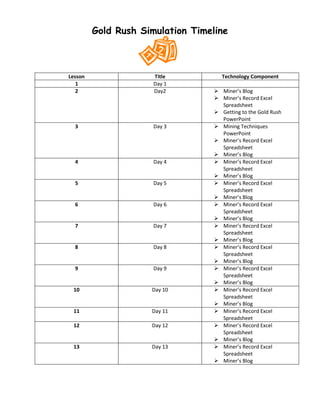
 \h \z \u An Introduction to Project Based Learning & Digital Storytelling PAGEREF _Toc280430524 \h 3Why Use Project Based Learning? PAGEREF _Toc280430525 \h 3What Does Project Based Learning Look Like in a Classroom? PAGEREF _Toc280430526 \h 4It Sounds Great…What’s the Catch? PAGEREF _Toc280430527 \h 5What is Digital Storytelling? PAGEREF _Toc280430528 \h 7The Lesson Plan Format PAGEREF _Toc280430529 \h 8How to Use this Handbook PAGEREF _Toc280430530 \h 8Gold Rush Simulation Timeline PAGEREF _Toc280430531 \h 10Lesson PlansA Miner’s Blog Lesson Plan PAGEREF _Toc280430532 \h 11Getting to the Gold Fields PowerPoint PAGEREF _Toc280430533 \h 17Student Guidelines PAGEREF _Toc280430534 \h 17Mining Techniques PowerPoint Guidelines PAGEREF _Toc280430535 \h 19Digital Storytelling: Life of a 49er Lesson Plan PAGEREF _Toc280430536 \h 21Rubrics/SurveysSimulation Rubrics & Informal Teacher/Student PBL Surveys PAGEREF _Toc280430537 \h 26Gold Rush Simulation Rubric PAGEREF _Toc280430538 \h 27<br />17094206009640<br />An Introduction to Project Based Learning & Digital Storytelling<br />Why Use Project Based Learning?<br />Project Based Learning (PBL) is widely known as an innovative, creative and popular teaching method that helps students better relate what they’re learning, to their lives outside of the classroom by giving them real-world problems to solve.  Rather than using textbooks exclusively to assist students with understanding lessons, textbooks are merely used as one of many tools or resources that the teacher utilizes to ensure students comprehend and understand what they’re being taught.  The role of the teacher changes from the traditional stand in front of the classroom and lecture style, to more of a mentor for the students; someone who provides information and answers questions for the students, but doesn’t dominate the discussion.  The role of the student is also much different in a PBL environment.  Students are expected to work with the teacher to select projects they would like to work on, actively participate in project activities, and become part of the decision-making process throughout the project. <br />Research had shown that students involved in Project Based Learning feel more of a sense of ownership of their learning. This causes them to become more invested in their learning and in turn develop better critical thinking skills, take more risks, and work better in a collaborative environment than those of their peers in traditional classrooms. PBL does not just teach facts and memorization, it teaches students how to think for themselves and become real world problem solvers. The PBL method of teaching therefore better prepares students for the future.<br />What Does Project Based Learning Look Like in a Classroom?<br />Unlike traditional classrooms where each core subject is taught as a separate entity, Project Based Learning seeks to integrate all subjects in one inquiry. This integration can be achieved by creating a thematic unit in which math, language arts, social studies, science, and art are combined throughout the unit as students investigate the overall problem or theme. This handbook is to be used as a supplement to the Interact simulation for a 4th grade unit on the California Gold Rush. Throughout the simulation, students take on the persona of a Gold Rush miner in the mid 1800s in California. As they immerse themselves in mining life students use and gain knowledge of core subjects to navigate through the everyday trials and tribulations of being a 49er. Language arts skills will come in handy as they reflect on their mining days in a Miner’s Blog. Math skills will be put to use as they calculate their daily losses or earnings and decide how much to spend on mining supplies at the local mining shop. Students will acquire critical thinking skills and apply social studies knowledge as they create a Digital Story documentary about mining life. Integrating more than one subject at a time into the unit allows teachers and students to relate new learning to real life situations and in turn make the connection between the classroom and the outside world. Students who understand how their knowledge gained in the classroom can be applied to their everyday life are more likely to become more invested in their learning, and become more well rounded citizens. <br />It Sounds Great…What’s the Catch?<br />While Project Based Learning is engaging and exciting, it does have its challenges. First, PBL can be difficult to implement as a new and less experienced teacher. Being able to integrate various subjects into one lesson or inquiry requires mastery of each subject by the classroom teacher. It is important that the PBL teacher feels comfortable with the subject matter in order to properly convey it to their students. Unlike the traditional teacher, a PBL can’t rely as much on manuals and textbooks to instill knowledge in her students. It is also important that a teacher using PBL have a handle on classroom management. A key part of PBL is collaborative learning. Unlike the traditional classroom where students might be seated in rows at individual desks working on individual assignments, students immersed in PBL need the freedom to work with their peers and communicate openly as they investigate the given problem. Students involved in PBL might not be working on the same task at the same time which means their potentially could be a lot of movement occurring in the classroom as students attend to different tasks. It is imperative that the PBL teacher establish a set of norms with the entire class before a project begins. While the PBL classroom might allow for more student freedom and creativity than its traditional counterpart, it is still important that students know what is expected of them in terms of behavior and assignment deadlines. Setting daily or weekly goals, depending on the length of the project, can be effective in this area.<br />Another challenge that can arise when implementing Project Based Learning is the issue of time. As all teachers know, there never seems to be enough time in the day to accomplish everything needing to be accomplished. At first glance, PBL can seem intimidating due to the amount of time needed to complete one inquiry. However, because PBL integrates multiple subjects, with proper planning, time can become less of a challenge. Planning and organization are two key components to successfully implementing PBL into any classroom. <br />Lastly, a common challenge faced by teachers who are attempting to implement PBL into their classrooms is that of student assessment. Unlike the traditional pen and paper exams used to assess student learning and understanding of a particular subject, in a PBL setting assessment is often shared by both the teacher and the student. Oftentimes, students in a PBL setting help to develop the criteria on which they will be assessed. This component brings the whole idea of PBL full circle. If students create their own assessment at the start of a project, they will know be completely aware of what is expected of them throughout the process.  This step in PBL also causes students to become self-reflective of their learning which is a skill often left out in the traditional classroom setting. Creating rubrics and alternative assessments can be more time consuming than just using the pre-made assessments provided in the teacher’s manual, but in the long run alternative assessments will prove to be effective and worthwhile.<br />What is Digital Storytelling?<br />Digital Storytelling is the practice of using computer-based tools to tell stories. As with traditional storytelling, most digital stories focus on a specific topic and contain a particular point of view. However, as the name implies, digital stories usually contain some mixture of computer-based images, text, recorded audio narration, video clips and/or music. Digital stories can vary in length, but most of the stories used in education typically last between two and ten minutes. The topics that are used in Digital Storytelling range from personal tales to the recounting of historical events, from exploring life in one's own community to the search for life in other corners of the universe, and literally, everything in between.<br />For this project, Digital Storytelling is the culminating activity completed by students after participating in the Interact Gold Rush simulation. Students will assume the role of a California Gold Rush miner as they narrate what life is life in the gold fields and in the mining camps. The Digital Story lesson plan for this project has been created based on the Photo Story program, however, any digital media can be used as long as students are familiar with it prior to this project.<br />The Lesson Plan Format<br />The technology lesson plans included in this handbook are to be used in correlation with the Interact Gold Rush Simulation handbook. The content of the Interact lesson plans are excellent, they just lack the technology component that is needed to update them for the 21st Century classroom.Some of the technology lessons are linked to just one daily Interact lesson, while others can be used with multiple Interact lessons. <br />The lessons provided in this handbook were written based on the assumption that students have had prior training or experience with programs such as Microsoft PowerPoint, Microsoft Excel, and Windows Photo Story. The lessons can be adapted and used as you, the teacher see fit. If students need training with any of these programs, it may be necessary to issue this training prior to using this handbook with the Interact Gold Rush Simulation.  <br />How to Use this Handbook<br />This handbook needs to be used side by side with the Interact Gold Rush simulation handbook. The Timeline Table included in this supplemental handbook can be used as a table of contents for the overall unit. Each Interact lesson is included in the timeline table along with a corresponding technology lesson plan that enhances the original lesson. The formal lesson plans/student guidelines for each technology component are included after the Timeline Table. These lessons can be used “as is”, or adapted to meet the needs of your individual classroom/students.<br />Included at the end of this handbook are two informal surveys. One survey is for you, the teacher, to complete as a reflection on your overall experience using this supplemental technology handbook. The other survey is for the students who participated in the technology infused simulation and is a reflection of their overall experience. A teacher’s log has also been created for you to maintain throughout the technology infused simulation. This log can be used to record any challenges you may have experienced throughout the simulation, as well as any suggestions you have on how this handbook can be improved or enhanced. <br />2443273304357Gold Rush Simulation Timeline<br />LessonTitleTechnology Component1Day 12Day2Miner’s BlogMiner’s Record Excel SpreadsheetGetting to the Gold Rush PowerPoint3Day 3Mining Techniques PowerPointMiner’s Record Excel SpreadsheetMiner’s Blog4Day 4Miner’s Record Excel SpreadsheetMiner’s Blog5Day 5Miner’s Record Excel SpreadsheetMiner’s Blog6Day 6Miner’s Record Excel SpreadsheetMiner’s Blog7Day 7Miner’s Record Excel SpreadsheetMiner’s Blog8Day 8Miner’s Record Excel SpreadsheetMiner’s Blog9Day 9Miner’s Record Excel SpreadsheetMiner’s Blog10Day 10Miner’s Record Excel SpreadsheetMiner’s Blog11Day 11Miner’s Record Excel Spreadsheet12Day 12Miner’s Record Excel SpreadsheetMiner’s Blog13Day 13Miner’s Record Excel SpreadsheetMiner’s Blog2613025300355A Miner’s Blog Lesson Plan<br />Concept / Topic To Teach: <br />In place of the Interact Miner’s Log, students will develop and maintain a Miner’s Blog throughout the entire simulation. Students will follow the given directions for the original Miner’s Log, except instead of keeping a handwritten journal, they will record their reactions to all important mining life experiences on an online blog. Maintaining a blog will not only teach students how to communicate using technology in a proper format, but it will also allow students to interact with one another in a digital format by commenting on each others’ blogs.<br />Prior Knowledge:<br />In order for this lesson to be successful, students will need to have a basic understanding of what a blog is and how blogging works. It is suggested that the teacher develop simple blogging lessons for students prior to this unit. Blogger is a user friendly blog building site that may be useful for  the purposes of this project.<br />www.blogger.com <br />Standards Addressed: <br />CA State Content Standards Grade 4:<br />Social Studies 4.3<br />Students explain the economic, social, and political life in California from the establishment of the Bear Flag Republic through the Mexican-American War, the Gold Rush, and the granting of statehood. <br />3. Analyze the effects of the Gold Rush on settlements, daily life, politics, and the physical environment (e.g., using biographies of John Sutter, Mariano Guadalupe Vallejo, Louise Clapp). <br />The ISTE National Educational Technology Standards (NETS•S)and Performance Indicators for Students<br />1. Creativity and Innovation<br />Students demonstrate creative thinking, construct knowledge, and develop innovative products and processes using technology. Students: a. apply existing knowledge to generate new ideas, products, or processes.<br />2. Communication and Collaboration<br />Students use digital media and environments to communicate and work collaboratively, including at a distance, to support individual learning and contribute to the learning of others. Students: a. interact, collaborate, and publish with peers, experts, or others employing a variety of digital environments and media.<br /> <br />6. Technology Operations and Concepts<br />Students demonstrate a sound understanding of technology concepts, systems, and operations. Students: a. understand and use technology systems.<br />General Goal(s): <br />Students will further their understanding of mining life by assuming the role of a Gold Rush miner and maintaining a daily miner’s blog online. Students will include information about daily life, hardships, and accomplishments. The Miner’s Blog will serve as a daily record that will be assessed by the teacher. Students will also interact with one another via their online blogs, commenting on similar/shared experiences and feelings, as well as conversing on upcoming decisions to be made in the mining camps.   <br />Required Materials: <br />Student computers<br />Free subscription to an online blogging site, such as Blogger, for each student<br />  <br />Step-By-Step Procedures: <br />Students will participate in the Interact Gold Rush Simulation and take on the role of a California gold miner. The experience they have during this simulation will help them to better understand what life was like for a 49er.<br />Students will blog daily on their mining experiences. Blogs will be monitored/assessed by the teacher on a daily basis.<br />Students will comment on each others’ blogs on a daily basis (minimum of one comment per day)<br />        <br />Assessment Based On Objectives: <br />Students will be assessed using the Miner' rubric. <br />2464435310515Miner’s Blog Student Guidelines<br />Directions: <br />At the end of each simulation day you, the gold miner, will add an entry to your online Miner’s Blog. This blog will be maintained throughout the simulation and will serve as a daily record of your mining experience. Your daily blog entries must be thoughtful, and include your reactions to all important mining experiences. In addition to maintaining your own Miner’s Blog, you will also keep in “virtual contact” with your mining companions by commenting on their Miner’s Blogs and sharing your similar experiences, and discussing upcoming decisions that need to be made. <br />Draft your first blog entry below:<br />Miner’s Blog Assessment Rubric<br />231521022860<br />Student Name: _________________________________<br />Date: _____________________<br />1Beginner2Capable3Accomplished4 Expert Quality of Writing- post has no style or voice- gives no new information on the topic- poorly organized- post has little style or voice- gives some new information on the topic- poorly organized- written in a somewhat interesting style and voice- some new information on the topic or reflective- well organized- written in an interesting style and voice- very informative or deeply reflective- well organized  Presentation- many words misspelled- many grammar errors- formatting makes post difficult to follow or read- several spelling errors- several grammar errors- formatting makes it difficult to follow or read- few spelling errors- few grammar errors- some formatting to help make the post easier to read- all words spelled correctly- no grammar errors- formatting makes the post more interesting and easier to readRequirements-inconsistent comments made on other miner’s blogs with little thought -one comment made on another miner’s blog each day with little effort or thought-one thoughtful comment made on another miner’s blog each day-more than one thoughtful comment made on another miner’s blog each day<br />Power Point Lesson Plan<br />Concept / Topic To Teach: <br />Students will create 2 PowerPoint presentations during the Interact Gold Rush simulation. The 2 presentations will provide important background on different aspects of the gold rush and it will allow them to become more familiar with the PowerPoint program.<br />Prior Knowledge:<br />In order for this lesson to be successful, students will need to have a basic understanding of how PowerPoint works. Simple lessons can be created to help students become more familiar with the program. The link below is a useful Web site for educators who are unfamiliar with the PowerPoint program. It gives a brief tutorial to the program, as well as sample units to use with students to give them the experience they need.<br />http://www.actden.com/pp/index.htm <br />Standards Addressed: <br />CA State Content Standards Grade 4:<br />Social Studies 4.3<br />Students explain the economic, social, and political life in California from the establishment of the Bear Flag Republic through the Mexican-American War, the Gold Rush, and the granting of statehood. <br />3. Analyze the effects of the Gold Rush on settlements, daily life, politics, and the physical environment (e.g., using biographies of John Sutter, Mariano Guadalupe Vallejo, Louise Clapp). <br />The ISTE National Educational Technology Standards (NETS•S)and Performance Indicators for Students<br />1. Creativity and Innovation<br />Students demonstrate creative thinking, construct knowledge, and develop innovative products and processes using technology. Students: a. apply existing knowledge to generate new ideas, products, or processes.<br />2. Communication and Collaboration<br />Students use digital media and environments to communicate and work collaboratively, including at a distance, to support individual learning and contribute to the learning of others. Students: a. interact, collaborate, and publish with peers, experts, or others employing a variety of digital environments and media.<br /> <br />6. Technology Operations and Concepts<br />Students demonstrate a sound understanding of technology concepts, systems, and operations. Students: a. understand and use technology systems.<br />General Goal(s): <br />Students will further their understanding of mining life by researching two different and important aspects of the gold rush. Students will learn about the different routes miners took to get to the gold fields. Students will also learn more about different mining techniques used, along with their advantages and disadvantages. <br />Required Materials: <br />Student computers<br />Microsoft PowerPoint presentation program<br />  <br />Step-By-Step Procedures: <br />1. Students will participate in the Interact Gold Rush Simulation and take on the role of a California gold miner. The experience they have during this simulation will help them to better understand what life was like for a 49er.<br />2. Students will perform further research on gold field routes and mining techniques using such resources as their social studies textbook, reference books and online sources.<br />3. Students will create 2 PowerPoint presentations. 1 presentation will focus on the routes miners took to arrive in the gold fields in California. They will discuss the benefits and negative aspects of the different choices. The other presentation will focus on the different mining techniques employed by gold miners. They will discuss the advantages and disadvantages of the different techniques. <br />        <br />Assessment Based On Objectives: <br />Students will be assessed using the two PowerPoint Rubrics created in this handbook. <br />Getting to the Gold Fields PowerPoint<br />Student Guidelines<br />2129613205312<br />After reading Background Sheet 2 in your student booklet, and doing further research on how miners got to the California gold fields, summarize the 4 different routes/modes of transportation used by miners during the Gold Rush period:<br />Overland<br />Sea<br />Panama Route<br />Cape Horn Route<br /> Each Route needs to have its own slide. On each slide include a graphic/picture of the route along with a description of it. Included in the summary should be a description of the advantages and disadvantages of the route. <br />Getting to the Gold Rush<br />PowerPoint Assessment Rubric<br />Student Name:     ________________________________ Date:                             ____ ______________________________________<br />CATEGORY 4 3 2 1 Requirements All requirements are met and exceeded. All requirements are met. One requirement was not completely met. More than one requirement was not completely met. Attractiveness Makes excellent use of font, color, graphics, effects, etc. to enhance the presentation. Makes good use of font, color, graphics, effects, etc. to enhance to presentation. Makes use of font, color, graphics, effects, etc. but occasionally these detract from the presentation content. Use of font, color, graphics, effects etc. but these often distract from the presentation content. Content Covers topic in-depth with details and examples. Subject knowledge is excellent. Includes essential knowledge about the topic. Subject knowledge appears to be good. Includes essential information about the topic but there are 1-2 factual errors. Content is minimal OR there are several factual errors. Mechanics No misspellings or grammatical errors. Three or fewer misspellings and/or mechanical errors. Four misspellings and/or grammatical errors. More than 4 errors in spelling or grammar. <br />Mining Techniques PowerPoint Guidelines<br />2650490203835<br />After reading Background Sheet 3 in your student booklet, and doing further research on mining techniques, summarize the 5 different techniques used to mine gold during the Gold Rush period:<br />Panning<br />Cradle<br />Long Tom<br />Coyote Mining<br />Hydraulic Mining<br /> Each technique needs to have its own slide. On each slide include a graphic/picture of the technique along with a description of the technique. Included in the summary should be a description of the advantages and disadvantages of the technique. <br />Use the following slide as an example for your final project <br />Mining Techniques<br />PowerPoint Assessment Rubric<br />2559685114300<br />Student Name:     ________________________________ Date:                             ____ ______________________________________<br />CATEGORY 4 3 2 1 Requirements All requirements are met and exceeded. All requirements are met. One requirement was not completely met. More than one requirement was not completely met. Attractiveness Makes excellent use of font, color, graphics, effects, etc. to enhance the presentation. Makes good use of font, color, graphics, effects, etc. to enhance to presentation. Makes use of font, color, graphics, effects, etc. but occasionally these detract from the presentation content. Use of font, color, graphics, effects etc. but these often distract from the presentation content. Content Covers topic in-depth with details and examples. Subject knowledge is excellent. Includes essential knowledge about the topic. Subject knowledge appears to be good. Includes essential information about the topic but there are 1-2 factual errors. Content is minimal OR there are several factual errors. Mechanics No misspellings or grammatical errors. Three or fewer misspellings and/or mechanical errors. Four misspellings and/or grammatical errors. More than 4 errors in spelling or grammar. <br />Digital Storytelling: Life of a 49er Lesson Plan<br />26027615877<br />Concept / Topic To Teach: <br />Students will create a Digital Story as they take on the personality of a California gold rush miner. <br />Standards Addressed: <br />CA State Content Standards Grade 4:<br />Social Studies 4.3<br />Students explain the economic, social, and political life in California from the establishment of the Bear Flag Republic through the Mexican-American War, the Gold Rush, and the granting of statehood.<br />2.  Compare how and why people traveled to California and the routes they traveled (e.g., James Beckwourth, John Bidwell, John C. Fremont, Pio Pico). <br />3. Analyze the effects of the Gold Rush on settlements, daily life, politics, and the physical environment (e.g., using biographies of John Sutter, Mariano Guadalupe Vallejo, Louise Clapp). <br />The ISTE National Educational Technology Standards (NETS•S)and Performance Indicators for Students<br />1. Creativity and Innovation<br />Students demonstrate creative thinking, construct knowledge, and develop innovative products and processes using technology. Students: a. apply existing knowledge to generate new ideas, products, or processes.<br />2. Communication and Collaboration<br />Students use digital media and environments to communicate and work collaboratively, including at a distance, to support individual learning and contribute to the learning of others. Students: a. interact, collaborate, and publish with peers, experts, or others employing a variety of digital environments and media.<br /> 6. Technology Operations and Concepts<br />Students demonstrate a sound understanding of technology concepts, systems, and operations. Students: a. understand and use technology systems.<br />General Goal(s): <br />Students will further their understanding of mining life by assuming the role of a Gold Rush miner and creating a Digital Story based on the life of their miner persona. Students will include information about daily life and hardships of a miner, where their miner is from and how he/she arrived in California. Students will also include information about the failures and accomplishments of their miner during the time of the Gold Rush.<br />   <br />Required Materials: <br />photographs/images found by students, <br />microphone, <br />Photo Story program<br />Story Board templates for student use<br />Student computers<br />  <br />Step-By-Step Procedures: <br />Students will participate in the Interact Gold Rush Simulation and take on the role of a California gold miner. The experience they have during this simulation will help them to better understand what life was like for a 49er.<br />During or following the simulation students will visit the following interactive learning sites to learn more about the Gold Rush and mining life to prepare them to create their Digital Story<br />Visit the following Gold Rush site: <br />http://museumca.org/goldrush/fever01.html<br />This site provides a virtual tour of the Gold Fever! exhibit at the Oakland Museum of California. Here, students will learn more about the history of the Gold Rush as well as hear audio clips describing different aspects of the Gold Rush.<br /> Students will visit http://pbskids.org/wayback/goldrush to learn more about the history of the Gold Rush and what life was like for a gold miner.<br />Students will be paired/grouped and will develop a Gold Rush miner personality to depict in their Digital Story.<br />Students will create a Digital Story storyboard to prepare for creating their Digital Story.<br />Students will use Photo Story to create their Gold Miner Digital Story with their partner/group<br />      <br />Closure (Reflect Anticipatory Set): <br />Students will share their “Life of a 49er” digital stories with their classmates.<br />  <br />Assessment Based On Objectives: <br />Students will be assessed using the corresponding rubric. Students will also complete a personal reflection/assessment.<br />  <br />2666365361315Digital Storytelling: Life of a 49er<br />Student Guidelines<br />Now that we have completed the Gold Rush simulation and you have more of an understanding of Gold Rush life, with your partner or group, you will be assuming the role of a California Gold Miner and narrating your miner’s personal story. You will use pictures/images to go along with your narration. Your Digital Story will be created using the Photo Story program, and you will be graded on various aspects including detail, voice consistency, detail, and duration of your story. The following outline demonstrates the details that need to be included in your story. Use the outline as a guide, but be sure to use your own creativity to make your Digital Story unique and original. Before you can begin working on your story, you must complete a Storyboard outline. This storyboard needs to be completed and turned in before you begin working on your final Digital Story. Do your best work and most importantly, have fun!<br />Introduction<br />Who are you?<br />Where are you from?<br />If you are not from California, why did you come? If you are from California, why did you decide to come to the Gold Fields?<br />Who did you leave behind? (ie-family members)<br />Daily Life<br />What is your life like in the mining camp?<br />How did you decide where to stake your claim?<br />How is your life different than before you arrived in the gold fields?<br />What is a typical day life for you?<br />What mining techniques have you tried? Which have been successful?<br />What challenges have you faced since arriving to the gold fields?<br />Have you made any friends?<br />Thinking Ahead<br />How long do you plan on staying in the gold fields?<br />What will you do if you “strike it rich”?<br />Where will you go once the Gold Rush is over?<br />Will you miss anything about mining life?<br />Digital Storytelling : The Life of a 49er2539365-3810Student Name:  __________________________________Date: ______________________________<br />CATEGORY 4 3 2 1 Voice - Consistency Voice quality is clear and consistently audible throughout the presentation. Voice quality is clear and consistently audible throughout the majority (85-95%) of the presentation. Voice quality is clear and consistently audible through some (70-84%)of the presentation. Voice quality needs more attention. Images Images create a distinct atmosphere or tone that matches different parts of the story. The images may communicate symbolism and/or metaphors. Images create an atmosphere or tone that matches some parts of the story. The images may communicate symbolism and/or metaphors. An attempt was made to use images to create an atmosphere/tone but it needed more work. Image choice is logical. Little or no attempt to use images to create an appropriate atmosphere/tone. DetailThe story is told with exactly the right amount of detail throughout. It does not seem too short nor does it seem too long. The story composition is typically good, though it seems to drag somewhat OR need slightly more detail in one or two sections. The story seems to need more editing. It is noticeably too long or too short in more than one section. The story needs extensive editing. It is too long or too short to be interesting. Duration of Presentation Length of presentation was 4 minutes. Length of presentation was 3 minutes. Length of presentation was 2 minutes. Presentation was less than 2 minutes long OR more than 4 minutes. <br />Simulation Rubrics & Informal Teacher/Student PBL Surveys<br />491334932385075535323850Collaborative Work Skills : Gold Rush Simulation RubricStudent Name:______________________Date:_____________________<br />CATEGORY 4 3 2 1 Working with Others Almost always listens to, shares with, and supports the efforts of others. Tries to keep people working well together. Usually listens to, shares, with, and supports the efforts of others. Does not cause \"
waves\"
 in the group. Often listens to, shares with, and supports the efforts of others, but sometimes is not a good team member. Rarely listens to, shares with, and supports the efforts of others. Often is not a good team player. Focus on the task Consistently stays focused on the task and what needs to be done. Very self-directed. Focuses on the task and what needs to be done most of the time. Other group members can count on this person. Focuses on the task and what needs to be done some of the time. Other group members must sometimes nag, prod, and remind to keep this person on-task. Rarely focuses on the task and what needs to be done. Lets others do the work. Preparedness Brings needed materials to class and is always ready to work. Almost always brings needed materials to class and is ready to work. Almost always brings needed materials but sometimes needs to settle down and get to work Often forgets needed materials or is rarely ready to get to work. Contributions Routinely provides useful ideas when participating in the group and in classroom discussion. A definite leader who contributes a lot of effort. Usually provides useful ideas when participating in the group and in classroom discussion. A strong group member who tries hard! Sometimes provides useful ideas when participating in the group and in classroom discussion. A satisfactory group member who does what is required. Rarely provides useful ideas when participating in the group and in classroom discussion. May refuse to participate. Quality of Work Provides work of the highest quality. Provides high quality work. Provides work that occasionally needs to be checked/redone by other group members to ensure quality. Provides work that usually needs to be checked/redone by others to ensure quality. <br />Technology-Infused PBL Gold Rush Simulation Teacher’s Log<br />Teachers, <br />Simulation DayComments/Concerns/ObservationsDay 1Day 2Day 3Day 4Day 5Day 6Day 7Day 8<br />2707658896980As you navigate through the Interact Gold Rush simulation, and this corresponding technology handbook, please take some time to record your thoughts about the project daily. Express any concerns you might have and anything else that might contribute to the success of this project in the future.<br />Day 9Day 10Day 11Day 12Day 13<br />Project-Based Learning Student Survey<br />Students, <br />Now that we have completed our simulation on the California Gold Rush, and the corresponding technology lessons, I would like to get some feedback from you. Please complete the table below to share with me your experience and feelings towards the project. You are not being assessed on this survey, and can leave it anonymous if you would like. I would just like to hear from you in order to make the project and others like it, more successful in the future<br />I Got (what did you get out of participating in this project?)I Needed (What did you need during this project that you may have gotten, or not?)I Wanted (What did you want from this project that may have made it a more successful experience for you?)Aha! (What did you learn from participating in this project that you didn’t know before? This could be related to the gold rush, or about yourself.)<br />
Handbook
Handbook
Handbook
Handbook
Handbook
Handbook
Handbook
Handbook
Handbook
Handbook
Handbook
Handbook
Handbook
Handbook
Handbook
Handbook
Handbook
Handbook
Handbook
Handbook
Handbook
Handbook
Handbook
Handbook
Handbook
Handbook
Handbook
Handbook
Handbook
Handbook

Handbook

  • 1.
    EUREKA! <br />2137144659057<br/>Incorporating Technology into a Gold Rush Simulation<br />A Handbook for 4th Grade Teachers<br />Handbook Table of Contents TOC \o \" 1-3\" \h \z \u An Introduction to Project Based Learning & Digital Storytelling PAGEREF _Toc280430524 \h 3Why Use Project Based Learning? PAGEREF _Toc280430525 \h 3What Does Project Based Learning Look Like in a Classroom? PAGEREF _Toc280430526 \h 4It Sounds Great…What’s the Catch? PAGEREF _Toc280430527 \h 5What is Digital Storytelling? PAGEREF _Toc280430528 \h 7The Lesson Plan Format PAGEREF _Toc280430529 \h 8How to Use this Handbook PAGEREF _Toc280430530 \h 8Gold Rush Simulation Timeline PAGEREF _Toc280430531 \h 10Lesson PlansA Miner’s Blog Lesson Plan PAGEREF _Toc280430532 \h 11Getting to the Gold Fields PowerPoint PAGEREF _Toc280430533 \h 17Student Guidelines PAGEREF _Toc280430534 \h 17Mining Techniques PowerPoint Guidelines PAGEREF _Toc280430535 \h 19Digital Storytelling: Life of a 49er Lesson Plan PAGEREF _Toc280430536 \h 21Rubrics/SurveysSimulation Rubrics & Informal Teacher/Student PBL Surveys PAGEREF _Toc280430537 \h 26Gold Rush Simulation Rubric PAGEREF _Toc280430538 \h 27<br />17094206009640<br />An Introduction to Project Based Learning & Digital Storytelling<br />Why Use Project Based Learning?<br />Project Based Learning (PBL) is widely known as an innovative, creative and popular teaching method that helps students better relate what they’re learning, to their lives outside of the classroom by giving them real-world problems to solve. Rather than using textbooks exclusively to assist students with understanding lessons, textbooks are merely used as one of many tools or resources that the teacher utilizes to ensure students comprehend and understand what they’re being taught. The role of the teacher changes from the traditional stand in front of the classroom and lecture style, to more of a mentor for the students; someone who provides information and answers questions for the students, but doesn’t dominate the discussion. The role of the student is also much different in a PBL environment. Students are expected to work with the teacher to select projects they would like to work on, actively participate in project activities, and become part of the decision-making process throughout the project. <br />Research had shown that students involved in Project Based Learning feel more of a sense of ownership of their learning. This causes them to become more invested in their learning and in turn develop better critical thinking skills, take more risks, and work better in a collaborative environment than those of their peers in traditional classrooms. PBL does not just teach facts and memorization, it teaches students how to think for themselves and become real world problem solvers. The PBL method of teaching therefore better prepares students for the future.<br />What Does Project Based Learning Look Like in a Classroom?<br />Unlike traditional classrooms where each core subject is taught as a separate entity, Project Based Learning seeks to integrate all subjects in one inquiry. This integration can be achieved by creating a thematic unit in which math, language arts, social studies, science, and art are combined throughout the unit as students investigate the overall problem or theme. This handbook is to be used as a supplement to the Interact simulation for a 4th grade unit on the California Gold Rush. Throughout the simulation, students take on the persona of a Gold Rush miner in the mid 1800s in California. As they immerse themselves in mining life students use and gain knowledge of core subjects to navigate through the everyday trials and tribulations of being a 49er. Language arts skills will come in handy as they reflect on their mining days in a Miner’s Blog. Math skills will be put to use as they calculate their daily losses or earnings and decide how much to spend on mining supplies at the local mining shop. Students will acquire critical thinking skills and apply social studies knowledge as they create a Digital Story documentary about mining life. Integrating more than one subject at a time into the unit allows teachers and students to relate new learning to real life situations and in turn make the connection between the classroom and the outside world. Students who understand how their knowledge gained in the classroom can be applied to their everyday life are more likely to become more invested in their learning, and become more well rounded citizens. <br />It Sounds Great…What’s the Catch?<br />While Project Based Learning is engaging and exciting, it does have its challenges. First, PBL can be difficult to implement as a new and less experienced teacher. Being able to integrate various subjects into one lesson or inquiry requires mastery of each subject by the classroom teacher. It is important that the PBL teacher feels comfortable with the subject matter in order to properly convey it to their students. Unlike the traditional teacher, a PBL can’t rely as much on manuals and textbooks to instill knowledge in her students. It is also important that a teacher using PBL have a handle on classroom management. A key part of PBL is collaborative learning. Unlike the traditional classroom where students might be seated in rows at individual desks working on individual assignments, students immersed in PBL need the freedom to work with their peers and communicate openly as they investigate the given problem. Students involved in PBL might not be working on the same task at the same time which means their potentially could be a lot of movement occurring in the classroom as students attend to different tasks. It is imperative that the PBL teacher establish a set of norms with the entire class before a project begins. While the PBL classroom might allow for more student freedom and creativity than its traditional counterpart, it is still important that students know what is expected of them in terms of behavior and assignment deadlines. Setting daily or weekly goals, depending on the length of the project, can be effective in this area.<br />Another challenge that can arise when implementing Project Based Learning is the issue of time. As all teachers know, there never seems to be enough time in the day to accomplish everything needing to be accomplished. At first glance, PBL can seem intimidating due to the amount of time needed to complete one inquiry. However, because PBL integrates multiple subjects, with proper planning, time can become less of a challenge. Planning and organization are two key components to successfully implementing PBL into any classroom. <br />Lastly, a common challenge faced by teachers who are attempting to implement PBL into their classrooms is that of student assessment. Unlike the traditional pen and paper exams used to assess student learning and understanding of a particular subject, in a PBL setting assessment is often shared by both the teacher and the student. Oftentimes, students in a PBL setting help to develop the criteria on which they will be assessed. This component brings the whole idea of PBL full circle. If students create their own assessment at the start of a project, they will know be completely aware of what is expected of them throughout the process. This step in PBL also causes students to become self-reflective of their learning which is a skill often left out in the traditional classroom setting. Creating rubrics and alternative assessments can be more time consuming than just using the pre-made assessments provided in the teacher’s manual, but in the long run alternative assessments will prove to be effective and worthwhile.<br />What is Digital Storytelling?<br />Digital Storytelling is the practice of using computer-based tools to tell stories. As with traditional storytelling, most digital stories focus on a specific topic and contain a particular point of view. However, as the name implies, digital stories usually contain some mixture of computer-based images, text, recorded audio narration, video clips and/or music. Digital stories can vary in length, but most of the stories used in education typically last between two and ten minutes. The topics that are used in Digital Storytelling range from personal tales to the recounting of historical events, from exploring life in one's own community to the search for life in other corners of the universe, and literally, everything in between.<br />For this project, Digital Storytelling is the culminating activity completed by students after participating in the Interact Gold Rush simulation. Students will assume the role of a California Gold Rush miner as they narrate what life is life in the gold fields and in the mining camps. The Digital Story lesson plan for this project has been created based on the Photo Story program, however, any digital media can be used as long as students are familiar with it prior to this project.<br />The Lesson Plan Format<br />The technology lesson plans included in this handbook are to be used in correlation with the Interact Gold Rush Simulation handbook. The content of the Interact lesson plans are excellent, they just lack the technology component that is needed to update them for the 21st Century classroom.Some of the technology lessons are linked to just one daily Interact lesson, while others can be used with multiple Interact lessons. <br />The lessons provided in this handbook were written based on the assumption that students have had prior training or experience with programs such as Microsoft PowerPoint, Microsoft Excel, and Windows Photo Story. The lessons can be adapted and used as you, the teacher see fit. If students need training with any of these programs, it may be necessary to issue this training prior to using this handbook with the Interact Gold Rush Simulation. <br />How to Use this Handbook<br />This handbook needs to be used side by side with the Interact Gold Rush simulation handbook. The Timeline Table included in this supplemental handbook can be used as a table of contents for the overall unit. Each Interact lesson is included in the timeline table along with a corresponding technology lesson plan that enhances the original lesson. The formal lesson plans/student guidelines for each technology component are included after the Timeline Table. These lessons can be used “as is”, or adapted to meet the needs of your individual classroom/students.<br />Included at the end of this handbook are two informal surveys. One survey is for you, the teacher, to complete as a reflection on your overall experience using this supplemental technology handbook. The other survey is for the students who participated in the technology infused simulation and is a reflection of their overall experience. A teacher’s log has also been created for you to maintain throughout the technology infused simulation. This log can be used to record any challenges you may have experienced throughout the simulation, as well as any suggestions you have on how this handbook can be improved or enhanced. <br />2443273304357Gold Rush Simulation Timeline<br />LessonTitleTechnology Component1Day 12Day2Miner’s BlogMiner’s Record Excel SpreadsheetGetting to the Gold Rush PowerPoint3Day 3Mining Techniques PowerPointMiner’s Record Excel SpreadsheetMiner’s Blog4Day 4Miner’s Record Excel SpreadsheetMiner’s Blog5Day 5Miner’s Record Excel SpreadsheetMiner’s Blog6Day 6Miner’s Record Excel SpreadsheetMiner’s Blog7Day 7Miner’s Record Excel SpreadsheetMiner’s Blog8Day 8Miner’s Record Excel SpreadsheetMiner’s Blog9Day 9Miner’s Record Excel SpreadsheetMiner’s Blog10Day 10Miner’s Record Excel SpreadsheetMiner’s Blog11Day 11Miner’s Record Excel Spreadsheet12Day 12Miner’s Record Excel SpreadsheetMiner’s Blog13Day 13Miner’s Record Excel SpreadsheetMiner’s Blog2613025300355A Miner’s Blog Lesson Plan<br />Concept / Topic To Teach: <br />In place of the Interact Miner’s Log, students will develop and maintain a Miner’s Blog throughout the entire simulation. Students will follow the given directions for the original Miner’s Log, except instead of keeping a handwritten journal, they will record their reactions to all important mining life experiences on an online blog. Maintaining a blog will not only teach students how to communicate using technology in a proper format, but it will also allow students to interact with one another in a digital format by commenting on each others’ blogs.<br />Prior Knowledge:<br />In order for this lesson to be successful, students will need to have a basic understanding of what a blog is and how blogging works. It is suggested that the teacher develop simple blogging lessons for students prior to this unit. Blogger is a user friendly blog building site that may be useful for the purposes of this project.<br />www.blogger.com <br />Standards Addressed: <br />CA State Content Standards Grade 4:<br />Social Studies 4.3<br />Students explain the economic, social, and political life in California from the establishment of the Bear Flag Republic through the Mexican-American War, the Gold Rush, and the granting of statehood. <br />3. Analyze the effects of the Gold Rush on settlements, daily life, politics, and the physical environment (e.g., using biographies of John Sutter, Mariano Guadalupe Vallejo, Louise Clapp). <br />The ISTE National Educational Technology Standards (NETS•S)and Performance Indicators for Students<br />1. Creativity and Innovation<br />Students demonstrate creative thinking, construct knowledge, and develop innovative products and processes using technology. Students: a. apply existing knowledge to generate new ideas, products, or processes.<br />2. Communication and Collaboration<br />Students use digital media and environments to communicate and work collaboratively, including at a distance, to support individual learning and contribute to the learning of others. Students: a. interact, collaborate, and publish with peers, experts, or others employing a variety of digital environments and media.<br /> <br />6. Technology Operations and Concepts<br />Students demonstrate a sound understanding of technology concepts, systems, and operations. Students: a. understand and use technology systems.<br />General Goal(s): <br />Students will further their understanding of mining life by assuming the role of a Gold Rush miner and maintaining a daily miner’s blog online. Students will include information about daily life, hardships, and accomplishments. The Miner’s Blog will serve as a daily record that will be assessed by the teacher. Students will also interact with one another via their online blogs, commenting on similar/shared experiences and feelings, as well as conversing on upcoming decisions to be made in the mining camps.   <br />Required Materials: <br />Student computers<br />Free subscription to an online blogging site, such as Blogger, for each student<br />  <br />Step-By-Step Procedures: <br />Students will participate in the Interact Gold Rush Simulation and take on the role of a California gold miner. The experience they have during this simulation will help them to better understand what life was like for a 49er.<br />Students will blog daily on their mining experiences. Blogs will be monitored/assessed by the teacher on a daily basis.<br />Students will comment on each others’ blogs on a daily basis (minimum of one comment per day)<br />        <br />Assessment Based On Objectives: <br />Students will be assessed using the Miner' rubric. <br />2464435310515Miner’s Blog Student Guidelines<br />Directions: <br />At the end of each simulation day you, the gold miner, will add an entry to your online Miner’s Blog. This blog will be maintained throughout the simulation and will serve as a daily record of your mining experience. Your daily blog entries must be thoughtful, and include your reactions to all important mining experiences. In addition to maintaining your own Miner’s Blog, you will also keep in “virtual contact” with your mining companions by commenting on their Miner’s Blogs and sharing your similar experiences, and discussing upcoming decisions that need to be made. <br />Draft your first blog entry below:<br />Miner’s Blog Assessment Rubric<br />231521022860<br />Student Name: _________________________________<br />Date: _____________________<br />1Beginner2Capable3Accomplished4 Expert Quality of Writing- post has no style or voice- gives no new information on the topic- poorly organized- post has little style or voice- gives some new information on the topic- poorly organized- written in a somewhat interesting style and voice- some new information on the topic or reflective- well organized- written in an interesting style and voice- very informative or deeply reflective- well organized  Presentation- many words misspelled- many grammar errors- formatting makes post difficult to follow or read- several spelling errors- several grammar errors- formatting makes it difficult to follow or read- few spelling errors- few grammar errors- some formatting to help make the post easier to read- all words spelled correctly- no grammar errors- formatting makes the post more interesting and easier to readRequirements-inconsistent comments made on other miner’s blogs with little thought -one comment made on another miner’s blog each day with little effort or thought-one thoughtful comment made on another miner’s blog each day-more than one thoughtful comment made on another miner’s blog each day<br />Power Point Lesson Plan<br />Concept / Topic To Teach: <br />Students will create 2 PowerPoint presentations during the Interact Gold Rush simulation. The 2 presentations will provide important background on different aspects of the gold rush and it will allow them to become more familiar with the PowerPoint program.<br />Prior Knowledge:<br />In order for this lesson to be successful, students will need to have a basic understanding of how PowerPoint works. Simple lessons can be created to help students become more familiar with the program. The link below is a useful Web site for educators who are unfamiliar with the PowerPoint program. It gives a brief tutorial to the program, as well as sample units to use with students to give them the experience they need.<br />http://www.actden.com/pp/index.htm <br />Standards Addressed: <br />CA State Content Standards Grade 4:<br />Social Studies 4.3<br />Students explain the economic, social, and political life in California from the establishment of the Bear Flag Republic through the Mexican-American War, the Gold Rush, and the granting of statehood. <br />3. Analyze the effects of the Gold Rush on settlements, daily life, politics, and the physical environment (e.g., using biographies of John Sutter, Mariano Guadalupe Vallejo, Louise Clapp). <br />The ISTE National Educational Technology Standards (NETS•S)and Performance Indicators for Students<br />1. Creativity and Innovation<br />Students demonstrate creative thinking, construct knowledge, and develop innovative products and processes using technology. Students: a. apply existing knowledge to generate new ideas, products, or processes.<br />2. Communication and Collaboration<br />Students use digital media and environments to communicate and work collaboratively, including at a distance, to support individual learning and contribute to the learning of others. Students: a. interact, collaborate, and publish with peers, experts, or others employing a variety of digital environments and media.<br /> <br />6. Technology Operations and Concepts<br />Students demonstrate a sound understanding of technology concepts, systems, and operations. Students: a. understand and use technology systems.<br />General Goal(s): <br />Students will further their understanding of mining life by researching two different and important aspects of the gold rush. Students will learn about the different routes miners took to get to the gold fields. Students will also learn more about different mining techniques used, along with their advantages and disadvantages. <br />Required Materials: <br />Student computers<br />Microsoft PowerPoint presentation program<br />  <br />Step-By-Step Procedures: <br />1. Students will participate in the Interact Gold Rush Simulation and take on the role of a California gold miner. The experience they have during this simulation will help them to better understand what life was like for a 49er.<br />2. Students will perform further research on gold field routes and mining techniques using such resources as their social studies textbook, reference books and online sources.<br />3. Students will create 2 PowerPoint presentations. 1 presentation will focus on the routes miners took to arrive in the gold fields in California. They will discuss the benefits and negative aspects of the different choices. The other presentation will focus on the different mining techniques employed by gold miners. They will discuss the advantages and disadvantages of the different techniques. <br />        <br />Assessment Based On Objectives: <br />Students will be assessed using the two PowerPoint Rubrics created in this handbook. <br />Getting to the Gold Fields PowerPoint<br />Student Guidelines<br />2129613205312<br />After reading Background Sheet 2 in your student booklet, and doing further research on how miners got to the California gold fields, summarize the 4 different routes/modes of transportation used by miners during the Gold Rush period:<br />Overland<br />Sea<br />Panama Route<br />Cape Horn Route<br /> Each Route needs to have its own slide. On each slide include a graphic/picture of the route along with a description of it. Included in the summary should be a description of the advantages and disadvantages of the route. <br />Getting to the Gold Rush<br />PowerPoint Assessment Rubric<br />Student Name:     ________________________________ Date: ____ ______________________________________<br />CATEGORY 4 3 2 1 Requirements All requirements are met and exceeded. All requirements are met. One requirement was not completely met. More than one requirement was not completely met. Attractiveness Makes excellent use of font, color, graphics, effects, etc. to enhance the presentation. Makes good use of font, color, graphics, effects, etc. to enhance to presentation. Makes use of font, color, graphics, effects, etc. but occasionally these detract from the presentation content. Use of font, color, graphics, effects etc. but these often distract from the presentation content. Content Covers topic in-depth with details and examples. Subject knowledge is excellent. Includes essential knowledge about the topic. Subject knowledge appears to be good. Includes essential information about the topic but there are 1-2 factual errors. Content is minimal OR there are several factual errors. Mechanics No misspellings or grammatical errors. Three or fewer misspellings and/or mechanical errors. Four misspellings and/or grammatical errors. More than 4 errors in spelling or grammar. <br />Mining Techniques PowerPoint Guidelines<br />2650490203835<br />After reading Background Sheet 3 in your student booklet, and doing further research on mining techniques, summarize the 5 different techniques used to mine gold during the Gold Rush period:<br />Panning<br />Cradle<br />Long Tom<br />Coyote Mining<br />Hydraulic Mining<br /> Each technique needs to have its own slide. On each slide include a graphic/picture of the technique along with a description of the technique. Included in the summary should be a description of the advantages and disadvantages of the technique. <br />Use the following slide as an example for your final project <br />Mining Techniques<br />PowerPoint Assessment Rubric<br />2559685114300<br />Student Name:     ________________________________ Date: ____ ______________________________________<br />CATEGORY 4 3 2 1 Requirements All requirements are met and exceeded. All requirements are met. One requirement was not completely met. More than one requirement was not completely met. Attractiveness Makes excellent use of font, color, graphics, effects, etc. to enhance the presentation. Makes good use of font, color, graphics, effects, etc. to enhance to presentation. Makes use of font, color, graphics, effects, etc. but occasionally these detract from the presentation content. Use of font, color, graphics, effects etc. but these often distract from the presentation content. Content Covers topic in-depth with details and examples. Subject knowledge is excellent. Includes essential knowledge about the topic. Subject knowledge appears to be good. Includes essential information about the topic but there are 1-2 factual errors. Content is minimal OR there are several factual errors. Mechanics No misspellings or grammatical errors. Three or fewer misspellings and/or mechanical errors. Four misspellings and/or grammatical errors. More than 4 errors in spelling or grammar. <br />Digital Storytelling: Life of a 49er Lesson Plan<br />26027615877<br />Concept / Topic To Teach: <br />Students will create a Digital Story as they take on the personality of a California gold rush miner. <br />Standards Addressed: <br />CA State Content Standards Grade 4:<br />Social Studies 4.3<br />Students explain the economic, social, and political life in California from the establishment of the Bear Flag Republic through the Mexican-American War, the Gold Rush, and the granting of statehood.<br />2. Compare how and why people traveled to California and the routes they traveled (e.g., James Beckwourth, John Bidwell, John C. Fremont, Pio Pico). <br />3. Analyze the effects of the Gold Rush on settlements, daily life, politics, and the physical environment (e.g., using biographies of John Sutter, Mariano Guadalupe Vallejo, Louise Clapp). <br />The ISTE National Educational Technology Standards (NETS•S)and Performance Indicators for Students<br />1. Creativity and Innovation<br />Students demonstrate creative thinking, construct knowledge, and develop innovative products and processes using technology. Students: a. apply existing knowledge to generate new ideas, products, or processes.<br />2. Communication and Collaboration<br />Students use digital media and environments to communicate and work collaboratively, including at a distance, to support individual learning and contribute to the learning of others. Students: a. interact, collaborate, and publish with peers, experts, or others employing a variety of digital environments and media.<br /> 6. Technology Operations and Concepts<br />Students demonstrate a sound understanding of technology concepts, systems, and operations. Students: a. understand and use technology systems.<br />General Goal(s): <br />Students will further their understanding of mining life by assuming the role of a Gold Rush miner and creating a Digital Story based on the life of their miner persona. Students will include information about daily life and hardships of a miner, where their miner is from and how he/she arrived in California. Students will also include information about the failures and accomplishments of their miner during the time of the Gold Rush.<br />   <br />Required Materials: <br />photographs/images found by students, <br />microphone, <br />Photo Story program<br />Story Board templates for student use<br />Student computers<br />  <br />Step-By-Step Procedures: <br />Students will participate in the Interact Gold Rush Simulation and take on the role of a California gold miner. The experience they have during this simulation will help them to better understand what life was like for a 49er.<br />During or following the simulation students will visit the following interactive learning sites to learn more about the Gold Rush and mining life to prepare them to create their Digital Story<br />Visit the following Gold Rush site: <br />http://museumca.org/goldrush/fever01.html<br />This site provides a virtual tour of the Gold Fever! exhibit at the Oakland Museum of California. Here, students will learn more about the history of the Gold Rush as well as hear audio clips describing different aspects of the Gold Rush.<br /> Students will visit http://pbskids.org/wayback/goldrush to learn more about the history of the Gold Rush and what life was like for a gold miner.<br />Students will be paired/grouped and will develop a Gold Rush miner personality to depict in their Digital Story.<br />Students will create a Digital Story storyboard to prepare for creating their Digital Story.<br />Students will use Photo Story to create their Gold Miner Digital Story with their partner/group<br />      <br />Closure (Reflect Anticipatory Set): <br />Students will share their “Life of a 49er” digital stories with their classmates.<br />  <br />Assessment Based On Objectives: <br />Students will be assessed using the corresponding rubric. Students will also complete a personal reflection/assessment.<br />  <br />2666365361315Digital Storytelling: Life of a 49er<br />Student Guidelines<br />Now that we have completed the Gold Rush simulation and you have more of an understanding of Gold Rush life, with your partner or group, you will be assuming the role of a California Gold Miner and narrating your miner’s personal story. You will use pictures/images to go along with your narration. Your Digital Story will be created using the Photo Story program, and you will be graded on various aspects including detail, voice consistency, detail, and duration of your story. The following outline demonstrates the details that need to be included in your story. Use the outline as a guide, but be sure to use your own creativity to make your Digital Story unique and original. Before you can begin working on your story, you must complete a Storyboard outline. This storyboard needs to be completed and turned in before you begin working on your final Digital Story. Do your best work and most importantly, have fun!<br />Introduction<br />Who are you?<br />Where are you from?<br />If you are not from California, why did you come? If you are from California, why did you decide to come to the Gold Fields?<br />Who did you leave behind? (ie-family members)<br />Daily Life<br />What is your life like in the mining camp?<br />How did you decide where to stake your claim?<br />How is your life different than before you arrived in the gold fields?<br />What is a typical day life for you?<br />What mining techniques have you tried? Which have been successful?<br />What challenges have you faced since arriving to the gold fields?<br />Have you made any friends?<br />Thinking Ahead<br />How long do you plan on staying in the gold fields?<br />What will you do if you “strike it rich”?<br />Where will you go once the Gold Rush is over?<br />Will you miss anything about mining life?<br />Digital Storytelling : The Life of a 49er2539365-3810Student Name:  __________________________________Date: ______________________________<br />CATEGORY 4 3 2 1 Voice - Consistency Voice quality is clear and consistently audible throughout the presentation. Voice quality is clear and consistently audible throughout the majority (85-95%) of the presentation. Voice quality is clear and consistently audible through some (70-84%)of the presentation. Voice quality needs more attention. Images Images create a distinct atmosphere or tone that matches different parts of the story. The images may communicate symbolism and/or metaphors. Images create an atmosphere or tone that matches some parts of the story. The images may communicate symbolism and/or metaphors. An attempt was made to use images to create an atmosphere/tone but it needed more work. Image choice is logical. Little or no attempt to use images to create an appropriate atmosphere/tone. DetailThe story is told with exactly the right amount of detail throughout. It does not seem too short nor does it seem too long. The story composition is typically good, though it seems to drag somewhat OR need slightly more detail in one or two sections. The story seems to need more editing. It is noticeably too long or too short in more than one section. The story needs extensive editing. It is too long or too short to be interesting. Duration of Presentation Length of presentation was 4 minutes. Length of presentation was 3 minutes. Length of presentation was 2 minutes. Presentation was less than 2 minutes long OR more than 4 minutes. <br />Simulation Rubrics & Informal Teacher/Student PBL Surveys<br />491334932385075535323850Collaborative Work Skills : Gold Rush Simulation RubricStudent Name:______________________Date:_____________________<br />CATEGORY 4 3 2 1 Working with Others Almost always listens to, shares with, and supports the efforts of others. Tries to keep people working well together. Usually listens to, shares, with, and supports the efforts of others. Does not cause \" waves\" in the group. Often listens to, shares with, and supports the efforts of others, but sometimes is not a good team member. Rarely listens to, shares with, and supports the efforts of others. Often is not a good team player. Focus on the task Consistently stays focused on the task and what needs to be done. Very self-directed. Focuses on the task and what needs to be done most of the time. Other group members can count on this person. Focuses on the task and what needs to be done some of the time. Other group members must sometimes nag, prod, and remind to keep this person on-task. Rarely focuses on the task and what needs to be done. Lets others do the work. Preparedness Brings needed materials to class and is always ready to work. Almost always brings needed materials to class and is ready to work. Almost always brings needed materials but sometimes needs to settle down and get to work Often forgets needed materials or is rarely ready to get to work. Contributions Routinely provides useful ideas when participating in the group and in classroom discussion. A definite leader who contributes a lot of effort. Usually provides useful ideas when participating in the group and in classroom discussion. A strong group member who tries hard! Sometimes provides useful ideas when participating in the group and in classroom discussion. A satisfactory group member who does what is required. Rarely provides useful ideas when participating in the group and in classroom discussion. May refuse to participate. Quality of Work Provides work of the highest quality. Provides high quality work. Provides work that occasionally needs to be checked/redone by other group members to ensure quality. Provides work that usually needs to be checked/redone by others to ensure quality. <br />Technology-Infused PBL Gold Rush Simulation Teacher’s Log<br />Teachers, <br />Simulation DayComments/Concerns/ObservationsDay 1Day 2Day 3Day 4Day 5Day 6Day 7Day 8<br />2707658896980As you navigate through the Interact Gold Rush simulation, and this corresponding technology handbook, please take some time to record your thoughts about the project daily. Express any concerns you might have and anything else that might contribute to the success of this project in the future.<br />Day 9Day 10Day 11Day 12Day 13<br />Project-Based Learning Student Survey<br />Students, <br />Now that we have completed our simulation on the California Gold Rush, and the corresponding technology lessons, I would like to get some feedback from you. Please complete the table below to share with me your experience and feelings towards the project. You are not being assessed on this survey, and can leave it anonymous if you would like. I would just like to hear from you in order to make the project and others like it, more successful in the future<br />I Got (what did you get out of participating in this project?)I Needed (What did you need during this project that you may have gotten, or not?)I Wanted (What did you want from this project that may have made it a more successful experience for you?)Aha! (What did you learn from participating in this project that you didn’t know before? This could be related to the gold rush, or about yourself.)<br />