H A D O O P AT N O K I A


                            JOSH DEVINS, NOKIA          HADOOP MEETUP, JANUARY 2011
                                                                 BERLIN


Wednesday, April 20, 2011

Two parts:
 * technical setup
 * applications

before starting Question: Hadoop experience levels from none to some to lots, and what
about cluster mgmt?
TECHNICAL SETUP


Wednesday, April 20, 2011

http://www.flickr.com/photos/josecamoessilva/2873298422/sizes/o/in/photostream/
GLOBAL ARCHITECTURE


Wednesday, April 20, 2011

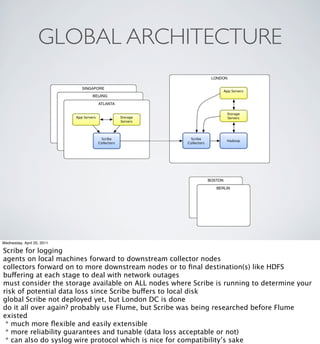
Scribe for logging
agents on local machines forward to downstream collector nodes
collectors forward on to more downstream nodes or to final destination(s) like HDFS
buffering at each stage to deal with network outages
must consider the storage available on ALL nodes where Scribe is running to determine your
risk of potential data loss since Scribe buffers to local disk
global Scribe not deployed yet, but London DC is done
do it all over again? probably use Flume, but Scribe was being researched before Flume
existed
 * much more flexible and easily extensible
 * more reliability guarantees and tunable (data loss acceptable or not)
 * can also do syslog wire protocol which is nice for compatibility’s sake
DATA NODE HARDWARE

                DC          LONDON                     BERLIN

              cores         12x (w/ HT)                4x 2.00 GHz (w/ HT)

               RAM          48GB                       16GB

               disks        12x 2TB                    4x 1TB

            storage         24TB                       4TB

               LAN          1Gb                        2x 1Gb (bonded)

Wednesday, April 20, 2011

http://www.flickr.com/photos/torkildr/3462607995/in/photostream/

BERLIN
•HP DL160 G6
•1x Quad-core Intel Xeon E5504 @ 2.00 GHz (4-cores total)
•16GB DDR3 RAM
•4x 1TB 7200 RPM SATA
•2x 1Gb LAN
•iLO Lights-Out 100 Advanced
MASTER NODE HARDWARE

                DC          LONDON                    BERLIN

              cores         12x (w/ HT)               8x 2.00 GHz (w/ HT)

               RAM          48GB                      32GB

               disks        12x 2TB                   4x 1TB

            storage         24TB                      4TB

               LAN          10Gb                      4x 1Gb (bonded, DRBD/Heartbeat)

Wednesday, April 20, 2011

BERLIN
•HP DL160 G6
•2x Quad-core Intel Xeon E5504 @ 2.00 GHz (8-cores total)
•32GB DDR3 RAM
•4x 1TB 7200 RPM SATA
•4x 1Gb Ethernet (2x LAN, 2x DRBD/Heartbeat)
•iLO Lights-Out 100 Advanced (hadoop-master[01-02]-ilo.devbln)
MEANING?

    •   Size

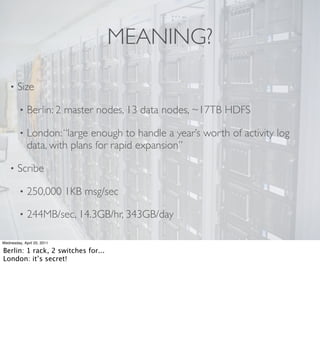
         •   Berlin: 2 master nodes, 13 data nodes, ~17TB HDFS

         •   London: “large enough to handle a year’s worth of activity log
             data, with plans for rapid expansion”

    •   Scribe

         •   250,000 1KB msg/sec

         •   244MB/sec, 14.3GB/hr, 343GB/day

Wednesday, April 20, 2011

Berlin: 1 rack, 2 switches for...
London: it’s secret!
PHYSICAL OR CLOUD?
  •   Physical                                       •   Cloud (AWS)
        •   Capital cost                                 •   Elastic MR, 15 extra large nodes, 10%
                                                             utilized: $1,560
             •   1 rack w/ 2x switches
                                                         •   S3, 5TB: $7,800
             •   15x HP DL160 servers
                                                         •   $9,360 or €6,835
             •   ~€20,000
        •   Annual operating costs
             •   power and cooling: €5,265 @ €0.24
                 kWh
             •   rent: €3,600
             •   hardware support contract: €2,000
                 (disks replaced on warranty)
             •   €10,865

Wednesday, April 20, 2011

http://www.flickr.com/photos/dumbledad/4745475799/

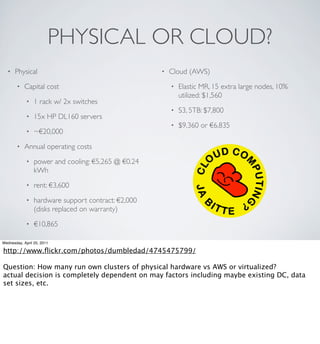
Question: How many run own clusters of physical hardware vs AWS or virtualized?
actual decision is completely dependent on may factors including maybe existing DC, data
set sizes, etc.
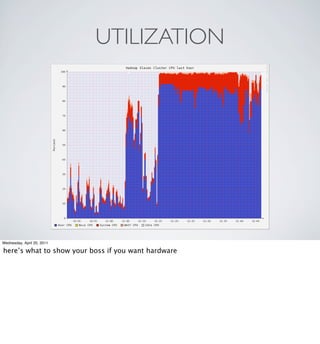
UTILIZATION


Wednesday, April 20, 2011

here’s what to show your boss if you want hardware
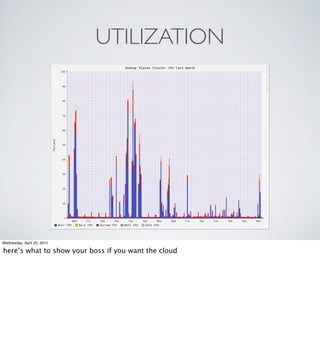
UTILIZATION


Wednesday, April 20, 2011

here’s what to show your boss if you want the cloud
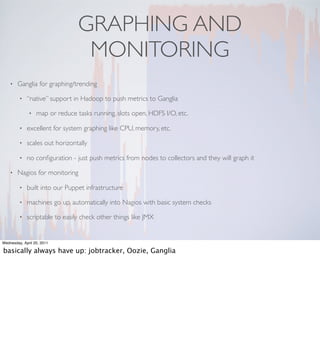
GRAPHING AND
                                  MONITORING
    •   Ganglia for graphing/trending

         •   “native” support in Hadoop to push metrics to Ganglia

              •   map or reduce tasks running, slots open, HDFS I/O, etc.

         •   excellent for system graphing like CPU, memory, etc.

         •   scales out horizontally

         •   no configuration - just push metrics from nodes to collectors and they will graph it

    •   Nagios for monitoring

         •   built into our Puppet infrastructure

         •   machines go up, automatically into Nagios with basic system checks

         •   scriptable to easily check other things like JMX


Wednesday, April 20, 2011

basically always have up: jobtracker, Oozie, Ganglia
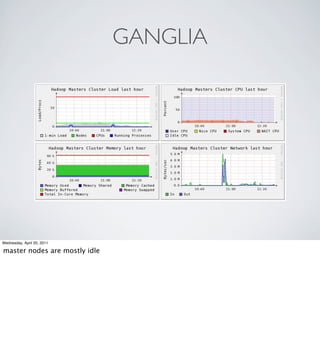
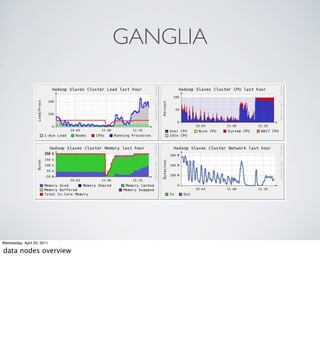
GANGLIA


Wednesday, April 20, 2011

master nodes are mostly idle
GANGLIA


Wednesday, April 20, 2011

data nodes overview
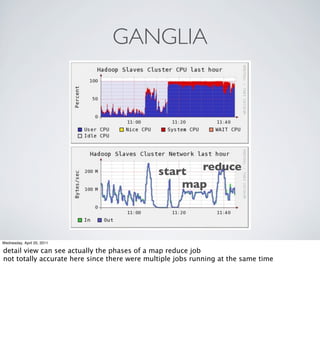
GANGLIA


                                              start reduce
                                                  map


Wednesday, April 20, 2011

detail view can see actually the phases of a map reduce job
not totally accurate here since there were multiple jobs running at the same time
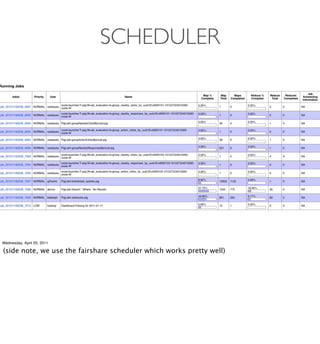
SCHEDULER


Wednesday, April 20, 2011

(side note, we use the fairshare scheduler which works pretty well)
INFRASTRUCTURE
                              MANAGEMENT


Wednesday, April 20, 2011

we use Puppet
Question: Who here has used or knows of Puppet/Chef/etc?

pros
 * used throughout the rest of our infrastructure
 * all configuration of Hadoop and machines is in source control/Subversion
cons
 * no push from central
 * can only pull from each node (pssh is your friend, poke Puppet on all nodes)
 * that’s it, Puppet rules
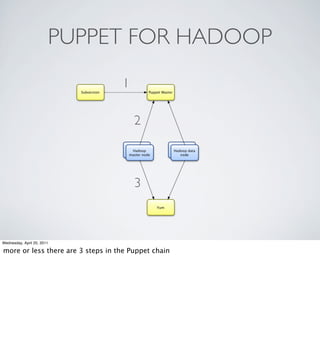
PUPPET FOR HADOOP
                                   1

                                       2


                                       3


Wednesday, April 20, 2011

more or less there are 3 steps in the Puppet chain
PUPPET FOR HADOOP
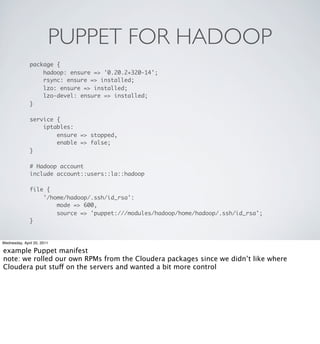
               package {
                   hadoop: ensure => '0.20.2+320-14';
                   rsync: ensure => installed;
                   lzo: ensure => installed;
                   lzo-devel: ensure => installed;
               }

               service {
                   iptables:
                       ensure => stopped,
                       enable => false;
               }

               # Hadoop account
               include account::users::la::hadoop

               file {
                   '/home/hadoop/.ssh/id_rsa':
                       mode => 600,
                       source => 'puppet:///modules/hadoop/home/hadoop/.ssh/id_rsa';
               }


Wednesday, April 20, 2011

example Puppet manifest
note: we rolled our own RPMs from the Cloudera packages since we didn’t like where
Cloudera put stuff on the servers and wanted a bit more control
PUPPET FOR HADOOP
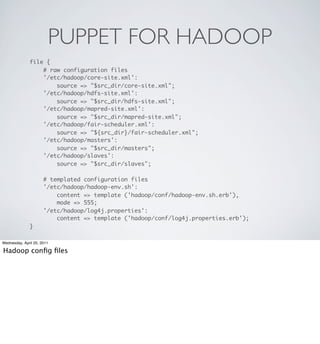
               file {
                   # raw configuration files
                   '/etc/hadoop/core-site.xml':
                       source => "$src_dir/core-site.xml";
                   '/etc/hadoop/hdfs-site.xml':
                       source => "$src_dir/hdfs-site.xml";
                   '/etc/hadoop/mapred-site.xml':
                       source => "$src_dir/mapred-site.xml";
                   '/etc/hadoop/fair-scheduler.xml':
                       source => "${src_dir}/fair-scheduler.xml";
                   '/etc/hadoop/masters':
                       source => "$src_dir/masters";
                   '/etc/hadoop/slaves':
                       source => "$src_dir/slaves";

                      # templated configuration files
                      '/etc/hadoop/hadoop-env.sh':
                          content => template ('hadoop/conf/hadoop-env.sh.erb'),
                          mode => 555;
                      '/etc/hadoop/log4j.properties':
                          content => template ('hadoop/conf/log4j.properties.erb');
               }

Wednesday, April 20, 2011

Hadoop config files
APPLICATIONS


Wednesday, April 20, 2011

http://www.flickr.com/photos/thomaspurves/1039363039/sizes/o/in/photostream/

that wrap’s up the setup stuff, any questions on that?
REPORTING


Wednesday, April 20, 2011

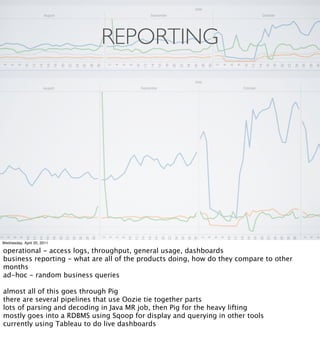
operational - access logs, throughput, general usage, dashboards
business reporting - what are all of the products doing, how do they compare to other
months
ad-hoc - random business queries

almost all of this goes through Pig
there are several pipelines that use Oozie tie together parts
lots of parsing and decoding in Java MR job, then Pig for the heavy lifting
mostly goes into a RDBMS using Sqoop for display and querying in other tools
currently using Tableau to do live dashboards
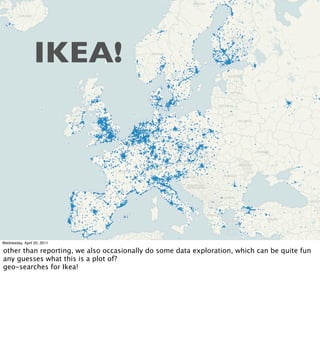
IKEA!


Wednesday, April 20, 2011

other than reporting, we also occasionally do some data exploration, which can be quite fun
any guesses what this is a plot of?
geo-searches for Ikea!
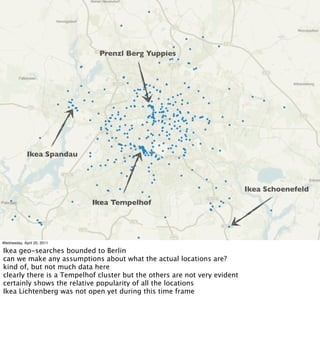
Prenzl Berg Yuppies


             Ikea Spandau


                                                                           Ikea Schoenefeld
                            Ikea Tempelhof


Wednesday, April 20, 2011

Ikea geo-searches bounded to Berlin
can we make any assumptions about what the actual locations are?
kind of, but not much data here
clearly there is a Tempelhof cluster but the others are not very evident
certainly shows the relative popularity of all the locations
Ikea Lichtenberg was not open yet during this time frame
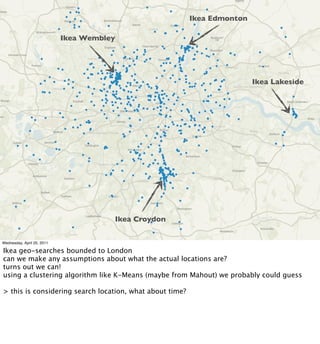
Ikea Edmonton

                            Ikea Wembley


                                                                          Ikea Lakeside


                                       Ikea Croydon


Wednesday, April 20, 2011

Ikea geo-searches bounded to London
can we make any assumptions about what the actual locations are?
turns out we can!
using a clustering algorithm like K-Means (maybe from Mahout) we probably could guess

> this is considering search location, what about time?
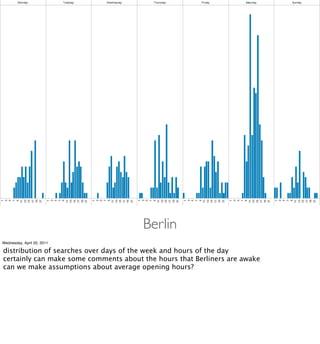
Berlin
Wednesday, April 20, 2011

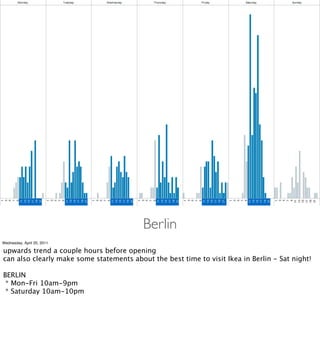
distribution of searches over days of the week and hours of the day
certainly can make some comments about the hours that Berliners are awake
can we make assumptions about average opening hours?
Berlin
Wednesday, April 20, 2011

upwards trend a couple hours before opening
can also clearly make some statements about the best time to visit Ikea in Berlin - Sat night!

BERLIN
 * Mon-Fri 10am-9pm
 * Saturday 10am-10pm
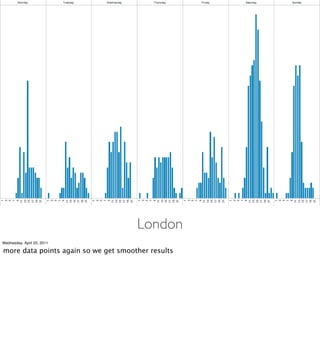
London
Wednesday, April 20, 2011

more data points again so we get smoother results
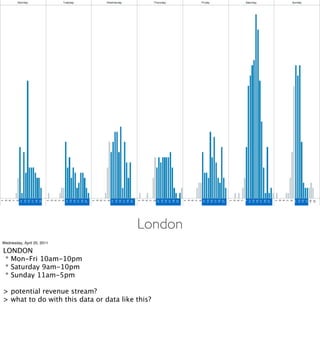
London
Wednesday, April 20, 2011

LONDON
 * Mon-Fri 10am-10pm
 * Saturday 9am-10pm
 * Sunday 11am-5pm

> potential revenue stream?
> what to do with this data or data like this?
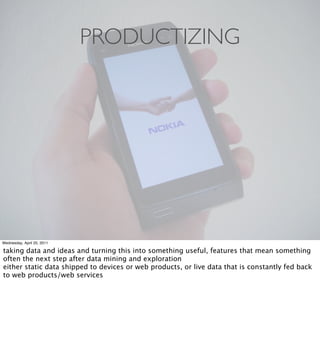
PRODUCTIZING


Wednesday, April 20, 2011

taking data and ideas and turning this into something useful, features that mean something
often the next step after data mining and exploration
either static data shipped to devices or web products, or live data that is constantly fed back
to web products/web services
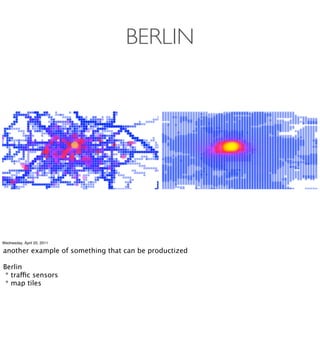
BERLIN


Wednesday, April 20, 2011

another example of something that can be productized

Berlin
 * traffic sensors
 * map tiles
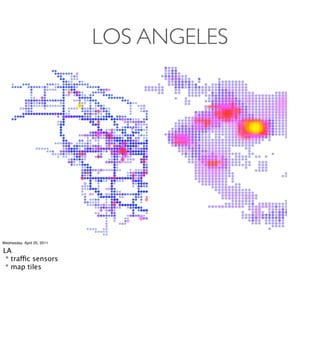
LOS ANGELES


Wednesday, April 20, 2011

LA
 * traffic sensors
 * map tiles
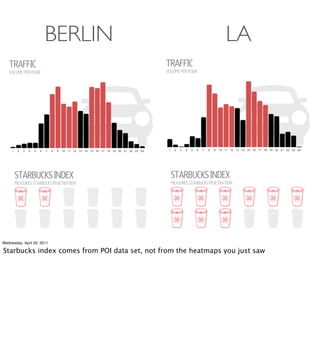
BERLIN                                  LA


Wednesday, April 20, 2011

Starbucks index comes from POI data set, not from the heatmaps you just saw
JOIN US!

    • Nokia                 is hiring in Berlin!

         • analytics            engineers, smart data folks

         • software              engineers

         • operations

         • josh.devins@nokia.com

         • www.nokia.com/careers

Wednesday, April 20, 2011
THANKS!
        JOSH DEVINS         www.joshdevins.net   @joshdevins


Wednesday, April 20, 2011

Hadoop at Nokia

  • 1.
    H A DO O P AT N O K I A JOSH DEVINS, NOKIA HADOOP MEETUP, JANUARY 2011 BERLIN Wednesday, April 20, 2011 Two parts: * technical setup * applications before starting Question: Hadoop experience levels from none to some to lots, and what about cluster mgmt?
  • 2.
    TECHNICAL SETUP Wednesday, April20, 2011 http://www.flickr.com/photos/josecamoessilva/2873298422/sizes/o/in/photostream/
  • 3.
    GLOBAL ARCHITECTURE Wednesday, April20, 2011 Scribe for logging agents on local machines forward to downstream collector nodes collectors forward on to more downstream nodes or to final destination(s) like HDFS buffering at each stage to deal with network outages must consider the storage available on ALL nodes where Scribe is running to determine your risk of potential data loss since Scribe buffers to local disk global Scribe not deployed yet, but London DC is done do it all over again? probably use Flume, but Scribe was being researched before Flume existed * much more flexible and easily extensible * more reliability guarantees and tunable (data loss acceptable or not) * can also do syslog wire protocol which is nice for compatibility’s sake
  • 4.
    DATA NODE HARDWARE DC LONDON BERLIN cores 12x (w/ HT) 4x 2.00 GHz (w/ HT) RAM 48GB 16GB disks 12x 2TB 4x 1TB storage 24TB 4TB LAN 1Gb 2x 1Gb (bonded) Wednesday, April 20, 2011 http://www.flickr.com/photos/torkildr/3462607995/in/photostream/ BERLIN •HP DL160 G6 •1x Quad-core Intel Xeon E5504 @ 2.00 GHz (4-cores total) •16GB DDR3 RAM •4x 1TB 7200 RPM SATA •2x 1Gb LAN •iLO Lights-Out 100 Advanced
  • 5.
    MASTER NODE HARDWARE DC LONDON BERLIN cores 12x (w/ HT) 8x 2.00 GHz (w/ HT) RAM 48GB 32GB disks 12x 2TB 4x 1TB storage 24TB 4TB LAN 10Gb 4x 1Gb (bonded, DRBD/Heartbeat) Wednesday, April 20, 2011 BERLIN •HP DL160 G6 •2x Quad-core Intel Xeon E5504 @ 2.00 GHz (8-cores total) •32GB DDR3 RAM •4x 1TB 7200 RPM SATA •4x 1Gb Ethernet (2x LAN, 2x DRBD/Heartbeat) •iLO Lights-Out 100 Advanced (hadoop-master[01-02]-ilo.devbln)
  • 6.
    MEANING? • Size • Berlin: 2 master nodes, 13 data nodes, ~17TB HDFS • London: “large enough to handle a year’s worth of activity log data, with plans for rapid expansion” • Scribe • 250,000 1KB msg/sec • 244MB/sec, 14.3GB/hr, 343GB/day Wednesday, April 20, 2011 Berlin: 1 rack, 2 switches for... London: it’s secret!
  • 7.
    PHYSICAL OR CLOUD? • Physical • Cloud (AWS) • Capital cost • Elastic MR, 15 extra large nodes, 10% utilized: $1,560 • 1 rack w/ 2x switches • S3, 5TB: $7,800 • 15x HP DL160 servers • $9,360 or €6,835 • ~€20,000 • Annual operating costs • power and cooling: €5,265 @ €0.24 kWh • rent: €3,600 • hardware support contract: €2,000 (disks replaced on warranty) • €10,865 Wednesday, April 20, 2011 http://www.flickr.com/photos/dumbledad/4745475799/ Question: How many run own clusters of physical hardware vs AWS or virtualized? actual decision is completely dependent on may factors including maybe existing DC, data set sizes, etc.
  • 8.
    UTILIZATION Wednesday, April 20,2011 here’s what to show your boss if you want hardware
  • 9.
    UTILIZATION Wednesday, April 20,2011 here’s what to show your boss if you want the cloud
  • 10.
    GRAPHING AND MONITORING • Ganglia for graphing/trending • “native” support in Hadoop to push metrics to Ganglia • map or reduce tasks running, slots open, HDFS I/O, etc. • excellent for system graphing like CPU, memory, etc. • scales out horizontally • no configuration - just push metrics from nodes to collectors and they will graph it • Nagios for monitoring • built into our Puppet infrastructure • machines go up, automatically into Nagios with basic system checks • scriptable to easily check other things like JMX Wednesday, April 20, 2011 basically always have up: jobtracker, Oozie, Ganglia
  • 11.
    GANGLIA Wednesday, April 20,2011 master nodes are mostly idle
  • 12.
    GANGLIA Wednesday, April 20,2011 data nodes overview
  • 13.
    GANGLIA start reduce map Wednesday, April 20, 2011 detail view can see actually the phases of a map reduce job not totally accurate here since there were multiple jobs running at the same time
  • 14.
    SCHEDULER Wednesday, April 20,2011 (side note, we use the fairshare scheduler which works pretty well)
  • 15.
    INFRASTRUCTURE MANAGEMENT Wednesday, April 20, 2011 we use Puppet Question: Who here has used or knows of Puppet/Chef/etc? pros * used throughout the rest of our infrastructure * all configuration of Hadoop and machines is in source control/Subversion cons * no push from central * can only pull from each node (pssh is your friend, poke Puppet on all nodes) * that’s it, Puppet rules
  • 16.
    PUPPET FOR HADOOP 1 2 3 Wednesday, April 20, 2011 more or less there are 3 steps in the Puppet chain
  • 17.
    PUPPET FOR HADOOP package { hadoop: ensure => '0.20.2+320-14'; rsync: ensure => installed; lzo: ensure => installed; lzo-devel: ensure => installed; } service { iptables: ensure => stopped, enable => false; } # Hadoop account include account::users::la::hadoop file { '/home/hadoop/.ssh/id_rsa': mode => 600, source => 'puppet:///modules/hadoop/home/hadoop/.ssh/id_rsa'; } Wednesday, April 20, 2011 example Puppet manifest note: we rolled our own RPMs from the Cloudera packages since we didn’t like where Cloudera put stuff on the servers and wanted a bit more control
  • 18.
    PUPPET FOR HADOOP file { # raw configuration files '/etc/hadoop/core-site.xml': source => "$src_dir/core-site.xml"; '/etc/hadoop/hdfs-site.xml': source => "$src_dir/hdfs-site.xml"; '/etc/hadoop/mapred-site.xml': source => "$src_dir/mapred-site.xml"; '/etc/hadoop/fair-scheduler.xml': source => "${src_dir}/fair-scheduler.xml"; '/etc/hadoop/masters': source => "$src_dir/masters"; '/etc/hadoop/slaves': source => "$src_dir/slaves"; # templated configuration files '/etc/hadoop/hadoop-env.sh': content => template ('hadoop/conf/hadoop-env.sh.erb'), mode => 555; '/etc/hadoop/log4j.properties': content => template ('hadoop/conf/log4j.properties.erb'); } Wednesday, April 20, 2011 Hadoop config files
  • 19.
    APPLICATIONS Wednesday, April 20,2011 http://www.flickr.com/photos/thomaspurves/1039363039/sizes/o/in/photostream/ that wrap’s up the setup stuff, any questions on that?
  • 20.
    REPORTING Wednesday, April 20,2011 operational - access logs, throughput, general usage, dashboards business reporting - what are all of the products doing, how do they compare to other months ad-hoc - random business queries almost all of this goes through Pig there are several pipelines that use Oozie tie together parts lots of parsing and decoding in Java MR job, then Pig for the heavy lifting mostly goes into a RDBMS using Sqoop for display and querying in other tools currently using Tableau to do live dashboards
  • 21.
    IKEA! Wednesday, April 20,2011 other than reporting, we also occasionally do some data exploration, which can be quite fun any guesses what this is a plot of? geo-searches for Ikea!
  • 22.
    Prenzl Berg Yuppies Ikea Spandau Ikea Schoenefeld Ikea Tempelhof Wednesday, April 20, 2011 Ikea geo-searches bounded to Berlin can we make any assumptions about what the actual locations are? kind of, but not much data here clearly there is a Tempelhof cluster but the others are not very evident certainly shows the relative popularity of all the locations Ikea Lichtenberg was not open yet during this time frame
  • 23.
    Ikea Edmonton Ikea Wembley Ikea Lakeside Ikea Croydon Wednesday, April 20, 2011 Ikea geo-searches bounded to London can we make any assumptions about what the actual locations are? turns out we can! using a clustering algorithm like K-Means (maybe from Mahout) we probably could guess > this is considering search location, what about time?
  • 24.
    Berlin Wednesday, April 20,2011 distribution of searches over days of the week and hours of the day certainly can make some comments about the hours that Berliners are awake can we make assumptions about average opening hours?
  • 25.
    Berlin Wednesday, April 20,2011 upwards trend a couple hours before opening can also clearly make some statements about the best time to visit Ikea in Berlin - Sat night! BERLIN * Mon-Fri 10am-9pm * Saturday 10am-10pm
  • 26.
    London Wednesday, April 20,2011 more data points again so we get smoother results
  • 27.
    London Wednesday, April 20,2011 LONDON * Mon-Fri 10am-10pm * Saturday 9am-10pm * Sunday 11am-5pm > potential revenue stream? > what to do with this data or data like this?
  • 28.
    PRODUCTIZING Wednesday, April 20,2011 taking data and ideas and turning this into something useful, features that mean something often the next step after data mining and exploration either static data shipped to devices or web products, or live data that is constantly fed back to web products/web services
  • 29.
    BERLIN Wednesday, April 20,2011 another example of something that can be productized Berlin * traffic sensors * map tiles
  • 30.
    LOS ANGELES Wednesday, April20, 2011 LA * traffic sensors * map tiles
  • 31.
    BERLIN LA Wednesday, April 20, 2011 Starbucks index comes from POI data set, not from the heatmaps you just saw
  • 32.
    JOIN US! • Nokia is hiring in Berlin! • analytics engineers, smart data folks • software engineers • operations • josh.devins@nokia.com • www.nokia.com/careers Wednesday, April 20, 2011
  • 33.
    THANKS! JOSH DEVINS www.joshdevins.net @joshdevins Wednesday, April 20, 2011