Hacking Tomcat Secrets Revealed
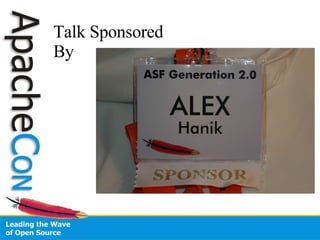
Talk Sponsored    By
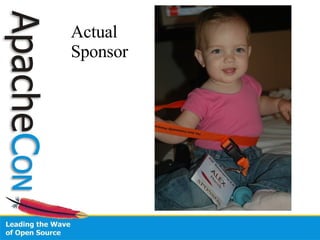
Actual    Sponsor
Who am I – bla bla [email_address] Tomcat Committer / ASF member Co-designed the Comet implementation Implemented NIO connector in 6 Responsible for session replication and clustering Been involved with ASF since 2001
Who are We Top Level Project – tomcat.apache.org 24 committers on file Active/core group is much smaller Find us on  [email_address] Work on what interests you and work without guidance Our people skills are improving ;)
Welcome to Tomcat We are Hiring!!!
What we will cover History of Tomcat The Basics Configuration and Container Architecture The Advanced Swappable Components Tomcat Connectors Servlet Container JSP Compiler Developing/Debugging Tomcat
What We Will Not Cover Too Basic stuff – This is a technical presentation Configuration details How the actual JSP .jsp to .java compiler works Forked Tomcat code bases, how they differ and why they happened Older versions of Tomcat, we will work with Tomcat 6, no looking back  
History of Tomcat Started out as a reference implemenation by Sun Microsystem Donated to ASF – Tomcat 3 (roughly 1999) Tomcat 4 – New specs & First rewrite – Codename Catalina Tomcat 5.0 New specs Tomcat 5.5 – 2nd Rewrite – Performance Tomcat 6.0 – New specs, New Cool Features
Basics server.xml Main configuration file Builds server on “the fly” Parsed using commons-digester Tomcat has hard coded rule sets for the parsing Every element/component is swappable
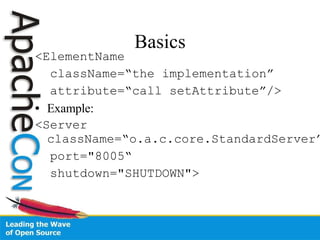
Basics <ElementName className=“the implementation” attribute=“call setAttribute”/> Example: <Server className=“o.a.c.core.StandardServer”  port=&quot;8005“ shutdown=&quot;SHUTDOWN&quot;>
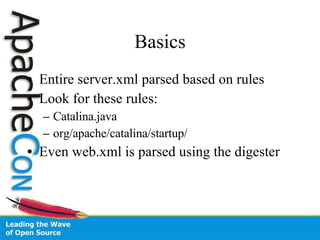
Basics Entire server.xml parsed based on rules Look for these rules: Catalina.java org/apache/catalina/startup/ Even web.xml is parsed using the digester
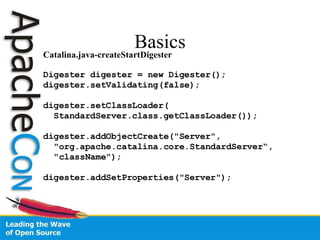
Basics Catalina.java-createStartDigester Digester digester = new Digester(); digester.setValidating(false); digester.setClassLoader( StandardServer.class.getClassLoader()); digester.addObjectCreate(&quot;Server&quot;,  &quot;org.apache.catalina.core.StandardServer“, &quot;className&quot;); digester.addSetProperties(&quot;Server&quot;);
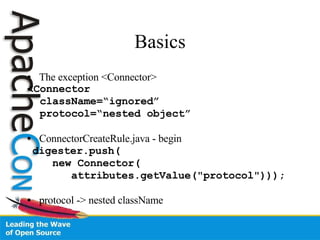
Basics The exception <Connector> <Connector  className=“ignored” protocol=“nested object” ConnectorCreateRule.java - begin digester.push( new Connector( attributes.getValue(&quot;protocol&quot;))); protocol -> nested className
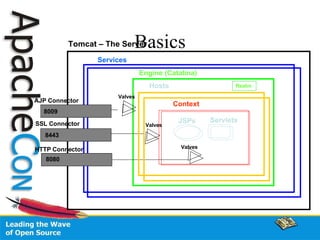
Basics Tomcat – The Server Services Engine (Catalina) Context JSPs Servlets Valves AJP Connector 8009 SSL Connector 8443 8080 HTTP Connector Hosts Realm Valves Valves
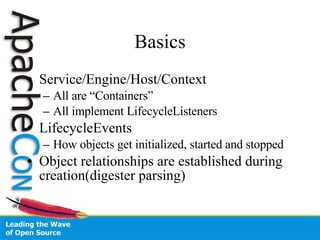
Basics Service/Engine/Host/Context All are “Containers” All implement LifecycleListeners LifecycleEvents How objects get initialized, started and stopped Object relationships are established during creation(digester parsing)
Basics Last Basics – I promise conf/web.xml Default web.xml Merged with webapps WEB-INF/web.xml DefaultServlet –static content JSP Servlet – JSP files conf/context.xml Merged with apps <Context> definition
Advanced Connectors – the entry point Servlet Engine and Container Design Jasper – The JSP engine Valves – interceptor pattern Developing and Debugging How to join – if you are interested
Performance Tip Tomcat produces very little GC Most objects are pooled Even though makers of VM say, never pool objects Prevents CPU/GC jigsaw pattern Resetting fields is faster than GC old object, create new object and initialize No GC lock up surprises
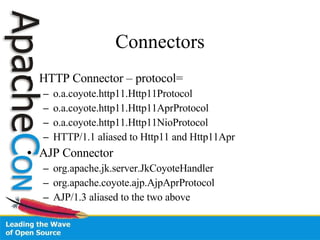
Connectors HTTP Connector – protocol= o.a.coyote.http11.Http11Protocol o.a.coyote.http11.Http11AprProtocol o.a.coyote.http11.Http11NioProtocol HTTP/1.1 aliased to Http11 and Http11Apr AJP Connector org.apache.jk.server.JkCoyoteHandler org.apache.coyote.ajp.AjpAprProtocol AJP/1.3 aliased to the two above
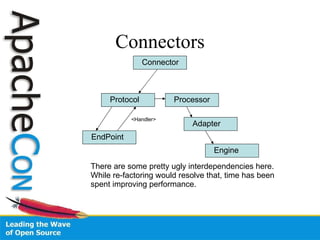
Connectors <Handler> There are some pretty ugly interdependencies here. While re-factoring would resolve that, time has been  spent improving performance. Connector Protocol EndPoint Processor Adapter Engine
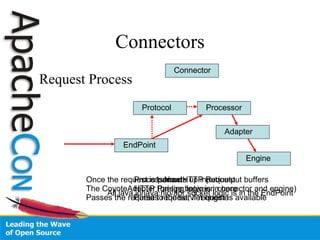
Connectors Request Process 1. New HTTP Request All java.io/java.nio/apr socket logic is in the EndPoint Processor sets up input/output buffers HTTP Parsing logic is in here Parses request, if request is available Once the request is parsed The CoyoteAdapter (bridge between connector and engine) Passes the request to the servlet engine Connector Protocol EndPoint Processor Adapter Engine
Performance Tip MessageBytes.java All HTTP Parsing doesn’t deal with strings Every chunk of data gets parsed into a MessageBytes object This object represents a ‘string’ in the HTTP header Avoid string comparison routines Doesn’t contain copy of byte[], but a pointer to the original data with an offset and length
Performance Tip Use Http11Protocol  Keep Alive is turned off Kernel accept filter is in place Use Http11AprProtocol Take advantage of SEND_FILE Native SSL handling Comet Support Use Http11NioProtocol Take advantage of SEND_FILE Large number of sockets using Keep Alive APR is not available or JNI is not preferred Comet Support
Advanced CoyoteAdapter.java Creates Request/Response objects Maps Request/Response to  A Host object (StandardHost) A Context object (StandardContext) A Servlet (StandardWrapper) Parses Session Cookie URL  Cookie Grabs Engine’s valve and passes the request into the servlet engine
Performance Tip DefaultServlet.java Handles all static content Gets deployed into every webapp through conf/web.xml If SEND_FILE support is enabled it will use it It’s a REGULAR SERVLET!! Files and their attributes are cached You can replace with your own implementation
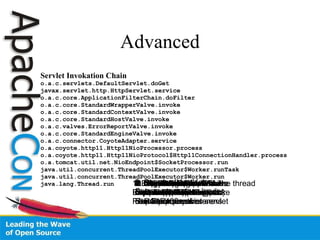
Advanced Servlet Invokation Chain o.a.c.servlets.DefaultServlet.doGet javax.servlet.http.HttpServlet.service o.a.c.core.ApplicationFilterChain.doFilter o.a.c.core.StandardWrapperValve.invoke o.a.c.core.StandardContextValve.invoke o.a.c.core.StandardHostValve.invoke o.a.c.valves.ErrorReportValve.invoke o.a.c.core.StandardEngineValve.invoke o.a.c.connector.CoyoteAdapter.service o.a.coyote.http11.Http11NioProcessor.process o.a.coyote.http11.Http11NioProtocol$Http11ConnectionHandler.process o.a.tomcat.util.net.NioEndpoint$SocketProcessor.run java.util.concurrent.ThreadPoolExecutor$Worker.runTask java.util.concurrent.ThreadPoolExecutor$Worker.run java.lang.Thread.run 1. Everything starts with the thread 2. NIO Connector defaults  to ThreadPoolExecutor 3. SocketProcessor –  Simple Runnable to invoke  Handler.process 4. HttpProcessor –  parses HTTP request 5. CoyoteAdapter Creates Request Response pair 6. StandardEngineValve First valve in the engine  container 7. ErrorReportValve Catches Throwable  Reports 400+ errors 8. StandardHostValve Sets context class loader 9. StandardContextValve Invokes (spec) ServletRequestListeners 10. StandardWrapperValve Invokes (spec) FilterChain 11. ApplicationFilterChain Represents Servlet (spec) FilterChain, invokes servlet 12. The Servlet Execution of the servlet
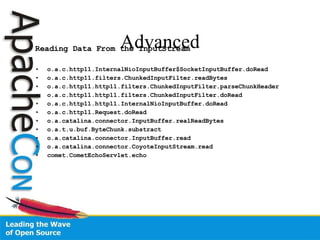
Advanced Reading Data From the InputStream o.a.c.http11.InternalNioInputBuffer$SocketInputBuffer.doRead o.a.c.http11.filters.ChunkedInputFilter.readBytes o.a.c.http11.http11.filters.ChunkedInputFilter.parseChunkHeader  o.a.c.http11.http11.filters.ChunkedInputFilter.doRead o.a.c.http11.http11.InternalNioInputBuffer.doRead o.a.c.http11.Request.doRead o.a.catalina.connector.InputBuffer.realReadBytes o.a.t.u.buf.ByteChunk.substract o.a.catalina.connector.InputBuffer.read o.a.catalina.connector.CoyoteInputStream.read comet.CometEchoServlet.echo
Performance Tip JspServlet.java Handles all JSP files Gets deployed into every webapp through conf/web.xml Mapping done through URL patterns (per spec) It’s a REGULAR SERVLET!! Connects into the Jasper engine
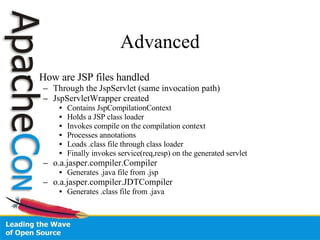
Advanced How are JSP files handled Through the JspServlet (same invocation path) JspServletWrapper created Contains JspCompilationContext Holds a JSP class loader Invokes compile on the compilation context Processes annotations Loads .class file through class loader Finally invokes service(req,resp) on the generated servlet o.a.jasper.compiler.Compiler Generates .java file from .jsp o.a.jasper.compiler.JDTCompiler Generates .class file from .java
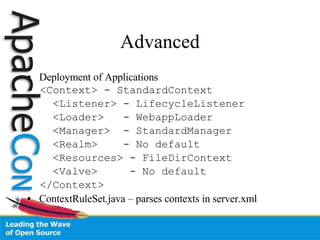
Advanced Deployment of Applications  <Context> - StandardContext <Listener> - LifecycleListener <Loader>  - WebappLoader <Manager>  - StandardManager <Realm>  - No default <Resources> - FileDirContext <Valve>  - No default </Context> ContextRuleSet.java – parses contexts in server.xml
Advanced Deployment of applications The deployer is HostConfig.java Each StandardHost.java object holds a reference to a HostConfig Deploy order context.xml files WAR files Directories /ROOT is hardcoded for path=“” Runtime deployment triggered by LifecycleEvent
Advanced Developing/Debugging SVN Repo for TC 6 is simplified trunk/java – all you need svn co/ant download/ant – builds the system Run inside a debugger by emulating the catalina.sh/catalina.bat if you wish Everything is java, breakpoints anywhere
Performance Tip Does it scale Yes, its been tested with 16k concurrent and active connections on a –Xmx512m system Performance increases well as new CPUs are added RAM is your “max # concurrent connection” limitation Simple tests run at  http://blog.covalent.net/roller/covalent/entry/20070308
Performance Tip Tuning Mostly in the application itself, Tomcat default is pretty good When it comes down to nuts and bolts, the tuning is in the connectors NIO connector, by far the most tuning options (see docs) Socket and App buffers usually the most important aspect for “write-speed” APR connector, speedy little devil, not as many options, but relies on APR below being well tuned.
Performance Tip Tuning the servlet engine Sure, it can be done, but not through configuration Most common bottlenecks turn out to be synchronized statements or locks Compared to the webapp or the connector, spending time tuning the engine is not worth the time
Conclusion Not so difficult on first impression Slightly confusing on second impression Once you get a hang of it, go crazy Modular design, and nasty deps Not the typical text book java design Find something interesting? want to contribute? – take initiative, don’t be shy
Want to join? Ideas for needed projects Better deployer Documentation Administration tool Better JMX support Remote and Cluster deployments Live status – dash board SIP support The list goes on, take your pick!
Q & A Lots and Lots covered Only a drop in the sea, but enough to get you started not enough time [email_address]  – anytime [email_address]  – be brave http://people.apache.org/~fhanik  for the presentation

Hacking Tomcat

  • 1.
  • 2.
  • 3.
    Actual Sponsor
  • 4.
    Who am I– bla bla [email_address] Tomcat Committer / ASF member Co-designed the Comet implementation Implemented NIO connector in 6 Responsible for session replication and clustering Been involved with ASF since 2001
  • 5.
    Who are WeTop Level Project – tomcat.apache.org 24 committers on file Active/core group is much smaller Find us on [email_address] Work on what interests you and work without guidance Our people skills are improving ;)
  • 6.
    Welcome to TomcatWe are Hiring!!!
  • 7.
    What we willcover History of Tomcat The Basics Configuration and Container Architecture The Advanced Swappable Components Tomcat Connectors Servlet Container JSP Compiler Developing/Debugging Tomcat
  • 8.
    What We WillNot Cover Too Basic stuff – This is a technical presentation Configuration details How the actual JSP .jsp to .java compiler works Forked Tomcat code bases, how they differ and why they happened Older versions of Tomcat, we will work with Tomcat 6, no looking back 
  • 9.
    History of TomcatStarted out as a reference implemenation by Sun Microsystem Donated to ASF – Tomcat 3 (roughly 1999) Tomcat 4 – New specs & First rewrite – Codename Catalina Tomcat 5.0 New specs Tomcat 5.5 – 2nd Rewrite – Performance Tomcat 6.0 – New specs, New Cool Features
  • 10.
    Basics server.xml Mainconfiguration file Builds server on “the fly” Parsed using commons-digester Tomcat has hard coded rule sets for the parsing Every element/component is swappable
  • 11.
    Basics <ElementName className=“theimplementation” attribute=“call setAttribute”/> Example: <Server className=“o.a.c.core.StandardServer” port=&quot;8005“ shutdown=&quot;SHUTDOWN&quot;>
  • 12.
    Basics Entire server.xmlparsed based on rules Look for these rules: Catalina.java org/apache/catalina/startup/ Even web.xml is parsed using the digester
  • 13.
    Basics Catalina.java-createStartDigester Digesterdigester = new Digester(); digester.setValidating(false); digester.setClassLoader( StandardServer.class.getClassLoader()); digester.addObjectCreate(&quot;Server&quot;, &quot;org.apache.catalina.core.StandardServer“, &quot;className&quot;); digester.addSetProperties(&quot;Server&quot;);
  • 14.
    Basics The exception<Connector> <Connector className=“ignored” protocol=“nested object” ConnectorCreateRule.java - begin digester.push( new Connector( attributes.getValue(&quot;protocol&quot;))); protocol -> nested className
  • 15.
    Basics Tomcat –The Server Services Engine (Catalina) Context JSPs Servlets Valves AJP Connector 8009 SSL Connector 8443 8080 HTTP Connector Hosts Realm Valves Valves
  • 16.
    Basics Service/Engine/Host/Context Allare “Containers” All implement LifecycleListeners LifecycleEvents How objects get initialized, started and stopped Object relationships are established during creation(digester parsing)
  • 17.
    Basics Last Basics– I promise conf/web.xml Default web.xml Merged with webapps WEB-INF/web.xml DefaultServlet –static content JSP Servlet – JSP files conf/context.xml Merged with apps <Context> definition
  • 18.
    Advanced Connectors –the entry point Servlet Engine and Container Design Jasper – The JSP engine Valves – interceptor pattern Developing and Debugging How to join – if you are interested
  • 19.
    Performance Tip Tomcatproduces very little GC Most objects are pooled Even though makers of VM say, never pool objects Prevents CPU/GC jigsaw pattern Resetting fields is faster than GC old object, create new object and initialize No GC lock up surprises
  • 20.
    Connectors HTTP Connector– protocol= o.a.coyote.http11.Http11Protocol o.a.coyote.http11.Http11AprProtocol o.a.coyote.http11.Http11NioProtocol HTTP/1.1 aliased to Http11 and Http11Apr AJP Connector org.apache.jk.server.JkCoyoteHandler org.apache.coyote.ajp.AjpAprProtocol AJP/1.3 aliased to the two above
  • 21.
    Connectors <Handler> Thereare some pretty ugly interdependencies here. While re-factoring would resolve that, time has been spent improving performance. Connector Protocol EndPoint Processor Adapter Engine
  • 22.
    Connectors Request Process1. New HTTP Request All java.io/java.nio/apr socket logic is in the EndPoint Processor sets up input/output buffers HTTP Parsing logic is in here Parses request, if request is available Once the request is parsed The CoyoteAdapter (bridge between connector and engine) Passes the request to the servlet engine Connector Protocol EndPoint Processor Adapter Engine
  • 23.
    Performance Tip MessageBytes.javaAll HTTP Parsing doesn’t deal with strings Every chunk of data gets parsed into a MessageBytes object This object represents a ‘string’ in the HTTP header Avoid string comparison routines Doesn’t contain copy of byte[], but a pointer to the original data with an offset and length
  • 24.
    Performance Tip UseHttp11Protocol Keep Alive is turned off Kernel accept filter is in place Use Http11AprProtocol Take advantage of SEND_FILE Native SSL handling Comet Support Use Http11NioProtocol Take advantage of SEND_FILE Large number of sockets using Keep Alive APR is not available or JNI is not preferred Comet Support
  • 25.
    Advanced CoyoteAdapter.java CreatesRequest/Response objects Maps Request/Response to A Host object (StandardHost) A Context object (StandardContext) A Servlet (StandardWrapper) Parses Session Cookie URL Cookie Grabs Engine’s valve and passes the request into the servlet engine
  • 26.
    Performance Tip DefaultServlet.javaHandles all static content Gets deployed into every webapp through conf/web.xml If SEND_FILE support is enabled it will use it It’s a REGULAR SERVLET!! Files and their attributes are cached You can replace with your own implementation
  • 27.
    Advanced Servlet InvokationChain o.a.c.servlets.DefaultServlet.doGet javax.servlet.http.HttpServlet.service o.a.c.core.ApplicationFilterChain.doFilter o.a.c.core.StandardWrapperValve.invoke o.a.c.core.StandardContextValve.invoke o.a.c.core.StandardHostValve.invoke o.a.c.valves.ErrorReportValve.invoke o.a.c.core.StandardEngineValve.invoke o.a.c.connector.CoyoteAdapter.service o.a.coyote.http11.Http11NioProcessor.process o.a.coyote.http11.Http11NioProtocol$Http11ConnectionHandler.process o.a.tomcat.util.net.NioEndpoint$SocketProcessor.run java.util.concurrent.ThreadPoolExecutor$Worker.runTask java.util.concurrent.ThreadPoolExecutor$Worker.run java.lang.Thread.run 1. Everything starts with the thread 2. NIO Connector defaults to ThreadPoolExecutor 3. SocketProcessor – Simple Runnable to invoke Handler.process 4. HttpProcessor – parses HTTP request 5. CoyoteAdapter Creates Request Response pair 6. StandardEngineValve First valve in the engine container 7. ErrorReportValve Catches Throwable Reports 400+ errors 8. StandardHostValve Sets context class loader 9. StandardContextValve Invokes (spec) ServletRequestListeners 10. StandardWrapperValve Invokes (spec) FilterChain 11. ApplicationFilterChain Represents Servlet (spec) FilterChain, invokes servlet 12. The Servlet Execution of the servlet
  • 28.
    Advanced Reading DataFrom the InputStream o.a.c.http11.InternalNioInputBuffer$SocketInputBuffer.doRead o.a.c.http11.filters.ChunkedInputFilter.readBytes o.a.c.http11.http11.filters.ChunkedInputFilter.parseChunkHeader o.a.c.http11.http11.filters.ChunkedInputFilter.doRead o.a.c.http11.http11.InternalNioInputBuffer.doRead o.a.c.http11.Request.doRead o.a.catalina.connector.InputBuffer.realReadBytes o.a.t.u.buf.ByteChunk.substract o.a.catalina.connector.InputBuffer.read o.a.catalina.connector.CoyoteInputStream.read comet.CometEchoServlet.echo
  • 29.
    Performance Tip JspServlet.javaHandles all JSP files Gets deployed into every webapp through conf/web.xml Mapping done through URL patterns (per spec) It’s a REGULAR SERVLET!! Connects into the Jasper engine
  • 30.
    Advanced How areJSP files handled Through the JspServlet (same invocation path) JspServletWrapper created Contains JspCompilationContext Holds a JSP class loader Invokes compile on the compilation context Processes annotations Loads .class file through class loader Finally invokes service(req,resp) on the generated servlet o.a.jasper.compiler.Compiler Generates .java file from .jsp o.a.jasper.compiler.JDTCompiler Generates .class file from .java
  • 31.
    Advanced Deployment ofApplications <Context> - StandardContext <Listener> - LifecycleListener <Loader> - WebappLoader <Manager> - StandardManager <Realm> - No default <Resources> - FileDirContext <Valve> - No default </Context> ContextRuleSet.java – parses contexts in server.xml
  • 32.
    Advanced Deployment ofapplications The deployer is HostConfig.java Each StandardHost.java object holds a reference to a HostConfig Deploy order context.xml files WAR files Directories /ROOT is hardcoded for path=“” Runtime deployment triggered by LifecycleEvent
  • 33.
    Advanced Developing/Debugging SVNRepo for TC 6 is simplified trunk/java – all you need svn co/ant download/ant – builds the system Run inside a debugger by emulating the catalina.sh/catalina.bat if you wish Everything is java, breakpoints anywhere
  • 34.
    Performance Tip Doesit scale Yes, its been tested with 16k concurrent and active connections on a –Xmx512m system Performance increases well as new CPUs are added RAM is your “max # concurrent connection” limitation Simple tests run at http://blog.covalent.net/roller/covalent/entry/20070308
  • 35.
    Performance Tip TuningMostly in the application itself, Tomcat default is pretty good When it comes down to nuts and bolts, the tuning is in the connectors NIO connector, by far the most tuning options (see docs) Socket and App buffers usually the most important aspect for “write-speed” APR connector, speedy little devil, not as many options, but relies on APR below being well tuned.
  • 36.
    Performance Tip Tuningthe servlet engine Sure, it can be done, but not through configuration Most common bottlenecks turn out to be synchronized statements or locks Compared to the webapp or the connector, spending time tuning the engine is not worth the time
  • 37.
    Conclusion Not sodifficult on first impression Slightly confusing on second impression Once you get a hang of it, go crazy Modular design, and nasty deps Not the typical text book java design Find something interesting? want to contribute? – take initiative, don’t be shy
  • 38.
    Want to join?Ideas for needed projects Better deployer Documentation Administration tool Better JMX support Remote and Cluster deployments Live status – dash board SIP support The list goes on, take your pick!
  • 39.
    Q & ALots and Lots covered Only a drop in the sea, but enough to get you started not enough time [email_address] – anytime [email_address] – be brave http://people.apache.org/~fhanik for the presentation