Apache Tomcat NEXT
progress report
Jean-Frederic Clere
Manager
Sat, 18th Jun
2
AGENDA
• Who I am
• New features required by specifications
• Tomcat specific new features
• Tomcat features removed
• Internal changes
• Why Apache Tomcat 8.5?
• HTTP/2 and ALPN
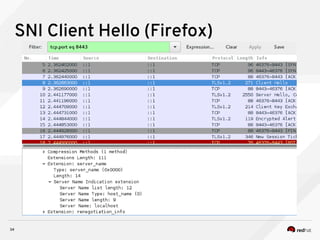
• SNI
• OpenSSLImplementation
• Migration from 8.0 to 8.5
• Get involved
• Questions
3
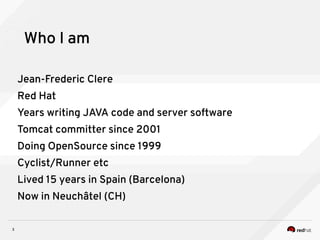
Who I am
Jean-Frederic Clere
Red Hat
Years writing JAVA code and server software
Tomcat committer since 2001
Doing OpenSource since 1999
Cyclist/Runner etc
Lived 15 years in Spain (Barcelona)
Now in Neuchâtel (CH)
4
Tomcat
5
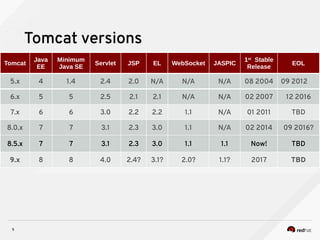
Tomcat versions
Tomcat
Java
EE
Minimum
Java SE
Servlet JSP EL WebSocket JASPIC
1st
Stable
Release
EOL
5.x 4 1.4 2.4 2.0 N/A N/A N/A 08 2004 09 2012
6.x 5 5 2.5 2.1 2.1 N/A N/A 02 2007 12 2016
7.x 6 6 3.0 2.2 2.2 1.1 N/A 01 2011 TBD
8.0.x 7 7 3.1 2.3 3.0 1.1 N/A 02 2014 09 2016?
8.5.x 7 7 3.1 2.3 3.0 1.1 1.1 Now! TBD
9.x 8 8 4.0 2.4? 3.1? 2.0? 1.1? 2017 TBD
6
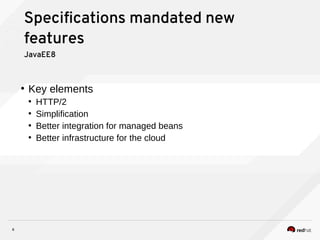
Specifications mandated new
features
JavaEE8
●
Key elements
●
HTTP/2
●
Simplification
●
Better integration for managed beans
●
Better infrastructure for the cloud
7
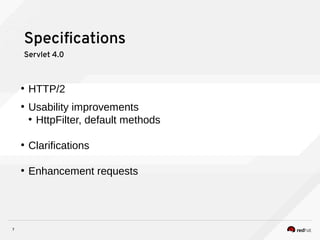
Specifications
Servlet 4.0
●
HTTP/2
●
Usability improvements
●
HttpFilter, default methods
●
Clarifications
●
Enhancement requests
8
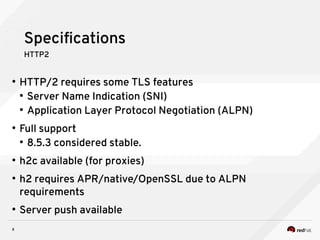
Specifications
HTTP2
●
HTTP/2 requires some TLS features
●
Server Name Indication (SNI)
●
Application Layer Protocol Negotiation (ALPN)
●
Full support
●
8.5.3 considered stable.
●
h2c available (for proxies)
●
h2 requires APR/native/OpenSSL due to ALPN
requirements
●
Server push available
9
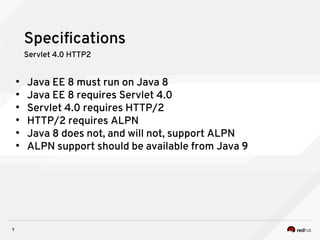
Specifications
Servlet 4.0 HTTP2
●
Java EE 8 must run on Java 8
●
Java EE 8 requires Servlet 4.0
●
Servlet 4.0 requires HTTP/2
●
HTTP/2 requires ALPN
●
Java 8 does not, and will not, support ALPN
●
ALPN support should be available from Java 9
10
Specifications
Other
●
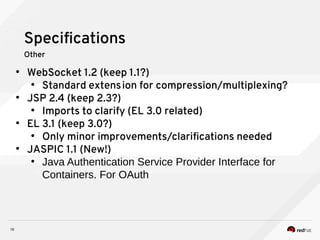
WebSocket 1.2 (keep 1.1?)
●
Standard extension for compression/multiplexing?
●
JSP 2.4 (keep 2.3?)
●
Imports to clarify (EL 3.0 related)
●
EL 3.1 (keep 3.0?)
●
Only minor improvements/clarifications needed
●
JASPIC 1.1 (New!)
●
Java Authentication Service Provider Interface for
Containers. For OAuth
11
Tomcat New Features
TLS support improvements (1)
●
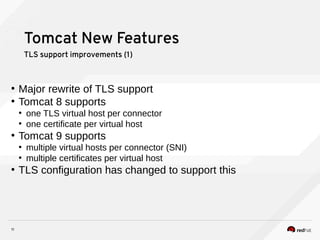
Major rewrite of TLS support
●
Tomcat 8 supports
●
one TLS virtual host per connector
●
one certificate per virtual host
●
Tomcat 9 supports
●
multiple virtual hosts per connector (SNI)
●
multiple certificates per virtual host
●
TLS configuration has changed to support this
12
Tomcat New Features
TLS support improvements (2)
●
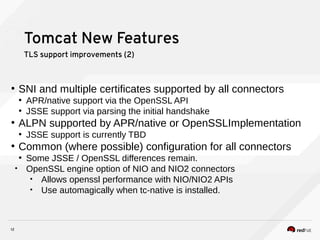
SNI and multiple certificates supported by all connectors
●
APR/native support via the OpenSSL API
●
JSSE support via parsing the initial handshake
●
ALPN supported by APR/native or OpenSSLImplementation
●
JSSE support is currently TBD
●
Common (where possible) configuration for all connectors
●
Some JSSE / OpenSSL differences remain.
• OpenSSL engine option of NIO and NIO2 connectors
• Allows openssl performance with NIO/NIO2 APIs
• Use automagically when tc-native is installed.
13
Tomcat Removed Features
Old blocking O/I connectors...
●
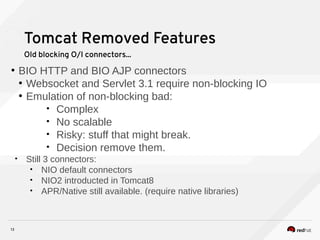
BIO HTTP and BIO AJP connectors
●
Websocket and Servlet 3.1 require non-blocking IO
●
Emulation of non-blocking bad:
• Complex
• No scalable
• Risky: stuff that might break.
• Decision remove them.
• Still 3 connectors:
• NIO default connectors
• NIO2 introducted in Tomcat8
• APR/Native still available. (require native libraries)
14
Tomcat Removed Features
Comet
●
Proprietary interface for asynchronous I/O
●
Users are moving (have moved) to WebSocket
●
Adds complexity to all the connectors
●
Therefore decided to remove it
15
Internal Changes
Connectors
●
Removed
●
BIO
●
Comet
●
Reduce duplication
●
HTTP upgrade from 12 classes to 3
●
HTTP/1.1 cleanup = removed ~ 50% (~2500 loc)
●
AJP 1.3 cleanup = remove ~ 30%
●
No connector specific HTTP/2 code
●
Implementation specific per connector → Endpoint
●
Implementation specific per connection → SocketWrapper
16
Internal Changes
Websocket
● Refactored I/O implementation
● Direct to Tomcat’s I/O layer
● Not via Servlet 3.1 non-blocking API
● Simpler
● Faster
● Extension support likely to require further refactoring?
17
Internal Changes
Other
● Remove use of system properties for configuration
● Move to per Context / Host / Server / Connector
● keep the system property as a default
● Made RFC 6265 CookieProcessor the default
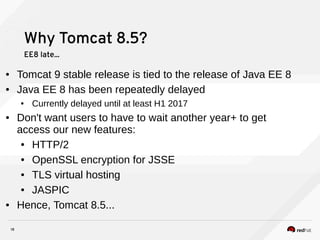
● Note UTF-8 extension
18
Why Tomcat 8.5?
EE8 late...
● Tomcat 9 stable release is tied to the release of Java EE 8
● Java EE 8 has been repeatedly delayed
● Currently delayed until at least H1 2017
● Don't want users to have to wait another year+ to get
access our new features:
● HTTP/2
● OpenSSL encryption for JSSE
● TLS virtual hosting
● JASPIC
● Hence, Tomcat 8.5...
19
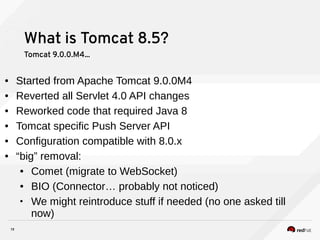
What is Tomcat 8.5?
Tomcat 9.0.0.M4...
● Started from Apache Tomcat 9.0.0M4
● Reverted all Servlet 4.0 API changes
● Reworked code that required Java 8
● Tomcat specific Push Server API
● Configuration compatible with 8.0.x
● “big” removal:
● Comet (migrate to WebSocket)
● BIO (Connector… probably not noticed)
• We might reintroduce stuff if needed (no one asked till
now)
20
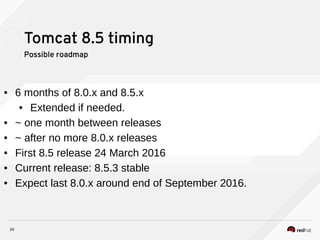
Tomcat 8.5 timing
Possible roadmap
● 6 months of 8.0.x and 8.5.x
● Extended if needed.
● ~ one month between releases
● ~ after no more 8.0.x releases
● First 8.5 release 24 March 2016
● Current release: 8.5.3 stable
● Expect last 8.0.x around end of September 2016.
21
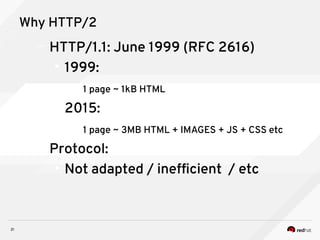
Why HTTP/2
– HTTP/1.1: June 1999 (RFC 2616)
●
1999:
– 1 page ~ 1kB HTML
●
2015:
– 1 page ~ 3MB HTML + IMAGES + JS + CSS etc
– Protocol:
●
Not adapted / inefficient / etc
22
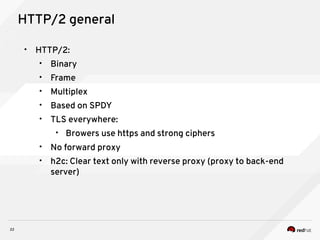
HTTP/2 general
• HTTP/2:
• Binary
• Frame
• Multiplex
• Based on SPDY
• TLS everywhere:
• Browers use https and strong ciphers
• No forward proxy
• h2c: Clear text only with reverse proxy (proxy to back-end
server)
23
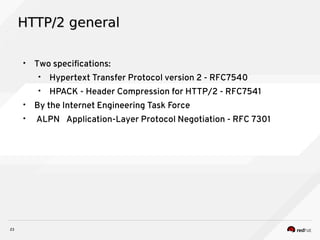
HTTP/2 generalHTTP/2 general
• Two specifications:
• Hypertext Transfer Protocol version 2 - RFC7540
• HPACK - Header Compression for HTTP/2 - RFC7541
• By the Internet Engineering Task Force
• ALPN Application-Layer Protocol Negotiation - RFC 7301
24
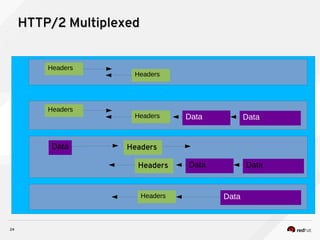
HTTP/2 MultiplexedHTTP/2 Multiplexed
Headers
Data
Headers
Headers
Headers Data Data
Headers Data Data
HeadersData
Headers
25
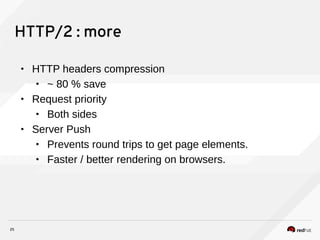
HTTP/2 : more
• HTTP headers compression
• ~ 80 % save
• Request priority
• Both sides
• Server Push
• Prevents round trips to get page elements.
• Faster / better rendering on browsers.
26
HTTP/2 When Browsers
• Browser with HTTP/2 and TLS
• FireFox 34
• Chrome 40 (with ALPN before was NPN)
• IE 11
• Opera and Safari 9
• Stats from docs.trafficserver and ci.trafficserver:
• More than 50% is over HTTP/2 (data from April)
• → go for it now!
27
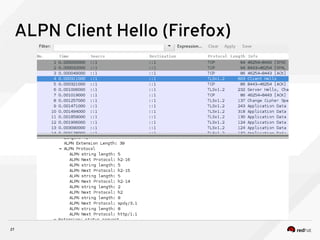
ALPN Client Hello (Firefox)
28
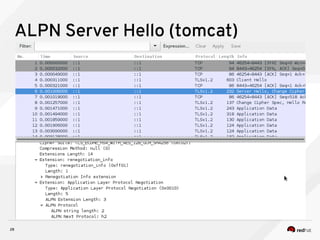
ALPN Server Hello (tomcat)
29
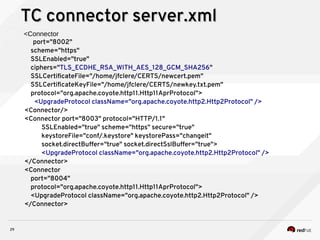
TC connector server.xmlTC connector server.xml
<Connector
port="8002"
scheme="https"
SSLEnabled="true"
ciphers="TLS_ECDHE_RSA_WITH_AES_128_GCM_SHA256"
SSLCertificateFile="/home/jfclere/CERTS/newcert.pem"
SSLCertificateKeyFile="/home/jfclere/CERTS/newkey.txt.pem"
protocol="org.apache.coyote.http11.Http11AprProtocol">
<UpgradeProtocol className="org.apache.coyote.http2.Http2Protocol" />
<Connector/>
<Connector port="8003" protocol="HTTP/1.1"
SSLEnabled="true" scheme="https" secure="true"
keystoreFile="conf/.keystore" keystorePass="changeit"
socket.directBuffer="true" socket.directSslBuffer="true">
<UpgradeProtocol className="org.apache.coyote.http2.Http2Protocol" />
</Connector>
<Connector
port="8004"
protocol="org.apache.coyote.http11.Http11AprProtocol">
<UpgradeProtocol className="org.apache.coyote.http2.Http2Protocol" />
</Connector>
30
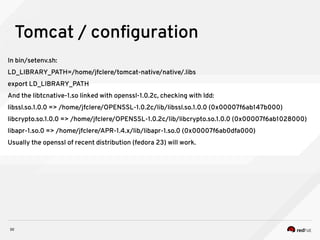
Tomcat / configuration
In bin/setenv.sh:
LD_LIBRARY_PATH=/home/jfclere/tomcat-native/native/.libs
export LD_LIBRARY_PATH
And the libtcnative-1.so linked with openssl-1.0.2c, checking with ldd:
libssl.so.1.0.0 => /home/jfclere/OPENSSL-1.0.2c/lib/libssl.so.1.0.0 (0x00007f6ab147b000)
libcrypto.so.1.0.0 => /home/jfclere/OPENSSL-1.0.2c/lib/libcrypto.so.1.0.0 (0x00007f6ab1028000)
libapr-1.so.0 => /home/jfclere/APR-1.4.x/lib/libapr-1.so.0 (0x00007f6ab0dfa000)
Usually the openssl of recent distribution (fedora 23) will work.
31
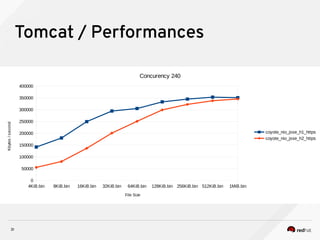
Tomcat / Performances
4KiB.bin 8KiB.bin 16KiB.bin 32KiB.bin 64KiB.bin 128KiB.bin 256KiB.bin 512KiB.bin 1MiB.bin
0
50000
100000
150000
200000
250000
300000
350000
400000
Concurency 240
coyote_nio_jsse_h1_https
coyote_nio_jsse_h2_https
File Size
Kbytes/second
32
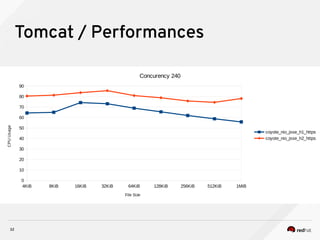
Tomcat / Performances
4KiB 8KiB 16KiB 32KiB 64KiB 128KiB 256KiB 512KiB 1MiB
0
10
20
30
40
50
60
70
80
90
Concurency 240
coyote_nio_jsse_h1_https
coyote_nio_jsse_h2_https
File Size
CPUUsage
33
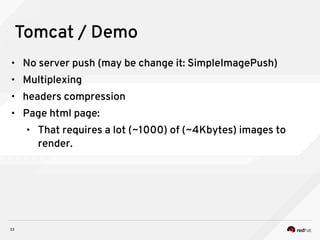
Tomcat / Demo
• No server push (may be change it: SimpleImagePush)
• Multiplexing
• headers compression
• Page html page:
• That requires a lot (~1000) of (~4Kbytes) images to
render.
34
SNI Client Hello (Firefox)
35
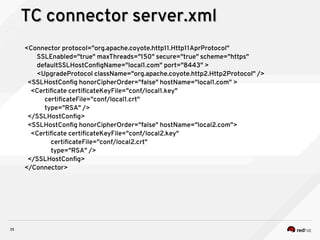
TC connector server.xmlTC connector server.xml
<Connector protocol="org.apache.coyote.http11.Http11AprProtocol"
SSLEnabled="true" maxThreads="150" secure="true" scheme="https"
defaultSSLHostConfigName="local1.com" port="8443" >
<UpgradeProtocol className="org.apache.coyote.http2.Http2Protocol" />
<SSLHostConfig honorCipherOrder="false" hostName="local1.com" >
<Certificate certificateKeyFile="conf/local1.key"
certificateFile="conf/local1.crt"
type="RSA" />
</SSLHostConfig>
<SSLHostConfig honorCipherOrder="false" hostName="local2.com">
<Certificate certificateKeyFile="conf/local2.key"
certificateFile="conf/local2.crt"
type="RSA" />
</SSLHostConfig>
</Connector>
36
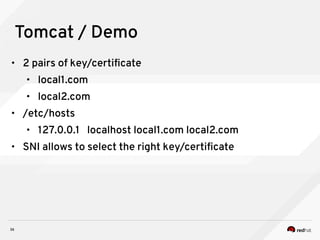
Tomcat / Demo
• 2 pairs of key/certificate
• local1.com
• local2.com
• /etc/hosts
• 127.0.0.1 localhost local1.com local2.com
• SNI allows to select the right key/certificate
37
Why a new SSLImplementation
• JSSE:
• Very slow
• Missing features: like ALPN (JEP 244: TLS Application-Layer Protocol
Negotiation)
• Hardware acceleration used to be very partial (like AES in early java8)
• Native connector:
• Fast but a lot of native code
• Use OpenSSL for SSL/TLS.
• New OpenSSL implemetation:
• Fast.
• Uses only a OpenSSL for native code (no native socket, poller etc).
• Works with NIO and NIO2.
• Uses OpenSSL for SSL/TLS. (warp, unwarp, handshake etc).
38
OpenSSLImplementation
• Code orginates from netty-tcnative a forked Tomcat
Native
• Prototype (last year):
• Done with the BeFriNe University
• Tested and ported to tc_trunk last summer
• SSL Configuration compatible with the JSSE
configuration style (*)
• Uses keystores (*)
• Uses SSL BIO to wrap/unwarp, handshake
• Uses java NIO or NIO2 Sockets for the reads and writes
• Automatically enabled when TC native is
installed/enabled (*)
39
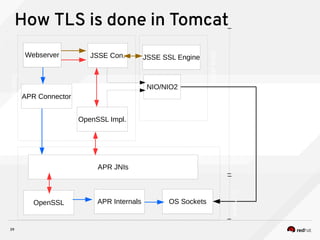
How TLS is done in Tomcat
Tomcat
JSSE Con.
Javastdlib
JSSE SSL Engine
NIO/NIO2
Tomcat Native
APR JNIs
Webserver
APR Internals
APR Connector
OpenSSL OS Sockets
JavaC/Native
Webserver
OpenSSL Impl.
40
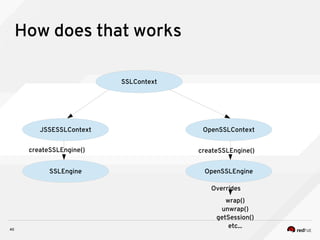
How does that works
SSLContext
JSSESSLContext OpenSSLContext
SSLEngine
SSLContext
OpenSSLEngine
createSSLEngine() createSSLEngine()
wrap()
unwrap()
getSession()
etc...
Overrides
41
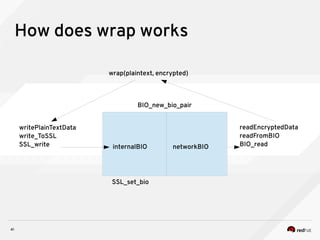
How does wrap works
wrap(plaintext, encrypted)
internalBIO networkBIO
BIO_new_bio_pair
SSL_set_bio
writePlainTextData
write_ToSSL
SSL_write
readEncryptedData
readFromBIO
BIO_read
42
How does unwrap works
unwrap(encrypted, plaintext)
internalBIO networkBIO
BIO_new_bio_pair
SSL_set_bio
writeEncryptedData
writeToBIO
BIO_write
readPlaintextData
readFromSSL
SSL_read
43
Connector Throughput (c80)
4KiB.bin
8KiB.bin
16KiB.bin
32KiB.bin
64KiB.bin
128KiB.bin
256KiB.bin
512KiB.bin
1MiB.bin
2MiB.bin
4MiB.bin
8MiB.bin
16MiB.bin
32MiB.bin
0
100000
200000
300000
400000
500000
600000
700000
concurency 80
coyote_apr_https
coyote_nio2_openssl_https
coyote_nio_jsse_https
coyote_nio_openssl_https
File Size
ThroughputKbytes/sec
44
TC connector server.xmlTC connector server.xml
OLD NATIVE CONNECTOR WAY:
<Connector
port="8002"
scheme="https"
SSLEnabled="true"
SSLCertificateFile="/home/jfclere/CERTS/newcert.pem"
SSLCertificateKeyFile="/home/jfclere/CERTS/newkey.txt.pem"
protocol="org.apache.coyote.http11.Http11AprProtocol">
<UpgradeProtocol className="org.apache.coyote.http2.Http2Protocol" />
<Connector/>
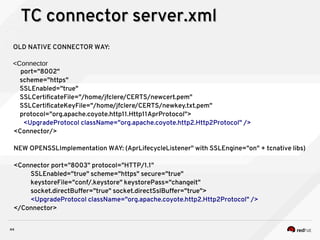
NEW OPENSSLImplementation WAY: (AprLifecycleListener" with SSLEngine="on" + tcnative libs)
<Connector port="8003" protocol="HTTP/1.1"
SSLEnabled="true" scheme="https" secure="true"
keystoreFile="conf/.keystore" keystorePass="changeit"
socket.directBuffer="true" socket.directSslBuffer="true">
<UpgradeProtocol className="org.apache.coyote.http2.Http2Protocol" />
</Connector>
45
Migration from Apache Tomcat 8.0.x
● Aiming to make it a seamless process for most users
● Some users will have some work to do
● Configuration files can be re-used
● Will need migration to use new TLS features
● Some removed features will not be replaced
● Comet (Stick with final 8.0, revert 7.0 or migrate WebSocket)
● Work arounds may be added for some removed features
● BIO
● Removed deprecated code may be restored
● Manager, Context, RealmBase
46
GET INVOLVED
Help is welcomed ;-)
• SVN:
• http://svn.apache.org/repos/asf/tomcat/tc8.5.x/trunk/
• http://svn.apache.org/repos/asf/tomcat/trunk/
• MAIL LISTS:
• dev@tomcat.apache.org Dev list.
• users@tomcat.apache.org Users list.
• WIKI:
• http://wiki.apache.org/tomcat/FrontPage
THANK YOU
plus.google.com/+RedHat
linkedin.com/company/red-hat
youtube.com/user/RedHatVideos
facebook.com/redhatinc
twitter.com/RedHatNews

Tomcat next

  • 1.
    Apache Tomcat NEXT progressreport Jean-Frederic Clere Manager Sat, 18th Jun
  • 2.
    2 AGENDA • Who Iam • New features required by specifications • Tomcat specific new features • Tomcat features removed • Internal changes • Why Apache Tomcat 8.5? • HTTP/2 and ALPN • SNI • OpenSSLImplementation • Migration from 8.0 to 8.5 • Get involved • Questions
  • 3.
    3 Who I am Jean-FredericClere Red Hat Years writing JAVA code and server software Tomcat committer since 2001 Doing OpenSource since 1999 Cyclist/Runner etc Lived 15 years in Spain (Barcelona) Now in Neuchâtel (CH)
  • 4.
  • 5.
    5 Tomcat versions Tomcat Java EE Minimum Java SE ServletJSP EL WebSocket JASPIC 1st Stable Release EOL 5.x 4 1.4 2.4 2.0 N/A N/A N/A 08 2004 09 2012 6.x 5 5 2.5 2.1 2.1 N/A N/A 02 2007 12 2016 7.x 6 6 3.0 2.2 2.2 1.1 N/A 01 2011 TBD 8.0.x 7 7 3.1 2.3 3.0 1.1 N/A 02 2014 09 2016? 8.5.x 7 7 3.1 2.3 3.0 1.1 1.1 Now! TBD 9.x 8 8 4.0 2.4? 3.1? 2.0? 1.1? 2017 TBD
  • 6.
    6 Specifications mandated new features JavaEE8 ● Keyelements ● HTTP/2 ● Simplification ● Better integration for managed beans ● Better infrastructure for the cloud
  • 7.
    7 Specifications Servlet 4.0 ● HTTP/2 ● Usability improvements ● HttpFilter,default methods ● Clarifications ● Enhancement requests
  • 8.
    8 Specifications HTTP2 ● HTTP/2 requires someTLS features ● Server Name Indication (SNI) ● Application Layer Protocol Negotiation (ALPN) ● Full support ● 8.5.3 considered stable. ● h2c available (for proxies) ● h2 requires APR/native/OpenSSL due to ALPN requirements ● Server push available
  • 9.
    9 Specifications Servlet 4.0 HTTP2 ● JavaEE 8 must run on Java 8 ● Java EE 8 requires Servlet 4.0 ● Servlet 4.0 requires HTTP/2 ● HTTP/2 requires ALPN ● Java 8 does not, and will not, support ALPN ● ALPN support should be available from Java 9
  • 10.
    10 Specifications Other ● WebSocket 1.2 (keep1.1?) ● Standard extension for compression/multiplexing? ● JSP 2.4 (keep 2.3?) ● Imports to clarify (EL 3.0 related) ● EL 3.1 (keep 3.0?) ● Only minor improvements/clarifications needed ● JASPIC 1.1 (New!) ● Java Authentication Service Provider Interface for Containers. For OAuth
  • 11.
    11 Tomcat New Features TLSsupport improvements (1) ● Major rewrite of TLS support ● Tomcat 8 supports ● one TLS virtual host per connector ● one certificate per virtual host ● Tomcat 9 supports ● multiple virtual hosts per connector (SNI) ● multiple certificates per virtual host ● TLS configuration has changed to support this
  • 12.
    12 Tomcat New Features TLSsupport improvements (2) ● SNI and multiple certificates supported by all connectors ● APR/native support via the OpenSSL API ● JSSE support via parsing the initial handshake ● ALPN supported by APR/native or OpenSSLImplementation ● JSSE support is currently TBD ● Common (where possible) configuration for all connectors ● Some JSSE / OpenSSL differences remain. • OpenSSL engine option of NIO and NIO2 connectors • Allows openssl performance with NIO/NIO2 APIs • Use automagically when tc-native is installed.
  • 13.
    13 Tomcat Removed Features Oldblocking O/I connectors... ● BIO HTTP and BIO AJP connectors ● Websocket and Servlet 3.1 require non-blocking IO ● Emulation of non-blocking bad: • Complex • No scalable • Risky: stuff that might break. • Decision remove them. • Still 3 connectors: • NIO default connectors • NIO2 introducted in Tomcat8 • APR/Native still available. (require native libraries)
  • 14.
    14 Tomcat Removed Features Comet ● Proprietaryinterface for asynchronous I/O ● Users are moving (have moved) to WebSocket ● Adds complexity to all the connectors ● Therefore decided to remove it
  • 15.
    15 Internal Changes Connectors ● Removed ● BIO ● Comet ● Reduce duplication ● HTTPupgrade from 12 classes to 3 ● HTTP/1.1 cleanup = removed ~ 50% (~2500 loc) ● AJP 1.3 cleanup = remove ~ 30% ● No connector specific HTTP/2 code ● Implementation specific per connector → Endpoint ● Implementation specific per connection → SocketWrapper
  • 16.
    16 Internal Changes Websocket ● RefactoredI/O implementation ● Direct to Tomcat’s I/O layer ● Not via Servlet 3.1 non-blocking API ● Simpler ● Faster ● Extension support likely to require further refactoring?
  • 17.
    17 Internal Changes Other ● Removeuse of system properties for configuration ● Move to per Context / Host / Server / Connector ● keep the system property as a default ● Made RFC 6265 CookieProcessor the default ● Note UTF-8 extension
  • 18.
    18 Why Tomcat 8.5? EE8late... ● Tomcat 9 stable release is tied to the release of Java EE 8 ● Java EE 8 has been repeatedly delayed ● Currently delayed until at least H1 2017 ● Don't want users to have to wait another year+ to get access our new features: ● HTTP/2 ● OpenSSL encryption for JSSE ● TLS virtual hosting ● JASPIC ● Hence, Tomcat 8.5...
  • 19.
    19 What is Tomcat8.5? Tomcat 9.0.0.M4... ● Started from Apache Tomcat 9.0.0M4 ● Reverted all Servlet 4.0 API changes ● Reworked code that required Java 8 ● Tomcat specific Push Server API ● Configuration compatible with 8.0.x ● “big” removal: ● Comet (migrate to WebSocket) ● BIO (Connector… probably not noticed) • We might reintroduce stuff if needed (no one asked till now)
  • 20.
    20 Tomcat 8.5 timing Possibleroadmap ● 6 months of 8.0.x and 8.5.x ● Extended if needed. ● ~ one month between releases ● ~ after no more 8.0.x releases ● First 8.5 release 24 March 2016 ● Current release: 8.5.3 stable ● Expect last 8.0.x around end of September 2016.
  • 21.
    21 Why HTTP/2 – HTTP/1.1:June 1999 (RFC 2616) ● 1999: – 1 page ~ 1kB HTML ● 2015: – 1 page ~ 3MB HTML + IMAGES + JS + CSS etc – Protocol: ● Not adapted / inefficient / etc
  • 22.
    22 HTTP/2 general • HTTP/2: •Binary • Frame • Multiplex • Based on SPDY • TLS everywhere: • Browers use https and strong ciphers • No forward proxy • h2c: Clear text only with reverse proxy (proxy to back-end server)
  • 23.
    23 HTTP/2 generalHTTP/2 general •Two specifications: • Hypertext Transfer Protocol version 2 - RFC7540 • HPACK - Header Compression for HTTP/2 - RFC7541 • By the Internet Engineering Task Force • ALPN Application-Layer Protocol Negotiation - RFC 7301
  • 24.
  • 25.
    25 HTTP/2 : more •HTTP headers compression • ~ 80 % save • Request priority • Both sides • Server Push • Prevents round trips to get page elements. • Faster / better rendering on browsers.
  • 26.
    26 HTTP/2 When Browsers •Browser with HTTP/2 and TLS • FireFox 34 • Chrome 40 (with ALPN before was NPN) • IE 11 • Opera and Safari 9 • Stats from docs.trafficserver and ci.trafficserver: • More than 50% is over HTTP/2 (data from April) • → go for it now!
  • 27.
  • 28.
  • 29.
    29 TC connector server.xmlTCconnector server.xml <Connector port="8002" scheme="https" SSLEnabled="true" ciphers="TLS_ECDHE_RSA_WITH_AES_128_GCM_SHA256" SSLCertificateFile="/home/jfclere/CERTS/newcert.pem" SSLCertificateKeyFile="/home/jfclere/CERTS/newkey.txt.pem" protocol="org.apache.coyote.http11.Http11AprProtocol"> <UpgradeProtocol className="org.apache.coyote.http2.Http2Protocol" /> <Connector/> <Connector port="8003" protocol="HTTP/1.1" SSLEnabled="true" scheme="https" secure="true" keystoreFile="conf/.keystore" keystorePass="changeit" socket.directBuffer="true" socket.directSslBuffer="true"> <UpgradeProtocol className="org.apache.coyote.http2.Http2Protocol" /> </Connector> <Connector port="8004" protocol="org.apache.coyote.http11.Http11AprProtocol"> <UpgradeProtocol className="org.apache.coyote.http2.Http2Protocol" /> </Connector>
  • 30.
    30 Tomcat / configuration Inbin/setenv.sh: LD_LIBRARY_PATH=/home/jfclere/tomcat-native/native/.libs export LD_LIBRARY_PATH And the libtcnative-1.so linked with openssl-1.0.2c, checking with ldd: libssl.so.1.0.0 => /home/jfclere/OPENSSL-1.0.2c/lib/libssl.so.1.0.0 (0x00007f6ab147b000) libcrypto.so.1.0.0 => /home/jfclere/OPENSSL-1.0.2c/lib/libcrypto.so.1.0.0 (0x00007f6ab1028000) libapr-1.so.0 => /home/jfclere/APR-1.4.x/lib/libapr-1.so.0 (0x00007f6ab0dfa000) Usually the openssl of recent distribution (fedora 23) will work.
  • 31.
    31 Tomcat / Performances 4KiB.bin8KiB.bin 16KiB.bin 32KiB.bin 64KiB.bin 128KiB.bin 256KiB.bin 512KiB.bin 1MiB.bin 0 50000 100000 150000 200000 250000 300000 350000 400000 Concurency 240 coyote_nio_jsse_h1_https coyote_nio_jsse_h2_https File Size Kbytes/second
  • 32.
    32 Tomcat / Performances 4KiB8KiB 16KiB 32KiB 64KiB 128KiB 256KiB 512KiB 1MiB 0 10 20 30 40 50 60 70 80 90 Concurency 240 coyote_nio_jsse_h1_https coyote_nio_jsse_h2_https File Size CPUUsage
  • 33.
    33 Tomcat / Demo •No server push (may be change it: SimpleImagePush) • Multiplexing • headers compression • Page html page: • That requires a lot (~1000) of (~4Kbytes) images to render.
  • 34.
  • 35.
    35 TC connector server.xmlTCconnector server.xml <Connector protocol="org.apache.coyote.http11.Http11AprProtocol" SSLEnabled="true" maxThreads="150" secure="true" scheme="https" defaultSSLHostConfigName="local1.com" port="8443" > <UpgradeProtocol className="org.apache.coyote.http2.Http2Protocol" /> <SSLHostConfig honorCipherOrder="false" hostName="local1.com" > <Certificate certificateKeyFile="conf/local1.key" certificateFile="conf/local1.crt" type="RSA" /> </SSLHostConfig> <SSLHostConfig honorCipherOrder="false" hostName="local2.com"> <Certificate certificateKeyFile="conf/local2.key" certificateFile="conf/local2.crt" type="RSA" /> </SSLHostConfig> </Connector>
  • 36.
    36 Tomcat / Demo •2 pairs of key/certificate • local1.com • local2.com • /etc/hosts • 127.0.0.1 localhost local1.com local2.com • SNI allows to select the right key/certificate
  • 37.
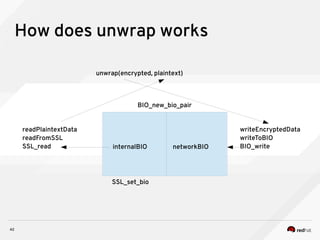
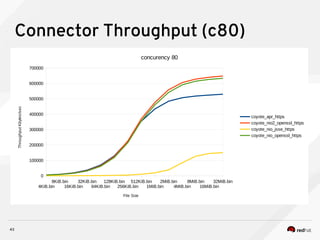
    37 Why a newSSLImplementation • JSSE: • Very slow • Missing features: like ALPN (JEP 244: TLS Application-Layer Protocol Negotiation) • Hardware acceleration used to be very partial (like AES in early java8) • Native connector: • Fast but a lot of native code • Use OpenSSL for SSL/TLS. • New OpenSSL implemetation: • Fast. • Uses only a OpenSSL for native code (no native socket, poller etc). • Works with NIO and NIO2. • Uses OpenSSL for SSL/TLS. (warp, unwarp, handshake etc).
  • 38.
    38 OpenSSLImplementation • Code orginatesfrom netty-tcnative a forked Tomcat Native • Prototype (last year): • Done with the BeFriNe University • Tested and ported to tc_trunk last summer • SSL Configuration compatible with the JSSE configuration style (*) • Uses keystores (*) • Uses SSL BIO to wrap/unwarp, handshake • Uses java NIO or NIO2 Sockets for the reads and writes • Automatically enabled when TC native is installed/enabled (*)
  • 39.
    39 How TLS isdone in Tomcat Tomcat JSSE Con. Javastdlib JSSE SSL Engine NIO/NIO2 Tomcat Native APR JNIs Webserver APR Internals APR Connector OpenSSL OS Sockets JavaC/Native Webserver OpenSSL Impl.
  • 40.
    40 How does thatworks SSLContext JSSESSLContext OpenSSLContext SSLEngine SSLContext OpenSSLEngine createSSLEngine() createSSLEngine() wrap() unwrap() getSession() etc... Overrides
  • 41.
    41 How does wrapworks wrap(plaintext, encrypted) internalBIO networkBIO BIO_new_bio_pair SSL_set_bio writePlainTextData write_ToSSL SSL_write readEncryptedData readFromBIO BIO_read
  • 42.
    42 How does unwrapworks unwrap(encrypted, plaintext) internalBIO networkBIO BIO_new_bio_pair SSL_set_bio writeEncryptedData writeToBIO BIO_write readPlaintextData readFromSSL SSL_read
  • 43.
  • 44.
    44 TC connector server.xmlTCconnector server.xml OLD NATIVE CONNECTOR WAY: <Connector port="8002" scheme="https" SSLEnabled="true" SSLCertificateFile="/home/jfclere/CERTS/newcert.pem" SSLCertificateKeyFile="/home/jfclere/CERTS/newkey.txt.pem" protocol="org.apache.coyote.http11.Http11AprProtocol"> <UpgradeProtocol className="org.apache.coyote.http2.Http2Protocol" /> <Connector/> NEW OPENSSLImplementation WAY: (AprLifecycleListener" with SSLEngine="on" + tcnative libs) <Connector port="8003" protocol="HTTP/1.1" SSLEnabled="true" scheme="https" secure="true" keystoreFile="conf/.keystore" keystorePass="changeit" socket.directBuffer="true" socket.directSslBuffer="true"> <UpgradeProtocol className="org.apache.coyote.http2.Http2Protocol" /> </Connector>
  • 45.
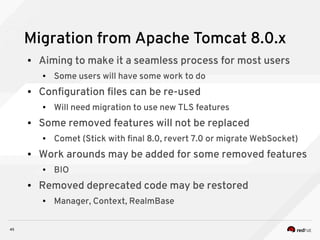
    45 Migration from ApacheTomcat 8.0.x ● Aiming to make it a seamless process for most users ● Some users will have some work to do ● Configuration files can be re-used ● Will need migration to use new TLS features ● Some removed features will not be replaced ● Comet (Stick with final 8.0, revert 7.0 or migrate WebSocket) ● Work arounds may be added for some removed features ● BIO ● Removed deprecated code may be restored ● Manager, Context, RealmBase
  • 46.
    46 GET INVOLVED Help iswelcomed ;-) • SVN: • http://svn.apache.org/repos/asf/tomcat/tc8.5.x/trunk/ • http://svn.apache.org/repos/asf/tomcat/trunk/ • MAIL LISTS: • dev@tomcat.apache.org Dev list. • users@tomcat.apache.org Users list. • WIKI: • http://wiki.apache.org/tomcat/FrontPage
  • 47.