P R E S E N T E D B Y : J H U R R Y A . H A D I
3 R D Y E A R B . D . S
B A T C H : 2 0 1 4 - 1 5
HABITS
Definition
 A habit can be defined as tendency towards an act that has
become a repeated performance, relatively fixed, consistent
and easy to perform by an individual. (Boucher O.C)
 Habit includes: 1) oral habits
2) oral hygiene habits
3) adverse habits
4) dietary habits
1) Oral habits
 Various oral habits are :
1) Thumb and digit sucking
2) Tongue thrust sucking
3) Mouth breathing habit
4) Lip biting
5) Nail biting
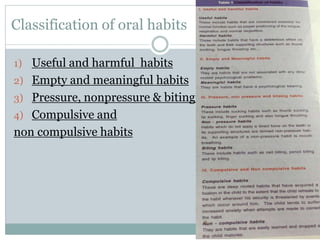
Classification of oral habits
1) Useful and harmful habits
2) Empty and meaningful habits
3) Pressure, nonpressure & biting habits
4) Compulsive and
non compulsive habits
1 i)Thumb and digit sucking
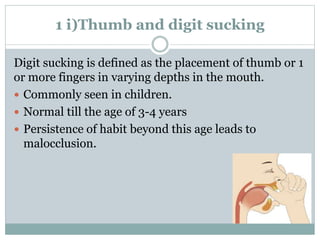
Digit sucking is defined as the placement of thumb or 1
or more fingers in varying depths in the mouth.
 Commonly seen in children.
 Normal till the age of 3-4 years
 Persistence of habit beyond this age leads to
malocclusion.
Effects of thumb sucking
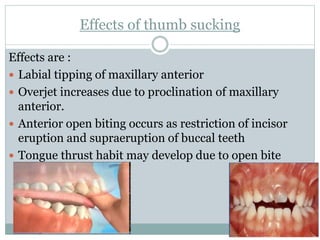
Effects are :
 Labial tipping of maxillary anterior
 Overjet increases due to proclination of maxillary
anterior.
 Anterior open biting occurs as restriction of incisor
eruption and supraeruption of buccal teeth
 Tongue thrust habit may develop due to open bite
1 ii) Tongue thrust habit
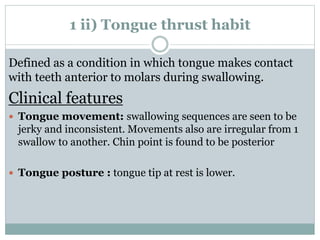
Defined as a condition in which tongue makes contact
with teeth anterior to molars during swallowing.
Clinical features
 Tongue movement: swallowing sequences are seen to be
jerky and inconsistent. Movements also are irregular from 1
swallow to another. Chin point is found to be posterior
 Tongue posture : tongue tip at rest is lower.
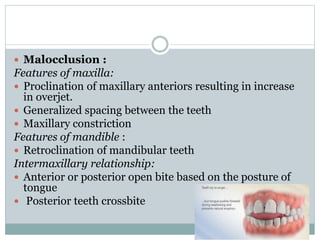
 Malocclusion :
Features of maxilla:
 Proclination of maxillary anteriors resulting in increase
in overjet.
 Generalized spacing between the teeth
 Maxillary constriction
Features of mandible :
 Retroclination of mandibular teeth
Intermaxillary relationship:
 Anterior or posterior open bite based on the posture of
tongue
 Posterior teeth crossbite
1 iii) Mouth breathing
Defined mouth breathing as habitual respiration through the
mouth instead of the nose ( Sassouni)
Clinical features
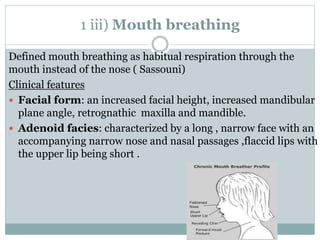
 Facial form: an increased facial height, increased mandibular
plane angle, retrognathic maxilla and mandible.
 Adenoid facies: characterized by a long , narrow face with an
accompanying narrow nose and nasal passages ,flaccid lips with
the upper lip being short .
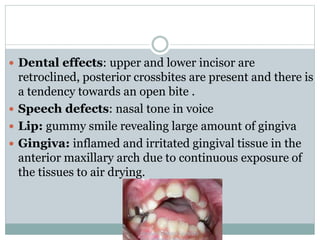
 Dental effects: upper and lower incisor are
retroclined, posterior crossbites are present and there is
a tendency towards an open bite .
 Speech defects: nasal tone in voice
 Lip: gummy smile revealing large amount of gingiva
 Gingiva: inflamed and irritated gingival tissue in the
anterior maxillary arch due to continuous exposure of
the tissues to air drying.
How to diagnose mouth breathing
The following tests can be performed to diagnose mouth
breathing:
1) Mirror test
2) Water test
Mirror test
A double sided mirror is held between the nose and the
mouth. Fogging on the oral side indicates oral breathing
and vice versa.
Water test
Patient is asked to fill his mouth with waterand retain it for
a period of time.
Mouth breathers find the task difficult compared to nasal
breathers.
1 iv) Bruxism
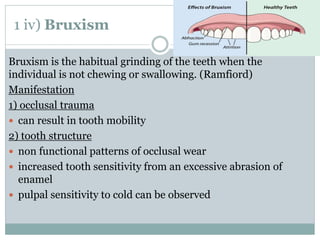
Bruxism is the habitual grinding of the teeth when the
individual is not chewing or swallowing. (Ramfiord)
Manifestation
1) occlusal trauma
 can result in tooth mobility
2) tooth structure
 non functional patterns of occlusal wear
 increased tooth sensitivity from an excessive abrasion of
enamel
 pulpal sensitivity to cold can be observed
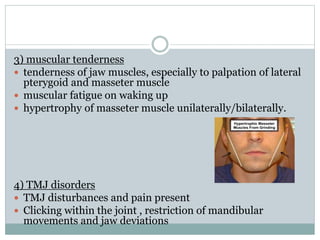
3) muscular tenderness
 tenderness of jaw muscles, especially to palpation of lateral
pterygoid and masseter muscle
 muscular fatigue on waking up
 hypertrophy of masseter muscle unilaterally/bilaterally.
4) TMJ disorders
 TMJ disturbances and pain present
 Clicking within the joint , restriction of mandibular
movements and jaw deviations
1 v) Lip habit
 Habits that involve manipulation of the lips and perioral
structures.
Clinical features
1) Protrusion of maxillary incisors and retrusion of
mandibular incisors
 Wedging the lip between the upper and lower incisors
creates a muscular imbalance
2) Lip
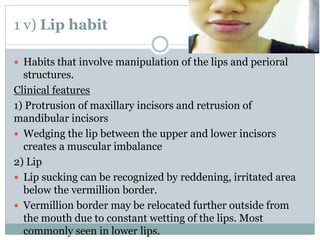
 Lip sucking can be recognized by reddening, irritated area
below the vermillion border.
 Vermillion border may be relocated further outside from
the mouth due to constant wetting of the lips. Most
commonly seen in lower lips.
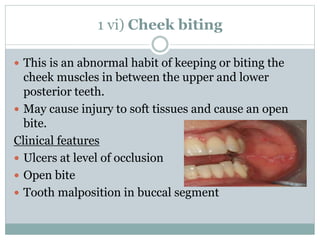
1 vi) Cheek biting
 This is an abnormal habit of keeping or biting the
cheek muscles in between the upper and lower
posterior teeth.
 May cause injury to soft tissues and cause an open
bite.
Clinical features
 Ulcers at level of occlusion
 Open bite
 Tooth malposition in buccal segment
1 vii) Nail biting
 Nail biting is one of the most common habits in
children and adults. It is a sign of internal tension.
Effects
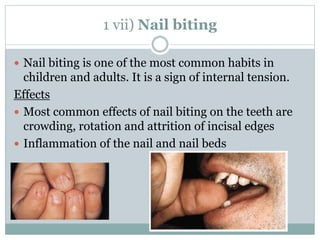
 Most common effects of nail biting on the teeth are
crowding, rotation and attrition of incisal edges
 Inflammation of the nail and nail beds
2) Oral hygiene habit
• Oral hygiene is the practice which enables to keep
the oral cavity clean in order to prevent the onset
and progression of common dental problems.
• By maintaining good oral hygiene we can prevent :
1)Dental caries
2)Gingivitis
3)Periodontitis
4)Halitosis
Basic steps for maintaining oral hygiene:
1.Brushing your teeth (at least twice a day )
2.Floss your teeth regularly
3.Proper diet
4.Other interdental cleaning
5.Rinsing
6.Regular dental checkups
2 i) Brushing:
• Many methods have been described to be efficient
and effective for brushing the teeth namely Fones
technique , Leonard technique etc.
• Most recomended technique is the Bass technique
because it emphasizes sulcular placement of the
bristle.
Bass technique
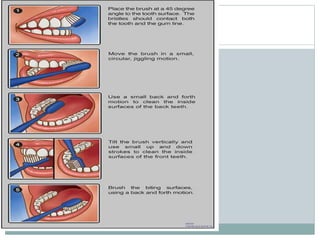
1) Place the head of a soft brush parallel to the
occlusal plane, beginning at the most distal tooth in
the arch.
2) Place the bristles at the gingival margin, pointing at
a 45 degree angle at the long axis of the teeth.
3) Exert gentle vibratory pressure, using short, back
and forth motions without dislodging the tips of the
bristles. The latter must end into the gingival
sulcus area and the embrasures area.
4) Complete several strokes in the same position.
5) Lift the brush and move it adjacent teeth and repeat
the process
6) Continue around the arch. Use same method to
brush the lingual surfaces.
7) Mandibular are also brushed in the same organised
manner to reach all teeth.
8) Brush the occlusal surfaces of 3-4 teeth at a time by
pressing the bristles firmly into the pits and brushing
with several back and forth strokes
2 ii) Flossing:
 A dental floss is a tool used to remove interdental
plaque
 Available as multifilament nylon that can be twisted
or non twisted, bonded or non bonded, waxed or non
waxed.
 Factors influencing the choice of dental floss include
tightness of tooth contacts, roughness of proximal
surfaces.
METHOD OF FLOSSING:
METHOD:
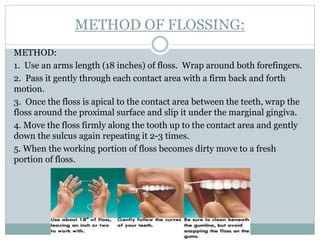
1. Use an arms length (18 inches) of floss. Wrap around both forefingers.
2. Pass it gently through each contact area with a firm back and forth
motion.
3. Once the floss is apical to the contact area between the teeth, wrap the
floss around the proximal surface and slip it under the marginal gingiva.
4. Move the floss firmly along the tooth up to the contact area and gently
down the sulcus again repeating it 2-3 times.
5. When the working portion of floss becomes dirty move to a fresh
portion of floss.
2 iii) Proper Diet:
1. Avoid foods that are high in sugar content.
2.Carbonated drinks are more acidic than non carbonated drinks; hence
more dangerous.
3.Avoid sticky food which tend to stick in the grooves; stay for an
extended period and cause decay.
4.Avoid excessive intake of fruit juices (can be very acidic). They can be
diluted with water.
2 iv ) Other interdental cleaning:
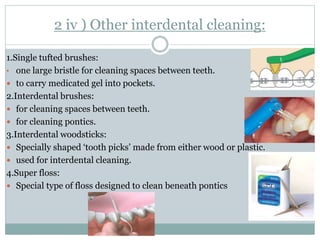
1.Single tufted brushes:
• one large bristle for cleaning spaces between teeth.
 to carry medicated gel into pockets.
2.Interdental brushes:
 for cleaning spaces between teeth.
 for cleaning pontics.
3.Interdental woodsticks:
 Specially shaped ‘tooth picks’ made from either wood or plastic.
 used for interdental cleaning.
4.Super floss:
 Special type of floss designed to clean beneath pontics
2 v) Rinsing:
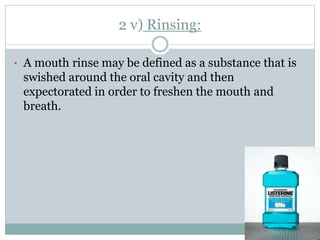
• A mouth rinse may be defined as a substance that is
swished around the oral cavity and then
expectorated in order to freshen the mouth and
breath.
 Basic ingredients include water, alcohol, cleansing
agents, flavoring ingredients and coloring agents.
1) Antimicrobial agents ( chlorhexidine 0.2%) act directly
on oral bacteria to help reduce plaque, decrease the
severity of gingivitis and control bad breath.
2) Fluoride helps reduce tiny lesions (tooth decay) on tooth
enamel and make teeth more resistant to decay.
3) Astringent salts can serve as temporary deodorizers that
mask bad breath.
4) Odor neutralizers act by chemically inactivating odor
causing compounds.
3) Adverse habits
Adverse habits include:
 Smoking
 Tobacco chewing
 Alcohol consumption
SMOKING AND ORAL HEALTH
 Tobacco use in all forms, especially cigarette smoking, is the
number one risk factor for oral cancer.
 Possible mechanisms are:
 Irritants and toxic substances in tobacco
 Change in Ph
 Dryness due to heat produced while smoking
• The most common form of cancer is Squamous cell
carcinoma.
• The most common sites of the oral cancer is the tongue and
the floor of the mouth.
• The other common sites are buccal vestibule, buccal mucosa,
gingiva and rarely hard and soft palate.
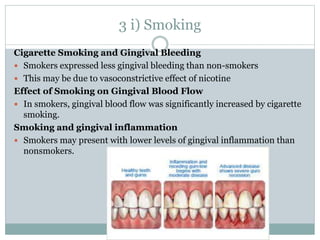
3 i) Smoking
Cigarette Smoking and Gingival Bleeding
 Smokers expressed less gingival bleeding than non-smokers
 This may be due to vasoconstrictive effect of nicotine
Effect of Smoking on Gingival Blood Flow
 In smokers, gingival blood flow was significantly increased by cigarette
smoking.
Smoking and gingival inflammation
 Smokers may present with lower levels of gingival inflammation than
nonsmokers.
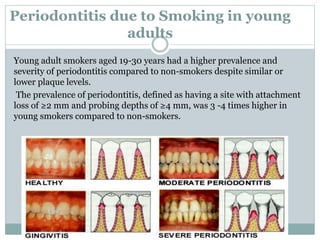
Periodontitis due to Smoking in young
adults
Young adult smokers aged 19-30 years had a higher prevalence and
severity of periodontitis compared to non-smokers despite similar or
lower plaque levels.
The prevalence of periodontitis, defined as having a site with attachment
loss of ≥2 mm and probing depths of ≥4 mm, was 3 -4 times higher in
young smokers compared to non-smokers.
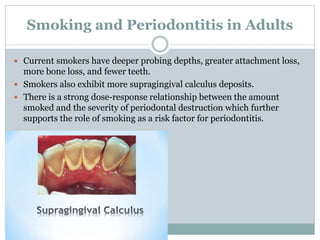
Smoking and Periodontitis in Adults
 Current smokers have deeper probing depths, greater attachment loss,
more bone loss, and fewer teeth.
 Smokers also exhibit more supragingival calculus deposits.
 There is a strong dose-response relationship between the amount
smoked and the severity of periodontal destruction which further
supports the role of smoking as a risk factor for periodontitis.
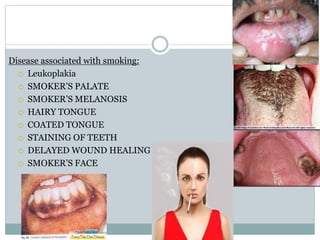
Disease associated with smoking:
 Leukoplakia
 SMOKER’S PALATE
 SMOKER’S MELANOSIS
 HAIRY TONGUE
 COATED TONGUE
 STAINING OF TEETH
 DELAYED WOUND HEALING
 SMOKER’S FACE
3 ii) Tobacco chewing
 It involves chewing a quid that includes betel leaf,
lime, areca nut, and tobacco.
 Tobacco use may significantly increase bleeding on
probing and periodontal attachment loss.
 Areca nut extracts have also been shown to inhibit
the growth, attachment, and matrix protein
synthesis of cultured human gingival fibroblasts.
3 iii) Alcohol
 Alcohol and smoking gives synergistic effect affecting
the integrity of oral tissues causing oral submucous
fibrosis, leukoplakia and oral cancer.
4 ) Dietary habits
 Diet is the total intake of substances that provide
nutrition and energy.
 A balanced diet is when various nutrients are present
in proper proportion and in sufficient amount to
meet all the needs of the body.
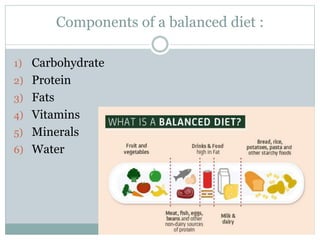
Components of a balanced diet :
1) Carbohydrate
2) Protein
3) Fats
4) Vitamins
5) Minerals
6) Water
Dietary history and evaluation
Information for a dietary history is collected from
a 24 hour or a 7 days ( including 1 weekend day )
recall record of food intake.
• Information consists of amount of food ingested and
patient’s eating habits and attitude about food.
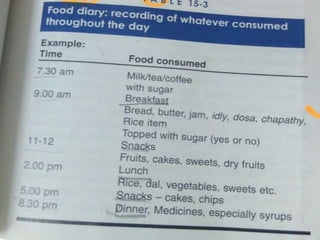
• Patient is asked to record everything consumed from
morning to before going to sleep in a note book.
Dietary recommendations:
1) Eat a variety of food
2) Maintain a healthy weight
3) Choose a diet low in fat, saturated fat and
cholesterol
4) Have plenty of vegetables, fruits and grain products
5) Consume sugars in moderation
6) Consume salt and sodium in moderation
7) If you drink alcoholic beverages, do so in
moderation.
Source of water in diet
 Through the food ingested.
 Some of the water is made during the process of
metabolism. But drinking water is the main, and best
source of water.
 Also through liquid foods and beverages, such as
soup, milk, and juices.
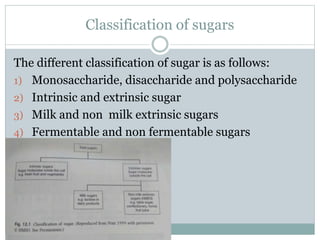
Classification of sugars
The different classification of sugar is as follows:
1) Monosaccharide, disaccharide and polysaccharide
2) Intrinsic and extrinsic sugar
3) Milk and non milk extrinsic sugars
4) Fermentable and non fermentable sugars
Factors affecting cariogenicity of a diet
 Dental caries is caused mainly by fermentable sugars
particularly sucrose.
 Cariogenicity of a diet depends on :
1) Ability of food particle to be retained by teeth
2) Ability to form acids
3) Ability to dissolve enamel
4) Buffer the acids
Important dietary habit that merit attention
 1) frequency of sugar consumption
 2) physical form and retentiveness of sugars
 3) amount of sugar added to food or beverages for
sweetening.
Cariogenicity of sucrose-containing meal
depends on:
On a decreasing order , it is grouped as :
1) Adherent and eaten frequently between meals.
2) Adherent and eaten during meals.
3) Non retentive beverages consumed frequently
between meals.
4) Liquid beverages consumed during meals.
Preventive dietary programme
1) exclude fermentable sugars from diet
2) If child is fond of sweets, give them all at meal time
and not in between meals.
3) Include vegetables and fruits , nuts and cheese as
basic diet( increases salivation )
4) Avoid solid and sticky sugary food
5) Decrease number of sugar exposures
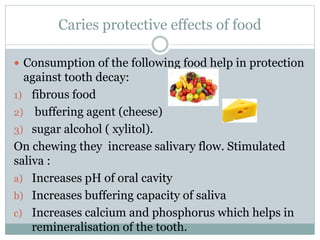
Caries protective effects of food
 Consumption of the following food help in protection
against tooth decay:
1) fibrous food
2) buffering agent (cheese)
3) sugar alcohol ( xylitol).
On chewing they increase salivary flow. Stimulated
saliva :
a) Increases pH of oral cavity
b) Increases buffering capacity of saliva
c) Increases calcium and phosphorus which helps in
remineralisation of the tooth.
Thank you

habits

  • 1.
    P R ES E N T E D B Y : J H U R R Y A . H A D I 3 R D Y E A R B . D . S B A T C H : 2 0 1 4 - 1 5 HABITS
  • 2.
    Definition  A habitcan be defined as tendency towards an act that has become a repeated performance, relatively fixed, consistent and easy to perform by an individual. (Boucher O.C)  Habit includes: 1) oral habits 2) oral hygiene habits 3) adverse habits 4) dietary habits
  • 3.
    1) Oral habits Various oral habits are : 1) Thumb and digit sucking 2) Tongue thrust sucking 3) Mouth breathing habit 4) Lip biting 5) Nail biting
  • 4.
    Classification of oralhabits 1) Useful and harmful habits 2) Empty and meaningful habits 3) Pressure, nonpressure & biting habits 4) Compulsive and non compulsive habits
  • 5.
    1 i)Thumb anddigit sucking Digit sucking is defined as the placement of thumb or 1 or more fingers in varying depths in the mouth.  Commonly seen in children.  Normal till the age of 3-4 years  Persistence of habit beyond this age leads to malocclusion.
  • 6.
    Effects of thumbsucking Effects are :  Labial tipping of maxillary anterior  Overjet increases due to proclination of maxillary anterior.  Anterior open biting occurs as restriction of incisor eruption and supraeruption of buccal teeth  Tongue thrust habit may develop due to open bite
  • 7.
    1 ii) Tonguethrust habit Defined as a condition in which tongue makes contact with teeth anterior to molars during swallowing. Clinical features  Tongue movement: swallowing sequences are seen to be jerky and inconsistent. Movements also are irregular from 1 swallow to another. Chin point is found to be posterior  Tongue posture : tongue tip at rest is lower.
  • 8.
     Malocclusion : Featuresof maxilla:  Proclination of maxillary anteriors resulting in increase in overjet.  Generalized spacing between the teeth  Maxillary constriction Features of mandible :  Retroclination of mandibular teeth Intermaxillary relationship:  Anterior or posterior open bite based on the posture of tongue  Posterior teeth crossbite
  • 9.
    1 iii) Mouthbreathing Defined mouth breathing as habitual respiration through the mouth instead of the nose ( Sassouni) Clinical features  Facial form: an increased facial height, increased mandibular plane angle, retrognathic maxilla and mandible.  Adenoid facies: characterized by a long , narrow face with an accompanying narrow nose and nasal passages ,flaccid lips with the upper lip being short .
  • 10.
     Dental effects:upper and lower incisor are retroclined, posterior crossbites are present and there is a tendency towards an open bite .  Speech defects: nasal tone in voice  Lip: gummy smile revealing large amount of gingiva  Gingiva: inflamed and irritated gingival tissue in the anterior maxillary arch due to continuous exposure of the tissues to air drying.
  • 11.
    How to diagnosemouth breathing The following tests can be performed to diagnose mouth breathing: 1) Mirror test 2) Water test Mirror test A double sided mirror is held between the nose and the mouth. Fogging on the oral side indicates oral breathing and vice versa. Water test Patient is asked to fill his mouth with waterand retain it for a period of time. Mouth breathers find the task difficult compared to nasal breathers.
  • 12.
    1 iv) Bruxism Bruxismis the habitual grinding of the teeth when the individual is not chewing or swallowing. (Ramfiord) Manifestation 1) occlusal trauma  can result in tooth mobility 2) tooth structure  non functional patterns of occlusal wear  increased tooth sensitivity from an excessive abrasion of enamel  pulpal sensitivity to cold can be observed
  • 13.
    3) muscular tenderness tenderness of jaw muscles, especially to palpation of lateral pterygoid and masseter muscle  muscular fatigue on waking up  hypertrophy of masseter muscle unilaterally/bilaterally. 4) TMJ disorders  TMJ disturbances and pain present  Clicking within the joint , restriction of mandibular movements and jaw deviations
  • 14.
    1 v) Liphabit  Habits that involve manipulation of the lips and perioral structures. Clinical features 1) Protrusion of maxillary incisors and retrusion of mandibular incisors  Wedging the lip between the upper and lower incisors creates a muscular imbalance 2) Lip  Lip sucking can be recognized by reddening, irritated area below the vermillion border.  Vermillion border may be relocated further outside from the mouth due to constant wetting of the lips. Most commonly seen in lower lips.
  • 15.
    1 vi) Cheekbiting  This is an abnormal habit of keeping or biting the cheek muscles in between the upper and lower posterior teeth.  May cause injury to soft tissues and cause an open bite. Clinical features  Ulcers at level of occlusion  Open bite  Tooth malposition in buccal segment
  • 16.
    1 vii) Nailbiting  Nail biting is one of the most common habits in children and adults. It is a sign of internal tension. Effects  Most common effects of nail biting on the teeth are crowding, rotation and attrition of incisal edges  Inflammation of the nail and nail beds
  • 17.
    2) Oral hygienehabit • Oral hygiene is the practice which enables to keep the oral cavity clean in order to prevent the onset and progression of common dental problems. • By maintaining good oral hygiene we can prevent : 1)Dental caries 2)Gingivitis 3)Periodontitis 4)Halitosis
  • 18.
    Basic steps formaintaining oral hygiene: 1.Brushing your teeth (at least twice a day ) 2.Floss your teeth regularly 3.Proper diet 4.Other interdental cleaning 5.Rinsing 6.Regular dental checkups
  • 20.
    2 i) Brushing: •Many methods have been described to be efficient and effective for brushing the teeth namely Fones technique , Leonard technique etc. • Most recomended technique is the Bass technique because it emphasizes sulcular placement of the bristle.
  • 21.
    Bass technique 1) Placethe head of a soft brush parallel to the occlusal plane, beginning at the most distal tooth in the arch. 2) Place the bristles at the gingival margin, pointing at a 45 degree angle at the long axis of the teeth. 3) Exert gentle vibratory pressure, using short, back and forth motions without dislodging the tips of the bristles. The latter must end into the gingival sulcus area and the embrasures area. 4) Complete several strokes in the same position.
  • 22.
    5) Lift thebrush and move it adjacent teeth and repeat the process 6) Continue around the arch. Use same method to brush the lingual surfaces. 7) Mandibular are also brushed in the same organised manner to reach all teeth. 8) Brush the occlusal surfaces of 3-4 teeth at a time by pressing the bristles firmly into the pits and brushing with several back and forth strokes
  • 24.
    2 ii) Flossing: A dental floss is a tool used to remove interdental plaque  Available as multifilament nylon that can be twisted or non twisted, bonded or non bonded, waxed or non waxed.  Factors influencing the choice of dental floss include tightness of tooth contacts, roughness of proximal surfaces.
  • 25.
    METHOD OF FLOSSING: METHOD: 1.Use an arms length (18 inches) of floss. Wrap around both forefingers. 2. Pass it gently through each contact area with a firm back and forth motion. 3. Once the floss is apical to the contact area between the teeth, wrap the floss around the proximal surface and slip it under the marginal gingiva. 4. Move the floss firmly along the tooth up to the contact area and gently down the sulcus again repeating it 2-3 times. 5. When the working portion of floss becomes dirty move to a fresh portion of floss.
  • 26.
    2 iii) ProperDiet: 1. Avoid foods that are high in sugar content. 2.Carbonated drinks are more acidic than non carbonated drinks; hence more dangerous. 3.Avoid sticky food which tend to stick in the grooves; stay for an extended period and cause decay. 4.Avoid excessive intake of fruit juices (can be very acidic). They can be diluted with water.
  • 27.
    2 iv )Other interdental cleaning: 1.Single tufted brushes: • one large bristle for cleaning spaces between teeth.  to carry medicated gel into pockets. 2.Interdental brushes:  for cleaning spaces between teeth.  for cleaning pontics. 3.Interdental woodsticks:  Specially shaped ‘tooth picks’ made from either wood or plastic.  used for interdental cleaning. 4.Super floss:  Special type of floss designed to clean beneath pontics
  • 28.
    2 v) Rinsing: •A mouth rinse may be defined as a substance that is swished around the oral cavity and then expectorated in order to freshen the mouth and breath.
  • 29.
     Basic ingredientsinclude water, alcohol, cleansing agents, flavoring ingredients and coloring agents. 1) Antimicrobial agents ( chlorhexidine 0.2%) act directly on oral bacteria to help reduce plaque, decrease the severity of gingivitis and control bad breath. 2) Fluoride helps reduce tiny lesions (tooth decay) on tooth enamel and make teeth more resistant to decay. 3) Astringent salts can serve as temporary deodorizers that mask bad breath. 4) Odor neutralizers act by chemically inactivating odor causing compounds.
  • 30.
    3) Adverse habits Adversehabits include:  Smoking  Tobacco chewing  Alcohol consumption
  • 31.
    SMOKING AND ORALHEALTH  Tobacco use in all forms, especially cigarette smoking, is the number one risk factor for oral cancer.  Possible mechanisms are:  Irritants and toxic substances in tobacco  Change in Ph  Dryness due to heat produced while smoking • The most common form of cancer is Squamous cell carcinoma. • The most common sites of the oral cancer is the tongue and the floor of the mouth. • The other common sites are buccal vestibule, buccal mucosa, gingiva and rarely hard and soft palate.
  • 32.
    3 i) Smoking CigaretteSmoking and Gingival Bleeding  Smokers expressed less gingival bleeding than non-smokers  This may be due to vasoconstrictive effect of nicotine Effect of Smoking on Gingival Blood Flow  In smokers, gingival blood flow was significantly increased by cigarette smoking. Smoking and gingival inflammation  Smokers may present with lower levels of gingival inflammation than nonsmokers.
  • 33.
    Periodontitis due toSmoking in young adults Young adult smokers aged 19-30 years had a higher prevalence and severity of periodontitis compared to non-smokers despite similar or lower plaque levels. The prevalence of periodontitis, defined as having a site with attachment loss of ≥2 mm and probing depths of ≥4 mm, was 3 -4 times higher in young smokers compared to non-smokers.
  • 34.
    Smoking and Periodontitisin Adults  Current smokers have deeper probing depths, greater attachment loss, more bone loss, and fewer teeth.  Smokers also exhibit more supragingival calculus deposits.  There is a strong dose-response relationship between the amount smoked and the severity of periodontal destruction which further supports the role of smoking as a risk factor for periodontitis.
  • 35.
    Disease associated withsmoking:  Leukoplakia  SMOKER’S PALATE  SMOKER’S MELANOSIS  HAIRY TONGUE  COATED TONGUE  STAINING OF TEETH  DELAYED WOUND HEALING  SMOKER’S FACE
  • 36.
    3 ii) Tobaccochewing  It involves chewing a quid that includes betel leaf, lime, areca nut, and tobacco.  Tobacco use may significantly increase bleeding on probing and periodontal attachment loss.  Areca nut extracts have also been shown to inhibit the growth, attachment, and matrix protein synthesis of cultured human gingival fibroblasts.
  • 37.
    3 iii) Alcohol Alcohol and smoking gives synergistic effect affecting the integrity of oral tissues causing oral submucous fibrosis, leukoplakia and oral cancer.
  • 38.
    4 ) Dietaryhabits  Diet is the total intake of substances that provide nutrition and energy.  A balanced diet is when various nutrients are present in proper proportion and in sufficient amount to meet all the needs of the body.
  • 39.
    Components of abalanced diet : 1) Carbohydrate 2) Protein 3) Fats 4) Vitamins 5) Minerals 6) Water
  • 40.
    Dietary history andevaluation Information for a dietary history is collected from a 24 hour or a 7 days ( including 1 weekend day ) recall record of food intake. • Information consists of amount of food ingested and patient’s eating habits and attitude about food. • Patient is asked to record everything consumed from morning to before going to sleep in a note book.
  • 42.
    Dietary recommendations: 1) Eata variety of food 2) Maintain a healthy weight 3) Choose a diet low in fat, saturated fat and cholesterol 4) Have plenty of vegetables, fruits and grain products 5) Consume sugars in moderation 6) Consume salt and sodium in moderation 7) If you drink alcoholic beverages, do so in moderation.
  • 43.
    Source of waterin diet  Through the food ingested.  Some of the water is made during the process of metabolism. But drinking water is the main, and best source of water.  Also through liquid foods and beverages, such as soup, milk, and juices.
  • 44.
    Classification of sugars Thedifferent classification of sugar is as follows: 1) Monosaccharide, disaccharide and polysaccharide 2) Intrinsic and extrinsic sugar 3) Milk and non milk extrinsic sugars 4) Fermentable and non fermentable sugars
  • 45.
    Factors affecting cariogenicityof a diet  Dental caries is caused mainly by fermentable sugars particularly sucrose.  Cariogenicity of a diet depends on : 1) Ability of food particle to be retained by teeth 2) Ability to form acids 3) Ability to dissolve enamel 4) Buffer the acids
  • 46.
    Important dietary habitthat merit attention  1) frequency of sugar consumption  2) physical form and retentiveness of sugars  3) amount of sugar added to food or beverages for sweetening.
  • 47.
    Cariogenicity of sucrose-containingmeal depends on: On a decreasing order , it is grouped as : 1) Adherent and eaten frequently between meals. 2) Adherent and eaten during meals. 3) Non retentive beverages consumed frequently between meals. 4) Liquid beverages consumed during meals.
  • 48.
    Preventive dietary programme 1)exclude fermentable sugars from diet 2) If child is fond of sweets, give them all at meal time and not in between meals. 3) Include vegetables and fruits , nuts and cheese as basic diet( increases salivation ) 4) Avoid solid and sticky sugary food 5) Decrease number of sugar exposures
  • 49.
    Caries protective effectsof food  Consumption of the following food help in protection against tooth decay: 1) fibrous food 2) buffering agent (cheese) 3) sugar alcohol ( xylitol). On chewing they increase salivary flow. Stimulated saliva : a) Increases pH of oral cavity b) Increases buffering capacity of saliva c) Increases calcium and phosphorus which helps in remineralisation of the tooth.
  • 50.