HABITS
Presented by,
G.Raj subakar
CRRI
INTRODUCTION
 Oral habits are habits that frequently children
aquire that may either temporarily or
permanently be harmful to dental occlusion
and to the supporting structures.
 When habit cause defect in orofacial structure
it is termed as pernicious oral habit.
DEFINITION
 Habit may be defined as the tendency
towards, an act that has become a repeated
performance, relatively fixed, consistent
and easy to perform by an individual.
CLASSIFICATION
Grabers(Basedonetiology)
 Thumb sucking
 Tongue thrusting
 Mouth breathing
 Lip bitting
 Bruxism
 Speech defects
 Nail biting
 Postural habits
 Defective occlusal habits
EARNEST KLEIN(1971)
• Intentional habits: it functions as an
important psychological problem for the
child. E.g.: thumb sucking
• Un-intentional habit: these are cased by
a definite underlying psychological
disturbance e.g: mouth breathing
WILLIAM JAMES(1923)
 Useful habits:These includes habits that
are considered essential for normal
function such as proper position of the
tongue,respiration and normal
deglutition.
 Harmful habits:Includes all habits which
exerts pressure/stresses on dentofacial
structures such as thumb sucking,tongue
thrusting,lip bitting etc.
KINGSLEY(1958)
 Functional oral habit eg: mouth breathing
 Muscular habits eg: lip and cheek biting
 Combined eg: thumb sucking.
 Postural habits
MORRIS & BOHNNA(1969)
 Pressure habits eg:thumb sucking, tongue
thrusting
 Non-pressure habits eg:mouth breathing
 Biting habits eg:nail biting,pencil biting and
lip biting
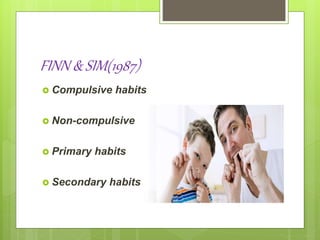
FINN & SIM(1987)
 Compulsive habits
 Non-compulsive
 Primary habits
 Secondary habits
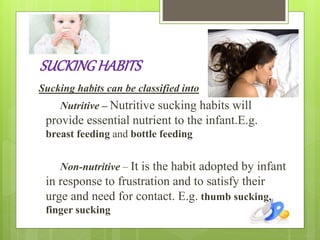
SUCKINGHABITS
Sucking habits can be classified into
Nutritive – Nutritive sucking habits will
provide essential nutrient to the infant.E.g.
breast feeding and bottle feeding
Non-nutritive – It is the habit adopted by infant
in response to frustration and to satisfy their
urge and need for contact. E.g. thumb sucking,
finger sucking
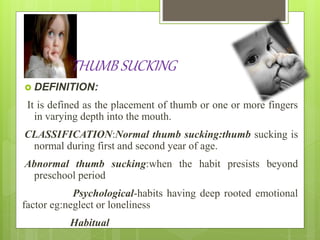
 DEFINITION:
It is defined as the placement of thumb or one or more fingers
in varying depth into the mouth.
CLASSIFICATION:Normal thumb sucking:thumb sucking is
normal during first and second year of age.
Abnormal thumb sucking:when the habit presists beyond
preschool period
Psychological-habits having deep rooted emotional
factor eg:neglect or loneliness
Habitual
THUMB SUCKING
.
Can also be classified by as :
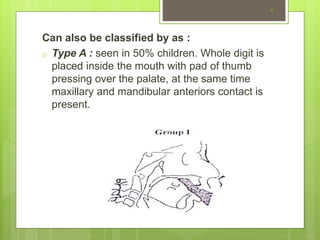
o Type A : seen in 50% children. Whole digit is
placed inside the mouth with pad of thumb
pressing over the palate, at the same time
maxillary and mandibular anteriors contact is
present.
.
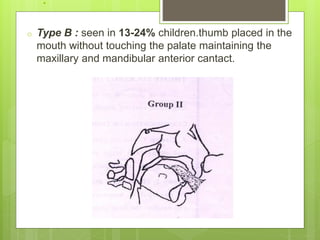
o Type B : seen in 13-24% children.thumb placed in the
mouth without touching the palate maintaining the
maxillary and mandibular anterior cantact.
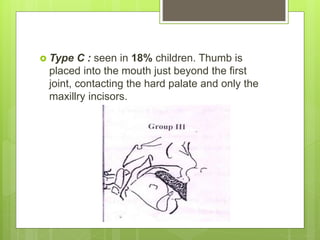
 Type C : seen in 18% children. Thumb is
placed into the mouth just beyond the first
joint, contacting the hard palate and only the
maxillry incisors.
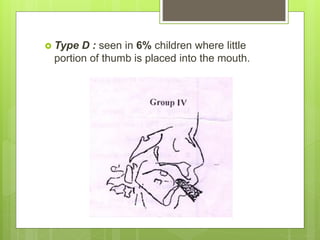
 Type D : seen in 6% children where little
portion of thumb is placed into the mouth.
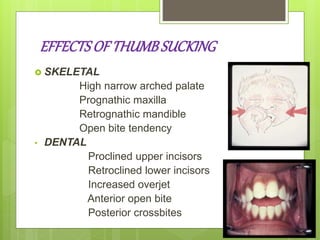
EFFECTS OF THUMBSUCKING
 SKELETAL
High narrow arched palate
Prognathic maxilla
Retrognathic mandible
Open bite tendency
• DENTAL
Proclined upper incisors
Retroclined lower incisors
Increased overjet
Anterior open bite
Posterior crossbites
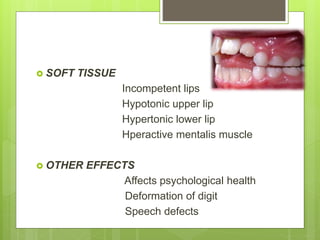
 SOFT TISSUE
Incompetent lips
Hypotonic upper lip
Hypertonic lower lip
Hperactive mentalis muscle
 OTHER EFFECTS
Affects psychological health
Deformation of digit
Speech defects
Diagnosis
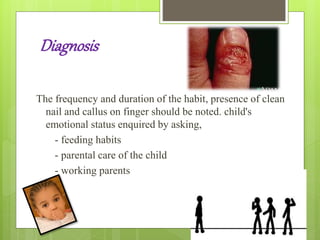
The frequency and duration of the habit, presence of clean
nail and callus on finger should be noted. child's
emotional status enquired by asking,
- feeding habits
- parental care of the child
- working parents
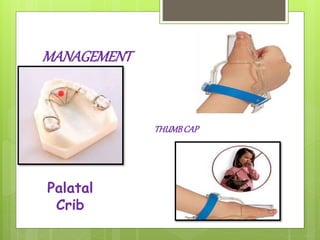
MANAGEMENT
Palatal
Crib
THUMBCAP
PSYCHOLOGICALTHERAPY
 Screening of patients for underlying psychological
disturbances.
 Once determined—sent to psychologist for counseling.
 Thumb sucking between 4-8 years, needs only
reassurance, positive reinforcement, awareness can be
achieved by emphasizing positive aspects of habit
cessation.
 Children and parents are informed about existing dento
facial deformities and long term risk of the habit.
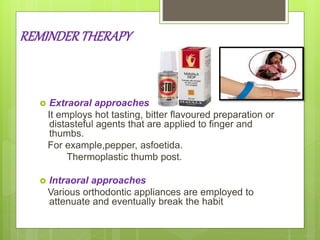
REMINDERTHERAPY
 Extraoral approaches
It employs hot tasting, bitter flavoured preparation or
distasteful agents that are applied to finger and
thumbs.
For example,pepper, asfoetida.
Thermoplastic thumb post.
 Intraoral approaches
Various orthodontic appliances are employed to
attenuate and eventually break the habit
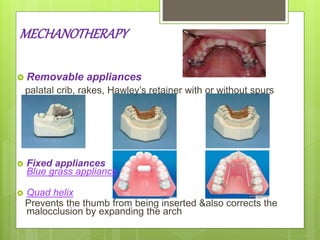
MECHANOTHERAPY
 Removable appliances
palatal crib, rakes, Hawley’s retainer with or without spurs
 Fixed appliances
Blue grass appliance
 Quad helix
Prevents the thumb from being inserted &also corrects the
malocclusion by expanding the arch
TONGUETHRUSTING
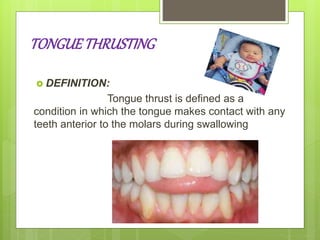
 DEFINITION:
Tongue thrust is defined as a
condition in which the tongue makes contact with any
teeth anterior to the molars during swallowing
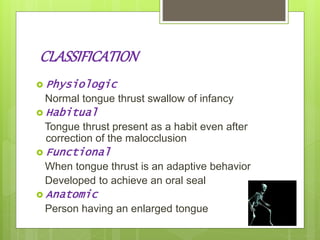
CLASSIFICATION
 Physiologic
Normal tongue thrust swallow of infancy
 Habitual
Tongue thrust present as a habit even after
correction of the malocclusion
 Functional
When tongue thrust is an adaptive behavior
Developed to achieve an oral seal
 Anatomic
Person having an enlarged tongue
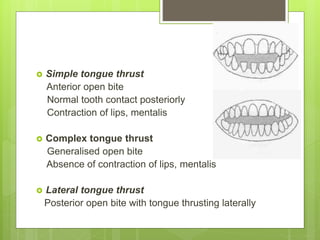
 Simple tongue thrust
Anterior open bite
Normal tooth contact posteriorly
Contraction of lips, mentalis
 Complex tongue thrust
Generalised open bite
Absence of contraction of lips, mentalis
 Lateral tongue thrust
Posterior open bite with tongue thrusting laterally
ETIOLOGY
 Retained infantile swallow
 Upper respiratory tract infection
 Neurological disturbance
 Functional adaptability to transient change in
anatomy
 Induced due to other oral habits
 Tongue size
 Hereditary
 Feeding practices
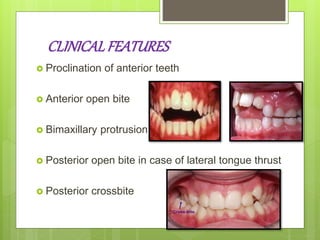
CLINICALFEATURES
 Proclination of anterior teeth
 Anterior open bite
 Bimaxillary protrusion
 Posterior open bite in case of lateral tongue thrust
 Posterior crossbite
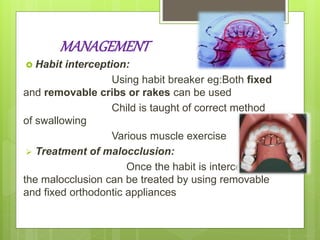
MANAGEMENT
 Habit interception:
Using habit breaker eg:Both fixed
and removable cribs or rakes can be used
Child is taught of correct method
of swallowing
Various muscle exercise
 Treatment of malocclusion:
Once the habit is intercepted
the malocclusion can be treated by using removable
and fixed orthodontic appliances
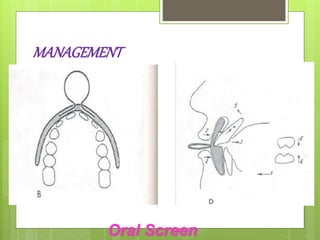
MANAGEMENT
Oral Screen
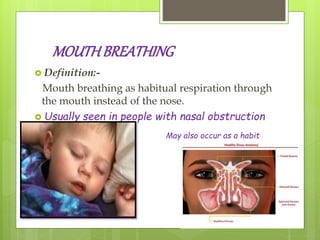
MOUTHBREATHING
 Definition:-
Mouth breathing as habitual respiration through
the mouth instead of the nose.
 Usually seen in people with nasal obstruction
May also occur as a habit
CLASSIFICATION
(1) Anatomic
Mouth breather is one whose short upper lip does
not permit complete closure without undue effort
(2) Habitual
Persistence of habit even after the elimination of
obstructive cause
(3) Obstructive
Increased resistance to complete obstruction of
normal airflow to nasal passage
ETIOLOGY
Complete or partial obstruction of nasal passage can
result in mouth breathing. Some of the causes for
obstruction are:
• Deviated nasal septum
• Nasal polyps
• Chronic inflammation of nasal mucosa
• Localized benign tumors
• Congenital enlargement of nasal turbinate
• Allergic reaction of nasal mucosa
• Obstructive adenoids
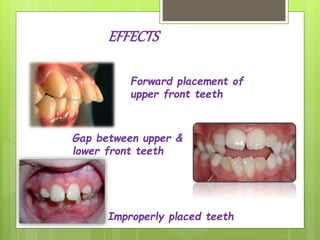
EFFECTS
Forward placement of
upper front teeth
Gap between upper &
lower front teeth
Improperly placed teeth
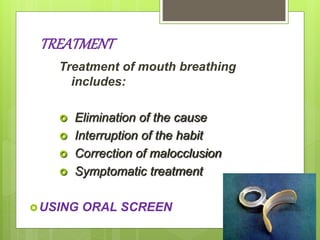
TREATMENT
Treatment of mouth breathing
includes:
 Elimination of the cause
 Interruption of the habit
 Correction of malocclusion
 Symptomatic treatment
USING ORAL SCREEN
Bruxism
 RAMFFORD[1966]
BRUXISM IS THE HABITUAL
GRINDING OF TEETH WHEN THE
INDIVIDUAL IS NOT CHEWING OR
SWALLOWING
ETIOLOGY
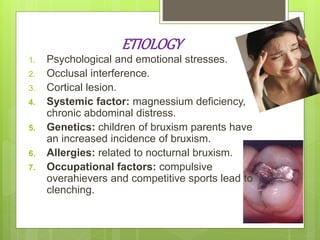
1. Psychological and emotional stresses.
2. Occlusal interference.
3. Cortical lesion.
4. Systemic factor: magnessium deficiency,
chronic abdominal distress.
5. Genetics: children of bruxism parents have
an increased incidence of bruxism.
6. Allergies: related to nocturnal bruxism.
7. Occupational factors: compulsive
overahievers and competitive sports lead to
clenching.
EFFECTS
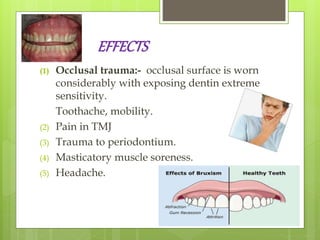
(1) Occlusal trauma:- occlusal surface is worn
considerably with exposing dentin extreme
sensitivity.
Toothache, mobility.
(2) Pain in TMJ
(3) Trauma to periodontium.
(4) Masticatory muscle soreness.
(5) Headache.
TREATMENT
(1) Adjunctive theory:-
 Psychotherapy- Aim to lower the emotional
disturbances.
 Relining exercise - Serve to decrease muscle
function
 Elimination of oral pain & discomfort by
giving ethyl chloride within the tempro-
mandibular joint area.
Counseling
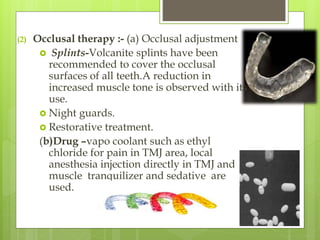
(2) Occlusal therapy :- (a) Occlusal adjustment
 Splints-Volcanite splints have been
recommended to cover the occlusal
surfaces of all teeth.A reduction in
increased muscle tone is observed with its
use.
 Night guards.
 Restorative treatment.
(b)Drug –vapo coolant such as ethyl
chloride for pain in TMJ area, local
anesthesia injection directly in TMJ and
muscle tranquilizer and sedative are
used.
Lipbitting
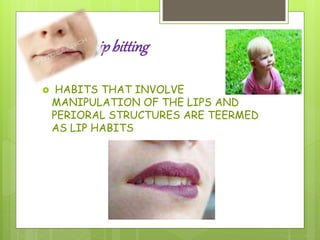
 HABITS THAT INVOLVE
MANIPULATION OF THE LIPS AND
PERIORAL STRUCTURES ARE TEERMED
AS LIP HABITS
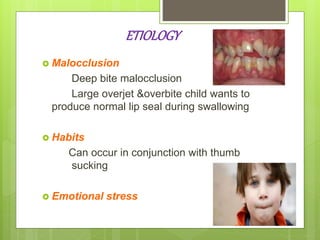
ETIOLOGY
 Malocclusion
Deep bite malocclusion
Large overjet &overbite child wants to
produce normal lip seal during swallowing
 Habits
Can occur in conjunction with thumb
sucking
 Emotional stress
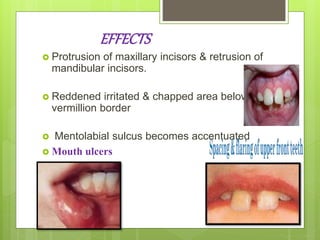
EFFECTS
 Protrusion of maxillary incisors & retrusion of
mandibular incisors.
 Reddened irritated & chapped area below the
vermillion border
 Mentolabial sulcus becomes accentuated
 Mouth ulcers
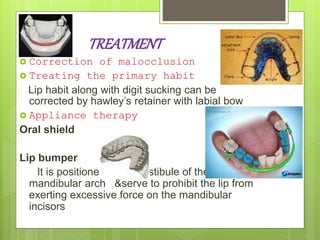
TREATMENT
 Correction of malocclusion
 Treating the primary habit
Lip habit along with digit sucking can be
corrected by hawley’s retainer with labial bow
 Appliance therapy
Oral shield
Lip bumper
It is positioned in the vestibule of the
mandibular arch &serve to prohibit the lip from
exerting excessive force on the mandibular
incisors
CONCLUSION
 The identification and assessment of an abnormal
habits and its immediate and long term effect on
the craniofacial complex and dentition should be
made as early as possible to minimize the potential
deleterious effect on dentofacial Complex.
Reference
 Textbook of orthodontics :
S.GOWRI SANKAR
 Orthodontics THE ART and SCIENCE:
S.I BHALAJHI
 http://www.slideshare.net/indiandentalacadem
y/oral-habits-31764065
 http://www.slideshare.net/search/slideshow?s
earchfrom=header&q=oral+habits

HABITS

  • 1.
  • 2.
    INTRODUCTION  Oral habitsare habits that frequently children aquire that may either temporarily or permanently be harmful to dental occlusion and to the supporting structures.  When habit cause defect in orofacial structure it is termed as pernicious oral habit.
  • 3.
    DEFINITION  Habit maybe defined as the tendency towards, an act that has become a repeated performance, relatively fixed, consistent and easy to perform by an individual.
  • 4.
  • 5.
    Grabers(Basedonetiology)  Thumb sucking Tongue thrusting  Mouth breathing  Lip bitting  Bruxism  Speech defects  Nail biting  Postural habits  Defective occlusal habits
  • 6.
    EARNEST KLEIN(1971) • Intentionalhabits: it functions as an important psychological problem for the child. E.g.: thumb sucking • Un-intentional habit: these are cased by a definite underlying psychological disturbance e.g: mouth breathing
  • 7.
    WILLIAM JAMES(1923)  Usefulhabits:These includes habits that are considered essential for normal function such as proper position of the tongue,respiration and normal deglutition.  Harmful habits:Includes all habits which exerts pressure/stresses on dentofacial structures such as thumb sucking,tongue thrusting,lip bitting etc.
  • 8.
    KINGSLEY(1958)  Functional oralhabit eg: mouth breathing  Muscular habits eg: lip and cheek biting  Combined eg: thumb sucking.  Postural habits
  • 9.
    MORRIS & BOHNNA(1969) Pressure habits eg:thumb sucking, tongue thrusting  Non-pressure habits eg:mouth breathing  Biting habits eg:nail biting,pencil biting and lip biting
  • 10.
    FINN & SIM(1987) Compulsive habits  Non-compulsive  Primary habits  Secondary habits
  • 11.
    SUCKINGHABITS Sucking habits canbe classified into Nutritive – Nutritive sucking habits will provide essential nutrient to the infant.E.g. breast feeding and bottle feeding Non-nutritive – It is the habit adopted by infant in response to frustration and to satisfy their urge and need for contact. E.g. thumb sucking, finger sucking
  • 12.
     DEFINITION: It isdefined as the placement of thumb or one or more fingers in varying depth into the mouth. CLASSIFICATION:Normal thumb sucking:thumb sucking is normal during first and second year of age. Abnormal thumb sucking:when the habit presists beyond preschool period Psychological-habits having deep rooted emotional factor eg:neglect or loneliness Habitual THUMB SUCKING
  • 13.
    . Can also beclassified by as : o Type A : seen in 50% children. Whole digit is placed inside the mouth with pad of thumb pressing over the palate, at the same time maxillary and mandibular anteriors contact is present.
  • 14.
    . o Type B: seen in 13-24% children.thumb placed in the mouth without touching the palate maintaining the maxillary and mandibular anterior cantact.
  • 15.
     Type C: seen in 18% children. Thumb is placed into the mouth just beyond the first joint, contacting the hard palate and only the maxillry incisors.
  • 16.
     Type D: seen in 6% children where little portion of thumb is placed into the mouth.
  • 17.
    EFFECTS OF THUMBSUCKING SKELETAL High narrow arched palate Prognathic maxilla Retrognathic mandible Open bite tendency • DENTAL Proclined upper incisors Retroclined lower incisors Increased overjet Anterior open bite Posterior crossbites
  • 18.
     SOFT TISSUE Incompetentlips Hypotonic upper lip Hypertonic lower lip Hperactive mentalis muscle  OTHER EFFECTS Affects psychological health Deformation of digit Speech defects
  • 19.
    Diagnosis The frequency andduration of the habit, presence of clean nail and callus on finger should be noted. child's emotional status enquired by asking, - feeding habits - parental care of the child - working parents
  • 20.
  • 21.
    PSYCHOLOGICALTHERAPY  Screening ofpatients for underlying psychological disturbances.  Once determined—sent to psychologist for counseling.  Thumb sucking between 4-8 years, needs only reassurance, positive reinforcement, awareness can be achieved by emphasizing positive aspects of habit cessation.  Children and parents are informed about existing dento facial deformities and long term risk of the habit.
  • 22.
    REMINDERTHERAPY  Extraoral approaches Itemploys hot tasting, bitter flavoured preparation or distasteful agents that are applied to finger and thumbs. For example,pepper, asfoetida. Thermoplastic thumb post.  Intraoral approaches Various orthodontic appliances are employed to attenuate and eventually break the habit
  • 23.
    MECHANOTHERAPY  Removable appliances palatalcrib, rakes, Hawley’s retainer with or without spurs  Fixed appliances Blue grass appliance  Quad helix Prevents the thumb from being inserted &also corrects the malocclusion by expanding the arch
  • 24.
    TONGUETHRUSTING  DEFINITION: Tongue thrustis defined as a condition in which the tongue makes contact with any teeth anterior to the molars during swallowing
  • 25.
    CLASSIFICATION  Physiologic Normal tonguethrust swallow of infancy  Habitual Tongue thrust present as a habit even after correction of the malocclusion  Functional When tongue thrust is an adaptive behavior Developed to achieve an oral seal  Anatomic Person having an enlarged tongue
  • 26.
     Simple tonguethrust Anterior open bite Normal tooth contact posteriorly Contraction of lips, mentalis  Complex tongue thrust Generalised open bite Absence of contraction of lips, mentalis  Lateral tongue thrust Posterior open bite with tongue thrusting laterally
  • 27.
    ETIOLOGY  Retained infantileswallow  Upper respiratory tract infection  Neurological disturbance  Functional adaptability to transient change in anatomy  Induced due to other oral habits  Tongue size  Hereditary  Feeding practices
  • 28.
    CLINICALFEATURES  Proclination ofanterior teeth  Anterior open bite  Bimaxillary protrusion  Posterior open bite in case of lateral tongue thrust  Posterior crossbite
  • 29.
    MANAGEMENT  Habit interception: Usinghabit breaker eg:Both fixed and removable cribs or rakes can be used Child is taught of correct method of swallowing Various muscle exercise  Treatment of malocclusion: Once the habit is intercepted the malocclusion can be treated by using removable and fixed orthodontic appliances
  • 30.
  • 31.
    MOUTHBREATHING  Definition:- Mouth breathingas habitual respiration through the mouth instead of the nose.  Usually seen in people with nasal obstruction May also occur as a habit
  • 32.
    CLASSIFICATION (1) Anatomic Mouth breatheris one whose short upper lip does not permit complete closure without undue effort (2) Habitual Persistence of habit even after the elimination of obstructive cause (3) Obstructive Increased resistance to complete obstruction of normal airflow to nasal passage
  • 33.
    ETIOLOGY Complete or partialobstruction of nasal passage can result in mouth breathing. Some of the causes for obstruction are: • Deviated nasal septum • Nasal polyps • Chronic inflammation of nasal mucosa • Localized benign tumors • Congenital enlargement of nasal turbinate • Allergic reaction of nasal mucosa • Obstructive adenoids
  • 34.
    EFFECTS Forward placement of upperfront teeth Gap between upper & lower front teeth Improperly placed teeth
  • 35.
    TREATMENT Treatment of mouthbreathing includes:  Elimination of the cause  Interruption of the habit  Correction of malocclusion  Symptomatic treatment USING ORAL SCREEN
  • 36.
    Bruxism  RAMFFORD[1966] BRUXISM ISTHE HABITUAL GRINDING OF TEETH WHEN THE INDIVIDUAL IS NOT CHEWING OR SWALLOWING
  • 37.
    ETIOLOGY 1. Psychological andemotional stresses. 2. Occlusal interference. 3. Cortical lesion. 4. Systemic factor: magnessium deficiency, chronic abdominal distress. 5. Genetics: children of bruxism parents have an increased incidence of bruxism. 6. Allergies: related to nocturnal bruxism. 7. Occupational factors: compulsive overahievers and competitive sports lead to clenching.
  • 38.
    EFFECTS (1) Occlusal trauma:-occlusal surface is worn considerably with exposing dentin extreme sensitivity. Toothache, mobility. (2) Pain in TMJ (3) Trauma to periodontium. (4) Masticatory muscle soreness. (5) Headache.
  • 39.
    TREATMENT (1) Adjunctive theory:- Psychotherapy- Aim to lower the emotional disturbances.  Relining exercise - Serve to decrease muscle function  Elimination of oral pain & discomfort by giving ethyl chloride within the tempro- mandibular joint area. Counseling
  • 40.
    (2) Occlusal therapy:- (a) Occlusal adjustment  Splints-Volcanite splints have been recommended to cover the occlusal surfaces of all teeth.A reduction in increased muscle tone is observed with its use.  Night guards.  Restorative treatment. (b)Drug –vapo coolant such as ethyl chloride for pain in TMJ area, local anesthesia injection directly in TMJ and muscle tranquilizer and sedative are used.
  • 41.
    Lipbitting  HABITS THATINVOLVE MANIPULATION OF THE LIPS AND PERIORAL STRUCTURES ARE TEERMED AS LIP HABITS
  • 42.
    ETIOLOGY  Malocclusion Deep bitemalocclusion Large overjet &overbite child wants to produce normal lip seal during swallowing  Habits Can occur in conjunction with thumb sucking  Emotional stress
  • 43.
    EFFECTS  Protrusion ofmaxillary incisors & retrusion of mandibular incisors.  Reddened irritated & chapped area below the vermillion border  Mentolabial sulcus becomes accentuated  Mouth ulcers
  • 44.
    TREATMENT  Correction ofmalocclusion  Treating the primary habit Lip habit along with digit sucking can be corrected by hawley’s retainer with labial bow  Appliance therapy Oral shield Lip bumper It is positioned in the vestibule of the mandibular arch &serve to prohibit the lip from exerting excessive force on the mandibular incisors
  • 45.
    CONCLUSION  The identificationand assessment of an abnormal habits and its immediate and long term effect on the craniofacial complex and dentition should be made as early as possible to minimize the potential deleterious effect on dentofacial Complex.
  • 46.
    Reference  Textbook oforthodontics : S.GOWRI SANKAR  Orthodontics THE ART and SCIENCE: S.I BHALAJHI  http://www.slideshare.net/indiandentalacadem y/oral-habits-31764065  http://www.slideshare.net/search/slideshow?s earchfrom=header&q=oral+habits

Editor's Notes

  • #4 Reference:Textbook of orthodontics S.GOWRI SANKAR
  • #30 REFERENCE:ORTHODONTICS S I BHALAJHI