"How whole are we?”
By Dr. Raymund B. Habaradas
Symposium on the “Vocation of the Business
Leader” and CST-BEN Organization Meeting
University of San Carlos, Cebu
November 6 and 7, 2015
An application of the Integral Human
Development Framework
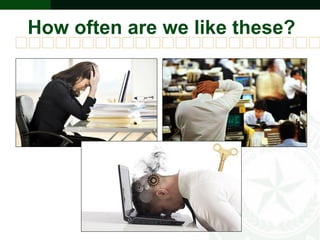
How often are we like these?
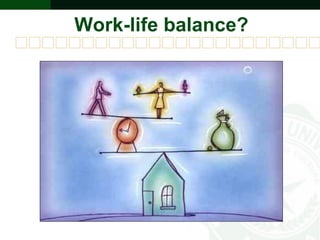
Work-life balance?
Work-life integration
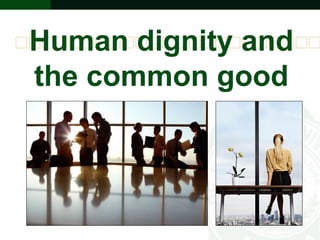
Human dignity and
the common good
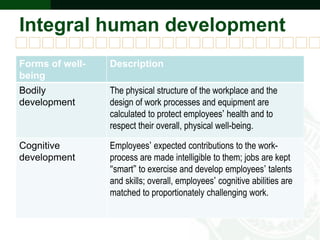
Integral human development
Forms of well-
being
Description
Bodily
development
The physical structure of the workplace and the
design of work processes and equipment are
calculated to protect employees’ health and to
respect their overall, physical well-being.
Cognitive
development
Employees’ expected contributions to the work-
process are made intelligible to them; jobs are kept
“smart” to exercise and develop employees’ talents
and skills; overall, employees’ cognitive abilities are
matched to proportionately challenging work.
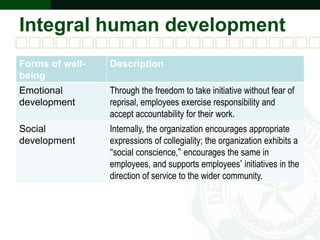
Integral human development
Forms of well-
being
Description
Emotional
development
Through the freedom to take initiative without fear of
reprisal, employees exercise responsibility and
accept accountability for their work.
Social
development
Internally, the organization encourages appropriate
expressions of collegiality; the organization exhibits a
“social conscience,” encourages the same in
employees, and supports employees’ initiatives in the
direction of service to the wider community.
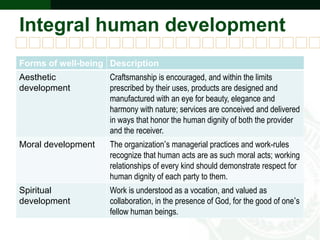
Integral human development
Forms of well-being Description
Aesthetic
development
Craftsmanship is encouraged, and within the limits
prescribed by their uses, products are designed and
manufactured with an eye for beauty, elegance and
harmony with nature; services are conceived and delivered
in ways that honor the human dignity of both the provider
and the receiver.
Moral development The organization’s managerial practices and work-rules
recognize that human acts are as such moral acts; working
relationships of every kind should demonstrate respect for
human dignity of each party to them.
Spiritual
development
Work is understood as a vocation, and valued as
collaboration, in the presence of God, for the good of one’s
fellow human beings.
Self-reflection
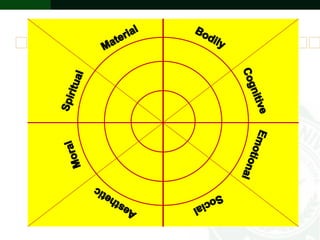
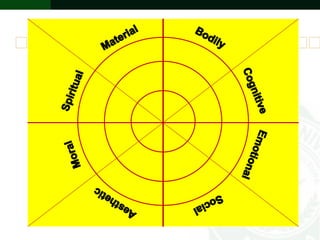
The human development flower – Part 1
 Using the integral human development framework as your
guide, assess your personal well-being by drawing a flower,
with each petal representing one form of well-being. A large
petal means that form of well-being is nurtured well, while a
small petal means that form of well-being has not been
adequately nurtured.
 Answer the following: (a) Which forms of well-being are
nurtured in me? (b) Which forms of well-being need further
nurturing? Explain your answer.
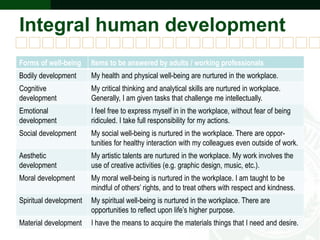
Integral human development
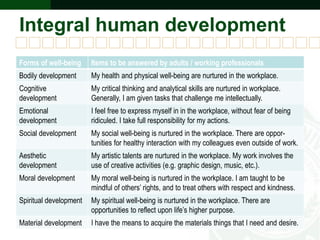
Forms of well-being Items to be answered by adults / working professionals
Bodily development My health and physical well-being are nurtured in the workplace.
Cognitive
development
My critical thinking and analytical skills are nurtured in workplace.
Generally, I am given tasks that challenge me intellectually.
Emotional
development
I feel free to express myself in in the workplace, without fear of being
ridiculed. I take full responsibility for my actions.
Social development My social well-being is nurtured in the workplace. There are oppor-
tunities for healthy interaction with my colleagues even outside of work.
Aesthetic
development
My artistic talents are nurtured in the workplace. My work involves the
use of creative activities (e.g. graphic design, music, etc.).
Moral development My moral well-being is nurtured in the workplace. I am taught to be
mindful of others’ rights, and to treat others with respect and kindness.
Spiritual development My spiritual well-being is nurtured in the workplace. There are
opportunities to reflect upon life’s higher purpose.
Material development I have the means to acquire the materials things that I need and desire.
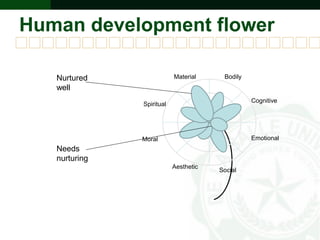
Bodily
Cognitive
Emotional
Social
Aesthetic
Moral
Spiritual
MaterialNurtured
well
Needs
nurturing
Human development flower
Group discussion
 Work in groups of four or five. Share your drawings and
answers to your group mates.
 After sharing with your group mates, identify similarities
or differences among yourselves.
 Choose a representative to present the highlights of your
discussion to the big group.
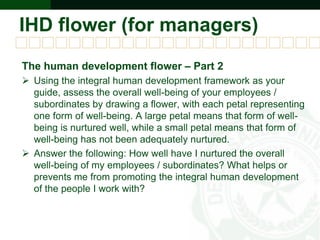
IHD flower (for managers)
The human development flower – Part 2
 Using the integral human development framework as your
guide, assess the overall well-being of your employees /
subordinates by drawing a flower, with each petal representing
one form of well-being. A large petal means that form of well-
being is nurtured well, while a small petal means that form of
well-being has not been adequately nurtured.
 Answer the following: How well have I nurtured the overall
well-being of my employees / subordinates? What helps or
prevents me from promoting the integral human development
of the people I work with?
Integral human development
Forms of well-being Items to be answered by adults / working professionals
Bodily development My health and physical well-being are nurtured in the workplace.
Cognitive
development
My critical thinking and analytical skills are nurtured in workplace.
Generally, I am given tasks that challenge me intellectually.
Emotional
development
I feel free to express myself in in the workplace, without fear of being
ridiculed. I take full responsibility for my actions.
Social development My social well-being is nurtured in the workplace. There are oppor-
tunities for healthy interaction with my colleagues even outside of work.
Aesthetic
development
My artistic talents are nurtured in the workplace. My work involves the
use of creative activities (e.g. graphic design, music, etc.).
Moral development My moral well-being is nurtured in the workplace. I am taught to be
mindful of others’ rights, and to treat others with respect and kindness.
Spiritual development My spiritual well-being is nurtured in the workplace. There are
opportunities to reflect upon life’s higher purpose.
Material development I have the means to acquire the materials things that I need and desire.
Group discussion
 Work in groups of four or five. Share your drawings and
answers to your group mates.
 After sharing with your group mates, identify similarities
or differences among yourselves.
 Come up with a consensus on the following questions:
– Is it possible for modern work organizations to nurture all of the
different forms of well-being of its employees? Why or why not?
– What can we do to promote integral human development in our
respective schools?
Should we not be like these?
"How whole are we?”
By Dr. Raymund B. Habaradas
Symposium on the “Vocation of the Business
Leader” and CST-BEN Organization Meeting
University of San Carlos, Cebu
November 6 and 7, 2015
An application of the Integral Human
Development Framework

Habaradas how whole are we

  • 1.
    "How whole arewe?” By Dr. Raymund B. Habaradas Symposium on the “Vocation of the Business Leader” and CST-BEN Organization Meeting University of San Carlos, Cebu November 6 and 7, 2015 An application of the Integral Human Development Framework
  • 2.
    How often arewe like these?
  • 3.
  • 4.
  • 5.
  • 6.
    Integral human development Formsof well- being Description Bodily development The physical structure of the workplace and the design of work processes and equipment are calculated to protect employees’ health and to respect their overall, physical well-being. Cognitive development Employees’ expected contributions to the work- process are made intelligible to them; jobs are kept “smart” to exercise and develop employees’ talents and skills; overall, employees’ cognitive abilities are matched to proportionately challenging work.
  • 7.
    Integral human development Formsof well- being Description Emotional development Through the freedom to take initiative without fear of reprisal, employees exercise responsibility and accept accountability for their work. Social development Internally, the organization encourages appropriate expressions of collegiality; the organization exhibits a “social conscience,” encourages the same in employees, and supports employees’ initiatives in the direction of service to the wider community.
  • 8.
    Integral human development Formsof well-being Description Aesthetic development Craftsmanship is encouraged, and within the limits prescribed by their uses, products are designed and manufactured with an eye for beauty, elegance and harmony with nature; services are conceived and delivered in ways that honor the human dignity of both the provider and the receiver. Moral development The organization’s managerial practices and work-rules recognize that human acts are as such moral acts; working relationships of every kind should demonstrate respect for human dignity of each party to them. Spiritual development Work is understood as a vocation, and valued as collaboration, in the presence of God, for the good of one’s fellow human beings.
  • 9.
    Self-reflection The human developmentflower – Part 1  Using the integral human development framework as your guide, assess your personal well-being by drawing a flower, with each petal representing one form of well-being. A large petal means that form of well-being is nurtured well, while a small petal means that form of well-being has not been adequately nurtured.  Answer the following: (a) Which forms of well-being are nurtured in me? (b) Which forms of well-being need further nurturing? Explain your answer.
  • 14.
    Integral human development Formsof well-being Items to be answered by adults / working professionals Bodily development My health and physical well-being are nurtured in the workplace. Cognitive development My critical thinking and analytical skills are nurtured in workplace. Generally, I am given tasks that challenge me intellectually. Emotional development I feel free to express myself in in the workplace, without fear of being ridiculed. I take full responsibility for my actions. Social development My social well-being is nurtured in the workplace. There are oppor- tunities for healthy interaction with my colleagues even outside of work. Aesthetic development My artistic talents are nurtured in the workplace. My work involves the use of creative activities (e.g. graphic design, music, etc.). Moral development My moral well-being is nurtured in the workplace. I am taught to be mindful of others’ rights, and to treat others with respect and kindness. Spiritual development My spiritual well-being is nurtured in the workplace. There are opportunities to reflect upon life’s higher purpose. Material development I have the means to acquire the materials things that I need and desire.
  • 15.
  • 16.
    Group discussion  Workin groups of four or five. Share your drawings and answers to your group mates.  After sharing with your group mates, identify similarities or differences among yourselves.  Choose a representative to present the highlights of your discussion to the big group.
  • 17.
    IHD flower (formanagers) The human development flower – Part 2  Using the integral human development framework as your guide, assess the overall well-being of your employees / subordinates by drawing a flower, with each petal representing one form of well-being. A large petal means that form of well- being is nurtured well, while a small petal means that form of well-being has not been adequately nurtured.  Answer the following: How well have I nurtured the overall well-being of my employees / subordinates? What helps or prevents me from promoting the integral human development of the people I work with?
  • 19.
    Integral human development Formsof well-being Items to be answered by adults / working professionals Bodily development My health and physical well-being are nurtured in the workplace. Cognitive development My critical thinking and analytical skills are nurtured in workplace. Generally, I am given tasks that challenge me intellectually. Emotional development I feel free to express myself in in the workplace, without fear of being ridiculed. I take full responsibility for my actions. Social development My social well-being is nurtured in the workplace. There are oppor- tunities for healthy interaction with my colleagues even outside of work. Aesthetic development My artistic talents are nurtured in the workplace. My work involves the use of creative activities (e.g. graphic design, music, etc.). Moral development My moral well-being is nurtured in the workplace. I am taught to be mindful of others’ rights, and to treat others with respect and kindness. Spiritual development My spiritual well-being is nurtured in the workplace. There are opportunities to reflect upon life’s higher purpose. Material development I have the means to acquire the materials things that I need and desire.
  • 20.
    Group discussion  Workin groups of four or five. Share your drawings and answers to your group mates.  After sharing with your group mates, identify similarities or differences among yourselves.  Come up with a consensus on the following questions: – Is it possible for modern work organizations to nurture all of the different forms of well-being of its employees? Why or why not? – What can we do to promote integral human development in our respective schools?
  • 21.
    Should we notbe like these?
  • 22.
    "How whole arewe?” By Dr. Raymund B. Habaradas Symposium on the “Vocation of the Business Leader” and CST-BEN Organization Meeting University of San Carlos, Cebu November 6 and 7, 2015 An application of the Integral Human Development Framework