INTEGRAL HUMAN  DEVELOPMENTThe Guarantee of Catholicity1
Mission Statement of the Archdiocese of Port of SpainWe are the People of God in Trinidad and Tobago, building the Civilization of Love - reconciliation with God, neighbour, creation and self - through:   • The New Evangelization• Revitalizing Catholic Culture and Identity• Regenerating the Moral and Spiritual           Values of our Society2
Pope Paul VI (1963 - 1978)PopulorumProgressio (1967)Outlined a charter for the progress of peoplesHas a developmental framework [from less human to more human]Begins at the individual human, and embraces the nation and the community of nations. Underlying metaphor or theme is the journey. 3
Pope Paul VI (1963 - 1978)Civilizations are born, develop and die. But humanity is advancing along the path of history like the waves of a rising tide encroaching gradually on from past generations, and we have   benefited from the work of our contemporaries: for this reason we have obligations towards all, and we cannot refuse to interest ourselves in those who will come after us to enlarge the human family. The reality of human solidarity, which is a benefit for us, also imposes a duty.4
AUTHENTIC, INTEGRAL, HUMAN DEVELOPMENT5
AUTHENTIC6
INTEGRAL7
HUMAN8
DEVELOPMENT9
AUTHENTIC, INTEGRAL, HUMAN DEVELOPMENT10
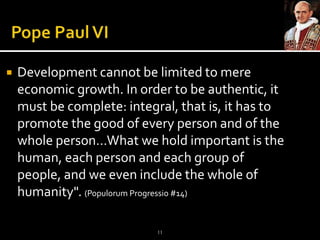
Pope Paul VIDevelopment cannot be limited to mere economic growth. In order to be authentic, it must be complete: integral, that is, it has to promote the good of every person and of the whole person…What we hold important is the human, each person and each group of people, and we even include the whole of humanity". (PopulorumProgressio #14)11
Pope Paul VIWhat must be aimed at is complete humanism. And what is that if not the fully-rounded development of the whole person and of all people?  An isolated humanism is an inhuman humanism". There is no true humanism but that which is open to the Absolute and is conscious of a vocation which gives human life its true meaning. (PopulorumProgressio # 42)12
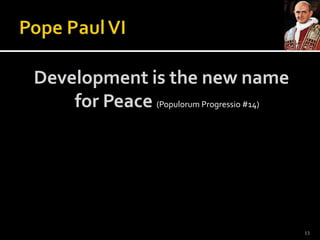
Pope Paul VIDevelopment is the new name for Peace (PopulorumProgressio #14) 13
Pope Benedict XVI (2005 )Caritas in Veritate (2009)14
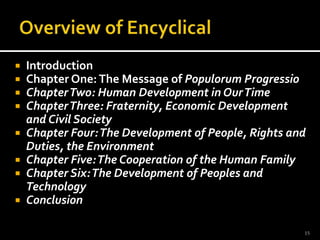
Overview of EncyclicalIntroductionChapter One: The Message of Populorum ProgressioChapter Two: Human Development in Our TimeChapter Three: Fraternity, Economic Development and Civil SocietyChapter Four: The Development of People, Rights and Duties, the EnvironmentChapter Five: The Cooperation of the Human FamilyChapter Six: The Development of Peoples and TechnologyConclusion15
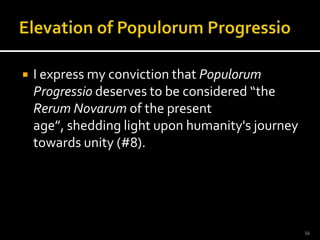
Elevation of PopulorumProgressioI express my conviction that PopulorumProgressio deserves to be considered “theRerumNovarumof the present age”, shedding light upon humanity's journey towards unity (#8).16
Pope Leo XIIRerumNovarum 1891First Encyclical dedicated to the Social contextElaborated the rights of the workersA Pope intervened on behalf of the workers It began a tradition that has been celebrated at each significant anniversary17
Caritas in Veritate1. All people feel the interior impulse to love authentically: love and truth never abandon them completely, because these are the vocationplanted by God in the heart and mind of every human person. .. In Christ, charity in truth becomes the Face of his Person, a vocation for us to love our brothers and sisters in the truth of his plan. Indeed, he himself is the Truth (cf. Jn 14:6).18
Caritas in Veritate16. Paul VI taught that progress, in its origin and essence, is first and foremost a vocation: “in the design of God, every person is called upon to develop and fulfill himself, for every life is a vocation .”  This is what gives legitimacy to the Church's involvement in the whole question of development.  19
Caritas in Veritate17. To regard development as a vocation is to recognize, on the one hand, that it derives from a transcendent call, and on the other hand that it is incapable, on its own, of supplying its ultimate meaning. Not without reason the word “vocation” is also found in another passage of the Encyclical, where we read: “There is no true humanism but that which is open to the Absolute, and is conscious of a vocation which gives human life its true meaning.” 20
Caritas in Veritate17. A vocation is a call that requires a free and responsible answer. Integral human development presupposes the responsible freedom of the individual and of peoples:  no structure can guarantee this development over and above human responsibility.  21
Caritas in Veritate18. Besides requiring freedom, integral human development as a vocation also demands respect for its truth. The vocation to progress drives us to “do more, know more and have more in order to be more”. But herein lies the problem: what does it mean “to be more”? Paul VI answers the question by indicating the essential quality of “authentic” development: it must be “integral, that is, it has to promote the good of every man and of the whole man”.  22
Caritas in Veritate18. Amid the various competing anthropological visions put forward in today's society, even more so than in Paul VI's time, the Christian vision has the particular characteristic of asserting and justifying the unconditional value of the human person and the meaning of his growth. The Christian vocation to development helps to promote the advancement of all men and of the whole man. As Paul VI wrote: “What we hold important is man, each man and each group of men, and we even include the whole of humanity”. 23
Caritas in Veritate19. Finally, the vision of development as a vocation brings with it the central place of charity within that development . .. first of all, in the will, which often neglects the duties of solidarity; secondly in thinking, which does not always give proper direction to the will. Hence, in the pursuit of development, there is a need for “the deep thought and reflection of wise men in search of a new humanism which will enable modern man to find himself anew” 24
Caritas in Veritate19. As society becomes ever more globalized, it makes us neighbours but does not make us brothers. Reason, by itself, is capable of grasping the equality between men and of giving stability to their civic coexistence, but it cannot establish fraternity. This originates in a transcendent vocation from God the Father, who loved us first, teaching us through the Son what fraternal charity is.25
Caritas in VeritateIntegral Human Development:The first is that the whole Church, in all her being and acting — when she proclaims, when she celebrates, when she performs works of charity — is engaged in promoting integral human development. The second truth is that authentic human development concerns the whole of the person in every single dimensionMoreover, such development requires a transcendent vision of the person, it needs God: without him, development is either denied, or entrusted exclusively to man, who falls into the trap of thinking he can bring about his own salvation, and ends up promoting a dehumanized form of development (#11). 26
Pope Paul VI-Less Human ConditionsThe lack of material necessities for those who are without the minimum essential for life, The moral deficiencies of those who are mutilated byselfishness. Oppressive social structures, whether due to the abuses of ownership or to the abuses of power, to the exploitation of workers or to unjust transactions. 27
Pope Paul VI-More humanthe passage from misery towards the possession of necessities, victory over social scourges, the growth of knowledge, the acquisition of culture.  increased esteem for the dignity of others, the turning toward the spirit of poverty,[18] cooperation for thecommon good, the will and desire for peace. 28
Pope Paul VI-More HumanThe acknowledgment by man of supreme values, and of God their source and their finality.  Faith, a gift of God accepted by the good will of man, and unity in the charity of Christ, Who calls us all to share as sons in the life of the living God, the Father of all men.29
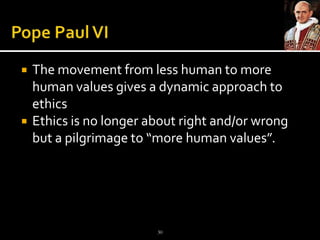
Pope Paul VIThe movement from less human to more human values gives a dynamic approach to ethicsEthics is no longer about right and/or wrong but a pilgrimage to “more human values”.30
Integral human Development is salvationPaul VI, presenting the various levels in the process of human development, placed at the summit, after mentioning faith, “unity in the charity of Christ who calls us all to share as sons in the life of the living God, the Father of all”.This is authentic humanism and Christian Vision of salvation  31
CatholicityNow, turning to the second aspect of catholicity, we must ask whether there is anything in it corresponding to depth. If so, how deep are its roots in the world? Presenting a basic Catholic answer to this question, Yves Congarwrites: 'The fullness that is in Christ does not communicate itself to an empty and inert humanity. It has a source of richness likewise in human beings or in human nature.'1 According to the Catholic understanding, the Spirit of God does not merely hover above the world, nor does it simply touch the world as a tangent touches a circle, but it reaches into the depths. Divine life, when it enters the human realm, penetrates not only the spiritual faculties of intellect and will, but the person's whole being, including the sensory and bodily aspects (Dulles, The Catholicity of the Church, 1987. 48)33
CatholicityThe guarantee of an authentic anthropology. Two threats to authentic AnthropologyPlagiarism Manichaeanism/Jansenism34
Pelagianism,The Pelagian, denying that original sin makes us inwardly corrupt, regards human nature in its present condition as sound and healthy. Hence it follows that if we are sinful, this is the result of our own free activity, and that the same freedom makes us capable of rising again. Grace is understood as a set of favourable conditions, such as the good example and admonition that come from other human beings. Conversely, original sin, if the term is used at all, means the bad example and moral influence of Adam or our predecessors. According to the Pelagian, the justified person is inherently righteous and does not need to rely on the merits of Christ as imputed. Finally, the virtuous person can perform good and meritorious works by the powers of unaided nature.. (Dulles, 49)35
ManichaeanismThe second major tendency is the Manichaean, which has its analogues in  Jansenius (Cornelius Jansen). In reaction against Pelagianizing movements, this tendency stresses the discontinuities. In the old Manichaeanism nature itself was regarded as evil and as produced by an evil demiurge rather than by the God of Jesus Christ. In its Protestant and Jansenist forms, this tendency is expressed in the view that human nature, since the Fall, is irreparably corrupt and incapable of doing anything but sin.2 The Christian life therefore consists in allowing the sufferings of Jesus Christ to serve as a substitute for the meritorious works36
CatholicityThe third tendency, proposed most officially by the Council of Trent in its Decree on Justification (1547), may be called the Catholic position. Striking a middle path between the other two, this position emphasizes, as catholicity always does, continuity within discontinuity. Nature is fundamentally good, and remains so, even though it is wounded by the effects of original sin. The human person is and remains an image of God. Retaining the essential powers of intelligence and free will, the sinner is able to act responsibly, and does not necessarily sin (as some Protestants held) in every act. (Dulles, 50)37
WE38
BELIEVE39
IN40
ONE41
HOLY42
CATHOLIC43
AND44
APOSTOLIC45
CHURCH46
CatholicityAuthentic integral human development is the depth and guarantee of Catholicity. 47

Integral Human Development Caritas In Veritate

  • 1.
    INTEGRAL HUMAN DEVELOPMENTThe Guarantee of Catholicity1
  • 2.
    Mission Statement ofthe Archdiocese of Port of SpainWe are the People of God in Trinidad and Tobago, building the Civilization of Love - reconciliation with God, neighbour, creation and self - through: • The New Evangelization• Revitalizing Catholic Culture and Identity• Regenerating the Moral and Spiritual Values of our Society2
  • 3.
    Pope Paul VI(1963 - 1978)PopulorumProgressio (1967)Outlined a charter for the progress of peoplesHas a developmental framework [from less human to more human]Begins at the individual human, and embraces the nation and the community of nations. Underlying metaphor or theme is the journey. 3
  • 4.
    Pope Paul VI(1963 - 1978)Civilizations are born, develop and die. But humanity is advancing along the path of history like the waves of a rising tide encroaching gradually on from past generations, and we have benefited from the work of our contemporaries: for this reason we have obligations towards all, and we cannot refuse to interest ourselves in those who will come after us to enlarge the human family. The reality of human solidarity, which is a benefit for us, also imposes a duty.4
  • 5.
  • 6.
  • 7.
  • 8.
  • 9.
  • 10.
  • 11.
    Pope Paul VIDevelopmentcannot be limited to mere economic growth. In order to be authentic, it must be complete: integral, that is, it has to promote the good of every person and of the whole person…What we hold important is the human, each person and each group of people, and we even include the whole of humanity". (PopulorumProgressio #14)11
  • 12.
    Pope Paul VIWhatmust be aimed at is complete humanism. And what is that if not the fully-rounded development of the whole person and of all people? An isolated humanism is an inhuman humanism". There is no true humanism but that which is open to the Absolute and is conscious of a vocation which gives human life its true meaning. (PopulorumProgressio # 42)12
  • 13.
    Pope Paul VIDevelopmentis the new name for Peace (PopulorumProgressio #14) 13
  • 14.
    Pope Benedict XVI(2005 )Caritas in Veritate (2009)14
  • 15.
    Overview of EncyclicalIntroductionChapterOne: The Message of Populorum ProgressioChapter Two: Human Development in Our TimeChapter Three: Fraternity, Economic Development and Civil SocietyChapter Four: The Development of People, Rights and Duties, the EnvironmentChapter Five: The Cooperation of the Human FamilyChapter Six: The Development of Peoples and TechnologyConclusion15
  • 16.
    Elevation of PopulorumProgressioIexpress my conviction that PopulorumProgressio deserves to be considered “theRerumNovarumof the present age”, shedding light upon humanity's journey towards unity (#8).16
  • 17.
    Pope Leo XIIRerumNovarum1891First Encyclical dedicated to the Social contextElaborated the rights of the workersA Pope intervened on behalf of the workers It began a tradition that has been celebrated at each significant anniversary17
  • 18.
    Caritas in Veritate1.All people feel the interior impulse to love authentically: love and truth never abandon them completely, because these are the vocationplanted by God in the heart and mind of every human person. .. In Christ, charity in truth becomes the Face of his Person, a vocation for us to love our brothers and sisters in the truth of his plan. Indeed, he himself is the Truth (cf. Jn 14:6).18
  • 19.
    Caritas in Veritate16.Paul VI taught that progress, in its origin and essence, is first and foremost a vocation: “in the design of God, every person is called upon to develop and fulfill himself, for every life is a vocation .” This is what gives legitimacy to the Church's involvement in the whole question of development.  19
  • 20.
    Caritas in Veritate17.To regard development as a vocation is to recognize, on the one hand, that it derives from a transcendent call, and on the other hand that it is incapable, on its own, of supplying its ultimate meaning. Not without reason the word “vocation” is also found in another passage of the Encyclical, where we read: “There is no true humanism but that which is open to the Absolute, and is conscious of a vocation which gives human life its true meaning.” 20
  • 21.
    Caritas in Veritate17.A vocation is a call that requires a free and responsible answer. Integral human development presupposes the responsible freedom of the individual and of peoples:  no structure can guarantee this development over and above human responsibility.  21
  • 22.
    Caritas in Veritate18.Besides requiring freedom, integral human development as a vocation also demands respect for its truth. The vocation to progress drives us to “do more, know more and have more in order to be more”. But herein lies the problem: what does it mean “to be more”? Paul VI answers the question by indicating the essential quality of “authentic” development: it must be “integral, that is, it has to promote the good of every man and of the whole man”. 22
  • 23.
    Caritas in Veritate18.Amid the various competing anthropological visions put forward in today's society, even more so than in Paul VI's time, the Christian vision has the particular characteristic of asserting and justifying the unconditional value of the human person and the meaning of his growth. The Christian vocation to development helps to promote the advancement of all men and of the whole man. As Paul VI wrote: “What we hold important is man, each man and each group of men, and we even include the whole of humanity”. 23
  • 24.
    Caritas in Veritate19.Finally, the vision of development as a vocation brings with it the central place of charity within that development . .. first of all, in the will, which often neglects the duties of solidarity; secondly in thinking, which does not always give proper direction to the will. Hence, in the pursuit of development, there is a need for “the deep thought and reflection of wise men in search of a new humanism which will enable modern man to find himself anew” 24
  • 25.
    Caritas in Veritate19.As society becomes ever more globalized, it makes us neighbours but does not make us brothers. Reason, by itself, is capable of grasping the equality between men and of giving stability to their civic coexistence, but it cannot establish fraternity. This originates in a transcendent vocation from God the Father, who loved us first, teaching us through the Son what fraternal charity is.25
  • 26.
    Caritas in VeritateIntegralHuman Development:The first is that the whole Church, in all her being and acting — when she proclaims, when she celebrates, when she performs works of charity — is engaged in promoting integral human development. The second truth is that authentic human development concerns the whole of the person in every single dimensionMoreover, such development requires a transcendent vision of the person, it needs God: without him, development is either denied, or entrusted exclusively to man, who falls into the trap of thinking he can bring about his own salvation, and ends up promoting a dehumanized form of development (#11). 26
  • 27.
    Pope Paul VI-LessHuman ConditionsThe lack of material necessities for those who are without the minimum essential for life, The moral deficiencies of those who are mutilated byselfishness. Oppressive social structures, whether due to the abuses of ownership or to the abuses of power, to the exploitation of workers or to unjust transactions. 27
  • 28.
    Pope Paul VI-Morehumanthe passage from misery towards the possession of necessities, victory over social scourges, the growth of knowledge, the acquisition of culture. increased esteem for the dignity of others, the turning toward the spirit of poverty,[18] cooperation for thecommon good, the will and desire for peace. 28
  • 29.
    Pope Paul VI-MoreHumanThe acknowledgment by man of supreme values, and of God their source and their finality. Faith, a gift of God accepted by the good will of man, and unity in the charity of Christ, Who calls us all to share as sons in the life of the living God, the Father of all men.29
  • 30.
    Pope Paul VIThemovement from less human to more human values gives a dynamic approach to ethicsEthics is no longer about right and/or wrong but a pilgrimage to “more human values”.30
  • 31.
    Integral human Developmentis salvationPaul VI, presenting the various levels in the process of human development, placed at the summit, after mentioning faith, “unity in the charity of Christ who calls us all to share as sons in the life of the living God, the Father of all”.This is authentic humanism and Christian Vision of salvation  31
  • 33.
    CatholicityNow, turning tothe second aspect of catholicity, we must ask whether there is anything in it corresponding to depth. If so, how deep are its roots in the world? Presenting a basic Catholic answer to this question, Yves Congarwrites: 'The fullness that is in Christ does not communicate itself to an empty and inert humanity. It has a source of richness likewise in human beings or in human nature.'1 According to the Catholic understanding, the Spirit of God does not merely hover above the world, nor does it simply touch the world as a tangent touches a circle, but it reaches into the depths. Divine life, when it enters the human realm, penetrates not only the spiritual faculties of intellect and will, but the person's whole being, including the sensory and bodily aspects (Dulles, The Catholicity of the Church, 1987. 48)33
  • 34.
    CatholicityThe guarantee ofan authentic anthropology. Two threats to authentic AnthropologyPlagiarism Manichaeanism/Jansenism34
  • 35.
    Pelagianism,The Pelagian, denyingthat original sin makes us inwardly corrupt, regards human nature in its present condition as sound and healthy. Hence it follows that if we are sinful, this is the result of our own free activity, and that the same freedom makes us capable of rising again. Grace is understood as a set of favourable conditions, such as the good example and admonition that come from other human beings. Conversely, original sin, if the term is used at all, means the bad example and moral influence of Adam or our predecessors. According to the Pelagian, the justified person is inherently righteous and does not need to rely on the merits of Christ as imputed. Finally, the virtuous person can perform good and meritorious works by the powers of unaided nature.. (Dulles, 49)35
  • 36.
    ManichaeanismThe second majortendency is the Manichaean, which has its analogues in  Jansenius (Cornelius Jansen). In reaction against Pelagianizing movements, this tendency stresses the discontinuities. In the old Manichaeanism nature itself was regarded as evil and as produced by an evil demiurge rather than by the God of Jesus Christ. In its Protestant and Jansenist forms, this tendency is expressed in the view that human nature, since the Fall, is irreparably corrupt and incapable of doing anything but sin.2 The Christian life therefore consists in allowing the sufferings of Jesus Christ to serve as a substitute for the meritorious works36
  • 37.
    CatholicityThe third tendency,proposed most officially by the Council of Trent in its Decree on Justification (1547), may be called the Catholic position. Striking a middle path between the other two, this position emphasizes, as catholicity always does, continuity within discontinuity. Nature is fundamentally good, and remains so, even though it is wounded by the effects of original sin. The human person is and remains an image of God. Retaining the essential powers of intelligence and free will, the sinner is able to act responsibly, and does not necessarily sin (as some Protestants held) in every act. (Dulles, 50)37
  • 38.
  • 39.
  • 40.
  • 41.
  • 42.
  • 43.
  • 44.
  • 45.
  • 46.
  • 47.
    CatholicityAuthentic integral humandevelopment is the depth and guarantee of Catholicity. 47