






Higher Education Issues in Korea  Based on HE as Public Goods and Private Commodities 12 Sep 2007
Contents Overview  Status of Higher Education Major Issues Government’s Efforts
Overview  about Korea
 
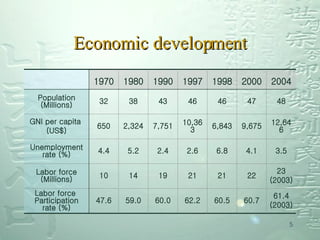
Economic development 61.4 (2003) 60.7 60.5 62.2 60.0 59.0 47.6 Labor force  Participation rate (%) 23 (2003) 22 21 21 19 14 10 Labor force (Millions) 3.5 4.1 6.8 2.6 2.4 5.2 4.4 Unemployment rate (%) 12,646 9,675 6,843 10,363 7,751 2,324 650 GNI per capita  (US$) 48 47 46 46 43 38 32 Population (Millions) 2004 2000 1998 1997 1990 1980 1970
II. Status of HE
 
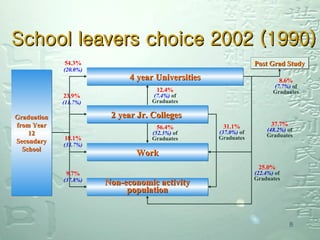
School leavers choice 2002 (1990) Graduation from Year 12 Secondary School 4 year Universities 2 year Jr. Colleges  18.1% (33.7%) Post Grad Study 8.6%   (7.7%)   of Graduates 56.4%   (52.3%)   of Graduates Non-economic activity population Work 9.7% (37.8%) 23.9% (11.7%) 54.3% (20.0%) 37.7%   (48.2%)   of Graduates 12.4%   (7.4%)   of Graduates 25.0%   (22.4%)  of Graduates 31.1%   (37.0%)  of Graduates
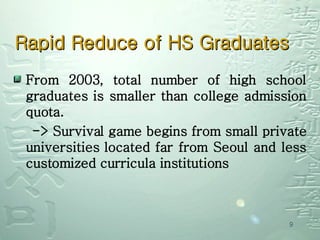
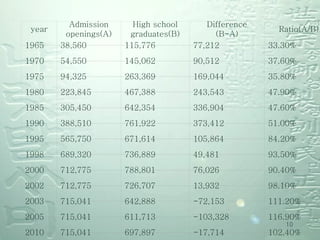
Rapid Reduce of HS Graduates From 2003, total number of high school graduates is smaller than college admission quota. -> Survival game begins from small private universities located far from Seoul and less customized curricula institutions
year Admission openings(A) High school graduates(B) Difference (B-A) Ratio(A/B) 1965 38,560 115,776 77,212 33.30% 1970 54,550 145,062 90,512 37.60% 1975 94,325 263,369 169,044 35.80% 1980 223,845 467,388 243,543 47.90% 1985 305,450 642,354 336,904 47.60% 1990 388,510 761,922 373,412 51.00% 1995 565,750 671,614 105,864 84.20% 1998 689,320 736,889 49,481 93.50% 2000 712,775 788,801 76,026 90.40% 2002 712,775 726,707 13,932 98.10% 2003 715,041 642,888 -72,153 111.20% 2005 715,041 611,713 -103,328 116.90% 2010 715,041 697,897 -17,714 102.40%
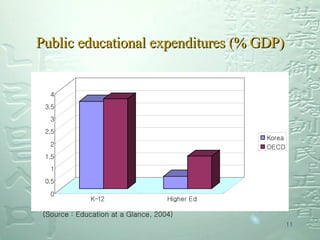
Public educational expenditures (% GDP)   (Source : Education at a Glance, 2004)
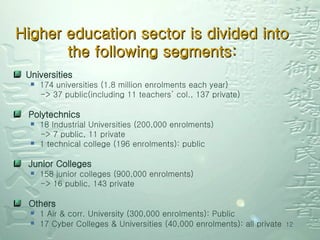
Higher education sector is divided into the following segments: Universities 174 universities (1.8   million enrolments each year) -> 37 public(including 11 teachers’ col., 137 private) Polytechnics 18 Industrial Universities (200,000 enrolments) -> 7 public, 11 private 1 technical college (196 enrolments): public Junior Colleges 158 junior colleges (900,000 enrolments) -> 16 public, 143 private Others  1 Air & corr. University (300,000 enrolments): Public 17 Cyber Colleges & Universities (40,000 enrolments): all private
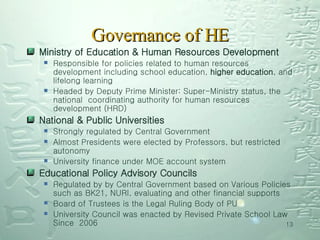
Governance of HE Ministry of Education & Human Resources Development Responsible for policies related to human resources development including school education,  higher education , and lifelong learning  Headed by Deputy Prime Minister: Super-Ministry status, the national  coordinating authority for human resources development (HRD) National & Public Universities Strongly regulated by Central Government Almost Presidents were elected by Professors, but restricted  autonomy  University finance under MOE account system Educational Policy Advisory Councils Regulated by by Central Government based on Various Policies such as BK21, NURI, evaluating and other financial supports Board of Trustees is the Legal Ruling Body of PU University Council was enacted by Revised Private School Law Since  2006
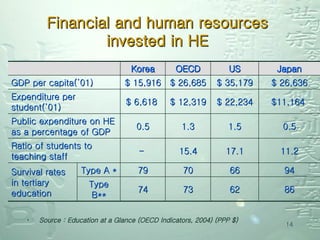
Financial and human resources invested in HE Source : Education at a Glance (OECD Indicators, 2004) (PPP $) Type B** Type A * 94 66 70 79 $ 26,636 $ 35,179 $ 26,685 $ 15,916 GDP per capita(’01) 0.5 1.5 1.3 0.5 Public expenditure on HE as a percentage of GDP 62 17.1 $ 22,234 US 73 15.4 $ 12,319 OECD 11.2 -  Ratio of students to teaching staff 86 74 Survival rates in tertiary education $11,164  $ 6,618  Expenditure per student(’01) Japan Korea
Earnings differentials
III. Major Issues
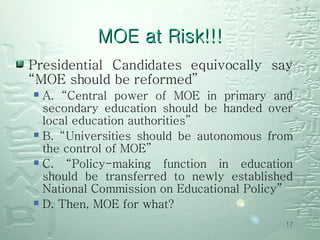
MOE at Risk!!! Presidential Candidates equivocally say “MOE should be reformed”  A. “Central power of MOE in primary and secondary education should be handed over local education authorities”  B. “Universities should be autonomous from the control of MOE”  C. “Policy-making function in education should be transferred to newly established National Commission on Educational Policy”  D. Then, MOE for what?
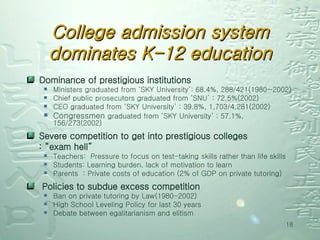
College admission system dominates K-12 education Dominance of prestigious institutions Ministers graduated from ‘SKY University’: 68.4%, 288/421(1980~2002) Chief public prosecutors graduated from ‘SNU’ : 72.5%(2002) CEO graduated from ‘SKY University’ : 39.8%, 1,703/4,281(2002) Congressmen  graduated from ‘SKY University’ : 57.1%, 156/273(2002) Severe competition to get into prestigious colleges : “exam hell” Teachers:  Pressure to focus on test-taking skills rather than life skills Students: Learning burden, lack of motivation to learn  Parents  : Private costs of education (2% of GDP on private tutoring) Policies to subdue excess competition Ban on private tutoring by Law(1980-2002) High School Leveling Policy for last 30 years Debate between egalitarianism and elitism
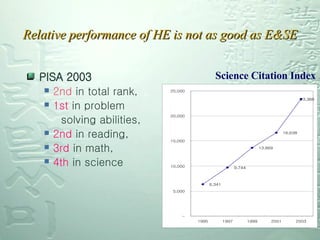
Relative performance of HE is not as good as E&SE PISA 2003 2nd  in total rank,  1st  in problem  solving abilities,  2nd  in reading, 3rd  in math,  4th  in science Science Citation Index
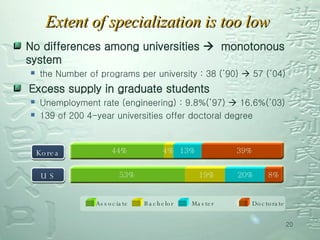
Extent of specialization is too low No differences among universities     monotonous system the Number of programs per university : 38 (’90)    57 (’04)  Excess supply in graduate students Unemployment rate (engineering) : 9.8%(’97)    16.6%(’03) 139 of 200 4-year universities offer doctoral degree Korea U S 53% 19% 20% 8% 44% 4% 13% 39% Associate Bachelor  Master  Doctorate
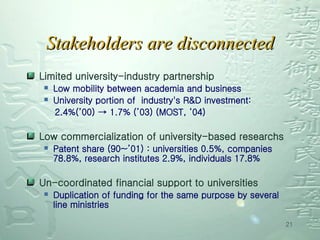
Stakeholders are disconnected Limited university-industry partnership Low mobility between academia and business University portion of  industry's R&D investment:  2.4%(’00) -> 1.7% (’03) (MOST, ‘04) Low commercialization of university-based researchs Patent share (90~’01) : universities 0.5%, companies 78.8%, research institutes 2.9%, individuals 17.8%  Un-coordinated financial support to universities   Duplication of funding for the same purpose by several line ministries
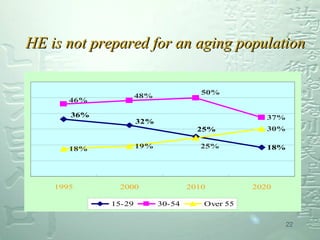
HE is not prepared for an aging population
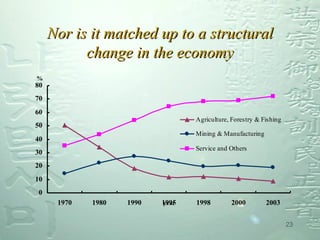
Nor is it matched up to a structural change in the economy
IV. Government’s Efforts
Corporatizing National Univs
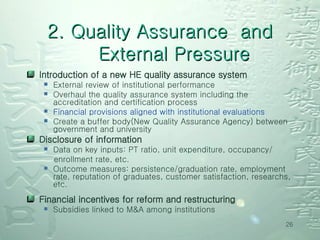
2. Quality Assurance  and External Pressure Introduction of a new HE quality assurance system External review of institutional performance  Overhaul the quality assurance system including the accreditation and certification process Financial provisions aligned with institutional evaluations Create a buffer body(New Quality Assurance Agency) between government and university Disclosure of information   Data on key inputs: PT ratio, unit expenditure, occupancy/ enrollment rate, etc. Outcome measures: persistence/graduation rate, employment rate, reputation of graduates, customer satisfaction, researchs, etc. Financial incentives for reform and restructuring   Subsidies linked to M&A among institutions
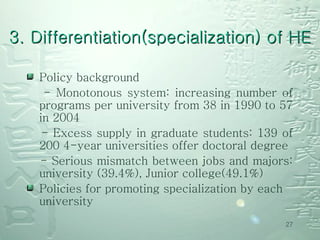
Policy background - Monotonous system: increasing number of programs per university from 38 in 1990 to 57 in 2004 - Excess supply in graduate students: 139 of 200 4-year universities offer doctoral degree - Serious mismatch between jobs and majors: university (39.4%), Junior college(49.1%)  Policies for promoting specialization by each university 3. Differentiation(specialization) of HE
Decision of Specialization Index by the National Committee of HRD in 2006.  Applying the Specialization Index in selecting universities for the project supporting “Specialization of HE in the Metropolitan Area” in 2007 Applying the Specialization Index in allocating HE budgets from more than 6 Ministries from 2008  3. Differentiation(specialization) of HE
Policy background - Need for strengthening international competitiveness in a knowledge economy - Promoting cross border HE as a response to globalization Policies for promoting Internationalization of HE 4. Internalization of HE
Decision of National strategic plan for Internationalization of HE by the National Committee of HRD in 2006.  -  Selection of 6 areas (in 2007, changing into 7 areas) such as Student exchange, academics and researcher exchange; attracting overseas HE institutions and program; recruiting overseas students; exporting HE service; promoting the environment of internationalization; constructing infrastructure for the support of internationalization   5 year national plan(’07~’11) for  Internationalization   4. Internalization of HE
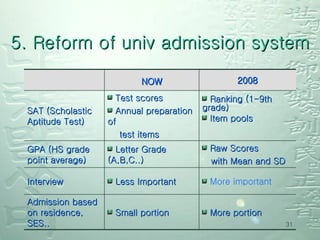
5. Reform of univ admission system Raw Scores  with Mean and SD Letter Grade (A,B,C..) GPA (HS grade point average) More important Less Important Interview More portion Small portion Admission based on residence, SES.. Ranking (1-9th grade) Item pools Test scores Annual preparation of  test items SAT (Scholastic Aptitude Test) 2008 NOW
“ Three Don’t” Policy  Three hot issues among government, universities, and the public There have been kind of controversial issues challenging each stake-holders for university education “ Three Don’t”: MOE prohibit univs’ own entrance exam, ranking high school for selecting students, and entrance by donation.
1. Universitys’ own entrance examination: It has been long time history for the government to control university entrance examination by managing SAT with some guide lines of what portion should be counted on for selecting students. However SNU and major private universities have been looking for alternative ways of selecting their students based upon their own criteria, mainly because they are looking for good candidates.
2. Ranking High school for using GPA: The government has wanted to recover the high school education, which has been strongly influenced by university entrance examination run by the government. From the government's stand point, it would be a big risk to hand over the authority of issuing the guide line to private universities, because  the Korean government believes that introducing the high school record for the university entrance examination would be the best way to return deterioated high school education to normal. However, major private universities are strongly against the policy because they just distrust the student record, simple because they distrust the record and they don't think it is hard to make them to difference among applicants. So simply stated, they just give them non-credits.
3. Personal endowment(donation) for entrance: Major private universities are among the  strong advocators for the issue because they think they are good enough to attract more endowment and they argue the money will be used for improving the quality of university education by recruiting distinguished faculties and reinvesting the money for improving physical condition for teaching and learning.
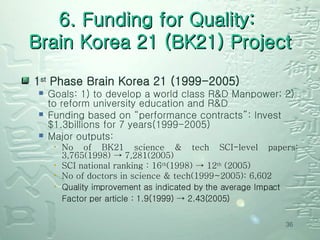
1 st  Phase Brain Korea 21 (1999-2005)  Goals: 1) to develop a world class R&D Manpower; 2) to reform university education and R&D Funding based on “performance contracts”: Invest $1.3billions for 7 years(1999-2005)  Major outputs: No of BK21 science & tech SCI-level papers: 3,765(1998) -> 7,281(2005) SCI national ranking : 16 th (1998) -> 12 th  (2005)  No of doctors in science & tech(1999~2005): 6,602 Quality improvement as indicated by the average Impact Factor per article : 1.9(1999) -> 2.43(2005)   6. Funding for Quality:  Brain Korea 21 (BK21) Project
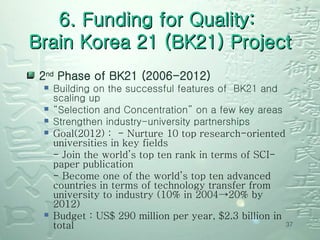
2 nd  Phase of BK21 (2006-2012) Building on the successful features of  BK21 and scaling up “ Selection and Concentration” on a few key areas Strengthen industry-university partnerships Goal(2012) :  - Nurture 10 top research-oriented universities in key fields - Join the world’s top ten rank in terms of SCI-paper publication  - Become one of the world’s top ten advanced countries in terms of technology transfer from university to industry (10% in 2004->20% by 2012) Budget : US$ 290 million per year, $2.3 billion in total 6. Funding for Quality:  Brain Korea 21 (BK21) Project
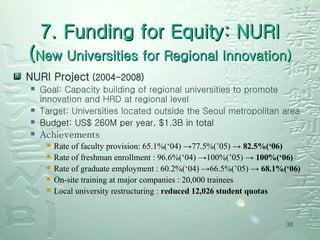
NURI Project  (2004-2008) Goal: Capacity building of regional universities to promote innovation and HRD at regional level Target: Universities located outside the Seoul metropolitan area  Budget: US$ 260M per year, $1.3B in total Achievements Rate of faculty provision: 65.1%(‘04) ->77.5%(’05) ->  82.5%(‘06)   Rate of freshman enrollment : 96.6%(‘04) ->100%(’05) ->  100%(‘06)   Rate of graduate employment : 60.2%(‘04) ->66.5%(’05) ->  68.1%(‘06)   On-site training at major companies : 20,000 trainees  Local university restructuring :  reduced 12,026 student quotas    7. Funding for Equity: NURI ( New Universities for Regional Innovation)
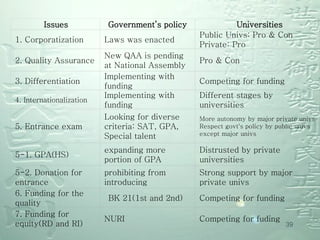
Five Issues    Issues  Government’s policy   Universities 1. Corporatization  Laws was enacted Public Univs: Pro & Con  Private: Pro 2. Quality Assurance New QAA is pending at National Assembly Pro & Con 3. Differentiation Implementing with funding  Competing for funding 4. Internationalization Implementing with funding Different stages by universities 5. Entrance exam Looking for diverse criteria: SAT, GPA, Special talent More autonomy by major private univs Respect govt's policy by public univs except major univs 5-1. GPA(HS) expanding more portion of GPA Distrusted by private universities 5-2. Donation for entrance  prohibiting from introducing Strong support by major private univs 6. Funding for the quality    BK 21(1st and 2nd) Competing for funding 7. Funding for equity(RD and RI) NURI Competing for fuding
감사합니다 . Thank You !

H Ein Korea Ife2020 1 1

  • 1.
    Higher Education Issuesin Korea Based on HE as Public Goods and Private Commodities 12 Sep 2007
  • 2.
    Contents Overview Status of Higher Education Major Issues Government’s Efforts
  • 3.
  • 4.
  • 5.
    Economic development 61.4(2003) 60.7 60.5 62.2 60.0 59.0 47.6 Labor force Participation rate (%) 23 (2003) 22 21 21 19 14 10 Labor force (Millions) 3.5 4.1 6.8 2.6 2.4 5.2 4.4 Unemployment rate (%) 12,646 9,675 6,843 10,363 7,751 2,324 650 GNI per capita (US$) 48 47 46 46 43 38 32 Population (Millions) 2004 2000 1998 1997 1990 1980 1970
  • 6.
  • 7.
  • 8.
    School leavers choice2002 (1990) Graduation from Year 12 Secondary School 4 year Universities 2 year Jr. Colleges 18.1% (33.7%) Post Grad Study 8.6% (7.7%) of Graduates 56.4% (52.3%) of Graduates Non-economic activity population Work 9.7% (37.8%) 23.9% (11.7%) 54.3% (20.0%) 37.7% (48.2%) of Graduates 12.4% (7.4%) of Graduates 25.0% (22.4%) of Graduates 31.1% (37.0%) of Graduates
  • 9.
    Rapid Reduce ofHS Graduates From 2003, total number of high school graduates is smaller than college admission quota. -> Survival game begins from small private universities located far from Seoul and less customized curricula institutions
  • 10.
    year Admission openings(A)High school graduates(B) Difference (B-A) Ratio(A/B) 1965 38,560 115,776 77,212 33.30% 1970 54,550 145,062 90,512 37.60% 1975 94,325 263,369 169,044 35.80% 1980 223,845 467,388 243,543 47.90% 1985 305,450 642,354 336,904 47.60% 1990 388,510 761,922 373,412 51.00% 1995 565,750 671,614 105,864 84.20% 1998 689,320 736,889 49,481 93.50% 2000 712,775 788,801 76,026 90.40% 2002 712,775 726,707 13,932 98.10% 2003 715,041 642,888 -72,153 111.20% 2005 715,041 611,713 -103,328 116.90% 2010 715,041 697,897 -17,714 102.40%
  • 11.
    Public educational expenditures(% GDP)   (Source : Education at a Glance, 2004)
  • 12.
    Higher education sectoris divided into the following segments: Universities 174 universities (1.8 million enrolments each year) -> 37 public(including 11 teachers’ col., 137 private) Polytechnics 18 Industrial Universities (200,000 enrolments) -> 7 public, 11 private 1 technical college (196 enrolments): public Junior Colleges 158 junior colleges (900,000 enrolments) -> 16 public, 143 private Others 1 Air & corr. University (300,000 enrolments): Public 17 Cyber Colleges & Universities (40,000 enrolments): all private
  • 13.
    Governance of HEMinistry of Education & Human Resources Development Responsible for policies related to human resources development including school education, higher education , and lifelong learning Headed by Deputy Prime Minister: Super-Ministry status, the national coordinating authority for human resources development (HRD) National & Public Universities Strongly regulated by Central Government Almost Presidents were elected by Professors, but restricted autonomy University finance under MOE account system Educational Policy Advisory Councils Regulated by by Central Government based on Various Policies such as BK21, NURI, evaluating and other financial supports Board of Trustees is the Legal Ruling Body of PU University Council was enacted by Revised Private School Law Since 2006
  • 14.
    Financial and humanresources invested in HE Source : Education at a Glance (OECD Indicators, 2004) (PPP $) Type B** Type A * 94 66 70 79 $ 26,636 $ 35,179 $ 26,685 $ 15,916 GDP per capita(’01) 0.5 1.5 1.3 0.5 Public expenditure on HE as a percentage of GDP 62 17.1 $ 22,234 US 73 15.4 $ 12,319 OECD 11.2 - Ratio of students to teaching staff 86 74 Survival rates in tertiary education $11,164 $ 6,618 Expenditure per student(’01) Japan Korea
  • 15.
  • 16.
  • 17.
    MOE at Risk!!!Presidential Candidates equivocally say “MOE should be reformed” A. “Central power of MOE in primary and secondary education should be handed over local education authorities” B. “Universities should be autonomous from the control of MOE” C. “Policy-making function in education should be transferred to newly established National Commission on Educational Policy” D. Then, MOE for what?
  • 18.
    College admission systemdominates K-12 education Dominance of prestigious institutions Ministers graduated from ‘SKY University’: 68.4%, 288/421(1980~2002) Chief public prosecutors graduated from ‘SNU’ : 72.5%(2002) CEO graduated from ‘SKY University’ : 39.8%, 1,703/4,281(2002) Congressmen graduated from ‘SKY University’ : 57.1%, 156/273(2002) Severe competition to get into prestigious colleges : “exam hell” Teachers: Pressure to focus on test-taking skills rather than life skills Students: Learning burden, lack of motivation to learn Parents : Private costs of education (2% of GDP on private tutoring) Policies to subdue excess competition Ban on private tutoring by Law(1980-2002) High School Leveling Policy for last 30 years Debate between egalitarianism and elitism
  • 19.
    Relative performance ofHE is not as good as E&SE PISA 2003 2nd in total rank, 1st in problem solving abilities, 2nd in reading, 3rd in math, 4th in science Science Citation Index
  • 20.
    Extent of specializationis too low No differences among universities  monotonous system the Number of programs per university : 38 (’90)  57 (’04) Excess supply in graduate students Unemployment rate (engineering) : 9.8%(’97)  16.6%(’03) 139 of 200 4-year universities offer doctoral degree Korea U S 53% 19% 20% 8% 44% 4% 13% 39% Associate Bachelor Master Doctorate
  • 21.
    Stakeholders are disconnectedLimited university-industry partnership Low mobility between academia and business University portion of industry's R&D investment: 2.4%(’00) -> 1.7% (’03) (MOST, ‘04) Low commercialization of university-based researchs Patent share (90~’01) : universities 0.5%, companies 78.8%, research institutes 2.9%, individuals 17.8% Un-coordinated financial support to universities Duplication of funding for the same purpose by several line ministries
  • 22.
    HE is notprepared for an aging population
  • 23.
    Nor is itmatched up to a structural change in the economy
  • 24.
  • 25.
  • 26.
    2. Quality Assurance and External Pressure Introduction of a new HE quality assurance system External review of institutional performance Overhaul the quality assurance system including the accreditation and certification process Financial provisions aligned with institutional evaluations Create a buffer body(New Quality Assurance Agency) between government and university Disclosure of information Data on key inputs: PT ratio, unit expenditure, occupancy/ enrollment rate, etc. Outcome measures: persistence/graduation rate, employment rate, reputation of graduates, customer satisfaction, researchs, etc. Financial incentives for reform and restructuring Subsidies linked to M&A among institutions
  • 27.
    Policy background -Monotonous system: increasing number of programs per university from 38 in 1990 to 57 in 2004 - Excess supply in graduate students: 139 of 200 4-year universities offer doctoral degree - Serious mismatch between jobs and majors: university (39.4%), Junior college(49.1%) Policies for promoting specialization by each university 3. Differentiation(specialization) of HE
  • 28.
    Decision of SpecializationIndex by the National Committee of HRD in 2006. Applying the Specialization Index in selecting universities for the project supporting “Specialization of HE in the Metropolitan Area” in 2007 Applying the Specialization Index in allocating HE budgets from more than 6 Ministries from 2008 3. Differentiation(specialization) of HE
  • 29.
    Policy background -Need for strengthening international competitiveness in a knowledge economy - Promoting cross border HE as a response to globalization Policies for promoting Internationalization of HE 4. Internalization of HE
  • 30.
    Decision of Nationalstrategic plan for Internationalization of HE by the National Committee of HRD in 2006. - Selection of 6 areas (in 2007, changing into 7 areas) such as Student exchange, academics and researcher exchange; attracting overseas HE institutions and program; recruiting overseas students; exporting HE service; promoting the environment of internationalization; constructing infrastructure for the support of internationalization   5 year national plan(’07~’11) for Internationalization 4. Internalization of HE
  • 31.
    5. Reform ofuniv admission system Raw Scores with Mean and SD Letter Grade (A,B,C..) GPA (HS grade point average) More important Less Important Interview More portion Small portion Admission based on residence, SES.. Ranking (1-9th grade) Item pools Test scores Annual preparation of test items SAT (Scholastic Aptitude Test) 2008 NOW
  • 32.
    “ Three Don’t”Policy Three hot issues among government, universities, and the public There have been kind of controversial issues challenging each stake-holders for university education “ Three Don’t”: MOE prohibit univs’ own entrance exam, ranking high school for selecting students, and entrance by donation.
  • 33.
    1. Universitys’ ownentrance examination: It has been long time history for the government to control university entrance examination by managing SAT with some guide lines of what portion should be counted on for selecting students. However SNU and major private universities have been looking for alternative ways of selecting their students based upon their own criteria, mainly because they are looking for good candidates.
  • 34.
    2. Ranking Highschool for using GPA: The government has wanted to recover the high school education, which has been strongly influenced by university entrance examination run by the government. From the government's stand point, it would be a big risk to hand over the authority of issuing the guide line to private universities, because  the Korean government believes that introducing the high school record for the university entrance examination would be the best way to return deterioated high school education to normal. However, major private universities are strongly against the policy because they just distrust the student record, simple because they distrust the record and they don't think it is hard to make them to difference among applicants. So simply stated, they just give them non-credits.
  • 35.
    3. Personal endowment(donation)for entrance: Major private universities are among the  strong advocators for the issue because they think they are good enough to attract more endowment and they argue the money will be used for improving the quality of university education by recruiting distinguished faculties and reinvesting the money for improving physical condition for teaching and learning.
  • 36.
    1 st Phase Brain Korea 21 (1999-2005) Goals: 1) to develop a world class R&D Manpower; 2) to reform university education and R&D Funding based on “performance contracts”: Invest $1.3billions for 7 years(1999-2005) Major outputs: No of BK21 science & tech SCI-level papers: 3,765(1998) -> 7,281(2005) SCI national ranking : 16 th (1998) -> 12 th (2005) No of doctors in science & tech(1999~2005): 6,602 Quality improvement as indicated by the average Impact Factor per article : 1.9(1999) -> 2.43(2005) 6. Funding for Quality: Brain Korea 21 (BK21) Project
  • 37.
    2 nd Phase of BK21 (2006-2012) Building on the successful features of BK21 and scaling up “ Selection and Concentration” on a few key areas Strengthen industry-university partnerships Goal(2012) : - Nurture 10 top research-oriented universities in key fields - Join the world’s top ten rank in terms of SCI-paper publication - Become one of the world’s top ten advanced countries in terms of technology transfer from university to industry (10% in 2004->20% by 2012) Budget : US$ 290 million per year, $2.3 billion in total 6. Funding for Quality: Brain Korea 21 (BK21) Project
  • 38.
    NURI Project (2004-2008) Goal: Capacity building of regional universities to promote innovation and HRD at regional level Target: Universities located outside the Seoul metropolitan area Budget: US$ 260M per year, $1.3B in total Achievements Rate of faculty provision: 65.1%(‘04) ->77.5%(’05) -> 82.5%(‘06) Rate of freshman enrollment : 96.6%(‘04) ->100%(’05) -> 100%(‘06) Rate of graduate employment : 60.2%(‘04) ->66.5%(’05) -> 68.1%(‘06) On-site training at major companies : 20,000 trainees Local university restructuring : reduced 12,026 student quotas   7. Funding for Equity: NURI ( New Universities for Regional Innovation)
  • 39.
    Five Issues   Issues Government’s policy   Universities 1. Corporatization Laws was enacted Public Univs: Pro & Con Private: Pro 2. Quality Assurance New QAA is pending at National Assembly Pro & Con 3. Differentiation Implementing with funding Competing for funding 4. Internationalization Implementing with funding Different stages by universities 5. Entrance exam Looking for diverse criteria: SAT, GPA, Special talent More autonomy by major private univs Respect govt's policy by public univs except major univs 5-1. GPA(HS) expanding more portion of GPA Distrusted by private universities 5-2. Donation for entrance prohibiting from introducing Strong support by major private univs 6. Funding for the quality   BK 21(1st and 2nd) Competing for funding 7. Funding for equity(RD and RI) NURI Competing for fuding
  • 40.