






HAIDEI
About me: Andoni Sanz
I'm a Computer Scientist working as a STEM Teacher
and an Educational Technologist. Google Certified
Educator and Moodle expert.
I’m actively involved in researching and writing
articles about EdTech, pedagogy, gamification and
coding.
@andonisanz
Let me tell you a story...
Get comfortable
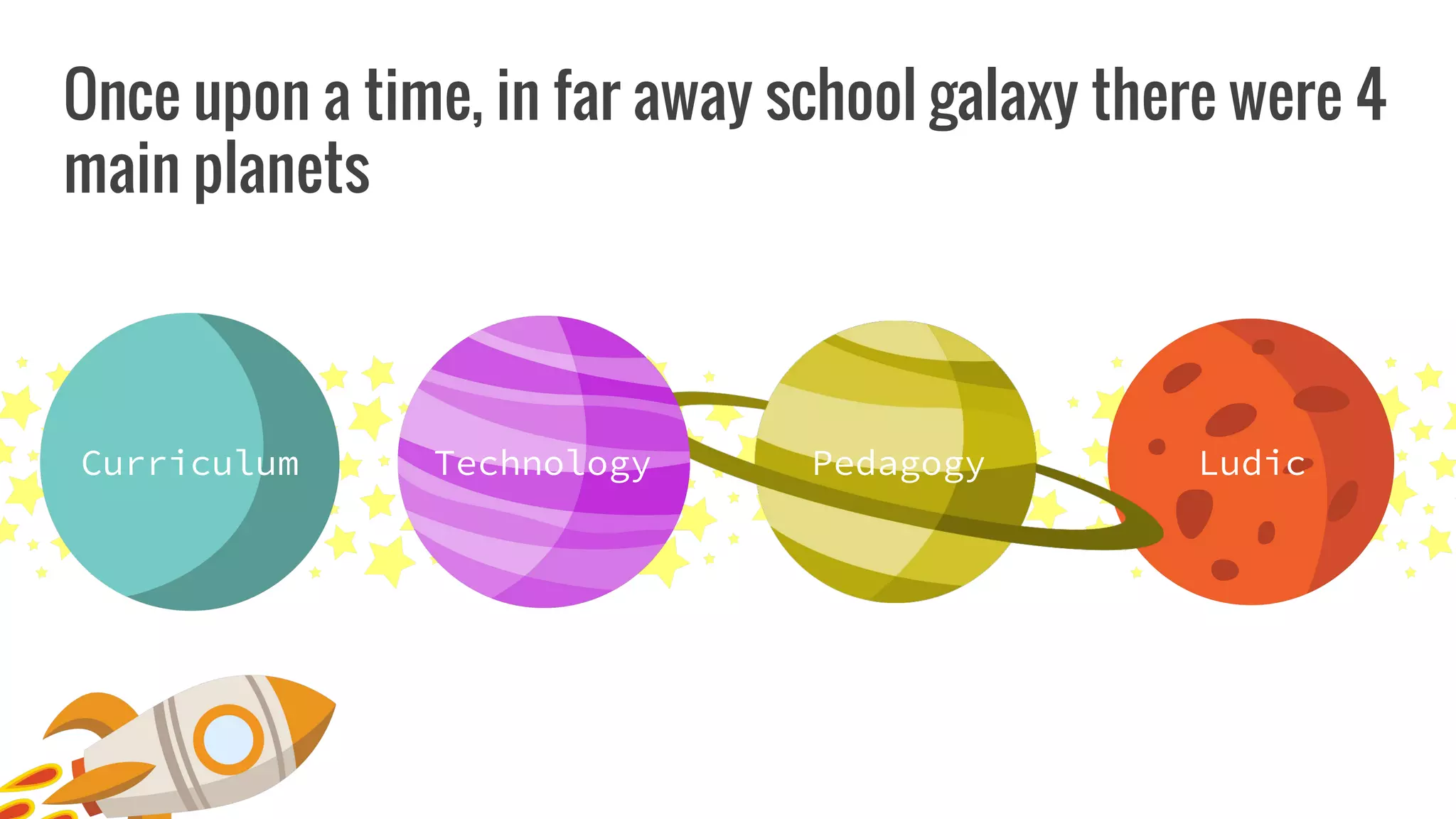
Once upon a time, in far away school galaxy there were 4
main planets
Technology Pedagogy LudicCurriculum
Each planet had plenty of satellites
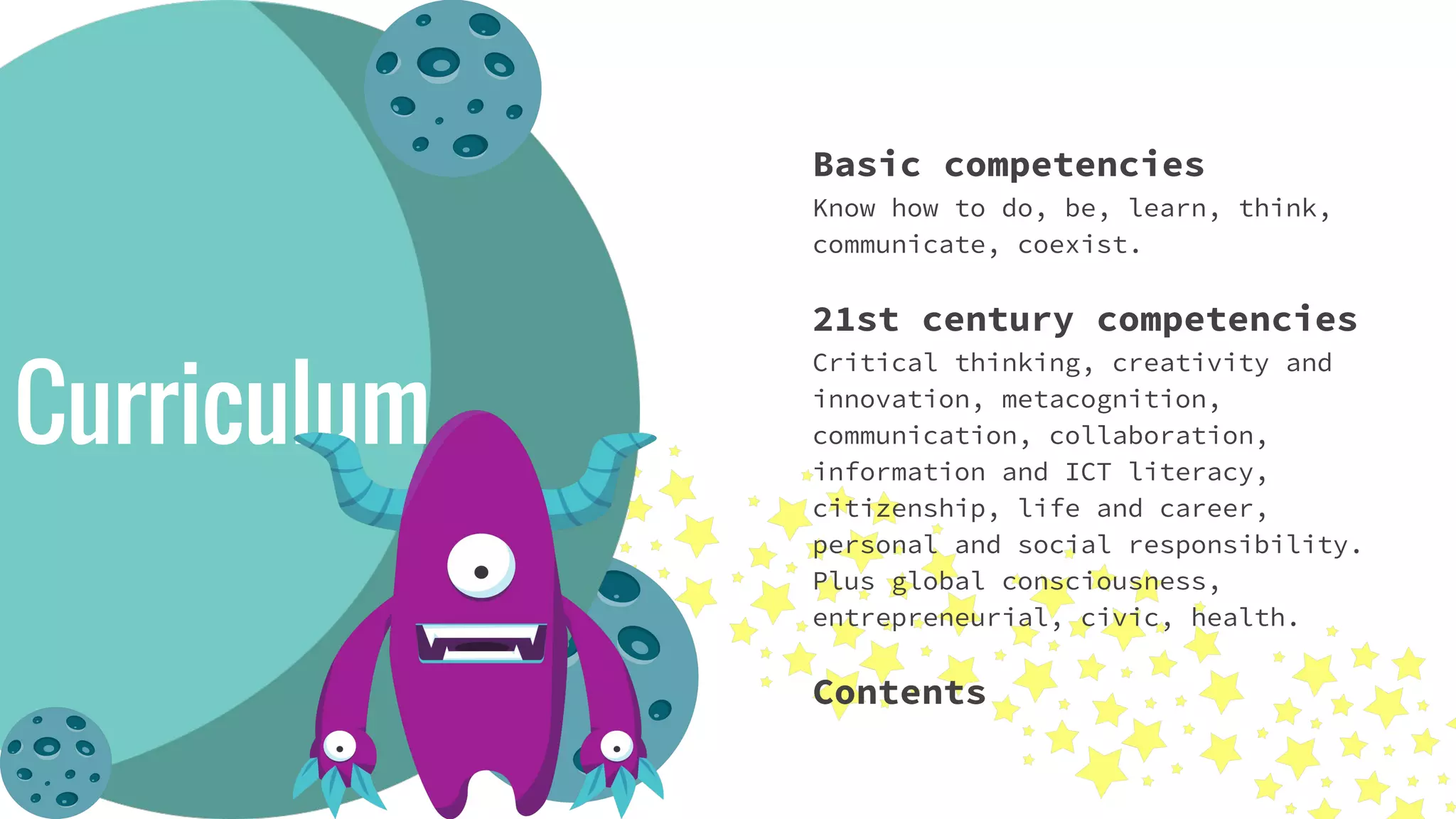
Basic competencies
Know how to do, be, learn, think,
communicate, coexist.
21st century competencies
Critical thinking, creativity and
innovation, metacognition,
communication, collaboration,
information and ICT literacy,
citizenship, life and career,
personal and social responsibility.
Plus global consciousness,
entrepreneurial, civic, health.
Contents
Curriculum
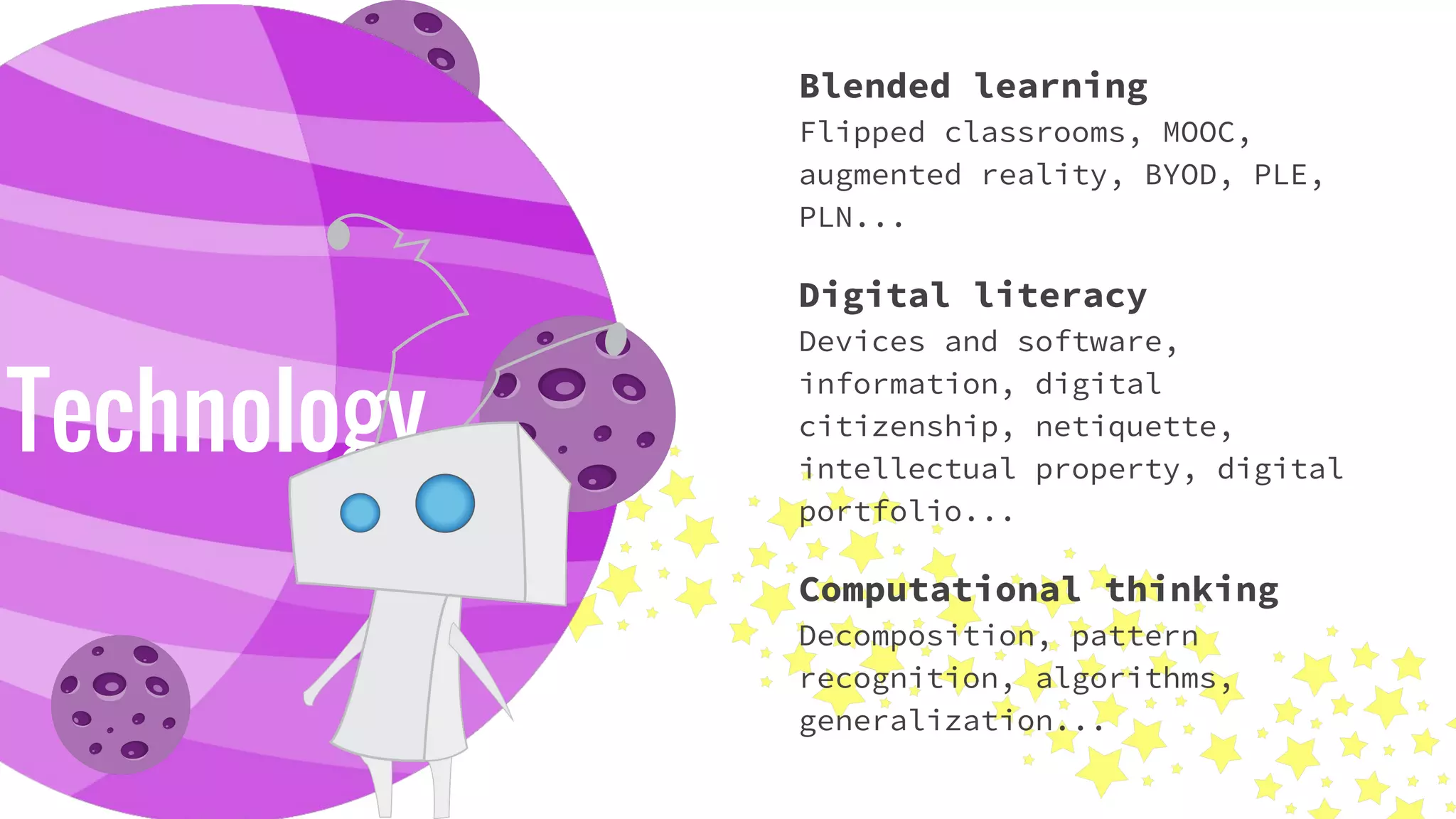
Technology
Blended learning
Flipped classrooms, MOOC,
augmented reality, BYOD, PLE,
PLN...
Digital literacy
Devices and software,
information, digital
citizenship, netiquette,
intellectual property, digital
portfolio...
Computational thinking
Decomposition, pattern
recognition, algorithms,
generalization...
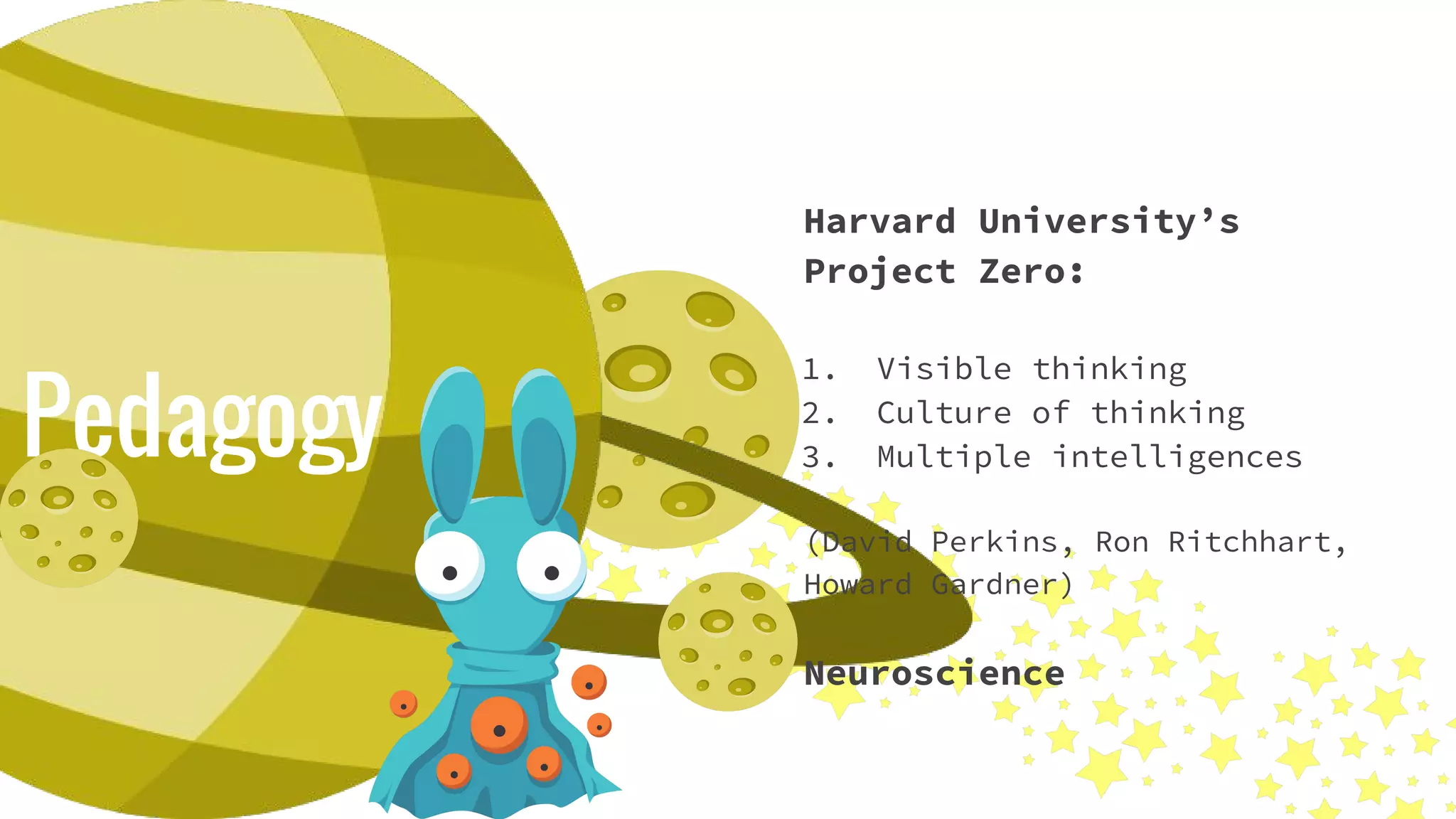
Pedagogy
Harvard University’s
Project Zero:
1. Visible thinking
2. Culture of thinking
3. Multiple intelligences
(David Perkins, Ron Ritchhart,
Howard Gardner)
Neuroscience
Ludic
Gamification
Game based learning
And when I mapped this galaxy, I found that
Some of those satellites were common
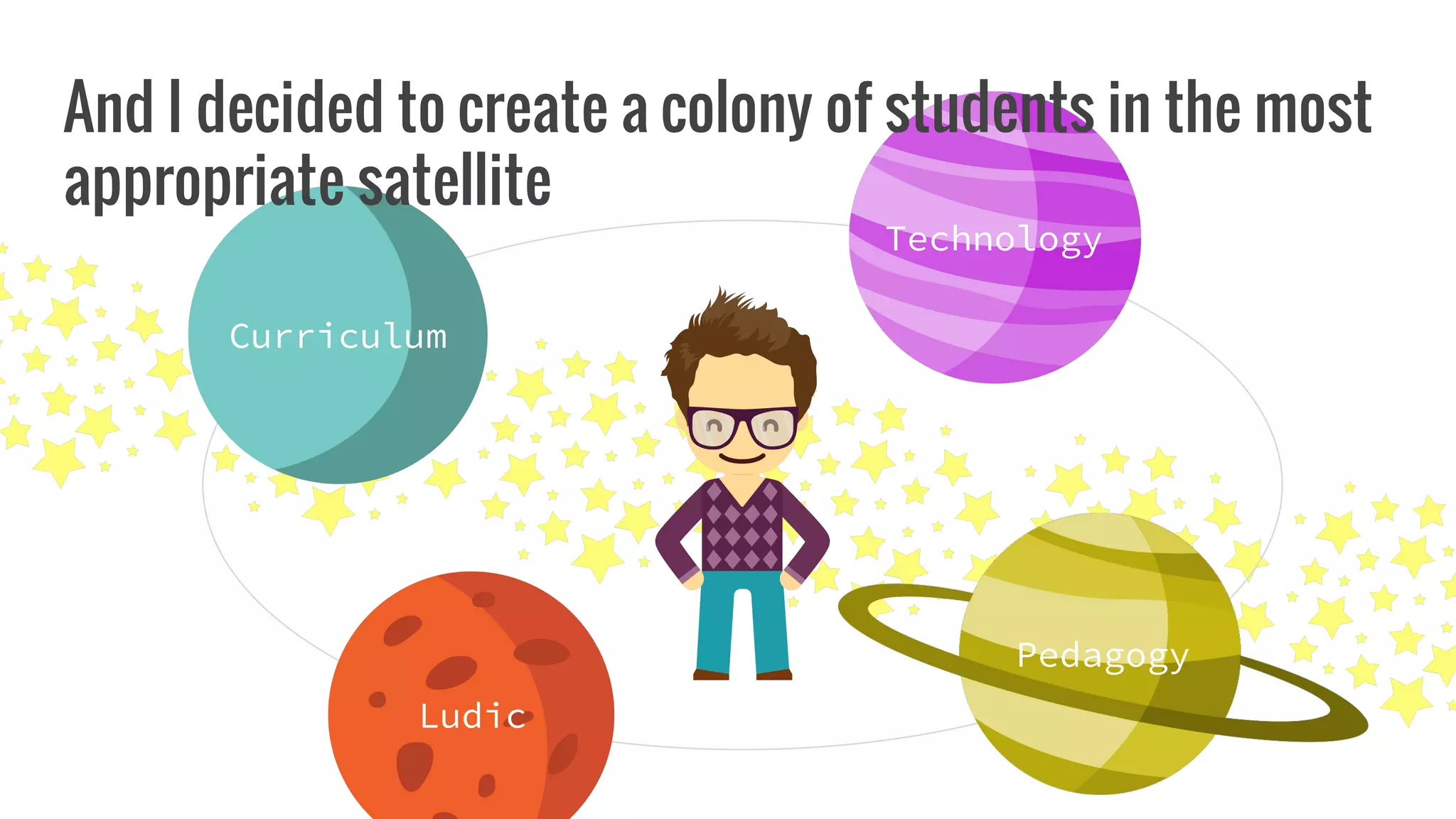
Technology
Pedagogy
Curriculum
Ludic
And I decided to create a colony of students in the most
appropriate satellite
I identified 2 subsystems
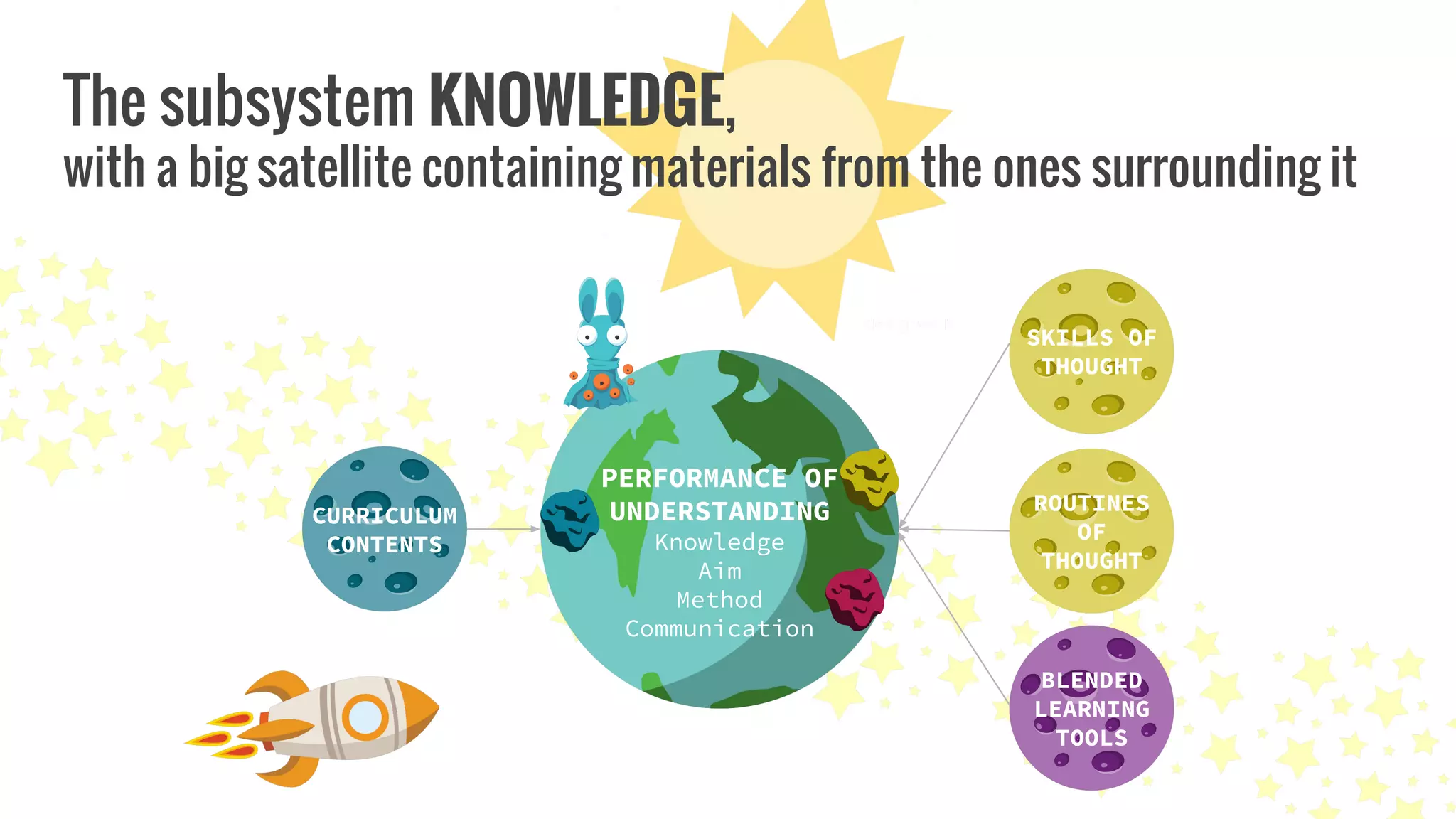
The subsystem KNOWLEDGE,
with a big satellite containing materials from the ones surrounding it
PERFORMANCE OF
UNDERSTANDING
Knowledge
Aim
Method
Communication
ROUTINES
OF
THOUGHT
SKILLS OF
THOUGHT
CURRICULUM
CONTENTS
BLENDED
LEARNING
TOOLS
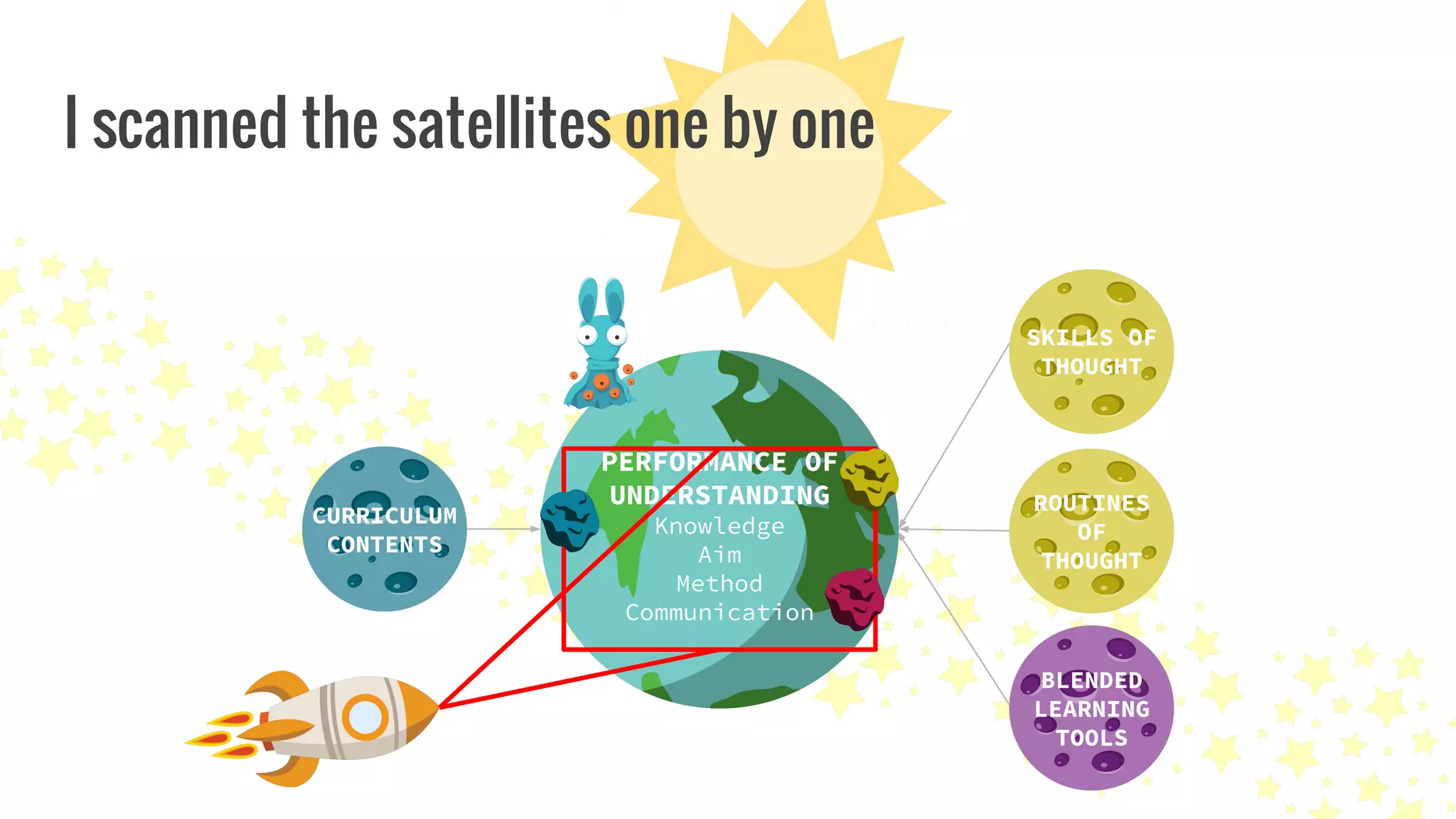
I scanned the satellites one by one
PERFORMANCE OF
UNDERSTANDING
Knowledge
Aim
Method
Communication
ROUTINES
OF
THOUGHT
SKILLS OF
THOUGHT
CURRICULUM
CONTENTS
BLENDED
LEARNING
TOOLS
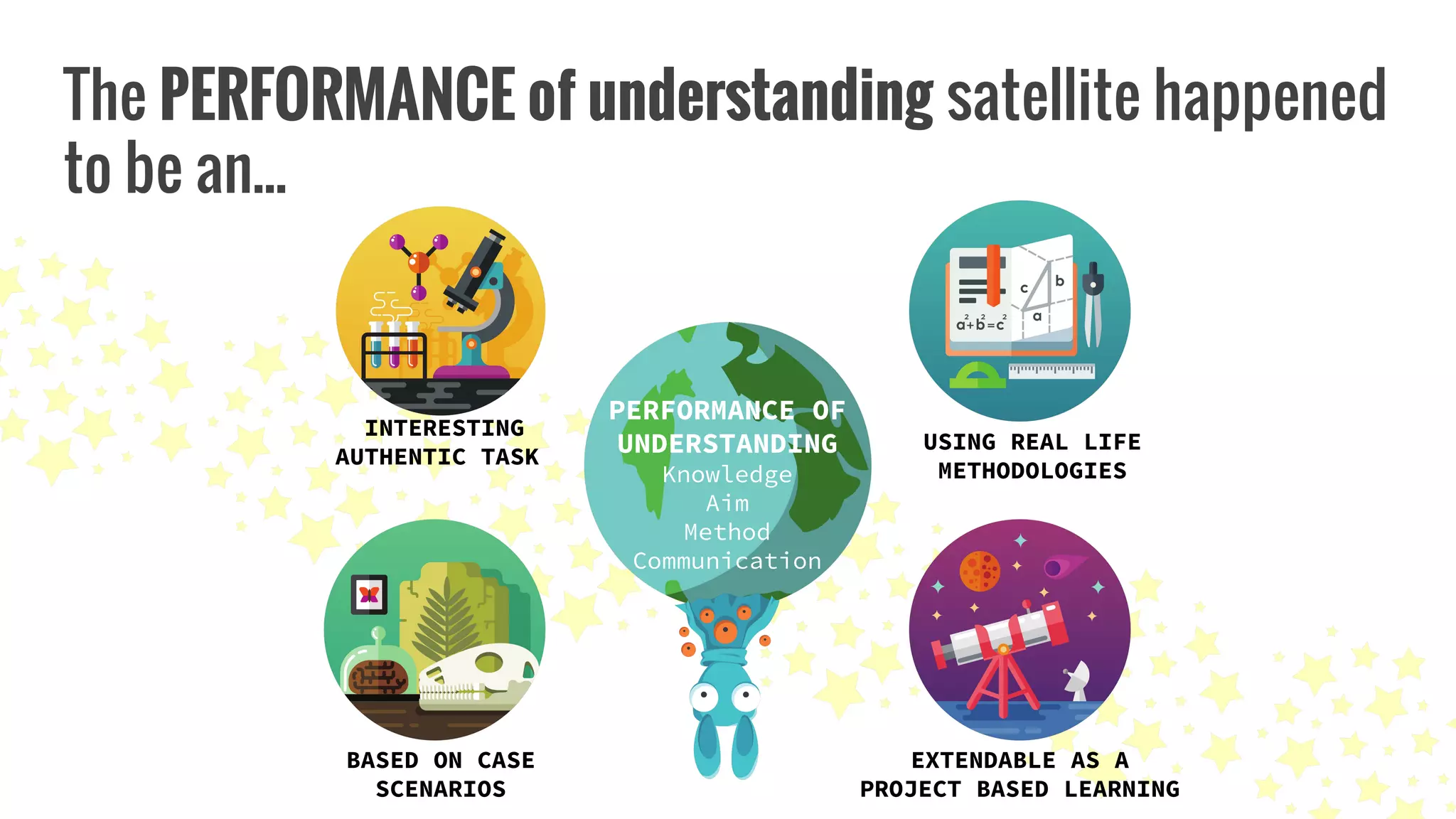
The PERFORMANCE of understanding satellite happened
to be an...
PERFORMANCE OF
UNDERSTANDING
Knowledge
Aim
Method
Communication
INTERESTING
AUTHENTIC TASK
USING REAL LIFE
METHODOLOGIES
BASED ON CASE
SCENARIOS
EXTENDABLE AS A
PROJECT BASED LEARNING
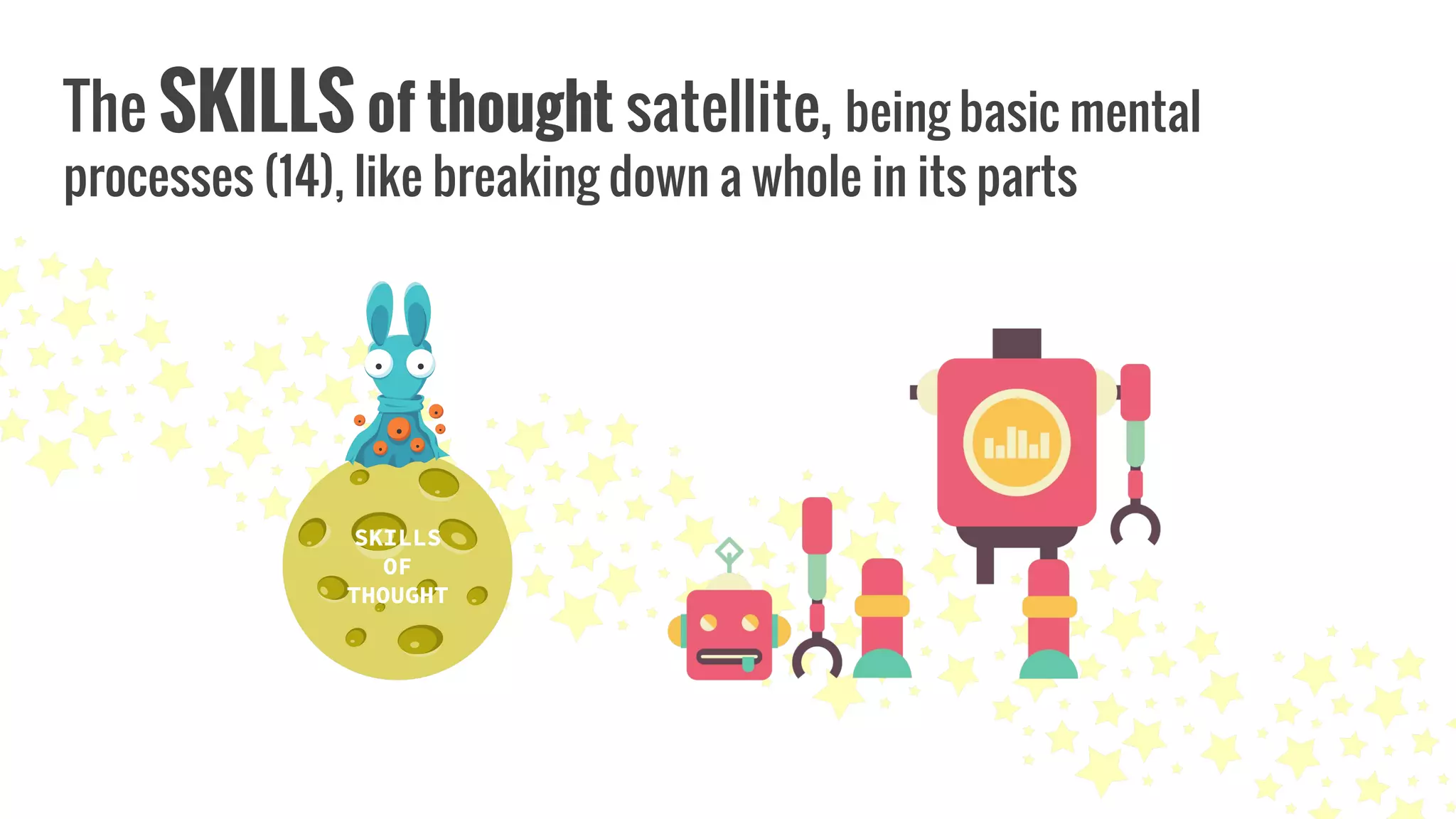
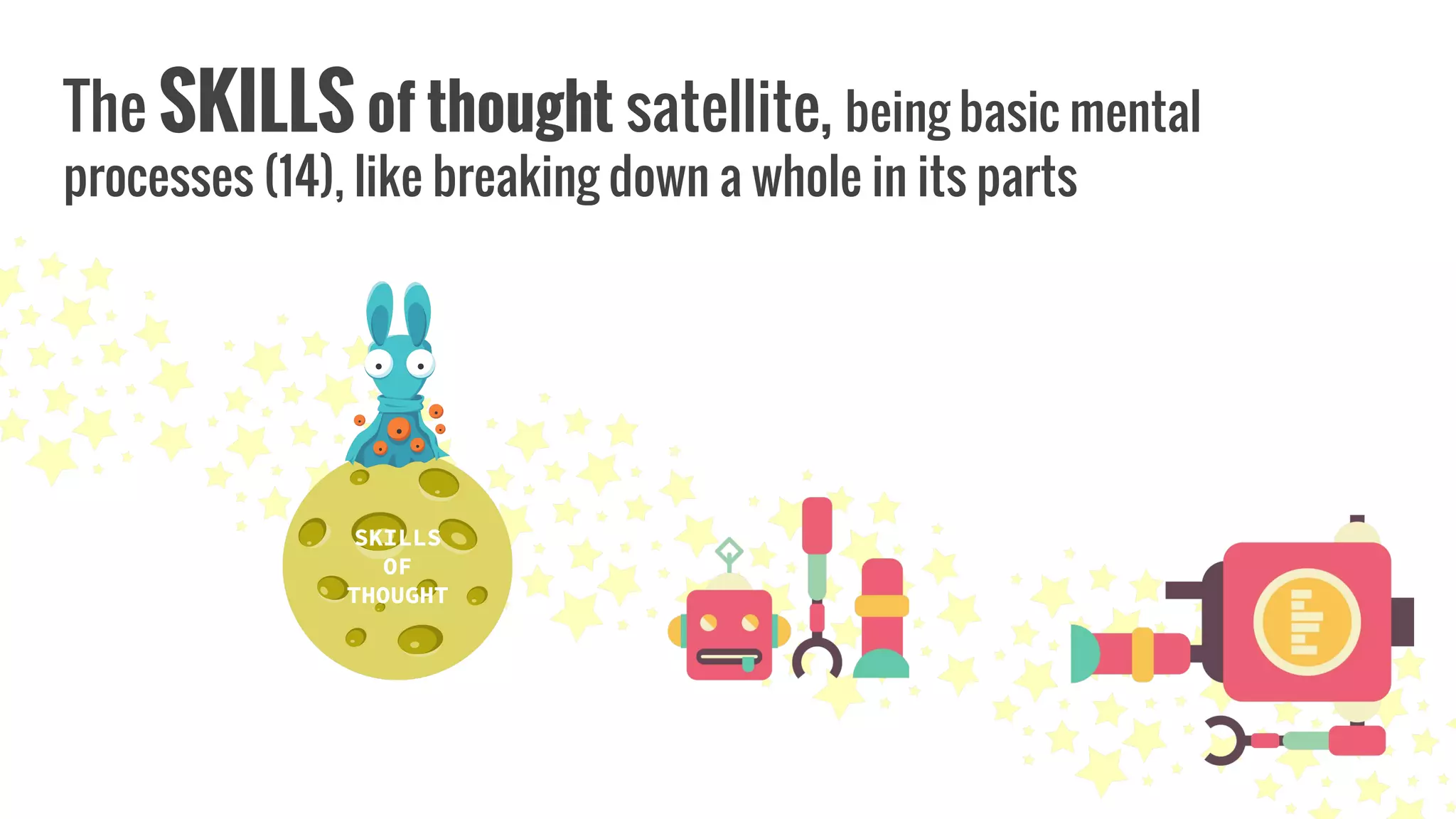
The SKILLS of thought satellite, being basic mental
processes (14), like breaking down a whole in its parts
SKILLS
OF
THOUGHT
The SKILLS of thought satellite, being basic mental
processes (14), like breaking down a whole in its parts
SKILLS
OF
THOUGHT
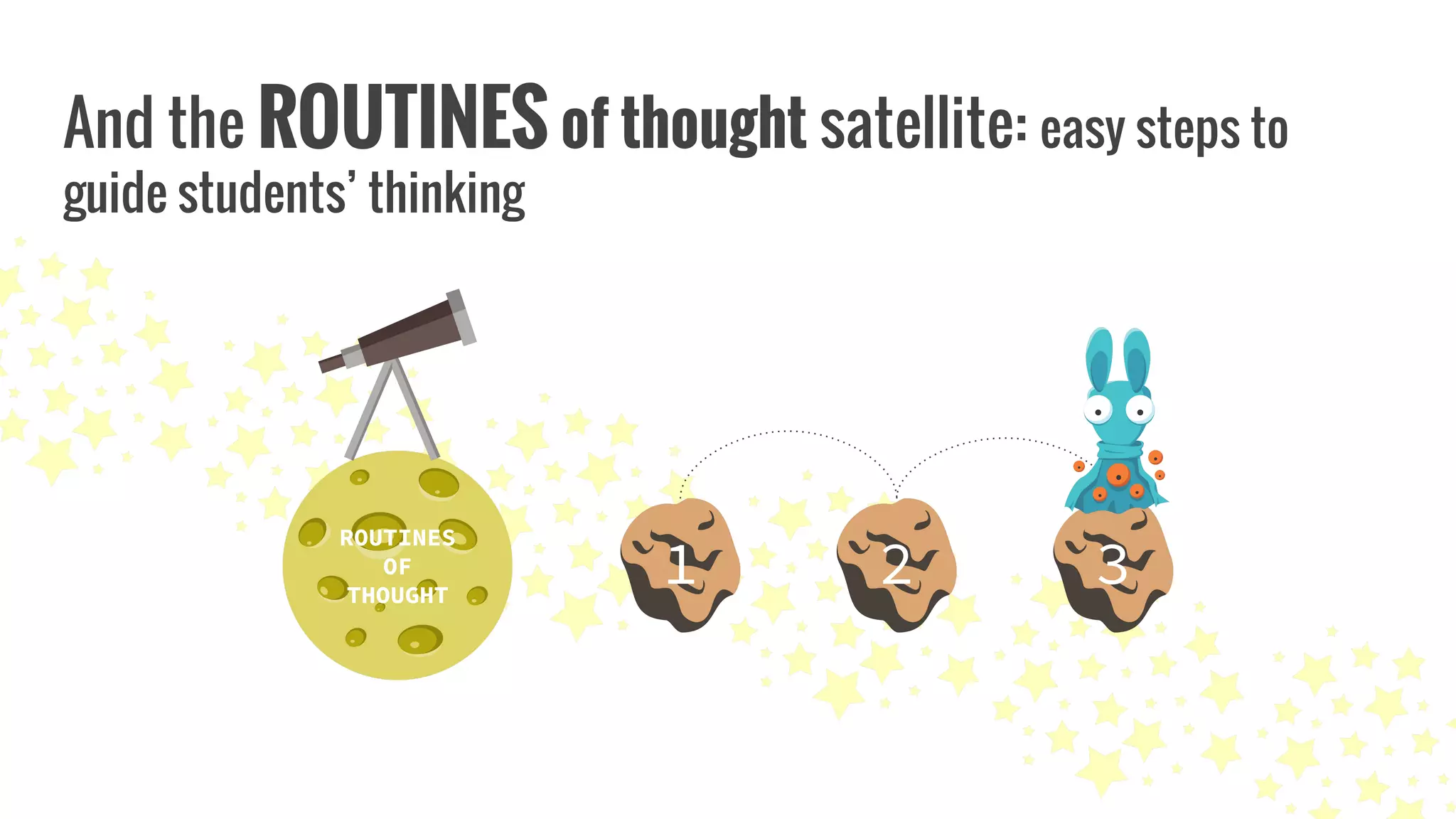
And the ROUTINES of thought satellite: easy steps to
guide students’ thinking
ROUTINES
OF
THOUGHT
1 2 3
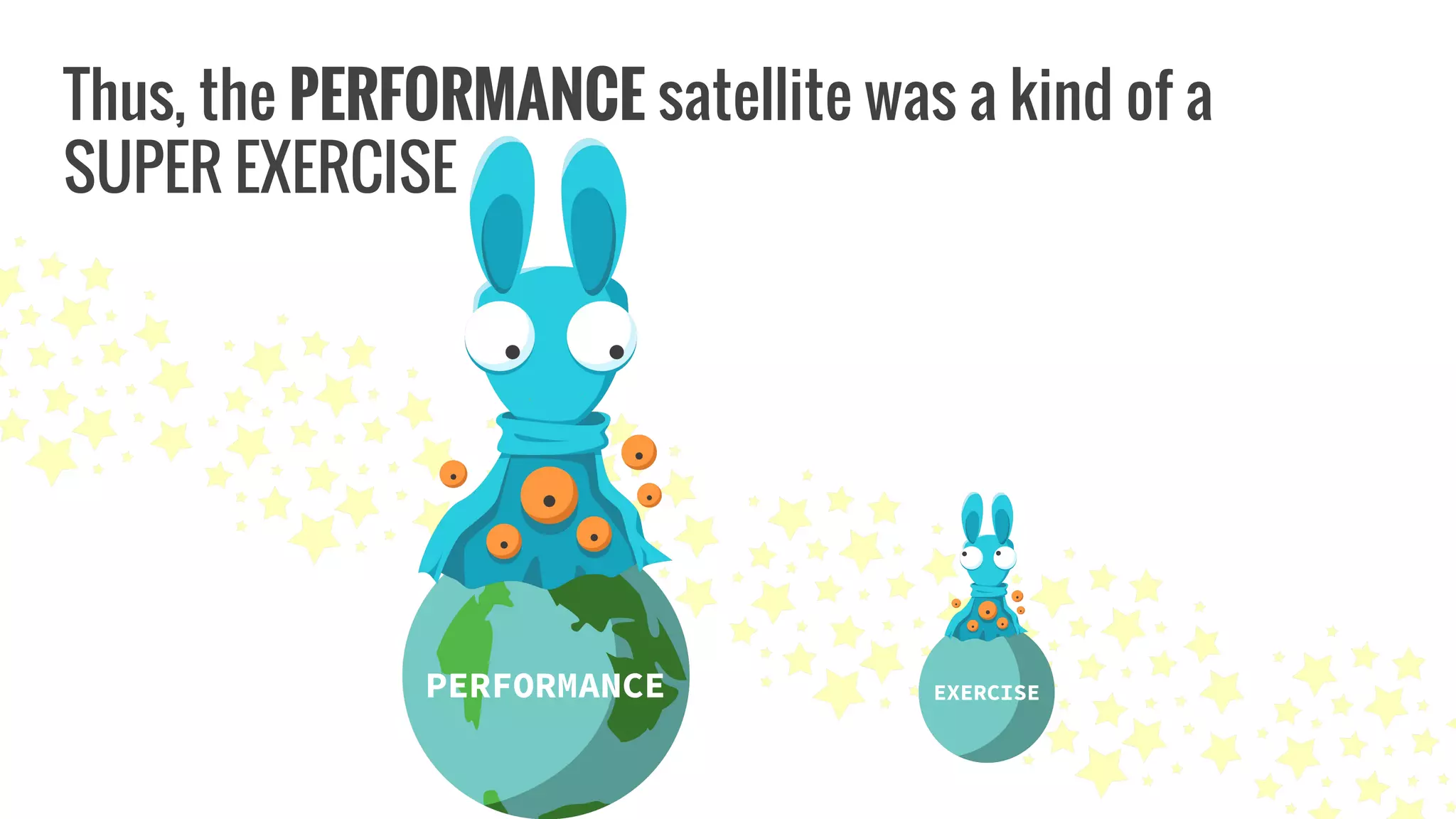
Thus, the PERFORMANCE satellite was a kind of a
SUPER EXERCISE
PERFORMANCE EXERCISE
Once finished, I headed to the other
subsystem
MULTIPLE
INTELLIGENCE
PERFORMANCE
OF
UNDER
STANDING
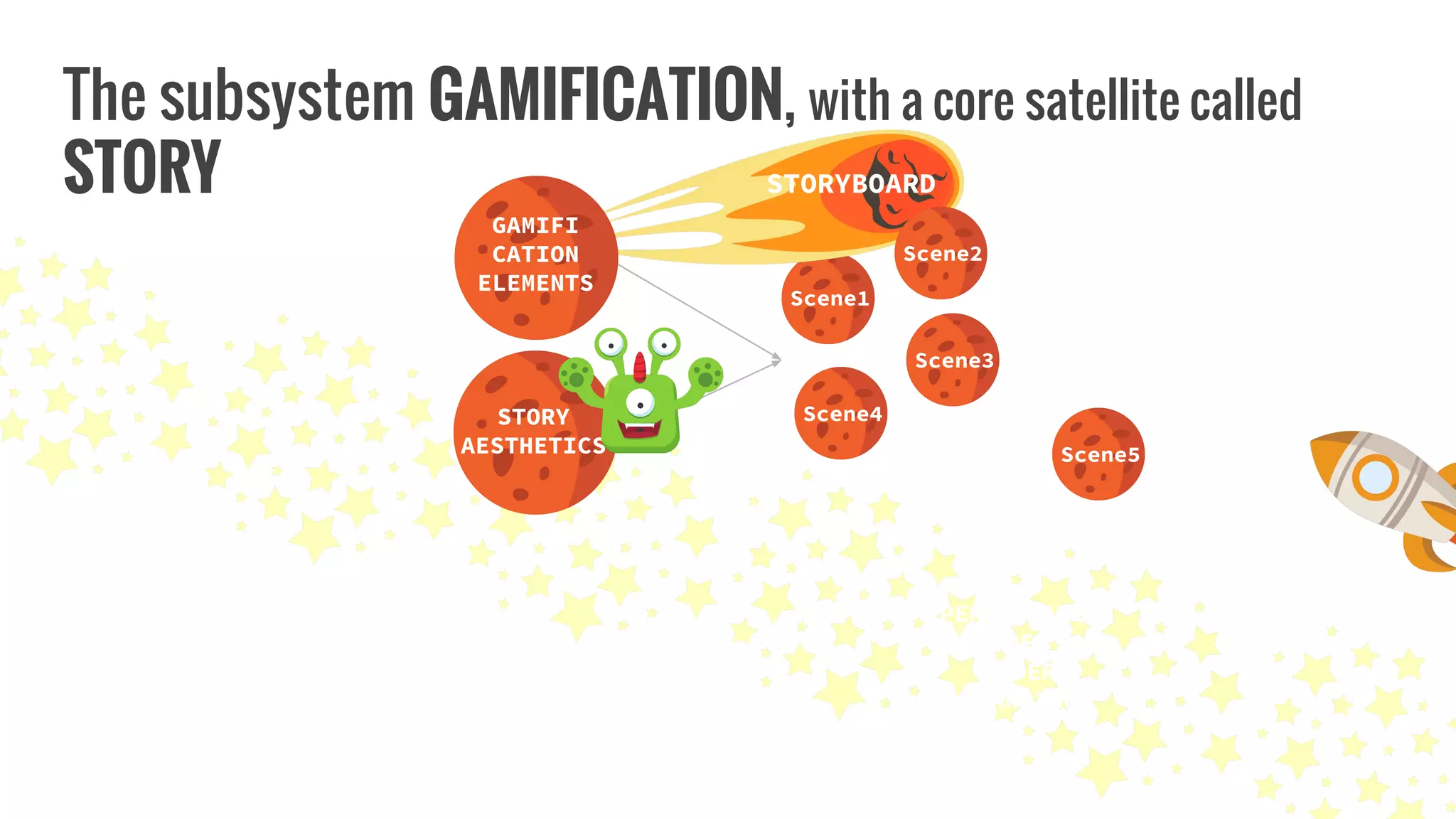
GAMIFI
CATION
ELEMENTS
STORY
AESTHETICS
Scene1
Scene2
Scene3
Scene4
STORYBOARD
The subsystem GAMIFICATION, with a core satellite called
STORY
Scene5
COMPETENCIES MULTIPLE
INTELLIGENCE
PLAYERS
PERFORMANCE
OF
UNDER
STANDING
GAMIFI
CATION
ELEMENTS
STORY
AESTHETICS
Scene1
Scene2
Scene3
Scene4
STORYBOARD
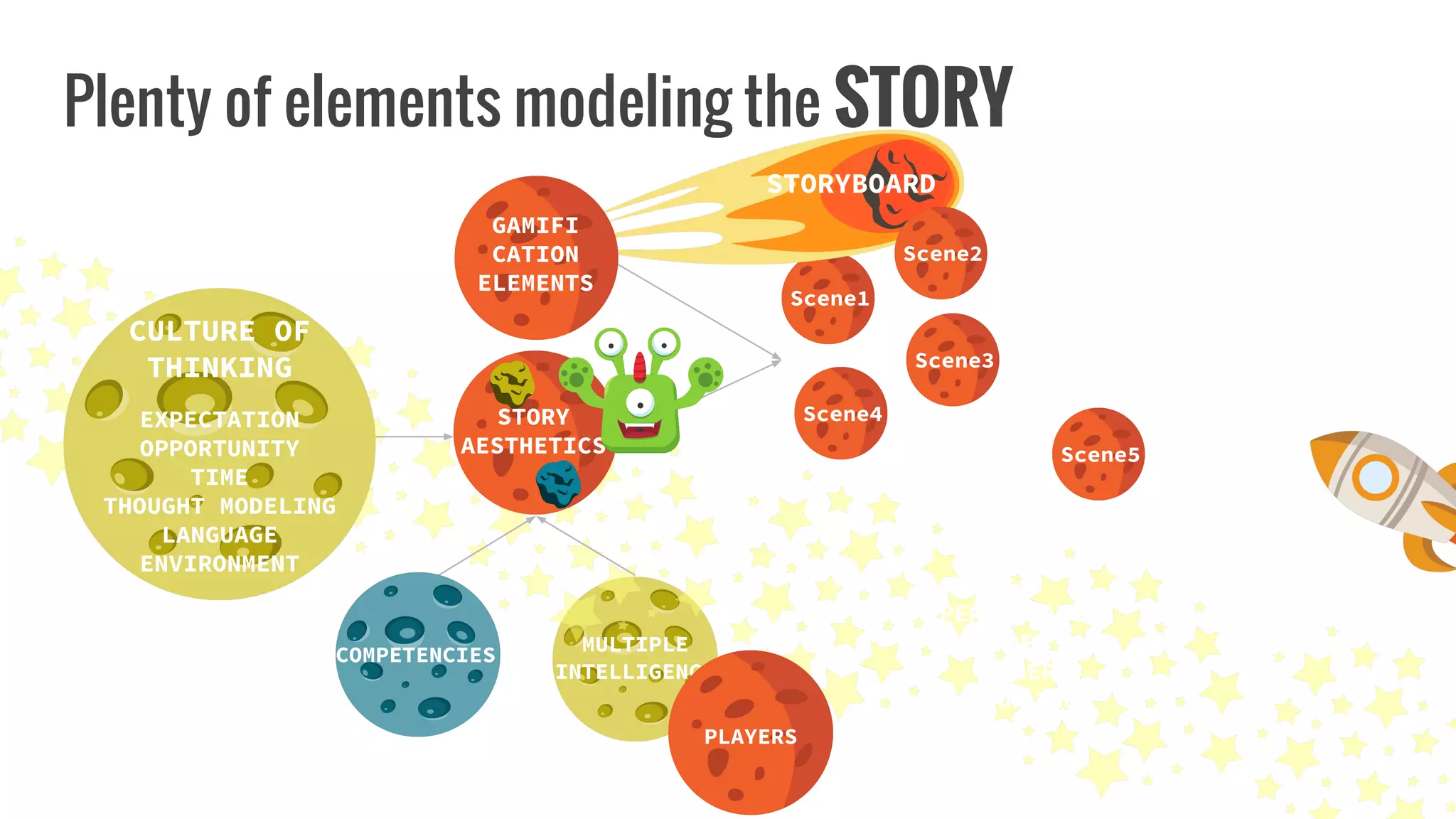
Plenty of elements modeling the STORY
CULTURE OF
THINKING
EXPECTATION
OPPORTUNITY
TIME
THOUGHT MODELING
LANGUAGE
ENVIRONMENT
Scene5
CULTURE OF
THINKING
EXPECTATION
OPPORTUNITY
TIME
THOUGHT MODELING
LANGUAGE
ENVIRONMENT
COMPETENCIES MULTIPLE
INTELLIGENCE
PLAYERS
GAMIFI
CATION
ELEMENTS
STORY
AESTHETICS
Scene1
Scene2
Scene3
Scene4
Scene5
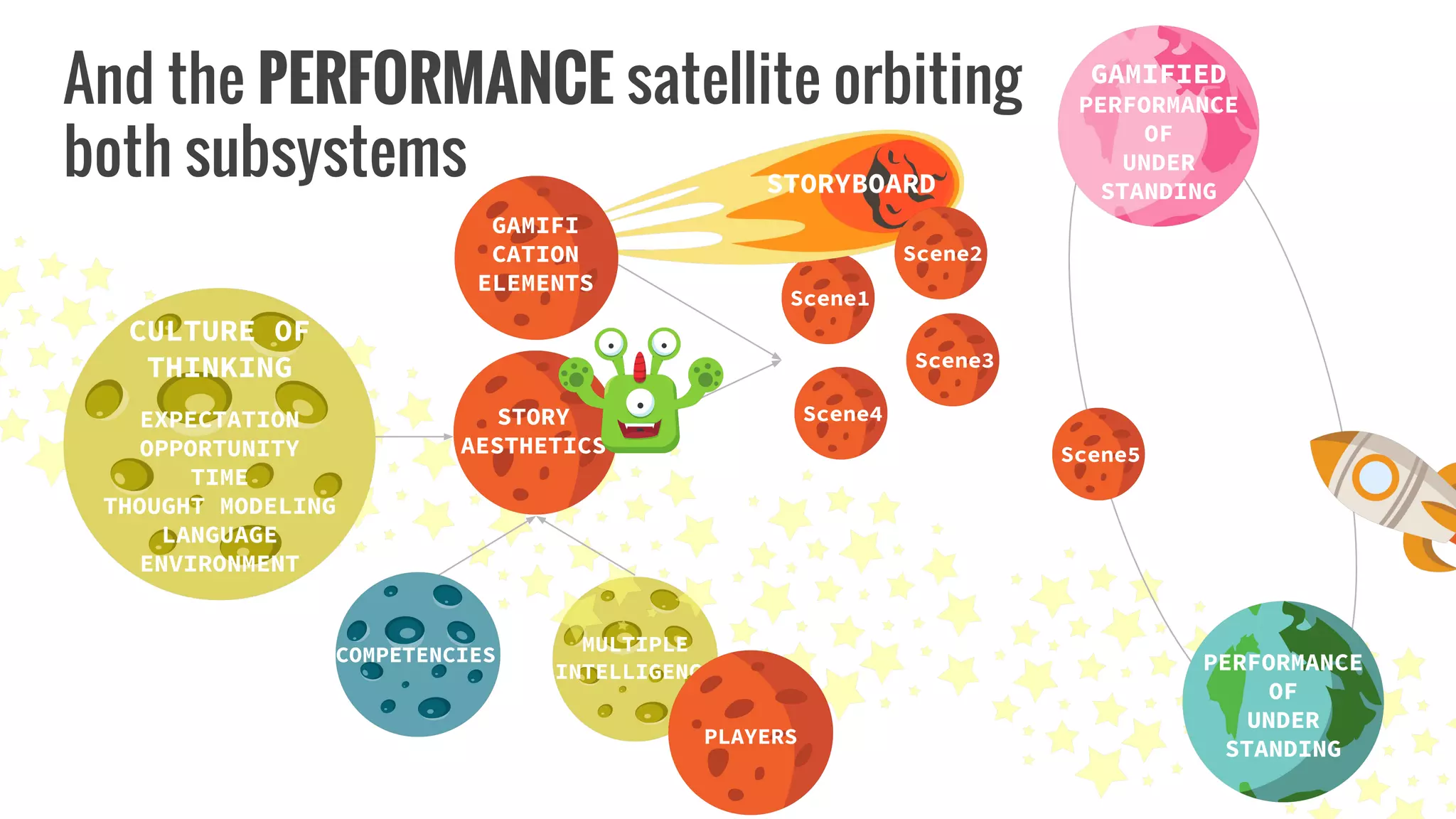
GAMIFIED
PERFORMANCE
OF
UNDER
STANDINGSTORYBOARD
PERFORMANCE
OF
UNDER
STANDING
And the PERFORMANCE satellite orbiting
both subsystems
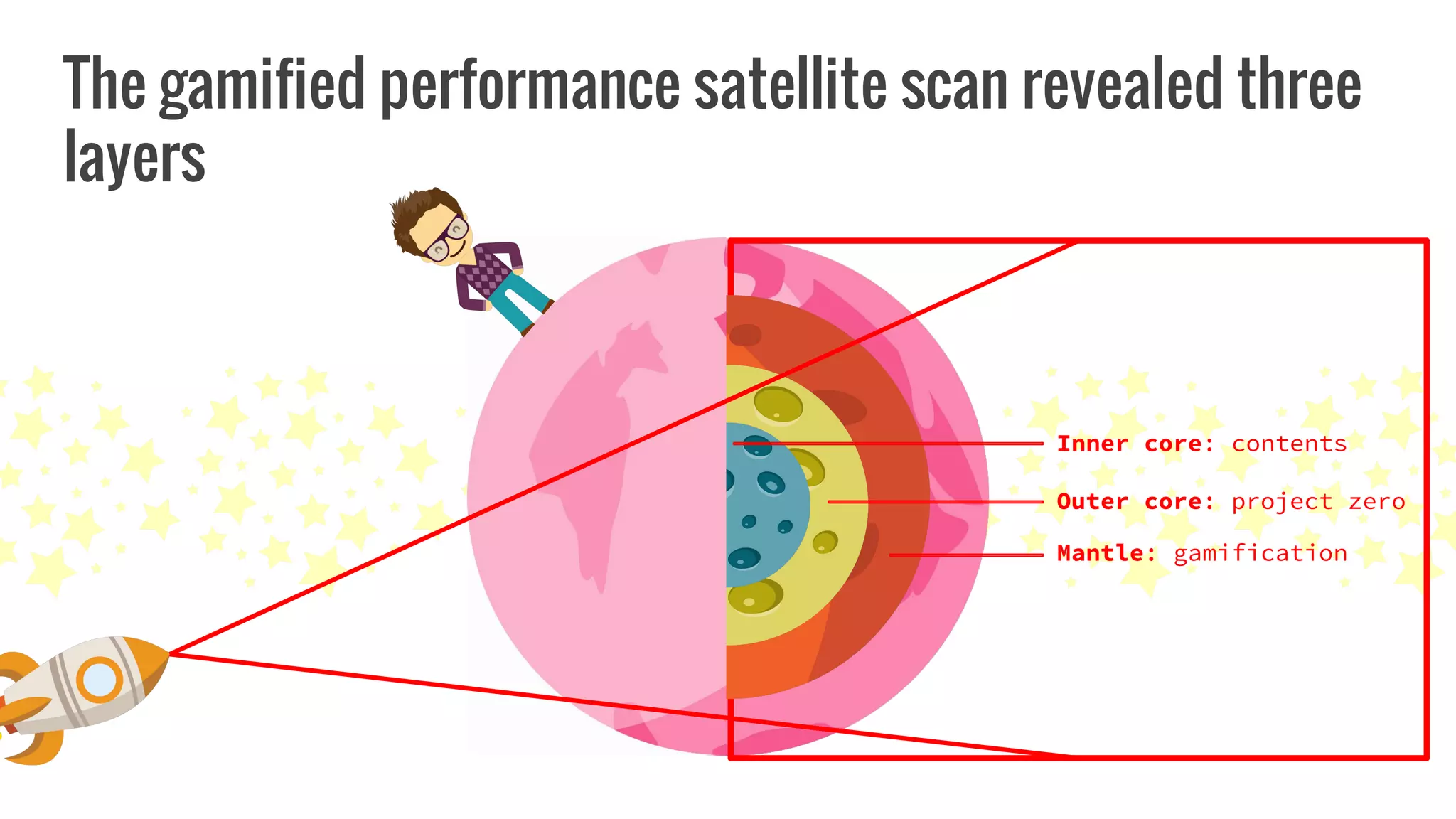
The gamified performance satellite scan revealed three
layers
Inner core: contents
Outer core: project zero
Mantle: gamification
The 2-layer galaxy structure happened to be
of great importance
PERFORMANCE
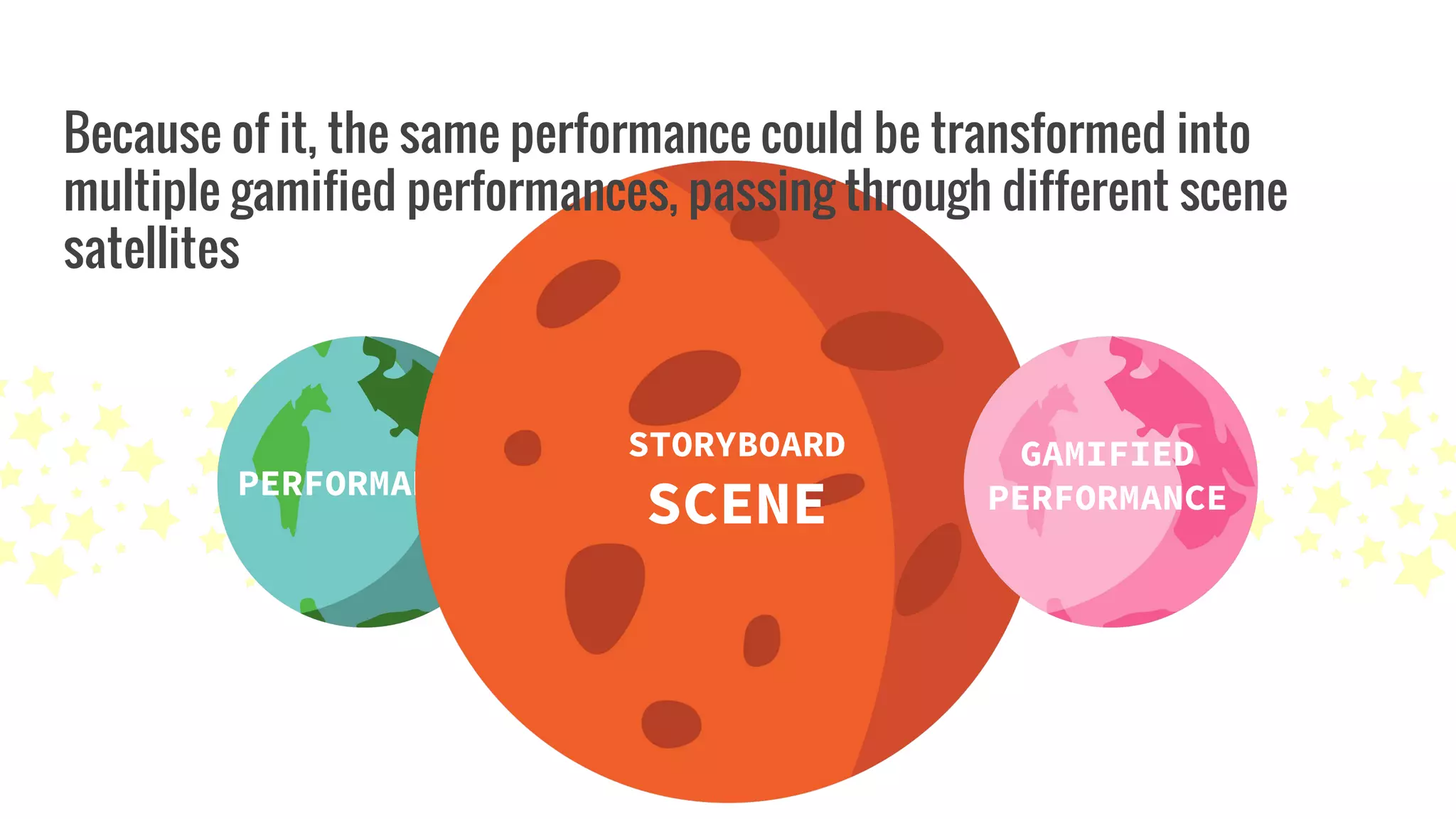
Because of it, the same performance could be transformed into
multiple gamified performances, passing through different scene
satellites
GAMIFIED
PERFORMANCE
STORYBOARD
SCENE
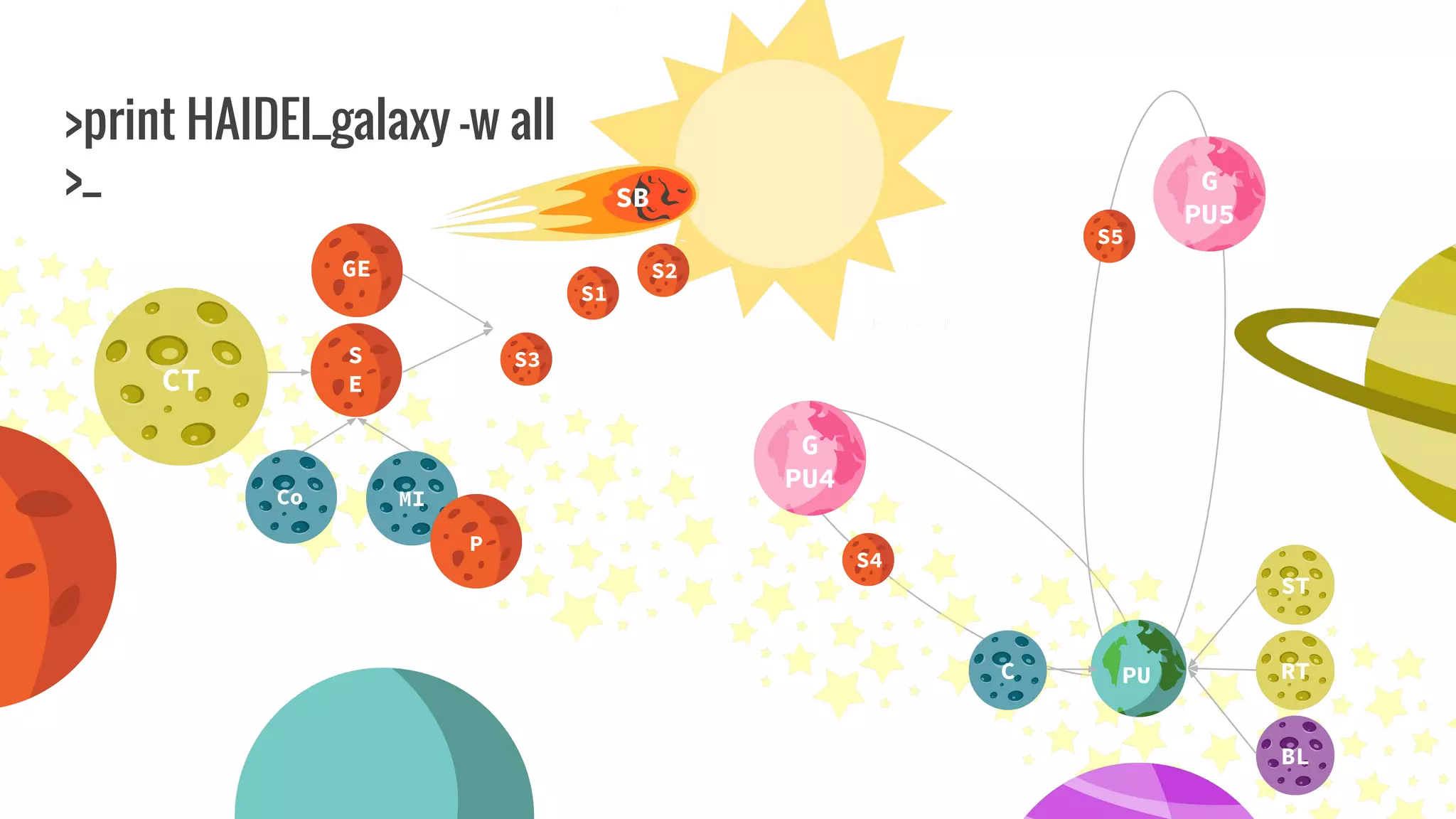
Finally, my ship’s supercomputer was able
to plot the whole map
>print HAIDEI_galaxy -w all
>_
CT
Co MI
P
GE
S
E
S1
S2
S4
S3
S5
G
PU5
SB
PU RTC
BL
G
PU4
ST
Did you like the metaphor?
You’ll love the real examples!
Case study: Maths lesson,
probability (secondary school)
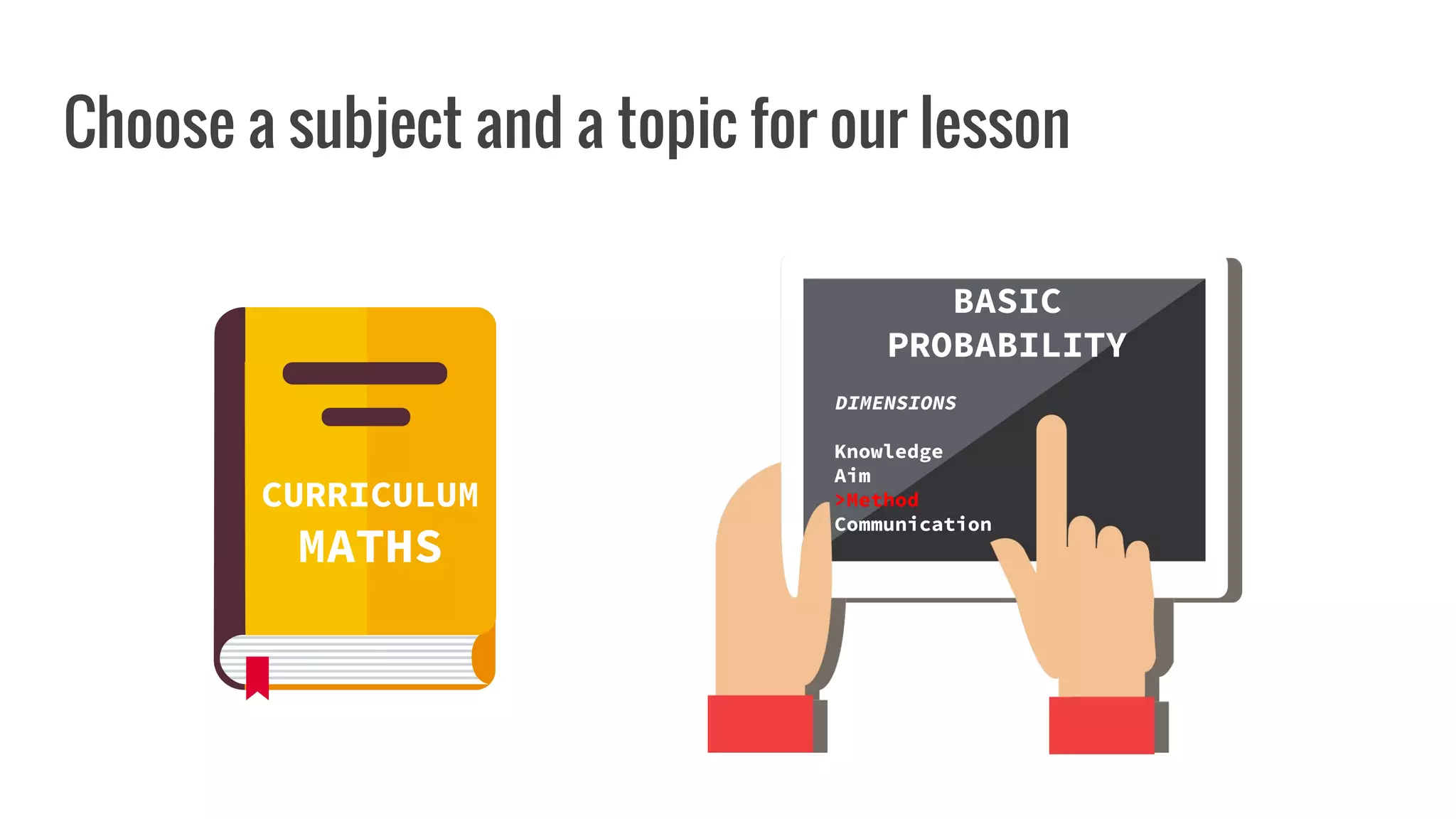
Choose a subject and a topic for our lesson
CURRICULUM
MATHS
BASIC
PROBABILITY
DIMENSIONS
Knowledge
Aim
>Method
Communication
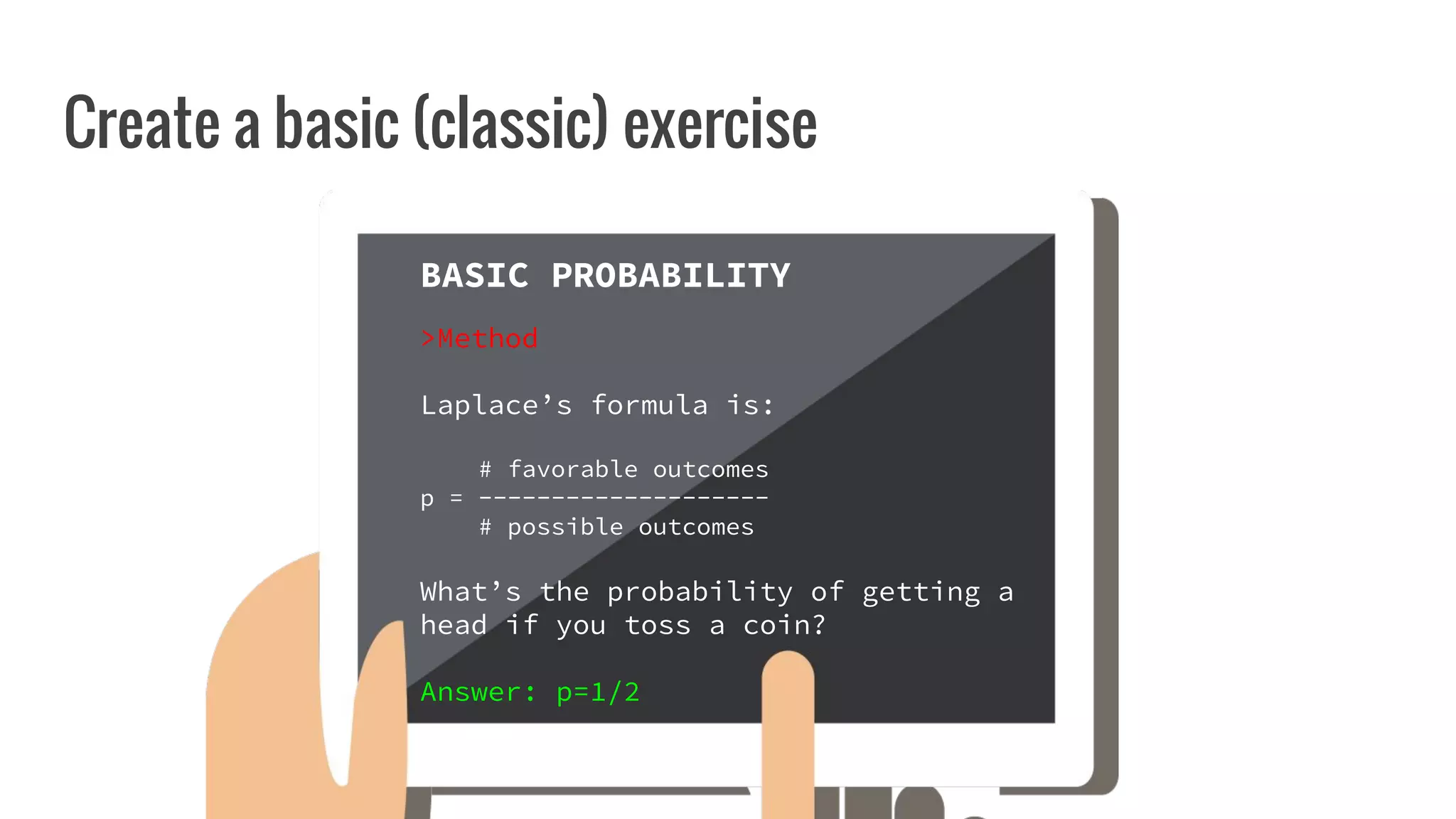
Create a basic (classic) exercise
CURRICULUM
MATHS
BASIC
PROBABILITY
BASIC PROBABILITY
>Method
Laplace’s formula is:
# favorable outcomes
p = --------------------
# possible outcomes
What’s the probability of getting a
head if you toss a coin?
Answer: p=1/2
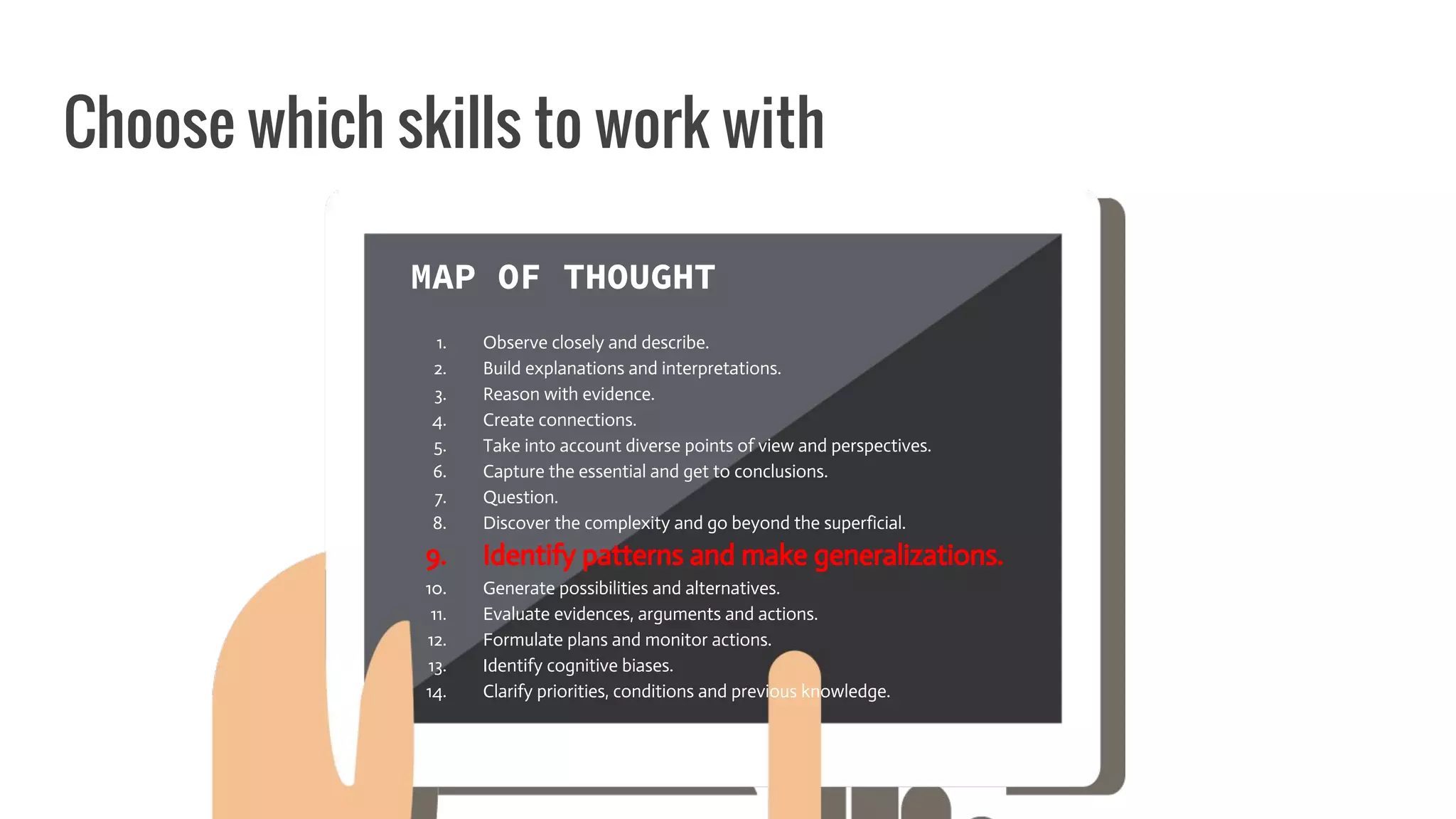
Choose which skills to work with
MAP OF THOUGHT
1. Observe closely and describe.
2. Build explanations and interpretations.
3. Reason with evidence.
4. Create connections.
5. Take into account diverse points of view and perspectives.
6. Capture the essential and get to conclusions.
7. Question.
8. Discover the complexity and go beyond the superficial.
9. Identify patterns and make generalizations.
10. Generate possibilities and alternatives.
11. Evaluate evidences, arguments and actions.
12. Formulate plans and monitor actions.
13. Identify cognitive biases.
14. Clarify priorities, conditions and previous knowledge.
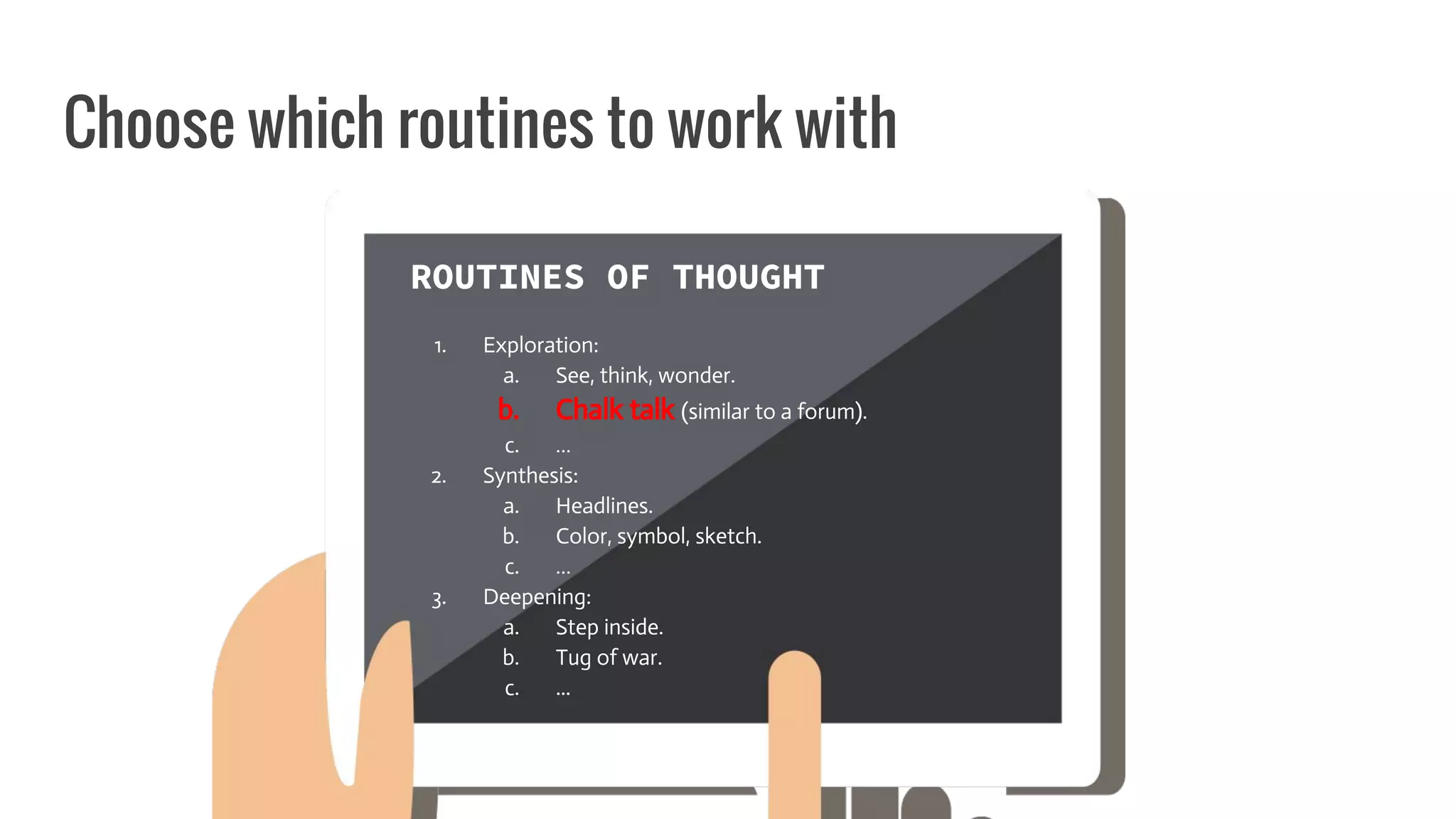
Choose which routines to work with
ROUTINES OF THOUGHT
1. Exploration:
a. See, think, wonder.
b. Chalk talk (similar to a forum).
c. …
2. Synthesis:
a. Headlines.
b. Color, symbol, sketch.
c. …
3. Deepening:
a. Step inside.
b. Tug of war.
c. ...
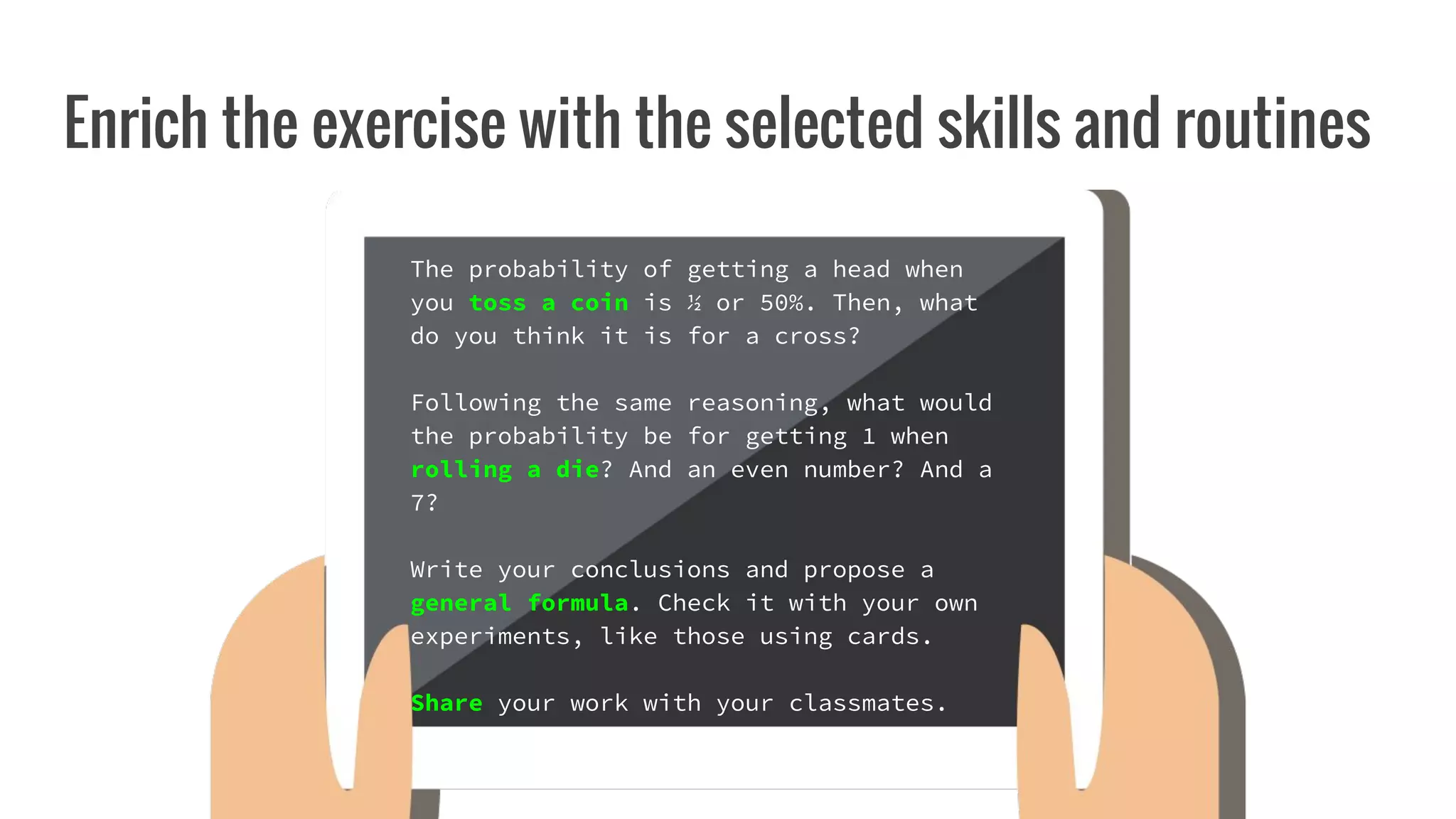
Enrich the exercise with the selected skills and routines
The probability of getting a head when
you toss a coin is ½ or 50%. Then, what
do you think it is for a cross?
Following the same reasoning, what would
the probability be for getting 1 when
rolling a die? And an even number? And a
7?
Write your conclusions and propose a
general formula. Check it with your own
experiments, like those using cards.
Share your work with your classmates.
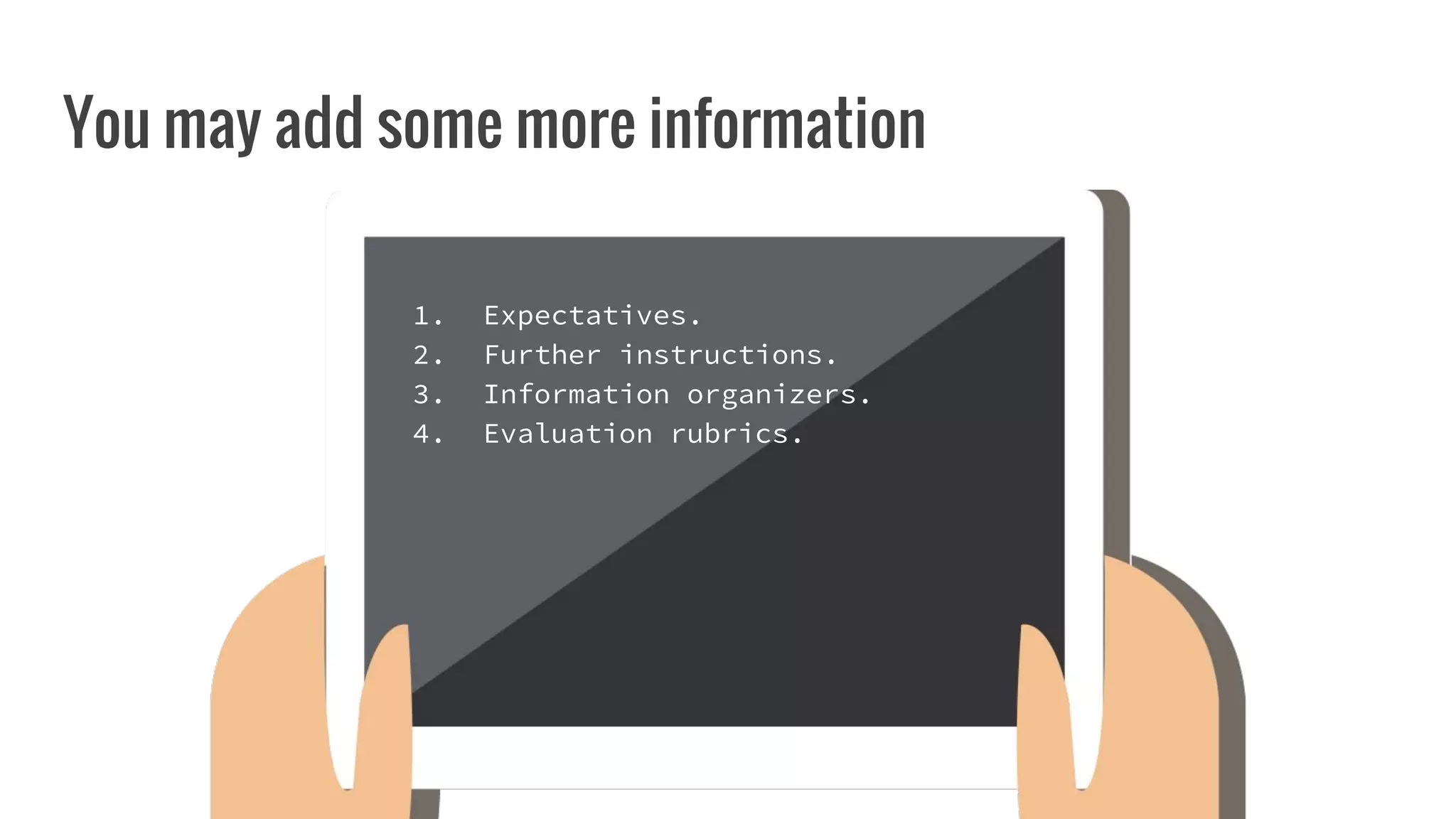
You may add some more information
1. Expectatives.
2. Further instructions.
3. Information organizers.
4. Evaluation rubrics.
What is an information organizer or visual organizer?
A sheet designed to guide students
in structuring their information.
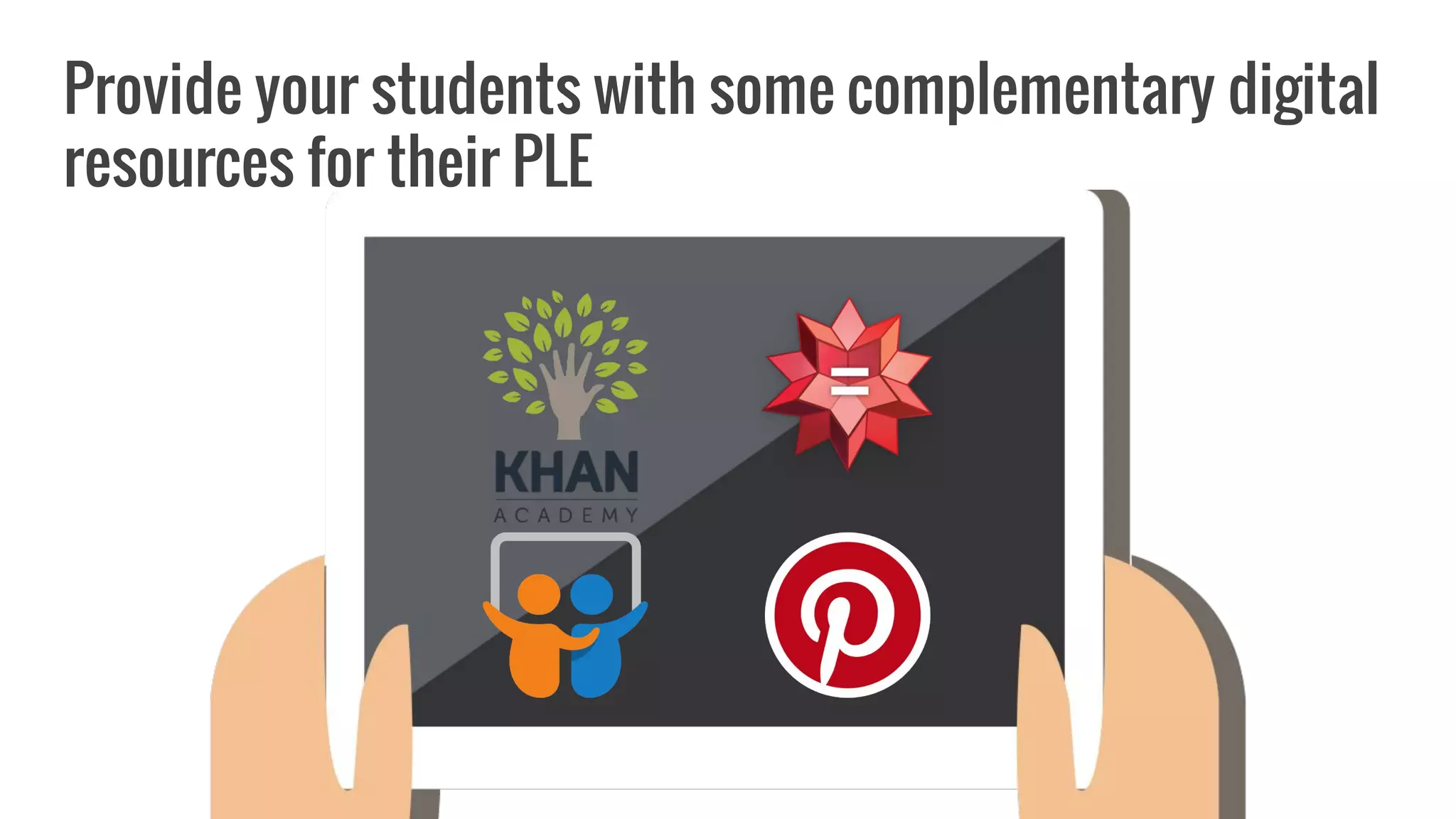
Provide your students with some complementary digital
resources for their PLE
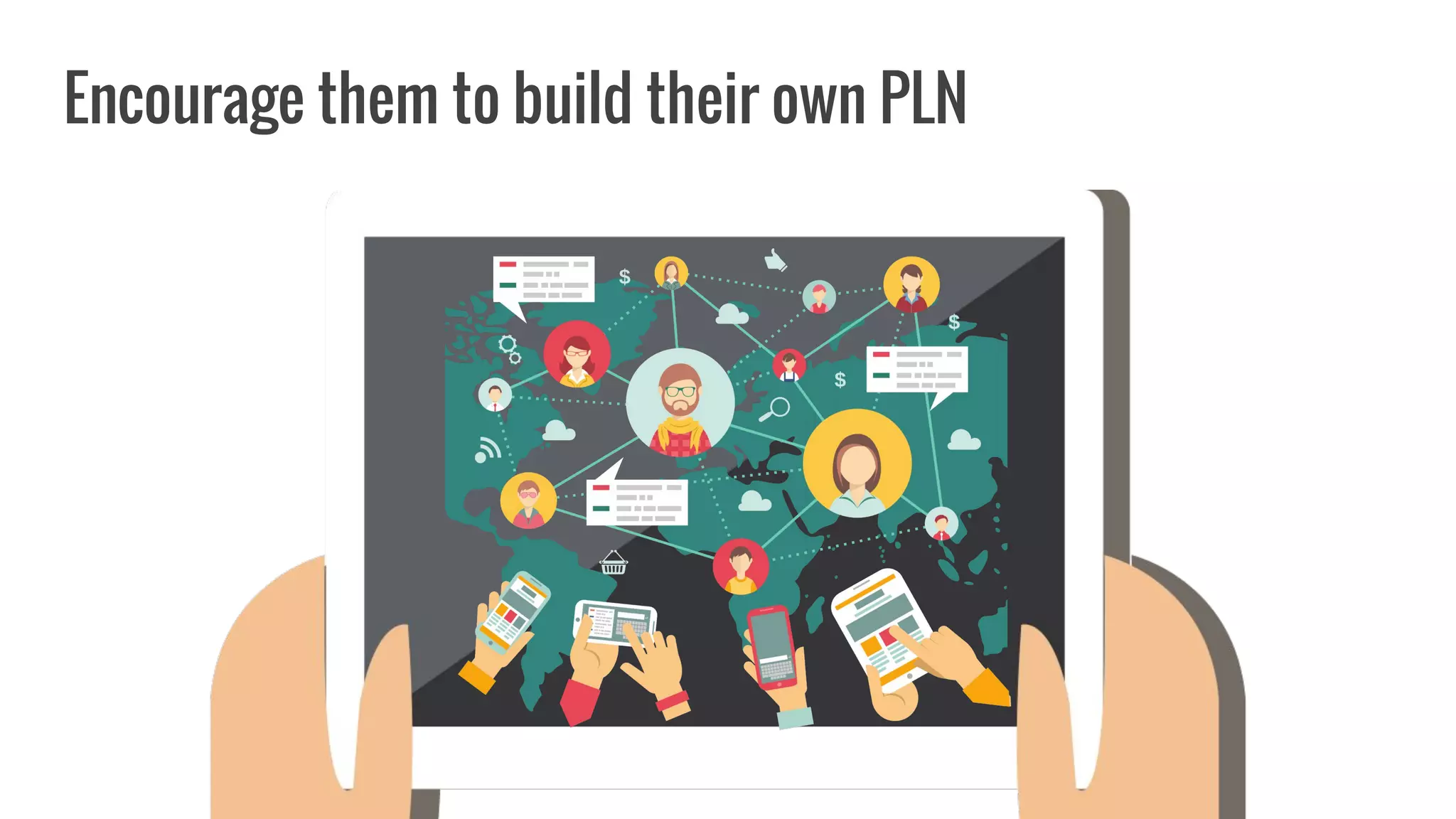
Encourage them to build their own PLN
And, finally, set up the LMS and the virtual portfolio
Now let’s apply gamification
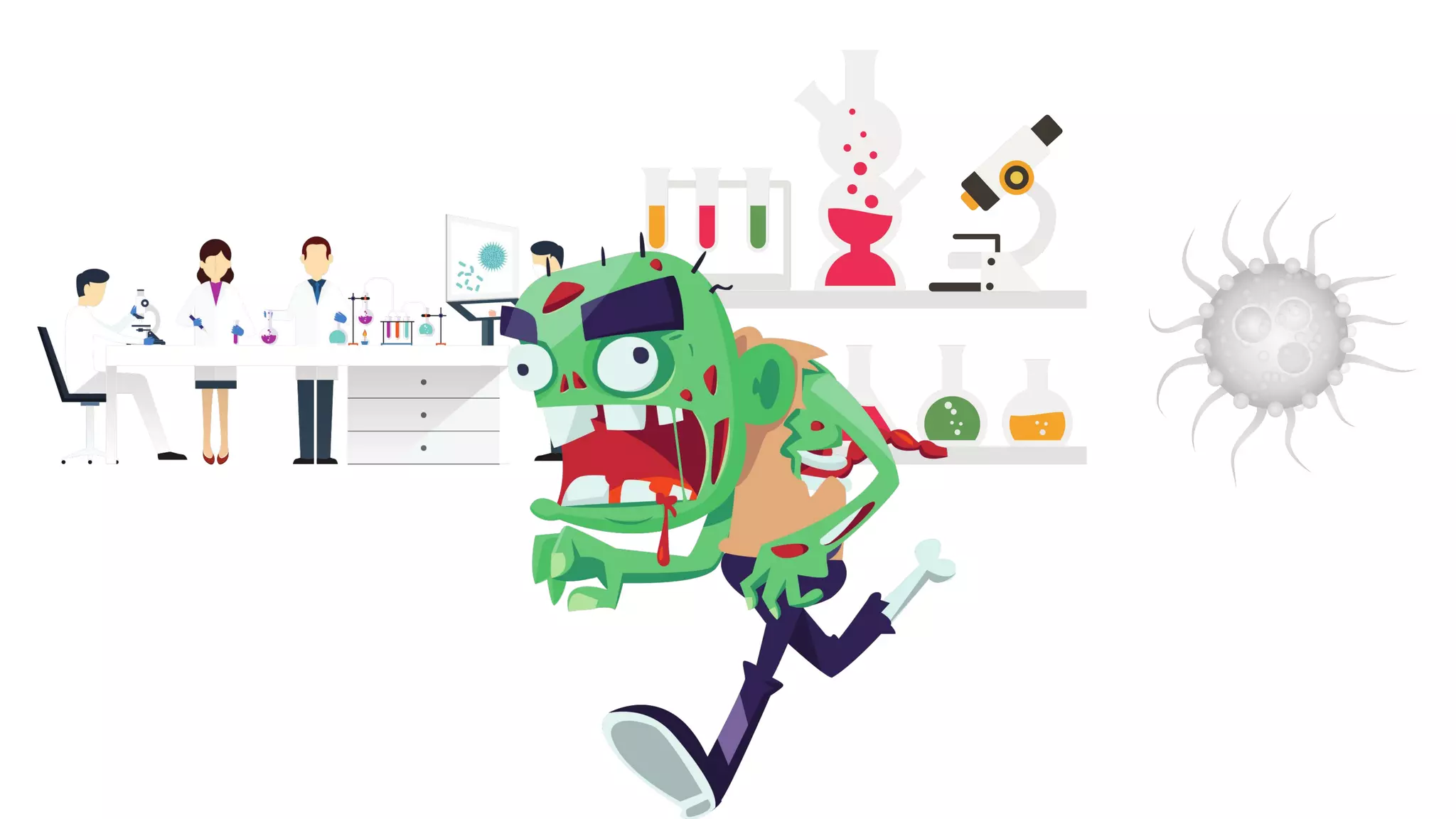
The story: the dawn of the zombies
COMPETENCIES
1. Entrepreneurial
INTELLIGENCES
1. Naturalistic
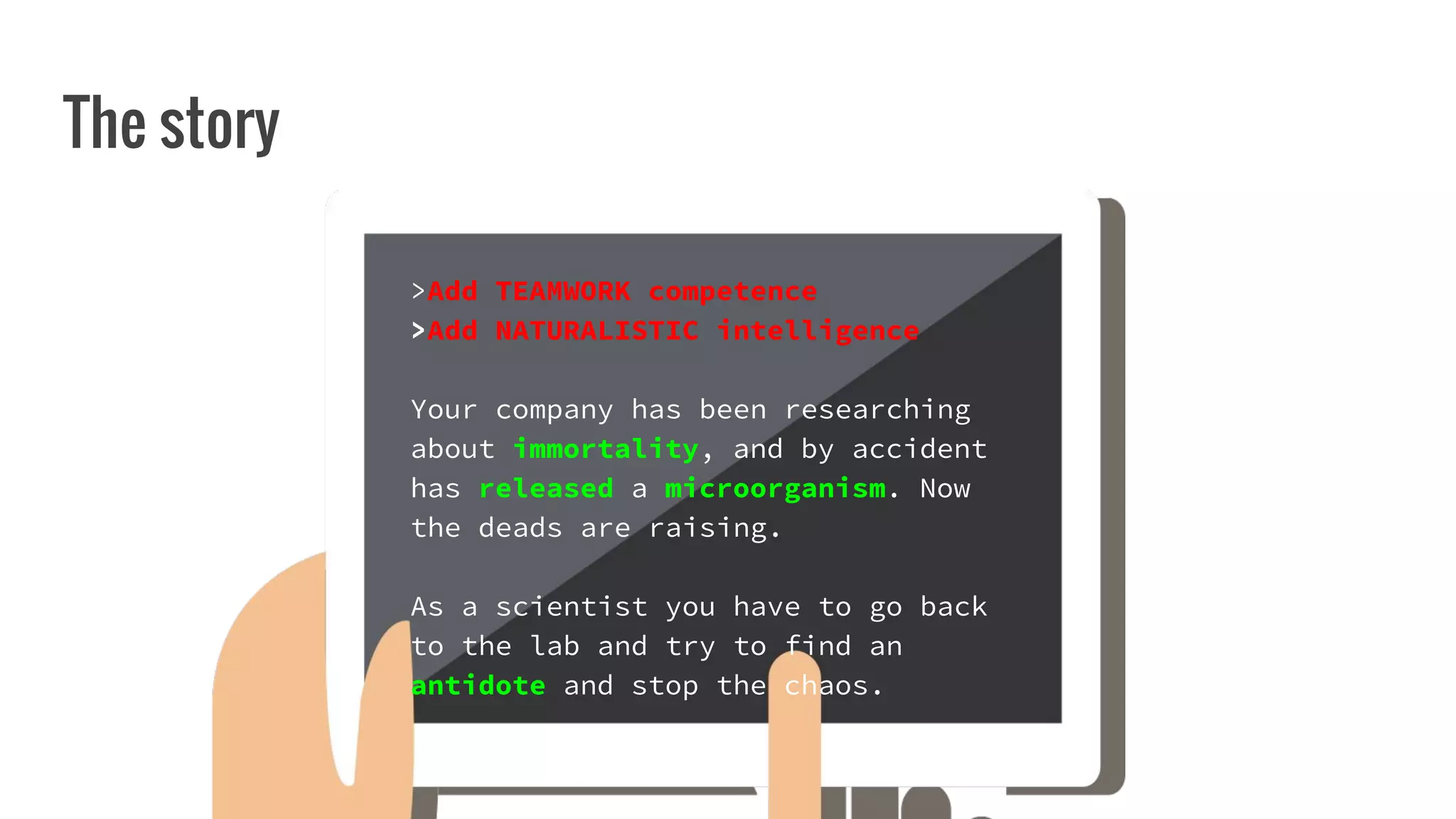
The story
>Add TEAMWORK competence
>Add NATURALISTIC intelligence
Your company has been researching
about immortality, and by accident
has released a microorganism. Now
the deads are raising.
As a scientist you have to go back
to the lab and try to find an
antidote and stop the chaos.
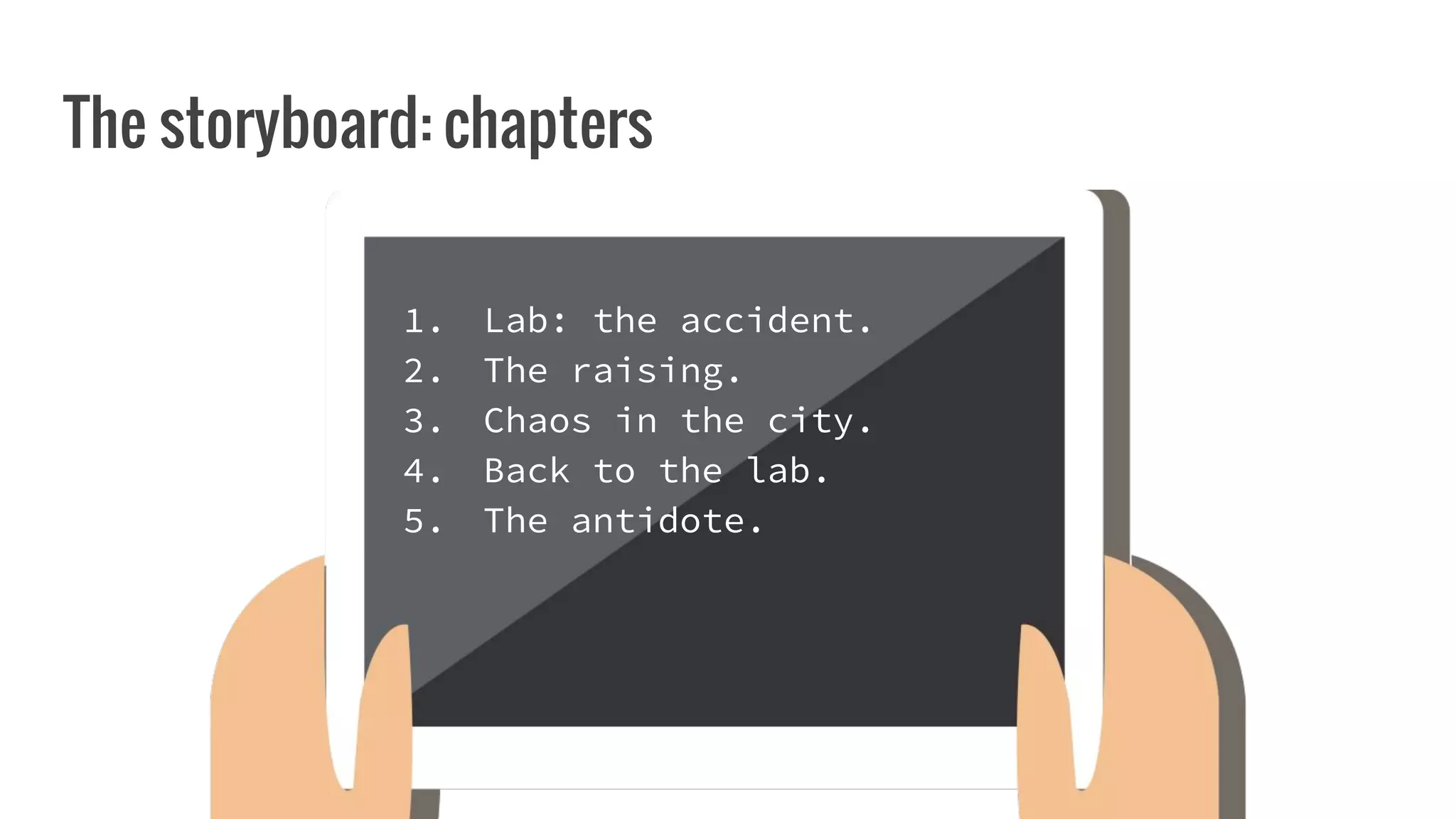
The storyboard: chapters
1. Lab: the accident.
2. The raising.
3. Chaos in the city.
4. Back to the lab.
5. The antidote.
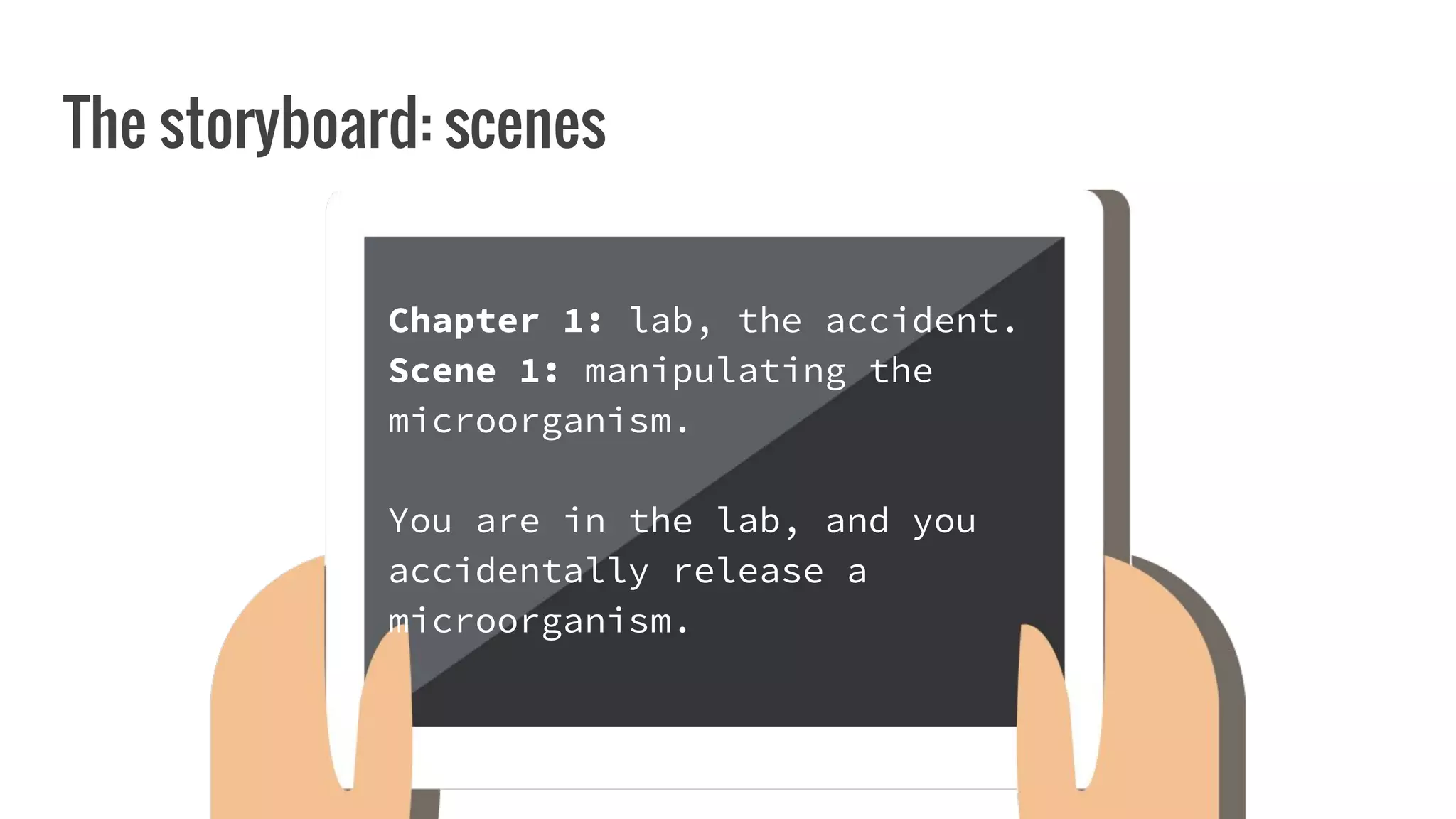
The storyboard: scenes
Chapter 1: lab, the accident.
Scene 1: manipulating the
microorganism.
You are in the lab, and you
accidentally release a
microorganism.
Transform the enriched exercise into a gamified
performance
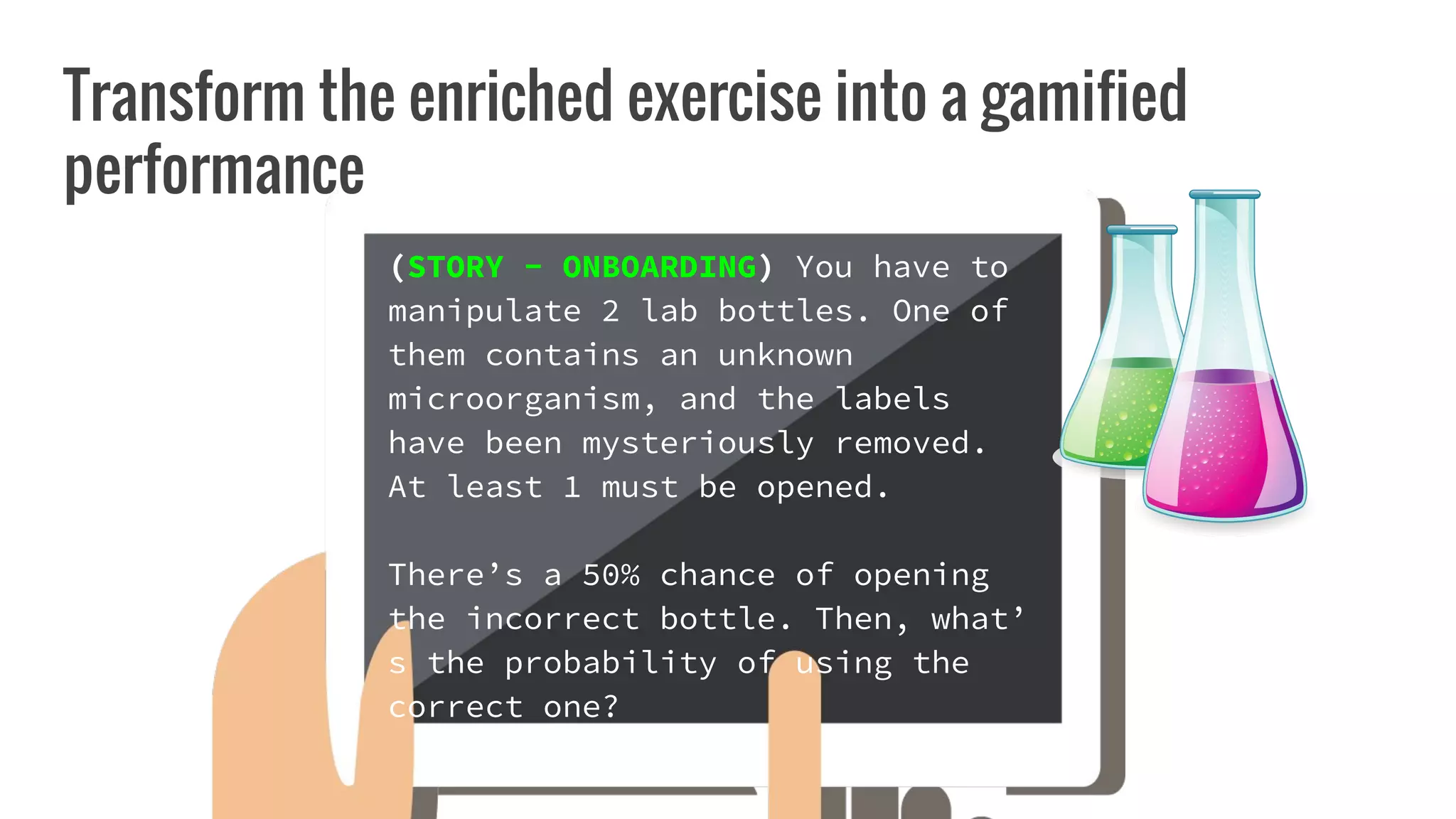
(STORY - ONBOARDING) You have to
manipulate 2 lab bottles. One of
them contains an unknown
microorganism, and the labels
have been mysteriously removed.
At least 1 must be opened.
There’s a 50% chance of opening
the incorrect bottle. Then, what’
s the probability of using the
correct one?
Gamified performance
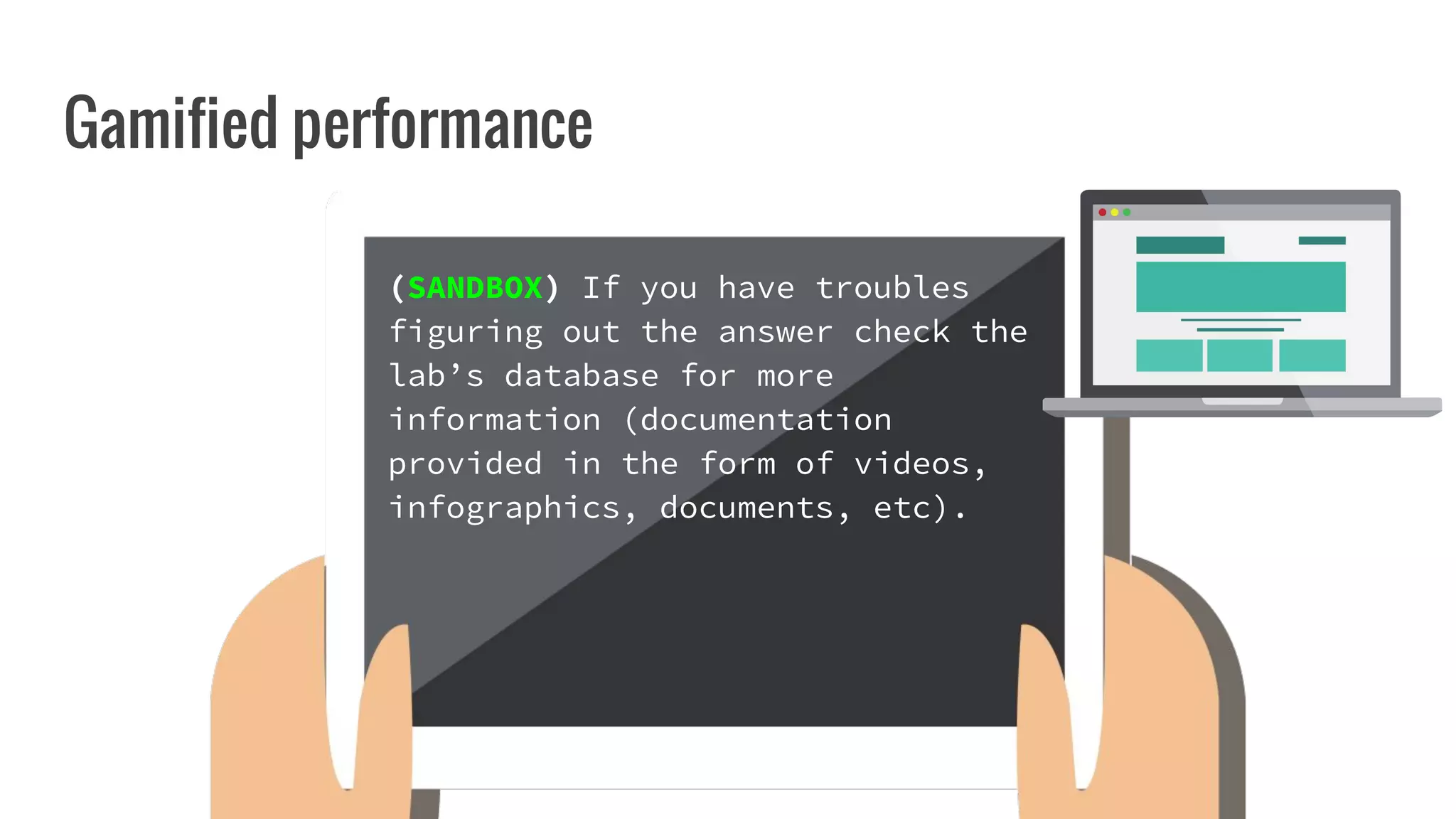
(SANDBOX) If you have troubles
figuring out the answer check the
lab’s database for more
information (documentation
provided in the form of videos,
infographics, documents, etc).
Gamified performance
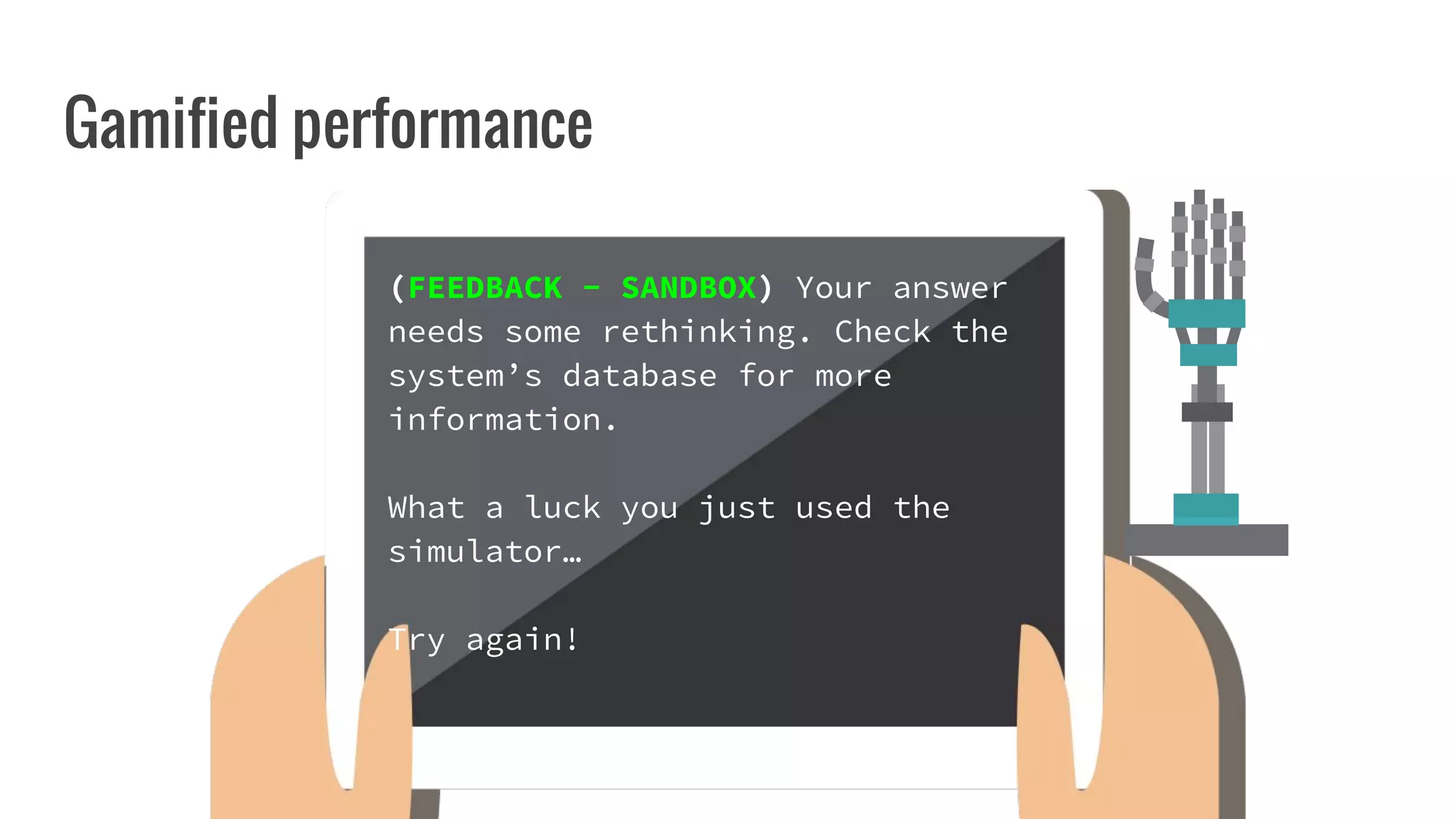
(FEEDBACK - SANDBOX) Your answer
needs some rethinking. Check the
system’s database for more
information.
What a luck you just used the
simulator…
Try again!
Gamified performance
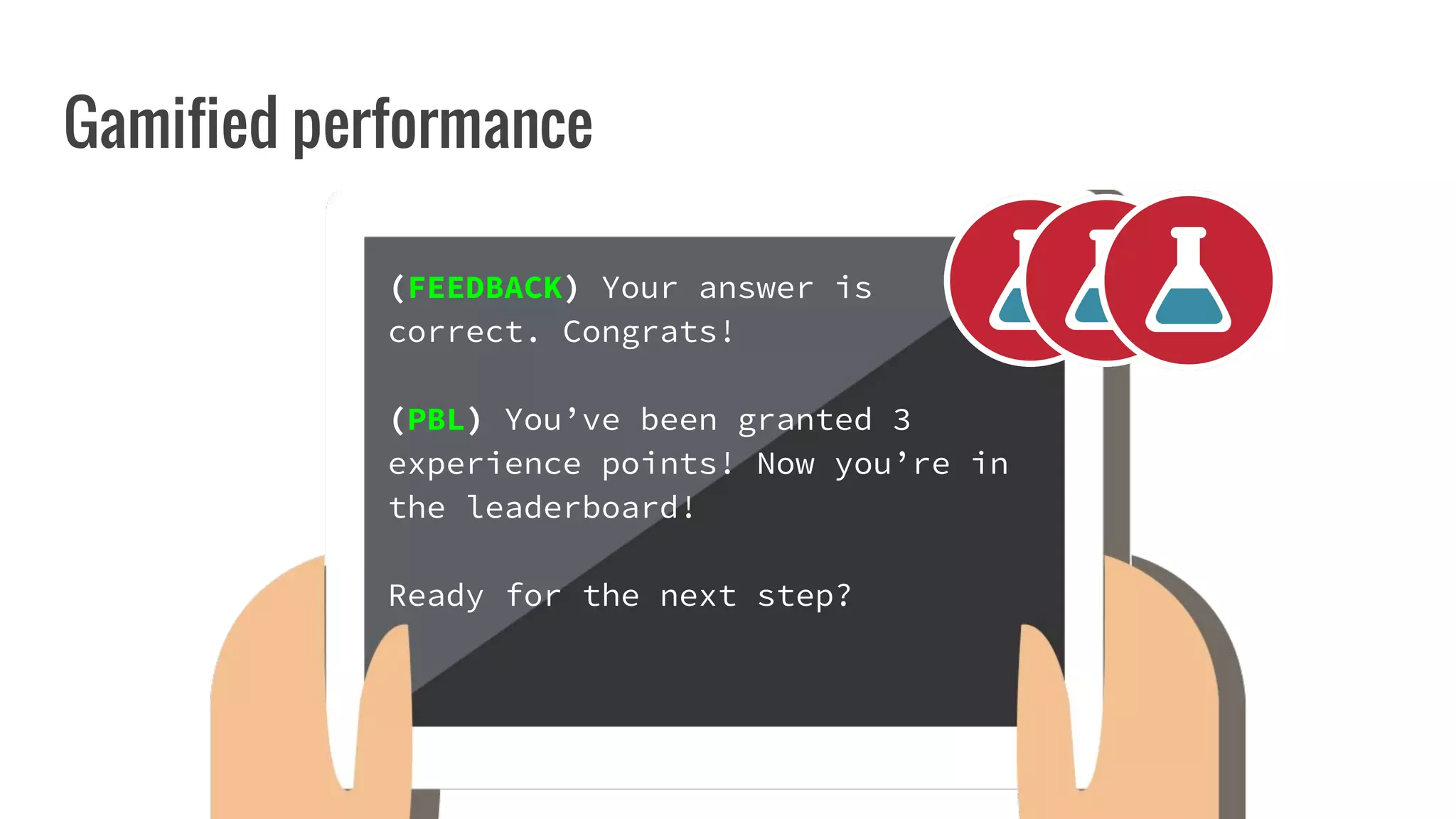
(FEEDBACK) Your answer is
correct. Congrats!
(PBL) You’ve been granted 3
experience points! Now you’re in
the leaderboard!
Ready for the next step?
Gamified performance
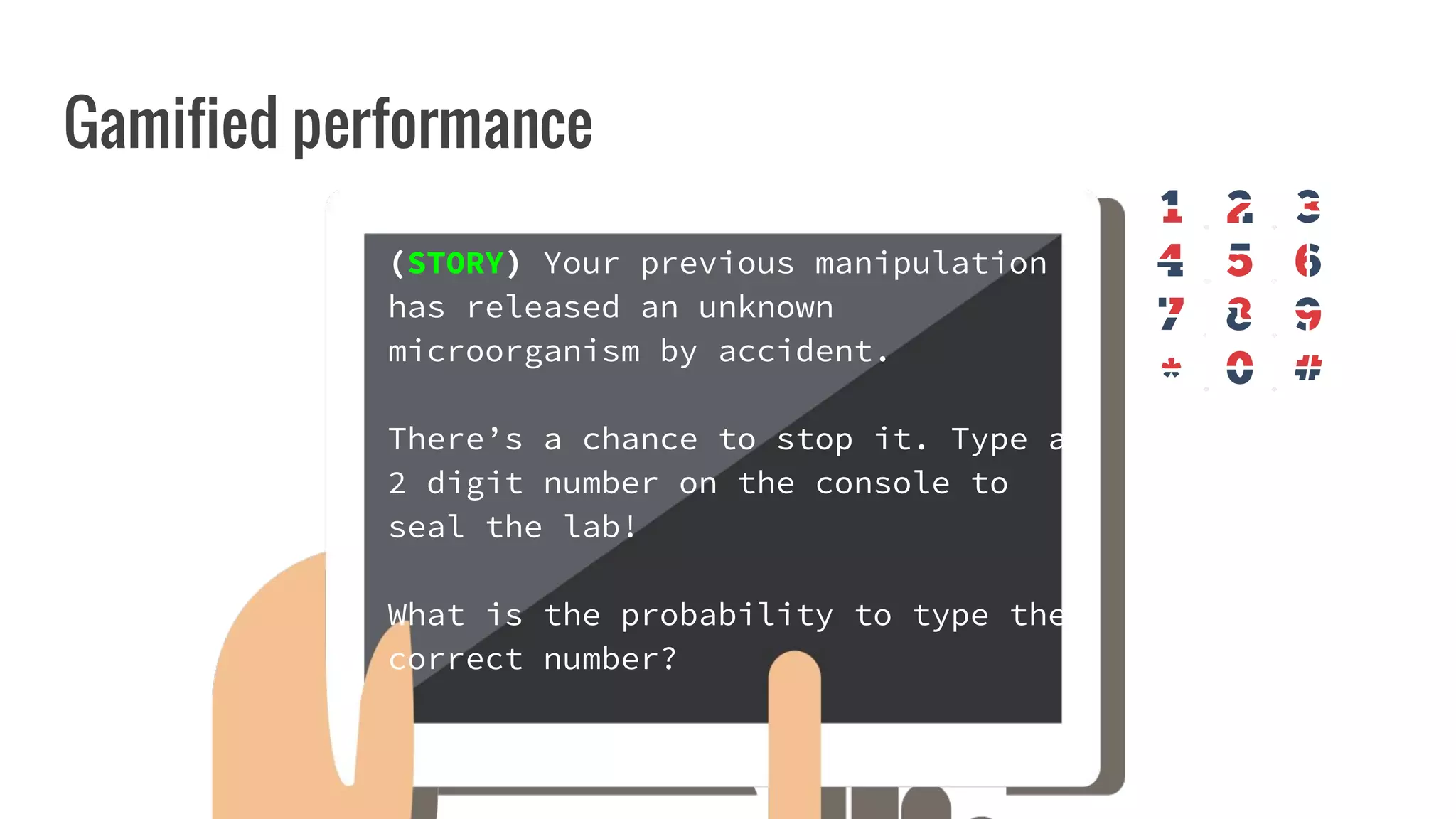
(STORY) Your previous manipulation
has released an unknown
microorganism by accident.
There’s a chance to stop it. Type a
2 digit number on the console to
seal the lab!
What is the probability to type the
correct number?
Gamified performance
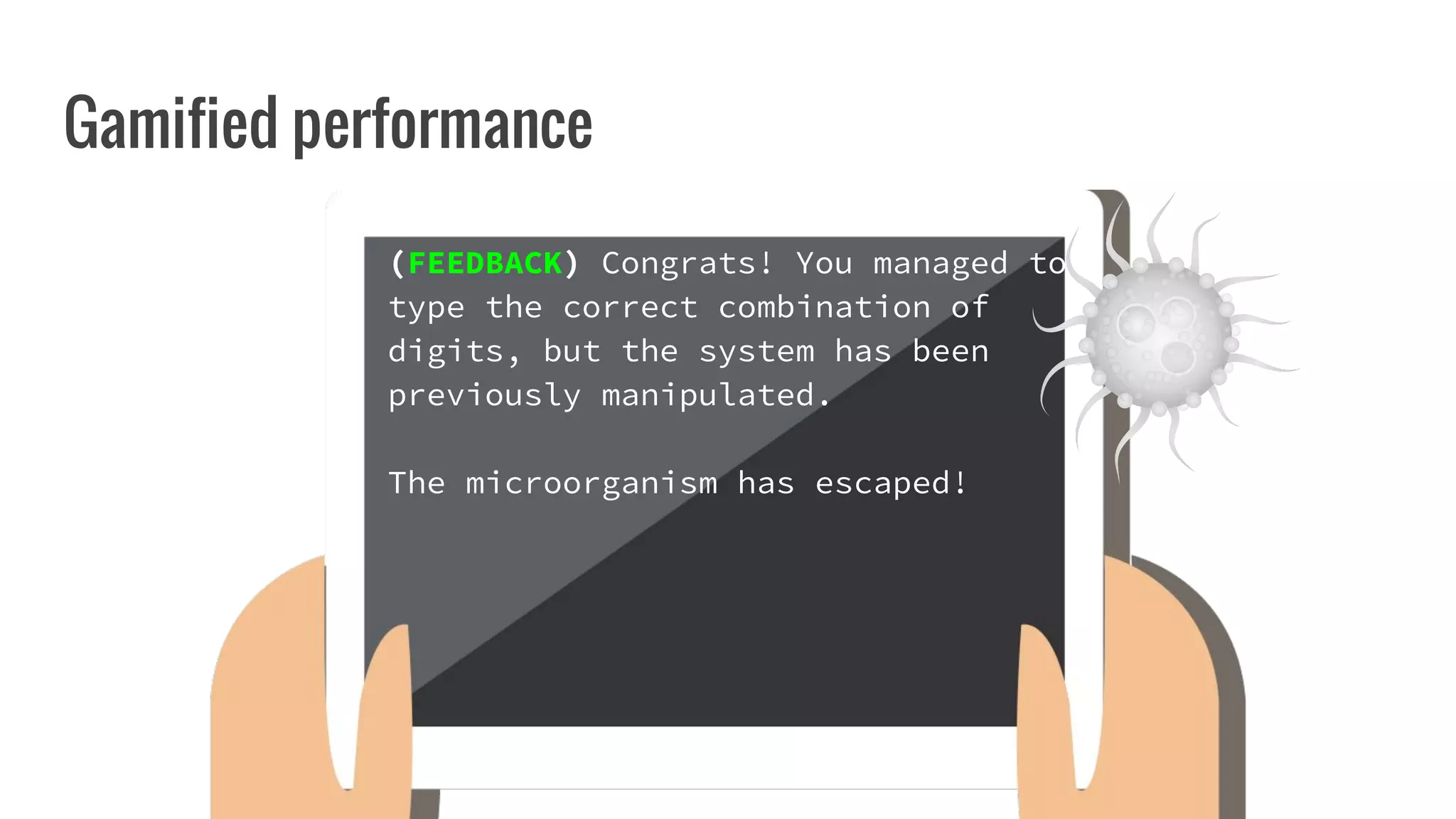
(FEEDBACK) Congrats! You managed to
type the correct combination of
digits, but the system has been
previously manipulated.
The microorganism has escaped!
Gamified performance
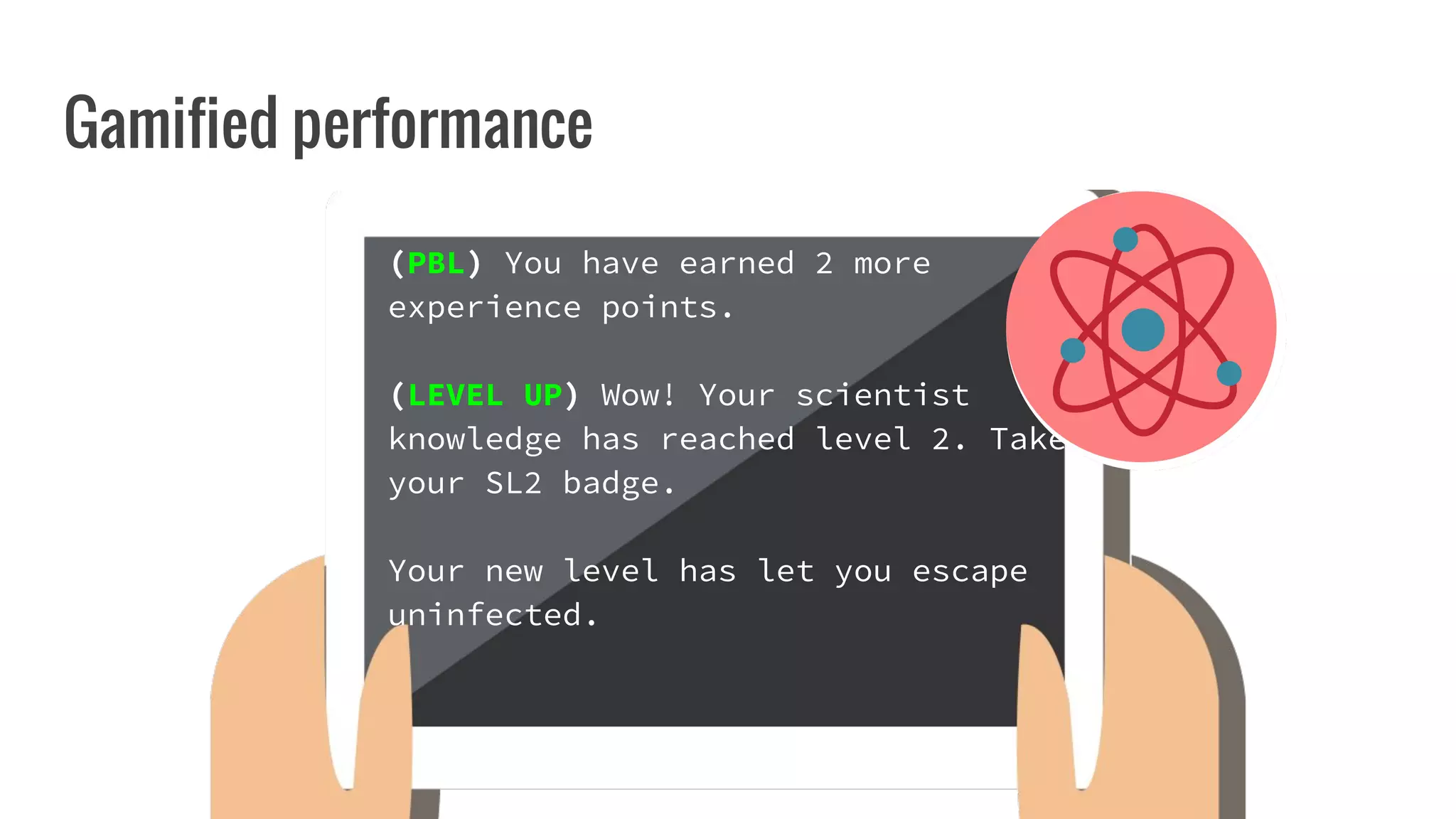
(PBL) You have earned 2 more
experience points.
(LEVEL UP) Wow! Your scientist
knowledge has reached level 2. Take
your SL2 badge.
Your new level has let you escape
uninfected.
Gamified performance
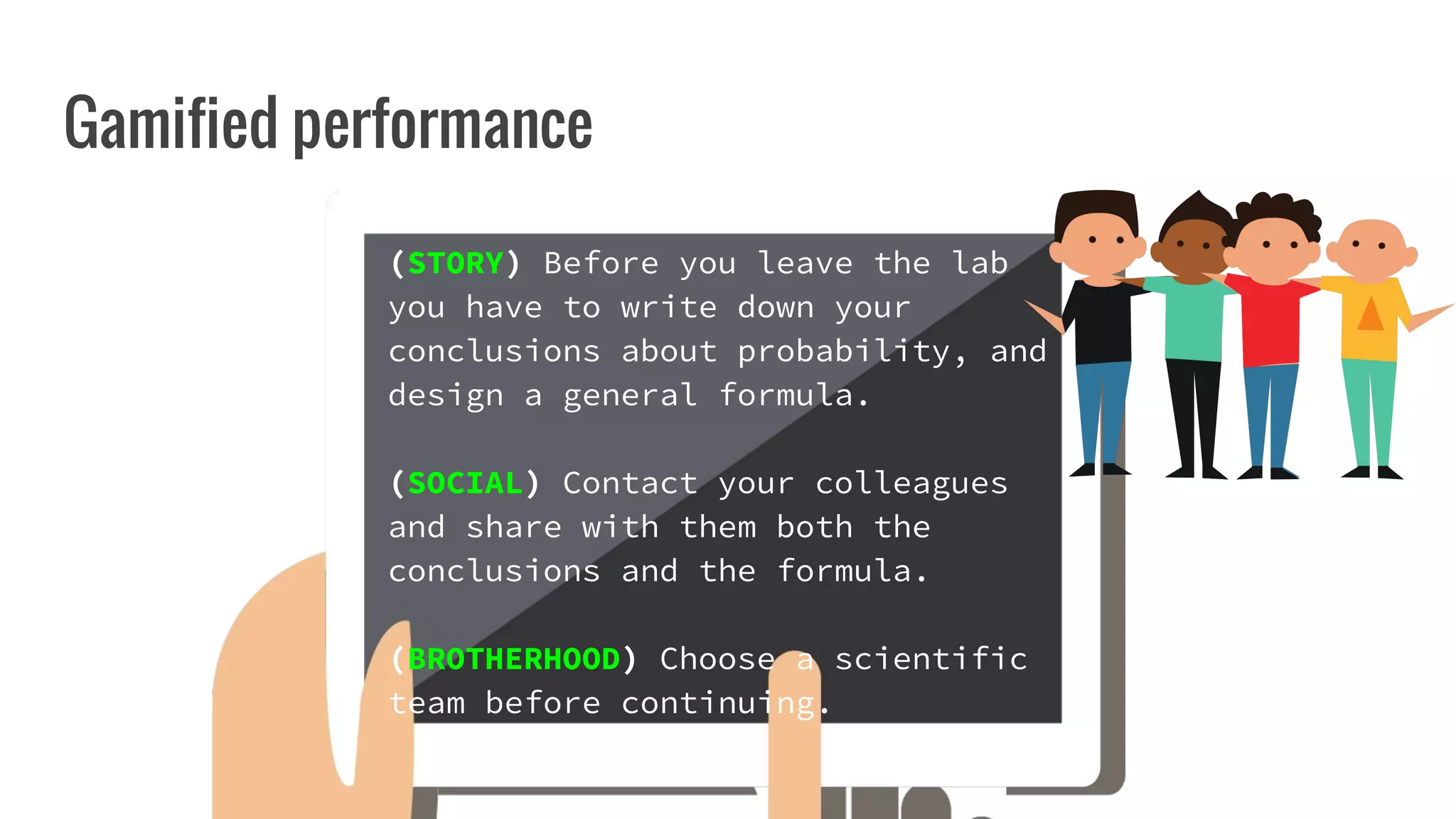
(STORY) Before you leave the lab
you have to write down your
conclusions about probability, and
design a general formula.
(SOCIAL) Contact your colleagues
and share with them both the
conclusions and the formula.
(BROTHERHOOD) Choose a scientific
team before continuing.
Gamified performance
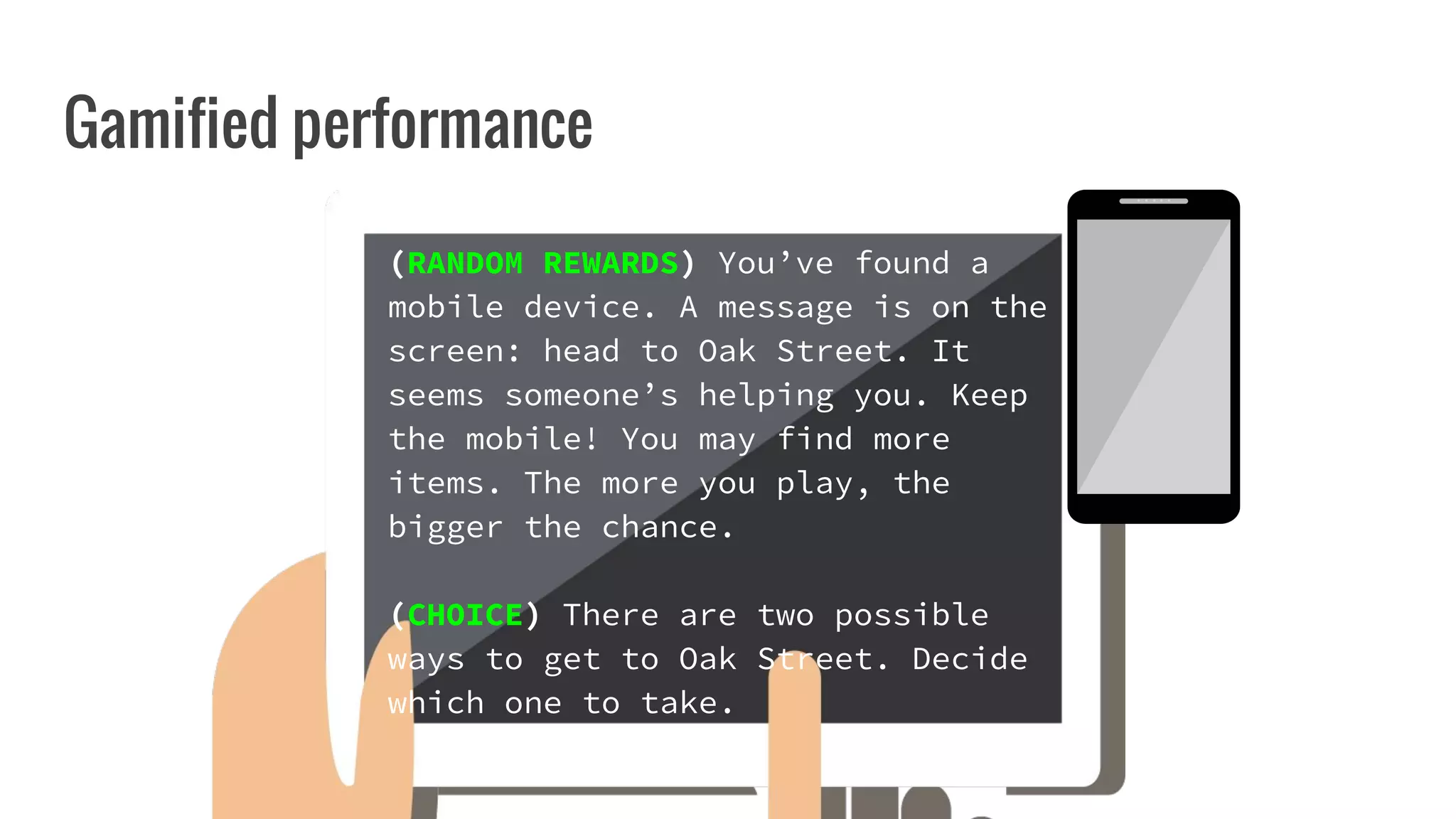
(RANDOM REWARDS) You’ve found a
mobile device. A message is on the
screen: head to Oak Street. It
seems someone’s helping you. Keep
the mobile! You may find more
items. The more you play, the
bigger the chance.
(CHOICE) There are two possible
ways to get to Oak Street. Decide
which one to take.
Gamified performance
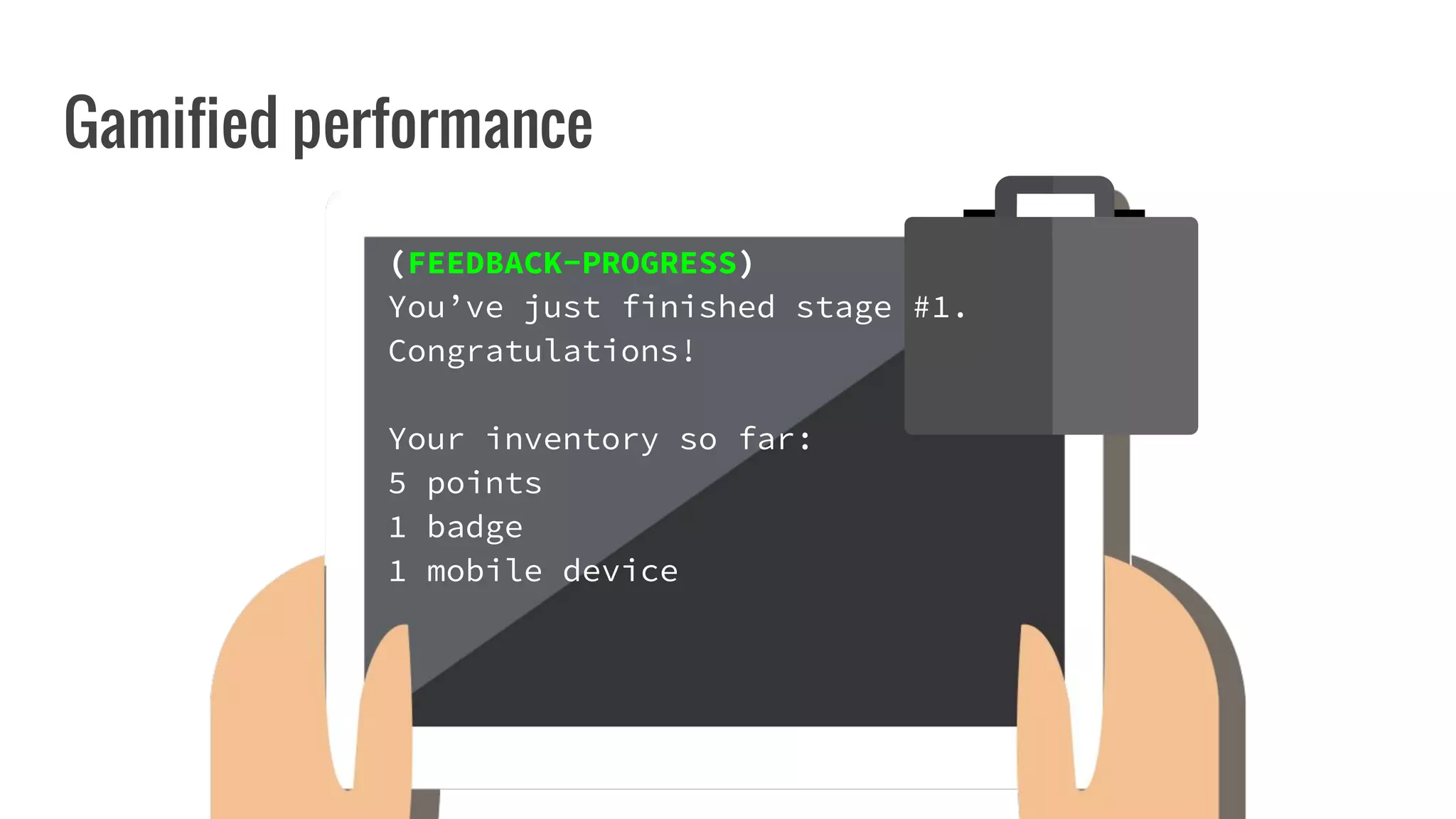
(FEEDBACK-PROGRESS)
You’ve just finished stage #1.
Congratulations!
Your inventory so far:
5 points
1 badge
1 mobile device
What about a video showing an
implementation using Moodle?
Case study: Maths, probability exam
Single scene
The Da Vinci Code book
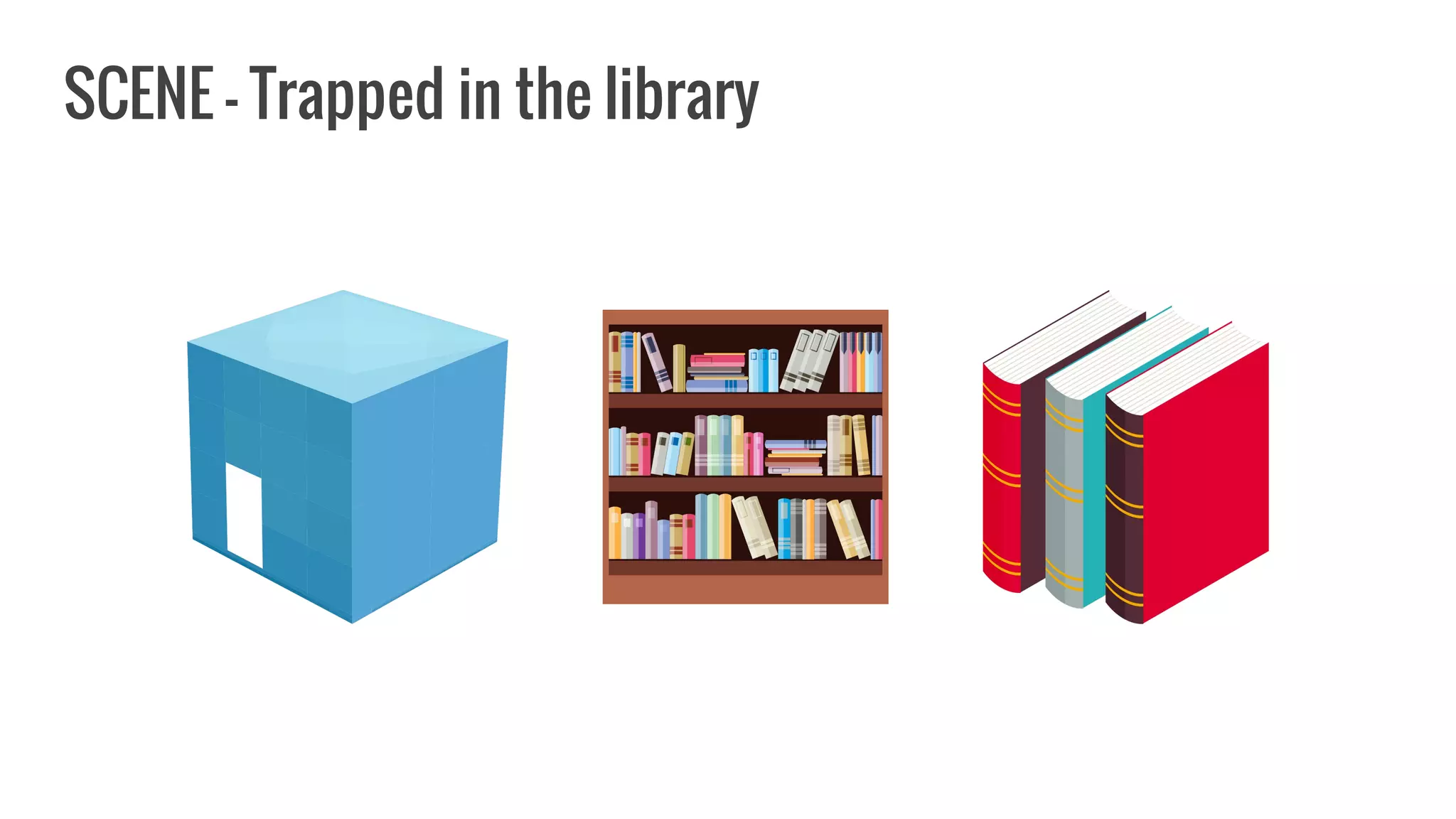
SCENE - Trapped in the library
Exam
(STORY) You’ve been trapped in a
sealed library. Your mission is:
1. Find a specific book.
2. Escape before you run out of
oxygen.
For each incorrect answer you’ll
lose oxygen.
Exam
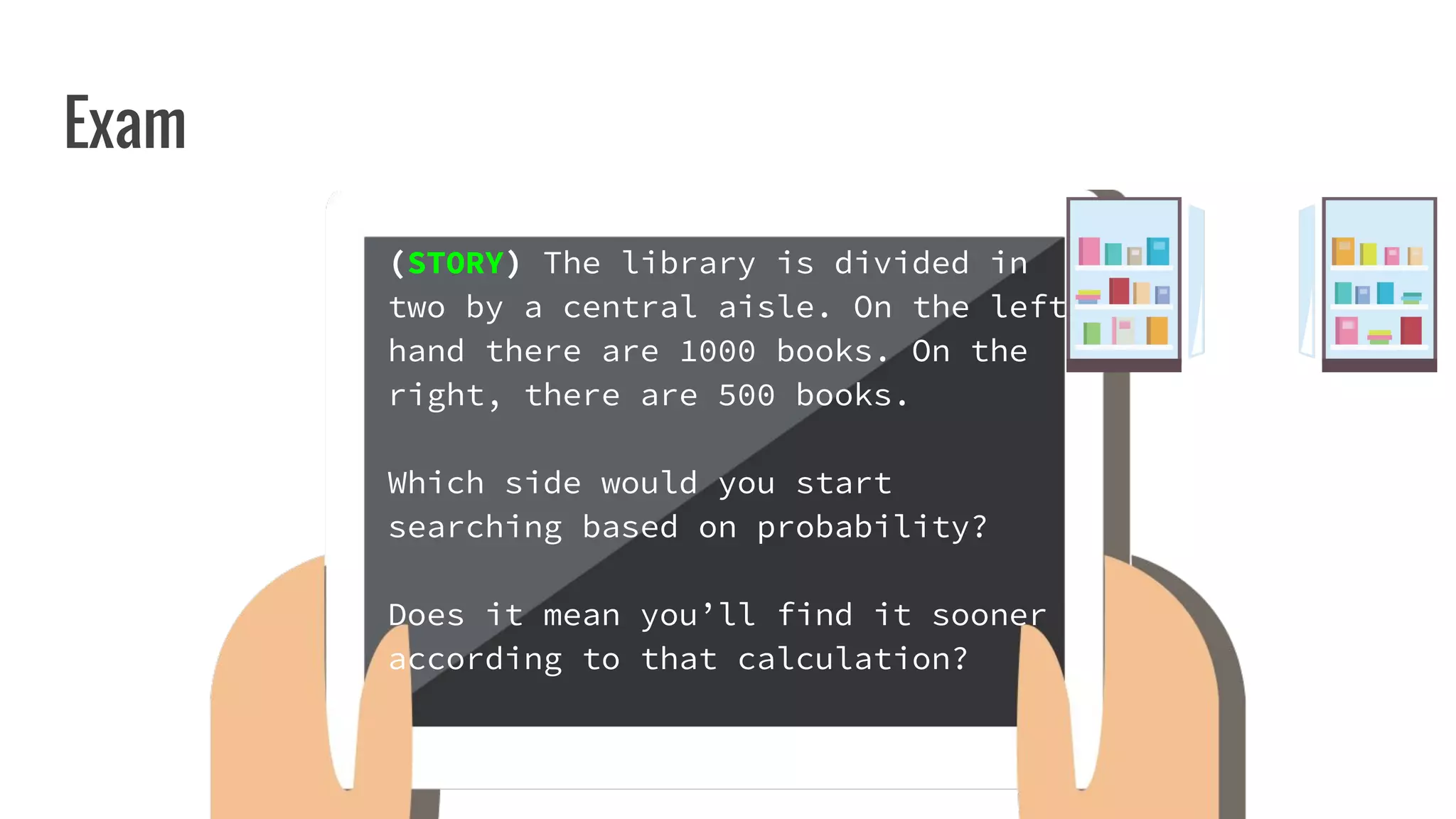
(STORY) The library is divided in
two by a central aisle. On the left
hand there are 1000 books. On the
right, there are 500 books.
Which side would you start
searching based on probability?
Does it mean you’ll find it sooner
according to that calculation?
Exam
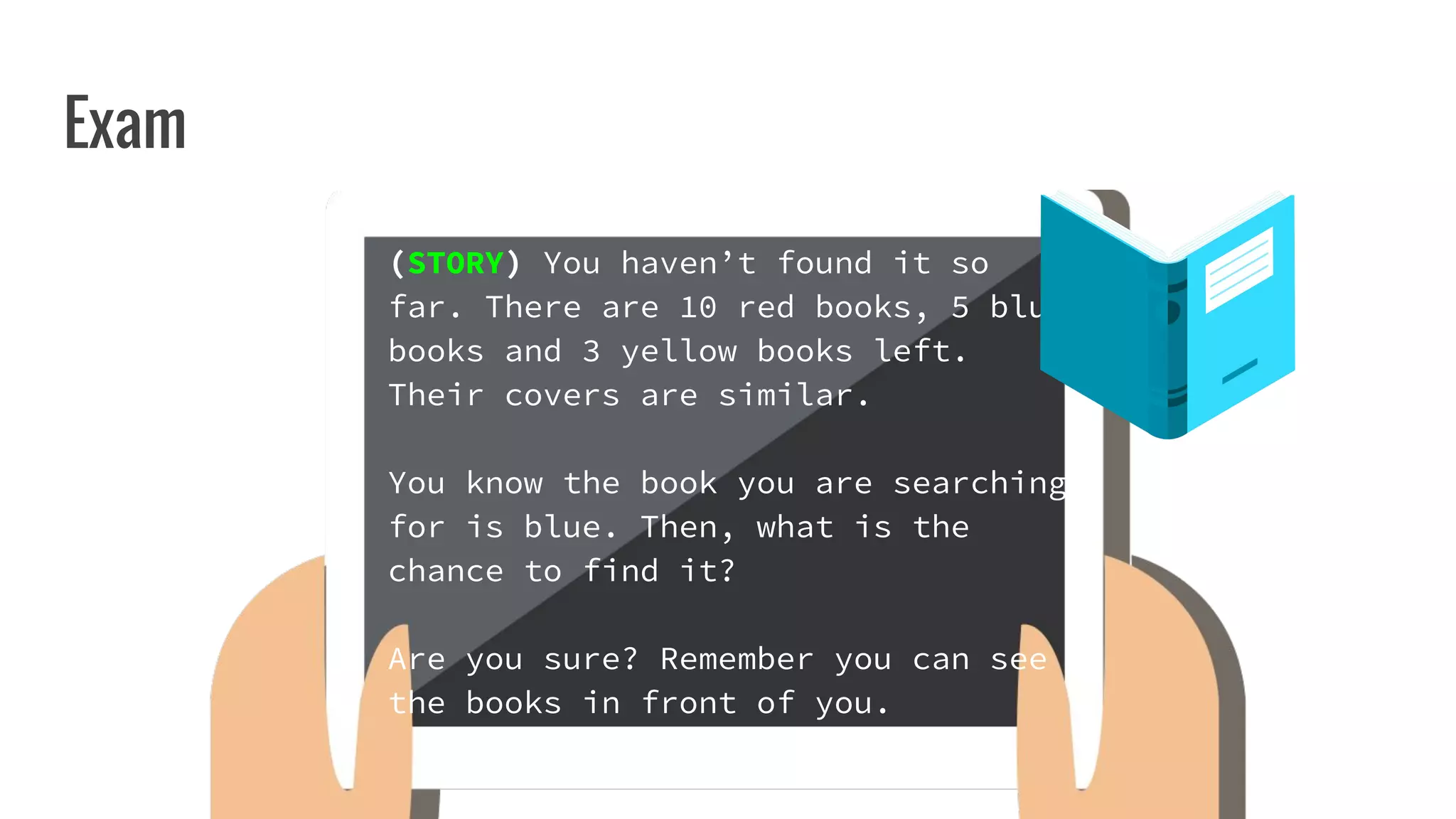
(STORY) You haven’t found it so
far. There are 10 red books, 5 blue
books and 3 yellow books left.
Their covers are similar.
You know the book you are searching
for is blue. Then, what is the
chance to find it?
Are you sure? Remember you can see
the books in front of you.
Exam
(STORY) Now you need to get out of
the library.
There are 5 buttons to open the door:
one of them is broken (but you can’t
see which one), another one opens the
door, and the rest activate the
destruction mechanism.
What’s the chance to escape? And to
die? And not to happen anything?
Exam
(STORY) Have you managed to escape?
- For each correct answer add 1
unit of oxygen.
- For each incorrect answer
subtract 0.5 units of oxygen.
You need at least 3 units to
survive. Did you make it?
We’ve finished! ...honestly!
References
References
Harvard project zero:
http://www.pz.harvard.edu/
Gamification and Moodle:
http://edtechreview.in/research/2055-guide-gamification-in-education
21st century competencies:
http://www.atc21s.org/
http://www.p21.org/our-work/p21-framework
Some blended learning tools:
https://www.symbaloo.com/home/mix/myownple
A european framework for digital literacy:
https://www.idunn.no/dk/2006/02/a_european_framework_for_digital_literacy
Images by
Thank you!
@andonisanz
andonisanz.com

Gwc15 - haidei presentation - (@andonisanz)

  • 1.
  • 2.
    About me: AndoniSanz I'm a Computer Scientist working as a STEM Teacher and an Educational Technologist. Google Certified Educator and Moodle expert. I’m actively involved in researching and writing articles about EdTech, pedagogy, gamification and coding. @andonisanz
  • 3.
    Let me tellyou a story...
  • 4.
  • 5.
    Once upon atime, in far away school galaxy there were 4 main planets Technology Pedagogy LudicCurriculum
  • 6.
    Each planet hadplenty of satellites
  • 7.
    Basic competencies Know howto do, be, learn, think, communicate, coexist. 21st century competencies Critical thinking, creativity and innovation, metacognition, communication, collaboration, information and ICT literacy, citizenship, life and career, personal and social responsibility. Plus global consciousness, entrepreneurial, civic, health. Contents Curriculum
  • 8.
    Technology Blended learning Flipped classrooms,MOOC, augmented reality, BYOD, PLE, PLN... Digital literacy Devices and software, information, digital citizenship, netiquette, intellectual property, digital portfolio... Computational thinking Decomposition, pattern recognition, algorithms, generalization...
  • 9.
    Pedagogy Harvard University’s Project Zero: 1.Visible thinking 2. Culture of thinking 3. Multiple intelligences (David Perkins, Ron Ritchhart, Howard Gardner) Neuroscience
  • 10.
  • 11.
    And when Imapped this galaxy, I found that
  • 12.
    Some of thosesatellites were common
  • 13.
    Technology Pedagogy Curriculum Ludic And I decidedto create a colony of students in the most appropriate satellite
  • 14.
    I identified 2subsystems
  • 15.
    The subsystem KNOWLEDGE, witha big satellite containing materials from the ones surrounding it PERFORMANCE OF UNDERSTANDING Knowledge Aim Method Communication ROUTINES OF THOUGHT SKILLS OF THOUGHT CURRICULUM CONTENTS BLENDED LEARNING TOOLS
  • 16.
    I scanned thesatellites one by one PERFORMANCE OF UNDERSTANDING Knowledge Aim Method Communication ROUTINES OF THOUGHT SKILLS OF THOUGHT CURRICULUM CONTENTS BLENDED LEARNING TOOLS
  • 17.
    The PERFORMANCE ofunderstanding satellite happened to be an... PERFORMANCE OF UNDERSTANDING Knowledge Aim Method Communication INTERESTING AUTHENTIC TASK USING REAL LIFE METHODOLOGIES BASED ON CASE SCENARIOS EXTENDABLE AS A PROJECT BASED LEARNING
  • 18.
    The SKILLS ofthought satellite, being basic mental processes (14), like breaking down a whole in its parts SKILLS OF THOUGHT
  • 19.
    The SKILLS ofthought satellite, being basic mental processes (14), like breaking down a whole in its parts SKILLS OF THOUGHT
  • 20.
    And the ROUTINESof thought satellite: easy steps to guide students’ thinking ROUTINES OF THOUGHT 1 2 3
  • 21.
    Thus, the PERFORMANCEsatellite was a kind of a SUPER EXERCISE PERFORMANCE EXERCISE
  • 22.
    Once finished, Iheaded to the other subsystem
  • 23.
  • 24.
    COMPETENCIES MULTIPLE INTELLIGENCE PLAYERS PERFORMANCE OF UNDER STANDING GAMIFI CATION ELEMENTS STORY AESTHETICS Scene1 Scene2 Scene3 Scene4 STORYBOARD Plenty ofelements modeling the STORY CULTURE OF THINKING EXPECTATION OPPORTUNITY TIME THOUGHT MODELING LANGUAGE ENVIRONMENT Scene5
  • 25.
    CULTURE OF THINKING EXPECTATION OPPORTUNITY TIME THOUGHT MODELING LANGUAGE ENVIRONMENT COMPETENCIESMULTIPLE INTELLIGENCE PLAYERS GAMIFI CATION ELEMENTS STORY AESTHETICS Scene1 Scene2 Scene3 Scene4 Scene5 GAMIFIED PERFORMANCE OF UNDER STANDINGSTORYBOARD PERFORMANCE OF UNDER STANDING And the PERFORMANCE satellite orbiting both subsystems
  • 26.
    The gamified performancesatellite scan revealed three layers Inner core: contents Outer core: project zero Mantle: gamification
  • 27.
    The 2-layer galaxystructure happened to be of great importance
  • 28.
    PERFORMANCE Because of it,the same performance could be transformed into multiple gamified performances, passing through different scene satellites GAMIFIED PERFORMANCE STORYBOARD SCENE
  • 29.
    Finally, my ship’ssupercomputer was able to plot the whole map
  • 30.
    >print HAIDEI_galaxy -wall >_ CT Co MI P GE S E S1 S2 S4 S3 S5 G PU5 SB PU RTC BL G PU4 ST
  • 31.
    Did you likethe metaphor? You’ll love the real examples!
  • 32.
    Case study: Mathslesson, probability (secondary school)
  • 33.
    Choose a subjectand a topic for our lesson CURRICULUM MATHS BASIC PROBABILITY DIMENSIONS Knowledge Aim >Method Communication
  • 34.
    Create a basic(classic) exercise CURRICULUM MATHS BASIC PROBABILITY BASIC PROBABILITY >Method Laplace’s formula is: # favorable outcomes p = -------------------- # possible outcomes What’s the probability of getting a head if you toss a coin? Answer: p=1/2
  • 35.
    Choose which skillsto work with MAP OF THOUGHT 1. Observe closely and describe. 2. Build explanations and interpretations. 3. Reason with evidence. 4. Create connections. 5. Take into account diverse points of view and perspectives. 6. Capture the essential and get to conclusions. 7. Question. 8. Discover the complexity and go beyond the superficial. 9. Identify patterns and make generalizations. 10. Generate possibilities and alternatives. 11. Evaluate evidences, arguments and actions. 12. Formulate plans and monitor actions. 13. Identify cognitive biases. 14. Clarify priorities, conditions and previous knowledge.
  • 36.
    Choose which routinesto work with ROUTINES OF THOUGHT 1. Exploration: a. See, think, wonder. b. Chalk talk (similar to a forum). c. … 2. Synthesis: a. Headlines. b. Color, symbol, sketch. c. … 3. Deepening: a. Step inside. b. Tug of war. c. ...
  • 37.
    Enrich the exercisewith the selected skills and routines The probability of getting a head when you toss a coin is ½ or 50%. Then, what do you think it is for a cross? Following the same reasoning, what would the probability be for getting 1 when rolling a die? And an even number? And a 7? Write your conclusions and propose a general formula. Check it with your own experiments, like those using cards. Share your work with your classmates.
  • 38.
    You may addsome more information 1. Expectatives. 2. Further instructions. 3. Information organizers. 4. Evaluation rubrics.
  • 39.
    What is aninformation organizer or visual organizer? A sheet designed to guide students in structuring their information.
  • 40.
    Provide your studentswith some complementary digital resources for their PLE
  • 41.
    Encourage them tobuild their own PLN
  • 42.
    And, finally, setup the LMS and the virtual portfolio
  • 43.
    Now let’s applygamification
  • 44.
    The story: thedawn of the zombies COMPETENCIES 1. Entrepreneurial INTELLIGENCES 1. Naturalistic
  • 45.
    The story >Add TEAMWORKcompetence >Add NATURALISTIC intelligence Your company has been researching about immortality, and by accident has released a microorganism. Now the deads are raising. As a scientist you have to go back to the lab and try to find an antidote and stop the chaos.
  • 46.
    The storyboard: chapters 1.Lab: the accident. 2. The raising. 3. Chaos in the city. 4. Back to the lab. 5. The antidote.
  • 47.
    The storyboard: scenes Chapter1: lab, the accident. Scene 1: manipulating the microorganism. You are in the lab, and you accidentally release a microorganism.
  • 49.
    Transform the enrichedexercise into a gamified performance (STORY - ONBOARDING) You have to manipulate 2 lab bottles. One of them contains an unknown microorganism, and the labels have been mysteriously removed. At least 1 must be opened. There’s a 50% chance of opening the incorrect bottle. Then, what’ s the probability of using the correct one?
  • 50.
    Gamified performance (SANDBOX) Ifyou have troubles figuring out the answer check the lab’s database for more information (documentation provided in the form of videos, infographics, documents, etc).
  • 51.
    Gamified performance (FEEDBACK -SANDBOX) Your answer needs some rethinking. Check the system’s database for more information. What a luck you just used the simulator… Try again!
  • 52.
    Gamified performance (FEEDBACK) Youranswer is correct. Congrats! (PBL) You’ve been granted 3 experience points! Now you’re in the leaderboard! Ready for the next step?
  • 53.
    Gamified performance (STORY) Yourprevious manipulation has released an unknown microorganism by accident. There’s a chance to stop it. Type a 2 digit number on the console to seal the lab! What is the probability to type the correct number?
  • 54.
    Gamified performance (FEEDBACK) Congrats!You managed to type the correct combination of digits, but the system has been previously manipulated. The microorganism has escaped!
  • 55.
    Gamified performance (PBL) Youhave earned 2 more experience points. (LEVEL UP) Wow! Your scientist knowledge has reached level 2. Take your SL2 badge. Your new level has let you escape uninfected.
  • 56.
    Gamified performance (STORY) Beforeyou leave the lab you have to write down your conclusions about probability, and design a general formula. (SOCIAL) Contact your colleagues and share with them both the conclusions and the formula. (BROTHERHOOD) Choose a scientific team before continuing.
  • 57.
    Gamified performance (RANDOM REWARDS)You’ve found a mobile device. A message is on the screen: head to Oak Street. It seems someone’s helping you. Keep the mobile! You may find more items. The more you play, the bigger the chance. (CHOICE) There are two possible ways to get to Oak Street. Decide which one to take.
  • 58.
    Gamified performance (FEEDBACK-PROGRESS) You’ve justfinished stage #1. Congratulations! Your inventory so far: 5 points 1 badge 1 mobile device
  • 59.
    What about avideo showing an implementation using Moodle?
  • 61.
    Case study: Maths,probability exam Single scene The Da Vinci Code book
  • 62.
    SCENE - Trappedin the library
  • 63.
    Exam (STORY) You’ve beentrapped in a sealed library. Your mission is: 1. Find a specific book. 2. Escape before you run out of oxygen. For each incorrect answer you’ll lose oxygen.
  • 64.
    Exam (STORY) The libraryis divided in two by a central aisle. On the left hand there are 1000 books. On the right, there are 500 books. Which side would you start searching based on probability? Does it mean you’ll find it sooner according to that calculation?
  • 65.
    Exam (STORY) You haven’tfound it so far. There are 10 red books, 5 blue books and 3 yellow books left. Their covers are similar. You know the book you are searching for is blue. Then, what is the chance to find it? Are you sure? Remember you can see the books in front of you.
  • 66.
    Exam (STORY) Now youneed to get out of the library. There are 5 buttons to open the door: one of them is broken (but you can’t see which one), another one opens the door, and the rest activate the destruction mechanism. What’s the chance to escape? And to die? And not to happen anything?
  • 67.
    Exam (STORY) Have youmanaged to escape? - For each correct answer add 1 unit of oxygen. - For each incorrect answer subtract 0.5 units of oxygen. You need at least 3 units to survive. Did you make it?
  • 68.
  • 69.
  • 70.
    References Harvard project zero: http://www.pz.harvard.edu/ Gamificationand Moodle: http://edtechreview.in/research/2055-guide-gamification-in-education 21st century competencies: http://www.atc21s.org/ http://www.p21.org/our-work/p21-framework Some blended learning tools: https://www.symbaloo.com/home/mix/myownple A european framework for digital literacy: https://www.idunn.no/dk/2006/02/a_european_framework_for_digital_literacy
  • 71.
  • 72.