Introduction:-
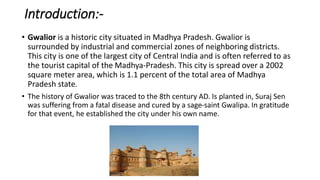
• Gwalior is a historic city situated in Madhya Pradesh. Gwalior is
surrounded by industrial and commercial zones of neighboring districts.
This city is one of the largest city of Central India and is often referred to as
the tourist capital of the Madhya-Pradesh. This city is spread over a 2002
square meter area, which is 1.1 percent of the total area of Madhya
Pradesh state.
• The history of Gwalior was traced to the 8th century AD. Is planted in, Suraj Sen
was suffering from a fatal disease and cured by a sage-saint Gwalipa. In gratitude
for that event, he established the city under his own name.
History:-
• History of Gwalior can be divided into three different ages.
• Ancient Time:-
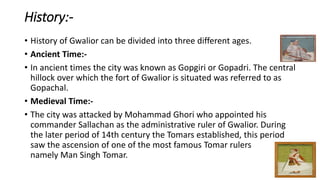
• In ancient times the city was known as Gopgiri or Gopadri. The central
hillock over which the fort of Gwalior is situated was referred to as
Gopachal.
• Medieval Time:-
• The city was attacked by Mohammad Ghori who appointed his
commander Sallachan as the administrative ruler of Gwalior. During
the later period of 14th century the Tomars established, this period
saw the ascension of one of the most famous Tomar rulers
namely Man Singh Tomar.
• Modern Time:-
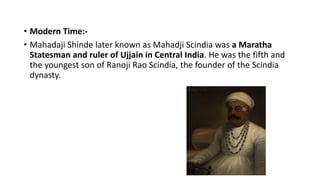
• Mahadaji Shinde later known as Mahadji Scindia was a Maratha
Statesman and ruler of Ujjain in Central India. He was the fifth and
the youngest son of Ranoji Rao Scindia, the founder of the Scindia
dynasty.
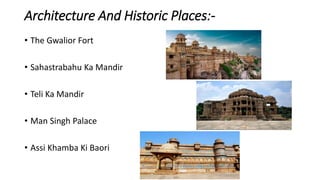
Architecture And Historic Places:-
• The Gwalior Fort
• Sahastrabahu Ka Mandir
• Teli Ka Mandir
• Man Singh Palace
• Assi Khamba Ki Baori
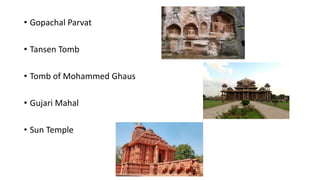
• Gopachal Parvat
• Tansen Tomb
• Tomb of Mohammed Ghaus
• Gujari Mahal
• Sun Temple
Education:-
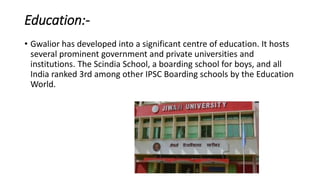
• Gwalior has developed into a significant centre of education. It hosts
several prominent government and private universities and
institutions. The Scindia School, a boarding school for boys, and all
India ranked 3rd among other IPSC Boarding schools by the Education
World.
Economy:-
• Gwalior is surrounded by three industrial areas – Sitholi, Banmore
and Malanpur. The city is scattered with coaching institutes and
educational institutions which provide employment to a large section
of city's population.
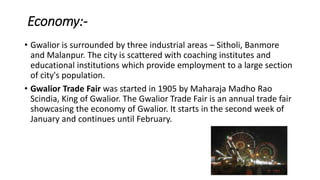
• Gwalior Trade Fair was started in 1905 by Maharaja Madho Rao
Scindia, King of Gwalior. The Gwalior Trade Fair is an annual trade fair
showcasing the economy of Gwalior. It starts in the second week of
January and continues until February.
Sports:-
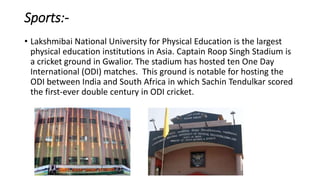
• Lakshmibai National University for Physical Education is the largest
physical education institutions in Asia. Captain Roop Singh Stadium is
a cricket ground in Gwalior. The stadium has hosted ten One Day
International (ODI) matches. This ground is notable for hosting the
ODI between India and South Africa in which Sachin Tendulkar scored
the first-ever double century in ODI cricket.
Music:-
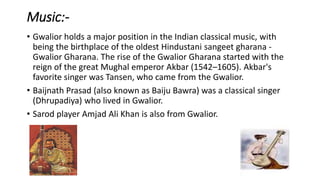
• Gwalior holds a major position in the Indian classical music, with
being the birthplace of the oldest Hindustani sangeet gharana -
Gwalior Gharana. The rise of the Gwalior Gharana started with the
reign of the great Mughal emperor Akbar (1542–1605). Akbar's
favorite singer was Tansen, who came from the Gwalior.
• Baijnath Prasad (also known as Baiju Bawra) was a classical singer
(Dhrupadiya) who lived in Gwalior.
• Sarod player Amjad Ali Khan is also from Gwalior.
Food:-
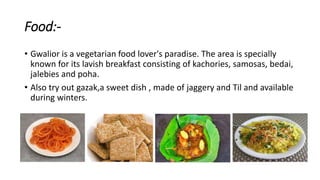
• Gwalior is a vegetarian food lover's paradise. The area is specially
known for its lavish breakfast consisting of kachories, samosas, bedai,
jalebies and poha.
• Also try out gazak,a sweet dish , made of jaggery and Til and available
during winters.
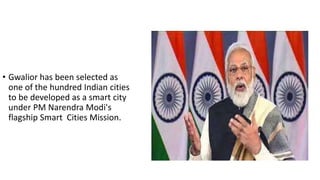
• Gwalior has been selected as
one of the hundred Indian cities
to be developed as a smart city
under PM Narendra Modi's
flagship Smart Cities Mission.
Gwalior city.pptx

Gwalior city.pptx

  • 2.
    Introduction:- • Gwalior isa historic city situated in Madhya Pradesh. Gwalior is surrounded by industrial and commercial zones of neighboring districts. This city is one of the largest city of Central India and is often referred to as the tourist capital of the Madhya-Pradesh. This city is spread over a 2002 square meter area, which is 1.1 percent of the total area of Madhya Pradesh state. • The history of Gwalior was traced to the 8th century AD. Is planted in, Suraj Sen was suffering from a fatal disease and cured by a sage-saint Gwalipa. In gratitude for that event, he established the city under his own name.
  • 3.
    History:- • History ofGwalior can be divided into three different ages. • Ancient Time:- • In ancient times the city was known as Gopgiri or Gopadri. The central hillock over which the fort of Gwalior is situated was referred to as Gopachal. • Medieval Time:- • The city was attacked by Mohammad Ghori who appointed his commander Sallachan as the administrative ruler of Gwalior. During the later period of 14th century the Tomars established, this period saw the ascension of one of the most famous Tomar rulers namely Man Singh Tomar.
  • 4.
    • Modern Time:- •Mahadaji Shinde later known as Mahadji Scindia was a Maratha Statesman and ruler of Ujjain in Central India. He was the fifth and the youngest son of Ranoji Rao Scindia, the founder of the Scindia dynasty.
  • 5.
    Architecture And HistoricPlaces:- • The Gwalior Fort • Sahastrabahu Ka Mandir • Teli Ka Mandir • Man Singh Palace • Assi Khamba Ki Baori
  • 6.
    • Gopachal Parvat •Tansen Tomb • Tomb of Mohammed Ghaus • Gujari Mahal • Sun Temple
  • 7.
    Education:- • Gwalior hasdeveloped into a significant centre of education. It hosts several prominent government and private universities and institutions. The Scindia School, a boarding school for boys, and all India ranked 3rd among other IPSC Boarding schools by the Education World.
  • 8.
    Economy:- • Gwalior issurrounded by three industrial areas – Sitholi, Banmore and Malanpur. The city is scattered with coaching institutes and educational institutions which provide employment to a large section of city's population. • Gwalior Trade Fair was started in 1905 by Maharaja Madho Rao Scindia, King of Gwalior. The Gwalior Trade Fair is an annual trade fair showcasing the economy of Gwalior. It starts in the second week of January and continues until February.
  • 9.
    Sports:- • Lakshmibai NationalUniversity for Physical Education is the largest physical education institutions in Asia. Captain Roop Singh Stadium is a cricket ground in Gwalior. The stadium has hosted ten One Day International (ODI) matches. This ground is notable for hosting the ODI between India and South Africa in which Sachin Tendulkar scored the first-ever double century in ODI cricket.
  • 10.
    Music:- • Gwalior holdsa major position in the Indian classical music, with being the birthplace of the oldest Hindustani sangeet gharana - Gwalior Gharana. The rise of the Gwalior Gharana started with the reign of the great Mughal emperor Akbar (1542–1605). Akbar's favorite singer was Tansen, who came from the Gwalior. • Baijnath Prasad (also known as Baiju Bawra) was a classical singer (Dhrupadiya) who lived in Gwalior. • Sarod player Amjad Ali Khan is also from Gwalior.
  • 11.
    Food:- • Gwalior isa vegetarian food lover's paradise. The area is specially known for its lavish breakfast consisting of kachories, samosas, bedai, jalebies and poha. • Also try out gazak,a sweet dish , made of jaggery and Til and available during winters.
  • 12.
    • Gwalior hasbeen selected as one of the hundred Indian cities to be developed as a smart city under PM Narendra Modi's flagship Smart Cities Mission.