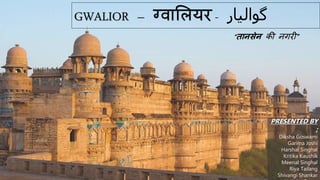
GWALIOR – ग्वालियर - ‫گوالیار‬
“तानसेन की नगरी”
PRESENTED BY
:
Diksha Goswami
Garima Joshi
Harshal Singhal
Kritika Kaushik
Meenal Singhal
Riya Tailang
Shivangi Shankar
LOCATION
Country : India
State : Madhya Pradesh
Region : Grid
District : Gwalior
Founded by : Suraj Sen
INTRODUCTION
 Gwalior is a major and the northern-most city in the Indian
state of Madhya Pradesh and one of the Counter-
magnet cities.
 Area : 604 km
2
 Elevation : 211 m (692 ft)
 Population (2017) : 2.67 Million
 Languages : Hindi, English,
Marathi, Sindhi
 Avg. summer temperature : 40.5 °C (104.9 °F)
 Avg. winter temperature : 6.6 °C (43.9 °F)
 Gwalior's history is traced back to a legend in 8th century AD.
 The cradle of great dynasties ruled the city Gwalior.
HISTORY AND ARCHITECTURE
 Gwalior has been the seat of power to many dynasties and
kingdoms, which is reflected, in its diverse architectural style.
Every religion and age has left behind its own legacy.
 There is an intermingling of construction style seen in the
monuments of Gwalior. There are Hindu temples, Jain cave
temples and also Islamic buildings in Gwalior.
• Gwalior was
originally a Hindu
kingdom.
Until 1232
• Iltutmish occupied it and
brought in Islamic rule.
1232
• Mansingh of the Tomar
family of Rajputs recaptured
it and built the
present Gwalior fort.1486
• Marathas
occupied it.
1754
• Britishers
took over.
1804
Historical timeline
 The city and its fortress have been ruled by several historic
northern Indian kingdoms.
 From the Kachchhapaghatas in the 10th century.
 Tomars in the 13th century.
 It was passed on to the Mughal Empire.
 Then to the Maratha in 1754.
 Followed by the Scindia in the 18th century.A study of urban
pollution in 2016 found the city to have the highest level of
air pollution in India, and the second highest in the world.
Kachchhapaghatas
 The dynasty patronized Shaivism and Vaishnavism, but were tolerant
towards Buddhism and Jainism. Several temples were constructed during their
reign in Kadwaha.
 The Kachchhapaghatas of Gwalior are especially noted for their art and
architecture. Kachchhapaghata ruler Mahipala commissioned the Sas-Bahu
Temple at Gwalior. Records of two grants issued by him at Gwalior, dated 1093 and
1104 CE, have been found. Several silver and gold coins issued by him have also
been discovered. Ajayapala (r. c. 1192–1194) had the Gangola tank of Gwalior
desilted, as attested by a 1194 inscription.
Sasbahu Temple,
Gwalior
Chausath Yogini Temple,
Morena
Kakanmath, Sihoniya Matha
(monastery), Kadwaha
Tomars
 The Tomaras of Gwalior (also
called Tomar in modern
vernaculars because of schwa
deletion) were a dynasty who
ruled the Gwalior Fortand its
surrounding region in central
India during 14th-16th centuries.
They are known for their
patronage to the cultural
activities in Gwalior.
Mughals
In 1231 a Muslim army invaded Gwalior and the city
remained under Muslim domination until the next
century. In 1375, it fell to Raja Veer Singh and the
Tomar dynasty. This was Gwalior’s golden age. In
1516 the city was conquered again, this time by the
Delhi Sultanate under the Lodi dynasty.
Maratha
 The term "Maratha" originally referred to the speakers of the Marathi language. In the
17th century, it emerged as a designation for peasants from Deccan who served as
soldiers in the armies of Muslim rulers and later in the armies of Shivaji Maharaj. Thus the
term 'Maratha' became a marker of an endogamous caste.
Scindia
Scindia (anglicized from Shinde and also
spelled as Scindhia, Sindhia, Sindia) is
a Hindu Maratha dynasty that ruled
the Gwalior State.[1] The Gwalior state was a
part of the Maratha Confederacy in the 18th
and 19th centuries, and a princely state of
the colonial British government during the
19th and the 20th centuries. After India's
independence in 1947, the members of the
Scindia family became politicians.
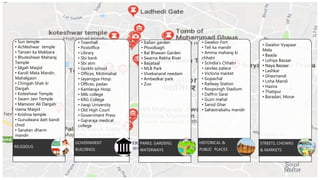
RELIGIOUS
GOVERNMENT
BUILDINGS
PARKS, GARDENS,
WATERWAYS
HISTORICAL &
PUBLIC PLACES
STREETS, CHOWKS
& MARKETS
• Sun temple
• Achleshwar temple
• Tansen ka Makbara
• Bhuteshwar Maharaj
Temple
• Idgah Masjid
• Karoli Mata Mandir,
Mahalgaon
• Chingah Shah ki
Dargah
• Koteshwar Temple
• Swarn Jain Temple
• Mansoor Ali Dargah
•Jama Masjid
• Krishna temple
• Gurudwara datt bandi
chod
• Sanatan dharm
mandir
• Gwalior Vyapaar
Mela
• Baada
• Lohiya Bazaar
• Naya Bazaar
• Lashkar
• Ghasmandi
• Loha Mandi
• Hazira
• Thatipur
• Baradari, Morar
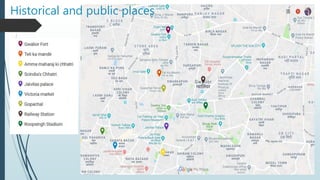
• Gwalior Fort
• Teli ka mandir
• Amma maharaj ki
chhatri
• Scindia’s Chhatri
• Jaivilas palace
• Victoria market
• Gopachal
• Railway Station
• Roopsingh Stadium
• Daffrin Sarai
• Guzri mahal
• Sarod Ghar
• Sahastrabahu mandir
• Townhall
• Postoffice
• Library
• Sbi bank
• Sbi atm
• Gorkhi school
• Offices, Motimahal
• Jayarogya Hosp.
• Offices, padav
• Kamlaraja Hosp.
• Mlb college
• KRG College
• Jiwaji University
• Old High Court
• Government Press
• Gajraraja medical
college
• Italian garden
• Phoolbagh
• Bal Bhawan Garden
• Swarna Rekha River
• Baijataal
• MLB Park
• Vivekanand needam
• Ambedkar park
• Zoo
Religious heritage map
Government buildings
Parks , gardens
Historical and public places
Streets , chowks and markets
SONREKHA RIVER
MORAR RIVER
GWALIOR FORT
"the Gibraltar of India"
• Gwalior Fort, situated on top of a hill, finds its place among the best
fortress in India and spreads out over an area of 3 square km,
surrounded by concrete walls of sandstone.
• Man Singh built a palace in blue, green and yellow colored stones for his
wife. He decorated it with many geometric patterns. Today, the palace is
an archeological museum, which contains ancient rare artefacts of 1st
century BC, terracotta items, king’s possessions and much more.
• The fort includes several water tanks that can feed 1500 garrisons, 3
major temples, 6 palaces, monuments and others. These monuments
are built at different time by different emperors.
• The fort combines many different architectural styles including the
Dravidian style along with the Hindu, Buddhist and Jain architecture.
• Apart from the Man Mandir and Gujari Mahal, constructions in the
Gwalior Fort notable for their sculpted work and architecture include Teli
ka Mandir, The Elephant Gate (Hathi Pol gate), the Saas-bahu temple,
Karn Mahal and Vikram Mahal.
3 CE
Suraj Sen
1022 CE
Mahmud of
Ghazni
1232 CE
Iltumish
1398
Maan Singh
1558
Akbar
1780-1884
Frequent changes
in control of fort
b/w Scindias &
Britishers
1886-
1947
Scindias
ruled until
Indepnden
e
T
I
M
E
L
I
N
E• Geographical importance of
Gwalior Fort is that the main city
of the reign lies on the foothills
of the fort. Thus, the fort makes a
good watching tower for the
city.
• Gwalior fort is site of
mathematical interest because
here a 9th century Hindu temple
records the oldest “0” in India.
ASSI KHAMBA KI BAORI
This ancient monument lies right in front of the Man Singh Palace.
It is a step-well with 80 pillars all around and is therefore called
Assi Khamba Ki Baori. The monument has different chambers
which were constructed for the queens to take baths.
The pristine architecture and design of the Baori captures
great attention from archaeologists and historians who
come to visit the Gwalior Fort. So make sure this place is
there on your list too.
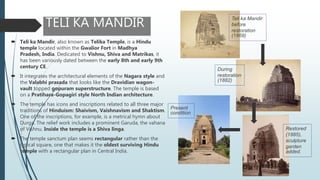
TELI KA MANDIR
 Teli ka Mandir, also known as Telika Temple, is a Hindu
temple located within the Gwalior Fort in Madhya
Pradesh, India. Dedicated to Vishnu, Shiva and Matrikas, it
has been variously dated between the early 8th and early 9th
century CE.
 It integrates the architectural elements of the Nagara style and
the Valabhi prasada that looks like the Dravidian wagon-
vault topped gopuram superstructure. The temple is based
on a Pratihara-Gopagiri style North Indian architecture.
 The temple has icons and inscriptions related to all three major
traditions of Hinduism: Shaivism, Vaishnavism and Shaktism.
One of the inscriptions, for example, is a metrical hymn about
Durga. The relief work includes a prominent Garuda, the vahana
of Vishnu. Inside the temple is a Shiva linga.
 The temple sanctum plan seems rectangular rather than the
typical square, one that makes it the oldest surviving Hindu
temple with a rectangular plan in Central India.
Teli ka Mandir
before
restoration
(1869)
During
restoration
(1882)
Present
condition
Restored
(1885),
sculpture
garden
added.
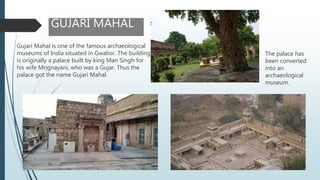
GUJARI MAHAL
Gujari Mahal is one of the famous archaeological
museums of India situated in Gwalior. The building
is originally a palace built by king Man Singh for
his wife Mrignayani, who was a Gujar. Thus the
palace got the name Gujari Mahal.
The palace has
been converted
into an
archaeological
museum.
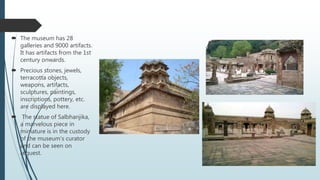
 The museum has 28
galleries and 9000 artifacts.
It has artifacts from the 1st
century onwards.
 Precious stones, jewels,
terracotta objects,
weapons, artifacts,
sculptures, paintings,
inscriptions, pottery, etc.
are displayed here.
 The statue of Salbhanjika,
a marvelous piece in
miniature is in the custody
of the museum’s curator
and can be seen on
request.
SAHASTRA BAHU MANDIR
• This temple was constructed in 1092 by King Mahipala of the Kachchhwaha
dynasty. The temple is 32 meters long and 22 meters wide and has three
gateways facing three different directions and there is a room (presently
locked) in the forth direction. This magnificent temple welcomes all with its
explicitly carved idols of Lord Brahma, Vishnu and Shiva at the doorway.
• The temple derives its name from the word “Sahastrabahu” which portrays a
man with a thousand hands, i.e., Lord Vishnu. As per the legends, the wife of
the king of Kachchhwaha dynasty was a devotee of Lord Vishnu while her
daughter-in-law worshipped Lord Shiva. Thus, eventually two temples were
built, one after the another. These adjacent temples are known as the Sas
Bahu temple.
• Both the temples are similar in architecture, with the beautiful lotus carving on
the roof of the larger temple.
• According to the history a prince named Suraj sen of
Kachhwaha clan of 8th century, lost his way while
pacing in the jungle for hunting.
• After some time of wandering he reached an isolated
hill. While roaming around he got tired and thirsty .
• He found a sage and asked him for some water . The
sage led to the pond . After drinking water from the
pond , not only his thirst was fulfilled but hid disease
named leaposy was cured . He asked the sage to do
something for him in return . The sage told to fortify
the hill . The hill was secured and was named Gwalior .
• It is believed to have magical powers. Water from the
tank act as a medicinal water that assumed to cure
chronic diseases. Noticable thing of the Suraj kund is
the sunset and sunrise. The historical significance of
suraj kund attract large number of tourist. The place is
full of peace.
SURAJ KUND
GURUDWARA SHRI DATA BANDI CHHOD
It is situated on the hill top in the Fort Gwalior. SHRI GURU HARGOBIND SAHIB JI started raising the army of Sant
Soldiers to fight against the cruelty.
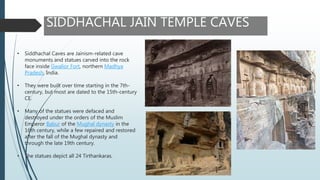
SIDDHACHAL JAIN TEMPLE CAVES
• Siddhachal Caves are Jainism-related cave
monuments and statues carved into the rock
face inside Gwalior Fort, northern Madhya
Pradesh, India.
• They were built over time starting in the 7th-
century, but most are dated to the 15th-century
CE.
• Many of the statues were defaced and
destroyed under the orders of the Muslim
Emperor Babur of the Mughal dynasty in the
16th century, while a few repaired and restored
after the fall of the Mughal dynasty and
through the late 19th century.
• The statues depict all 24 Tirthankaras.
TOMB OF MUHAMMAD GHAUS AND
TANSEN
 It is built in the form of a square with hexagonal tower. At its corners
surmounted by small domes . The body of the building is enclosed on
all sides by carved stone lattices elaborate and delicate design. The
whole being crowned by a large dome sheikh Mohammad Ghaus was
a well known Muslim saint in 16th century AD.
 The Memorial of Tansen, also known as the ‘Tomb of Tansen’, is
located in the vicinity of the tomb of Muhammad Ghaus.
• Tomb of Tansen is built on a rectangular elevated platform with a pillared
gallery in the center of which lies the tomb. It is a small structure, 22 feet
square. It is supported on 12 pillars, 4 pillars in center surrounding the
sarcophagus.
 The monument is made in the traditional Mughal
architecture with the domes and the fantastic lattice
work on the windows. It is made of sandstone. It is a
perfect place especially for people who love serenity
and look for peace.
 The surrounding gardens are laid out in the form of
Mughal gardens; divided in 4 squares by two
crossing paths having a small water body at the
junction.
 Apart from being a beautiful monument, the tomb also
serves as a part of the living cultural heritage of
Gwalior.
 A national level music festival is organized every
year during the months of November and December
at the tomb.
SUN TEMPLE
 Located in Morar Cantonment,
the Sun Temple "Vivsvaan
mandir" is dedicated to the
sun god Surya.
 Designed as a facsimile of the
Sun temple of Konark in
Odisha, the temple was
sponsored and built in the
1980s by the Birla family.
 There are total 365 idols of
Gods around the temple for
365 days in a year. The
enchanting exterior of the
temple is crafted out of red
sand stone while the interior
adorns pearly white marble
adding charm to its beauty.
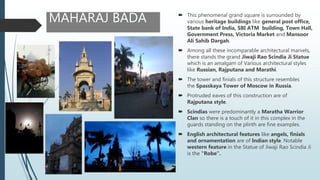
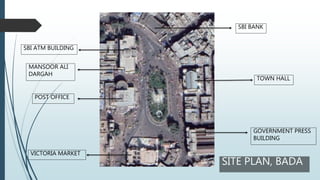
MAHARAJ BADA  This phenomenal grand square is surrounded by
various heritage buildings like general post office,
State bank of India, SBI ATM building, Town Hall,
Government Press, Victoria Market and Mansoor
Ali Sahib Dargah.
 Among all these incomparable architectural marvels,
there stands the grand Jiwaji Rao Scindia Ji Statue
which is an amalgam of Various architectural styles
like Russian, Rajputana and Marathi.
 The tower and finials of this structure resembles
the Spasskaya Tower of Moscow in Russia.
 Protruded eaves of this construction are of
Rajputana style.
 Scindias were predominantly a Maratha Warrior
Clan so there is a touch of it in this complex in the
guards standing on the plinth are fine examples.
 English architectural features like angels, finials
and ornamentation are of Indian style. Notable
western feature in the Statue of Jiwaji Rao Scindia Ji
is the "Robe“.
SBI ATM BUILDING
MANSOOR ALI
DARGAH
POST OFFICE
VICTORIA MARKET
TOWN HALL
SBI BANK
GOVERNMENT PRESS
BUILDING
SITE PLAN, BADA
THE WHITE & RED GENERAL POST OFFICE-
The long steps leading to its entrance are followed by tall
pillars on which rested is the triangular architrave, an
important feature of Greek architecture. General post office
projects the fundamental aspect of Greek architecture –
post and lintel system.
STATE BANK OF INDIA-
with enormous triumphal arches, a unique feature of British
architecture. Two massive piers are connected by an arch. The
Arch is extended by a flat entablature a super structure above
columns resting on capitals. This type of architectural buildings
bear ornamentation and commemorative inscriptions but to
one’s surprise, the State Bank of India building in plain with no
such work. Lotus flowers on either side of the triumphal arch are
the chief constituents of Indian Architecture.
TOWN HALL
On the east of this majestic Square, Jiwaji Chowk is the
structure with French work consisting of pointed arches,
finials, ribbed vaults and flying buttresses all of which
adorn this Gothic architecture marvel once an Opera
house is now popularly known as Town hall. This
building of Bada is rich in Corinthian capitals and
Luxurious foliage of Corinthian designs too.
SBI ATM BUILDING-
An edifice with roman Tuscans. Giant pillars are
employed in making this picturesque building.
These columns are known as architectural orders of
ancient classical architecture distinguished by its
proportions, forms one of the most solid structures
and least ornamentedted among all other pillars.
The literature also hints that this architectural form
is the older primitive Italic form which precedes
Greek Doric and Ionic styles.
VICTORIA MARKET-
The abandoned Victoria market,
half of which collapsed in a fire
accident is under renovation by
INTACH, ASI and Madhya
Pradesh Government is a best
imitation of Indo-Saracenic
architecture with a clock tower, a
feature of English architecture,
Indian Gateways, Brackets,
ornate structures, columned
domes and parapet slabs.
GOVERNMENT PRESS BUILDING-
On the left hand side of the Town Hall
is the Government press which
exhibits the flagship qualities of
Mughal Architecture which is a
combination of Islamic, Persian and
Indian architectural styles. The
Government press building has a
uniform pattern of structure and
character with large bulbous domes
and small minarets at the corners
above the roof. This style usually has
gateways with a compartment at the
entrance with an arch.
MANSOOR ALI SAHIB
DARGAH-
Beside Gorkhi gate is an high
example of Rajput
Architecture with fine
balconies, lattice work,
Triangular shaped friezes,
towers with cupolas,
elongated Domes, fancy
octagonal bay windows,
domed Canopies, fluted
pillars, lotus and floral
patterns and Jharokhas.
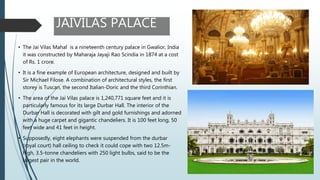
JAIVILAS PALACE
• The Jai Vilas Mahal is a nineteenth century palace in Gwalior, India
it was constructed by Maharaja Jayaji Rao Scindia in 1874 at a cost
of Rs. 1 crore.
• It is a fine example of European architecture, designed and built by
Sir Michael Filose. A combination of architectural styles, the first
storey is Tuscan, the second Italian-Doric and the third Corinthian.
• The area of the Jai Vilas palace is 1,240,771 square feet and it is
particularly famous for its large Durbar Hall. The interior of the
Durbar Hall is decorated with gilt and gold furnishings and adorned
with a huge carpet and gigantic chandeliers. It is 100 feet long, 50
feet wide and 41 feet in height.
• Supposedly, eight elephants were suspended from the durbar
(royal court) hall ceiling to check it could cope with two 12.5m-
high, 3.5-tonne chandeliers with 250 light bulbs, said to be the
largest pair in the world.
PRESENT STATUS
 A wing of Jaivilas Palace was converted into a museum in memory of
Srimant Jiwajirao Scindia by the late Rajmata Shrimant Vijayaraje Scindia.
Then president of India H.E. Dr. Sarvapally Radhakrishnan opened the HH
Maharaja Sir Jiwajirao Scindia Museum to the public on December 12th,
1964.
 Museum offers to the public a unique view of the palace created in the
19th and 20th century and focuses on various arts and crafts that grew
and reached their zenith under the patronage of the royal family.
Museum aims to provide a viable space for the expansion of knowledge
through research and sharing.
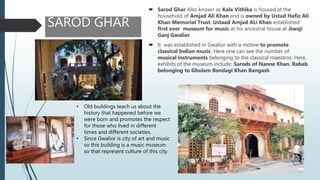
SAROD GHAR
 Sarod Ghar Also known as Kala Vithika is housed at the
household of Amjad Ali Khan and is owned by Ustad Hafiz Ali
Khan Memorial Trust. Ustaad Amjad ALi Khan established
first ever museum for music at his ancestral house at Jiwaji
Ganj Gwalior.
 It was established in Gwalior with a motive to promote
classical Indian music. Here one can see the number of
musical instruments belonging to the classical maestros. Here,
exhibits of the museum include: Sarods of Nanne Khan, Rabab
belonging to Ghulam Bandagi Khan Bangash.
• Old buildings teach us about the
history that happened before we
were born and promotes the respect
for those who lived in different
times and different societies.
• Since Gwalior is city of art and music
so this building is a music museum
so that represent culture of this city.
OLD HIGH COURT
 The high court building built in the middle of the city is
extremely important in terms of architecture. Built in the
tenure of Madhavrao Scindia I, the building is
composed of British and Indian styles. The
confirmation of which is also made by the British State
Crest logo by its main entrance.
 the building was built as a school building. A boarding
arrangement was also made for the students to stay. But
when the country was liberated, it turned into a high
court. Madhya Pradesh High Court was located in
Jabalpur and its bench was established in Gwalior and
Indore.
 This building is three stories high, in which large halls
remain. The entire building is made of stone found in
the city.
WHY TO CONSERVE?
• This building shows the great architecture that is indo
British architecture.
• This building is situated in the middle of the city so this
is a attraction point of the city.
• The detailing of the building is very precious for city's
cultural and historical value.
• Maharani Laxmi Bai Govt. College Of Excellence, Gwalior is one of the
most well-known educational institutions in Northern India.
• The glorious history of the college marks its various stages of
and spread of higher education in Northern India. The rulers of erstwhile
Scindia state established this college in 1846 as “Lashkar Madarsa”.
• The college was given a new name in the year 1887 i.e. Victoria College.
The sole objective behind this was to celebrate Queen Victoria’s Golden
Jubilee.
• Now it is known as the Maharani Laxmi Bai College Of Art And
Commerce.
 REASON OF CONSERVATION
• With its high clock tower and stone chhatris an chhajas, it is clear example
of so called Indo-Saracenic style which was favoured by british architects
India for colleges and universities.
MLB COLLEGE
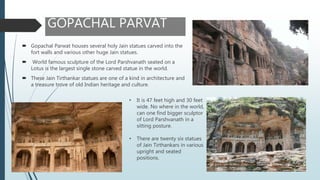
GOPACHAL PARVAT
 Gopachal Parwat houses several holy Jain statues carved into the
fort walls and various other huge Jain statues.
 World famous sculpture of the Lord Parshvanath seated on a
Lotus is the largest single stone carved statue in the world.
 These Jain Tirthankar statues are one of a kind in architecture and
a treasure trove of old Indian heritage and culture.
• It is 47 feet high and 30 feet
wide. No where in the world,
can one find bigger sculptor
of Lord Parshvanath in a
sitting posture.
• There are twenty six statues
of Jain Tirthankars in various
upright and seated
positions.
EK PATHAR KI BAORI
Gopachal Parwat consists 26 caves in which Ek pathar ki baori is in the first
cave and other caves have jain sculptures carved with stone.
REASON OF CONSERVATION
 Ek pathar ki Baori is in the first cave, a water reservoir carved out of a single
stone.
AMMA MAHARAJ KI CHHATRI
 Amma Maharaj Ki Chhatri is very
close to the famous Jai Vilas
Palace.
 Chhatri means a place where
dead body is buried.
 Is a popular cenotaph of Late
Madhav Rao Scindia.
 This cenotaph is surrounded by
beautiful and lush green
environment.
 The funeral of the late maharaja
was conducted at Amma
Maharaj Ki Chhatri .
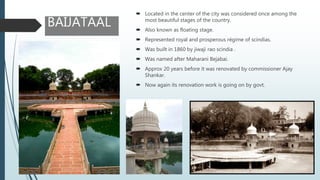
 Located in the center of the city was considered once among the
most beautiful stages of the country.
 Also known as floating stage.
 Represented royal and prosperous régime of scindias.
 Was built in 1860 by jiwaji rao scindia .
 Was named after Maharani Bejabai.
 Approx 20 years before it was renovated by commissioner Ajay
Shankar.
 Now again its renovation work is going on by govt.
BAIJATAAL
THANKYOU

Gwalior, Madhya Pradesh

  • 1.
    GWALIOR – ग्वालियर- ‫گوالیار‬ “तानसेन की नगरी” PRESENTED BY : Diksha Goswami Garima Joshi Harshal Singhal Kritika Kaushik Meenal Singhal Riya Tailang Shivangi Shankar
  • 2.
    LOCATION Country : India State: Madhya Pradesh Region : Grid District : Gwalior Founded by : Suraj Sen
  • 3.
    INTRODUCTION  Gwalior isa major and the northern-most city in the Indian state of Madhya Pradesh and one of the Counter- magnet cities.  Area : 604 km 2  Elevation : 211 m (692 ft)  Population (2017) : 2.67 Million  Languages : Hindi, English, Marathi, Sindhi  Avg. summer temperature : 40.5 °C (104.9 °F)  Avg. winter temperature : 6.6 °C (43.9 °F)  Gwalior's history is traced back to a legend in 8th century AD.  The cradle of great dynasties ruled the city Gwalior.
  • 4.
    HISTORY AND ARCHITECTURE Gwalior has been the seat of power to many dynasties and kingdoms, which is reflected, in its diverse architectural style. Every religion and age has left behind its own legacy.  There is an intermingling of construction style seen in the monuments of Gwalior. There are Hindu temples, Jain cave temples and also Islamic buildings in Gwalior. • Gwalior was originally a Hindu kingdom. Until 1232 • Iltutmish occupied it and brought in Islamic rule. 1232 • Mansingh of the Tomar family of Rajputs recaptured it and built the present Gwalior fort.1486 • Marathas occupied it. 1754 • Britishers took over. 1804
  • 5.
    Historical timeline  Thecity and its fortress have been ruled by several historic northern Indian kingdoms.  From the Kachchhapaghatas in the 10th century.  Tomars in the 13th century.  It was passed on to the Mughal Empire.  Then to the Maratha in 1754.  Followed by the Scindia in the 18th century.A study of urban pollution in 2016 found the city to have the highest level of air pollution in India, and the second highest in the world.
  • 6.
    Kachchhapaghatas  The dynastypatronized Shaivism and Vaishnavism, but were tolerant towards Buddhism and Jainism. Several temples were constructed during their reign in Kadwaha.  The Kachchhapaghatas of Gwalior are especially noted for their art and architecture. Kachchhapaghata ruler Mahipala commissioned the Sas-Bahu Temple at Gwalior. Records of two grants issued by him at Gwalior, dated 1093 and 1104 CE, have been found. Several silver and gold coins issued by him have also been discovered. Ajayapala (r. c. 1192–1194) had the Gangola tank of Gwalior desilted, as attested by a 1194 inscription. Sasbahu Temple, Gwalior Chausath Yogini Temple, Morena Kakanmath, Sihoniya Matha (monastery), Kadwaha
  • 7.
    Tomars  The Tomarasof Gwalior (also called Tomar in modern vernaculars because of schwa deletion) were a dynasty who ruled the Gwalior Fortand its surrounding region in central India during 14th-16th centuries. They are known for their patronage to the cultural activities in Gwalior. Mughals In 1231 a Muslim army invaded Gwalior and the city remained under Muslim domination until the next century. In 1375, it fell to Raja Veer Singh and the Tomar dynasty. This was Gwalior’s golden age. In 1516 the city was conquered again, this time by the Delhi Sultanate under the Lodi dynasty.
  • 8.
    Maratha  The term"Maratha" originally referred to the speakers of the Marathi language. In the 17th century, it emerged as a designation for peasants from Deccan who served as soldiers in the armies of Muslim rulers and later in the armies of Shivaji Maharaj. Thus the term 'Maratha' became a marker of an endogamous caste. Scindia Scindia (anglicized from Shinde and also spelled as Scindhia, Sindhia, Sindia) is a Hindu Maratha dynasty that ruled the Gwalior State.[1] The Gwalior state was a part of the Maratha Confederacy in the 18th and 19th centuries, and a princely state of the colonial British government during the 19th and the 20th centuries. After India's independence in 1947, the members of the Scindia family became politicians.
  • 9.
    RELIGIOUS GOVERNMENT BUILDINGS PARKS, GARDENS, WATERWAYS HISTORICAL & PUBLICPLACES STREETS, CHOWKS & MARKETS • Sun temple • Achleshwar temple • Tansen ka Makbara • Bhuteshwar Maharaj Temple • Idgah Masjid • Karoli Mata Mandir, Mahalgaon • Chingah Shah ki Dargah • Koteshwar Temple • Swarn Jain Temple • Mansoor Ali Dargah •Jama Masjid • Krishna temple • Gurudwara datt bandi chod • Sanatan dharm mandir • Gwalior Vyapaar Mela • Baada • Lohiya Bazaar • Naya Bazaar • Lashkar • Ghasmandi • Loha Mandi • Hazira • Thatipur • Baradari, Morar • Gwalior Fort • Teli ka mandir • Amma maharaj ki chhatri • Scindia’s Chhatri • Jaivilas palace • Victoria market • Gopachal • Railway Station • Roopsingh Stadium • Daffrin Sarai • Guzri mahal • Sarod Ghar • Sahastrabahu mandir • Townhall • Postoffice • Library • Sbi bank • Sbi atm • Gorkhi school • Offices, Motimahal • Jayarogya Hosp. • Offices, padav • Kamlaraja Hosp. • Mlb college • KRG College • Jiwaji University • Old High Court • Government Press • Gajraraja medical college • Italian garden • Phoolbagh • Bal Bhawan Garden • Swarna Rekha River • Baijataal • MLB Park • Vivekanand needam • Ambedkar park • Zoo
  • 10.
  • 11.
  • 12.
  • 13.
  • 14.
    Streets , chowksand markets
  • 15.
  • 16.
    GWALIOR FORT "the Gibraltarof India" • Gwalior Fort, situated on top of a hill, finds its place among the best fortress in India and spreads out over an area of 3 square km, surrounded by concrete walls of sandstone. • Man Singh built a palace in blue, green and yellow colored stones for his wife. He decorated it with many geometric patterns. Today, the palace is an archeological museum, which contains ancient rare artefacts of 1st century BC, terracotta items, king’s possessions and much more. • The fort includes several water tanks that can feed 1500 garrisons, 3 major temples, 6 palaces, monuments and others. These monuments are built at different time by different emperors. • The fort combines many different architectural styles including the Dravidian style along with the Hindu, Buddhist and Jain architecture. • Apart from the Man Mandir and Gujari Mahal, constructions in the Gwalior Fort notable for their sculpted work and architecture include Teli ka Mandir, The Elephant Gate (Hathi Pol gate), the Saas-bahu temple, Karn Mahal and Vikram Mahal.
  • 17.
    3 CE Suraj Sen 1022CE Mahmud of Ghazni 1232 CE Iltumish 1398 Maan Singh 1558 Akbar 1780-1884 Frequent changes in control of fort b/w Scindias & Britishers 1886- 1947 Scindias ruled until Indepnden e T I M E L I N E• Geographical importance of Gwalior Fort is that the main city of the reign lies on the foothills of the fort. Thus, the fort makes a good watching tower for the city. • Gwalior fort is site of mathematical interest because here a 9th century Hindu temple records the oldest “0” in India.
  • 18.
    ASSI KHAMBA KIBAORI This ancient monument lies right in front of the Man Singh Palace. It is a step-well with 80 pillars all around and is therefore called Assi Khamba Ki Baori. The monument has different chambers which were constructed for the queens to take baths. The pristine architecture and design of the Baori captures great attention from archaeologists and historians who come to visit the Gwalior Fort. So make sure this place is there on your list too.
  • 19.
    TELI KA MANDIR Teli ka Mandir, also known as Telika Temple, is a Hindu temple located within the Gwalior Fort in Madhya Pradesh, India. Dedicated to Vishnu, Shiva and Matrikas, it has been variously dated between the early 8th and early 9th century CE.  It integrates the architectural elements of the Nagara style and the Valabhi prasada that looks like the Dravidian wagon- vault topped gopuram superstructure. The temple is based on a Pratihara-Gopagiri style North Indian architecture.  The temple has icons and inscriptions related to all three major traditions of Hinduism: Shaivism, Vaishnavism and Shaktism. One of the inscriptions, for example, is a metrical hymn about Durga. The relief work includes a prominent Garuda, the vahana of Vishnu. Inside the temple is a Shiva linga.  The temple sanctum plan seems rectangular rather than the typical square, one that makes it the oldest surviving Hindu temple with a rectangular plan in Central India. Teli ka Mandir before restoration (1869) During restoration (1882) Present condition Restored (1885), sculpture garden added.
  • 20.
    GUJARI MAHAL Gujari Mahalis one of the famous archaeological museums of India situated in Gwalior. The building is originally a palace built by king Man Singh for his wife Mrignayani, who was a Gujar. Thus the palace got the name Gujari Mahal. The palace has been converted into an archaeological museum.
  • 21.
     The museumhas 28 galleries and 9000 artifacts. It has artifacts from the 1st century onwards.  Precious stones, jewels, terracotta objects, weapons, artifacts, sculptures, paintings, inscriptions, pottery, etc. are displayed here.  The statue of Salbhanjika, a marvelous piece in miniature is in the custody of the museum’s curator and can be seen on request.
  • 22.
    SAHASTRA BAHU MANDIR •This temple was constructed in 1092 by King Mahipala of the Kachchhwaha dynasty. The temple is 32 meters long and 22 meters wide and has three gateways facing three different directions and there is a room (presently locked) in the forth direction. This magnificent temple welcomes all with its explicitly carved idols of Lord Brahma, Vishnu and Shiva at the doorway. • The temple derives its name from the word “Sahastrabahu” which portrays a man with a thousand hands, i.e., Lord Vishnu. As per the legends, the wife of the king of Kachchhwaha dynasty was a devotee of Lord Vishnu while her daughter-in-law worshipped Lord Shiva. Thus, eventually two temples were built, one after the another. These adjacent temples are known as the Sas Bahu temple. • Both the temples are similar in architecture, with the beautiful lotus carving on the roof of the larger temple.
  • 23.
    • According tothe history a prince named Suraj sen of Kachhwaha clan of 8th century, lost his way while pacing in the jungle for hunting. • After some time of wandering he reached an isolated hill. While roaming around he got tired and thirsty . • He found a sage and asked him for some water . The sage led to the pond . After drinking water from the pond , not only his thirst was fulfilled but hid disease named leaposy was cured . He asked the sage to do something for him in return . The sage told to fortify the hill . The hill was secured and was named Gwalior . • It is believed to have magical powers. Water from the tank act as a medicinal water that assumed to cure chronic diseases. Noticable thing of the Suraj kund is the sunset and sunrise. The historical significance of suraj kund attract large number of tourist. The place is full of peace. SURAJ KUND
  • 24.
    GURUDWARA SHRI DATABANDI CHHOD It is situated on the hill top in the Fort Gwalior. SHRI GURU HARGOBIND SAHIB JI started raising the army of Sant Soldiers to fight against the cruelty.
  • 25.
    SIDDHACHAL JAIN TEMPLECAVES • Siddhachal Caves are Jainism-related cave monuments and statues carved into the rock face inside Gwalior Fort, northern Madhya Pradesh, India. • They were built over time starting in the 7th- century, but most are dated to the 15th-century CE. • Many of the statues were defaced and destroyed under the orders of the Muslim Emperor Babur of the Mughal dynasty in the 16th century, while a few repaired and restored after the fall of the Mughal dynasty and through the late 19th century. • The statues depict all 24 Tirthankaras.
  • 26.
    TOMB OF MUHAMMADGHAUS AND TANSEN  It is built in the form of a square with hexagonal tower. At its corners surmounted by small domes . The body of the building is enclosed on all sides by carved stone lattices elaborate and delicate design. The whole being crowned by a large dome sheikh Mohammad Ghaus was a well known Muslim saint in 16th century AD.  The Memorial of Tansen, also known as the ‘Tomb of Tansen’, is located in the vicinity of the tomb of Muhammad Ghaus. • Tomb of Tansen is built on a rectangular elevated platform with a pillared gallery in the center of which lies the tomb. It is a small structure, 22 feet square. It is supported on 12 pillars, 4 pillars in center surrounding the sarcophagus.
  • 27.
     The monumentis made in the traditional Mughal architecture with the domes and the fantastic lattice work on the windows. It is made of sandstone. It is a perfect place especially for people who love serenity and look for peace.  The surrounding gardens are laid out in the form of Mughal gardens; divided in 4 squares by two crossing paths having a small water body at the junction.  Apart from being a beautiful monument, the tomb also serves as a part of the living cultural heritage of Gwalior.  A national level music festival is organized every year during the months of November and December at the tomb.
  • 28.
    SUN TEMPLE  Locatedin Morar Cantonment, the Sun Temple "Vivsvaan mandir" is dedicated to the sun god Surya.  Designed as a facsimile of the Sun temple of Konark in Odisha, the temple was sponsored and built in the 1980s by the Birla family.  There are total 365 idols of Gods around the temple for 365 days in a year. The enchanting exterior of the temple is crafted out of red sand stone while the interior adorns pearly white marble adding charm to its beauty.
  • 29.
    MAHARAJ BADA This phenomenal grand square is surrounded by various heritage buildings like general post office, State bank of India, SBI ATM building, Town Hall, Government Press, Victoria Market and Mansoor Ali Sahib Dargah.  Among all these incomparable architectural marvels, there stands the grand Jiwaji Rao Scindia Ji Statue which is an amalgam of Various architectural styles like Russian, Rajputana and Marathi.  The tower and finials of this structure resembles the Spasskaya Tower of Moscow in Russia.  Protruded eaves of this construction are of Rajputana style.  Scindias were predominantly a Maratha Warrior Clan so there is a touch of it in this complex in the guards standing on the plinth are fine examples.  English architectural features like angels, finials and ornamentation are of Indian style. Notable western feature in the Statue of Jiwaji Rao Scindia Ji is the "Robe“.
  • 30.
    SBI ATM BUILDING MANSOORALI DARGAH POST OFFICE VICTORIA MARKET TOWN HALL SBI BANK GOVERNMENT PRESS BUILDING SITE PLAN, BADA
  • 31.
    THE WHITE &RED GENERAL POST OFFICE- The long steps leading to its entrance are followed by tall pillars on which rested is the triangular architrave, an important feature of Greek architecture. General post office projects the fundamental aspect of Greek architecture – post and lintel system. STATE BANK OF INDIA- with enormous triumphal arches, a unique feature of British architecture. Two massive piers are connected by an arch. The Arch is extended by a flat entablature a super structure above columns resting on capitals. This type of architectural buildings bear ornamentation and commemorative inscriptions but to one’s surprise, the State Bank of India building in plain with no such work. Lotus flowers on either side of the triumphal arch are the chief constituents of Indian Architecture.
  • 32.
    TOWN HALL On theeast of this majestic Square, Jiwaji Chowk is the structure with French work consisting of pointed arches, finials, ribbed vaults and flying buttresses all of which adorn this Gothic architecture marvel once an Opera house is now popularly known as Town hall. This building of Bada is rich in Corinthian capitals and Luxurious foliage of Corinthian designs too. SBI ATM BUILDING- An edifice with roman Tuscans. Giant pillars are employed in making this picturesque building. These columns are known as architectural orders of ancient classical architecture distinguished by its proportions, forms one of the most solid structures and least ornamentedted among all other pillars. The literature also hints that this architectural form is the older primitive Italic form which precedes Greek Doric and Ionic styles.
  • 33.
    VICTORIA MARKET- The abandonedVictoria market, half of which collapsed in a fire accident is under renovation by INTACH, ASI and Madhya Pradesh Government is a best imitation of Indo-Saracenic architecture with a clock tower, a feature of English architecture, Indian Gateways, Brackets, ornate structures, columned domes and parapet slabs. GOVERNMENT PRESS BUILDING- On the left hand side of the Town Hall is the Government press which exhibits the flagship qualities of Mughal Architecture which is a combination of Islamic, Persian and Indian architectural styles. The Government press building has a uniform pattern of structure and character with large bulbous domes and small minarets at the corners above the roof. This style usually has gateways with a compartment at the entrance with an arch. MANSOOR ALI SAHIB DARGAH- Beside Gorkhi gate is an high example of Rajput Architecture with fine balconies, lattice work, Triangular shaped friezes, towers with cupolas, elongated Domes, fancy octagonal bay windows, domed Canopies, fluted pillars, lotus and floral patterns and Jharokhas.
  • 34.
    JAIVILAS PALACE • TheJai Vilas Mahal is a nineteenth century palace in Gwalior, India it was constructed by Maharaja Jayaji Rao Scindia in 1874 at a cost of Rs. 1 crore. • It is a fine example of European architecture, designed and built by Sir Michael Filose. A combination of architectural styles, the first storey is Tuscan, the second Italian-Doric and the third Corinthian. • The area of the Jai Vilas palace is 1,240,771 square feet and it is particularly famous for its large Durbar Hall. The interior of the Durbar Hall is decorated with gilt and gold furnishings and adorned with a huge carpet and gigantic chandeliers. It is 100 feet long, 50 feet wide and 41 feet in height. • Supposedly, eight elephants were suspended from the durbar (royal court) hall ceiling to check it could cope with two 12.5m- high, 3.5-tonne chandeliers with 250 light bulbs, said to be the largest pair in the world.
  • 35.
    PRESENT STATUS  Awing of Jaivilas Palace was converted into a museum in memory of Srimant Jiwajirao Scindia by the late Rajmata Shrimant Vijayaraje Scindia. Then president of India H.E. Dr. Sarvapally Radhakrishnan opened the HH Maharaja Sir Jiwajirao Scindia Museum to the public on December 12th, 1964.  Museum offers to the public a unique view of the palace created in the 19th and 20th century and focuses on various arts and crafts that grew and reached their zenith under the patronage of the royal family. Museum aims to provide a viable space for the expansion of knowledge through research and sharing.
  • 36.
    SAROD GHAR  SarodGhar Also known as Kala Vithika is housed at the household of Amjad Ali Khan and is owned by Ustad Hafiz Ali Khan Memorial Trust. Ustaad Amjad ALi Khan established first ever museum for music at his ancestral house at Jiwaji Ganj Gwalior.  It was established in Gwalior with a motive to promote classical Indian music. Here one can see the number of musical instruments belonging to the classical maestros. Here, exhibits of the museum include: Sarods of Nanne Khan, Rabab belonging to Ghulam Bandagi Khan Bangash. • Old buildings teach us about the history that happened before we were born and promotes the respect for those who lived in different times and different societies. • Since Gwalior is city of art and music so this building is a music museum so that represent culture of this city.
  • 37.
    OLD HIGH COURT The high court building built in the middle of the city is extremely important in terms of architecture. Built in the tenure of Madhavrao Scindia I, the building is composed of British and Indian styles. The confirmation of which is also made by the British State Crest logo by its main entrance.  the building was built as a school building. A boarding arrangement was also made for the students to stay. But when the country was liberated, it turned into a high court. Madhya Pradesh High Court was located in Jabalpur and its bench was established in Gwalior and Indore.  This building is three stories high, in which large halls remain. The entire building is made of stone found in the city. WHY TO CONSERVE? • This building shows the great architecture that is indo British architecture. • This building is situated in the middle of the city so this is a attraction point of the city. • The detailing of the building is very precious for city's cultural and historical value.
  • 38.
    • Maharani LaxmiBai Govt. College Of Excellence, Gwalior is one of the most well-known educational institutions in Northern India. • The glorious history of the college marks its various stages of and spread of higher education in Northern India. The rulers of erstwhile Scindia state established this college in 1846 as “Lashkar Madarsa”. • The college was given a new name in the year 1887 i.e. Victoria College. The sole objective behind this was to celebrate Queen Victoria’s Golden Jubilee. • Now it is known as the Maharani Laxmi Bai College Of Art And Commerce.  REASON OF CONSERVATION • With its high clock tower and stone chhatris an chhajas, it is clear example of so called Indo-Saracenic style which was favoured by british architects India for colleges and universities. MLB COLLEGE
  • 39.
    GOPACHAL PARVAT  GopachalParwat houses several holy Jain statues carved into the fort walls and various other huge Jain statues.  World famous sculpture of the Lord Parshvanath seated on a Lotus is the largest single stone carved statue in the world.  These Jain Tirthankar statues are one of a kind in architecture and a treasure trove of old Indian heritage and culture. • It is 47 feet high and 30 feet wide. No where in the world, can one find bigger sculptor of Lord Parshvanath in a sitting posture. • There are twenty six statues of Jain Tirthankars in various upright and seated positions.
  • 40.
    EK PATHAR KIBAORI Gopachal Parwat consists 26 caves in which Ek pathar ki baori is in the first cave and other caves have jain sculptures carved with stone. REASON OF CONSERVATION  Ek pathar ki Baori is in the first cave, a water reservoir carved out of a single stone.
  • 41.
    AMMA MAHARAJ KICHHATRI  Amma Maharaj Ki Chhatri is very close to the famous Jai Vilas Palace.  Chhatri means a place where dead body is buried.  Is a popular cenotaph of Late Madhav Rao Scindia.  This cenotaph is surrounded by beautiful and lush green environment.  The funeral of the late maharaja was conducted at Amma Maharaj Ki Chhatri .
  • 42.
     Located inthe center of the city was considered once among the most beautiful stages of the country.  Also known as floating stage.  Represented royal and prosperous régime of scindias.  Was built in 1860 by jiwaji rao scindia .  Was named after Maharani Bejabai.  Approx 20 years before it was renovated by commissioner Ajay Shankar.  Now again its renovation work is going on by govt. BAIJATAAL
  • 43.