1
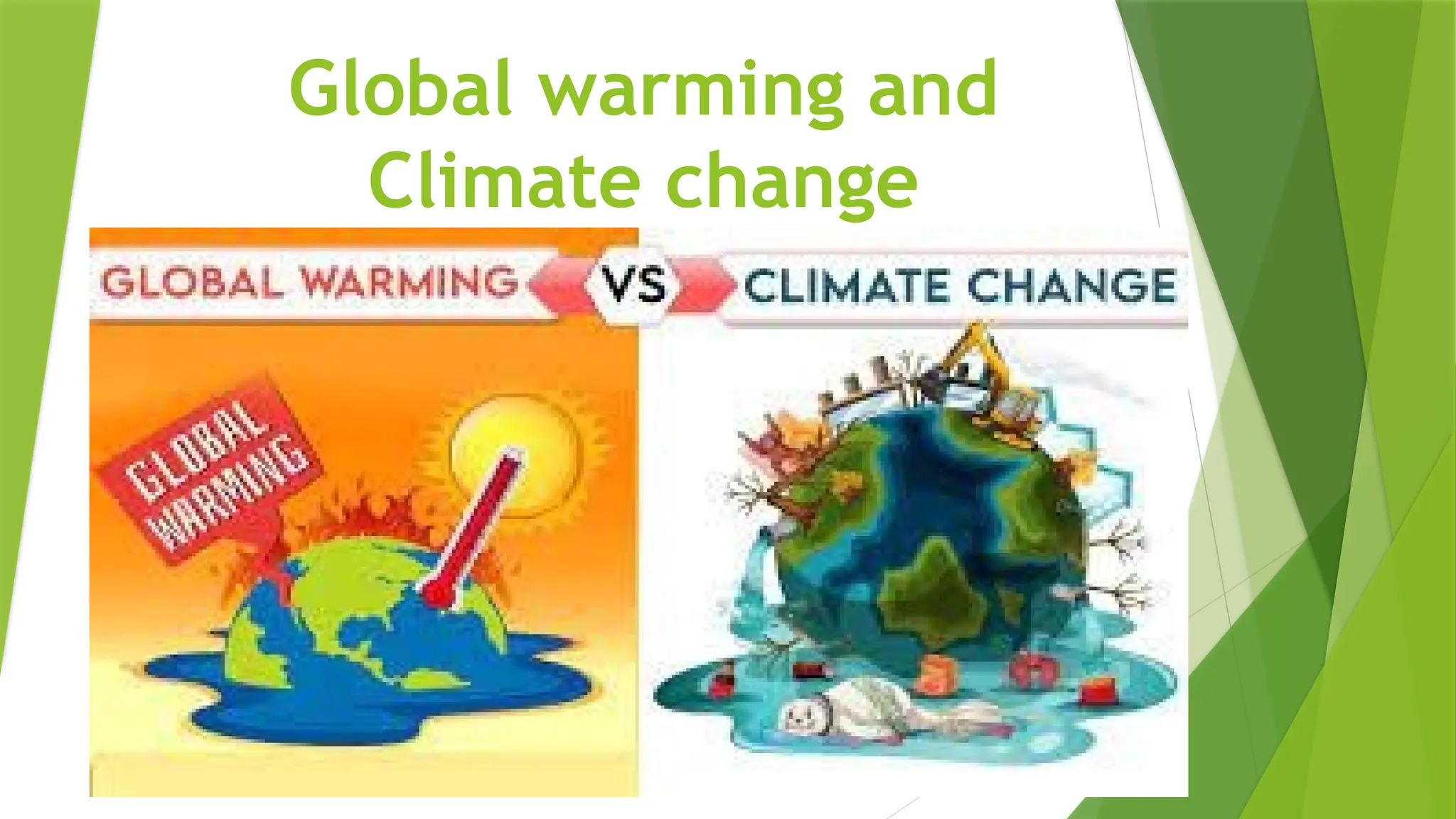
Global warming and
Climate change
2
Introduction
 The phenomenon of increasing average air temperatures near the surface of Earth
over the past one to two centuries.
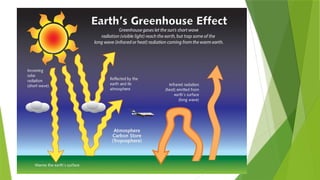
 Some gases present in the Earth’s atmosphere act like the covering of a greenhouse,
allowing the sun’s energy to enter but then keeping the heat from escaping back into
space, thus helping to make our planet a warm and habitable place.
 Although greenhouses gases (e.g., carbon dioxide, methane and nitrous oxide) are
emitted naturally from trees and animals, they are also emitted from human
activities like burning coal, driving cars, farming and deforestation.
 An increase in such human activities leads to higher emissions of the greenhouse
gases into the atmosphere and increases their concentrations.
 Rising concentrations of greenhouse gases in the atmosphere means that even more
heat is being trapped from the sun, causing the planet to warm up and our natural
weather patterns to change. This process is termed as Global warming.
 However, it is preferable to think of climate change because the changes currently
observed and predicted are not limited to temperature alone but also embrace
changes in climate patterns and related events (sea rise, floods, cyclones, droughts
and landslips) (Ministry for the Environment, 2007).
3
4
 The Intergovernmental Panel on Climate Change (IPCC) was formed in 1988 by
the World Meteorological Organization (WMO) and the
United Nations Environment Program (UNEP).
 The IPCC’s Sixth Assessment Report (AR6), published in 2021, noted that the
best estimate of the increase in global average surface temperature between
1850 and 2019 was 1.07 °C (1.9 °F).
 An IPCC special report produced in 2018 noted that human beings and their
activities have been responsible for a worldwide average temperature
increase between 0.8 and 1.2 °C (1.4 and 2.2 °F) since preindustrial times,
and most of the warming over the second half of the 20th century could be
attributed to human activities.
5
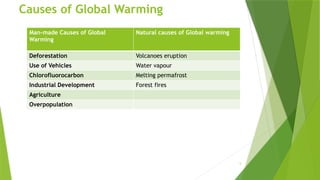
Causes of Global Warming
Man-made Causes of Global
Warming
Natural causes of Global warming
Deforestation Volcanoes eruption
Use of Vehicles Water vapour
Chlorofluorocarbon Melting permafrost
Industrial Development Forest fires
Agriculture
Overpopulation
6
Man-made Causes of Global Warming
Deforestation
 Plants are the main source of oxygen. They take in carbon dioxide and release
oxygen thereby maintaining environmental balance. Forests are being
depleted for many domestic and commercial purposes. This has led to an
environmental imbalance, thereby giving rise to global warming.
Use of Vehicles
 The use of vehicles, even for a very short distance results in various gaseous
emissions. Vehicles burn fossil fuels which emit a large amount of carbon
dioxide and other toxins into the atmosphere resulting in a temperature
increase.
Chlorofluorocarbon
 With the excessive use of air conditioners and refrigerators, humans have
been adding CFCs into the environment which affects the atmospheric ozone
layer. The ozone layer protects the earth surface from the harmful ultraviolet
rays emitted by the sun. The CFCs have led to ozone layer depletion making
way for the ultraviolet rays, thereby increasing the temperature of the earth.
7
Industrial Development
 With the advent of industrialization, the temperature of the earth has been
increasing rapidly. The harmful emissions from the factories add to the
increasing temperature of the earth.
 In 2013, the Intergovernmental Panel for Climate Change reported that the
increase in the global temperature between 1880 and 2012 has been 0.9
degrees Celsius. The increase is 1.1 degrees Celsius when compared to the
pre-industrial mean temperature.
Agriculture
 Various farming activities produce carbon dioxide and methane gas. These
add to the greenhouse gases in the atmosphere and increase the temperature
of the earth.
Overpopulation
 An increase in population means more people breathing. This leads to an
increase in the level of carbon dioxide, the primary gas causing global
warming, in the atmosphere.
8
Natural Causes of Global Warming
Volcanoes
 Volcanoes are one of the largest natural contributors to global warming. The ash
and smoke emitted during volcanic eruptions goes out into the atmosphere and
affects the climate.
Water Vapour
 Water vapour is a kind of greenhouse gas. Due to the increase in the earth’s
temperature, more water gets evaporated from the water bodies and stays in the
atmosphere adding to global warming.
Melting Permafrost
 Permafrost is frozen soil that has environmental gases trapped in it for several
years and is present below Earth’s surface. It is present in glaciers. As the
permafrost melts, it releases the gases back into the atmosphere, increasing
Earth’s temperature.
Forest Blazes
 Forest blazes or forest fires emit a large amount of carbon-containing smoke.
These gases are released into the atmosphere and increase the earth’s
temperature resulting in global warming.
9
Effects of Global Warming
Rise in Temperature
 Global warming has led to an incredible increase in earth’s temperature.
Since 1880, the earth’s temperature has increased by ~1 degrees. This has
resulted in an increase in the melting of glaciers, which have led to an
increase in the sea level. This could have devastating effects on coastal
regions.
Threats to the Ecosystem
 Global warming has affected the coral reefs that can lead to the loss of plant
and animal lives. Increase in global temperatures has made the fragility of
coral reefs even worse.
Climate Change
 Global warming has led to a change in climatic conditions. There are droughts
at some places and floods at some. This climatic imbalance is the result of
global warming.
.
10
Spread of Diseases
 Global warming leads to a change in the patterns of heat and humidity. This
has led to the movement of mosquitoes that carry and spread diseases.
High Mortality Rates
 Due to an increase in floods, tsunamis and other natural calamities, the
average death toll usually increases. Also, such events can bring about the
spread of diseases that can hamper human life.
Loss of Natural Habitat
A global shift in the climate leads to the loss of habitats of several plants and
animals. In this case, the animals need to migrate from their natural habitat
and many of them even become extinct. This is yet another major impact of
global warming on biodiversity.
11
Prevention of Global warming
Change a light
Replacing one regular light bulb with a compact fluorescent light bulb will
save 150 pounds of carbon dioxide a year.
Drive less
Walk, bike, carpool or take mass transit more often. You'll save one pound of
carbon dioxide for every mile you don't drive!
Recycle more
You can save 2,400 pounds of carbon dioxide per year by recycling just half of
your household waste.
Check your tires
Keeping your tires inflated properly can improve your gas mileage by more
than 3 percent. Every gallon of gasoline saved keeps 20 pounds of carbon
dioxide out of the atmosphere.
12
Use less hot water
It takes a lot of energy to heat water. Use less hot water by taking shorter and
cooler showers and washing your clothes in cold or warm instead of hot water
(more than 500 pounds of carbon dioxide saved per year).
Avoid products with a lot of packaging
You can save 1,200 pounds of carbon dioxide if you reduce your garbage by 10
percent.
Plant a tree
A single tree will absorb one ton of carbon dioxide over its lifetime.
Turn off electronic devices
Simply turning off your television, DVD player, stereo, and computer, when
you're not using them, will save you thousands of pounds of carbon dioxide a
year. (related to fuel consumption for generating electricity.
13
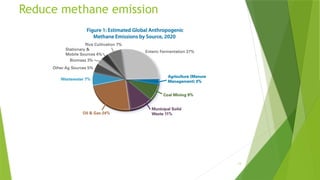
Reduce methane emission
14
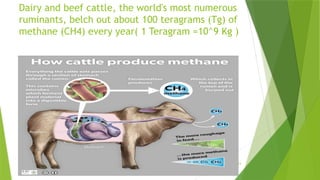
Dairy and beef cattle, the world's most numerous
ruminants, belch out about 100 teragrams (Tg) of
methane (CH4) every year( 1 Teragram =10^9 Kg )
15
Effect of Global Warming and climate change and food security
in Nepal
 The effect of global climate change in Nepal could be observed by glacier retreat
in the Himalaya region and change in the pattern of the south west monsoon which
is the only reliable source of water for farming. Climate change has been occurred
in Terai, hills and mountain of Nepal resulting change in agriculture systems leading
to the emergence of new insect, pest and disease of crops and animals. There are
frequent losses of lives, crops and, human settlements due to occurrence of flash
floods, droughts, typhoon and hurricanes in the world mainly due to climate
change. Global food production and trade have been affected by the negative
consequences of climate change as a result countries like Nepal are also victimized
due to the negative effect of climate change. Increase in C02concentration in the
atmosphere and change in precipitation are being the main cause of floods,
droughts, glacier retreat, and melting of snows, hence, change in the flora and
fauna globally. To address such measures of climate change, Nepal has been trying
to develop some adoptive ways such as development of climate resilient
technology including crop varieties, animal breeds; agronomic practices that could
address vagaries of climate change and sustain food and nutritional security. In
Nepal, the effect of climate change is more pronounced in hills and mountains with
respect to increase in temperature than that of Terai.
16
Global warming, climate change and biodiversity
 The Earth’s land and the ocean serve as natural carbon sinks, absorbing large amounts
of greenhouse gas emissions. Conserving and restoring natural spaces, and the
biodiversity they contain, is essential for limiting emissions and adapting to climate
impacts.
 Biological diversity — or biodiversity — is the variety of life on Earth, in all its forms,
from genes and bacteria to entire ecosystems such as forests or coral reefs. The
biodiversity we see today is the result of 4.5 billion years of evolution, increasingly
influenced by humans.
 Biodiversity forms the web of life that we depend on for so many things – food, water,
medicine, a stable climate, economic growth, among others. Over half of global GDP
is dependent on nature. More than 1 billion people rely on forests for their
livelihoods. And land and the ocean absorb more than half of all carbon emissions.
 But nature is in crisis. Up to one million species are threatened with extinction, many
within decades. Irreplaceable ecosystems like parts of the Amazon rainforest are
turning from carbon sinks into carbon sources due to deforestation. And 85 per cent
of wetlands, such as salt marshes and mangrove swamps which absorb large amounts
of carbon, have disappeared.
17
 The main driver of biodiversity loss remains humans’ use of land – primarily
for food production. Human activity has already altered over 70 per cent of all
ice-free land. When land is converted for agriculture, some animal and plant
species may lose their habitat and face extinction.
 But climate change is playing an increasingly important role in the decline of
biodiversity. Climate change has altered marine, terrestrial, and freshwater
ecosystems around the world. It has caused the loss of local species, increased
diseases, and driven mass mortality of plants and animals, resulting in the first
climate-driven extinctions.
 On land, higher temperatures have forced animals and plants to move to
higher elevations or higher latitudes, many moving towards the Earth’s poles,
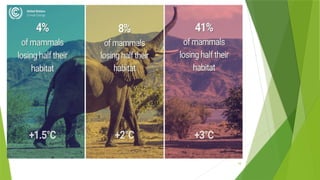
with far-reaching consequences for ecosystems. The risk of species extinction
increases with every degree of warming.
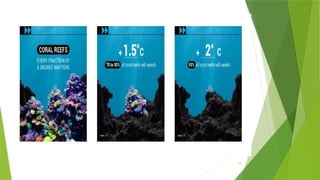
 In the ocean, rising temperatures increase the
risk of irreversible loss of marine and coastal ecosystems. Live coral reefs, for
instance, have nearly halved in the past 150 years, and further warming
threatens to destroy almost all remaining reefs.
 Overall, climate change affects the health of ecosystems, influencing shifts in
the distribution of plants, viruses, animals, and even human settlements. This
can create increased opportunities for animals to spread diseases and for
viruses to spill over to humans. Human health can also be affected by reduced
ecosystem services, such as the loss of food, medicine and livelihoods provided
by nature.
18
19
20
GLOBAL WARMING IN THE CONTEXT OF NEPAL
 Weather and climatic patterns
 High altitude and latitude regions are likely to experience a higher rate of
temperature rise compared to other regions (Beniston et al. 1997, Diaz and
Bradley 1997, Shrestha et al. 1999, IPCC 2001), Himalayan countries like
Nepal being no exception.
 From 1977‐1994, mean annual maximum temperature in Nepal increased by
0.06 degrees celsius (Shrestha et al. 1999, UNEP 2002, Ebi et al. 2007).
 Now, average temperature rise is estimated at 0.5 degrees celsius per
decade, which is very high compared to several other developing countries.
 Precipitation is also becoming unpredictable and more erratic than ever, with
more droughts and shorter periods of heavy rainfall (Shrestha et al. 2000).
Several regions in the country are already vulnerable to unevenly distributed
and erratic weather
21
Snow melting and glacial retreat
 Glaciers are excellent indicators of climate change and global warming (Ageta
and Kadota 1992, Oerlemans 1994).
 Warming‐led glacier retreat in the Nepalese Himalayas is widespread and
alarming.
 According to a study carried out by the International Commission for Snow and
Ice, snow in the Himalayas will disappear by 2035 if no proper initiative is
taken to reduce warming.
 Khumbu glacier in Nepal has retreated about 100m on average annually since
1953 (Shrestha et al. 1999).
 Some other glaciers of Nepal were also studied by Mool et al. (2001) and
Bajracharya et al. (2007). Their satellite imagery data show the glaciers are
retreating.
 Yamada et al. (1992) and Fujita et al. (2001) studied glaciers in Khumbu region
and Shrong Himal of Nepal respectively for about 20 years and found the
glaciers retreated by 30‐60 meters in the entire period.
 Similarly, UNEP (2002) reveals that the Tradkarding glacier is retreating at a
rate of over 20 meters a year and estimates it will reach 100 meters per year
in some years. This is an alarm bell
22
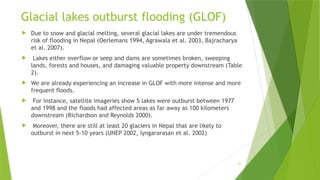
Glacial lakes outburst flooding (GLOF)
 Due to snow and glacial melting, several glacial lakes are under tremendous
risk of flooding in Nepal (Oerlemans 1994, Agrawala et al. 2003, Bajracharya
et al. 2007).
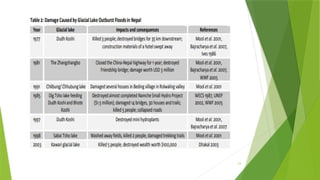
 Lakes either overflow or seep and dams are sometimes broken, sweeping
lands, forests and houses, and damaging valuable property downstream (Table
2).
 We are already experiencing an increase in GLOF with more intense and more
frequent floods.
 For instance, satellite imageries show 5 lakes were outburst between 1977
and 1998 and the floods had affected areas as far away as 100 kilometers
downstream (Richardson and Reynolds 2000).
 Moreover, there are still at least 20 glaciers in Nepal that are likely to
outburst in next 5‐10 years (UNEP 2002, Iyngararasan et al. 2002)
23
24
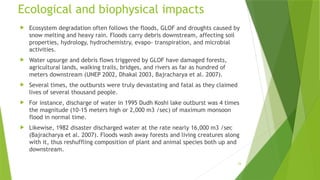
Ecological and biophysical impacts
 Ecosystem degradation often follows the floods, GLOF and droughts caused by
snow melting and heavy rain. Floods carry debris downstream, affecting soil
properties, hydrology, hydrochemistry, evapo‐ transpiration, and microbial
activities.
 Water upsurge and debris flows triggered by GLOF have damaged forests,
agricultural lands, walking trails, bridges, and rivers as far as hundred of
meters downstream (UNEP 2002, Dhakal 2003, Bajracharya et al. 2007).
 Several times, the outbursts were truly devastating and fatal as they claimed
lives of several thousand people.
 For instance, discharge of water in 1995 Dudh Koshi lake outburst was 4 times
the magnitude (10‐15 meters high or 2,000 m3 /sec) of maximum monsoon
flood in normal time.
 Likewise, 1982 disaster discharged water at the rate nearly 16,000 m3 /sec
(Bajracharya et al. 2007). Floods wash away forests and living creatures along
with it, thus reshuffling composition of plant and animal species both up and
downstream.
25
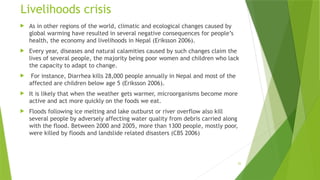
Livelihoods crisis
 As in other regions of the world, climatic and ecological changes caused by
global warming have resulted in several negative consequences for people’s
health, the economy and livelihoods in Nepal (Eriksson 2006).
 Every year, diseases and natural calamities caused by such changes claim the
lives of several people, the majority being poor women and children who lack
the capacity to adapt to change.
 For instance, Diarrhea kills 28,000 people annually in Nepal and most of the
affected are children below age 5 (Eriksson 2006).
 It is likely that when the weather gets warmer, microorganisms become more
active and act more quickly on the foods we eat.
 Floods following ice melting and lake outburst or river overflow also kill
several people by adversely affecting water quality from debris carried along
with the flood. Between 2000 and 2005, more than 1300 people, mostly poor,
were killed by floods and landslide related disasters (CBS 2006)
26
Agriculture ‐
 the mainstay of rural food and economy that accounts for about 96% of the
total water use in the country ‐ suffers a lot from erratic weather patterns
such as heat stress, longer dry seasons and uncertain rainfall, since 64% of the
cultivated area fully depends on monsoon rainfall (CBS 2006).
 Declined yield due to unfavourable weather and climate will lead to
vulnerability in the form of food insecurity, hunger and shorter life
expectancies (Ebi et al. 2007), and the rural poor will again be the hardest hit.
 Floods carrying rocks, sediments and debris increase the intensity of landslides
and erosion; deteriorate soil and water; wash away houses and properties;
cause human injuries and deaths; destroy infrastructure such as schools, roads,
and markets.
 Since hydro‐electricity accounts for about 91% of total power production in the
country, people will have to face problems in hydropower operation due to
sediments carried along the floods.
 The effects will be more pronounced in higher altitudes (Diaz and Bradley
1997, Shrestha et al. 1999), because of poor infrastructure and lack of
resources to cope with the changes. As a result, dependency on firewood will
increase and destruction of forest ‐ carbon reservoir ‐ is undeniable, which
will further increase GHG emission and exacerbate global warming.
27
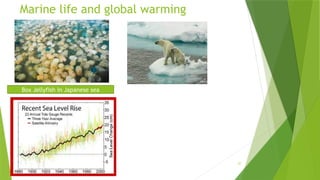
Marine life and global warming
Box Jellyfish in Japanese sea
28
Thank you….

global-warning-and-climate-change - Copy.pptx

  • 1.
  • 2.
    2 Introduction  The phenomenonof increasing average air temperatures near the surface of Earth over the past one to two centuries.  Some gases present in the Earth’s atmosphere act like the covering of a greenhouse, allowing the sun’s energy to enter but then keeping the heat from escaping back into space, thus helping to make our planet a warm and habitable place.  Although greenhouses gases (e.g., carbon dioxide, methane and nitrous oxide) are emitted naturally from trees and animals, they are also emitted from human activities like burning coal, driving cars, farming and deforestation.  An increase in such human activities leads to higher emissions of the greenhouse gases into the atmosphere and increases their concentrations.  Rising concentrations of greenhouse gases in the atmosphere means that even more heat is being trapped from the sun, causing the planet to warm up and our natural weather patterns to change. This process is termed as Global warming.  However, it is preferable to think of climate change because the changes currently observed and predicted are not limited to temperature alone but also embrace changes in climate patterns and related events (sea rise, floods, cyclones, droughts and landslips) (Ministry for the Environment, 2007).
  • 3.
  • 4.
    4  The IntergovernmentalPanel on Climate Change (IPCC) was formed in 1988 by the World Meteorological Organization (WMO) and the United Nations Environment Program (UNEP).  The IPCC’s Sixth Assessment Report (AR6), published in 2021, noted that the best estimate of the increase in global average surface temperature between 1850 and 2019 was 1.07 °C (1.9 °F).  An IPCC special report produced in 2018 noted that human beings and their activities have been responsible for a worldwide average temperature increase between 0.8 and 1.2 °C (1.4 and 2.2 °F) since preindustrial times, and most of the warming over the second half of the 20th century could be attributed to human activities.
  • 5.
    5 Causes of GlobalWarming Man-made Causes of Global Warming Natural causes of Global warming Deforestation Volcanoes eruption Use of Vehicles Water vapour Chlorofluorocarbon Melting permafrost Industrial Development Forest fires Agriculture Overpopulation
  • 6.
    6 Man-made Causes ofGlobal Warming Deforestation  Plants are the main source of oxygen. They take in carbon dioxide and release oxygen thereby maintaining environmental balance. Forests are being depleted for many domestic and commercial purposes. This has led to an environmental imbalance, thereby giving rise to global warming. Use of Vehicles  The use of vehicles, even for a very short distance results in various gaseous emissions. Vehicles burn fossil fuels which emit a large amount of carbon dioxide and other toxins into the atmosphere resulting in a temperature increase. Chlorofluorocarbon  With the excessive use of air conditioners and refrigerators, humans have been adding CFCs into the environment which affects the atmospheric ozone layer. The ozone layer protects the earth surface from the harmful ultraviolet rays emitted by the sun. The CFCs have led to ozone layer depletion making way for the ultraviolet rays, thereby increasing the temperature of the earth.
  • 7.
    7 Industrial Development  Withthe advent of industrialization, the temperature of the earth has been increasing rapidly. The harmful emissions from the factories add to the increasing temperature of the earth.  In 2013, the Intergovernmental Panel for Climate Change reported that the increase in the global temperature between 1880 and 2012 has been 0.9 degrees Celsius. The increase is 1.1 degrees Celsius when compared to the pre-industrial mean temperature. Agriculture  Various farming activities produce carbon dioxide and methane gas. These add to the greenhouse gases in the atmosphere and increase the temperature of the earth. Overpopulation  An increase in population means more people breathing. This leads to an increase in the level of carbon dioxide, the primary gas causing global warming, in the atmosphere.
  • 8.
    8 Natural Causes ofGlobal Warming Volcanoes  Volcanoes are one of the largest natural contributors to global warming. The ash and smoke emitted during volcanic eruptions goes out into the atmosphere and affects the climate. Water Vapour  Water vapour is a kind of greenhouse gas. Due to the increase in the earth’s temperature, more water gets evaporated from the water bodies and stays in the atmosphere adding to global warming. Melting Permafrost  Permafrost is frozen soil that has environmental gases trapped in it for several years and is present below Earth’s surface. It is present in glaciers. As the permafrost melts, it releases the gases back into the atmosphere, increasing Earth’s temperature. Forest Blazes  Forest blazes or forest fires emit a large amount of carbon-containing smoke. These gases are released into the atmosphere and increase the earth’s temperature resulting in global warming.
  • 9.
    9 Effects of GlobalWarming Rise in Temperature  Global warming has led to an incredible increase in earth’s temperature. Since 1880, the earth’s temperature has increased by ~1 degrees. This has resulted in an increase in the melting of glaciers, which have led to an increase in the sea level. This could have devastating effects on coastal regions. Threats to the Ecosystem  Global warming has affected the coral reefs that can lead to the loss of plant and animal lives. Increase in global temperatures has made the fragility of coral reefs even worse. Climate Change  Global warming has led to a change in climatic conditions. There are droughts at some places and floods at some. This climatic imbalance is the result of global warming. .
  • 10.
    10 Spread of Diseases Global warming leads to a change in the patterns of heat and humidity. This has led to the movement of mosquitoes that carry and spread diseases. High Mortality Rates  Due to an increase in floods, tsunamis and other natural calamities, the average death toll usually increases. Also, such events can bring about the spread of diseases that can hamper human life. Loss of Natural Habitat A global shift in the climate leads to the loss of habitats of several plants and animals. In this case, the animals need to migrate from their natural habitat and many of them even become extinct. This is yet another major impact of global warming on biodiversity.
  • 11.
    11 Prevention of Globalwarming Change a light Replacing one regular light bulb with a compact fluorescent light bulb will save 150 pounds of carbon dioxide a year. Drive less Walk, bike, carpool or take mass transit more often. You'll save one pound of carbon dioxide for every mile you don't drive! Recycle more You can save 2,400 pounds of carbon dioxide per year by recycling just half of your household waste. Check your tires Keeping your tires inflated properly can improve your gas mileage by more than 3 percent. Every gallon of gasoline saved keeps 20 pounds of carbon dioxide out of the atmosphere.
  • 12.
    12 Use less hotwater It takes a lot of energy to heat water. Use less hot water by taking shorter and cooler showers and washing your clothes in cold or warm instead of hot water (more than 500 pounds of carbon dioxide saved per year). Avoid products with a lot of packaging You can save 1,200 pounds of carbon dioxide if you reduce your garbage by 10 percent. Plant a tree A single tree will absorb one ton of carbon dioxide over its lifetime. Turn off electronic devices Simply turning off your television, DVD player, stereo, and computer, when you're not using them, will save you thousands of pounds of carbon dioxide a year. (related to fuel consumption for generating electricity.
  • 13.
  • 14.
    14 Dairy and beefcattle, the world's most numerous ruminants, belch out about 100 teragrams (Tg) of methane (CH4) every year( 1 Teragram =10^9 Kg )
  • 15.
    15 Effect of GlobalWarming and climate change and food security in Nepal  The effect of global climate change in Nepal could be observed by glacier retreat in the Himalaya region and change in the pattern of the south west monsoon which is the only reliable source of water for farming. Climate change has been occurred in Terai, hills and mountain of Nepal resulting change in agriculture systems leading to the emergence of new insect, pest and disease of crops and animals. There are frequent losses of lives, crops and, human settlements due to occurrence of flash floods, droughts, typhoon and hurricanes in the world mainly due to climate change. Global food production and trade have been affected by the negative consequences of climate change as a result countries like Nepal are also victimized due to the negative effect of climate change. Increase in C02concentration in the atmosphere and change in precipitation are being the main cause of floods, droughts, glacier retreat, and melting of snows, hence, change in the flora and fauna globally. To address such measures of climate change, Nepal has been trying to develop some adoptive ways such as development of climate resilient technology including crop varieties, animal breeds; agronomic practices that could address vagaries of climate change and sustain food and nutritional security. In Nepal, the effect of climate change is more pronounced in hills and mountains with respect to increase in temperature than that of Terai.
  • 16.
    16 Global warming, climatechange and biodiversity  The Earth’s land and the ocean serve as natural carbon sinks, absorbing large amounts of greenhouse gas emissions. Conserving and restoring natural spaces, and the biodiversity they contain, is essential for limiting emissions and adapting to climate impacts.  Biological diversity — or biodiversity — is the variety of life on Earth, in all its forms, from genes and bacteria to entire ecosystems such as forests or coral reefs. The biodiversity we see today is the result of 4.5 billion years of evolution, increasingly influenced by humans.  Biodiversity forms the web of life that we depend on for so many things – food, water, medicine, a stable climate, economic growth, among others. Over half of global GDP is dependent on nature. More than 1 billion people rely on forests for their livelihoods. And land and the ocean absorb more than half of all carbon emissions.  But nature is in crisis. Up to one million species are threatened with extinction, many within decades. Irreplaceable ecosystems like parts of the Amazon rainforest are turning from carbon sinks into carbon sources due to deforestation. And 85 per cent of wetlands, such as salt marshes and mangrove swamps which absorb large amounts of carbon, have disappeared.
  • 17.
    17  The maindriver of biodiversity loss remains humans’ use of land – primarily for food production. Human activity has already altered over 70 per cent of all ice-free land. When land is converted for agriculture, some animal and plant species may lose their habitat and face extinction.  But climate change is playing an increasingly important role in the decline of biodiversity. Climate change has altered marine, terrestrial, and freshwater ecosystems around the world. It has caused the loss of local species, increased diseases, and driven mass mortality of plants and animals, resulting in the first climate-driven extinctions.  On land, higher temperatures have forced animals and plants to move to higher elevations or higher latitudes, many moving towards the Earth’s poles, with far-reaching consequences for ecosystems. The risk of species extinction increases with every degree of warming.  In the ocean, rising temperatures increase the risk of irreversible loss of marine and coastal ecosystems. Live coral reefs, for instance, have nearly halved in the past 150 years, and further warming threatens to destroy almost all remaining reefs.  Overall, climate change affects the health of ecosystems, influencing shifts in the distribution of plants, viruses, animals, and even human settlements. This can create increased opportunities for animals to spread diseases and for viruses to spill over to humans. Human health can also be affected by reduced ecosystem services, such as the loss of food, medicine and livelihoods provided by nature.
  • 18.
  • 19.
  • 20.
    20 GLOBAL WARMING INTHE CONTEXT OF NEPAL  Weather and climatic patterns  High altitude and latitude regions are likely to experience a higher rate of temperature rise compared to other regions (Beniston et al. 1997, Diaz and Bradley 1997, Shrestha et al. 1999, IPCC 2001), Himalayan countries like Nepal being no exception.  From 1977‐1994, mean annual maximum temperature in Nepal increased by 0.06 degrees celsius (Shrestha et al. 1999, UNEP 2002, Ebi et al. 2007).  Now, average temperature rise is estimated at 0.5 degrees celsius per decade, which is very high compared to several other developing countries.  Precipitation is also becoming unpredictable and more erratic than ever, with more droughts and shorter periods of heavy rainfall (Shrestha et al. 2000). Several regions in the country are already vulnerable to unevenly distributed and erratic weather
  • 21.
    21 Snow melting andglacial retreat  Glaciers are excellent indicators of climate change and global warming (Ageta and Kadota 1992, Oerlemans 1994).  Warming‐led glacier retreat in the Nepalese Himalayas is widespread and alarming.  According to a study carried out by the International Commission for Snow and Ice, snow in the Himalayas will disappear by 2035 if no proper initiative is taken to reduce warming.  Khumbu glacier in Nepal has retreated about 100m on average annually since 1953 (Shrestha et al. 1999).  Some other glaciers of Nepal were also studied by Mool et al. (2001) and Bajracharya et al. (2007). Their satellite imagery data show the glaciers are retreating.  Yamada et al. (1992) and Fujita et al. (2001) studied glaciers in Khumbu region and Shrong Himal of Nepal respectively for about 20 years and found the glaciers retreated by 30‐60 meters in the entire period.  Similarly, UNEP (2002) reveals that the Tradkarding glacier is retreating at a rate of over 20 meters a year and estimates it will reach 100 meters per year in some years. This is an alarm bell
  • 22.
    22 Glacial lakes outburstflooding (GLOF)  Due to snow and glacial melting, several glacial lakes are under tremendous risk of flooding in Nepal (Oerlemans 1994, Agrawala et al. 2003, Bajracharya et al. 2007).  Lakes either overflow or seep and dams are sometimes broken, sweeping lands, forests and houses, and damaging valuable property downstream (Table 2).  We are already experiencing an increase in GLOF with more intense and more frequent floods.  For instance, satellite imageries show 5 lakes were outburst between 1977 and 1998 and the floods had affected areas as far away as 100 kilometers downstream (Richardson and Reynolds 2000).  Moreover, there are still at least 20 glaciers in Nepal that are likely to outburst in next 5‐10 years (UNEP 2002, Iyngararasan et al. 2002)
  • 23.
  • 24.
    24 Ecological and biophysicalimpacts  Ecosystem degradation often follows the floods, GLOF and droughts caused by snow melting and heavy rain. Floods carry debris downstream, affecting soil properties, hydrology, hydrochemistry, evapo‐ transpiration, and microbial activities.  Water upsurge and debris flows triggered by GLOF have damaged forests, agricultural lands, walking trails, bridges, and rivers as far as hundred of meters downstream (UNEP 2002, Dhakal 2003, Bajracharya et al. 2007).  Several times, the outbursts were truly devastating and fatal as they claimed lives of several thousand people.  For instance, discharge of water in 1995 Dudh Koshi lake outburst was 4 times the magnitude (10‐15 meters high or 2,000 m3 /sec) of maximum monsoon flood in normal time.  Likewise, 1982 disaster discharged water at the rate nearly 16,000 m3 /sec (Bajracharya et al. 2007). Floods wash away forests and living creatures along with it, thus reshuffling composition of plant and animal species both up and downstream.
  • 25.
    25 Livelihoods crisis  Asin other regions of the world, climatic and ecological changes caused by global warming have resulted in several negative consequences for people’s health, the economy and livelihoods in Nepal (Eriksson 2006).  Every year, diseases and natural calamities caused by such changes claim the lives of several people, the majority being poor women and children who lack the capacity to adapt to change.  For instance, Diarrhea kills 28,000 people annually in Nepal and most of the affected are children below age 5 (Eriksson 2006).  It is likely that when the weather gets warmer, microorganisms become more active and act more quickly on the foods we eat.  Floods following ice melting and lake outburst or river overflow also kill several people by adversely affecting water quality from debris carried along with the flood. Between 2000 and 2005, more than 1300 people, mostly poor, were killed by floods and landslide related disasters (CBS 2006)
  • 26.
    26 Agriculture ‐  themainstay of rural food and economy that accounts for about 96% of the total water use in the country ‐ suffers a lot from erratic weather patterns such as heat stress, longer dry seasons and uncertain rainfall, since 64% of the cultivated area fully depends on monsoon rainfall (CBS 2006).  Declined yield due to unfavourable weather and climate will lead to vulnerability in the form of food insecurity, hunger and shorter life expectancies (Ebi et al. 2007), and the rural poor will again be the hardest hit.  Floods carrying rocks, sediments and debris increase the intensity of landslides and erosion; deteriorate soil and water; wash away houses and properties; cause human injuries and deaths; destroy infrastructure such as schools, roads, and markets.  Since hydro‐electricity accounts for about 91% of total power production in the country, people will have to face problems in hydropower operation due to sediments carried along the floods.  The effects will be more pronounced in higher altitudes (Diaz and Bradley 1997, Shrestha et al. 1999), because of poor infrastructure and lack of resources to cope with the changes. As a result, dependency on firewood will increase and destruction of forest ‐ carbon reservoir ‐ is undeniable, which will further increase GHG emission and exacerbate global warming.
  • 27.
    27 Marine life andglobal warming Box Jellyfish in Japanese sea
  • 28.