1 6  S Y N T H E S I S
In the past few years, researchers have been gradually illuminating
the secret lives of gastrointestinal bacteria, also called microbiota.
Gut reaction
Finding cancer clues in the microbiome
This is no small task. There are
trillions of microbes in the body —
ten times more bacteria than there
are cells. And while many may
perform beneficial tasks, others
aren’t so friendly. Researchers believe
these bacteria play a role in metabolism,
immunity, even mental health.
There’s also evidence that certain
gut bacteria can influence
the risk of developing cancer.
Conditions like type 2 diabetes
and obesity can skew this carefully
balanced system, increasing levels
of hostile bacteria. But it may not
even take a disease to throw bacterial
ratios out of whack. New evidence
suggests that the so-called Western
diet — high in sugar and fat — also
plays havoc with our microbiota.
Could these bacterial imbalances
be contributing to gastrointestinal
and liver cancers?
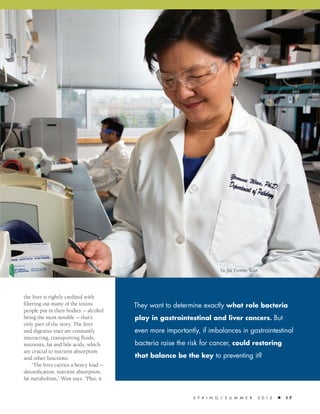
Yu-Jui Yvonne Wan, vice chair
for research in the Department of
Pathology and Laboratory Medicine,
and colleagues are on a mission to
find out. They want to determine
exactly what role bacteria play in
gastrointestinal and liver cancers.
But even more importantly, if
imbalances in gastrointestinal
bacteria raise the risk for cancer,
could restoring that balance be
the key to preventing it?
The busy liver
That gut bacteria might modulate
the risk of liver cancer is not as
farfetched as it may seem. While
Building on basics>>
spr i n g / su m m e R 2 0 1 5  1 7
the liver is rightly credited with
filtering out many of the toxins
people put in their bodies — alcohol
being the most notable — that’s
only part of the story. The liver
and digestive tract are constantly
interacting, transporting fluids,
nutrients, fat and bile acids, which
are crucial to nutrient absorption
and other functions.
“The liver carries a heavy load —
detoxification, nutrient absorption,
fat metabolism,” Wan says. “Plus, it
They want to determine exactly what role bacteria
play in gastrointestinal and liver cancers. But
even more importantly, if imbalances in gastrointestinal
bacteria raise the risk for cancer, could restoring
that balance be the key to preventing it?
Yu-Jui Yvonne Wan
1 8  S Y N T H E S I S
has an extremely close relationship
with the gut. Bile acid is made in the
liver, circulates to the gut and then
comes back to the liver.”
This transaction is of particular
interest to Wan and could be the
point at which bacteria make their
entrance. The liver produces water-
soluble, or primary, bile acid, which
bile acid can damage DNA and
activate cancer genes. It also plays
a role in inflammation, which can
also be carcinogenic.”
A healthy gut regulates the levels
of secondary bile acid; however, there
is evidence that people with diabetes,
obesity and metabolic syndrome
tend to have too many of the wrong
bacteria. It’s possible these conditions,
and the high-fat diets that help
generate them, are creating too
much toxic bile acid.
The final straw
Livers are complicated and so is
liver cancer. Generally, liver cancer
patients have had a previous liver
condition, such as hepatitis or fatty
liver disease, which ultimately leads
to cancer. However, some people can
have these pre-existing conditions
without developing liver cancer.
Researchers have wanted
to explain this disparity. What is
protecting some people from cancer
while others succumb? Once again,
is transported to the gut. Once
there, certain species of bacteria
convert this primary bile acid into
secondary, water-insoluble, bile
acid, which can be toxic.
“In normal amounts, secondary
bile acid helps absorb nutrients,”
notes Wan. “But everything is
about dose. Too much secondary
Building on basics>>
“Bile acid may not be directly
causing liver cancer, but there’s
a lot of evidence that it
plays a contributing role.”
	 ~ Yu-Jui Yvonne Wan
spr i n g / su m m e R 2 0 1 5  1 9
the possible relationship between
unbalanced microbiota and liver
cancer provides an intriguing
possibility. What if we could
rebalance gut bacteria to reduce
levels of toxic bile acid?
The idea that we can improve
health by introducing friendly
bacteria is not new. Probiotics have
been touted for their health benefits
for many years. More recently,
doctors have been using fecal trans-
plants to insert beneficial bacteria
into diseased intestines to treat
C. difficile, a bacterial infection that’s
often hard to treat.
Wan and her team also are
interested in using bacteria as
medicine. Specifically, they will
be testing whether a common gut
microbe, called bifidobacteria, along
with oligosaccharides (carbohydrates)
found in milk, can restore bacterial
balance. The bifidobacteria will
enrich healthy gut bacteria, while the
oligosaccharides will provide food for
these good bacteria. The researchers
hope this combination will provide
a one-two punch, protecting both
the liver and gut from inflammation,
reducing levels of toxic bile acid, and
lowering the risk of gastrointestinal
and liver cancers.
“We want to understand the
link between bacterial composition
and cancer,” says Wan.“But even
more importantly, we want to use
this approach to intercept the carci-
nogenic process and, hopefully,
reduce cancer formation.”
the trail leads back to microbiota.
It’s possible that unfriendly
bacteria, which may generate too
much toxic bile acid, are the final
elements that push fatty liver
disease and other conditions into
becoming liver cancer.
“Bile acid may not be directly
causing liver cancer, but there’s
a lot of evidence that it plays a
contributing role,” says Wan.
To figure that out, Wan was
recently awarded a $2.7 million
grant from the National Cancer
Institute. She and fellow grantees
Carolyn Slupsky and David Mills,
associate professor and professor,
respectively, in the UC Davis
Food Science and Technology
Department and the Foods for
Health Institute, will now have the
resources to thoroughly investigate
the relationship between gut
bacteria and both gastrointestinal
and liver cancers.
Building on earlier studies,
the team hopes to illustrate the
relationship between the Western
diet, gut bacteria, metabolism and
bile acid. With this information,
the researchers believe they will
produce a better picture of the
entire chain of events that lead to
liver and gastrointestinal cancers:
diet leading to unbalanced gastro-
intestinal bacteria; increased
production of toxic bile acids;
inflammation and DNA damage;
and cancer gene activation.
Bacteria as medicine
The research will perform another
important function: evaluate
potential therapies that could
disrupt this chain and perhaps
even prevent cancer. With all the
cross-talk between gut and liver,
The research will perform another important function:
evaluate potential therapies that could disrupt this
chain and perhaps even prevent cancer.
Carolyn Slupsky | Slupsky will be
measuring the metabolic difference
between normal mice and mice that are
genetically lacking bile acid receptors
in their liver and intestine. By taking
this measurement in the context of a
high-fat diet, researchers will learn more
about the role bile acids play in cancer
development and whether certain intestinal
microbes can reverse or prevent it.
David Mills | Mills will study
the microbiome and whether
supplementation with a particular
bacterium typically present in the
intestinal tract of infants, together
with certain complex sugars
present in bovine milk, will have
a protective effect against liver
and intestinal cancer.
Project team members

Gut Reaction Synthesis 2015

  • 1.
    1 6 S Y N T H E S I S In the past few years, researchers have been gradually illuminating the secret lives of gastrointestinal bacteria, also called microbiota. Gut reaction Finding cancer clues in the microbiome This is no small task. There are trillions of microbes in the body — ten times more bacteria than there are cells. And while many may perform beneficial tasks, others aren’t so friendly. Researchers believe these bacteria play a role in metabolism, immunity, even mental health. There’s also evidence that certain gut bacteria can influence the risk of developing cancer. Conditions like type 2 diabetes and obesity can skew this carefully balanced system, increasing levels of hostile bacteria. But it may not even take a disease to throw bacterial ratios out of whack. New evidence suggests that the so-called Western diet — high in sugar and fat — also plays havoc with our microbiota. Could these bacterial imbalances be contributing to gastrointestinal and liver cancers? Yu-Jui Yvonne Wan, vice chair for research in the Department of Pathology and Laboratory Medicine, and colleagues are on a mission to find out. They want to determine exactly what role bacteria play in gastrointestinal and liver cancers. But even more importantly, if imbalances in gastrointestinal bacteria raise the risk for cancer, could restoring that balance be the key to preventing it? The busy liver That gut bacteria might modulate the risk of liver cancer is not as farfetched as it may seem. While Building on basics>>
  • 2.
    spr i ng / su m m e R 2 0 1 5  1 7 the liver is rightly credited with filtering out many of the toxins people put in their bodies — alcohol being the most notable — that’s only part of the story. The liver and digestive tract are constantly interacting, transporting fluids, nutrients, fat and bile acids, which are crucial to nutrient absorption and other functions. “The liver carries a heavy load — detoxification, nutrient absorption, fat metabolism,” Wan says. “Plus, it They want to determine exactly what role bacteria play in gastrointestinal and liver cancers. But even more importantly, if imbalances in gastrointestinal bacteria raise the risk for cancer, could restoring that balance be the key to preventing it? Yu-Jui Yvonne Wan
  • 3.
    1 8 S Y N T H E S I S has an extremely close relationship with the gut. Bile acid is made in the liver, circulates to the gut and then comes back to the liver.” This transaction is of particular interest to Wan and could be the point at which bacteria make their entrance. The liver produces water- soluble, or primary, bile acid, which bile acid can damage DNA and activate cancer genes. It also plays a role in inflammation, which can also be carcinogenic.” A healthy gut regulates the levels of secondary bile acid; however, there is evidence that people with diabetes, obesity and metabolic syndrome tend to have too many of the wrong bacteria. It’s possible these conditions, and the high-fat diets that help generate them, are creating too much toxic bile acid. The final straw Livers are complicated and so is liver cancer. Generally, liver cancer patients have had a previous liver condition, such as hepatitis or fatty liver disease, which ultimately leads to cancer. However, some people can have these pre-existing conditions without developing liver cancer. Researchers have wanted to explain this disparity. What is protecting some people from cancer while others succumb? Once again, is transported to the gut. Once there, certain species of bacteria convert this primary bile acid into secondary, water-insoluble, bile acid, which can be toxic. “In normal amounts, secondary bile acid helps absorb nutrients,” notes Wan. “But everything is about dose. Too much secondary Building on basics>> “Bile acid may not be directly causing liver cancer, but there’s a lot of evidence that it plays a contributing role.” ~ Yu-Jui Yvonne Wan
  • 4.
    spr i ng / su m m e R 2 0 1 5  1 9 the possible relationship between unbalanced microbiota and liver cancer provides an intriguing possibility. What if we could rebalance gut bacteria to reduce levels of toxic bile acid? The idea that we can improve health by introducing friendly bacteria is not new. Probiotics have been touted for their health benefits for many years. More recently, doctors have been using fecal trans- plants to insert beneficial bacteria into diseased intestines to treat C. difficile, a bacterial infection that’s often hard to treat. Wan and her team also are interested in using bacteria as medicine. Specifically, they will be testing whether a common gut microbe, called bifidobacteria, along with oligosaccharides (carbohydrates) found in milk, can restore bacterial balance. The bifidobacteria will enrich healthy gut bacteria, while the oligosaccharides will provide food for these good bacteria. The researchers hope this combination will provide a one-two punch, protecting both the liver and gut from inflammation, reducing levels of toxic bile acid, and lowering the risk of gastrointestinal and liver cancers. “We want to understand the link between bacterial composition and cancer,” says Wan.“But even more importantly, we want to use this approach to intercept the carci- nogenic process and, hopefully, reduce cancer formation.” the trail leads back to microbiota. It’s possible that unfriendly bacteria, which may generate too much toxic bile acid, are the final elements that push fatty liver disease and other conditions into becoming liver cancer. “Bile acid may not be directly causing liver cancer, but there’s a lot of evidence that it plays a contributing role,” says Wan. To figure that out, Wan was recently awarded a $2.7 million grant from the National Cancer Institute. She and fellow grantees Carolyn Slupsky and David Mills, associate professor and professor, respectively, in the UC Davis Food Science and Technology Department and the Foods for Health Institute, will now have the resources to thoroughly investigate the relationship between gut bacteria and both gastrointestinal and liver cancers. Building on earlier studies, the team hopes to illustrate the relationship between the Western diet, gut bacteria, metabolism and bile acid. With this information, the researchers believe they will produce a better picture of the entire chain of events that lead to liver and gastrointestinal cancers: diet leading to unbalanced gastro- intestinal bacteria; increased production of toxic bile acids; inflammation and DNA damage; and cancer gene activation. Bacteria as medicine The research will perform another important function: evaluate potential therapies that could disrupt this chain and perhaps even prevent cancer. With all the cross-talk between gut and liver, The research will perform another important function: evaluate potential therapies that could disrupt this chain and perhaps even prevent cancer. Carolyn Slupsky | Slupsky will be measuring the metabolic difference between normal mice and mice that are genetically lacking bile acid receptors in their liver and intestine. By taking this measurement in the context of a high-fat diet, researchers will learn more about the role bile acids play in cancer development and whether certain intestinal microbes can reverse or prevent it. David Mills | Mills will study the microbiome and whether supplementation with a particular bacterium typically present in the intestinal tract of infants, together with certain complex sugars present in bovine milk, will have a protective effect against liver and intestinal cancer. Project team members