Dr Bhupendra Shah
Assistant Professor
Department of internal Medicine
B.P .Koirala institute of Health Sciences
History of Gullainn-Barre syndrome
Leading cause of acute flaccid
paralysis in developed countries
Ventilation in 25% cases
Death in 4-15% cases
Gullain-Barre Syndrome
Leading cause of acute
flaccid paralysis in
developed countries
Ventilation in 25%
cases
Death in 4-15%
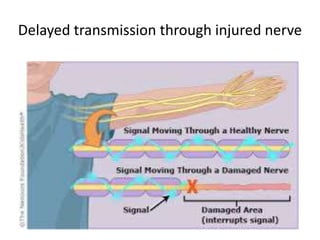
Delayed transmission through injured nerve
Clinical Features
Muscle weakness usually in the legs
-Acute
-Progressive
-symmetric
-usually peak by 2 weeks
Facial weakness
Dysautonomia
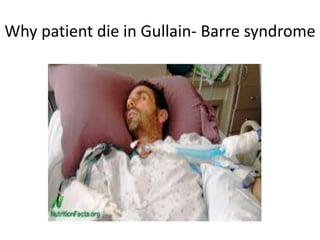
Respiratory failure
Sensory deficit:minimal
bladder /bowel:transiently involved
Why patient die in Gullain- Barre syndrome
Variants of GBS
Acute inflammatory demylinating polyneuropthy
• Acute motor axonal neuropathy
Acute motor sensory axonal
neuropathy
• Miller Fisher variant
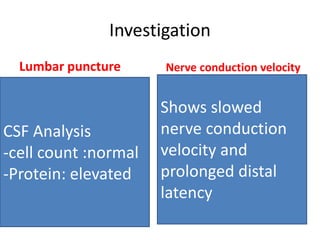
Investigation
Lumbar puncture Nerve conduction velocity
CSF Analysis
-cell count :normal
-Protein: elevated
Shows slowed
nerve conduction
velocity and
prolonged distal
latency
Brighton criteria
1.Bilateral and flaccid weakness of the limbs
2.Decreased /absent DTR in weak limbs.
3.Monophasic ,interval between onset and nadir of weakness
between 12 h and 28 days .
4.Electrophysiological study consistent with GBS.
5.CSF:cytoalbuminologic dissociation
6. Absence of alternatice diagnosis for weakness.
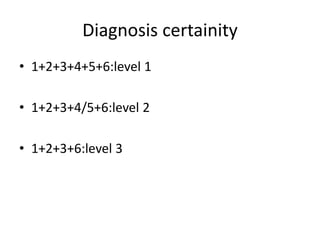
Diagnosis certainity
• 1+2+3+4+5+6:level 1
• 1+2+3+4/5+6:level 2
• 1+2+3+6:level 3
Treatment
• Setting : usuallly Intensive care unit
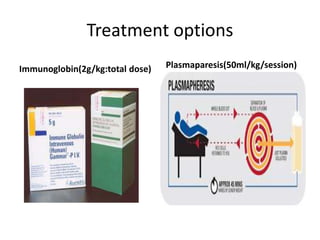
Treatment options
Immunoglobin(2g/kg:total dose) Plasmaparesis(50ml/kg/session)
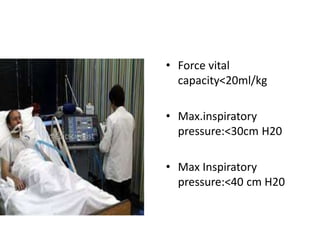
• Force vital
capacity<20ml/kg
• Max.inspiratory
pressure:<30cm H20
• Max Inspiratory
pressure:<40 cm H20
Thank you

Gullain barre syndrome