Foundation Portfolio in Media
Aims & Objectives – Todays Lesson
•Introduction to blogging
•Introduction to blogging tools
•You will start blogging
• Example
• http://asmedia1314sam5.blogspot.co.uk/search/label/Marc?updated-max=2014-03-04T12:55:00Z&max-
results=20&start=20&by-date=false
• My Blog
• https://www.blogger.com/blogger.g?
blogID=6773806116803475798#overview/src=dashboard
With the proliferation of technology, Blogs will probably be
replaced by something else at some point.
But the skills learnt from their use are essential in the 21st
Century
• Analytic thinking
• Critical thinking
• Collaborative working
• Referencing skills
• Producing texts with clear fluidity
• Competent use of technology
Blog Benefits
1.Deeper learning – getting students to think for themselves
2.Encouraging you to reach out to each other – sharing knowledge
3.Easy to manipulate – easy technical understanding. Elastic in design.
Convenient and engaging
4.Encouraging a more reflective individual
5.Creative platform – potential to use a wide range of tools/widgets etc
6.Students can shape their own contributions to suit their
styles/audience
Nonsense blogging
• Students sometimes embrace the journal aspect of
blogging during a project a little too much. Random
jokes, recounts of arguments and general content which
is not applicable to the project can often dominate.
• Whilst we don’t want to restrict personal response and
deter you from the flow of blogging, the content of the
blog needs to be a balance of personal reflection and
direct accounts of what has taken place during the
project.
Text-heavy blogging
• We (OCR) too often see blogs which are
dominated by text – almost like the posting of
mini-essays throughout
• However, blogs have the potential to be an
innovative and interactive forum combining
visual, audio and written communication
forms and this should be actively encouraged.
Cluster blogging
• Like retrospective blogging, cluster blogging is
very obvious. It’s not just spotted through the
date indication but also recognised through
the depth of the recount of the process.
• It is easy to forget something that happened
or was carried out when you are blogging
together in a bulk. This approach also
encourages text-heavy blogging as panic sets
in.
Scanty blogging
• Like limited powerpoint slides, posts which fail
to include any specific detail or lack depth
often do not contribute to the journey.
• Obviously, at times you want to post if there
has been a complication. However, such posts
need to move beyond exclamatory
statements and provide detail to the
occurence!
• E.g. – ‘Today we did our filming.’ ‘Lost all our
footage!’
Colloquial blogging
• Remember the importance of formality and to
consider your audience.
• Over-use of slang and colloquial terms will not
do you many favours, especially during the
evaluation stages.
• You should always proofread, checking for
spellings and punctuation.
Great start, poor finish blogging
• The risk with blogging is that this happens.
You get lots of research evidence, then some
planning and then the next post is the final
product.
• You blogging needs to be consistent
throughout the project!
Key to a Successful Blog is:
1. Organisation
2. Detail
3. Media specific
terminology
4. Web 2.0 tools
5. Frequency
6. Consistency of quality
7. The journey
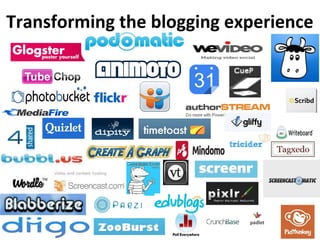
Transforming the blogging experience
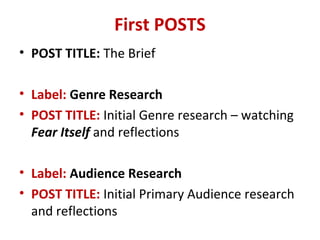
First POSTS
• POST TITLE: The Brief
• Label: Genre Research
• POST TITLE: Initial Genre research – watching
Fear Itself and reflections
• Label: Audience Research
• POST TITLE: Initial Primary Audience research
and reflections

Guidence for blogging

  • 1.
  • 2.
    Aims & Objectives– Todays Lesson •Introduction to blogging •Introduction to blogging tools •You will start blogging
  • 4.
  • 5.
    With the proliferationof technology, Blogs will probably be replaced by something else at some point. But the skills learnt from their use are essential in the 21st Century • Analytic thinking • Critical thinking • Collaborative working • Referencing skills • Producing texts with clear fluidity • Competent use of technology
  • 6.
    Blog Benefits 1.Deeper learning– getting students to think for themselves 2.Encouraging you to reach out to each other – sharing knowledge 3.Easy to manipulate – easy technical understanding. Elastic in design. Convenient and engaging 4.Encouraging a more reflective individual 5.Creative platform – potential to use a wide range of tools/widgets etc 6.Students can shape their own contributions to suit their styles/audience
  • 7.
    Nonsense blogging • Studentssometimes embrace the journal aspect of blogging during a project a little too much. Random jokes, recounts of arguments and general content which is not applicable to the project can often dominate. • Whilst we don’t want to restrict personal response and deter you from the flow of blogging, the content of the blog needs to be a balance of personal reflection and direct accounts of what has taken place during the project.
  • 8.
    Text-heavy blogging • We(OCR) too often see blogs which are dominated by text – almost like the posting of mini-essays throughout • However, blogs have the potential to be an innovative and interactive forum combining visual, audio and written communication forms and this should be actively encouraged.
  • 9.
    Cluster blogging • Likeretrospective blogging, cluster blogging is very obvious. It’s not just spotted through the date indication but also recognised through the depth of the recount of the process. • It is easy to forget something that happened or was carried out when you are blogging together in a bulk. This approach also encourages text-heavy blogging as panic sets in.
  • 10.
    Scanty blogging • Likelimited powerpoint slides, posts which fail to include any specific detail or lack depth often do not contribute to the journey. • Obviously, at times you want to post if there has been a complication. However, such posts need to move beyond exclamatory statements and provide detail to the occurence! • E.g. – ‘Today we did our filming.’ ‘Lost all our footage!’
  • 11.
    Colloquial blogging • Rememberthe importance of formality and to consider your audience. • Over-use of slang and colloquial terms will not do you many favours, especially during the evaluation stages. • You should always proofread, checking for spellings and punctuation.
  • 12.
    Great start, poorfinish blogging • The risk with blogging is that this happens. You get lots of research evidence, then some planning and then the next post is the final product. • You blogging needs to be consistent throughout the project!
  • 13.
    Key to aSuccessful Blog is: 1. Organisation 2. Detail 3. Media specific terminology 4. Web 2.0 tools 5. Frequency 6. Consistency of quality 7. The journey
  • 14.
  • 16.
    First POSTS • POSTTITLE: The Brief • Label: Genre Research • POST TITLE: Initial Genre research – watching Fear Itself and reflections • Label: Audience Research • POST TITLE: Initial Primary Audience research and reflections