Test Construction
Rosemarie C. Blando
Division Coordinator, AP
Test is….
a measuring tool to
capture your
cognitive traits
through pen and
paper
a tool in which measuring
unit depends on its length
and level of difficulty of items
indicated by its assigned
points or percentage of
examinees who got the
correct answer.
Why do we give
test?
Test allow …
• Students to answer at the
same time using the same
format.
Test allow …
• Students to answer at the
same time using the same
format.
• Objective scoring of students
knowledge
Test allow …
• Students to answer at the
same time using the same
format.
• Objective scoring of students
knowledge
• Easy grading system
Test allow …
• Students to answer at the
same time using the same
format.
• Objective scoring of students
knowledge
• Easy grading system
• Easy ranking of students
What are the
structure of a test?
STRUCTURE OF A TEST
1. Stem
STRUCTURE OF A TEST
1. Stem
is the beginning part of
the item that presents the item as
a problem to be solved, a question
asked of the respondent, or an
incomplete statement to be
completed, as well as any other
relevant information.
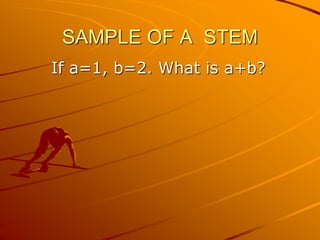
SAMPLE OF A STEM
If a=1, b=2. What is a+b?
STRUCTURE OF A TEST
2. Options
STRUCTURE OF A TEST
2. Options
The options are the
possible answers that the
examiner can choose from,
with the correct answer called
the KEY and the incorrect
answers called
DISTRACTORS.
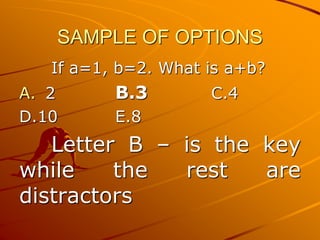
SAMPLE OF OPTIONS
If a=1, b=2. What is a+b?
A. 2 B.3 C.4
D.10 E.8
Letter B – is the key
while the rest are
distractors
Flowchart of test construction
1. Formulate test
objectives
What cognitive learning objectives
could be targeted by the test?
Use the revised
taxonomy of cognitive
behavior as your
framework.
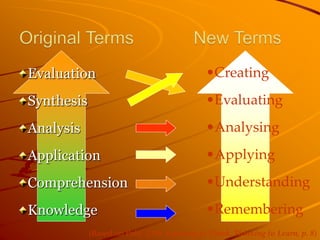
Evaluation
Synthesis
Analysis
Application
Comprehension
Knowledge
•Creating
•Evaluating
•Analysing
•Applying
•Understanding
•Remembering
(Based on Pohl, 2000, Learning to Think, Thinking to Learn, p. 8)
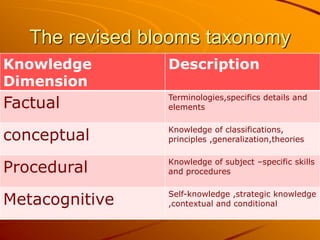
The revised blooms taxonomy
Knowledge
Dimension
Description
Factual Terminologies,specifics details and
elements
conceptual Knowledge of classifications,
principles ,generalization,theories
Procedural Knowledge of subject –specific skills
and procedures
Metacognitive Self-knowledge ,strategic knowledge
,contextual and conditional
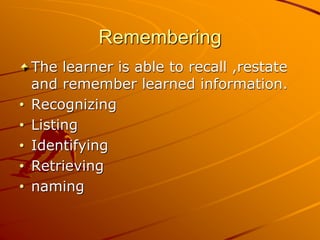
Remembering
The learner is able to recall ,restate
and remember learned information.
• Recognizing
• Listing
• Identifying
• Retrieving
• naming
Locating
Finding
Can you recall the information?
Understanding
Interpreting
Exemplifying
Inferring
Paraphrasing
Explaining
Describing
Classifying
Can you explain ideas or
concepts?
Applying
The learner makes use of
information in a context different
from the one in which it was
learned.
•Implementing
•Carrying out
•Using
Executing
Applying
Doing
Can you use information in
another familiar situation.
Analysing
The learner breaks learned
information into its parts to best
understand the information,
Differentiating
Organizing
Deconstructing
Outlining
Distinguishing
Can you break information into parts
explicit understandings and
relationships?
Evaluating
The learner makes decisions based
on in-depth reflection ,criticism and
assessment.
Checking
Critiquing
Judging
Testing
Detecting
Monitoring
Can you justify a decision or course of
action?
Creating
The learner creates new ideas and
information using what has been
previously learned.
Designing
Constructing
Planning
Producing
Inventing
Devising
Can you generate new
products ,ideas or ways or
viewing things?
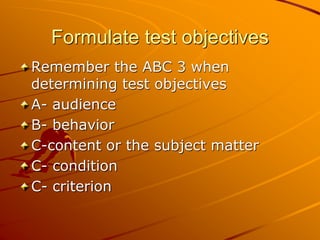
Formulate test objectives
Remember the ABC 3 when
determining test objectives
A- audience
B- behavior
C-content or the subject matter
C- condition
C- criterion
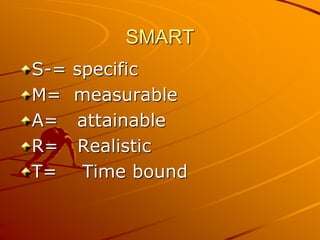
SMART
S-= specific
M= measurable
A= attainable
R= Realistic
T= Time bound
2. Construct a table of
specifications
Two way
Decide on the test
format
Check the table of specifications
Inspect the TOS,
check the scope of test ,
the distribution of the items
correctness of the
classification of behavior .
Better if a specialist helps
check the work.
Write the test items.
Follow the guidelines in
constructing the
different test formats.
Multiple Choice Items
• Advantages:
– Extremely versatile-can measure the higher level
mental processes (application, analysis, synthesis
and evaluation)
– A compromise between a short answer/essay and
T/F item
– Can cover a wide range of content can be sampled
by one test
• Disadvantages
– Difficult to construct plausible alternative responses
Types of Multiple Choice Items
• Four Basic Types
– Question Type
– Incomplete Statement Type
– Right Answer Type
– Best Answer Type
• Which Type is Best?
– Question Type vs. Incomplete Statement
– Right Answer vs. Best Answer Type
Multiple Choice Items
1. Writing the stem first:
A. Be sure the stem asks a clear question
B. Stems phrased as questions are usually easier to
write
C. Stems should not contain a lot of irrelevant info.
D. Appropriate reading level/terms
E. Be sure the stem is grammatically correct
F. Avoid negatively stated stems
Multiple Choice Items
• Writing the correct response
– Use same terms/reading level
– Avoid too many qualifiers
– Assign a random position in the answer sequence
• Read the stem and correct response together
• Generate the distractors/alternative responses
Multiple Choice Items
• Other Tips for Constructing MC Items:
– Items should have 3-4 alternatives.
– Stem should present a single, clearly formulated
problem
– Simple, understandable, exclude extraneous words
from both stem and alternatives
– Include in the stem any word that are repeated in
each response
– Avoid all of the above (can answer based on partial
information)
– Avoid none of the above
Multiple Choice Items
• Alternative responses/distractors should be plausible
and as homogeneous as possible
• Response alternatives should not overlap
– Two synonymous terms (arithmetic average/mean)
• Avoid double negatives
– None of the following are part of the brain except which one?
• Emphasize negative wording
• Each item should be independent of other items in the
test
– Information in the stem of one item should NOT help answer
another item.
Multiple choice item
Should have a clear problem
Example:
The IT capital of India is ______
Multiple choice item
Should have a clear problem
Plausible distractors
Ex: The IT capital of India is
a. Mysore
b. Mumbai
c. Bangalore
d. New Delhi
Multiple choice item
Alternatives that are
grammatically parallel to
the stem and arranged
logically, alphabetically
or according to
length/value.
Multiple choice item
Ex: Ang mga sumusunod ay ang mga
dahilan sa pagkabigo ng rebelyon
maliban sa isa:
a.kawalan ng katarungan
b.kawalan ng mahusay ng lider
c.kawalan ng kasanayan sa
pakikidigma at mga armas
d.kawalan ng pagkakaisa at mas
malalim na damdaming makabayan
Multiple choice item
Only one correct or clearly best answer
Ex:
33. Ito ay isang sakit na namiminsala
tuwing tag-ulan na dala ng lamok na
Aedes Aegypti.
a. SARS b. dengue
c. cholera d. Hepatitis A
All multiple choice
options should be
grammatically consistent
with the stem
Alin sa mga sumusunod na
bansa ang hindi matatagpuan
sa Silangang Asya?
a. Tsina
b. Hapon
c. Pilipinas
d. Timog Korea
Should avoid
=double negatives in the stem
Should avoid
=double negatives in the stem
=irrelevant materials in the stem
Should avoid
=double negatives in the stem
=irrelevant materials in the stem
=having pattern
Should avoid
=double negatives in the stem
=irrelevant materials in the stem
=having pattern
=verbal clues in the stem and correct
answer
=avoid vague qualitative modifiers
such as many ,large ,much ,small
Should avoid
=double negatives in the stem
=irrelevant materials in the stem
=having pattern
=verbal clues in the stem and correct
answer
Should avoid
=double negatives in the stem
=irrelevant materials in the stem
=having pattern
=verbal clues in the stem and correct
answer
=avoid vague qualitative modifiers
such as many ,large ,much ,small
Avoid specific determiners or
give –away qualifiers. Never,
no, all, always
Avoid specific determiners or
give –away qualifiers. Never,
no, all, always
Avoid use of unnecessary
words or phrases ,which are
not relevant to the problem
Avoid silly or obvious
distractors
1. The IT capital of India is
a. Mexico
b. Mysore
c. Mumbai
d. Bangalore
*A is the obvious distractors because it is a
country, not a city in India
Write the test items
Validate the face and content of the
item/rubric
Check if:
It looks good
The guidelines in test construction
were followed
The target behaviours in the TOS
were met
Any
questions?
Any violent
reactions?
Any
clarifications?
It is clear?
This Time, Lets Do It
Yes, this time lets do this reform
TOGETHER….
this life-changing power
of K to 12 can make a difference.
For our Filipino children and adults.
For our Country
END WITH
IT TAKES A VILLAGE TO RAISE A
CHILD
MARAMING
SALAMAT
PO!
WORKSHOP
1. Write your own TOS individually on the
bond paper
2. 50 items, multiple choice, 30 days
2 – way grid – 4 obejctives minimum
3. Write only 6 items on the yellow paper
that shows the 6 cognitive skills - 1
item per skill (revised Bloom’s
Taxonomy)
4. Time limit – 1 hour
5. Use a reference/textbook/Lesson Plan

Test_construction.ppt

  • 1.
    Test Construction Rosemarie C.Blando Division Coordinator, AP
  • 2.
    Test is…. a measuringtool to capture your cognitive traits through pen and paper
  • 3.
    a tool inwhich measuring unit depends on its length and level of difficulty of items indicated by its assigned points or percentage of examinees who got the correct answer.
  • 4.
    Why do wegive test?
  • 5.
    Test allow … •Students to answer at the same time using the same format.
  • 6.
    Test allow … •Students to answer at the same time using the same format. • Objective scoring of students knowledge
  • 7.
    Test allow … •Students to answer at the same time using the same format. • Objective scoring of students knowledge • Easy grading system
  • 8.
    Test allow … •Students to answer at the same time using the same format. • Objective scoring of students knowledge • Easy grading system • Easy ranking of students
  • 9.
  • 10.
    STRUCTURE OF ATEST 1. Stem
  • 11.
    STRUCTURE OF ATEST 1. Stem is the beginning part of the item that presents the item as a problem to be solved, a question asked of the respondent, or an incomplete statement to be completed, as well as any other relevant information.
  • 12.
    SAMPLE OF ASTEM If a=1, b=2. What is a+b?
  • 13.
    STRUCTURE OF ATEST 2. Options
  • 14.
    STRUCTURE OF ATEST 2. Options The options are the possible answers that the examiner can choose from, with the correct answer called the KEY and the incorrect answers called DISTRACTORS.
  • 15.
    SAMPLE OF OPTIONS Ifa=1, b=2. What is a+b? A. 2 B.3 C.4 D.10 E.8 Letter B – is the key while the rest are distractors
  • 16.
    Flowchart of testconstruction 1. Formulate test objectives
  • 17.
    What cognitive learningobjectives could be targeted by the test? Use the revised taxonomy of cognitive behavior as your framework.
  • 18.
  • 19.
    The revised bloomstaxonomy Knowledge Dimension Description Factual Terminologies,specifics details and elements conceptual Knowledge of classifications, principles ,generalization,theories Procedural Knowledge of subject –specific skills and procedures Metacognitive Self-knowledge ,strategic knowledge ,contextual and conditional
  • 20.
    Remembering The learner isable to recall ,restate and remember learned information. • Recognizing • Listing • Identifying • Retrieving • naming
  • 21.
  • 22.
  • 23.
  • 24.
    Applying The learner makesuse of information in a context different from the one in which it was learned. •Implementing •Carrying out •Using
  • 25.
    Executing Applying Doing Can you useinformation in another familiar situation.
  • 26.
    Analysing The learner breakslearned information into its parts to best understand the information, Differentiating Organizing Deconstructing
  • 27.
    Outlining Distinguishing Can you breakinformation into parts explicit understandings and relationships?
  • 28.
    Evaluating The learner makesdecisions based on in-depth reflection ,criticism and assessment. Checking Critiquing Judging
  • 29.
    Testing Detecting Monitoring Can you justifya decision or course of action?
  • 30.
    Creating The learner createsnew ideas and information using what has been previously learned. Designing Constructing Planning
  • 31.
    Producing Inventing Devising Can you generatenew products ,ideas or ways or viewing things?
  • 32.
    Formulate test objectives Rememberthe ABC 3 when determining test objectives A- audience B- behavior C-content or the subject matter C- condition C- criterion
  • 33.
    SMART S-= specific M= measurable A=attainable R= Realistic T= Time bound
  • 34.
    2. Construct atable of specifications Two way Decide on the test format
  • 35.
    Check the tableof specifications Inspect the TOS, check the scope of test , the distribution of the items correctness of the classification of behavior . Better if a specialist helps check the work.
  • 36.
    Write the testitems. Follow the guidelines in constructing the different test formats.
  • 37.
    Multiple Choice Items •Advantages: – Extremely versatile-can measure the higher level mental processes (application, analysis, synthesis and evaluation) – A compromise between a short answer/essay and T/F item – Can cover a wide range of content can be sampled by one test • Disadvantages – Difficult to construct plausible alternative responses
  • 38.
    Types of MultipleChoice Items • Four Basic Types – Question Type – Incomplete Statement Type – Right Answer Type – Best Answer Type • Which Type is Best? – Question Type vs. Incomplete Statement – Right Answer vs. Best Answer Type
  • 39.
    Multiple Choice Items 1.Writing the stem first: A. Be sure the stem asks a clear question B. Stems phrased as questions are usually easier to write C. Stems should not contain a lot of irrelevant info. D. Appropriate reading level/terms E. Be sure the stem is grammatically correct F. Avoid negatively stated stems
  • 40.
    Multiple Choice Items •Writing the correct response – Use same terms/reading level – Avoid too many qualifiers – Assign a random position in the answer sequence • Read the stem and correct response together • Generate the distractors/alternative responses
  • 41.
    Multiple Choice Items •Other Tips for Constructing MC Items: – Items should have 3-4 alternatives. – Stem should present a single, clearly formulated problem – Simple, understandable, exclude extraneous words from both stem and alternatives – Include in the stem any word that are repeated in each response – Avoid all of the above (can answer based on partial information) – Avoid none of the above
  • 42.
    Multiple Choice Items •Alternative responses/distractors should be plausible and as homogeneous as possible • Response alternatives should not overlap – Two synonymous terms (arithmetic average/mean) • Avoid double negatives – None of the following are part of the brain except which one? • Emphasize negative wording • Each item should be independent of other items in the test – Information in the stem of one item should NOT help answer another item.
  • 43.
    Multiple choice item Shouldhave a clear problem Example: The IT capital of India is ______
  • 44.
    Multiple choice item Shouldhave a clear problem Plausible distractors Ex: The IT capital of India is a. Mysore b. Mumbai c. Bangalore d. New Delhi
  • 45.
    Multiple choice item Alternativesthat are grammatically parallel to the stem and arranged logically, alphabetically or according to length/value.
  • 46.
    Multiple choice item Ex:Ang mga sumusunod ay ang mga dahilan sa pagkabigo ng rebelyon maliban sa isa: a.kawalan ng katarungan b.kawalan ng mahusay ng lider c.kawalan ng kasanayan sa pakikidigma at mga armas d.kawalan ng pagkakaisa at mas malalim na damdaming makabayan
  • 47.
    Multiple choice item Onlyone correct or clearly best answer Ex: 33. Ito ay isang sakit na namiminsala tuwing tag-ulan na dala ng lamok na Aedes Aegypti. a. SARS b. dengue c. cholera d. Hepatitis A
  • 48.
    All multiple choice optionsshould be grammatically consistent with the stem
  • 49.
    Alin sa mgasumusunod na bansa ang hindi matatagpuan sa Silangang Asya? a. Tsina b. Hapon c. Pilipinas d. Timog Korea
  • 50.
  • 51.
    Should avoid =double negativesin the stem =irrelevant materials in the stem
  • 52.
    Should avoid =double negativesin the stem =irrelevant materials in the stem =having pattern
  • 53.
    Should avoid =double negativesin the stem =irrelevant materials in the stem =having pattern =verbal clues in the stem and correct answer =avoid vague qualitative modifiers such as many ,large ,much ,small
  • 54.
    Should avoid =double negativesin the stem =irrelevant materials in the stem =having pattern =verbal clues in the stem and correct answer
  • 55.
    Should avoid =double negativesin the stem =irrelevant materials in the stem =having pattern =verbal clues in the stem and correct answer =avoid vague qualitative modifiers such as many ,large ,much ,small
  • 56.
    Avoid specific determinersor give –away qualifiers. Never, no, all, always
  • 57.
    Avoid specific determinersor give –away qualifiers. Never, no, all, always Avoid use of unnecessary words or phrases ,which are not relevant to the problem
  • 58.
    Avoid silly orobvious distractors 1. The IT capital of India is a. Mexico b. Mysore c. Mumbai d. Bangalore *A is the obvious distractors because it is a country, not a city in India
  • 59.
    Write the testitems Validate the face and content of the item/rubric Check if: It looks good The guidelines in test construction were followed The target behaviours in the TOS were met
  • 60.
  • 61.
  • 62.
  • 63.
  • 65.
    This Time, LetsDo It Yes, this time lets do this reform TOGETHER…. this life-changing power of K to 12 can make a difference. For our Filipino children and adults. For our Country
  • 66.
    END WITH IT TAKESA VILLAGE TO RAISE A CHILD
  • 67.
  • 68.
    WORKSHOP 1. Write yourown TOS individually on the bond paper 2. 50 items, multiple choice, 30 days 2 – way grid – 4 obejctives minimum 3. Write only 6 items on the yellow paper that shows the 6 cognitive skills - 1 item per skill (revised Bloom’s Taxonomy) 4. Time limit – 1 hour 5. Use a reference/textbook/Lesson Plan