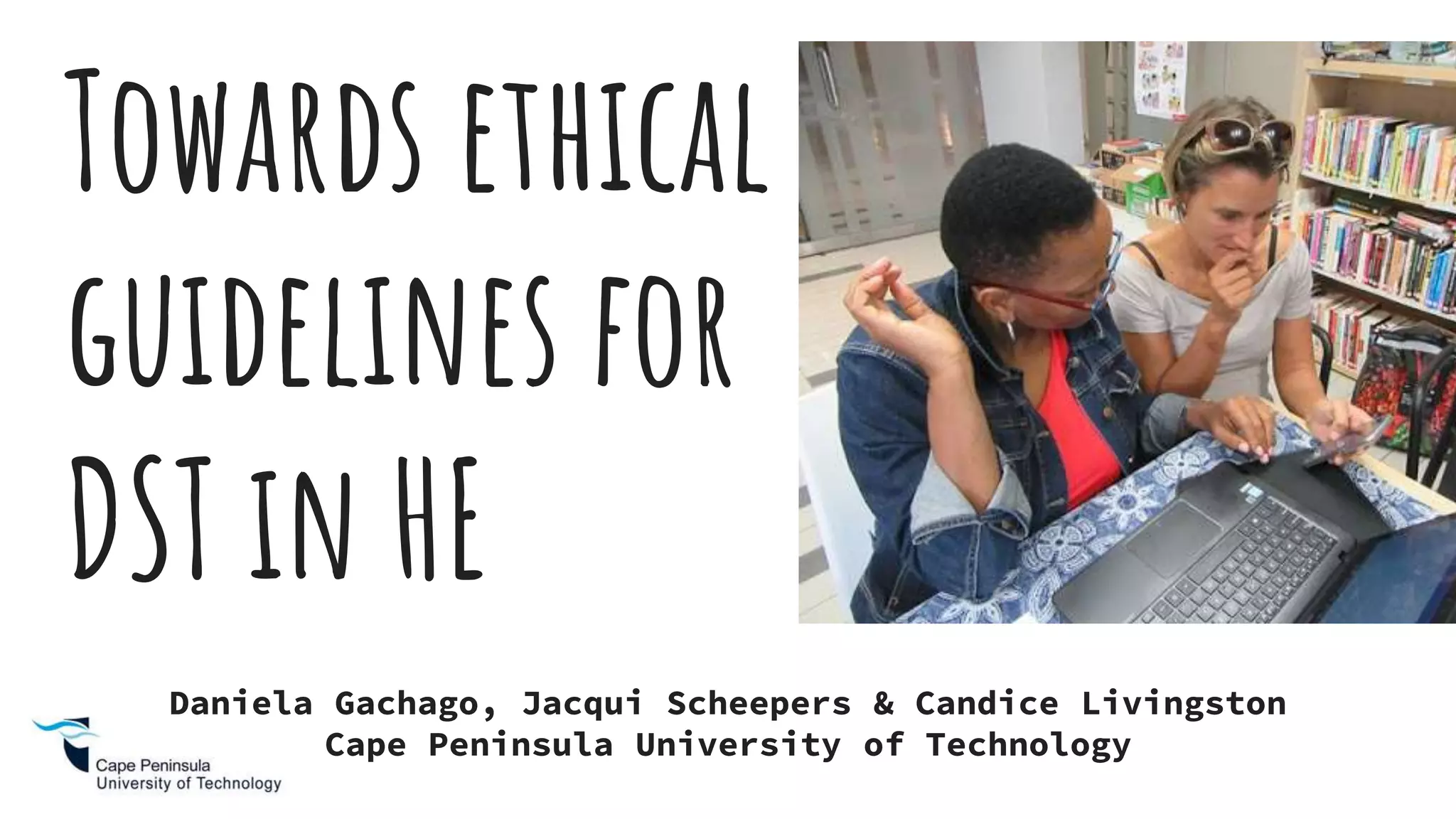
Towards ethical
guidelines for
DST in HE
Daniela Gachago, Jacqui Scheepers & Candice Livingston
Cape Peninsula University of Technology
We are here as part of large community of inquiry
- CPUT colleagues and students
- Local and International DST community
- Untold conference - ethics group
Presentation is based on:
Gachago, D., Scheepers, J. & Livingston, C. 2021. Telling
Stories about Stories. Towards ethical guidelines for digital
storytelling in Higher Education. In Bezerra, J., Paterson,
C. & Paphitis, S. (Eds): Challenging the Apartheids of
Knowledge in Higher Education through Social Innovation.
Stellenbosch: Sun Media. link to chapter
DSt in Higher Education
- Digital storytelling (DST) has found its way into “every
corner of higher education” (Lambert, 2017, p. vi)
- to empower students through personal reflection, growth,
and the development of new multimodal literacies
- Participatory research methodology for Public Health
Education, but also Professional Development / Teacher
Education
- Community Engagement projects for healing, heritage,
reconciliation, recovery, celebration, resilience,
motivation, etc.
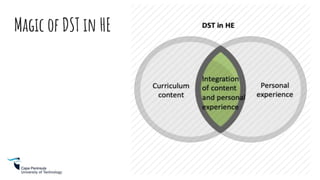
Magic of DST in HE
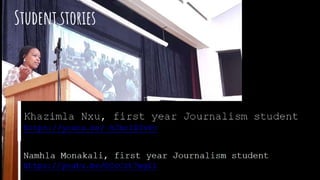
Student stories
Digital storytelling at CPUT
● Since 2010
● From Education spread into other Faculties
● Across variety of disciplines and contexts
● More or less supported / structured
● More or less personal
● Some training but not enough
● Ethical questions more and more urgent
OUR Own practice
- pedagogical tool that unpacks issues around students’
identity and positionality and as such can be implemented
as a socially just pedagogy (Burgess, 2006; Scott Nixon,
2009; Stewart & Gachago, 2016; Stewart, 2017; Stewart &
Ivala , 2017; 2019; Stewart, 2019)
- facilitate difficult conversations in the classroom
around race, gender, and class (Benmayor, 2008; Matias &
Grosland, 2016; Rolón-Dow, 2011).
Storycenter’s principles of ethical practice
Amy Hill (Silence Speaks)
- Storyteller’s wellbeing
- Expanding consent / Continual process
- Knowledge production and ownership
- Local relevance
- Distribution
Certain assumptions (examples)
- Small group
- Workshop context
- Skilled/trained facilitators
- Voluntary participation / consent / right to withdraw
- Support
- Equal access to technology
- Claim for authenticity
- Right to choose story / language
- Therapy / healing / catharsis
- Demarcated time / relationship
Some EThical questions in HE
● Consent? Choice to withdraw? - multilayered
approach / Choice!
● Support? Facilitation skills?
● Assessment? What and how?
● Screening? Ownership of stories? Who has final
control?
● Power dynamics? Teacher / student / researcher
● Aesthetics = process vs product
● Responsibility towards story and storyteller -
where does it end?
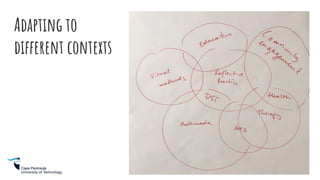
Adapting to
different contexts
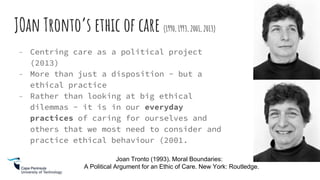
JOan Tronto’s ethic of care (1990, 1993, 2001, 2013)
- Centring care as a political project
(2013)
- More than just a disposition - but a
ethical practice
- Rather than looking at big ethical
dilemmas - it is in our everyday
practices of caring for ourselves and
others that we most need to consider and
practice ethical behaviour (2001.
Joan Tronto (1993). Moral Boundaries:
A Political Argument for an Ethic of Care. New York: Routledge.
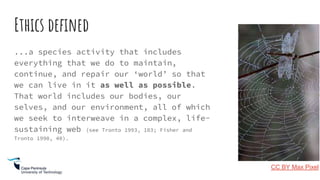
Ethics defined
...a species activity that includes
everything that we do to maintain,
continue, and repair our ‘world’ so that
we can live in it as well as possible.
That world includes our bodies, our
selves, and our environment, all of which
we seek to interweave in a complex, life-
sustaining web (see Tronto 1993, 103; Fisher and
Tronto 1990, 40).
CC BY Max Pixel
relationality
● complex ethical relationship
● all participants or actors need to be
involved (engagement and ownership)
● Moves beyond dyadic relations for
carer/caregiver, mother/child,
teacher/student
● Contextual / situational - we are all
both caregiver and care receiver at
times (reciprocal)
CC BY Pixabay
references/REsources
Black, G.F. et al., 2018. Reflections on the ethics of participatory visual methods to engage communities in
global health research. Global Bioethics, 29(1), pp.22–38. Available at:
https://www.tandfonline.com/doi/full/10.1080/11287462.2017.1415722.
Gachago, D. & Sykes, P., 2017. Navigating Ethical Boundaries When Adopting Digital Storytelling in Higher
Education. In G. Jamisson et al., eds. Digital Storytelling in Higher Education. Cham: Palgrave Macmillan,
pp. 91–106.
Gubrium, A.C., Hill, A.L. & Flicker, S., 2014. A situated practice of ethics for participatory visual and
digital methods in public health research and practice: A focus on digital storytelling. American Journal of
Public Health, 104(9), pp.1606–1614.
Hill, A., 2014. Digital Storytelling and the Politics of Doing Good: Exploring the Ethics of Bringing
Personal Narratives into Public Spheres. In H. Pleasants & D. E. Salter, eds. Community-based Multiliteracies
and Digital Media Projects. Peter Lang Publishing, pp. 174–178.
Stewart, K.D. & Ivala, E., 2017. Silence, voice, and “other languages”: Digital storytelling as a site for
resistance and restoration in a South African higher education classroom. British Journal of Educational
Technology. Available at: http://doi.wiley.com/10.1111/bjet.12540.
References
Ahmed, S. (2017). Living a feminist life. Durham, NY: Duke University Press.
Barad, K. (2007). Meeting the universe halfway. Durham and London: Duke University Press.
Barad, K. (2014). Diffracting diffraction: Cutting together-apart. Parallax, 20(3), 168-187. doi:
10.1080/13534645.2014.927623
Black, G.F. et al., 2018. Reflections on the ethics of participatory visual methods to engage communities in
global health research. Global Bioethics, 29(1), pp.22–38. Available at:
https://www.tandfonline.com/doi/full/10.1080/11287462.2017.1415722.
Braidotti, R. (2019). Posthuman knowledge. Cambridge, United Kingdom: Polity Press.
Gachago, D., & Sykes, P. 2017. Navigating ethical boundaries when adopting digital storytelling in higher
education. In G. Jamissen, G. Hardy, P. Nordkvelle, & H. Pleasand (Eds.), Digital storytelling higher
education (pp. 91-106). Springer International.
Gubrium, A. C., Hill, A. L., & Flicker, S. (2014). A situated practice of ethics for participatory visual and
digital methods in public health research and practice : A focus on digital storytelling. American Journal of
Public Health, 104(9), 1606–1613.
Hill, A. (2014). Digital storytelling and the politics of doing good: Exploring the ethics of bringing
personal narratives into public spheres. In H. Pleasants & D. E. Salter (Eds.), Community-based
multiliteracies and digital media projects (Vol. 39, pp. 174–178). New York: Peter Lang Publishing.
Posel, D., & Ross, F. C. (2014). Ethical quandaries in social research. Cape Town: HRSC Press.
Reed, A., & Hill, A. (2012). “Don’t keep it to yourself!’’: Digital storytelling with South African Youth.”
International Journal for Media, Technology and LIfelong Learning, 8(2). Retrieved from
http://seminar.net/index.php/component/content/article/75-current-issue/146- dont-keep-it-to-yourself-
digital-storytelling-with-south-african-youth
Stewart, K., & Gachago, D. (2016). Being human today: A digital storytelling pedagogy for transcontinental
border crossing. British Journal of Educational Technology, 47(3), 528–542.
https://doi.org/10.1111/bjet.12450
Sykes, P. & Gachago, D. (2018). Creating "safe-ish" learning spaces - attempts to practice an ethics of care.
South African Journal of Higher Education, 36(6), 83-98.
StoryCenter (2018). Ethical practice. Retrieved from
https://static1.squarespace.com/static/55368c08e4b0d419e1c011f7/t/579134a05016e13dde264720/1469133984611/Ethi
cs.pdf
Tronto, J. (1993). Moral boundaries: A political argument for an ethic of care. New York & London: Routledge.
Tronto, J. (2001). An ethic of care. In M. B. Holstein & P. B. Mitzen (Eds.), Ethics in community-based elder
care (pp. 60–68). New York, NY: Springer
Tronto, J. C. (2013). Caring democracy. New York and London: New York University Press.
Guidelines for ethical DST 0810

Guidelines for ethical DST 0810

  • 1.
    Towards ethical guidelines for DSTin HE Daniela Gachago, Jacqui Scheepers & Candice Livingston Cape Peninsula University of Technology
  • 2.
    We are hereas part of large community of inquiry - CPUT colleagues and students - Local and International DST community - Untold conference - ethics group Presentation is based on: Gachago, D., Scheepers, J. & Livingston, C. 2021. Telling Stories about Stories. Towards ethical guidelines for digital storytelling in Higher Education. In Bezerra, J., Paterson, C. & Paphitis, S. (Eds): Challenging the Apartheids of Knowledge in Higher Education through Social Innovation. Stellenbosch: Sun Media. link to chapter
  • 3.
    DSt in HigherEducation - Digital storytelling (DST) has found its way into “every corner of higher education” (Lambert, 2017, p. vi) - to empower students through personal reflection, growth, and the development of new multimodal literacies - Participatory research methodology for Public Health Education, but also Professional Development / Teacher Education - Community Engagement projects for healing, heritage, reconciliation, recovery, celebration, resilience, motivation, etc.
  • 4.
  • 5.
  • 6.
    Digital storytelling atCPUT ● Since 2010 ● From Education spread into other Faculties ● Across variety of disciplines and contexts ● More or less supported / structured ● More or less personal ● Some training but not enough ● Ethical questions more and more urgent
  • 7.
    OUR Own practice -pedagogical tool that unpacks issues around students’ identity and positionality and as such can be implemented as a socially just pedagogy (Burgess, 2006; Scott Nixon, 2009; Stewart & Gachago, 2016; Stewart, 2017; Stewart & Ivala , 2017; 2019; Stewart, 2019) - facilitate difficult conversations in the classroom around race, gender, and class (Benmayor, 2008; Matias & Grosland, 2016; Rolón-Dow, 2011).
  • 9.
    Storycenter’s principles ofethical practice Amy Hill (Silence Speaks) - Storyteller’s wellbeing - Expanding consent / Continual process - Knowledge production and ownership - Local relevance - Distribution
  • 10.
    Certain assumptions (examples) -Small group - Workshop context - Skilled/trained facilitators - Voluntary participation / consent / right to withdraw - Support - Equal access to technology - Claim for authenticity - Right to choose story / language - Therapy / healing / catharsis - Demarcated time / relationship
  • 11.
    Some EThical questionsin HE ● Consent? Choice to withdraw? - multilayered approach / Choice! ● Support? Facilitation skills? ● Assessment? What and how? ● Screening? Ownership of stories? Who has final control? ● Power dynamics? Teacher / student / researcher ● Aesthetics = process vs product ● Responsibility towards story and storyteller - where does it end?
  • 12.
  • 14.
    JOan Tronto’s ethicof care (1990, 1993, 2001, 2013) - Centring care as a political project (2013) - More than just a disposition - but a ethical practice - Rather than looking at big ethical dilemmas - it is in our everyday practices of caring for ourselves and others that we most need to consider and practice ethical behaviour (2001. Joan Tronto (1993). Moral Boundaries: A Political Argument for an Ethic of Care. New York: Routledge.
  • 15.
    Ethics defined ...a speciesactivity that includes everything that we do to maintain, continue, and repair our ‘world’ so that we can live in it as well as possible. That world includes our bodies, our selves, and our environment, all of which we seek to interweave in a complex, life- sustaining web (see Tronto 1993, 103; Fisher and Tronto 1990, 40). CC BY Max Pixel
  • 16.
    relationality ● complex ethicalrelationship ● all participants or actors need to be involved (engagement and ownership) ● Moves beyond dyadic relations for carer/caregiver, mother/child, teacher/student ● Contextual / situational - we are all both caregiver and care receiver at times (reciprocal) CC BY Pixabay
  • 17.
    references/REsources Black, G.F. etal., 2018. Reflections on the ethics of participatory visual methods to engage communities in global health research. Global Bioethics, 29(1), pp.22–38. Available at: https://www.tandfonline.com/doi/full/10.1080/11287462.2017.1415722. Gachago, D. & Sykes, P., 2017. Navigating Ethical Boundaries When Adopting Digital Storytelling in Higher Education. In G. Jamisson et al., eds. Digital Storytelling in Higher Education. Cham: Palgrave Macmillan, pp. 91–106. Gubrium, A.C., Hill, A.L. & Flicker, S., 2014. A situated practice of ethics for participatory visual and digital methods in public health research and practice: A focus on digital storytelling. American Journal of Public Health, 104(9), pp.1606–1614. Hill, A., 2014. Digital Storytelling and the Politics of Doing Good: Exploring the Ethics of Bringing Personal Narratives into Public Spheres. In H. Pleasants & D. E. Salter, eds. Community-based Multiliteracies and Digital Media Projects. Peter Lang Publishing, pp. 174–178. Stewart, K.D. & Ivala, E., 2017. Silence, voice, and “other languages”: Digital storytelling as a site for resistance and restoration in a South African higher education classroom. British Journal of Educational Technology. Available at: http://doi.wiley.com/10.1111/bjet.12540.
  • 18.
    References Ahmed, S. (2017).Living a feminist life. Durham, NY: Duke University Press. Barad, K. (2007). Meeting the universe halfway. Durham and London: Duke University Press. Barad, K. (2014). Diffracting diffraction: Cutting together-apart. Parallax, 20(3), 168-187. doi: 10.1080/13534645.2014.927623 Black, G.F. et al., 2018. Reflections on the ethics of participatory visual methods to engage communities in global health research. Global Bioethics, 29(1), pp.22–38. Available at: https://www.tandfonline.com/doi/full/10.1080/11287462.2017.1415722. Braidotti, R. (2019). Posthuman knowledge. Cambridge, United Kingdom: Polity Press. Gachago, D., & Sykes, P. 2017. Navigating ethical boundaries when adopting digital storytelling in higher education. In G. Jamissen, G. Hardy, P. Nordkvelle, & H. Pleasand (Eds.), Digital storytelling higher education (pp. 91-106). Springer International. Gubrium, A. C., Hill, A. L., & Flicker, S. (2014). A situated practice of ethics for participatory visual and digital methods in public health research and practice : A focus on digital storytelling. American Journal of Public Health, 104(9), 1606–1613.
  • 19.
    Hill, A. (2014).Digital storytelling and the politics of doing good: Exploring the ethics of bringing personal narratives into public spheres. In H. Pleasants & D. E. Salter (Eds.), Community-based multiliteracies and digital media projects (Vol. 39, pp. 174–178). New York: Peter Lang Publishing. Posel, D., & Ross, F. C. (2014). Ethical quandaries in social research. Cape Town: HRSC Press. Reed, A., & Hill, A. (2012). “Don’t keep it to yourself!’’: Digital storytelling with South African Youth.” International Journal for Media, Technology and LIfelong Learning, 8(2). Retrieved from http://seminar.net/index.php/component/content/article/75-current-issue/146- dont-keep-it-to-yourself- digital-storytelling-with-south-african-youth Stewart, K., & Gachago, D. (2016). Being human today: A digital storytelling pedagogy for transcontinental border crossing. British Journal of Educational Technology, 47(3), 528–542. https://doi.org/10.1111/bjet.12450 Sykes, P. & Gachago, D. (2018). Creating "safe-ish" learning spaces - attempts to practice an ethics of care. South African Journal of Higher Education, 36(6), 83-98. StoryCenter (2018). Ethical practice. Retrieved from https://static1.squarespace.com/static/55368c08e4b0d419e1c011f7/t/579134a05016e13dde264720/1469133984611/Ethi cs.pdf Tronto, J. (1993). Moral boundaries: A political argument for an ethic of care. New York & London: Routledge. Tronto, J. (2001). An ethic of care. In M. B. Holstein & P. B. Mitzen (Eds.), Ethics in community-based elder care (pp. 60–68). New York, NY: Springer Tronto, J. C. (2013). Caring democracy. New York and London: New York University Press.

Editor's Notes

  • #15 University of Minnesota