listen deeply • tell stories

Center for Digital Storytelling • 1803 Martin Luther King Jr. Way • Berkeley, CA • 94709 www.storycenter.org


                      Digital Storytelling:
  A Methodology for Individual and Community Transformation
There are many ways to make media and many reasons for making it. Everyone has
powerful stories to tell -- the ritual of sharing personal insights and experiences can be
immensely valuable to both those speak and those who bear witness. People who believe
they are mundane, uninteresting, or unmemorable possess beneath this mask a vivid,
complex, and rich body of stories just waiting to be told.

Over the past ten years, digital storytelling has emerged as an important participatory media
production method used in a variety of community, health, educational, and academic
research settings. Since we began this work in the early 1990s, The Center for Digital
Storytelling (CDS) has drawn from well-established traditions in the fields of popular
education, oral history, participatory communications, public health, and, most recently, what
has been called “citizen journalism,” to train and work with small groups of people around the
world, on the process and production of short, first-person video pieces that document a wide
range of culturally and historically embedded stories.

The Center’s work is guided by a strong commitment to offering non-threatening production
environments in which the process of creating digital work is just as meaningful as the stories
created. We support the individual learning styles of workshop participants rather than
insisting on uniform methods.

We also believe that making stories is just the first step, which means that coming up with
meaningful ways for them to be shared and listened to is a core aspect of our work. Whether
in local communities, online, or at the institutional/policy level, our partnerships across the
globe have shown us that stories have the power to make a real difference in people’s lives.
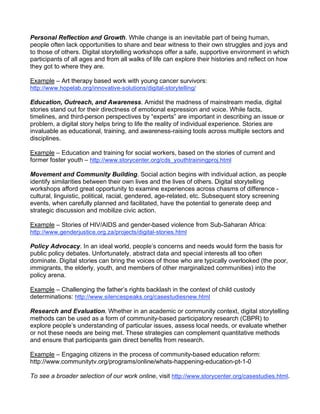
We offer below a model that outlines a continuum of strategies for utilizing digital stories –
from those created to support the individual healing and growth of workshop participants, to
those shared in the service of broader agendas for heath, equity, and justice.
Personal Reflection and Growth. While change is an inevitable part of being human,
people often lack opportunities to share and bear witness to their own struggles and joys and
to those of others. Digital storytelling workshops offer a safe, supportive environment in which
participants of all ages and from all walks of life can explore their histories and reflect on how
they got to where they are.

Example – Art therapy based work with young cancer survivors:
http://www.hopelab.org/innovative-solutions/digital-storytelling/

Education, Outreach, and Awareness. Amidst the madness of mainstream media, digital
stories stand out for their directness of emotional expression and voice. While facts,
timelines, and third-person perspectives by “experts” are important in describing an issue or
problem, a digital story helps bring to life the reality of individual experience. Stories are
invaluable as educational, training, and awareness-raising tools across multiple sectors and
disciplines.

Example – Education and training for social workers, based on the stories of current and
former foster youth – http://www.storycenter.org/cds_youthtrainingproj.html

Movement and Community Building. Social action begins with individual action, as people
identify similarities between their own lives and the lives of others. Digital storytelling
workshops afford great opportunity to examine experiences across chasms of difference -
cultural, linguistic, political, racial, gendered, age-related, etc. Subsequent story screening
events, when carefully planned and facilitated, have the potential to generate deep and
strategic discussion and mobilize civic action.

Example – Stories of HIV/AIDS and gender-based violence from Sub-Saharan Africa:
http://www.genderjustice.org.za/projects/digital-stories.html

Policy Advocacy. In an ideal world, people’s concerns and needs would form the basis for
public policy debates. Unfortunately, abstract data and special interests all too often
dominate. Digital stories can bring the voices of those who are typically overlooked (the poor,
immigrants, the elderly, youth, and members of other marginalized communities) into the
policy arena.

Example – Challenging the father’s rights backlash in the context of child custody
determinations: http://www.silencespeaks.org/casestudiesnew.html

Research and Evaluation. Whether in an academic or community context, digital storytelling
methods can be used as a form of community-based participatory research (CBPR) to
explore people’s understanding of particular issues, assess local needs, or evaluate whether
or not these needs are being met. These strategies can complement quantitative methods
and ensure that participants gain direct benefits from research.

Example – Engaging citizens in the process of community-based education reform:
http://www.communitytv.org/programs/online/whats-happening-education-pt-1-0

To see a broader selection of our work online, visit http://www.storycenter.org/casestudies.html.

D smethods overview1

  • 1.
    listen deeply •tell stories Center for Digital Storytelling • 1803 Martin Luther King Jr. Way • Berkeley, CA • 94709 www.storycenter.org Digital Storytelling: A Methodology for Individual and Community Transformation There are many ways to make media and many reasons for making it. Everyone has powerful stories to tell -- the ritual of sharing personal insights and experiences can be immensely valuable to both those speak and those who bear witness. People who believe they are mundane, uninteresting, or unmemorable possess beneath this mask a vivid, complex, and rich body of stories just waiting to be told. Over the past ten years, digital storytelling has emerged as an important participatory media production method used in a variety of community, health, educational, and academic research settings. Since we began this work in the early 1990s, The Center for Digital Storytelling (CDS) has drawn from well-established traditions in the fields of popular education, oral history, participatory communications, public health, and, most recently, what has been called “citizen journalism,” to train and work with small groups of people around the world, on the process and production of short, first-person video pieces that document a wide range of culturally and historically embedded stories. The Center’s work is guided by a strong commitment to offering non-threatening production environments in which the process of creating digital work is just as meaningful as the stories created. We support the individual learning styles of workshop participants rather than insisting on uniform methods. We also believe that making stories is just the first step, which means that coming up with meaningful ways for them to be shared and listened to is a core aspect of our work. Whether in local communities, online, or at the institutional/policy level, our partnerships across the globe have shown us that stories have the power to make a real difference in people’s lives. We offer below a model that outlines a continuum of strategies for utilizing digital stories – from those created to support the individual healing and growth of workshop participants, to those shared in the service of broader agendas for heath, equity, and justice.
  • 2.
    Personal Reflection andGrowth. While change is an inevitable part of being human, people often lack opportunities to share and bear witness to their own struggles and joys and to those of others. Digital storytelling workshops offer a safe, supportive environment in which participants of all ages and from all walks of life can explore their histories and reflect on how they got to where they are. Example – Art therapy based work with young cancer survivors: http://www.hopelab.org/innovative-solutions/digital-storytelling/ Education, Outreach, and Awareness. Amidst the madness of mainstream media, digital stories stand out for their directness of emotional expression and voice. While facts, timelines, and third-person perspectives by “experts” are important in describing an issue or problem, a digital story helps bring to life the reality of individual experience. Stories are invaluable as educational, training, and awareness-raising tools across multiple sectors and disciplines. Example – Education and training for social workers, based on the stories of current and former foster youth – http://www.storycenter.org/cds_youthtrainingproj.html Movement and Community Building. Social action begins with individual action, as people identify similarities between their own lives and the lives of others. Digital storytelling workshops afford great opportunity to examine experiences across chasms of difference - cultural, linguistic, political, racial, gendered, age-related, etc. Subsequent story screening events, when carefully planned and facilitated, have the potential to generate deep and strategic discussion and mobilize civic action. Example – Stories of HIV/AIDS and gender-based violence from Sub-Saharan Africa: http://www.genderjustice.org.za/projects/digital-stories.html Policy Advocacy. In an ideal world, people’s concerns and needs would form the basis for public policy debates. Unfortunately, abstract data and special interests all too often dominate. Digital stories can bring the voices of those who are typically overlooked (the poor, immigrants, the elderly, youth, and members of other marginalized communities) into the policy arena. Example – Challenging the father’s rights backlash in the context of child custody determinations: http://www.silencespeaks.org/casestudiesnew.html Research and Evaluation. Whether in an academic or community context, digital storytelling methods can be used as a form of community-based participatory research (CBPR) to explore people’s understanding of particular issues, assess local needs, or evaluate whether or not these needs are being met. These strategies can complement quantitative methods and ensure that participants gain direct benefits from research. Example – Engaging citizens in the process of community-based education reform: http://www.communitytv.org/programs/online/whats-happening-education-pt-1-0 To see a broader selection of our work online, visit http://www.storycenter.org/casestudies.html.