00
'
I
0:::
(Y)•
'
l.()
(Y)
u
<(
without license from IHS
Report on Foundations
for Dynamic Equipment
Reported by ACI Committee 351
� American Concrete Institute
� acI • Always advancing
�
Licensee=Chongqing Institute of quality and Standardizationb 5990390
Not for Resale, 2018/6/28 12:40:39
American Concrete Institute
Always advancing
First Printing
January 2018
ISBN: 978-1-945487-98-9
Report on Foundations for Dynamic Equipment
Copyright by the American Concrete Institute, Farmington Hills, MI. All rights reserved. This material
may not be reproduced or copied, in whole or part, in any printed, mechanical, electronic, film, or other
distribution and storage media, without the written consent of ACI.
The technical committees responsible for ACI committee reports and standards strive to avoid
ambiguities, omissions, and errors in these documents. In spite of these efforts, the users of ACI
documents occasionally find information or requirements that may be subject to more than one
interpretation or may be incomplete or incorrect. Users who have suggestions for the improvement of
ACI documents are requested to contact ACI via the errata website at http://concrete.org/Publications/
DocumentErrata.aspx. Proper use of this document includes periodically checking for errata for the most
up-to-date revisions.
ACI committee documents are intended for the use of individuals who are competent to evaluate the
significance and limitations of its content and recommendations and who will accept responsibility for
the application of the material it contains. Individuals who use this publication in any way assume all
risk and accept total responsibility for the application and use of this information.
All information in this publication is provided "as is" without warranty of any kind, either express or
implied, including but not limited to, the implied warranties of merchantability, fitness for a particular
purpose or non-infringement.
ACI and its members disclaim liability for damages of any kind, including any special, indirect, incidental,
or consequential damages, including without limitation, lost revenues or lost profits, which may result
from the use of this publication.
It is the responsibility of the user of this document to establish health and safety practices appropriate
to the specific circumstances involved with its use. ACI does not make any representations with regard
to health and safety issues and the use of this document. The user must determine the applicability of
all regulatory limitations before applying the document and must comply with all applicable laws and
regulations, including but not limited to, United States Occupational Safety and Health Administration
(OSHA) health and safety standards.
Par,ticipation by governmental representatives in the work of the American Concrete Institute and in
the development of Institute standards does not constitute governmental endorsement of ACI or the
standards that it develops.
Order information: ACI documents are available in print, by download, through electronic subscription,
or reprint and may be obtained by contacting ACI.
Most ACI standards and committee reports are gathered together in the annually revised the ACI
Collection of Concrete Codes, Specifications, and Practices.
American Concrete Institute
38800 Country Club Drive
Farmington Hills, MI 48331
Phone: +1.248.848.3700
Fax: +1.248.848.3701
American Concrete Institute
Provided by IHS Markit under license with ACI
No reproduction or networking permitted without license from IHS
www.concrete.org
Licensee=Chongqing Institute of quality and Standardizationb 5990390
Not for Resale, 2018/6/28 12:40:39
ACI 351.3R-18
Report on Foundations for Dynamic Equipment
Reported by ACI Committee 351
Omesh B. Abhat'
William L. Bounds'
William D. Brant'
Michael M. Chehab
Shu-Jin Fang'
Fred R. Goodwin
Mukti L. Das', Chair
Ping Jiang
David Kerins'
Hoan-Kee Kim
Robert R. McGlohn
Abbas Mokhtar-Zadeh
Carl A. Nelson'
Susan lsble', Secretary
Richard O'Malley
Michael A. Paipal
Ira W. Pearce
William E. Rushing Jr.
Larry W. Schulze'
Widianto'
F. Alan Wiley
Sheng-Chi Wu
Curtis R. Yokoyama
Consulting Members
Navin N. Pandya Shamsher Prakash Robert L. Rowan Jr.
The committee would like to thank the following people for their contribution to this report: H. Liu,' C. Coronado,' and X. Wang.'
'indicates members ofthe subcommittee who prepared the report.
This report presents to industry practitioners the various design
criteria and methods and procedures of analysis, design, and
construction applied to foundations for dynamic equipment.
Keywords: amplitude; foundation; reinforcement; vibration.
CONTENTS
CHAPTER 1-INTRODUCTION, p. 2
1 . 1-Background, p. 2
1 .2-Purpose, p. 2
1 .3-Scope, p. 2
CHAPTER 2-NOTATION AND DEFINITIONS, p. 3
2.1-Notation, p. 3
2.2-Definitions, p. 5
CHAPTER 3-FOUNDATION AND MACHINE
TYPES, p. 5
3.1-Genera1 considerations, p. 5
ACI Committee Reports, Guides, and Commentaries are
intended for guidance in planning, designing, executing, and
inspecting construction. This document is intended for the use
of individuals who are competent to evaluate the significance
and limitations of its content and recommendations and who
will accept responsibility for the application of the material it
contains. The American Concrete Institute disclaims any and
all responsibility for the stated principles. The Institute shall
not be liable for any loss or damage arising therefrom.
Reference to this document shall not be made in contract
documents. If items found in this document are desired by
the Architect/Engineer to be a part of the contract documents,
they shall be restated in mandatory language for incorporation
by the Architect/Engineer.
3.2-Machine types, p. 5
3.3-Foundation types, p. 6
CHAPTER 4-DESIGN LOADS, p. 8
4. 1-0verview of design loads and criteria, p. 8
4.2-Static machine loads, p. 9
4.3-Dynamic machine loads, p. 11
4.4-Environmental loads, p. 17
4.5-Load conditions, p. 17
4.6-Load combinations, p. 18
CHAPTER 5-IMPEDANCE OF THE SUPPORTING
MEDIUM, p. 18
5.1-0verview and use of soil impedance, p. 18
5.2-Basic dynamic concepts, p. 19
5.3-Calculation of dynamic foundation impedances,
p. 2 1
5.4-Dynamic impedance of soil-supported foundations,
p. 22
5.5-Dynamic impedance ofpile foundations, p. 28
5.6-Transformed impedance relative to center ofgravity,
p. 35
5.7-Added mass concept, p. 35
5.8-Sample impedance calculations, p. 36
ACI 351.3R-18 supersedes ACI 351.3R-04 and was adopted and published January
2018.
Copyright© 2018, American Concrete Institute.
All rights reserved including rights of reproduction and use in any form or by
any means, including the making of copies by any photo process, or by electronic
or mechanical device, printed, written, or oral, or recording for sound or visual
reproduction or for use in any knowledge or retrieval system or device, unless
permission in writing is obtained from the copyright proprietors.
American Concrete Institute
Provided by IHS Markit under license with ACI
Licensee=Chongqing Institute of quality and Standardizationb 5990390
Not ftr Resale, 2018/6/28 12:40:39
No reproduction or networking permitted without license from IHS
2 REPORT ON FOUNDATIONS FOR DYNAMIC EQUIPMENT (ACI 351.3R-18)
CHAPTER 6-VIBRATION ANALYSIS AND
ACCEPTANCE CRITERIA, p. 40
6. 1-0verview, p. 40
6.2-Modeling for rigid foundations, p. 41
6.3-Modeling for flexible foundations, p. 42
6.4-Solution methods, p. 46
6.5-Frequency analysis, p. 49
6.6-Forced response analysis, p. 50
6.7-Sample calculations, p. 52
CHAPTER 7-DESIGN AND MATERIALS, p. 56
7.!-Overview of design methods, p. 56
7.2-Concrete, p. 59
7.3-Reinforcement, p. 61
7.4-Machine anchorage, p. 62
7.5-Elastic support systems, p. 63
7.6-Grout, p. 63
7.7-Seismic design considerations, p. 64
7.8-Fatigue considerations, p. 64
7.9-Special considerations for compressor block post­
tensioning, p. 64
7. 10-Sample calculations, p. 64
CHAPTER a-CONSTRUCTION
CONSIDERATIONS, p. 67
8.1-Subsurface preparation and improvement, p. 67
CHAPTER 9-REPAIR AND UPGRADE, p. 67
9. 1-0verview ofneed for repair, p. 67
9.2-Discussion ofrepair options, p. 68
CHAPTER 10-REFERENCES, p. 69
Authored documents, p. 71
APPENDIX A-DYNAMIC SOIL PROPERTIES, p. 73
A. l-Poisson's ratio, p. 73
A.2-Dynamic shear modulus, p. 74
A.3-Soil damping, p. 75
A.4-Radiation damping, p. 76
CHAPTER 1-INTRODUCTION
1.1-Background
Machinery with rotating, reciprocating, or impacting
masses requires a foundation that can resist dynamic forces.
Precise machine alignment should be maintained, and foun­
dation vibrations should be controlled to ensure proper func­
tioning ofthe machinery during its design service life.
Successful design ofsuch foundations for dynamic equip­
ment involves close collaboration and cooperation among
machine manufacturers, geotechnical engineers, engineers,
owners, and construction personnel. Because different
manufacturers may have very different foundation accep­
tance criteria and their own practices with regards to foun­
dation design requirements, strict adherence to ACI 3 1 8
alone may not be necessarily appropriate for certain foun­
dations that support heavy industrial equipment, such as
steam turbine generators, combustion turbine generators, or
compressors. In addition, different practicing engineering
firms may use design approaches based on past successful
performance of foundations, even though these may not
be the most economical designs. Therefore, this report
summarizes current design practices to present a common
approach, in principle, for various types of concrete founda­
tions supporting dynamic equipment.
Compared to the previous edition, this document has been
reorganized to make the document more systematic and
user-friendly. More detailed information on the following
subjects has been added on the behavior of foundations
subjected to dynamic machine forces:
a) Impedance of the supporting medium (both soil­
supported and pile-supported foundations)
b) General overview of vibration analysis (including
finite-element modeling) and acceptance criteria, including
finite-element analysis
c) Determination of various soil properties required for
dynamic analysis ofmachine foundations
Example problems have been reworked and improved
with some additional details to better illustrate the imple­
mentation of the calculation procedure in a manual calcula­
tion. Latest relevant references have been added to capture
the current practice.
1.2-Purpose
The purpose ofthis report is topresentgeneral guidelines and
current engineering practices in the analysis and design ofrein­
forced concrete foundations supporting dynamic equipment.
This report presents and summarizes, with reference
materials, various design criteria, methods and procedures
of analysis, and construction practices currently applied to
dynamic equipment foundations by industry practitioners.
1.3-Scope
This document is limited in scope to the engineering,
construction, repair, and upgrade of concrete foundations
for dynamic equipment. For the purposes of this document,
dynamic equipment includes the following:
a) Rotating machinery
b) Reciprocating machinery
c) Impact or impulsive machinery
ACI 3 5 1 . 1R provides an overview of current design prac­
tice on grouting. Design practices for foundations supporting
static equipment are discussed in ACI 35 1 .2R.
There are many technical areas that are common to both
dynamic equipment and static equipment foundations.
Various aspects of the analysis design and construction
of foundations for static equipment are addressed in ACI
351 .2R. To simplify the presentation, this report is limited in
scope to primarily address the design and material require­
ments that are pertinent only to dynamic equipment foun­
dations. Engineers are advised to refer to ACI 351.2R for
more information on the foundation design criteria (static
loadings, load combinations, design strength, stiffness, and
stability) and design methods for static loads. In particular,
ACI 351 .2R provides detailed coverage on the design of
anchorage of equipment to concrete foundations. Note that
American Co ete Ins Licensee=Chongqing Institute of quality and Standardizationb 5990390
Provided by I ftQJn r license with ACI American Concrete Institute- Copyright� @>fMate'l'laf6L21W�oncrete.org
No reproduction��or mg permitted without license from IHS
REPORT ON FOUNDATIONS FOR DYNAMIC EQUIPMENT (ACI 351.3R-18) 3
ACI 351.2R was published prior to a major revision to ACI
3 1 8 and some of the section numbers that it references in
ACI 3 1 8 may have changed.
CHAPTER 2-NOTATION AND DEFINITIONS
2.1-Notation
A steady-state vibration amplitude, in. (mm)
Ahead,
Acrank=
Ap =
a, b =
B;
Emf=
BM =
B,.
b�, bz=
c
head and crank areas, in.2 (mm2)
cross-sectional area ofthe pile, in.2 (mm2)
plan dimension of a rectangular foundation, ft (m)
dimensionless frequency
cylinder bore diameter, in. (mm)
mass ratio for the i-th direction
machine footprint width, ft (m)
width ofmat foundation, ft (m)
ram weight, tons (kN)
constants 0.425 and 0.687, respectively
damping coefficient or total damping at center of
resistance
[C] damping matrix
CCR = critical damping coefficient
C
n,C
;2= dimensionless stiffness and damping parameters,
subscription i = u, v, jl, YJ
c viscous damping constant, lbf-s/ft (N-s/m)
c
; damping constant for the i-th direction
c
; (adj) = adjusted damping constant for the i-th direction
cu = equivalent viscous damping of pile j in the i-th
direction
CG= center ofgravity
CF center of force
Cg; pile group damping in the i-th direction
D damping ratio
D; damping ratio for the i-th direction
Drod= rod diameter, in. (mm)
d pile diameter, in (mm)
ds displacement ofthe slide, in. (mm)
dmf distance from machine shaft centerline to top of
foundation, ft (m)
E static Young's modulus of concrete, psi (MPa)
Ed dynamic Young's modulus of concrete, psi (MPa)
EP Young's modulus ofthe pile, psi (MPa)
em mass eccentricity, in. (mm)
F peak value of harmonic dynamic load (force or
moment)
F1 correction factor
Fblock= force acting outward on the block from which
concrete stresses should be calculated, lbf(N)
(FbottkHc = force to be restrained by friction at the crosshead
guide tie-down bolts, lbf(N)
(FbotJJrame = force to be restrained by friction at the frame
tie-down bolts, lbf (N)
FD = damper force, lbf(N)
FGMAx= maximum horizontal gas force on a throw or
cylinder, lbf (N)
F1M� maximum horizontal inertia force on a throw or
cylinder, lbf (N)
force in vibration isolator spring, lbf (N)
dynamic force amplitude (zero-to-peak), lbf (N)
lateral/longitudinal pseudo-dynamic design force,
lbf (N)
Fpv vertical pseudo-dynamic design force, lbf (N)
F,. maximum horizontal dynamic force, lbf (N)
Fred = force reduction factor to account for the fraction of
individual cylinder load carried by the compressor
frame (frame rigidity factor)
Frod = force acting on piston rod, lbf(N)
Fs = dynamic inertia force of slide, lbf (N)
FrHRovF horizontal force to be resisted by each throw's
anchor bolts, lbf (N)
F(t)= generic representation of time-varying load (force
or moment) horizontal
Funbatance= maximum value applied using parameters for a
horizontal compressor cylinder, lbf (N)
fc' specified concrete compressive strength, psi (MPa)
f
n,Ji2= dimensionless pile stiffness and damping functions
for the i-th direction
K
[KJ
K'
Ku*=
operating speed, rpm
dynamic shear modulus of the soil, psi (MPa)
torsional stiffness ofthe pile, lbf-ft2 (N-m2)
dynamic shear modulus of the embedment (side)
material, psi (MPa)
depth of soil layer, ft (m)
gross area moment of inertia, in.2 (mm2)
moment of inertia of the pile cross section in.4
(mm4)
-1-1
directional indicator or modal indicator, as a
subscript
stiffness or total stiffness at center ofresistance, lbf/
ft (N/m) or lbf-ft/rad (N-m/rad)
stiffness matrix
total stiffness at center of gravity, lb£'ft (N/m) or
lbf-ft/rad (N-m/rad)
impedance in the i-th direction due to a displace­
ment in thej-th direction
actual negative stiffness, lbf/ft (N/m) or lbf-ft/rad
(N-m/rad)
arbitrary chosen positive stiffness value (typically
set equal to the static stiffness), lbf/ft (N/m) or
lbf-ft/rad (N-m/rad)
effective bearing stiffness, lbf/in. (N/mm)
static soil stiffness, lbf/in3 (N/m3)
pile group coupling impedance
pile group horizontal impedance
pile group vertical impedance
pile group rocking impedance
individual pile stiffness at center of resistance, lbf/
ft (N/m) or lbf-ft/rad (N-m/rad)
impedance in the i-th direction due to embedment
pile group stiffness in the i-th direction, lbf/ft (N/m)
or lbf-ft/rad (N-m/rad)
static stiffness for the i-th direction, lbf/ft (N/m) or
lbf-ft/rad (N-m/rad)
American Concrete Institute
Provided by IHS Markit under license with ACI
No reproduction or networking permitted without license from IHS
Licensee=Chongqing Institute of quality and Standardizationb 5990390
American Concrete Institute- Copytri!!lflt�.@11Wlfe¥i11�3!l www.concrete.org
4 REPORT ON FOUNDATIONS FOR DYNAMIC EQUIPMENT (ACI 351.3R-18)
k
;' frequency-dependent impedance in the i-th
direction
k
; (adj) = adjusted static stiffness for the i-th direction, lbf/ft
(N/m) or lbf-ft/rad (N-m/rad)
k
;' (adj)= adjusted frequency-dependent impedance in the
i-th direction
k
u stiffness ofpile) in the i-th direction, lbf/ft (N/m) or
lbf-ft/rad (N-m/rad)
ks
kst
ku
*
kv*
k./
�·
k(w)=
L
lp
M
[MJ =
M =
0
MR =
M,.
Mres=
Mt;
m
m,.
mrec
static stiffness of an individual pile j in the i-th
direction, lbf/ft (N/m) or lbf-ft/rad (N-m/rad)
soil modulus of subgrade reaction, lbf/in3 (N/m3)
static stiffness constant
horizontal impedance of supporting medium
vertical impedance of supporting medium
rocking impedance ofsupporting medium
torsional impedance of supporting medium
frequency (w)-dependent dynamic impedance
length ofconnecting rod, in. (mm)
greater plan dimension of the mat foundation, ft
(m)
machine footprint length, ft (m)
lateral distance from center of resistance to indi­
vidual piles, ft (m)
depth of embedment, ft (m)
pile length, ft (m)
mass, Ibm (kg)
mass matrix
hammer mass, including any auxiliary foundation,
Ibm (kg)
overturning moment on foundation, lbf-ft (N-m)
mass ratio of concrete foundation to machine
ram mass, including dies and ancillary parts, Ibm
(kg)
foundation overturning resistance, lbf-ft (N-m)
added mass, Ibm (kg)
mass ofthe machine-foundation system; Ibm (kg)
slide mass including the effects of any balance
mechanism, Ibm (kg)
rotating mass, Ibm (kg)
reciprocating mass in a reciprocating machine, Ibm
(kg)
m,v1 rotating mass in a reciprocating machine, Ibm (kg)
m5 = added mass (inertial), Ibm (kg)
N number ofpiles
(NboltkHc = number of bolts holding down one cross-
head guide
(Nbo!t)frame = number of bolts holding down the frame, per
cylinder
NT = normal torque, lbf-ft (N-m)
PALL= allowable bearing pressure, ksf (kPa)
Phead,
Pcrank= instantaneous head and crank pressures, psi (MPa)
Pmax= maximum bearing pressure, ksf(kPa)
Ps power being transmitted by the shaft at the connec­
tion, horsepower (kilowatts)
R circular foundation radius, equivalent translation
radius ofrectangular foundation, ft (m)
R; equivalent radius ofrectangular foundation, ft (m)
R'¥a' R>¥b = equivalent rocking radius of foundation about a-
and b-axis, respectively, ft (m)
R� equivalent torsional radius of foundation, ft (m)
r length ofcrank, in. (mm)
r; radius of the crank mechanism of the i-th cylinder,
in. (mm)
r0 pile radius or equivalent radius, in. (mm)
S press stroke, in. (mm)
Sa11 allowable foundation settlement, in. (mm)
s1 service factor, used to account for increasing unbal-
ance during the design service life ofthe machine
sil , si2 = dimensionless stiffness and damping parameters
for side layer, subscription i = u, v, "'' 11
Smax = maximum foundation settlement, in. (mm)
SVR = seismic shear force due to the rigid foundation and
other rigid components, lbf (N)
SVs = seismic shear force due to the superstructure,
machine and other flexible components, lbf (N)
SVseismic=total seismic shear force machine-foundation
system, lbf (N)
s pile center-to-center spacing, ft (m)
[T] transfer matrix
TM mat foundation thickness, ft (m)
T,11;11 = minimum required anchor bolt tension, lbf (N)
u
Vmax=
Vpeak=
VRMs=
vs
y
y
'
(ji)=
y
"
(ji)=
Yc
Ye
time, s
displacement amplitude, in. (mm)
peak displacement amplitude, in. (mm)
compressive velocity ofa pile, ft/s (m/s)
transmissibility factor
Lysmer's analog wave velocity, ft/second (m/s)
maximum allowable bearing vibration, in. (mm)
peak velocity, in./s (mm/s)
root mean square velocity, in./s (mm/s)
shear wave velocity ofthe soil, ft/s (m/s)
post-impact hammer velocity, in./s (mm/s)
reference velocity = 18.4 ft/s (5.6 m/s) from a free
fall of 5.25 ft ( 1 .6 m)
ram impact velocity, ft/s (m/s)
equipment weight at anchorage location, lbf (N)
weight ofthe foundation, tons (kN)
machine weight, tons (kN)
rotating weight, lbf (N)
generic representation of displacement (transla­
tional or rotational), in. (mm) or rad
generic representation of velocity (translational or
rotational), in./s (mm/s) or rad/s
generic representation ofacceleration (translational
or rotational), in./s2 (mm/s2) or rad/s2
crank pin displacement in local y-axis, or distance
from the center of gravity to the base support, in.
(mm)
distance from the center of gravity to the level of
embedment resistance, ft (m)
crank pin displacement in local z-axis, in. (mm)
piston displacement, in. (mm)
angle between battered piles and vertical piles, rad
ram rebound velocity to impact velocity ratio
American Co ete Ins Licensee=Chongqing Institute of quality and Standardizationb 5990390
Provided by I ftQJn r license with ACI American Concrete Institute- Copyright� @>fMate'l'laf6L21W�oncrete.org
No reproduction��or mg permitted without license from IHS
REPORT ON FOUNDATIONS FOR DYNAMIC EQUIPMENT (ACI 351.3R-18) 5
U;
aj
�i
�j
'
yj=
�m
pile dynamic interaction factor in the i-th direction,
subscription i = z (axial), HH (horizontal), MM (in
phase rocking), MH (sway rocking)
coefficients,}= 1
rectangular footing coefficient for the i-th direction
coefficients,}= 1 to 4
material damping ratio
concrete density, lbf/ft3 (kN/m3)
phase angle
mode shape vector
mode shape factor
tuning ratio
phase angle, or angle between the direction ofload
action and the plane in which piles lie, rad
soil mass density, lbm/ft3 (kg/m3)
pile mass density, lbm/ft3 (kg!m3)
peak amplitude (translational or rotational), in. or
rad
coefficient offriction
Poisson's ratio ofthe soil
w circular frequency of motion, rad/s
wd damped circular natural frequency, rad/s
ffi; undamped circular natural frequency for the i-th
mode, rad/s
ffi11 undamped circular natural frequency, rad/s
W0 circular operating frequency of a machine or other
driving force, rad/s
ffisu. ffisv =circular natural frequencies of a soil layer in hori­
zontal (u) and vertical (v) directions, rad/s
u, v,
ljl, 11 = subscriptions used for notating horizontal, vertical,
rocking, and torsional direction, respectively
2.2-Definitions
Please refer to the latest version ofACI Concrete Termi­
nology for a comprehensive list of definitions. Definitions
provided herein complement that resource.
root cause analysis-collective termthatdescribes a wide
range of approaches, tools, and techniques used to uncover
causes ofproblems.
CHAPTER 3-FOUNDATION AND MACHINE TYPES
3.1-General considerations
The type, configuration, and installation ofa foundation or
support structure for dynamic machinery may depend on the
following factors:
a) Site conditions such as soil characteristics, topography,
seismicity, climate, and other effects
b) Machine base configuration such as frame size, cylinder
supports, pulsation bottles, drive mechanisms, and exhaust
ducts
c) Process requirements such as elevation requirements
with respect to connected process equipment and support
requirements for piping
d) Anticipated loads such as the equipment static weight,
along with loads developed during construction, startup,
operation, shutdown, and maintenance
e) Allowable amplitudes ofvibration associated with each
dynamic load case
f) Construction requirements such as limitations or
constraints imposed by construction equipment, procedures,
techniques, or the sequence ofconstruction
g) Operational requirements such as accessibility, settle­
ment limitations, temperature effects, and drainage
h) Maintenance requirements such as temporary access,
laydown space, in-plant crane capabilities, and machine
removal considerations
i) Regulatory factors, owner requirements, or building
code provisions such as tied pile caps in seismic zones
j) Economic factors such as capital cost, useful or design
service life, and replacement or repair cost
k) Environmental requirements such as secondary contain­
ment or special concrete coating requirements
1) Recognition that certain machines, particularly large
reciprocating compressors, rely on the foundation to add
strength and stiffness that is not inherent in the structure of
the machine
3.2-Machine types
3.2.1 Rotating machinery-This category includes
gas turbines, steam turbines, and other expanders; turbo­
pumps and compressors; fans; motors; and centrifuges.
These machines are characterized by the motion ofrotating
components.
Unbalanced forces in rotating machines are created when
the mass centroid oftherotatingcomponent does not coincide
with the center of rotation (Fig. 3.2. 1 ). This dynamic force
is a function ofthe mass ofthe rotating component, speed of
rotation, and the magnitude ofthe eccentricity ofoffset. The
offset or eccentricity should be minor under manufactured
conditions when the machine is well balanced, clean, and
without wear or erosion. Changes in alignment, operation
near resonance, turbine blade loss, and other malfunctions or
undesirable conditions can greatly increase the force applied
to its bearings by the rotor.
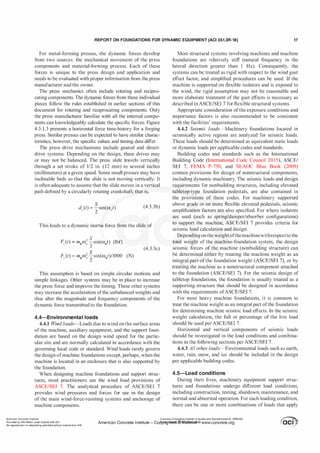
3.2.2 Reciprocating machinery-For reciprocating
machinery, such as compressors or diesel engines, a piston
moving in a cylinder interacts with a gas through the kine­
matics of a slider crank mechanism driven by, or driving,
a rotating crankshaft. Individual inertia forces from each
cylinder are inherently unbalanced with dominant frequencies
at one and two times the rotational frequency (Fig. 3.2.2).
of mass
Fig. 3.2.1-Rotating machine diagram.
American Concrete Institute
Provided by IHS Markit under license with ACI
No reproduction or networking permitted without license from IHS
Licensee=Chongqing Institute of quality and Standardizationb 5990390
American Concrete Institute- Copytri!!lflt�.@11Wlfe¥i11�3!l www.concrete.org
6 REPORT ON FOUNDATIONS FOR DYNAMIC EQUIPMENT (ACI 351.3R-18)
/Primary force
Cylinder head
Rotatio.@ Crankshaft
Fig. 3.2.2-Reciprocating machine diagram.
Primary and
.. ..
secondary
force
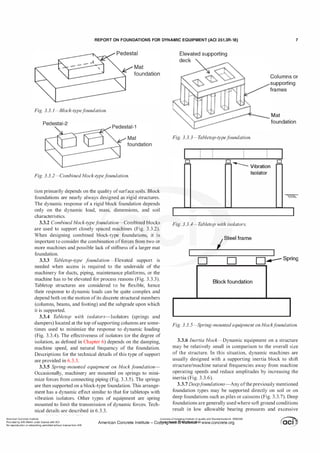
The unbalanced forces and moments generated by recip­
rocating machines with more than one piston are dependent
on the crank arrangement. The optimum crank arrangement
that minimizes loading is generally not possible because the
mechanical design will be optimized to satisfy the operating
requirements. This leads to piston/cylinder assemblies and
crank arrangements that do not completely counter-oppose;
therefore, unbalanced loads occur, which should be resisted
by the foundation.
Individual cylinder fluid forces act outward on the cylinder
head and inward on the crankshaft (Fig. 3.2.2). For a rigid
cylinder and frame, these forces are internally balanced in
the machine, but deformations of large machines can cause
a significant portion of the forces to be transmitted to the
mounts and into the foundation. Particularly on large recip­
rocating compressors with horizontal cylinders, it is inap­
propriate and unconservative to assume the compressor
frame and cylinder are sufficiently stiff to internally balance
all forces. Such an assumption has led to many inadequate
mounts for reciprocating machines.
3.2.3 Impulsive machinery-Equipment, such as forging
hammers and some metal-forming presses, operate with regu­
lated impacts or shocks between different parts of the equip­
ment. This shock loading is often transmitted to the foun­
dation system of the equipment and can propagate into the
surroundings and is a factor in the design ofthe foundation.
Closed die forging hammers typically operate by dropping
a weight (ram) onto hot metal, forcing it into a predefined
shape. While the intent is to use this impact energy to form
and shape the material, there is significant energy trans­
mission, particularly late in the forming process. During
these final blows, the material being forged is cooling and
less shaping takes place. Thus, pre-impact kinetic energy
of the ram converts to post-impact kinetic energy of the
entire forging hammer. As the entire hammer moves down­
ward, it becomes a simple dynamic mass oscillating on its
supporting medium. This system should be well damped so
that the oscillations decay sufficiently before the next blow.
Timing of the blows commonly range from 40 to 100 blows
per minute. The ramweights vary from a few hundred pounds
to 35,000 pounds (16 tons). Impact velocities in the range of
25 ft/s (7.6 rn/s) are common. Open die hammers operate in a
similar fashion but are often oftwo-piece construction with
a separate hammer frame and anvil.
Forging presses perform a similar manufacturing func­
tion as forging hammers but are commonly mechanically
or hydraulically driven. These presses form the material at
t1 =Coupling
r-r-
f.- t2 = Downward Slide Motion
t3 =Bottom Dead Center w/o Impact
�
0
LL
ro
c
2
·.:::
0
I
-_ t4 = Upward Slide Motion
t5 = Decoupling
/
r-
!"
, I
0
I "'-. / I
lo.2 0.4 0.6 0.8 1.0 1.2 1.4 1.6
t1 t2 3
1. t4 ts
�
t1 Crankshaft Rotation =I
time
Fig. 3.2.3-Example ofaf
orcingf
unctionf
oraf
orgingpress.
low velocities but with greater forces. The mechanical drive
system generates horizontal dynamic forces that the engi­
neer should consider in the design of the support system.
Rocking stability of this construction is important. Figure
3 .2.3 shows a typical example of a horizontal forcing func­
tion through one full stroke of a forging press.
Mechanical metal forming presses operate by squeezing
and shearing metal between two dies. Because this equip­
ment can vary greatly in size, weight, speed, and operation,
forces and design criteria used for the foundation design can
vary greatly. Speeds can vary from 30 to 1800 strokes per
minute. Dynamic forces from the press develop from two
sources: the mechanical imbalance of the moving parts in
the equipment and the response of the press frame as the
material is sheared (snap-through forces). Imbalances in the
mechanics ofthe equipment can occur both horizontally and
vertically. Generally, high-speed equipment is well balanced.
Low-speed equipment is often not balanced because the
inertia forces at low speeds are small. The dynamic forces
generated by all of these presses can be significant as they
are transmitted into the foundation and propagate into the
subgrade.
3.2.4 Other machine rypes-Other machinery generating
dynamic loads include rock crushers and metal shredders.
While part of the dynamic load from these types of equip­
ment tend to be based on rotating imbalances, there are also
random characteristics to the dynamic forces that vary with
the particular operation and design.
3.3-Foundation types
3.3.1 Block-rype f
oundation-Dynamic machines are
preferably located close to grade to minimize the eleva­
tion difference between the machine dynamic forces and
the center of gravity of the machine-foundation system
(Fig. 3.3. 1). The low location also reduces the moments
due to horizontal forces. The ability to use such a founda-
REPORT ON FOUNDATIONS FOR DYNAMIC EQUIPMENT (ACI 351.3R-18) 7
Fig. 3.3. 1-Block-typef
oundation.
Pedestal-2
Fig. 3.3.2-Combined block-typef
oundation.
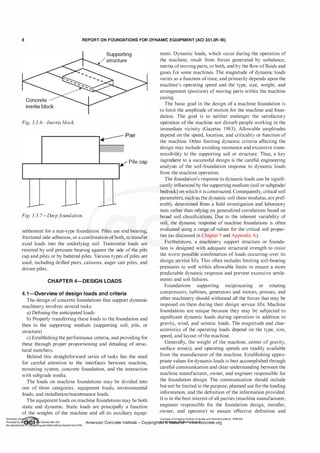
tion primarily depends on the quality ofsurface soils. Block
foundations are nearly always designed as rigid structures.
The dynamic response of a rigid block foundation depends
only on the dynamic load, mass, dimensions, and soil
characteristics.
3.3.2 Combined block-typef
oundation-Combined blocks
are used to support closely spaced machines (Fig. 3.3.2).
When designing combined block-type foundations, it is
important to consider the combination offorces from two or
more machines and possible lack of stiffness of a larger mat
foundation.
3.3.3 T
abletop-type f
oundation-Elevated support is
needed when access is required to the underside of the
machinery for ducts, piping, maintenance platforms, or the
machine has to be elevated for process reasons (Fig. 3.3.3).
Tabletop structures are considered to be flexible, hence
their response to dynamic loads can be quite complex and
depend both on the motion ofits discrete structural members
(columns, beams, and footing) and the subgrade upon which
it is supported.
3.3.4 T
abletop with isolators-Isolators (springs and
dampers) located at the top ofsupporting columns are some­
times used to minimize the response to dynamic loading
(Fig. 3.3.4). The effectiveness of isolators (or the degree of
isolation, as defined in Chapter 6) depends on the damping,
machine speed, and natural frequency of the foundation.
Descriptions for the technical details of this type of support
are provided in 6.3.3.
3.3.5 Spring-mounted equipment on block f
oundation­
Occasionally, machinery are mounted on springs to mini­
mize forces from connecting piping (Fig. 3.3.5). The springs
are then supported on a block-type foundation. This arrange­
ment has a dynamic effect similar to that for tabletops with
vibration isolators. Other types of equipment are spring
mounted to limit the transmission of dynamic forces. Tech­
nical details are described in 6.3.3.
Elevated supporting
deck
Columns or
supporting
frames
Mat
foundation
Fig. 3.3.3-T
abletop-typef
oundation.
D
r= .....___ Vibration
Isolator
I I
Fig. 3.3.4-T
abletop with isolators.
/Steel frame
D D
o� Spring
��----�=-----��
Block foundation
Fig. 3.3.5-S
pring-mounted equipment on blockf
oundation.
3.3.6 Inertia block-Dynamic equipment on a structure
may be relatively small in comparison to the overall size
of the structure. In this situation, dynamic machines are
usually designed with a supporting inertia block to shift
structure/machine natural frequencies away from machine
operating speeds and reduce amplitudes by increasing the
inertia (Fig. 3.3.6).
3.3.7 Deepf
oundations-Any ofthe previously mentioned
foundation types may be supported directly on soil or on
deep foundations such as piles or caissons (Fig. 3.3.7). Deep
foundations are generally usedwhere soft ground conditions
result in low allowable bearing pressures and excessive
American Concrete Institute
Provided by IHS Markit under license with ACI
No reproduction or networking permitted without license from tHS
Licensee=Chongqing Institute of quality and Standardizationb 5990390
American Concrete Institute- Copytri!!lflt�.@'IW!fe¥i11�3!l www.concrete.org
8 REPORT ON FOUNDATIONS FOR DYNAMIC EQUIPMENT (ACI 351.3R-18)
Concrete
inertia block
Fig. 3.3. 6-Inertia block.
Fig. 3.3. 7-Deepf
oundation.
Supporting
structure
Pier
Pile cap
settlement for a mat-type foundation. Piles use end bearing,
frictional side adhesion, or a combination ofboth, to transfer
axial loads into the underlying soil. Transverse loads are
resisted by soil pressure bearing against the side of the pile
cap and piles or by battered piles. Various types ofpiles are
used, including drilled piers, caissons, auger cast piles, and
driven piles.
CHAPTER 4-DESIGN LOADS
4.1-0verview of design loads and criteria
The design of concrete foundations that support dynamic
machinery involves several tasks:
a) Defining the anticipated loads
b) Properly transferring these loads to the foundation and
then to the supporting medium (supporting soil, pile, or
structure)
c) Establishing the performance criteria, and providing for
these through proper proportioning and detailing of struc­
tural members.
Behind this straightforward series of tasks lies the need
for careful attention to the interfaces between machine,
mounting system, concrete foundation, and the interaction
with subgrade media.
The loads on machine foundations may be divided into
one of three categories: equipment loads; environmental
loads; and installation/maintenance loads.
The equipment loads on machine foundations may be both
static and dynamic. Static loads are principally a function
of the weights of the machine and all its auxiliary equip-
ment. Dynamic loads, which occur during the operation of
the machine, result from forces generated by unbalance,
inertia ofmoving parts, orboth, and by the flow offluids and
gases for some machines. The magnitude of dynamic loads
varies as a function oftime; and primarily depends upon the
machine's operating speed and the type, size, weight, and
arrangement (position) of moving parts within the machine
casing.
The basic goal in the design of a machine foundation is
to limit the amplitude of motion for the machine and foun­
dation. The goal is to neither endanger the satisfactory
operation of the machine nor disturb people working in the
immediate vicinity (Gazetas 1983). Allowable amplitudes
depend on the speed, location, and criticality or function of
the machine. Other limiting dynamic criteria affecting the
design may include avoiding resonance and excessive trans­
missibility to the supporting soil or structure. Thus, a key
ingredient to a successful design is the careful engineering
analysis of the soil-foundation response to dynamic loads
from the machine operation.
The foundation's response to dynamic loads can be signifi­
cantly influenced by the supporting medium (soil or subgrade/
bedrock) on which it is constructed. Consequently, critical soil
parameters, such as the dynamic soil shear modulus, are pref­
erably determined from a field investigation and laboratory
tests rather than relying on generalized correlations based on
broad soil classifications. Due to the inherent variability of
soil, the dynamic response of machine foundations is often
evaluated using a range of values for the critical soil proper­
ties (as discussed in Chapter 5 and Appendix A).
Furthermore, a machinery support structure or founda­
tion is designed with adequate structural strength to resist
the worst possible combination of loads occurring over its
design service life. This often includes limiting soil-bearing
pressures to well within allowable limits to ensure a more
predictable dynamic response and prevent excessive settle­
ments and soil failures.
Foundations supporting reciprocating or rotating
compressors, turbines, generators and motors, presses, and
other machinery should withstand all the forces that may be
imposed on them during their design service life. Machine
foundations are unique because they may be subjected to
significant dynamic loads during operation in addition to
gravity, wind, and seismic loads. The magnitude and char­
acteristics of the operating loads depend on the type, size,
speed, and layout ofthe machine.
Generally, the weight of the machine, center of gravity,
surface area(s), and operating speeds are readily available
from the manufacturer of the machine. Establishing appro­
priate values fordynamic loads is best accomplished through
careful communication and clear understanding between the
machine manufacturer, owner, and engineer responsible for
the foundation design. The communication should include
but not be limited to the purpose, planned use for the loading
information, and the definition of the information provided.
It is in the best interest of all parties (machine manufacturer,
engineer responsible for the foundation design, installer,
owner, and operator)· ·to ensure· effective definition and
. . Licensee=Chongqing Institute of quality and Standardizationb 5990390
Amencan Concrete Institute- Copyright� @>fMate'l'laf6L21W�oncrete.org
REPORT ON FOUNDATIONS FOR DYNAMIC EQUIPMENT (ACI 351.3R-18) 9
communication of data and its appropriate use. Machines
always experience some level of unbalance, vibration, and
force transmitted through the bearings. Under some off­
design conditions, such as wear, the forces may increase
significantly. The machine manufacturer and engineer
responsible for the foundation design should work together
so that their combined knowledge achieves an integrated
machine-foundation system that robustly serves the needs of
its owner and operator and withstands design loads.
Usually the machine loads, including normal operation
loads, emergency loads, catastrophic loads, and accidental
loads, are provided by the machine manufacturer. Seismic
loads and their distribution pattern from machine to the foun­
dation at the machine support points should be provided by
the manufacturer based on the machine configuration and
mounting system. The total seismic loads for the foundation
analysis should include the seismic loads induced from the
machine mass and the seismic loads induced from foundation
concrete mass. However, the engineerresponsible forthe foun­
dation design should have a good understanding of each load
and how the seismic load is transferred to the foundation. The
machine seismic loads provided by the machine vendor may
need to be adjusted based on the seismic design code require­
ments. Seismic loads from the mat foundation are, in general,
out of phase from the seismic loads due to the machine and
superstructure, unless the machine or superstructure are rigid.
Therefore, the seismic shear due to the foundation and other
rigid members (SVR) and the seismic shear due to the super­
structure + machine and other flexible (SVs) members should
be calculated by similar combinations such as square root of
sum ofthe squares (SRSS) approach as follows
SVseismic = (SVi + SVi)05 (4. 1)
Close cooperation and coordination with the machine
vendor is essential for a successful foundation design.
Sections 4.2 to 4.4 provide some of the commonly used
loading descriptions, evaluations, or both, for determining
machine-induced forces and other design loads for foun­
dations supporting machinery. They include definitions
and other information on static and dynamic loads. These
loads should be provided by the machine manufacturer, and
alternative assumptions should be made when such data are
unavailable or are under-predicted.
4.2-Static machine loads
4.2.1 Dead loads-Amajor function ofthe foundation is to
supportgravity (dead) loads due to the weight ofthe machine,
auxiliary equipment, piping, valves, and dead weight of the
foundation structure. The weights of the machine compo­
nents are normally supplied by the machine manufacturer.
The distribution of the weight of the machine on the foun­
dation depends on the location of support points and on the
rigidity or flexibility of the machine frame. Typically, there
are multiple supportpoints and, thus, the distribution is stati­
cally indeterminate. In many cases, the machine manufac­
turer provides a loading diagram showing the vertical loads
at each support point. Sometimes the center ofgravity loca-
tion of the machine components provided by the machine
manufacturer can be used to distribute machine dead loads
to the supporting points.
Some machine manufacturers provide the weights of
turbine and generator at certain support points. These forces
are due to axial movements of the turbine-generator rotor
only at the bearing casing connection points ofthe combined
radial/axial bearing (thrust bearing). These weights should
be used in the dynamic analysis, seismic analysis, or both,
ofthe foundation.
4.2.2 Live loads-Live loads are produced by personnel,
tools, and maintenance equipment and materials. The live
loads used in design should be the maximum loads expected
duringthe design service life ofthe machine. Formost designs,
live loads are uniformly distributed over the floor areas of
platforms ofelevated support structures or to the access areas
around at-grade foundations. Typical live loads vary from
60 lbf/ft2 (3 kPa) for personnel to as much as 250 lbf/ft2 (12
kPa) for maintenance equipment and materials (ASCE/SEI
7). For steam turbine generator machines, it is common to
also consider a value of 400 to 500 lbf/ft2 (19 to 24 kPa) for
machine parts (such as rotors and casings) in a laydown area.
4.2.3 Normal operating loads-Static operating loads
include the weight of the machine contents during normal
operation. Static operating loads include forces such as the
drive torque developed by some machines at the connection
between the drive mechanism and driven machinery. Static
operating loads can also include forces caused by thermal
growth of the machinery equipment and connecting piping.
Time-varying (dynamic) loads generated by machines
during operation are covered in 4.3.
4.2.3.1 Operating torque loads-Machines such as
compressors, turbines, and generators require some form of
drive mechanism, either integral with the machine or sepa­
rate from it. When the drive mechanism is nonintegral, such
as a separate electric motor, reciprocating engine, and gas or
steam turbine, it produces a net external drive torque on the
driven machine. For turbine-generators, fluid or magnetic
coupling between the rotor and stator of the generator can
produce an overturning torque about the longitudinal axis
(shaft) equal in magnitude and opposite in direction on the
driver and driven machine. For example, the normal opera­
tional torque load from turbines is oriented in the opposite
direction to that of shaft rotation, whereas for the generator,
the normal operational torque load is oriented in the direc­
tion of shaft rotation (Fig. 4.2.3 . l a). The normal torque
(sometimes called drive torque) is generally applied to the
foundation as a static force couple in the vertical direction
acting about the centerline ofthe shaft ofthe machine based
on the highest expected output of the machine. The magni­
tude ofthe normal torque is often calculated as
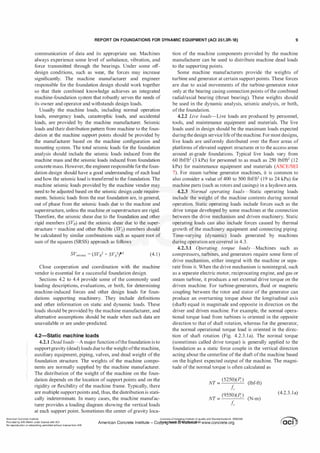
NT =
(5250)(P, )
(lbf-ft)
;;,
NT =
(9550)(P, )
(N-m)
;;,
(4.2.3 . l a)
American Concrete Institute
Provided by IHS Markit under license with ACI
No reproduction or networking permitted without license from IHS
Licensee=Chongqing Institute of quality and Standardizationb 5990390
American Concrete Institute- Copytri!!lflt�.@11Wlfe¥i11�3!l www.concrete.org
1 0 REPORT ON FOUNDATIONS F O R DYNAMIC EQUIPMENT (ACI 351.3R-18)
GAS
FLOW
�
+Z
MACIDNE
ROTATION
+Y
Fig. 4.2.3.Ja-Equivalentf
orcesf
or torque loads.
Shaft rotation
I. Spacing t
•�
�
,
Force = torque/spacing
Fig. 4.2.3. 1b-Equivalent f
orces f
or torque loads-torque
resisted by longitudinal equipment soleplates.
The torque load is generally resolved into a vertical force
couple by dividing itbythe center-to-center distance between
longitudinal soleplates or anchor points (Fig. 4.2.3. 1b).
When the machine is supported by transverse soleplates
only, the torque is applied along the width of the soleplate
assuming a straight line variation of force (Fig. 4.2.3.lc).
The torque on a generator stator is applied in the same
direction as the rotation of the rotor and can be high due to
startup or an electrical short circuit.
4.2.3.2 Condenser vacuum loads-For steam turbine­
generator machines, usually a condenser is connected to
the low-pressure (LP) turbine and may share one common
foundation with the steam turbine-generator. The condenser
generates vacuum loads on the steam turbine (LP turbine)
when an expansion joint is provided between the condenser
duct and the LP turbine exhaust neck. Condenser vacuum
loads are normally based on zero absolute pressure. The
vacuum loads can act vertically on the tabletop of the foun­
dation if the condenser is located directly below the LP
turbine, and it can also act laterally to the foundation if the
condenser is not located directly below the LP turbine. The
magnitude ofthe vacuum load can be estimated as the stan­
dard atmospheric pressure (14.7 psi [101.4 kPa]) times the
Shaft rotation
Width
Force/length = 6 x torque/width2
Fig. 4.2.3. 1c-Equivalent f
orces for torque loads-torque
resisted by transverse equipment soleplates.
neck duct opening area ofthe LP turbine. The vacuum loads
are normally supplied by the machine manufacturer.
4.2.3.3 Axial thrust loads-Axial loads result from gas­
flow momentum changes through gas turbines, or from the
pressure differences between the gas inlet and exhaust. These
loads generally are treated as a static load whose magnitude
varies depending on the normal operation level exhaust of
back pressure or shut-down level of exhaust back pressure.
The axial thrust loads are normally supplied by the machine
manufacturer.
4.2.3.4 Piping loads-Piping forces can be calculated
based on the pipe stress analysis, taking into account the
pipe weight (including insulation weight), fluid weight, fluid
dynamics, thermal expansion/contractions, valve opera­
tions, and environmental load conditions (seismic, wind, and
ice). These forces are transferred to the foundation by pipe
supports, attachments, or anchors attached to the foundation
along the piping system.
The piping load results from steam pipes and circulating
water pipes attached to the turbine sections. The resultant
piping loads acting on various points of support and guid­
ance for the turbine casing reach the foundation as forces.
During a valve trip, the turbine foundation can be subjected
to significant piping valve trip loads. The piping loads
usually are determined by the mechanical pipe engineers.
4.2.3.5 Thermal loads-Changing temperatures of
machines and their foundations cause expansions, contrac­
tions, and distortions, causing the various parts to try to
slide on the support surfaces. Thermal loads or self-straining
loads may be divided into one ofthree loads types:
a) Thermal friction loads
b) Thermal expansion/contraction loads
c) Temperature change and temperature gradient change
on the foundation member cross section
Licensee=Chongqing Institute of quality and Standardizationb 5990390
American Concrete Institute- Copyright� @>fMate'l'laf6L21W�oncrete.org
REPORT ON FOUNDATIONS FOR DYNAMIC EQUIPMENT (ACI 351.3R-18) 11
Thermal friction load occurs at the machine supports (at
sole plates) from static friction resistance to the thermal
movement of the machine components. The magnitude of
the resulting frictional forces depends on the magnitude of
the temperature change, the location ofthe supports, and on
the condition of the support surfaces. The thermal forces do
not impose a net force on the foundation to be resisted by
supporting medium (soil or piles) because the forces on any
surface are balanced by equal and opposite forces on other
support surfaces. Thermal forces, however, may govern the
design of the grout system, pedestals, and hold downs and
may cause thermal stresses in the supporting concrete struc­
tures, including girders, slabs, and columns/pedestals.
It is not possible to exactly calculate the exact thermal
loading because it depends on numerous factors, including
distance between anchor points, magnitude of temperature
change, the material properties, the condition of the sliding
surface, and the magnitude ofthe vertical load on each sole­
plate; it is, therefore, approximated. The static friction resis­
tance has to be overcome before thermal movements occurs
and many engineers use this value for the design loads. The
magnitude ofthe frictional load may be calculated as follows
friction force = (friction coefficient)
x (normal load acting through soleplate) (4.2.3.5)
The friction coefficient generally varies from 0.2 to 0.5.
Loads acting through the soleplate include machine dead
load, normaltorque load, anchor bolt load, and piping loads.
Normally, the expected thermal deflection at various bear­
ings is estimated by the manufacturer based on past field
measurements on existing units. The machine erector then
compensates for the thermal deflection during installation.
Mandke and Smalley (1989, 1992) and Smalley (1985)
illustrate the effects of thermal loads and deflections in the
concrete foundation ofa large reciprocating compressor and
their influence on the machine.
Heat transfer to the foundation can be by convection
across an air gap and by conduction through points ofphys­
ical contact. The resultant temperature gradients induce
deformations, strains, and stresses.
When evaluating thermal stress, the calculations are
strongly influenced by the stiffness and restraint against
deformation for the structural member in question. There­
fore, it is important to consider the self-relieving nature of
thermal stress due to deformation and concrete cracking to
prevent being overly conservative in the analysis. As the
thermal forces are applied to the foundation member by
the machine, the foundation member changes length and
thereby provides reduced resistance to the machine forces.
This phenomenon can have the effect ofreducing the thermal
forces from the machine.
Accurate determinations ofconcrete surface temperatures
significant means for dissipating heat, and its effect should
be included when establishing surface temperatures.
4.2.4 S
pecial loads for foundations-The following
special static load conditions are recommended in some
proprietary standards for large equipment on foundations to
ensure adequate strength and deflection control, especially
ifthe appropriate information is not provided by the equip­
ment manufacturer:
a) Vertical force equal to 50 percent of the total weight of
each machine
b) Horizontal force (in the transverse direction) equal to
25 percent ofthe total weight ofeach machine
c) Horizontal force (in the longitudinal direction) equal to
10 percent ofthe total weight ofeach machine
These forces are additive to normal gravity loads and
are considered to act at the centerline of the machine shaft.
Loads a, b, and c are not considered to act concurrently with
one another.
4.2.5 Construction and maintenance loads-Construction
(erection and installation), hydro test, and maintenance loads
are temporary loads required for installing or dismantling
machine components during erection or maintenance. Erec­
tion loads are usually furnished in the manufacturer's foun­
dation load drawing and should be used in conjunction with
other specified dead, live, and environmental loads. Mainte­
nance loads occur any time the equipment is being drained,
cleaned, repaired, and realigned or when the components are
being removed or replaced. Loads may result from mainte­
nance equipment, davits, and hoists. Guidance on construc­
tion loads is provided in ASCE/SEI 37. Environmental loads
can be reduced per ASCE/SEI 37 when combined with
maintenance or construction loads.
A hydro-test load is the weight of water or other fluid that
is placed temporarily into a vessel to confirm the integrity of
the equipment.
4.2.6 Machine catastrophic loads-Machine catastrophic
loads are caused by machine malfunction such as generator
short circuit, turbine loss-of-blade/loss-of-bucket or a bowed
rotor in a steam turbine. Catastrophic loads are generally
applied at the bearings of the machine shaft vertically or
horizontally and are not considered to act simultaneously
with seismic loads, as there is a very low probability ofthese
loads occurring at the same time. Often in the design for an
electrical-short-circuit-induced torque load, the emergency
drive torque is treated as an equivalent static load and the
magnitude is determined by applying a magnification factor
to the normal torque. Although these loads are time-depen­
dent, they are normally given as equivalent static loads to
simplify the foundation design efforts. These loads are
normally provided by the machine manufacturer. Consulta­
tion with the generator manufacturer is necessary to estab­
lish the appropriate magnification factor.
and thermal gradients are also important. Under steady- 4.3-Dynamic machine loads
state normal operating conditions, temperature distribu- 4.3.1 Rotary machine loads due to unbalanced masses-
tions across structural sections are usually linear. The air These rotating loads are generated by the rotating motion of
gap between the machine casing and foundation provides a one ormore impellers orrotors. Unbalanced forces inrotating
American Concrete Institute
Provided by IHS Markit under license with ACI
No reproduction or networking permitted without license from IHS
.
macliities are created when the mass centroid ofthe rotating
Licensee=Chongqing Institute of quality and Standardizationb 5990390
�
OC1. ..
.
•
American Concrete Institute- Copytri!!lflt�.@11Wlfe¥i11�3!l www.concrete.org � CCI j
1 2 REPORT ON FOUNDATIONS F O R DYNAMIC EQUIPMENT (ACI 351.3R-18)
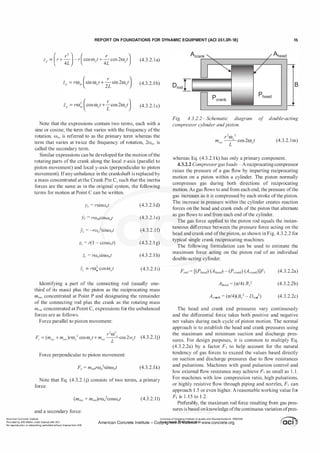
part does not coincide with the axis of rotation. In theory,
it is possible to precisely balance the rotating elements of
rotating machinery. In practice, this is never achieved; slight
mass eccentricities always remain. During operation, the
eccentric rotating mass produces centrifugal forces that are
proportional to the square of machine speed. Centrifugal
forces generally increase during the design service life of
the machine due to conditions such as machine wear, rotor
play, and dirt accumulation.
Arotating machine transmits dynamic force to the founda­
tion predominantly through its bearings (with small, gener­
ally unimportant exceptions such as seals and the air gap in a
motor). The forces acting at the bearings are a function ofthe
level and axial distribution of the unbalance, the geometry
of the rotor and its bearings, the speed of rotation, and the
dynamic characteristics of the rotor-bearing system. At or
near a critical speed, the force from rotating unbalance can
be substantially amplified, sometimes by a factor of five or
more due to resonance.
The engineer should request the machine manufacturer to
provide the following information:
a) Design levels of unbalance and basis-This informa­
tion defines the unbalance level that is the basis for calcu­
lating the subsequent transmitted forces.
b) Dynamic forces transmitted to the bearing pedestals
under the following conditions:
1 . Unbalance levels over operating speed range
2. At highest vibration when running at critical speeds
3. At a vibration level where the machine is just short of
tripping due to high vibration
4. Maximum level of upset condition the machine is
designed to survive (for example, loss ofone or more blades)
Items 1 and 2 document the predicted dynamic forces
resulting from levels of unbalance assumed in design for
normaloperation. Usingthese forces, it is possible topredictthe
normal dynamic vibration ofthe machine and its foundation.
Item 3 identifies a maximum level of transmitted force
under which the machine could operate continuously without
tripping; the foundation should have the strength to tolerate
such a dynamic force on a continuous basis.
Item 4 identifies the higher level of dynamic forces that
could occur under occasional upset conditions over a short
period of time. If the machine is designed to tolerate this
level of dynamic force for a short period of time, then the
foundation should also be designed to tolerate it for a similar
period.
If an independent dynamic analysis of the rotor-bearing
system is performed by the manufacturer, the end user, or a
third party, the results likely provide some or all the above
dynamic forces transmitted to the foundation.
By assuming that the dynamic force transmitted to the
bearings equals the rotating unbalanced force generated by
the rotor, information on unbalance can be used to estimate
or confirm the transmitted force.
4.3.1.1 Machine unbalance load provided by manuf
ac­
turer-When the mass unbalance (eccentricity) is known
or stated by the manufacturer, the resulting dynamic force
amplitude is
(4.3. 1 . 1 )
where Fa should be distributed to the bearings considering
the rotor/shaft span between bearings as a simple beam and
the center of mass ofthe rotor location within the span.
4.3.1.2 Machine unbalance load (meeting industry
criteria)-Many rotating machines are balanced to an initial
balance quality either in accordance with the manufacturer's
procedures or as specified by the purchaser. ISO 1940-1
and ASA/ANSI S2. 19 define balance quality in terms of
a constant emW0• For example, the normal balance quality
Q for parts of process-plant machinery is 0.25 in./s (6.3
mm/s). Typical balance quality grade examples are shown
in Table 4.3.1.2. To meet these criteria, a rotor intended for
faster speeds should be better balanced than one operating
at a slower speed. Using this approach, Eq. (4.3 . 1 . 1) can be
rewritten as
(4.3.1 .2a)
where Q is in inch-pound and SI systems is ft/s and mm/s,
respectively.
API 617 and API 684 workwith maximum residual unbal­
ance Umox criteria for petroleum processing applications. The
mass eccentricity is determined by dividing Umox by the rotor
weight. For axial and centrifugal compressors with maximum
continuous operating speeds greater than 25,000 rpm, API
617 establishes a maximum allowable mass eccentricity of
10 x 1 0--<i in. (254 nm). For compressors operating at slower
speeds, the maximum allowable mass eccentricity is
em = 0.25/fo (in.)
(4.3. 1 .2b)
em = 6.3/fo (mm)
where.fa is the less than or equal to 25,000 rpm.
This permitted initial mass eccentricity equates to ISO
1940-1 balance quality Grade 00.7, which is much smaller
than the 02.5 that would be applied to this type of equip­
ment (Table 4.3.1 .2, turbo compressors). As such, the
dynamic force calculated from this API 617 consideration
will be quite small and a larger service factor might be used
to calculate a realistic design force.
API 617 also identifies a limitation on the peak-to-peak
vibration amplitude ((12,000!fo)05 mil [25.4(12,000!fo)0 5
J.lm]) during mechanical testing of the compressor with the
equipment operating at its maximum continuous speed. Some
design firms use this criterion as a mechanical test vibration
limit for the mass eccentricity em, using Eq. (4.3.1 .2a), and a
service factor S1of2.0 to calculate the zero to peak dynamic
force amplitude as
Licensee=Chongqing Institute of qualityand Standardizationb 5990390
American Concrete Institute- Copyright� @>fMate'l'laf6L21W�oncrete.org
REPORT ON FOUNDATIONS FOR DYNAMIC EQUIPMENT (ACI 351.3R-18) 13
Table 4.3.1.2-Balance quality grades for selected groups of representative rigid rotors'
Balance quality Product of ero,
guide in./s (mm/s) Rotor types-general examples
G l 600 63 ( 1600) Crankshaft/drives of rigidly mounted, large, two-cycle engines
G630 25 (630) Crankshaft/drives of rigidly mounted, large, four-cycle engines
G250 10 (250) Crankshaft/drives of rigidly mounted, fast, four-cylinder diesel engines
GIOO 4 (100) Crankshaft/drives of fast diesel engines with six or more cylinders
G40 1.6 (40) Crankshaft/drives of elastically mounted, fast four-cycle engines (gasoline or diesel) with six or more cylinders
G l 6 0.6 ( 1 6)
Parts of crushing machines; drive shafts (propeller shafts, cardan shafts) with special requirements; crankshaft/
drives ofengines with six or more cylinders under special requirements
Parts ofprocess plant machines; centrifuge drums, paper machinery rolls, print rolls; fans; flywheels; pump
G6.3 0.25 (6.3) impellers; machine tool and general machinery parts; medium and large electric annatures (ofelectric motors
having at least 3-1/4 in. [80 mm] shaft height) without special requirement
G2.5 0. 1 (2.5)
Gas and steam turbines, including marine main turbines; rigid turbo-generator rotors; turbo-compressors;
machine tool drives; medium and large electric armatures with special requirements; turbine driven pumps
G l 0.04 ( 1 ) Grinding machine drives
G0.4 0.015 (0.4) Spindles, discs, and armatures ofprecision grinders
"Excerpted from ASA/ANSI S2. 19.
W f l.s
F = r o
0 322,000
(4.3.1 .2c)
Units of Fa and w;. are lbf and N in inch-pound and SI
systems, respectively.
4.3.1.3 Machine unbalance load (determined f
rom a
f
ormula)-Rotating machine manufacturers often do not
report the unbalance that remains after balancing. Conse­
quently, formulas are frequently used to ensure that foun­
dations are designed for some minimum unbalance, which
generally includes some allowance for unbalance increases
over time. One general-purpose method assumes that
balancing improves with machine speed and that there is a
linear relationship between the unbalanced forces and the
machine speed. The zero-to-peak centrifugal force ampli­
tude from Eq. (4.3. 1 .2a) and (4.3.1 .2b) and a service factor
ofS
1of2.5 from one such commonly used expression is
W,.J;,
6000
(4.3. 1 .3)
where units ofFa and w;. are lbfand N in inch-pound and SI
systems, respectively.
Equations (4.3. 1 . 1), (4.3. 1 .2a), (4.3. 1 .2c), and (4.3. 1 .3)
appear to be very different: the exponents on the speed
of rotation vary from 1 to 1 .5 to 2, constants vary widely,
and different variables appear. Some equations use mass,
others use weight. In reality, the equations are more similar
than they appear. Given the right understanding of Q as a
replacement for e111ffia, Eq. (4.3. 1 . 1), (4.3.1 .2a), and (4.3. 1 .3)
take on the same character. These equations then indicate
that the design force at operating speed varies linearly with
both the mass of the rotating body and the operating rota­
tional speed. Once that state is identified, Eq. (4.3.1 .1) can
be adjusted to reflect the actual speed of rotation, and the
dynamic centrifugal force is seen to vary with the square of
0.012
.£ 0.010
�
'(3 0.008
·;::
'E
§
0.006
UJ 0.004
�
t5 0.002
&
UJ 0
0


I;Eq. (4.3.1.2c)
I
� /
,..... Eq. (4.3. 1 .3)
� --�v
� ---..:: - - - - - - - - - -
2000 4000 6000 8000
Operating Speed, rpm
Fig. 4.3.1.3-Machine unbalanced loads-comparison of
e
ff
ective eccentricity.
the speed. Restating Eq. (4.3.1 .2c) and (4.3. 1 .3) in the form
of Eq. (4.3 . 1 .1) allows for the development of an effective
eccentricity implied within these equations with the compar­
ison shown in Fig. 4.3. 1 .3. Equation (4.3. 1.3) produces the
same result as Eq. (4.3. 1 .2a) using Q = 0.25 in./s (6.3 mm/s)
and S
1= 2.5.
The centrifugal forces due to mass unbalance are consid­
ered to act at the center of gravity of the rotating part and
vary harmonically at the speed of the machine in the two
orthogonal directions perpendicular to the shaft axis. The
forces in the two orthogonal directions are equal in magni­
tude and 90 degrees out ofphase, and are transmitted to the
foundation through the bearings. Schenck (1990) provides
useful information about balance quality for various classes
ofmachinery.
4.3.1.4 Machine unbalance load (determined f
rom trip
vibration level and e
ff
ective bearing stUf
ness
)-Because a
rotor is often set to trip offat high vibration, it can be expected
to operate continuously at any vibration level up to the trip
limit. Given the effective bearing stiffness, it is possible to
calculate the maximum dynamic force amplitude as
American Concrete Institute
Provided by IHS Markit under license with ACI
No reproduction or networking permitted without license from IHS
Licensee=Chongqing Institute of quality and Standardizationb 5990390
American Concrete Institute- Copytri!!lflt�.@1!Wlfe¥i11�3!l www.concrete.org
1 4 REPORT ON FOUNDATIONS F O R DYNAMIC EQUIPMENT (ACI 351.3R-18)
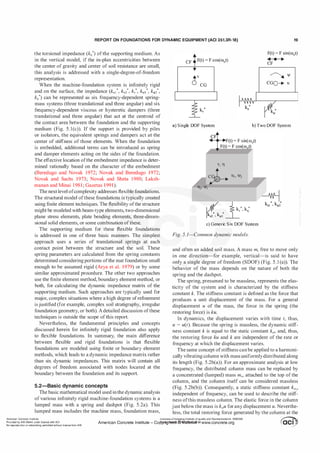
Crank Throw
(Length = r
"'
-�
>
]
0
6
Fig. 4.3.2. 1-Single crank mechanism.
(4.3. 1 .4)
To use this approach, the manufacturer should provide
effective bearing stiffness from the bearing geometry and
operating conditions (such as viscosity and speed) or provide
the corresponding forces for the foundation design.
4.3.1.5 Steam or gas turbine generator units-The deter­
mination of the transmitted dynamic rotating unbalanced
forces from the bearings to the foundation, for large rotating
machines such as steam turbine generator units and combus­
tion turbine generator units with complicated rotor configu­
ration, shaft configurations, or both, can be completed by
a dynamic analysis of the rotor-bearing system (the rotor/
shaft power train dynamic analysis). This dynamic analysis
should be completed under varying conditions ofunbalance
and at varying speeds. This dynamic analysis is based on the
expected level ofrotor/shaft unbalance that corresponds to a
turbine generator rotor in operable condition but in need of
balancing. The analysis can be completed by using an appro­
priate combination of computer programs for calculating
bearing dynamic characteristics and the response of the
rotor in the bearings due to the unbalance and the operating
speeds. Such an analysis would usually be performed by the
machine manufacturer. Results of such analyses, especially
values for transmitted bearing forces, represent the best
source ofinformation for use by the engineer responsible for
foundation design.
4.3.1.6 Loadsf
rom multiple rotating machines-Ifa foun­
dation supports multiple rotating machines, the engineer
should calculate the unbalanced dynamic force based on
the mass, unbalance, and operating speed of each rotating
component. The response to each rotating mass is then
combined to determine the total response. Some practitio­
ners, depending on the specific situation ofmachine size and
criticality, find it advantageous to combine the unbalanced
forces from each rotating component into a single resultant
unbalanced force. The method of combining two dynamic
forces is up to individual judgment and often involves some
approximations. In some cases, loads or responses can be
ylindcr
added absolutely. In other cases, the loads are treated as
out-of-phase so that twisting effects are increased. Often,
the operating speed of the equipment should be consid­
ered. Even if operating speeds are nominally the same, the
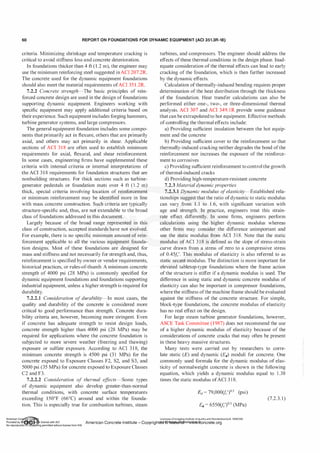
engineer should recognize that during normal operation,
the speed of the machines will vary and beating effects can
develop. Beating effects develop as two machines operate at
close to the same speed. At one point in time, responses to
the two machines are additive and motions are maximized.
A short time later, the responses cancel each other and the
motions are minimized. The net effect is a continual cyclic
rising and falling ofmotion.
4.3.2 Reciprocating machine loads-Internal-combustion
engines, piston-type compressors and pumps, some metal
forming presses, steam engines, and other machinery are
characterized by the rotating motion of a master crankshaft
and the linear reciprocating motion of connected pistons or
sliders. The motion of these components causes cyclically
varying forces, often called reciprocating forces.
4.3.2.1 Primary and secondary reciprocating loads-The
simplest type of reciprocating machine uses a single crank
mechanism, as shown in Fig. 4.3.2. 1 . The idealization ofthis
mechanism consists of a piston that moves within a guiding
cylinder, a crank throw oflength r that rotates about a crank
shaft, and a connecting rod of length L. The connecting rod
is attached to the piston at Point P and to the crank at Point
C. The Wrist Pin P oscillates while the Crank Pin C follows
a circular path. This idealized single cylinder illustrates the
concept ofa machine producing both primary and secondary
reciprocating forces.
If the crank is assumed to rotate at a constant angular
velocity ffi0, the translational acceleration of the piston
along its axis may be evaluated. Ifzp is defined as the piston
displacement toward the crankshaft (local z-axis), an expres­
sion can be written for zp at any time t. Further, the velocity
and acceleration can also be obtained by taking the first
and second derivatives of the displacement expression with
respect to time. The displacement, velocity, and acceleration
expressions for the motion ofthe piston are as follows.
American Co ete Ins Licensee=Chongqing Institute of quality and Standardizationb 5990390
Provided by I ftQJn r license with ACI American Concrete Institute- Copyright� @>fMate'l'laf6L21W�oncrete.org
No reproduction��or mg permitted without license from IHS
REPORT ON FOUNDATIONS FOR DYNAMIC EQUIPMENT (ACI 351.3R-18) 15
z = (r+ �)- r(cos ro t +
�cos 2ro t)
P
4L o
4L o
(4.3.2. l a)
(4.3.2. lb)
(4.3.2. l c)
Note that the expressions contain two terms, each with a
sine or cosine; the term that varies with the frequency ofthe
rotation, W0, is referred to as the primary term whereas the
term that varies at twice the frequency of rotation, 2m0, is
called the secondary term.
Similar expressions can be developed for the motion ofthe
rotating parts of the crank along the local z-axis (parallel to
piston movement) and local y-axis (perpendicular to piston
movement). Ifany unbalance in the crankshaft is replaced by
a mass concentrated at the Crank Pin C, such that the inertia
forces are the same as in the original system, the following
terms for motion at Point C can be written.
Yc = rsinmot (4.3.2. l d)
Yc = rWmCOSWot (4.3.2. l e)
Yc = -rm}sinm0t (4.3.2.1f)
Zc = r(l - cosm0t) (4.3.2. l g)
Zc = rm0sinm0t (4.3.2. l h)
zc = r(l)� COS(l)0t (4.3.2. l i)
Identifying a part of the connecting rod (usually one­
third of its mass) plus the piston as the reciprocating mass
m,.ec concentrated at Point P and designating the remainder
of the connecting rod plus the crank as the rotating mass
m,.01 concentrated at Point C, expressions for the unbalanced
forces are as follows.
Force parallel to piston movement:
Force perpendicular to piston movement:
(4.3.2. l k)
Note that Eq. (4.3.2. lj) consists of two terms, a primary
force:
(4.3.2. 11)
and a secondary force:
Fig. 4.3.2.2-Schematic diagram of double-acting
compressor cylinder andpiston.
(4.3.2. lm)
whereas Eq. (4.3.2. l k) has only a primary component.
4.3.2.2 Compressorgas loads-Areciprocating compressor
raises the pressure of a gas flow by imparting reciprocating
motion on a piston within a cylinder. The piston normally
compresses gas during both directions of reciprocating
motion. As gas flows to and from each end, the pressure ofthe
gas increases as it is compressed by each stroke ofthe piston.
The increase in pressure within the cylinder creates reaction
forces on the head and crank ends of the piston that alternate
as gas flows to and from each end ofthe cylinder.
The gas force applied to the piston rod equals the instan­
taneous difference between the pressure force acting on the
head and crank end ofthe piston, as shown in Fig. 4.3.2.2 for
typical single crank reciprocating machines.
The following formulation can be used to estimate the
maximum force acting on the piston rod of an individual
double-acting cylinder.
(4.3.2.2a)
Ahead = (n/4) B/ (4.3.2.2b)
Acrank = (n/4)(B/ - Dro}) (4.3.2.2c)
The head and crank end pressures vary continuously
and the differential force takes both positive and negative
net values during each cycle of piston motion. The normal
approach is to establish the head and crank pressures using
the maximum and minimum suction and discharge pres­
sures. For design purposes, it is common to multiply Eq.
(4.3.2.2a) by a factor F1 to help account for the natural
tendency of gas forces to exceed the values based directly
on suction and discharge pressures due to flow resistances
and pulsations. Machines with good pulsation control and
low external flow resistance may achieve F1 as small as 1 . 1 .
For machines with low compression ratio, high pulsations,
or highly resistive flow through piping and nozzles, F1 can
approach 1 .5 or even higher. Areasonable working value for
F1 is 1 . 15 to 1 .2.
Preferably, the maximum rod force resulting from gas pres­
sures is b(lsed onknowledge ofthe continuous variation ofpres-
American Concrete Institute
Provided by IHS Markit under license with ACI
No reproduction or networking permitted without license from IHS
Licensee=Chongqing Institute of quality and Standardizationb 5990390
American Concrete Institute- Copytri!!lflt�.@11Wlfe¥i11�3!l www.concrete.org
1 6 REPORT ON FOUNDATIONS F O R DYNAMIC EQUIPMENT (ACI 351.3R-18)
sure in the cylinder (measured or predicted). In a repair situ­
ation, measured cylinder pressure variation using a cylinder
analyzer provides the most accurate value ofgas forces. Even
without cylinder pressure analysis, extreme operating values
of suction and discharge pressure for each stage should be
recorded before the repair and used in Eq. (4.3.2.2a).
On new compressors, the engineer should ask the machine
manufacturer to provide values for maximum compressive
and tensile gas loads on each cylinder rod and to recom­
mend a value ofF1 if these forces are based on suction and
discharge pressures.
Gas forces act on the crankshaft with an equal and oppo­
site reaction to the force on the cylinder. Thus, crankshaft
and cylinder forces globally balance each other. Between the
crankshaft and the cylinder, however, the metal compressor
frame stretches or contracts in tension or compression under
the action ofthe gas forces. The forces due to frame deflec­
tions are transmitted to the foundation through connections
with the compressor frame. When acting without slippage,
the frame and foundation become an integral structure and
together stretch or contract under the gas loads.
The magnitude ofgas force transferred into the foundation
depends on the relative flexibility of the compressor frame.
A very stiff frame transmits only a small fraction ofthe gas
force while a very flexible frame transmits most or all the
force. Similar comments apply to the transfer of individual
cylinder inertia forces.
Based on limited comparisons using finite element anal­
ysis (Smalley 1 988), the following guidelines are suggested
for gas and inertia force loads transmitted to the foundation
by a typical compressor
Fblock = Frod/Fred (4.3.2.2d)
(Fbo!t)Jrame = [(Funba/ancdCNbo!t)]/Fred (4.3.2.2f)
The factor Fred is used to simplify a complex problem,
thus avoiding the application ofunrealistically high loads on
the anchor bolts and the foundation block. The mechanics
involved in transmitting loads are complex and cannot easily
be reduced to a simplerelationshipbetweena few parameters
beyond the given load equations. A detailed finite-element
analysis ofmetal compressor frame, chock mounts, concrete
block, and grout will account for the relative flexibility ofthe
frame and its foundation in determining individual anchor
bolt loads and implicitly provide a value forFred· Ifthe frame
is very stiff relative to the foundation, the value for Fred will
be higher, implyingmore ofthe transmitted loads are carried
by the frame and less by the anchor bolts and foundation
block. Based on experience, a value of 2 for this factor is
conservatively low; however, higher values have been seen
with frames designed to be especially stiff.
Simplifying this approach, Smalley and Harrell (1997)
suggest using a finite element analysis to calculate forces
transmitted to the anchor bolts. If a finite element analysis
is not possible, the engineer should obtain from the machine
manufacturer or calculate the maximum horizontal gas
force and maximum horizontal inertia force for any throw
or cylinder. The mounts, anchor bolts, and blocks are then
designed for
FTHRow = (greater ofFGMAX or F,MAX)/2 (4.3.2.2g)
4.3.2.3 Reciprocating inertia loads f
or multi-cylinder
machines-As a practical matter, most reciprocating
machines have more than one cylinder, and manufacturers
arrange the machine components in a manner that mini­
mizes the net unbalanced forces. For example, rotating
parts such as the crankshaft can be balanced by adding or
removing correcting weights. Translating parts such as
pistons and those that exhibit both rotation and translation
such as connecting rods can be arranged in such a way as
to minimize the unbalanced forces and moments generated.
Seldom, if ever, is it possible to perfectly balance recipro­
cating machines.
The forces generated by reciprocating mechanisms are
functions ofthe mass, stroke, piston arrangement, connecting
rod size, crankthrow orientation (phase angle), and the mass
and arrangement of counterweights on the crankshaft. For
this reason, calculating the reciprocating forces for multi­
cylinder machines can be quite complex and are therefore
normally provided by the machine manufacturer. If the
machine is an integral engine compressor, it can include, in
one frame, cylinders oriented horizontally, vertically, or in
between, all with reciprocating inertias.
Some machine manufacturers place displacement trans­
ducers and accelerometers on strategic points on the
machinery. They can then measure displacements and accel­
erations at those points for several operational frequencies
to determine the magnitude of the unbalanced forces and
couples for multi-cylinder machines.
4.3.2.4 Estimating reciprocating inertiaf
orcesfrom multi­
cylinder machines-In cases where the manufacturer's
data are unavailable or components are being replaced, the
engineer should use hand calculations to estimate the recip­
rocating forces from a multi-cylinder machine. One such
procedure for a machine having n number of cylinders is
discussed by Mandke and Troxler (1992).
4.3.3 Impulsive machine loads-The impulsive load
generated by a forging hammer is caused by the impact of
the hammer ram onto the hammer anvil. This impact process
transfers the kinetic energy ofthe ram into kinetic energy of
the entire hammer assembly. The post-impact velocity ofthe
hammer is represented by
M
v" = -
' (1 + a,)v,
M"
(4.3.3a)
General experience indicates that a11 is approximately 60
percent for many forging hammer installations. From that
point, the hammer foundation performance can be assessed
as a rigid body oscillating as a single degree-of-freedom
SY,Stemlith an initial velocity ofv11•
American Co ete Ins Licensee=Chongqing Institute of quality and Standardizationb 5990390
Provided by I ftQJn r license with ACI American Concrete Institute- Copyright� @>fMate'l'laf6L21W�oncrete.org
No reproduction��or mg permitted without license from IHS
REPORT ON FOUNDATIONS FOR DYNAMIC EQUIPMENT (ACI 351.3R-18) 17
For metal-forming presses, the dynamic forces develop
from two sources: the mechanical movement of the press
components and material-forming process. Each of these
forces is unique to the press design and application and
needs to be evaluated with proper information from the press
manufacturer and the owner.
The press mechanics often include rotating and recipro­
cating components. The dynamic forces from these individual
pieces follow the rules established in earlier sections of this
document for rotating and reciprocating components. Only
the press manufacturer familiar with all the internal compo­
nents can knowledgeably calculate the specific forces. Figure
4.3.1.3 presents a horizontal force time-history for a forging
press. Similar presses can be expected to have similar charac­
teristics; however, the specific values and timing data differ.
The press drive mechanisms include geared and direct­
drive systems. Depending on the design, these drives may
or may not be balanced. The press slide travels vertically
through a set stroke of 112 in. (12 mm) to several inches
(millimeters) at a given speed. Some small presses may have
inclinable beds so that the slide is not moving vertically. It
is often adequate to assume that the slide moves in a vertical
path defined by a circularly rotating crankshaft; that is,
(4.3.3b)
This leads to a dynamic inertia force from the slide of
F: (t) = mdw; �sin(wJ) (lbf)
2
F: (t) =mdw; %sin(W0t)/1000 (N)
(4.3.3c)
This assumption is based on simple circular motions and
simple linkages. Other systems may be in place to increase
the press force and improve the timing. These other systems
may increase the acceleration ofthe unbalanced weights and
thus alter the magnitude and frequency components of the
dynamic force transmitted to the foundation.
4.4-Environmental loads
4.4.1 Wind loads-Loads due to wind on the surface areas
of the machine, auxiliary equipment, and the support foun­
dation are based on the design wind speed for the partic­
ular site and are normally calculated in accordance with the
governing local code or standard. Wind loads rarely govern
the design ofmachine foundations except, perhaps, when the
machine is located in an enclosure that is also supported by
the foundation.
When designing machine foundations and support struc­
tures, most practitioners use the wind load provisions of
ASCE/SEI 7. The analytical procedure of ASCE/SEI 7
provides wind pressures and forces for use in the design
of the main wind-force-resisting systems and anchorage of
machine components.
Most structural systems involving machines and machine
foundations are relatively stiff (natural frequency in the
lateral direction greater than 1 Hz). Consequently, the
systems can be treated as rigid with respect to the wind gust
effect factor, and simplified procedures can be used. If the
machine is supported on flexible isolators and is exposed to
the wind, the rigid assumption may not be reasonable and
more elaborate treatment of the gust effects is necessary as
described in ASCE/SEI 7 for flexible structural systems.
Appropriate consideration ofthe exposure conditions and
importance factors is also recommended to be consistent
with the facilities' requirements.
4.4.2 Seismic loads-Machinery foundations located in
seismically active regions are analyzed for seismic loads.
These loads should be determined as equivalent static loads
or dynamic loads per applicable codes and standards.
Building codes and standards such as the International
Building Code (International Code Council 2015), ASCE/
SEI 7, FEMA P-750, and SEAOC Blue Book (2009)
contain provisions for design of nonstructural components,
including dynamic machinery. The seismic loads and design
requirements for nonbuilding structures, including elevated
tabletop-type foundation pedestals, are also contained in
the provisions of these codes. For machinery supporte
-
d
above grade or on more flexible elevated pedestals, seismic
amplification factors are also specified. For where isolators
are used (such as spring/damper/absorber configurations)
to support the machine, ASCE/SEI 7 provides criteria for
seismic load calculation and design.
Depending on theweightofthemachinewithrespectto the
total weight of the machine-foundation system, the design
seismic forces of the machine (nonbuilding structure) can
be determined either by treating the machine weight as an
integral part ofthe foundation weight (ASCE/SEI 7), or by
treating the machine as a nonstructural component attached
to the foundation (ASCE/SEI 7). For the seismic design of
tabletop foundations, the foundation is usually treated as a
supporting structure that should be designed in accordance
with the requirements ofASCE/SEI 7.
For most heavy machine foundations, it is common to
treat the machine weight as an integral part ofthe foundation
for determining machine seismic load effects. In the seismic
weight calculation, the full or percentage of the live load
should be used per ASCE/SEI 7.
Horizontal and vertical components of seismic loads
should be investigated in the load conditions and combina­
tions in the following sections per ASCE/SEI 7.
4.4.3 All other loads-Environmental loads such as earth,
water, rain, snow, and ice should be included in the design
per applicable building codes.
4.5-Load conditions
During their lives, machinery equipment support struc­
tures and foundations undergo different load conditions,
including construction, testing, shutdown, maintenance, and
normal and abnormal operation. For each loading condition,
there can be one or more combinations of loads that apply
American Concrete Institute
Provided by IHS Markit under license with ACI
No reproduction or networking permitted without license from IHS
Licensee=Chongqing Institute of quality and Standardizationb 5990390
American Concrete Institute- Copytri!!lflt�.@11Wlfe¥i11�3!l www.concrete.org
1 8 REPORT ON FOUNDATIONS F O R DYNAMIC EQUIPMENT (ACI 351.3R-18)
Table 4.6-Load classifications for ultimate
strength design
Load
Design loads classification
Weight ofstructure, equipment, internals, insulation,
and platforms
Dead
Fluid loads during testing and operation
Anchor and guide loads
Platform and walkway loads
Materials to be temporarily stored during maintenance
Materials normally stored during operation such as tools
Live
and maintenance equipment
Vibrating equipment forces
Impact loads for hoist and equipment handling utilities
Seismic loads
Snow, ice, or rain loads Environmental
Wind loads
Notes. Thermal or self-strammg loads classJficatwns should be evaluated per reqUire­
ments ofASCE/SEI 7.
Load due to lateral earth pressure, ground water pressure, orpressure ofthe bulk mate­
rials classifications should be evaluated per guidelines ofASCE/SEl 7.
to the structure or foundation. The following load conditions
are generally considered in design:
a) Construction condition represents the design loads that
act on the structure/foundation during its construction.
b) Testing condition represents the design loads that act
on the structure/foundation while the equipment being
supported is undergoing testing, such as hydro test.
c) Normal operating condition represents the design
loading during periods ofnormal equipment operation.
d) Abnormal operating condition represents the design
loading during periods when unusual or extreme operating
loads act on the structure/foundation.
e) Maintenance condition (empty or shutdown) represents
the design loads that act on the structure when the supported
equipment is at its least weight due to removal of process
fluids, applicable internals, or both, as a result of mainte­
nance or other out-of-service disruption.
4.6-Load combinations
Table 4.6 shows the general classification of loads for use
in determining the applicable load factors in strength design
(ACI 3 1 8; ASCE/SEI 7; ASCE/SEI 37). In considering soil
stresses or loading on piles, the normal approach is working
stress design without load factors and with overall factors of
safety identified as appropriate by geotechnical engineers.
The load combinations frequently used for the various load
conditions are as follows:
a. Construction
i. Dead loads + construction loads
ii. Dead loads + construction loads + reduced wind
loads + snow, ice, or rain loads
iii. Dead loads + construction loads + seismic loads +
snow, ice, or rain loads
b. Hydro testing
i. Dead loads + test loads
ii. Dead loads + test loads + live loads + snow, ice, or
rain loads
iii. Dead loads + test loads + reduced wind loads +
snow, ice, or rain loads
c. Normal operation
i. Dead loads + machine operation loads + live loads
(for multi bearings machine post-alignment deflection
check)
ii. Dead loads + machine operation loads + live loads +
wind loads + snow, ice, or rain loads
iii. Dead loads + machine operation loads + seismic
loads + snow, ice, or rain
d. Abnormal operation
i. Dead loads + upset (abnormal, emergency, cata­
strophic) machine loads + live loads + reduced wind
loads
e. Maintenance loads
i. Dead loads + maintenance loads + live loads + snow,
ice, wind or rain loads
Environmental loads can be reduced per ASCE/SEI 37
when combined with maintenance or construction loads due
to the low probability ofthe loads occurring at the same time.
CHAPTER 5-IMPEDANCE OF THE SUPPORTING
MEDIUM
5.1-0verview and use of soil im pedance
The foundation dynamic response depends on the stiffness
and damping characteristics ofthe machine-foundation-soil
system. This section presents a general introduction to this
subject and a summary of approaches and formulas often
used to evaluate the stiffness and damping of both soil­
supported and pile foundations. These stiffness and damping
relationships, collectively known as impedance, are used for
determining both free-vibration performance and motions of
the foundation system due to the dynamic loading associated
with the machine operation.
The simplest mathematical model used in dynamic anal­
ysis of machine-foundation systems is a single-degree-of­
freedom representation of a rigid mass vertically supported
on a single spring and damper combination (Fig. 5 . l(a)).
This model is applicable if the center of gravity of the
machine-foundation system is directly over the center ofsoil
resistance and the resultant of the dynamic forces (acting
through a center of force [CF]) is a vertical force passing
through the center ofgravity. The vertical impedance (kv*) of
the supporting medium is necessary for this model.
The next level of complexity is a two-degree-of-freedom
model commonly used when lateral dynamic forces act on
the system (Fig. 5 . l (b)). Because the lines of action of the
applied forces and the soil resistance do not coincide, the
rocking and translational motions ofthe system are coupled.
For this model, the engineerneeds to calculate the horizontal
translational impedance (ku*) and the rocking impedance
(k'l'*) of the supporting medium. These impedance values,
especially the rocking terms, are usually different about
different horizontal directions.
Application of the lateral dynamic forces can cause a
machine-foundation system to twist about a vertical axis.
To model this behavior, the engineer needs to determine
. . Licensee=Chongqing Institute of quality and Standardizationb 5990390
Amencan Concrete Institute- Copyright� @>fMate'l'laf6L21W�oncrete.org
REPORT ON FOUNDATIONS FOR DYNAMIC EQUIPMENT (ACI 351.3R-18) 19
the torsional impedance (�*) ofthe supporting medium. As
in the vertical model, if the in-plan eccentricities between
the center of gravity and center of soil resistance are small,
this analysis is addressed with a single-degree-of-freedom
representation.
When the machine-foundation system is infinitely rigid
and on the surface, the impedance (kul*, kuz*, k/, k1111
*, k111z*,
�*) can be represented as six frequency-dependent spring­
mass systems (three translational and three angular) and six
frequency-dependent viscous or hysteretic dampers (three
translational and three angular) that act at the centroid of
the contact area between the foundation and the supporting
medium (Fig. 5.1(c)). If the support is provided by piles
or isolators, the equivalent springs and dampers act at the
center of stiffness of those elements. When the foundation
is embedded, additional terms can be introduced as spring
and damper elements acting on the sides of the foundation.
The effective location ofthe embedment impedance is deter­
mined rationally based on the character of the embedment
(Beredugo and Novak 1972; Novak and Beredugo 1972;
Novak and Sachs 1973; Novak and Sheta 1 980; Laksh­
manan and Minai 1 981 ; Gazetas 1991).
The next level ofcomplexity addresses flexible foundations.
The structural model ofthese foundations is typically created
using finite element techniques. The flexibility ofthe structure
might be modeled with beam-type elements, two-dimensional
plane stress elements, plate bending elements, three-dimen­
sional solid elements, or some combination ofthese.
The supporting medium for these flexible foundations
is addressed in one of three basic manners. The simplest
approach uses a series of translational springs at each
contact point between the structure and the soil. These
spring parameters are calculated from the spring constants
determined considering portions ofthe mat foundation small
enough to be assumed rigid (Arya et a!. 1979) or by some
similar approximated procedure. The other two approaches
use the finite element method, boundary element method, or
both, for calculating the dynamic impedance matrix of the
supporting medium. Such approaches are typically used for
major, complex situations where a high degree ofrefinement
is justified (for example, complex soil stratigraphy, irregular
foundation geometry, or both). A detailed discussion ofthese
techniques is outside the scope ofthis report.
Nevertheless, the fundamental principles and concepts
discussed herein for infinitely rigid foundation also apply
to flexible foundations. In summary, the main difference
between flexible and rigid foundations is that flexible
foundations are modeled using finite or boundary element
methods, which leads to a dynamic impedance matrix rather
than six dynamic impedances. This matrix will contain all
degrees of freedom associated with nodes located at the
boundary between the foundation and its support.
CF F(t)=F cos(C00t)
F(t) = F sin(C00t)
... . �
CF
� ljl
CGQ-+ u
a) Single OOF System b) Two DOF System
c) Generic Six OOF System
Fig. 5. 1-Common dynamic models.
and often an added soil mass. A mass m, free to move only
in one direction-for example, vertical-is said to have
only a single degree of freedom (SDOF) (Fig. 5 . 1 (a)). The
behavior of the mass depends on the nature of both the
spring and the dashpot.
The spring, presumed to be massless, represents the elas­
ticity of the system and is characterized by the stiffness
constant k. The stiffness constant is defined as the force that
produces a unit displacement of the mass. For a general
displacement u of the mass, the force in the spring (the
restoring force) is ku.
In dynamics, the displacement varies with time t, thus,
u = u(t). Because the spring is massless, the dynamic stiff­
ness constant k is equal to the static constant k,�> and, thus,
the restoring force ku and k are independent of the rate or
frequency at which the displacement varies.
The same concept ofstiffness canbe applied to a harmoni­
cally vibrating column with massuniformlydistributed along
its length (Fig. 5.2b(a)). For an approximate analysis at low
frequency, the distributed column mass can be replaced by
a concentrated (lumped) mass ms. attached to the top of the
column, and the column itself can be considered massless
5.2-Basic dynamic concepts (Fig. 5.2b(b)). Consequently, a static stiffness constant ks,,,
The basic mathematical model used in the dynamic analysis independent of frequency, can be used to describe the stiff-
ofvarious infinitely rigid machine-foundation systems is a ness ofthis massless column. The elastic force in the column
lumped mass with a spring and dashpot (Fig. 5.2a). This just below the mass is k51u for any displacement u. Neverthe-
lumped mass includes the machine mass, foundation mass, less, the total restoring force generated by the column at the
American Concrete Institute
Provided by IHS Markit under license with ACI
No reproduction or networking permitted without license from IHS
Licensee=Chongqing Institute of quality and Standardizationb 5990390
�
OC1. ..
.
•
American Concrete Institute- Copytri!!lflt�.@11Wlfe¥i11�3!l www.concrete.org � CCI j
20 REPORT ON FOUNDATIONS FOR DYNAMIC EQUIPMENT (ACI 351.3R-18)
ACIUAL FOUNDATION
Vertical
Excitation
EQUIVALENT SYSTEM
Rigid block having
equivalent mass
Equivalent
Damping
Equivalent Rotationtal Spring Equivalent Rotational Damping
Rigid block having equivalent
Torsional Excitation
Plan View
torsional spring torsional damping
Fig. 5.2a-Lumped systemf
or af
oundation subjected to vertical, horizontal, and torsional
excitationf
orces (Richart et al. 1970).
p (t)
mass
k = canst k
0 frequency
(a) (b) (c)
Fig. 5.2b-E
ff
ect ofmass on dynamic stiffness.
top ofthe lumped mass is the sum ofthe elastic force in the
column and the inertia force ofthe mass. Ifthe displacement
ofthis mass varies harmonically
and the inertia force is
u(t) = U0COSffit (5.2a)
Then, the acceleration is
Licensee=Chongqing Institute of quality and Standardizationb 5990390
American Concrete Institute- Copyright� @>fMate'l'laf6L21W�oncrete.org
(5.2b)
(5.2c)
REPORT ON FOUNDATIONS FOR DYNAMIC EQUIPMENT (ACI 351.3R-18) 21
In the absence ofdamping, the time-dependent relation of
the external harmonic force applied with amplitude P0 and
frequency W0 to the displacement u is
and the amplitudes offorce and displacement relate as
(5.2e)
The dynamic stiffness, being the constant of proportion­
ality between the applied force and displacement, becomes
(5.2f)
Thus, with vibration ofan element having distributed mass,
the dynamic stiffness generally varies with frequency. At low
frequency, this variation is sometimes close to parabolic, as
shown in Fig. 5.2b(c). The column used in this example may
represent the column of soil and, thus, a soil deposit always
features stiffness parameters that are frequency dependent.
The magnitude and character ofthis frequency effect depend
on the size ofthe foundation geometry, vibration mode, soil
layering, and other factors.
The dashpots of Fig. 5.2a are often represented as viscous
dampers producing forces proportional to the vibration
velocity u ofthe mass. The magnitude ofthe damper force is
F
. du
= cu = c-
0
dt
(5.2g)
The damping constant c is defined as the force associated
with a unit velocity. During harmonic vibrations, the time­
dependent viscous damping force is
(5.2h)
and its peak value is cu0W. Equation (5.2h) shows that for a
given constant c and displacement amplitude U0, the ampli­
tude of viscous damping force is proportional to frequency
(Fig. 5.2c).
5.3-Calculation of dynamic foundation
im pedances
The calculation of dynamic impedances is fundamental
for the dynamic analysis and design ofmachine foundations.
For instance, as previously discussed, six lumped dynamic
impedances-three translational and three rotational
dynamic impedances-are needed to model the dynamic
response ofan infinitely rigid foundation. These impedances
are defined and calculated as explained in the following.
5.3.1 Dynamic impedance de
finition-The response of
an infinitely rigid foundation to static or dynamic load, P
or P(wt), arises solely from the deformation, U or U(wt +
q,), of the supporting soil. In particular, the static founda­
tion stiffness, ks
r
= PIU, is used for modeling the soil-foun­
dation response to static loads. In an analogous manner, the
b.O
c
·c..
E
ro
0
Frequency
Fig. 5.2c-Comparison ofviscous and hysteric damping.
dynamic foundation impedance, k*(m) = P(wt)/U(wt + <!J), is
used for modeling the soil-foundation responseto a harmonic
(dynamic) load of angular frequency w (for example, due to
rotating machinery). The main difference between the static,
k51, and dynamic, k*(w), impedance is that in the static case,
the load (P) and displacement (U) occur simultaneously,
that is, P and U are in phase, whereas in the dynamic case,
the displacement response is frequency dependent and typi­
cally lags the loading; that is, there is a phase difference
between the two. Therefore, for mathematical convenience,
complex notation is used to represent the dynamic imped­
ance of a foundation, given that complex numbers encap­
sulate magnitude and phase information in a single entity/
number. It should be emphasized, however, that the loading
and response (vibration amplitude) of a machine founda­
tion are always real; complex numbers are used just for
mathematical convenience given that they greatly simplify
calculations involving harmonic functions, such the loading
acting in machine foundations.
5.3.2 Dynamic impedance calculation-The procedure
used to calculate the dynamic impedances of a rigid surface
foundation can be summarized in the following steps:
a) Model the foundation as massless and infinitely rigid;
therefore, only the geometry of the area in contact with the
soil is required. The use of a massless foundation is impor­
tant because it avoids the need for recalculating the dynamic
impedance every time the foundation mass changes, which
often happens during the design process.
b) Apply a harmonic force or moment of frequency w to
the rigid foundation (P(t) = P0eiwr orM(t) = M0eiwr), as shown
in Fig. 5.3.2, where i = -1-1. Such force/moment excites the
foundation, which in turn generates stress waves that propa­
gate into the underlying soil. Where the soil is modeled as
a viscoelastic material, therefore, the following properties
are needed for each soil layer supporting the foundation:
thickness (h), modulus of elasticity (£5), Poisson's ratio (v),
density (p), and material damping CPm).
c) Calculate the vibration response (U(wt + q,) = U0eiwr+i$
or 8(mt + <!J) = 80eiwr+i4>) of the foundation under the applied
harmonic excitation. It should be noted that the steady-state
vibration amplitude is obtained by keeping track of the
American Concrete Institute
Provided by IHS Markit under license with ACI
No reproduction or networking permitted without license from IHS
Licensee=Chongqing Institute of quality and Standardizationb 5990390
American Concrete Institute- Copytri!!lflt�.@11Wlfe¥i11�3!l www.concrete.org
22 REPORT ON FOUNDATIONS FOR DYNAMIC EQUIPMENT (ACI 351.3R-18)
A
/ I 
I I 
/ I 
I 
I 
I 
I 
I
[ 4
I
Fig. 5.3.2-Downward and upward wave propagation f
or
sur
f
ace disk in layered halfspace (W
olfand Deeks 2004).
reflections and refractions that take place every time that a
stress wave, generated by the foundation vibration, reaches a
soil layer boundary. This is achieved by finding the different
wave paths shown in Fig. 5.3.2, which can be done analyti­
cally or numerically. Note that <!> represents the phase differ­
ence (lag) of the response relative to the applied force or
moment.
d) Calculate the translational/rotational dynamic imped­
ance k*(ro) as the ratio between the harmonic excitation
(force/moment) acting on the foundation and its corre­
sponding vibration amplitude, as shown in Eq. (5.3.2a) and
(5.3.2b). It is important to note that k*(ro) is a frequency­
dependent quantity with a real (Re) and imaginary (Im) part.
k
.
(ro) =
P(rot)
U(rot + <)>)
e) Separate the real and imaginary parts of the dynamic
impedance to streamline its use in computer codes used for
structural analysis. It is customary to express the complex
dynamic impedance as shown in Eq. (5.3.2c). The real and
imaginary parts of the dynamic impedance are associated,
by analogy to the system described in 5.2, with a dynamic
(frequency-dependent) spring and dashpot as shown in Eq.
(5.3.2d) and (5.3.2e).
k*(ro) = k + iroC
* Po
k(ro) = Re(k (ro)) = -cos<)>
Uo
C(ro) =
Im(k
*
(ro))
= -�sin <)>
(J) roU0
(5.3.2c)
(5.3.2d)
(5.3.2e)
Equations (5.3.2c) and (5.3.2d) are analogous to Eq. (5.3.2b).
f) Repeat steps (b) to (e) for each frequency of interest
until the range of vibration frequencies of the machine is
covered.
The aforementioned approach may also be used for calcu­
lating the dynamic impedance ofa single pile or pile founda­
tion. Because, in this case, the mass and flexibility of each
pile are considered, the pile impedance is a function of the
pile stiffness and density per unit length. Furthermore, the
concept of dynamic impedance can be extended to flex­
ible foundations; however, in this case, it is more natural to
define a dynamic impedance matrix. Details regarding the
generalization of the dynamic impedance concept can be
found in Wolfand Song ( 1996) and Lysmer et a!. (1999).
5.4-Dynamic im pedance of soil-supported
foundations
The engineer can calculate the dynamic impedance of
a soil-supported foundation using the steps presented in
5.3.2 in a finite or boundary element code. Many founda­
tion impedances of practical importance, however, have
been published in the literature as closed-form solutions,
tables, or charts. Therefore, for application purposes, the
engineer can estimate the dynamic impedance, k*(ro), of a
soil-supported foundation by one or a combination of the
following approaches:
a) Frequency-dependent equations-Veletsos and Nair
(1974), Veletsos and Verbic (1973), and Veletsos and Wei
(1 97 1 ) have developed appropriate equations that represent
the impedance to motion offered by uniform soil conditions.
They developed these formulations using an assumption of
a uniform elastic or viscoelastic half-space and the related
motion of a rigid or flexible foundation on this half-space.
Motions can be translational or rotational. While the calcu­
lations can be manually tedious, computer implementation
provides acceptable efficiency. Some of the simpler equa­
tions are presented in 5.4. 1 .2 of this report. More extensive
equations are presented in Gazetas (1991) and Sieffert and
Cevaer (1992).
b) Constant approximation-If the frequency range of
interest is not very wide, an often-satisfactory technique
is to replace the variable dynamic stiffness by the constant
representative of the stiffness in the vicinity of the domi­
nant frequency (Fig. 5.2b(c)). Another constant approxima­
tion can be to add an effective or fictitious in-phase mass of
the supporting soil medium to the vibrating lumped mass of
the machine and foundation and to consider stiffness to be
constant and equal to the static stiffness. Nevertheless, the
variation of dynamic stiffness with frequency can be repre­
sented by a parabola only in some cases, and the added mass
is not the same for all vibration modes.
c) Computer-based numerical analysis-For complex
geometry, flexible foundations, or variable soil conditions,
the recommended approach is to obtain the stiffness and
damping offoundations using dynamic analysis ofathree- or
two-dimensional continuum representing the soil medium.
The continuum is modeled as an elastic or viscoelastic half­
space. The half-space can be homogeneous or nonhomoge-
Licensee=Chongqing Institute of quality and Standardizationb 5990390
American Concrete Institute- Copyright� @>fMate'l'laf6L21W�oncrete.org
REPORT ON FOUNDATIONS FOR DYNAMIC EQUIPMENT (ACI 351.3R-18) 23
I
b - t

'
'
I�
t z. w
, - i- - .....
.. ...
'
..
... .. I
..... _ _ _ ...
a
..,.
� 'V X, u
'-"'V
mw"
/
/
1
�
/
/
ff
m
u
... -
Y, v
a
Fig. 5.4-Notationf
or calculation ofequivalent radiif
or rectangular bases.
neous (layered) and isotropic or anisotropic. The governing
equations are solved analytically or by means of numerical
methods such as the finite element method. The major advan­
tages ofthis elastic half-space technique are that it accounts for
energy dissipation through elastic waves (geometric damping,
also known as radiation damping), provides for systematic
analysis, and uses soil properties defined by constants that
can be established by independent experiments. Computer
programs are very useful in this regard.
Commonly, the analysis of dynamically loaded founda­
tions is performed considering the rectangular foundation as
if it were a circular foundation with equivalent properties
(Fig. 5.4). Bowles (1996) and Gazetas (1991) provide alter­
nates to this approach. The equivalent circular foundation
is not the same for all directions of motion. For the three
translational directions, the equivalent circular foundation is
determined based on an area equivalent to the rectangular
foundation; thus, these three share a common equivalent
radius R. For the three rotational directions, three unique
radii are determined that have moments of inertia equiva­
lent to their rectangularcounterparts. These relationships are
reflected in the following equations.
Translation:
R =
f!
Rocking (about an axis parallel to b):
R
= J
lb
ljfb v�
Rocking (about an axis parallel to a):
Torsion:
R =
J
z
l-:;
ljfa v�
(5.4a)
(5.4b)
(5.4c)
(5.4d)
The equivalent radius works very well for square founda­
tions and rectangular foundations with aspect ratios alb of
up to 2. With alb above 2, the accuracy decreases. For long
foundations, the assumption of an infinite strip foundation
may be more appropriate (Gazetas 1983). Alternatively, the
formulas and charts provided by Dobry and Gazetas ( 1986)
and Gazetas ( 199 1) can be used for the analysis of rigid
surface foundations of arbitrary shape.
These dynamics problems are addressed either with real
domain mathematics or with complex domain mathematics,
as illustrated in 5.2 and 5.3.2, respectively. The real domain
solution is more easily understood and is typified by the
damped stiffness models ofRichart and Whitman (1967) and
Richart et al. (1970), in which the stiffness and damping are
represented as constants. The complex domain impedance
is easier to describe mathematically and is applied in the
impedance models ofVeletsos and Nair (1974), Veletsos and
Verbic (1973), and Veletsos and Wei (1971). Equation (5.4e)
characterizes the relationship between impedance models
and damped stiffness models.
k/ = k; + iWC; (5.4e)
Another common approach is to calculate impedance
parameters based on a dimensionless frequency a0, first
introduced by Reissner (1936), and calculated as
(5.4f)
In the most common circumstances, the soil and founda­
tion are moving at the same frequency the machine operates
at. Thus, w is commonly equal to W0• In unusual cases, such
as when motions result from a multiple harmonic excitation
of the equipment speed, from blade passage effects, from
multiple speed equipment combinations, and from some
poor bearing conditions, the motion may develop at a speed
different from the equipment speed. These situations are
more commonly found during in-place problem investiga­
tions rather than initial design applications. In those cases,
the correct frequency to consider is determined by in-place
field measurements.
5.4.1 Unif
orm soil conditions-In many instances, engi­
neers approximate or assume that the soil conditions are
American Concrete Institute
Provided by IHS Markit under license with ACI
No reproduction or networking permitted without license from IHS
Licensee=Chongqing Institute of quality and Standardizationb 5990390
American Concrete Institute- Copytri!!lflt�.@11Wlfe¥i11�3!l www.concrete.org
24 REPORT ON FOUNDATIONS FOR DYNAMIC EQUIPMENT (ACI 351.3R-18)
uniform throughout the depth of interest for the founda­
tion being designed, which permits the use of a homoge­
neous half-space model. This assumption, in some cases,
is reasonable. In other cases, it is accepted for lack of any
better model and because the scope ofthe foundation design
does not warrant more sophisticated techniques. However,
significant error is introduced when this assumption is used
for the analysis of foundations supported by a layer resting
on a rigid substratum or for foundations on layered soils with
differing properties.
5.4.1.1 Richart-Whitman models-Engineers frequently
use a lumped parameter model (Richart and Whitman 1967),
which is considered suitable for uniform soil conditions.
This model represents the stiffness, damping, and mass for
each mode as single, lumped parameters. In the norm, these
parameters are treated as frequency-independent. For the
vertical direction, the stiffness and damping equations are
expressly validated for the range of dimensionless frequen­
cies from 0 to 1 .0 (0 < a0 < 1 .0) (Richart et a!. 1970). The
other directions are similarly limited, as the stiffness param­
eters are actually static stiffness values.
The mass of these models is determined solely as the
translational mass and rotational mass moment ofinertia for
the appropriate directions. No effective soil mass is included
in the representation. The mass and damping ratios recom­
mended by Richart et a!. (1 970) for infinitely rigid, circular
foundations are given by the following equations. Lysmer
and Richart (1 966) first proposed this formulation for the
vertical translation case.
Vertical:
and
Horizontal:
and
Rocking:
(1 - v) m
-- --
4 pR3
0.425
JB:
B
= (7 - 8v) m
" 32(1 - v) pR3
0.288
JB:
(5.4. 1 . 1a)
(5.4. l . lb)
(5.4. 1 . 1c)
(5.4. l . l d)
(5.4. l . l e)
and
D =
0.1 5
ljl (l + Biji )JB: (5.4. l . l f)
Torsion:
(5.4. l . l g)
and
D
= 0.50
� (1 + 2B
�
)
(5.4. 1 . 1h)
The lumped parameter models generally recognize two
alternate representations for the lumped stiffness terms.
These equations are based on the theory of elasticity for
elastic half-spaces with infinitely rigid foundations, except
for horizontal motions, which use a slightly different rigidity
assumption. For a rigid circular foundation, the applicable
formulas are given in Eq. (5.4. 1 . 1i) to (5.4. 1 . 11). For a rectan­
gular foundation, the equivalent radii of Eq. (5.4a) to (5.4d)
can be used in the calculations ifalb < 2.0. Alternatively, Eq.
(5.4. 1 . 1m) to (5.4. l . l o) can be used directly for rectangular
foundations of plan dimensions a by b. In these equations,
the �i values vary with the aspect ratio of the rectangle. The
�" value for vertical vibration ranges from approximately 2 . 1
to 2.8, �11 for the horizontal vibration ranges from approxi­
mately 0.95 to 1 .2, and �ljl for the rocking vibration varies
from approximately 0.35 to 1 .25. Specific relationships can
be found in a variety of sources (Richart et a!. 1 970; Arya et
a!. 1979; Richart and Whitman 1967), usually in a graphical
form, as shown in Fig. 5.4. 1 . 1 . The original source materials
contain the mathematical relationships. There is little differ­
ence between using either the circular or the rectangular
formulations for these stiffness terms.
Vertical:
Horizontal:
Rocking:
Torsion:
k = -
4
-GR
" (1 - v)
k =
32(1 - v)
GR
" (7 - 8v)
k
=
-
8
- GR 3
ljl 3(1 - v) ljl
Licensee=Chongqing Institute of quality and Standardizationb 5990390
(5.4. 1 . 1 i)
(5.4. l . lj)
(5.4. l . l k)
American Concrete Institute- Copyright� @>fMate'l'laf6L21W�oncrete.org
REPORT ON FOUNDATIONS FOR DYNAMIC EQUIPMENT (ACI 351.3R-18) 25
(5.4. 1 . 11)
Vertical:
(5.4. 1 . 1 m)
Horizontal:
k, = 2(1 + v)G�, M (5.4. 1 . 1n)
Rocking (about an axis parallel to b):
(5.4. 1 . 1o)
The damping constants can be determined from the calcu­
lated damping ratio, system mass, and stiffness as
(5.4. 1 . 1p)
or
(5.4. l . l q)
5.4.1.2 V
eletsos models-For the impedance functions of
infinitely rigid circular foundations resting on the surface of
a viscoelastic half-space, Veletsos and Verbic (1973) deter­
mined the analytical expressions for the dynamic impedance
as a function offrequency, Poisson's ratio, and internal mate­
rial damping. Neglecting the internal material damping, the
relationships for an infinitely rigid circular foundation are
Horizontal impedance:
(5.4. 1 .2a)
Rocking impedance:
Vertical impedance:
(5.4. 1 .2c)
3
�
""L:::::=::l'"
t---':-----1
•
..IC>
I
O ' z
!!!It
!::�
2
-
1---!-
1..--
...........IR
�
�.
IP'
z
1---
1.5
1.0
13,
0.5
0
0.2 0.4 0.6 1.0
LIB
2 4 6 8 10
Fig. 5.4.1. 1-Rectangularf
ooting coe
fficients (Richart etal.
1970).
Torsional impedance:
1 6G�
k� = -
3
-[A + ia0B]
A _ 1
b1 • (b2aj
and B =
b1b2 • (b2aj
where - -
(b )
2 2
1 + 2a0 1 + (b2aJ
(5.4. 1 .2d)
where j = 1 to 4 as appropriate and b1 and b2 = 0.425 and
'
:
0.687, respectively (Veletsos and Nair 1974). .
The leading terms of each of these impedance equa- ':
tions are the static stiffness of the foundation for vibration .
in that direction. For three cases (vertical, rocking, and
torsional motion), these terms are the same as presented in ;
the Richart-Whitman (Richart and Whitman 1967) lumped
parameter model. For the horizontal motion, there is a slight
difference due to assumptions about the foundation rigidity.
The practicality ofthe difference is small, especially toward
the higher range of Poisson's ratio values. These equations
may also be expressed as
Horizontal impedance:
(5.4. 1 .2e)
Rocking impedance:
(5.4. 1 .2f)
Vertical impedance:
(5.4. 1 .2g)
Torsional impedance:
(5.4. 1 .2h)
Constant approximations of Cil and C;2 are given in Table
5 .4. 1 .2 for twobroad classes ofsoils (cohesive and granular)
and for dimensionless frequency values a0 less than 2.0. The
American Concrete Institute
Provided by IHS Markit under license with ACI
No reproduction or networking permitted without license from IHS
Licensee=Chongqing Institute of quality and Standardizationb 5990390
American Concrete Institute- Copytri!!lflt�.@11Wlfe¥i1!l3!l www.concrete.org
26 REPORT ON FOUNDATIONS FOR DYNAMIC EQUIPMENT (ACI 351.3R-18)
Table 5.4.1.2-Stiffness and dam ping parameters (D = 0)
Motion Soil Side layer Halfspace
Cohesive s,, = 4. 1
Horizontal
Granular s,, = 4.0
Cohesive s�, = 2.5
Rocking
Granular s�, = 2.5
Cohesive s�, = 1 0.2
Torsion
Granular s�, = 1 0.2
Cohesive sd = 2.7
Vertical
Granular Svl = 2.7
Note: S values are valid for 0.5 < a" < 1.5; C values for valid for a0 < 2.0.
polynomial expansions given in Eq. (5.4. 1 .2a) to (5.4. 1 .2d)
cover a wide range of dimensionless frequencies. While the
practical application of the closed-form solution presented
in this section and in 5.4. 1 . 1 is rather limited because real
foundations are not infinitely rigid or rest on a homogeneous
half-space, closed-form solutions areimportantbecause they
can be used to validate numerical impedance calculations.
Therefore, the engineer should become familiar with these
formulations and use them to judge the results from more
complex approaches. For this purpose, the compilation of
dynamic foundation impedances provided by Sieffert and
Cevaer (1992) is particularly useful.
5.4.1.3 Other methods-Engineers have used finite
element models as another approach to obtain stiffness and
damping relationships. Rather than theoretically assessing
the behavior of an elastic continuum, parametric studies
with a finite element model determine the impedance rela­
tionships. Given all the approximations involved, the agree­
ment between the solutions-the half-space theory and the
finite element modeling-is very good. The exception is the
rocking stiffness k"' for which researchers have calculated
substantiallylargervalues byfinite element solutions (Karab­
alis and Beskos 1 985; Kobayashi and Nishimura 1983; Wolf
and Darbre 1984). Additionally, empirical expressions for
the static stiffness of circular foundations embedded into a
homogeneous soil layer can be found in Elsabee and Morray
(1 977) and Kausel and Ushijima (1979).
5.4.2 Ad
justments to theoretical values-Damping in
a soil-foundation system consists of two components:
geometric damping and material damping. The geometric
damping represents a measure of the energy radiated away
from the immediate region of the foundation by the soil.
Material damping measures the energy loss as a result ofsoil
hysteresis effects.
Sections 5.4. 1 . 1 and 5.4. 1 .2 present equations to eval­
uate geometric damping for various foundation geometries
and different types of soils using elastic half-space theo­
ries. Both experience and experimental results show that
damp�ng values for large foundations undergoing small
vibration amplitudes are typically less than those predicted
analytically (EPRl 1 980; Novak 1970). This discrepancy is
attributed to the presence of soil layers that reflect waves
back :to the vibrating foundation. Various sources recom­
mend reduced geometric soil damping values (EPRl 1 980;
s,, = 10.6 c,, = 5. 1 c,, = 3.2
s,, = 9.1 c,, = 4.7 c,, = 2.8
s�, = 1 .8 c�, = 4.3 c�, = o.7
s�, = 1 .8 c�, = 3.3 c�, = o.5
s�, = 5.4 c�, = 4.3 c�, = 0.7
Sv2 = 6.7 Cvl = 7.5 Cv2 = 6.8
Sv2 = 6.7 Cvl = 5.2 Cv2 = 5.0
Novak 1970; Gazetas 1983). Specific recommendations
vary with the type of application. The engineer needs to
select proper soil damping values and limits based on the
specific application. For example, EPRl ( 1980) recommends
the soil damping ratio for use in the design of power plant
fan foundations should not exceed 20 percent for horizontal
motion, 50 percent for vertical motion, 10 percent for trans­
verse rocking motion, and 15 percent for axial and torsional
motions. DIN 4024-2 recommends that the soil damping
ratios used in vibration analysis of rigid block foundations
should not exceed 25 percent. Novak (1970) recommends
reducing the analytically determined geometric damping
ratios (from elastic half-space models) by 50 percent for
a dynamic analysis of the foundation. Therefore, the engi­
neer should generally be conservative in the application of
analytically determined damping values.
Although material damping is often neglected, as
presented in 5.4. 1, that assumption often leads to overesti­
mating the first resonant amplitude of the coupled transla­
tion/rocking response ofsurface footings by several hundred
percent because very limited geometric damping develops
during rocking. This overestimation can be reduced by the
inclusion ofmaterial damping (5.4.4).
Torsional response is difficult to predict because of slip­
page. For surface foundations, slippage reduces stiffness
and increases damping; for embedded foundations, slip­
page reduces damping. The inclusion ofthe weakened zone
around the footing may improve the agreement between the
theory and the experiments. This typically requires more
complete computer-based numerical analysis.
Another correction of the half-space theory may be
required if the soil deposit is a shallow layer resting on a
rigid substratum. In such cases, the stiffness increases and
geometric damping decreases and can even vanish if the
frequency of interest (for example, the excitation frequency)
is lower than the first natural frequency of the soil layer
(Kausel and Ushijima 1979). For a homogeneous layer of
thickness Hwith soil shear wave velocity V5, the first natural
frequencies ofthe soil deposit are
Horizontal direction:
nV
,
(!) = __
.
su
2H
(5.4.2a)
American Co ete Ins Licensee=Chongqing Institute of quality and Standardizationb 5990390
Provided by I ftQJn r license with ACI American Concrete Institute- Copyright� @>fMate'l'laf6L2JW�oncrete.org
No reproduction��or mg permitted without license from IHS
REPORT ON FOUNDATIONS FOR DYNAMIC EQUIPMENT (ACI 351.3R-18) 27
Vertical direction:
w
=
n� �2(1 - v)
sv
2H 1 - 2v
(5.4.2b)
At excitation frequencies W0 lower than W511 and COm only
material damping remains because no progressive wave
occurs to generate geometric damping in the absence of
material damping, and only a very weak progressive wave
occurs in the presence of material damping. The damping
parameters generated by the material alone to be used for
excitation frequencies C00 lower than C0511 and COsv are
(5.4.2c)
(5.4.2d)
where Bm is the material damping ratio.
In the impedance models, the imaginary terms ofthe hori­
zontal(k,,*) and vertical(kv*) impedance become +2Bmi within
the brackets of Eq. (5.4. 1 .2a) and (5.4. 1 .2c). This correction
is most important for the vertical and horizontal directions
in which the geometric damping ofthe half-space is high bu�
is minimal for the shallow layer. This correction is not an
absolute breakpoint based on the calculated layer frequency
and the excitation frequency. Therefore, the recommended
approach is to use computer-based numerical solution
techniques that reasonably represent the loss of geometric
?amping. If this is not possible, the engineer should apply
Judgment to decrease the geometric damping for shallow
layer sites, as well as the aforementioned recommendations.
5.4.3 Embedment e
ff
ects-Most footings do not rest on
the surface ofthe soil but are partly embedded. Studies have
shown that embedment increases both stiffness and damping,
but the increase in damping is more significant (Kausel et a!.
1977; Tyapin 199 1).
Overall, embedment effects are often overestimated
because soil stiffness (shear modulus) diminishes toward the
soil surface due to diminishing confining pressure. When the
embedment consists of backfill, the specific characteristics
ofthebackfill should always be considered in evaluating soil
stiffness. The lack of confining pressure at the surface often
leads to separation ofthe soil from the foundation and to the
creation of a gap, as indicated in Fig. 5.4.3, which signifi­
cantly reduces the effectiveness of embedment. To find an
approximate correction for this effect, the engineer should
consider an effective embedment depth less than the true
embedment.
In determining the stiffness ofembedded foundations, one
approximate but versatile approach is to assume that the soil
reactions acting on the base can be taken as equal to those
of a surface foundation (half-space) and the reactions acting
on the footing sides as equal to those ofan independent layer
overlying the half-space (Fig. 5.4.3). The evaluation of the
reactions of a layer are simplified and calculated using the
assumption of plane strain. This means that these reactions
are taken as equal to those of a rigid, infinitely long, mass-
2R
Separation
-
� � � � � � � -� ��
· . ·
. . - : .. . : - . . . : ;�
Backfill
Fig. 5.4.3-Schematic o
fembeddedf
oundation.
less cylinder undergoing a uniform motion in an infinite
homogeneous medium.
The plane strain approach to the side reactions has many
advantages: it accounts for energy radiation through wave
propagation, leads to closed-form solutions, and allows for
the variation of the soil properties with depth. It can also
allow for the slippage zone around the footing. Also, the
approach is simple and makes it possible to use the solu­
tions of surface footings because the effect of the indepen­
dent side layer actuallyrepresents an approximate correction
of the half-space solutions for the embedment effect. This
approach works quite well, and its accuracy increases with
increasing frequency. Alternatively, the formulas and charts
provided by Gazetas (1991) can be used if more accurate
expressions are required.
Equations (5.4.3a) to (5.4.3d) describe the side resistance
of the embedded cylinder, analogous to the surface disk
using complex, frequency-dependent impedance
'
Horizontal direction:
(5.4.3a)
Vertical impedance:
(5.4.3b)
Rocking impedance:
(5.4.3c)
Torsional impedance:
(5.4.3d)
In these expressions, the dynamic shear modulus Gs is that
of the side layer that may represent the backfill. The dimen­
sionless parameters Sn and S;2 relate to the real stiffness and
the da�ping (out-of-phase component of the impedance),
respecttvely. These parameters depend on the dimension­
less frequency ao (Eq. (5.4f)) applicable for the layer of
embedm.ent .materi.al. Poisson's ratio affects only the hori­
zontal impedance generated by the footing embedment, not
American Concrete Institute
Provided by IHS Markit under license with ACI A
.
C
. Licensee=Chongqing Institute of quality and Standardizationb 5990390
�
mencan onerete Institute- Copytri!!lflt�.@'IW!fe¥i11�3!l www.concrete.org � OCiJ
No reproduction or networking permitted without license from tHS
28 REPORT ON FOUNDATIONS FOR DYNAMIC EQUIPMENT (ACI 351.3R-18)
the impedance in other directions. In complete form, these
si parameters also depend on material damping of the side
layer soils.
The mathematical expressions for the parameters Sn
and Si2 can be found in Novak et al. (1978) and Novak and
Sheta (1980). These parameters are frequency-dependent;
nevertheless, given all the approximations involved in the
modeling dynamic soil behavior, it is often sufficient to
select suitable constant values to represent the parameters, at
least over limited frequency range of interest. Table 5.4. 1 .2
shows constant values for cohesive soils and granular soils
with Poisson's ratio of0.4 and 0.25, respectively. The values
correspond to dimensionless frequencies between 0.5 and
1 .5, which are typical of many machine foundations. If a
large frequency range is important, parameter S should be
considered as frequency-dependent and calculated from the
expression of impedance functions given in Novak et al.
(1978) and Novak and Sheta (1980). Material damping is
not included in Table 5.4. 1 .2 but can be accounted for by
using Eq. (5.4.4b).
The engineer can approximate the complex stiffness of
embedded foundations by adding the stiffness generated by
the footing sides to that generated in the base. In some cases,
consideration ofthe difference in location ofthe embedment
impedance and the basic soil impedance may be included
in the analysis. For vertical translation and torsion, the total
stiffness and damping results in simple addition of the two
values. For horizontal translation and rocking, coupling
between the two motions should be considered.
5.4.4 Material damping-Material damping can be
incorporated into the stiffness and damping of the footing
in several ways. The most direct way is to introduce the
complex shear modulus into the governing equations of the
soil medium at the beginning ofthe analysis and to carry out
the entire solution with material damping included.
Another way is to carry out the purely elastic solution and
then introduce material damping into the results by applying
the correspondence principle ofviscoelasticity. With steady­
state oscillations considered in the derivation offooting stiff­
ness, the application ofthe correspondence principle consists
ofreplacing the real shear modulus G by the complex shear
modulus G*.
This replacement should be done consistently wherever G
occurs in the elastic solution. This includes the shear wave
velocity and the dimensionless frequency (Eq. (5.4f)), which
consequently become complex. Therefore, all functions that
depend on a0 are complex as well. The substitution of G* can
be done if analytical expressions for the impedance k/ or
constants ki and ci are available from the elastic solution. With
the material damping included, the parameters have the same
meaning as before, but also depend on the material damping.
The aforementioned procedures for the inclusion ofmate­
rial damping into an elastic solution are accurate but not
always convenient. When the elastic solution is obtained
using a numerical method, the impedance functions are
obtained in a digital or graphical form, and analytical
expressions are not available. In such cases, an approximate
approach often used to account for material damping multi-
plies the complex impedance, evaluated without regard to
material damping, by the complex factor ( 1 + i2�m) to deter­
mine an adjusted complex impedance
k/(adj) = (ki + iwci) x (1 + 2i�m)
= (ki - 2�m weD + iw (ci + 2�m k/w) (5.4.4a)
Recognizing the stiffness as therealpart ofthe impedance
and the damping as the imaginary term ofthe impedance, the
adjusted stiffness and damping terms considering material
damping become
kladj) = ki - 2�mffiCi (5.4.4b)
ci(adj) = ci + 2�mk/w (5.4.4c)
where ki and ci are calculated assuming perfect elasticity,
and ci includes only geometric damping. Studies indicate
that this approximate approach gives sufficient accuracy at
low dimensionless frequencies, but the accuracy deteriorates
with increasing frequency. Equations (5.4.4b) and (5.4.4c)
show that material damping reduces stiffness in addition to
increasing damping.
As another approach, variations of Eq. (5.4. 1 .2a) to
(5.4. 1 .2d) are available, which include material damping
directly as a distinct parameter (Veletsos and Verbic 1973;
Veletsos and Nair 1974).
Finally, some engineers simply add the material damping to
the geometric damping otherwise determined by the preceding
equations. This approach is more commonly used with the
Richart-Whitman (Richart and Whitman 1967) formula­
tions and does not alter the stiffness. In such circumstances,
broad judgments are often applied at the same time so that
if the geometric damping is large, the material damping may
be neglected. Similarly, material damping may be included
only in those cases where excessive resonance amplification
is expected. This simple additive approach is generally recog­
nized as the least accurate ofthe possible methods.
5.5-Dynamic im pedance of pile foundations
Stiffness and damping ofpiles are affected by interaction
of the piles with the surrounding soil. The soil-pile inter­
action under dynamic loading modifies the pile stiffness,
making it frequency dependent. As with shallow founda­
tions, this interaction also generates geometric damping.
In groups of closely spaced piles, the character of dynamic
stiffness and damping is further complicated by interaction
between individual piles known as pile-soil-pile interaction
or group effect.
Therefore, recentapproaches for determining stiffness and
damping of piles consider soil-pile interaction in terms of
continuum mechanics and account forpropagation ofelastic
waves. The solutions to the problem are based on various
approaches such as continuum mechanics methods, lumped
mass models, the finite element model, and the boundary
integral method (Fig. 5.5).
In most cases, the impedance ofa pile foundation is deter­
mined considering only the impedance ofthe piles. Because
AmericanCo ete Ins Licensee=Chongqing Institute ofqualityand Standardizationb 5990390
Provided by I ftQJn r license with ACI American Concrete Institute- Copyright� @>fMate'l'laf6L21W�oncrete.org
No reproduction��or mg permitted without license from IHS
REPORT ON FOUNDATIONS FOR DYNAMIC EQUIPMENT (ACI 351.3R-18) 29
piles are typically used due to poor surface layer soils, the
effects ofthe soils directly under the cap are often neglected;
a settlementgap is assumed to develop. Similarly, the effects
of embedment are often neglected. Ifcircumstances indicate
that the embedment effect may be significant, the procedures
outlined in 5.4.3 are often applied.
The basic approach toward pile analysis is to first evaluate
the impedance parameters ofa single pile. Once these param­
eters (stiffness and damping) are established for the single
pile, the group effects are determined. Other approaches,
such as finite element analysis, may model and consider both
effects simultaneously.
5.5.1 Single piles-Dynamic behavior of embedded
piles depends on excitation frequency and the material and
geometric properties of both the pile and soil. The pile is
described by its length, bending and axial stiffness, tip/end
conditions, mass, and batter (inclination from the vertical).
Soil behavior depends on soil properties and the soil's varia­
tion with depth (layering).
Dynamic response ofa pile-supported foundation depends
on the dynamic stiffness and damping of the piles. These
properties for a single pile can be described in terms ofeither
impedance or dynamic stiffness and equivalent viscous
damping. As previously established, these are related as
k/ = k; + iWC; (5.5 . l a)
Continuum Lumped Mass FEM
Fig. 5.5-Mathematical models usedf
or dynamic analysis
ofpiles.
kvl
v=I
Vertical Horizontal
The engineer can determine the constants experimentally
or theoretically. The theoretical approach is commonly used
because experiments, though very useful, are difficult to
generalize. In the theoretical approach, the dynamic stiffness
is obtained by calculatingthe forces neededto produce a unit
amplitude vibration of the pile head in the prescribed direc­
tion as shown in Fig. 5.5 . l a and discussed in 5.3. For a single
pile, the impedance at the pile head can be determined from
the following equations
Vertical translation:
and
Horizontal translation:
and
E A
c = ___1!__1'_ .(
'
U
r
2
V Juz
0 s
Rotation ofthe pile head in the vertical plane:
Rotational Torsional
(5.5.lb)
(5.5. l c)
(5.5.ld)
(5.5.
(5.5 . l f)
Fig. 5.5.1a-Generation ofpile stiff
ness in individual directions.
American Concrete Institute
Provided by IHS Markit under license with ACI
No reproduction or networking permitted without license from IHS
Licensee=Chongqing Institute of quality and Standardizationb 5990390
American Concrete Institute- Copytri!!lflt�.@11Wlfe¥i11�3!l www.concrete.org
30 REPORT ON FOUNDATIONS FOR DYNAMIC EQUIPMENT (ACI 351.3R-18)
Table 5.5.1-Stiffness and dam ping parameters for Eq (5 5 1a) to (5 5 1 k) for I /r > 25 (Novak 1974)
p 0
Stiffness parameters Damping parameters
v p/pp V,lvc ./7,1 .f9., /u,t /7,2 ./9,z /n,2
0.01 0.202 -0.0194 0.0036 0.139 -0.0280 0.0084
0.02 0.285 -0.0388 0.0100 0.200 -0.0566 0.0238
0.4 0.7 (Concrete) 0.03 0.349 -0.0582 0.01 85 0.243 -0.0848 0.0438
0.04 0.403 -0.0776 0.0284 0.28 1 -0. 1 130 0.0674
0.05 0.450 -0.0970 0.0397 0.3 14 -0. 1410 0.0942
0.01 0. 1 95 -0.01 81 0.0032 0.135 -0.0262 0.0076
0.02 0.275 -0.0362 0.0090 0.192 -0.0529 0.0215
0.25 0.7 (Concrete) 0.03 0.337 -0.0543 0.0166 0.235 -0.0793 0.0395
0.04 0.389 -0.0724 0.0256 0.272 -0. 1057 0.0608
0.05 0.437 -0.0905 0.0358 0.304 -0. 1321 0.0850
Note:
and
h.t f
.,,h.z f
.,,fo., J,.,,fo., J,,.,,Ji,,, [,,, andfi ,.2 [,,.
E I
c = __1!__1'_ f.
jl
j v jl2
s
(5.5.1g)
Coupling between horizontal translation and rotation:
(5.5. 1h)
and
(5.5 . 1 i)
Torsion:
G J
k = -
P _
J
li r
o )Jl]
(5.5. 1j)
and
(5.5. 1k)
Graphical or tabular compilations of the f
il and f
i2 func­
tions are presented in a variety of sources (Novak 1974,
1 977; Kuhlmeyer 1 979a,b) and are included in some soft­
ware packages. Table 5.5. 1 and Fig. 5.5.1b show these func­
tions for concrete piles. Note that these functions are gener­
ally dependent on many parameters, and the original source
(Novak 1974) should be consulted for further informa­
tion. If the pile heads are pinned into the foundation block,
then k"' = k""' = � = 0 and c"' = c""' = c� = 0 in the previous
formulas, and k" should be evaluated for pinned head piles.
The vertical constants labeled v are the same for the fixed
0.10
.08
f18,1 - STIFFNESS
f1e,e - DAMPING
Fig. 5.5. 1b-Stiff
ness and damping parameters f
or Eq.
(5.5. 1b) and (5.5. 1c) (Novak 1974). Note:Ji8,,=fv, andfisf
fv2- Also, Vc is the compression wave velocity o
fthepile (re
f
er
to section 5.5.1).
and pinned heads. The rotational parameters �1, h,2, J,,"'�o
f,,"'z,��o and�z) are applicable only ifthe pile is assumed or
designed to be rotationally fixed to the pile cap. In general,
thej1 andfz functions depend on the following dimension­
less parameters:
a) Dimensionless frequency a0 = mr01Vs (note that this
value is calculated using the pile radius and typically is much
smaller than the a0 calculated for a complete soil supported
foundation)
b) Relative stiffness of the soil to the pile, which can be
described either by the modulus ratio GIEP or the velocity
ratio V
sfVc in which Vc is the compression wave velocity ofthe
pile equal to JE/PP with Pp equal to the pile mass density
c) The mass density ratio p/pPofthe soil and the pile
d) The slenderness ratio lp/r0 in which lp is pile length
. . Licensee=Chongqing Institute of quality and Standardizationb 5990390
Amencan Concrete Institute- Copyright� @>fMate'l'laf6L21W�oncrete.org
REPORT ON FOUNDATIONS FOR DYNAMIC EQUIPMENT (ACI 351.3R-18) 31
e) Material damping ofboth soil and pile
f) The pile's tip restraint condition and rotational fixity of
the head
g) Variation of soil and pile properties with depth
These factors affecting the functions f are not of equal
importance in all situations. Often, some of them can be
neglected, making it possible to present numerical values of
the functionsfin the form oftables and charts for some basic
cases.
The pile stiffness diminishes with frequency quickly ifthe
soil is very weak relative to the pile. This happens when the
soil shear modulus is very low or when the pile is very stiff.
In addition, dynamic stiffness can be considered practically
independent of frequency for slender piles in average soil.
The imaginary part of the impedance (pile damping)
grows almost linearly with frequency and, therefore, can be
represented by constants of equivalent viscous damping ci,
which are also almost frequency-independent. Only below
the fundamental natural frequencies of the soil layer (Eq.
(5.4.2a) and (5.4.2b)) does geometric damping vanish and
material damping remain as the principal source of energy
dissipation. In particular, Eq. (5.4.2a) applies to founda­
tion vibrations producing horizontal motion (for example,
horizontal and torsion vibrations), and Eq. (5.4.2b) applies
to foundation vibrations producing vertical motion (for
example, vertical and rocking vibrations). Soil damping
can then be evaluated using Eq. (5.4.2c) and (5.4.2d). The
disappearance of geometric damping may be expected for
low frequencies and shallow layers, stiff soils, or both.
Apart from these situations, frequency-independent viscous
damping constants, and functionsJi2, which define them, are
sufficient for practical applications.
The mass density ratio p/pP is another factor whose effect
is limited to extreme cases. Only for very heavy piles do
the pile stiffness and damping change significantly with the
mass ratio.
The Poisson's ratio effect is very weak for vertical vibra­
tion, absent for torsion, and not very strong for the other
modes of vibration, unless the Poisson's ratio approaches
0.5 and frequencies are high. The effect ofPoisson's ratio on
parameters/;1 andfi2 can be further reduced ifthe ratio EIEP,
rather than GIEP, is used to define the stiffness ratio.
The slenderness ratio !Jr0 and the tip conditions are very
important for short piles, particularly for vertical motion
because the piles are stiff in that direction. Floating piles
(also called friction piles) have lower stiffness but higher
damping than end bearing piles. In the horizontal direction,
piles tend to be very flexible. Consequently, parameters /;1
and/;
2
become practically independent ofpile length and the
tip condition for lp!r0 greater than 25 if the soil medium is
homogeneous.
Observations suggest that the most important factors
controlling the stiffness and damping functions/;1 andh are
the stiffness ratio relating soil stiffness to pile stiffness, the
soil profile, and, for the vertical direction, the tip restraint
condition. It should be noted that the stiffness and damping
functions/;1 andfi2 reported by Novak ( 1974) were obtained
using plain strain models, which introduce substantial
underestimation of stiffness and overestimation of damping
values at frequencies wd!V, < 1 (Gazetas et al. 1993). Addi­
tionally, the lateral radiation damping exhibits spurious high
sensitivity to Poisson's ratio, which is mainly caused by the
restriction ofvertical soil deformation introduced by the plain
strain model (Gazetas et al. 1993). Therefore, it is recom­
mended that dynamic pile impedance be calculated using
finite element models or computer codes specifically devel­
oped for this purpose. Alternatively, the approach proposed
by Gazetas et al. ( 1991 , 1993) and Mylonakis and Gazetas
( 1998, 1 999) could be used if the scope of the foundation
design does not warrant more sophisticated techniques.
5.5.2 Pile groups-Piles are usually used in a group. The
behavior of a pile group depends on the distance between
individual piles. When the distance between individual piles
is large (20 diameters or more), the piles do not affect each
other, and the group stiffness and damping are the sums of
the contributions from the individual piles. If, however, the
piles are closely spaced, they interact with each other. This
pile-soil-pile interaction or group effect exerts a consider­
able influence on the stiffness and damping of the group.
5.5.2.1 Pileinteraction neglected-When spacing between
piles reaches 20 diameters or more, the interaction between
piles can be neglected. Then, the stiffness and damping ofthe
pile group can be determined by the summation of dynamic
stiffness and damping ofthe individual piles. In many cases,
initial calculations are performed neglecting the interaction.
An overall group efficiency factor is then determined and
applied to the summations.
In the vertical and horizontal directions, the summation
is straightforward. For torsion and sliding coupled with
rocking, the position of the center of gravity (CG) and the
arrangement of the piles in plan are important. Thus, the
group stiffness and damping with respect to rotation are a
function of the horizontal, vertical, and moment resistance
of individual piles and the pile layout.
Under the assumption ofinfinitely rigid pile cap behavior,
if the pile group is rotated, an amount 1Jf about the axis
passing through its CG (Fig. 5.5.2. 1 a), the head of pile j
undergoes horizontal translation ui = 'VYi• vertical transla­
tion vi = IJ!Xi, and rotation 'Vi = IJ!. For the torsional stiffness
and damping of the group, the rotation 11 applied at the CG
twists the pile by the same angle and translates its head
horizontally by a distance equal to l]R (Fig. 5.5.2. 1b). With
these considerations and the notation shown in Fig. 5.5. l a
and 5.5.1b, the stiffness and damping of the pile group, for
individual motions, as referenced to the centroid of the pile
group, are as follows
Vertical translation:
and
N
cgv
= I cvj
j=l
(5.5.2. 1a)
(5.5.2. 1b)
American Concrete Institute
Provided by IHS Markit under license with ACI
No reproduction or networking permitted without license from IHS
Licensee=Chongqing Institute of quality and Standardizationb 5990390
American Concrete Institute- Copytri!!lflt�.@11Wlfe¥i11�3!l www.concrete.org
32 REPORT ON FOUNDATIONS FOR DYNAMIC EQUIPMENT (ACI 351.3R-18)
�r-----���----��
---��--T
Y, v
Fig. 5.5.2. 1a-Pile displacements f
or determination of
group stiff
ness and damping related to unit rotation If·
®
z •
I
Q ®
Fig. 5.5.2. 1b-Pile displacements f
or determination of
group stiff
ness and damping related to unit torsion '7·
Horizontal translation:
and
N
cgu = I cll
j
j=l
Rocking about vertical plane:
and
N
2
k = L, (k . + k . x. )
gljf j=l ljf
j V
J )
(5.5.2. l c)
(5.5.2. l d)
(5.5.2. l e)
(5.5.2. l f)
Coupling between horizontal translation and rotation:
and
N
cgujl = cgjlu = L ctnW
j=l
Torsion about vertical axis:
and
N
cg� = I [c,!i + c,1(xJ + zJ)]
j=l
(5.5.2. l g)
(5.5.2. lh)
(5.5.2. l i)
(5.5.2. lj)
where the pile cap is assumed infinitely rigid. The summa­
tions extend over all the piles. The distancesxiand zi refer to
the distances from the centroid ofthe pile group to the indi­
vidual pile. Ifthe CG is located directly above the pile group
centroid, these distances are as indicated in Fig. 5.5.2. l a and
5.5.2. lb. The vertical eccentricity Yc should be addressed as
presented in 5.6. These stiffness and damping terms, or their
impedance equivalents, represent values comparable to the
terms developed for a soil-supported foundation in 5.4.
5.5.2.2 Pile interaction considered-When spacing
between piles is less than 20 diameters, they interact with
each other because the displacement of one pile contrib­
utes to the displacements of others. Studies of these effects
call for the consideration of the soil as a continuum. The
studies of the dynamic pile-soil-pile interaction provide the
following findings:
a) Dynamic group effects are profound and differ consid­
erably from static group effects.
b) Dynamic group effect is more pronounced as the
number ofpiles increases.
c) Dynamic stiffness and damping of piles groups vary
with frequency, and these variations are more dramatic than
with single piles.
d) Group stiffness and damping can be either reduced or
increased by pile-soil-pile interaction.
These effects can be demonstrated if the group stiffness
and damping are described in terms of the group efficiency
ratio (GE) defined as (Gazetas et a!. 1993)
ffi
. dynamic group impedance
group e tctency = . .
stattc group stiffness
Vertical translation:
Licensee=Chongqing Institute of quality and Standardizationb 5990390
(5.5.2.2a)
(5.5.2.2b)
American Concrete Institute- Copyright� @>fMate'l'laf6L21W�oncrete.org
REPORT ON FOUNDATIONS FOR DYNAMIC EQUIPMENT (ACI 351.3R-18) 33
and
c
D =
____£___
v I er
V
J
(5.2.2.2c)
Horizontal translation:
(5.5.2.2d)
and
(5.5.2.2e)
Rocking about vertical:
(5.5.2.2f)
and
(5.5.2.2g)
where ki/is the static stiffness ofindividual pilej in the i-th
direction when considered in isolation. When dynamic pile­
soil-pile interaction effects are absent, GE = 1 . However, as
illustrated in Fig. 5.5.2.2a to 5.5.2.2c (Gazetas et a!. 1 993),
dynamic group effects are significant and cannot be ignored
for the typical pile spacing used in practice (s < 5d). These
figures also highlight the fact that static interaction factors
(Poulos and Davis 1980) cannot be used for predicting
the dynamic response of pile groups, except at very low
frequencies ofexcitation (Gazetas et a!. 1993). For instance,
dynamic group efficiencies can be significantly larger than
one and may become negative at certain frequencies whereas
the static efficiency is always below unity, particularly for
pile groups with large numbers ofpiles (Gazetas et a!. 1 993).
In summary, dynamic group effects are complex and there
is no simple way of alleviating these complexities. Use suit­
able computer programs to describe the dynamic group stiff­
ness and damping over a broad frequency range (Novak and
Sheta 1982).
5.5.2.3 Pile group stiff
ness using dynamic interaction
coe
fficients-An accurate analysis of dynamic behavior of
pile groups should be performed using a suitable computer
pr?gram. Nevertheless, a simplified approximate analysis
smtable for hand calculations can be formulated based on
dynamic interaction factors a. The interaction factors derive
from the deformations oftwo equally loaded piles and give
the fractional increase in deformation of one pile due to the
deformation of an equally loaded adjacent pile. The flex­
ibility and stiffness are then established by superposition
Fig. 5.5.2.2a-Normalized vertical dynamic stiff
ness and
dampinggroupf
actors ofn x n rigidly-cappedpilegroups in
a nonhomogeneous halfspace. (EpfE5 = 5000, Lid = 15, s/d
= 5, p,/
pp = 0 . 7, /3 = 0.05 and v = 0.4): e
ff
ect ofpile group
configuration.
R = �x 2 +z 2
r r
Fig. 5.5.2.2b-Normalized horizontal dynamic stiff
ness and
dampinggroupf
actors ofn x n rigidly-cappedpile groups in
a nonhomogeneous halfspace. (Ep!E5= 5000, Lid = 15, s/d
= 5, p,/
pp = 0 . 7, /3 = 0.05 and v = 0.4): e
ff
ect ofpile group
configuration.
of the interaction between individual pairs of piles in the
group. The approximation comes from neglecting the wave
reflections of the other piles when evaluating the factor a.
The accuracy ofthe approach appears adequate, at least for
small to moderately large groups (Dobry and Gazetas 1988;
Mylonakis and Gazetas 1998, 1999).
Dobry and Gazetas (1988) proposed a simple model
for calculating the dynamic interaction factor between
floating piles in homogeneous soil. According to that
model, the response of the receiver pile to the oscillations
of the source pile is equal approximately to the response
of the free-field soil at the location of the receiver pile.
Based on the subject assumption, the interaction factors
are defined and calculated as follows
AmericanConcrete Institute
Provided by IHS Markit under license with ACI A
.
C
. Licensee=Chongqing Institute of quality and Standardizationb 5990390
mencan onerete Institute- Copytri!!lflt�.@'IW!fe¥i11�3!l www.concrete.org
No reproduction or networking permitted without license from tHS
34 REPORT ON FOUNDATIONS FOR DYNAMIC EQUIPMENT (ACI 351.3R-18)
- 1
0.0 0.1 0.2 0.:3 0.4 0.5
1 5
single pile
1 2 A 2•2 piles
D 3•:3 piles
9
s
t!
Cl
6
o ������������������
0.0 0.1 0.2 O.J 0.4
wd
a =
o v.. (L)
0.5
Fig. 5.5.2.2c-Normalized rotational dynamic stiff
ness and
damping groupf
actors ofn x n rigidly-cappedpile groups in
a nonhomogeneous halfspace. (Epi'Es = 5000, Lid = 15, s/d
= 5, p/
pp = 0 . 7, f3 = 0. 05 and v = 0.4): e
ff
ect ofpile group
configuration.
additional displacement ofpile q caused by pilep
a = --
--
--
--
--
�
--
--
--
--
�
--
�
--
--
--
�
�
�
'
displacement ofpile q under own dynamic load
(5.5.2.3a)
Interaction factor az for axial in-phase oscillations of the
two piles
(5.5.2.3b)
Interaction factor aHH for lateral in phase oscillation
(5.5.2.3c)
Interaction factors:
aMM for in phase rocking, aMH for swaying-rocking,
aMM ;:::: aMH ;:::: 0 (5.5.2.3d)
where VLa = 3.4V5hr(1 - v) = Lysmer's analog velocity.
Although the interaction factors given by Eq. (5.5.2.3a)
are complex numbers, their use is identical to the familiar
static interaction factors (Poulos and Davis 1980). To calcu­
late the dynamic stiffness of a pile group using the inter­
action factors approach, the impedance functions of single
piles and the interaction factors are calculated first, then the
group impedance functions are calculated for each machine
frequency ofinterest. The stiffness and damping constants of
individual piles are calculated per the procedures discussed
in 5.5. 1 . The interaction factors are calculated using Eq.
(5.5.2.3). The impedance functions ofa pile group ofn piles
are then given by (El Naggar and Novak 1995)
Vertical group impedance:
K: =kvf ± E�
i=l j=l
Horizontal group impedance:
K,: = k" I
i=l
Rocking group impedance:
Coupling group impedance:
� £"
L.., 2i-J,2j-1
J=l
K: = k17 I I £;,-1,21
i=l )=I
(5.5.2.3e)
(5.5.2.3f)
(5.5.2.3g)
(5.5.2.3h)
where [Ev] = [a]v-1 (where a;/ is complex interaction factors
between piles i andj for vertical translations) and [E"] = [a]
"-I (where a/ is complex interaction coefficients for the
horizontal translations and rotations). The formulation ofthe
[a]" can be found in El Naggar and Novak (1995).
5.5.2.4 Pile group stiff
ness using static interaction coe
ffi­
cients--In place ofthe approach outlined in 5.5.2.3, pile static
interaction coefficients may be used to estimate dynamic pile
group stiffness ifthe frequency ofinterest is low. Ifthe dimen­
sionless frequency a0 < 0.1, or if the frequency is much less
than the natural frequency ofthe soil layer as determined by
Eq. (5.4.2a) and (5.4.2b), then this approach should provide a
reasonable estimate ofpile group stiffness.
5.5.3 Battered piles-Pile batter can be considered by
calculating the pile stiffnesses for a vertical pile, assembling
the stiffness as the stiffness matrix [K] in element coordinates
(along and perpendicular to the axis of the pile), and trans­
forming this matrix into horizontal and vertical global coor­
dinates (Novak 1979). This gives the pile stiffness matrix
American Co ete Ins Licensee=Chongqing Institute of quality and Standardizationb 5990390
Provided by I ftQJn r license with ACI American Concrete Institute- Copyright� @>1Mate'l'laf6L21W�oncrete.org
No reproduction��or mg permitted without license from IHS
REPORT ON FOUNDATIONS FOR DYNAMIC EQUIPMENT (ACI 351.3R-18) 35
[k']; = [TY[k]j[TJ (5.5.3a)
in which the transformation matrix [T) depends on direction
cosines from the batter. The horizontal and vertical stiffnesses
for the individual battered pile can then be combined with the
other pile stiffnesses, as presented in 5.5.2 for pile groups.
When the horizontal coordinate axis lies in the plane of
the batter, the transformation matrix is
[cos a sin a 0�]
[T] = - sin a cos a
0 0
(5.5.3b)
The pile stiffness matrix in global coordinates becomes
[k, cos2 (a) +kv sin2 (a)
= cos(a)sin(a)(k, - kv )
cos(a)k,,,
cos(a)sin(a)(k, - kJ
k, sin2(a) + kv cos2 (a)
sin(a)k,,,,
(5.5.3c)
The element stiffness functions k are calculated assuming
that the pile is vertical, thus
(5.5.3d)
In some cases, the off-diagonal terms of the transformed
stiffness matrix may be ignored and only the diagonal terms
carried forward. One criterion for this is if the off-diagonal
terms are small in comparison to the diagonal terms (for
example, less than 10 percent on an absolute value compar­
ison). The same process may be applied to the damping
terms, or, for more accuracy, the transformation can take
place using the complex impedance functions. Dynamic
group effects on battered piles are complex and should be
calculated using specialized computer codes.
5.6-Transformed im pedance relative to center of
gravity
A machine foundation implies a body of certain depth,
and, typically, the center of gravity of the system is above
the center of resistance provided by the soil, embedment,
piles, and any combination of these. For simplicity of anal­
ysis, many foundations are treated as a rigid body, and their
center of gravity is used as the point of reference for all
displacements and rotations. Thus, stiffness or impedance
provided by the support system (piles, isolation springs, soil,
or soil embedment) should be transformed to reflect resis­
tance provided against motions of the center of gravity. In
this analysis, a horizontal translation is resisted not only by
horizontal soil reactions, but also by moments. This gives
rise to a coupling between translation and rotation and the
corresponding off-diagonal or cross stiffness and damping
constants such as k"'!l = k'!l" and c"VI = c'!l"' Double subscripts
are used to indicate coupling. Equations (5.5. lh) and (5.5 . l k)
also introduced coupling ofterms.
For coupled horizontal and rocking motions, the genera­
tion of the stiffness and damping constants is developed as
shown in Fig. 5.6. By applying unit translations to a free
body of the foundation, examining the forces developed in
the support system by the translation, and determining the
forces needed to cause this unit translation, the coupled
impedances can be determined with respect to the center of
gravity. Figure 5.6 is presented for a simple system where
both embedment and bottom support are provided. Evalu­
ation of the forces associated with free-body movements
yields the following impedance matrix for the system with
respect to the center of gravity:
[K,:,
K'U'!/
-(k,:Yc + k;,Ye ) ]
• • 2
k' 2
(k'!/ + k,yc + euYe )
(5.6)
Ifthe CG is not directly over the center of vertical imped­
ance, additional coupling terms between the rotation and the
vertical motion are introduced. Thus, most engineers dili­
gently adhere to guidelines to minimize such in-plan eccen­
tricities. In extreme cases, it may be appropriate to develop
the K'matrix as a full six-by-six matrix due to eccentrici­
ties. For other combinations ofdirections in other coordinate
systems, the sign on the off-diagonal terms may change, so
close attention to sign convention is required. This trans­
formation to the CG may be developed on stiffness and
damping terms or based on impedance.
5.7-Added mass concept
The dynamic stiffness of surfaces and pile foundations
may become negative for certain frequencies, as shown
in previous sections. This is because the dynamic stiff­
ness captures the rigidity and inertia of the vibrating soil,
as discussed in 5.2 and Eq. (5.2f). Typical structural codes
do not have the capability to conduct analysis using the
complex frequency response method and, therefore, cannot
deal with negative springs directly. In this case, the concept
of added mass can be used when dealing with negative
springs. This is done by analogy with the single-degree-of­
freedom (SDOF) system studied in 5.2. For this purpose,
Eq. (5.3.2d) is rewritten and shown in Eq. (5.7). Additional
details regarding the concept ofadded mass/inertia to model
frequency-dependent impedance functions can be found in
Saitoh (2007)
k(ru) = Re(k'(ru)) = k51 - m5W2 = k5; - m5;W2 (5.7)
where k(w) = k;(w) is dynamic stiffness coefficient of the
foundation for vibration mode i and machine frequency w
(that is, /(,, ku, k�, �, etc.); k5; = k;(O) = k;'(O) is static stiffness
coefficients of the foundation (that is, k5, ksw k5�, ks�); and
m5; = [k5; - k;(ru)]/ru2 is added inertia for vibration mode i at
frequency ru� (that is, m5, m5u, 15�, J�).
American Concrete Institute
Provided by IHS Markit under license with ACI
No reproduction or networking permitted without license from IHS
Licensee=Chongqing Institute of quality and Standardizationb 5990390
American Concrete Institute- CoWri!!lflt�.@11Wlfe¥i11� 3!1 www.concrete.org
36 REPORT ON FOUNDATIONS FOR DYNAMIC EQUIPMENT (ACI 351.3R-18)
'
'
CG u
,
P = (k*u + k*eJ u
I
o�---
�
1 -------L..,-
-1�]�-----�t-- *
l � k eu u
------------ -- .............! ... k* u
u
a) Translational Free Body Forces
M - (k* k* 2 k* 2)
f�Ji.. - IJI+ u Yc + eu Ye jl
! ···········
� k*ljl jl
b) Rotational Free Body Forces
Fig. 5. 6-Coupling e
ff
ect introduced by an elevated CG.
5.8-Sam ple im pedance calculations Equivalent radius for vertical vibration:
5.8.1 Shallowf
oundations-This section presents numer­
ical calculations using the equations from the previous
sections in Chapter 5. Only the vertical impedance is
included; the other directions follow the same approach.
These calculations are not typical ofall machine foundations
and, as such, broad conclusions about results from alternate
equations should not be reached. The results ofthese various
calculations are given in Table 5.8. l a.
(20 ft)(l 5 ft)
= 9.77 ft (2.93 m)
1t
Soil mass density p:
p = w/gravity = ( 120 lbf/ft3)/(32.2 ft/s2)
= 3.73 lbf-s2fft4 (1922.5 kg/m3)
(5.8. lb)
(5.8. l c)
Given quantities:
Soil shear modulus G = 10 ksi 1,440,000 lbf/ft2
(69,000,000 N/m2)
Soil Poisson's ratio v = 0.45
Soil weight density w = 120 lbf/ft3 (1 8.86 kN/m3)
Material damping Pm = 5 percent, or 0.05
Because this machine generates a harmonic dynamic
force with a frequency that matches the machine speed, the
frequency of the motion will match the operating speed, w
equals W0•
Soil is cohesive
Mat foundation width a = 20 ft (6m)
Mat foundation length b = 15 ft (4.5m)
Machine speed = 350 rpm
Effective embedment depth = 3 ft (lm)
Base calculations:
Circular operating frequency ffi0:
W0 = (350 rpm)(2nrad/rev)(l/60 minis) = 36.65 rad/s (5.8.la)
Nondimensional frequency:
( rad)
ao = (9.77 ft) 36.65-
s
-
(5.8. l d)
(3.73 lbf �24)
�
-
-
-
--"..,-- = 0.576
(1 440 000
lbf )
' ' fe
Licensee=Chongqing Institute of quality and Standardizationb 5990390
American Concrete Institute- Copyright� @>fMate'l'laf6L21W�oncrete.org
REPORT ON FOUNDATIONS FOR DYNAMIC EQUIPMENT (ACI 351.3R-18) 37
Table 5.8.1a-Summary of vertical im pedance calculations
Calculation basis
Eq. (5.4. 1 .2c)
Adjust by Eq. (5AAb) and
(5.4Ac)
Eq. (5A. 1 .2g), Table 5.4.1 .2
Adjust by Eq. (5AAb) and
No embedment
(5AAc)
Eq. (5A. L i a), (5A. L i b), and
(5.4.1 . 1 i)
Adjust by adding 5% for
material damping
Veletsos and Verbic (1 973)
complete
Eq. (5A.3b)
Embedment effects (additive
to above) Adjust by Eq. (5AAb) and
(5.4Ac)
�Note: cv values have not been reduced as discussed in 5.4.
Method 1 : Base vertical im pedance-Section
5.4.1.2, Eq. (5.4.1.2c)
From Table 5.8. 1b:
k, kip/in. (kN/mm) c,,, kip-s/in. (kN-s/mm)' Comment
8 1 70 (143 1 ) 1 1 0. 1 (1 9.28) No material damping
7770 (1 630) 1 32,4 (23.2) 5 percent material damping
8790 (1439.3) 1 25.3 (21 .94) No material damping
8330 (1460) 149.3 (26. 15) 5 percent material damping
8530 (1495) 1 14 (20) No material damping
8530 (1495) 1 20.4 (21 . 1 )
5 percent material damping
l:Wt = 187.5 k
8030 (1406) 1 33.5 (23.4)
5 percent material damping
included; best calculation
972 (I 70.25) 37.9 (6.65) No material damping
833 (146) 40.6 (7.1 )
5 percent side material
damping
Table 5.8.1b-Values of a, fli, and Yi
v = O v = 0.33 v = OA5 v = 0.50
Ot 0.775 0.650 0.600 0.600
(Values for 0.45 are interpolated between 0.33 and 0.5.)
�I 0.525 0.500 0.450 OAOO
v = 0.33 v = 0.5 v = 0.45
Y1 = 0.350
'¥2 = 0.800
'¥3 = 0.000
'¥4 = 0.750
Parameter Xv
0.000 0. 103
0.000 0.235
0.170 0. 120
0.850 0.82 1
(0. 103) [(0.235)(0.576)y
--'----
-
'--"-'-
-
---'---'
-
----,-c
"--- = 0.00185 [
1 +[(0.235)(0.576)y
Parameter 'l'v
'Jf
=
Y1Y2Cy2aJ2
v
1+ (y2aj
= (0. 103)(0.235)[(0.235)(0.576)]2
= 0.000436
1 +[(0.235)(0.576)]2
Vertical impedance
k" = 4(1,440,000 lbf/ft2)(9.77 ft)
v
(1 -0.45)
(5.8. 1e)
(5.8. 1f)
(5.8.1g)
[(1 - 0.00185- (0.12)(0.576)2) +i(0.576)(0.821 +0.000436)]
�2
�3
Yt
Y2
Y3
Y4
0.800 0.800 0.800
0.000 0.000 0.023
0.850 0.750 -
1 .000 0.800 -
0.000 0.000 -
0.850 0.750 -
k} = 102,3 1 8,545[0.9583 + i0.473 1]
;::: 98,100,000 + i48,400,000 lbf/ft
The stiffness is equivalent to the real part ofkv*
0.800
.027
0.850
0.000
0.1 70
0.850
kv= 98,100,000 lbflft or 8170 kip/in. (143 1 kN/mm) (5.8. 1h)
The damping constant is derived from the imaginary part
ofkv*
Cv = (48,400,000 lbf/ft)/(36.65 rad/s) ;::: 1 ,321,000 lbf-s/ft
or 1 10.1 kip-s/in. (19.28 kN-s/mm) (5.8. l i)
Including material damping through Eq. (5.4.4b) and
(5.4.4c) yields adjusted stiffness and damping terms of
(5.8. lj)
kv(adj) = 98, 100,000 - 2(0.05)(1,32 1 ,000)(36.65)
;::: 93,300,000 lbf/ft = 7770 kip/in. (1630 kN/mm)
(5.8.lk)
American Concrete Institute
Provided by IHS Markit under license with ACI
No reproduction or networking permitted without license from IHS
Licensee=Chongqing Institute of quality and Standardizationb 5990390
American Concrete Institute- Cop-ytril!}flte>ct.@1rlill'lfe¥l1!l3!l www.concrete.org
38 REPORT ON FOUNDATIONS FOR DYNAMIC EQUIPMENT (ACI 351.3R-18)
cv(adj) = 1 ,321,000 + 2(0.05)(98, 100,000)/(36.65)
;:::; 1 ,589,000 lbf-s/ft = 132.4 kip-s/in. (23.2 kN-s/mm)
Method 2: Base vertical im pedance-Section
5.4.1.2 and Eq. (5.4.1.2g), Table 5.4.1.2
Use the same input data as before. Use of Table 5.4. 1 .2
is allowed because a0 is less than 2.0. From Table 5.4. 1 .2,
using cohesive soil, Cv1 = 7.5, Cv2 = 6.8
Vertical impedance
kv* = GR(Cvl + iaoCv2)
= (1 ,440,000 lbf/ft2)(9.77 ft)[7.5 + i(0.576)(6.8)]
k/ ;:::; 105,500,000 + i55, 100,000 lbf/ft (5.8. 11)
The stiffness is equivalent to the real part ofk/
kv = 105,500,000 lbf/ft or 8790 kip/in. (1539.3 kN/mm)
(5.8. 1m)
The damping constant is derived from the imaginary part
of kv*
Cv = 55, 100,000/36.65 ;:::; 1 ,503,000 lbf-s/ft
or 125.3 kip-s/in. (2 1 .9 kN-s/mm) (5.8. 1n)
Calculations using polynomial expansions of Cv1 and Cv2
support the tabulated constants for this speed of operation
(a0 = 0.576). For higher speeds, the difference between the
constant value and the polynomial are significant.
Including material damping through Eq. (5.4.4b) and
(5.4.4c) yields adjusted stiffness and damping terms of:
kv(adj) = 8790 - 2(0.05)(125.3)(36.65)
= 8330 kip/in. (;::o 1460 kN/mm) (5.8. 1o)
cv(adj) = 125.3 + 2(0.05)(8790)/(36.65)
= 149.3 kip-s/in. (26. 1 kN-s/mm) (5.8. 1p)
Method 3: Base vertical im pedance-Richart
and Whitman (1967): Eq. (5.4.1.1 a), (5.4.1.1b), and
(5.4.1.1i)
This approach is valid for a0 less than 1 .0. Assume the
machine weighs 30 kip (135 kN) and the mat foundation is
3.5 ft (1 100 mm) thick. These assumptions are not signifi­
cant for the impedance in the vertical direction; the kv and
cv values are not dependent on these weights. For rotational
motions, there is some minor dependence on the specific
assumed values.
The base stiffness is calculated as
kv = 4GR/(1 - v) = 4(1 ,440,000 lbf/ft2)(9.77 ft)/(1 - 0.45)
;:::; 102,300,000 lb£'ft or 8530 kip/in. (;::o 1495 kN/mm) (5.8. 1q)
The total weight ofmachine and foundation is
W= (20 ft)(1 5 ft)(3.5 ft)(0.15 kef) + (30 kip)
= 187.5 kip (;:::; 835 kN) (5.8. 1r)
Either weights (W, w) or masses (m, p) can be used in
Eq. (5.4. 1 . 1a), provided consistency is maintained. The mass
ratio for this calculation is
Bv = (1 - v) WI[4wR03] = (1 - 0.45)(187.5 kip)/
[4(0. 1 2 kcf)(9.77 ft)3] = 0.230 (5.8. 1 s)
Damping ratio (geometric damping)
D =
0.425 =
0.425 =
0.886 =
88.6%
v JB: �0.23
The total system mass is
M =
w
=
187.5 kip
g 386.4 in./s2
= 0.485 kip-s2 /in. (0.085 kN-s2 /mm)
The damping constant is calculated as
Cv = 2Dv�(kvM)
�
--
--
--
--
--
--
--
--
--
-
= 2(0.886)�(8530 kip/in.)(0.485 kip-s2 /in.)
= 1 14 kip-s/in. (20 kN-s/mm)
(5.8.1t)
(5.8. 1u)
(5.8. 1v)
To include the material damping as a simple addition, the
5 percent material damping is added to the Dv value, and
Eq. (5.4. 1 . 1h) is applied. The stiffness is not altered in this
approach.
Cv = 2Dv�(kvM)
= 2(0.936)�,.
(8
-
5
-
30
_
k
_
i
-
p/
-
in
-
.)
-
(0
_
.4
_
8
_
5
_
k
-
ip
-
-s
-
2 /
-
in
-
.) (5.8.1w)
= 1 20.4 kip-s/in. (21 . 1 kN-s/mm)
Method 4: Base vertical im pedance-Veletsos and
Verbic (1973)
Veletsos and Verbic (1973) presents more complete
versions of 5.4. 1 .2, Eq. (5.4.1 .2c), that include material
damping. Short of a complete complex domain solution,
this approach is accepted as the best calculation basis. With
material damping of 5 percent, those equations yield
kv = 8030 kip/in. (1406 kN/mm)
Cv = 1 33.5 kip-s/in. (23.4 kN-s/mm)
Embedment vertical im pedance-Eq. (5.4.3b)
Because the dimensionless frequency (a0 = 0.576) is in the
range of0.5 to 1 .5, the use ofTable 5.4. 1 .2 factors is permis­
sible. From Table 5.4. 1 .2, Svl = 2.7, Svz = 6.7.
Embedment.verticql.impedance
Licensee=Chongqing Instituteofqualityand Standardizationb 5990390
American Concrete Institute- Copyright� @>fMate'l'laf6L21W�oncrete.org
REPORT ON FOUNDATIONS FOR DYNAMIC EQUIPMENT (ACI 351.3R-18) 39
ke/ = G,l[Svl + iaoSv2]
= (1 ,440,000 lbf/ft2)(3 ft)[(2.7 + i (0.576)(6.7)]
;::; 1 1 ,660,000 + i16,670,000 lbf/ft (5.8. 1x)
The stiffness is equivalent to the real part ofke/
kv= 1 1,660,000 lbf/ft or 972 kip/in. (170.25 kN/mrn) (5.8.1y)
The damping constant is derived from the imaginary part
ofkev*
Cv = (16,670,000 lbf/ft)/(36.65 rad/s)
= 455,000 lbf-s/ft or 37.9 kip-s/in. (6.65 kN-s/mm) (5.8. 1z)
These values can be adjusted for the material damping
effects ofthe embedment material. The material damping of
this side material may be different from the base material.
Using Eq. (5.4.4b) and (5.4.4c) yields adjusted stiffness and
damping terms of
kv(adj) = (972 kip/in.) - 2 (0.05)(37.9 kip-s/in.)(36.65 rad/s)
= (972 kip/in.) - (139.0 kip/in.) = 833 kip/in. (146 kN/mm)
(5.8. 1aa)
cv(adj) = (37.9 kip-s/in.) + 2 (0.05)(972 kip/in.)/(36.65 rad/s)
= (37.9 kip-s/in.) + (2.7 kip-s/in.) = 40.6 kip-s/in. (7.1 kN-s/mrn)
(5.8. 1bb)
The embedment impedance values are directly additive to
the base impedance values. For example, combining with
the results from the complete solution ofVeletsos (Method 4
previously mentioned) yields
(kv)rotal = (kvhase + (kv)embed = (8030 kip/in.) + (833 kip/in.)
;::; 8860 kip/in. (1 552 kN/mm) (5.8.1cc)
(cv)rotal= (cv)base + (cv)embed = (133.5 kip-s/in.) + (40.6 kip-s/in.)
= 1 74. 1 kip-s/in. (30.5 kN-s/mm) (5.8. 1dd)
Base impedance values from other calculations could also
be used. Most often, consistent approaches are used. The
overall results of these various calculations are tabulated in
Table 5.8. 1 a.
Calculation of displacements
Once the stiffness and damping have been determined, the
engineer calculates the maximum response using the single­
degree-of-freedom (SDOF) approach in Chapter 6. For
demonstration, use the Veletsos and Verbic (1973) values
with the embedmentterms added and reduce the damping by
50 percent as a rough consideration ofpossible soil layering
effects. Thus, the embedded stiffness is 8860 kip/in. (1552
kN/m) and the embedded damping is 87 kip-s/in. (15.2 kN-s/
mm). The total system weight is 187.5 kip (;::;835 kN) (refer
to Method 3 calculation).
To calculate motions, determining an excitation force
is necessary. Use a given rotor weight of 10 kip and Eq.
(5.8.1 ee) to.geL
F = 10,000 lbf x 350/6000 = 583 lbf (5.8. 1 ee)
Calculating the natural frequency C011 and damping ratio D,
COn = (k/m)112 = (kg/W)112 (5.8. l ff)
COn = (8860 kip/in. x 32.2 ft/s2 x 12 in./ft/1 87.5 kip)112
= 135 . 1 rad/s (5.8. l gg)
c c
D - -
- - -
=
=
-
2&
-
2�kW/g
(5.8. 1hh)
87 kip-s/in.
D = ------c
=
=
=
�
�
===:
=:===
=:=:=
=
= = 0.663
(5.8. 1ii)
187.5 kip
2 8860 kip/in.
(32.2 ft/s2 )(12 in./ft)
The closed-form solution for a harmonically excited
SDOF system is given by
F /k
A = o
�(1 - (w)w,,)2)2 + (2Dw)wj (5.8. ljj)
583 / 8860
A =
z
�(1 - (36.65 I 135.1)2 )2 + (2(0.663)(36.65) 1 135. 1))
= 0·0658 =
0.0664 mils
0.994
The predicted amplitude motion of this SDOF system
is 0.0662 mils. The peak-to-peak motion is 0. 1324 mils
(3.36 mm) at 350 rpm. For comparison using Fig. 5.8. 1 a,
this motion at this speed is seen to qualify as extremely
smooth. Similarly, on Fig. 5.8.1b(a) and 5.8. 1b(b), the resul­
tant motion at the operating speed is well below the various
corporate and other standards for acceptance. This figure
provides a comparison of five company standards, desig­
nated A through E, plotted against the Baxter and Bernhard
(1967) background. Permissible amplitudes are presented
for reciprocating (recip) and for rotating (rot) machines.
Although a con value is calculated for use in Eq. (5.8. 1ff),
this is not actually the system natural frequency because the
value has been calculated using a stiffness value specific
to motion at a specific frequency (350 rpm or 36.65 rad/s).
With frequency-dependent impedance, as the frequency of
excitation increases, the stiffness decreases. Determining
the frequency at which maximum response occurs requires
an iterative solution across a range of frequencies. For
this problem, such an iteration shows that the maximum
undamped response (comparable with the aforementioned
con value) occurs at a speed of 1030 rpm (108 rad/s) and the
more realistic, maximum damped response occurs at 1 390
rpm (146 rad/s).
. .
5.8.2 Pile f
oundations-Sample calculatiOns for p1le
foundations are not included herein for reasons of brevity.
American Concrete Institute
Provided by IHS Markit under license with ACI
No reproduction or networking permitted without license from IHS
Licensee=Chongqing Institute of quality and Standardizationb 5990390
American Concrete Institute- Copytri!!lflt�.@11Wlfe¥i11�3!l www.concrete.org
40 REPORT ON FOUNDATIONS FOR DYNAMIC EQUIPMENT (ACI 351.3R-18)
1 0
w1 .00
.><
"'
Q)
0..
.9
.><
"'
Q)
0..
I
Q)
� 0.10
"
"""
�" 1
"
1'
-�
�
19
� :
�
� :
' � o
�'
�
151
.Q <9
�
: .���
� � 1'
o
Q
_�
;.-�
.9-
k . 0
o
No.
I!>
� � '
�
�
� " il
'
�
�
254
�
I �
1l
o
v.
l;:r�
It
.
'I'
6'
0
�
v
�
v
6'
,s. ·0
CJo �
-;�- �
�
u>
�. "?
o '�'
25.4
2.54
a.
E
--)
&
,.,
:t-&
�
"-'
o
<(
c:
Q)
E
8
"'
g. 0.01
0
mils
0.001
1 00
, ,
0
�
: '
8� 8f_ o •
o.
m�i-ri
1 ,000
)'
& )'0 'V
�
0�
v
v. 0 �
�
:9
.-,; ·.:>
s 'V
';!- 0.
())' '.
<"
s v
" �
�
'{
'VI
microns
0.254
10,000
1t 0.0254
1 00,000
Vibration Frequency, rpm
Fig. 5.8.1a-General machinery vibration severity chart
(Baxter and Bernhard 1967).
..
...
:I
.t
a.
E
<(
,. 1.0
..
..
a.
�
..
..
a.
0.1
100 1000 10000
Frequency, rpm
(a) Reciprocating
Calculations for single piles can be found in a variety of
sources including Novak (1 974, 1977) and Kuhlmeyer
(1 979a,b). For pile groups, Dobry and Gazetas (1988), El
Naggar and Novak (1995), Mylonakis and Gazetas (1 998,
1999), and Gazetas et al. (1991 , 1993) may be consulted for
sample calculations.
CHAPTER 6-VIBRATION ANALYSIS AND
ACCEPTANCE CRITERIA
6.1-0verview
The purpose of this chapter is to describe analytical
methods to determine the adequacy of foundations subject
to dynamic machine forces. This is part ofthe overall design
procedure described in Chapter 7.
A complete dynamic analysis of a machine foundation
system is normally performed in two stages:
1 . Frequency analysis: Calculation ofthe natural frequen­
cies ofa machine-foundation system and a comparison with
the frequency of the applied harmonic force. A frequency
analysis is covered in 6.5.
2. Forced response analysis: Calculation ofthe machine­
foundation system amplitudes causedby the applied dynamic
forces. A forced response analysis is covered in 6.6.
These two stages involve a solution of the equation of
motion:
..
...
.;
a.
E
<(
,. 1.0
..
..
a.
�
,.
..
..
a.
0.1
100 1000 10000
Frequency, rpm
(b) Rotating
Fig. 5.8.1b-Comparison ofpermissible displacements (mils)f
orfive company standards.
American Co ete Ins Licensee=Chongqing Institute of quality and Standardizationb 5990390
Provided by I ftQJn r license with ACI American Concrete Institute- Copyright� @>1Mate'l'laf6L21W�oncrete.org
No reproduction��or mg permitted without license from IHS
REPORT ON FOUNDATIONS FOR DYNAMIC EQUIPMENT (ACI 351.3R-18) 41
M
y + Cj + Ky = F(t) (6. 1 )
The first term, M
y, is the internal force due to inertia,
consisting of the mass M and acceleration (or the second
derivative of the displacement) y. Mass is calculated from
the properties ofthe foundation and machine.
The second term, Cy, is the internal force due to viscous
damping, consisting of the damping coefficient C and
velocity (or first derivative of displacement) y. Damping is
determined from concrete properties, soil properties, and
foundation configuration (refer to Chapter 5).
The third term, Ky, is the internal force due to stiffness,
consisting ofthe stiffness K and displacement y. Stiffness is
determined from soil properties and foundation configura­
tion (refer to Chapter 5).
The term on the right, F(t), is the time-varying external
machine force. The force is a property of the operating
machine (refer to Chapter 4).
Equation (6. 1) is expressed in a single-degree-of-freedom
(SDOF) format. Multiple (coupled) degrees of freedom
result from the interaction of translational and rotational
movements, and the rigidity of the supporting concrete
elements. The configuration ofthe foundation under analysis
will determine the number of coupled degrees of freedom.
This topic is examined further in the following section.
6.2-Modeling for rigid foundations
In many applications, concrete provides the required iner­
tial mass so that foundations are often massive and consid­
ered rigid (Fig. 6.2a). This, in conjunction with the rigid
nature of many machines, can greatly simplify dynamic
analysis ofthe machine-foundation system.
As described in 3.3. l , a rigid foundation is a situation
where the machine and foundation are considered rigid with
respect to the soil or piles. Mat foundation thickness criteria
primarily serve to support this simplifying assumption.
Clearly, this is a more complex problem than is addressed by
simple rules-of-thumb. On soft soils, a thinner section may
be sufficient, whereas on stiffer soils, a thicker section might
be required to support the rigid body assumption. Gazetas
(1 983) provides some clarification in this regard.
One rule-of-thumb criterion for thickness is that the
minimum mat foundation thickness should be one-fifth ofits
width (short side), one-tenth of its length (long side), or 2 ft
(0.6 m), whichever is greatest.
Another criterion for minimum thickness is
(6.2)
Ifthe mat foundation thickness is less than what is defined
by the minimum, then the foundation is considered flexible
in the vibration analysis and more elaborate calculation tech­
niques, as described in 6.3, are justified.
Equation (6.2) is based on engineering judgment and
industry practice for some traditional block-type founda­
tions (Fig. 6.2a(a)). The applicability of Eq. (6.2) to large
American Concrete Institute
Mat Foundation
(a) diagram
(b) actual foundation
Fig. 6.2a-Rigidf
oundation.
combined block-type foundations (Fig. 6.2b) is not well
established and may need to be investigated by the engineer
on a case-by-case basis. A finite element analysis may show
that some of these large combined block-type foundations
may be significantly flexible. Analysis of the frequency
and dynamic response of such foundations using the finite
element methods given in 6.3 will be more appropriate.
In general, a six DOF model is needed to properly repre­
sent the dynamic performance ofa rigid machine-foundation
system. In this situation, a rigid foundation will contain three
translation modes (along the vertical and two lateral direc­
tions), and three rotation modes (about the vertical and two
lateral directions). Solving six coupled equations of motion
is typically handled by computer software.
If the foundation is well laid out so that the center of
gravity (CG) and the center ofresistance (CR) are vertically
aligned, then the six DOF model mathematically uncouples
to become two problems of two DOF (rocking about one
horizontal axis coupled with translation along the other hori­
zontal axis for both horizontal directions) and two SDOF
problems (vertical motion and torsional motion about the
vertical axis). The horizontal motion is coupled with the
rocking motion due to the CG being at one height and the
CR being at a different height. The advantage ofthis vertical
alignment is that one and two DOF models can be solved
manually (refer to Fig. 6.2c).
Sometimes a DOF is ignored if there are no dynamic
forces acting in the DOF direction or if the ignored DOF is
Provided by IHS MarMunder licensewithACI
No reproduction ornetworking permitted without license from 1HS
Licensee=Chongqing Institute ofqualityandStandardizationb 5990390
�
OC1 .
..
.
•
American Concrete Institute - Cof1Y!�fi<1�.@1JIIOOe¥laf 39 www.concrete.org � OCI j
42 REPORT ON FOUNDATIONS FOR DYNAMIC EQUIPMENT (ACI 351.3R-18)
I
Q)
1J
� C>
a. c
E ·c
<( lll
c C!l
Q) Q)
E .J::
Q) ­
u c
"' 0
Q. "C
(/) �
i5 :::>
- r.l
.Ill Q)
§ �
N
·c
0
J:
2540
254
25.4
microns
2.54
1 00 1 000 1 0000
Operating Speed, rpm
A: No faults. Typical new equipment.
B: Minorfaults. Correction wastes dollars.
C: Faulty. Correct with in 10 days to save maintenance dollars.
D: Failure is near. Correct with in twodays to avoid breakdown .
E: Dangerous. Shut it down now to avoid danger.
Fig. 6.2b-Vibration criteriaf
or rotating machinery (Blake
1964, as modified byArya et al. 1979).
relatively uncoupled with the dynamic forces. Examples of
ignored DOF would be translation in the direction parallel to
a rotating machine shaft, or rotation about the vertical axis.
6.3-Modeling for flexible foundations
A flexible foundation is any structural configuration that
does not meet rigid foundation requirements. The classic
case of a flexible foundation is a tabletop (Fig. 6.3a) that
uses moment-resisting frames to provide open space for
piping and equipment located directly below the machine.
In this situation, a multi degree of freedom (MDOF) model
should be used.
Equation (6. 1),whenexpressed in MDOF format, becomes
[M] {ji} + [C) {j} + [K) {y} = {F(t)} (6.3)
where [] represents a square matrix and {} represents
a column matrix. The size of the matrixes is equal to the
number ofunknown degrees offreedom.
Structural members (beams, columns, and elevated slabs)
are generally represented in the computer model by pris­
matic elastic members/elements, and concrete slabs and
mat foundations are represented by plates or solid elements.
The choice of modeling complexity can vary greatly. Prac­
titioners use anything from simple beam elements to three­
dimensional solid elements (Fig. 6.3b).
l Fv(t)
+
(a) Vertical translation (b) Coupled horizontal
and rocking
Fig. 6.2c-Aligned f
oundation representation. Note:
Subscript U is horizontal, rp is rocking, and C is cross hori­
zontal rocking.
j_
Elevated Slab
: i
i :
� � '
Column ----._.
Mat Foundation
'
'
�
�
-
-
�
-
Fig. 6.3a-Flexiblef
oundation.
Structural stiffness comes from the modeled structural
elements, in addition to specified lumped stiffness values
applied to mat foundation and subgrade (soil) interface
nodes. Structural damping comes from a specified damping
ratio applied to the modeled structural elements, in addition
to specified lumped damping coefficients applied to mat
foundation and subgrade (soil) interface nodes.
The machine can be quite stiff compared with the struc­
tural members. If so, the machine can be represented by a
mass point or points concentrated at their centers of gravity
and connected to their supports using rigid links. Solid
elements with matching densities can also be used to simu­
late the mass and mass moment of inertia of the machine.
If the equipment is not so stiff as compared with the struc­
tural members, as is the case for many large gas compres­
sors, its flexibility should be included in the computer model
representation. Mat foundations and pile caps are commonly
proportioned to be rigid to match assumptions made in the
determination of soil or pile impedance.
Impedance ofthe soil or piles should be properly included
in the model to account for the soil-structure interaction
effects. Chapter 5 discusses the impedance ofthe supporting
media. This impedance is nearly always included, either by
Licensee=Chongqing Institute of quality and Standardizationb 5990390
�����":d"b�� �.n r license with ACI
. American Concrete Institute- Copyright� @>fMate'l'laf6L21W�oncrete.org
Noreproduction��or mg perm1tted Without license from IHS
REPORT ON FOUNDATIONS FOR DYNAMIC EQUIPMENT (ACI 351.3R-18) 43
(a) Actual Foundation
(b) Beam Element
Fig. 6.3b-Foundation modeling complexity.
directly modeling the soil with the structure (6.3. 1) or by
separating concrete structure and soil/pile models (6.3.2).
The dynamic concrete modulus ofelasticity is higher (that
is, stiffer) than the static modulus, although not in any simple
form. The distinctionismore important forelevatedtabletop­
type foundations where the frame action of the structure is
stiffer if a higher dynamic modulus is used. The difference
can also be important for large compressors where the stiff­
ness of the machine frame should be evaluated against the
stiffness of the concrete structure. For simple, in-block-type
foundations, the concrete modulus of elasticity has no real
effect on the design. Refer to Eq. (7.2.3.1) for values.
6.3.1 Combined model-Soil/pile and machine/foundation
elements may be combined into a single finite element model
(Fig. 6.3.1). The advantage is thatthe interaction between soil
and structure is handled automatically through the model solu­
tion. A second advantage is in the flexibility ofmodel geom­
etry. The disadvantage is the increased modeling complexity
and additional solution time. In addition, because of the lack
rigid link elements
20thick shell elements
frame elements
20thick shell elements
(c) Shell and Frame Elements
(d) 3D Solid Elements
ofmachine symmetry, the axisymmetric soil models described
in Chapter 5 would not be applicable.
6.3.2 Substructured model-Substructured models are
more commonly used, where machine/foundation and soil/
pile properties are evaluated separately (Fig. 6.3.2a). The soil
evaluation can use a finite element model, or use one of the
other procedures described in Chapter 5. The stiffness and
damping from the soil or pile impedance evaluation would
then be incorporated in the structure finite element model.
Soil/pile impedance is normally applied to the machine/
foundation model as point values on interface mat founda­
tion and subgrade node points. Pile impedance is normally
applied as point values at nodes representing the individual
pile locations. Soil impedance is normally applied in a
similar manner, at nodes located to represent equal areas of
soil pressure across the mat foundation area. Because the
impedance ofthe supporting media is typically evaluated as
a lumped value, this lumped value should then be divided
for use at the selected node locations (refer to Fig. 6.3.2b).
American Concrete Institute
Provided by IHS Markit under license with ACI
No reproduction or networking permitted without license from IHS
Licensee=Chongqing Institute of quality and Standardizationb 5990390
American Concrete Institute- Copytri!!lflt�.@11Wlfe¥i11�3!l www.concrete.org
44 REPORT ON FOUNDATIONS FOR DYNAMIC EQUIPMENT (ACI 351.3R-18)
Stlucture
Fig. 6.3. 1-Combined model.
An approximate method for this distribution would be to
assume the mat foundation to be rigid and divide the lumped
soil (or pile group) impedance value evenly such that the
combined effect of the individual nodes is equivalent. The
assumption of mat foundation rigidity would need to be
confirmed; however, this assumption is typically inherent in
the determination of soil impedance. This approach results
in the following equations.
For stiffness:
kv = KjN (6.3.2a)
k" = KjN (6.3.2b)
(6.3.2c)
kc = KjN (6.3.2d)
For damping:
Cv = CjN (6.3.2e)
c" = CjN (6.3.2f)
(6.3.2g)
Cc = CjN (6.3.2h)
Computer programs used to calculate foundation imped­
ance often report impedance at the center of gravity of the
foundation plus machine (instead of the center of founda­
tion resistance) unless the data input dictates otherwise. The
user needs to be aware of this difference. In the aforemen­
tioned equations, subscript v represents vertical, subscript
u represents horizontal, subscript jl represents rocking, and
subscript c represents cross horizontal-rocking values. The
sign of cross impedance values depends on the axis orienta­
tion and can be different between the software used to calcu­
late the impedance and the finite element software. Because
the input of stiffness and damping into a finite element
model can be different from the positive global axes, values
and orientation should be carefully verified.
(a) Machine/Foundation Model
Footing N damped elements
�
Layer 1
Layer 2
,Halfspace
"'
E
"'
E
�
"'
!
;, at:,' '
E
"'
"
�
/
Fix boundary conditions
(b) Soil Model
Fig. 6.3.2a-Substructured model.
;, at:,'
�·
T
For a sample application of usage, refer to Example 1 in
6.7. 1 .
Some finite element analysis software will not allow the
input of negative values for stiffness. Soil or pile imped­
ance can be negative under certain circumstances (uniform
high Poisson's ratio soil at higher frequencies, pile groups
at specific values of spacing and frequency). For such situ­
ations, an alternative method is to use a positive stiffness
value and to add mass to the foundation. The value ofadded
mass is given by
(6.3.2i)
6.3.3 Vibration isolation-Impedance characteris-
tics are typically determined from the soil properties, and
for tabletop foundations, from the soil properties and the
structure flexibility. The designer can modify stiffness and
. . Licensee=Chongqing Institute of quality and Standardizationb 5990390
Amencan Concrete Institute- Copyright� @>fMate'l'laf6L21W�oncrete.org
REPORT ON FOUNDATIONS FOR DYNAMIC EQUIPMENT (ACI 351.3R-18) 45
force rigid link elements
20 thick shell elements
Q mass frame elements
20 thick shell elements
distributed impedance mode
(a) Lumped Impedance (b) Distributed Impedance on a Pile Foundation
Fig. 6.3.2b-Lumped and distributed soil impedance.
damping values by specifying ground modifications and
by changing the proportioning of foundation and structural
members/elements. The use of vibration isolation devices
provides the ability to establish more precise and stable
impedance characteristics, and can capture the benefit of
effectively reducing the foundation vibration level.
Vibration isolators are proprietary devices consisting of
springs, dampers, or both. Springs are used to reduce the stiff­
ness otherwise provided by the ground/structure. Dampers
are used to increase the energy dissipation in the machine­
foundation system. These devices can be placed between an
inertia block and supporting structural members/elements, as
indicated in Fig. 6.3.3a. They can also be placed between a
tabletop slab and columns as indicated in Fig. 3.3.4 and 3.3.5.
Isolation systems are used for two purposes. The first
purpose is to reduce the transmission ofvibrations between a
supported machine and the surrounding environment. Isola­
tors could be used with dynamic machinery, such as forging
hammers, to prevent machine-induced vibrations from
interfering with nearby machines and with worker comfort.
The second purpose is to create a less expensive machine
support when the cost of installing isolators is less than the
cost ofthe larger structural members/elements that would be
required without isolators.
There are three basic spring isolator types used for
dynamic machinery applications: rubber (or elastomeric
materials) pads, steel springs, and air mounts. Rubber pads
are generally the stiffest designs and have a nonlinear load­
deflection relationship. Steel springs are less stiff, providing
better isolation but low damping. Air-mount types are the
least-stiff type of isolator.
Most rubbers and steel springs do not have high level of
damping. These designs can be augmented with viscous
dampers, providing higher damping levels up to 40 percent,
depending on the specific application needs.
The effectiveness ofvibration isolators is expressed in two
factors: the transmissibility factor and degree ofisolation.
The transmissibility factor Vp is the peak force trans­
mitted to the foundation, FK, divided by the machine's peak
dynamic force F. For rotating and reciprocating machines
Fig. 6.3.3a-Isolator-supportedf
anf
oundation (photo cour­
tesy ofGERB Vibration Control Systems, Inc.).
producing a harmonic dynamic force, the transmissibility
factor derived from the equation of motion is indicated in
Fig. 6.3.3b for various values ofdamping ratio D and tuning
ratio ll· The tuning ratio is defined as the forcing frequency
m0 divided by the undamped natural frequency ffi11 of the
machine-inertia block-isolator system. A reduction in the
transmissibility occurs for values ofl] larger than the square
root of2. Stiffness isolation devices typically target 11 values
between 2 to 5. Damping devices are most effective when
11 is near 1 at resonant condition. Note that in the isolation
region for 11 > .Y2, higher damping will result in less isola­
tion. Thus, special care should be taken to select suitable
damper devices for optimal design between vibration isola­
tion and vibration mitigation near resonance.
The equation for the transmissibility factor, Vp is
expressed as
(6.3.3a)
The isolation efficiency as a percentage, I, is derived from
the transmissibility factor as
I = 100(1 - Vp) (6.3.3b)
American Concrete Institute
Provided by IHS Markit under license with ACI
No reproduction or networking permitted without license from IHS
Licensee=Chongqing Institute of quality and Standardizationb 5990390
American Concrete Institute- Copytri!!lflt�.@11Wlfe¥i11�3!l www.concrete.org
46 REPORT ON FOUNDATIONS FOR DYNAMIC EQUIPMENT (ACI 351.3R-18)
0
2,0
1,5
1,0
0,5
0
0.3 o.4
'-o.I
0 ' ..../.,.
II /
0.5
0,6 0,8
.8
02
.3
F'- o
1-:-
03
0.2
:Y
o.I""'
0.5
8 7 8
Toolng Ratio,'I
Fig. 6.3.3b-Transmissibilityf
actors by damping ratio D.
or, for 11 > -J2 and neglecting damping (D = 0), the degree of
isolation can be expressed as
(6.3.3c)
For different tuning ratios up to 11 = 5, typical for prac­
tical applications, the following gives the degree ofisolation
according to Eq. (6.9):
3 4 5
87.5 93.3 95.8
Note that the transmissibility peaks at resonance (11 = 1).
When the tuning ratio equals -J2, transmissibility will once
again drop to 1. This is known as the crossover frequency,
and the frequencies below this frequency are known as the
amplification region. Above this frequency lies the isolation
region, where transmissibility is less than 1 . Typically, the
isolator designer designs a mounting system that puts the
primary operating frequencies of the system in the isolation
region, frequently at isolation efficiencies greater than 90
percent. Some machine systems need to operate at numerous
primary frequencies or frequently go through a startup or
slowdown as part ofthe operation cycle. For these systems,
damping in the mount becomes increasingly important when
it functions at or near resonance.
6.3.3.1 Direct support systems-With direct isolator
support of the equipment, the equipment and isolators form
the complete dynamic system. The foundation supporting
the isolators is subject only to static loads, with the isolators
greatly reducing the dynamic force component.
6.3.3.2 Inertia block systems-Inertia block systems are
used where the mass of the equipment is insufficient to limit
the vibration response ofthe system to acceptable levels. The
added mass of the interia block also allows the use of stiffer
springs while achieving a low natural frequency ofthe spring/
mass system. For both direct support systems and inertia block
systems, the same basic principles in laying out the isolators
apply. For a sample calculation, refer to Example 2 in 6.7.2.
6.3.3.3 Modeling and design-The arrangement and
sizing ofisolators should be provided in a manner that prop­
erly stabilizes the equipment, distributing both stiffness and
damping. The isolator manufacturer should be consulted to
provide design aids, design recommendations, and possibly
could provide the dynamic calculation for the support if
provided with sufficient information. If a design is prepared
by the engineer, then the isolator manufacturer's concur­
rence on the resulting design should be obtained.
Dynamic calculations using vibration isolators are the
same as those made for soil- or pile-supported systems,
except with the stiffness and damping coming from the
isolators. The design of the inertia block follows concrete
design recommendations established herein.
If the inertia block is sufficiently thick to be considered
rigid (judgment is required), then the dynamic calculation
follows that for a soil- or pile-supported rigid block foun­
dation. Resulting natural frequencies of the rigid system
should be below the machine's operating frequency (prefer­
ably 11 > 1 .4).
If the inertia block is not considered rigid, then a finite
element analysis can be used to model the desired system.
Appropriate plate/shell or solid finite elements can be used
to represent the inertia block (Fig. 6.3.3.3), rigid elements
are generally used to represent the machine, and singlejoint­
support spring elements can be used to represent the isolation
devices. Modal frequencies representing rigid body move­
ment of the inertia block should be below the machine's
operating frequency. Frequencies representing flexing ofthe
inertia block should generally be above the machine's oper­
ating frequency.
Ifit becomes necessary to determine amplitudes on nearby
machines or work areas, then the model should be expanded
accordingly. Appropriate plate/shell or solid finite elements
may be used to represent the surroundings and twojoint link
elements can be used to represent the isolation devices. A
link element is a member where the user can explicitly input
the stiffness and damping. A one-joint link element is like a
support point. A two-joint link is like a beam.
6.4-Solution methods
Several methods to solve the equation of motion are
commonly applied, depending on the type of loading and
the model.
a) One and two degree-of-freedom (DOF) models-A
simplification of a rigid foundation into one and two DOF
models is significant because the solution of the equations
of motion can be performed manually or with the aid of a
spreadsheet.
b) Six DOF models-Solving the six coupled equations
of motion for a general block foundation is too lengthy for
a purely manual calculation. Computer-aided manual solu­
tions using solvers built into the spreadsheet or engineering
calculation software can be used, or a solution can be quickly
obtained using commercial vibration analysis software.
A
.
C
Licensee=Chongqing Institute of quality and Standardizationb 5990390
mencan onerete Institute- Copyright� @>fMate'l'laf6L21W�oncrete.org
REPORT ON FOUNDATIONS FOR DYNAMIC EQUIPMENT (ACI 351.3R-18) 47
Fig. 6.3.3.3-Finite element model ofinertia blockand machine (image courtesy ofGERB
Vibration Control Systems, Inc.).
c) Multi DOF models-A solution of the equation of
motion for flexible foundations will, of necessity, involve
finite element analysis computer software. For harmonic
loads, a steady-state approach is efficient. A general-purpose
approach would be to use a modal time history analysis.
6.4.1 Modal trans
f
ormation-This is a transformation of
a coupled multi DOF (MDOF) model into an equivalent
system ofuncoupled single DOF (SDOF) modes. A model of
Q independent degrees offreedom will theoretically result in
Q modes. Each mode is then typically solved using the time
history method (6.4.2). Finally, the results from each mode
are recombined to produce the total system response.
The computational efficiency of a modal transformation
results from the concept that not all modes need to be trans­
formed to obtain an accurate result. Additionally, an advan­
tageously intermediate result of the transformation is the
frequency (or eigenvalue) and shape (or eigenvector) ofeach
mode. Unlike the more commonly used seismic response
spectrum analysis, the forces for a machine dynamic anal­
ysis are known, and the magnitude and direction of ampli­
tude results from each mode can be accurately combined.
The efficiency of a modal analysis is improved by deter­
mining the least number of modes to reduce computation
time while still achieving an accurate result. The criterion to
select the number of modes to be analyzed depends on two
factors. First, to achieve an accurate calculation of ampli­
tude, the total mass participation should be above a stipulated
percentage (usually approximately 95 percent). Second,
enough modes should be included so that the highest modal
natural frequency is greaterthanthe machine frequency plus
a margin. This margin can be determined from a sensitivity
analysis; however, experience indicates the margin should
be approximately 20 percent. For the sample results in Table
6.4. 1 , with an operating speed of 25 Hz, the maximum
modal frequency should be at least the operating speed of
25 Hz times 1 .2 or 30.0 Hz. Thus, 1 5 modes (with an indi­
cated maximum frequency of 42 Hz) would suffice. The
minimum mass participation percentage and resonant range
are typically taken from project specifications or internal
procedures.
Table 6.4.1-MDOF analysis options (com parative
time of analysis using typical sam ple data)
Analysis Max frequency, Mass participation,
Analysis time Hz percent
Steady state 3 seconds NA NA
Modal T-H
4 seconds
(5 modes)
15 47
Modal T-H
5 seconds
( 1 5 modes)
42 100
Modal T-H
1 5 seconds
(200 modes)
412 1 00
Modal T-H 1 2 minutes,
(1000 modes) 37 seconds
1 106 1 00
Direct T-H
53 minutes,
NA NA
3 1 seconds
Briefly, the modal transformation begins with modifying
Eq. (6.3) for free vibration by setting the damping C = 0 and
dynamic load, F(t) = 0
[M] {.Y} + [K] {y} = 0 (6.4. 1 a)
Substituting for amplitude and acceleration
{y} = {cp}eiwnt (6.4. lb)
and
{.Y} =
-m,?{<jJ}eiwnt (6.4. 1 c)
Applying this substitution to Eq. (6.4. 1 a), and removal of
the common exponential term results in
[-Mm/] {<jl} + [K] {<jl} = 0 (6.4. 1d)
and rearranging
[K - Mm}] {<jl} = 0 (6.4. 1e)
American Concrete Institute
Provided by IHS Markit under license with ACI
No reproduction or networking permitted without license from IHS
Licensee=Chongqing Institute of quality and Standardizationb 5990390
American Concrete Institute- Cop-ytril!}flte>ct.@1!Wlfe¥i1!l3!l www.concrete.org
48 REPORT ON FOUNDATIONS FOR DYNAMIC EQUIPMENT (ACI 351.3R-18)
For a nontrivial solution, <!> t- 0, the determinant of [K ­
Mco,?] should be equal to zero, or
IK- Mco}l = 0 (6.4. 1 f)
For relatively low DOF models, a direct solution can be
manually obtained by expanding Eq. (6.4. 1f) to solve for
the natural frequencies, and then solving Eq. (6.4. 1 e) for
the relative amplitudes. For a further discussion related to a
frequency analysis, refer to 6.5.2. For sample applications,
refer to Example 3 (6.7.3) and Example 4 (6.7.4).
For larger DOF models, a direct solution becomes
computationally inefficient. Computer-assisted iterative
techniques can be used on Eq. (6.4. 1 a) to simultaneously
solve for natural frequencies and mode shapes. These tech­
niques generally proceed from first (lowest) mode onward
with computational complexity increasing with each higher
mode. To limit computational time, the procedure is usually
halted at a user-specified number ofmodes.
For a detailed description ofmodal transformations, solu­
tion procedures, and the recombination of individual mode
results, refer to Biggs (1964) and Bathe ( 1996).
6.4.2 Time history method-The time history solution
method is a resolution of the equation of motion at specific
increments of time. The method begins by calculating the
system mass, damping, and stiffness. Then initial conditions
of displacement, velocity, and acceleration are assumed.
These initial conditions aretypically taken as zero. Values of
displacement, velocity, and acceleration are then calculated
at the subsequent time increment using one of a variety of
available equations.
This method is more flexible than the steady-state method
because the applied force need not be harmonic. This allows
the time history methodto be used for impact type machinery
foundations.
The time history method is commonly used with a modal
transformation using the SDOF form of the time step
equations applied to each mode. As an example, time step
equations based on the constant velocity approach (where
subscripts denote the time step numbers, S) are as follows.
Initial condition where the system is at rest (S = 0):
displacement, y0 = 0 (6.4.2a)
velocity,.Yo = 0 (6.4.2b)
acceleration, ji0 = Fo!M (6.4.2c)
Firsttime step (S = 1):
(6.4.2d)
(6.4.2e)
(6.4.2f)
Subsequent steps (S + 1):
1200
I I I
1000
800
600
400
,!!
200
�
....,_
--- time step= 0.01 s
.t
'1,
--time step = 0.001 s
.I
h;--- I
-� j.[---
 �
of
-� -200
! -400
·600
-800
·1000
 '
1 /
rll i
 .J'..,_ _ _
"' ..L
_
·1200
0.00 0.01 0.02 0.03 0.04 0.05 0.06
Time, s
Fig. 6.4.2-Dynamic loadversus time step.
Ys+I = 2ys -Ys-I + jisTtJ.
2
-,rw;---

�

0.07 0.08
(6.2.4g)
Ys+I = [Fs+I - KYs+I - C(ys+I -Ys)!Tt:,]!M (6.4.2h)
(6.4.2i)
In the preceding equations, the mass M and stiffness K
are constant with time. The dynamic force is evaluated at
each time step and treated as a constant during that time
step. Because of this, the user-selected time step increment
Tt:, should be short enough to accurately describe the loading
function. This effect is illustrated in Fig. 6.4.2.
Because a time history analysis begins at a user-speci­
fied initial condition, the transient portion of the response
becomes included in the result. For a harmonic load, this
implies that there should be enough time steps included
to calculate beyond the end of the transient portion of the
response. In addition, the deformation result is reported at
each time step and the user should manually determine the
peak steady-state amplitude. This is normally accomplished
by examining a deformation-time plot ofthe analysis results.
For a sample calculation, refer to Example 5 in 6.7.5.
In place of a modal separation, the time step equations
can be extended to directly deal with MDOF models. Such
a direct time-history analysis can be advantageous for
numerous analysis situations; however, it is not commonly
used for machine foundations because of the slow progress
ofthe calculation (refer to Table 6.4. 1). An additional consid­
eration for a direct time-history analysis is that the type of
time step equations to be used becomes significant. For the
analysis of machine foundations, an implicit (iterative) type
oftime step equation would normally apply.
For a detailed description of the time history solution,
refer to Biggs ( 1964) and Bathe (1996).
6.4.3 Steady-state method-This is a closed-form equation
solution based on the assumption of a continuous harmonic
load. The method neglects the (usually not needed) tran­
sient portion of the response; however, the method does not
directly calculate natural frequencies.
The steady-state method begins by making the following
substitutions
Licensee=ChongqingInstituteof quality and Standardizationb 5990390
American Concrete Institute- Copyright� @>fMate'l'laf6L21W�oncrete.org
REPORT ON FOUNDATIONS FOR DYNAMIC EQUIPMENT (ACI 351.3R-18) 49
{y} = {A}exp(im0t) (6.4.3a)
(6.4.3b)
{ji} = -w}{A} exp(iffi0t) (6.4.3c)
{F(t)} = {F0}exp(iruat) (6.4.3d)
Applying this substitution to Eq. (6.3), and removal ofthe
common exponential term results in
[-Mw}] {A} + [iru0C] {A} + [KJ {A} = {Fa} (6.4.3e)
Solving for the amplitude A, the resulting solution is
A = {F0}/[K - Mw} + iCwa] (6.4.3f)
If the damping C is zero, then the amplitude A is a real
number representing the peak amplitude L'l and the phase
angle 8 is zero.
If the damping C is nonzero, then the amplitude A is a
complex number (that is, A = a + ib). Resolving this complex
number into the equivalent polar form yields the desired
parameters
amplitude, L'l = modulus (a, b) (6.4.3g)
phase angle, 8 = argument (a, b) (6.4.3h)
For example applications, refer to Example 6 (6.7.6) and
Example 7 (6.7.7).
For a detailed description of the steady-state solution,
refer to Biggs ( 1964) and Kreyszig ( 1967).
6.5-Frequency analysis
A frequency analysis applies to foundations subjected
to harmonic loads and calculates natural frequencies for
comparison with specified acceptance criteria. Methods to
determine natural frequencies are discussed in 6.5.2 and
6.5.3. Acceptance criterion is discussed in 6.5 . 1 .
The term "natural frequency" is commonly used in accep­
tance criteria. The term does not stipulate whether the
frequency is damped or undamped. The natural frequency
is typically assumed to be undamped (especially if a modal
transformation is used); however, some practitioners calcu­
late a damped frequency because it more accurately repre­
sents actual conditions. For low levels of damping, the
undamped and damped natural frequencies are very close.
For high levels of damping, the undamped and damped
natural frequencies are significantly separated and, if the
damping is high enough, there is no resonance. Applicable
equations are as follows.
undamped natural frequency, Wn = JMIK (6.5a)
damped natural frequency, ffid = Wn .J1 - D2 (6.5b)
critical damping, CcR = 2 JMK (6.5d)
Determining the natural frequencies and mode shapes
of the machine foundation system provides information
about the dynamic characteristic of that system. In addi­
tion, calculating the natural frequencies identifies the funda­
mental frequency, usually the lowest value of the natural
frequencies.
Natural frequencies are significant for the following reasons:
a) They indicate the relative degree of stiffness of the
machine-foundation-soil system.
b) They can be compared with the frequency ofthe acting
dynamic force so that a possible resonance condition may
be prevented. Resonance is prevented when the ratio of the
machine operating frequency to the fundamental frequency
of the machine-foundation system falls outside the undesir­
able range (6.5. 1). In many cases, six frequencies are calcu­
lated consistent with six rigid body motions of the overall
machine-foundation system. Each of the six frequencies
should be compared with the excitation frequency when
checking for resonance condition.
The significance ofthe mode shapes is as follows:
a) They indicate the deflection pattern that the machine-
foundation system assumes when it is left to vibrate after
the termination of the disturbing force. Generally, it is the
first mode that dominates the vibrating shape, and the higher
modes supplement that shape when superimposed.
b) They indicate the relative degree of the structural
stiffness among various points of the machine-foundation
system-that is, the relationship between different ampli­
tudes and mode shapes. If the flexural characteristics of a
foundation are being modeled, a mode shape may indicate
that a portion of the foundation (a beam or a pedestal) is
relatively flexible at a specific frequency. For a system repre­
sented by a six degree-of-freedom (DOF) model, the relative
importance ofthe rocking stiffness and the translational stiff­
ness can be indicated.
c) They can be used as indicators of sensitivity when
varying the stiffness, mass, and damping resistance of the
machine-foundation system to reduce the vibration ampli­
tudes at critical points. A particular beam or foundation
component may or may not be significant to the overall
behavior ofthe system. An understanding ofthe mode shape
can aid in identifying the sensitive components.
Resonance will not be a concern if the natural frequen­
cies are well separated from the machine frequency. Ifthere
is a potential for resonance, the engineer should modify
the foundation. If resonance is unavoidable, then a more
refined calculation can be performed. Refined calculations
may include a forced response analysis with a deliberately
reduced level of damping. The size and type of equipment
play an important role in this decision process.
6.5.1 Acceptance criteria f
or f
requency-Acceptance
criteria are typically stated in a project specification, supplier
requirements, client requirements, published criteria, or
internal company criteria.
A specified acceptance criterion is usually expressed in
damping ratio, D = C/CCR (6.5c) terms of the frequency ratio. The frequency ratio is a term
American Concrete Institute
Provided by IHS Markit under license with ACI
No reproduction or networking permitted without license from IHS
Licensee=Chongqing Institute of quality and Standardizationb 5990390
�
OC1
• '
•
'
American Concrete Institute- Copytri!!lflt�.@11Wlfe¥i11�3!l www.concrete.org � CCI j
50 REPORT ON FOUNDATIONS FOR DYNAMIC EQUIPMENT (ACI 351.3R-18)
that relates the operating speed of the equipment to the
natural frequencies ofthe foundation. Frequency ratios may
be based around either W0IW11 or w,/W0 (operating frequency to
natural frequency or its inverse), and engineers or manufac­
turers should exercise caution to prevent misunderstandings.
Many companies' acceptance criteria require that the
natural frequency be a minimum of20 to 30 percent removed
from the operating speed. Some firms have used factors as
low as 10 percent or as high as 50 percent.
Frequency ratio is a reasonable design criterion, but one
single limiting value does not fit all situations. Where there
is greater uncertainty in other design parameters (soil stiff­
ness, for example), more conservatism in the frequency ratio
may be appropriate. Similarly, vibration problems can exist
even though resonance is not a problem.
There is theoretically one natural frequency for each DOF
in a machine-foundation model. For atypical flexible tabletop
foundation, there could easily be thousands ofDOFs. Because
most DOFs are too insignificant to generate significant reso­
nant amplitudes, a minimum mass participation factor is
normally specified to determine which modes are significant
enough to be evaluated. Mass participation is an indicator of
how much mass is mobilized by a particular mode shape.
6.5.2 Calculation of natural f
requencies (direct tech­
nique)-The direct technique determines the undamped
natural frequency through a solution derived from the equa­
tion of motion. Though the direct technique is fast, it is not
normally found in software as a part ofa coupled steady-state
analysis (6.4.2). However, it is widely applied as a natural
step following a MDOF modal transformation (6.4. 1). The
direct technique is also often used for SDOF models, which
are calculated manually.
For a SDOF system (rigid block-type vertical or torsional
modes), the solution is obtained by rearranging Eq. (6.4. 1 f)
m11 = sqrt[Kv'IM] (6.5.2a)
(6.5.2b)
For a two DOF system (rigid block-type coupled hori­
zontal-rocking modes), the following equation is obtained
by expanding Eq. (6.4. 1f). The solution is obtained by
applying a quadratic equation solution
m,4 - [(K,'/M) + (K,/IM"')]w,,2
+ [(K,')(K"'') - (Kc')2]/(M)(M"') = 0 (6.5.2c)
If the soil impedance cannot be considered as linear
over the frequency range of interest, then Eq. (6.5.2b) and
(6.5.2c) will not automatically yield an accurate result. For
nonlinear soil impedance, the assumed frequency value used
to determine the impedance may not match the resulting
calculated value of natural frequency. This situation can
be handled by repeating the calculation of impedance
and natural frequency using different values of assumed
frequency until the assumed frequency matches the calcu­
lated:
'
natural frequency. Because ofthe repetitionrequired, it
then becomes more efficient to use the amplitude technique.
I I
3.5 f--. •• • • •• calculated Damping
--- Calculated Damping /2
3 I-- -Calculated Damping I 1000 --11�--+----+------i
� 2.5 t----r---t---;�---r----r--�
.
� 2 t----r---t---�---r----r--�
a.
� 1.5 t----r---t---�---r----r--�
.!!
:!'
� 1 �--�---�--�---r---�--�
0.5 /
�;-.. 
···:0:�
500 1000 1500 2000 2500 3000
Frequency, rpm
Fig. 6.5.3-Use of reduced damping to detect natural
f
requencies.
6.5.3 Calculation ofnaturalf
requencies (amplitude tech­
nique)-The amplitude technique determines undamped
natural frequency through a steady-state solution of the
equation of motion (Eq. (6.4.3f)) by suppressing damping
and applying a fictitious dynamic load over a range of
frequencies. Peaks in the plotted frequency-amplitude
response indicate the desired natural frequency (refer to Fig.
6.5.3). The interpretation of the response curve is typically
completed manually.
This method can be used for most any modeling situation,
but is best implemented when modeling nonlinear soil imped­
ance (especially pile groups). To obtain undamped natural
frequencies, damping values should be greatly suppressed.
This is an indirect method because the natural frequen­
cies should be determined by the user from amplitude results
over a range of frequencies. The method may be cumber­
some to implement for finite element models for frequency­
dependent soil/pile impedance.
6.6-Forced response analysis
In a forced response analysis, the equation ofmotion (Eq.
(6. 1) or (6.3)) is solved forthe displacements ofthemachine­
foundation system as a function of time. The results of the
forced response analysis include displacements, velocities,
and accelerations. These results are then compared against
allowable limits for acceptance (6.6. 1 ). The allowable limits
are typically applicable at discrete locations (for example,
the equipment bearing, connections to adjacent equipment,
and locations where people may be affected). For flexible
foundation MDOF models, additional nodes are commonly
included in the analysis model for the locations of interest.
The analysis should account for variation in parameters
such as structural stiffness, mass, and soil properties. If
amplitude criteria cannot be met, then the foundation size
will need to be adjusted.
6.6.1 Calculation o
f amplitudes-The peak amplitude
may be calculated by using the methods described in 6.4.
6.6.2 Acceptance criteria f
or amplitude-Acceptance
criteria are typically stated in a project specification, supplier
requirements, client requirements, published criteria, appli­
cable legally adopted codes, or internal company criteria.
The engineer should confirm applicable criteria prior to
beginning a design.
American Co-
te Ins Licensee=Chongqing Institute of quality and Standardizationb 5990390
Prov;ded by I
� tn r t;cense w;th ACt American Concrete Institute - Copyright� ®FM!'itel'i!!I'612B,N�oncrete.org
No reproduction � �or mg permitted without license from 1HS
REPORT ON FOUNDATIONS FOR DYNAMIC EQUIPMENT (ACI 351.3R-18) 51
The main purposes of the foundation system with respect
to dynamic loads include limiting vibrations, internal loads,
and stresses within the equipment. The foundation system
also limits vibrations in the areas around the equipment
where other vibration-sensitive equipment may be installed,
where personnel may have to work on a regular basis, or
where damage to the surrounding structures may occur.
These performance criteria are usually established based on
vibration amplitudes at key points on or around the equip­
ment and foundation system. These amplitudes are based on
displacement, velocity, or acceleration units. Displacement
limitations are commonly based on peak-to-peak ampli­
tudes measured in mils (0.001 in.) or micrometers oo-6 m).
Velocity limitations are typically either based on peak veloc­
ities or root-mean-square (rms) velocities in units of in./s or
mm/s. Displacement criteria are almost always frequency­
dependent with greater amplitudes tolerated at slower
speeds. Velocity criteria may depend on frequency but are
often independent. Acceleration criteria may be constant
with frequency or may be frequency-dependent.
Some types of equipment operate at a constant speed
whereas other types operate across a range of speeds. The
engineer should consider the effect ofthese speed variations
during the foundation design.
6.6.2.1 Machine limits-The vibration limits applicable
to the machine are normally set by the equipment manufac­
turer or are specified by the equipment operator or owner. The
limits are usually predicated on either limiting damage to the
equipment or ensuring proper long-term performance of the
equipment. Limits specified by operators ofthe machinery and
engineers are usually based on such factors as experience or
the installation of additional vibration monitoring equipment.
For rotating equipment (fans, pumps, and turbines), the
typical criterion limits the vibration displacements or veloci­
ties at the bearings of the rotating shaft. Excessive vibra­
tions ofthe bearings increase maintenance requirements and
lead to premature failure of the bearings. Often, rotating
equipment has sensors for monitoring vibrations and control
switches to alarm operators or automatically shut down the
equipment ifvibrations become excessive.
Reciprocating equipment, such as diesel generators and
compressors, tends to be more dynamically rugged than
rotating equipment. At the same time, reciprocating equip­
ment often generates larger dynamic forces. While the limits
may be higher, motions are measured at bearing locations.
In addition, operators of reciprocating compressors often
monitor vibrations of the compressor base relative to the
foundation (sometimes referred to as frame movement) as a
measure ofthe foundation and machine-mounting condition
and integrity.
Impulsive machines, such as presses and forging hammers,
tend notto have specific vibration limitations thatare control­
lable by the foundation design. With these machines, it is
important to recognize the difference between the inertial
forces and equipment dynamics as contrasted with the foun­
dation system dynamics. The equipment forces can generate
significant accelerations and stresses that are unrelated to
the stiffness, mass, or other design aspect of the foundation
American Concrete InstitUte
system. Thus, monitoring accelerations, in particular on an
equipment frame, may not be indicative of foundation suit­
ability or adequacy.
Researchers have presented various studies and papers
addressing the issues of machinery vibration limits. This
variety is reflected in the standards of engineering compa­
nies, plant owners, and industry standards. When the equip­
ment manufacturer does not establish limits, recommen­
dation from ISO 108 1 6-1 , Blake (1964), and Baxter and
Bernhard (1967) are often followed. Most of these studies
relate directly to rotating equipment. In many cases, they are
also applicable to reciprocating equipment. Rarely do these
studies apply to impulsive equipment.
ISO 10816 contains seven parts to address evaluation of
machinery vibration by measurements on the nonrotating
parts. ISO 108 16-1 provides general guidelines and sets
the overall rules. Subsequent parts provide specific criteria
for specific machinery types. These standards are primarily
directed toward in-place measurements for the assessment
of machinery operation. They are not intended to identify
design standards. Engineers, however, have used prede­
cessor documents to ISO 108 1 6 as a baseline for design
calculations and can be expected to do similarly with these
more recent standards.
ISO 10816 presents vibration criteria in terms of rms
velocity. Where there is complexity in the vibration signal
(beyond simple rotor unbalance), the rms velocity basis
provides the broad measure ofvibration severity and can be
correlated to likely machine damage. For situations where
the pattern of motion is fairly characterized by a single
frequency, such as simple rotor unbalance, the rms, veloci­
ties can be multiplied by -12 to determine corresponding
peak velocity criteria. For these same cases, displacements
(�) can be calculated as
(6.6.2.1)
The displacements determined from Eq. (6.6.2.1) are
zero-to-peak displacement values, which can be doubled to
determine peak-to-peak values. Ifthe motion is not a simple
pure harmonic motion, a simple relationship among the
rms displacement, rms velocity, peak velocity, zero-to-peak
displacement, and peak-to-peak displacement does not exist.
ISO 10816-1 identifies four areas of interest with respect
to the magnitude ofvibration measured:
a) Zone A: vibration typical ofnew equipment
b) Zone B: vibration normally considered acceptable for
long-term operation
c) Zone C: vibration normally considered unsatisfactory
for long-term operation
d) Zone D: vibration normally considered severe enough
to damage the machine
The subsequent parts of ISO 108 1 6 establish the bound­
aries between these zones as applicable to specific equip­
ment. ISO 10816-2 establishes criteria for large, land-based,
steam-turbine generator sets rated over 67,000 horsepower
(50 MW). ISO 108 1 6-3 is the most general of the stan­
dards. It addresses in-place evaluation of general industrial
Provided by IHS Markit un�er licensewith ACI
No reproduction or networking permitted without license from IHS
Licensee=Chongqing Institute of quality and Standardizationb 5990390
�
OC1
• '
•
'
American Concrete Institute- Copytri!!lflt�.@11Wlfe¥i11�3!l www.concrete.org � CCI j
52 REPORT ON FOUNDATIONS FOR DYNAMIC EQUIPMENT (ACI 351.3R-18)
machinery nominally over 1 5 kW and operating between
120 and 1 5,000 rpm. Within ISO 108 1 6-3, criteria are estab­
lished for four different groups ofmachinery, and provisions
include either flexible or rigid support conditions. Criteria
are also established based on both rms velocity and rms
displacement. ISO 10816-4 identifies evaluation criteria
for gas-turbine-driven power generation units (excluding
aircraft derivatives) operating between 3000 and 20,000
rpm. ISO 1 0816-5 applies to machine sets in hydropower
facilities and pumping plants. ISO 10816-6 provides evalu­
ation criteria for reciprocating machines with power ratings
over 134 horsepower (100 kW). ISO 10816-7 gives guid­
ance for the evaluation of vibration on rotodynamic pumps
for industrial applications with nominal power above 1 kW.
The scope of Part 5 is not applicable to general equipment
foundations and the criteria ofPart 6 needs additional verifi­
cation and is seldom used.
Lifshits et al. (1986) also establishes vibration limitation.
This document follows Blake's (1964) approach of identi­
fying five different categories from No Faults to Danger of
Immediate Failure. In addition, a series of correction factors
are established to broaden the applicability to a wider range
of equipment and measurement data.
Blake ( 1964) has become a common basis for some
industries and firms. His work presented a standard vibra­
tion chart for process equipment with performance ratings
from No Faults (typical of new equipment) to Dangerous
(shut it down now to avoid danger). The chart was primarily
intended to aid plant personnel in assessing field installa­
tions and determiningmaintenance plans. Service factors for
different types of equipment are used to allow widespread
use ofthe basic chart. This tool uses vibration displacement
(in. or mm) rather than velocity and covers speed ranges
from 100 to 10,000 rpm. Figure 6.2b presents the basic chart
established by Blake ( 1964).
Baxter and Bernhard ( 1967) offered more general vibra­
tion tolerances and is widely referenced. Again, with primary
interest to the plant maintenance operations, they established
the General Machinery Vibration Severity Chart, shown in
Fig. 5.8.la, with severity ranging from extremely smooth to
very rough. These are plotted as displacement versus vibra­
tion frequency so that the various categories are differenti­
ated along lines of constant peak velocity.
,The American Petroleum Institute (API) also has a series
of standards for equipment common in the petrochemical
industry (API 541, 610, 612, 613, 6 1 7, 618, and 619). ISO
108 1 6-3 can be applied for some large electrical motors. HI/
ANSI 9.6.4 can be applied for water pumps.
Internal companypractices frequently provide the basis to
be used for design. Figure 5.8.1b(a) and 5.8. 1b(b)c provides
a comparison of five company standards, designated A
through E, plotted against the Baxter and Bernhard ( 1967)
background. Permissible amplitudes are presented for recip­
rocating (recip) and for rotating (rot) machines.
Most ofthe permissible values shown in Fig. 5.8. 1b(a) and
5.8. 1b(b) tend to decrease with increasing frequency. The
simplest example of this is Companies D and E, which use
PIP STC01015. PIP STC01015 specifies a constant velocity
that results in the straight sloping lines shown in Fig. 5.8. 1 b.
Companies A and B use a constant value of amplitude for
reciprocating machines. The collection of amplitudes shown
in the figure indicates a significant variation at low frequen­
cies, with Companies A and B at the low end of the range
and Companies D and E at the high end. All values are fairly
close, at frequencies just above 1000 rpm. Harris (1996)
contains further general information.
6.6.2.2 Physiological limits-Human perception and
sensitivity to vibration is ambiguous and subjective.
Researchers have studied and investigated this topic, but
there are no clear uniform U.S. standards. Important issues
arethe personnel expectations and needs andthe surrounding
environment. Industrial workers near such equipment have
different expectations than office workers or the public.
ISO 263 1 , Parts 1, 2, 4, and 5, providesguidancefor human
exposure to whole-body vibration and considers different
comfort levels and duration of exposure. The frequency of
the accelerations also impact fatigue and proficiency. Indus­
trial workers near such equipment have different expecta­
tions than office workers or the public.
The modified Reiher-Meister figure (barely perceptible,
noticeable, and troublesome) is also used to establish limits
with respect to personnel sensitivity, shown in Fig. 6.6.2.2.
DIN 41 50-3 defines permissible velocities suitable for
assessment of short-term vibrations on structures, which are
given in Table 6.6.2.2. Furthermore, DIN 4 150-2 defines
limitations for allowable vibrations based on perception
as a function of location (residential, light industrial) and
either daytime or nighttime. In the design of foundations
for dynamic equipment, most engineering offices do not
consider human perception to vibrations, unless there are
extenuating circumstances, such as proximity to office or
residential areas.
There are no conclusive limitations on the effects ofvibra­
tion ofsurrounding buildings. Figure 6.6.2.2 identifies levels
of vibration from mining operations that have damaged
structures.
6.7-Sam ple calculations
The following examples are provided to illustrate imple­
mentation of the procedures described in Chapter 6 and to
illustrate the use of a manual calculation.
6.7.1 Example 1: Distribution oflumped impedance on a
finite element method matf
oundation-This example illus­
trates how a lumped value of impedance can be approxi­
mately separated into distributed values for input into a finite
element model, as described in 6.3.2.
Given: lumped impedance results at the center of resis­
tance as follows:
Kv = 2.604 X 10⁶ kip/ft Cv = 1 .480 x 1 04 kip-s/ft
K11 = 8.400 X 10⁵ kip/ft Cu = 5.400 x 10³ kip-s/ft
K111 = 3.790 x 1 011 kip-ft/rad C111 = 8.010 X 10⁵ kip-ft-s/rad
Kc = 5.418 x 10⁹ kip/rad Cc = 2. 1 70 x 1 04 kip-s/rad
Given: layout of mat foundation elements with nodes at
locations as follows:
American Co ete Ins Licensee=Chongqing Institute of quality and Standardizationb 5990390
Provided by I ftQJn r license with ACI American Concrete Institute- Copyright� @>fMate'l'laf6L21W�oncrete.org
No reproduction��or mg permitted without license from IHS
REPORT ON FOUNDATIONS FOR DYNAMIC EQUIPMENT (ACI 351.3R-18) 53
Table 6.6.2.2-Short-term permissible values (DIN 4150-3)
Foundation Foundation Foundation Top complete floor
Type of building (1 to 10 Hz) (10 to 50 Hz) (50 to 100 Hz) (all frequencies)
Industrial and commercial 0.8 in./s (20 mrnls) 0.8 to 1 .6 in./s (20 to 40 m1nls) 1 .6 to 2.0 in./s (40 to 50 mm/s) 1 .6 in./s (40 mrn!s)
Residential 0.2 in./s (5 mrnls) 0.2 to 0.6 in./s (5 to 15 m1nls) 0.6 to 0.8 in./s ( 1 5 to 20 mm/s) 0.6 inls (15 mm/s)
Special or sensitive 0. 1 in./s (3 mrnls) 0.1 to 0.3 in./s (3 to 8 m1nls) 0.3 to 0.4 in.Is (8 to I0 mm/s) 0.3 in.Is (8 mm/s)
Number ofnodes, N = 9
Spacing of nodes, 3 x 3 pattern, 6 ft spacing
Pattern parameter:
L.L/ = (3 each)(--6 flY + (3 each)(O flY + (3 each)(6 ft? = 216 ft2
•
I
6.0 ft
<E------------7
•
X
• • •
Single-node vertical stiffness using Eq. (6.3.2a):
kv = KjN= (2.604 x 1 06 kip/ft)/(9 each) = 289,333 kip/ft
= 4.22 x 10⁶ kN/m
Single-node horizontal stiffness using Eq. (6.3.2b):
k11 = K,!N = (8.400 x 1 05 kip/ft)/(9 each) = 93,333 kip/ft
= 1 .36 x 106 kN/m
Single-node rocking stiffness using Eq. (6.3.2c):
kiJi = [KIJI - kv(2J-/)]!N
= [(3.790 X 10¹¹ kip-ft/rad) - (2.893 X 1 05 kip/ft)(2 16 ft2)]/
(9 each) = 4.21 0 x 1010 kip-ft/rad = 5.71 x 10¹¹ kN-m/rad
Single-node cross stiffness using Eq. (6.3.2d):
kc = KcfN = (5.4 1 8 x 10⁹ kip/rad)/(9 each)
= 6.020 x 10⁸ kip/rad = 2.68 x 1 09 kN/rad
Single-node vertical damping using Eq. (6.3.2e):
Cv = CjN = (1 .480 x I 04 kip-s/ft)/(9 each) = 1644 kip-s/ft
Single-node horizontal damping using Eq. (6.3.2f):
C11 = C,!N = (5.400 x 1 03 kip-s/ft)/(9 each)
= 600 kip-s/ft = 8756.33 kN-s/m
10
�
Q)
"0
:E
c.
E
<{
c
Q)
E
1l 1 .0
"'
c.
"'
Ci
mils
2540
254
25.4
microns
0.1 L-
-
--L..
-
.L..-
.J.....J
L....L..
..I....I.
.J...J:o.-
-
.l.-
--l:>
.......
....J...
.L..J..
.I....J.I 2.54
100 200 500 1 ,000 2,000 5,000 10,000
Frequen cy, rpm
Fig. 6. 6.2.2-Reiher-Meister chart (Richart et al. 1970).
Single-node rocking damping using Eq. (6.3.2g):
ciJI = [CIJI - Cv(2J-/)]!N= [(8.010 x 1 05 kip-ft-s/rad)
- ( 1 .644 x 1 03 kip-s/ft)(2 16 ft2)]/(9 each)
= 49,544 kip-ft/rad = 67 172.64 kN-m/rad
Single-node cross damping using Eq. (6.3.2h):
Cc = CcfN= (2. 170 x 104 kip-s/rad)/(9 each)
= 241 1 kip-s!rad = 10724.66 kN-s/rad
6.7.2 Example 2: Amplitude determination using vibra­
tion isolation-This example illustrates a dynamic calcula­
tion for a fan supported on an inertia block with vibration
isolators (Fig. 6.3.3a). This example is limited to the vertical
mode. For an actual design, all six modes would need to be
considered.
Fan data:
Machine size: 2.4 m wide by 5.5 m long
Machine speed: W0 = 78.5 rad/s (750 rpm)
Machine mass: 5500 kg
Peak dynamic force: 4600 N
American Concrete Institute
Provided by IHS Markit under license with ACI
No reproduction or networking permitted without license from IHS
Licensee=Chongqing Institute of quality and Standardizationb 5990390
American Concrete Institute- Copytri!!lflt�.@11Wlfe¥i11�3!l www.concrete.org
54 REPORT ON FOUNDATIONS FOR DYNAMIC EQUIPMENT (ACI 351.3R-18)
Permissible peak-to-peak amplitude at foundation: 75 !lm
Permissible tuning ratio: W0IW11 = outside of 0.6 to 1 .4
resonant range
Calculation:
Assume no damping and a rigid inertia block
Select an inertia block: 2.7 m wide by 5.8 m long by
0.46 m thick
Inertia block mass: (2.7 x 5.8 x 0.46 m)(2400 kg/m3) =
1 7,289 kg
In this example, springs are selected, by trial calculation,
that target a natural frequency ofone-third that ofthe fan.
Select springs: Eight each at 19,600 N/cm
Stiffness:
Kv = (8 each)(1 9,600 N/cm)(l OO crn/m) = 1 5,680,000 N/m
Mass:
M= 5500 kg + 17,289 kg = 22,789 kg
Natural frequency using Eq. (6.5a):
0011 = sqrt(KjM) = sqrt[(15,680,000 N/m)/(22,789 kg)]
= 26.2 rad/s
Tuning ratio:
rt = wjw" = (78.5 rad/s)/(26.2 rad/s) = 3 > 1 .4 OK
Degree ofisolation from Eq. (6.3.3c):
I = 1 00(rt2 - 2)/(rt2 - 1) = 1 00(32 - 2)/(JZ - 1) = 87.5%
Transmissibility factor using Eq. (6.3.3b) rearranged:
Vp = 100% - 87.5% = 12.5%
Single (zero-to-peak) displacement amplitude:
SA = F x Vp/abs(Kv - Moo02)
= (4600 N) x 0. 1 25/abs[(1 5,680,000 N/m) - (22,789 kg)
(78.5 rad/s?J = 4.61 x 10⁻⁶ m = 4.61 1-lm = 0. 1 8 1 mil
Double (peak-to-peak) amplitude:
DA = 2(SA) = 2(4.61 !lm) = 9.22 !lm
= 0.363 << 75 !lm = 2.95 OK
Note that nonrigid inertia blocks would require the addi­
tional calculation ofnatural frequencies within the block itself.
6.7.3 Example 3: SDOF determination of natural
f
requency-This example illustrates a manual calculation for
vertical translation as described in 6.5.2.
Stiffness: Kv' = 1 1 ,000 lbf/ft
Weight: WT = 3000 lbf
Mass: (WT)/g = (3000 lbf)/(32.2 ft/s2) = 93 lbf-s2/ft
Calculate the natural undamped frequency using Eq.
(6.5.2a):
0011 = sqrt[Kv'IM] = sqrt[(1 1,000 lbf/ft)/(93 lbf-s2/ft)]
= 10.88 rad/s
6.7.4 Example 4: Two DOF determination of natural
f
requency using modal transf
ormation-This example illus­
trates a manual calculation for coupled horizontal translation
and rocking as described in 6.4. 1 .
Given impedance at center ofresistance, aligned vertically
with center of gravity:
K, = 8.5 1 8 X 10⁷ lbf/ft
K"' = 5.085 x 10⁹ lbf-ft/rad
Kc = 0 lbf/rad; supposedly a soil-supported mat foundation
Mass: M = 5350 lbf-s2fft
Mass moment of inertia: M"' = 240,000 lbf-s2-ft
Base to center of gravity: h = 3.861 ft
Calculate stiffness at center of gravity:
Ku' = K, = 8.5 1 8 X 1 07 lbf/ft
K'l' = K'l + K,N - 2Kch = (5.085 x 10⁹ lbf-ft/rad) + (8.5 1 8 x
107 lbf/ft)(3.861 ft)2 - 2(0 lbf/rad)(3.861 ft)
= 6.355 x 10⁹ lbf-ft/rad
Kc' = Kc - K,h = (0 lbf/rad) - (8.5 18 x 107 lbf/ft)(3.861 ft)
= -3.289 x 1 08 lbf/rad
Quadratic solution of Eq. (6.5b):
B1 = -(K,'IM) - (K"''IM"')
= -(8.5 1 8 x 10⁷ lbf/ft)/(5350 lbf-s2/ft)
- (6.355 x 1 09 lbf-ft!rad)/(240,000 lbf-s2-ft) = -4.238 x 10⁴ s-2
B2 = [(K,')(K"'') - (Kc'?JI(M)(M"')
= [(8.51 8 x 10⁷ lbf/ft)(6.355 x 109 lbf-ft/rad)
- (-3.289 x 1 08 lbf/rad)2]/(5350 lbf-s2fft)(240,000 lbf-s2-ft)
= 3.370 x 10⁸ s-4
w,12 = {-B1 + �·
B
--=-
12-
-
-
4
-
B
-
2 } I 2
- /2
l-(-4.238 x 1 04 1/s2)
)
-
+�(-4.238x 10⁴ 1/s2 )2 - 4(3.370 x 10⁸ l/s4)
= 3 1, 775 s-2
00111 = 1 78 rad/s
w,/ = {-B1 -�,---
B
--::-
12-
-
-
4
-
B
-
2 }/2
- /2
l-(-4.238 x 10⁴ l!s2)
l
-
-J(-4.238 x 10⁴ l!s2)2 - 4(3.370 x 10⁸ l/s4)
= 10, 605 s-2
oo"z = 103 rad/s
For the first mode, the shape factors derived from Eq.
(6.4. 1 d) are:
<jl1 = -Kc'I(K,' - Moo,12) = -(-3.289 x 1 08 lbf/rad)/
[(8.5 1 8 x 1 07 lbf/ft) - (5350 lbf-s2fft)(1 78 rad/s?J = -3.87
<Pz = 1 .0
For the second mode, the shape factors derived from Eq.
(6.4. 1 d) are:
Licensee=Chongqing Institute of quality and Standardizationb 5990390
American Concrete Institute- Copyright� @>1Mate'l'laf6L21W�oncrete.org
REPORT ON FOUNDATIONS FOR DYNAMIC EQUIPMENT (ACI 351.3R-18) 55
cp1 = -Kc'I(K11' - Mw,}) = -(-3.289 x 1 08 lbf/rad)/
[(8.5 18 x 107 lbf/ft) - (5350 lbf-s2/ft)(103 rad/s?J = 1 1 .58
<P
2
= 1 .0
6.7.5 Example 5: SDOF determination ofamplitude using
time-history method-This example illustrates a manual
calculation for peak vertical translation as described in 6.4.2.
Magnitude of force: Fv = 1000 lbf
Frequency afforce: W0 = 3 14. 16 rad/s (3000 rpm)
Mass: M= 2960 lbf-s2/ft
Stiffness: Kv' = 135,300,000 lbf/ft
Damping coefficient: Cv' = 36,840 lbf-s/ft
Select time step (Tt.):
cycle time = (l/3000 min/rev)(60 s/min) = 0.02 s
Time step: Tt. = (cycle time)/10 = (0.02 s)/10 = 0.002 s
Calculate the initial conditions (S = 0) using Eq. (6.4.2a)
through (6.4.2c):
F0 = Fveos(W0t) = (1000 lbf)cos(3 14. 16 rad/s x 0 s) = 1000 lbf
Yo = 0
Yo = 0
ji0 = F01Mv = (1000 lbf)/(2960 lbf-s2/ft) = 0.338 ft/s2
Calculate the first time step (S = 1) using Eq. (6.4.2d)
through (6.4.2f):
t1 = 0 + Tt. = 0.002 s
F1 = Fveos(w0t1) = (1000 lbf)cos(3 14. 16 rad/s x 0.002 s) =
809 lbf
y1 = y0 + 0.5ji0Tt.2 = 0 + 0.5(0.338 ft/s2)(0.002 s? = 6.76 x
1 0-7 ft
ji1 = [F1 -Ky1 - C(y1 -y0)1Tt.]IM= [(809 lbf) - (135,300,000
lbf/ft)(6.76 x 1 0-7 ft) - (36,840 lbf-s/ft)(6.76 x 10-7 - 0 ft) I
(0.002 s)]/(2960 lbf-s2/ft) = 0.238 ft/s2
Y1 = (y1 - Yo)ITt. + YI Tt./2 = (6.76 x 1 0·7 - 0 ft)/0.002 s +
(0.238 ft/s2)(0.002 s)/2 = 5.76 x 10·4 ft/s
Calculate the second time step (S = 2) using Eq. (6.4.2g)
through (6.4.2i):
t2 = t1 + Tt. = (0.002 s) + (0.002 s) = 0.004 s
F2 = Fveos(w0t
2
) = (1000 lbf)cos(3 14. 1 6 rad/s x 0.004 s) =
309 lbf
y2 = 2y1 -y0 + ji1Tt.2 = 2(6.76 x 10⁻⁷ ft) - (0) + (0.238 ft/s2)
(0.002 s)2 = 2.30 x 10⁻⁶ ft
ji2
= [F
2
-Ky2
- C(y2
-y1)1Tt.]IM= [(309 lbf) - (135,300,000
lbf/ft)(2.30 x 1 o-6 ft) - (36,840 lbf-s/ft)(2.30 x 1 o-6 - 6.76 x
l 0-7 ft)/(0.002 s)]/(2960 lbf-s2/ft) = -0.0 1 1 ft/s2
Y2 = (Y2
- Yl)!Tt,. + Y2Tt.l2 = (2.30 X 10⁻⁶ - 6.76 X 1 0-7 ft)/
(0.002 s) + (-0.0 1 1 ft/s2)(0.002 s)/2 = 8.01 x 10⁻⁴ ft/s
The repeated calculation is typically performed on a
spreadsheet as follows·
Dynamic Accelera-
Time, s load, lbf Deflection, ft Velocity, ft/s tion, ft/s2
0.0000 1 000 0.000 0.000 0.338
0.0020 809 6.757 X J0-{)7 5.73J X J0-{)4 0.235
0.0040 309 2.293 X 1 0-{)6 7.98J X J0-{)4 -0.01 0
0.0060 -309 3.868 X 1 0-{)6 5.003 X J0-{)4 -0.287
0.0080 -809 4.292 X 1 0-{)6 -2.535 X 10-{)4 -0.466
0.0100 -1000 2.854 X J0-{)6 -J .J74 X J 0-{)3 -0.454
0.0120 -809 -4.007 X 10-{)7 -1 .859 X J 0-{)3 -0.232
0.0140 -309 -4.583 X 10-{)6 -1 .962 X J 0-{)3 0.129
0.0160 309 -8.247 X 10-{)6 -J .334 X J 0-{)3 0.498
0.01 80 809 -9.9J9 X 10-{)6 -J .08J X J 0-{)4 0.728
Dynamic Deflection, Accelera-
Time, s load, kN !lm Velocity, mm/s tion, m/s2
0.0000 4.448 0.000 0.000 0.103
0.0020 3.599 0.206 0. 1 74 0.072
0.0040 1 .375 0.699 0.243 -0.003
0.0060 -1 .375 1 . 1 79 0. 152 -0.087
0.0080 -3.599 1 .308 -0.077 -0. 142
0.0100 -4.448 0.870 -0.358 -0. 1 38
0.0120 -809 -0. 1 22 -0.567 -0.07 1
0.0140 -309 -1.397 -0.598 0.039
0.0160 309 -2.5 14 -0.407 0.152
0.0180 809 -3.023 -0.033 0.222
Theresulting deformationtimeplotis as follows inFig. 6.7.5.
The steady-state peak amplitude is read from the spread­
sheet at a time period after the observable transient response
has subsided.
single amplitude (at t = 1 .8700 s) = 6.749 x 1 0-6 ft
= 0.08 mils (2 11m)
The use ofa shorter time step would result in an amplitude
that matches the corresponding result in Example 6 (6.7.6).
6.7.6 Example 6: SDOF determination ofresponse using
steady-state method-This example illustrates a manual
calculation for the peak vertical translation response as
described in 6.4.3 without the use ofcomplex arithmetic.
Magnitude offorce: Fv = 1000 lbf
Frequency of force: W0 = 3 14. 1 6 rad/s (3000 rpm)
Mass: M = 2960 lbf-s2/ft
Stiffness: Kv = 135,300,000 lbf/ft
Damping coefficient: Cv = 36,840 lbf-s/ft
Calculate parameters based on Eq. (6.4.3f):
a = Kv - Mw} = (135,300,000 lbf/ft)
- (2960 lbf-s2fft)(3 14. 16 rad/s? = -1 .565 x 108 lbf/ft
b = -Cvffio = -(36,840 lbf-s/ft)(3 14. 1 6 rad/s)
= -1 . 157 X 1 07 lbf/ft
Calculate the peak amplitude:
L1v = F/sqrt[a2 + b2] = ( 1000 lbf)/sqrt[(-1 .565 x 108 lbf/ft)2 +
(-1 .157 X 1 07 lbf/ft?] = 6.358 X 1o-6 ft = 0.076 milS = 1 .93 11m
Calculate the phase angle (with both a and b negative):
8v = 180 - arctan[b/a] = 180 - arctan[(-1 . 1 57 x 1 07 lbf/ft)/
(-1 .565 x 108 lbf/ft)] = -175.779 deg
American Concrete Institute
Provided by IHS Markit under license with ACI
No reproduction or networking permitted without license from IHS
Licensee=Chongqing Institute of quality and Standardizationb 5990390
American Concrete Institute- Copytri!!lflt�.@11Wlfe¥i11�3!l www.concrete.org
56 REPORT ON FOUNDATIONS FOR DYNAMIC EQUIPMENT (ACI 351.3R-18)
1.5E-05 �---,-----,-------,----,-------,----,
l.OE-05 hi-�J---+---+--+--+----j
.,
.­
E
5.0E-06 HU.--1-Itll--ll-lh.HI-.JH-ft-;II+A-+tl-ft-Atf+ll-ft-iltliHIHI""fti
� O.OE+OO
}
II
v
c
-5.0E-o6 -I-U--U--11--Iii--!--V-IIJ-V--f.--li-U-f-#--V-ll-li--ll-f--v-11t--V--f--tll--f--H+-IH
-l.OE-05 f-1-
--f--
-
+--
-
�
+-
-
-
+
-
-
+
-
-
+
-
-
-
-l.SE-05 .I---J---+----+-----+------1------<
M U U U U U U
Time.s
Fig. 6. 7.5-Time-history amplitudeplot.
6.7.7 Example 7: Two DOF determination of response
using steady state method-This example illustrates a
manual calculation for peak horizontal translation and
rocking response as described in 6.4.3.
Given impedance at center ofresistance·
Ku = 5.634 X 10⁷ lbf/ft Cu = 1 .441 x 105 lbf-s/ft
Kill = 3.636 x 10⁹ lbf-ft/rad Cll/ = 7.225 x 10⁶ lbf-ft-s/rad
Kc = --4.772 x 1 07 lbf/rad Cc = -6.395 x 1 04 lbf-s/rad
Given inertia about center ofgravity:
IM = 2956 lbf-s2fft IMill = 62, 183 lbf-s2-ft
Given height from center ofresistance to center ofgravity:
h = 3.418 ft
Given machine properties:
(!)0 = 3 14 rad/s (3000 rpm)
Force: Fu = 1000 lbf
Moment: Fill = 0 lbf-ft
The following equations are from Fang (199 1), and modi­
fied to include damping:
B1 = (K,) - (M)(roo? + i(CH)(ro0) = (5.634 x 10⁷ lbf/ft)
- (2956 lbf-s2/ft)(314 rad/sf + i(1.441 x 10⁵ lbf-s/ft)(3 14 rad/s)
= -2.354 X 10⁸ + i4.527 X 107 lbf/ft
B2
= (Kc) - (Ku)(h) + i(Cc)(ffi0) - i(Cu)(h)(roo)
= (--4.772 x 10⁷ lbf/rad) - (5.634 x 1 07 lbf/ft)(3.418 ft)
+ i(-6.395 x 10⁴ lbf-s/rad)(3 14 rad/s) - i(l .441 x 105 lbf-s/ft)
(3.418 ft)(3 14 rad/s) = -2.403 x 10⁸ - il .748 x 1 08 lbf/rad
B3 = (Kill) - (Mil!)(roo? + (Ku)(h)2 - (2)(Kc)(h) + i(Cill)(roa)
+ i(Cu)(ro0)(h? - i(2)(Cc)(ro0)(h) = (3.636 x 10⁹ lbf-ft/rad)
- (62,183 lbf-s2-ft)(3 14 rad/s)2 + (5.634 x 10⁷ lbf7ft)(3.418 ft)2
- (2)(--4.772 x W lbf7rad)(3.418 ft) + i(7.225 x 10⁶ lbf-ft-s/rad)
(3 14 rad/s) + i(1 .441 x 1 05 lbf-s/ft)(3 14 rad/s)(3 .41 8 ft?
- i(2)(-6.395 x 10⁴ lbf-s/rad)(3 14 rad/s)(3.418 ft)
= -1.5 17 x 109 + i2.936 x 109 lbf-ft/rad
B4 = (BJ)(B3) - (B2
?= (-2.354 X 10⁸ + i4.527 X 107 lbf/ft)
(-1.5 1 7 x 10⁹ + i2.936 x 109 lbf-ft/rad)
-(-2_403 X 108 - il .748 X 1 08 lbflrad? = 1 .970 X 1 017 -
i8.440 X 1 017 lbf2
Au = [(B3)(Fu) - (B2
)(FIJ!)]/B4
= [(-1.517 X 1 09 + i2.936 X
J09 Jbf-ftlrad)(l00D lbf) - (-2.403 x 10⁸ - il.748 x WS lbflrad)
(0 lbf-ft)]/(1 .970 X 1017 - i8.440 X 1017 lbf2)
= -3.697 x 1 0·6 - i9.341 x 10-7 ft
Amplitude:
1'1u = modulus (Au) = sqrt[a2 + b2] = sqrt[(-3.697 x 1 0-6 ft)2
+ (-9.341 x 10⁻⁷ ft?J = 3.81 x 10⁻⁶ ft
Phase angle:
8, = argument (A,), with both a and b being negative:
= -180 + arctan[b/a] = -180 + arctan[(-9.341 x 1 0-7 ft)/
(-3.697 X 10⁻⁶ ft)] = -165.8 deg
All! = [(BJ)(Fil/) - (B2
)(F,)]/B4 = [(-2.354 X 10⁸ + i4.527 X
1 07 lbf/ft)(O lbf-ft) - (-2.403 X 10⁸ - il .748 X 1 08 lbf/rad)
(1000 }bf))/(1 .970 X 1017 - i8.440 X 1 017 lbf2)
= -1.334 x 1 0-7 + i3. 159 x 10-7 ft
Amplitude:
1'1JI = modulus (All!) = sqrt[a2 + b2]= sqrt[(-1 .334 x 10-7 ft?
+ (3.159 x 10⁻⁷ ft?J = 3.43 x 10⁻⁷ n = o.1o5 J-lm
Phase angle:
8lll = argument (All!), with a positive and b negative:
= arctan[b/a) = arctan[(3.159 x 10⁻⁷ ft)/(-1 .334 x 1 0-7 ft)] =
-67.1 deg
CHAPTER 7-DESIGN AND MATERIALS
7.1-0verview of design methods
This section presents general considerations andan overview
of three commonly used methods for the design of dynamic
equipment foundations: the rule-of-thumb method, the equiva­
lent static loading method, and the dynamic analysis method.
7.1.1 General considerations-The objectives of the
machine foundation design are to assess the dynamic
response of the foundation and verify compliance with the
required vibration and structural performance criteria.
Machine foundation design typically includes the
following steps:
a) Develop a preliminary size for the foundation using
rule-of-thumb approaches (7.1.2.1) or equivalent static
loading method (7. 1 .2.2), past experience, machine manu­
facturer recommendations, and other available data.
b) Calculate the vibration parameters, such as natural
frequency, amplitudes, velocities, and accelerations, for the
preliminarily sized foundation (7. 1 .2.3).
c) Verify that these calculated parameters do not exceed
generally accepted limits or project specific vibration perfor­
mance criteria (7. 1 .2.3).
d) If necessary, incorporate appropriate modifications in
the foundation design to reduce vibration responses to meet
the specified vibration performance criteria and cost.
e) Check the structural integrity ofthe concrete foundation
and machine-mounting system.
f) If foundation sizes required are excessively large, deter­
mine if vibration mitigation measures such as vibration
isolation are required or beneficial.
Preventive measures to reduce vibrations are generally
less expensive when incorporated in the original design than
remedial measures applied after machinery is in operation.
The following are some common means that can be used
separately or combined to reduce vibrations:
Licensee=Chongqing Institute of quality and Standardizationb 5990390
American Concrete Institute- Copyright� @>fMate'l'laf6L21W�oncrete.org
REPORT ON FOUNDATIONS FOR DYNAMIC EQUIPMENT (ACI 351.3R-18) 57
a) Selection of the most favorable location for the
machinery. For example, locating the machine closer to the
ground will help reduce rocking vibrations. Another benefi­
cial example is keeping the center ofgravity ofthe machine
close to the center of foundation rigidity.
b) Adjustment ofmachine with respect to speed or balance
ofmoving parts
c) Adjustment of the foundation with respect to mass
(larger versus smaller), stiffness, or both. Piles or caissons
can increase foundation stiffness substantially.
d) Isolation of the machinery from the foundation using
special mountings such as springs and flexible foundation mats
e) Isolation of the foundations from surrounding by phys­
ical barriers
7.1.2 Design methods-Design methods for the founda­
tions supporting dynamic equipment have gradually evolved
over time from an approximate rule-of-thumb procedure
to the more technically sound engineering methods. This
evolution has been accelerated by the widespread avail­
ability of dynamic analysis software. These methods can be
identified as follows:
a) Rule-of-thumb
b) Equivalent static loading
c) Dynamic analysis
The selection of an appropriate method depends heavily
on machine characteristics, including unbalanced forces,
speed, weight, center of gravity location, mounting, impor­
tance ofthe machine, foundation type and size, and required
performance criteria.
Design of the foundation starts with the selection and
assessment of the foundation type, size, and location.
Usually, foundation type is governed by the soil proper­
ties and operational requirements. The machine footprint,
weight, and unbalanced forces govern the size of the foun­
dation. The location of a foundation is governed by envi­
ronmental and operational considerations. Thus, the engi­
neer should consider information from the following three
categories before the foundation can be preliminarily sized.
Note that the following are the sample information required
for foundation design.
a) Machine characteristics and machine-foundation
performance requirements
i. Functions ofthe machine
ii. Weight ofthe machine and its moving components
iii. Location ofthe center ofgravity in both vertical and
horizontal dimensions
iv. Operating speed ranges ofthe machine
v. Magnitude and direction ofthe unbalanced forces and
moments
vi. Limits imposed on the foundation with respect to
differential displacement
vii. Limits with respect to vibration performance
criteria: vibration amplitude, velocity, and acceleration
b) Geotechnical information
i. Allowable soil-bearing capacity
ii. Allowable pile capacity
iii. Effect of vibration on the soil-for example, settle-
ment or liquefaction-risk · - - ·
iv. Classification/type of soil
v. Modulus of subgrade reaction
vi. Dynamic soil shear modulus
vii. Dynamic soil-pile stiffness and damping data (for
pile-supported foundations)
c) Environmental conditions
i. Existing vibration sources such as existing vibrating
equipment, vehicular traffic, or construction
ii. Human susceptibility to vibration or vibration-sensi­
tive equipment
iii. Flooding
iv. High water table
v. Seismic hazard
vi. Wind
vii. Snow
viii. Low or high temperature
Usually, the preliminary foundation size is established
using the rule-of-thumb method, and then the performance
criteria, for both machine and foundation, are verified using
the equivalent static loading method or dynamic analysis.
Ifthe equivalent static loading method or dynamic analysis
shows that the foundation is inadequate, the engineer revises
the foundation size and repeats the analysis.
7.1.2.1 Rule-o
fthumb method-Rule-of-thumb is the
simplest design method for dynamic equipment founda­
tions. The concept of this method is to provide sufficient
mass in the foundation block so that the vibration is attenu­
ated and absorbed by the foundation and soil system. Unless
otherwise indicated, the rule-of-thumb methods described
in the following are referring to block-type or combined
block-type foundations supported on soil or piles/caissons.
Dynamic equipment supported on elevated structures typi­
cally requires dynamic analysis to evaluate its vibration
performance adequacy.
For rotating and reciprocating machine foundations, most
engineers consider the rule-of-thumb procedure satisfac­
tory for a preliminary foundation sizing. Sometimes engi­
neers use this method to design block-type foundations
supporting relatively small machinery, up to 5000 Ibm
(2270 kg) in mass and having small unbalanced forces. For
reciprocating machinery and sensitive machinery, rule-of­
thumb procedures by themselves may not be sufficient. A
long-established rule-of-thumb formachinery on block-type
foundations is to make the mass of the foundation block at
least three times the mass of a rotating machine and at least
five times the mass of a reciprocating machine. For pile­
supported foundations, these ratios are sometimes reduced
so that the foundation block mass, including pile cap, is at
least 2.5 times the mass of a rotating machine and at least
four times the mass ofa reciprocating machine. These ratios
are machine mass inclusive of moving and stationary parts
as compared with the mass ofthe concrete foundation block.
Additionally, many designers require the foundation to be
of such weight that the resultant oflateral and vertical loads
(static loads) falls within the middle one-third ofthe founda­
tion base. That is, the net effect of lateral and vertical loads
or the eccentricity of the vertical load should not cause lack
of compression under any part ofthe foundation.
American Concrete Institute
Provided by IHS Markit under license with ACI
No reproduction or networking permitted without license from IHS
Licensee=Chongqing Institute of quality and Standardizationb 5990390
American Concrete Institute- Copytri!!lflt�.@11Wlfe¥ia�3!l www.concrete.org
58 REPORT ON FOUNDATIONS FOR DYNAMIC EQUIPMENT (ACI 351.3R-18)
The engineer should determine the shape and thickness
ofthe foundation to provide uniform distribution of vertical
dead and live loads to the supporting soil or piles, ifpractical.
This can be accomplished by adjusting the length and width
of the foundation so the center of gravity of the machine
coincides with the center ofgravity ofthe foundation block
in plan. A common criterion is that the plan-view eccentrici­
ties between the center ofgravity ofthe combined machine­
foundation system and the center of resistance (center of
stiffness) should be less than 5 percent of the plan dimen­
sions of the foundation. The shape ofthe foundation should
fit the supported equipment requirements. Also, the engineer
should provide sufficient area for machine maintenance. The
shape ofthe foundation should adequately accommodate the
equipment, including maintenance space if required. The
minimum width should be 1 .5 times the vertical distance
from the machine centerline to the bottom ofthe foundation
block. In any case, the foundation is sized so that the foun­
dation bearing pressure does not exceed the allowable soil­
bearing capacity. Depending on machine vendors, allowable
soil-bearing pressure for dynamic machines may be limited
to one-half of allowable soil bearing pressure for founda­
tions supporting static equipment.
Thickness criteria primarily serve to support a common
assumption that the foundation behaves as a rigid body on
the supporting material. Clearly, this is a more complex
problem than is addressed by simple rules-of-thumb. On soft
soils, a thinner section may be sufficient, whereas on stiffer
soils, a thicker section might be required to support the rigid
body assumption. If the rigid body assumption is not appli­
cable, more elaborate computation techniques, such as finite
element methods, should be used. Gazetas (1983) provides
some direction in this regard. One rule-ofthumb criterion for
thickness is that the minimum thickness of the foundation
block should be one-fifth of its width (short side), one-tenth
of its length (long side), or 2 ft (0.6 m), whichever produces
the largest foundation thickness. Another criterion is given
in 6.2 as 1/30 of the length plus 2 ft (0.6 m). Normally,
dynamically loaded foundations should not be placed on the
top ofbuilding footings or in such locations that the dynamic
effects can transfer into the building footings.
Forging hammer foundations are unique in the sense that
design of the foundation is essentially based on the impact
energy and characteristics of the forging process. There is
no current U.S. document addressing design requirements
for forging hammer foundations. Most hammer manufac­
turers are familiar with DIN 4025 issued in 1958. Although
this document has been withdrawn by the German standards
organization, it is still widely referenced, as a more current
standard is not available. That document is summarized in
the following paragraphs for general information.
The required weight of a foundation block resting upon
soil should be determined by calculation, and such calcu­
lations should consider the effect of vibrations on nearby
structures and facilities. One reference equation suggested
by DIN 4025 is
(7. 1.2.1)
Equation (7. 1 .2.1) assumes an anvil-to-ram weight ratio of
20: 1 . The minimum foundation weight should be decreased
or increased to make up for a lighter or heavier anvil weight
relative to the ram weight, respectively.
7.1.2.2 Equivalentstatic loading method-The equivalent
static loading method is a simplified and approximate way of
applying pseudo-dynamic forces to the machine-supporting
structure to check the strength and stability of the founda­
tion. This method is used mainly for the design of founda­
tions for machines weighing 10,000 Ibm (4540 kg) or less.
For design of reciprocating machine foundations by the
static method, the machine manufacturer should provide the
following data:
a) Weight ofthe machine and baseplate
b) Unbalanced forces and moments ofthe machine during
operation
c) Individual cylinder forces including fluid and inertia
effects
For design of rotating machine foundations by the static
method, the machine manufacturer should provide:
a) Weight ofthe machine and base plate
b) Vertical pseudo-dynamic design force
c) Horizontal pseudo-dynamic design forces:
i. lateral force
ii. longitudinal force
Calculated natural frequencies, deformations (displacements,
rotations, or both), and forces within the foundation/structure
supporting the machine should satisfy established design and
performance recommendations outlined in 6.5 and 6.6.
Note that vertical dynamic force is applied normal to the
shaft (for a horizontally shafted machine) at the midpoint
between the bearings or at the centroid of the rotating mass.
Ifthe magnitude ofthis force is not provided by the machine
manufacturer, the engineer may conservatively take it as 50
percent ofthe machine assembly dead weight. Lateral force
is applied normal to the shaft at the midpoint between the
bearings or at the centroid ofthe rotating mass. Longitudinal
force is applied along the shaft axis. The engineer can conser­
vatively take both the lateral and the longitudinal force as 25
percent of the dead weight of the machine assembly, unless
specifically defined by the machine manufacturer. Vertical,
lateral, and longitudinal forces are not considered to act
concurrently for many types ofrotating machines.
7.1.2.3 Dynamic analysis method-Dynamic analysis
incorporates more advanced and more accurate methods of
determining vibration parameters and, therefore, is often
used in the final design stage and for critical machine foun­
dations. Dynamic analysis (or vibration analysis) is almost
always required for large machine foundations with signifi­
cant dynamic forces (6.5 and 6.6).
For the dynamic analysis of reciprocating and rotating
machine foundations, the machine manufacturer should at
least provide the following data to the extent required by the
analysis:
a) Primary unbalanced forces and moments applied at the
machine speed over the full range ofspecified operating speeds
American Co ete Ins Licensee=Chongqing Institute of quality and Standardizationb 5990390
Provided by I ftQJn r license with ACI American Concrete Institute- Copyright� @>fMate'l'laf6L21W�oncrete.org
No reproduction��or mg permitted without license from IHS
REPORT ON FOUNDATIONS FOR DYNAMIC EQUIPMENT (ACI 351.3R-18) 59
b) Secondary unbalanced forces and moments applied
at twice the machine speed over the full range of specified
operating speeds
c) Individual cylinder forces, including fluid and inertia
effects
Note that a more detailed list can be found in 4.3.
For rotating machinery foundations, the dynamic analysis
(6.6) determines the vibration amplitudes based on these
dynamic forces. Refer to 4.3 for the dynamic force calcu­
lations for both reciprocating and rotating machines. When
there is more than one rotor, however, amplitudes are often
calculated with the rotor forces assumed to be in-phase and
180 degrees out-of-phase. To obtain the maximum transla­
tional and maximum torsional amplitudes, other phase rela­
tionships may also be investigated. Alternatively, to obtain
maximum values, the loads may be analyzed separately and
the peak responses summed.
As discussed in 6. 1, a complete dynamic analysis of a
system is normally performed in two stages:
1. Frequency analysis: Determination ofthenatural frequen­
cies and mode shapes ofa machine-foundation system
2. Forced vibration analysis: Calculation of the machine­
foundation system response caused by the dynamic forces
Determining the natural frequencies and mode shapes of
the machine foundation system provides information about
the dynamic characteristic ofthat system. In addition, calcu­
lating the natural frequencies identifies the fundamental
frequency, usually the lowest value of the natural frequen­
cies. The significance of natural frequencies and mode
shapes are discussed in 6.5.
Frequency analysis is also called free vibration analysis.
The details offrequency analysis methodology are discussed
in 6.5.2 and 6.5.3. Frequency analysis of a soil-founda­
tion-machinery system will provide the dynamic character­
istics ofthe system-for example, natural frequencies, mode
shapes, and modal participating mass ratio. The calculated
natural frequencies can be used for the resonance check of
that system. In addition, the frequencies and modal shapes can
be used by the modal superposition/transformation method as
the basis to perform forced vibration analysis. In many cases,
slx frequencies are calculated consistent with six rigid body
motions ofthe overall machine foundation system. Any or all
of the six frequencies may be compared with the excitation
frequency when checking for resonance conditions.
Forced vibration analysis calculates the machine-foun­
dation system responses caused by the dynamic forces.
The results are the specific vibration parameters, such as
displacement, velocity, and acceleration of the masses, as
well as the internal forces in the members of the machine
support system. Then, these vibration parameters are then
compared with the defined criteria or recommended allow­
able values for a specific condition (6.5. 1 and 6.6. 1), and
internal forces are used to check the structural strength of
the foundation components. The details of forced vibration
analysis methodology are covered in 6.6.2.
Based on results of vibration analyses, the proportions of
the foundation (shape, width, length, and depth) foundation
embedment depth, and pile arrangement if the foundation is
pile-supported, may be modified for reanalysis and reevalu­
ation. This may take numerous iterations until the project­
specific vibration acceptance criteria are completely met.
7.2-Concrete
7.2.1 Concrete perf
ormance criteria-The design of the
foundation should withstand all applied loads, both static and
dynamic, as defined in Chapter 4. The foundation should act
in unison with the equipment and supporting soil or struc­
ture to meet the deflection limits specified by the machinery
manufacturer or equipment owner. The design service life of
a concrete foundation should meet or exceed the anticipated
design service life of the equipment installed and resist the
cyclic stresses from dynamic loads.
Design of machinery foundations is driven by the unique
requirements ofthe machinery, its size, weight, and the need
to control or limit the response to dynamic loading imposed
by the equipment. The performance is more dependent on
its mass, footprint, and dynamic response as opposed to
building-type structures where strength design controls
member size and minimum reinforcement requirements
imposed by ACI 3 1 8. Additionally, safety of the general
public is generally not a concern because the foundation is
not built to be occupied, as buildings are.
ACI 3 1 8 provisions were developed primarily for
commercial and office building structures. For these struc­
tures, member sizes are selected based on the minimum
design strengths to resist environmental and gravity loads.
Reinforcement is sized to resist temperature and shrinkage,
compression, tension, shear, and torsion. Member sizes
may be larger than required by strength to satisfy deflection
and drift. High occupancy is expected and minimum rein­
forcement using ACI 3 1 8 criteria is maintained to provide
strength for service loads and ductility during seismic events
to provide a certain degree of over-strength for increased
design service life safety capabilities ofthe structure.
There is limited guidance currently available on how to
select minimum reinforcement in the design of oversize
sections for machinery foundations. In the absence of this
information, users often default to ACI 3 1 8. Applying ACI
3 1 8 provisions to oversize members, however, can result in
very conservative and costly designs.
Some equipment vendors may require stresses calculated
under service loads to meet their specific allowable stress
acceptance criteria. For some equipment foundations, there
is neither a published standard nor a clear industry consensus
as to which type of performance criteria is appropriate. In
those cases, foundation designer, equipment vendor, and
owner should seek a clear understanding and mutual agree­
ment ofthe foundation performance criteria.
Concrete cracking, regardless of the causes of the
cracking, can have negative effects on foundation durability.
Unlike statically loaded foundations, cracking ofconcrete in
foundations supporting dynamic equipment can also cause
a significant reduction in foundation stiffness and affect
vibration performance. Some equipment vendors require
foundation design to meet their specific cracking acceptance
American Concrete Institute
Provided by IHS Markit under license with ACI
No reproduction or networking permitted without license from IHS
Licensee=Chongqing Institute of quality and Standardizationb 5990390
American Concrete Institute- Copytri!!lflt�.@11Wlfe¥i11�3!l www.concrete.org
60 REPORT ON FOUNDATIONS FOR DYNAMIC EQUIPMENT (ACI 351.3R-18)
criteria. Minimizing shrinkage and temperature cracking is
critical to avoid stiffness loss and concrete deterioration.
In foundations thicker than 4 ft (1.2 m), the engineer may
use the minimum reinforcing steel suggested inACI 207.2R.
The concrete used for the dynamic equipment foundations
should also meet the material requirements ofACI 35 1 .2R.
7.2.2 Concrete strength-The basic principles of rein­
forced concrete design are used in the design of foundations
supporting dynamic equipment. Engineers working with
specific equipment may apply additional criteria based on
their experience. Such equipment includes forging hammers,
turbine generator systems, and large compressors.
The general equipment foundation includes some compo­
nents that primarily act in flexure, others that are primarily
axial, and others may act primarily in shear. Applicable
sections of ACI 3 1 8 are often used to establish minimum
requirements for axial, flexural, and shear reinforcement.
In some cases, engineering firms have supplemented these
criteria with internal criteria or internal interpretations of
the ACI 3 1 8 requirements for foundation structures that are
nonbuilding structures. For thick sections such as turbine­
generator pedestals or foundation mats over 4 ft ( 1 .2 m)
thick, special criteria involving location of reinforcement
or minimum reinforcement may be identified more in line
with mass concrete construction. Such criteria are typically
structure-specific and, thus, are not extendable to the broad
class of foundations addressed in this document.
Largely because of the broad range represented in this
class of construction, accepted standards have not evolved.
For example, there is no specific minimum amount of rein­
forcement applicable to all the various equipment founda­
tion designs. Most of these foundations are designed for
mass and stiffness and not necessarily for strength and, thus,
reinforcement is specified by owner or vendor requirements,
historical practices, or rules-of-thumb. A minimum concrete
strength of 4000 psi (28 MPa) is commonly specified for
dynamic equipment foundations and foundations supporting
industrial equipment, unless a higher strength is required for
durability.
7.2.2.1 Consideration of durability-In most cases, the
quality and durability of the concrete is considered more
critical to good performance than strength. Concrete dura­
bility criteria are, however, becoming more stringent. Even
if concrete has adequate strength to resist design loads,
concrete strength higher than 4000 psi (28 MPa) may be
required for applications where the concrete foundation is
subjected to more severe weather (freezing and thawing)
exposure or sulfate exposure. According to ACI 3 1 8, the
minimum concrete strength is 4500 psi (3 1 MPa) for the
concrete exposed to Exposure Classes F2, S2, and S3, and
5000 psi (35 MPa) for concrete exposed to Exposure Classes
C2 and F3.
7.2.2.2 Consideration of thermal e
ff
ects-Some types
of dynamic equipment also develop greater-than-normal
thermal conditions, with concrete surface temperatures
exceeding 150°F (66°C) around and within the founda­
tion. This is especially true for combustion turbines, steam
turbines, and compressors. The engineer should address the
effects ofthese thermal conditions in the design phase. Inad­
equate consideration of the thermal effects can lead to early
cracking of the foundation, which is then further increased
by the dynamic effects.
Calculation ofthermally-induced bending requires proper
determination of the heat distribution through the thickness
of the foundation. Heat transfer calculations can also be
performed either one-, two-, or three-dimensional thermal
analysis. ACI 307 and ACI 349. 1R provide some guidance
that can be extrapolatedto hot equipment. Effective methods
ofcontrolling the thermal effects include:
a) Providing sufficient insulation between the hot equip­
ment and the concrete
b) Providing sufficient cover to the reinforcement so that
thermally-induced cracking neither degrades the bond ofthe
reinforcement nor increases the exposure of the reinforce­
ment to corrosives
c) Providing sufficient reinforcement to control the growth
ofthermal-induced cracks
d) Providing high-temperature-resistant concrete
7.2.3 Material dynamicproperties
7.2.3.1 Dynamic modulus o
felasticity-Established rela­
tionships suggest that the ratio ofdynamic to static modulus
can vary from 1 . 1 to 1.6, with significant variation with
age and strength. In practice, engineers treat this strain­
rate effect differently. In some firms, engineers perform
calculations using the higher dynamic modulus whereas
other firms may consider the difference unimportant and
use the static modulus from ACI 3 1 8. Note that the static
modulus ofACI 3 1 8 is defined as the slope of stress-strain
curve drawn from a stress of zero to a compressive stress
of 0.45/c'. This modulus of elasticity is also referred to as
static secant modulus. The distinction is more important for
elevated tabletop-type foundations where the frame action
of the structure is stiffer if a dynamic modulus is used. The
difference in using static and dynamic concrete modulus of
elasticity can also be important in compressor foundations,
where the stiffness ofthe machine frame should be evaluated
against the stiffness of the concrete structure. For simple,
block-type foundations, the concrete modulus of elasticity
has no real effect on the design.
For large steam turbine generator foundations, however,
ASCE Task Committee (1987) does not recommend the use
of a higher dynamic modulus of elasticity because of the
considerations of concrete cracks that may often be present
in these heavy massive structures.
Many tests were carried out by researchers to corre­
late static (E) and dynamic (Ed) moduli for concrete. One
commonly used formula for the dynamic modulus of elas­
ticity of normalweight concrete is shown in the following
equation, which yields a dynamic modulus equal to 1 .38
times the static modulus ofACI 3 1 8.
Ed = 79,000(fc')05 (psi)
(7.2.3. 1)
Ed = 6550(fc')0 5 (MPa)
Licensee=Chongqing Institute of quality and Standardizationb 5990390
American Concrete Institute- Copyright�@>fMate'l'laf6L21W�oncrete.org
REPORT ON FOUNDATIONS FOR DYNAMIC EQUIPMENT (ACI 351.3R-18) 61
Dynamic concrete modulus may also be determined by
other appropriate means (Neville 1997; BS 8 1 1 0-2; USACE
EM 1 1 10-2-605 1 ; Popovics 2008).
Dynamic modulus of elasticity is applicable to only
response spectrum and time-history dynamic analysis load
cases (as theyhave rapid rate ofchanges in the loads). There
is no common agreement to use it in the static equivalent
analysis, steady-state dynamic analysis, or both, unless
required by machine manufacturers.
In the load combinations composed of static and dynamic
load cases, the engineer may need to investigate and develop
design values by two separate analyses (static with static
modulus/properties and dynamic with dynamic modules/
properties ofmaterial).
7.2.3.2 Concrete material damping-Concrete mate­
rial damping typically does not have much impact on the
vibration performance of block-type foundations. Concrete
material damping is very small compared to soil damping
(geometric damping plus soil material damping). In that
case, the material damping of concrete may be neglected.
In contrast, concrete material damping can play an impor­
tant role in vibration performance of elevated tabletop-type
foundations. For foundation vibration analysis, concrete
material damping ratio is typically taken as 2 percent due to
low stress levels in the foundations. ASCE Task Committee
(1987) recommends that damping of concrete structural
members/elements should be taken as no greater than 2
percent. Some engineers conservatively use 1 percent of
concrete material damping for the dynamic equipment that
is highly vibration-sensitive.
7.2.3.3 Concrete Poisson s ratio-For an isotropic and
linear-elastic material, Poisson's ratio is constant; however,
in concrete, Poisson's ratio may be influenced by specific
conditions. For stresses for which the relationship between
the applied stress and the longitudinal strain is linear,
however, the value of Poisson's ratio for concrete is approxi­
mately constant. Depending on the properties ofthe aggregate
used, Poisson's ratio of concrete lies generally in the range
of 0. 1 5 to 0.22 when determined from strain measurements
under a compressive load. The value ofPoisson's ratio under
tensile load appears to be the same as in compression. Existing
research (Popovics 2008) reports that the dynamic and static
values ofPoisson's ratio are not strongly related to each other
and dynamic Poisson's ratio can be as high as 0.25. However,
foundation designers commonly use 0. 15 to 0.2 as concrete
Poisson's ratio for foundation dynamic analysis.
7.2.3.4 Moment of inertia of members-Gross moment
of inertia (!g) calculated based on an uncracked concrete
section is typically used for modeling ofblock-type founda­
tions and tabletop foundations because of massive member
size and low stresses. If cracked members are to be consid-
ered, however, reduced moment of inertia as determined in
accordance with 6.6.3 ofACI 3 1 8-14 is typically used.
7.3-Reinforcement
7.3.1 Reinf
orcing steels-As with most construction,
ASTM A615/A615M Grade 60 reinforcing steel is most
commonly used for dynamic machine
_
foundati?_lls
,
- (]_�od
design practice requires particular attention to the detailing
of the reinforcement, including proper development of the
bars well into the block of the concrete, avoidance of bar
ends in high-stress regions, and appropriate cover.
Where concrete is exposed to severe weather, sulfate
exposure, or both, reinforcing steel may require corrosion
protection. Depending on the corrosion severity, protec­
tion measures could include use of epoxy-coated, metallic­
coated, and solid metallic reinforcing bars (such as galva­
nized steel bars and stainless steel bars); use of FRP bars;
use ofcorrosion inhibitors (such as calcium nitrates or other
organic corrosion inhibitors); use of concrete membranes or
concrete sealers; or providing catholic protection.
7.3.2 Minimum reinforcing requirements-Industry prac­
tice on the minimum reinforcement used varies widely,
depending on type ofdynamic equipment foundations, type
ofmembers, and the preference offirms.
In foundations thicker than 4 ft (1.2 m), the engineer
commonly uses the minimum reinforcement suggested in
ACI 207.2R for mass concrete. Section 7. 12.2 ofACI 350-06
provides more recent alternative criterion, which states that
concrete sections that are at least 24 in. (600 mm) thick may
have the minimum shrinkage and temperature reinforcement
based on a 12 in. (300 mm) concrete layer at each face.
For large turbine generator foundations, some firms
specify a minimum reinforcement of3.l lbf/ft3 (50 kgf/m3 or
0.64 percentby volume) for pedestals and 1 .9 lbf/ft3 (30 kgf/
m3 or 0.38 percent by volume) for foundation slabs. Others
prefer to use a larger minimum reinforcement of 3.1 lbf/ft3
(50 kgf/m3) in the foundation slabs. Some European equip­
mentvendorsrequirethe use ofmultiple layers ofreinforcing
steel spaced in all three directions. For compressor blocks,
some firms suggest 1 percent reinforcement by volume
consisting of multi-layers of reinforcement instead of rein­
forcement only at faces of concrete and may post-tension
the block. Many engineers recommend additional reinforce­
ment, such as hairpin bars, around embedded anchor bolts
to ensure long-term performance. The criteria and presenta­
tions in ACI 351 .2R for static equipment also can be applied
to dynamic equipment foundations.
Design of forging hammer foundations considers a stati­
cally equivalent load determined from the impact energy
and characteristics ofthe forging process in addition to other
design basis loads. Minimum reinforcement of the founda­
tion block is set at 1 .56 lbf/ft3 (25 kgf/m3) or 0.32 percent
by volume. This reinforcement should be distributed in all
three directions throughout the foundation block. The upper
layer of steel should be capable of resisting 1 percent of the
statically equivalent load applied in any horizontal direction.
Bending and shear effects should be addressed in the layout
and design of the reinforcement. In large hammer founda­
tions, reinforcement is often installed in all three orthogonal
directions and diagonally in the horizontal and vertical
planes. Suitable development of the reinforcement is very
important. Excessive reinforcement can create constructa­
bility and quality problems and should be avoided.
7.3.3 Common reinf
orcingsteeldesignpracticef
orconcrete
pedestals-ACI 351 .2R provides a summary of commonly
American Concrete Institute
Provided by IHS Markit under license with ACI
No reproduction or networking permitted without license from IHS
Licensee=Chongqing Institute of quality and Standardizationb 5990390
�
OC1. ..
.
•
American Concrete Institute- Copytri!!lflt�.@11Wlfe¥i11�3!l www.concrete.org � CCI j
62 R EPORT ON FOUNDATIONS FOR DYNAMIC EQUIPMENT (ACI 351.3R-18)
used reinforcing steel design practice for concrete pedes­
tals supporting static equipment. These practices are equally
applicable to foundations supporting dynamic equipment.
7.4-Machine anchorage
7.4.1 Per
f
ormance criteria-The major components of
machine anchorage are the anchor bolts and the support
system directly under the machine frame at the anchor bolt
location. Selection of the support system is generally deter­
mined by the equipment supplier considering the support
requirements for the equipment base along with any require­
ment to ventilate the bottom of the equipment. Support
systems range from a full bed of grout to various designs
of soleplates and chocks, fixed or adjustable. Figure 7.4. 1
shows various types ofmachine frame support system using
epoxy grout, chocks, and shims.
One of the important performance criteria on seismic
design, as required inASCE/SEI 7, specifies that the compo­
nent attachments shall be bolted, welded, or otherwise posi­
tively fastened without consideration offrictional resistance
produced by the effects ofgravity.
The structural performance criteria for anchor bolts
holding dynamic machinery require that sufficient clamping
force be available to maintain the critical alignment of the
machine. The clamping force should allow smooth trans­
mission of unbalanced machine forces into the foundation
so that the machine and foundation can act as an integrated
structure. Generally, higher clamping forces are preferred
because they result in less vibration being reflected back
into the machine. In the presence of unbalanced forces, a
machine that has a low clamping force expressed in terms of
bearing pressure of400 psi (2.8 MPa) at the machine support
points can vibrate more than the same machine with high
clamping forces with a bearing pressure of 1000 psi (7 MPa).
• .L.
EPOXYGROUT
EPOXY CHOCKS
POURED IN PLACEEPOXY CHOCKS
ADJUSTABLE EPOXY
CHOCKS
TAPERED ADJUSTABLE
CHOCKS
DUAL SHIMMABLE
CHOCKS
FULL BED GROUT
Fig. 7.4. 1-T
ypes of machinery f
rame support systems
(courtesy ofRobert L. Rowan & Associates).
7.4.3.1 Determination of minimum anchor bolt tension
f
orce-In general:
F,. = J.L(Tmin + Wa) or T,11in =
F,)J.L - Wa (7.4.3. 1 )
Precision machines in the machine tool industry sometimes An anchor bolt and concrete anchorage system that has
have clamping forces that result in bearing pressure as high long-term tensile strength in excess of T,11;11 and maintains
as 2000 psi (14 MPa) to minimize tool chatter. Instead of a preload at or above this tension, coupled with a chock inter-
more refined method, designing for clamping force that is face whose coefficient of friction equals or exceeds J.l, will
150 percent of the anticipated normal operating bolt force withstand the force F,.. A conservative approach neglects Wa
is good practice. A minimum anchor bolt clamping force of (assumes it to be zero) because distortion of the frame or
1 5 percent of the bolt material yield strength is often used block may reduce the effective force due to weight at any
if specific values are not provided by the equipment manu- one anchorage location.
facturer. Higher values are appropriate for more aggressive In the case ofmachines, such as reciprocating gas compres-
machines. Clamping force, also known as preload or preten- sors, gas loads or inertia loads may dictate the required fric-
sioning, is developed by tensioning the anchor bolt. tiona! holding capacityF,. (Smalley and Pantermuehl 1 997),
7.4.2 Anchorage materials and styles-There are various depending on the location of the anchor bolt. Because holes
styles (types) of anchor bolts, including J style, L style, P in the frame and crosshead guide establish bolt diameter, the
style, N style, PH style, PN style, S style, and post-installed bolt strength determines the maximum possible preload.
anchors that may be used for anchorage ofequipment support. The Gas Machinery Research Council (GMRC) research
A detailed discussion of anchorage materials, anchorage program (Smalley 1997) has developed data for friction
styles, and their design can be found in 5.2 ofACI 351.2R-12. between common chock interface materials, including
7.4.3 Anchor bolt tensioning-To avoid slippage under steel/cast iron, steel/steel, epoxy/cast iron, epoxy/steel, and
dynamic loads at any interface between the frame and chock epoxy/epoxy in both dry and when-oil-is-present conditions,
and soleplate, or chock and foundation top surface, the using sizes that come close to those typical of compressor
normal force at the interface multiplied by the effective coef- mounting practice. This report presents some values for
ficient of friction should exceed the maximum horizontal breakaway friction coefficients, including a range from 0.22
dynamic force applied by the frame at the location of the to 0.41 for dry interfaces between cast iron and various
tie-down. . ... epoxy products and a value of 0. 19 for cast iron on cold-
American Co-
te Ins • Ucensee:Chongqing Institute of quality and Standardizationb 5990390
Provided by I
t!IQ�n r licensewithACI
American Concrete Institute- Copyrightt!iei @>FM8re:i'iaf6128,t,)�oncrete.org
No reproduction � � or 1ng permitted without license from IHS
REPORT ON FOUNDATIONS FOR DYNAMIC EQUIPMENT (ACI 351.3R-18) 63
rolled steel. The presence of oil in the sliding interfaces
reduces the friction coefficient for cast iron on epoxy to a
range from 0.09 to 0. 15 and to a value of 0.14 for cast iron
on cold-rolled steel. Thus, maintaining an oil-free interface
greatly enhances frictional holding capacity.
7.4.3.2 Preload loss and monitoring preloads-Anchor
bolts always lose a portion of the preload, both in the first
24 hours after tightening and then during operation. Usually,
at least one retightening is required until the preload stabi­
lizes. For dynamic equipment, vibrations tend to promote a
loss of tension in anchor bolts larger than static equipment
anchorage. Loss of preload can increase vibration levels
and adversely affect machine vibration performance. Some
manufacturers recommend periodic retightening of anchor
bolts to the original preload level for their vibration-sensi­
tive equipment.
7.4.4 Anchor bolt depth/length/style-For dynamic equip­
ment support, a good commonpractice is to make the anchor
bolt as long as possible so the anchoring forces are distributed
lower in the foundation or ideally into the concrete mat founda­
tion below the foundation pedestal. Alternatively, anchor bolts
maystaywithinthe foundationpedestal, but additional dowels
are provided aroundanchor bolts to help transfer tension into
the foundation mat. Anchor bolts that are designed to exactly
match a ductile failure criterion and just long enough so that
the concrete pullout strength equals the strength of the steel
may be still too shallow for dynamic machinery foundations.
Cracking ofthe upper concrete has been a common problem
when shallow embedment depths are used.
There are additional benefits to using a long anchor bolt.
Such systems exhibit greater tolerance to grout creep, that
is, less loss of preload from creep. In addition, the lower
termination point, in the foundation or in the mat foundation
below, moves the potential site for any crack initiation away
from the dynamic loads imposed by the machine and from
sources ofoil.
In addition to the depth, the engineer should pay atten­
tion to the bolt style. J- and L-style bolts can straighten out
and pull out of concrete foundations before their maximum
tensile capacity is reached. Many engineers prohibit their use
with dynamic machinery. Expansion shell anchors should
only be used where they have been tested by the manufac­
turer and approved for the vibratory condition ofthe specific
dynamic machinery application.
It is worth pointing out that another good practice is the
use of sleeves to allow elongation of the anchor bolt over
a longer development length, especially with epoxy grouts,
to increase clamping force without causing undue localized
stress on the anchorbolt. The capacity ofanchorbolts should
be determined as described in ACI 35 1 .2R and in accordance
with ACI 3 1 8.
7.5-Eiastic su pport systems
For the application and design ofelastic support systems,
refer to 3.3.3, 3.3.5, and 6.3.3.
American Concrete Institute
7.6-Grout
There are two basic types of grout: cementitious (cement­
based) grouts and epoxy grouts. Both types of grout have
limitations that should be considered when specifying a
grout for a specific project.
ACI 35 1 . 1R provides a detailed discussion of the proper­
ties of both epoxy and cementitious grouts. Several reports
(Smalley and Pantermuehl 1997; Smalley 1997; Pantermuehl
and Smalley 1997a,b) address friction properties, creep prop­
erties, and methods ofengineering and assessing epoxy grouts
and chock material for reciprocating compressor applications.
ACI 35 1.1R also provides detailed recommendations on
grout material requirements, design, details, and placement of
grouts. Additionally, ACI 35 1 .4 andACI 35 1 .5 provide speci­
fications for installation of cementitious grouts and epoxy
grouts, respectively. Typically, the foundation designer is
responsible for the selection ofthe grout for vibratory equip­
ment foundation unless it has been specified in project speci­
fications. Considerations that are important in selection of
grouts for dynamic equipment foundations are:
a) The type of load that will be applied to the base plate
b) The operating temperature at which the grout must
perform
c) Workability
d) Service history
e) Recommendations of equipment manufacturer
The grout chosen should provide the long-term strength
to carry the applied load from the machine mounts. For
dynamic equipment foundations, engineers can specify
either cementitious grout (also called hydraulic machine
base grout) or epoxy grout. However, for dynamic machines
that produce large impact loads and shock loading, such as
produced by reciprocating machines or hammers/crushers,
epoxy grouts are often specified because ofbetter resistance
to vibration and impact loads and better chemical resistance
to process fluids and lubricating oils.
Generally speaking, epoxy grouts can perform at tempera­
tures below 1 30°F (55°C), whereas cementitious grout can
operate at temperatures up to 400°F (200°C). At service
temperatures of 150°F (66°C) or higher, epoxy grouts can
experience significant creep, thus increasing static deforma­
tion at supports and limiting the usage of epoxy grouts to
where operating temperature is not severe. However, epoxy
grouts are less rigid than cementitious grouts and have
higher resistance to chemicals, shock, and vibratory loads.
Cementitious grouts can have compressive strength as
high as 8000 psi (56 MPa), butare low in tensile and flexural
strength, thereby limiting their use for dynamic machines
to smooth running rotating machines such as fans, motors,
electric generators, and turbine generators. Cementitious
grouts are generally preferred to epoxy grouts for supporting
static equipment and for smooth running dynamic equip­
ment because they are easier to place, cost less, and creep
less under temperature when compared to epoxy grouts.
This design practice is followed by many turbine generator
manufacturers, fan manufacturers, motor manufacturers,
and engineers responsible for foundation design where flow­
able nonshrink cementitious grouts are commonly specified.
Provided by IHS Markit under license with ACI
No reproduction or networking permitted without license from IHS
Licensee=Chongqing Institute of quality and Standardizationb 5990390
�
OC1. ..
.
•
American Concrete Institute- Copytri!!lflt�.@11Wlfe¥i11�3!l www.concrete.org � CCI j
64 REPORT ON FOUNDATIONS FOR DYNAMIC EQUIPMENT (ACI 351.3R-18)
7.7-Seismic design considerations
Seismic design of dynamic equipment foundations
should follow the seismic design requirements stipulated in
ASCE/SEI 7-16 Chapter 13 as components or Chapter 1 5
as nonbuilding structure components. A detailed discussion
about seismic loads can be found in 4.4.2.
Large tabletop-frame-type foundations such as steam
turbine generator pedestal foundations can be treated as
building-like nonbuilding structures using 1 5.5 of ASCE/
SEI 7-16 for their seismic design.
Due to the massive member sizes of these frame-type
tabletop foundations where member sizes are typically
governed by stiffness/mass rather than strength, providing
ductile detailing can be difficult. Industry experience in
engineering and detailing of elevated tabletop-type founda­
tions for high seismic regions is limited at this time. Limited
experience thus far seems to indicate that it is more cost­
advantageous to design a less ductile frame system that
results in higher design seismic loads.
7.8-Fatigue considerations
For many dynamic equipment foundations, the cyclic
stresses are small, and engineers choose not to perform any
specific fatigue stress calculations. Other equipment can
require more significant consideration of cyclic stresses.
One:example is the foundation of a wind turbine, which is
required to withstand numerous cycles of small to moderate
stress range and hundreds of cycles of large stress range.
In such cases, ACI 2 1 5R and other fatigue codes provide
guidiince, particularly where the flexural characteristics of
the foundation are most important. Note that ACI 215R first
published in 1974 was revised in 1992 and has not been
updated since. Engineers may refer to European codes for
newer fatigue provisions. EN 1992-1-1 and DNV-OS-C502
seem to provide the most comprehensive fatigue design
guidelines for concrete structures.
Aside from performing detailed fatigue stress evaluation,
some firms choose to employ simplified methods to implic­
itly or explicitly address fatigue. These include:
a) Proportioning sections to resist all conventional loads
plus three times the dynamic load
b) Designing such that concrete modulus of rupture is not
exceeded while including the inertial loads from the concrete
motion. In certain cases, the calculated modulus of rupture
is reduced by 50 percent to approximate permissible stresses
reduced for fatigue
c) Reducing by as much as 80 percent the strength reduc­
tion factors specified by ACI 3 1 8
d) Recognizing that cracking is less likely in structures
built with clean, straight lines and not having reentrant
corners and notches.
7.9-Special considerations for com pressor block
post-tensioning
Some engineers prefer that block-type compressor foun­
dations be post-tensioned to provide residual compressive
stress that will prevent the generation of cracks. Shrinkage
cracks or surface drying cracks are expected in any concrete
block-type foundation, especially when the water content
in the concrete mixture is excessive. With the addition of
subsequent vibration, these cracks propagate, allowing oil
to penetrate the block and eventually destroy the integrity of
the foundation. Post-tensioning puts the block in compres­
sion, offsetting the dynamic and shrinkage stresses. When
horizontal post-tensioning rods are placed one-third the
distance from the top of the block, a triangular compres­
sion stress distribution can be idealized. This idealization
maximizes the compression at the top where it is needed the
most. An average horizontal pressure of 100 psi (690 kPa) at
the level of the prestress translates to a horizontal pressure
of 200 psi (1380 kPa) at the top, providing the necessary
residual compression.
Vertical post-tensioning rods are anchored as deep as
possible into the mat foundation and are sleeved or taped
along their length to allow them to stretch during post­
tensioning. The embedded end is anchored by a nut with a
diameter twice the rod diameter and a thickness 1 .5 times the
rod diameter. Horizontal rods are not bonded (sleeved) and
are anchored at each end ofthe block through thick bearing
plates designed to distribute the load to the concrete. High­
strength steel rods are recommended for post-tensioning
compressor blocks (Smalley and Pantermuehl 1997).
The concrete should have a 28-day strength of at least
3500 psi (24 MPa) and be reasonably free of shrinkage
cracks when cured. Compliance with the ACI 3 1 8 provisions
is commonly mandated for these systems.
7.10-Sam ple calculations
A total of five examples are presented in the following
sections. Examples 1 to 3 are to illustrate application of
the three design methods as described in 7. 1 .2. Example 4
is provided to show determination of anchor bolt tension
forces. It should be pointed out that Examples 3a and 3b
represent a typical simplified dynamic analysis with rigid
foundation assumption. The method is well suited for block­
type foundations. Where the foundation does not meet rigid
foundation assumption, however, a more refined dynamic
analysis (finite element analysis) will be needed.
The design input of the first three examples is from an
indoor block-type foundation supporting a centrifugal
dynamic machine. Wind load and seismic load do not govern
the design, as the plant is located in a low seismic region.
Note that SI values are not provided in sample calcula­
tions, and U.S. customary units only are used to simplify the
calculations.
Given conditions:
Allowable soil bearing capacity: Pa11 = 5 ksf
Soil modulus of subgrade reaction: ks = 36 lbf/in.3
Allowable foundation settlement: S011 = 1 in.
Machine speed:fa = 600 rpm
Machine weight: W,, = 98,000 lbf
Machine unbalance force at the center of gravity of the
machine: Fa = 2000 lbf
Machine footprint: length: L11y= 30 ft, width: B11y= 16 ft
American Co ete Ins Licensee=Chongqing Institute of quality and Standardizationb 5990390
Provided by I ftQJn r license with ACI American Concrete Institute- Copyright� @>fMate'l'laf6L21W�oncrete.org
No reproduction��or mg permitted without license from IHS
REPORT ON FOUNDATIONS FOR DYNAMIC EQUIPMENT (ACI 351.3R-18) 65
Distance ofmachine shaft centerline to top of foundation:
dmf= 10 ft
Concrete 28-day strength:};,' = 4000 psi
Concrete unit weight: Yc = 150 lbf/ft3
Dynamic acceptance criteria:
Mass ratio offoundation to machine: 3
Frequency separation: Fundamental frequencies of foun­
dation should be 25 percent away from the machine oper­
ating speed of 600 rpm.
Vibration limit: Peak-to-peak (p-p) displacements at the
center of gravity ofthe machine should not exceed 1.5 mils
at machine operating speed of 600 rpm under a machine
unbalance force of2000 lbf.
7.10.1 Example 1: design by the rule-of-thumb method
Initial length of foundation mat:
LM = 1 ft + Lmr+ 1 ft = 1 ft + 30 ft + 1 ft = 32 ft
(for typical clearance)
Initial width of foundation mat:
BMI = 1 ft + Bnif+ 1 ft = 1 ft + 1 6 ft + 1 ft = 1 8 ft
(for typical clearance)
Select initial mat foundation thickness:
According to the four minimum thickness proportioning
rule-of-thumb rules:
TMI = LM/10 = 32 ft/10 = 3.2 ft
TM2 = BM,/5 = 1 8 ft/5 = 3.6 ft
TM3 = 2 ft
TM4 = BM,/30 + 2 ft = 1 8 ft/30 + 2 ft = 2.6 ft
Select TM2 = 3.6 ft, which is equal or greater than all the
aforementioned values.
Check the initialwidth adequacy using the following rule­
of-thumb rule:
BM_req = 1.5 x (dmr+ TM2) = 1 .5 x (10 ft + 3.6 ft) = 20.4 ft> BMI
As the minimum foundation width of 20.4 ft exceeds the
initial width of 18 ft, and considering the site space restric­
tion, revise foundation width to BM = 20 ft.
Recheck mat foundation thickness due to larger width:
TM_req = BM/5 = 20 ft/5 = 4 ft; revise foundation thickness to
TM = 4 ft.
Check foundation mass (or weight) adequacy:
Weight ofconcrete mat foundation:
Tfr= (LM X BM X TM) X Yc = (32 ft X 20 ft X 4 ft) X 150 lbf/ft3
= 384,000 lbf
Mass (or weight) ratio ofconcrete foundation to machine:
MR = W
JW," = 384,000 lbf/98,000 lbf= 3.9 > 3
Thus, the foundation with size selected meets the minimum
mass ratio requirement.
This example demonstrates that the rule-of-thumb method
is simple and can be easily applied to establish the initial
foundation size. The initial foundation sizes can be veri­
fied using the equivalent static loading method described in
7. 1 .2.2 and Example 2 (7. 1 0.2).
7.10.2 Example 2: eqidvalenislaiz'cT
oading method
Vertical pseudo-dynamic design force:
Fpv = 0.5 X W111 = 0.5 X 98,000 lbf= 49,000 lbf
Lateral and longitudinal pseudo-dynamic design forces:
Fp/ = 0.25 X W111 = 0.25 X 98,000 lbf= 24,500 lbf
Overturning moment:
M0 = Fpl X (dnif+ TM) = 24,500 lbf X (10 ft + 4 ft)
= 343,000 lbf-ft
Resisting moment:
M,'eS = (W,, + Wr) X BM/2 = (98,000 lbf+ 384,000 lbf) X 20 ft/2
= 4,820,000 lbf-ft
Overturning check:
M,-es > Mo OK
Maximum bearing pressure:
Pmax = (Tfr+ W,, + Fpv)f(LM X BM)
= (384,000 lbf + 98,000 lbf + 49,000 lbf)/(32 ftx 20 ft)
= 0.83 ksf < 0.5 x P011 = 2.5 ksf
Note that the maximum soil bearing pressure due to
normal operating is 0.83 ksf, which is less than half of the
allowable soil bearing capacity of 5 ksf.
Static soil stiffness:
Ks = ks X (LM X BM)
= 36 lbf/in.3x (32 x 12 in. x 20 x 12 in.) = 3,3 1 8,000 lbf/in.
Maximum foundation settlement:
Smax = (Tfr+ Wm + Fpv)fKs
= (384,000 lbf+ 98,000 lbf+ 49,000 lbf)/(3,3 18,000 lbf/in.)
= 0. 1 6 in. < Sail (= 1 in.)
Note that the equivalent static loading method can
verify the foundation configuration design based on the
soil bearing, settlements, and foundation stability, but the
dynamic analysis method (Example 3a and 3b [7. 10.3 and
7 . 1 0.4]) will be needed for evaluation of the foundation
dynamic performance acceptance.
7.10.3 Example 3a: dynamic analysis method-frequency
check
Frequency acceptance criteria:
Fundamental frequencies Wu of the foundation system
should be 25 percent away from the machine speed of 600
rpm (10 Hz).
Wu < 0.75 x 600 rpm = 7.5 Hz
or
Wu > 1 .25x600 rpm = 12.5 Hz
The soil spring stiffness was calculated at the center of
resistance under 600 rpm using commercial software:
Soil vertical stiffness Kv = 2.629 x 10⁸ lbf/ft
Soil horizontal stiffness KH = 2.467 x 10⁸ lbf/ft
Soil rocking stiffness KR = 5.292 x 10¹⁰ lbf-ft/rad
Soil cross stiffness Kc = --4.933 x 10⁸ lbf/rad
American Concrete Institute
Provided by IHS Markit under license with ACI
No reproduction or networking permitted without license from IHS
Licensee=Chongqing Institute of quality and Standardizationb 5990390
American Concrete Institute- Copytri!!lflt�.@11Wlfe¥i11�3!l www.concrete.org
66 REPORT ON FOUNDATIONS FOR DYNAMIC EQUIPMENT (ACI 351.3R-18)
Total mass ofthe foundation system:
m = (WJ+ W,11)/g = (384,000 lbf+ 98,000 lbf)/32. 1 7 ft/s2 =
14,982.9 lbf-s2/ft
Calculatetheundampedvertical frequency using Eq. (6.4. lf):
Wv = sqrt[Kv!M] = sqrt[(2.629x 10⁸ lbf/ft)/(14,982.9 lbf-s2/ft)]
= 132.5 rad/s = 2 1 . 1 Hz
Calculate theundampedlateralfrequencyusing Eq. (6.4. 1 f):
w11= sqrt[KHIM] =sqrt[(2.467 x 10⁸ lbf/ft)/(14,982.9 lbf-s2/ft)]
= 128.3 rad/s = 20.4 Hz
Mass moment of inertia about the rocking axis at center
ofgravity:
IR = w
f x [(BM2 + TM2)11 2 + (h - TMI2?]1g + w,ll
X (dmf+ TM - h)2/g
= 384,000 lbf x {[(20 flY + (4 ft?J/12 + (4.44 ft - 4 ft?}/32. 17
ft/s2 + 98,000 lbf x (10 ft + 4 ft - 4.44 ftf/32. 1 7 ft/s2
= 763,281 lbf-s2-ft
CalculatetheundampedrockingfrequencyusingEq. (6.4. 1f):
w$ = sqrt[KRIIR] = sqrt[(5.292 x 10¹⁰ lbflft)/(763,281 lbf-s2fft)]
= 263.3 rad/s = 41.9 Hz
Calculate the coupled horizontal translation and rocking
frequency as described in 6.4. 1 :
Distance of base to center of gravity of foundation system:
h = 4.44 ft
Calculate stiffness at center ofgravityoffoundation system:
KH' = KH = 2.467 X 10⁸ lbf/ft
KR' = KR + KH x h2 - 2 x Kc x h
= 5.292 x 10¹⁰ lbf-ft/rad + 2.467 x 10⁸ lbf/ft
X (4.44 ft? - 2 X (-4.933 X 10⁸ lbf/rad) X 4.44 ft
= 6.22 x 1 010 lbf-ft/rad
K'c=Kc-KHxh=-4.933 x 10⁸Jbf/rad-2.467x 108lbf/ftx4.44ft
= - 1 .59x 109 lbf-ft/rad
Quadratic solution ofEq. (6.5b):
B1 = - K'H!M- K'R!JR = -(2.467x 10⁸ lbflft)/(14982.9 lbf-s2/ft)
- (6.22x 10¹⁰ lbf-ft/rad)/(763,28l lbf-s2-ft) = -9.79x 1 04 s-2
B
2
= (K'H x K'R - K'c2)/(M x IR) = [2.467 x 10⁸ lbf/ft x 6.22
x 1 010 lbf-ft/rad) - (-1 .59x 109 lbf-ft/rad)2]/(14,982.9 lbf-s2/
ft x 763,28l lbf-s2-ft) = 1 . 12 x 109 s-4
w? = [-B1 + (B12 - 4 x B
2
)112] /2 = {-(-9.79 x 1 04 s-2) +
[(-9.79 x 10⁴ s-2? - 4 x 1 . 12 x 109 s-4]112}/2 = 84,678.67 s-2
w1 = 291 rad/s = 46.3 Hz
wl = [-B1 - (B12 - 4 x B
2
)112]/2 = {-(-9.79x l 04 s-2) +
[(-9.79x l04 s-2)2 - 4 x 1 . 12 x 109 s-4]112}/2 = 13,23 1 .78 s-2
w
2
= 1 15 rad/s = 1 8.3 Hz
T:he lowest fundamental frequency is the coupled hori­
zontal translation and rocking frequency (18.3 Hz), which is
sufficiently higher than 12.5 Hz (125 percent ofthe machine
speed). Therefore, this foundation design meets the dynamic
fre�uency acceptance criteria.
7.10.4 Example 3b: Dynamic analysis method-calcula­
tion ofvibration magnitudes-All design input are the same
as in Examples 1 , 2, and 3a except that the foundation should
meet the following allowable vibration magnitude criterion:
Vibration displacements, p-p, at the center of gravity of
the machine :S 1 .5 mils at machine operating speed of 600
rpm under a dynamic machine unbalance force of 2000 lbf.
The soil spring stiffness was calculated at the center of
resistance under 600 rpm using software:
Soil vertical stiffness: Kv = 2.629 x 10⁸ lbf/ft
Soil horizontal stiffness: KH = 2.467 x 10⁸ lbf/ft
Soil rocking stiffness: KR = 5.292 x 10¹⁰ lbf-ft/rad
Soil cross stiffness: Kc = -4.933 x 10⁸ lbf/rad
Soil vertical damping: Cv = 3.9 x 1 06 lbf-s/ft
Soil horizontal damping: CH = 2.522 x 10⁶ lbf-s/ft
Soil rocking damping: CR = 4.683 x 10⁸ lbf-ft-s/rad
Soil cross damping: Cc = -5.044 x 1 06 lbf-s/rad
Distance ofbase to center of gravity: h = 4.44 ft
Dynamic forces at center of gravity of foundation system:
Unbalanced forces:
Fv = 2000 lbf(vertical) and F11 = 2000 lbf
(Lateral) dynamic moment:
FR = F0 X (14 ft-h) = 19,120 lbf-ft
Frequency of force:
W0 = 600 rpm = 62.8 rad/s
Apply Eq. (6.4.3f) to calculate the complex vertical
amplitude:
Av = F,,[Kv - M x w} + i x Cv x W0] = (2000 lbf)/[2.629 x
1 08 lbf/ft - 14,982.9 lbf-s2/ft x (62.8 rad/s)2 + i x 3.9 x 1 06
lbf-s/ft X 62.8 rad/s] = (4.012 X 1 0·6 - i X 4.826 X 10·6) ft
Apply Eq. (6.4.3g) to calculate the peakvertical amplitude:
llv= Sqrt[a2 + b2] = Sqrt[(4.0J 2 X 10⁻⁶ ft)2 + (-4.826 X 10⁻⁶
ft)2] = 0.075 mils
Vertical p-p displacement at the center of gravity of the
machine:
dpv = 2 x L'lv = 0. 1 5 mils < 1 .5 mils OK
Calculation for peak horizontal translation and rocking
response as described in 6.4.3: The following equations are
from Example 7 (6.7.7).
Bl = KH - M x Wa2 + i X cf-1 X Wa = 2.467 X 1 08 lbf/ft
- 1 4,982.9 lbf-s2/ft x (62.8 rad/s)2 + i x 2.522 x 1 06 lbf-s/ft
X 62.8 radfS = ( 1 .875 X 108 + i X 1 .585 X 108) lbf/ft
B
2
= Kc - KH x h + i x Cc x W0 i x CH x h x W0 = -4.933 x
108 lbf/rad - 2.467 X 10⁸ lbf/ft X 4.44 ft + i X (-5.044 X J06
lbf-s/rad)(62.8 rad/s) - i x 2.522 x 10⁶ lbf-s/ft x 4.44 ft x
62.8 rad/s = (-1 .589 x 109 - i x 1 .02 x 1 09) lbflrad
B3 = KR - IR x w} +KH x h2 - 2 x Kc x h + i x CR x W0 + i
x CH xwa x h2 - i x 2 x Cc x W0 x h = 5.292 x 10¹⁰ lbf-ft/rad
- 763,28l lbf-s2-ft x (62.8 rad/s)2 + 2.467 x 10⁸ lbf/ft x (4.44
ft? - 2 X (- 4.933 X 10⁸ lbf/rad) X 4.44 ft + i X 4.683 X 10⁸
lbf-ft-s/rad x 62.8 rad/s + i x 2.522 x 10⁶ lbf-s/ft x 62.8 rad/s
x (4.44 ft? - i x 2 x (-5.044 x 10⁶ lbf-s/rad) x 62.8 rad/s x
4.44 ft = (5.9J5x J010 + i X 3.536 X 10¹⁰) lbf-ft/rad
Licensee=Chongqing Institute of quality and Standardizationb 5990390
American Concrete Institute- Copyright� @>fMate'l'laf6L21W�oncrete.org
REPORT ON FOUNDATIONS FOR DYNAMIC EQUIPMENT (ACI 351.3R-18) 67
B4 = B1 x B3 - (B2? = (1.875 x 10⁸ + i x 1.585 x 10⁸) lbf/ft x
(5.915 X 10¹⁰ + i X 3.536 X [010) lbf-ft/rad - [(-1.589 X 10⁹ - i
X 1 .02 X 109) lb£'radF = (4.008 X 10¹⁸ + i X 1 .276 x 1019) lbf-1
AH = (B3 x F11 - B2 x FR)IB4 = [(5.915 x 10¹⁰ + i x 3.536 x
[010) lbf-ft/rad X 2000 lbf- (-1 .589 X 109 - i X 1 .02 X [09)
lbf/rad X 19, 120 lbf-ft]/(4.008 X 1018 + i X 1 .276 X [ 019)
lbfl = (9.765 X 10·6 - i X 8.583 X 10·6) ft
Calculate the peak horizontal translation amplitude at
center of gravity of foundation system:
/',.H = sqrt[a2 + b2] = sqrt[(9.765 X 10·6 ft)2 + (-8.583 X 1 0·6
ft)2] = 0. 156 mils
AR = (B1 x FR - B2 x F1YB4 = [(1.875 x 10⁸ + i x 1 .585 x
[08) lbf/ft X [ 9,120 lbf-ft - (-1 .589 X [09 - i X 1 .02 X 109)
lbf/rad X 2000 lbf]/(4.008 X 1018 + i X 1 .276 X [ 019) lbfl
= (5 . 1 3 1 X 10⁻⁷ - i x 3.688 X 10⁻⁷) rad
Calculate the peak rocking amplitude at center of gravity
of foundation system:
/',.R = sqrt[a2 + b2] = Sqrt[(5. [ 3 [ X 10-7 rad? + (-3.688 X 10⁻⁷
rad)2] = 6.3 1 9 X 10⁻⁷ rad
Lateral p-p displacement at the center of gravity of the
machine:
dPL = 2 X [J",.H + /',.R X (14 ft - h)] = 2 X [0. 1 56 milS + 6.3 1 9
x 10-7 rad x (14 ft - 4.44 ft)] = 0.457 mils < 1 .5 mils OK
The previous three examples show that the rule-of-thumb
method and the equivalent static load method are very useful
for developing the initial size of dynamic equipment foun­
dations or sizing ofthe foundations for dynamic equipment
that are not highly vibration-sensitive. Among the three, the
dynamic analysis method used in Example 3a and 3b is the
only method that can confirm or evaluate whether the foun­
dations sized on the basis ofthe first two methods will meet
the frequency separation and allowable vibration limits.
7.10.5 Example 4: Determination ofpretension required
in anchor bolts-Problem description: A separate analysis
has shown that each 2 in. (50 mm) diameter anchor bolt of
ASTM Al93/Al93M, Grade B7, material for a compressor
should carry a maximum horizontal dynamic load of 1 3,500
lbf(60 kN). Determine the tension (preload) required in the
anchor bolt. Also, verify that the bolt size and bolt material
selected are adequate.
Using a coefficient of friction of 0.12 and setting the
contribution of compressor weight to zero, Eq. (7.4.3. 1)
gives the following minimum tension in the anchor bolt
T,11;11 = 13,500 lbf/0. 12 = 1 12,500 lbf (500 kN)
The recommended clamping force (lacking more explicit
information) is 1 50 percent ofthis value, or 168,750 lbf(750
kN). The nominal area of a 2 in. (50 mm) diameter bolt is
3 . 14 in.2 (20.3 cm2). With a yield stress of 105,000 psi (724
MPa), the yield force for the bolt is 330,000 lbf (1467 kN).
The required force is 51 percent ofthe yield force, which is
less than the 80 percent maximum and greater than the 1 5
percent minimum. The bolt should be tensioned to 1 68,750
lbf(750 kN) and that tension be maintained.
To calculate a minimum required yield stress for this
application:
Bolt stress = 168,750 lbf/3.14 in.Z = 53,700 psi (375 MPa)
Required Fy= 53,700 psi/80% = 67,200 psi (463 MPa)
A material with a yield stress exceeding 67,200 psi (463
MPa) could be substituted for the ASTM A193/A1 93M,
Grade B7, material.
CHAPTER a-CONSTRUCTION CONSIDERATIONS
There are many construction considerations that are
common to both dynamic equipment and static equip­
ment. Various aspects ofthe construction of foundations for
static equipment are addressed in ACI 351.2R. This chapter
is limited in scope to address primarily the construction
considerations that are pertinent only to dynamic equipment
foundations. Engineers are advised to refer to ACI 351.2R
for more information on construction.
8.1-Subsurface preparation and im provement
Results of a dynamic analysis sometimes demonstrate the
advantage of modifying the soil stiffness dynamic param­
eters instead of increasing the size of the equipment foun­
dation. Typical modifications include stiffening the soil by
replacing part ofthe soil with engineered fill, lean concrete,
or flowable fill. Other methods are vibro-compaction or
rolling the soil. In some cases, the soil impedance is reduced
by isolating the sides ofthe foundation from the soil.
CHAPTER 9-REPAIR AND UPGRADE
9.1-0verview of need for repair
9.1.1 Introduction-Existing concrete equipment foun­
dations may need repair over the course of time because
the machine is not functioning correctly, there is excessive
downtime, or costs due to required maintenance. The unac­
ceptable performance and high maintenance costs may be
due to greater-than-anticipated loads, inadequate original
design, inappropriate or inadequate maintenance, and other
details provided in 9. 1 .2. Cracking and deterioration affecting
the performance of the machine usually trigger founda­
tion repairs. Cracks can cause anchor bolts to loosen and
start a cycle of foundation deterioration. Furthermore, large
cracks may allow fluids such as oil to penetrate the concrete
and may stimulate cracking and concrete deterioration.
The magnitude of repair needs to be assessed as described
in 9. 1 .3. This involves conducting a root cause analysis to
better understand the underlying problem, as presented in
9. 1 .4. Because concrete always cracks, it is important to
evaluate whether the cracks present a cosmetic problem or a
problem in machine performance as time progresses. A root
cause analysis will help to uncover the real problems and
focus on the most-effective approach to keep the machine in
good operating condition for a long time.
9.1.2 Causes o
f repair f
or a dynamic machine founda­
tion-A dynamic machine foundation may require repairs
for numerous reasons such as:
a) Inadequate original design for actual operating condi­
tions and dynamic forces
American Concrete Institute
Provided by IHS Markit under license with ACI
No reproduction or networking permitted without license from IHS
Licensee=Chongqing Institute of quality and Standardizationb 5990390
American Concrete Institute- Copytri!!lflt�.@11Wlfe¥i11�3!l www.concrete.org
68 REPORT ON FOUNDATIONS FOR DYNAMIC EQUIPMENT (ACI 351.3R-18)
b) Change in machinery dynamic forces
c) The dynamic equipment has experienced loss ofalignment
or has degraded in tolerance from the specified vibration levels
d) Incorrect foundation width to height configuration
e) Improper attachment to the underlying concrete mat
foundation or pile cap
f) Damage caused to the foundation by fire, impact, or
explosion
g) Deterioration caused by aging
h) Excessive surface temperatures on concrete foundation
and thermal cycling causing concrete degradation
i) Concrete and grout cracking
9.1.3 Repair mitigation options-An early assessment is
required to decide the extent of repairs needed for the dete­
riorated foundation (ACI 364. 1R; ACI 562). The repair plan
should harmonize with the remaining service life of the
equipment or planned future equipment for which it serves.
Deciding the extent ofrepairs needed requires responding to
the three critical options identified in the following.
9.1.3.1 Restoref
oundation to original as-built condition­
Determine whether a repair procedure should simply return
the foundation back to the original design or as-built condi­
tion. There are situations when simple repairs are appro­
priate (9.2. 1). Provided the original as-built condition meets
the current performance requirements for the equipment and
could be durable within the environment, simply repairing
the foundation to its preservice condition could be appro­
priate and cost-effective. Extension of design service life or
de�ired upgrade of the foundation may not be practical for
various reasons, such as the need to restore service quickly,
budget constraints, and other factors. Sections 9. 1.3.2 and
9. !.3.3 need, in general, more time and higher cost to repair a
dynamic machine foundation. At times, restoring a foundation
to as-built conditions could be the most optimum solution.
9.1.3.2 U
pgrade equipment f
oundation-Determine
whether an upgrade design should be commissioned and
implemented to provide additional years ofuseful remaining
service life for the dynamic equipment. Upgrades to the
foundation occur when the performance of the as-built
foundation is deemed insufficient for the current equipment
performance requirements, leading to structural cracking
and damage to its foundation, or will not be durable for the
remaining service life mandated by the owner. To determine
whether this option is appropriate, the engineer needs to
understand the following, which is applicable to severely
degraded foundations.
It has been observed that often the greatest deterioration
from structural cracking, or other deterioration, is in the
upper one-third of the concrete foundation where loads are
greater and deterioration from process fluids or lubricating
oil are more likely to be present. With proper engineering,
the upgrade can be accomplished with the equipment left in
place. In many cases, the extended remaining service life of
an upgrade/repair can be 30 years, when the root cause ofthe
equipment foundation deterioration is properly addressed.
If repair is needed because the original design was inad­
equate, the loads were increased, or any other significant
reasons exist for repair, then incorporating upgrades into the
repair design makes sense. It is undesirable to repair a foun­
dation back to its original condition ifoperation has proven
the original design to be inadequate.
9.1.3.3 Replace equipment f
oundation-Determine
whether a completely new equipment foundation should be
engineered and constructed to replace the existing founda­
tion. The need for extensive repairs with a limited remaining
service life, proactive equipment upgrades, and owner pref­
erences typically prompt the replacement of a foundation.
For reasons of construction safety, this option could require
temporarily lifting the equipment out of the way. This
approach could cost three to five times the cost of partial
foundation removal and upgrade, and cause a much longer
out-of-service time for the equipment. When plant outage
(loss due to out of service) costs are estimated to be large,
building new foundations for equipment may be considered
as a viable alternative.
9.1.4 Root cause analysis-Aroot cause analysis is a better
approach than simply addressing the symptoms, and helps
in deciding which of the aforementioned three approaches
should be implemented. This is illustrated with the following.
If deterioration of the equipment grouting results in
increased vibration levels that exceed safe operating levels,
simply replacing the grout, or choosing a different brand
of grout, may not solve the vibrations issue for long if the
wrong generic class of grout was originally chosen for the
operating conditions ofthe equipment (ACI 351.1R).
If the concrete foundation has cracked badly, simply
patching with epoxy injection or a repair mortar/concrete
may not provide extended useful equipment foundation life,
especially if the operating speed has changed, resulting in
increased equipment dynamic forces. A repair upgrade with
additional reinforcing steel and possibly post-tensioning
may be needed to address the cracking and deterioration.
9.2-Discussion of repair options
9.2.1 Simple repair situations-Ifthe root cause analysis
determines that only a simple concrete repair is needed to
bring the foundation back to the intent ofthe original design,
guidance can be found in ACI 562 and ACI 546R. ACI 546R
considers surface preparation as one of the most important
steps in the repair of a concrete structure. It further states
that the repair is only as good as the surface preparation.
It provides enhanced guidelines for surface preparation that
would be beneficial to adopt in a repair project.
Poor workmanship in the initial construction ofa dynamic
equipment foundation is the most likely situation where a
simple repair is applicable. Various evaluation methods
(ACI 228.2R) can provide valuable information about the
condition of the concrete before removal. Quality control
and assurance procedures (ACI 562) are required throughout
the repair project to validate that the repair work complies
with the design intent and specified performance criteria.
Construction problems are often seen in the first 6 to 12
months of operation, whereas a problem due to poor design
may take years to develop.
9.2.2 Complex repair situations-Often, the root cause
analysis indicates that the dynamic forces are not being
American Co ete Ins Licensee=Chongqing Institute ofqualityand Standardizationb 5990390
Provided by I ftQJn r license with ACI American Concrete Institute- Copyright� @>fMate'l'laf6L21W�oncrete.org
No reproduction��or mg permitted without license from IHS
REPORT ON FOUNDATIONS FOR DYNAMIC EQUIPMENT (ACI 351.3R-18) 69
constrained and transmitted smoothly from the machine
down through the foundation and into the soil below. When
the symptoms are high vibration of the equipment, cracked
concrete and grout, anchorage failure, or foundation rocking,
the causes could be one or more ofthe following:
a) Incorrect original calculation of the projected magni­
tude ofthe dynamic forces, or a change in magnitude after a
mechanical repair. Note that sometimes a very small change
in a rotating part's weight can cause large increases in vibra­
tory forces.
b) A change in operating speed can increase dynamic forces
c) A tall narrow foundation, made only as wide as the foot­
print ofthe machine
Often the minimum width and length supplied by the orig­
inal equipment manufacturer (OEM) will have more rocking
around the horizontal axis than a shorter, wider foundation.
An OEM suggested concrete outline should only be a guide
to minimum size. The OEM is not the foundation designer,
and it is the engineer ofrecord's responsibility to provide the
best width-to-height ratio to help control rocking. Excessive
rocking can be reduced in an existing foundation by adding
vertical post-tension bolts (9.2.3(a)) and by adding founda­
tion mass (9.2.3(e)). However, a revised vibration analysis
with new parameters needs to be conducted to verify vibra­
tion levels and design allowable. When applicable, soil­
structure interaction effects need to be included in the revised
vibration analysis, as discussed in Chapter 5. Moreover, a
parametric study would be beneficial to determine optimum
values for bolt tension or additional foundation mass.
For any repair options, concrete foundation problems
caused by equipment vibration can worsen over time as the
equipment foundation deteriorates and causes an increase
in equipment vibratory forces. These increased equipment
forces may further deteriorate the dynamic equipment foun­
dation with potential for further cracking of the concrete
foundation and loosening of anchor bolts. This results in
even further increases in vibratory forces. This cycle of
degradation phenomenon continues as time progresses,
demonstrating that an early and timely repair is always
warranted for a dynamic machine foundation.
9.2.3 T
ools and techniques f
or machine f
oundation
repair-A variety of tools and techniques exist that may be
applicable to the repair of a foundation that has deteriorated
due to the problems described previously. The tools and
techniques are described in the following:
a) Drill and install vertical post-tension bolts completely
through the cracked sections and often down to an under­
lying concrete mat foundation or pile cap.
b) After partial or complete removal of the concrete and
grout in the upper one-third ofthe foundation, replace it with
a dense reinforcing bar grid of 1 percent (No. 6s [No. 19] on
6 in. [150 mm] centers in 6 in. [150 mm] vertical layers),
and replace with a stronger concrete such as a steel fiber­
reinforced polymer-modified concrete (PMC).
PMC (ACI 548.3R) is considered because the repair is
being made, in most cases, from a degraded foundation or an
inadequate original foundation design. A stronger concrete is
beneficial in such situations. PMC is stronger in tensile and
flexural strength, develops a better bond and adhesion to the
original concrete, and develops less heat of hydration than
ready mixed concrete.
Material selection for concrete repair is an important step.
ACI 546R and ACI 546.3R provide guidelines for material
selection ofconcrete repairs.
c) Upgrade the anchor bolts from typical 36,000 psi (248
MPa) lower-strength steel to higher-strength alloy steel, such
as ASTM A1 93/A193M, Grade B7, with rolled threads. This
material has minimum tensile strength of 125,000 psi (860
MPa) and minimum yield strength of 105,000 psi (720 MPa)
for rods ofvarious diameters (ACI 355.3R-l l Appendix A).
The increased clamping force transfers the vibratory forces
more efficiently into the foundation.
d) Add horizontal post-tensioning both ways in the upper
one-third of the foundation. Earlier repair techniques used
steel bolts to accomplish this, but newer techniques have
been developed using closely spaced post-tensioned cables
because oflower cost and ease ofinstallation in a dense rein­
forcing bar grid. This technique is beneficial when severe
vertical cracks exist.
e) Make changes to the concrete mass by increasing the
horizontal width, length, or both, of the concrete where
possible without equipment interference.
f) The connection between the equipment and the foun­
dation is a critical point in providing a smooth path of the
equipment vibratory forces down into the concrete foundation
and into the soil or bedrock below. The improved anchorage
suggested in 9.2.3(c) can help with increased clamping forces.
Further, transmission of vibratory forces can be improved
by changes such as using a poured polymer chock at each
anchorage point in place of a full bed ofgrout, or one of the
several adjustable steel or composite machinery supports that
additionally correct for angularity and vertical alignment.
The aforementioned tools and techniques are generic sugges­
tions; details depend on specific repair conditions, budget
availability, significance of machine, desired design service
life extension of the machine foundation, and feasible design
details. It is advisable to verify design modifications for the
repair job against applicable codes, standards, and specifica­
tions, and it should depend on the discretion of the engineer.
Consider different options and costs associated with each of
them and come to an optimum solution for the repairjob.
CHAPTER 10-REFERENCES
Committee documents are listed first by document number
and year of publication followed by authored documents
listed alphabetically.
Acoustical Society ofAmerica
ASA/ANSI S2. 19: 1999-Mechanical Vibration-
Balance Quality Requirements of Rigid Rotors, Part 1 :
Determination ofPermissible Residual Unbalance
American Concrete Institute
ACI 207.2R-07-Report on Thermal and Volume Change
Effects on Cracking ofMass Concrete
American Concrete Institute
Provided by IHS Markit under license with ACI
No reproduction or networking permitted without license from IHS
Licensee=Chongqing Institute of quality and Standardizationb 5990390
American Concrete Institute- Copytri!!lflt�.@11Wlfe¥i11�3!l www.concrete.org
70 REPORT ON FOUNDATIONS FOR DYNAMIC EQUIPMENT (ACI 351.3R-18)
ACI 2 15R-92(97)-Considerations forDesign ofConcrete
Structures Subjected to Fatigue Loading
ACI 228.2R-13-Report on Nondestructive Test Methods
for Evaluation of Concrete in Structures
ACI 307-08-Code Requirements for Reinforced
Concrete Chimneys and Commentary
ACI 3 1 8-14-Building Code Requirements for Structural
Concrete and Commentary
ACI 349. 1R-07-Reinforced Concrete Design for
Thermal Effects on Nuclear Power Plant Structures
ACI 350-06-Code Requirements for Environmental
Concrete Structures and Commentary
ACI 35 l . IR-12-Report on Grouting Between Founda­
tions and Bases for Support ofEquipment and Machinery
ACI 351 .2R-12-Report on Grouting Between Founda­
tions and Bases for Support ofEquipment and Machinery
ACI 351.4-14-Specification for Installation of Cementi­
tious Grouting between Foundations and Equipment Bases
ACI 351.5-15-Specification for Installation of Epoxy
Grout between Foundations and Equipment Bases
ACI 355.3R-1 1-Guide for Design of Anchorage to
Concrete: Example UsingACI 3 1 8 Appendix D
ACI 364.1R-07-Guide to Evaluation of Concrete Struc­
tures before Rehabilitation
ACI 546R-14-Guide to Concrete Repair
ACI 546.3R-14-Guide to Materials Selection for
Concrete Repair
ACI 548.3R-09-Report on Polymer-Modified Concrete
ACI 562-16-Code Requirements for Evaluation, Repair,
and Rehabilitation of Concrete Buildings and Commentary
American Petroleum Institute
API 541 :2014-Form-Wound Squirrel Cage Induction
Motors-375 kW (500 Horsepower) and Larger
API 610:2004-Centrifugal Pumps for Petroleum, Petro­
chemical, and Natural Gas Industry
API 612:2014-Petroleum, Petrochemical and Natural Gas
Industries - Steam Turbines - Special-Purpose Applications
API 613:2007-Special-Purpose Gear Units for Petro­
leum, Chemical, and Gas Industry Services
API 617:2014-Axial and Centrifugal Compressors and
Expander-Compressors
API 618:2007-Reciprocating Compressors for Petro­
leum, Chemical, and Gas Industry Services
API 619:2010-Rotary-Type Positive-Displacement
Compressors for Petroleum, Petrochemical, andNatural Gas
Industries
API 684:2005-API Standard Paragraphs Rotodynamic
Tutorial: Lateral Critical Speeds, Unbalance Response,
Stability, Train Torsionals and Rotor Balancing
American Society ofCivilEngineers (ASCE)
ASCE/SEI 7-16-Minimum Design Loads for Buildings
and Other Structures
ASCE/SEI 37-14-Design Loads on Structures During
Construction
ASTMInternational
ASTM A193/A193M-16-Standard Specification for
Alloy-Steel and Stainless Steel Bolting for High-Temper­
ature or High Pressure Service and Other Special Purpose
Applications
ASTM A6 15/A61 5M-1 5-Standard Specification
for Deformed and Plain Billet-Steel Bars for Concrete
Reinforcement
ASTM D4015-15-Standard Test Methods for Modulus
and Damping of Soils by Fixed-Base Resonant Column
Devices
British Standards
BS 8 1 10-2:1985-Structural Use of Concrete-Part 2:
Code ofPractice for Special Circumstances
European Standards
EN 1992-1-1 :2004-Eurocode 2: Design of Concrete
Structures-Part 1-1: General Rules and Rules for Buildings
Federal Emergency ManagementAgency
FEMA P-750:2009-NEHRP Recommended Seismic
Provisions for New Buildings and Other Structures
Det Norske V
eritas
DNV-OS-C502:2012-0ffshore Concrete Structures
Deutsches Institutf
iir Normung
DIN 4024-2: 1991-Machine Foundations: Rigid Supporting
Constructions for Machines with Periodic Excitation
DIN 4025: 1958-Foundations for Anvil Block Hammers
DIN 41 50-2:1999-Structural Vibration-Part 2: Human
Exposure to Vibration in Buildings
DIN 41 50-3: 1999-Structural Vibration-Part 3: Effects
ofVibration on Structures
Hydraulic Institute
HI/ANSI 9.6.4-2009-Rotodynamic Pumps for Vibration
Measurements and Allowable Values
International Standards Organization (ISO)
ISO 1 940-1 :2003-Mechanical Vibration-Balance
Quality Requirements of Rigid Rotors-Part 1 : Determina­
tion of Permissible Residual Unbalance
ISO 2631-1: 1997-Mechanical Vibration and Shock­
Evaluation of Human Exposure to Whole Body Vibration­
Part 1 : General Requirements
ISO 263 1-2:2003-Mechanical Vibration and Shock­
Evaluation of Human Exposure to Whole Body Vibration­
Part 2: Vibration in Buildings (1 to 80 Hz)
ISO 263 1-4:2001-Mechanical Vibration and Shock­
Evaluation ofHuman Exposure to Whole Body Vibration­
Part 4: Guidelines for the Evaluation ofthe Effects ofVibra­
tion and Rotational Motion on Passenger and Crew Comfort
in Fixed-Guideway Transport System
ISO 263 1-5:2004-Mechanical Vibration and Shock­
Evaluation of Human Exposure to Whole Body Vibra­
tion-Part 5: Method ofEvaluation ofVibration Containing
Multiple Shocks
Licensee=Chongqing Institute of quality and Standardizationb 5990390
American Concrete Institute- Copyright� @>fMate'l'laf6L21W�oncrete.org
REPORT ON FOUNDATIONS FOR DYNAMIC EQUIPMENT (ACI 351.3R-18) 71
ISO 10816-1: 1 995-Mechanical Vibration-Evaluation
of Machine Vibration by Measurements on Non-Rotating
Parts-Part 1 : General Guidelines
ISO 10816-2:2009-Mechanical Vibration-Evaluation
of Machine Vibration by Measurements on Non-Rotating
Parts-Part 2: Land-Based Steam Turbines and Generators
in Excess of 50 MW with Normal Operating Speeds of 1500
rpm, 1800 rpm, 3000 rpm and 3600 rpm
ISO 10816-3 :2009-Mechanical Vibration-Evaluation
of Machine Vibration by Measurements on Non-Rotating
Parts-Part 3: Industrial Machines with Nominal Power
Above 15 kW and Nominal Speeds Between 120 r/min and
15,000 r/min when Measured In Situ
ISO 10816-4:2009-Mechanical Vibration-Evaluation
of Machine Vibration by Measurements on Non-Rotating
Parts-Part 4: Gas Turbine Sets with Fluid-Film Bearings
ISO 10816-5:2000-Mechanical Vibration-Evaluation
of Machine Vibration by Measurements on Non-Rotating
Parts-Part 5: Machine Sets in Hydraulic Power Generating
and Pumping Plants
ISO 10816-6: 1 995-Mechanical Vibration-Evaluation
of Machine Vibration by Measurements on Non-Rotating
Parts-Part 6: Reciprocating Machines with Power Ratings
above 100 kW
ISO 10816-7:2009-Mechanical Vibration-Evaluation
of Machine Vibration by Measurements on Non-Rotating
Parts-Part 7: Rotodynamic Pumps for Industrial Applica­
tions, Including Measurements on Rotating Shafts
Process Industry Practices
PIP STC01015:2007-Structural Design Criteria
U.S. Army Corps ofEngineers
USACE EM 1 1 10-2-605 1 :2003-Time-History Dynamic
Analysis of Concrete Hydraulic Structures.
Authored documents
Andrus, R. D.; Zhang, J.; Brian, S.; Ellis, B. S.; and Juang,
C. H., 2003, "Guide for Estimating the Dynamic Properties of
South Carolina Soils for Ground Response Analysis," Final
Report, Department of Civil Engineering, College of Engi­
neering and Science, Clemson University, Clemson, SC.
Arya, S. C.; O'Neill, M. W.; and Pincus, G., 1 979, Design
ofStructures and Foundationsf
or V
ibrating Machines, Gulf
Publishing Co., Houston, TX.
ASCE Task Committee, 1987, "Design of Large Steam
Turbine Generator Foundations," American Society of Civil
Engineers, Reston, VA, 43 pp.
Bathe, K. J., 1996, Finite Element Procedures, Prentice
Hall, 1043 pp.
Baxter, R. L., and Bernhard, D. L., 1 967, "Vibration Toler­
ances for Industry," ASME Paper 67-PEM-14, Plant Engi­
neering and Maintenance Conference, Detroit, MI, Apr., 8 pp.
. Beredugo, Y. 0., and Novak, M., 1972, "Coupled Hori­
zontal and Rocking Vibration of Embedded Footings,"
Canadian Geotechnical Journal, V. 9, No. 4, pp. 477-497.
doi: 10. 1 1 39/t72-046
Biggs, J., 1964, Introduction to Structural Dynamics,
McGraw-Hill Book Co., 341 pp.
Blake, M. P., 1964, "New Vibration Standards for Mainte­
nance," Hydrocarbon Processing and Petroleum Re
finer, V.
43, No. 1, Jan., pp. 1 1 1-1 14.
Bowles, J. E., 1996, Foundation Analysis and Design,
fifth edition, McGraw-Hill, New York, 1024 pp.
Dobry, R., and Gazetas, G. J., 1986, "Dynamic Response
ofArbitrarily Shaped Foundations,"Journal ofthe Geotech­
nical Engineering Division, V. 1 12, No. 2, Feb., pp. 109-135.
doi: 1 0.1061/(ASCE)0733-9410(1986) 1 12:2(109)
Dobry, R., and Gazetas, G. J., 1988, "Simple Method for
Dynamic Stiffness and Damping of Floating Pile Groups,"
Geotechnique, V. 38, No. 4, pp. 557-574. doi: 10. 1 680/
geot. 1988.38.4.557
El Naggar, M. H., and Novak, M., 1995, "Nonlinear
Lateral Interaction in Pile Dynamics," Journal of Soil
Dynamics and Earthquake Engineering, V. 14, No. 2, pp.
141-157. doi: 1 0. 1016/0267-7261(94)00028-F
Elsabee, F., and Morray, J. P., 1977, "Dynamic Behavior
ofEmbedded Foundations," Research Report R77-33, Civil
Engineering Department, Massachusetts Institute of Tech­
nology, Cambridge, MA.
Electric Power Research Institute (EPRI), 1980,
"Dynamics ofPower Plant Fan-Foundation Systems," Final
Report CS-1440, July, pp. 3-12.
Fang, H.-Y., 1991, Foundation Engineering Handbook,
second edition, Van Nostrand Reinhold, New York, 924 pp.
Gazetas, G., 1983, "Analysis of Machine Founda­
tion Vibrations: State of the Art," Soil Dynamics and
Earthquake Engineering, V. 2, No. 1 , Jan., pp. 2-42. doi:
10.101 6/0261-7277(83)90025-6
Gazetas, G., 199 1 , "Formulas and Charts for Imped­
ances of Surface and Embedded Foundations," Journal of
Geotechnical Engineering, V. 1 17, No. 9, pp. 1363-138 1 .
doi: 1 0.1061/(ASCE)0733-9410(199 1 ) 1 17:9(1 363)
Gazetas, G.; Fan, K.; and Kaynia, A., 1993, "Dynamic
Response of Pile Groups with Different Configurations,"
Soil Dynamics and Earthquake Engineering, V. 12, No. 4,
pp. 239-257. doi: 10.1016/0267-7261 (93)90061-U
Gazetas, G.; Fan, K.; Kaynia, A.; and Kausel, E.,
1991, "Dynamic Interaction Factors for Floating Pile
Groups," Journal of the Geotechnical Engineering Divi­
sion, V. 1 17, No. 10, pp. 1 53 1-1548. doi: 10.10611
(ASCE)0733-9410(1991) 1 1 7: 10(153 1)
Hardin,B. 0., andBlack, W. L., 1968, "VibrationModulusof
Normally Consolidated Clay," Journal o
fthe Soil Mechanics
and Foundations Division, V. 92, Mar., pp. 353-369.
Hardin, B. 0., and Drnevich, V. P., 1 972, "Shear Modulus
and Damping in Soils," Journal ofthe Soil Mechanics and
Foundations Division, V. 98, No. 7, pp. 667-692.
Hardin, B. 0., and Richart Jr., F. E., 1963, "Elastic Wave
Velocities in Granular Soils," Journal ofthe Soil Mechanics
and Foundations Division, V. 89, Feb., pp. 33-65.
Harris, C. M., 1996, Shock and Vibration Handbook,
fourth edition, McGraw-Hill, New York, 1456 pp.
International Code Council, 201 5, "International Building
Code," ICC, Washington, DC, 736 pp.
American Concrete Institute
Provided by IHS Markit un�er license with ACI
No reproduction or networKing permitted without license from IHS
Licensee=Chongqing Institute of quality and Standardizationb 5990390
American Concrete Institute- Copytri!!lflt�.@11Wlfe¥i11�3!l www.concrete.org
72 REPORT ON FOUNDATIONS FOR DYNAMIC EQUIPMENT (ACI 351.3R-18)
Karabalis, D. L., and Beskos, D. E., 1 985, "Dynamic
Response of 3-D Embedded Foundations by Boundary
Element Method," 2nd Joint ASCEIASME Mechanics
Conf
erence, Albuquerque, NM, 34 pp.
Kausel, E., andUshijima, R., 1979, "Vertical andTorsional
Stiffness of Cylindrical Footings," Research Report R79-6,
Civil Engineering Department, Massachusetts Institute of
Technology, Cambridge, MA.
Kausel, E.; Whitman, R.V.; Elsabee, F.; and Morray, J.
P., 1977, "Dynamic Analysis of Embedded Structures,"
SMiRT-4, K 2/6.
Kobayashi, S., and Nishimura, N., 1983, "Analysis of
Dynamic Soil-Structure Interactions by Boundary Integral
Equation Method," 3rdInternational Symposium on Numer­
ical Methods in Engineering, Paris, pp. 342-353.
Kuhlmeyer, R. L., 1979a, "Vertical Vibration of Piles,"
Journal of Geotechnical Engineering, V. 105, Feb., pp.
273-287.
Kuhlmeyer, R. L., 1 979b, "Static and Dynamic Later­
ally Loaded Floating Piles," Journal ofGeotechnical Engi­
neering, V. 105, Feb., pp. 289-304.
Kreyszig, E., 1967, AdvanacedEngineeringMathematics,
seco,nd edition, John Wiley & Sons, 1280 pp.
Lakshmanan, N., and Minai, R., 1 98 1 , "Dynamic Soil
Reactions in Radially Non-Homogeneous Soil Media,"
Bulletin ofthe DisasterPrevention Research Institute, Kyoto
Uniyersity, V. 3 1 , No. 279, pp. 79-1 14.
Lifshits,A.; Simmons, H. R.; and Smalley,A. J., 1986, "More
Coniprehensive Vibration Limits for Rotating Machinery,"
Journal ofEngineeringf
or Gas Turbines and Power, V. 108,
No. 4, Oct., pp. 583-590. doi: 10.1 1 1 5/1.3239951
Lysmer, M., and Richart, F. E., 1966, "Dynamic Response
of Footings to Vertical Loading," Journal of the Soil
Mechanics andFoundations Division, V. 92, Jan., pp. 65-9 1 .
Lysmer, J.; Ostadan, F.; and Chin, C . C., 1999, "A
System for Analysis of Soil-Structure Interaction," SASSI
2000, Geotechnical Engineering, University of California,
Berkeley, CA.
Mandke, J. S., and Smalley, A. J., 1 989, "Foundation
Thermoelastic Distortion," Report No. 89-3, Pipeline and
Compressor Research Council.
Mandke, J. S., and Smalley, A. J., 1992, "Thermal Distor­
tion of Reciprocating Compressor Foundation Blocks,"
ASME Paper No. 92-Pet-3, ASME Energy-Sources Tech­
nology Conference and Exhibition, Houston, TX.
Mandke, J. S., and Troxler, P. J., 1 992, "Dynamics of
Compressor Skids," GMRC Technical Report No. TR 92-2,
Gas Machinery Research Council, Mar.
Mitchell, J., and Soga, K., 2005, Fundamentals of Soil
Behavior, John Wiley & Sons, Hoboken, NJ.
Mylonakis, G., and Gazetas, G., 1998, "Vertical Vibration
and Additional Distress of Grouped Piles in Layered Soil,"
Soils and Foundations, V. 38, No. 1, 1 pg.
Mylonakis, G., and Gazetas, G., 1 999, "Lateral Vibra­
tion and Internal Forces of Grouped Piles in Layered
Soil," Journal of Geotechnical and Geoenvironmental
Engineering, V. 125, No. 1, pp. 1 6-25. doi: 10. 1 06 1/
(ASCE)1090-024 1(1 999) 125: 1(16)
Neville, A. M., 1997, Properties ofConcrete, John Wiley
& Sons, New York.
Novak, M., 1970, "Prediction of Footing Vibrations,"
Journal ofthe SoilMechanics and Foundations Division, V.
96, May, pp. 837-86 1 .
Novak, M., 1 974, "Dynamic Stiffness and Damping of
Piles," Canadian Geotechnical Journal, V. 1 1 , No. 4, pp.
574-598.
Novak, M., 1 977, "Soil-Pile-Foundation Interaction,"
Proceedings of the 9th International Corif
erence on Soil
Mechanics and Foundation Engineering, Japanese Society
of Soil Mechanics and Found Engineering, Tokyo, Japan,
pp. 309-3 15.
Novak, M., 1979, "Soil Pile Interaction Under Dynamic
Loads," NumericalMethods in O
ffshore Piling: Proceedings
ofa Conference Organized by the Institution o
f Civil Engi­
neers, ICE, London, UK, pp. 59-68.
Novak, M., and Beredugo, Y. 0., 1972, "Vertical Vibration
of Embedded Footings," Journal o
fthe Soil Mechanics and
Foundations Division, V. 98, Dec., pp. 1291-13 10.
Novak, M., and Sachs, K., 1973, "Torsional and Coupled
Vibrations ofEmbedded Footings," InternationalJournal of
Earthquake Engineering and Structural Dynamics, V. 2, No.
1, pp. 1 1-33. doi: 10. 1002/eqe.4290020103
Novak, M., and Sheta, M., 1980, "Approximate Approach
to Contact Problems of Piles," Dynamic Response of Pile
Foundations, Analytical Aspects: Proceedings ofa Session
Sponsored by the Geotechnical Engineering Division at
the ASCE National Convention, 30, M. W. O'Neill and R.
Dobry, eds., ASCE, New York.
Novak, M., and Sheta, M., 1982, "Dynamic Response
of Piles and Pile Groups," Proceedings ofthe 2nd Interna­
tional Conference on NumericalMethods in O
ffshore Piling,
University ofTexas, Austin, TX.
Novak, M.; Nogami, T.; and Aboul-Ella, F., 1978,
"Dynamic Soil Reactions for Plain Strain Case," Journal of
Engineering Mechanics, V. 104, Aug., pp. 953-959.
Pantermuehl, P. J., and Smalley, A. J., 1997a, "Compressor
Anchor Bolt Design," GMRC TechnicalReportNo. TR 97-6,
Gas Machinery Research Council, Dec.
Pantermuehl, P. J., and Smalley, A. J., 1997b, "Friction
Tests-Typical Chock Materials and Cast Iron," GMRC
Technical Report No. TR 97-3, Gas Machinery Research
Council, Dec.
Popovics, J. S., 2008, "A Study of Static and Dynamic
Modulus of Elasticity of Concrete," CRC #43, Concrete
Research Council (CRC), Farmington Hills, MI.
Poulos, H. G., and Davis, E. H., 1980, Pile FoundationAnal­
ysis andDesign, John Wiley and Sons, New York., 410 pp.
Richart Jr., F. E., and Whitman, R. V., 1967, "Comparison
of Footing Vibration Tests with Theory," Journal o
f the Soil
Mechanics andFoundations Division,V. 93, Nov., pp. 143-168.
Richart Jr., F. E.; Hall Jr., J. R.; and Woods, R. D., 1970,
Vibrations ofSoils and Foundations, Prentice-Hall, Engle­
wood Cliffs, NJ, 414 pp.
Reissner, E., 1936, "Stationare, axialsymmetrische, durch
eine schiittelnde Masse erregte Schwingung eines homo-
American Co ete Ins Licensee=Chongqing Institute of quality and Standardizationb 5990390
Provided by I ftQJn r license with ACI American Concrete Institute- Copyright� @>fMate'l'laf6L21W�oncrete.org
No reproduction��or mg permitted without license from IHS
REPORT ON FOUNDATIONS FOR DYNAMIC EQUIPMENT (ACI 351.3R-18) 73
genen elastischen Halbraum," Ingenieur-Archiv, V. 7, No. 6,
pp. 381-396. doi: 10. 1007/BF02090427
Saitoh, M., 2007, "Simple Model ofFrequency-Dependent
Impedance Functions in Soil-Structure Interaction Using
Frequency-Independent Elements," Journal ofEngineering
Mechanics, V. 1 33, No. 10, pp. 1 101-1 1 14. doi: 10. 1061/
(ASCE)0733-9399(2007)133: 10( 1 1 01)
Schenck, T., 1990, Fundamentals ofBalancing, Schenck
Trebel Corporation, Deer Park, NY.
SEAOC Blue Book, 2009, "Seismic Design Recommen­
dations," Structural Engineers Association of California
(SEAOC), Seismology Committee.
Seed, H. B., and Idriss, I. M., 1970, "Soil Moduli and
Damping Factors for Dynamic Response Analysis," Report
70-I, EERC, Dec., Berkeley, CA.
Seed, H. B.; Wong, R. T.; Idriss, I. M.; and Tokimatsu,
K., 1 986, "Moduli and Damping Factors for Dynamic
Analyses of Cohesionless Soils," Journal of Geotechnical
Engineering, V. 1 12, No. 1 1 , pp. 1016-1032. doi: 10. 1061/
(ASCE)0733-94 10(1986)1 12: 1 1 (10 16)
Sieffert, J.-G., and Cevaer, F., 1992, Handbookoflmpedance
Functions, Surface Foundations, Nantes, Ouest Editions.
Smalley, A. J., 1985, "Topical Report: Misalignment and
Temperature Measurements on a Fully Grouted Recipro­
cating Compressor," Pro
ject PRJ5-J 74, American Gas
Association.
Smalley, A. J., 1988, "Dynamic Forces Transmitted by a
Compressor to its Foundation," ASME Conference Paper,
New Orleans, LA.
Smalley, A. J., 1 997, "Epoxy Chock Material Creep Tests,"
GMRC Technical Report No. TR 97-5, Gas Machinery
Research Council, Dec.
Smalley, A. J., and Harrell, J. P., 1 997, "Foundation
Design," 1997 PCRC Gas Machinery Conference, Austin,
TA, Gas Machinery Research Council, Dallas, TX.
Smalley, A. J., and Pantermuehl, P. J., 1997, "Foundation
Guidelines," GMRC Technical Report No. TR 97-2, Gas
Machinery Research Council, Dallas, TX, Jan.
Stokoe, K. H.; Darendeli, M. B.; Andrus, R. D.; and
Brown, L. T., 1999, "Dynamic Soil Properties: Laboratory,
Field and Correlation Studies," Theme Lecture, Second
International Corif
erence Earthquake Geotechnical Engi­
neering, V. 3, Lisbon, Portugal, pp. 81 1-845.
Tyapin, A. G., 1 991, "Influence of Embedment on the
First Resonance of Soil-Structure Systems," Earthquake
Engineering, Proceeding of the 1 6th Regional European
Seminar, Rotterdam, Balkema, pp. 220-226.
USNRC, 2013, "Seismic System Analysis," Standard
Review Plan f
or the Review ofSafety Analysis Reports f
or
Nuclear Power Plants, Section 3.7.2, NUREG-0800, LWR
edition.
Veletsos, A. S., andNair, V. V. D., 1974, "Torsional Vibra­
tion for Viscoelastic Foundations," Journal ofGeotechnical
Engineering, V. 100, Mar., pp. 225-246.
Veletsos, A. S., and Verbic, B., 1973, "Vibration ofVisco­
elastic Foundations," Earthquake Engineering & Structural
Dynamics, V. 2, No. 1, July-Sept., pp. 87-102. doi: 10. 1002/
eqe.4290020108
Veletsos, A. S., and Wei, Y. T., 1971, "Lateral and Rocking
Vibrations of Footings," Journal o
fthe Soil Mechanics and
Foundations Division, V. 97, Sept., pp. 1 227-1248.
Wolf, J. P., and Darbre, G. R., 1984, "Dynamic-Stiffness
Matrix ofSoil by the Boundary-Element Method: Embedded
Foundations," Earthquake Engineering & Structural
Dynamics, V. 12, No. 3, May, pp. 401-416. doi: 10.1002/
eqe.4290120308
Wolf, J. P., and Deeks, A. J., 2004, Foundation Vibra­
tion Analysis: A Strength-o
f-Materials Approach, Elsevier,
Amsterdam.
Wolf, J. P., and Song, C., 1996, Finite-Element Modelling
ofUnbounded Media, Wiley, Chichester, UK.
Wolf, J. P., and Song, C., 2002, "Some Comer­
stones of Dynamic Soil-Structure Interaction," Engi­
neering Structures, V. 24, No. 1, pp. 13-28. doi: 10.1016/
so141-0296(01)00082-7
APPENDIX A-DYNAMIC SOIL PROPERTIES
Soil properties should be provided by a geotechnical
engineer. Appendix A, however, provides engineers with a
general overview of methods used to determine the various
soil properties required for the dynamic analysis ofmachine
foundations. Many references are available that provide a
greater level of detail on the theory, standard practice, and
factors that affect dynamic soil properties (Mitchell and
Soga 2005; Seed and Idriss 1970; Stokoe et a!. 1999; Andrus
et a!. 2003).
Many factors affect the ability ofa given soil to support a
dynamic machine foundation. These include excessive settle­
ment caused by dynamic or static loads, liquefaction, expan­
sive soils, and frost heave. All these should be addressed by a
geotechnical engineer familiar with the local conditions.
The soil properties that are most important for the dynamic
analysis of machine foundations are stiffness, density (p)
and material damping (D111). Stiffness properties are typically
provided in the form of small strain Poisson's ratio (v), and
shear modulus (G), or alternatively in the form ofshear (Vs)
and compressional (V
p) wave velocities, as discussed in the
following.
A.1-Poisson's ratio
Poisson's ratio (v) is the ratio oftransverse strain to longi­
tudinal strain in the direction of applied force. In general,
most soils have Poisson's ratio values in the range from 0.2
to 0.5. Laboratory determination of Poisson's ratio is diffi­
cult; therefore, it is sometimes estimated. Alternatively, for
soils above the water table, v is often determined, per Eq.
(A. 1), based on in-place measurements ofthe shear (Vs) and
compressional (V
p) wave velocities.
(A. l)
The dynamic response ofa foundation system is generally
insensitive to variations of Poisson's ratio in the range of
values common for dry orpartial saturated soils (that is, 0.25
American Concrete Institute
Provided by IHS Markit under license with ACI
No reproduction or networking permitted without license from IHS
Licensee=Chongqing Institute of quality and Standardizationb 5990390
�
OC1. ..
.
•
American Concrete Institute- Copytri!!lflt�.@11Wlfe¥i11�3!l www.concrete.org � CCI j
74 REPORT ON FOUNDATIONS FOR DYNAMIC EQUIPMENT (ACI 351.3R-18)
to 0.4). On the other hand, the dynamic vertical and rocking
responses of a foundation are very sensitive to Poisson's
ratios greater than 0.4. Therefore, when calculating this type
of foundation response, it should be taken into account that
the Poisson's ratio ofa fully saturated soil, under dynamic or
undrained load conditions, approaches 0.5.
Ifthe Poisson's ratio value is not provided in the geotech­
nical report, then values from 0.25 to 0.40 should be used
for cohesionless granular (free-draining) soils, and from
0.33 to 0.5 for cohesive (impermeable) soils. In addition, a
value of or near 0.5 should be used for fully saturated soils
below the water table; although a slightly lower number­
for example, 0.48-is sometimes necessary for stability of
numerical calculations.
A.2-Dynamic shear modulus
Dynamic shear modulus (G) is the most important soil
parameter influencing the dynamic behavior ofthe machine­
foundation-soil system. The dynamic shear modulus repre­
sents the slope of the shear stress versus shear strain curve.
Most soils do not respond elastically to shear stress but
rather with a combination of elastic and plastic strain. For
that reason, plotting shear stress versus shear strain results
in a curve, not a straight line, as shown in Fig. A.2. Thus,
the value of G varies depending on the strain magnitude:
the lower the strain, the higher the dynamic shear modulus.
In general, for design of machine foundations, the initial
tangent shear modulus (Gmax) is commonly used and recom­
mended. However, due to inherent variations of the Gmax
values of in-place soils, completing more than one dynamic
foundation analysis is recommended. For this purpose, the
geotechnical engineer should recommend a best estimate
(BE), lower bound (LB), and upper bound (UB) forthe shear
modulus. Ifnot provided, the UB and LB values ofthe shear
modulus can be determined from the BE values per Eq.
(A.2a) and (A.2b), where COV is the coefficient of varia­
tion. In particular, per USNRC (2013), it is recommended to
take the COV as 0.5 for well-investigated sites and at least
1 .0 for sites that are not well investigated, that is, lacking
the required number ofborings and geophysical tests per the
applicable jurisdiction.
G =
GBE
LB
1 + COV
Gus = Gs£(1 + COV)
(A.2a)
(A.2b)
As discussed in the following section, several methods are
available for obtaining design values of the Gmax modulus;
these include:
a) Field measurements of the shear wave velocity of the
in-place soils
b) Laboratory tests on soil samples
c) Correlation to other soil properties
A.2.1 Field determination-Field measurements are the
most common method for determining the Gmax modulus
of a given soil. These methods involve measuring the
T
G
Yo y
Fig. A.2-H
ysteresis loopfor one cycle ofloading showing
Gmax· G, and D.
compression (Vp), shear (Vs), Rayleigh (V,), or all of these
wave velocities of the in-place soil, at the actual founda­
tion location(s). The methods available for measuring wave
velocities ofthe in-place soil include:
a) The cross-hole method
b) The down-hole method
c) The up-hole method
d) Seismic cone penetration test (SCPT)
e) Seismic refraction
f) Spectral analysis of surface wave (SASW)
g) Multichannel analysis of surface waves (MASW)
h) Refraction microtremor (ReMi) method
A detailed discussion of the aforementioned methods is
outside the scope of this report; for specific details, refer to
Fang (1991) and Stokoe et al. (1999).
A.2.2 Laboratory determ ination-Laboratory tests are
considered less accurate than field measurements for calcu­
lating the shear modulus, due to the possibility of sample
disturbance.
The most common laboratory test is the resonant-column
method, where a cylindrical sample of soil is placed in a
device capable ofgenerating forced torsional vibrations. The
soil sample is excited at different frequencies until the reso­
nant frequency is determined. The dynamic soil modulus
can be calculated based on the resonant frequency, length,
density, and end conditions of the soil sample. Specific
details are provided in ASTM D401 5, which defines the
resonant-column method.
A.2.3 Correlation to other soil properties-Empirical
correlations can be used for estimating the shear modulus of
the soil. However, the engineer should be especially careful
when using any correlation method because they offer, at
the best order of magnitude, estimated values. Correlations
methods should only be used for preliminary design or for
analysis of small noncritical foundations with small dynamic
loads. Correlation of the dynamic shear modulus to other
soil properties should be considered as providing a range
of possible values, not providing a single exact value. This
American Co ete Ins Licensee=Chongqing Institute of quality and Standardizationb 5990390
Provided by I ftQJn r license with ACI American Concrete Institute- Copyright� @>fMate'l'laf6L21W�oncrete.org
No reproduction��or mg permitted without license from IHS
REPORT ON FOUNDATIONS FOR DYNAMIC EQUIPMENT (ACI 351.3R-18) 75
should be accounted for in the preliminary design by applying
Eq. (A.2a) and (A.2b) with a COY between 2 and 3.
A.2.3.1 Correlationsf
or sands and gravels-Hardin and
Richart (1963) determined that the soil void ratio (e) and the
in-place mean effective stress (a0) had the most impact on
the dynamic shear modulus. In general, Gmax decreases with
an increase of void ratio and increases with the confining
stress and over-consolidation ratio. Accordingly, Hardin and
Richart (1963) and Hardin and Black (1968) developed the
following relationships for estimating the dynamic shear
modulus Gmax of round-grained sands with e between 0.3
and 0.8, where a0 = (a1' + az' + a3')/3 for laboratory samples,
and a0 = a1'(1 + 2K0)/3 for in-place soils:
144, 000(2. 17 - e)/� 2
G = (lb/ft )
max 1 + e
6,900, 000(2.17 - e)
2
.{<i;
G,a, =
1
(Pa)
+ e
(A.2.3.1a)
Similarly, for angular-grained materials with e between 0.6
and 1.3, the dynamic shear modulus can be estimated from
68,300(2.97 - e)2 [<i; 2
G = (lb/ft )
mar 1 + e
3, 270, 000 (2.97 - e)
2
.{<i;
G,m =
I
(Pa)
+ e
(A2.3. 1b)
Additionally, Eq. (A.2.3.1c) proposed by Seed and Idriss
(1970) and further refined by Seed et a!. (1986) can be used
for correlating the dynamic shear modulus to the relative
density and confining pressure ofgranular soils. In this equa­
tion, (K2)max is a correlation coefficient and nc is typically
taken as 0.5. Table A.2.3 . 1 a provides the variation of(K2)max
with respect to relative density and void ratio, whereas Table
A.2.3. 1b, from Seed et a!. (1986), provides examples ofthe
values of(K2)max of sandy soils and gravelly soils determined
at various sites, for depths ranging from 1 0 to 300 ft (3 to
91 m). For additional correlations and discussion, refer to
Mitchell and Saga (2005)
Gmax
= 1000(K2),ax(<>0)"c (lb/fe )
Gmax = 6920(K2 ),m (00 )"G (Pa)
(A.2.3. 1 c)
A.2.3.2 Correlations f
or clays-For normally consoli­
dated clays with low surface activity and e between 0.5 and
1.7, the dynamic shear modulus may be estimated using Eq.
(A.2.3. 1b). For over-consolidated clays, Hardin and Dmevich
(1972) proposed Eq. (A.2.3.2) for Gma.n where e < 2.0 and
OCR is the over-consolidation ratio; Mis an exponent ranging
between 0 and 0.5, depending on the plasticity index detailed
in Table A.2.3.2; N ranges from 0.5 1 to 0.73 for most sandy
and clay soils, but 0.65 is recommended; andPa is a reference
atmospheric pressure. As already mentioned, additional corre­
lations have been reported (Mitchell and Saga 2005).
Table A.2.3.1a-Values of K2 coefficient for various
void ratios and relative densities (Seed and ldriss
1970)
e
0.45
0.5
0.6
0-.7
0.8
0.9
K, D, % K,
70 30 34
60 40 40
5 1 45 43
44 60 52
39 75 59
34 90 70
Gmax =
321(2.97 - e)2
OCRM (<>o )N
1
(A.2.3.2)
Pa + e Pa
A.3-Soil dam ping
The material damping ratio Dm represents the energy
dissipated by the soil during the vibrations induced by the
machine-foundation system. Mechanisms that contribute to
material damping are friction between soil particles, strain
rate effects, and nonlinear soil behavior. Referring to Fig.
A.2, the material or hysteretic damping is defined by Eq.
(A.3a), where WD is the energy dissipated in one cycle of
loading and Ws is the maximum strain energy stored during
the cycle. The area inside the hysteresis loop is WD and the
area ofthe triangle is Ws.
(A.3a)
The material damping is frequency-independent and,
thus, cannot be modeled using a viscous dashpot. Instead,
the complex shear modulus (G*) defined by Eq. (A.3b) is
typically used for all dynamic calculations involving mate­
rial damping.
G* = G(1 + 2iD111) (A.3b)
The material damping increases with the shear strain;
however, for properly designed machine foundations, the low
strain or minimum material damping (D111;,) should be used.
Minimum damping Dmin is measured in the laboratory
using torsional shear (TS) or resonant column (RC) tests.
However, the problem with laboratory measurements of D
lies in the identification of equipment-related energy losses
as discussed by Stokoe et a!. (1999). This effect should be
deducted from the measured values to obtain the correct
damping value D. In addition, it has been suggested that
the soil damping D should be measured at frequencies and
number of loading cycles similar to those of the anticipated
cyclic loading (for example, seismic or machine vibration)
to account for the effects ofthese factors. In place ofexperi­
mental values, the low-strain minimum soil damping ratio
can be set to 1 percent or less. For additional discussion on
American Concrete Institute
Provided by IHS Markit under license with ACI
No reproduction or networking permitted without license from IHS
Licensee=Chongqing Institute of quality and Standardizationb 5990390
American Concrete Institute- Cop-ytril!}fltertJ.@1rllll'lfe¥i1!l3!l www.concrete.org
76 REPORT ON FOUNDATIONS FOR DYNAMIC EQUIPMENT (ACI 351.3R-18)
Table A2.3.1b-Values of (K2)max of sandy and gravelly soils (Seed et al. 1986)
Soil description
Loose moist sand
Dense dry sand
Dense saturated sand
Sandy soils Dense saturated sand
Dense saturated silty sand
Dense saturated sand
Extremely dense silty sand
Sand, gravel, and cobbles
with little clay
Dense sand and gravel
Gravel soils
Sand, gravel, and cobbles
with little clay
Dense sand and sandy gravel
Table A.2.3.2-Val ues of M coefficient for clays
(Hardin and Drnevich 1972)
Plasticity index M
0 0.00
20 0. 1 8
40 0.30
60 0.41
80 0.48
2:100 0.50
Location Depth, ft (m) (Kz)max
Minnesota 10 (3) 34
Washington I0 (3) 44
So. California 50 (15) 58
Georgia 200 (60) 60
Georgia 60 (18) 65
So. California 300 (90) 72
So. California 125 (38) 86
Caracas 200 (60) 90
Washington 150 (45) 122
Caracas 255 (77) 123
So. California 175 (53) 188
content. In a half-space, these waves propagate continuously
away from the structure, as shown in Fig. 5.3.2. Therefore,
the energy carried by the waves is dissipated (lost) in the
half-space medium, giving rise to attenuation of the vibra­
tion (that is, damping). In summary, the term "radiation
damping" is used to characterize a mechanism where energy
seems to be lost due to wave propagation. Unlike the mate­
rial damping, radiation damping is frequency-dependent and
is generally modeled using a damper/dashpot.
this subject, refer to Stokoe et al. (1999) and Mitchell and
Saga (2005).
In the case of a foundation supported on a soil layer over­
lying a rigid stratum, the radiation damping (not the mate­
rial damping) vanishes for vibration frequencies below
a threshold or cutoff frequency, which is a function of the
vibration mode and soil properties. In the case ofhorizontal
vibration, the cutoff frequency corresponds to the funda­
mental frequency (f) of the soil layer in Eq. (A.4), where V5
is the shear wave velocity ofthe layer and H is its thickness.
A.4-Radiation dam ping
Radiation damping or geometry damping is a term used to
describe the dissipation ofelastic energy that takes place for
a foundation vibrating in an elastic half-space, even when
the half-space has no material damping.
To illustrate this phenomenon, consider the system shown
in Fig. 5.3.2. The vibration ofthe foundation results in elastic
waves (body and surface waves) with significant energy
(A.4)
Additionally, the radiation damping also vanishes for half­
spaces with rapidly increasing stiffness (Wolfand Song 2002).
Licensee=Chongqing Institute o f quality and Standardizationb 5990390
American Concrete Institute- Copyright� @>fMate'l'laf6L21W�oncrete.org
American Concrete Institute
Always advancing
As ACI begins its second century of advancing concrete knowledge, its original chartered purpose
remains "to provide a comradeship in finding the best ways to do concrete work of all kinds and in
spreading knowledge." In keeping with this purpose, ACI supports the following activities:
Technical committees that produce consensus reports, guides, specifications, and codes.
Spring and fall conventions to facilitate the work of its committees.
Educational seminars that disseminate reliable information on concrete.
Certification programs for personnel employed within the concrete industry.
Student programs such as scholarships, internships, and competitions.
Sponsoring and co-sponsoring international conferences and symposia.
Formal coordination with several international concrete related societies.
Periodicals: the ACI Structural Journal, Materials Journal, and Concrete International.
Benefits of membership include a subscription to Concrete International and to an ACI Journal. ACI
members receive discounts of up to 40% on all ACI products and services, including documents, seminars
and convention registration fees.
As a member of ACI, you join thousands of practitioners and professionals worldwide who share
a commitment to maintain the highest industry standards for concrete technology, construction,
and practices. In addition, ACI chapters provide opportunities for interaction of professionals and
practitioners at a local level to discuss and share concrete knowledge and fellowship.
American Concrete Institute
38800 Country Club Drive
Farmington Hills, MI 48331
Phone: +1.248.848.3700
Fax: +1.248.848.3701
American Concrete Institute
Provided by IHS Markit under license with ACI
No reproduction or networking permitted without license from IHS
www.concrete.org
Licensee=Chongqing Institute of quality and Standardizationb 5990390
Not for Resale, 2018/6/28 12:40:39
American Concrete Institute
Always advancing
38800 Country Club Drive
Farmington Hills, Ml 48331 USA
+1.248.848.3700
www.concrete.org
The American Concrete Institute (ACI) is a leading a uthority and resou rce
worldwide for the development a nd d istri bution of consensus-based
sta ndards a n d techn ical resou rces, ed ucational programs, and certifications
for individ uals and orga nizations involved in concrete design, construction,
and materia ls, who share a com m itment to p u rs u i ng the best use of concrete.
I n d ivid uals i nterested in the activities of ACI a re encouraged to explore the
ACI website for mem bership opportu n ities, comm ittee activities, and a wide
va riety of concrete resou rces. As a vol u nteer m e m ber-d riven organization,
ACI invites partnersh ips and welcomes all concrete professionals who wish to
be part of a respected, connected, social g roup that provides a n opportu n ity
for p rofessional g rowth, networking a nd enjoyment.
9 1ij�m1111�mllll
Provided by IHS Markit under license with ACI
Licensee=Chongqing Institute of quality and Standardizationb 5990390
Not for Resale, 2018/6/28 12:40:39
No reproduction or networking permitted without license from IHS

351.3r-18-report-on-foundations-for-dynamic-equipment.pdf

  • 1.
    00 ' I 0::: (Y)• ' l.() (Y) u <( without license fromIHS Report on Foundations for Dynamic Equipment Reported by ACI Committee 351 � American Concrete Institute � acI • Always advancing � Licensee=Chongqing Institute of quality and Standardizationb 5990390 Not for Resale, 2018/6/28 12:40:39
  • 2.
    American Concrete Institute Alwaysadvancing First Printing January 2018 ISBN: 978-1-945487-98-9 Report on Foundations for Dynamic Equipment Copyright by the American Concrete Institute, Farmington Hills, MI. All rights reserved. This material may not be reproduced or copied, in whole or part, in any printed, mechanical, electronic, film, or other distribution and storage media, without the written consent of ACI. The technical committees responsible for ACI committee reports and standards strive to avoid ambiguities, omissions, and errors in these documents. In spite of these efforts, the users of ACI documents occasionally find information or requirements that may be subject to more than one interpretation or may be incomplete or incorrect. Users who have suggestions for the improvement of ACI documents are requested to contact ACI via the errata website at http://concrete.org/Publications/ DocumentErrata.aspx. Proper use of this document includes periodically checking for errata for the most up-to-date revisions. ACI committee documents are intended for the use of individuals who are competent to evaluate the significance and limitations of its content and recommendations and who will accept responsibility for the application of the material it contains. Individuals who use this publication in any way assume all risk and accept total responsibility for the application and use of this information. All information in this publication is provided "as is" without warranty of any kind, either express or implied, including but not limited to, the implied warranties of merchantability, fitness for a particular purpose or non-infringement. ACI and its members disclaim liability for damages of any kind, including any special, indirect, incidental, or consequential damages, including without limitation, lost revenues or lost profits, which may result from the use of this publication. It is the responsibility of the user of this document to establish health and safety practices appropriate to the specific circumstances involved with its use. ACI does not make any representations with regard to health and safety issues and the use of this document. The user must determine the applicability of all regulatory limitations before applying the document and must comply with all applicable laws and regulations, including but not limited to, United States Occupational Safety and Health Administration (OSHA) health and safety standards. Par,ticipation by governmental representatives in the work of the American Concrete Institute and in the development of Institute standards does not constitute governmental endorsement of ACI or the standards that it develops. Order information: ACI documents are available in print, by download, through electronic subscription, or reprint and may be obtained by contacting ACI. Most ACI standards and committee reports are gathered together in the annually revised the ACI Collection of Concrete Codes, Specifications, and Practices. American Concrete Institute 38800 Country Club Drive Farmington Hills, MI 48331 Phone: +1.248.848.3700 Fax: +1.248.848.3701 American Concrete Institute Provided by IHS Markit under license with ACI No reproduction or networking permitted without license from IHS www.concrete.org Licensee=Chongqing Institute of quality and Standardizationb 5990390 Not for Resale, 2018/6/28 12:40:39
  • 3.
    ACI 351.3R-18 Report onFoundations for Dynamic Equipment Reported by ACI Committee 351 Omesh B. Abhat' William L. Bounds' William D. Brant' Michael M. Chehab Shu-Jin Fang' Fred R. Goodwin Mukti L. Das', Chair Ping Jiang David Kerins' Hoan-Kee Kim Robert R. McGlohn Abbas Mokhtar-Zadeh Carl A. Nelson' Susan lsble', Secretary Richard O'Malley Michael A. Paipal Ira W. Pearce William E. Rushing Jr. Larry W. Schulze' Widianto' F. Alan Wiley Sheng-Chi Wu Curtis R. Yokoyama Consulting Members Navin N. Pandya Shamsher Prakash Robert L. Rowan Jr. The committee would like to thank the following people for their contribution to this report: H. Liu,' C. Coronado,' and X. Wang.' 'indicates members ofthe subcommittee who prepared the report. This report presents to industry practitioners the various design criteria and methods and procedures of analysis, design, and construction applied to foundations for dynamic equipment. Keywords: amplitude; foundation; reinforcement; vibration. CONTENTS CHAPTER 1-INTRODUCTION, p. 2 1 . 1-Background, p. 2 1 .2-Purpose, p. 2 1 .3-Scope, p. 2 CHAPTER 2-NOTATION AND DEFINITIONS, p. 3 2.1-Notation, p. 3 2.2-Definitions, p. 5 CHAPTER 3-FOUNDATION AND MACHINE TYPES, p. 5 3.1-Genera1 considerations, p. 5 ACI Committee Reports, Guides, and Commentaries are intended for guidance in planning, designing, executing, and inspecting construction. This document is intended for the use of individuals who are competent to evaluate the significance and limitations of its content and recommendations and who will accept responsibility for the application of the material it contains. The American Concrete Institute disclaims any and all responsibility for the stated principles. The Institute shall not be liable for any loss or damage arising therefrom. Reference to this document shall not be made in contract documents. If items found in this document are desired by the Architect/Engineer to be a part of the contract documents, they shall be restated in mandatory language for incorporation by the Architect/Engineer. 3.2-Machine types, p. 5 3.3-Foundation types, p. 6 CHAPTER 4-DESIGN LOADS, p. 8 4. 1-0verview of design loads and criteria, p. 8 4.2-Static machine loads, p. 9 4.3-Dynamic machine loads, p. 11 4.4-Environmental loads, p. 17 4.5-Load conditions, p. 17 4.6-Load combinations, p. 18 CHAPTER 5-IMPEDANCE OF THE SUPPORTING MEDIUM, p. 18 5.1-0verview and use of soil impedance, p. 18 5.2-Basic dynamic concepts, p. 19 5.3-Calculation of dynamic foundation impedances, p. 2 1 5.4-Dynamic impedance of soil-supported foundations, p. 22 5.5-Dynamic impedance ofpile foundations, p. 28 5.6-Transformed impedance relative to center ofgravity, p. 35 5.7-Added mass concept, p. 35 5.8-Sample impedance calculations, p. 36 ACI 351.3R-18 supersedes ACI 351.3R-04 and was adopted and published January 2018. Copyright© 2018, American Concrete Institute. All rights reserved including rights of reproduction and use in any form or by any means, including the making of copies by any photo process, or by electronic or mechanical device, printed, written, or oral, or recording for sound or visual reproduction or for use in any knowledge or retrieval system or device, unless permission in writing is obtained from the copyright proprietors. American Concrete Institute Provided by IHS Markit under license with ACI Licensee=Chongqing Institute of quality and Standardizationb 5990390 Not ftr Resale, 2018/6/28 12:40:39 No reproduction or networking permitted without license from IHS
  • 4.
    2 REPORT ONFOUNDATIONS FOR DYNAMIC EQUIPMENT (ACI 351.3R-18) CHAPTER 6-VIBRATION ANALYSIS AND ACCEPTANCE CRITERIA, p. 40 6. 1-0verview, p. 40 6.2-Modeling for rigid foundations, p. 41 6.3-Modeling for flexible foundations, p. 42 6.4-Solution methods, p. 46 6.5-Frequency analysis, p. 49 6.6-Forced response analysis, p. 50 6.7-Sample calculations, p. 52 CHAPTER 7-DESIGN AND MATERIALS, p. 56 7.!-Overview of design methods, p. 56 7.2-Concrete, p. 59 7.3-Reinforcement, p. 61 7.4-Machine anchorage, p. 62 7.5-Elastic support systems, p. 63 7.6-Grout, p. 63 7.7-Seismic design considerations, p. 64 7.8-Fatigue considerations, p. 64 7.9-Special considerations for compressor block post­ tensioning, p. 64 7. 10-Sample calculations, p. 64 CHAPTER a-CONSTRUCTION CONSIDERATIONS, p. 67 8.1-Subsurface preparation and improvement, p. 67 CHAPTER 9-REPAIR AND UPGRADE, p. 67 9. 1-0verview ofneed for repair, p. 67 9.2-Discussion ofrepair options, p. 68 CHAPTER 10-REFERENCES, p. 69 Authored documents, p. 71 APPENDIX A-DYNAMIC SOIL PROPERTIES, p. 73 A. l-Poisson's ratio, p. 73 A.2-Dynamic shear modulus, p. 74 A.3-Soil damping, p. 75 A.4-Radiation damping, p. 76 CHAPTER 1-INTRODUCTION 1.1-Background Machinery with rotating, reciprocating, or impacting masses requires a foundation that can resist dynamic forces. Precise machine alignment should be maintained, and foun­ dation vibrations should be controlled to ensure proper func­ tioning ofthe machinery during its design service life. Successful design ofsuch foundations for dynamic equip­ ment involves close collaboration and cooperation among machine manufacturers, geotechnical engineers, engineers, owners, and construction personnel. Because different manufacturers may have very different foundation accep­ tance criteria and their own practices with regards to foun­ dation design requirements, strict adherence to ACI 3 1 8 alone may not be necessarily appropriate for certain foun­ dations that support heavy industrial equipment, such as steam turbine generators, combustion turbine generators, or compressors. In addition, different practicing engineering firms may use design approaches based on past successful performance of foundations, even though these may not be the most economical designs. Therefore, this report summarizes current design practices to present a common approach, in principle, for various types of concrete founda­ tions supporting dynamic equipment. Compared to the previous edition, this document has been reorganized to make the document more systematic and user-friendly. More detailed information on the following subjects has been added on the behavior of foundations subjected to dynamic machine forces: a) Impedance of the supporting medium (both soil­ supported and pile-supported foundations) b) General overview of vibration analysis (including finite-element modeling) and acceptance criteria, including finite-element analysis c) Determination of various soil properties required for dynamic analysis ofmachine foundations Example problems have been reworked and improved with some additional details to better illustrate the imple­ mentation of the calculation procedure in a manual calcula­ tion. Latest relevant references have been added to capture the current practice. 1.2-Purpose The purpose ofthis report is topresentgeneral guidelines and current engineering practices in the analysis and design ofrein­ forced concrete foundations supporting dynamic equipment. This report presents and summarizes, with reference materials, various design criteria, methods and procedures of analysis, and construction practices currently applied to dynamic equipment foundations by industry practitioners. 1.3-Scope This document is limited in scope to the engineering, construction, repair, and upgrade of concrete foundations for dynamic equipment. For the purposes of this document, dynamic equipment includes the following: a) Rotating machinery b) Reciprocating machinery c) Impact or impulsive machinery ACI 3 5 1 . 1R provides an overview of current design prac­ tice on grouting. Design practices for foundations supporting static equipment are discussed in ACI 35 1 .2R. There are many technical areas that are common to both dynamic equipment and static equipment foundations. Various aspects of the analysis design and construction of foundations for static equipment are addressed in ACI 351 .2R. To simplify the presentation, this report is limited in scope to primarily address the design and material require­ ments that are pertinent only to dynamic equipment foun­ dations. Engineers are advised to refer to ACI 351.2R for more information on the foundation design criteria (static loadings, load combinations, design strength, stiffness, and stability) and design methods for static loads. In particular, ACI 351 .2R provides detailed coverage on the design of anchorage of equipment to concrete foundations. Note that American Co ete Ins Licensee=Chongqing Institute of quality and Standardizationb 5990390 Provided by I ftQJn r license with ACI American Concrete Institute- Copyright� @>fMate'l'laf6L21W�oncrete.org No reproduction��or mg permitted without license from IHS
  • 5.
    REPORT ON FOUNDATIONSFOR DYNAMIC EQUIPMENT (ACI 351.3R-18) 3 ACI 351.2R was published prior to a major revision to ACI 3 1 8 and some of the section numbers that it references in ACI 3 1 8 may have changed. CHAPTER 2-NOTATION AND DEFINITIONS 2.1-Notation A steady-state vibration amplitude, in. (mm) Ahead, Acrank= Ap = a, b = B; Emf= BM = B,. b�, bz= c head and crank areas, in.2 (mm2) cross-sectional area ofthe pile, in.2 (mm2) plan dimension of a rectangular foundation, ft (m) dimensionless frequency cylinder bore diameter, in. (mm) mass ratio for the i-th direction machine footprint width, ft (m) width ofmat foundation, ft (m) ram weight, tons (kN) constants 0.425 and 0.687, respectively damping coefficient or total damping at center of resistance [C] damping matrix CCR = critical damping coefficient C n,C ;2= dimensionless stiffness and damping parameters, subscription i = u, v, jl, YJ c viscous damping constant, lbf-s/ft (N-s/m) c ; damping constant for the i-th direction c ; (adj) = adjusted damping constant for the i-th direction cu = equivalent viscous damping of pile j in the i-th direction CG= center ofgravity CF center of force Cg; pile group damping in the i-th direction D damping ratio D; damping ratio for the i-th direction Drod= rod diameter, in. (mm) d pile diameter, in (mm) ds displacement ofthe slide, in. (mm) dmf distance from machine shaft centerline to top of foundation, ft (m) E static Young's modulus of concrete, psi (MPa) Ed dynamic Young's modulus of concrete, psi (MPa) EP Young's modulus ofthe pile, psi (MPa) em mass eccentricity, in. (mm) F peak value of harmonic dynamic load (force or moment) F1 correction factor Fblock= force acting outward on the block from which concrete stresses should be calculated, lbf(N) (FbottkHc = force to be restrained by friction at the crosshead guide tie-down bolts, lbf(N) (FbotJJrame = force to be restrained by friction at the frame tie-down bolts, lbf (N) FD = damper force, lbf(N) FGMAx= maximum horizontal gas force on a throw or cylinder, lbf (N) F1M� maximum horizontal inertia force on a throw or cylinder, lbf (N) force in vibration isolator spring, lbf (N) dynamic force amplitude (zero-to-peak), lbf (N) lateral/longitudinal pseudo-dynamic design force, lbf (N) Fpv vertical pseudo-dynamic design force, lbf (N) F,. maximum horizontal dynamic force, lbf (N) Fred = force reduction factor to account for the fraction of individual cylinder load carried by the compressor frame (frame rigidity factor) Frod = force acting on piston rod, lbf(N) Fs = dynamic inertia force of slide, lbf (N) FrHRovF horizontal force to be resisted by each throw's anchor bolts, lbf (N) F(t)= generic representation of time-varying load (force or moment) horizontal Funbatance= maximum value applied using parameters for a horizontal compressor cylinder, lbf (N) fc' specified concrete compressive strength, psi (MPa) f n,Ji2= dimensionless pile stiffness and damping functions for the i-th direction K [KJ K' Ku*= operating speed, rpm dynamic shear modulus of the soil, psi (MPa) torsional stiffness ofthe pile, lbf-ft2 (N-m2) dynamic shear modulus of the embedment (side) material, psi (MPa) depth of soil layer, ft (m) gross area moment of inertia, in.2 (mm2) moment of inertia of the pile cross section in.4 (mm4) -1-1 directional indicator or modal indicator, as a subscript stiffness or total stiffness at center ofresistance, lbf/ ft (N/m) or lbf-ft/rad (N-m/rad) stiffness matrix total stiffness at center of gravity, lb£'ft (N/m) or lbf-ft/rad (N-m/rad) impedance in the i-th direction due to a displace­ ment in thej-th direction actual negative stiffness, lbf/ft (N/m) or lbf-ft/rad (N-m/rad) arbitrary chosen positive stiffness value (typically set equal to the static stiffness), lbf/ft (N/m) or lbf-ft/rad (N-m/rad) effective bearing stiffness, lbf/in. (N/mm) static soil stiffness, lbf/in3 (N/m3) pile group coupling impedance pile group horizontal impedance pile group vertical impedance pile group rocking impedance individual pile stiffness at center of resistance, lbf/ ft (N/m) or lbf-ft/rad (N-m/rad) impedance in the i-th direction due to embedment pile group stiffness in the i-th direction, lbf/ft (N/m) or lbf-ft/rad (N-m/rad) static stiffness for the i-th direction, lbf/ft (N/m) or lbf-ft/rad (N-m/rad) American Concrete Institute Provided by IHS Markit under license with ACI No reproduction or networking permitted without license from IHS Licensee=Chongqing Institute of quality and Standardizationb 5990390 American Concrete Institute- Copytri!!lflt�.@11Wlfe¥i11�3!l www.concrete.org
  • 6.
    4 REPORT ONFOUNDATIONS FOR DYNAMIC EQUIPMENT (ACI 351.3R-18) k ;' frequency-dependent impedance in the i-th direction k ; (adj) = adjusted static stiffness for the i-th direction, lbf/ft (N/m) or lbf-ft/rad (N-m/rad) k ;' (adj)= adjusted frequency-dependent impedance in the i-th direction k u stiffness ofpile) in the i-th direction, lbf/ft (N/m) or lbf-ft/rad (N-m/rad) ks kst ku * kv* k./ �· k(w)= L lp M [MJ = M = 0 MR = M,. Mres= Mt; m m,. mrec static stiffness of an individual pile j in the i-th direction, lbf/ft (N/m) or lbf-ft/rad (N-m/rad) soil modulus of subgrade reaction, lbf/in3 (N/m3) static stiffness constant horizontal impedance of supporting medium vertical impedance of supporting medium rocking impedance ofsupporting medium torsional impedance of supporting medium frequency (w)-dependent dynamic impedance length ofconnecting rod, in. (mm) greater plan dimension of the mat foundation, ft (m) machine footprint length, ft (m) lateral distance from center of resistance to indi­ vidual piles, ft (m) depth of embedment, ft (m) pile length, ft (m) mass, Ibm (kg) mass matrix hammer mass, including any auxiliary foundation, Ibm (kg) overturning moment on foundation, lbf-ft (N-m) mass ratio of concrete foundation to machine ram mass, including dies and ancillary parts, Ibm (kg) foundation overturning resistance, lbf-ft (N-m) added mass, Ibm (kg) mass ofthe machine-foundation system; Ibm (kg) slide mass including the effects of any balance mechanism, Ibm (kg) rotating mass, Ibm (kg) reciprocating mass in a reciprocating machine, Ibm (kg) m,v1 rotating mass in a reciprocating machine, Ibm (kg) m5 = added mass (inertial), Ibm (kg) N number ofpiles (NboltkHc = number of bolts holding down one cross- head guide (Nbo!t)frame = number of bolts holding down the frame, per cylinder NT = normal torque, lbf-ft (N-m) PALL= allowable bearing pressure, ksf (kPa) Phead, Pcrank= instantaneous head and crank pressures, psi (MPa) Pmax= maximum bearing pressure, ksf(kPa) Ps power being transmitted by the shaft at the connec­ tion, horsepower (kilowatts) R circular foundation radius, equivalent translation radius ofrectangular foundation, ft (m) R; equivalent radius ofrectangular foundation, ft (m) R'¥a' R>¥b = equivalent rocking radius of foundation about a- and b-axis, respectively, ft (m) R� equivalent torsional radius of foundation, ft (m) r length ofcrank, in. (mm) r; radius of the crank mechanism of the i-th cylinder, in. (mm) r0 pile radius or equivalent radius, in. (mm) S press stroke, in. (mm) Sa11 allowable foundation settlement, in. (mm) s1 service factor, used to account for increasing unbal- ance during the design service life ofthe machine sil , si2 = dimensionless stiffness and damping parameters for side layer, subscription i = u, v, "'' 11 Smax = maximum foundation settlement, in. (mm) SVR = seismic shear force due to the rigid foundation and other rigid components, lbf (N) SVs = seismic shear force due to the superstructure, machine and other flexible components, lbf (N) SVseismic=total seismic shear force machine-foundation system, lbf (N) s pile center-to-center spacing, ft (m) [T] transfer matrix TM mat foundation thickness, ft (m) T,11;11 = minimum required anchor bolt tension, lbf (N) u Vmax= Vpeak= VRMs= vs y y ' (ji)= y " (ji)= Yc Ye time, s displacement amplitude, in. (mm) peak displacement amplitude, in. (mm) compressive velocity ofa pile, ft/s (m/s) transmissibility factor Lysmer's analog wave velocity, ft/second (m/s) maximum allowable bearing vibration, in. (mm) peak velocity, in./s (mm/s) root mean square velocity, in./s (mm/s) shear wave velocity ofthe soil, ft/s (m/s) post-impact hammer velocity, in./s (mm/s) reference velocity = 18.4 ft/s (5.6 m/s) from a free fall of 5.25 ft ( 1 .6 m) ram impact velocity, ft/s (m/s) equipment weight at anchorage location, lbf (N) weight ofthe foundation, tons (kN) machine weight, tons (kN) rotating weight, lbf (N) generic representation of displacement (transla­ tional or rotational), in. (mm) or rad generic representation of velocity (translational or rotational), in./s (mm/s) or rad/s generic representation ofacceleration (translational or rotational), in./s2 (mm/s2) or rad/s2 crank pin displacement in local y-axis, or distance from the center of gravity to the base support, in. (mm) distance from the center of gravity to the level of embedment resistance, ft (m) crank pin displacement in local z-axis, in. (mm) piston displacement, in. (mm) angle between battered piles and vertical piles, rad ram rebound velocity to impact velocity ratio American Co ete Ins Licensee=Chongqing Institute of quality and Standardizationb 5990390 Provided by I ftQJn r license with ACI American Concrete Institute- Copyright� @>fMate'l'laf6L21W�oncrete.org No reproduction��or mg permitted without license from IHS
  • 7.
    REPORT ON FOUNDATIONSFOR DYNAMIC EQUIPMENT (ACI 351.3R-18) 5 U; aj �i �j ' yj= �m pile dynamic interaction factor in the i-th direction, subscription i = z (axial), HH (horizontal), MM (in phase rocking), MH (sway rocking) coefficients,}= 1 rectangular footing coefficient for the i-th direction coefficients,}= 1 to 4 material damping ratio concrete density, lbf/ft3 (kN/m3) phase angle mode shape vector mode shape factor tuning ratio phase angle, or angle between the direction ofload action and the plane in which piles lie, rad soil mass density, lbm/ft3 (kg/m3) pile mass density, lbm/ft3 (kg!m3) peak amplitude (translational or rotational), in. or rad coefficient offriction Poisson's ratio ofthe soil w circular frequency of motion, rad/s wd damped circular natural frequency, rad/s ffi; undamped circular natural frequency for the i-th mode, rad/s ffi11 undamped circular natural frequency, rad/s W0 circular operating frequency of a machine or other driving force, rad/s ffisu. ffisv =circular natural frequencies of a soil layer in hori­ zontal (u) and vertical (v) directions, rad/s u, v, ljl, 11 = subscriptions used for notating horizontal, vertical, rocking, and torsional direction, respectively 2.2-Definitions Please refer to the latest version ofACI Concrete Termi­ nology for a comprehensive list of definitions. Definitions provided herein complement that resource. root cause analysis-collective termthatdescribes a wide range of approaches, tools, and techniques used to uncover causes ofproblems. CHAPTER 3-FOUNDATION AND MACHINE TYPES 3.1-General considerations The type, configuration, and installation ofa foundation or support structure for dynamic machinery may depend on the following factors: a) Site conditions such as soil characteristics, topography, seismicity, climate, and other effects b) Machine base configuration such as frame size, cylinder supports, pulsation bottles, drive mechanisms, and exhaust ducts c) Process requirements such as elevation requirements with respect to connected process equipment and support requirements for piping d) Anticipated loads such as the equipment static weight, along with loads developed during construction, startup, operation, shutdown, and maintenance e) Allowable amplitudes ofvibration associated with each dynamic load case f) Construction requirements such as limitations or constraints imposed by construction equipment, procedures, techniques, or the sequence ofconstruction g) Operational requirements such as accessibility, settle­ ment limitations, temperature effects, and drainage h) Maintenance requirements such as temporary access, laydown space, in-plant crane capabilities, and machine removal considerations i) Regulatory factors, owner requirements, or building code provisions such as tied pile caps in seismic zones j) Economic factors such as capital cost, useful or design service life, and replacement or repair cost k) Environmental requirements such as secondary contain­ ment or special concrete coating requirements 1) Recognition that certain machines, particularly large reciprocating compressors, rely on the foundation to add strength and stiffness that is not inherent in the structure of the machine 3.2-Machine types 3.2.1 Rotating machinery-This category includes gas turbines, steam turbines, and other expanders; turbo­ pumps and compressors; fans; motors; and centrifuges. These machines are characterized by the motion ofrotating components. Unbalanced forces in rotating machines are created when the mass centroid oftherotatingcomponent does not coincide with the center of rotation (Fig. 3.2. 1 ). This dynamic force is a function ofthe mass ofthe rotating component, speed of rotation, and the magnitude ofthe eccentricity ofoffset. The offset or eccentricity should be minor under manufactured conditions when the machine is well balanced, clean, and without wear or erosion. Changes in alignment, operation near resonance, turbine blade loss, and other malfunctions or undesirable conditions can greatly increase the force applied to its bearings by the rotor. 3.2.2 Reciprocating machinery-For reciprocating machinery, such as compressors or diesel engines, a piston moving in a cylinder interacts with a gas through the kine­ matics of a slider crank mechanism driven by, or driving, a rotating crankshaft. Individual inertia forces from each cylinder are inherently unbalanced with dominant frequencies at one and two times the rotational frequency (Fig. 3.2.2). of mass Fig. 3.2.1-Rotating machine diagram. American Concrete Institute Provided by IHS Markit under license with ACI No reproduction or networking permitted without license from IHS Licensee=Chongqing Institute of quality and Standardizationb 5990390 American Concrete Institute- Copytri!!lflt�.@11Wlfe¥i11�3!l www.concrete.org
  • 8.
    6 REPORT ONFOUNDATIONS FOR DYNAMIC EQUIPMENT (ACI 351.3R-18) /Primary force Cylinder head Rotatio.@ Crankshaft Fig. 3.2.2-Reciprocating machine diagram. Primary and .. .. secondary force The unbalanced forces and moments generated by recip­ rocating machines with more than one piston are dependent on the crank arrangement. The optimum crank arrangement that minimizes loading is generally not possible because the mechanical design will be optimized to satisfy the operating requirements. This leads to piston/cylinder assemblies and crank arrangements that do not completely counter-oppose; therefore, unbalanced loads occur, which should be resisted by the foundation. Individual cylinder fluid forces act outward on the cylinder head and inward on the crankshaft (Fig. 3.2.2). For a rigid cylinder and frame, these forces are internally balanced in the machine, but deformations of large machines can cause a significant portion of the forces to be transmitted to the mounts and into the foundation. Particularly on large recip­ rocating compressors with horizontal cylinders, it is inap­ propriate and unconservative to assume the compressor frame and cylinder are sufficiently stiff to internally balance all forces. Such an assumption has led to many inadequate mounts for reciprocating machines. 3.2.3 Impulsive machinery-Equipment, such as forging hammers and some metal-forming presses, operate with regu­ lated impacts or shocks between different parts of the equip­ ment. This shock loading is often transmitted to the foun­ dation system of the equipment and can propagate into the surroundings and is a factor in the design ofthe foundation. Closed die forging hammers typically operate by dropping a weight (ram) onto hot metal, forcing it into a predefined shape. While the intent is to use this impact energy to form and shape the material, there is significant energy trans­ mission, particularly late in the forming process. During these final blows, the material being forged is cooling and less shaping takes place. Thus, pre-impact kinetic energy of the ram converts to post-impact kinetic energy of the entire forging hammer. As the entire hammer moves down­ ward, it becomes a simple dynamic mass oscillating on its supporting medium. This system should be well damped so that the oscillations decay sufficiently before the next blow. Timing of the blows commonly range from 40 to 100 blows per minute. The ramweights vary from a few hundred pounds to 35,000 pounds (16 tons). Impact velocities in the range of 25 ft/s (7.6 rn/s) are common. Open die hammers operate in a similar fashion but are often oftwo-piece construction with a separate hammer frame and anvil. Forging presses perform a similar manufacturing func­ tion as forging hammers but are commonly mechanically or hydraulically driven. These presses form the material at t1 =Coupling r-r- f.- t2 = Downward Slide Motion t3 =Bottom Dead Center w/o Impact � 0 LL ro c 2 ·.::: 0 I -_ t4 = Upward Slide Motion t5 = Decoupling / r- !" , I 0 I "'-. / I lo.2 0.4 0.6 0.8 1.0 1.2 1.4 1.6 t1 t2 3 1. t4 ts � t1 Crankshaft Rotation =I time Fig. 3.2.3-Example ofaf orcingf unctionf oraf orgingpress. low velocities but with greater forces. The mechanical drive system generates horizontal dynamic forces that the engi­ neer should consider in the design of the support system. Rocking stability of this construction is important. Figure 3 .2.3 shows a typical example of a horizontal forcing func­ tion through one full stroke of a forging press. Mechanical metal forming presses operate by squeezing and shearing metal between two dies. Because this equip­ ment can vary greatly in size, weight, speed, and operation, forces and design criteria used for the foundation design can vary greatly. Speeds can vary from 30 to 1800 strokes per minute. Dynamic forces from the press develop from two sources: the mechanical imbalance of the moving parts in the equipment and the response of the press frame as the material is sheared (snap-through forces). Imbalances in the mechanics ofthe equipment can occur both horizontally and vertically. Generally, high-speed equipment is well balanced. Low-speed equipment is often not balanced because the inertia forces at low speeds are small. The dynamic forces generated by all of these presses can be significant as they are transmitted into the foundation and propagate into the subgrade. 3.2.4 Other machine rypes-Other machinery generating dynamic loads include rock crushers and metal shredders. While part of the dynamic load from these types of equip­ ment tend to be based on rotating imbalances, there are also random characteristics to the dynamic forces that vary with the particular operation and design. 3.3-Foundation types 3.3.1 Block-rype f oundation-Dynamic machines are preferably located close to grade to minimize the eleva­ tion difference between the machine dynamic forces and the center of gravity of the machine-foundation system (Fig. 3.3. 1). The low location also reduces the moments due to horizontal forces. The ability to use such a founda-
  • 9.
    REPORT ON FOUNDATIONSFOR DYNAMIC EQUIPMENT (ACI 351.3R-18) 7 Fig. 3.3. 1-Block-typef oundation. Pedestal-2 Fig. 3.3.2-Combined block-typef oundation. tion primarily depends on the quality ofsurface soils. Block foundations are nearly always designed as rigid structures. The dynamic response of a rigid block foundation depends only on the dynamic load, mass, dimensions, and soil characteristics. 3.3.2 Combined block-typef oundation-Combined blocks are used to support closely spaced machines (Fig. 3.3.2). When designing combined block-type foundations, it is important to consider the combination offorces from two or more machines and possible lack of stiffness of a larger mat foundation. 3.3.3 T abletop-type f oundation-Elevated support is needed when access is required to the underside of the machinery for ducts, piping, maintenance platforms, or the machine has to be elevated for process reasons (Fig. 3.3.3). Tabletop structures are considered to be flexible, hence their response to dynamic loads can be quite complex and depend both on the motion ofits discrete structural members (columns, beams, and footing) and the subgrade upon which it is supported. 3.3.4 T abletop with isolators-Isolators (springs and dampers) located at the top ofsupporting columns are some­ times used to minimize the response to dynamic loading (Fig. 3.3.4). The effectiveness of isolators (or the degree of isolation, as defined in Chapter 6) depends on the damping, machine speed, and natural frequency of the foundation. Descriptions for the technical details of this type of support are provided in 6.3.3. 3.3.5 Spring-mounted equipment on block f oundation­ Occasionally, machinery are mounted on springs to mini­ mize forces from connecting piping (Fig. 3.3.5). The springs are then supported on a block-type foundation. This arrange­ ment has a dynamic effect similar to that for tabletops with vibration isolators. Other types of equipment are spring mounted to limit the transmission of dynamic forces. Tech­ nical details are described in 6.3.3. Elevated supporting deck Columns or supporting frames Mat foundation Fig. 3.3.3-T abletop-typef oundation. D r= .....___ Vibration Isolator I I Fig. 3.3.4-T abletop with isolators. /Steel frame D D o� Spring ��----�=-----�� Block foundation Fig. 3.3.5-S pring-mounted equipment on blockf oundation. 3.3.6 Inertia block-Dynamic equipment on a structure may be relatively small in comparison to the overall size of the structure. In this situation, dynamic machines are usually designed with a supporting inertia block to shift structure/machine natural frequencies away from machine operating speeds and reduce amplitudes by increasing the inertia (Fig. 3.3.6). 3.3.7 Deepf oundations-Any ofthe previously mentioned foundation types may be supported directly on soil or on deep foundations such as piles or caissons (Fig. 3.3.7). Deep foundations are generally usedwhere soft ground conditions result in low allowable bearing pressures and excessive American Concrete Institute Provided by IHS Markit under license with ACI No reproduction or networking permitted without license from tHS Licensee=Chongqing Institute of quality and Standardizationb 5990390 American Concrete Institute- Copytri!!lflt�.@'IW!fe¥i11�3!l www.concrete.org
  • 10.
    8 REPORT ONFOUNDATIONS FOR DYNAMIC EQUIPMENT (ACI 351.3R-18) Concrete inertia block Fig. 3.3. 6-Inertia block. Fig. 3.3. 7-Deepf oundation. Supporting structure Pier Pile cap settlement for a mat-type foundation. Piles use end bearing, frictional side adhesion, or a combination ofboth, to transfer axial loads into the underlying soil. Transverse loads are resisted by soil pressure bearing against the side of the pile cap and piles or by battered piles. Various types ofpiles are used, including drilled piers, caissons, auger cast piles, and driven piles. CHAPTER 4-DESIGN LOADS 4.1-0verview of design loads and criteria The design of concrete foundations that support dynamic machinery involves several tasks: a) Defining the anticipated loads b) Properly transferring these loads to the foundation and then to the supporting medium (supporting soil, pile, or structure) c) Establishing the performance criteria, and providing for these through proper proportioning and detailing of struc­ tural members. Behind this straightforward series of tasks lies the need for careful attention to the interfaces between machine, mounting system, concrete foundation, and the interaction with subgrade media. The loads on machine foundations may be divided into one of three categories: equipment loads; environmental loads; and installation/maintenance loads. The equipment loads on machine foundations may be both static and dynamic. Static loads are principally a function of the weights of the machine and all its auxiliary equip- ment. Dynamic loads, which occur during the operation of the machine, result from forces generated by unbalance, inertia ofmoving parts, orboth, and by the flow offluids and gases for some machines. The magnitude of dynamic loads varies as a function oftime; and primarily depends upon the machine's operating speed and the type, size, weight, and arrangement (position) of moving parts within the machine casing. The basic goal in the design of a machine foundation is to limit the amplitude of motion for the machine and foun­ dation. The goal is to neither endanger the satisfactory operation of the machine nor disturb people working in the immediate vicinity (Gazetas 1983). Allowable amplitudes depend on the speed, location, and criticality or function of the machine. Other limiting dynamic criteria affecting the design may include avoiding resonance and excessive trans­ missibility to the supporting soil or structure. Thus, a key ingredient to a successful design is the careful engineering analysis of the soil-foundation response to dynamic loads from the machine operation. The foundation's response to dynamic loads can be signifi­ cantly influenced by the supporting medium (soil or subgrade/ bedrock) on which it is constructed. Consequently, critical soil parameters, such as the dynamic soil shear modulus, are pref­ erably determined from a field investigation and laboratory tests rather than relying on generalized correlations based on broad soil classifications. Due to the inherent variability of soil, the dynamic response of machine foundations is often evaluated using a range of values for the critical soil proper­ ties (as discussed in Chapter 5 and Appendix A). Furthermore, a machinery support structure or founda­ tion is designed with adequate structural strength to resist the worst possible combination of loads occurring over its design service life. This often includes limiting soil-bearing pressures to well within allowable limits to ensure a more predictable dynamic response and prevent excessive settle­ ments and soil failures. Foundations supporting reciprocating or rotating compressors, turbines, generators and motors, presses, and other machinery should withstand all the forces that may be imposed on them during their design service life. Machine foundations are unique because they may be subjected to significant dynamic loads during operation in addition to gravity, wind, and seismic loads. The magnitude and char­ acteristics of the operating loads depend on the type, size, speed, and layout ofthe machine. Generally, the weight of the machine, center of gravity, surface area(s), and operating speeds are readily available from the manufacturer of the machine. Establishing appro­ priate values fordynamic loads is best accomplished through careful communication and clear understanding between the machine manufacturer, owner, and engineer responsible for the foundation design. The communication should include but not be limited to the purpose, planned use for the loading information, and the definition of the information provided. It is in the best interest of all parties (machine manufacturer, engineer responsible for the foundation design, installer, owner, and operator)· ·to ensure· effective definition and . . Licensee=Chongqing Institute of quality and Standardizationb 5990390 Amencan Concrete Institute- Copyright� @>fMate'l'laf6L21W�oncrete.org
  • 11.
    REPORT ON FOUNDATIONSFOR DYNAMIC EQUIPMENT (ACI 351.3R-18) 9 communication of data and its appropriate use. Machines always experience some level of unbalance, vibration, and force transmitted through the bearings. Under some off­ design conditions, such as wear, the forces may increase significantly. The machine manufacturer and engineer responsible for the foundation design should work together so that their combined knowledge achieves an integrated machine-foundation system that robustly serves the needs of its owner and operator and withstands design loads. Usually the machine loads, including normal operation loads, emergency loads, catastrophic loads, and accidental loads, are provided by the machine manufacturer. Seismic loads and their distribution pattern from machine to the foun­ dation at the machine support points should be provided by the manufacturer based on the machine configuration and mounting system. The total seismic loads for the foundation analysis should include the seismic loads induced from the machine mass and the seismic loads induced from foundation concrete mass. However, the engineerresponsible forthe foun­ dation design should have a good understanding of each load and how the seismic load is transferred to the foundation. The machine seismic loads provided by the machine vendor may need to be adjusted based on the seismic design code require­ ments. Seismic loads from the mat foundation are, in general, out of phase from the seismic loads due to the machine and superstructure, unless the machine or superstructure are rigid. Therefore, the seismic shear due to the foundation and other rigid members (SVR) and the seismic shear due to the super­ structure + machine and other flexible (SVs) members should be calculated by similar combinations such as square root of sum ofthe squares (SRSS) approach as follows SVseismic = (SVi + SVi)05 (4. 1) Close cooperation and coordination with the machine vendor is essential for a successful foundation design. Sections 4.2 to 4.4 provide some of the commonly used loading descriptions, evaluations, or both, for determining machine-induced forces and other design loads for foun­ dations supporting machinery. They include definitions and other information on static and dynamic loads. These loads should be provided by the machine manufacturer, and alternative assumptions should be made when such data are unavailable or are under-predicted. 4.2-Static machine loads 4.2.1 Dead loads-Amajor function ofthe foundation is to supportgravity (dead) loads due to the weight ofthe machine, auxiliary equipment, piping, valves, and dead weight of the foundation structure. The weights of the machine compo­ nents are normally supplied by the machine manufacturer. The distribution of the weight of the machine on the foun­ dation depends on the location of support points and on the rigidity or flexibility of the machine frame. Typically, there are multiple supportpoints and, thus, the distribution is stati­ cally indeterminate. In many cases, the machine manufac­ turer provides a loading diagram showing the vertical loads at each support point. Sometimes the center ofgravity loca- tion of the machine components provided by the machine manufacturer can be used to distribute machine dead loads to the supporting points. Some machine manufacturers provide the weights of turbine and generator at certain support points. These forces are due to axial movements of the turbine-generator rotor only at the bearing casing connection points ofthe combined radial/axial bearing (thrust bearing). These weights should be used in the dynamic analysis, seismic analysis, or both, ofthe foundation. 4.2.2 Live loads-Live loads are produced by personnel, tools, and maintenance equipment and materials. The live loads used in design should be the maximum loads expected duringthe design service life ofthe machine. Formost designs, live loads are uniformly distributed over the floor areas of platforms ofelevated support structures or to the access areas around at-grade foundations. Typical live loads vary from 60 lbf/ft2 (3 kPa) for personnel to as much as 250 lbf/ft2 (12 kPa) for maintenance equipment and materials (ASCE/SEI 7). For steam turbine generator machines, it is common to also consider a value of 400 to 500 lbf/ft2 (19 to 24 kPa) for machine parts (such as rotors and casings) in a laydown area. 4.2.3 Normal operating loads-Static operating loads include the weight of the machine contents during normal operation. Static operating loads include forces such as the drive torque developed by some machines at the connection between the drive mechanism and driven machinery. Static operating loads can also include forces caused by thermal growth of the machinery equipment and connecting piping. Time-varying (dynamic) loads generated by machines during operation are covered in 4.3. 4.2.3.1 Operating torque loads-Machines such as compressors, turbines, and generators require some form of drive mechanism, either integral with the machine or sepa­ rate from it. When the drive mechanism is nonintegral, such as a separate electric motor, reciprocating engine, and gas or steam turbine, it produces a net external drive torque on the driven machine. For turbine-generators, fluid or magnetic coupling between the rotor and stator of the generator can produce an overturning torque about the longitudinal axis (shaft) equal in magnitude and opposite in direction on the driver and driven machine. For example, the normal opera­ tional torque load from turbines is oriented in the opposite direction to that of shaft rotation, whereas for the generator, the normal operational torque load is oriented in the direc­ tion of shaft rotation (Fig. 4.2.3 . l a). The normal torque (sometimes called drive torque) is generally applied to the foundation as a static force couple in the vertical direction acting about the centerline ofthe shaft ofthe machine based on the highest expected output of the machine. The magni­ tude ofthe normal torque is often calculated as NT = (5250)(P, ) (lbf-ft) ;;, NT = (9550)(P, ) (N-m) ;;, (4.2.3 . l a) American Concrete Institute Provided by IHS Markit under license with ACI No reproduction or networking permitted without license from IHS Licensee=Chongqing Institute of quality and Standardizationb 5990390 American Concrete Institute- Copytri!!lflt�.@11Wlfe¥i11�3!l www.concrete.org
  • 12.
    1 0 REPORTON FOUNDATIONS F O R DYNAMIC EQUIPMENT (ACI 351.3R-18) GAS FLOW � +Z MACIDNE ROTATION +Y Fig. 4.2.3.Ja-Equivalentf orcesf or torque loads. Shaft rotation I. Spacing t •� � , Force = torque/spacing Fig. 4.2.3. 1b-Equivalent f orces f or torque loads-torque resisted by longitudinal equipment soleplates. The torque load is generally resolved into a vertical force couple by dividing itbythe center-to-center distance between longitudinal soleplates or anchor points (Fig. 4.2.3. 1b). When the machine is supported by transverse soleplates only, the torque is applied along the width of the soleplate assuming a straight line variation of force (Fig. 4.2.3.lc). The torque on a generator stator is applied in the same direction as the rotation of the rotor and can be high due to startup or an electrical short circuit. 4.2.3.2 Condenser vacuum loads-For steam turbine­ generator machines, usually a condenser is connected to the low-pressure (LP) turbine and may share one common foundation with the steam turbine-generator. The condenser generates vacuum loads on the steam turbine (LP turbine) when an expansion joint is provided between the condenser duct and the LP turbine exhaust neck. Condenser vacuum loads are normally based on zero absolute pressure. The vacuum loads can act vertically on the tabletop of the foun­ dation if the condenser is located directly below the LP turbine, and it can also act laterally to the foundation if the condenser is not located directly below the LP turbine. The magnitude ofthe vacuum load can be estimated as the stan­ dard atmospheric pressure (14.7 psi [101.4 kPa]) times the Shaft rotation Width Force/length = 6 x torque/width2 Fig. 4.2.3. 1c-Equivalent f orces for torque loads-torque resisted by transverse equipment soleplates. neck duct opening area ofthe LP turbine. The vacuum loads are normally supplied by the machine manufacturer. 4.2.3.3 Axial thrust loads-Axial loads result from gas­ flow momentum changes through gas turbines, or from the pressure differences between the gas inlet and exhaust. These loads generally are treated as a static load whose magnitude varies depending on the normal operation level exhaust of back pressure or shut-down level of exhaust back pressure. The axial thrust loads are normally supplied by the machine manufacturer. 4.2.3.4 Piping loads-Piping forces can be calculated based on the pipe stress analysis, taking into account the pipe weight (including insulation weight), fluid weight, fluid dynamics, thermal expansion/contractions, valve opera­ tions, and environmental load conditions (seismic, wind, and ice). These forces are transferred to the foundation by pipe supports, attachments, or anchors attached to the foundation along the piping system. The piping load results from steam pipes and circulating water pipes attached to the turbine sections. The resultant piping loads acting on various points of support and guid­ ance for the turbine casing reach the foundation as forces. During a valve trip, the turbine foundation can be subjected to significant piping valve trip loads. The piping loads usually are determined by the mechanical pipe engineers. 4.2.3.5 Thermal loads-Changing temperatures of machines and their foundations cause expansions, contrac­ tions, and distortions, causing the various parts to try to slide on the support surfaces. Thermal loads or self-straining loads may be divided into one ofthree loads types: a) Thermal friction loads b) Thermal expansion/contraction loads c) Temperature change and temperature gradient change on the foundation member cross section Licensee=Chongqing Institute of quality and Standardizationb 5990390 American Concrete Institute- Copyright� @>fMate'l'laf6L21W�oncrete.org
  • 13.
    REPORT ON FOUNDATIONSFOR DYNAMIC EQUIPMENT (ACI 351.3R-18) 11 Thermal friction load occurs at the machine supports (at sole plates) from static friction resistance to the thermal movement of the machine components. The magnitude of the resulting frictional forces depends on the magnitude of the temperature change, the location ofthe supports, and on the condition of the support surfaces. The thermal forces do not impose a net force on the foundation to be resisted by supporting medium (soil or piles) because the forces on any surface are balanced by equal and opposite forces on other support surfaces. Thermal forces, however, may govern the design of the grout system, pedestals, and hold downs and may cause thermal stresses in the supporting concrete struc­ tures, including girders, slabs, and columns/pedestals. It is not possible to exactly calculate the exact thermal loading because it depends on numerous factors, including distance between anchor points, magnitude of temperature change, the material properties, the condition of the sliding surface, and the magnitude ofthe vertical load on each sole­ plate; it is, therefore, approximated. The static friction resis­ tance has to be overcome before thermal movements occurs and many engineers use this value for the design loads. The magnitude ofthe frictional load may be calculated as follows friction force = (friction coefficient) x (normal load acting through soleplate) (4.2.3.5) The friction coefficient generally varies from 0.2 to 0.5. Loads acting through the soleplate include machine dead load, normaltorque load, anchor bolt load, and piping loads. Normally, the expected thermal deflection at various bear­ ings is estimated by the manufacturer based on past field measurements on existing units. The machine erector then compensates for the thermal deflection during installation. Mandke and Smalley (1989, 1992) and Smalley (1985) illustrate the effects of thermal loads and deflections in the concrete foundation ofa large reciprocating compressor and their influence on the machine. Heat transfer to the foundation can be by convection across an air gap and by conduction through points ofphys­ ical contact. The resultant temperature gradients induce deformations, strains, and stresses. When evaluating thermal stress, the calculations are strongly influenced by the stiffness and restraint against deformation for the structural member in question. There­ fore, it is important to consider the self-relieving nature of thermal stress due to deformation and concrete cracking to prevent being overly conservative in the analysis. As the thermal forces are applied to the foundation member by the machine, the foundation member changes length and thereby provides reduced resistance to the machine forces. This phenomenon can have the effect ofreducing the thermal forces from the machine. Accurate determinations ofconcrete surface temperatures significant means for dissipating heat, and its effect should be included when establishing surface temperatures. 4.2.4 S pecial loads for foundations-The following special static load conditions are recommended in some proprietary standards for large equipment on foundations to ensure adequate strength and deflection control, especially ifthe appropriate information is not provided by the equip­ ment manufacturer: a) Vertical force equal to 50 percent of the total weight of each machine b) Horizontal force (in the transverse direction) equal to 25 percent ofthe total weight ofeach machine c) Horizontal force (in the longitudinal direction) equal to 10 percent ofthe total weight ofeach machine These forces are additive to normal gravity loads and are considered to act at the centerline of the machine shaft. Loads a, b, and c are not considered to act concurrently with one another. 4.2.5 Construction and maintenance loads-Construction (erection and installation), hydro test, and maintenance loads are temporary loads required for installing or dismantling machine components during erection or maintenance. Erec­ tion loads are usually furnished in the manufacturer's foun­ dation load drawing and should be used in conjunction with other specified dead, live, and environmental loads. Mainte­ nance loads occur any time the equipment is being drained, cleaned, repaired, and realigned or when the components are being removed or replaced. Loads may result from mainte­ nance equipment, davits, and hoists. Guidance on construc­ tion loads is provided in ASCE/SEI 37. Environmental loads can be reduced per ASCE/SEI 37 when combined with maintenance or construction loads. A hydro-test load is the weight of water or other fluid that is placed temporarily into a vessel to confirm the integrity of the equipment. 4.2.6 Machine catastrophic loads-Machine catastrophic loads are caused by machine malfunction such as generator short circuit, turbine loss-of-blade/loss-of-bucket or a bowed rotor in a steam turbine. Catastrophic loads are generally applied at the bearings of the machine shaft vertically or horizontally and are not considered to act simultaneously with seismic loads, as there is a very low probability ofthese loads occurring at the same time. Often in the design for an electrical-short-circuit-induced torque load, the emergency drive torque is treated as an equivalent static load and the magnitude is determined by applying a magnification factor to the normal torque. Although these loads are time-depen­ dent, they are normally given as equivalent static loads to simplify the foundation design efforts. These loads are normally provided by the machine manufacturer. Consulta­ tion with the generator manufacturer is necessary to estab­ lish the appropriate magnification factor. and thermal gradients are also important. Under steady- 4.3-Dynamic machine loads state normal operating conditions, temperature distribu- 4.3.1 Rotary machine loads due to unbalanced masses- tions across structural sections are usually linear. The air These rotating loads are generated by the rotating motion of gap between the machine casing and foundation provides a one ormore impellers orrotors. Unbalanced forces inrotating American Concrete Institute Provided by IHS Markit under license with ACI No reproduction or networking permitted without license from IHS . macliities are created when the mass centroid ofthe rotating Licensee=Chongqing Institute of quality and Standardizationb 5990390 � OC1. .. . • American Concrete Institute- Copytri!!lflt�.@11Wlfe¥i11�3!l www.concrete.org � CCI j
  • 14.
    1 2 REPORTON FOUNDATIONS F O R DYNAMIC EQUIPMENT (ACI 351.3R-18) part does not coincide with the axis of rotation. In theory, it is possible to precisely balance the rotating elements of rotating machinery. In practice, this is never achieved; slight mass eccentricities always remain. During operation, the eccentric rotating mass produces centrifugal forces that are proportional to the square of machine speed. Centrifugal forces generally increase during the design service life of the machine due to conditions such as machine wear, rotor play, and dirt accumulation. Arotating machine transmits dynamic force to the founda­ tion predominantly through its bearings (with small, gener­ ally unimportant exceptions such as seals and the air gap in a motor). The forces acting at the bearings are a function ofthe level and axial distribution of the unbalance, the geometry of the rotor and its bearings, the speed of rotation, and the dynamic characteristics of the rotor-bearing system. At or near a critical speed, the force from rotating unbalance can be substantially amplified, sometimes by a factor of five or more due to resonance. The engineer should request the machine manufacturer to provide the following information: a) Design levels of unbalance and basis-This informa­ tion defines the unbalance level that is the basis for calcu­ lating the subsequent transmitted forces. b) Dynamic forces transmitted to the bearing pedestals under the following conditions: 1 . Unbalance levels over operating speed range 2. At highest vibration when running at critical speeds 3. At a vibration level where the machine is just short of tripping due to high vibration 4. Maximum level of upset condition the machine is designed to survive (for example, loss ofone or more blades) Items 1 and 2 document the predicted dynamic forces resulting from levels of unbalance assumed in design for normaloperation. Usingthese forces, it is possible topredictthe normal dynamic vibration ofthe machine and its foundation. Item 3 identifies a maximum level of transmitted force under which the machine could operate continuously without tripping; the foundation should have the strength to tolerate such a dynamic force on a continuous basis. Item 4 identifies the higher level of dynamic forces that could occur under occasional upset conditions over a short period of time. If the machine is designed to tolerate this level of dynamic force for a short period of time, then the foundation should also be designed to tolerate it for a similar period. If an independent dynamic analysis of the rotor-bearing system is performed by the manufacturer, the end user, or a third party, the results likely provide some or all the above dynamic forces transmitted to the foundation. By assuming that the dynamic force transmitted to the bearings equals the rotating unbalanced force generated by the rotor, information on unbalance can be used to estimate or confirm the transmitted force. 4.3.1.1 Machine unbalance load provided by manuf ac­ turer-When the mass unbalance (eccentricity) is known or stated by the manufacturer, the resulting dynamic force amplitude is (4.3. 1 . 1 ) where Fa should be distributed to the bearings considering the rotor/shaft span between bearings as a simple beam and the center of mass ofthe rotor location within the span. 4.3.1.2 Machine unbalance load (meeting industry criteria)-Many rotating machines are balanced to an initial balance quality either in accordance with the manufacturer's procedures or as specified by the purchaser. ISO 1940-1 and ASA/ANSI S2. 19 define balance quality in terms of a constant emW0• For example, the normal balance quality Q for parts of process-plant machinery is 0.25 in./s (6.3 mm/s). Typical balance quality grade examples are shown in Table 4.3.1.2. To meet these criteria, a rotor intended for faster speeds should be better balanced than one operating at a slower speed. Using this approach, Eq. (4.3 . 1 . 1) can be rewritten as (4.3.1 .2a) where Q is in inch-pound and SI systems is ft/s and mm/s, respectively. API 617 and API 684 workwith maximum residual unbal­ ance Umox criteria for petroleum processing applications. The mass eccentricity is determined by dividing Umox by the rotor weight. For axial and centrifugal compressors with maximum continuous operating speeds greater than 25,000 rpm, API 617 establishes a maximum allowable mass eccentricity of 10 x 1 0--<i in. (254 nm). For compressors operating at slower speeds, the maximum allowable mass eccentricity is em = 0.25/fo (in.) (4.3. 1 .2b) em = 6.3/fo (mm) where.fa is the less than or equal to 25,000 rpm. This permitted initial mass eccentricity equates to ISO 1940-1 balance quality Grade 00.7, which is much smaller than the 02.5 that would be applied to this type of equip­ ment (Table 4.3.1 .2, turbo compressors). As such, the dynamic force calculated from this API 617 consideration will be quite small and a larger service factor might be used to calculate a realistic design force. API 617 also identifies a limitation on the peak-to-peak vibration amplitude ((12,000!fo)05 mil [25.4(12,000!fo)0 5 J.lm]) during mechanical testing of the compressor with the equipment operating at its maximum continuous speed. Some design firms use this criterion as a mechanical test vibration limit for the mass eccentricity em, using Eq. (4.3.1 .2a), and a service factor S1of2.0 to calculate the zero to peak dynamic force amplitude as Licensee=Chongqing Institute of qualityand Standardizationb 5990390 American Concrete Institute- Copyright� @>fMate'l'laf6L21W�oncrete.org
  • 15.
    REPORT ON FOUNDATIONSFOR DYNAMIC EQUIPMENT (ACI 351.3R-18) 13 Table 4.3.1.2-Balance quality grades for selected groups of representative rigid rotors' Balance quality Product of ero, guide in./s (mm/s) Rotor types-general examples G l 600 63 ( 1600) Crankshaft/drives of rigidly mounted, large, two-cycle engines G630 25 (630) Crankshaft/drives of rigidly mounted, large, four-cycle engines G250 10 (250) Crankshaft/drives of rigidly mounted, fast, four-cylinder diesel engines GIOO 4 (100) Crankshaft/drives of fast diesel engines with six or more cylinders G40 1.6 (40) Crankshaft/drives of elastically mounted, fast four-cycle engines (gasoline or diesel) with six or more cylinders G l 6 0.6 ( 1 6) Parts of crushing machines; drive shafts (propeller shafts, cardan shafts) with special requirements; crankshaft/ drives ofengines with six or more cylinders under special requirements Parts ofprocess plant machines; centrifuge drums, paper machinery rolls, print rolls; fans; flywheels; pump G6.3 0.25 (6.3) impellers; machine tool and general machinery parts; medium and large electric annatures (ofelectric motors having at least 3-1/4 in. [80 mm] shaft height) without special requirement G2.5 0. 1 (2.5) Gas and steam turbines, including marine main turbines; rigid turbo-generator rotors; turbo-compressors; machine tool drives; medium and large electric armatures with special requirements; turbine driven pumps G l 0.04 ( 1 ) Grinding machine drives G0.4 0.015 (0.4) Spindles, discs, and armatures ofprecision grinders "Excerpted from ASA/ANSI S2. 19. W f l.s F = r o 0 322,000 (4.3.1 .2c) Units of Fa and w;. are lbf and N in inch-pound and SI systems, respectively. 4.3.1.3 Machine unbalance load (determined f rom a f ormula)-Rotating machine manufacturers often do not report the unbalance that remains after balancing. Conse­ quently, formulas are frequently used to ensure that foun­ dations are designed for some minimum unbalance, which generally includes some allowance for unbalance increases over time. One general-purpose method assumes that balancing improves with machine speed and that there is a linear relationship between the unbalanced forces and the machine speed. The zero-to-peak centrifugal force ampli­ tude from Eq. (4.3. 1 .2a) and (4.3.1 .2b) and a service factor ofS 1of2.5 from one such commonly used expression is W,.J;, 6000 (4.3. 1 .3) where units ofFa and w;. are lbfand N in inch-pound and SI systems, respectively. Equations (4.3. 1 . 1), (4.3. 1 .2a), (4.3. 1 .2c), and (4.3. 1 .3) appear to be very different: the exponents on the speed of rotation vary from 1 to 1 .5 to 2, constants vary widely, and different variables appear. Some equations use mass, others use weight. In reality, the equations are more similar than they appear. Given the right understanding of Q as a replacement for e111ffia, Eq. (4.3. 1 . 1), (4.3.1 .2a), and (4.3. 1 .3) take on the same character. These equations then indicate that the design force at operating speed varies linearly with both the mass of the rotating body and the operating rota­ tional speed. Once that state is identified, Eq. (4.3.1 .1) can be adjusted to reflect the actual speed of rotation, and the dynamic centrifugal force is seen to vary with the square of 0.012 .£ 0.010 � '(3 0.008 ·;:: 'E § 0.006 UJ 0.004 � t5 0.002 & UJ 0 0 I;Eq. (4.3.1.2c) I � / ,..... Eq. (4.3. 1 .3) � --�v � ---..:: - - - - - - - - - - 2000 4000 6000 8000 Operating Speed, rpm Fig. 4.3.1.3-Machine unbalanced loads-comparison of e ff ective eccentricity. the speed. Restating Eq. (4.3.1 .2c) and (4.3. 1 .3) in the form of Eq. (4.3 . 1 .1) allows for the development of an effective eccentricity implied within these equations with the compar­ ison shown in Fig. 4.3. 1 .3. Equation (4.3. 1.3) produces the same result as Eq. (4.3. 1 .2a) using Q = 0.25 in./s (6.3 mm/s) and S 1= 2.5. The centrifugal forces due to mass unbalance are consid­ ered to act at the center of gravity of the rotating part and vary harmonically at the speed of the machine in the two orthogonal directions perpendicular to the shaft axis. The forces in the two orthogonal directions are equal in magni­ tude and 90 degrees out ofphase, and are transmitted to the foundation through the bearings. Schenck (1990) provides useful information about balance quality for various classes ofmachinery. 4.3.1.4 Machine unbalance load (determined f rom trip vibration level and e ff ective bearing stUf ness )-Because a rotor is often set to trip offat high vibration, it can be expected to operate continuously at any vibration level up to the trip limit. Given the effective bearing stiffness, it is possible to calculate the maximum dynamic force amplitude as American Concrete Institute Provided by IHS Markit under license with ACI No reproduction or networking permitted without license from IHS Licensee=Chongqing Institute of quality and Standardizationb 5990390 American Concrete Institute- Copytri!!lflt�.@1!Wlfe¥i11�3!l www.concrete.org
  • 16.
    1 4 REPORTON FOUNDATIONS F O R DYNAMIC EQUIPMENT (ACI 351.3R-18) Crank Throw (Length = r "' -� > ] 0 6 Fig. 4.3.2. 1-Single crank mechanism. (4.3. 1 .4) To use this approach, the manufacturer should provide effective bearing stiffness from the bearing geometry and operating conditions (such as viscosity and speed) or provide the corresponding forces for the foundation design. 4.3.1.5 Steam or gas turbine generator units-The deter­ mination of the transmitted dynamic rotating unbalanced forces from the bearings to the foundation, for large rotating machines such as steam turbine generator units and combus­ tion turbine generator units with complicated rotor configu­ ration, shaft configurations, or both, can be completed by a dynamic analysis of the rotor-bearing system (the rotor/ shaft power train dynamic analysis). This dynamic analysis should be completed under varying conditions ofunbalance and at varying speeds. This dynamic analysis is based on the expected level ofrotor/shaft unbalance that corresponds to a turbine generator rotor in operable condition but in need of balancing. The analysis can be completed by using an appro­ priate combination of computer programs for calculating bearing dynamic characteristics and the response of the rotor in the bearings due to the unbalance and the operating speeds. Such an analysis would usually be performed by the machine manufacturer. Results of such analyses, especially values for transmitted bearing forces, represent the best source ofinformation for use by the engineer responsible for foundation design. 4.3.1.6 Loadsf rom multiple rotating machines-Ifa foun­ dation supports multiple rotating machines, the engineer should calculate the unbalanced dynamic force based on the mass, unbalance, and operating speed of each rotating component. The response to each rotating mass is then combined to determine the total response. Some practitio­ ners, depending on the specific situation ofmachine size and criticality, find it advantageous to combine the unbalanced forces from each rotating component into a single resultant unbalanced force. The method of combining two dynamic forces is up to individual judgment and often involves some approximations. In some cases, loads or responses can be ylindcr added absolutely. In other cases, the loads are treated as out-of-phase so that twisting effects are increased. Often, the operating speed of the equipment should be consid­ ered. Even if operating speeds are nominally the same, the engineer should recognize that during normal operation, the speed of the machines will vary and beating effects can develop. Beating effects develop as two machines operate at close to the same speed. At one point in time, responses to the two machines are additive and motions are maximized. A short time later, the responses cancel each other and the motions are minimized. The net effect is a continual cyclic rising and falling ofmotion. 4.3.2 Reciprocating machine loads-Internal-combustion engines, piston-type compressors and pumps, some metal forming presses, steam engines, and other machinery are characterized by the rotating motion of a master crankshaft and the linear reciprocating motion of connected pistons or sliders. The motion of these components causes cyclically varying forces, often called reciprocating forces. 4.3.2.1 Primary and secondary reciprocating loads-The simplest type of reciprocating machine uses a single crank mechanism, as shown in Fig. 4.3.2. 1 . The idealization ofthis mechanism consists of a piston that moves within a guiding cylinder, a crank throw oflength r that rotates about a crank shaft, and a connecting rod of length L. The connecting rod is attached to the piston at Point P and to the crank at Point C. The Wrist Pin P oscillates while the Crank Pin C follows a circular path. This idealized single cylinder illustrates the concept ofa machine producing both primary and secondary reciprocating forces. If the crank is assumed to rotate at a constant angular velocity ffi0, the translational acceleration of the piston along its axis may be evaluated. Ifzp is defined as the piston displacement toward the crankshaft (local z-axis), an expres­ sion can be written for zp at any time t. Further, the velocity and acceleration can also be obtained by taking the first and second derivatives of the displacement expression with respect to time. The displacement, velocity, and acceleration expressions for the motion ofthe piston are as follows. American Co ete Ins Licensee=Chongqing Institute of quality and Standardizationb 5990390 Provided by I ftQJn r license with ACI American Concrete Institute- Copyright� @>fMate'l'laf6L21W�oncrete.org No reproduction��or mg permitted without license from IHS
  • 17.
    REPORT ON FOUNDATIONSFOR DYNAMIC EQUIPMENT (ACI 351.3R-18) 15 z = (r+ �)- r(cos ro t + �cos 2ro t) P 4L o 4L o (4.3.2. l a) (4.3.2. lb) (4.3.2. l c) Note that the expressions contain two terms, each with a sine or cosine; the term that varies with the frequency ofthe rotation, W0, is referred to as the primary term whereas the term that varies at twice the frequency of rotation, 2m0, is called the secondary term. Similar expressions can be developed for the motion ofthe rotating parts of the crank along the local z-axis (parallel to piston movement) and local y-axis (perpendicular to piston movement). Ifany unbalance in the crankshaft is replaced by a mass concentrated at the Crank Pin C, such that the inertia forces are the same as in the original system, the following terms for motion at Point C can be written. Yc = rsinmot (4.3.2. l d) Yc = rWmCOSWot (4.3.2. l e) Yc = -rm}sinm0t (4.3.2.1f) Zc = r(l - cosm0t) (4.3.2. l g) Zc = rm0sinm0t (4.3.2. l h) zc = r(l)� COS(l)0t (4.3.2. l i) Identifying a part of the connecting rod (usually one­ third of its mass) plus the piston as the reciprocating mass m,.ec concentrated at Point P and designating the remainder of the connecting rod plus the crank as the rotating mass m,.01 concentrated at Point C, expressions for the unbalanced forces are as follows. Force parallel to piston movement: Force perpendicular to piston movement: (4.3.2. l k) Note that Eq. (4.3.2. lj) consists of two terms, a primary force: (4.3.2. 11) and a secondary force: Fig. 4.3.2.2-Schematic diagram of double-acting compressor cylinder andpiston. (4.3.2. lm) whereas Eq. (4.3.2. l k) has only a primary component. 4.3.2.2 Compressorgas loads-Areciprocating compressor raises the pressure of a gas flow by imparting reciprocating motion on a piston within a cylinder. The piston normally compresses gas during both directions of reciprocating motion. As gas flows to and from each end, the pressure ofthe gas increases as it is compressed by each stroke ofthe piston. The increase in pressure within the cylinder creates reaction forces on the head and crank ends of the piston that alternate as gas flows to and from each end ofthe cylinder. The gas force applied to the piston rod equals the instan­ taneous difference between the pressure force acting on the head and crank end ofthe piston, as shown in Fig. 4.3.2.2 for typical single crank reciprocating machines. The following formulation can be used to estimate the maximum force acting on the piston rod of an individual double-acting cylinder. (4.3.2.2a) Ahead = (n/4) B/ (4.3.2.2b) Acrank = (n/4)(B/ - Dro}) (4.3.2.2c) The head and crank end pressures vary continuously and the differential force takes both positive and negative net values during each cycle of piston motion. The normal approach is to establish the head and crank pressures using the maximum and minimum suction and discharge pres­ sures. For design purposes, it is common to multiply Eq. (4.3.2.2a) by a factor F1 to help account for the natural tendency of gas forces to exceed the values based directly on suction and discharge pressures due to flow resistances and pulsations. Machines with good pulsation control and low external flow resistance may achieve F1 as small as 1 . 1 . For machines with low compression ratio, high pulsations, or highly resistive flow through piping and nozzles, F1 can approach 1 .5 or even higher. Areasonable working value for F1 is 1 . 15 to 1 .2. Preferably, the maximum rod force resulting from gas pres­ sures is b(lsed onknowledge ofthe continuous variation ofpres- American Concrete Institute Provided by IHS Markit under license with ACI No reproduction or networking permitted without license from IHS Licensee=Chongqing Institute of quality and Standardizationb 5990390 American Concrete Institute- Copytri!!lflt�.@11Wlfe¥i11�3!l www.concrete.org
  • 18.
    1 6 REPORTON FOUNDATIONS F O R DYNAMIC EQUIPMENT (ACI 351.3R-18) sure in the cylinder (measured or predicted). In a repair situ­ ation, measured cylinder pressure variation using a cylinder analyzer provides the most accurate value ofgas forces. Even without cylinder pressure analysis, extreme operating values of suction and discharge pressure for each stage should be recorded before the repair and used in Eq. (4.3.2.2a). On new compressors, the engineer should ask the machine manufacturer to provide values for maximum compressive and tensile gas loads on each cylinder rod and to recom­ mend a value ofF1 if these forces are based on suction and discharge pressures. Gas forces act on the crankshaft with an equal and oppo­ site reaction to the force on the cylinder. Thus, crankshaft and cylinder forces globally balance each other. Between the crankshaft and the cylinder, however, the metal compressor frame stretches or contracts in tension or compression under the action ofthe gas forces. The forces due to frame deflec­ tions are transmitted to the foundation through connections with the compressor frame. When acting without slippage, the frame and foundation become an integral structure and together stretch or contract under the gas loads. The magnitude ofgas force transferred into the foundation depends on the relative flexibility of the compressor frame. A very stiff frame transmits only a small fraction ofthe gas force while a very flexible frame transmits most or all the force. Similar comments apply to the transfer of individual cylinder inertia forces. Based on limited comparisons using finite element anal­ ysis (Smalley 1 988), the following guidelines are suggested for gas and inertia force loads transmitted to the foundation by a typical compressor Fblock = Frod/Fred (4.3.2.2d) (Fbo!t)Jrame = [(Funba/ancdCNbo!t)]/Fred (4.3.2.2f) The factor Fred is used to simplify a complex problem, thus avoiding the application ofunrealistically high loads on the anchor bolts and the foundation block. The mechanics involved in transmitting loads are complex and cannot easily be reduced to a simplerelationshipbetweena few parameters beyond the given load equations. A detailed finite-element analysis ofmetal compressor frame, chock mounts, concrete block, and grout will account for the relative flexibility ofthe frame and its foundation in determining individual anchor bolt loads and implicitly provide a value forFred· Ifthe frame is very stiff relative to the foundation, the value for Fred will be higher, implyingmore ofthe transmitted loads are carried by the frame and less by the anchor bolts and foundation block. Based on experience, a value of 2 for this factor is conservatively low; however, higher values have been seen with frames designed to be especially stiff. Simplifying this approach, Smalley and Harrell (1997) suggest using a finite element analysis to calculate forces transmitted to the anchor bolts. If a finite element analysis is not possible, the engineer should obtain from the machine manufacturer or calculate the maximum horizontal gas force and maximum horizontal inertia force for any throw or cylinder. The mounts, anchor bolts, and blocks are then designed for FTHRow = (greater ofFGMAX or F,MAX)/2 (4.3.2.2g) 4.3.2.3 Reciprocating inertia loads f or multi-cylinder machines-As a practical matter, most reciprocating machines have more than one cylinder, and manufacturers arrange the machine components in a manner that mini­ mizes the net unbalanced forces. For example, rotating parts such as the crankshaft can be balanced by adding or removing correcting weights. Translating parts such as pistons and those that exhibit both rotation and translation such as connecting rods can be arranged in such a way as to minimize the unbalanced forces and moments generated. Seldom, if ever, is it possible to perfectly balance recipro­ cating machines. The forces generated by reciprocating mechanisms are functions ofthe mass, stroke, piston arrangement, connecting rod size, crankthrow orientation (phase angle), and the mass and arrangement of counterweights on the crankshaft. For this reason, calculating the reciprocating forces for multi­ cylinder machines can be quite complex and are therefore normally provided by the machine manufacturer. If the machine is an integral engine compressor, it can include, in one frame, cylinders oriented horizontally, vertically, or in between, all with reciprocating inertias. Some machine manufacturers place displacement trans­ ducers and accelerometers on strategic points on the machinery. They can then measure displacements and accel­ erations at those points for several operational frequencies to determine the magnitude of the unbalanced forces and couples for multi-cylinder machines. 4.3.2.4 Estimating reciprocating inertiaf orcesfrom multi­ cylinder machines-In cases where the manufacturer's data are unavailable or components are being replaced, the engineer should use hand calculations to estimate the recip­ rocating forces from a multi-cylinder machine. One such procedure for a machine having n number of cylinders is discussed by Mandke and Troxler (1992). 4.3.3 Impulsive machine loads-The impulsive load generated by a forging hammer is caused by the impact of the hammer ram onto the hammer anvil. This impact process transfers the kinetic energy ofthe ram into kinetic energy of the entire hammer assembly. The post-impact velocity ofthe hammer is represented by M v" = - ' (1 + a,)v, M" (4.3.3a) General experience indicates that a11 is approximately 60 percent for many forging hammer installations. From that point, the hammer foundation performance can be assessed as a rigid body oscillating as a single degree-of-freedom SY,Stemlith an initial velocity ofv11• American Co ete Ins Licensee=Chongqing Institute of quality and Standardizationb 5990390 Provided by I ftQJn r license with ACI American Concrete Institute- Copyright� @>fMate'l'laf6L21W�oncrete.org No reproduction��or mg permitted without license from IHS
  • 19.
    REPORT ON FOUNDATIONSFOR DYNAMIC EQUIPMENT (ACI 351.3R-18) 17 For metal-forming presses, the dynamic forces develop from two sources: the mechanical movement of the press components and material-forming process. Each of these forces is unique to the press design and application and needs to be evaluated with proper information from the press manufacturer and the owner. The press mechanics often include rotating and recipro­ cating components. The dynamic forces from these individual pieces follow the rules established in earlier sections of this document for rotating and reciprocating components. Only the press manufacturer familiar with all the internal compo­ nents can knowledgeably calculate the specific forces. Figure 4.3.1.3 presents a horizontal force time-history for a forging press. Similar presses can be expected to have similar charac­ teristics; however, the specific values and timing data differ. The press drive mechanisms include geared and direct­ drive systems. Depending on the design, these drives may or may not be balanced. The press slide travels vertically through a set stroke of 112 in. (12 mm) to several inches (millimeters) at a given speed. Some small presses may have inclinable beds so that the slide is not moving vertically. It is often adequate to assume that the slide moves in a vertical path defined by a circularly rotating crankshaft; that is, (4.3.3b) This leads to a dynamic inertia force from the slide of F: (t) = mdw; �sin(wJ) (lbf) 2 F: (t) =mdw; %sin(W0t)/1000 (N) (4.3.3c) This assumption is based on simple circular motions and simple linkages. Other systems may be in place to increase the press force and improve the timing. These other systems may increase the acceleration ofthe unbalanced weights and thus alter the magnitude and frequency components of the dynamic force transmitted to the foundation. 4.4-Environmental loads 4.4.1 Wind loads-Loads due to wind on the surface areas of the machine, auxiliary equipment, and the support foun­ dation are based on the design wind speed for the partic­ ular site and are normally calculated in accordance with the governing local code or standard. Wind loads rarely govern the design ofmachine foundations except, perhaps, when the machine is located in an enclosure that is also supported by the foundation. When designing machine foundations and support struc­ tures, most practitioners use the wind load provisions of ASCE/SEI 7. The analytical procedure of ASCE/SEI 7 provides wind pressures and forces for use in the design of the main wind-force-resisting systems and anchorage of machine components. Most structural systems involving machines and machine foundations are relatively stiff (natural frequency in the lateral direction greater than 1 Hz). Consequently, the systems can be treated as rigid with respect to the wind gust effect factor, and simplified procedures can be used. If the machine is supported on flexible isolators and is exposed to the wind, the rigid assumption may not be reasonable and more elaborate treatment of the gust effects is necessary as described in ASCE/SEI 7 for flexible structural systems. Appropriate consideration ofthe exposure conditions and importance factors is also recommended to be consistent with the facilities' requirements. 4.4.2 Seismic loads-Machinery foundations located in seismically active regions are analyzed for seismic loads. These loads should be determined as equivalent static loads or dynamic loads per applicable codes and standards. Building codes and standards such as the International Building Code (International Code Council 2015), ASCE/ SEI 7, FEMA P-750, and SEAOC Blue Book (2009) contain provisions for design of nonstructural components, including dynamic machinery. The seismic loads and design requirements for nonbuilding structures, including elevated tabletop-type foundation pedestals, are also contained in the provisions of these codes. For machinery supporte - d above grade or on more flexible elevated pedestals, seismic amplification factors are also specified. For where isolators are used (such as spring/damper/absorber configurations) to support the machine, ASCE/SEI 7 provides criteria for seismic load calculation and design. Depending on theweightofthemachinewithrespectto the total weight of the machine-foundation system, the design seismic forces of the machine (nonbuilding structure) can be determined either by treating the machine weight as an integral part ofthe foundation weight (ASCE/SEI 7), or by treating the machine as a nonstructural component attached to the foundation (ASCE/SEI 7). For the seismic design of tabletop foundations, the foundation is usually treated as a supporting structure that should be designed in accordance with the requirements ofASCE/SEI 7. For most heavy machine foundations, it is common to treat the machine weight as an integral part ofthe foundation for determining machine seismic load effects. In the seismic weight calculation, the full or percentage of the live load should be used per ASCE/SEI 7. Horizontal and vertical components of seismic loads should be investigated in the load conditions and combina­ tions in the following sections per ASCE/SEI 7. 4.4.3 All other loads-Environmental loads such as earth, water, rain, snow, and ice should be included in the design per applicable building codes. 4.5-Load conditions During their lives, machinery equipment support struc­ tures and foundations undergo different load conditions, including construction, testing, shutdown, maintenance, and normal and abnormal operation. For each loading condition, there can be one or more combinations of loads that apply American Concrete Institute Provided by IHS Markit under license with ACI No reproduction or networking permitted without license from IHS Licensee=Chongqing Institute of quality and Standardizationb 5990390 American Concrete Institute- Copytri!!lflt�.@11Wlfe¥i11�3!l www.concrete.org
  • 20.
    1 8 REPORTON FOUNDATIONS F O R DYNAMIC EQUIPMENT (ACI 351.3R-18) Table 4.6-Load classifications for ultimate strength design Load Design loads classification Weight ofstructure, equipment, internals, insulation, and platforms Dead Fluid loads during testing and operation Anchor and guide loads Platform and walkway loads Materials to be temporarily stored during maintenance Materials normally stored during operation such as tools Live and maintenance equipment Vibrating equipment forces Impact loads for hoist and equipment handling utilities Seismic loads Snow, ice, or rain loads Environmental Wind loads Notes. Thermal or self-strammg loads classJficatwns should be evaluated per reqUire­ ments ofASCE/SEI 7. Load due to lateral earth pressure, ground water pressure, orpressure ofthe bulk mate­ rials classifications should be evaluated per guidelines ofASCE/SEl 7. to the structure or foundation. The following load conditions are generally considered in design: a) Construction condition represents the design loads that act on the structure/foundation during its construction. b) Testing condition represents the design loads that act on the structure/foundation while the equipment being supported is undergoing testing, such as hydro test. c) Normal operating condition represents the design loading during periods ofnormal equipment operation. d) Abnormal operating condition represents the design loading during periods when unusual or extreme operating loads act on the structure/foundation. e) Maintenance condition (empty or shutdown) represents the design loads that act on the structure when the supported equipment is at its least weight due to removal of process fluids, applicable internals, or both, as a result of mainte­ nance or other out-of-service disruption. 4.6-Load combinations Table 4.6 shows the general classification of loads for use in determining the applicable load factors in strength design (ACI 3 1 8; ASCE/SEI 7; ASCE/SEI 37). In considering soil stresses or loading on piles, the normal approach is working stress design without load factors and with overall factors of safety identified as appropriate by geotechnical engineers. The load combinations frequently used for the various load conditions are as follows: a. Construction i. Dead loads + construction loads ii. Dead loads + construction loads + reduced wind loads + snow, ice, or rain loads iii. Dead loads + construction loads + seismic loads + snow, ice, or rain loads b. Hydro testing i. Dead loads + test loads ii. Dead loads + test loads + live loads + snow, ice, or rain loads iii. Dead loads + test loads + reduced wind loads + snow, ice, or rain loads c. Normal operation i. Dead loads + machine operation loads + live loads (for multi bearings machine post-alignment deflection check) ii. Dead loads + machine operation loads + live loads + wind loads + snow, ice, or rain loads iii. Dead loads + machine operation loads + seismic loads + snow, ice, or rain d. Abnormal operation i. Dead loads + upset (abnormal, emergency, cata­ strophic) machine loads + live loads + reduced wind loads e. Maintenance loads i. Dead loads + maintenance loads + live loads + snow, ice, wind or rain loads Environmental loads can be reduced per ASCE/SEI 37 when combined with maintenance or construction loads due to the low probability ofthe loads occurring at the same time. CHAPTER 5-IMPEDANCE OF THE SUPPORTING MEDIUM 5.1-0verview and use of soil im pedance The foundation dynamic response depends on the stiffness and damping characteristics ofthe machine-foundation-soil system. This section presents a general introduction to this subject and a summary of approaches and formulas often used to evaluate the stiffness and damping of both soil­ supported and pile foundations. These stiffness and damping relationships, collectively known as impedance, are used for determining both free-vibration performance and motions of the foundation system due to the dynamic loading associated with the machine operation. The simplest mathematical model used in dynamic anal­ ysis of machine-foundation systems is a single-degree-of­ freedom representation of a rigid mass vertically supported on a single spring and damper combination (Fig. 5 . l(a)). This model is applicable if the center of gravity of the machine-foundation system is directly over the center ofsoil resistance and the resultant of the dynamic forces (acting through a center of force [CF]) is a vertical force passing through the center ofgravity. The vertical impedance (kv*) of the supporting medium is necessary for this model. The next level of complexity is a two-degree-of-freedom model commonly used when lateral dynamic forces act on the system (Fig. 5 . l (b)). Because the lines of action of the applied forces and the soil resistance do not coincide, the rocking and translational motions ofthe system are coupled. For this model, the engineerneeds to calculate the horizontal translational impedance (ku*) and the rocking impedance (k'l'*) of the supporting medium. These impedance values, especially the rocking terms, are usually different about different horizontal directions. Application of the lateral dynamic forces can cause a machine-foundation system to twist about a vertical axis. To model this behavior, the engineer needs to determine . . Licensee=Chongqing Institute of quality and Standardizationb 5990390 Amencan Concrete Institute- Copyright� @>fMate'l'laf6L21W�oncrete.org
  • 21.
    REPORT ON FOUNDATIONSFOR DYNAMIC EQUIPMENT (ACI 351.3R-18) 19 the torsional impedance (�*) ofthe supporting medium. As in the vertical model, if the in-plan eccentricities between the center of gravity and center of soil resistance are small, this analysis is addressed with a single-degree-of-freedom representation. When the machine-foundation system is infinitely rigid and on the surface, the impedance (kul*, kuz*, k/, k1111 *, k111z*, �*) can be represented as six frequency-dependent spring­ mass systems (three translational and three angular) and six frequency-dependent viscous or hysteretic dampers (three translational and three angular) that act at the centroid of the contact area between the foundation and the supporting medium (Fig. 5.1(c)). If the support is provided by piles or isolators, the equivalent springs and dampers act at the center of stiffness of those elements. When the foundation is embedded, additional terms can be introduced as spring and damper elements acting on the sides of the foundation. The effective location ofthe embedment impedance is deter­ mined rationally based on the character of the embedment (Beredugo and Novak 1972; Novak and Beredugo 1972; Novak and Sachs 1973; Novak and Sheta 1 980; Laksh­ manan and Minai 1 981 ; Gazetas 1991). The next level ofcomplexity addresses flexible foundations. The structural model ofthese foundations is typically created using finite element techniques. The flexibility ofthe structure might be modeled with beam-type elements, two-dimensional plane stress elements, plate bending elements, three-dimen­ sional solid elements, or some combination ofthese. The supporting medium for these flexible foundations is addressed in one of three basic manners. The simplest approach uses a series of translational springs at each contact point between the structure and the soil. These spring parameters are calculated from the spring constants determined considering portions ofthe mat foundation small enough to be assumed rigid (Arya et a!. 1979) or by some similar approximated procedure. The other two approaches use the finite element method, boundary element method, or both, for calculating the dynamic impedance matrix of the supporting medium. Such approaches are typically used for major, complex situations where a high degree ofrefinement is justified (for example, complex soil stratigraphy, irregular foundation geometry, or both). A detailed discussion ofthese techniques is outside the scope ofthis report. Nevertheless, the fundamental principles and concepts discussed herein for infinitely rigid foundation also apply to flexible foundations. In summary, the main difference between flexible and rigid foundations is that flexible foundations are modeled using finite or boundary element methods, which leads to a dynamic impedance matrix rather than six dynamic impedances. This matrix will contain all degrees of freedom associated with nodes located at the boundary between the foundation and its support. CF F(t)=F cos(C00t) F(t) = F sin(C00t) ... . � CF � ljl CGQ-+ u a) Single OOF System b) Two DOF System c) Generic Six OOF System Fig. 5. 1-Common dynamic models. and often an added soil mass. A mass m, free to move only in one direction-for example, vertical-is said to have only a single degree of freedom (SDOF) (Fig. 5 . 1 (a)). The behavior of the mass depends on the nature of both the spring and the dashpot. The spring, presumed to be massless, represents the elas­ ticity of the system and is characterized by the stiffness constant k. The stiffness constant is defined as the force that produces a unit displacement of the mass. For a general displacement u of the mass, the force in the spring (the restoring force) is ku. In dynamics, the displacement varies with time t, thus, u = u(t). Because the spring is massless, the dynamic stiff­ ness constant k is equal to the static constant k,�> and, thus, the restoring force ku and k are independent of the rate or frequency at which the displacement varies. The same concept ofstiffness canbe applied to a harmoni­ cally vibrating column with massuniformlydistributed along its length (Fig. 5.2b(a)). For an approximate analysis at low frequency, the distributed column mass can be replaced by a concentrated (lumped) mass ms. attached to the top of the column, and the column itself can be considered massless 5.2-Basic dynamic concepts (Fig. 5.2b(b)). Consequently, a static stiffness constant ks,,, The basic mathematical model used in the dynamic analysis independent of frequency, can be used to describe the stiff- ofvarious infinitely rigid machine-foundation systems is a ness ofthis massless column. The elastic force in the column lumped mass with a spring and dashpot (Fig. 5.2a). This just below the mass is k51u for any displacement u. Neverthe- lumped mass includes the machine mass, foundation mass, less, the total restoring force generated by the column at the American Concrete Institute Provided by IHS Markit under license with ACI No reproduction or networking permitted without license from IHS Licensee=Chongqing Institute of quality and Standardizationb 5990390 � OC1. .. . • American Concrete Institute- Copytri!!lflt�.@11Wlfe¥i11�3!l www.concrete.org � CCI j
  • 22.
    20 REPORT ONFOUNDATIONS FOR DYNAMIC EQUIPMENT (ACI 351.3R-18) ACIUAL FOUNDATION Vertical Excitation EQUIVALENT SYSTEM Rigid block having equivalent mass Equivalent Damping Equivalent Rotationtal Spring Equivalent Rotational Damping Rigid block having equivalent Torsional Excitation Plan View torsional spring torsional damping Fig. 5.2a-Lumped systemf or af oundation subjected to vertical, horizontal, and torsional excitationf orces (Richart et al. 1970). p (t) mass k = canst k 0 frequency (a) (b) (c) Fig. 5.2b-E ff ect ofmass on dynamic stiffness. top ofthe lumped mass is the sum ofthe elastic force in the column and the inertia force ofthe mass. Ifthe displacement ofthis mass varies harmonically and the inertia force is u(t) = U0COSffit (5.2a) Then, the acceleration is Licensee=Chongqing Institute of quality and Standardizationb 5990390 American Concrete Institute- Copyright� @>fMate'l'laf6L21W�oncrete.org (5.2b) (5.2c)
  • 23.
    REPORT ON FOUNDATIONSFOR DYNAMIC EQUIPMENT (ACI 351.3R-18) 21 In the absence ofdamping, the time-dependent relation of the external harmonic force applied with amplitude P0 and frequency W0 to the displacement u is and the amplitudes offorce and displacement relate as (5.2e) The dynamic stiffness, being the constant of proportion­ ality between the applied force and displacement, becomes (5.2f) Thus, with vibration ofan element having distributed mass, the dynamic stiffness generally varies with frequency. At low frequency, this variation is sometimes close to parabolic, as shown in Fig. 5.2b(c). The column used in this example may represent the column of soil and, thus, a soil deposit always features stiffness parameters that are frequency dependent. The magnitude and character ofthis frequency effect depend on the size ofthe foundation geometry, vibration mode, soil layering, and other factors. The dashpots of Fig. 5.2a are often represented as viscous dampers producing forces proportional to the vibration velocity u ofthe mass. The magnitude ofthe damper force is F . du = cu = c- 0 dt (5.2g) The damping constant c is defined as the force associated with a unit velocity. During harmonic vibrations, the time­ dependent viscous damping force is (5.2h) and its peak value is cu0W. Equation (5.2h) shows that for a given constant c and displacement amplitude U0, the ampli­ tude of viscous damping force is proportional to frequency (Fig. 5.2c). 5.3-Calculation of dynamic foundation im pedances The calculation of dynamic impedances is fundamental for the dynamic analysis and design ofmachine foundations. For instance, as previously discussed, six lumped dynamic impedances-three translational and three rotational dynamic impedances-are needed to model the dynamic response ofan infinitely rigid foundation. These impedances are defined and calculated as explained in the following. 5.3.1 Dynamic impedance de finition-The response of an infinitely rigid foundation to static or dynamic load, P or P(wt), arises solely from the deformation, U or U(wt + q,), of the supporting soil. In particular, the static founda­ tion stiffness, ks r = PIU, is used for modeling the soil-foun­ dation response to static loads. In an analogous manner, the b.O c ·c.. E ro 0 Frequency Fig. 5.2c-Comparison ofviscous and hysteric damping. dynamic foundation impedance, k*(m) = P(wt)/U(wt + <!J), is used for modeling the soil-foundation responseto a harmonic (dynamic) load of angular frequency w (for example, due to rotating machinery). The main difference between the static, k51, and dynamic, k*(w), impedance is that in the static case, the load (P) and displacement (U) occur simultaneously, that is, P and U are in phase, whereas in the dynamic case, the displacement response is frequency dependent and typi­ cally lags the loading; that is, there is a phase difference between the two. Therefore, for mathematical convenience, complex notation is used to represent the dynamic imped­ ance of a foundation, given that complex numbers encap­ sulate magnitude and phase information in a single entity/ number. It should be emphasized, however, that the loading and response (vibration amplitude) of a machine founda­ tion are always real; complex numbers are used just for mathematical convenience given that they greatly simplify calculations involving harmonic functions, such the loading acting in machine foundations. 5.3.2 Dynamic impedance calculation-The procedure used to calculate the dynamic impedances of a rigid surface foundation can be summarized in the following steps: a) Model the foundation as massless and infinitely rigid; therefore, only the geometry of the area in contact with the soil is required. The use of a massless foundation is impor­ tant because it avoids the need for recalculating the dynamic impedance every time the foundation mass changes, which often happens during the design process. b) Apply a harmonic force or moment of frequency w to the rigid foundation (P(t) = P0eiwr orM(t) = M0eiwr), as shown in Fig. 5.3.2, where i = -1-1. Such force/moment excites the foundation, which in turn generates stress waves that propa­ gate into the underlying soil. Where the soil is modeled as a viscoelastic material, therefore, the following properties are needed for each soil layer supporting the foundation: thickness (h), modulus of elasticity (£5), Poisson's ratio (v), density (p), and material damping CPm). c) Calculate the vibration response (U(wt + q,) = U0eiwr+i$ or 8(mt + <!J) = 80eiwr+i4>) of the foundation under the applied harmonic excitation. It should be noted that the steady-state vibration amplitude is obtained by keeping track of the American Concrete Institute Provided by IHS Markit under license with ACI No reproduction or networking permitted without license from IHS Licensee=Chongqing Institute of quality and Standardizationb 5990390 American Concrete Institute- Copytri!!lflt�.@11Wlfe¥i11�3!l www.concrete.org
  • 24.
    22 REPORT ONFOUNDATIONS FOR DYNAMIC EQUIPMENT (ACI 351.3R-18) A / I I I / I I I I I I [ 4 I Fig. 5.3.2-Downward and upward wave propagation f or sur f ace disk in layered halfspace (W olfand Deeks 2004). reflections and refractions that take place every time that a stress wave, generated by the foundation vibration, reaches a soil layer boundary. This is achieved by finding the different wave paths shown in Fig. 5.3.2, which can be done analyti­ cally or numerically. Note that <!> represents the phase differ­ ence (lag) of the response relative to the applied force or moment. d) Calculate the translational/rotational dynamic imped­ ance k*(ro) as the ratio between the harmonic excitation (force/moment) acting on the foundation and its corre­ sponding vibration amplitude, as shown in Eq. (5.3.2a) and (5.3.2b). It is important to note that k*(ro) is a frequency­ dependent quantity with a real (Re) and imaginary (Im) part. k . (ro) = P(rot) U(rot + <)>) e) Separate the real and imaginary parts of the dynamic impedance to streamline its use in computer codes used for structural analysis. It is customary to express the complex dynamic impedance as shown in Eq. (5.3.2c). The real and imaginary parts of the dynamic impedance are associated, by analogy to the system described in 5.2, with a dynamic (frequency-dependent) spring and dashpot as shown in Eq. (5.3.2d) and (5.3.2e). k*(ro) = k + iroC * Po k(ro) = Re(k (ro)) = -cos<)> Uo C(ro) = Im(k * (ro)) = -�sin <)> (J) roU0 (5.3.2c) (5.3.2d) (5.3.2e) Equations (5.3.2c) and (5.3.2d) are analogous to Eq. (5.3.2b). f) Repeat steps (b) to (e) for each frequency of interest until the range of vibration frequencies of the machine is covered. The aforementioned approach may also be used for calcu­ lating the dynamic impedance ofa single pile or pile founda­ tion. Because, in this case, the mass and flexibility of each pile are considered, the pile impedance is a function of the pile stiffness and density per unit length. Furthermore, the concept of dynamic impedance can be extended to flex­ ible foundations; however, in this case, it is more natural to define a dynamic impedance matrix. Details regarding the generalization of the dynamic impedance concept can be found in Wolfand Song ( 1996) and Lysmer et a!. (1999). 5.4-Dynamic im pedance of soil-supported foundations The engineer can calculate the dynamic impedance of a soil-supported foundation using the steps presented in 5.3.2 in a finite or boundary element code. Many founda­ tion impedances of practical importance, however, have been published in the literature as closed-form solutions, tables, or charts. Therefore, for application purposes, the engineer can estimate the dynamic impedance, k*(ro), of a soil-supported foundation by one or a combination of the following approaches: a) Frequency-dependent equations-Veletsos and Nair (1974), Veletsos and Verbic (1973), and Veletsos and Wei (1 97 1 ) have developed appropriate equations that represent the impedance to motion offered by uniform soil conditions. They developed these formulations using an assumption of a uniform elastic or viscoelastic half-space and the related motion of a rigid or flexible foundation on this half-space. Motions can be translational or rotational. While the calcu­ lations can be manually tedious, computer implementation provides acceptable efficiency. Some of the simpler equa­ tions are presented in 5.4. 1 .2 of this report. More extensive equations are presented in Gazetas (1991) and Sieffert and Cevaer (1992). b) Constant approximation-If the frequency range of interest is not very wide, an often-satisfactory technique is to replace the variable dynamic stiffness by the constant representative of the stiffness in the vicinity of the domi­ nant frequency (Fig. 5.2b(c)). Another constant approxima­ tion can be to add an effective or fictitious in-phase mass of the supporting soil medium to the vibrating lumped mass of the machine and foundation and to consider stiffness to be constant and equal to the static stiffness. Nevertheless, the variation of dynamic stiffness with frequency can be repre­ sented by a parabola only in some cases, and the added mass is not the same for all vibration modes. c) Computer-based numerical analysis-For complex geometry, flexible foundations, or variable soil conditions, the recommended approach is to obtain the stiffness and damping offoundations using dynamic analysis ofathree- or two-dimensional continuum representing the soil medium. The continuum is modeled as an elastic or viscoelastic half­ space. The half-space can be homogeneous or nonhomoge- Licensee=Chongqing Institute of quality and Standardizationb 5990390 American Concrete Institute- Copyright� @>fMate'l'laf6L21W�oncrete.org
  • 25.
    REPORT ON FOUNDATIONSFOR DYNAMIC EQUIPMENT (ACI 351.3R-18) 23 I b - t ' ' I� t z. w , - i- - ..... .. ... ' .. ... .. I ..... _ _ _ ... a ..,. � 'V X, u '-"'V mw" / / 1 � / / ff m u ... - Y, v a Fig. 5.4-Notationf or calculation ofequivalent radiif or rectangular bases. neous (layered) and isotropic or anisotropic. The governing equations are solved analytically or by means of numerical methods such as the finite element method. The major advan­ tages ofthis elastic half-space technique are that it accounts for energy dissipation through elastic waves (geometric damping, also known as radiation damping), provides for systematic analysis, and uses soil properties defined by constants that can be established by independent experiments. Computer programs are very useful in this regard. Commonly, the analysis of dynamically loaded founda­ tions is performed considering the rectangular foundation as if it were a circular foundation with equivalent properties (Fig. 5.4). Bowles (1996) and Gazetas (1991) provide alter­ nates to this approach. The equivalent circular foundation is not the same for all directions of motion. For the three translational directions, the equivalent circular foundation is determined based on an area equivalent to the rectangular foundation; thus, these three share a common equivalent radius R. For the three rotational directions, three unique radii are determined that have moments of inertia equiva­ lent to their rectangularcounterparts. These relationships are reflected in the following equations. Translation: R = f! Rocking (about an axis parallel to b): R = J lb ljfb v� Rocking (about an axis parallel to a): Torsion: R = J z l-:; ljfa v� (5.4a) (5.4b) (5.4c) (5.4d) The equivalent radius works very well for square founda­ tions and rectangular foundations with aspect ratios alb of up to 2. With alb above 2, the accuracy decreases. For long foundations, the assumption of an infinite strip foundation may be more appropriate (Gazetas 1983). Alternatively, the formulas and charts provided by Dobry and Gazetas ( 1986) and Gazetas ( 199 1) can be used for the analysis of rigid surface foundations of arbitrary shape. These dynamics problems are addressed either with real domain mathematics or with complex domain mathematics, as illustrated in 5.2 and 5.3.2, respectively. The real domain solution is more easily understood and is typified by the damped stiffness models ofRichart and Whitman (1967) and Richart et al. (1970), in which the stiffness and damping are represented as constants. The complex domain impedance is easier to describe mathematically and is applied in the impedance models ofVeletsos and Nair (1974), Veletsos and Verbic (1973), and Veletsos and Wei (1971). Equation (5.4e) characterizes the relationship between impedance models and damped stiffness models. k/ = k; + iWC; (5.4e) Another common approach is to calculate impedance parameters based on a dimensionless frequency a0, first introduced by Reissner (1936), and calculated as (5.4f) In the most common circumstances, the soil and founda­ tion are moving at the same frequency the machine operates at. Thus, w is commonly equal to W0• In unusual cases, such as when motions result from a multiple harmonic excitation of the equipment speed, from blade passage effects, from multiple speed equipment combinations, and from some poor bearing conditions, the motion may develop at a speed different from the equipment speed. These situations are more commonly found during in-place problem investiga­ tions rather than initial design applications. In those cases, the correct frequency to consider is determined by in-place field measurements. 5.4.1 Unif orm soil conditions-In many instances, engi­ neers approximate or assume that the soil conditions are American Concrete Institute Provided by IHS Markit under license with ACI No reproduction or networking permitted without license from IHS Licensee=Chongqing Institute of quality and Standardizationb 5990390 American Concrete Institute- Copytri!!lflt�.@11Wlfe¥i11�3!l www.concrete.org
  • 26.
    24 REPORT ONFOUNDATIONS FOR DYNAMIC EQUIPMENT (ACI 351.3R-18) uniform throughout the depth of interest for the founda­ tion being designed, which permits the use of a homoge­ neous half-space model. This assumption, in some cases, is reasonable. In other cases, it is accepted for lack of any better model and because the scope ofthe foundation design does not warrant more sophisticated techniques. However, significant error is introduced when this assumption is used for the analysis of foundations supported by a layer resting on a rigid substratum or for foundations on layered soils with differing properties. 5.4.1.1 Richart-Whitman models-Engineers frequently use a lumped parameter model (Richart and Whitman 1967), which is considered suitable for uniform soil conditions. This model represents the stiffness, damping, and mass for each mode as single, lumped parameters. In the norm, these parameters are treated as frequency-independent. For the vertical direction, the stiffness and damping equations are expressly validated for the range of dimensionless frequen­ cies from 0 to 1 .0 (0 < a0 < 1 .0) (Richart et a!. 1970). The other directions are similarly limited, as the stiffness param­ eters are actually static stiffness values. The mass of these models is determined solely as the translational mass and rotational mass moment ofinertia for the appropriate directions. No effective soil mass is included in the representation. The mass and damping ratios recom­ mended by Richart et a!. (1 970) for infinitely rigid, circular foundations are given by the following equations. Lysmer and Richart (1 966) first proposed this formulation for the vertical translation case. Vertical: and Horizontal: and Rocking: (1 - v) m -- -- 4 pR3 0.425 JB: B = (7 - 8v) m " 32(1 - v) pR3 0.288 JB: (5.4. 1 . 1a) (5.4. l . lb) (5.4. 1 . 1c) (5.4. l . l d) (5.4. l . l e) and D = 0.1 5 ljl (l + Biji )JB: (5.4. l . l f) Torsion: (5.4. l . l g) and D = 0.50 � (1 + 2B � ) (5.4. 1 . 1h) The lumped parameter models generally recognize two alternate representations for the lumped stiffness terms. These equations are based on the theory of elasticity for elastic half-spaces with infinitely rigid foundations, except for horizontal motions, which use a slightly different rigidity assumption. For a rigid circular foundation, the applicable formulas are given in Eq. (5.4. 1 . 1i) to (5.4. 1 . 11). For a rectan­ gular foundation, the equivalent radii of Eq. (5.4a) to (5.4d) can be used in the calculations ifalb < 2.0. Alternatively, Eq. (5.4. 1 . 1m) to (5.4. l . l o) can be used directly for rectangular foundations of plan dimensions a by b. In these equations, the �i values vary with the aspect ratio of the rectangle. The �" value for vertical vibration ranges from approximately 2 . 1 to 2.8, �11 for the horizontal vibration ranges from approxi­ mately 0.95 to 1 .2, and �ljl for the rocking vibration varies from approximately 0.35 to 1 .25. Specific relationships can be found in a variety of sources (Richart et a!. 1 970; Arya et a!. 1979; Richart and Whitman 1967), usually in a graphical form, as shown in Fig. 5.4. 1 . 1 . The original source materials contain the mathematical relationships. There is little differ­ ence between using either the circular or the rectangular formulations for these stiffness terms. Vertical: Horizontal: Rocking: Torsion: k = - 4 -GR " (1 - v) k = 32(1 - v) GR " (7 - 8v) k = - 8 - GR 3 ljl 3(1 - v) ljl Licensee=Chongqing Institute of quality and Standardizationb 5990390 (5.4. 1 . 1 i) (5.4. l . lj) (5.4. l . l k) American Concrete Institute- Copyright� @>fMate'l'laf6L21W�oncrete.org
  • 27.
    REPORT ON FOUNDATIONSFOR DYNAMIC EQUIPMENT (ACI 351.3R-18) 25 (5.4. 1 . 11) Vertical: (5.4. 1 . 1 m) Horizontal: k, = 2(1 + v)G�, M (5.4. 1 . 1n) Rocking (about an axis parallel to b): (5.4. 1 . 1o) The damping constants can be determined from the calcu­ lated damping ratio, system mass, and stiffness as (5.4. 1 . 1p) or (5.4. l . l q) 5.4.1.2 V eletsos models-For the impedance functions of infinitely rigid circular foundations resting on the surface of a viscoelastic half-space, Veletsos and Verbic (1973) deter­ mined the analytical expressions for the dynamic impedance as a function offrequency, Poisson's ratio, and internal mate­ rial damping. Neglecting the internal material damping, the relationships for an infinitely rigid circular foundation are Horizontal impedance: (5.4. 1 .2a) Rocking impedance: Vertical impedance: (5.4. 1 .2c) 3 � ""L:::::=::l'" t---':-----1 • ..IC> I O ' z !!!It !::� 2 - 1---!- 1..-- ...........IR � �. IP' z 1--- 1.5 1.0 13, 0.5 0 0.2 0.4 0.6 1.0 LIB 2 4 6 8 10 Fig. 5.4.1. 1-Rectangularf ooting coe fficients (Richart etal. 1970). Torsional impedance: 1 6G� k� = - 3 -[A + ia0B] A _ 1 b1 • (b2aj and B = b1b2 • (b2aj where - - (b ) 2 2 1 + 2a0 1 + (b2aJ (5.4. 1 .2d) where j = 1 to 4 as appropriate and b1 and b2 = 0.425 and ' : 0.687, respectively (Veletsos and Nair 1974). . The leading terms of each of these impedance equa- ': tions are the static stiffness of the foundation for vibration . in that direction. For three cases (vertical, rocking, and torsional motion), these terms are the same as presented in ; the Richart-Whitman (Richart and Whitman 1967) lumped parameter model. For the horizontal motion, there is a slight difference due to assumptions about the foundation rigidity. The practicality ofthe difference is small, especially toward the higher range of Poisson's ratio values. These equations may also be expressed as Horizontal impedance: (5.4. 1 .2e) Rocking impedance: (5.4. 1 .2f) Vertical impedance: (5.4. 1 .2g) Torsional impedance: (5.4. 1 .2h) Constant approximations of Cil and C;2 are given in Table 5 .4. 1 .2 for twobroad classes ofsoils (cohesive and granular) and for dimensionless frequency values a0 less than 2.0. The American Concrete Institute Provided by IHS Markit under license with ACI No reproduction or networking permitted without license from IHS Licensee=Chongqing Institute of quality and Standardizationb 5990390 American Concrete Institute- Copytri!!lflt�.@11Wlfe¥i1!l3!l www.concrete.org
  • 28.
    26 REPORT ONFOUNDATIONS FOR DYNAMIC EQUIPMENT (ACI 351.3R-18) Table 5.4.1.2-Stiffness and dam ping parameters (D = 0) Motion Soil Side layer Halfspace Cohesive s,, = 4. 1 Horizontal Granular s,, = 4.0 Cohesive s�, = 2.5 Rocking Granular s�, = 2.5 Cohesive s�, = 1 0.2 Torsion Granular s�, = 1 0.2 Cohesive sd = 2.7 Vertical Granular Svl = 2.7 Note: S values are valid for 0.5 < a" < 1.5; C values for valid for a0 < 2.0. polynomial expansions given in Eq. (5.4. 1 .2a) to (5.4. 1 .2d) cover a wide range of dimensionless frequencies. While the practical application of the closed-form solution presented in this section and in 5.4. 1 . 1 is rather limited because real foundations are not infinitely rigid or rest on a homogeneous half-space, closed-form solutions areimportantbecause they can be used to validate numerical impedance calculations. Therefore, the engineer should become familiar with these formulations and use them to judge the results from more complex approaches. For this purpose, the compilation of dynamic foundation impedances provided by Sieffert and Cevaer (1992) is particularly useful. 5.4.1.3 Other methods-Engineers have used finite element models as another approach to obtain stiffness and damping relationships. Rather than theoretically assessing the behavior of an elastic continuum, parametric studies with a finite element model determine the impedance rela­ tionships. Given all the approximations involved, the agree­ ment between the solutions-the half-space theory and the finite element modeling-is very good. The exception is the rocking stiffness k"' for which researchers have calculated substantiallylargervalues byfinite element solutions (Karab­ alis and Beskos 1 985; Kobayashi and Nishimura 1983; Wolf and Darbre 1984). Additionally, empirical expressions for the static stiffness of circular foundations embedded into a homogeneous soil layer can be found in Elsabee and Morray (1 977) and Kausel and Ushijima (1979). 5.4.2 Ad justments to theoretical values-Damping in a soil-foundation system consists of two components: geometric damping and material damping. The geometric damping represents a measure of the energy radiated away from the immediate region of the foundation by the soil. Material damping measures the energy loss as a result ofsoil hysteresis effects. Sections 5.4. 1 . 1 and 5.4. 1 .2 present equations to eval­ uate geometric damping for various foundation geometries and different types of soils using elastic half-space theo­ ries. Both experience and experimental results show that damp�ng values for large foundations undergoing small vibration amplitudes are typically less than those predicted analytically (EPRl 1 980; Novak 1970). This discrepancy is attributed to the presence of soil layers that reflect waves back :to the vibrating foundation. Various sources recom­ mend reduced geometric soil damping values (EPRl 1 980; s,, = 10.6 c,, = 5. 1 c,, = 3.2 s,, = 9.1 c,, = 4.7 c,, = 2.8 s�, = 1 .8 c�, = 4.3 c�, = o.7 s�, = 1 .8 c�, = 3.3 c�, = o.5 s�, = 5.4 c�, = 4.3 c�, = 0.7 s�, = 5.4 c�, = 4.3 c�, = 0.7 Sv2 = 6.7 Cvl = 7.5 Cv2 = 6.8 Sv2 = 6.7 Cvl = 5.2 Cv2 = 5.0 Novak 1970; Gazetas 1983). Specific recommendations vary with the type of application. The engineer needs to select proper soil damping values and limits based on the specific application. For example, EPRl ( 1980) recommends the soil damping ratio for use in the design of power plant fan foundations should not exceed 20 percent for horizontal motion, 50 percent for vertical motion, 10 percent for trans­ verse rocking motion, and 15 percent for axial and torsional motions. DIN 4024-2 recommends that the soil damping ratios used in vibration analysis of rigid block foundations should not exceed 25 percent. Novak (1970) recommends reducing the analytically determined geometric damping ratios (from elastic half-space models) by 50 percent for a dynamic analysis of the foundation. Therefore, the engi­ neer should generally be conservative in the application of analytically determined damping values. Although material damping is often neglected, as presented in 5.4. 1, that assumption often leads to overesti­ mating the first resonant amplitude of the coupled transla­ tion/rocking response ofsurface footings by several hundred percent because very limited geometric damping develops during rocking. This overestimation can be reduced by the inclusion ofmaterial damping (5.4.4). Torsional response is difficult to predict because of slip­ page. For surface foundations, slippage reduces stiffness and increases damping; for embedded foundations, slip­ page reduces damping. The inclusion ofthe weakened zone around the footing may improve the agreement between the theory and the experiments. This typically requires more complete computer-based numerical analysis. Another correction of the half-space theory may be required if the soil deposit is a shallow layer resting on a rigid substratum. In such cases, the stiffness increases and geometric damping decreases and can even vanish if the frequency of interest (for example, the excitation frequency) is lower than the first natural frequency of the soil layer (Kausel and Ushijima 1979). For a homogeneous layer of thickness Hwith soil shear wave velocity V5, the first natural frequencies ofthe soil deposit are Horizontal direction: nV , (!) = __ . su 2H (5.4.2a) American Co ete Ins Licensee=Chongqing Institute of quality and Standardizationb 5990390 Provided by I ftQJn r license with ACI American Concrete Institute- Copyright� @>fMate'l'laf6L2JW�oncrete.org No reproduction��or mg permitted without license from IHS
  • 29.
    REPORT ON FOUNDATIONSFOR DYNAMIC EQUIPMENT (ACI 351.3R-18) 27 Vertical direction: w = n� �2(1 - v) sv 2H 1 - 2v (5.4.2b) At excitation frequencies W0 lower than W511 and COm only material damping remains because no progressive wave occurs to generate geometric damping in the absence of material damping, and only a very weak progressive wave occurs in the presence of material damping. The damping parameters generated by the material alone to be used for excitation frequencies C00 lower than C0511 and COsv are (5.4.2c) (5.4.2d) where Bm is the material damping ratio. In the impedance models, the imaginary terms ofthe hori­ zontal(k,,*) and vertical(kv*) impedance become +2Bmi within the brackets of Eq. (5.4. 1 .2a) and (5.4. 1 .2c). This correction is most important for the vertical and horizontal directions in which the geometric damping ofthe half-space is high bu� is minimal for the shallow layer. This correction is not an absolute breakpoint based on the calculated layer frequency and the excitation frequency. Therefore, the recommended approach is to use computer-based numerical solution techniques that reasonably represent the loss of geometric ?amping. If this is not possible, the engineer should apply Judgment to decrease the geometric damping for shallow layer sites, as well as the aforementioned recommendations. 5.4.3 Embedment e ff ects-Most footings do not rest on the surface ofthe soil but are partly embedded. Studies have shown that embedment increases both stiffness and damping, but the increase in damping is more significant (Kausel et a!. 1977; Tyapin 199 1). Overall, embedment effects are often overestimated because soil stiffness (shear modulus) diminishes toward the soil surface due to diminishing confining pressure. When the embedment consists of backfill, the specific characteristics ofthebackfill should always be considered in evaluating soil stiffness. The lack of confining pressure at the surface often leads to separation ofthe soil from the foundation and to the creation of a gap, as indicated in Fig. 5.4.3, which signifi­ cantly reduces the effectiveness of embedment. To find an approximate correction for this effect, the engineer should consider an effective embedment depth less than the true embedment. In determining the stiffness ofembedded foundations, one approximate but versatile approach is to assume that the soil reactions acting on the base can be taken as equal to those of a surface foundation (half-space) and the reactions acting on the footing sides as equal to those ofan independent layer overlying the half-space (Fig. 5.4.3). The evaluation of the reactions of a layer are simplified and calculated using the assumption of plane strain. This means that these reactions are taken as equal to those of a rigid, infinitely long, mass- 2R Separation - � � � � � � � -� �� · . · . . - : .. . : - . . . : ;� Backfill Fig. 5.4.3-Schematic o fembeddedf oundation. less cylinder undergoing a uniform motion in an infinite homogeneous medium. The plane strain approach to the side reactions has many advantages: it accounts for energy radiation through wave propagation, leads to closed-form solutions, and allows for the variation of the soil properties with depth. It can also allow for the slippage zone around the footing. Also, the approach is simple and makes it possible to use the solu­ tions of surface footings because the effect of the indepen­ dent side layer actuallyrepresents an approximate correction of the half-space solutions for the embedment effect. This approach works quite well, and its accuracy increases with increasing frequency. Alternatively, the formulas and charts provided by Gazetas (1991) can be used if more accurate expressions are required. Equations (5.4.3a) to (5.4.3d) describe the side resistance of the embedded cylinder, analogous to the surface disk using complex, frequency-dependent impedance ' Horizontal direction: (5.4.3a) Vertical impedance: (5.4.3b) Rocking impedance: (5.4.3c) Torsional impedance: (5.4.3d) In these expressions, the dynamic shear modulus Gs is that of the side layer that may represent the backfill. The dimen­ sionless parameters Sn and S;2 relate to the real stiffness and the da�ping (out-of-phase component of the impedance), respecttvely. These parameters depend on the dimension­ less frequency ao (Eq. (5.4f)) applicable for the layer of embedm.ent .materi.al. Poisson's ratio affects only the hori­ zontal impedance generated by the footing embedment, not American Concrete Institute Provided by IHS Markit under license with ACI A . C . Licensee=Chongqing Institute of quality and Standardizationb 5990390 � mencan onerete Institute- Copytri!!lflt�.@'IW!fe¥i11�3!l www.concrete.org � OCiJ No reproduction or networking permitted without license from tHS
  • 30.
    28 REPORT ONFOUNDATIONS FOR DYNAMIC EQUIPMENT (ACI 351.3R-18) the impedance in other directions. In complete form, these si parameters also depend on material damping of the side layer soils. The mathematical expressions for the parameters Sn and Si2 can be found in Novak et al. (1978) and Novak and Sheta (1980). These parameters are frequency-dependent; nevertheless, given all the approximations involved in the modeling dynamic soil behavior, it is often sufficient to select suitable constant values to represent the parameters, at least over limited frequency range of interest. Table 5.4. 1 .2 shows constant values for cohesive soils and granular soils with Poisson's ratio of0.4 and 0.25, respectively. The values correspond to dimensionless frequencies between 0.5 and 1 .5, which are typical of many machine foundations. If a large frequency range is important, parameter S should be considered as frequency-dependent and calculated from the expression of impedance functions given in Novak et al. (1978) and Novak and Sheta (1980). Material damping is not included in Table 5.4. 1 .2 but can be accounted for by using Eq. (5.4.4b). The engineer can approximate the complex stiffness of embedded foundations by adding the stiffness generated by the footing sides to that generated in the base. In some cases, consideration ofthe difference in location ofthe embedment impedance and the basic soil impedance may be included in the analysis. For vertical translation and torsion, the total stiffness and damping results in simple addition of the two values. For horizontal translation and rocking, coupling between the two motions should be considered. 5.4.4 Material damping-Material damping can be incorporated into the stiffness and damping of the footing in several ways. The most direct way is to introduce the complex shear modulus into the governing equations of the soil medium at the beginning ofthe analysis and to carry out the entire solution with material damping included. Another way is to carry out the purely elastic solution and then introduce material damping into the results by applying the correspondence principle ofviscoelasticity. With steady­ state oscillations considered in the derivation offooting stiff­ ness, the application ofthe correspondence principle consists ofreplacing the real shear modulus G by the complex shear modulus G*. This replacement should be done consistently wherever G occurs in the elastic solution. This includes the shear wave velocity and the dimensionless frequency (Eq. (5.4f)), which consequently become complex. Therefore, all functions that depend on a0 are complex as well. The substitution of G* can be done if analytical expressions for the impedance k/ or constants ki and ci are available from the elastic solution. With the material damping included, the parameters have the same meaning as before, but also depend on the material damping. The aforementioned procedures for the inclusion ofmate­ rial damping into an elastic solution are accurate but not always convenient. When the elastic solution is obtained using a numerical method, the impedance functions are obtained in a digital or graphical form, and analytical expressions are not available. In such cases, an approximate approach often used to account for material damping multi- plies the complex impedance, evaluated without regard to material damping, by the complex factor ( 1 + i2�m) to deter­ mine an adjusted complex impedance k/(adj) = (ki + iwci) x (1 + 2i�m) = (ki - 2�m weD + iw (ci + 2�m k/w) (5.4.4a) Recognizing the stiffness as therealpart ofthe impedance and the damping as the imaginary term ofthe impedance, the adjusted stiffness and damping terms considering material damping become kladj) = ki - 2�mffiCi (5.4.4b) ci(adj) = ci + 2�mk/w (5.4.4c) where ki and ci are calculated assuming perfect elasticity, and ci includes only geometric damping. Studies indicate that this approximate approach gives sufficient accuracy at low dimensionless frequencies, but the accuracy deteriorates with increasing frequency. Equations (5.4.4b) and (5.4.4c) show that material damping reduces stiffness in addition to increasing damping. As another approach, variations of Eq. (5.4. 1 .2a) to (5.4. 1 .2d) are available, which include material damping directly as a distinct parameter (Veletsos and Verbic 1973; Veletsos and Nair 1974). Finally, some engineers simply add the material damping to the geometric damping otherwise determined by the preceding equations. This approach is more commonly used with the Richart-Whitman (Richart and Whitman 1967) formula­ tions and does not alter the stiffness. In such circumstances, broad judgments are often applied at the same time so that if the geometric damping is large, the material damping may be neglected. Similarly, material damping may be included only in those cases where excessive resonance amplification is expected. This simple additive approach is generally recog­ nized as the least accurate ofthe possible methods. 5.5-Dynamic im pedance of pile foundations Stiffness and damping ofpiles are affected by interaction of the piles with the surrounding soil. The soil-pile inter­ action under dynamic loading modifies the pile stiffness, making it frequency dependent. As with shallow founda­ tions, this interaction also generates geometric damping. In groups of closely spaced piles, the character of dynamic stiffness and damping is further complicated by interaction between individual piles known as pile-soil-pile interaction or group effect. Therefore, recentapproaches for determining stiffness and damping of piles consider soil-pile interaction in terms of continuum mechanics and account forpropagation ofelastic waves. The solutions to the problem are based on various approaches such as continuum mechanics methods, lumped mass models, the finite element model, and the boundary integral method (Fig. 5.5). In most cases, the impedance ofa pile foundation is deter­ mined considering only the impedance ofthe piles. Because AmericanCo ete Ins Licensee=Chongqing Institute ofqualityand Standardizationb 5990390 Provided by I ftQJn r license with ACI American Concrete Institute- Copyright� @>fMate'l'laf6L21W�oncrete.org No reproduction��or mg permitted without license from IHS
  • 31.
    REPORT ON FOUNDATIONSFOR DYNAMIC EQUIPMENT (ACI 351.3R-18) 29 piles are typically used due to poor surface layer soils, the effects ofthe soils directly under the cap are often neglected; a settlementgap is assumed to develop. Similarly, the effects of embedment are often neglected. Ifcircumstances indicate that the embedment effect may be significant, the procedures outlined in 5.4.3 are often applied. The basic approach toward pile analysis is to first evaluate the impedance parameters ofa single pile. Once these param­ eters (stiffness and damping) are established for the single pile, the group effects are determined. Other approaches, such as finite element analysis, may model and consider both effects simultaneously. 5.5.1 Single piles-Dynamic behavior of embedded piles depends on excitation frequency and the material and geometric properties of both the pile and soil. The pile is described by its length, bending and axial stiffness, tip/end conditions, mass, and batter (inclination from the vertical). Soil behavior depends on soil properties and the soil's varia­ tion with depth (layering). Dynamic response ofa pile-supported foundation depends on the dynamic stiffness and damping of the piles. These properties for a single pile can be described in terms ofeither impedance or dynamic stiffness and equivalent viscous damping. As previously established, these are related as k/ = k; + iWC; (5.5 . l a) Continuum Lumped Mass FEM Fig. 5.5-Mathematical models usedf or dynamic analysis ofpiles. kvl v=I Vertical Horizontal The engineer can determine the constants experimentally or theoretically. The theoretical approach is commonly used because experiments, though very useful, are difficult to generalize. In the theoretical approach, the dynamic stiffness is obtained by calculatingthe forces neededto produce a unit amplitude vibration of the pile head in the prescribed direc­ tion as shown in Fig. 5.5 . l a and discussed in 5.3. For a single pile, the impedance at the pile head can be determined from the following equations Vertical translation: and Horizontal translation: and E A c = ___1!__1'_ .( ' U r 2 V Juz 0 s Rotation ofthe pile head in the vertical plane: Rotational Torsional (5.5.lb) (5.5. l c) (5.5.ld) (5.5. (5.5 . l f) Fig. 5.5.1a-Generation ofpile stiff ness in individual directions. American Concrete Institute Provided by IHS Markit under license with ACI No reproduction or networking permitted without license from IHS Licensee=Chongqing Institute of quality and Standardizationb 5990390 American Concrete Institute- Copytri!!lflt�.@11Wlfe¥i11�3!l www.concrete.org
  • 32.
    30 REPORT ONFOUNDATIONS FOR DYNAMIC EQUIPMENT (ACI 351.3R-18) Table 5.5.1-Stiffness and dam ping parameters for Eq (5 5 1a) to (5 5 1 k) for I /r > 25 (Novak 1974) p 0 Stiffness parameters Damping parameters v p/pp V,lvc ./7,1 .f9., /u,t /7,2 ./9,z /n,2 0.01 0.202 -0.0194 0.0036 0.139 -0.0280 0.0084 0.02 0.285 -0.0388 0.0100 0.200 -0.0566 0.0238 0.4 0.7 (Concrete) 0.03 0.349 -0.0582 0.01 85 0.243 -0.0848 0.0438 0.04 0.403 -0.0776 0.0284 0.28 1 -0. 1 130 0.0674 0.05 0.450 -0.0970 0.0397 0.3 14 -0. 1410 0.0942 0.01 0. 1 95 -0.01 81 0.0032 0.135 -0.0262 0.0076 0.02 0.275 -0.0362 0.0090 0.192 -0.0529 0.0215 0.25 0.7 (Concrete) 0.03 0.337 -0.0543 0.0166 0.235 -0.0793 0.0395 0.04 0.389 -0.0724 0.0256 0.272 -0. 1057 0.0608 0.05 0.437 -0.0905 0.0358 0.304 -0. 1321 0.0850 Note: and h.t f .,,h.z f .,,fo., J,.,,fo., J,,.,,Ji,,, [,,, andfi ,.2 [,,. E I c = __1!__1'_ f. jl j v jl2 s (5.5.1g) Coupling between horizontal translation and rotation: (5.5. 1h) and (5.5 . 1 i) Torsion: G J k = - P _ J li r o )Jl] (5.5. 1j) and (5.5. 1k) Graphical or tabular compilations of the f il and f i2 func­ tions are presented in a variety of sources (Novak 1974, 1 977; Kuhlmeyer 1 979a,b) and are included in some soft­ ware packages. Table 5.5. 1 and Fig. 5.5.1b show these func­ tions for concrete piles. Note that these functions are gener­ ally dependent on many parameters, and the original source (Novak 1974) should be consulted for further informa­ tion. If the pile heads are pinned into the foundation block, then k"' = k""' = � = 0 and c"' = c""' = c� = 0 in the previous formulas, and k" should be evaluated for pinned head piles. The vertical constants labeled v are the same for the fixed 0.10 .08 f18,1 - STIFFNESS f1e,e - DAMPING Fig. 5.5. 1b-Stiff ness and damping parameters f or Eq. (5.5. 1b) and (5.5. 1c) (Novak 1974). Note:Ji8,,=fv, andfisf fv2- Also, Vc is the compression wave velocity o fthepile (re f er to section 5.5.1). and pinned heads. The rotational parameters �1, h,2, J,,"'�o f,,"'z,��o and�z) are applicable only ifthe pile is assumed or designed to be rotationally fixed to the pile cap. In general, thej1 andfz functions depend on the following dimension­ less parameters: a) Dimensionless frequency a0 = mr01Vs (note that this value is calculated using the pile radius and typically is much smaller than the a0 calculated for a complete soil supported foundation) b) Relative stiffness of the soil to the pile, which can be described either by the modulus ratio GIEP or the velocity ratio V sfVc in which Vc is the compression wave velocity ofthe pile equal to JE/PP with Pp equal to the pile mass density c) The mass density ratio p/pPofthe soil and the pile d) The slenderness ratio lp/r0 in which lp is pile length . . Licensee=Chongqing Institute of quality and Standardizationb 5990390 Amencan Concrete Institute- Copyright� @>fMate'l'laf6L21W�oncrete.org
  • 33.
    REPORT ON FOUNDATIONSFOR DYNAMIC EQUIPMENT (ACI 351.3R-18) 31 e) Material damping ofboth soil and pile f) The pile's tip restraint condition and rotational fixity of the head g) Variation of soil and pile properties with depth These factors affecting the functions f are not of equal importance in all situations. Often, some of them can be neglected, making it possible to present numerical values of the functionsfin the form oftables and charts for some basic cases. The pile stiffness diminishes with frequency quickly ifthe soil is very weak relative to the pile. This happens when the soil shear modulus is very low or when the pile is very stiff. In addition, dynamic stiffness can be considered practically independent of frequency for slender piles in average soil. The imaginary part of the impedance (pile damping) grows almost linearly with frequency and, therefore, can be represented by constants of equivalent viscous damping ci, which are also almost frequency-independent. Only below the fundamental natural frequencies of the soil layer (Eq. (5.4.2a) and (5.4.2b)) does geometric damping vanish and material damping remain as the principal source of energy dissipation. In particular, Eq. (5.4.2a) applies to founda­ tion vibrations producing horizontal motion (for example, horizontal and torsion vibrations), and Eq. (5.4.2b) applies to foundation vibrations producing vertical motion (for example, vertical and rocking vibrations). Soil damping can then be evaluated using Eq. (5.4.2c) and (5.4.2d). The disappearance of geometric damping may be expected for low frequencies and shallow layers, stiff soils, or both. Apart from these situations, frequency-independent viscous damping constants, and functionsJi2, which define them, are sufficient for practical applications. The mass density ratio p/pP is another factor whose effect is limited to extreme cases. Only for very heavy piles do the pile stiffness and damping change significantly with the mass ratio. The Poisson's ratio effect is very weak for vertical vibra­ tion, absent for torsion, and not very strong for the other modes of vibration, unless the Poisson's ratio approaches 0.5 and frequencies are high. The effect ofPoisson's ratio on parameters/;1 andfi2 can be further reduced ifthe ratio EIEP, rather than GIEP, is used to define the stiffness ratio. The slenderness ratio !Jr0 and the tip conditions are very important for short piles, particularly for vertical motion because the piles are stiff in that direction. Floating piles (also called friction piles) have lower stiffness but higher damping than end bearing piles. In the horizontal direction, piles tend to be very flexible. Consequently, parameters /;1 and/; 2 become practically independent ofpile length and the tip condition for lp!r0 greater than 25 if the soil medium is homogeneous. Observations suggest that the most important factors controlling the stiffness and damping functions/;1 andh are the stiffness ratio relating soil stiffness to pile stiffness, the soil profile, and, for the vertical direction, the tip restraint condition. It should be noted that the stiffness and damping functions/;1 andfi2 reported by Novak ( 1974) were obtained using plain strain models, which introduce substantial underestimation of stiffness and overestimation of damping values at frequencies wd!V, < 1 (Gazetas et al. 1993). Addi­ tionally, the lateral radiation damping exhibits spurious high sensitivity to Poisson's ratio, which is mainly caused by the restriction ofvertical soil deformation introduced by the plain strain model (Gazetas et al. 1993). Therefore, it is recom­ mended that dynamic pile impedance be calculated using finite element models or computer codes specifically devel­ oped for this purpose. Alternatively, the approach proposed by Gazetas et al. ( 1991 , 1993) and Mylonakis and Gazetas ( 1998, 1 999) could be used if the scope of the foundation design does not warrant more sophisticated techniques. 5.5.2 Pile groups-Piles are usually used in a group. The behavior of a pile group depends on the distance between individual piles. When the distance between individual piles is large (20 diameters or more), the piles do not affect each other, and the group stiffness and damping are the sums of the contributions from the individual piles. If, however, the piles are closely spaced, they interact with each other. This pile-soil-pile interaction or group effect exerts a consider­ able influence on the stiffness and damping of the group. 5.5.2.1 Pileinteraction neglected-When spacing between piles reaches 20 diameters or more, the interaction between piles can be neglected. Then, the stiffness and damping ofthe pile group can be determined by the summation of dynamic stiffness and damping ofthe individual piles. In many cases, initial calculations are performed neglecting the interaction. An overall group efficiency factor is then determined and applied to the summations. In the vertical and horizontal directions, the summation is straightforward. For torsion and sliding coupled with rocking, the position of the center of gravity (CG) and the arrangement of the piles in plan are important. Thus, the group stiffness and damping with respect to rotation are a function of the horizontal, vertical, and moment resistance of individual piles and the pile layout. Under the assumption ofinfinitely rigid pile cap behavior, if the pile group is rotated, an amount 1Jf about the axis passing through its CG (Fig. 5.5.2. 1 a), the head of pile j undergoes horizontal translation ui = 'VYi• vertical transla­ tion vi = IJ!Xi, and rotation 'Vi = IJ!. For the torsional stiffness and damping of the group, the rotation 11 applied at the CG twists the pile by the same angle and translates its head horizontally by a distance equal to l]R (Fig. 5.5.2. 1b). With these considerations and the notation shown in Fig. 5.5. l a and 5.5.1b, the stiffness and damping of the pile group, for individual motions, as referenced to the centroid of the pile group, are as follows Vertical translation: and N cgv = I cvj j=l (5.5.2. 1a) (5.5.2. 1b) American Concrete Institute Provided by IHS Markit under license with ACI No reproduction or networking permitted without license from IHS Licensee=Chongqing Institute of quality and Standardizationb 5990390 American Concrete Institute- Copytri!!lflt�.@11Wlfe¥i11�3!l www.concrete.org
  • 34.
    32 REPORT ONFOUNDATIONS FOR DYNAMIC EQUIPMENT (ACI 351.3R-18) �r-----���----�� ---��--T Y, v Fig. 5.5.2. 1a-Pile displacements f or determination of group stiff ness and damping related to unit rotation If· ® z • I Q ® Fig. 5.5.2. 1b-Pile displacements f or determination of group stiff ness and damping related to unit torsion '7· Horizontal translation: and N cgu = I cll j j=l Rocking about vertical plane: and N 2 k = L, (k . + k . x. ) gljf j=l ljf j V J ) (5.5.2. l c) (5.5.2. l d) (5.5.2. l e) (5.5.2. l f) Coupling between horizontal translation and rotation: and N cgujl = cgjlu = L ctnW j=l Torsion about vertical axis: and N cg� = I [c,!i + c,1(xJ + zJ)] j=l (5.5.2. l g) (5.5.2. lh) (5.5.2. l i) (5.5.2. lj) where the pile cap is assumed infinitely rigid. The summa­ tions extend over all the piles. The distancesxiand zi refer to the distances from the centroid ofthe pile group to the indi­ vidual pile. Ifthe CG is located directly above the pile group centroid, these distances are as indicated in Fig. 5.5.2. l a and 5.5.2. lb. The vertical eccentricity Yc should be addressed as presented in 5.6. These stiffness and damping terms, or their impedance equivalents, represent values comparable to the terms developed for a soil-supported foundation in 5.4. 5.5.2.2 Pile interaction considered-When spacing between piles is less than 20 diameters, they interact with each other because the displacement of one pile contrib­ utes to the displacements of others. Studies of these effects call for the consideration of the soil as a continuum. The studies of the dynamic pile-soil-pile interaction provide the following findings: a) Dynamic group effects are profound and differ consid­ erably from static group effects. b) Dynamic group effect is more pronounced as the number ofpiles increases. c) Dynamic stiffness and damping of piles groups vary with frequency, and these variations are more dramatic than with single piles. d) Group stiffness and damping can be either reduced or increased by pile-soil-pile interaction. These effects can be demonstrated if the group stiffness and damping are described in terms of the group efficiency ratio (GE) defined as (Gazetas et a!. 1993) ffi . dynamic group impedance group e tctency = . . stattc group stiffness Vertical translation: Licensee=Chongqing Institute of quality and Standardizationb 5990390 (5.5.2.2a) (5.5.2.2b) American Concrete Institute- Copyright� @>fMate'l'laf6L21W�oncrete.org
  • 35.
    REPORT ON FOUNDATIONSFOR DYNAMIC EQUIPMENT (ACI 351.3R-18) 33 and c D = ____£___ v I er V J (5.2.2.2c) Horizontal translation: (5.5.2.2d) and (5.5.2.2e) Rocking about vertical: (5.5.2.2f) and (5.5.2.2g) where ki/is the static stiffness ofindividual pilej in the i-th direction when considered in isolation. When dynamic pile­ soil-pile interaction effects are absent, GE = 1 . However, as illustrated in Fig. 5.5.2.2a to 5.5.2.2c (Gazetas et a!. 1 993), dynamic group effects are significant and cannot be ignored for the typical pile spacing used in practice (s < 5d). These figures also highlight the fact that static interaction factors (Poulos and Davis 1980) cannot be used for predicting the dynamic response of pile groups, except at very low frequencies ofexcitation (Gazetas et a!. 1993). For instance, dynamic group efficiencies can be significantly larger than one and may become negative at certain frequencies whereas the static efficiency is always below unity, particularly for pile groups with large numbers ofpiles (Gazetas et a!. 1 993). In summary, dynamic group effects are complex and there is no simple way of alleviating these complexities. Use suit­ able computer programs to describe the dynamic group stiff­ ness and damping over a broad frequency range (Novak and Sheta 1982). 5.5.2.3 Pile group stiff ness using dynamic interaction coe fficients-An accurate analysis of dynamic behavior of pile groups should be performed using a suitable computer pr?gram. Nevertheless, a simplified approximate analysis smtable for hand calculations can be formulated based on dynamic interaction factors a. The interaction factors derive from the deformations oftwo equally loaded piles and give the fractional increase in deformation of one pile due to the deformation of an equally loaded adjacent pile. The flex­ ibility and stiffness are then established by superposition Fig. 5.5.2.2a-Normalized vertical dynamic stiff ness and dampinggroupf actors ofn x n rigidly-cappedpilegroups in a nonhomogeneous halfspace. (EpfE5 = 5000, Lid = 15, s/d = 5, p,/ pp = 0 . 7, /3 = 0.05 and v = 0.4): e ff ect ofpile group configuration. R = �x 2 +z 2 r r Fig. 5.5.2.2b-Normalized horizontal dynamic stiff ness and dampinggroupf actors ofn x n rigidly-cappedpile groups in a nonhomogeneous halfspace. (Ep!E5= 5000, Lid = 15, s/d = 5, p,/ pp = 0 . 7, /3 = 0.05 and v = 0.4): e ff ect ofpile group configuration. of the interaction between individual pairs of piles in the group. The approximation comes from neglecting the wave reflections of the other piles when evaluating the factor a. The accuracy ofthe approach appears adequate, at least for small to moderately large groups (Dobry and Gazetas 1988; Mylonakis and Gazetas 1998, 1999). Dobry and Gazetas (1988) proposed a simple model for calculating the dynamic interaction factor between floating piles in homogeneous soil. According to that model, the response of the receiver pile to the oscillations of the source pile is equal approximately to the response of the free-field soil at the location of the receiver pile. Based on the subject assumption, the interaction factors are defined and calculated as follows AmericanConcrete Institute Provided by IHS Markit under license with ACI A . C . Licensee=Chongqing Institute of quality and Standardizationb 5990390 mencan onerete Institute- Copytri!!lflt�.@'IW!fe¥i11�3!l www.concrete.org No reproduction or networking permitted without license from tHS
  • 36.
    34 REPORT ONFOUNDATIONS FOR DYNAMIC EQUIPMENT (ACI 351.3R-18) - 1 0.0 0.1 0.2 0.:3 0.4 0.5 1 5 single pile 1 2 A 2•2 piles D 3•:3 piles 9 s t! Cl 6 o ������������������ 0.0 0.1 0.2 O.J 0.4 wd a = o v.. (L) 0.5 Fig. 5.5.2.2c-Normalized rotational dynamic stiff ness and damping groupf actors ofn x n rigidly-cappedpile groups in a nonhomogeneous halfspace. (Epi'Es = 5000, Lid = 15, s/d = 5, p/ pp = 0 . 7, f3 = 0. 05 and v = 0.4): e ff ect ofpile group configuration. additional displacement ofpile q caused by pilep a = -- -- -- -- -- � -- -- -- -- � -- � -- -- -- � � � ' displacement ofpile q under own dynamic load (5.5.2.3a) Interaction factor az for axial in-phase oscillations of the two piles (5.5.2.3b) Interaction factor aHH for lateral in phase oscillation (5.5.2.3c) Interaction factors: aMM for in phase rocking, aMH for swaying-rocking, aMM ;:::: aMH ;:::: 0 (5.5.2.3d) where VLa = 3.4V5hr(1 - v) = Lysmer's analog velocity. Although the interaction factors given by Eq. (5.5.2.3a) are complex numbers, their use is identical to the familiar static interaction factors (Poulos and Davis 1980). To calcu­ late the dynamic stiffness of a pile group using the inter­ action factors approach, the impedance functions of single piles and the interaction factors are calculated first, then the group impedance functions are calculated for each machine frequency ofinterest. The stiffness and damping constants of individual piles are calculated per the procedures discussed in 5.5. 1 . The interaction factors are calculated using Eq. (5.5.2.3). The impedance functions ofa pile group ofn piles are then given by (El Naggar and Novak 1995) Vertical group impedance: K: =kvf ± E� i=l j=l Horizontal group impedance: K,: = k" I i=l Rocking group impedance: Coupling group impedance: � £" L.., 2i-J,2j-1 J=l K: = k17 I I £;,-1,21 i=l )=I (5.5.2.3e) (5.5.2.3f) (5.5.2.3g) (5.5.2.3h) where [Ev] = [a]v-1 (where a;/ is complex interaction factors between piles i andj for vertical translations) and [E"] = [a] "-I (where a/ is complex interaction coefficients for the horizontal translations and rotations). The formulation ofthe [a]" can be found in El Naggar and Novak (1995). 5.5.2.4 Pile group stiff ness using static interaction coe ffi­ cients--In place ofthe approach outlined in 5.5.2.3, pile static interaction coefficients may be used to estimate dynamic pile group stiffness ifthe frequency ofinterest is low. Ifthe dimen­ sionless frequency a0 < 0.1, or if the frequency is much less than the natural frequency ofthe soil layer as determined by Eq. (5.4.2a) and (5.4.2b), then this approach should provide a reasonable estimate ofpile group stiffness. 5.5.3 Battered piles-Pile batter can be considered by calculating the pile stiffnesses for a vertical pile, assembling the stiffness as the stiffness matrix [K] in element coordinates (along and perpendicular to the axis of the pile), and trans­ forming this matrix into horizontal and vertical global coor­ dinates (Novak 1979). This gives the pile stiffness matrix American Co ete Ins Licensee=Chongqing Institute of quality and Standardizationb 5990390 Provided by I ftQJn r license with ACI American Concrete Institute- Copyright� @>1Mate'l'laf6L21W�oncrete.org No reproduction��or mg permitted without license from IHS
  • 37.
    REPORT ON FOUNDATIONSFOR DYNAMIC EQUIPMENT (ACI 351.3R-18) 35 [k']; = [TY[k]j[TJ (5.5.3a) in which the transformation matrix [T) depends on direction cosines from the batter. The horizontal and vertical stiffnesses for the individual battered pile can then be combined with the other pile stiffnesses, as presented in 5.5.2 for pile groups. When the horizontal coordinate axis lies in the plane of the batter, the transformation matrix is [cos a sin a 0�] [T] = - sin a cos a 0 0 (5.5.3b) The pile stiffness matrix in global coordinates becomes [k, cos2 (a) +kv sin2 (a) = cos(a)sin(a)(k, - kv ) cos(a)k,,, cos(a)sin(a)(k, - kJ k, sin2(a) + kv cos2 (a) sin(a)k,,,, (5.5.3c) The element stiffness functions k are calculated assuming that the pile is vertical, thus (5.5.3d) In some cases, the off-diagonal terms of the transformed stiffness matrix may be ignored and only the diagonal terms carried forward. One criterion for this is if the off-diagonal terms are small in comparison to the diagonal terms (for example, less than 10 percent on an absolute value compar­ ison). The same process may be applied to the damping terms, or, for more accuracy, the transformation can take place using the complex impedance functions. Dynamic group effects on battered piles are complex and should be calculated using specialized computer codes. 5.6-Transformed im pedance relative to center of gravity A machine foundation implies a body of certain depth, and, typically, the center of gravity of the system is above the center of resistance provided by the soil, embedment, piles, and any combination of these. For simplicity of anal­ ysis, many foundations are treated as a rigid body, and their center of gravity is used as the point of reference for all displacements and rotations. Thus, stiffness or impedance provided by the support system (piles, isolation springs, soil, or soil embedment) should be transformed to reflect resis­ tance provided against motions of the center of gravity. In this analysis, a horizontal translation is resisted not only by horizontal soil reactions, but also by moments. This gives rise to a coupling between translation and rotation and the corresponding off-diagonal or cross stiffness and damping constants such as k"'!l = k'!l" and c"VI = c'!l"' Double subscripts are used to indicate coupling. Equations (5.5. lh) and (5.5 . l k) also introduced coupling ofterms. For coupled horizontal and rocking motions, the genera­ tion of the stiffness and damping constants is developed as shown in Fig. 5.6. By applying unit translations to a free body of the foundation, examining the forces developed in the support system by the translation, and determining the forces needed to cause this unit translation, the coupled impedances can be determined with respect to the center of gravity. Figure 5.6 is presented for a simple system where both embedment and bottom support are provided. Evalu­ ation of the forces associated with free-body movements yields the following impedance matrix for the system with respect to the center of gravity: [K,:, K'U'!/ -(k,:Yc + k;,Ye ) ] • • 2 k' 2 (k'!/ + k,yc + euYe ) (5.6) Ifthe CG is not directly over the center of vertical imped­ ance, additional coupling terms between the rotation and the vertical motion are introduced. Thus, most engineers dili­ gently adhere to guidelines to minimize such in-plan eccen­ tricities. In extreme cases, it may be appropriate to develop the K'matrix as a full six-by-six matrix due to eccentrici­ ties. For other combinations ofdirections in other coordinate systems, the sign on the off-diagonal terms may change, so close attention to sign convention is required. This trans­ formation to the CG may be developed on stiffness and damping terms or based on impedance. 5.7-Added mass concept The dynamic stiffness of surfaces and pile foundations may become negative for certain frequencies, as shown in previous sections. This is because the dynamic stiff­ ness captures the rigidity and inertia of the vibrating soil, as discussed in 5.2 and Eq. (5.2f). Typical structural codes do not have the capability to conduct analysis using the complex frequency response method and, therefore, cannot deal with negative springs directly. In this case, the concept of added mass can be used when dealing with negative springs. This is done by analogy with the single-degree-of­ freedom (SDOF) system studied in 5.2. For this purpose, Eq. (5.3.2d) is rewritten and shown in Eq. (5.7). Additional details regarding the concept ofadded mass/inertia to model frequency-dependent impedance functions can be found in Saitoh (2007) k(ru) = Re(k'(ru)) = k51 - m5W2 = k5; - m5;W2 (5.7) where k(w) = k;(w) is dynamic stiffness coefficient of the foundation for vibration mode i and machine frequency w (that is, /(,, ku, k�, �, etc.); k5; = k;(O) = k;'(O) is static stiffness coefficients of the foundation (that is, k5, ksw k5�, ks�); and m5; = [k5; - k;(ru)]/ru2 is added inertia for vibration mode i at frequency ru� (that is, m5, m5u, 15�, J�). American Concrete Institute Provided by IHS Markit under license with ACI No reproduction or networking permitted without license from IHS Licensee=Chongqing Institute of quality and Standardizationb 5990390 American Concrete Institute- CoWri!!lflt�.@11Wlfe¥i11� 3!1 www.concrete.org
  • 38.
    36 REPORT ONFOUNDATIONS FOR DYNAMIC EQUIPMENT (ACI 351.3R-18) ' ' CG u , P = (k*u + k*eJ u I o�--- � 1 -------L..,- -1�]�-----�t-- * l � k eu u ------------ -- .............! ... k* u u a) Translational Free Body Forces M - (k* k* 2 k* 2) f�Ji.. - IJI+ u Yc + eu Ye jl ! ··········· � k*ljl jl b) Rotational Free Body Forces Fig. 5. 6-Coupling e ff ect introduced by an elevated CG. 5.8-Sam ple im pedance calculations Equivalent radius for vertical vibration: 5.8.1 Shallowf oundations-This section presents numer­ ical calculations using the equations from the previous sections in Chapter 5. Only the vertical impedance is included; the other directions follow the same approach. These calculations are not typical ofall machine foundations and, as such, broad conclusions about results from alternate equations should not be reached. The results ofthese various calculations are given in Table 5.8. l a. (20 ft)(l 5 ft) = 9.77 ft (2.93 m) 1t Soil mass density p: p = w/gravity = ( 120 lbf/ft3)/(32.2 ft/s2) = 3.73 lbf-s2fft4 (1922.5 kg/m3) (5.8. lb) (5.8. l c) Given quantities: Soil shear modulus G = 10 ksi 1,440,000 lbf/ft2 (69,000,000 N/m2) Soil Poisson's ratio v = 0.45 Soil weight density w = 120 lbf/ft3 (1 8.86 kN/m3) Material damping Pm = 5 percent, or 0.05 Because this machine generates a harmonic dynamic force with a frequency that matches the machine speed, the frequency of the motion will match the operating speed, w equals W0• Soil is cohesive Mat foundation width a = 20 ft (6m) Mat foundation length b = 15 ft (4.5m) Machine speed = 350 rpm Effective embedment depth = 3 ft (lm) Base calculations: Circular operating frequency ffi0: W0 = (350 rpm)(2nrad/rev)(l/60 minis) = 36.65 rad/s (5.8.la) Nondimensional frequency: ( rad) ao = (9.77 ft) 36.65- s - (5.8. l d) (3.73 lbf �24) � - - - --"..,-- = 0.576 (1 440 000 lbf ) ' ' fe Licensee=Chongqing Institute of quality and Standardizationb 5990390 American Concrete Institute- Copyright� @>fMate'l'laf6L21W�oncrete.org
  • 39.
    REPORT ON FOUNDATIONSFOR DYNAMIC EQUIPMENT (ACI 351.3R-18) 37 Table 5.8.1a-Summary of vertical im pedance calculations Calculation basis Eq. (5.4. 1 .2c) Adjust by Eq. (5AAb) and (5.4Ac) Eq. (5A. 1 .2g), Table 5.4.1 .2 Adjust by Eq. (5AAb) and No embedment (5AAc) Eq. (5A. L i a), (5A. L i b), and (5.4.1 . 1 i) Adjust by adding 5% for material damping Veletsos and Verbic (1 973) complete Eq. (5A.3b) Embedment effects (additive to above) Adjust by Eq. (5AAb) and (5.4Ac) �Note: cv values have not been reduced as discussed in 5.4. Method 1 : Base vertical im pedance-Section 5.4.1.2, Eq. (5.4.1.2c) From Table 5.8. 1b: k, kip/in. (kN/mm) c,,, kip-s/in. (kN-s/mm)' Comment 8 1 70 (143 1 ) 1 1 0. 1 (1 9.28) No material damping 7770 (1 630) 1 32,4 (23.2) 5 percent material damping 8790 (1439.3) 1 25.3 (21 .94) No material damping 8330 (1460) 149.3 (26. 15) 5 percent material damping 8530 (1495) 1 14 (20) No material damping 8530 (1495) 1 20.4 (21 . 1 ) 5 percent material damping l:Wt = 187.5 k 8030 (1406) 1 33.5 (23.4) 5 percent material damping included; best calculation 972 (I 70.25) 37.9 (6.65) No material damping 833 (146) 40.6 (7.1 ) 5 percent side material damping Table 5.8.1b-Values of a, fli, and Yi v = O v = 0.33 v = OA5 v = 0.50 Ot 0.775 0.650 0.600 0.600 (Values for 0.45 are interpolated between 0.33 and 0.5.) �I 0.525 0.500 0.450 OAOO v = 0.33 v = 0.5 v = 0.45 Y1 = 0.350 '¥2 = 0.800 '¥3 = 0.000 '¥4 = 0.750 Parameter Xv 0.000 0. 103 0.000 0.235 0.170 0. 120 0.850 0.82 1 (0. 103) [(0.235)(0.576)y --'---- - '--"-'- - ---'---' - ----,-c "--- = 0.00185 [ 1 +[(0.235)(0.576)y Parameter 'l'v 'Jf = Y1Y2Cy2aJ2 v 1+ (y2aj = (0. 103)(0.235)[(0.235)(0.576)]2 = 0.000436 1 +[(0.235)(0.576)]2 Vertical impedance k" = 4(1,440,000 lbf/ft2)(9.77 ft) v (1 -0.45) (5.8. 1e) (5.8. 1f) (5.8.1g) [(1 - 0.00185- (0.12)(0.576)2) +i(0.576)(0.821 +0.000436)] �2 �3 Yt Y2 Y3 Y4 0.800 0.800 0.800 0.000 0.000 0.023 0.850 0.750 - 1 .000 0.800 - 0.000 0.000 - 0.850 0.750 - k} = 102,3 1 8,545[0.9583 + i0.473 1] ;::: 98,100,000 + i48,400,000 lbf/ft The stiffness is equivalent to the real part ofkv* 0.800 .027 0.850 0.000 0.1 70 0.850 kv= 98,100,000 lbflft or 8170 kip/in. (143 1 kN/mm) (5.8. 1h) The damping constant is derived from the imaginary part ofkv* Cv = (48,400,000 lbf/ft)/(36.65 rad/s) ;::: 1 ,321,000 lbf-s/ft or 1 10.1 kip-s/in. (19.28 kN-s/mm) (5.8. l i) Including material damping through Eq. (5.4.4b) and (5.4.4c) yields adjusted stiffness and damping terms of (5.8. lj) kv(adj) = 98, 100,000 - 2(0.05)(1,32 1 ,000)(36.65) ;::: 93,300,000 lbf/ft = 7770 kip/in. (1630 kN/mm) (5.8.lk) American Concrete Institute Provided by IHS Markit under license with ACI No reproduction or networking permitted without license from IHS Licensee=Chongqing Institute of quality and Standardizationb 5990390 American Concrete Institute- Cop-ytril!}flte>ct.@1rlill'lfe¥l1!l3!l www.concrete.org
  • 40.
    38 REPORT ONFOUNDATIONS FOR DYNAMIC EQUIPMENT (ACI 351.3R-18) cv(adj) = 1 ,321,000 + 2(0.05)(98, 100,000)/(36.65) ;:::; 1 ,589,000 lbf-s/ft = 132.4 kip-s/in. (23.2 kN-s/mm) Method 2: Base vertical im pedance-Section 5.4.1.2 and Eq. (5.4.1.2g), Table 5.4.1.2 Use the same input data as before. Use of Table 5.4. 1 .2 is allowed because a0 is less than 2.0. From Table 5.4. 1 .2, using cohesive soil, Cv1 = 7.5, Cv2 = 6.8 Vertical impedance kv* = GR(Cvl + iaoCv2) = (1 ,440,000 lbf/ft2)(9.77 ft)[7.5 + i(0.576)(6.8)] k/ ;:::; 105,500,000 + i55, 100,000 lbf/ft (5.8. 11) The stiffness is equivalent to the real part ofk/ kv = 105,500,000 lbf/ft or 8790 kip/in. (1539.3 kN/mm) (5.8. 1m) The damping constant is derived from the imaginary part of kv* Cv = 55, 100,000/36.65 ;:::; 1 ,503,000 lbf-s/ft or 125.3 kip-s/in. (2 1 .9 kN-s/mm) (5.8. 1n) Calculations using polynomial expansions of Cv1 and Cv2 support the tabulated constants for this speed of operation (a0 = 0.576). For higher speeds, the difference between the constant value and the polynomial are significant. Including material damping through Eq. (5.4.4b) and (5.4.4c) yields adjusted stiffness and damping terms of: kv(adj) = 8790 - 2(0.05)(125.3)(36.65) = 8330 kip/in. (;::o 1460 kN/mm) (5.8. 1o) cv(adj) = 125.3 + 2(0.05)(8790)/(36.65) = 149.3 kip-s/in. (26. 1 kN-s/mm) (5.8. 1p) Method 3: Base vertical im pedance-Richart and Whitman (1967): Eq. (5.4.1.1 a), (5.4.1.1b), and (5.4.1.1i) This approach is valid for a0 less than 1 .0. Assume the machine weighs 30 kip (135 kN) and the mat foundation is 3.5 ft (1 100 mm) thick. These assumptions are not signifi­ cant for the impedance in the vertical direction; the kv and cv values are not dependent on these weights. For rotational motions, there is some minor dependence on the specific assumed values. The base stiffness is calculated as kv = 4GR/(1 - v) = 4(1 ,440,000 lbf/ft2)(9.77 ft)/(1 - 0.45) ;:::; 102,300,000 lb£'ft or 8530 kip/in. (;::o 1495 kN/mm) (5.8. 1q) The total weight ofmachine and foundation is W= (20 ft)(1 5 ft)(3.5 ft)(0.15 kef) + (30 kip) = 187.5 kip (;:::; 835 kN) (5.8. 1r) Either weights (W, w) or masses (m, p) can be used in Eq. (5.4. 1 . 1a), provided consistency is maintained. The mass ratio for this calculation is Bv = (1 - v) WI[4wR03] = (1 - 0.45)(187.5 kip)/ [4(0. 1 2 kcf)(9.77 ft)3] = 0.230 (5.8. 1 s) Damping ratio (geometric damping) D = 0.425 = 0.425 = 0.886 = 88.6% v JB: �0.23 The total system mass is M = w = 187.5 kip g 386.4 in./s2 = 0.485 kip-s2 /in. (0.085 kN-s2 /mm) The damping constant is calculated as Cv = 2Dv�(kvM) � -- -- -- -- -- -- -- -- -- - = 2(0.886)�(8530 kip/in.)(0.485 kip-s2 /in.) = 1 14 kip-s/in. (20 kN-s/mm) (5.8.1t) (5.8. 1u) (5.8. 1v) To include the material damping as a simple addition, the 5 percent material damping is added to the Dv value, and Eq. (5.4. 1 . 1h) is applied. The stiffness is not altered in this approach. Cv = 2Dv�(kvM) = 2(0.936)�,. (8 - 5 - 30 _ k _ i - p/ - in - .) - (0 _ .4 _ 8 _ 5 _ k - ip - -s - 2 / - in - .) (5.8.1w) = 1 20.4 kip-s/in. (21 . 1 kN-s/mm) Method 4: Base vertical im pedance-Veletsos and Verbic (1973) Veletsos and Verbic (1973) presents more complete versions of 5.4. 1 .2, Eq. (5.4.1 .2c), that include material damping. Short of a complete complex domain solution, this approach is accepted as the best calculation basis. With material damping of 5 percent, those equations yield kv = 8030 kip/in. (1406 kN/mm) Cv = 1 33.5 kip-s/in. (23.4 kN-s/mm) Embedment vertical im pedance-Eq. (5.4.3b) Because the dimensionless frequency (a0 = 0.576) is in the range of0.5 to 1 .5, the use ofTable 5.4. 1 .2 factors is permis­ sible. From Table 5.4. 1 .2, Svl = 2.7, Svz = 6.7. Embedment.verticql.impedance Licensee=Chongqing Instituteofqualityand Standardizationb 5990390 American Concrete Institute- Copyright� @>fMate'l'laf6L21W�oncrete.org
  • 41.
    REPORT ON FOUNDATIONSFOR DYNAMIC EQUIPMENT (ACI 351.3R-18) 39 ke/ = G,l[Svl + iaoSv2] = (1 ,440,000 lbf/ft2)(3 ft)[(2.7 + i (0.576)(6.7)] ;::; 1 1 ,660,000 + i16,670,000 lbf/ft (5.8. 1x) The stiffness is equivalent to the real part ofke/ kv= 1 1,660,000 lbf/ft or 972 kip/in. (170.25 kN/mrn) (5.8.1y) The damping constant is derived from the imaginary part ofkev* Cv = (16,670,000 lbf/ft)/(36.65 rad/s) = 455,000 lbf-s/ft or 37.9 kip-s/in. (6.65 kN-s/mm) (5.8. 1z) These values can be adjusted for the material damping effects ofthe embedment material. The material damping of this side material may be different from the base material. Using Eq. (5.4.4b) and (5.4.4c) yields adjusted stiffness and damping terms of kv(adj) = (972 kip/in.) - 2 (0.05)(37.9 kip-s/in.)(36.65 rad/s) = (972 kip/in.) - (139.0 kip/in.) = 833 kip/in. (146 kN/mm) (5.8. 1aa) cv(adj) = (37.9 kip-s/in.) + 2 (0.05)(972 kip/in.)/(36.65 rad/s) = (37.9 kip-s/in.) + (2.7 kip-s/in.) = 40.6 kip-s/in. (7.1 kN-s/mrn) (5.8. 1bb) The embedment impedance values are directly additive to the base impedance values. For example, combining with the results from the complete solution ofVeletsos (Method 4 previously mentioned) yields (kv)rotal = (kvhase + (kv)embed = (8030 kip/in.) + (833 kip/in.) ;::; 8860 kip/in. (1 552 kN/mm) (5.8.1cc) (cv)rotal= (cv)base + (cv)embed = (133.5 kip-s/in.) + (40.6 kip-s/in.) = 1 74. 1 kip-s/in. (30.5 kN-s/mm) (5.8. 1dd) Base impedance values from other calculations could also be used. Most often, consistent approaches are used. The overall results of these various calculations are tabulated in Table 5.8. 1 a. Calculation of displacements Once the stiffness and damping have been determined, the engineer calculates the maximum response using the single­ degree-of-freedom (SDOF) approach in Chapter 6. For demonstration, use the Veletsos and Verbic (1973) values with the embedmentterms added and reduce the damping by 50 percent as a rough consideration ofpossible soil layering effects. Thus, the embedded stiffness is 8860 kip/in. (1552 kN/m) and the embedded damping is 87 kip-s/in. (15.2 kN-s/ mm). The total system weight is 187.5 kip (;::;835 kN) (refer to Method 3 calculation). To calculate motions, determining an excitation force is necessary. Use a given rotor weight of 10 kip and Eq. (5.8.1 ee) to.geL F = 10,000 lbf x 350/6000 = 583 lbf (5.8. 1 ee) Calculating the natural frequency C011 and damping ratio D, COn = (k/m)112 = (kg/W)112 (5.8. l ff) COn = (8860 kip/in. x 32.2 ft/s2 x 12 in./ft/1 87.5 kip)112 = 135 . 1 rad/s (5.8. l gg) c c D - - - - - = = - 2& - 2�kW/g (5.8. 1hh) 87 kip-s/in. D = ------c = = = � � ===: =:=== =:=:= = = = 0.663 (5.8. 1ii) 187.5 kip 2 8860 kip/in. (32.2 ft/s2 )(12 in./ft) The closed-form solution for a harmonically excited SDOF system is given by F /k A = o �(1 - (w)w,,)2)2 + (2Dw)wj (5.8. ljj) 583 / 8860 A = z �(1 - (36.65 I 135.1)2 )2 + (2(0.663)(36.65) 1 135. 1)) = 0·0658 = 0.0664 mils 0.994 The predicted amplitude motion of this SDOF system is 0.0662 mils. The peak-to-peak motion is 0. 1324 mils (3.36 mm) at 350 rpm. For comparison using Fig. 5.8. 1 a, this motion at this speed is seen to qualify as extremely smooth. Similarly, on Fig. 5.8.1b(a) and 5.8. 1b(b), the resul­ tant motion at the operating speed is well below the various corporate and other standards for acceptance. This figure provides a comparison of five company standards, desig­ nated A through E, plotted against the Baxter and Bernhard (1967) background. Permissible amplitudes are presented for reciprocating (recip) and for rotating (rot) machines. Although a con value is calculated for use in Eq. (5.8. 1ff), this is not actually the system natural frequency because the value has been calculated using a stiffness value specific to motion at a specific frequency (350 rpm or 36.65 rad/s). With frequency-dependent impedance, as the frequency of excitation increases, the stiffness decreases. Determining the frequency at which maximum response occurs requires an iterative solution across a range of frequencies. For this problem, such an iteration shows that the maximum undamped response (comparable with the aforementioned con value) occurs at a speed of 1030 rpm (108 rad/s) and the more realistic, maximum damped response occurs at 1 390 rpm (146 rad/s). . . 5.8.2 Pile f oundations-Sample calculatiOns for p1le foundations are not included herein for reasons of brevity. American Concrete Institute Provided by IHS Markit under license with ACI No reproduction or networking permitted without license from IHS Licensee=Chongqing Institute of quality and Standardizationb 5990390 American Concrete Institute- Copytri!!lflt�.@11Wlfe¥i11�3!l www.concrete.org
  • 42.
    40 REPORT ONFOUNDATIONS FOR DYNAMIC EQUIPMENT (ACI 351.3R-18) 1 0 w1 .00 .>< "' Q) 0.. .9 .>< "' Q) 0.. I Q) � 0.10 " """ �" 1 " 1' -� � 19 � : � � : ' � o �' � 151 .Q <9 � : .��� � � 1' o Q _� ;.-� .9- k . 0 o No. I!> � � ' � � � " il ' � � 254 � I � 1l o v. l;:r� It . 'I' 6' 0 � v � v 6' ,s. ·0 CJo � -;�- � � u> �. "? o '�' 25.4 2.54 a. E --) & ,., :t-& � "-' o <( c: Q) E 8 "' g. 0.01 0 mils 0.001 1 00 , , 0 � : ' 8� 8f_ o • o. m�i-ri 1 ,000 )' & )'0 'V � 0� v v. 0 � � :9 .-,; ·.:> s 'V ';!- 0. ())' '. <" s v " � � '{ 'VI microns 0.254 10,000 1t 0.0254 1 00,000 Vibration Frequency, rpm Fig. 5.8.1a-General machinery vibration severity chart (Baxter and Bernhard 1967). .. ... :I .t a. E <( ,. 1.0 .. .. a. � .. .. a. 0.1 100 1000 10000 Frequency, rpm (a) Reciprocating Calculations for single piles can be found in a variety of sources including Novak (1 974, 1977) and Kuhlmeyer (1 979a,b). For pile groups, Dobry and Gazetas (1988), El Naggar and Novak (1995), Mylonakis and Gazetas (1 998, 1999), and Gazetas et al. (1991 , 1993) may be consulted for sample calculations. CHAPTER 6-VIBRATION ANALYSIS AND ACCEPTANCE CRITERIA 6.1-0verview The purpose of this chapter is to describe analytical methods to determine the adequacy of foundations subject to dynamic machine forces. This is part ofthe overall design procedure described in Chapter 7. A complete dynamic analysis of a machine foundation system is normally performed in two stages: 1 . Frequency analysis: Calculation ofthe natural frequen­ cies ofa machine-foundation system and a comparison with the frequency of the applied harmonic force. A frequency analysis is covered in 6.5. 2. Forced response analysis: Calculation ofthe machine­ foundation system amplitudes causedby the applied dynamic forces. A forced response analysis is covered in 6.6. These two stages involve a solution of the equation of motion: .. ... .; a. E <( ,. 1.0 .. .. a. � ,. .. .. a. 0.1 100 1000 10000 Frequency, rpm (b) Rotating Fig. 5.8.1b-Comparison ofpermissible displacements (mils)f orfive company standards. American Co ete Ins Licensee=Chongqing Institute of quality and Standardizationb 5990390 Provided by I ftQJn r license with ACI American Concrete Institute- Copyright� @>1Mate'l'laf6L21W�oncrete.org No reproduction��or mg permitted without license from IHS
  • 43.
    REPORT ON FOUNDATIONSFOR DYNAMIC EQUIPMENT (ACI 351.3R-18) 41 M y + Cj + Ky = F(t) (6. 1 ) The first term, M y, is the internal force due to inertia, consisting of the mass M and acceleration (or the second derivative of the displacement) y. Mass is calculated from the properties ofthe foundation and machine. The second term, Cy, is the internal force due to viscous damping, consisting of the damping coefficient C and velocity (or first derivative of displacement) y. Damping is determined from concrete properties, soil properties, and foundation configuration (refer to Chapter 5). The third term, Ky, is the internal force due to stiffness, consisting ofthe stiffness K and displacement y. Stiffness is determined from soil properties and foundation configura­ tion (refer to Chapter 5). The term on the right, F(t), is the time-varying external machine force. The force is a property of the operating machine (refer to Chapter 4). Equation (6. 1) is expressed in a single-degree-of-freedom (SDOF) format. Multiple (coupled) degrees of freedom result from the interaction of translational and rotational movements, and the rigidity of the supporting concrete elements. The configuration ofthe foundation under analysis will determine the number of coupled degrees of freedom. This topic is examined further in the following section. 6.2-Modeling for rigid foundations In many applications, concrete provides the required iner­ tial mass so that foundations are often massive and consid­ ered rigid (Fig. 6.2a). This, in conjunction with the rigid nature of many machines, can greatly simplify dynamic analysis ofthe machine-foundation system. As described in 3.3. l , a rigid foundation is a situation where the machine and foundation are considered rigid with respect to the soil or piles. Mat foundation thickness criteria primarily serve to support this simplifying assumption. Clearly, this is a more complex problem than is addressed by simple rules-of-thumb. On soft soils, a thinner section may be sufficient, whereas on stiffer soils, a thicker section might be required to support the rigid body assumption. Gazetas (1 983) provides some clarification in this regard. One rule-of-thumb criterion for thickness is that the minimum mat foundation thickness should be one-fifth ofits width (short side), one-tenth of its length (long side), or 2 ft (0.6 m), whichever is greatest. Another criterion for minimum thickness is (6.2) Ifthe mat foundation thickness is less than what is defined by the minimum, then the foundation is considered flexible in the vibration analysis and more elaborate calculation tech­ niques, as described in 6.3, are justified. Equation (6.2) is based on engineering judgment and industry practice for some traditional block-type founda­ tions (Fig. 6.2a(a)). The applicability of Eq. (6.2) to large American Concrete Institute Mat Foundation (a) diagram (b) actual foundation Fig. 6.2a-Rigidf oundation. combined block-type foundations (Fig. 6.2b) is not well established and may need to be investigated by the engineer on a case-by-case basis. A finite element analysis may show that some of these large combined block-type foundations may be significantly flexible. Analysis of the frequency and dynamic response of such foundations using the finite element methods given in 6.3 will be more appropriate. In general, a six DOF model is needed to properly repre­ sent the dynamic performance ofa rigid machine-foundation system. In this situation, a rigid foundation will contain three translation modes (along the vertical and two lateral direc­ tions), and three rotation modes (about the vertical and two lateral directions). Solving six coupled equations of motion is typically handled by computer software. If the foundation is well laid out so that the center of gravity (CG) and the center ofresistance (CR) are vertically aligned, then the six DOF model mathematically uncouples to become two problems of two DOF (rocking about one horizontal axis coupled with translation along the other hori­ zontal axis for both horizontal directions) and two SDOF problems (vertical motion and torsional motion about the vertical axis). The horizontal motion is coupled with the rocking motion due to the CG being at one height and the CR being at a different height. The advantage ofthis vertical alignment is that one and two DOF models can be solved manually (refer to Fig. 6.2c). Sometimes a DOF is ignored if there are no dynamic forces acting in the DOF direction or if the ignored DOF is Provided by IHS MarMunder licensewithACI No reproduction ornetworking permitted without license from 1HS Licensee=Chongqing Institute ofqualityandStandardizationb 5990390 � OC1 . .. . • American Concrete Institute - Cof1Y!�fi<1�.@1JIIOOe¥laf 39 www.concrete.org � OCI j
  • 44.
    42 REPORT ONFOUNDATIONS FOR DYNAMIC EQUIPMENT (ACI 351.3R-18) I Q) 1J � C> a. c E ·c <( lll c C!l Q) Q) E .J:: Q) ­ u c "' 0 Q. "C (/) � i5 :::> - r.l .Ill Q) § � N ·c 0 J: 2540 254 25.4 microns 2.54 1 00 1 000 1 0000 Operating Speed, rpm A: No faults. Typical new equipment. B: Minorfaults. Correction wastes dollars. C: Faulty. Correct with in 10 days to save maintenance dollars. D: Failure is near. Correct with in twodays to avoid breakdown . E: Dangerous. Shut it down now to avoid danger. Fig. 6.2b-Vibration criteriaf or rotating machinery (Blake 1964, as modified byArya et al. 1979). relatively uncoupled with the dynamic forces. Examples of ignored DOF would be translation in the direction parallel to a rotating machine shaft, or rotation about the vertical axis. 6.3-Modeling for flexible foundations A flexible foundation is any structural configuration that does not meet rigid foundation requirements. The classic case of a flexible foundation is a tabletop (Fig. 6.3a) that uses moment-resisting frames to provide open space for piping and equipment located directly below the machine. In this situation, a multi degree of freedom (MDOF) model should be used. Equation (6. 1),whenexpressed in MDOF format, becomes [M] {ji} + [C) {j} + [K) {y} = {F(t)} (6.3) where [] represents a square matrix and {} represents a column matrix. The size of the matrixes is equal to the number ofunknown degrees offreedom. Structural members (beams, columns, and elevated slabs) are generally represented in the computer model by pris­ matic elastic members/elements, and concrete slabs and mat foundations are represented by plates or solid elements. The choice of modeling complexity can vary greatly. Prac­ titioners use anything from simple beam elements to three­ dimensional solid elements (Fig. 6.3b). l Fv(t) + (a) Vertical translation (b) Coupled horizontal and rocking Fig. 6.2c-Aligned f oundation representation. Note: Subscript U is horizontal, rp is rocking, and C is cross hori­ zontal rocking. j_ Elevated Slab : i i : � � ' Column ----._. Mat Foundation ' ' � � - - � - Fig. 6.3a-Flexiblef oundation. Structural stiffness comes from the modeled structural elements, in addition to specified lumped stiffness values applied to mat foundation and subgrade (soil) interface nodes. Structural damping comes from a specified damping ratio applied to the modeled structural elements, in addition to specified lumped damping coefficients applied to mat foundation and subgrade (soil) interface nodes. The machine can be quite stiff compared with the struc­ tural members. If so, the machine can be represented by a mass point or points concentrated at their centers of gravity and connected to their supports using rigid links. Solid elements with matching densities can also be used to simu­ late the mass and mass moment of inertia of the machine. If the equipment is not so stiff as compared with the struc­ tural members, as is the case for many large gas compres­ sors, its flexibility should be included in the computer model representation. Mat foundations and pile caps are commonly proportioned to be rigid to match assumptions made in the determination of soil or pile impedance. Impedance ofthe soil or piles should be properly included in the model to account for the soil-structure interaction effects. Chapter 5 discusses the impedance ofthe supporting media. This impedance is nearly always included, either by Licensee=Chongqing Institute of quality and Standardizationb 5990390 �����":d"b�� �.n r license with ACI . American Concrete Institute- Copyright� @>fMate'l'laf6L21W�oncrete.org Noreproduction��or mg perm1tted Without license from IHS
  • 45.
    REPORT ON FOUNDATIONSFOR DYNAMIC EQUIPMENT (ACI 351.3R-18) 43 (a) Actual Foundation (b) Beam Element Fig. 6.3b-Foundation modeling complexity. directly modeling the soil with the structure (6.3. 1) or by separating concrete structure and soil/pile models (6.3.2). The dynamic concrete modulus ofelasticity is higher (that is, stiffer) than the static modulus, although not in any simple form. The distinctionismore important forelevatedtabletop­ type foundations where the frame action of the structure is stiffer if a higher dynamic modulus is used. The difference can also be important for large compressors where the stiff­ ness of the machine frame should be evaluated against the stiffness of the concrete structure. For simple, in-block-type foundations, the concrete modulus of elasticity has no real effect on the design. Refer to Eq. (7.2.3.1) for values. 6.3.1 Combined model-Soil/pile and machine/foundation elements may be combined into a single finite element model (Fig. 6.3.1). The advantage is thatthe interaction between soil and structure is handled automatically through the model solu­ tion. A second advantage is in the flexibility ofmodel geom­ etry. The disadvantage is the increased modeling complexity and additional solution time. In addition, because of the lack rigid link elements 20thick shell elements frame elements 20thick shell elements (c) Shell and Frame Elements (d) 3D Solid Elements ofmachine symmetry, the axisymmetric soil models described in Chapter 5 would not be applicable. 6.3.2 Substructured model-Substructured models are more commonly used, where machine/foundation and soil/ pile properties are evaluated separately (Fig. 6.3.2a). The soil evaluation can use a finite element model, or use one of the other procedures described in Chapter 5. The stiffness and damping from the soil or pile impedance evaluation would then be incorporated in the structure finite element model. Soil/pile impedance is normally applied to the machine/ foundation model as point values on interface mat founda­ tion and subgrade node points. Pile impedance is normally applied as point values at nodes representing the individual pile locations. Soil impedance is normally applied in a similar manner, at nodes located to represent equal areas of soil pressure across the mat foundation area. Because the impedance ofthe supporting media is typically evaluated as a lumped value, this lumped value should then be divided for use at the selected node locations (refer to Fig. 6.3.2b). American Concrete Institute Provided by IHS Markit under license with ACI No reproduction or networking permitted without license from IHS Licensee=Chongqing Institute of quality and Standardizationb 5990390 American Concrete Institute- Copytri!!lflt�.@11Wlfe¥i11�3!l www.concrete.org
  • 46.
    44 REPORT ONFOUNDATIONS FOR DYNAMIC EQUIPMENT (ACI 351.3R-18) Stlucture Fig. 6.3. 1-Combined model. An approximate method for this distribution would be to assume the mat foundation to be rigid and divide the lumped soil (or pile group) impedance value evenly such that the combined effect of the individual nodes is equivalent. The assumption of mat foundation rigidity would need to be confirmed; however, this assumption is typically inherent in the determination of soil impedance. This approach results in the following equations. For stiffness: kv = KjN (6.3.2a) k" = KjN (6.3.2b) (6.3.2c) kc = KjN (6.3.2d) For damping: Cv = CjN (6.3.2e) c" = CjN (6.3.2f) (6.3.2g) Cc = CjN (6.3.2h) Computer programs used to calculate foundation imped­ ance often report impedance at the center of gravity of the foundation plus machine (instead of the center of founda­ tion resistance) unless the data input dictates otherwise. The user needs to be aware of this difference. In the aforemen­ tioned equations, subscript v represents vertical, subscript u represents horizontal, subscript jl represents rocking, and subscript c represents cross horizontal-rocking values. The sign of cross impedance values depends on the axis orienta­ tion and can be different between the software used to calcu­ late the impedance and the finite element software. Because the input of stiffness and damping into a finite element model can be different from the positive global axes, values and orientation should be carefully verified. (a) Machine/Foundation Model Footing N damped elements � Layer 1 Layer 2 ,Halfspace "' E "' E � "' ! ;, at:,' ' E "' " � / Fix boundary conditions (b) Soil Model Fig. 6.3.2a-Substructured model. ;, at:,' �· T For a sample application of usage, refer to Example 1 in 6.7. 1 . Some finite element analysis software will not allow the input of negative values for stiffness. Soil or pile imped­ ance can be negative under certain circumstances (uniform high Poisson's ratio soil at higher frequencies, pile groups at specific values of spacing and frequency). For such situ­ ations, an alternative method is to use a positive stiffness value and to add mass to the foundation. The value ofadded mass is given by (6.3.2i) 6.3.3 Vibration isolation-Impedance characteris- tics are typically determined from the soil properties, and for tabletop foundations, from the soil properties and the structure flexibility. The designer can modify stiffness and . . Licensee=Chongqing Institute of quality and Standardizationb 5990390 Amencan Concrete Institute- Copyright� @>fMate'l'laf6L21W�oncrete.org
  • 47.
    REPORT ON FOUNDATIONSFOR DYNAMIC EQUIPMENT (ACI 351.3R-18) 45 force rigid link elements 20 thick shell elements Q mass frame elements 20 thick shell elements distributed impedance mode (a) Lumped Impedance (b) Distributed Impedance on a Pile Foundation Fig. 6.3.2b-Lumped and distributed soil impedance. damping values by specifying ground modifications and by changing the proportioning of foundation and structural members/elements. The use of vibration isolation devices provides the ability to establish more precise and stable impedance characteristics, and can capture the benefit of effectively reducing the foundation vibration level. Vibration isolators are proprietary devices consisting of springs, dampers, or both. Springs are used to reduce the stiff­ ness otherwise provided by the ground/structure. Dampers are used to increase the energy dissipation in the machine­ foundation system. These devices can be placed between an inertia block and supporting structural members/elements, as indicated in Fig. 6.3.3a. They can also be placed between a tabletop slab and columns as indicated in Fig. 3.3.4 and 3.3.5. Isolation systems are used for two purposes. The first purpose is to reduce the transmission ofvibrations between a supported machine and the surrounding environment. Isola­ tors could be used with dynamic machinery, such as forging hammers, to prevent machine-induced vibrations from interfering with nearby machines and with worker comfort. The second purpose is to create a less expensive machine support when the cost of installing isolators is less than the cost ofthe larger structural members/elements that would be required without isolators. There are three basic spring isolator types used for dynamic machinery applications: rubber (or elastomeric materials) pads, steel springs, and air mounts. Rubber pads are generally the stiffest designs and have a nonlinear load­ deflection relationship. Steel springs are less stiff, providing better isolation but low damping. Air-mount types are the least-stiff type of isolator. Most rubbers and steel springs do not have high level of damping. These designs can be augmented with viscous dampers, providing higher damping levels up to 40 percent, depending on the specific application needs. The effectiveness ofvibration isolators is expressed in two factors: the transmissibility factor and degree ofisolation. The transmissibility factor Vp is the peak force trans­ mitted to the foundation, FK, divided by the machine's peak dynamic force F. For rotating and reciprocating machines Fig. 6.3.3a-Isolator-supportedf anf oundation (photo cour­ tesy ofGERB Vibration Control Systems, Inc.). producing a harmonic dynamic force, the transmissibility factor derived from the equation of motion is indicated in Fig. 6.3.3b for various values ofdamping ratio D and tuning ratio ll· The tuning ratio is defined as the forcing frequency m0 divided by the undamped natural frequency ffi11 of the machine-inertia block-isolator system. A reduction in the transmissibility occurs for values ofl] larger than the square root of2. Stiffness isolation devices typically target 11 values between 2 to 5. Damping devices are most effective when 11 is near 1 at resonant condition. Note that in the isolation region for 11 > .Y2, higher damping will result in less isola­ tion. Thus, special care should be taken to select suitable damper devices for optimal design between vibration isola­ tion and vibration mitigation near resonance. The equation for the transmissibility factor, Vp is expressed as (6.3.3a) The isolation efficiency as a percentage, I, is derived from the transmissibility factor as I = 100(1 - Vp) (6.3.3b) American Concrete Institute Provided by IHS Markit under license with ACI No reproduction or networking permitted without license from IHS Licensee=Chongqing Institute of quality and Standardizationb 5990390 American Concrete Institute- Copytri!!lflt�.@11Wlfe¥i11�3!l www.concrete.org
  • 48.
    46 REPORT ONFOUNDATIONS FOR DYNAMIC EQUIPMENT (ACI 351.3R-18) 0 2,0 1,5 1,0 0,5 0 0.3 o.4 '-o.I 0 ' ..../.,. II / 0.5 0,6 0,8 .8 02 .3 F'- o 1-:- 03 0.2 :Y o.I""' 0.5 8 7 8 Toolng Ratio,'I Fig. 6.3.3b-Transmissibilityf actors by damping ratio D. or, for 11 > -J2 and neglecting damping (D = 0), the degree of isolation can be expressed as (6.3.3c) For different tuning ratios up to 11 = 5, typical for prac­ tical applications, the following gives the degree ofisolation according to Eq. (6.9): 3 4 5 87.5 93.3 95.8 Note that the transmissibility peaks at resonance (11 = 1). When the tuning ratio equals -J2, transmissibility will once again drop to 1. This is known as the crossover frequency, and the frequencies below this frequency are known as the amplification region. Above this frequency lies the isolation region, where transmissibility is less than 1 . Typically, the isolator designer designs a mounting system that puts the primary operating frequencies of the system in the isolation region, frequently at isolation efficiencies greater than 90 percent. Some machine systems need to operate at numerous primary frequencies or frequently go through a startup or slowdown as part ofthe operation cycle. For these systems, damping in the mount becomes increasingly important when it functions at or near resonance. 6.3.3.1 Direct support systems-With direct isolator support of the equipment, the equipment and isolators form the complete dynamic system. The foundation supporting the isolators is subject only to static loads, with the isolators greatly reducing the dynamic force component. 6.3.3.2 Inertia block systems-Inertia block systems are used where the mass of the equipment is insufficient to limit the vibration response ofthe system to acceptable levels. The added mass of the interia block also allows the use of stiffer springs while achieving a low natural frequency ofthe spring/ mass system. For both direct support systems and inertia block systems, the same basic principles in laying out the isolators apply. For a sample calculation, refer to Example 2 in 6.7.2. 6.3.3.3 Modeling and design-The arrangement and sizing ofisolators should be provided in a manner that prop­ erly stabilizes the equipment, distributing both stiffness and damping. The isolator manufacturer should be consulted to provide design aids, design recommendations, and possibly could provide the dynamic calculation for the support if provided with sufficient information. If a design is prepared by the engineer, then the isolator manufacturer's concur­ rence on the resulting design should be obtained. Dynamic calculations using vibration isolators are the same as those made for soil- or pile-supported systems, except with the stiffness and damping coming from the isolators. The design of the inertia block follows concrete design recommendations established herein. If the inertia block is sufficiently thick to be considered rigid (judgment is required), then the dynamic calculation follows that for a soil- or pile-supported rigid block foun­ dation. Resulting natural frequencies of the rigid system should be below the machine's operating frequency (prefer­ ably 11 > 1 .4). If the inertia block is not considered rigid, then a finite element analysis can be used to model the desired system. Appropriate plate/shell or solid finite elements can be used to represent the inertia block (Fig. 6.3.3.3), rigid elements are generally used to represent the machine, and singlejoint­ support spring elements can be used to represent the isolation devices. Modal frequencies representing rigid body move­ ment of the inertia block should be below the machine's operating frequency. Frequencies representing flexing ofthe inertia block should generally be above the machine's oper­ ating frequency. Ifit becomes necessary to determine amplitudes on nearby machines or work areas, then the model should be expanded accordingly. Appropriate plate/shell or solid finite elements may be used to represent the surroundings and twojoint link elements can be used to represent the isolation devices. A link element is a member where the user can explicitly input the stiffness and damping. A one-joint link element is like a support point. A two-joint link is like a beam. 6.4-Solution methods Several methods to solve the equation of motion are commonly applied, depending on the type of loading and the model. a) One and two degree-of-freedom (DOF) models-A simplification of a rigid foundation into one and two DOF models is significant because the solution of the equations of motion can be performed manually or with the aid of a spreadsheet. b) Six DOF models-Solving the six coupled equations of motion for a general block foundation is too lengthy for a purely manual calculation. Computer-aided manual solu­ tions using solvers built into the spreadsheet or engineering calculation software can be used, or a solution can be quickly obtained using commercial vibration analysis software. A . C Licensee=Chongqing Institute of quality and Standardizationb 5990390 mencan onerete Institute- Copyright� @>fMate'l'laf6L21W�oncrete.org
  • 49.
    REPORT ON FOUNDATIONSFOR DYNAMIC EQUIPMENT (ACI 351.3R-18) 47 Fig. 6.3.3.3-Finite element model ofinertia blockand machine (image courtesy ofGERB Vibration Control Systems, Inc.). c) Multi DOF models-A solution of the equation of motion for flexible foundations will, of necessity, involve finite element analysis computer software. For harmonic loads, a steady-state approach is efficient. A general-purpose approach would be to use a modal time history analysis. 6.4.1 Modal trans f ormation-This is a transformation of a coupled multi DOF (MDOF) model into an equivalent system ofuncoupled single DOF (SDOF) modes. A model of Q independent degrees offreedom will theoretically result in Q modes. Each mode is then typically solved using the time history method (6.4.2). Finally, the results from each mode are recombined to produce the total system response. The computational efficiency of a modal transformation results from the concept that not all modes need to be trans­ formed to obtain an accurate result. Additionally, an advan­ tageously intermediate result of the transformation is the frequency (or eigenvalue) and shape (or eigenvector) ofeach mode. Unlike the more commonly used seismic response spectrum analysis, the forces for a machine dynamic anal­ ysis are known, and the magnitude and direction of ampli­ tude results from each mode can be accurately combined. The efficiency of a modal analysis is improved by deter­ mining the least number of modes to reduce computation time while still achieving an accurate result. The criterion to select the number of modes to be analyzed depends on two factors. First, to achieve an accurate calculation of ampli­ tude, the total mass participation should be above a stipulated percentage (usually approximately 95 percent). Second, enough modes should be included so that the highest modal natural frequency is greaterthanthe machine frequency plus a margin. This margin can be determined from a sensitivity analysis; however, experience indicates the margin should be approximately 20 percent. For the sample results in Table 6.4. 1 , with an operating speed of 25 Hz, the maximum modal frequency should be at least the operating speed of 25 Hz times 1 .2 or 30.0 Hz. Thus, 1 5 modes (with an indi­ cated maximum frequency of 42 Hz) would suffice. The minimum mass participation percentage and resonant range are typically taken from project specifications or internal procedures. Table 6.4.1-MDOF analysis options (com parative time of analysis using typical sam ple data) Analysis Max frequency, Mass participation, Analysis time Hz percent Steady state 3 seconds NA NA Modal T-H 4 seconds (5 modes) 15 47 Modal T-H 5 seconds ( 1 5 modes) 42 100 Modal T-H 1 5 seconds (200 modes) 412 1 00 Modal T-H 1 2 minutes, (1000 modes) 37 seconds 1 106 1 00 Direct T-H 53 minutes, NA NA 3 1 seconds Briefly, the modal transformation begins with modifying Eq. (6.3) for free vibration by setting the damping C = 0 and dynamic load, F(t) = 0 [M] {.Y} + [K] {y} = 0 (6.4. 1 a) Substituting for amplitude and acceleration {y} = {cp}eiwnt (6.4. lb) and {.Y} = -m,?{<jJ}eiwnt (6.4. 1 c) Applying this substitution to Eq. (6.4. 1 a), and removal of the common exponential term results in [-Mm/] {<jl} + [K] {<jl} = 0 (6.4. 1d) and rearranging [K - Mm}] {<jl} = 0 (6.4. 1e) American Concrete Institute Provided by IHS Markit under license with ACI No reproduction or networking permitted without license from IHS Licensee=Chongqing Institute of quality and Standardizationb 5990390 American Concrete Institute- Cop-ytril!}flte>ct.@1!Wlfe¥i1!l3!l www.concrete.org
  • 50.
    48 REPORT ONFOUNDATIONS FOR DYNAMIC EQUIPMENT (ACI 351.3R-18) For a nontrivial solution, <!> t- 0, the determinant of [K ­ Mco,?] should be equal to zero, or IK- Mco}l = 0 (6.4. 1 f) For relatively low DOF models, a direct solution can be manually obtained by expanding Eq. (6.4. 1f) to solve for the natural frequencies, and then solving Eq. (6.4. 1 e) for the relative amplitudes. For a further discussion related to a frequency analysis, refer to 6.5.2. For sample applications, refer to Example 3 (6.7.3) and Example 4 (6.7.4). For larger DOF models, a direct solution becomes computationally inefficient. Computer-assisted iterative techniques can be used on Eq. (6.4. 1 a) to simultaneously solve for natural frequencies and mode shapes. These tech­ niques generally proceed from first (lowest) mode onward with computational complexity increasing with each higher mode. To limit computational time, the procedure is usually halted at a user-specified number ofmodes. For a detailed description ofmodal transformations, solu­ tion procedures, and the recombination of individual mode results, refer to Biggs (1964) and Bathe ( 1996). 6.4.2 Time history method-The time history solution method is a resolution of the equation of motion at specific increments of time. The method begins by calculating the system mass, damping, and stiffness. Then initial conditions of displacement, velocity, and acceleration are assumed. These initial conditions aretypically taken as zero. Values of displacement, velocity, and acceleration are then calculated at the subsequent time increment using one of a variety of available equations. This method is more flexible than the steady-state method because the applied force need not be harmonic. This allows the time history methodto be used for impact type machinery foundations. The time history method is commonly used with a modal transformation using the SDOF form of the time step equations applied to each mode. As an example, time step equations based on the constant velocity approach (where subscripts denote the time step numbers, S) are as follows. Initial condition where the system is at rest (S = 0): displacement, y0 = 0 (6.4.2a) velocity,.Yo = 0 (6.4.2b) acceleration, ji0 = Fo!M (6.4.2c) Firsttime step (S = 1): (6.4.2d) (6.4.2e) (6.4.2f) Subsequent steps (S + 1): 1200 I I I 1000 800 600 400 ,!! 200 � ....,_ --- time step= 0.01 s .t '1, --time step = 0.001 s .I h;--- I -� j.[--- � of -� -200 ! -400 ·600 -800 ·1000 ' 1 / rll i .J'..,_ _ _ "' ..L _ ·1200 0.00 0.01 0.02 0.03 0.04 0.05 0.06 Time, s Fig. 6.4.2-Dynamic loadversus time step. Ys+I = 2ys -Ys-I + jisTtJ. 2 -,rw;--- � 0.07 0.08 (6.2.4g) Ys+I = [Fs+I - KYs+I - C(ys+I -Ys)!Tt:,]!M (6.4.2h) (6.4.2i) In the preceding equations, the mass M and stiffness K are constant with time. The dynamic force is evaluated at each time step and treated as a constant during that time step. Because of this, the user-selected time step increment Tt:, should be short enough to accurately describe the loading function. This effect is illustrated in Fig. 6.4.2. Because a time history analysis begins at a user-speci­ fied initial condition, the transient portion of the response becomes included in the result. For a harmonic load, this implies that there should be enough time steps included to calculate beyond the end of the transient portion of the response. In addition, the deformation result is reported at each time step and the user should manually determine the peak steady-state amplitude. This is normally accomplished by examining a deformation-time plot ofthe analysis results. For a sample calculation, refer to Example 5 in 6.7.5. In place of a modal separation, the time step equations can be extended to directly deal with MDOF models. Such a direct time-history analysis can be advantageous for numerous analysis situations; however, it is not commonly used for machine foundations because of the slow progress ofthe calculation (refer to Table 6.4. 1). An additional consid­ eration for a direct time-history analysis is that the type of time step equations to be used becomes significant. For the analysis of machine foundations, an implicit (iterative) type oftime step equation would normally apply. For a detailed description of the time history solution, refer to Biggs ( 1964) and Bathe (1996). 6.4.3 Steady-state method-This is a closed-form equation solution based on the assumption of a continuous harmonic load. The method neglects the (usually not needed) tran­ sient portion of the response; however, the method does not directly calculate natural frequencies. The steady-state method begins by making the following substitutions Licensee=ChongqingInstituteof quality and Standardizationb 5990390 American Concrete Institute- Copyright� @>fMate'l'laf6L21W�oncrete.org
  • 51.
    REPORT ON FOUNDATIONSFOR DYNAMIC EQUIPMENT (ACI 351.3R-18) 49 {y} = {A}exp(im0t) (6.4.3a) (6.4.3b) {ji} = -w}{A} exp(iffi0t) (6.4.3c) {F(t)} = {F0}exp(iruat) (6.4.3d) Applying this substitution to Eq. (6.3), and removal ofthe common exponential term results in [-Mw}] {A} + [iru0C] {A} + [KJ {A} = {Fa} (6.4.3e) Solving for the amplitude A, the resulting solution is A = {F0}/[K - Mw} + iCwa] (6.4.3f) If the damping C is zero, then the amplitude A is a real number representing the peak amplitude L'l and the phase angle 8 is zero. If the damping C is nonzero, then the amplitude A is a complex number (that is, A = a + ib). Resolving this complex number into the equivalent polar form yields the desired parameters amplitude, L'l = modulus (a, b) (6.4.3g) phase angle, 8 = argument (a, b) (6.4.3h) For example applications, refer to Example 6 (6.7.6) and Example 7 (6.7.7). For a detailed description of the steady-state solution, refer to Biggs ( 1964) and Kreyszig ( 1967). 6.5-Frequency analysis A frequency analysis applies to foundations subjected to harmonic loads and calculates natural frequencies for comparison with specified acceptance criteria. Methods to determine natural frequencies are discussed in 6.5.2 and 6.5.3. Acceptance criterion is discussed in 6.5 . 1 . The term "natural frequency" is commonly used in accep­ tance criteria. The term does not stipulate whether the frequency is damped or undamped. The natural frequency is typically assumed to be undamped (especially if a modal transformation is used); however, some practitioners calcu­ late a damped frequency because it more accurately repre­ sents actual conditions. For low levels of damping, the undamped and damped natural frequencies are very close. For high levels of damping, the undamped and damped natural frequencies are significantly separated and, if the damping is high enough, there is no resonance. Applicable equations are as follows. undamped natural frequency, Wn = JMIK (6.5a) damped natural frequency, ffid = Wn .J1 - D2 (6.5b) critical damping, CcR = 2 JMK (6.5d) Determining the natural frequencies and mode shapes of the machine foundation system provides information about the dynamic characteristic of that system. In addi­ tion, calculating the natural frequencies identifies the funda­ mental frequency, usually the lowest value of the natural frequencies. Natural frequencies are significant for the following reasons: a) They indicate the relative degree of stiffness of the machine-foundation-soil system. b) They can be compared with the frequency ofthe acting dynamic force so that a possible resonance condition may be prevented. Resonance is prevented when the ratio of the machine operating frequency to the fundamental frequency of the machine-foundation system falls outside the undesir­ able range (6.5. 1). In many cases, six frequencies are calcu­ lated consistent with six rigid body motions of the overall machine-foundation system. Each of the six frequencies should be compared with the excitation frequency when checking for resonance condition. The significance ofthe mode shapes is as follows: a) They indicate the deflection pattern that the machine- foundation system assumes when it is left to vibrate after the termination of the disturbing force. Generally, it is the first mode that dominates the vibrating shape, and the higher modes supplement that shape when superimposed. b) They indicate the relative degree of the structural stiffness among various points of the machine-foundation system-that is, the relationship between different ampli­ tudes and mode shapes. If the flexural characteristics of a foundation are being modeled, a mode shape may indicate that a portion of the foundation (a beam or a pedestal) is relatively flexible at a specific frequency. For a system repre­ sented by a six degree-of-freedom (DOF) model, the relative importance ofthe rocking stiffness and the translational stiff­ ness can be indicated. c) They can be used as indicators of sensitivity when varying the stiffness, mass, and damping resistance of the machine-foundation system to reduce the vibration ampli­ tudes at critical points. A particular beam or foundation component may or may not be significant to the overall behavior ofthe system. An understanding ofthe mode shape can aid in identifying the sensitive components. Resonance will not be a concern if the natural frequen­ cies are well separated from the machine frequency. Ifthere is a potential for resonance, the engineer should modify the foundation. If resonance is unavoidable, then a more refined calculation can be performed. Refined calculations may include a forced response analysis with a deliberately reduced level of damping. The size and type of equipment play an important role in this decision process. 6.5.1 Acceptance criteria f or f requency-Acceptance criteria are typically stated in a project specification, supplier requirements, client requirements, published criteria, or internal company criteria. A specified acceptance criterion is usually expressed in damping ratio, D = C/CCR (6.5c) terms of the frequency ratio. The frequency ratio is a term American Concrete Institute Provided by IHS Markit under license with ACI No reproduction or networking permitted without license from IHS Licensee=Chongqing Institute of quality and Standardizationb 5990390 � OC1 • ' • ' American Concrete Institute- Copytri!!lflt�.@11Wlfe¥i11�3!l www.concrete.org � CCI j
  • 52.
    50 REPORT ONFOUNDATIONS FOR DYNAMIC EQUIPMENT (ACI 351.3R-18) that relates the operating speed of the equipment to the natural frequencies ofthe foundation. Frequency ratios may be based around either W0IW11 or w,/W0 (operating frequency to natural frequency or its inverse), and engineers or manufac­ turers should exercise caution to prevent misunderstandings. Many companies' acceptance criteria require that the natural frequency be a minimum of20 to 30 percent removed from the operating speed. Some firms have used factors as low as 10 percent or as high as 50 percent. Frequency ratio is a reasonable design criterion, but one single limiting value does not fit all situations. Where there is greater uncertainty in other design parameters (soil stiff­ ness, for example), more conservatism in the frequency ratio may be appropriate. Similarly, vibration problems can exist even though resonance is not a problem. There is theoretically one natural frequency for each DOF in a machine-foundation model. For atypical flexible tabletop foundation, there could easily be thousands ofDOFs. Because most DOFs are too insignificant to generate significant reso­ nant amplitudes, a minimum mass participation factor is normally specified to determine which modes are significant enough to be evaluated. Mass participation is an indicator of how much mass is mobilized by a particular mode shape. 6.5.2 Calculation of natural f requencies (direct tech­ nique)-The direct technique determines the undamped natural frequency through a solution derived from the equa­ tion of motion. Though the direct technique is fast, it is not normally found in software as a part ofa coupled steady-state analysis (6.4.2). However, it is widely applied as a natural step following a MDOF modal transformation (6.4. 1). The direct technique is also often used for SDOF models, which are calculated manually. For a SDOF system (rigid block-type vertical or torsional modes), the solution is obtained by rearranging Eq. (6.4. 1 f) m11 = sqrt[Kv'IM] (6.5.2a) (6.5.2b) For a two DOF system (rigid block-type coupled hori­ zontal-rocking modes), the following equation is obtained by expanding Eq. (6.4. 1f). The solution is obtained by applying a quadratic equation solution m,4 - [(K,'/M) + (K,/IM"')]w,,2 + [(K,')(K"'') - (Kc')2]/(M)(M"') = 0 (6.5.2c) If the soil impedance cannot be considered as linear over the frequency range of interest, then Eq. (6.5.2b) and (6.5.2c) will not automatically yield an accurate result. For nonlinear soil impedance, the assumed frequency value used to determine the impedance may not match the resulting calculated value of natural frequency. This situation can be handled by repeating the calculation of impedance and natural frequency using different values of assumed frequency until the assumed frequency matches the calcu­ lated: ' natural frequency. Because ofthe repetitionrequired, it then becomes more efficient to use the amplitude technique. I I 3.5 f--. •• • • •• calculated Damping --- Calculated Damping /2 3 I-- -Calculated Damping I 1000 --11�--+----+------i � 2.5 t----r---t---;�---r----r--� . � 2 t----r---t---�---r----r--� a. � 1.5 t----r---t---�---r----r--� .!! :!' � 1 �--�---�--�---r---�--� 0.5 / �;-.. ···:0:� 500 1000 1500 2000 2500 3000 Frequency, rpm Fig. 6.5.3-Use of reduced damping to detect natural f requencies. 6.5.3 Calculation ofnaturalf requencies (amplitude tech­ nique)-The amplitude technique determines undamped natural frequency through a steady-state solution of the equation of motion (Eq. (6.4.3f)) by suppressing damping and applying a fictitious dynamic load over a range of frequencies. Peaks in the plotted frequency-amplitude response indicate the desired natural frequency (refer to Fig. 6.5.3). The interpretation of the response curve is typically completed manually. This method can be used for most any modeling situation, but is best implemented when modeling nonlinear soil imped­ ance (especially pile groups). To obtain undamped natural frequencies, damping values should be greatly suppressed. This is an indirect method because the natural frequen­ cies should be determined by the user from amplitude results over a range of frequencies. The method may be cumber­ some to implement for finite element models for frequency­ dependent soil/pile impedance. 6.6-Forced response analysis In a forced response analysis, the equation ofmotion (Eq. (6. 1) or (6.3)) is solved forthe displacements ofthemachine­ foundation system as a function of time. The results of the forced response analysis include displacements, velocities, and accelerations. These results are then compared against allowable limits for acceptance (6.6. 1 ). The allowable limits are typically applicable at discrete locations (for example, the equipment bearing, connections to adjacent equipment, and locations where people may be affected). For flexible foundation MDOF models, additional nodes are commonly included in the analysis model for the locations of interest. The analysis should account for variation in parameters such as structural stiffness, mass, and soil properties. If amplitude criteria cannot be met, then the foundation size will need to be adjusted. 6.6.1 Calculation o f amplitudes-The peak amplitude may be calculated by using the methods described in 6.4. 6.6.2 Acceptance criteria f or amplitude-Acceptance criteria are typically stated in a project specification, supplier requirements, client requirements, published criteria, appli­ cable legally adopted codes, or internal company criteria. The engineer should confirm applicable criteria prior to beginning a design. American Co- te Ins Licensee=Chongqing Institute of quality and Standardizationb 5990390 Prov;ded by I � tn r t;cense w;th ACt American Concrete Institute - Copyright� ®FM!'itel'i!!I'612B,N�oncrete.org No reproduction � �or mg permitted without license from 1HS
  • 53.
    REPORT ON FOUNDATIONSFOR DYNAMIC EQUIPMENT (ACI 351.3R-18) 51 The main purposes of the foundation system with respect to dynamic loads include limiting vibrations, internal loads, and stresses within the equipment. The foundation system also limits vibrations in the areas around the equipment where other vibration-sensitive equipment may be installed, where personnel may have to work on a regular basis, or where damage to the surrounding structures may occur. These performance criteria are usually established based on vibration amplitudes at key points on or around the equip­ ment and foundation system. These amplitudes are based on displacement, velocity, or acceleration units. Displacement limitations are commonly based on peak-to-peak ampli­ tudes measured in mils (0.001 in.) or micrometers oo-6 m). Velocity limitations are typically either based on peak veloc­ ities or root-mean-square (rms) velocities in units of in./s or mm/s. Displacement criteria are almost always frequency­ dependent with greater amplitudes tolerated at slower speeds. Velocity criteria may depend on frequency but are often independent. Acceleration criteria may be constant with frequency or may be frequency-dependent. Some types of equipment operate at a constant speed whereas other types operate across a range of speeds. The engineer should consider the effect ofthese speed variations during the foundation design. 6.6.2.1 Machine limits-The vibration limits applicable to the machine are normally set by the equipment manufac­ turer or are specified by the equipment operator or owner. The limits are usually predicated on either limiting damage to the equipment or ensuring proper long-term performance of the equipment. Limits specified by operators ofthe machinery and engineers are usually based on such factors as experience or the installation of additional vibration monitoring equipment. For rotating equipment (fans, pumps, and turbines), the typical criterion limits the vibration displacements or veloci­ ties at the bearings of the rotating shaft. Excessive vibra­ tions ofthe bearings increase maintenance requirements and lead to premature failure of the bearings. Often, rotating equipment has sensors for monitoring vibrations and control switches to alarm operators or automatically shut down the equipment ifvibrations become excessive. Reciprocating equipment, such as diesel generators and compressors, tends to be more dynamically rugged than rotating equipment. At the same time, reciprocating equip­ ment often generates larger dynamic forces. While the limits may be higher, motions are measured at bearing locations. In addition, operators of reciprocating compressors often monitor vibrations of the compressor base relative to the foundation (sometimes referred to as frame movement) as a measure ofthe foundation and machine-mounting condition and integrity. Impulsive machines, such as presses and forging hammers, tend notto have specific vibration limitations thatare control­ lable by the foundation design. With these machines, it is important to recognize the difference between the inertial forces and equipment dynamics as contrasted with the foun­ dation system dynamics. The equipment forces can generate significant accelerations and stresses that are unrelated to the stiffness, mass, or other design aspect of the foundation American Concrete InstitUte system. Thus, monitoring accelerations, in particular on an equipment frame, may not be indicative of foundation suit­ ability or adequacy. Researchers have presented various studies and papers addressing the issues of machinery vibration limits. This variety is reflected in the standards of engineering compa­ nies, plant owners, and industry standards. When the equip­ ment manufacturer does not establish limits, recommen­ dation from ISO 108 1 6-1 , Blake (1964), and Baxter and Bernhard (1967) are often followed. Most of these studies relate directly to rotating equipment. In many cases, they are also applicable to reciprocating equipment. Rarely do these studies apply to impulsive equipment. ISO 10816 contains seven parts to address evaluation of machinery vibration by measurements on the nonrotating parts. ISO 108 16-1 provides general guidelines and sets the overall rules. Subsequent parts provide specific criteria for specific machinery types. These standards are primarily directed toward in-place measurements for the assessment of machinery operation. They are not intended to identify design standards. Engineers, however, have used prede­ cessor documents to ISO 108 1 6 as a baseline for design calculations and can be expected to do similarly with these more recent standards. ISO 10816 presents vibration criteria in terms of rms velocity. Where there is complexity in the vibration signal (beyond simple rotor unbalance), the rms velocity basis provides the broad measure ofvibration severity and can be correlated to likely machine damage. For situations where the pattern of motion is fairly characterized by a single frequency, such as simple rotor unbalance, the rms, veloci­ ties can be multiplied by -12 to determine corresponding peak velocity criteria. For these same cases, displacements (�) can be calculated as (6.6.2.1) The displacements determined from Eq. (6.6.2.1) are zero-to-peak displacement values, which can be doubled to determine peak-to-peak values. Ifthe motion is not a simple pure harmonic motion, a simple relationship among the rms displacement, rms velocity, peak velocity, zero-to-peak displacement, and peak-to-peak displacement does not exist. ISO 10816-1 identifies four areas of interest with respect to the magnitude ofvibration measured: a) Zone A: vibration typical ofnew equipment b) Zone B: vibration normally considered acceptable for long-term operation c) Zone C: vibration normally considered unsatisfactory for long-term operation d) Zone D: vibration normally considered severe enough to damage the machine The subsequent parts of ISO 108 1 6 establish the bound­ aries between these zones as applicable to specific equip­ ment. ISO 10816-2 establishes criteria for large, land-based, steam-turbine generator sets rated over 67,000 horsepower (50 MW). ISO 108 1 6-3 is the most general of the stan­ dards. It addresses in-place evaluation of general industrial Provided by IHS Markit un�er licensewith ACI No reproduction or networking permitted without license from IHS Licensee=Chongqing Institute of quality and Standardizationb 5990390 � OC1 • ' • ' American Concrete Institute- Copytri!!lflt�.@11Wlfe¥i11�3!l www.concrete.org � CCI j
  • 54.
    52 REPORT ONFOUNDATIONS FOR DYNAMIC EQUIPMENT (ACI 351.3R-18) machinery nominally over 1 5 kW and operating between 120 and 1 5,000 rpm. Within ISO 108 1 6-3, criteria are estab­ lished for four different groups ofmachinery, and provisions include either flexible or rigid support conditions. Criteria are also established based on both rms velocity and rms displacement. ISO 10816-4 identifies evaluation criteria for gas-turbine-driven power generation units (excluding aircraft derivatives) operating between 3000 and 20,000 rpm. ISO 1 0816-5 applies to machine sets in hydropower facilities and pumping plants. ISO 10816-6 provides evalu­ ation criteria for reciprocating machines with power ratings over 134 horsepower (100 kW). ISO 10816-7 gives guid­ ance for the evaluation of vibration on rotodynamic pumps for industrial applications with nominal power above 1 kW. The scope of Part 5 is not applicable to general equipment foundations and the criteria ofPart 6 needs additional verifi­ cation and is seldom used. Lifshits et al. (1986) also establishes vibration limitation. This document follows Blake's (1964) approach of identi­ fying five different categories from No Faults to Danger of Immediate Failure. In addition, a series of correction factors are established to broaden the applicability to a wider range of equipment and measurement data. Blake ( 1964) has become a common basis for some industries and firms. His work presented a standard vibra­ tion chart for process equipment with performance ratings from No Faults (typical of new equipment) to Dangerous (shut it down now to avoid danger). The chart was primarily intended to aid plant personnel in assessing field installa­ tions and determiningmaintenance plans. Service factors for different types of equipment are used to allow widespread use ofthe basic chart. This tool uses vibration displacement (in. or mm) rather than velocity and covers speed ranges from 100 to 10,000 rpm. Figure 6.2b presents the basic chart established by Blake ( 1964). Baxter and Bernhard ( 1967) offered more general vibra­ tion tolerances and is widely referenced. Again, with primary interest to the plant maintenance operations, they established the General Machinery Vibration Severity Chart, shown in Fig. 5.8.la, with severity ranging from extremely smooth to very rough. These are plotted as displacement versus vibra­ tion frequency so that the various categories are differenti­ ated along lines of constant peak velocity. ,The American Petroleum Institute (API) also has a series of standards for equipment common in the petrochemical industry (API 541, 610, 612, 613, 6 1 7, 618, and 619). ISO 108 1 6-3 can be applied for some large electrical motors. HI/ ANSI 9.6.4 can be applied for water pumps. Internal companypractices frequently provide the basis to be used for design. Figure 5.8.1b(a) and 5.8. 1b(b)c provides a comparison of five company standards, designated A through E, plotted against the Baxter and Bernhard ( 1967) background. Permissible amplitudes are presented for recip­ rocating (recip) and for rotating (rot) machines. Most ofthe permissible values shown in Fig. 5.8. 1b(a) and 5.8. 1b(b) tend to decrease with increasing frequency. The simplest example of this is Companies D and E, which use PIP STC01015. PIP STC01015 specifies a constant velocity that results in the straight sloping lines shown in Fig. 5.8. 1 b. Companies A and B use a constant value of amplitude for reciprocating machines. The collection of amplitudes shown in the figure indicates a significant variation at low frequen­ cies, with Companies A and B at the low end of the range and Companies D and E at the high end. All values are fairly close, at frequencies just above 1000 rpm. Harris (1996) contains further general information. 6.6.2.2 Physiological limits-Human perception and sensitivity to vibration is ambiguous and subjective. Researchers have studied and investigated this topic, but there are no clear uniform U.S. standards. Important issues arethe personnel expectations and needs andthe surrounding environment. Industrial workers near such equipment have different expectations than office workers or the public. ISO 263 1 , Parts 1, 2, 4, and 5, providesguidancefor human exposure to whole-body vibration and considers different comfort levels and duration of exposure. The frequency of the accelerations also impact fatigue and proficiency. Indus­ trial workers near such equipment have different expecta­ tions than office workers or the public. The modified Reiher-Meister figure (barely perceptible, noticeable, and troublesome) is also used to establish limits with respect to personnel sensitivity, shown in Fig. 6.6.2.2. DIN 41 50-3 defines permissible velocities suitable for assessment of short-term vibrations on structures, which are given in Table 6.6.2.2. Furthermore, DIN 4 150-2 defines limitations for allowable vibrations based on perception as a function of location (residential, light industrial) and either daytime or nighttime. In the design of foundations for dynamic equipment, most engineering offices do not consider human perception to vibrations, unless there are extenuating circumstances, such as proximity to office or residential areas. There are no conclusive limitations on the effects ofvibra­ tion ofsurrounding buildings. Figure 6.6.2.2 identifies levels of vibration from mining operations that have damaged structures. 6.7-Sam ple calculations The following examples are provided to illustrate imple­ mentation of the procedures described in Chapter 6 and to illustrate the use of a manual calculation. 6.7.1 Example 1: Distribution oflumped impedance on a finite element method matf oundation-This example illus­ trates how a lumped value of impedance can be approxi­ mately separated into distributed values for input into a finite element model, as described in 6.3.2. Given: lumped impedance results at the center of resis­ tance as follows: Kv = 2.604 X 10⁶ kip/ft Cv = 1 .480 x 1 04 kip-s/ft K11 = 8.400 X 10⁵ kip/ft Cu = 5.400 x 10³ kip-s/ft K111 = 3.790 x 1 011 kip-ft/rad C111 = 8.010 X 10⁵ kip-ft-s/rad Kc = 5.418 x 10⁹ kip/rad Cc = 2. 1 70 x 1 04 kip-s/rad Given: layout of mat foundation elements with nodes at locations as follows: American Co ete Ins Licensee=Chongqing Institute of quality and Standardizationb 5990390 Provided by I ftQJn r license with ACI American Concrete Institute- Copyright� @>fMate'l'laf6L21W�oncrete.org No reproduction��or mg permitted without license from IHS
  • 55.
    REPORT ON FOUNDATIONSFOR DYNAMIC EQUIPMENT (ACI 351.3R-18) 53 Table 6.6.2.2-Short-term permissible values (DIN 4150-3) Foundation Foundation Foundation Top complete floor Type of building (1 to 10 Hz) (10 to 50 Hz) (50 to 100 Hz) (all frequencies) Industrial and commercial 0.8 in./s (20 mrnls) 0.8 to 1 .6 in./s (20 to 40 m1nls) 1 .6 to 2.0 in./s (40 to 50 mm/s) 1 .6 in./s (40 mrn!s) Residential 0.2 in./s (5 mrnls) 0.2 to 0.6 in./s (5 to 15 m1nls) 0.6 to 0.8 in./s ( 1 5 to 20 mm/s) 0.6 inls (15 mm/s) Special or sensitive 0. 1 in./s (3 mrnls) 0.1 to 0.3 in./s (3 to 8 m1nls) 0.3 to 0.4 in.Is (8 to I0 mm/s) 0.3 in.Is (8 mm/s) Number ofnodes, N = 9 Spacing of nodes, 3 x 3 pattern, 6 ft spacing Pattern parameter: L.L/ = (3 each)(--6 flY + (3 each)(O flY + (3 each)(6 ft? = 216 ft2 • I 6.0 ft <E------------7 • X • • • Single-node vertical stiffness using Eq. (6.3.2a): kv = KjN= (2.604 x 1 06 kip/ft)/(9 each) = 289,333 kip/ft = 4.22 x 10⁶ kN/m Single-node horizontal stiffness using Eq. (6.3.2b): k11 = K,!N = (8.400 x 1 05 kip/ft)/(9 each) = 93,333 kip/ft = 1 .36 x 106 kN/m Single-node rocking stiffness using Eq. (6.3.2c): kiJi = [KIJI - kv(2J-/)]!N = [(3.790 X 10¹¹ kip-ft/rad) - (2.893 X 1 05 kip/ft)(2 16 ft2)]/ (9 each) = 4.21 0 x 1010 kip-ft/rad = 5.71 x 10¹¹ kN-m/rad Single-node cross stiffness using Eq. (6.3.2d): kc = KcfN = (5.4 1 8 x 10⁹ kip/rad)/(9 each) = 6.020 x 10⁸ kip/rad = 2.68 x 1 09 kN/rad Single-node vertical damping using Eq. (6.3.2e): Cv = CjN = (1 .480 x I 04 kip-s/ft)/(9 each) = 1644 kip-s/ft Single-node horizontal damping using Eq. (6.3.2f): C11 = C,!N = (5.400 x 1 03 kip-s/ft)/(9 each) = 600 kip-s/ft = 8756.33 kN-s/m 10 � Q) "0 :E c. E <{ c Q) E 1l 1 .0 "' c. "' Ci mils 2540 254 25.4 microns 0.1 L- - --L.. - .L..- .J.....J L....L.. ..I....I. .J...J:o.- - .l.- --l:> ....... ....J... .L..J.. .I....J.I 2.54 100 200 500 1 ,000 2,000 5,000 10,000 Frequen cy, rpm Fig. 6. 6.2.2-Reiher-Meister chart (Richart et al. 1970). Single-node rocking damping using Eq. (6.3.2g): ciJI = [CIJI - Cv(2J-/)]!N= [(8.010 x 1 05 kip-ft-s/rad) - ( 1 .644 x 1 03 kip-s/ft)(2 16 ft2)]/(9 each) = 49,544 kip-ft/rad = 67 172.64 kN-m/rad Single-node cross damping using Eq. (6.3.2h): Cc = CcfN= (2. 170 x 104 kip-s/rad)/(9 each) = 241 1 kip-s!rad = 10724.66 kN-s/rad 6.7.2 Example 2: Amplitude determination using vibra­ tion isolation-This example illustrates a dynamic calcula­ tion for a fan supported on an inertia block with vibration isolators (Fig. 6.3.3a). This example is limited to the vertical mode. For an actual design, all six modes would need to be considered. Fan data: Machine size: 2.4 m wide by 5.5 m long Machine speed: W0 = 78.5 rad/s (750 rpm) Machine mass: 5500 kg Peak dynamic force: 4600 N American Concrete Institute Provided by IHS Markit under license with ACI No reproduction or networking permitted without license from IHS Licensee=Chongqing Institute of quality and Standardizationb 5990390 American Concrete Institute- Copytri!!lflt�.@11Wlfe¥i11�3!l www.concrete.org
  • 56.
    54 REPORT ONFOUNDATIONS FOR DYNAMIC EQUIPMENT (ACI 351.3R-18) Permissible peak-to-peak amplitude at foundation: 75 !lm Permissible tuning ratio: W0IW11 = outside of 0.6 to 1 .4 resonant range Calculation: Assume no damping and a rigid inertia block Select an inertia block: 2.7 m wide by 5.8 m long by 0.46 m thick Inertia block mass: (2.7 x 5.8 x 0.46 m)(2400 kg/m3) = 1 7,289 kg In this example, springs are selected, by trial calculation, that target a natural frequency ofone-third that ofthe fan. Select springs: Eight each at 19,600 N/cm Stiffness: Kv = (8 each)(1 9,600 N/cm)(l OO crn/m) = 1 5,680,000 N/m Mass: M= 5500 kg + 17,289 kg = 22,789 kg Natural frequency using Eq. (6.5a): 0011 = sqrt(KjM) = sqrt[(15,680,000 N/m)/(22,789 kg)] = 26.2 rad/s Tuning ratio: rt = wjw" = (78.5 rad/s)/(26.2 rad/s) = 3 > 1 .4 OK Degree ofisolation from Eq. (6.3.3c): I = 1 00(rt2 - 2)/(rt2 - 1) = 1 00(32 - 2)/(JZ - 1) = 87.5% Transmissibility factor using Eq. (6.3.3b) rearranged: Vp = 100% - 87.5% = 12.5% Single (zero-to-peak) displacement amplitude: SA = F x Vp/abs(Kv - Moo02) = (4600 N) x 0. 1 25/abs[(1 5,680,000 N/m) - (22,789 kg) (78.5 rad/s?J = 4.61 x 10⁻⁶ m = 4.61 1-lm = 0. 1 8 1 mil Double (peak-to-peak) amplitude: DA = 2(SA) = 2(4.61 !lm) = 9.22 !lm = 0.363 << 75 !lm = 2.95 OK Note that nonrigid inertia blocks would require the addi­ tional calculation ofnatural frequencies within the block itself. 6.7.3 Example 3: SDOF determination of natural f requency-This example illustrates a manual calculation for vertical translation as described in 6.5.2. Stiffness: Kv' = 1 1 ,000 lbf/ft Weight: WT = 3000 lbf Mass: (WT)/g = (3000 lbf)/(32.2 ft/s2) = 93 lbf-s2/ft Calculate the natural undamped frequency using Eq. (6.5.2a): 0011 = sqrt[Kv'IM] = sqrt[(1 1,000 lbf/ft)/(93 lbf-s2/ft)] = 10.88 rad/s 6.7.4 Example 4: Two DOF determination of natural f requency using modal transf ormation-This example illus­ trates a manual calculation for coupled horizontal translation and rocking as described in 6.4. 1 . Given impedance at center ofresistance, aligned vertically with center of gravity: K, = 8.5 1 8 X 10⁷ lbf/ft K"' = 5.085 x 10⁹ lbf-ft/rad Kc = 0 lbf/rad; supposedly a soil-supported mat foundation Mass: M = 5350 lbf-s2fft Mass moment of inertia: M"' = 240,000 lbf-s2-ft Base to center of gravity: h = 3.861 ft Calculate stiffness at center of gravity: Ku' = K, = 8.5 1 8 X 1 07 lbf/ft K'l' = K'l + K,N - 2Kch = (5.085 x 10⁹ lbf-ft/rad) + (8.5 1 8 x 10⁷ lbf/ft)(3.861 ft)2 - 2(0 lbf/rad)(3.861 ft) = 6.355 x 10⁹ lbf-ft/rad Kc' = Kc - K,h = (0 lbf/rad) - (8.5 18 x 107 lbf/ft)(3.861 ft) = -3.289 x 1 08 lbf/rad Quadratic solution of Eq. (6.5b): B1 = -(K,'IM) - (K"''IM"') = -(8.5 1 8 x 10⁷ lbf/ft)/(5350 lbf-s2/ft) - (6.355 x 1 09 lbf-ft!rad)/(240,000 lbf-s2-ft) = -4.238 x 10⁴ s-2 B2 = [(K,')(K"'') - (Kc'?JI(M)(M"') = [(8.51 8 x 10⁷ lbf/ft)(6.355 x 109 lbf-ft/rad) - (-3.289 x 1 08 lbf/rad)2]/(5350 lbf-s2fft)(240,000 lbf-s2-ft) = 3.370 x 10⁸ s-4 w,12 = {-B1 + �· B --=- 12- - - 4 - B - 2 } I 2 - /2 l-(-4.238 x 1 04 1/s2) ) - +�(-4.238x 10⁴ 1/s2 )2 - 4(3.370 x 10⁸ l/s4) = 3 1, 775 s-2 00111 = 1 78 rad/s w,/ = {-B1 -�,--- B --::- 12- - - 4 - B - 2 }/2 - /2 l-(-4.238 x 10⁴ l!s2) l - -J(-4.238 x 10⁴ l!s2)2 - 4(3.370 x 10⁸ l/s4) = 10, 605 s-2 oo"z = 103 rad/s For the first mode, the shape factors derived from Eq. (6.4. 1 d) are: <jl1 = -Kc'I(K,' - Moo,12) = -(-3.289 x 1 08 lbf/rad)/ [(8.5 1 8 x 1 07 lbf/ft) - (5350 lbf-s2fft)(1 78 rad/s?J = -3.87 <Pz = 1 .0 For the second mode, the shape factors derived from Eq. (6.4. 1 d) are: Licensee=Chongqing Institute of quality and Standardizationb 5990390 American Concrete Institute- Copyright� @>1Mate'l'laf6L21W�oncrete.org
  • 57.
    REPORT ON FOUNDATIONSFOR DYNAMIC EQUIPMENT (ACI 351.3R-18) 55 cp1 = -Kc'I(K11' - Mw,}) = -(-3.289 x 1 08 lbf/rad)/ [(8.5 18 x 107 lbf/ft) - (5350 lbf-s2/ft)(103 rad/s?J = 1 1 .58 <P 2 = 1 .0 6.7.5 Example 5: SDOF determination ofamplitude using time-history method-This example illustrates a manual calculation for peak vertical translation as described in 6.4.2. Magnitude of force: Fv = 1000 lbf Frequency afforce: W0 = 3 14. 16 rad/s (3000 rpm) Mass: M= 2960 lbf-s2/ft Stiffness: Kv' = 135,300,000 lbf/ft Damping coefficient: Cv' = 36,840 lbf-s/ft Select time step (Tt.): cycle time = (l/3000 min/rev)(60 s/min) = 0.02 s Time step: Tt. = (cycle time)/10 = (0.02 s)/10 = 0.002 s Calculate the initial conditions (S = 0) using Eq. (6.4.2a) through (6.4.2c): F0 = Fveos(W0t) = (1000 lbf)cos(3 14. 16 rad/s x 0 s) = 1000 lbf Yo = 0 Yo = 0 ji0 = F01Mv = (1000 lbf)/(2960 lbf-s2/ft) = 0.338 ft/s2 Calculate the first time step (S = 1) using Eq. (6.4.2d) through (6.4.2f): t1 = 0 + Tt. = 0.002 s F1 = Fveos(w0t1) = (1000 lbf)cos(3 14. 16 rad/s x 0.002 s) = 809 lbf y1 = y0 + 0.5ji0Tt.2 = 0 + 0.5(0.338 ft/s2)(0.002 s? = 6.76 x 1 0-7 ft ji1 = [F1 -Ky1 - C(y1 -y0)1Tt.]IM= [(809 lbf) - (135,300,000 lbf/ft)(6.76 x 1 0-7 ft) - (36,840 lbf-s/ft)(6.76 x 10-7 - 0 ft) I (0.002 s)]/(2960 lbf-s2/ft) = 0.238 ft/s2 Y1 = (y1 - Yo)ITt. + YI Tt./2 = (6.76 x 1 0·7 - 0 ft)/0.002 s + (0.238 ft/s2)(0.002 s)/2 = 5.76 x 10·4 ft/s Calculate the second time step (S = 2) using Eq. (6.4.2g) through (6.4.2i): t2 = t1 + Tt. = (0.002 s) + (0.002 s) = 0.004 s F2 = Fveos(w0t 2 ) = (1000 lbf)cos(3 14. 1 6 rad/s x 0.004 s) = 309 lbf y2 = 2y1 -y0 + ji1Tt.2 = 2(6.76 x 10⁻⁷ ft) - (0) + (0.238 ft/s2) (0.002 s)2 = 2.30 x 10⁻⁶ ft ji2 = [F 2 -Ky2 - C(y2 -y1)1Tt.]IM= [(309 lbf) - (135,300,000 lbf/ft)(2.30 x 1 o-6 ft) - (36,840 lbf-s/ft)(2.30 x 1 o-6 - 6.76 x l 0-7 ft)/(0.002 s)]/(2960 lbf-s2/ft) = -0.0 1 1 ft/s2 Y2 = (Y2 - Yl)!Tt,. + Y2Tt.l2 = (2.30 X 10⁻⁶ - 6.76 X 1 0-7 ft)/ (0.002 s) + (-0.0 1 1 ft/s2)(0.002 s)/2 = 8.01 x 10⁻⁴ ft/s The repeated calculation is typically performed on a spreadsheet as follows· Dynamic Accelera- Time, s load, lbf Deflection, ft Velocity, ft/s tion, ft/s2 0.0000 1 000 0.000 0.000 0.338 0.0020 809 6.757 X J0-{)7 5.73J X J0-{)4 0.235 0.0040 309 2.293 X 1 0-{)6 7.98J X J0-{)4 -0.01 0 0.0060 -309 3.868 X 1 0-{)6 5.003 X J0-{)4 -0.287 0.0080 -809 4.292 X 1 0-{)6 -2.535 X 10-{)4 -0.466 0.0100 -1000 2.854 X J0-{)6 -J .J74 X J 0-{)3 -0.454 0.0120 -809 -4.007 X 10-{)7 -1 .859 X J 0-{)3 -0.232 0.0140 -309 -4.583 X 10-{)6 -1 .962 X J 0-{)3 0.129 0.0160 309 -8.247 X 10-{)6 -J .334 X J 0-{)3 0.498 0.01 80 809 -9.9J9 X 10-{)6 -J .08J X J 0-{)4 0.728 Dynamic Deflection, Accelera- Time, s load, kN !lm Velocity, mm/s tion, m/s2 0.0000 4.448 0.000 0.000 0.103 0.0020 3.599 0.206 0. 1 74 0.072 0.0040 1 .375 0.699 0.243 -0.003 0.0060 -1 .375 1 . 1 79 0. 152 -0.087 0.0080 -3.599 1 .308 -0.077 -0. 142 0.0100 -4.448 0.870 -0.358 -0. 1 38 0.0120 -809 -0. 1 22 -0.567 -0.07 1 0.0140 -309 -1.397 -0.598 0.039 0.0160 309 -2.5 14 -0.407 0.152 0.0180 809 -3.023 -0.033 0.222 Theresulting deformationtimeplotis as follows inFig. 6.7.5. The steady-state peak amplitude is read from the spread­ sheet at a time period after the observable transient response has subsided. single amplitude (at t = 1 .8700 s) = 6.749 x 1 0-6 ft = 0.08 mils (2 11m) The use ofa shorter time step would result in an amplitude that matches the corresponding result in Example 6 (6.7.6). 6.7.6 Example 6: SDOF determination ofresponse using steady-state method-This example illustrates a manual calculation for the peak vertical translation response as described in 6.4.3 without the use ofcomplex arithmetic. Magnitude offorce: Fv = 1000 lbf Frequency of force: W0 = 3 14. 1 6 rad/s (3000 rpm) Mass: M = 2960 lbf-s2/ft Stiffness: Kv = 135,300,000 lbf/ft Damping coefficient: Cv = 36,840 lbf-s/ft Calculate parameters based on Eq. (6.4.3f): a = Kv - Mw} = (135,300,000 lbf/ft) - (2960 lbf-s2fft)(3 14. 16 rad/s? = -1 .565 x 108 lbf/ft b = -Cvffio = -(36,840 lbf-s/ft)(3 14. 1 6 rad/s) = -1 . 157 X 1 07 lbf/ft Calculate the peak amplitude: L1v = F/sqrt[a2 + b2] = ( 1000 lbf)/sqrt[(-1 .565 x 108 lbf/ft)2 + (-1 .157 X 1 07 lbf/ft?] = 6.358 X 1o-6 ft = 0.076 milS = 1 .93 11m Calculate the phase angle (with both a and b negative): 8v = 180 - arctan[b/a] = 180 - arctan[(-1 . 1 57 x 1 07 lbf/ft)/ (-1 .565 x 108 lbf/ft)] = -175.779 deg American Concrete Institute Provided by IHS Markit under license with ACI No reproduction or networking permitted without license from IHS Licensee=Chongqing Institute of quality and Standardizationb 5990390 American Concrete Institute- Copytri!!lflt�.@11Wlfe¥i11�3!l www.concrete.org
  • 58.
    56 REPORT ONFOUNDATIONS FOR DYNAMIC EQUIPMENT (ACI 351.3R-18) 1.5E-05 �---,-----,-------,----,-------,----, l.OE-05 hi-�J---+---+--+--+----j ., .­ E 5.0E-06 HU.--1-Itll--ll-lh.HI-.JH-ft-;II+A-+tl-ft-Atf+ll-ft-iltliHIHI""fti � O.OE+OO } II v c -5.0E-o6 -I-U--U--11--Iii--!--V-IIJ-V--f.--li-U-f-#--V-ll-li--ll-f--v-11t--V--f--tll--f--H+-IH -l.OE-05 f-1- --f-- - +-- - � +- - - + - - + - - + - - - -l.SE-05 .I---J---+----+-----+------1------< M U U U U U U Time.s Fig. 6. 7.5-Time-history amplitudeplot. 6.7.7 Example 7: Two DOF determination of response using steady state method-This example illustrates a manual calculation for peak horizontal translation and rocking response as described in 6.4.3. Given impedance at center ofresistance· Ku = 5.634 X 10⁷ lbf/ft Cu = 1 .441 x 105 lbf-s/ft Kill = 3.636 x 10⁹ lbf-ft/rad Cll/ = 7.225 x 10⁶ lbf-ft-s/rad Kc = --4.772 x 1 07 lbf/rad Cc = -6.395 x 1 04 lbf-s/rad Given inertia about center ofgravity: IM = 2956 lbf-s2fft IMill = 62, 183 lbf-s2-ft Given height from center ofresistance to center ofgravity: h = 3.418 ft Given machine properties: (!)0 = 3 14 rad/s (3000 rpm) Force: Fu = 1000 lbf Moment: Fill = 0 lbf-ft The following equations are from Fang (199 1), and modi­ fied to include damping: B1 = (K,) - (M)(roo? + i(CH)(ro0) = (5.634 x 10⁷ lbf/ft) - (2956 lbf-s2/ft)(314 rad/sf + i(1.441 x 10⁵ lbf-s/ft)(3 14 rad/s) = -2.354 X 10⁸ + i4.527 X 107 lbf/ft B2 = (Kc) - (Ku)(h) + i(Cc)(ffi0) - i(Cu)(h)(roo) = (--4.772 x 10⁷ lbf/rad) - (5.634 x 1 07 lbf/ft)(3.418 ft) + i(-6.395 x 10⁴ lbf-s/rad)(3 14 rad/s) - i(l .441 x 105 lbf-s/ft) (3.418 ft)(3 14 rad/s) = -2.403 x 10⁸ - il .748 x 1 08 lbf/rad B3 = (Kill) - (Mil!)(roo? + (Ku)(h)2 - (2)(Kc)(h) + i(Cill)(roa) + i(Cu)(ro0)(h? - i(2)(Cc)(ro0)(h) = (3.636 x 10⁹ lbf-ft/rad) - (62,183 lbf-s2-ft)(3 14 rad/s)2 + (5.634 x 10⁷ lbf7ft)(3.418 ft)2 - (2)(--4.772 x W lbf7rad)(3.418 ft) + i(7.225 x 10⁶ lbf-ft-s/rad) (3 14 rad/s) + i(1 .441 x 1 05 lbf-s/ft)(3 14 rad/s)(3 .41 8 ft? - i(2)(-6.395 x 10⁴ lbf-s/rad)(3 14 rad/s)(3.418 ft) = -1.5 17 x 109 + i2.936 x 109 lbf-ft/rad B4 = (BJ)(B3) - (B2 ?= (-2.354 X 10⁸ + i4.527 X 107 lbf/ft) (-1.5 1 7 x 10⁹ + i2.936 x 109 lbf-ft/rad) -(-2_403 X 108 - il .748 X 1 08 lbflrad? = 1 .970 X 1 017 - i8.440 X 1 017 lbf2 Au = [(B3)(Fu) - (B2 )(FIJ!)]/B4 = [(-1.517 X 1 09 + i2.936 X J09 Jbf-ftlrad)(l00D lbf) - (-2.403 x 10⁸ - il.748 x WS lbflrad) (0 lbf-ft)]/(1 .970 X 1017 - i8.440 X 1017 lbf2) = -3.697 x 1 0·6 - i9.341 x 10-7 ft Amplitude: 1'1u = modulus (Au) = sqrt[a2 + b2] = sqrt[(-3.697 x 1 0-6 ft)2 + (-9.341 x 10⁻⁷ ft?J = 3.81 x 10⁻⁶ ft Phase angle: 8, = argument (A,), with both a and b being negative: = -180 + arctan[b/a] = -180 + arctan[(-9.341 x 1 0-7 ft)/ (-3.697 X 10⁻⁶ ft)] = -165.8 deg All! = [(BJ)(Fil/) - (B2 )(F,)]/B4 = [(-2.354 X 10⁸ + i4.527 X 1 07 lbf/ft)(O lbf-ft) - (-2.403 X 10⁸ - il .748 X 1 08 lbf/rad) (1000 }bf))/(1 .970 X 1017 - i8.440 X 1 017 lbf2) = -1.334 x 1 0-7 + i3. 159 x 10-7 ft Amplitude: 1'1JI = modulus (All!) = sqrt[a2 + b2]= sqrt[(-1 .334 x 10-7 ft? + (3.159 x 10⁻⁷ ft?J = 3.43 x 10⁻⁷ n = o.1o5 J-lm Phase angle: 8lll = argument (All!), with a positive and b negative: = arctan[b/a) = arctan[(3.159 x 10⁻⁷ ft)/(-1 .334 x 1 0-7 ft)] = -67.1 deg CHAPTER 7-DESIGN AND MATERIALS 7.1-0verview of design methods This section presents general considerations andan overview of three commonly used methods for the design of dynamic equipment foundations: the rule-of-thumb method, the equiva­ lent static loading method, and the dynamic analysis method. 7.1.1 General considerations-The objectives of the machine foundation design are to assess the dynamic response of the foundation and verify compliance with the required vibration and structural performance criteria. Machine foundation design typically includes the following steps: a) Develop a preliminary size for the foundation using rule-of-thumb approaches (7.1.2.1) or equivalent static loading method (7. 1 .2.2), past experience, machine manu­ facturer recommendations, and other available data. b) Calculate the vibration parameters, such as natural frequency, amplitudes, velocities, and accelerations, for the preliminarily sized foundation (7. 1 .2.3). c) Verify that these calculated parameters do not exceed generally accepted limits or project specific vibration perfor­ mance criteria (7. 1 .2.3). d) If necessary, incorporate appropriate modifications in the foundation design to reduce vibration responses to meet the specified vibration performance criteria and cost. e) Check the structural integrity ofthe concrete foundation and machine-mounting system. f) If foundation sizes required are excessively large, deter­ mine if vibration mitigation measures such as vibration isolation are required or beneficial. Preventive measures to reduce vibrations are generally less expensive when incorporated in the original design than remedial measures applied after machinery is in operation. The following are some common means that can be used separately or combined to reduce vibrations: Licensee=Chongqing Institute of quality and Standardizationb 5990390 American Concrete Institute- Copyright� @>fMate'l'laf6L21W�oncrete.org
  • 59.
    REPORT ON FOUNDATIONSFOR DYNAMIC EQUIPMENT (ACI 351.3R-18) 57 a) Selection of the most favorable location for the machinery. For example, locating the machine closer to the ground will help reduce rocking vibrations. Another benefi­ cial example is keeping the center ofgravity ofthe machine close to the center of foundation rigidity. b) Adjustment ofmachine with respect to speed or balance ofmoving parts c) Adjustment of the foundation with respect to mass (larger versus smaller), stiffness, or both. Piles or caissons can increase foundation stiffness substantially. d) Isolation of the machinery from the foundation using special mountings such as springs and flexible foundation mats e) Isolation of the foundations from surrounding by phys­ ical barriers 7.1.2 Design methods-Design methods for the founda­ tions supporting dynamic equipment have gradually evolved over time from an approximate rule-of-thumb procedure to the more technically sound engineering methods. This evolution has been accelerated by the widespread avail­ ability of dynamic analysis software. These methods can be identified as follows: a) Rule-of-thumb b) Equivalent static loading c) Dynamic analysis The selection of an appropriate method depends heavily on machine characteristics, including unbalanced forces, speed, weight, center of gravity location, mounting, impor­ tance ofthe machine, foundation type and size, and required performance criteria. Design of the foundation starts with the selection and assessment of the foundation type, size, and location. Usually, foundation type is governed by the soil proper­ ties and operational requirements. The machine footprint, weight, and unbalanced forces govern the size of the foun­ dation. The location of a foundation is governed by envi­ ronmental and operational considerations. Thus, the engi­ neer should consider information from the following three categories before the foundation can be preliminarily sized. Note that the following are the sample information required for foundation design. a) Machine characteristics and machine-foundation performance requirements i. Functions ofthe machine ii. Weight ofthe machine and its moving components iii. Location ofthe center ofgravity in both vertical and horizontal dimensions iv. Operating speed ranges ofthe machine v. Magnitude and direction ofthe unbalanced forces and moments vi. Limits imposed on the foundation with respect to differential displacement vii. Limits with respect to vibration performance criteria: vibration amplitude, velocity, and acceleration b) Geotechnical information i. Allowable soil-bearing capacity ii. Allowable pile capacity iii. Effect of vibration on the soil-for example, settle- ment or liquefaction-risk · - - · iv. Classification/type of soil v. Modulus of subgrade reaction vi. Dynamic soil shear modulus vii. Dynamic soil-pile stiffness and damping data (for pile-supported foundations) c) Environmental conditions i. Existing vibration sources such as existing vibrating equipment, vehicular traffic, or construction ii. Human susceptibility to vibration or vibration-sensi­ tive equipment iii. Flooding iv. High water table v. Seismic hazard vi. Wind vii. Snow viii. Low or high temperature Usually, the preliminary foundation size is established using the rule-of-thumb method, and then the performance criteria, for both machine and foundation, are verified using the equivalent static loading method or dynamic analysis. Ifthe equivalent static loading method or dynamic analysis shows that the foundation is inadequate, the engineer revises the foundation size and repeats the analysis. 7.1.2.1 Rule-o fthumb method-Rule-of-thumb is the simplest design method for dynamic equipment founda­ tions. The concept of this method is to provide sufficient mass in the foundation block so that the vibration is attenu­ ated and absorbed by the foundation and soil system. Unless otherwise indicated, the rule-of-thumb methods described in the following are referring to block-type or combined block-type foundations supported on soil or piles/caissons. Dynamic equipment supported on elevated structures typi­ cally requires dynamic analysis to evaluate its vibration performance adequacy. For rotating and reciprocating machine foundations, most engineers consider the rule-of-thumb procedure satisfac­ tory for a preliminary foundation sizing. Sometimes engi­ neers use this method to design block-type foundations supporting relatively small machinery, up to 5000 Ibm (2270 kg) in mass and having small unbalanced forces. For reciprocating machinery and sensitive machinery, rule-of­ thumb procedures by themselves may not be sufficient. A long-established rule-of-thumb formachinery on block-type foundations is to make the mass of the foundation block at least three times the mass of a rotating machine and at least five times the mass of a reciprocating machine. For pile­ supported foundations, these ratios are sometimes reduced so that the foundation block mass, including pile cap, is at least 2.5 times the mass of a rotating machine and at least four times the mass ofa reciprocating machine. These ratios are machine mass inclusive of moving and stationary parts as compared with the mass ofthe concrete foundation block. Additionally, many designers require the foundation to be of such weight that the resultant oflateral and vertical loads (static loads) falls within the middle one-third ofthe founda­ tion base. That is, the net effect of lateral and vertical loads or the eccentricity of the vertical load should not cause lack of compression under any part ofthe foundation. American Concrete Institute Provided by IHS Markit under license with ACI No reproduction or networking permitted without license from IHS Licensee=Chongqing Institute of quality and Standardizationb 5990390 American Concrete Institute- Copytri!!lflt�.@11Wlfe¥ia�3!l www.concrete.org
  • 60.
    58 REPORT ONFOUNDATIONS FOR DYNAMIC EQUIPMENT (ACI 351.3R-18) The engineer should determine the shape and thickness ofthe foundation to provide uniform distribution of vertical dead and live loads to the supporting soil or piles, ifpractical. This can be accomplished by adjusting the length and width of the foundation so the center of gravity of the machine coincides with the center ofgravity ofthe foundation block in plan. A common criterion is that the plan-view eccentrici­ ties between the center ofgravity ofthe combined machine­ foundation system and the center of resistance (center of stiffness) should be less than 5 percent of the plan dimen­ sions of the foundation. The shape ofthe foundation should fit the supported equipment requirements. Also, the engineer should provide sufficient area for machine maintenance. The shape ofthe foundation should adequately accommodate the equipment, including maintenance space if required. The minimum width should be 1 .5 times the vertical distance from the machine centerline to the bottom ofthe foundation block. In any case, the foundation is sized so that the foun­ dation bearing pressure does not exceed the allowable soil­ bearing capacity. Depending on machine vendors, allowable soil-bearing pressure for dynamic machines may be limited to one-half of allowable soil bearing pressure for founda­ tions supporting static equipment. Thickness criteria primarily serve to support a common assumption that the foundation behaves as a rigid body on the supporting material. Clearly, this is a more complex problem than is addressed by simple rules-of-thumb. On soft soils, a thinner section may be sufficient, whereas on stiffer soils, a thicker section might be required to support the rigid body assumption. If the rigid body assumption is not appli­ cable, more elaborate computation techniques, such as finite element methods, should be used. Gazetas (1983) provides some direction in this regard. One rule-ofthumb criterion for thickness is that the minimum thickness of the foundation block should be one-fifth of its width (short side), one-tenth of its length (long side), or 2 ft (0.6 m), whichever produces the largest foundation thickness. Another criterion is given in 6.2 as 1/30 of the length plus 2 ft (0.6 m). Normally, dynamically loaded foundations should not be placed on the top ofbuilding footings or in such locations that the dynamic effects can transfer into the building footings. Forging hammer foundations are unique in the sense that design of the foundation is essentially based on the impact energy and characteristics of the forging process. There is no current U.S. document addressing design requirements for forging hammer foundations. Most hammer manufac­ turers are familiar with DIN 4025 issued in 1958. Although this document has been withdrawn by the German standards organization, it is still widely referenced, as a more current standard is not available. That document is summarized in the following paragraphs for general information. The required weight of a foundation block resting upon soil should be determined by calculation, and such calcu­ lations should consider the effect of vibrations on nearby structures and facilities. One reference equation suggested by DIN 4025 is (7. 1.2.1) Equation (7. 1 .2.1) assumes an anvil-to-ram weight ratio of 20: 1 . The minimum foundation weight should be decreased or increased to make up for a lighter or heavier anvil weight relative to the ram weight, respectively. 7.1.2.2 Equivalentstatic loading method-The equivalent static loading method is a simplified and approximate way of applying pseudo-dynamic forces to the machine-supporting structure to check the strength and stability of the founda­ tion. This method is used mainly for the design of founda­ tions for machines weighing 10,000 Ibm (4540 kg) or less. For design of reciprocating machine foundations by the static method, the machine manufacturer should provide the following data: a) Weight ofthe machine and baseplate b) Unbalanced forces and moments ofthe machine during operation c) Individual cylinder forces including fluid and inertia effects For design of rotating machine foundations by the static method, the machine manufacturer should provide: a) Weight ofthe machine and base plate b) Vertical pseudo-dynamic design force c) Horizontal pseudo-dynamic design forces: i. lateral force ii. longitudinal force Calculated natural frequencies, deformations (displacements, rotations, or both), and forces within the foundation/structure supporting the machine should satisfy established design and performance recommendations outlined in 6.5 and 6.6. Note that vertical dynamic force is applied normal to the shaft (for a horizontally shafted machine) at the midpoint between the bearings or at the centroid of the rotating mass. Ifthe magnitude ofthis force is not provided by the machine manufacturer, the engineer may conservatively take it as 50 percent ofthe machine assembly dead weight. Lateral force is applied normal to the shaft at the midpoint between the bearings or at the centroid ofthe rotating mass. Longitudinal force is applied along the shaft axis. The engineer can conser­ vatively take both the lateral and the longitudinal force as 25 percent of the dead weight of the machine assembly, unless specifically defined by the machine manufacturer. Vertical, lateral, and longitudinal forces are not considered to act concurrently for many types ofrotating machines. 7.1.2.3 Dynamic analysis method-Dynamic analysis incorporates more advanced and more accurate methods of determining vibration parameters and, therefore, is often used in the final design stage and for critical machine foun­ dations. Dynamic analysis (or vibration analysis) is almost always required for large machine foundations with signifi­ cant dynamic forces (6.5 and 6.6). For the dynamic analysis of reciprocating and rotating machine foundations, the machine manufacturer should at least provide the following data to the extent required by the analysis: a) Primary unbalanced forces and moments applied at the machine speed over the full range ofspecified operating speeds American Co ete Ins Licensee=Chongqing Institute of quality and Standardizationb 5990390 Provided by I ftQJn r license with ACI American Concrete Institute- Copyright� @>fMate'l'laf6L21W�oncrete.org No reproduction��or mg permitted without license from IHS
  • 61.
    REPORT ON FOUNDATIONSFOR DYNAMIC EQUIPMENT (ACI 351.3R-18) 59 b) Secondary unbalanced forces and moments applied at twice the machine speed over the full range of specified operating speeds c) Individual cylinder forces, including fluid and inertia effects Note that a more detailed list can be found in 4.3. For rotating machinery foundations, the dynamic analysis (6.6) determines the vibration amplitudes based on these dynamic forces. Refer to 4.3 for the dynamic force calcu­ lations for both reciprocating and rotating machines. When there is more than one rotor, however, amplitudes are often calculated with the rotor forces assumed to be in-phase and 180 degrees out-of-phase. To obtain the maximum transla­ tional and maximum torsional amplitudes, other phase rela­ tionships may also be investigated. Alternatively, to obtain maximum values, the loads may be analyzed separately and the peak responses summed. As discussed in 6. 1, a complete dynamic analysis of a system is normally performed in two stages: 1. Frequency analysis: Determination ofthenatural frequen­ cies and mode shapes ofa machine-foundation system 2. Forced vibration analysis: Calculation of the machine­ foundation system response caused by the dynamic forces Determining the natural frequencies and mode shapes of the machine foundation system provides information about the dynamic characteristic ofthat system. In addition, calcu­ lating the natural frequencies identifies the fundamental frequency, usually the lowest value of the natural frequen­ cies. The significance of natural frequencies and mode shapes are discussed in 6.5. Frequency analysis is also called free vibration analysis. The details offrequency analysis methodology are discussed in 6.5.2 and 6.5.3. Frequency analysis of a soil-founda­ tion-machinery system will provide the dynamic character­ istics ofthe system-for example, natural frequencies, mode shapes, and modal participating mass ratio. The calculated natural frequencies can be used for the resonance check of that system. In addition, the frequencies and modal shapes can be used by the modal superposition/transformation method as the basis to perform forced vibration analysis. In many cases, slx frequencies are calculated consistent with six rigid body motions ofthe overall machine foundation system. Any or all of the six frequencies may be compared with the excitation frequency when checking for resonance conditions. Forced vibration analysis calculates the machine-foun­ dation system responses caused by the dynamic forces. The results are the specific vibration parameters, such as displacement, velocity, and acceleration of the masses, as well as the internal forces in the members of the machine support system. Then, these vibration parameters are then compared with the defined criteria or recommended allow­ able values for a specific condition (6.5. 1 and 6.6. 1), and internal forces are used to check the structural strength of the foundation components. The details of forced vibration analysis methodology are covered in 6.6.2. Based on results of vibration analyses, the proportions of the foundation (shape, width, length, and depth) foundation embedment depth, and pile arrangement if the foundation is pile-supported, may be modified for reanalysis and reevalu­ ation. This may take numerous iterations until the project­ specific vibration acceptance criteria are completely met. 7.2-Concrete 7.2.1 Concrete perf ormance criteria-The design of the foundation should withstand all applied loads, both static and dynamic, as defined in Chapter 4. The foundation should act in unison with the equipment and supporting soil or struc­ ture to meet the deflection limits specified by the machinery manufacturer or equipment owner. The design service life of a concrete foundation should meet or exceed the anticipated design service life of the equipment installed and resist the cyclic stresses from dynamic loads. Design of machinery foundations is driven by the unique requirements ofthe machinery, its size, weight, and the need to control or limit the response to dynamic loading imposed by the equipment. The performance is more dependent on its mass, footprint, and dynamic response as opposed to building-type structures where strength design controls member size and minimum reinforcement requirements imposed by ACI 3 1 8. Additionally, safety of the general public is generally not a concern because the foundation is not built to be occupied, as buildings are. ACI 3 1 8 provisions were developed primarily for commercial and office building structures. For these struc­ tures, member sizes are selected based on the minimum design strengths to resist environmental and gravity loads. Reinforcement is sized to resist temperature and shrinkage, compression, tension, shear, and torsion. Member sizes may be larger than required by strength to satisfy deflection and drift. High occupancy is expected and minimum rein­ forcement using ACI 3 1 8 criteria is maintained to provide strength for service loads and ductility during seismic events to provide a certain degree of over-strength for increased design service life safety capabilities ofthe structure. There is limited guidance currently available on how to select minimum reinforcement in the design of oversize sections for machinery foundations. In the absence of this information, users often default to ACI 3 1 8. Applying ACI 3 1 8 provisions to oversize members, however, can result in very conservative and costly designs. Some equipment vendors may require stresses calculated under service loads to meet their specific allowable stress acceptance criteria. For some equipment foundations, there is neither a published standard nor a clear industry consensus as to which type of performance criteria is appropriate. In those cases, foundation designer, equipment vendor, and owner should seek a clear understanding and mutual agree­ ment ofthe foundation performance criteria. Concrete cracking, regardless of the causes of the cracking, can have negative effects on foundation durability. Unlike statically loaded foundations, cracking ofconcrete in foundations supporting dynamic equipment can also cause a significant reduction in foundation stiffness and affect vibration performance. Some equipment vendors require foundation design to meet their specific cracking acceptance American Concrete Institute Provided by IHS Markit under license with ACI No reproduction or networking permitted without license from IHS Licensee=Chongqing Institute of quality and Standardizationb 5990390 American Concrete Institute- Copytri!!lflt�.@11Wlfe¥i11�3!l www.concrete.org
  • 62.
    60 REPORT ONFOUNDATIONS FOR DYNAMIC EQUIPMENT (ACI 351.3R-18) criteria. Minimizing shrinkage and temperature cracking is critical to avoid stiffness loss and concrete deterioration. In foundations thicker than 4 ft (1.2 m), the engineer may use the minimum reinforcing steel suggested inACI 207.2R. The concrete used for the dynamic equipment foundations should also meet the material requirements ofACI 35 1 .2R. 7.2.2 Concrete strength-The basic principles of rein­ forced concrete design are used in the design of foundations supporting dynamic equipment. Engineers working with specific equipment may apply additional criteria based on their experience. Such equipment includes forging hammers, turbine generator systems, and large compressors. The general equipment foundation includes some compo­ nents that primarily act in flexure, others that are primarily axial, and others may act primarily in shear. Applicable sections of ACI 3 1 8 are often used to establish minimum requirements for axial, flexural, and shear reinforcement. In some cases, engineering firms have supplemented these criteria with internal criteria or internal interpretations of the ACI 3 1 8 requirements for foundation structures that are nonbuilding structures. For thick sections such as turbine­ generator pedestals or foundation mats over 4 ft ( 1 .2 m) thick, special criteria involving location of reinforcement or minimum reinforcement may be identified more in line with mass concrete construction. Such criteria are typically structure-specific and, thus, are not extendable to the broad class of foundations addressed in this document. Largely because of the broad range represented in this class of construction, accepted standards have not evolved. For example, there is no specific minimum amount of rein­ forcement applicable to all the various equipment founda­ tion designs. Most of these foundations are designed for mass and stiffness and not necessarily for strength and, thus, reinforcement is specified by owner or vendor requirements, historical practices, or rules-of-thumb. A minimum concrete strength of 4000 psi (28 MPa) is commonly specified for dynamic equipment foundations and foundations supporting industrial equipment, unless a higher strength is required for durability. 7.2.2.1 Consideration of durability-In most cases, the quality and durability of the concrete is considered more critical to good performance than strength. Concrete dura­ bility criteria are, however, becoming more stringent. Even if concrete has adequate strength to resist design loads, concrete strength higher than 4000 psi (28 MPa) may be required for applications where the concrete foundation is subjected to more severe weather (freezing and thawing) exposure or sulfate exposure. According to ACI 3 1 8, the minimum concrete strength is 4500 psi (3 1 MPa) for the concrete exposed to Exposure Classes F2, S2, and S3, and 5000 psi (35 MPa) for concrete exposed to Exposure Classes C2 and F3. 7.2.2.2 Consideration of thermal e ff ects-Some types of dynamic equipment also develop greater-than-normal thermal conditions, with concrete surface temperatures exceeding 150°F (66°C) around and within the founda­ tion. This is especially true for combustion turbines, steam turbines, and compressors. The engineer should address the effects ofthese thermal conditions in the design phase. Inad­ equate consideration of the thermal effects can lead to early cracking of the foundation, which is then further increased by the dynamic effects. Calculation ofthermally-induced bending requires proper determination of the heat distribution through the thickness of the foundation. Heat transfer calculations can also be performed either one-, two-, or three-dimensional thermal analysis. ACI 307 and ACI 349. 1R provide some guidance that can be extrapolatedto hot equipment. Effective methods ofcontrolling the thermal effects include: a) Providing sufficient insulation between the hot equip­ ment and the concrete b) Providing sufficient cover to the reinforcement so that thermally-induced cracking neither degrades the bond ofthe reinforcement nor increases the exposure of the reinforce­ ment to corrosives c) Providing sufficient reinforcement to control the growth ofthermal-induced cracks d) Providing high-temperature-resistant concrete 7.2.3 Material dynamicproperties 7.2.3.1 Dynamic modulus o felasticity-Established rela­ tionships suggest that the ratio ofdynamic to static modulus can vary from 1 . 1 to 1.6, with significant variation with age and strength. In practice, engineers treat this strain­ rate effect differently. In some firms, engineers perform calculations using the higher dynamic modulus whereas other firms may consider the difference unimportant and use the static modulus from ACI 3 1 8. Note that the static modulus ofACI 3 1 8 is defined as the slope of stress-strain curve drawn from a stress of zero to a compressive stress of 0.45/c'. This modulus of elasticity is also referred to as static secant modulus. The distinction is more important for elevated tabletop-type foundations where the frame action of the structure is stiffer if a dynamic modulus is used. The difference in using static and dynamic concrete modulus of elasticity can also be important in compressor foundations, where the stiffness ofthe machine frame should be evaluated against the stiffness of the concrete structure. For simple, block-type foundations, the concrete modulus of elasticity has no real effect on the design. For large steam turbine generator foundations, however, ASCE Task Committee (1987) does not recommend the use of a higher dynamic modulus of elasticity because of the considerations of concrete cracks that may often be present in these heavy massive structures. Many tests were carried out by researchers to corre­ late static (E) and dynamic (Ed) moduli for concrete. One commonly used formula for the dynamic modulus of elas­ ticity of normalweight concrete is shown in the following equation, which yields a dynamic modulus equal to 1 .38 times the static modulus ofACI 3 1 8. Ed = 79,000(fc')05 (psi) (7.2.3. 1) Ed = 6550(fc')0 5 (MPa) Licensee=Chongqing Institute of quality and Standardizationb 5990390 American Concrete Institute- Copyright�@>fMate'l'laf6L21W�oncrete.org
  • 63.
    REPORT ON FOUNDATIONSFOR DYNAMIC EQUIPMENT (ACI 351.3R-18) 61 Dynamic concrete modulus may also be determined by other appropriate means (Neville 1997; BS 8 1 1 0-2; USACE EM 1 1 10-2-605 1 ; Popovics 2008). Dynamic modulus of elasticity is applicable to only response spectrum and time-history dynamic analysis load cases (as theyhave rapid rate ofchanges in the loads). There is no common agreement to use it in the static equivalent analysis, steady-state dynamic analysis, or both, unless required by machine manufacturers. In the load combinations composed of static and dynamic load cases, the engineer may need to investigate and develop design values by two separate analyses (static with static modulus/properties and dynamic with dynamic modules/ properties ofmaterial). 7.2.3.2 Concrete material damping-Concrete mate­ rial damping typically does not have much impact on the vibration performance of block-type foundations. Concrete material damping is very small compared to soil damping (geometric damping plus soil material damping). In that case, the material damping of concrete may be neglected. In contrast, concrete material damping can play an impor­ tant role in vibration performance of elevated tabletop-type foundations. For foundation vibration analysis, concrete material damping ratio is typically taken as 2 percent due to low stress levels in the foundations. ASCE Task Committee (1987) recommends that damping of concrete structural members/elements should be taken as no greater than 2 percent. Some engineers conservatively use 1 percent of concrete material damping for the dynamic equipment that is highly vibration-sensitive. 7.2.3.3 Concrete Poisson s ratio-For an isotropic and linear-elastic material, Poisson's ratio is constant; however, in concrete, Poisson's ratio may be influenced by specific conditions. For stresses for which the relationship between the applied stress and the longitudinal strain is linear, however, the value of Poisson's ratio for concrete is approxi­ mately constant. Depending on the properties ofthe aggregate used, Poisson's ratio of concrete lies generally in the range of 0. 1 5 to 0.22 when determined from strain measurements under a compressive load. The value ofPoisson's ratio under tensile load appears to be the same as in compression. Existing research (Popovics 2008) reports that the dynamic and static values ofPoisson's ratio are not strongly related to each other and dynamic Poisson's ratio can be as high as 0.25. However, foundation designers commonly use 0. 15 to 0.2 as concrete Poisson's ratio for foundation dynamic analysis. 7.2.3.4 Moment of inertia of members-Gross moment of inertia (!g) calculated based on an uncracked concrete section is typically used for modeling ofblock-type founda­ tions and tabletop foundations because of massive member size and low stresses. If cracked members are to be consid- ered, however, reduced moment of inertia as determined in accordance with 6.6.3 ofACI 3 1 8-14 is typically used. 7.3-Reinforcement 7.3.1 Reinf orcing steels-As with most construction, ASTM A615/A615M Grade 60 reinforcing steel is most commonly used for dynamic machine _ foundati?_lls , - (]_�od design practice requires particular attention to the detailing of the reinforcement, including proper development of the bars well into the block of the concrete, avoidance of bar ends in high-stress regions, and appropriate cover. Where concrete is exposed to severe weather, sulfate exposure, or both, reinforcing steel may require corrosion protection. Depending on the corrosion severity, protec­ tion measures could include use of epoxy-coated, metallic­ coated, and solid metallic reinforcing bars (such as galva­ nized steel bars and stainless steel bars); use of FRP bars; use ofcorrosion inhibitors (such as calcium nitrates or other organic corrosion inhibitors); use of concrete membranes or concrete sealers; or providing catholic protection. 7.3.2 Minimum reinforcing requirements-Industry prac­ tice on the minimum reinforcement used varies widely, depending on type ofdynamic equipment foundations, type ofmembers, and the preference offirms. In foundations thicker than 4 ft (1.2 m), the engineer commonly uses the minimum reinforcement suggested in ACI 207.2R for mass concrete. Section 7. 12.2 ofACI 350-06 provides more recent alternative criterion, which states that concrete sections that are at least 24 in. (600 mm) thick may have the minimum shrinkage and temperature reinforcement based on a 12 in. (300 mm) concrete layer at each face. For large turbine generator foundations, some firms specify a minimum reinforcement of3.l lbf/ft3 (50 kgf/m3 or 0.64 percentby volume) for pedestals and 1 .9 lbf/ft3 (30 kgf/ m3 or 0.38 percent by volume) for foundation slabs. Others prefer to use a larger minimum reinforcement of 3.1 lbf/ft3 (50 kgf/m3) in the foundation slabs. Some European equip­ mentvendorsrequirethe use ofmultiple layers ofreinforcing steel spaced in all three directions. For compressor blocks, some firms suggest 1 percent reinforcement by volume consisting of multi-layers of reinforcement instead of rein­ forcement only at faces of concrete and may post-tension the block. Many engineers recommend additional reinforce­ ment, such as hairpin bars, around embedded anchor bolts to ensure long-term performance. The criteria and presenta­ tions in ACI 351 .2R for static equipment also can be applied to dynamic equipment foundations. Design of forging hammer foundations considers a stati­ cally equivalent load determined from the impact energy and characteristics ofthe forging process in addition to other design basis loads. Minimum reinforcement of the founda­ tion block is set at 1 .56 lbf/ft3 (25 kgf/m3) or 0.32 percent by volume. This reinforcement should be distributed in all three directions throughout the foundation block. The upper layer of steel should be capable of resisting 1 percent of the statically equivalent load applied in any horizontal direction. Bending and shear effects should be addressed in the layout and design of the reinforcement. In large hammer founda­ tions, reinforcement is often installed in all three orthogonal directions and diagonally in the horizontal and vertical planes. Suitable development of the reinforcement is very important. Excessive reinforcement can create constructa­ bility and quality problems and should be avoided. 7.3.3 Common reinf orcingsteeldesignpracticef orconcrete pedestals-ACI 351 .2R provides a summary of commonly American Concrete Institute Provided by IHS Markit under license with ACI No reproduction or networking permitted without license from IHS Licensee=Chongqing Institute of quality and Standardizationb 5990390 � OC1. .. . • American Concrete Institute- Copytri!!lflt�.@11Wlfe¥i11�3!l www.concrete.org � CCI j
  • 64.
    62 R EPORTON FOUNDATIONS FOR DYNAMIC EQUIPMENT (ACI 351.3R-18) used reinforcing steel design practice for concrete pedes­ tals supporting static equipment. These practices are equally applicable to foundations supporting dynamic equipment. 7.4-Machine anchorage 7.4.1 Per f ormance criteria-The major components of machine anchorage are the anchor bolts and the support system directly under the machine frame at the anchor bolt location. Selection of the support system is generally deter­ mined by the equipment supplier considering the support requirements for the equipment base along with any require­ ment to ventilate the bottom of the equipment. Support systems range from a full bed of grout to various designs of soleplates and chocks, fixed or adjustable. Figure 7.4. 1 shows various types ofmachine frame support system using epoxy grout, chocks, and shims. One of the important performance criteria on seismic design, as required inASCE/SEI 7, specifies that the compo­ nent attachments shall be bolted, welded, or otherwise posi­ tively fastened without consideration offrictional resistance produced by the effects ofgravity. The structural performance criteria for anchor bolts holding dynamic machinery require that sufficient clamping force be available to maintain the critical alignment of the machine. The clamping force should allow smooth trans­ mission of unbalanced machine forces into the foundation so that the machine and foundation can act as an integrated structure. Generally, higher clamping forces are preferred because they result in less vibration being reflected back into the machine. In the presence of unbalanced forces, a machine that has a low clamping force expressed in terms of bearing pressure of400 psi (2.8 MPa) at the machine support points can vibrate more than the same machine with high clamping forces with a bearing pressure of 1000 psi (7 MPa). • .L. EPOXYGROUT EPOXY CHOCKS POURED IN PLACEEPOXY CHOCKS ADJUSTABLE EPOXY CHOCKS TAPERED ADJUSTABLE CHOCKS DUAL SHIMMABLE CHOCKS FULL BED GROUT Fig. 7.4. 1-T ypes of machinery f rame support systems (courtesy ofRobert L. Rowan & Associates). 7.4.3.1 Determination of minimum anchor bolt tension f orce-In general: F,. = J.L(Tmin + Wa) or T,11in = F,)J.L - Wa (7.4.3. 1 ) Precision machines in the machine tool industry sometimes An anchor bolt and concrete anchorage system that has have clamping forces that result in bearing pressure as high long-term tensile strength in excess of T,11;11 and maintains as 2000 psi (14 MPa) to minimize tool chatter. Instead of a preload at or above this tension, coupled with a chock inter- more refined method, designing for clamping force that is face whose coefficient of friction equals or exceeds J.l, will 150 percent of the anticipated normal operating bolt force withstand the force F,.. A conservative approach neglects Wa is good practice. A minimum anchor bolt clamping force of (assumes it to be zero) because distortion of the frame or 1 5 percent of the bolt material yield strength is often used block may reduce the effective force due to weight at any if specific values are not provided by the equipment manu- one anchorage location. facturer. Higher values are appropriate for more aggressive In the case ofmachines, such as reciprocating gas compres- machines. Clamping force, also known as preload or preten- sors, gas loads or inertia loads may dictate the required fric- sioning, is developed by tensioning the anchor bolt. tiona! holding capacityF,. (Smalley and Pantermuehl 1 997), 7.4.2 Anchorage materials and styles-There are various depending on the location of the anchor bolt. Because holes styles (types) of anchor bolts, including J style, L style, P in the frame and crosshead guide establish bolt diameter, the style, N style, PH style, PN style, S style, and post-installed bolt strength determines the maximum possible preload. anchors that may be used for anchorage ofequipment support. The Gas Machinery Research Council (GMRC) research A detailed discussion of anchorage materials, anchorage program (Smalley 1997) has developed data for friction styles, and their design can be found in 5.2 ofACI 351.2R-12. between common chock interface materials, including 7.4.3 Anchor bolt tensioning-To avoid slippage under steel/cast iron, steel/steel, epoxy/cast iron, epoxy/steel, and dynamic loads at any interface between the frame and chock epoxy/epoxy in both dry and when-oil-is-present conditions, and soleplate, or chock and foundation top surface, the using sizes that come close to those typical of compressor normal force at the interface multiplied by the effective coef- mounting practice. This report presents some values for ficient of friction should exceed the maximum horizontal breakaway friction coefficients, including a range from 0.22 dynamic force applied by the frame at the location of the to 0.41 for dry interfaces between cast iron and various tie-down. . ... epoxy products and a value of 0. 19 for cast iron on cold- American Co- te Ins • Ucensee:Chongqing Institute of quality and Standardizationb 5990390 Provided by I t!IQ�n r licensewithACI American Concrete Institute- Copyrightt!iei @>FM8re:i'iaf6128,t,)�oncrete.org No reproduction � � or 1ng permitted without license from IHS
  • 65.
    REPORT ON FOUNDATIONSFOR DYNAMIC EQUIPMENT (ACI 351.3R-18) 63 rolled steel. The presence of oil in the sliding interfaces reduces the friction coefficient for cast iron on epoxy to a range from 0.09 to 0. 15 and to a value of 0.14 for cast iron on cold-rolled steel. Thus, maintaining an oil-free interface greatly enhances frictional holding capacity. 7.4.3.2 Preload loss and monitoring preloads-Anchor bolts always lose a portion of the preload, both in the first 24 hours after tightening and then during operation. Usually, at least one retightening is required until the preload stabi­ lizes. For dynamic equipment, vibrations tend to promote a loss of tension in anchor bolts larger than static equipment anchorage. Loss of preload can increase vibration levels and adversely affect machine vibration performance. Some manufacturers recommend periodic retightening of anchor bolts to the original preload level for their vibration-sensi­ tive equipment. 7.4.4 Anchor bolt depth/length/style-For dynamic equip­ ment support, a good commonpractice is to make the anchor bolt as long as possible so the anchoring forces are distributed lower in the foundation or ideally into the concrete mat founda­ tion below the foundation pedestal. Alternatively, anchor bolts maystaywithinthe foundationpedestal, but additional dowels are provided aroundanchor bolts to help transfer tension into the foundation mat. Anchor bolts that are designed to exactly match a ductile failure criterion and just long enough so that the concrete pullout strength equals the strength of the steel may be still too shallow for dynamic machinery foundations. Cracking ofthe upper concrete has been a common problem when shallow embedment depths are used. There are additional benefits to using a long anchor bolt. Such systems exhibit greater tolerance to grout creep, that is, less loss of preload from creep. In addition, the lower termination point, in the foundation or in the mat foundation below, moves the potential site for any crack initiation away from the dynamic loads imposed by the machine and from sources ofoil. In addition to the depth, the engineer should pay atten­ tion to the bolt style. J- and L-style bolts can straighten out and pull out of concrete foundations before their maximum tensile capacity is reached. Many engineers prohibit their use with dynamic machinery. Expansion shell anchors should only be used where they have been tested by the manufac­ turer and approved for the vibratory condition ofthe specific dynamic machinery application. It is worth pointing out that another good practice is the use of sleeves to allow elongation of the anchor bolt over a longer development length, especially with epoxy grouts, to increase clamping force without causing undue localized stress on the anchorbolt. The capacity ofanchorbolts should be determined as described in ACI 35 1 .2R and in accordance with ACI 3 1 8. 7.5-Eiastic su pport systems For the application and design ofelastic support systems, refer to 3.3.3, 3.3.5, and 6.3.3. American Concrete Institute 7.6-Grout There are two basic types of grout: cementitious (cement­ based) grouts and epoxy grouts. Both types of grout have limitations that should be considered when specifying a grout for a specific project. ACI 35 1 . 1R provides a detailed discussion of the proper­ ties of both epoxy and cementitious grouts. Several reports (Smalley and Pantermuehl 1997; Smalley 1997; Pantermuehl and Smalley 1997a,b) address friction properties, creep prop­ erties, and methods ofengineering and assessing epoxy grouts and chock material for reciprocating compressor applications. ACI 35 1.1R also provides detailed recommendations on grout material requirements, design, details, and placement of grouts. Additionally, ACI 35 1 .4 andACI 35 1 .5 provide speci­ fications for installation of cementitious grouts and epoxy grouts, respectively. Typically, the foundation designer is responsible for the selection ofthe grout for vibratory equip­ ment foundation unless it has been specified in project speci­ fications. Considerations that are important in selection of grouts for dynamic equipment foundations are: a) The type of load that will be applied to the base plate b) The operating temperature at which the grout must perform c) Workability d) Service history e) Recommendations of equipment manufacturer The grout chosen should provide the long-term strength to carry the applied load from the machine mounts. For dynamic equipment foundations, engineers can specify either cementitious grout (also called hydraulic machine base grout) or epoxy grout. However, for dynamic machines that produce large impact loads and shock loading, such as produced by reciprocating machines or hammers/crushers, epoxy grouts are often specified because ofbetter resistance to vibration and impact loads and better chemical resistance to process fluids and lubricating oils. Generally speaking, epoxy grouts can perform at tempera­ tures below 1 30°F (55°C), whereas cementitious grout can operate at temperatures up to 400°F (200°C). At service temperatures of 150°F (66°C) or higher, epoxy grouts can experience significant creep, thus increasing static deforma­ tion at supports and limiting the usage of epoxy grouts to where operating temperature is not severe. However, epoxy grouts are less rigid than cementitious grouts and have higher resistance to chemicals, shock, and vibratory loads. Cementitious grouts can have compressive strength as high as 8000 psi (56 MPa), butare low in tensile and flexural strength, thereby limiting their use for dynamic machines to smooth running rotating machines such as fans, motors, electric generators, and turbine generators. Cementitious grouts are generally preferred to epoxy grouts for supporting static equipment and for smooth running dynamic equip­ ment because they are easier to place, cost less, and creep less under temperature when compared to epoxy grouts. This design practice is followed by many turbine generator manufacturers, fan manufacturers, motor manufacturers, and engineers responsible for foundation design where flow­ able nonshrink cementitious grouts are commonly specified. Provided by IHS Markit under license with ACI No reproduction or networking permitted without license from IHS Licensee=Chongqing Institute of quality and Standardizationb 5990390 � OC1. .. . • American Concrete Institute- Copytri!!lflt�.@11Wlfe¥i11�3!l www.concrete.org � CCI j
  • 66.
    64 REPORT ONFOUNDATIONS FOR DYNAMIC EQUIPMENT (ACI 351.3R-18) 7.7-Seismic design considerations Seismic design of dynamic equipment foundations should follow the seismic design requirements stipulated in ASCE/SEI 7-16 Chapter 13 as components or Chapter 1 5 as nonbuilding structure components. A detailed discussion about seismic loads can be found in 4.4.2. Large tabletop-frame-type foundations such as steam turbine generator pedestal foundations can be treated as building-like nonbuilding structures using 1 5.5 of ASCE/ SEI 7-16 for their seismic design. Due to the massive member sizes of these frame-type tabletop foundations where member sizes are typically governed by stiffness/mass rather than strength, providing ductile detailing can be difficult. Industry experience in engineering and detailing of elevated tabletop-type founda­ tions for high seismic regions is limited at this time. Limited experience thus far seems to indicate that it is more cost­ advantageous to design a less ductile frame system that results in higher design seismic loads. 7.8-Fatigue considerations For many dynamic equipment foundations, the cyclic stresses are small, and engineers choose not to perform any specific fatigue stress calculations. Other equipment can require more significant consideration of cyclic stresses. One:example is the foundation of a wind turbine, which is required to withstand numerous cycles of small to moderate stress range and hundreds of cycles of large stress range. In such cases, ACI 2 1 5R and other fatigue codes provide guidiince, particularly where the flexural characteristics of the foundation are most important. Note that ACI 215R first published in 1974 was revised in 1992 and has not been updated since. Engineers may refer to European codes for newer fatigue provisions. EN 1992-1-1 and DNV-OS-C502 seem to provide the most comprehensive fatigue design guidelines for concrete structures. Aside from performing detailed fatigue stress evaluation, some firms choose to employ simplified methods to implic­ itly or explicitly address fatigue. These include: a) Proportioning sections to resist all conventional loads plus three times the dynamic load b) Designing such that concrete modulus of rupture is not exceeded while including the inertial loads from the concrete motion. In certain cases, the calculated modulus of rupture is reduced by 50 percent to approximate permissible stresses reduced for fatigue c) Reducing by as much as 80 percent the strength reduc­ tion factors specified by ACI 3 1 8 d) Recognizing that cracking is less likely in structures built with clean, straight lines and not having reentrant corners and notches. 7.9-Special considerations for com pressor block post-tensioning Some engineers prefer that block-type compressor foun­ dations be post-tensioned to provide residual compressive stress that will prevent the generation of cracks. Shrinkage cracks or surface drying cracks are expected in any concrete block-type foundation, especially when the water content in the concrete mixture is excessive. With the addition of subsequent vibration, these cracks propagate, allowing oil to penetrate the block and eventually destroy the integrity of the foundation. Post-tensioning puts the block in compres­ sion, offsetting the dynamic and shrinkage stresses. When horizontal post-tensioning rods are placed one-third the distance from the top of the block, a triangular compres­ sion stress distribution can be idealized. This idealization maximizes the compression at the top where it is needed the most. An average horizontal pressure of 100 psi (690 kPa) at the level of the prestress translates to a horizontal pressure of 200 psi (1380 kPa) at the top, providing the necessary residual compression. Vertical post-tensioning rods are anchored as deep as possible into the mat foundation and are sleeved or taped along their length to allow them to stretch during post­ tensioning. The embedded end is anchored by a nut with a diameter twice the rod diameter and a thickness 1 .5 times the rod diameter. Horizontal rods are not bonded (sleeved) and are anchored at each end ofthe block through thick bearing plates designed to distribute the load to the concrete. High­ strength steel rods are recommended for post-tensioning compressor blocks (Smalley and Pantermuehl 1997). The concrete should have a 28-day strength of at least 3500 psi (24 MPa) and be reasonably free of shrinkage cracks when cured. Compliance with the ACI 3 1 8 provisions is commonly mandated for these systems. 7.10-Sam ple calculations A total of five examples are presented in the following sections. Examples 1 to 3 are to illustrate application of the three design methods as described in 7. 1 .2. Example 4 is provided to show determination of anchor bolt tension forces. It should be pointed out that Examples 3a and 3b represent a typical simplified dynamic analysis with rigid foundation assumption. The method is well suited for block­ type foundations. Where the foundation does not meet rigid foundation assumption, however, a more refined dynamic analysis (finite element analysis) will be needed. The design input of the first three examples is from an indoor block-type foundation supporting a centrifugal dynamic machine. Wind load and seismic load do not govern the design, as the plant is located in a low seismic region. Note that SI values are not provided in sample calcula­ tions, and U.S. customary units only are used to simplify the calculations. Given conditions: Allowable soil bearing capacity: Pa11 = 5 ksf Soil modulus of subgrade reaction: ks = 36 lbf/in.3 Allowable foundation settlement: S011 = 1 in. Machine speed:fa = 600 rpm Machine weight: W,, = 98,000 lbf Machine unbalance force at the center of gravity of the machine: Fa = 2000 lbf Machine footprint: length: L11y= 30 ft, width: B11y= 16 ft American Co ete Ins Licensee=Chongqing Institute of quality and Standardizationb 5990390 Provided by I ftQJn r license with ACI American Concrete Institute- Copyright� @>fMate'l'laf6L21W�oncrete.org No reproduction��or mg permitted without license from IHS
  • 67.
    REPORT ON FOUNDATIONSFOR DYNAMIC EQUIPMENT (ACI 351.3R-18) 65 Distance ofmachine shaft centerline to top of foundation: dmf= 10 ft Concrete 28-day strength:};,' = 4000 psi Concrete unit weight: Yc = 150 lbf/ft3 Dynamic acceptance criteria: Mass ratio offoundation to machine: 3 Frequency separation: Fundamental frequencies of foun­ dation should be 25 percent away from the machine oper­ ating speed of 600 rpm. Vibration limit: Peak-to-peak (p-p) displacements at the center of gravity ofthe machine should not exceed 1.5 mils at machine operating speed of 600 rpm under a machine unbalance force of2000 lbf. 7.10.1 Example 1: design by the rule-of-thumb method Initial length of foundation mat: LM = 1 ft + Lmr+ 1 ft = 1 ft + 30 ft + 1 ft = 32 ft (for typical clearance) Initial width of foundation mat: BMI = 1 ft + Bnif+ 1 ft = 1 ft + 1 6 ft + 1 ft = 1 8 ft (for typical clearance) Select initial mat foundation thickness: According to the four minimum thickness proportioning rule-of-thumb rules: TMI = LM/10 = 32 ft/10 = 3.2 ft TM2 = BM,/5 = 1 8 ft/5 = 3.6 ft TM3 = 2 ft TM4 = BM,/30 + 2 ft = 1 8 ft/30 + 2 ft = 2.6 ft Select TM2 = 3.6 ft, which is equal or greater than all the aforementioned values. Check the initialwidth adequacy using the following rule­ of-thumb rule: BM_req = 1.5 x (dmr+ TM2) = 1 .5 x (10 ft + 3.6 ft) = 20.4 ft> BMI As the minimum foundation width of 20.4 ft exceeds the initial width of 18 ft, and considering the site space restric­ tion, revise foundation width to BM = 20 ft. Recheck mat foundation thickness due to larger width: TM_req = BM/5 = 20 ft/5 = 4 ft; revise foundation thickness to TM = 4 ft. Check foundation mass (or weight) adequacy: Weight ofconcrete mat foundation: Tfr= (LM X BM X TM) X Yc = (32 ft X 20 ft X 4 ft) X 150 lbf/ft3 = 384,000 lbf Mass (or weight) ratio ofconcrete foundation to machine: MR = W JW," = 384,000 lbf/98,000 lbf= 3.9 > 3 Thus, the foundation with size selected meets the minimum mass ratio requirement. This example demonstrates that the rule-of-thumb method is simple and can be easily applied to establish the initial foundation size. The initial foundation sizes can be veri­ fied using the equivalent static loading method described in 7. 1 .2.2 and Example 2 (7. 1 0.2). 7.10.2 Example 2: eqidvalenislaiz'cT oading method Vertical pseudo-dynamic design force: Fpv = 0.5 X W111 = 0.5 X 98,000 lbf= 49,000 lbf Lateral and longitudinal pseudo-dynamic design forces: Fp/ = 0.25 X W111 = 0.25 X 98,000 lbf= 24,500 lbf Overturning moment: M0 = Fpl X (dnif+ TM) = 24,500 lbf X (10 ft + 4 ft) = 343,000 lbf-ft Resisting moment: M,'eS = (W,, + Wr) X BM/2 = (98,000 lbf+ 384,000 lbf) X 20 ft/2 = 4,820,000 lbf-ft Overturning check: M,-es > Mo OK Maximum bearing pressure: Pmax = (Tfr+ W,, + Fpv)f(LM X BM) = (384,000 lbf + 98,000 lbf + 49,000 lbf)/(32 ftx 20 ft) = 0.83 ksf < 0.5 x P011 = 2.5 ksf Note that the maximum soil bearing pressure due to normal operating is 0.83 ksf, which is less than half of the allowable soil bearing capacity of 5 ksf. Static soil stiffness: Ks = ks X (LM X BM) = 36 lbf/in.3x (32 x 12 in. x 20 x 12 in.) = 3,3 1 8,000 lbf/in. Maximum foundation settlement: Smax = (Tfr+ Wm + Fpv)fKs = (384,000 lbf+ 98,000 lbf+ 49,000 lbf)/(3,3 18,000 lbf/in.) = 0. 1 6 in. < Sail (= 1 in.) Note that the equivalent static loading method can verify the foundation configuration design based on the soil bearing, settlements, and foundation stability, but the dynamic analysis method (Example 3a and 3b [7. 10.3 and 7 . 1 0.4]) will be needed for evaluation of the foundation dynamic performance acceptance. 7.10.3 Example 3a: dynamic analysis method-frequency check Frequency acceptance criteria: Fundamental frequencies Wu of the foundation system should be 25 percent away from the machine speed of 600 rpm (10 Hz). Wu < 0.75 x 600 rpm = 7.5 Hz or Wu > 1 .25x600 rpm = 12.5 Hz The soil spring stiffness was calculated at the center of resistance under 600 rpm using commercial software: Soil vertical stiffness Kv = 2.629 x 10⁸ lbf/ft Soil horizontal stiffness KH = 2.467 x 10⁸ lbf/ft Soil rocking stiffness KR = 5.292 x 10¹⁰ lbf-ft/rad Soil cross stiffness Kc = --4.933 x 10⁸ lbf/rad American Concrete Institute Provided by IHS Markit under license with ACI No reproduction or networking permitted without license from IHS Licensee=Chongqing Institute of quality and Standardizationb 5990390 American Concrete Institute- Copytri!!lflt�.@11Wlfe¥i11�3!l www.concrete.org
  • 68.
    66 REPORT ONFOUNDATIONS FOR DYNAMIC EQUIPMENT (ACI 351.3R-18) Total mass ofthe foundation system: m = (WJ+ W,11)/g = (384,000 lbf+ 98,000 lbf)/32. 1 7 ft/s2 = 14,982.9 lbf-s2/ft Calculatetheundampedvertical frequency using Eq. (6.4. lf): Wv = sqrt[Kv!M] = sqrt[(2.629x 10⁸ lbf/ft)/(14,982.9 lbf-s2/ft)] = 132.5 rad/s = 2 1 . 1 Hz Calculate theundampedlateralfrequencyusing Eq. (6.4. 1 f): w11= sqrt[KHIM] =sqrt[(2.467 x 10⁸ lbf/ft)/(14,982.9 lbf-s2/ft)] = 128.3 rad/s = 20.4 Hz Mass moment of inertia about the rocking axis at center ofgravity: IR = w f x [(BM2 + TM2)11 2 + (h - TMI2?]1g + w,ll X (dmf+ TM - h)2/g = 384,000 lbf x {[(20 flY + (4 ft?J/12 + (4.44 ft - 4 ft?}/32. 17 ft/s2 + 98,000 lbf x (10 ft + 4 ft - 4.44 ftf/32. 1 7 ft/s2 = 763,281 lbf-s2-ft CalculatetheundampedrockingfrequencyusingEq. (6.4. 1f): w$ = sqrt[KRIIR] = sqrt[(5.292 x 10¹⁰ lbflft)/(763,281 lbf-s2fft)] = 263.3 rad/s = 41.9 Hz Calculate the coupled horizontal translation and rocking frequency as described in 6.4. 1 : Distance of base to center of gravity of foundation system: h = 4.44 ft Calculate stiffness at center ofgravityoffoundation system: KH' = KH = 2.467 X 10⁸ lbf/ft KR' = KR + KH x h2 - 2 x Kc x h = 5.292 x 10¹⁰ lbf-ft/rad + 2.467 x 10⁸ lbf/ft X (4.44 ft? - 2 X (-4.933 X 10⁸ lbf/rad) X 4.44 ft = 6.22 x 1 010 lbf-ft/rad K'c=Kc-KHxh=-4.933 x 10⁸Jbf/rad-2.467x 108lbf/ftx4.44ft = - 1 .59x 109 lbf-ft/rad Quadratic solution ofEq. (6.5b): B1 = - K'H!M- K'R!JR = -(2.467x 10⁸ lbflft)/(14982.9 lbf-s2/ft) - (6.22x 10¹⁰ lbf-ft/rad)/(763,28l lbf-s2-ft) = -9.79x 1 04 s-2 B 2 = (K'H x K'R - K'c2)/(M x IR) = [2.467 x 10⁸ lbf/ft x 6.22 x 1 010 lbf-ft/rad) - (-1 .59x 109 lbf-ft/rad)2]/(14,982.9 lbf-s2/ ft x 763,28l lbf-s2-ft) = 1 . 12 x 109 s-4 w? = [-B1 + (B12 - 4 x B 2 )112] /2 = {-(-9.79 x 1 04 s-2) + [(-9.79 x 10⁴ s-2? - 4 x 1 . 12 x 109 s-4]112}/2 = 84,678.67 s-2 w1 = 291 rad/s = 46.3 Hz wl = [-B1 - (B12 - 4 x B 2 )112]/2 = {-(-9.79x l 04 s-2) + [(-9.79x l04 s-2)2 - 4 x 1 . 12 x 109 s-4]112}/2 = 13,23 1 .78 s-2 w 2 = 1 15 rad/s = 1 8.3 Hz T:he lowest fundamental frequency is the coupled hori­ zontal translation and rocking frequency (18.3 Hz), which is sufficiently higher than 12.5 Hz (125 percent ofthe machine speed). Therefore, this foundation design meets the dynamic fre�uency acceptance criteria. 7.10.4 Example 3b: Dynamic analysis method-calcula­ tion ofvibration magnitudes-All design input are the same as in Examples 1 , 2, and 3a except that the foundation should meet the following allowable vibration magnitude criterion: Vibration displacements, p-p, at the center of gravity of the machine :S 1 .5 mils at machine operating speed of 600 rpm under a dynamic machine unbalance force of 2000 lbf. The soil spring stiffness was calculated at the center of resistance under 600 rpm using software: Soil vertical stiffness: Kv = 2.629 x 10⁸ lbf/ft Soil horizontal stiffness: KH = 2.467 x 10⁸ lbf/ft Soil rocking stiffness: KR = 5.292 x 10¹⁰ lbf-ft/rad Soil cross stiffness: Kc = -4.933 x 10⁸ lbf/rad Soil vertical damping: Cv = 3.9 x 1 06 lbf-s/ft Soil horizontal damping: CH = 2.522 x 10⁶ lbf-s/ft Soil rocking damping: CR = 4.683 x 10⁸ lbf-ft-s/rad Soil cross damping: Cc = -5.044 x 1 06 lbf-s/rad Distance ofbase to center of gravity: h = 4.44 ft Dynamic forces at center of gravity of foundation system: Unbalanced forces: Fv = 2000 lbf(vertical) and F11 = 2000 lbf (Lateral) dynamic moment: FR = F0 X (14 ft-h) = 19,120 lbf-ft Frequency of force: W0 = 600 rpm = 62.8 rad/s Apply Eq. (6.4.3f) to calculate the complex vertical amplitude: Av = F,,[Kv - M x w} + i x Cv x W0] = (2000 lbf)/[2.629 x 1 08 lbf/ft - 14,982.9 lbf-s2/ft x (62.8 rad/s)2 + i x 3.9 x 1 06 lbf-s/ft X 62.8 rad/s] = (4.012 X 1 0·6 - i X 4.826 X 10·6) ft Apply Eq. (6.4.3g) to calculate the peakvertical amplitude: llv= Sqrt[a2 + b2] = Sqrt[(4.0J 2 X 10⁻⁶ ft)2 + (-4.826 X 10⁻⁶ ft)2] = 0.075 mils Vertical p-p displacement at the center of gravity of the machine: dpv = 2 x L'lv = 0. 1 5 mils < 1 .5 mils OK Calculation for peak horizontal translation and rocking response as described in 6.4.3: The following equations are from Example 7 (6.7.7). Bl = KH - M x Wa2 + i X cf-1 X Wa = 2.467 X 1 08 lbf/ft - 1 4,982.9 lbf-s2/ft x (62.8 rad/s)2 + i x 2.522 x 1 06 lbf-s/ft X 62.8 radfS = ( 1 .875 X 108 + i X 1 .585 X 108) lbf/ft B 2 = Kc - KH x h + i x Cc x W0 i x CH x h x W0 = -4.933 x 10⁸ lbf/rad - 2.467 X 10⁸ lbf/ft X 4.44 ft + i X (-5.044 X J06 lbf-s/rad)(62.8 rad/s) - i x 2.522 x 10⁶ lbf-s/ft x 4.44 ft x 62.8 rad/s = (-1 .589 x 109 - i x 1 .02 x 1 09) lbflrad B3 = KR - IR x w} +KH x h2 - 2 x Kc x h + i x CR x W0 + i x CH xwa x h2 - i x 2 x Cc x W0 x h = 5.292 x 10¹⁰ lbf-ft/rad - 763,28l lbf-s2-ft x (62.8 rad/s)2 + 2.467 x 10⁸ lbf/ft x (4.44 ft? - 2 X (- 4.933 X 10⁸ lbf/rad) X 4.44 ft + i X 4.683 X 10⁸ lbf-ft-s/rad x 62.8 rad/s + i x 2.522 x 10⁶ lbf-s/ft x 62.8 rad/s x (4.44 ft? - i x 2 x (-5.044 x 10⁶ lbf-s/rad) x 62.8 rad/s x 4.44 ft = (5.9J5x J010 + i X 3.536 X 10¹⁰) lbf-ft/rad Licensee=Chongqing Institute of quality and Standardizationb 5990390 American Concrete Institute- Copyright� @>fMate'l'laf6L21W�oncrete.org
  • 69.
    REPORT ON FOUNDATIONSFOR DYNAMIC EQUIPMENT (ACI 351.3R-18) 67 B4 = B1 x B3 - (B2? = (1.875 x 10⁸ + i x 1.585 x 10⁸) lbf/ft x (5.915 X 10¹⁰ + i X 3.536 X [010) lbf-ft/rad - [(-1.589 X 10⁹ - i X 1 .02 X 109) lb£'radF = (4.008 X 10¹⁸ + i X 1 .276 x 1019) lbf-1 AH = (B3 x F11 - B2 x FR)IB4 = [(5.915 x 10¹⁰ + i x 3.536 x [010) lbf-ft/rad X 2000 lbf- (-1 .589 X 109 - i X 1 .02 X [09) lbf/rad X 19, 120 lbf-ft]/(4.008 X 1018 + i X 1 .276 X [ 019) lbfl = (9.765 X 10·6 - i X 8.583 X 10·6) ft Calculate the peak horizontal translation amplitude at center of gravity of foundation system: /',.H = sqrt[a2 + b2] = sqrt[(9.765 X 10·6 ft)2 + (-8.583 X 1 0·6 ft)2] = 0. 156 mils AR = (B1 x FR - B2 x F1YB4 = [(1.875 x 10⁸ + i x 1 .585 x [08) lbf/ft X [ 9,120 lbf-ft - (-1 .589 X [09 - i X 1 .02 X 109) lbf/rad X 2000 lbf]/(4.008 X 1018 + i X 1 .276 X [ 019) lbfl = (5 . 1 3 1 X 10⁻⁷ - i x 3.688 X 10⁻⁷) rad Calculate the peak rocking amplitude at center of gravity of foundation system: /',.R = sqrt[a2 + b2] = Sqrt[(5. [ 3 [ X 10-7 rad? + (-3.688 X 10⁻⁷ rad)2] = 6.3 1 9 X 10⁻⁷ rad Lateral p-p displacement at the center of gravity of the machine: dPL = 2 X [J",.H + /',.R X (14 ft - h)] = 2 X [0. 1 56 milS + 6.3 1 9 x 10-7 rad x (14 ft - 4.44 ft)] = 0.457 mils < 1 .5 mils OK The previous three examples show that the rule-of-thumb method and the equivalent static load method are very useful for developing the initial size of dynamic equipment foun­ dations or sizing ofthe foundations for dynamic equipment that are not highly vibration-sensitive. Among the three, the dynamic analysis method used in Example 3a and 3b is the only method that can confirm or evaluate whether the foun­ dations sized on the basis ofthe first two methods will meet the frequency separation and allowable vibration limits. 7.10.5 Example 4: Determination ofpretension required in anchor bolts-Problem description: A separate analysis has shown that each 2 in. (50 mm) diameter anchor bolt of ASTM Al93/Al93M, Grade B7, material for a compressor should carry a maximum horizontal dynamic load of 1 3,500 lbf(60 kN). Determine the tension (preload) required in the anchor bolt. Also, verify that the bolt size and bolt material selected are adequate. Using a coefficient of friction of 0.12 and setting the contribution of compressor weight to zero, Eq. (7.4.3. 1) gives the following minimum tension in the anchor bolt T,11;11 = 13,500 lbf/0. 12 = 1 12,500 lbf (500 kN) The recommended clamping force (lacking more explicit information) is 1 50 percent ofthis value, or 168,750 lbf(750 kN). The nominal area of a 2 in. (50 mm) diameter bolt is 3 . 14 in.2 (20.3 cm2). With a yield stress of 105,000 psi (724 MPa), the yield force for the bolt is 330,000 lbf (1467 kN). The required force is 51 percent ofthe yield force, which is less than the 80 percent maximum and greater than the 1 5 percent minimum. The bolt should be tensioned to 1 68,750 lbf(750 kN) and that tension be maintained. To calculate a minimum required yield stress for this application: Bolt stress = 168,750 lbf/3.14 in.Z = 53,700 psi (375 MPa) Required Fy= 53,700 psi/80% = 67,200 psi (463 MPa) A material with a yield stress exceeding 67,200 psi (463 MPa) could be substituted for the ASTM A193/A1 93M, Grade B7, material. CHAPTER a-CONSTRUCTION CONSIDERATIONS There are many construction considerations that are common to both dynamic equipment and static equip­ ment. Various aspects ofthe construction of foundations for static equipment are addressed in ACI 351.2R. This chapter is limited in scope to address primarily the construction considerations that are pertinent only to dynamic equipment foundations. Engineers are advised to refer to ACI 351.2R for more information on construction. 8.1-Subsurface preparation and im provement Results of a dynamic analysis sometimes demonstrate the advantage of modifying the soil stiffness dynamic param­ eters instead of increasing the size of the equipment foun­ dation. Typical modifications include stiffening the soil by replacing part ofthe soil with engineered fill, lean concrete, or flowable fill. Other methods are vibro-compaction or rolling the soil. In some cases, the soil impedance is reduced by isolating the sides ofthe foundation from the soil. CHAPTER 9-REPAIR AND UPGRADE 9.1-0verview of need for repair 9.1.1 Introduction-Existing concrete equipment foun­ dations may need repair over the course of time because the machine is not functioning correctly, there is excessive downtime, or costs due to required maintenance. The unac­ ceptable performance and high maintenance costs may be due to greater-than-anticipated loads, inadequate original design, inappropriate or inadequate maintenance, and other details provided in 9. 1 .2. Cracking and deterioration affecting the performance of the machine usually trigger founda­ tion repairs. Cracks can cause anchor bolts to loosen and start a cycle of foundation deterioration. Furthermore, large cracks may allow fluids such as oil to penetrate the concrete and may stimulate cracking and concrete deterioration. The magnitude of repair needs to be assessed as described in 9. 1 .3. This involves conducting a root cause analysis to better understand the underlying problem, as presented in 9. 1 .4. Because concrete always cracks, it is important to evaluate whether the cracks present a cosmetic problem or a problem in machine performance as time progresses. A root cause analysis will help to uncover the real problems and focus on the most-effective approach to keep the machine in good operating condition for a long time. 9.1.2 Causes o f repair f or a dynamic machine founda­ tion-A dynamic machine foundation may require repairs for numerous reasons such as: a) Inadequate original design for actual operating condi­ tions and dynamic forces American Concrete Institute Provided by IHS Markit under license with ACI No reproduction or networking permitted without license from IHS Licensee=Chongqing Institute of quality and Standardizationb 5990390 American Concrete Institute- Copytri!!lflt�.@11Wlfe¥i11�3!l www.concrete.org
  • 70.
    68 REPORT ONFOUNDATIONS FOR DYNAMIC EQUIPMENT (ACI 351.3R-18) b) Change in machinery dynamic forces c) The dynamic equipment has experienced loss ofalignment or has degraded in tolerance from the specified vibration levels d) Incorrect foundation width to height configuration e) Improper attachment to the underlying concrete mat foundation or pile cap f) Damage caused to the foundation by fire, impact, or explosion g) Deterioration caused by aging h) Excessive surface temperatures on concrete foundation and thermal cycling causing concrete degradation i) Concrete and grout cracking 9.1.3 Repair mitigation options-An early assessment is required to decide the extent of repairs needed for the dete­ riorated foundation (ACI 364. 1R; ACI 562). The repair plan should harmonize with the remaining service life of the equipment or planned future equipment for which it serves. Deciding the extent ofrepairs needed requires responding to the three critical options identified in the following. 9.1.3.1 Restoref oundation to original as-built condition­ Determine whether a repair procedure should simply return the foundation back to the original design or as-built condi­ tion. There are situations when simple repairs are appro­ priate (9.2. 1). Provided the original as-built condition meets the current performance requirements for the equipment and could be durable within the environment, simply repairing the foundation to its preservice condition could be appro­ priate and cost-effective. Extension of design service life or de�ired upgrade of the foundation may not be practical for various reasons, such as the need to restore service quickly, budget constraints, and other factors. Sections 9. 1.3.2 and 9. !.3.3 need, in general, more time and higher cost to repair a dynamic machine foundation. At times, restoring a foundation to as-built conditions could be the most optimum solution. 9.1.3.2 U pgrade equipment f oundation-Determine whether an upgrade design should be commissioned and implemented to provide additional years ofuseful remaining service life for the dynamic equipment. Upgrades to the foundation occur when the performance of the as-built foundation is deemed insufficient for the current equipment performance requirements, leading to structural cracking and damage to its foundation, or will not be durable for the remaining service life mandated by the owner. To determine whether this option is appropriate, the engineer needs to understand the following, which is applicable to severely degraded foundations. It has been observed that often the greatest deterioration from structural cracking, or other deterioration, is in the upper one-third of the concrete foundation where loads are greater and deterioration from process fluids or lubricating oil are more likely to be present. With proper engineering, the upgrade can be accomplished with the equipment left in place. In many cases, the extended remaining service life of an upgrade/repair can be 30 years, when the root cause ofthe equipment foundation deterioration is properly addressed. If repair is needed because the original design was inad­ equate, the loads were increased, or any other significant reasons exist for repair, then incorporating upgrades into the repair design makes sense. It is undesirable to repair a foun­ dation back to its original condition ifoperation has proven the original design to be inadequate. 9.1.3.3 Replace equipment f oundation-Determine whether a completely new equipment foundation should be engineered and constructed to replace the existing founda­ tion. The need for extensive repairs with a limited remaining service life, proactive equipment upgrades, and owner pref­ erences typically prompt the replacement of a foundation. For reasons of construction safety, this option could require temporarily lifting the equipment out of the way. This approach could cost three to five times the cost of partial foundation removal and upgrade, and cause a much longer out-of-service time for the equipment. When plant outage (loss due to out of service) costs are estimated to be large, building new foundations for equipment may be considered as a viable alternative. 9.1.4 Root cause analysis-Aroot cause analysis is a better approach than simply addressing the symptoms, and helps in deciding which of the aforementioned three approaches should be implemented. This is illustrated with the following. If deterioration of the equipment grouting results in increased vibration levels that exceed safe operating levels, simply replacing the grout, or choosing a different brand of grout, may not solve the vibrations issue for long if the wrong generic class of grout was originally chosen for the operating conditions ofthe equipment (ACI 351.1R). If the concrete foundation has cracked badly, simply patching with epoxy injection or a repair mortar/concrete may not provide extended useful equipment foundation life, especially if the operating speed has changed, resulting in increased equipment dynamic forces. A repair upgrade with additional reinforcing steel and possibly post-tensioning may be needed to address the cracking and deterioration. 9.2-Discussion of repair options 9.2.1 Simple repair situations-Ifthe root cause analysis determines that only a simple concrete repair is needed to bring the foundation back to the intent ofthe original design, guidance can be found in ACI 562 and ACI 546R. ACI 546R considers surface preparation as one of the most important steps in the repair of a concrete structure. It further states that the repair is only as good as the surface preparation. It provides enhanced guidelines for surface preparation that would be beneficial to adopt in a repair project. Poor workmanship in the initial construction ofa dynamic equipment foundation is the most likely situation where a simple repair is applicable. Various evaluation methods (ACI 228.2R) can provide valuable information about the condition of the concrete before removal. Quality control and assurance procedures (ACI 562) are required throughout the repair project to validate that the repair work complies with the design intent and specified performance criteria. Construction problems are often seen in the first 6 to 12 months of operation, whereas a problem due to poor design may take years to develop. 9.2.2 Complex repair situations-Often, the root cause analysis indicates that the dynamic forces are not being American Co ete Ins Licensee=Chongqing Institute ofqualityand Standardizationb 5990390 Provided by I ftQJn r license with ACI American Concrete Institute- Copyright� @>fMate'l'laf6L21W�oncrete.org No reproduction��or mg permitted without license from IHS
  • 71.
    REPORT ON FOUNDATIONSFOR DYNAMIC EQUIPMENT (ACI 351.3R-18) 69 constrained and transmitted smoothly from the machine down through the foundation and into the soil below. When the symptoms are high vibration of the equipment, cracked concrete and grout, anchorage failure, or foundation rocking, the causes could be one or more ofthe following: a) Incorrect original calculation of the projected magni­ tude ofthe dynamic forces, or a change in magnitude after a mechanical repair. Note that sometimes a very small change in a rotating part's weight can cause large increases in vibra­ tory forces. b) A change in operating speed can increase dynamic forces c) A tall narrow foundation, made only as wide as the foot­ print ofthe machine Often the minimum width and length supplied by the orig­ inal equipment manufacturer (OEM) will have more rocking around the horizontal axis than a shorter, wider foundation. An OEM suggested concrete outline should only be a guide to minimum size. The OEM is not the foundation designer, and it is the engineer ofrecord's responsibility to provide the best width-to-height ratio to help control rocking. Excessive rocking can be reduced in an existing foundation by adding vertical post-tension bolts (9.2.3(a)) and by adding founda­ tion mass (9.2.3(e)). However, a revised vibration analysis with new parameters needs to be conducted to verify vibra­ tion levels and design allowable. When applicable, soil­ structure interaction effects need to be included in the revised vibration analysis, as discussed in Chapter 5. Moreover, a parametric study would be beneficial to determine optimum values for bolt tension or additional foundation mass. For any repair options, concrete foundation problems caused by equipment vibration can worsen over time as the equipment foundation deteriorates and causes an increase in equipment vibratory forces. These increased equipment forces may further deteriorate the dynamic equipment foun­ dation with potential for further cracking of the concrete foundation and loosening of anchor bolts. This results in even further increases in vibratory forces. This cycle of degradation phenomenon continues as time progresses, demonstrating that an early and timely repair is always warranted for a dynamic machine foundation. 9.2.3 T ools and techniques f or machine f oundation repair-A variety of tools and techniques exist that may be applicable to the repair of a foundation that has deteriorated due to the problems described previously. The tools and techniques are described in the following: a) Drill and install vertical post-tension bolts completely through the cracked sections and often down to an under­ lying concrete mat foundation or pile cap. b) After partial or complete removal of the concrete and grout in the upper one-third ofthe foundation, replace it with a dense reinforcing bar grid of 1 percent (No. 6s [No. 19] on 6 in. [150 mm] centers in 6 in. [150 mm] vertical layers), and replace with a stronger concrete such as a steel fiber­ reinforced polymer-modified concrete (PMC). PMC (ACI 548.3R) is considered because the repair is being made, in most cases, from a degraded foundation or an inadequate original foundation design. A stronger concrete is beneficial in such situations. PMC is stronger in tensile and flexural strength, develops a better bond and adhesion to the original concrete, and develops less heat of hydration than ready mixed concrete. Material selection for concrete repair is an important step. ACI 546R and ACI 546.3R provide guidelines for material selection ofconcrete repairs. c) Upgrade the anchor bolts from typical 36,000 psi (248 MPa) lower-strength steel to higher-strength alloy steel, such as ASTM A1 93/A193M, Grade B7, with rolled threads. This material has minimum tensile strength of 125,000 psi (860 MPa) and minimum yield strength of 105,000 psi (720 MPa) for rods ofvarious diameters (ACI 355.3R-l l Appendix A). The increased clamping force transfers the vibratory forces more efficiently into the foundation. d) Add horizontal post-tensioning both ways in the upper one-third of the foundation. Earlier repair techniques used steel bolts to accomplish this, but newer techniques have been developed using closely spaced post-tensioned cables because oflower cost and ease ofinstallation in a dense rein­ forcing bar grid. This technique is beneficial when severe vertical cracks exist. e) Make changes to the concrete mass by increasing the horizontal width, length, or both, of the concrete where possible without equipment interference. f) The connection between the equipment and the foun­ dation is a critical point in providing a smooth path of the equipment vibratory forces down into the concrete foundation and into the soil or bedrock below. The improved anchorage suggested in 9.2.3(c) can help with increased clamping forces. Further, transmission of vibratory forces can be improved by changes such as using a poured polymer chock at each anchorage point in place of a full bed ofgrout, or one of the several adjustable steel or composite machinery supports that additionally correct for angularity and vertical alignment. The aforementioned tools and techniques are generic sugges­ tions; details depend on specific repair conditions, budget availability, significance of machine, desired design service life extension of the machine foundation, and feasible design details. It is advisable to verify design modifications for the repair job against applicable codes, standards, and specifica­ tions, and it should depend on the discretion of the engineer. Consider different options and costs associated with each of them and come to an optimum solution for the repairjob. CHAPTER 10-REFERENCES Committee documents are listed first by document number and year of publication followed by authored documents listed alphabetically. Acoustical Society ofAmerica ASA/ANSI S2. 19: 1999-Mechanical Vibration- Balance Quality Requirements of Rigid Rotors, Part 1 : Determination ofPermissible Residual Unbalance American Concrete Institute ACI 207.2R-07-Report on Thermal and Volume Change Effects on Cracking ofMass Concrete American Concrete Institute Provided by IHS Markit under license with ACI No reproduction or networking permitted without license from IHS Licensee=Chongqing Institute of quality and Standardizationb 5990390 American Concrete Institute- Copytri!!lflt�.@11Wlfe¥i11�3!l www.concrete.org
  • 72.
    70 REPORT ONFOUNDATIONS FOR DYNAMIC EQUIPMENT (ACI 351.3R-18) ACI 2 15R-92(97)-Considerations forDesign ofConcrete Structures Subjected to Fatigue Loading ACI 228.2R-13-Report on Nondestructive Test Methods for Evaluation of Concrete in Structures ACI 307-08-Code Requirements for Reinforced Concrete Chimneys and Commentary ACI 3 1 8-14-Building Code Requirements for Structural Concrete and Commentary ACI 349. 1R-07-Reinforced Concrete Design for Thermal Effects on Nuclear Power Plant Structures ACI 350-06-Code Requirements for Environmental Concrete Structures and Commentary ACI 35 l . IR-12-Report on Grouting Between Founda­ tions and Bases for Support ofEquipment and Machinery ACI 351 .2R-12-Report on Grouting Between Founda­ tions and Bases for Support ofEquipment and Machinery ACI 351.4-14-Specification for Installation of Cementi­ tious Grouting between Foundations and Equipment Bases ACI 351.5-15-Specification for Installation of Epoxy Grout between Foundations and Equipment Bases ACI 355.3R-1 1-Guide for Design of Anchorage to Concrete: Example UsingACI 3 1 8 Appendix D ACI 364.1R-07-Guide to Evaluation of Concrete Struc­ tures before Rehabilitation ACI 546R-14-Guide to Concrete Repair ACI 546.3R-14-Guide to Materials Selection for Concrete Repair ACI 548.3R-09-Report on Polymer-Modified Concrete ACI 562-16-Code Requirements for Evaluation, Repair, and Rehabilitation of Concrete Buildings and Commentary American Petroleum Institute API 541 :2014-Form-Wound Squirrel Cage Induction Motors-375 kW (500 Horsepower) and Larger API 610:2004-Centrifugal Pumps for Petroleum, Petro­ chemical, and Natural Gas Industry API 612:2014-Petroleum, Petrochemical and Natural Gas Industries - Steam Turbines - Special-Purpose Applications API 613:2007-Special-Purpose Gear Units for Petro­ leum, Chemical, and Gas Industry Services API 617:2014-Axial and Centrifugal Compressors and Expander-Compressors API 618:2007-Reciprocating Compressors for Petro­ leum, Chemical, and Gas Industry Services API 619:2010-Rotary-Type Positive-Displacement Compressors for Petroleum, Petrochemical, andNatural Gas Industries API 684:2005-API Standard Paragraphs Rotodynamic Tutorial: Lateral Critical Speeds, Unbalance Response, Stability, Train Torsionals and Rotor Balancing American Society ofCivilEngineers (ASCE) ASCE/SEI 7-16-Minimum Design Loads for Buildings and Other Structures ASCE/SEI 37-14-Design Loads on Structures During Construction ASTMInternational ASTM A193/A193M-16-Standard Specification for Alloy-Steel and Stainless Steel Bolting for High-Temper­ ature or High Pressure Service and Other Special Purpose Applications ASTM A6 15/A61 5M-1 5-Standard Specification for Deformed and Plain Billet-Steel Bars for Concrete Reinforcement ASTM D4015-15-Standard Test Methods for Modulus and Damping of Soils by Fixed-Base Resonant Column Devices British Standards BS 8 1 10-2:1985-Structural Use of Concrete-Part 2: Code ofPractice for Special Circumstances European Standards EN 1992-1-1 :2004-Eurocode 2: Design of Concrete Structures-Part 1-1: General Rules and Rules for Buildings Federal Emergency ManagementAgency FEMA P-750:2009-NEHRP Recommended Seismic Provisions for New Buildings and Other Structures Det Norske V eritas DNV-OS-C502:2012-0ffshore Concrete Structures Deutsches Institutf iir Normung DIN 4024-2: 1991-Machine Foundations: Rigid Supporting Constructions for Machines with Periodic Excitation DIN 4025: 1958-Foundations for Anvil Block Hammers DIN 41 50-2:1999-Structural Vibration-Part 2: Human Exposure to Vibration in Buildings DIN 41 50-3: 1999-Structural Vibration-Part 3: Effects ofVibration on Structures Hydraulic Institute HI/ANSI 9.6.4-2009-Rotodynamic Pumps for Vibration Measurements and Allowable Values International Standards Organization (ISO) ISO 1 940-1 :2003-Mechanical Vibration-Balance Quality Requirements of Rigid Rotors-Part 1 : Determina­ tion of Permissible Residual Unbalance ISO 2631-1: 1997-Mechanical Vibration and Shock­ Evaluation of Human Exposure to Whole Body Vibration­ Part 1 : General Requirements ISO 263 1-2:2003-Mechanical Vibration and Shock­ Evaluation of Human Exposure to Whole Body Vibration­ Part 2: Vibration in Buildings (1 to 80 Hz) ISO 263 1-4:2001-Mechanical Vibration and Shock­ Evaluation ofHuman Exposure to Whole Body Vibration­ Part 4: Guidelines for the Evaluation ofthe Effects ofVibra­ tion and Rotational Motion on Passenger and Crew Comfort in Fixed-Guideway Transport System ISO 263 1-5:2004-Mechanical Vibration and Shock­ Evaluation of Human Exposure to Whole Body Vibra­ tion-Part 5: Method ofEvaluation ofVibration Containing Multiple Shocks Licensee=Chongqing Institute of quality and Standardizationb 5990390 American Concrete Institute- Copyright� @>fMate'l'laf6L21W�oncrete.org
  • 73.
    REPORT ON FOUNDATIONSFOR DYNAMIC EQUIPMENT (ACI 351.3R-18) 71 ISO 10816-1: 1 995-Mechanical Vibration-Evaluation of Machine Vibration by Measurements on Non-Rotating Parts-Part 1 : General Guidelines ISO 10816-2:2009-Mechanical Vibration-Evaluation of Machine Vibration by Measurements on Non-Rotating Parts-Part 2: Land-Based Steam Turbines and Generators in Excess of 50 MW with Normal Operating Speeds of 1500 rpm, 1800 rpm, 3000 rpm and 3600 rpm ISO 10816-3 :2009-Mechanical Vibration-Evaluation of Machine Vibration by Measurements on Non-Rotating Parts-Part 3: Industrial Machines with Nominal Power Above 15 kW and Nominal Speeds Between 120 r/min and 15,000 r/min when Measured In Situ ISO 10816-4:2009-Mechanical Vibration-Evaluation of Machine Vibration by Measurements on Non-Rotating Parts-Part 4: Gas Turbine Sets with Fluid-Film Bearings ISO 10816-5:2000-Mechanical Vibration-Evaluation of Machine Vibration by Measurements on Non-Rotating Parts-Part 5: Machine Sets in Hydraulic Power Generating and Pumping Plants ISO 10816-6: 1 995-Mechanical Vibration-Evaluation of Machine Vibration by Measurements on Non-Rotating Parts-Part 6: Reciprocating Machines with Power Ratings above 100 kW ISO 10816-7:2009-Mechanical Vibration-Evaluation of Machine Vibration by Measurements on Non-Rotating Parts-Part 7: Rotodynamic Pumps for Industrial Applica­ tions, Including Measurements on Rotating Shafts Process Industry Practices PIP STC01015:2007-Structural Design Criteria U.S. Army Corps ofEngineers USACE EM 1 1 10-2-605 1 :2003-Time-History Dynamic Analysis of Concrete Hydraulic Structures. Authored documents Andrus, R. D.; Zhang, J.; Brian, S.; Ellis, B. S.; and Juang, C. H., 2003, "Guide for Estimating the Dynamic Properties of South Carolina Soils for Ground Response Analysis," Final Report, Department of Civil Engineering, College of Engi­ neering and Science, Clemson University, Clemson, SC. Arya, S. C.; O'Neill, M. W.; and Pincus, G., 1 979, Design ofStructures and Foundationsf or V ibrating Machines, Gulf Publishing Co., Houston, TX. ASCE Task Committee, 1987, "Design of Large Steam Turbine Generator Foundations," American Society of Civil Engineers, Reston, VA, 43 pp. Bathe, K. J., 1996, Finite Element Procedures, Prentice Hall, 1043 pp. Baxter, R. L., and Bernhard, D. L., 1 967, "Vibration Toler­ ances for Industry," ASME Paper 67-PEM-14, Plant Engi­ neering and Maintenance Conference, Detroit, MI, Apr., 8 pp. . Beredugo, Y. 0., and Novak, M., 1972, "Coupled Hori­ zontal and Rocking Vibration of Embedded Footings," Canadian Geotechnical Journal, V. 9, No. 4, pp. 477-497. doi: 10. 1 1 39/t72-046 Biggs, J., 1964, Introduction to Structural Dynamics, McGraw-Hill Book Co., 341 pp. Blake, M. P., 1964, "New Vibration Standards for Mainte­ nance," Hydrocarbon Processing and Petroleum Re finer, V. 43, No. 1, Jan., pp. 1 1 1-1 14. Bowles, J. E., 1996, Foundation Analysis and Design, fifth edition, McGraw-Hill, New York, 1024 pp. Dobry, R., and Gazetas, G. J., 1986, "Dynamic Response ofArbitrarily Shaped Foundations,"Journal ofthe Geotech­ nical Engineering Division, V. 1 12, No. 2, Feb., pp. 109-135. doi: 1 0.1061/(ASCE)0733-9410(1986) 1 12:2(109) Dobry, R., and Gazetas, G. J., 1988, "Simple Method for Dynamic Stiffness and Damping of Floating Pile Groups," Geotechnique, V. 38, No. 4, pp. 557-574. doi: 10. 1 680/ geot. 1988.38.4.557 El Naggar, M. H., and Novak, M., 1995, "Nonlinear Lateral Interaction in Pile Dynamics," Journal of Soil Dynamics and Earthquake Engineering, V. 14, No. 2, pp. 141-157. doi: 1 0. 1016/0267-7261(94)00028-F Elsabee, F., and Morray, J. P., 1977, "Dynamic Behavior ofEmbedded Foundations," Research Report R77-33, Civil Engineering Department, Massachusetts Institute of Tech­ nology, Cambridge, MA. Electric Power Research Institute (EPRI), 1980, "Dynamics ofPower Plant Fan-Foundation Systems," Final Report CS-1440, July, pp. 3-12. Fang, H.-Y., 1991, Foundation Engineering Handbook, second edition, Van Nostrand Reinhold, New York, 924 pp. Gazetas, G., 1983, "Analysis of Machine Founda­ tion Vibrations: State of the Art," Soil Dynamics and Earthquake Engineering, V. 2, No. 1 , Jan., pp. 2-42. doi: 10.101 6/0261-7277(83)90025-6 Gazetas, G., 199 1 , "Formulas and Charts for Imped­ ances of Surface and Embedded Foundations," Journal of Geotechnical Engineering, V. 1 17, No. 9, pp. 1363-138 1 . doi: 1 0.1061/(ASCE)0733-9410(199 1 ) 1 17:9(1 363) Gazetas, G.; Fan, K.; and Kaynia, A., 1993, "Dynamic Response of Pile Groups with Different Configurations," Soil Dynamics and Earthquake Engineering, V. 12, No. 4, pp. 239-257. doi: 10.1016/0267-7261 (93)90061-U Gazetas, G.; Fan, K.; Kaynia, A.; and Kausel, E., 1991, "Dynamic Interaction Factors for Floating Pile Groups," Journal of the Geotechnical Engineering Divi­ sion, V. 1 17, No. 10, pp. 1 53 1-1548. doi: 10.10611 (ASCE)0733-9410(1991) 1 1 7: 10(153 1) Hardin,B. 0., andBlack, W. L., 1968, "VibrationModulusof Normally Consolidated Clay," Journal o fthe Soil Mechanics and Foundations Division, V. 92, Mar., pp. 353-369. Hardin, B. 0., and Drnevich, V. P., 1 972, "Shear Modulus and Damping in Soils," Journal ofthe Soil Mechanics and Foundations Division, V. 98, No. 7, pp. 667-692. Hardin, B. 0., and Richart Jr., F. E., 1963, "Elastic Wave Velocities in Granular Soils," Journal ofthe Soil Mechanics and Foundations Division, V. 89, Feb., pp. 33-65. Harris, C. M., 1996, Shock and Vibration Handbook, fourth edition, McGraw-Hill, New York, 1456 pp. International Code Council, 201 5, "International Building Code," ICC, Washington, DC, 736 pp. American Concrete Institute Provided by IHS Markit un�er license with ACI No reproduction or networKing permitted without license from IHS Licensee=Chongqing Institute of quality and Standardizationb 5990390 American Concrete Institute- Copytri!!lflt�.@11Wlfe¥i11�3!l www.concrete.org
  • 74.
    72 REPORT ONFOUNDATIONS FOR DYNAMIC EQUIPMENT (ACI 351.3R-18) Karabalis, D. L., and Beskos, D. E., 1 985, "Dynamic Response of 3-D Embedded Foundations by Boundary Element Method," 2nd Joint ASCEIASME Mechanics Conf erence, Albuquerque, NM, 34 pp. Kausel, E., andUshijima, R., 1979, "Vertical andTorsional Stiffness of Cylindrical Footings," Research Report R79-6, Civil Engineering Department, Massachusetts Institute of Technology, Cambridge, MA. Kausel, E.; Whitman, R.V.; Elsabee, F.; and Morray, J. P., 1977, "Dynamic Analysis of Embedded Structures," SMiRT-4, K 2/6. Kobayashi, S., and Nishimura, N., 1983, "Analysis of Dynamic Soil-Structure Interactions by Boundary Integral Equation Method," 3rdInternational Symposium on Numer­ ical Methods in Engineering, Paris, pp. 342-353. Kuhlmeyer, R. L., 1979a, "Vertical Vibration of Piles," Journal of Geotechnical Engineering, V. 105, Feb., pp. 273-287. Kuhlmeyer, R. L., 1 979b, "Static and Dynamic Later­ ally Loaded Floating Piles," Journal ofGeotechnical Engi­ neering, V. 105, Feb., pp. 289-304. Kreyszig, E., 1967, AdvanacedEngineeringMathematics, seco,nd edition, John Wiley & Sons, 1280 pp. Lakshmanan, N., and Minai, R., 1 98 1 , "Dynamic Soil Reactions in Radially Non-Homogeneous Soil Media," Bulletin ofthe DisasterPrevention Research Institute, Kyoto Uniyersity, V. 3 1 , No. 279, pp. 79-1 14. Lifshits,A.; Simmons, H. R.; and Smalley,A. J., 1986, "More Coniprehensive Vibration Limits for Rotating Machinery," Journal ofEngineeringf or Gas Turbines and Power, V. 108, No. 4, Oct., pp. 583-590. doi: 10.1 1 1 5/1.3239951 Lysmer, M., and Richart, F. E., 1966, "Dynamic Response of Footings to Vertical Loading," Journal of the Soil Mechanics andFoundations Division, V. 92, Jan., pp. 65-9 1 . Lysmer, J.; Ostadan, F.; and Chin, C . C., 1999, "A System for Analysis of Soil-Structure Interaction," SASSI 2000, Geotechnical Engineering, University of California, Berkeley, CA. Mandke, J. S., and Smalley, A. J., 1 989, "Foundation Thermoelastic Distortion," Report No. 89-3, Pipeline and Compressor Research Council. Mandke, J. S., and Smalley, A. J., 1992, "Thermal Distor­ tion of Reciprocating Compressor Foundation Blocks," ASME Paper No. 92-Pet-3, ASME Energy-Sources Tech­ nology Conference and Exhibition, Houston, TX. Mandke, J. S., and Troxler, P. J., 1 992, "Dynamics of Compressor Skids," GMRC Technical Report No. TR 92-2, Gas Machinery Research Council, Mar. Mitchell, J., and Soga, K., 2005, Fundamentals of Soil Behavior, John Wiley & Sons, Hoboken, NJ. Mylonakis, G., and Gazetas, G., 1998, "Vertical Vibration and Additional Distress of Grouped Piles in Layered Soil," Soils and Foundations, V. 38, No. 1, 1 pg. Mylonakis, G., and Gazetas, G., 1 999, "Lateral Vibra­ tion and Internal Forces of Grouped Piles in Layered Soil," Journal of Geotechnical and Geoenvironmental Engineering, V. 125, No. 1, pp. 1 6-25. doi: 10. 1 06 1/ (ASCE)1090-024 1(1 999) 125: 1(16) Neville, A. M., 1997, Properties ofConcrete, John Wiley & Sons, New York. Novak, M., 1970, "Prediction of Footing Vibrations," Journal ofthe SoilMechanics and Foundations Division, V. 96, May, pp. 837-86 1 . Novak, M., 1 974, "Dynamic Stiffness and Damping of Piles," Canadian Geotechnical Journal, V. 1 1 , No. 4, pp. 574-598. Novak, M., 1 977, "Soil-Pile-Foundation Interaction," Proceedings of the 9th International Corif erence on Soil Mechanics and Foundation Engineering, Japanese Society of Soil Mechanics and Found Engineering, Tokyo, Japan, pp. 309-3 15. Novak, M., 1979, "Soil Pile Interaction Under Dynamic Loads," NumericalMethods in O ffshore Piling: Proceedings ofa Conference Organized by the Institution o f Civil Engi­ neers, ICE, London, UK, pp. 59-68. Novak, M., and Beredugo, Y. 0., 1972, "Vertical Vibration of Embedded Footings," Journal o fthe Soil Mechanics and Foundations Division, V. 98, Dec., pp. 1291-13 10. Novak, M., and Sachs, K., 1973, "Torsional and Coupled Vibrations ofEmbedded Footings," InternationalJournal of Earthquake Engineering and Structural Dynamics, V. 2, No. 1, pp. 1 1-33. doi: 10. 1002/eqe.4290020103 Novak, M., and Sheta, M., 1980, "Approximate Approach to Contact Problems of Piles," Dynamic Response of Pile Foundations, Analytical Aspects: Proceedings ofa Session Sponsored by the Geotechnical Engineering Division at the ASCE National Convention, 30, M. W. O'Neill and R. Dobry, eds., ASCE, New York. Novak, M., and Sheta, M., 1982, "Dynamic Response of Piles and Pile Groups," Proceedings ofthe 2nd Interna­ tional Conference on NumericalMethods in O ffshore Piling, University ofTexas, Austin, TX. Novak, M.; Nogami, T.; and Aboul-Ella, F., 1978, "Dynamic Soil Reactions for Plain Strain Case," Journal of Engineering Mechanics, V. 104, Aug., pp. 953-959. Pantermuehl, P. J., and Smalley, A. J., 1997a, "Compressor Anchor Bolt Design," GMRC TechnicalReportNo. TR 97-6, Gas Machinery Research Council, Dec. Pantermuehl, P. J., and Smalley, A. J., 1997b, "Friction Tests-Typical Chock Materials and Cast Iron," GMRC Technical Report No. TR 97-3, Gas Machinery Research Council, Dec. Popovics, J. S., 2008, "A Study of Static and Dynamic Modulus of Elasticity of Concrete," CRC #43, Concrete Research Council (CRC), Farmington Hills, MI. Poulos, H. G., and Davis, E. H., 1980, Pile FoundationAnal­ ysis andDesign, John Wiley and Sons, New York., 410 pp. Richart Jr., F. E., and Whitman, R. V., 1967, "Comparison of Footing Vibration Tests with Theory," Journal o f the Soil Mechanics andFoundations Division,V. 93, Nov., pp. 143-168. Richart Jr., F. E.; Hall Jr., J. R.; and Woods, R. D., 1970, Vibrations ofSoils and Foundations, Prentice-Hall, Engle­ wood Cliffs, NJ, 414 pp. Reissner, E., 1936, "Stationare, axialsymmetrische, durch eine schiittelnde Masse erregte Schwingung eines homo- American Co ete Ins Licensee=Chongqing Institute of quality and Standardizationb 5990390 Provided by I ftQJn r license with ACI American Concrete Institute- Copyright� @>fMate'l'laf6L21W�oncrete.org No reproduction��or mg permitted without license from IHS
  • 75.
    REPORT ON FOUNDATIONSFOR DYNAMIC EQUIPMENT (ACI 351.3R-18) 73 genen elastischen Halbraum," Ingenieur-Archiv, V. 7, No. 6, pp. 381-396. doi: 10. 1007/BF02090427 Saitoh, M., 2007, "Simple Model ofFrequency-Dependent Impedance Functions in Soil-Structure Interaction Using Frequency-Independent Elements," Journal ofEngineering Mechanics, V. 1 33, No. 10, pp. 1 101-1 1 14. doi: 10. 1061/ (ASCE)0733-9399(2007)133: 10( 1 1 01) Schenck, T., 1990, Fundamentals ofBalancing, Schenck Trebel Corporation, Deer Park, NY. SEAOC Blue Book, 2009, "Seismic Design Recommen­ dations," Structural Engineers Association of California (SEAOC), Seismology Committee. Seed, H. B., and Idriss, I. M., 1970, "Soil Moduli and Damping Factors for Dynamic Response Analysis," Report 70-I, EERC, Dec., Berkeley, CA. Seed, H. B.; Wong, R. T.; Idriss, I. M.; and Tokimatsu, K., 1 986, "Moduli and Damping Factors for Dynamic Analyses of Cohesionless Soils," Journal of Geotechnical Engineering, V. 1 12, No. 1 1 , pp. 1016-1032. doi: 10. 1061/ (ASCE)0733-94 10(1986)1 12: 1 1 (10 16) Sieffert, J.-G., and Cevaer, F., 1992, Handbookoflmpedance Functions, Surface Foundations, Nantes, Ouest Editions. Smalley, A. J., 1985, "Topical Report: Misalignment and Temperature Measurements on a Fully Grouted Recipro­ cating Compressor," Pro ject PRJ5-J 74, American Gas Association. Smalley, A. J., 1988, "Dynamic Forces Transmitted by a Compressor to its Foundation," ASME Conference Paper, New Orleans, LA. Smalley, A. J., 1 997, "Epoxy Chock Material Creep Tests," GMRC Technical Report No. TR 97-5, Gas Machinery Research Council, Dec. Smalley, A. J., and Harrell, J. P., 1 997, "Foundation Design," 1997 PCRC Gas Machinery Conference, Austin, TA, Gas Machinery Research Council, Dallas, TX. Smalley, A. J., and Pantermuehl, P. J., 1997, "Foundation Guidelines," GMRC Technical Report No. TR 97-2, Gas Machinery Research Council, Dallas, TX, Jan. Stokoe, K. H.; Darendeli, M. B.; Andrus, R. D.; and Brown, L. T., 1999, "Dynamic Soil Properties: Laboratory, Field and Correlation Studies," Theme Lecture, Second International Corif erence Earthquake Geotechnical Engi­ neering, V. 3, Lisbon, Portugal, pp. 81 1-845. Tyapin, A. G., 1 991, "Influence of Embedment on the First Resonance of Soil-Structure Systems," Earthquake Engineering, Proceeding of the 1 6th Regional European Seminar, Rotterdam, Balkema, pp. 220-226. USNRC, 2013, "Seismic System Analysis," Standard Review Plan f or the Review ofSafety Analysis Reports f or Nuclear Power Plants, Section 3.7.2, NUREG-0800, LWR edition. Veletsos, A. S., andNair, V. V. D., 1974, "Torsional Vibra­ tion for Viscoelastic Foundations," Journal ofGeotechnical Engineering, V. 100, Mar., pp. 225-246. Veletsos, A. S., and Verbic, B., 1973, "Vibration ofVisco­ elastic Foundations," Earthquake Engineering & Structural Dynamics, V. 2, No. 1, July-Sept., pp. 87-102. doi: 10. 1002/ eqe.4290020108 Veletsos, A. S., and Wei, Y. T., 1971, "Lateral and Rocking Vibrations of Footings," Journal o fthe Soil Mechanics and Foundations Division, V. 97, Sept., pp. 1 227-1248. Wolf, J. P., and Darbre, G. R., 1984, "Dynamic-Stiffness Matrix ofSoil by the Boundary-Element Method: Embedded Foundations," Earthquake Engineering & Structural Dynamics, V. 12, No. 3, May, pp. 401-416. doi: 10.1002/ eqe.4290120308 Wolf, J. P., and Deeks, A. J., 2004, Foundation Vibra­ tion Analysis: A Strength-o f-Materials Approach, Elsevier, Amsterdam. Wolf, J. P., and Song, C., 1996, Finite-Element Modelling ofUnbounded Media, Wiley, Chichester, UK. Wolf, J. P., and Song, C., 2002, "Some Comer­ stones of Dynamic Soil-Structure Interaction," Engi­ neering Structures, V. 24, No. 1, pp. 13-28. doi: 10.1016/ so141-0296(01)00082-7 APPENDIX A-DYNAMIC SOIL PROPERTIES Soil properties should be provided by a geotechnical engineer. Appendix A, however, provides engineers with a general overview of methods used to determine the various soil properties required for the dynamic analysis ofmachine foundations. Many references are available that provide a greater level of detail on the theory, standard practice, and factors that affect dynamic soil properties (Mitchell and Soga 2005; Seed and Idriss 1970; Stokoe et a!. 1999; Andrus et a!. 2003). Many factors affect the ability ofa given soil to support a dynamic machine foundation. These include excessive settle­ ment caused by dynamic or static loads, liquefaction, expan­ sive soils, and frost heave. All these should be addressed by a geotechnical engineer familiar with the local conditions. The soil properties that are most important for the dynamic analysis of machine foundations are stiffness, density (p) and material damping (D111). Stiffness properties are typically provided in the form of small strain Poisson's ratio (v), and shear modulus (G), or alternatively in the form ofshear (Vs) and compressional (V p) wave velocities, as discussed in the following. A.1-Poisson's ratio Poisson's ratio (v) is the ratio oftransverse strain to longi­ tudinal strain in the direction of applied force. In general, most soils have Poisson's ratio values in the range from 0.2 to 0.5. Laboratory determination of Poisson's ratio is diffi­ cult; therefore, it is sometimes estimated. Alternatively, for soils above the water table, v is often determined, per Eq. (A. 1), based on in-place measurements ofthe shear (Vs) and compressional (V p) wave velocities. (A. l) The dynamic response ofa foundation system is generally insensitive to variations of Poisson's ratio in the range of values common for dry orpartial saturated soils (that is, 0.25 American Concrete Institute Provided by IHS Markit under license with ACI No reproduction or networking permitted without license from IHS Licensee=Chongqing Institute of quality and Standardizationb 5990390 � OC1. .. . • American Concrete Institute- Copytri!!lflt�.@11Wlfe¥i11�3!l www.concrete.org � CCI j
  • 76.
    74 REPORT ONFOUNDATIONS FOR DYNAMIC EQUIPMENT (ACI 351.3R-18) to 0.4). On the other hand, the dynamic vertical and rocking responses of a foundation are very sensitive to Poisson's ratios greater than 0.4. Therefore, when calculating this type of foundation response, it should be taken into account that the Poisson's ratio ofa fully saturated soil, under dynamic or undrained load conditions, approaches 0.5. Ifthe Poisson's ratio value is not provided in the geotech­ nical report, then values from 0.25 to 0.40 should be used for cohesionless granular (free-draining) soils, and from 0.33 to 0.5 for cohesive (impermeable) soils. In addition, a value of or near 0.5 should be used for fully saturated soils below the water table; although a slightly lower number­ for example, 0.48-is sometimes necessary for stability of numerical calculations. A.2-Dynamic shear modulus Dynamic shear modulus (G) is the most important soil parameter influencing the dynamic behavior ofthe machine­ foundation-soil system. The dynamic shear modulus repre­ sents the slope of the shear stress versus shear strain curve. Most soils do not respond elastically to shear stress but rather with a combination of elastic and plastic strain. For that reason, plotting shear stress versus shear strain results in a curve, not a straight line, as shown in Fig. A.2. Thus, the value of G varies depending on the strain magnitude: the lower the strain, the higher the dynamic shear modulus. In general, for design of machine foundations, the initial tangent shear modulus (Gmax) is commonly used and recom­ mended. However, due to inherent variations of the Gmax values of in-place soils, completing more than one dynamic foundation analysis is recommended. For this purpose, the geotechnical engineer should recommend a best estimate (BE), lower bound (LB), and upper bound (UB) forthe shear modulus. Ifnot provided, the UB and LB values ofthe shear modulus can be determined from the BE values per Eq. (A.2a) and (A.2b), where COV is the coefficient of varia­ tion. In particular, per USNRC (2013), it is recommended to take the COV as 0.5 for well-investigated sites and at least 1 .0 for sites that are not well investigated, that is, lacking the required number ofborings and geophysical tests per the applicable jurisdiction. G = GBE LB 1 + COV Gus = Gs£(1 + COV) (A.2a) (A.2b) As discussed in the following section, several methods are available for obtaining design values of the Gmax modulus; these include: a) Field measurements of the shear wave velocity of the in-place soils b) Laboratory tests on soil samples c) Correlation to other soil properties A.2.1 Field determination-Field measurements are the most common method for determining the Gmax modulus of a given soil. These methods involve measuring the T G Yo y Fig. A.2-H ysteresis loopfor one cycle ofloading showing Gmax· G, and D. compression (Vp), shear (Vs), Rayleigh (V,), or all of these wave velocities of the in-place soil, at the actual founda­ tion location(s). The methods available for measuring wave velocities ofthe in-place soil include: a) The cross-hole method b) The down-hole method c) The up-hole method d) Seismic cone penetration test (SCPT) e) Seismic refraction f) Spectral analysis of surface wave (SASW) g) Multichannel analysis of surface waves (MASW) h) Refraction microtremor (ReMi) method A detailed discussion of the aforementioned methods is outside the scope of this report; for specific details, refer to Fang (1991) and Stokoe et al. (1999). A.2.2 Laboratory determ ination-Laboratory tests are considered less accurate than field measurements for calcu­ lating the shear modulus, due to the possibility of sample disturbance. The most common laboratory test is the resonant-column method, where a cylindrical sample of soil is placed in a device capable ofgenerating forced torsional vibrations. The soil sample is excited at different frequencies until the reso­ nant frequency is determined. The dynamic soil modulus can be calculated based on the resonant frequency, length, density, and end conditions of the soil sample. Specific details are provided in ASTM D401 5, which defines the resonant-column method. A.2.3 Correlation to other soil properties-Empirical correlations can be used for estimating the shear modulus of the soil. However, the engineer should be especially careful when using any correlation method because they offer, at the best order of magnitude, estimated values. Correlations methods should only be used for preliminary design or for analysis of small noncritical foundations with small dynamic loads. Correlation of the dynamic shear modulus to other soil properties should be considered as providing a range of possible values, not providing a single exact value. This American Co ete Ins Licensee=Chongqing Institute of quality and Standardizationb 5990390 Provided by I ftQJn r license with ACI American Concrete Institute- Copyright� @>fMate'l'laf6L21W�oncrete.org No reproduction��or mg permitted without license from IHS
  • 77.
    REPORT ON FOUNDATIONSFOR DYNAMIC EQUIPMENT (ACI 351.3R-18) 75 should be accounted for in the preliminary design by applying Eq. (A.2a) and (A.2b) with a COY between 2 and 3. A.2.3.1 Correlationsf or sands and gravels-Hardin and Richart (1963) determined that the soil void ratio (e) and the in-place mean effective stress (a0) had the most impact on the dynamic shear modulus. In general, Gmax decreases with an increase of void ratio and increases with the confining stress and over-consolidation ratio. Accordingly, Hardin and Richart (1963) and Hardin and Black (1968) developed the following relationships for estimating the dynamic shear modulus Gmax of round-grained sands with e between 0.3 and 0.8, where a0 = (a1' + az' + a3')/3 for laboratory samples, and a0 = a1'(1 + 2K0)/3 for in-place soils: 144, 000(2. 17 - e)/� 2 G = (lb/ft ) max 1 + e 6,900, 000(2.17 - e) 2 .{<i; G,a, = 1 (Pa) + e (A.2.3.1a) Similarly, for angular-grained materials with e between 0.6 and 1.3, the dynamic shear modulus can be estimated from 68,300(2.97 - e)2 [<i; 2 G = (lb/ft ) mar 1 + e 3, 270, 000 (2.97 - e) 2 .{<i; G,m = I (Pa) + e (A2.3. 1b) Additionally, Eq. (A.2.3.1c) proposed by Seed and Idriss (1970) and further refined by Seed et a!. (1986) can be used for correlating the dynamic shear modulus to the relative density and confining pressure ofgranular soils. In this equa­ tion, (K2)max is a correlation coefficient and nc is typically taken as 0.5. Table A.2.3 . 1 a provides the variation of(K2)max with respect to relative density and void ratio, whereas Table A.2.3. 1b, from Seed et a!. (1986), provides examples ofthe values of(K2)max of sandy soils and gravelly soils determined at various sites, for depths ranging from 1 0 to 300 ft (3 to 91 m). For additional correlations and discussion, refer to Mitchell and Saga (2005) Gmax = 1000(K2),ax(<>0)"c (lb/fe ) Gmax = 6920(K2 ),m (00 )"G (Pa) (A.2.3. 1 c) A.2.3.2 Correlations f or clays-For normally consoli­ dated clays with low surface activity and e between 0.5 and 1.7, the dynamic shear modulus may be estimated using Eq. (A.2.3. 1b). For over-consolidated clays, Hardin and Dmevich (1972) proposed Eq. (A.2.3.2) for Gma.n where e < 2.0 and OCR is the over-consolidation ratio; Mis an exponent ranging between 0 and 0.5, depending on the plasticity index detailed in Table A.2.3.2; N ranges from 0.5 1 to 0.73 for most sandy and clay soils, but 0.65 is recommended; andPa is a reference atmospheric pressure. As already mentioned, additional corre­ lations have been reported (Mitchell and Saga 2005). Table A.2.3.1a-Values of K2 coefficient for various void ratios and relative densities (Seed and ldriss 1970) e 0.45 0.5 0.6 0-.7 0.8 0.9 K, D, % K, 70 30 34 60 40 40 5 1 45 43 44 60 52 39 75 59 34 90 70 Gmax = 321(2.97 - e)2 OCRM (<>o )N 1 (A.2.3.2) Pa + e Pa A.3-Soil dam ping The material damping ratio Dm represents the energy dissipated by the soil during the vibrations induced by the machine-foundation system. Mechanisms that contribute to material damping are friction between soil particles, strain rate effects, and nonlinear soil behavior. Referring to Fig. A.2, the material or hysteretic damping is defined by Eq. (A.3a), where WD is the energy dissipated in one cycle of loading and Ws is the maximum strain energy stored during the cycle. The area inside the hysteresis loop is WD and the area ofthe triangle is Ws. (A.3a) The material damping is frequency-independent and, thus, cannot be modeled using a viscous dashpot. Instead, the complex shear modulus (G*) defined by Eq. (A.3b) is typically used for all dynamic calculations involving mate­ rial damping. G* = G(1 + 2iD111) (A.3b) The material damping increases with the shear strain; however, for properly designed machine foundations, the low strain or minimum material damping (D111;,) should be used. Minimum damping Dmin is measured in the laboratory using torsional shear (TS) or resonant column (RC) tests. However, the problem with laboratory measurements of D lies in the identification of equipment-related energy losses as discussed by Stokoe et a!. (1999). This effect should be deducted from the measured values to obtain the correct damping value D. In addition, it has been suggested that the soil damping D should be measured at frequencies and number of loading cycles similar to those of the anticipated cyclic loading (for example, seismic or machine vibration) to account for the effects ofthese factors. In place ofexperi­ mental values, the low-strain minimum soil damping ratio can be set to 1 percent or less. For additional discussion on American Concrete Institute Provided by IHS Markit under license with ACI No reproduction or networking permitted without license from IHS Licensee=Chongqing Institute of quality and Standardizationb 5990390 American Concrete Institute- Cop-ytril!}fltertJ.@1rllll'lfe¥i1!l3!l www.concrete.org
  • 78.
    76 REPORT ONFOUNDATIONS FOR DYNAMIC EQUIPMENT (ACI 351.3R-18) Table A2.3.1b-Values of (K2)max of sandy and gravelly soils (Seed et al. 1986) Soil description Loose moist sand Dense dry sand Dense saturated sand Sandy soils Dense saturated sand Dense saturated silty sand Dense saturated sand Extremely dense silty sand Sand, gravel, and cobbles with little clay Dense sand and gravel Gravel soils Sand, gravel, and cobbles with little clay Dense sand and sandy gravel Table A.2.3.2-Val ues of M coefficient for clays (Hardin and Drnevich 1972) Plasticity index M 0 0.00 20 0. 1 8 40 0.30 60 0.41 80 0.48 2:100 0.50 Location Depth, ft (m) (Kz)max Minnesota 10 (3) 34 Washington I0 (3) 44 So. California 50 (15) 58 Georgia 200 (60) 60 Georgia 60 (18) 65 So. California 300 (90) 72 So. California 125 (38) 86 Caracas 200 (60) 90 Washington 150 (45) 122 Caracas 255 (77) 123 So. California 175 (53) 188 content. In a half-space, these waves propagate continuously away from the structure, as shown in Fig. 5.3.2. Therefore, the energy carried by the waves is dissipated (lost) in the half-space medium, giving rise to attenuation of the vibra­ tion (that is, damping). In summary, the term "radiation damping" is used to characterize a mechanism where energy seems to be lost due to wave propagation. Unlike the mate­ rial damping, radiation damping is frequency-dependent and is generally modeled using a damper/dashpot. this subject, refer to Stokoe et al. (1999) and Mitchell and Saga (2005). In the case of a foundation supported on a soil layer over­ lying a rigid stratum, the radiation damping (not the mate­ rial damping) vanishes for vibration frequencies below a threshold or cutoff frequency, which is a function of the vibration mode and soil properties. In the case ofhorizontal vibration, the cutoff frequency corresponds to the funda­ mental frequency (f) of the soil layer in Eq. (A.4), where V5 is the shear wave velocity ofthe layer and H is its thickness. A.4-Radiation dam ping Radiation damping or geometry damping is a term used to describe the dissipation ofelastic energy that takes place for a foundation vibrating in an elastic half-space, even when the half-space has no material damping. To illustrate this phenomenon, consider the system shown in Fig. 5.3.2. The vibration ofthe foundation results in elastic waves (body and surface waves) with significant energy (A.4) Additionally, the radiation damping also vanishes for half­ spaces with rapidly increasing stiffness (Wolfand Song 2002). Licensee=Chongqing Institute o f quality and Standardizationb 5990390 American Concrete Institute- Copyright� @>fMate'l'laf6L21W�oncrete.org
  • 79.
    American Concrete Institute Alwaysadvancing As ACI begins its second century of advancing concrete knowledge, its original chartered purpose remains "to provide a comradeship in finding the best ways to do concrete work of all kinds and in spreading knowledge." In keeping with this purpose, ACI supports the following activities: Technical committees that produce consensus reports, guides, specifications, and codes. Spring and fall conventions to facilitate the work of its committees. Educational seminars that disseminate reliable information on concrete. Certification programs for personnel employed within the concrete industry. Student programs such as scholarships, internships, and competitions. Sponsoring and co-sponsoring international conferences and symposia. Formal coordination with several international concrete related societies. Periodicals: the ACI Structural Journal, Materials Journal, and Concrete International. Benefits of membership include a subscription to Concrete International and to an ACI Journal. ACI members receive discounts of up to 40% on all ACI products and services, including documents, seminars and convention registration fees. As a member of ACI, you join thousands of practitioners and professionals worldwide who share a commitment to maintain the highest industry standards for concrete technology, construction, and practices. In addition, ACI chapters provide opportunities for interaction of professionals and practitioners at a local level to discuss and share concrete knowledge and fellowship. American Concrete Institute 38800 Country Club Drive Farmington Hills, MI 48331 Phone: +1.248.848.3700 Fax: +1.248.848.3701 American Concrete Institute Provided by IHS Markit under license with ACI No reproduction or networking permitted without license from IHS www.concrete.org Licensee=Chongqing Institute of quality and Standardizationb 5990390 Not for Resale, 2018/6/28 12:40:39
  • 80.
    American Concrete Institute AmericanConcrete Institute Always advancing 38800 Country Club Drive Farmington Hills, Ml 48331 USA +1.248.848.3700 www.concrete.org The American Concrete Institute (ACI) is a leading a uthority and resou rce worldwide for the development a nd d istri bution of consensus-based sta ndards a n d techn ical resou rces, ed ucational programs, and certifications for individ uals and orga nizations involved in concrete design, construction, and materia ls, who share a com m itment to p u rs u i ng the best use of concrete. I n d ivid uals i nterested in the activities of ACI a re encouraged to explore the ACI website for mem bership opportu n ities, comm ittee activities, and a wide va riety of concrete resou rces. As a vol u nteer m e m ber-d riven organization, ACI invites partnersh ips and welcomes all concrete professionals who wish to be part of a respected, connected, social g roup that provides a n opportu n ity for p rofessional g rowth, networking a nd enjoyment. 9 1ij�m1111�mllll Provided by IHS Markit under license with ACI Licensee=Chongqing Institute of quality and Standardizationb 5990390 Not for Resale, 2018/6/28 12:40:39 No reproduction or networking permitted without license from IHS