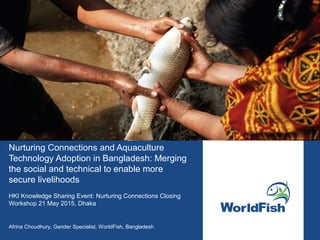
Nurturing Connections and Aquaculture
Technology Adoption in Bangladesh: Merging
the social and technical to enable more
secure livelihoods
HKI Knowledge Sharing Event: Nurturing Connections Closing
Workshop 21 May 2015, Dhaka
Afrina Choudhury, Gender Specialist, WorldFish, Bangladesh
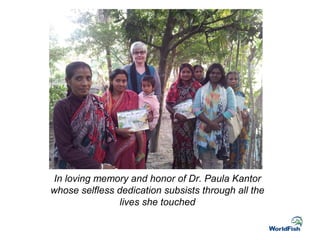
In loving memory and honor of Dr. Paula Kantor
whose selfless dedication subsists through all the
lives she touched
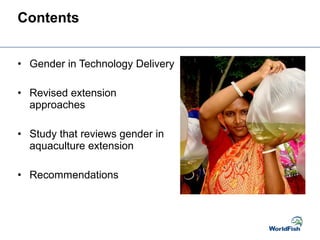
• Gender in Technology Delivery
• Revised extension
approaches
• Study that reviews gender in
aquaculture extension
• Recommendations
Contents
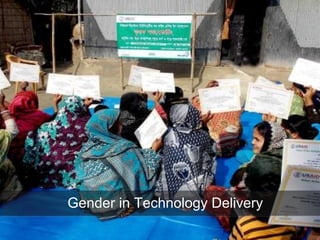
Gender in Technology Delivery
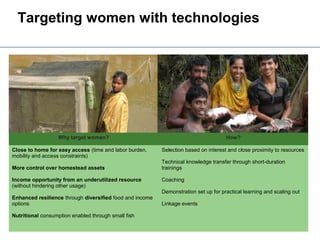
Why target women? How?
Close to home for easy access (time and labor burden,
mobility and access constraints)
More control over homestead assets
Income opportunity from an underutilized resource
(without hindering other usage)
Enhanced resilience through diversified food and income
options
Nutritional consumption enabled through small fish
Selection based on interest and close proximity to resources
Technical knowledge transfer through short-duration
trainings
Coaching
Demonstration set up for practical learning and scaling out
Linkage events
Targeting women with technologies
Trends
• Reducing technology adoption gap between men and women
by specifically targeting women
• Gender and aquaculture literature show that small-scale
aquaculture is suitable for women because ‘it is largely a
homestead-based activity that integrates well with prevailing
cultural norms’ (Jahan et al, 2010: 492).
• Marriage and family are the “the boundaries within which
women’s lives are ordained” (World Bank, 2008, p. 12), with
the composition and structure of women’s conjugal family
(e.g. nuclear or extended) correlated with women’s access…
(HKI, 2011)
Technologies cannot be 'delivered' in a gender-neutral way
because their impacts will not be gender-neutral; the operating
environment is shaped a priori by gender relations (Manfre et al.
2012; Ragasa et al. 2012; Farnworth, 2010).
Therefore, on the technology side, ignoring the social context
may limit the benefits of an intervention, as barriers to adoption
or to benefiting from adoption among marginalized groups are
not addressed
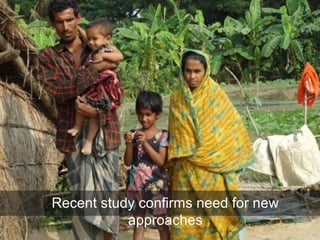
Recent study confirms need for new
approaches
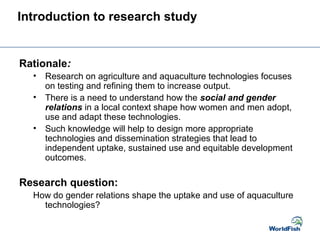
Introduction to research study
Rationale:
• Research on agriculture and aquaculture technologies focuses
on testing and refining them to increase output.
• There is a need to understand how the social and gender
relations in a local context shape how women and men adopt,
use and adapt these technologies.
• Such knowledge will help to design more appropriate
technologies and dissemination strategies that lead to
independent uptake, sustained use and equitable development
outcomes.
Research question:
How do gender relations shape the uptake and use of aquaculture
technologies?
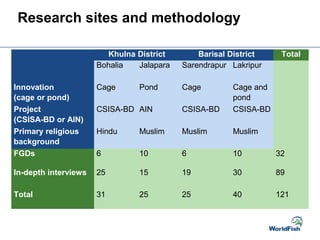
Research sites and methodology
Khulna District Barisal District Total
Bohalia Jalapara Sarendrapur Lakripur
Innovation
(cage or pond)
Cage Pond Cage Cage and
pond
Project
(CSISA-BD or AIN)
CSISA-BD AIN CSISA-BD CSISA-BD
Primary religious
background
Hindu Muslim Muslim Muslim
FGDs 6 10 6 10 32
In-depth interviews 25 15 19 30 89
Total 31 25 25 40 121
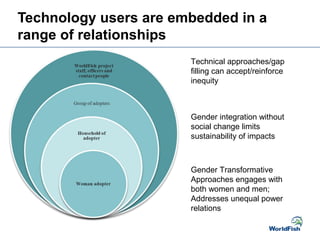
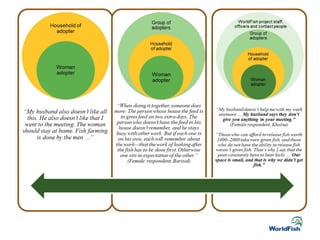
Technology users are embedded in a
range of relationships
Technical approaches/gap
filling can accept/reinforce
inequity
Gender integration without
social change limits
sustainability of impacts
Gender Transformative
Approaches engages with
both women and men;
Addresses unequal power
relations
Pilot of new extension approach in Faridpur
“in a family, it isn’t enough if one person is aware. If [training] is given to everyone in the
family, then all the members will be aware. Benefits can come.” (woman respondent,
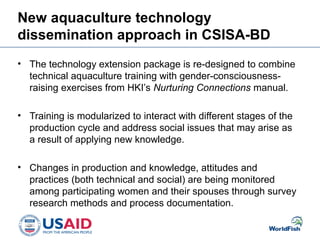
New aquaculture technology
dissemination approach in CSISA-BD
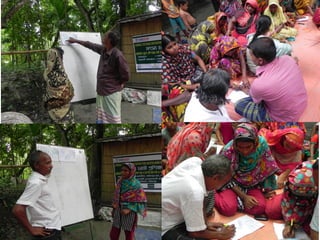
• The technology extension package is re-designed to combine
technical aquaculture training with gender-consciousness-
raising exercises from HKI’s Nurturing Connections manual.
• Training is modularized to interact with different stages of the
production cycle and address social issues that may arise as
a result of applying new knowledge.
• Changes in production and knowledge, attitudes and
practices (both technical and social) are being monitored
among participating women and their spouses through survey
research methods and process documentation.
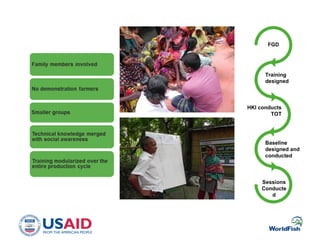
Sessions
Conducte
d
Baseline
designed and
conducted
HKI conducts
TOT
Training
designed
FGD
Farmer perceptions
Because we belong to a five member small (learning) group who live
close to each other, we discuss with one another. Should we forget
anything we can remind each other. This helps us solve problems and
answer any questions that may arise. The trainer’s visits also help to
clear up any queries we have (woman SGD participant).
Because our husbands, father in laws, and mother in laws were
included in some sessions, it was easier to for them to understand what
we told them. They don't create any barriers to our participation
(woman SGD participant).
Since they (other family members) were included they heard it from the
masters themselves. They believe us now about the benefits of
investing (woman SGD participant).
There was an exercise with family members on distributing food and on how we
usually make sure they eat better before eating ourselves. So usually we don’t
have much on our plates. In the past, men didn't notice this. As long as they got
a big piece or the head, they were happy. Now, following this exercise men
check what we are eating. They acknowledge that we work hard all day and
make sacrifices and should eat equally (Consolidated comments across many
women SGD participants).
Our husband’s ask us before purchases more than before. It is because
husbands are aware of the benefits of asking their wife’s opinion and since we
women were able to learn a lot from the training (woman SGD participant)
Preliminary findings from Gender in AQ
Review
• More scientific understanding of how to support healthy pond
functioning and how to intervene appropriately.
• The respondents associate improved analytic capacity
resulting from the training with higher social standing
• Improved analytic capacity considered to strengthen women's
voice in intra-household decision-making processes
• Merging social with technical interventions provides the
explicit livelihood incentive that motivates participation, and in
some contexts makes participation acceptable for women.
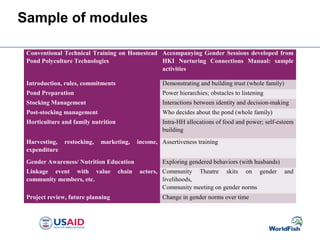
Sample of modules
Conventional Technical Training on Homestead
Pond Polyculture Technologies
Accompanying Gender Sessions developed from
HKI Nurturing Connections Manual: sample
activities
Introduction, rules, commitments Demonstrating and building trust (whole family)
Pond Preparation Power hierarchies; obstacles to listening
Stocking Management Interactions between identity and decision-making
Post-stocking management Who decides about the pond (whole family)
Horticulture and family nutrition Intra-HH allocations of food and power; self-esteem
building
Harvesting, restocking, marketing, income,
expenditure
Assertiveness training
Gender Awareness/ Nutrition Education Exploring gendered behaviors (with husbands)
Linkage event with value chain actors,
community members, etc.
Community Theatre skits on gender and
livelihoods,
Community meeting on gender norms
Project review, future planning Change in gender norms over time
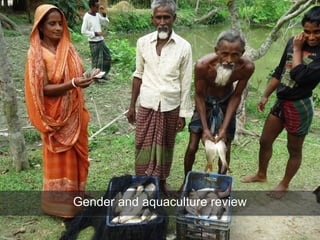
Gender and aquaculture review
Research Question:
Which technology x methodology interactions have the most
potential for sustained adoption, adaptation and use of the
technology and transformation of gender relations for women's
and men's economic, social and personal empowerment?
Focus:
Review of aquaculture technologies and gender in Bangladesh
from 1990 to 2014;
Review of select projects: Homestead aquaculture technology
delivery and participatory research initiatives
Study area: Bagerhat District, Faridpur District and Khulna
District
57 interviews and FGDs, consultations, review of grey and
published literature
Purpose
• A review of aquaculture technologies and gender in
Bangladesh in the period 1990 to 2014.
• Assesses how gender has been integrated within past
aquaculture technology interventions, before exploring the
gender dimensions associated with current approaches to
transferring knowledge about homestead aquaculture
technology.
• It draws out existing knowledge, identifies research gaps, and
selects practices to build upon - as well as practices to move
away from.
..
Projects Studied
• WorldFish Aquaculture for Income and Nutrition (AIN) Project.
• WorldFish Gender-Transformative Approach in Conventional
Training (WF-GTA) pilot (within CSISA-BD) using Nurturing
Connections
• WorldFish Challenged Ponds – a participatory action research
multi-partner project which involves technology dissemination.
• Solidaridad Sustainable Agriculture, Food security And
Linkages (SAFAL) project.
Gender in Aquaculture over the years
The way in which gender has been conceptualized and
integrated in aquaculture initiatives in Bangladesh over the past
thirty years has varied in line with organizational missions and
mandates, project objectives and donor interests among other
factors.
Even so, the targeting of women for interventions focused on
homestead ponds has been part of a wide variety of initiatives
over time
Several studies show that when women fishers access
resources effectively together with men, overall levels of
production, productivity and utilization can be strengthened
(Terry, 2014; Morgan et al. 2013; Rahman et al. 2011; Belton et
al. 2011; Shirajee et al. 2010).
Study conclusions
• Aquaculture training is leading to enhanced status and
strengthened voice in intrahousehold bargaining, irrespective
of methodology.
• Long-lasting and deeply held beliefs around gender roles and
responsibilities can be challenged when women are involved
in activities that bring clear economic benefits to their
households, or that enable them to perform their culturally
ascribed roles more effectively.
• However, the impacts of involving women can be temporary.
• Securing long-lasting change can only succeed if women and
men themselves take charge of—and feel they benefit as
individuals and as families from—changes in gender relations.
• Innovative methodologies for technology development and
dissemination need to focus on promoting farmer adaptive
capacity and enabling them to take charge of their own
learning, which is not a gender-neutral process.
• Working with development partners, value chain actors,
communities, families and individuals to remove gender-
based constraints to women's full participation in aquaculture
is essential.
Study conclusions
Recommendations
Link women's empowerment to the empowerment of the whole
family
Ensure direct links between women's contributions and
entitlements are made.
Challenge negative and promote positive gender norms. Adapt
activities from the Nurturing Connections training manual (and
others) to foster reflection and action around gendered attitudes
and practices that limit family livelihood security, or promote it.
• Enable all farmers to learn using their own resources
• Explicitly move away from the language of 'training', 'experts',
'trainees' and other forms of language which promote
hierarchies of understanding. Promote co-learning
• Distinguish technological content from learning processes
• Promote technologies as menus rather than packages
• Promote adaptive capacity.
• Foster understanding of the whole family in the technologies.
Way Forward
The findings of this rapid assessment indicate that building upon
the participatory action research methodology developed by the
Challenged Ponds project and combining it with the enabling
environment + value chain focus of SaFaL and Katalyst, and the
Gender-Transformative Approach piloted under CSISA-BD, holds
potential for fostering sustained improvements in livelihood
security for poor women and men in rural Bangladesh
Thank You

Gta nc hki event_afrina

  • 1.
    Nurturing Connections andAquaculture Technology Adoption in Bangladesh: Merging the social and technical to enable more secure livelihoods HKI Knowledge Sharing Event: Nurturing Connections Closing Workshop 21 May 2015, Dhaka Afrina Choudhury, Gender Specialist, WorldFish, Bangladesh
  • 2.
    In loving memoryand honor of Dr. Paula Kantor whose selfless dedication subsists through all the lives she touched
  • 3.
    • Gender inTechnology Delivery • Revised extension approaches • Study that reviews gender in aquaculture extension • Recommendations Contents
  • 4.
  • 5.
    Why target women?How? Close to home for easy access (time and labor burden, mobility and access constraints) More control over homestead assets Income opportunity from an underutilized resource (without hindering other usage) Enhanced resilience through diversified food and income options Nutritional consumption enabled through small fish Selection based on interest and close proximity to resources Technical knowledge transfer through short-duration trainings Coaching Demonstration set up for practical learning and scaling out Linkage events Targeting women with technologies
  • 6.
    Trends • Reducing technologyadoption gap between men and women by specifically targeting women • Gender and aquaculture literature show that small-scale aquaculture is suitable for women because ‘it is largely a homestead-based activity that integrates well with prevailing cultural norms’ (Jahan et al, 2010: 492). • Marriage and family are the “the boundaries within which women’s lives are ordained” (World Bank, 2008, p. 12), with the composition and structure of women’s conjugal family (e.g. nuclear or extended) correlated with women’s access… (HKI, 2011)
  • 7.
    Technologies cannot be'delivered' in a gender-neutral way because their impacts will not be gender-neutral; the operating environment is shaped a priori by gender relations (Manfre et al. 2012; Ragasa et al. 2012; Farnworth, 2010). Therefore, on the technology side, ignoring the social context may limit the benefits of an intervention, as barriers to adoption or to benefiting from adoption among marginalized groups are not addressed
  • 8.
    Recent study confirmsneed for new approaches
  • 9.
    Introduction to researchstudy Rationale: • Research on agriculture and aquaculture technologies focuses on testing and refining them to increase output. • There is a need to understand how the social and gender relations in a local context shape how women and men adopt, use and adapt these technologies. • Such knowledge will help to design more appropriate technologies and dissemination strategies that lead to independent uptake, sustained use and equitable development outcomes. Research question: How do gender relations shape the uptake and use of aquaculture technologies?
  • 10.
    Research sites andmethodology Khulna District Barisal District Total Bohalia Jalapara Sarendrapur Lakripur Innovation (cage or pond) Cage Pond Cage Cage and pond Project (CSISA-BD or AIN) CSISA-BD AIN CSISA-BD CSISA-BD Primary religious background Hindu Muslim Muslim Muslim FGDs 6 10 6 10 32 In-depth interviews 25 15 19 30 89 Total 31 25 25 40 121
  • 11.
    Technology users areembedded in a range of relationships Technical approaches/gap filling can accept/reinforce inequity Gender integration without social change limits sustainability of impacts Gender Transformative Approaches engages with both women and men; Addresses unequal power relations
  • 13.
    Pilot of newextension approach in Faridpur “in a family, it isn’t enough if one person is aware. If [training] is given to everyone in the family, then all the members will be aware. Benefits can come.” (woman respondent,
  • 14.
    New aquaculture technology disseminationapproach in CSISA-BD • The technology extension package is re-designed to combine technical aquaculture training with gender-consciousness- raising exercises from HKI’s Nurturing Connections manual. • Training is modularized to interact with different stages of the production cycle and address social issues that may arise as a result of applying new knowledge. • Changes in production and knowledge, attitudes and practices (both technical and social) are being monitored among participating women and their spouses through survey research methods and process documentation.
  • 15.
  • 16.
    Farmer perceptions Because webelong to a five member small (learning) group who live close to each other, we discuss with one another. Should we forget anything we can remind each other. This helps us solve problems and answer any questions that may arise. The trainer’s visits also help to clear up any queries we have (woman SGD participant). Because our husbands, father in laws, and mother in laws were included in some sessions, it was easier to for them to understand what we told them. They don't create any barriers to our participation (woman SGD participant). Since they (other family members) were included they heard it from the masters themselves. They believe us now about the benefits of investing (woman SGD participant).
  • 17.
    There was anexercise with family members on distributing food and on how we usually make sure they eat better before eating ourselves. So usually we don’t have much on our plates. In the past, men didn't notice this. As long as they got a big piece or the head, they were happy. Now, following this exercise men check what we are eating. They acknowledge that we work hard all day and make sacrifices and should eat equally (Consolidated comments across many women SGD participants). Our husband’s ask us before purchases more than before. It is because husbands are aware of the benefits of asking their wife’s opinion and since we women were able to learn a lot from the training (woman SGD participant)
  • 18.
    Preliminary findings fromGender in AQ Review • More scientific understanding of how to support healthy pond functioning and how to intervene appropriately. • The respondents associate improved analytic capacity resulting from the training with higher social standing • Improved analytic capacity considered to strengthen women's voice in intra-household decision-making processes • Merging social with technical interventions provides the explicit livelihood incentive that motivates participation, and in some contexts makes participation acceptable for women.
  • 19.
    Sample of modules ConventionalTechnical Training on Homestead Pond Polyculture Technologies Accompanying Gender Sessions developed from HKI Nurturing Connections Manual: sample activities Introduction, rules, commitments Demonstrating and building trust (whole family) Pond Preparation Power hierarchies; obstacles to listening Stocking Management Interactions between identity and decision-making Post-stocking management Who decides about the pond (whole family) Horticulture and family nutrition Intra-HH allocations of food and power; self-esteem building Harvesting, restocking, marketing, income, expenditure Assertiveness training Gender Awareness/ Nutrition Education Exploring gendered behaviors (with husbands) Linkage event with value chain actors, community members, etc. Community Theatre skits on gender and livelihoods, Community meeting on gender norms Project review, future planning Change in gender norms over time
  • 21.
  • 22.
    Research Question: Which technologyx methodology interactions have the most potential for sustained adoption, adaptation and use of the technology and transformation of gender relations for women's and men's economic, social and personal empowerment? Focus: Review of aquaculture technologies and gender in Bangladesh from 1990 to 2014; Review of select projects: Homestead aquaculture technology delivery and participatory research initiatives Study area: Bagerhat District, Faridpur District and Khulna District 57 interviews and FGDs, consultations, review of grey and published literature
  • 23.
    Purpose • A reviewof aquaculture technologies and gender in Bangladesh in the period 1990 to 2014. • Assesses how gender has been integrated within past aquaculture technology interventions, before exploring the gender dimensions associated with current approaches to transferring knowledge about homestead aquaculture technology. • It draws out existing knowledge, identifies research gaps, and selects practices to build upon - as well as practices to move away from. ..
  • 24.
    Projects Studied • WorldFishAquaculture for Income and Nutrition (AIN) Project. • WorldFish Gender-Transformative Approach in Conventional Training (WF-GTA) pilot (within CSISA-BD) using Nurturing Connections • WorldFish Challenged Ponds – a participatory action research multi-partner project which involves technology dissemination. • Solidaridad Sustainable Agriculture, Food security And Linkages (SAFAL) project.
  • 25.
    Gender in Aquacultureover the years The way in which gender has been conceptualized and integrated in aquaculture initiatives in Bangladesh over the past thirty years has varied in line with organizational missions and mandates, project objectives and donor interests among other factors. Even so, the targeting of women for interventions focused on homestead ponds has been part of a wide variety of initiatives over time Several studies show that when women fishers access resources effectively together with men, overall levels of production, productivity and utilization can be strengthened (Terry, 2014; Morgan et al. 2013; Rahman et al. 2011; Belton et al. 2011; Shirajee et al. 2010).
  • 26.
    Study conclusions • Aquaculturetraining is leading to enhanced status and strengthened voice in intrahousehold bargaining, irrespective of methodology. • Long-lasting and deeply held beliefs around gender roles and responsibilities can be challenged when women are involved in activities that bring clear economic benefits to their households, or that enable them to perform their culturally ascribed roles more effectively. • However, the impacts of involving women can be temporary.
  • 27.
    • Securing long-lastingchange can only succeed if women and men themselves take charge of—and feel they benefit as individuals and as families from—changes in gender relations. • Innovative methodologies for technology development and dissemination need to focus on promoting farmer adaptive capacity and enabling them to take charge of their own learning, which is not a gender-neutral process. • Working with development partners, value chain actors, communities, families and individuals to remove gender- based constraints to women's full participation in aquaculture is essential. Study conclusions
  • 28.
    Recommendations Link women's empowermentto the empowerment of the whole family Ensure direct links between women's contributions and entitlements are made. Challenge negative and promote positive gender norms. Adapt activities from the Nurturing Connections training manual (and others) to foster reflection and action around gendered attitudes and practices that limit family livelihood security, or promote it.
  • 29.
    • Enable allfarmers to learn using their own resources • Explicitly move away from the language of 'training', 'experts', 'trainees' and other forms of language which promote hierarchies of understanding. Promote co-learning • Distinguish technological content from learning processes • Promote technologies as menus rather than packages • Promote adaptive capacity. • Foster understanding of the whole family in the technologies.
  • 30.
    Way Forward The findingsof this rapid assessment indicate that building upon the participatory action research methodology developed by the Challenged Ponds project and combining it with the enabling environment + value chain focus of SaFaL and Katalyst, and the Gender-Transformative Approach piloted under CSISA-BD, holds potential for fostering sustained improvements in livelihood security for poor women and men in rural Bangladesh
  • 31.

Editor's Notes

  • #10 Formative study to help guide emerging AQ interventions in WorldFish – which are trying to integrate or involve women in these technologies…what can we learn to do this better? WorldFish is taking a bold step in doing this, and this study highlights the complexity of what field staff are having to encounter In order to do it appropriately, must challenge assumptions that targeting or involving women automatically leads to benefits for women or gender relations Furthermore – how to sustain any changes or benefits for women?
  • #12 We try to involve or target women but women do not use the technologies in a vacuum – without influences from other actors and institutions. Power relations – and specifically gender power relations – at every level affect the extent to which women can actually use and benefit from these innovations. This CCAFS & AAS funded study of two women targeted aquaculture technologies, disseminated through two WorldFish projects (USAID funded CSISA-BD and AIN), has found that technology interventions that target women alone may not necessarily enhance women’s contributions to aquaculture outcomes and the benefits they derive from them. This discrepancy between expected and actual outcomes arises because women, and men, exist in a multidimensional system of gender relations which influence women’s ability to: adopt technologies, gain and apply knowledge and skills to adapt them, achieve anticipated production and consumption outcomes and share equitably in their benefits.
  • #14 Applying learning from the study to design a new training approach in the CSISA BD project
  • #22 Applying learning from the study to design a new training approach in the CSISA BD project