GStreamer: An overview
Rodrigo Costa
Pontifical Catholic University of Rio de Janeiro
TeleM´ıdia Lab.
rodrigocosta@telemidia.puc-rio.br
April 16, 2015
Rodrigo Costa (TeleM´ıdia Lab.) GStreamer April 16, 2015 1 / 22
Overview
1 GStreamer
Overview
Pipelines
Basic Concepts
Synchronization
Examples
Rodrigo Costa (TeleM´ıdia Lab.) GStreamer April 16, 2015 2 / 22
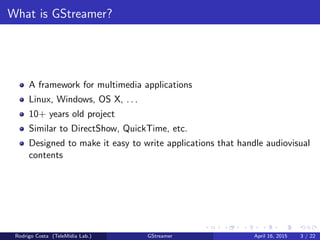
What is GStreamer?
A framework for multimedia applications
Linux, Windows, OS X, . . .
10+ years old project
Similar to DirectShow, QuickTime, etc.
Designed to make it easy to write applications that handle audiovisual
contents
Rodrigo Costa (TeleM´ıdia Lab.) GStreamer April 16, 2015 3 / 22
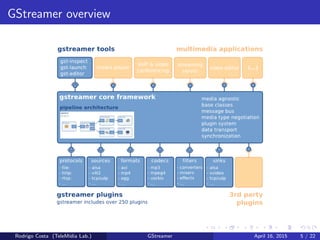
GStreamer overview
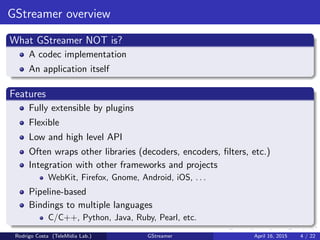
What GStreamer NOT is?
A codec implementation
An application itself
Features
Fully extensible by plugins
Flexible
Low and high level API
Often wraps other libraries (decoders, encoders, filters, etc.)
Integration with other frameworks and projects
WebKit, Firefox, Gnome, Android, iOS, . . .
Pipeline-based
Bindings to multiple languages
C/C++, Python, Java, Ruby, Pearl, etc.
Rodrigo Costa (TeleM´ıdia Lab.) GStreamer April 16, 2015 4 / 22
GStreamer overview
Rodrigo Costa (TeleM´ıdia Lab.) GStreamer April 16, 2015 5 / 22
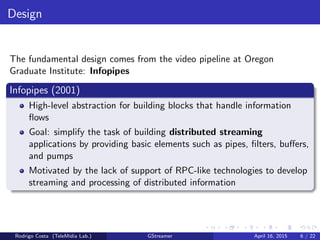
Design
The fundamental design comes from the video pipeline at Oregon
Graduate Institute: Infopipes
Infopipes (2001)
High-level abstraction for building blocks that handle information
flows
Goal: simplify the task of building distributed streaming
applications by providing basic elements such as pipes, filters, buffers,
and pumps
Motivated by the lack of support of RPC-like technologies to develop
streaming and processing of distributed information
Rodrigo Costa (TeleM´ıdia Lab.) GStreamer April 16, 2015 6 / 22
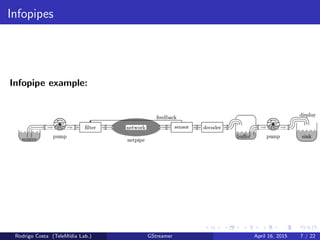
Infopipes
Infopipe example:
Rodrigo Costa (TeleM´ıdia Lab.) GStreamer April 16, 2015 7 / 22
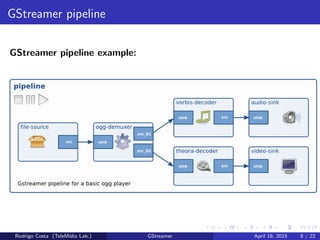
GStreamer pipeline
GStreamer pipeline example:
Rodrigo Costa (TeleM´ıdia Lab.) GStreamer April 16, 2015 8 / 22
Basic Concepts
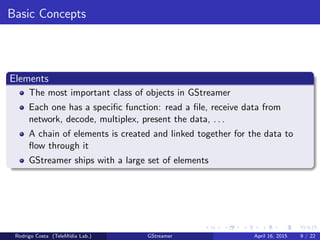
Elements
The most important class of objects in GStreamer
Each one has a specific function: read a file, receive data from
network, decode, multiplex, present the data, . . .
A chain of elements is created and linked together for the data to
flow through it
GStreamer ships with a large set of elements
Rodrigo Costa (TeleM´ıdia Lab.) GStreamer April 16, 2015 9 / 22
Basic Concepts
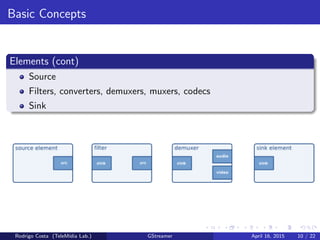
Elements (cont)
Source
Filters, converters, demuxers, muxers, codecs
Sink
Rodrigo Costa (TeleM´ıdia Lab.) GStreamer April 16, 2015 10 / 22
Basic Concepts
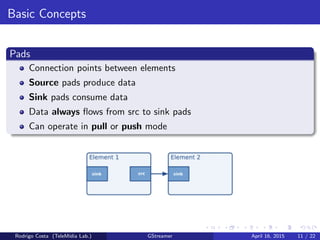
Pads
Connection points between elements
Source pads produce data
Sink pads consume data
Data always flows from src to sink pads
Can operate in pull or push mode
Rodrigo Costa (TeleM´ıdia Lab.) GStreamer April 16, 2015 11 / 22
Basic Concepts
Pads (cont)
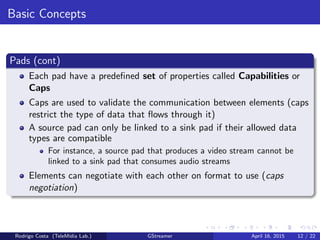
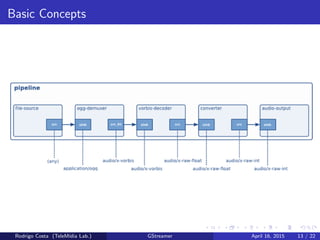
Each pad have a predefined set of properties called Capabilities or
Caps
Caps are used to validate the communication between elements (caps
restrict the type of data that flows through it)
A source pad can only be linked to a sink pad if their allowed data
types are compatible
For instance, a source pad that produces a video stream cannot be
linked to a sink pad that consumes audio streams
Elements can negotiate with each other on format to use (caps
negotiation)
Rodrigo Costa (TeleM´ıdia Lab.) GStreamer April 16, 2015 12 / 22
Basic Concepts
Rodrigo Costa (TeleM´ıdia Lab.) GStreamer April 16, 2015 13 / 22
Basic Concepts
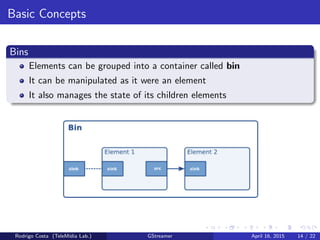
Bins
Elements can be grouped into a container called bin
It can be manipulated as it were an element
It also manages the state of its children elements
Rodrigo Costa (TeleM´ıdia Lab.) GStreamer April 16, 2015 14 / 22
Basic Concepts
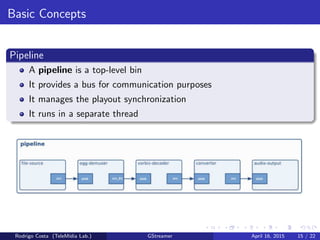
Pipeline
A pipeline is a top-level bin
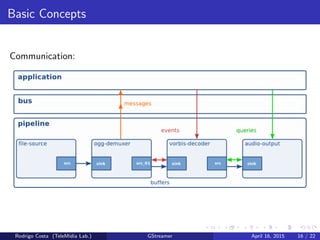
It provides a bus for communication purposes
It manages the playout synchronization
It runs in a separate thread
Rodrigo Costa (TeleM´ıdia Lab.) GStreamer April 16, 2015 15 / 22
Basic Concepts
Communication:
Rodrigo Costa (TeleM´ıdia Lab.) GStreamer April 16, 2015 16 / 22
Synchronization
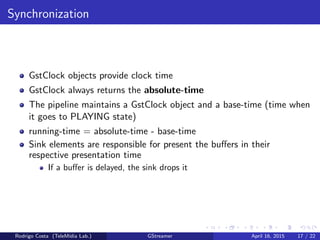
GstClock objects provide clock time
GstClock always returns the absolute-time
The pipeline maintains a GstClock object and a base-time (time when
it goes to PLAYING state)
running-time = absolute-time - base-time
Sink elements are responsible for present the buffers in their
respective presentation time
If a buffer is delayed, the sink drops it
Rodrigo Costa (TeleM´ıdia Lab.) GStreamer April 16, 2015 17 / 22
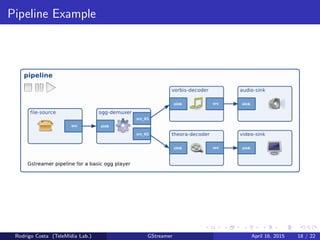
Pipeline Example
Rodrigo Costa (TeleM´ıdia Lab.) GStreamer April 16, 2015 18 / 22
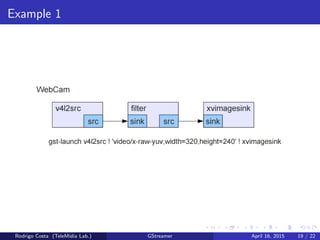
Example 1
Rodrigo Costa (TeleM´ıdia Lab.) GStreamer April 16, 2015 19 / 22
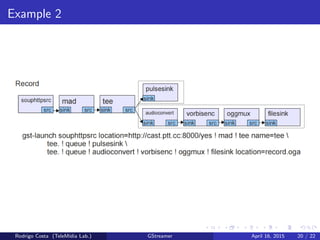
Example 2
Rodrigo Costa (TeleM´ıdia Lab.) GStreamer April 16, 2015 20 / 22
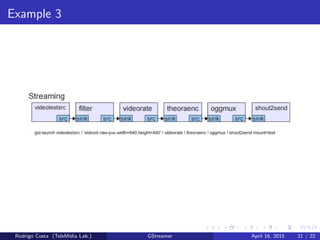
Example 3
Rodrigo Costa (TeleM´ıdia Lab.) GStreamer April 16, 2015 21 / 22
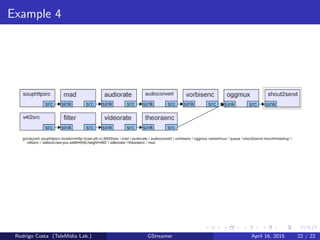
Example 4
Rodrigo Costa (TeleM´ıdia Lab.) GStreamer April 16, 2015 22 / 22

Gstreamer: an Overview

  • 1.
    GStreamer: An overview RodrigoCosta Pontifical Catholic University of Rio de Janeiro TeleM´ıdia Lab. rodrigocosta@telemidia.puc-rio.br April 16, 2015 Rodrigo Costa (TeleM´ıdia Lab.) GStreamer April 16, 2015 1 / 22
  • 2.
    Overview 1 GStreamer Overview Pipelines Basic Concepts Synchronization Examples RodrigoCosta (TeleM´ıdia Lab.) GStreamer April 16, 2015 2 / 22
  • 3.
    What is GStreamer? Aframework for multimedia applications Linux, Windows, OS X, . . . 10+ years old project Similar to DirectShow, QuickTime, etc. Designed to make it easy to write applications that handle audiovisual contents Rodrigo Costa (TeleM´ıdia Lab.) GStreamer April 16, 2015 3 / 22
  • 4.
    GStreamer overview What GStreamerNOT is? A codec implementation An application itself Features Fully extensible by plugins Flexible Low and high level API Often wraps other libraries (decoders, encoders, filters, etc.) Integration with other frameworks and projects WebKit, Firefox, Gnome, Android, iOS, . . . Pipeline-based Bindings to multiple languages C/C++, Python, Java, Ruby, Pearl, etc. Rodrigo Costa (TeleM´ıdia Lab.) GStreamer April 16, 2015 4 / 22
  • 5.
    GStreamer overview Rodrigo Costa(TeleM´ıdia Lab.) GStreamer April 16, 2015 5 / 22
  • 6.
    Design The fundamental designcomes from the video pipeline at Oregon Graduate Institute: Infopipes Infopipes (2001) High-level abstraction for building blocks that handle information flows Goal: simplify the task of building distributed streaming applications by providing basic elements such as pipes, filters, buffers, and pumps Motivated by the lack of support of RPC-like technologies to develop streaming and processing of distributed information Rodrigo Costa (TeleM´ıdia Lab.) GStreamer April 16, 2015 6 / 22
  • 7.
    Infopipes Infopipe example: Rodrigo Costa(TeleM´ıdia Lab.) GStreamer April 16, 2015 7 / 22
  • 8.
    GStreamer pipeline GStreamer pipelineexample: Rodrigo Costa (TeleM´ıdia Lab.) GStreamer April 16, 2015 8 / 22
  • 9.
    Basic Concepts Elements The mostimportant class of objects in GStreamer Each one has a specific function: read a file, receive data from network, decode, multiplex, present the data, . . . A chain of elements is created and linked together for the data to flow through it GStreamer ships with a large set of elements Rodrigo Costa (TeleM´ıdia Lab.) GStreamer April 16, 2015 9 / 22
  • 10.
    Basic Concepts Elements (cont) Source Filters,converters, demuxers, muxers, codecs Sink Rodrigo Costa (TeleM´ıdia Lab.) GStreamer April 16, 2015 10 / 22
  • 11.
    Basic Concepts Pads Connection pointsbetween elements Source pads produce data Sink pads consume data Data always flows from src to sink pads Can operate in pull or push mode Rodrigo Costa (TeleM´ıdia Lab.) GStreamer April 16, 2015 11 / 22
  • 12.
    Basic Concepts Pads (cont) Eachpad have a predefined set of properties called Capabilities or Caps Caps are used to validate the communication between elements (caps restrict the type of data that flows through it) A source pad can only be linked to a sink pad if their allowed data types are compatible For instance, a source pad that produces a video stream cannot be linked to a sink pad that consumes audio streams Elements can negotiate with each other on format to use (caps negotiation) Rodrigo Costa (TeleM´ıdia Lab.) GStreamer April 16, 2015 12 / 22
  • 13.
    Basic Concepts Rodrigo Costa(TeleM´ıdia Lab.) GStreamer April 16, 2015 13 / 22
  • 14.
    Basic Concepts Bins Elements canbe grouped into a container called bin It can be manipulated as it were an element It also manages the state of its children elements Rodrigo Costa (TeleM´ıdia Lab.) GStreamer April 16, 2015 14 / 22
  • 15.
    Basic Concepts Pipeline A pipelineis a top-level bin It provides a bus for communication purposes It manages the playout synchronization It runs in a separate thread Rodrigo Costa (TeleM´ıdia Lab.) GStreamer April 16, 2015 15 / 22
  • 16.
    Basic Concepts Communication: Rodrigo Costa(TeleM´ıdia Lab.) GStreamer April 16, 2015 16 / 22
  • 17.
    Synchronization GstClock objects provideclock time GstClock always returns the absolute-time The pipeline maintains a GstClock object and a base-time (time when it goes to PLAYING state) running-time = absolute-time - base-time Sink elements are responsible for present the buffers in their respective presentation time If a buffer is delayed, the sink drops it Rodrigo Costa (TeleM´ıdia Lab.) GStreamer April 16, 2015 17 / 22
  • 18.
    Pipeline Example Rodrigo Costa(TeleM´ıdia Lab.) GStreamer April 16, 2015 18 / 22
  • 19.
    Example 1 Rodrigo Costa(TeleM´ıdia Lab.) GStreamer April 16, 2015 19 / 22
  • 20.
    Example 2 Rodrigo Costa(TeleM´ıdia Lab.) GStreamer April 16, 2015 20 / 22
  • 21.
    Example 3 Rodrigo Costa(TeleM´ıdia Lab.) GStreamer April 16, 2015 21 / 22
  • 22.
    Example 4 Rodrigo Costa(TeleM´ıdia Lab.) GStreamer April 16, 2015 22 / 22