Gstreamer programming
Rajeev Tiwari
Sr Principal Architect
What’s Gstreamer
§  GStreamer is, in short, an engine used by other applications to
play media files
§  In more detail it is a framework based on graphs of filters
which operate on media data. Applications using this library
can do anything from the sound processing to real-time video
playback, and handle almost everything that is related to
multimedia. Its architecture based on plugins, you can easily
add new data types or new treatment options.
License – LGPL
¨ GStreamer is released under LGPL (GNU Lesser
General Public License).
¨ LGPL means that the GStremer software itself
has copyleft rules which means that you have to
keep the software free.
¨ But you are allowed to create your own software
with your own copyright rules and link it with
GStremer.
¨ For companies like Nokia this license gives a
profitable basis for their own software. They can
use GStremer as a multimedia framework, but
own the copyright to their own software, because
it is merely linked to GStreamer.
Applications
—  GStreamer’s most obvious use is creating a media
player on top of it, because it supports many needed
formats for this.
—  GStreamer can also be used to create more complex
programs like video or audio editing applications.
—  We intend to use it to create an Internet radio.
Usage
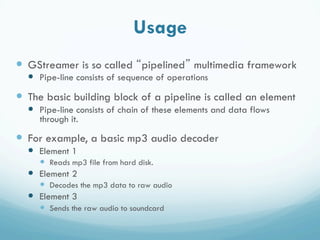
—  GStreamer is so called “pipelined” multimedia framework
—  Pipe-line consists of sequence of operations
—  The basic building block of a pipeline is called an element
—  Pipe-line consists of chain of these elements and data flows
through it.
—  For example, a basic mp3 audio decoder
—  Element 1
—  Reads mp3 file from hard disk.
—  Element 2
—  Decodes the mp3 data to raw audio
—  Element 3
—  Sends the raw audio to soundcard
Usage
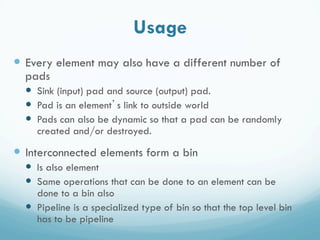
—  Every element may also have a different number of
pads
—  Sink (input) pad and source (output) pad.
—  Pad is an element’s link to outside world
—  Pads can also be dynamic so that a pad can be randomly
created and/or destroyed.
—  Interconnected elements form a bin
—  Is also element
—  Same operations that can be done to an element can be
done to a bin also
—  Pipeline is a specialized type of bin so that the top level bin
has to be pipeline
Usage
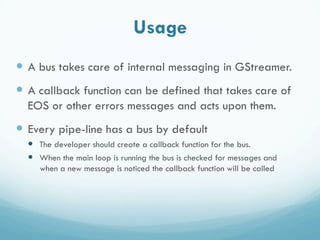
—  A bus takes care of internal messaging in GStreamer.
—  A callback function can be defined that takes care of
EOS or other errors messages and acts upon them.
—  Every pipe-line has a bus by default
—  The developer should create a callback function for the bus.
—  When the main loop is running the bus is checked for messages and
when a new message is noticed the callback function will be called
Gstreamer Global Architecture
What GStreamer provides ?
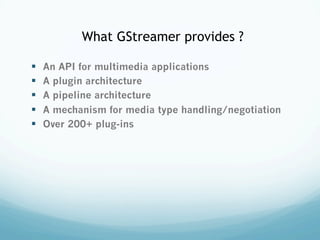
§  An API for multimedia applications
§  A plugin architecture
§  A pipeline architecture
§  A mechanism for media type handling/negotiation
§  Over 200+ plug-ins
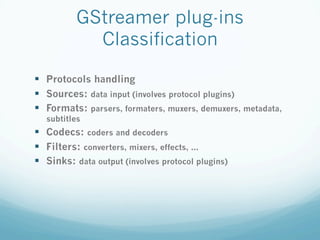
GStreamer plug-ins
Classification
§  Protocols handling
§  Sources: data input (involves protocol plugins)
§  Formats: parsers, formaters, muxers, demuxers, metadata,
subtitles
§  Codecs: coders and decoders
§  Filters: converters, mixers, effects, ...
§  Sinks: data output (involves protocol plugins)
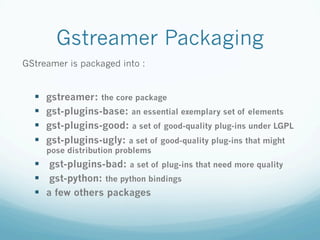
Gstreamer Packaging
GStreamer is packaged into :
§  gstreamer: the core package
§  gst-plugins-base: an essential exemplary set of elements
§  gst-plugins-good: a set of good-quality plug-ins under LGPL
§  gst-plugins-ugly: a set of good-quality plug-ins that might
pose distribution problems
§  gst-plugins-bad: a set of plug-ins that need more quality
§  gst-python: the python bindings
§  a few others packages
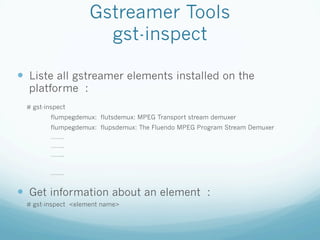
Gstreamer Tools
gst-inspect
—  Liste all gstreamer elements installed on the
platforme :
# gst-inspect
flumpegdemux: flutsdemux: MPEG Transport stream demuxer
flumpegdemux: flupsdemux: The Fluendo MPEG Program Stream Demuxer
……..
……..
……..
……..
—  Get information about an element :
# gst-inspect <element name>
Example
#include <gst/gst.h>
int
main (int argc,
char *argv[])
{
pipeline = gst_pipeline_new ("audio-player");
source = gst_element_factory_make ("filesrc", "file-source");
parser = gst_element_factory_make ("oggdemux", "ogg-parser");
decoder = gst_element_factory_make ("vorbisdec", "vorbis-decoder");
conv = gst_element_factory_make ("audioconvert", "converter");
sink = gst_element_factory_make ("alsasink", "alsa-output");
g_object_set (G_OBJECT (source), "location", argv[1], NULL);
bus = gst_pipeline_get_bus (GST_PIPELINE (pipeline));
gst_bus_add_watch (bus, bus_call, loop);
gst_object_unref (bus);
gst_bin_add_many (GST_BIN (pipeline),
source, parser, decoder, conv, sink, NULL);
gst_element_link (source, parser);
gst_element_link_many (decoder, conv, sink, NULL);
g_signal_connect (parser, "pad-added", G_CALLBACK (new_pad), NULL);
}
Example
#include <gst/gst.h>
int
main (int argc,
char *argv[])
{
pipeline = gst_pipeline_new ("audio-player");
source = gst_element_factory_make ("filesrc", "file-source");
parser = gst_element_factory_make ("oggdemux", "ogg-parser");
decoder = gst_element_factory_make ("vorbisdec", "vorbis-decoder");
conv = gst_element_factory_make ("audioconvert", "converter");
sink = gst_element_factory_make ("alsasink", "alsa-output");
g_object_set (G_OBJECT (source), "location", argv[1], NULL);
bus = gst_pipeline_get_bus (GST_PIPELINE (pipeline));
gst_bus_add_watch (bus, bus_call, loop);
gst_object_unref (bus);
gst_bin_add_many (GST_BIN (pipeline),
source, parser, decoder, conv, sink, NULL);
gst_element_link (source, parser);
gst_element_link_many (decoder, conv, sink, NULL);
g_signal_connect (parser, "pad-added", G_CALLBACK (new_pad), NULL);
}
Creating elements
Example
#include <gst/gst.h>
int
main (int argc,
char *argv[])
{
pipeline = gst_pipeline_new ("audio-player");
source = gst_element_factory_make ("filesrc", "file-source");
parser = gst_element_factory_make ("oggdemux", "ogg-parser");
decoder = gst_element_factory_make ("vorbisdec", "vorbis-decoder");
conv = gst_element_factory_make ("audioconvert", "converter");
sink = gst_element_factory_make ("alsasink", "alsa-output");
g_object_set (G_OBJECT (source), "location", argv[1], NULL);
bus = gst_pipeline_get_bus (GST_PIPELINE (pipeline));
gst_bus_add_watch (bus, bus_call, loop);
gst_object_unref (bus);
gst_bin_add_many (GST_BIN (pipeline),
source, parser, decoder, conv, sink, NULL);
gst_element_link (source, parser);
gst_element_link_many (decoder, conv, sink, NULL);
g_signal_connect (parser, "pad-added", G_CALLBACK (new_pad), NULL);
}
Creating elements
Setting filesrc
element properties
Example
#include <gst/gst.h>
int
main (int argc,
char *argv[])
{
pipeline = gst_pipeline_new ("audio-player");
source = gst_element_factory_make ("filesrc", "file-source");
parser = gst_element_factory_make ("oggdemux", "ogg-parser");
decoder = gst_element_factory_make ("vorbisdec", "vorbis-decoder");
conv = gst_element_factory_make ("audioconvert", "converter");
sink = gst_element_factory_make ("alsasink", "alsa-output");
g_object_set (G_OBJECT (source), "location", argv[1], NULL);
bus = gst_pipeline_get_bus (GST_PIPELINE (pipeline));
gst_bus_add_watch (bus, bus_call, loop);
gst_object_unref (bus);
gst_bin_add_many (GST_BIN (pipeline),
source, parser, decoder, conv, sink, NULL);
gst_element_link (source, parser);
gst_element_link_many (decoder, conv, sink, NULL);
g_signal_connect (parser, "pad-added", G_CALLBACK (new_pad), NULL);
}
Creating elements
Setting filesrc
element properties
Adding the callback
function for bus
Example
#include <gst/gst.h>
int
main (int argc,
char *argv[])
{
pipeline = gst_pipeline_new ("audio-player");
source = gst_element_factory_make ("filesrc", "file-source");
parser = gst_element_factory_make ("oggdemux", "ogg-parser");
decoder = gst_element_factory_make ("vorbisdec", "vorbis-decoder");
conv = gst_element_factory_make ("audioconvert", "converter");
sink = gst_element_factory_make ("alsasink", "alsa-output");
g_object_set (G_OBJECT (source), "location", argv[1], NULL);
bus = gst_pipeline_get_bus (GST_PIPELINE (pipeline));
gst_bus_add_watch (bus, bus_call, loop);
gst_object_unref (bus);
gst_bin_add_many (GST_BIN (pipeline),
source, parser, decoder, conv, sink, NULL);
gst_element_link (source, parser);
gst_element_link_many (decoder, conv, sink, NULL);
g_signal_connect (parser, "pad-added", G_CALLBACK (new_pad), NULL);
}
Adding the callback
function for bus
Putting elements to a bin
Creating elements
Setting filesrc
element properties
Example
#include <gst/gst.h>
int
main (int argc,
char *argv[])
{
pipeline = gst_pipeline_new ("audio-player");
source = gst_element_factory_make ("filesrc", "file-source");
parser = gst_element_factory_make ("oggdemux", "ogg-parser");
decoder = gst_element_factory_make ("vorbisdec", "vorbis-decoder");
conv = gst_element_factory_make ("audioconvert", "converter");
sink = gst_element_factory_make ("alsasink", "alsa-output");
g_object_set (G_OBJECT (source), "location", argv[1], NULL);
bus = gst_pipeline_get_bus (GST_PIPELINE (pipeline));
gst_bus_add_watch (bus, bus_call, loop);
gst_object_unref (bus);
gst_bin_add_many (GST_BIN (pipeline),
source, parser, decoder, conv, sink, NULL);
gst_element_link (source, parser);
gst_element_link_many (decoder, conv, sink, NULL);
g_signal_connect (parser, "pad-added", G_CALLBACK (new_pad), NULL);
}
Putting elements to a bin
Creating elements
Setting filesrc
element properties
Linking elements
together
Adding the callback
function for bus
Example
static gboolean bus_call (GstBus *bus, GstMessage
*msg,
gpointer data)
{
GMainLoop *loop = (GMainLoop *) data;
switch (GST_MESSAGE_TYPE (msg)) {
case GST_MESSAGE_EOS:
g_print ("End-of-streamn");
g_main_loop_quit (loop);
break;
case GST_MESSAGE_ERROR: {
gchar *debug;
GError *err;
gst_message_parse_error (msg, &err, &debug);
g_free (debug);
g_print ("Error: %sn", err->message);
g_error_free (err);
g_main_loop_quit (loop);
break;
}
default:
break;
}
return TRUE;
}
static void
new_pad (GstElement *element,
GstPad *pad,
gpointer data)
{
GstPad *sinkpad;
/* We can now link this pad with the audio decoder */
g_print ("Dynamic pad created, linking parser/
decodern");
sinkpad = gst_element_get_pad (decoder, "sink");
gst_pad_link (pad, sinkpad);
gst_object_unref (sinkpad);
}
Callback funtion for
error handling
Function for
dynamic pad
creation
Resources
q Gstreamer : http://www.gstreamer.org
q Fluendo plugin : http://core.fluendo.com/gstreamer/src/gst-fluendo-ismd/
q Gstreamer API :
http://gstreamer.freedesktop.org/data/doc/gstreamer/head/gstreamer/html/
libgstreamer.html

Gstreamer Basics

  • 1.
  • 2.
    What’s Gstreamer §  GStreameris, in short, an engine used by other applications to play media files §  In more detail it is a framework based on graphs of filters which operate on media data. Applications using this library can do anything from the sound processing to real-time video playback, and handle almost everything that is related to multimedia. Its architecture based on plugins, you can easily add new data types or new treatment options.
  • 3.
    License – LGPL ¨ GStreameris released under LGPL (GNU Lesser General Public License). ¨ LGPL means that the GStremer software itself has copyleft rules which means that you have to keep the software free. ¨ But you are allowed to create your own software with your own copyright rules and link it with GStremer. ¨ For companies like Nokia this license gives a profitable basis for their own software. They can use GStremer as a multimedia framework, but own the copyright to their own software, because it is merely linked to GStreamer.
  • 4.
    Applications —  GStreamer’s mostobvious use is creating a media player on top of it, because it supports many needed formats for this. —  GStreamer can also be used to create more complex programs like video or audio editing applications. —  We intend to use it to create an Internet radio.
  • 5.
    Usage —  GStreamer isso called “pipelined” multimedia framework —  Pipe-line consists of sequence of operations —  The basic building block of a pipeline is called an element —  Pipe-line consists of chain of these elements and data flows through it. —  For example, a basic mp3 audio decoder —  Element 1 —  Reads mp3 file from hard disk. —  Element 2 —  Decodes the mp3 data to raw audio —  Element 3 —  Sends the raw audio to soundcard
  • 6.
    Usage —  Every elementmay also have a different number of pads —  Sink (input) pad and source (output) pad. —  Pad is an element’s link to outside world —  Pads can also be dynamic so that a pad can be randomly created and/or destroyed. —  Interconnected elements form a bin —  Is also element —  Same operations that can be done to an element can be done to a bin also —  Pipeline is a specialized type of bin so that the top level bin has to be pipeline
  • 7.
    Usage —  A bustakes care of internal messaging in GStreamer. —  A callback function can be defined that takes care of EOS or other errors messages and acts upon them. —  Every pipe-line has a bus by default —  The developer should create a callback function for the bus. —  When the main loop is running the bus is checked for messages and when a new message is noticed the callback function will be called
  • 8.
  • 9.
    What GStreamer provides? §  An API for multimedia applications §  A plugin architecture §  A pipeline architecture §  A mechanism for media type handling/negotiation §  Over 200+ plug-ins
  • 10.
    GStreamer plug-ins Classification §  Protocolshandling §  Sources: data input (involves protocol plugins) §  Formats: parsers, formaters, muxers, demuxers, metadata, subtitles §  Codecs: coders and decoders §  Filters: converters, mixers, effects, ... §  Sinks: data output (involves protocol plugins)
  • 11.
    Gstreamer Packaging GStreamer ispackaged into : §  gstreamer: the core package §  gst-plugins-base: an essential exemplary set of elements §  gst-plugins-good: a set of good-quality plug-ins under LGPL §  gst-plugins-ugly: a set of good-quality plug-ins that might pose distribution problems §  gst-plugins-bad: a set of plug-ins that need more quality §  gst-python: the python bindings §  a few others packages
  • 12.
    Gstreamer Tools gst-inspect —  Listeall gstreamer elements installed on the platforme : # gst-inspect flumpegdemux: flutsdemux: MPEG Transport stream demuxer flumpegdemux: flupsdemux: The Fluendo MPEG Program Stream Demuxer …….. …….. …….. …….. —  Get information about an element : # gst-inspect <element name>
  • 13.
    Example #include <gst/gst.h> int main (intargc, char *argv[]) { pipeline = gst_pipeline_new ("audio-player"); source = gst_element_factory_make ("filesrc", "file-source"); parser = gst_element_factory_make ("oggdemux", "ogg-parser"); decoder = gst_element_factory_make ("vorbisdec", "vorbis-decoder"); conv = gst_element_factory_make ("audioconvert", "converter"); sink = gst_element_factory_make ("alsasink", "alsa-output"); g_object_set (G_OBJECT (source), "location", argv[1], NULL); bus = gst_pipeline_get_bus (GST_PIPELINE (pipeline)); gst_bus_add_watch (bus, bus_call, loop); gst_object_unref (bus); gst_bin_add_many (GST_BIN (pipeline), source, parser, decoder, conv, sink, NULL); gst_element_link (source, parser); gst_element_link_many (decoder, conv, sink, NULL); g_signal_connect (parser, "pad-added", G_CALLBACK (new_pad), NULL); }
  • 14.
    Example #include <gst/gst.h> int main (intargc, char *argv[]) { pipeline = gst_pipeline_new ("audio-player"); source = gst_element_factory_make ("filesrc", "file-source"); parser = gst_element_factory_make ("oggdemux", "ogg-parser"); decoder = gst_element_factory_make ("vorbisdec", "vorbis-decoder"); conv = gst_element_factory_make ("audioconvert", "converter"); sink = gst_element_factory_make ("alsasink", "alsa-output"); g_object_set (G_OBJECT (source), "location", argv[1], NULL); bus = gst_pipeline_get_bus (GST_PIPELINE (pipeline)); gst_bus_add_watch (bus, bus_call, loop); gst_object_unref (bus); gst_bin_add_many (GST_BIN (pipeline), source, parser, decoder, conv, sink, NULL); gst_element_link (source, parser); gst_element_link_many (decoder, conv, sink, NULL); g_signal_connect (parser, "pad-added", G_CALLBACK (new_pad), NULL); } Creating elements
  • 15.
    Example #include <gst/gst.h> int main (intargc, char *argv[]) { pipeline = gst_pipeline_new ("audio-player"); source = gst_element_factory_make ("filesrc", "file-source"); parser = gst_element_factory_make ("oggdemux", "ogg-parser"); decoder = gst_element_factory_make ("vorbisdec", "vorbis-decoder"); conv = gst_element_factory_make ("audioconvert", "converter"); sink = gst_element_factory_make ("alsasink", "alsa-output"); g_object_set (G_OBJECT (source), "location", argv[1], NULL); bus = gst_pipeline_get_bus (GST_PIPELINE (pipeline)); gst_bus_add_watch (bus, bus_call, loop); gst_object_unref (bus); gst_bin_add_many (GST_BIN (pipeline), source, parser, decoder, conv, sink, NULL); gst_element_link (source, parser); gst_element_link_many (decoder, conv, sink, NULL); g_signal_connect (parser, "pad-added", G_CALLBACK (new_pad), NULL); } Creating elements Setting filesrc element properties
  • 16.
    Example #include <gst/gst.h> int main (intargc, char *argv[]) { pipeline = gst_pipeline_new ("audio-player"); source = gst_element_factory_make ("filesrc", "file-source"); parser = gst_element_factory_make ("oggdemux", "ogg-parser"); decoder = gst_element_factory_make ("vorbisdec", "vorbis-decoder"); conv = gst_element_factory_make ("audioconvert", "converter"); sink = gst_element_factory_make ("alsasink", "alsa-output"); g_object_set (G_OBJECT (source), "location", argv[1], NULL); bus = gst_pipeline_get_bus (GST_PIPELINE (pipeline)); gst_bus_add_watch (bus, bus_call, loop); gst_object_unref (bus); gst_bin_add_many (GST_BIN (pipeline), source, parser, decoder, conv, sink, NULL); gst_element_link (source, parser); gst_element_link_many (decoder, conv, sink, NULL); g_signal_connect (parser, "pad-added", G_CALLBACK (new_pad), NULL); } Creating elements Setting filesrc element properties Adding the callback function for bus
  • 17.
    Example #include <gst/gst.h> int main (intargc, char *argv[]) { pipeline = gst_pipeline_new ("audio-player"); source = gst_element_factory_make ("filesrc", "file-source"); parser = gst_element_factory_make ("oggdemux", "ogg-parser"); decoder = gst_element_factory_make ("vorbisdec", "vorbis-decoder"); conv = gst_element_factory_make ("audioconvert", "converter"); sink = gst_element_factory_make ("alsasink", "alsa-output"); g_object_set (G_OBJECT (source), "location", argv[1], NULL); bus = gst_pipeline_get_bus (GST_PIPELINE (pipeline)); gst_bus_add_watch (bus, bus_call, loop); gst_object_unref (bus); gst_bin_add_many (GST_BIN (pipeline), source, parser, decoder, conv, sink, NULL); gst_element_link (source, parser); gst_element_link_many (decoder, conv, sink, NULL); g_signal_connect (parser, "pad-added", G_CALLBACK (new_pad), NULL); } Adding the callback function for bus Putting elements to a bin Creating elements Setting filesrc element properties
  • 18.
    Example #include <gst/gst.h> int main (intargc, char *argv[]) { pipeline = gst_pipeline_new ("audio-player"); source = gst_element_factory_make ("filesrc", "file-source"); parser = gst_element_factory_make ("oggdemux", "ogg-parser"); decoder = gst_element_factory_make ("vorbisdec", "vorbis-decoder"); conv = gst_element_factory_make ("audioconvert", "converter"); sink = gst_element_factory_make ("alsasink", "alsa-output"); g_object_set (G_OBJECT (source), "location", argv[1], NULL); bus = gst_pipeline_get_bus (GST_PIPELINE (pipeline)); gst_bus_add_watch (bus, bus_call, loop); gst_object_unref (bus); gst_bin_add_many (GST_BIN (pipeline), source, parser, decoder, conv, sink, NULL); gst_element_link (source, parser); gst_element_link_many (decoder, conv, sink, NULL); g_signal_connect (parser, "pad-added", G_CALLBACK (new_pad), NULL); } Putting elements to a bin Creating elements Setting filesrc element properties Linking elements together Adding the callback function for bus
  • 19.
    Example static gboolean bus_call(GstBus *bus, GstMessage *msg, gpointer data) { GMainLoop *loop = (GMainLoop *) data; switch (GST_MESSAGE_TYPE (msg)) { case GST_MESSAGE_EOS: g_print ("End-of-streamn"); g_main_loop_quit (loop); break; case GST_MESSAGE_ERROR: { gchar *debug; GError *err; gst_message_parse_error (msg, &err, &debug); g_free (debug); g_print ("Error: %sn", err->message); g_error_free (err); g_main_loop_quit (loop); break; } default: break; } return TRUE; } static void new_pad (GstElement *element, GstPad *pad, gpointer data) { GstPad *sinkpad; /* We can now link this pad with the audio decoder */ g_print ("Dynamic pad created, linking parser/ decodern"); sinkpad = gst_element_get_pad (decoder, "sink"); gst_pad_link (pad, sinkpad); gst_object_unref (sinkpad); } Callback funtion for error handling Function for dynamic pad creation
  • 20.
    Resources q Gstreamer : http://www.gstreamer.org q Fluendoplugin : http://core.fluendo.com/gstreamer/src/gst-fluendo-ismd/ q Gstreamer API : http://gstreamer.freedesktop.org/data/doc/gstreamer/head/gstreamer/html/ libgstreamer.html