DEMYSTIFYING
GOODS & SERVICES
TAX
CA Mudit Goyal
December 2016
1
DEMYSTIFYING
GOODS & SERVICES
TAX
CA Mudit Goyal
© CA Mudit Goyal
Printing and Publishing Rights reserved with the Author
No part of this publication may be reproduced in any manner
whatsoever or translated in any other language without
permission in writing from the author.
Disclaimer
This reference material on GST has been prepared basis the information
currently available in public domain. GST in India is in drafting stage and
the provisions of final law may or may not be the same
All reasonable care has been taken in preparing this reference manual. We
accept no responsibility for any error it may contain, whether caused by
negligence, or otherwise for any loss, however caused or sustained by the
person relying on it.
This document is not an offer, invitation or solicitation of any kind and is
meant for reference purpose only.
Ever since the Modi Government took over in 2014, GST has been
regularly featuring in top bulletins of all news channels. The
Government cleared a major milestone when it was able to have the
Constitution amended paving way for a nationalised GST.
With GST expected to come live on April 1, 2017, people from all
comers of the society have also started taking keen interest in
understanding the key provisions of the GST Law. Every small
development in this direction is being watched very carefully as
everybody understands the significance of this most important
indirect tax reform of 21st century.
In the present scenario, multiple taxes are being imposed on the same
transaction. Thus, the consumer bears the burnt of multiplicity of
taxes, which adds not only to the cost but also to the complications
involved in tax compliances, return filing and difficulties in claiming
input tax credits due to involvement of multiple tax authorities.
GST is an attempt to overcome this multiplicity of taxes. It is
expected to create a common market across the country with no
differentiation in tax rates and clearly demarcated distinction between
goods and services
Here, an effort has been made to provide an overview and key
highlights of Model GST Law for easy digest.
I would like to place on record my deep appreciation to my partners,
current and ex-colleagues, who have given valuable inputs for
preparation of this reference manual.
I am sure that this reference manual will be of great help to the
reader.
CA Mudit Goyal
Preface
DEMYSTIFYING
GOODS & SERVICES
TAX
CA Mudit Goyal
Contents
1 Introduction to GST
2 GST Model Law
3 Business Processes
4 Broad Impact of GST
& GST Roadmap
5
DEMYSTIFYING
GOODS & SERVICES
TAX
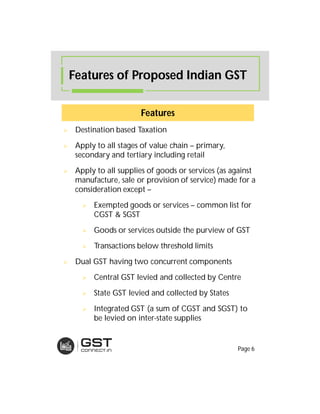
 Destination based Taxation
 Apply to all stages of value chain – primary,
secondary and tertiary including retail
 Apply to all supplies of goods or services (as against
manufacture, sale or provision of service) made for a
consideration except –
 Exempted goods or services – common list for
CGST & SGST
 Goods or services outside the purview of GST
 Transactions below threshold limits
 Dual GST having two concurrent components
 Central GST levied and collected by Centre
 State GST levied and collected by States
 Integrated GST (a sum of CGST and SGST) to
be levied on inter-state supplies
Features
Features of Proposed Indian GST
Page 6
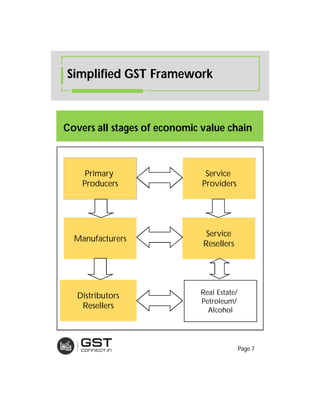
Primary
Producers
Distributors
Resellers
Service
Providers
Covers all stages of economic value chain
Primary
Producers
Manufacturers
Service
Providers
Service
Resellers
Real Estate/
Petroleum/
Alcohol
India Proposed GST Framework –
Simplified
Page 7
Simplified GST Framework
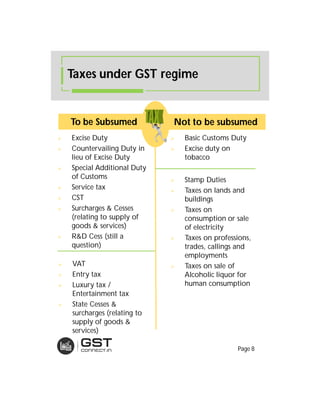
To be Subsumed
 Excise Duty
 Countervailing Duty in
lieu of Excise Duty
 Special Additional Duty
of Customs
 Service tax
 CST
 Surcharges & Cesses
(relating to supply of
goods & services)
 R&D Cess (still a
question)
Not to be subsumed
 VAT
 Entry tax
 Luxury tax /
Entertainment tax
 State Cesses &
surcharges (relating to
supply of goods &
services)
 Basic Customs Duty
 Excise duty on
tobacco
 Stamp Duties
 Taxes on lands and
buildings
 Taxes on
consumption or sale
of electricity
 Taxes on professions,
trades, callings and
employments
 Taxes on sale of
Alcoholic liquor for
human consumption
Taxes under GST regime
Page 8
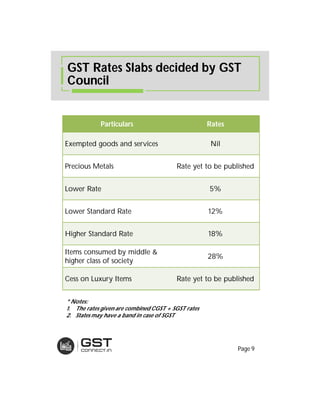
Particulars Rates
Exempted goods and services Nil
Precious Metals Rate yet to be published
Lower Rate 5%
Lower Standard Rate 12%
Higher Standard Rate 18%
Items consumed by middle &
higher class of society
28%
Cess on Luxury Items Rate yet to be published
* Notes:
1. The rates given are combined CGST + SGST rates
2. States may have a band in case of SGST
GST Rates Slabs decided by GST
Council
Page 9
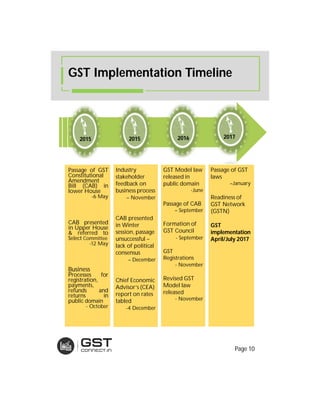
2015 2015 2016 2017
Passage of GST
Constitutional
Amendment
Bill (CAB) in
lower House
-6 May
CAB presented
in Upper House
& referred to
Select Committee
-12 May
Business
Processes for
registration,
payments,
refunds and
returns in
public domain
- October
Industry
stakeholder
feedback on
business process
– November
CAB presented
in Winter
session, passage
unsuccessful –
lack of political
consensus
– December
Chief Economic
Advisor’s (CEA)
report on rates
tabled
-4 December
GST Model law
released in
public domain
-June
Passage of CAB
– September
Formation of
GST Council
- September
GST
Registrations
- November
Revised GST
Model law
released
- November
Passage of GST
laws
–January
Readiness of
GST Network
(GSTN)
GST
implementation
April/July 2017
GST Implementation Timeline
Page 10
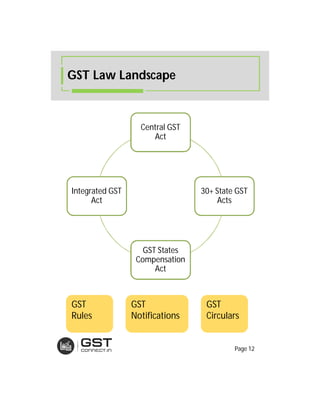
Central GST
Act
30+ State GST
Acts
GST States
Compensation
Act
Integrated GST
Act
GST
Rules
GST
Notifications
GST
Circulars
GST Law Landscape
Page 12
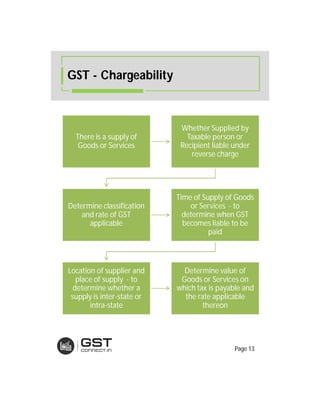
GST - Chargeability
There is a supply of
Goods or Services
Whether Supplied by
Taxable person or
Recipient liable under
reverse charge
Determine classification
and rate of GST
applicable
Time of Supply of Goods
or Services - to
determine when GST
becomes liable to be
paid
Location of supplier and
place of supply - to
determine whether a
supply is inter-state or
intra-state
Determine value of
Goods or Services on
which tax is payable and
the rate applicable
thereon
Page 13
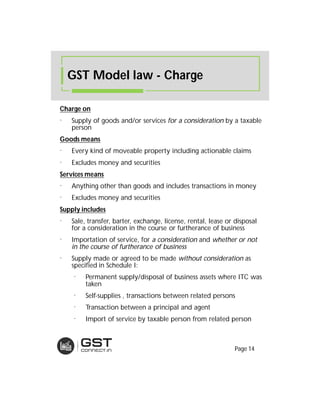
Charge on
⁻ Supply of goods and/or services for a considerationfor a consideration by a taxable
person
Goods means
⁻ Every kind of moveable property including actionable claims
⁻ Excludes money and securities
Services means
⁻ Anything other than goods and includes transactions in money
⁻ Excludes money and securities
Supply includes
⁻ Sale, transfer, barter, exchange, license, rental, lease or disposal
for a consideration in the course or furtherance of business
⁻ Importation of service, for aa considerationconsideration and whether or notwhether or not
in the course of furtherance of businessin the course of furtherance of business
⁻ Supply made or agreed to be made withoutwithout considerationconsideration as
specified in Schedule I:
⁻ Permanent supply/disposal of business assets where ITC was
taken
⁻ Self-supplies , transactions between related persons
⁻ Transaction between a principal and agent
⁻ Import of service by taxable person from related person
GST Model law - Charge
Page 14
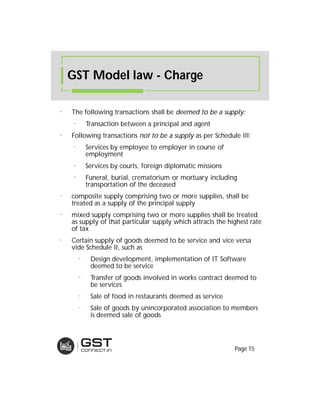
⁻ The following transactions shall be deemed to be a supply:deemed to be a supply:
⁻ Transaction between a principal and agent
⁻ Following transactions not to be anot to be a supplysupply as per Schedule III:
⁻ Services by employee to employer in course of
employment
⁻ Services by courts, foreign diplomatic missions
⁻ Funeral, burial, crematorium or mortuary including
transportation of the deceased
⁻ composite supply comprising two or more supplies, shall be
treated as a supply of the principal supply
⁻ mixed supply comprising two or more supplies shall be treated
as supply of that particular supply which attracts the highest rate
of tax
⁻ Certain supply of goods deemed to be service and vice versa
vide Schedule II, such as
⁻ Design development, implementation of IT Software
deemed to be service
⁻ Transfer of goods involved in works contract deemed to
be services
⁻ Sale of food in restaurants deemed as service
⁻ Sale of goods by unincorporated association to members
is deemed sale of goods
GST Model law - Charge
Page 15
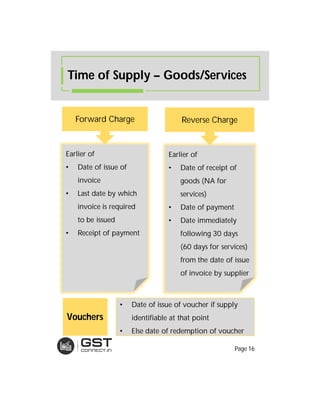
Forward Charge
Earlier of
• Date of issue of
invoice
• Last date by which
invoice is required
to be issued
• Receipt of payment
Reverse Charge
Earlier of
• Date of receipt of
goods (NA for
services)
• Date of payment
• Date immediately
following 30 days
(60 days for services)
from the date of issue
of invoice by supplier
Time of Supply – Goods/Services
• Date of issue of voucher if supply
identifiable at that point
• Else date of redemption of voucher
Vouchers
Page 16
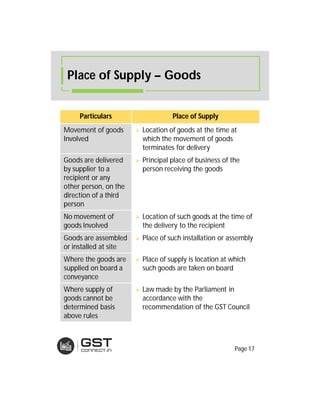
Place of Supply – Goods
Particulars Place of Supply
Movement of goods
Involved
 Location of goods at the time at
which the movement of goods
terminates for delivery
Goods are delivered
by supplier to a
recipient or any
other person, on the
direction of a third
person
 Principal place of business of the
person receiving the goods
No movement of
goods Involved
 Location of such goods at the time of
the delivery to the recipient
Goods are assembled
or installed at site
 Place of such installation or assembly
Where the goods are
supplied on board a
conveyance
 Place of supply is location at which
such goods are taken on board
Where supply of
goods cannot be
determined basis
above rules
 Law made by the Parliament in
accordance with the
recommendation of the GST Council
Page 17
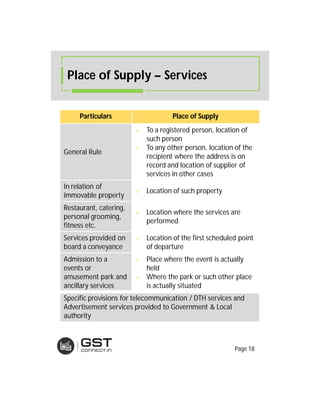
Place of Supply – Services
Particulars Place of Supply
General Rule
 To a registered person, location of
such person
 To any other person, location of the
recipient where the address is on
record and location of supplier of
services in other cases
In relation of
immovable property
 Location of such property
Restaurant, catering,
personal grooming,
fitness etc.
 Location where the services are
performed
Services provided on
board a conveyance
 Location of the first scheduled point
of departure
Admission to a
events or
amusement park and
ancillary services
 Place where the event is actually
held
 Where the park or such other place
is actually situated
Specific provisions for telecommunication / DTH services and
Advertisement services provided to Government & Local
authority
Page 18
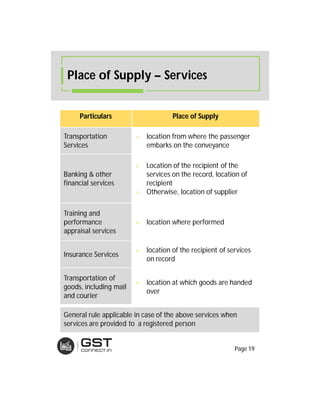
Place of Supply – Services
Particulars Place of Supply
Transportation
Services
 location from where the passenger
embarks on the conveyance
Banking & other
financial services
 Location of the recipient of the
services on the record, location of
recipient
 Otherwise, location of supplier
Training and
performance
appraisal services
 location where performed
Insurance Services
 location of the recipient of services
on record
Transportation of
goods, including mail
and courier
 location at which goods are handed
over
General rule applicable in case of the above services when
services are provided to a registered person
Page 19
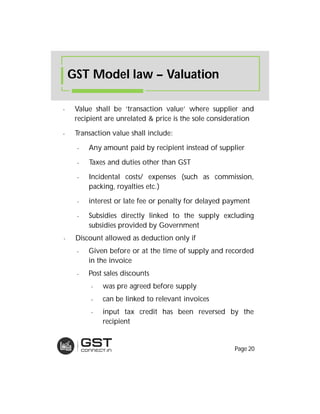
- Value shall be ‘transaction value’ where supplier and
recipient are unrelated & price is the sole consideration
- Transaction value shall include:
- Any amount paid by recipient instead of supplier
- Taxes and duties other than GST
- Incidental costs/ expenses (such as commission,
packing, royalties etc.)
- interest or late fee or penalty for delayed payment
- Subsidies directly linked to the supply excluding
subsidies provided by Government
- Discount allowed as deduction only if
- Given before or at the time of supply and recorded
in the invoice
- Post sales discounts
- was pre agreed before supply
- can be linked to relevant invoices
- input tax credit has been reversed by the
recipient
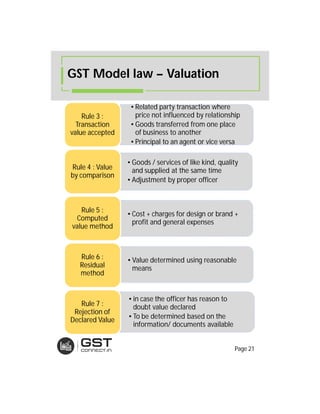
GST Model law – Valuation
Page 20
• Related party transaction where
price not influenced by relationship
• Goods transferred from one place
of business to another
• Principal to an agent or vice versa
Rule 3 :
Transaction
value accepted
• Goods / services of like kind, quality
and supplied at the same time
• Adjustment by proper officer
Rule 4 : Value
by comparison
• Cost + charges for design or brand +
profit and general expenses
Rule 5 :
Computed
value method
• Value determined using reasonable
means
Rule 6 :
Residual
method
• in case the officer has reason to
doubt value declared
• To be determined based on the
information/ documents available
Rule 7 :
Rejection of
Declared Value
GST Model law – Valuation
Page 21
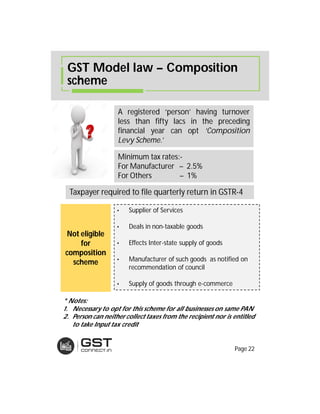
GST Model law – Composition
scheme
Minimum tax rates:-
For Manufacturer – 2.5%
For Others – 1%
A registered ‘person’ having turnover
less than fifty lacs in the preceding
financial year can opt ‘Composition
Levy Scheme.’
• Supplier of Services
• Deals in non-taxable goods
• Effects Inter-state supply of goods
• Manufacturer of such goods as notified on
recommendation of council
• Supply of goods through e-commerce
Not eligible
for
composition
scheme
* Notes:
1. Necessary to opt for this scheme for all businesses on same PAN
2. Person can neither collect taxes from the recipient nor is entitled
to take Input tax credit
Taxpayer required to file quarterly return in GSTR-4
Page 22
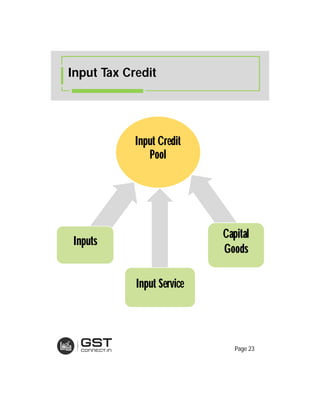
Input Credit
Pool
Inputs
Input Service
Capital
Goods
Input Tax Credit
Page 23
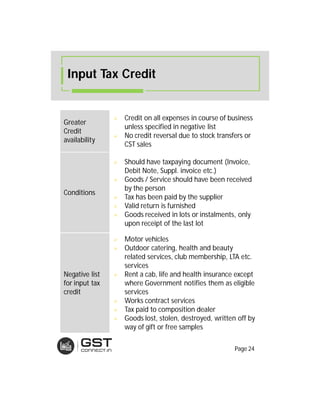
Input Tax Credit
Greater
Credit
availability
 Credit on all expenses in course of business
unless specified in negative list
 No credit reversal due to stock transfers or
CST sales
Conditions
 Should have taxpaying document (Invoice,
Debit Note, Suppl. invoice etc.)
 Goods / Service should have been received
by the person
 Tax has been paid by the supplier
 Valid return is furnished
 Goods received in lots or instalments, only
upon receipt of the last lot
Negative list
for input tax
credit
 Motor vehicles
 Outdoor catering, health and beauty
related services, club membership, LTA etc.
services
 Rent a cab, life and health insurance except
where Government notifies them as eligible
services
 Works contract services
 Tax paid to composition dealer
 Goods lost, stolen, destroyed, written off by
way of gift or free samples
Page 24
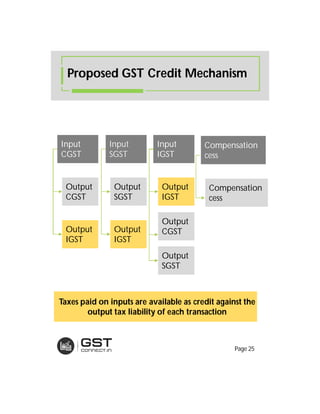
Taxes paid on inputs are available as credit against the
output tax liability of each transaction
Input
CGST
Output
CGST
Output
IGST
Input
SGST
Output
SGST
Output
IGST
Input
IGST
Output
IGST
Output
SGST
Output
CGST
Proposed GST Credit Mechanism
Page 25
Compensation
cess
Compensation
cess
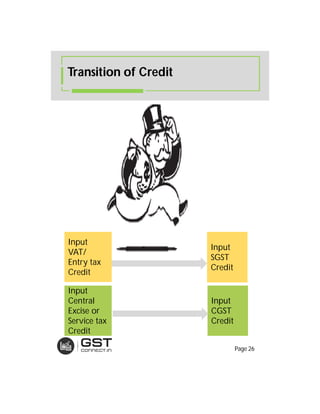
Input
VAT/
Entry tax
Credit
Input
SGST
Credit
Input
Central
Excise or
Service tax
Credit
Input
CGST
Credit
Transition of Credit
Page 26
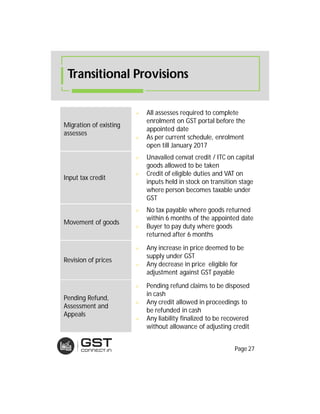
Transitional Provisions
Migration of existing
assesses
 All assesses required to complete
enrolment on GST portal before the
appointed date
 As per current schedule, enrolment
open till January 2017
Input tax credit
 Unavailed cenvat credit / ITC on capital
goods allowed to be taken
 Credit of eligible duties and VAT on
inputs held in stock on transition stage
where person becomes taxable under
GST
Movement of goods
 No tax payable where goods returned
within 6 months of the appointed date
 Buyer to pay duty where goods
returned after 6 months
Revision of prices
 Any increase in price deemed to be
supply under GST
 Any decrease in price eligible for
adjustment against GST payable
Pending Refund,
Assessment and
Appeals
 Pending refund claims to be disposed
in cash
 Any credit allowed in proceedings to
be refunded in cash
 Any liability finalized to be recovered
without allowance of adjusting credit
Page 27
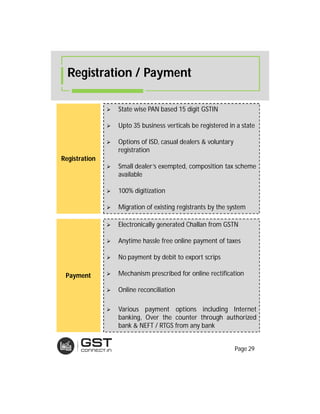
 State wise PAN based 15 digit GSTIN
 Upto 35 business verticals be registered in a state
 Options of ISD, casual dealers & voluntary
registration
 Small dealer’s exempted, composition tax scheme
available
 100% digitization
 Migration of existing registrants by the system
 Electronically generated Challan from GSTN
 Anytime hassle free online payment of taxes
 No payment by debit to export scrips
 Mechanism prescribed for online rectification
 Online reconciliation
 Various payment options including Internet
banking, Over the counter through authorized
bank & NEFT / RTGS from any bank
Registration
Payment
Registration / Payment
Page 29
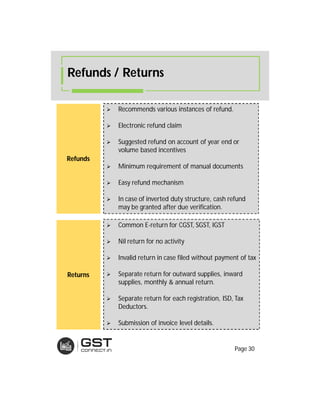
 Recommends various instances of refund.
 Electronic refund claim
 Suggested refund on account of year end or
volume based incentives
 Minimum requirement of manual documents
 Easy refund mechanism
 In case of inverted duty structure, cash refund
may be granted after due verification.
 Common E-return for CGST, SGST, IGST
 Nil return for no activity
 Invalid return in case filed without payment of tax
 Separate return for outward supplies, inward
supplies, monthly & annual return.
 Separate return for each registration, ISD, Tax
Deductors.
 Submission of invoice level details.
Refunds
Returns
Refunds / Returns
Page 30
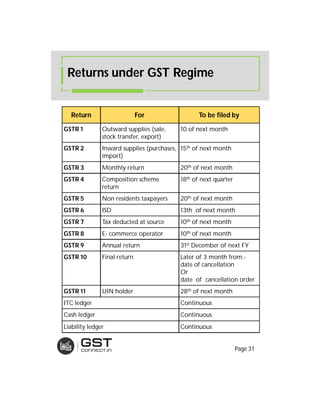
Return For To be filed by
GSTR 1 Outward supplies (sale,
stock transfer, export)
10 of next month
GSTR 2 Inward supplies (purchases,
import)
15th of next month
GSTR 3 Monthly return 20th of next month
GSTR 4 Composition scheme
return
18th of next quarter
GSTR 5 Non residents taxpayers 20th of next month
GSTR 6 ISD 13th of next month
GSTR 7 Tax deducted at source 10th of next month
GSTR 8 E- commerce operator 10th of next month
GSTR 9 Annual return 31st December of next FY
GSTR 10 Final return Later of 3 month from:-
date of cancellation
Or
date of cancellation order
GSTR 11 UIN holder 28th of next month
ITC ledger Continuous
Cash ledger Continuous
Liability ledger Continuous
Returns under GST Regime
Page 31
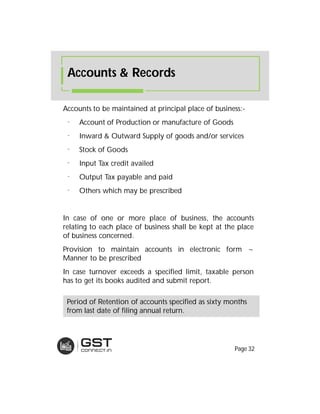
Accounts to be maintained at principal place of business:-
⁻ Account of Production or manufacture of Goods
⁻ Inward & Outward Supply of goods and/or services
⁻ Stock of Goods
⁻ Input Tax credit availed
⁻ Output Tax payable and paid
⁻ Others which may be prescribed
In case of one or more place of business, the accounts
relating to each place of business shall be kept at the place
of business concerned.
Provision to maintain accounts in electronic form ~
Manner to be prescribed
In case turnover exceeds a specified limit, taxable person
has to get its books audited and submit report.
Accounts & Records
Period of Retention of accounts specified as sixty months
from last date of filing annual return.
Page 32
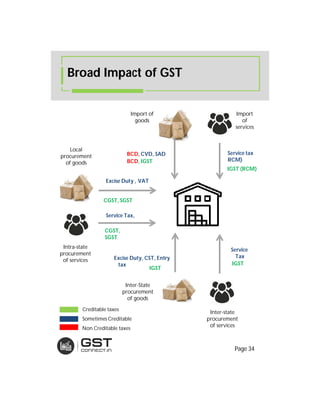
Broad Impact of GST
Intra-state
procurement
of services
Local
procurement
of goods
Inter-State
procurement
of goods
Inter-state
procurement
of services
Import of
goods
Import
of
services
BCD, CVD, SAD
BCD, IGST
Service tax
RCM)
IGST (RCM)
Excise Duty , VAT
CGST, SGST
Service Tax,
CGST,
SGST
IGST
Excise Duty, CST, Entry
tax
Service
Tax
IGST
Creditable taxes
Non Creditable taxes
Sometimes Creditable
Page 34
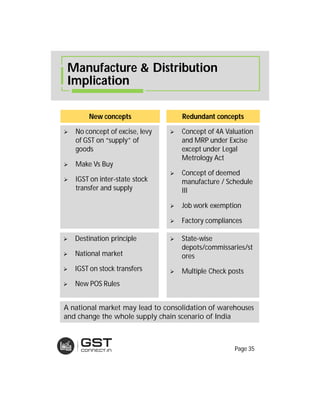
Manufacture & Distribution
Implication
 No concept of excise, levy
of GST on “supply” of
goods
 Make Vs Buy
 IGST on inter-state stock
transfer and supply
 Concept of 4A Valuation
and MRP under Excise
except under Legal
Metrology Act
 Concept of deemed
manufacture / Schedule
III
 Job work exemption
 Factory compliances
New concepts Redundant concepts
 Destination principle
 National market
 IGST on stock transfers
 New POS Rules
 State-wise
depots/commissaries/st
ores
 Multiple Check posts
A national market may lead to consolidation of warehouses
and change the whole supply chain scenario of India
Page 35
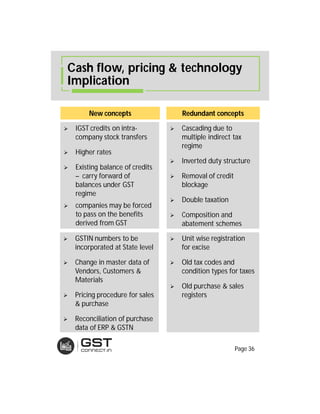
 IGST credits on intra-
company stock transfers
 Higher rates
 Existing balance of credits
– carry forward of
balances under GST
regime
 companies may be forced
to pass on the benefits
derived from GST
 Cascading due to
multiple indirect tax
regime
 Inverted duty structure
 Removal of credit
blockage
 Double taxation
 Composition and
abatement schemes
New concepts Redundant concepts
Cash flow, pricing & technology
Implication
 GSTIN numbers to be
incorporated at State level
 Change in master data of
Vendors, Customers &
Materials
 Pricing procedure for sales
& purchase
 Reconciliation of purchase
data of ERP & GSTN
 Unit wise registration
for excise
 Old tax codes and
condition types for taxes
 Old purchase & sales
registers
Page 36
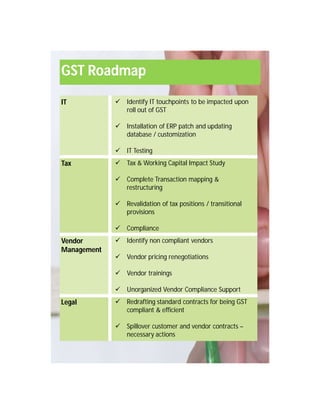
GST Roadmap
IT  Identify IT touchpoints to be impacted upon
roll out of GST
 Installation of ERP patch and updating
database / customization
 IT Testing
Tax  Tax & Working Capital Impact Study
 Complete Transaction mapping &
restructuring
 Revalidation of tax positions / transitional
provisions
 Compliance
Vendor
Management
 Identify non compliant vendors
 Vendor pricing renegotiations
 Vendor trainings
 Unorganized Vendor Compliance Support
Legal  Redrafting standard contracts for being GST
compliant & efficient
 Spillover customer and vendor contracts –
necessary actions
39
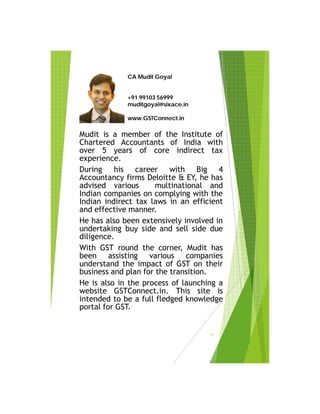
CA Mudit Goyal
+91 99103 56999
muditgoyal@sixace.in
www.GSTConnect.in
Mudit is a member of the Institute of
Chartered Accountants of India with
over 5 years of core indirect tax
experience.
During his career with Big 4
Accountancy firms Deloitte & EY, he has
advised various multinational and
Indian companies on complying with the
Indian indirect tax laws in an efficient
and effective manner.
He has also been extensively involved in
undertaking buy side and sell side due
diligence.
With GST round the corner, Mudit has
been assisting various companies
understand the impact of GST on their
business and plan for the transition.
He is also in the process of launching a
website GSTConnect.in. This site is
intended to be a full fledged knowledge
portal for GST.
40

GST Book v3.1

  • 1.
    DEMYSTIFYING GOODS & SERVICES TAX CAMudit Goyal December 2016 1
  • 2.
    DEMYSTIFYING GOODS & SERVICES TAX CAMudit Goyal © CA Mudit Goyal Printing and Publishing Rights reserved with the Author No part of this publication may be reproduced in any manner whatsoever or translated in any other language without permission in writing from the author. Disclaimer This reference material on GST has been prepared basis the information currently available in public domain. GST in India is in drafting stage and the provisions of final law may or may not be the same All reasonable care has been taken in preparing this reference manual. We accept no responsibility for any error it may contain, whether caused by negligence, or otherwise for any loss, however caused or sustained by the person relying on it. This document is not an offer, invitation or solicitation of any kind and is meant for reference purpose only.
  • 3.
    Ever since theModi Government took over in 2014, GST has been regularly featuring in top bulletins of all news channels. The Government cleared a major milestone when it was able to have the Constitution amended paving way for a nationalised GST. With GST expected to come live on April 1, 2017, people from all comers of the society have also started taking keen interest in understanding the key provisions of the GST Law. Every small development in this direction is being watched very carefully as everybody understands the significance of this most important indirect tax reform of 21st century. In the present scenario, multiple taxes are being imposed on the same transaction. Thus, the consumer bears the burnt of multiplicity of taxes, which adds not only to the cost but also to the complications involved in tax compliances, return filing and difficulties in claiming input tax credits due to involvement of multiple tax authorities. GST is an attempt to overcome this multiplicity of taxes. It is expected to create a common market across the country with no differentiation in tax rates and clearly demarcated distinction between goods and services Here, an effort has been made to provide an overview and key highlights of Model GST Law for easy digest. I would like to place on record my deep appreciation to my partners, current and ex-colleagues, who have given valuable inputs for preparation of this reference manual. I am sure that this reference manual will be of great help to the reader. CA Mudit Goyal Preface
  • 4.
  • 5.
    Contents 1 Introduction toGST 2 GST Model Law 3 Business Processes 4 Broad Impact of GST & GST Roadmap 5
  • 6.
  • 8.
     Destination basedTaxation  Apply to all stages of value chain – primary, secondary and tertiary including retail  Apply to all supplies of goods or services (as against manufacture, sale or provision of service) made for a consideration except –  Exempted goods or services – common list for CGST & SGST  Goods or services outside the purview of GST  Transactions below threshold limits  Dual GST having two concurrent components  Central GST levied and collected by Centre  State GST levied and collected by States  Integrated GST (a sum of CGST and SGST) to be levied on inter-state supplies Features Features of Proposed Indian GST Page 6
  • 9.
    Primary Producers Distributors Resellers Service Providers Covers all stagesof economic value chain Primary Producers Manufacturers Service Providers Service Resellers Real Estate/ Petroleum/ Alcohol India Proposed GST Framework – Simplified Page 7 Simplified GST Framework
  • 10.
    To be Subsumed Excise Duty  Countervailing Duty in lieu of Excise Duty  Special Additional Duty of Customs  Service tax  CST  Surcharges & Cesses (relating to supply of goods & services)  R&D Cess (still a question) Not to be subsumed  VAT  Entry tax  Luxury tax / Entertainment tax  State Cesses & surcharges (relating to supply of goods & services)  Basic Customs Duty  Excise duty on tobacco  Stamp Duties  Taxes on lands and buildings  Taxes on consumption or sale of electricity  Taxes on professions, trades, callings and employments  Taxes on sale of Alcoholic liquor for human consumption Taxes under GST regime Page 8
  • 11.
    Particulars Rates Exempted goodsand services Nil Precious Metals Rate yet to be published Lower Rate 5% Lower Standard Rate 12% Higher Standard Rate 18% Items consumed by middle & higher class of society 28% Cess on Luxury Items Rate yet to be published * Notes: 1. The rates given are combined CGST + SGST rates 2. States may have a band in case of SGST GST Rates Slabs decided by GST Council Page 9
  • 12.
    2015 2015 20162017 Passage of GST Constitutional Amendment Bill (CAB) in lower House -6 May CAB presented in Upper House & referred to Select Committee -12 May Business Processes for registration, payments, refunds and returns in public domain - October Industry stakeholder feedback on business process – November CAB presented in Winter session, passage unsuccessful – lack of political consensus – December Chief Economic Advisor’s (CEA) report on rates tabled -4 December GST Model law released in public domain -June Passage of CAB – September Formation of GST Council - September GST Registrations - November Revised GST Model law released - November Passage of GST laws –January Readiness of GST Network (GSTN) GST implementation April/July 2017 GST Implementation Timeline Page 10
  • 14.
    Central GST Act 30+ StateGST Acts GST States Compensation Act Integrated GST Act GST Rules GST Notifications GST Circulars GST Law Landscape Page 12
  • 15.
    GST - Chargeability Thereis a supply of Goods or Services Whether Supplied by Taxable person or Recipient liable under reverse charge Determine classification and rate of GST applicable Time of Supply of Goods or Services - to determine when GST becomes liable to be paid Location of supplier and place of supply - to determine whether a supply is inter-state or intra-state Determine value of Goods or Services on which tax is payable and the rate applicable thereon Page 13
  • 16.
    Charge on ⁻ Supplyof goods and/or services for a considerationfor a consideration by a taxable person Goods means ⁻ Every kind of moveable property including actionable claims ⁻ Excludes money and securities Services means ⁻ Anything other than goods and includes transactions in money ⁻ Excludes money and securities Supply includes ⁻ Sale, transfer, barter, exchange, license, rental, lease or disposal for a consideration in the course or furtherance of business ⁻ Importation of service, for aa considerationconsideration and whether or notwhether or not in the course of furtherance of businessin the course of furtherance of business ⁻ Supply made or agreed to be made withoutwithout considerationconsideration as specified in Schedule I: ⁻ Permanent supply/disposal of business assets where ITC was taken ⁻ Self-supplies , transactions between related persons ⁻ Transaction between a principal and agent ⁻ Import of service by taxable person from related person GST Model law - Charge Page 14
  • 17.
    ⁻ The followingtransactions shall be deemed to be a supply:deemed to be a supply: ⁻ Transaction between a principal and agent ⁻ Following transactions not to be anot to be a supplysupply as per Schedule III: ⁻ Services by employee to employer in course of employment ⁻ Services by courts, foreign diplomatic missions ⁻ Funeral, burial, crematorium or mortuary including transportation of the deceased ⁻ composite supply comprising two or more supplies, shall be treated as a supply of the principal supply ⁻ mixed supply comprising two or more supplies shall be treated as supply of that particular supply which attracts the highest rate of tax ⁻ Certain supply of goods deemed to be service and vice versa vide Schedule II, such as ⁻ Design development, implementation of IT Software deemed to be service ⁻ Transfer of goods involved in works contract deemed to be services ⁻ Sale of food in restaurants deemed as service ⁻ Sale of goods by unincorporated association to members is deemed sale of goods GST Model law - Charge Page 15
  • 18.
    Forward Charge Earlier of •Date of issue of invoice • Last date by which invoice is required to be issued • Receipt of payment Reverse Charge Earlier of • Date of receipt of goods (NA for services) • Date of payment • Date immediately following 30 days (60 days for services) from the date of issue of invoice by supplier Time of Supply – Goods/Services • Date of issue of voucher if supply identifiable at that point • Else date of redemption of voucher Vouchers Page 16
  • 19.
    Place of Supply– Goods Particulars Place of Supply Movement of goods Involved  Location of goods at the time at which the movement of goods terminates for delivery Goods are delivered by supplier to a recipient or any other person, on the direction of a third person  Principal place of business of the person receiving the goods No movement of goods Involved  Location of such goods at the time of the delivery to the recipient Goods are assembled or installed at site  Place of such installation or assembly Where the goods are supplied on board a conveyance  Place of supply is location at which such goods are taken on board Where supply of goods cannot be determined basis above rules  Law made by the Parliament in accordance with the recommendation of the GST Council Page 17
  • 20.
    Place of Supply– Services Particulars Place of Supply General Rule  To a registered person, location of such person  To any other person, location of the recipient where the address is on record and location of supplier of services in other cases In relation of immovable property  Location of such property Restaurant, catering, personal grooming, fitness etc.  Location where the services are performed Services provided on board a conveyance  Location of the first scheduled point of departure Admission to a events or amusement park and ancillary services  Place where the event is actually held  Where the park or such other place is actually situated Specific provisions for telecommunication / DTH services and Advertisement services provided to Government & Local authority Page 18
  • 21.
    Place of Supply– Services Particulars Place of Supply Transportation Services  location from where the passenger embarks on the conveyance Banking & other financial services  Location of the recipient of the services on the record, location of recipient  Otherwise, location of supplier Training and performance appraisal services  location where performed Insurance Services  location of the recipient of services on record Transportation of goods, including mail and courier  location at which goods are handed over General rule applicable in case of the above services when services are provided to a registered person Page 19
  • 22.
    - Value shallbe ‘transaction value’ where supplier and recipient are unrelated & price is the sole consideration - Transaction value shall include: - Any amount paid by recipient instead of supplier - Taxes and duties other than GST - Incidental costs/ expenses (such as commission, packing, royalties etc.) - interest or late fee or penalty for delayed payment - Subsidies directly linked to the supply excluding subsidies provided by Government - Discount allowed as deduction only if - Given before or at the time of supply and recorded in the invoice - Post sales discounts - was pre agreed before supply - can be linked to relevant invoices - input tax credit has been reversed by the recipient GST Model law – Valuation Page 20
  • 23.
    • Related partytransaction where price not influenced by relationship • Goods transferred from one place of business to another • Principal to an agent or vice versa Rule 3 : Transaction value accepted • Goods / services of like kind, quality and supplied at the same time • Adjustment by proper officer Rule 4 : Value by comparison • Cost + charges for design or brand + profit and general expenses Rule 5 : Computed value method • Value determined using reasonable means Rule 6 : Residual method • in case the officer has reason to doubt value declared • To be determined based on the information/ documents available Rule 7 : Rejection of Declared Value GST Model law – Valuation Page 21
  • 24.
    GST Model law– Composition scheme Minimum tax rates:- For Manufacturer – 2.5% For Others – 1% A registered ‘person’ having turnover less than fifty lacs in the preceding financial year can opt ‘Composition Levy Scheme.’ • Supplier of Services • Deals in non-taxable goods • Effects Inter-state supply of goods • Manufacturer of such goods as notified on recommendation of council • Supply of goods through e-commerce Not eligible for composition scheme * Notes: 1. Necessary to opt for this scheme for all businesses on same PAN 2. Person can neither collect taxes from the recipient nor is entitled to take Input tax credit Taxpayer required to file quarterly return in GSTR-4 Page 22
  • 25.
  • 26.
    Input Tax Credit Greater Credit availability Credit on all expenses in course of business unless specified in negative list  No credit reversal due to stock transfers or CST sales Conditions  Should have taxpaying document (Invoice, Debit Note, Suppl. invoice etc.)  Goods / Service should have been received by the person  Tax has been paid by the supplier  Valid return is furnished  Goods received in lots or instalments, only upon receipt of the last lot Negative list for input tax credit  Motor vehicles  Outdoor catering, health and beauty related services, club membership, LTA etc. services  Rent a cab, life and health insurance except where Government notifies them as eligible services  Works contract services  Tax paid to composition dealer  Goods lost, stolen, destroyed, written off by way of gift or free samples Page 24
  • 27.
    Taxes paid oninputs are available as credit against the output tax liability of each transaction Input CGST Output CGST Output IGST Input SGST Output SGST Output IGST Input IGST Output IGST Output SGST Output CGST Proposed GST Credit Mechanism Page 25 Compensation cess Compensation cess
  • 28.
    Input VAT/ Entry tax Credit Input SGST Credit Input Central Excise or Servicetax Credit Input CGST Credit Transition of Credit Page 26
  • 29.
    Transitional Provisions Migration ofexisting assesses  All assesses required to complete enrolment on GST portal before the appointed date  As per current schedule, enrolment open till January 2017 Input tax credit  Unavailed cenvat credit / ITC on capital goods allowed to be taken  Credit of eligible duties and VAT on inputs held in stock on transition stage where person becomes taxable under GST Movement of goods  No tax payable where goods returned within 6 months of the appointed date  Buyer to pay duty where goods returned after 6 months Revision of prices  Any increase in price deemed to be supply under GST  Any decrease in price eligible for adjustment against GST payable Pending Refund, Assessment and Appeals  Pending refund claims to be disposed in cash  Any credit allowed in proceedings to be refunded in cash  Any liability finalized to be recovered without allowance of adjusting credit Page 27
  • 31.
     State wisePAN based 15 digit GSTIN  Upto 35 business verticals be registered in a state  Options of ISD, casual dealers & voluntary registration  Small dealer’s exempted, composition tax scheme available  100% digitization  Migration of existing registrants by the system  Electronically generated Challan from GSTN  Anytime hassle free online payment of taxes  No payment by debit to export scrips  Mechanism prescribed for online rectification  Online reconciliation  Various payment options including Internet banking, Over the counter through authorized bank & NEFT / RTGS from any bank Registration Payment Registration / Payment Page 29
  • 32.
     Recommends variousinstances of refund.  Electronic refund claim  Suggested refund on account of year end or volume based incentives  Minimum requirement of manual documents  Easy refund mechanism  In case of inverted duty structure, cash refund may be granted after due verification.  Common E-return for CGST, SGST, IGST  Nil return for no activity  Invalid return in case filed without payment of tax  Separate return for outward supplies, inward supplies, monthly & annual return.  Separate return for each registration, ISD, Tax Deductors.  Submission of invoice level details. Refunds Returns Refunds / Returns Page 30
  • 33.
    Return For Tobe filed by GSTR 1 Outward supplies (sale, stock transfer, export) 10 of next month GSTR 2 Inward supplies (purchases, import) 15th of next month GSTR 3 Monthly return 20th of next month GSTR 4 Composition scheme return 18th of next quarter GSTR 5 Non residents taxpayers 20th of next month GSTR 6 ISD 13th of next month GSTR 7 Tax deducted at source 10th of next month GSTR 8 E- commerce operator 10th of next month GSTR 9 Annual return 31st December of next FY GSTR 10 Final return Later of 3 month from:- date of cancellation Or date of cancellation order GSTR 11 UIN holder 28th of next month ITC ledger Continuous Cash ledger Continuous Liability ledger Continuous Returns under GST Regime Page 31
  • 34.
    Accounts to bemaintained at principal place of business:- ⁻ Account of Production or manufacture of Goods ⁻ Inward & Outward Supply of goods and/or services ⁻ Stock of Goods ⁻ Input Tax credit availed ⁻ Output Tax payable and paid ⁻ Others which may be prescribed In case of one or more place of business, the accounts relating to each place of business shall be kept at the place of business concerned. Provision to maintain accounts in electronic form ~ Manner to be prescribed In case turnover exceeds a specified limit, taxable person has to get its books audited and submit report. Accounts & Records Period of Retention of accounts specified as sixty months from last date of filing annual return. Page 32
  • 36.
    Broad Impact ofGST Intra-state procurement of services Local procurement of goods Inter-State procurement of goods Inter-state procurement of services Import of goods Import of services BCD, CVD, SAD BCD, IGST Service tax RCM) IGST (RCM) Excise Duty , VAT CGST, SGST Service Tax, CGST, SGST IGST Excise Duty, CST, Entry tax Service Tax IGST Creditable taxes Non Creditable taxes Sometimes Creditable Page 34
  • 37.
    Manufacture & Distribution Implication No concept of excise, levy of GST on “supply” of goods  Make Vs Buy  IGST on inter-state stock transfer and supply  Concept of 4A Valuation and MRP under Excise except under Legal Metrology Act  Concept of deemed manufacture / Schedule III  Job work exemption  Factory compliances New concepts Redundant concepts  Destination principle  National market  IGST on stock transfers  New POS Rules  State-wise depots/commissaries/st ores  Multiple Check posts A national market may lead to consolidation of warehouses and change the whole supply chain scenario of India Page 35
  • 38.
     IGST creditson intra- company stock transfers  Higher rates  Existing balance of credits – carry forward of balances under GST regime  companies may be forced to pass on the benefits derived from GST  Cascading due to multiple indirect tax regime  Inverted duty structure  Removal of credit blockage  Double taxation  Composition and abatement schemes New concepts Redundant concepts Cash flow, pricing & technology Implication  GSTIN numbers to be incorporated at State level  Change in master data of Vendors, Customers & Materials  Pricing procedure for sales & purchase  Reconciliation of purchase data of ERP & GSTN  Unit wise registration for excise  Old tax codes and condition types for taxes  Old purchase & sales registers Page 36
  • 39.
    GST Roadmap IT Identify IT touchpoints to be impacted upon roll out of GST  Installation of ERP patch and updating database / customization  IT Testing Tax  Tax & Working Capital Impact Study  Complete Transaction mapping & restructuring  Revalidation of tax positions / transitional provisions  Compliance Vendor Management  Identify non compliant vendors  Vendor pricing renegotiations  Vendor trainings  Unorganized Vendor Compliance Support Legal  Redrafting standard contracts for being GST compliant & efficient  Spillover customer and vendor contracts – necessary actions 39
  • 40.
    CA Mudit Goyal +9199103 56999 muditgoyal@sixace.in www.GSTConnect.in Mudit is a member of the Institute of Chartered Accountants of India with over 5 years of core indirect tax experience. During his career with Big 4 Accountancy firms Deloitte & EY, he has advised various multinational and Indian companies on complying with the Indian indirect tax laws in an efficient and effective manner. He has also been extensively involved in undertaking buy side and sell side due diligence. With GST round the corner, Mudit has been assisting various companies understand the impact of GST on their business and plan for the transition. He is also in the process of launching a website GSTConnect.in. This site is intended to be a full fledged knowledge portal for GST. 40