Presented by: Sharjeel Ahmad
15-ECM -45
 GST is a system of taxation where there is a single tax in the economy for
goods as well as services.
 GST is expected to be a major reform in the arena of domestic indirect
taxes in India. And it will lead to the abolition of all other taxes such as,
central sales tax, state-level sales tax, excise duty, service tax, and value-
added tax (VAT). Both the state and the central governments will impose
GST on almost all goods and services produced in India or imported into
the country.
 Definition- According to Article 366(12A) in 122nd Constitutional
Amendment Bill, 2014 to define GST as “Goods and service tax” means
any tax on supply of goods, or services or both except taxes on supply of
the alcoholic liquor for human consumption .
 Article 366(26A) defines service as “Services” means anything other than
goods.
Sharjeel
 This is simply very similar to VAT.
 It can be termed as National level VAT on Goods and Services.
 Only difference in this system is that not only goods but also
services are involved.
 The rate of tax on goods and services are generally the same.
 All goods and services, barring a few exceptions, will be brought
into the GST base. There will be no distinction between goods and
services.
 Under GST, the taxation burden will be divided equitably between
manufacturing and services, through a lower tax rate by increasing the
tax base and minimizing exemptions.
Sharjeel
 In Indian economy the service sector contributes over 53%.
 To avoid multiple layer taxation that currently exits in India.
 For common markets and uniform rates.
 Separate taxation of goods and services is neither viable nor
desirable.
 Hidden tax on exports, no state tax on imports.
 High transaction costs and narrow base.
Sharjeel
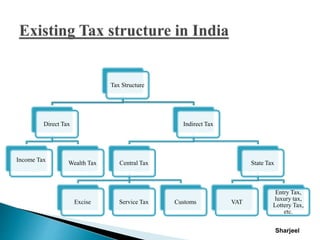
Tax Structure
Direct Tax
Income Tax
Wealth Tax
Indirect Tax
Central Tax
Excise Service Tax Customs
State Tax
VAT
Entry Tax,
luxury tax,
Lottery Tax,
etc.
Sharjeel
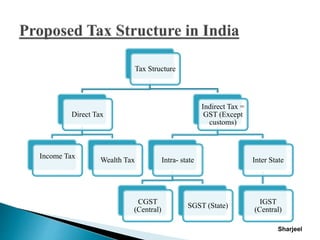
Tax Structure
Direct Tax
Income Tax
Wealth Tax
Indirect Tax =
GST (Except
customs)
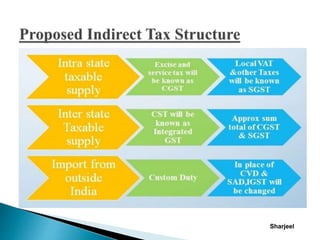
Intra- state
CGST
(Central)
SGST (State)
Inter State
IGST
(Central)
Sharjeel
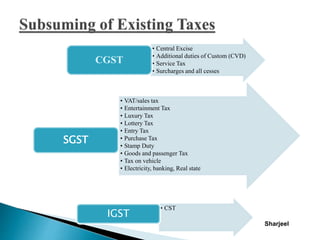
• Central Excise
• Additional duties of Custom (CVD)
• Service Tax
• Surcharges and all cesses
CGST
• VAT/sales tax
• Entertainment Tax
• Luxury Tax
• Lottery Tax
• Entry Tax
• Purchase Tax
• Stamp Duty
• Goods and passenger Tax
• Tax on vehicle
• Electricity, banking, Real state
SGST
• CST
IGST
Sharjeel
Sharjeel
Sharjeel
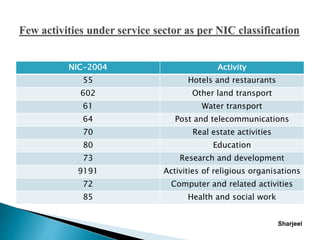
NIC-2004 Activity
55 Hotels and restaurants
602 Other land transport
61 Water transport
64 Post and telecommunications
70 Real estate activities
80 Education
73 Research and development
9191 Activities of religious organisations
72 Computer and related activities
85 Health and social work
Sharjeel
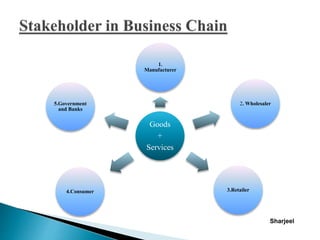
Goods
+
Services
1.
Manufacturer
2. Wholesaler
3.Retailer4.Consumer
5.Government
and Banks
Sharjeel
 GST on export would be zero rated.
 Similar benefits may be given to Special Economic Zones (in
processing zones only).
 No benefit to the sales from an SEZ to Domestic Tariff Area (DTA).
 GST paid by Exporter on the procurement of goods and
services will be refunded.
Sharjeel
 Each taxpayer would be allotted a PAN linked taxpayer
identification number with a total of 13/15 digits.
 This would bring the GST PAN-linked system in line with the
prevailing PAN-based system for Income tax facilitating data
exchange and taxpayer compliance.
 The exact design would be worked out in consultation with
the Income-Tax Department.
Sharjeel
 The combined GST rate is being discussed by government
.
 The rate is expected around 16 per cent.
 Alcohol, tobacco, petroleum products are likely to be out of
the GST regime.
 Most countries have unified GST system, but India has opted
for dual GST, which is prevalent in Brazil and Canada.
 Today the Rate of GST in some countries are Australia 10%,
France19.60%,Canada5%,Germany19%,Japan5%,
Singapore7%, Sweden25%, New Zealand15% & Pakistan17%
Sharjeel
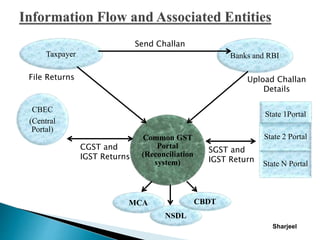
Common GST
Portal
(Reconciliation
system)
Taxpayer
State 1Portal
State 2 Portal
State N Portal
NSDL
MCA CBDT
CBEC
(Central
Portal)
Banks and RBI
Send Challan
Upload Challan
Details
File Returns
CGST and
IGST Returns
SGST and
IGST Return
Sharjeel
 Local Dealers have to pay CGST in addition to SGST.
 The issue which still needs to be resolved are, the revenue
sharing between States and Centre, and a framework for
exemption, thresholds and composition.
 In Addition to this, CGST mainly represents the
Excise/service tax and SGST mainly represents the VAT
portion but, because of ‘No differentiation between
Goods and Services’ service supply within the state
would attract SGST as GST is levied at each stage in the
supply chain and Assessee have to Pay CGST as well
SGST.
Sharjeel
 Include a cap on GST rate at 18 percent.
 Deletion of the provision which allows imposition of
1 percent tax by additional levy.
 An independent dispute resolution mechanism.
Sharjeel
Sharjeel
 The states should evolve a “flawless” or an “ideal” GST (with minimum
exemptions and a single rate) to be eligible to receive compensation in the
eventuality of revenue loss.
 The recommendations of the THFC which says that both the center and states
should conclude a Grand Bargain to implement the model GST.
 Common markets and uniform rates.
 The states should levy “flawless” GST to be eligible to receive compensation for
any loss of revenue put the entire negotiation process on the back burner. The
problem was compounded by the central government’s refusal to pay compensation
for the loss of revenue arising from the reduction in central sales tax (CST). CST is
the sales tax levied on inter-state transactions. When the central government
refused to compensate the states after 2010, a huge trust deficit was created and the
entire negotiation process virtually broke down.
Sharjeel
 Introduction of GST depends on the mutual consent of political
parties. If GST ones implemented it will prove to be fruitful for the
economy. According to a report by the NCAER,GST is expected to
increase economic growth by between 0.9% and 1.7%.
 GST will also benefit for corporate because tax burden and
production cost will fall which will lead to increase in export.
 Our country will draw benefits of GST only with the proper
improvement in social and economic infrastructure and
constitutional amendments.
Sharjeel
 Economic and political weekly.
 13th & 14th finance commission.
 Economic times.
Sharjeel
GST

GST

  • 1.
    Presented by: SharjeelAhmad 15-ECM -45
  • 2.
     GST isa system of taxation where there is a single tax in the economy for goods as well as services.  GST is expected to be a major reform in the arena of domestic indirect taxes in India. And it will lead to the abolition of all other taxes such as, central sales tax, state-level sales tax, excise duty, service tax, and value- added tax (VAT). Both the state and the central governments will impose GST on almost all goods and services produced in India or imported into the country.  Definition- According to Article 366(12A) in 122nd Constitutional Amendment Bill, 2014 to define GST as “Goods and service tax” means any tax on supply of goods, or services or both except taxes on supply of the alcoholic liquor for human consumption .  Article 366(26A) defines service as “Services” means anything other than goods. Sharjeel
  • 3.
     This issimply very similar to VAT.  It can be termed as National level VAT on Goods and Services.  Only difference in this system is that not only goods but also services are involved.  The rate of tax on goods and services are generally the same.  All goods and services, barring a few exceptions, will be brought into the GST base. There will be no distinction between goods and services.  Under GST, the taxation burden will be divided equitably between manufacturing and services, through a lower tax rate by increasing the tax base and minimizing exemptions. Sharjeel
  • 4.
     In Indianeconomy the service sector contributes over 53%.  To avoid multiple layer taxation that currently exits in India.  For common markets and uniform rates.  Separate taxation of goods and services is neither viable nor desirable.  Hidden tax on exports, no state tax on imports.  High transaction costs and narrow base. Sharjeel
  • 5.
    Tax Structure Direct Tax IncomeTax Wealth Tax Indirect Tax Central Tax Excise Service Tax Customs State Tax VAT Entry Tax, luxury tax, Lottery Tax, etc. Sharjeel
  • 6.
    Tax Structure Direct Tax IncomeTax Wealth Tax Indirect Tax = GST (Except customs) Intra- state CGST (Central) SGST (State) Inter State IGST (Central) Sharjeel
  • 7.
    • Central Excise •Additional duties of Custom (CVD) • Service Tax • Surcharges and all cesses CGST • VAT/sales tax • Entertainment Tax • Luxury Tax • Lottery Tax • Entry Tax • Purchase Tax • Stamp Duty • Goods and passenger Tax • Tax on vehicle • Electricity, banking, Real state SGST • CST IGST Sharjeel
  • 8.
  • 9.
  • 10.
    NIC-2004 Activity 55 Hotelsand restaurants 602 Other land transport 61 Water transport 64 Post and telecommunications 70 Real estate activities 80 Education 73 Research and development 9191 Activities of religious organisations 72 Computer and related activities 85 Health and social work Sharjeel
  • 11.
  • 12.
     GST onexport would be zero rated.  Similar benefits may be given to Special Economic Zones (in processing zones only).  No benefit to the sales from an SEZ to Domestic Tariff Area (DTA).  GST paid by Exporter on the procurement of goods and services will be refunded. Sharjeel
  • 13.
     Each taxpayerwould be allotted a PAN linked taxpayer identification number with a total of 13/15 digits.  This would bring the GST PAN-linked system in line with the prevailing PAN-based system for Income tax facilitating data exchange and taxpayer compliance.  The exact design would be worked out in consultation with the Income-Tax Department. Sharjeel
  • 14.
     The combinedGST rate is being discussed by government .  The rate is expected around 16 per cent.  Alcohol, tobacco, petroleum products are likely to be out of the GST regime.  Most countries have unified GST system, but India has opted for dual GST, which is prevalent in Brazil and Canada.  Today the Rate of GST in some countries are Australia 10%, France19.60%,Canada5%,Germany19%,Japan5%, Singapore7%, Sweden25%, New Zealand15% & Pakistan17% Sharjeel
  • 15.
    Common GST Portal (Reconciliation system) Taxpayer State 1Portal State2 Portal State N Portal NSDL MCA CBDT CBEC (Central Portal) Banks and RBI Send Challan Upload Challan Details File Returns CGST and IGST Returns SGST and IGST Return Sharjeel
  • 16.
     Local Dealershave to pay CGST in addition to SGST.  The issue which still needs to be resolved are, the revenue sharing between States and Centre, and a framework for exemption, thresholds and composition.  In Addition to this, CGST mainly represents the Excise/service tax and SGST mainly represents the VAT portion but, because of ‘No differentiation between Goods and Services’ service supply within the state would attract SGST as GST is levied at each stage in the supply chain and Assessee have to Pay CGST as well SGST. Sharjeel
  • 17.
     Include acap on GST rate at 18 percent.  Deletion of the provision which allows imposition of 1 percent tax by additional levy.  An independent dispute resolution mechanism. Sharjeel
  • 18.
  • 19.
     The statesshould evolve a “flawless” or an “ideal” GST (with minimum exemptions and a single rate) to be eligible to receive compensation in the eventuality of revenue loss.  The recommendations of the THFC which says that both the center and states should conclude a Grand Bargain to implement the model GST.  Common markets and uniform rates.  The states should levy “flawless” GST to be eligible to receive compensation for any loss of revenue put the entire negotiation process on the back burner. The problem was compounded by the central government’s refusal to pay compensation for the loss of revenue arising from the reduction in central sales tax (CST). CST is the sales tax levied on inter-state transactions. When the central government refused to compensate the states after 2010, a huge trust deficit was created and the entire negotiation process virtually broke down. Sharjeel
  • 20.
     Introduction ofGST depends on the mutual consent of political parties. If GST ones implemented it will prove to be fruitful for the economy. According to a report by the NCAER,GST is expected to increase economic growth by between 0.9% and 1.7%.  GST will also benefit for corporate because tax burden and production cost will fall which will lead to increase in export.  Our country will draw benefits of GST only with the proper improvement in social and economic infrastructure and constitutional amendments. Sharjeel
  • 21.
     Economic andpolitical weekly.  13th & 14th finance commission.  Economic times. Sharjeel