Understanding Goods and Services Tax
Agenda
 Journey so far
 Design of GST
 Main features of GST Law
 Administration and IT Network
 Benefits of GST and Way Forward
1
The Journey so far
Announcement
to introduce GST
by 2010
2006
2009
2014
2013
2011
First Discussion Paper (FDP) released by EC
Constitution (115th
Amendment) Bill introduced
Three committees constituted by EC and GSTN set up
Constitution (122nd Amendment) Bill (CAB)
introduced in Lok Sabha
Mar 2017
12 GST Council
Meetings
CGST, SGST,
UTGST, IGST,
Compensation
Cess Bills
recommended
2
Aug
2016
Constitution Amendment
Bill passed
The Effort and Work Done
10 Years…
In Making
14
Empowered
Committee
Meetings
30 +
Sub-Groups &
Committees
175 +
Officers
Meetings
31000 +
Industry
professionals
trained
51000 +
Officers
trained
3
18000 +
Man Hours of
discussion by
GST Council
Constitution
Amendment
and 5 Laws
approved by
collaborative
effort
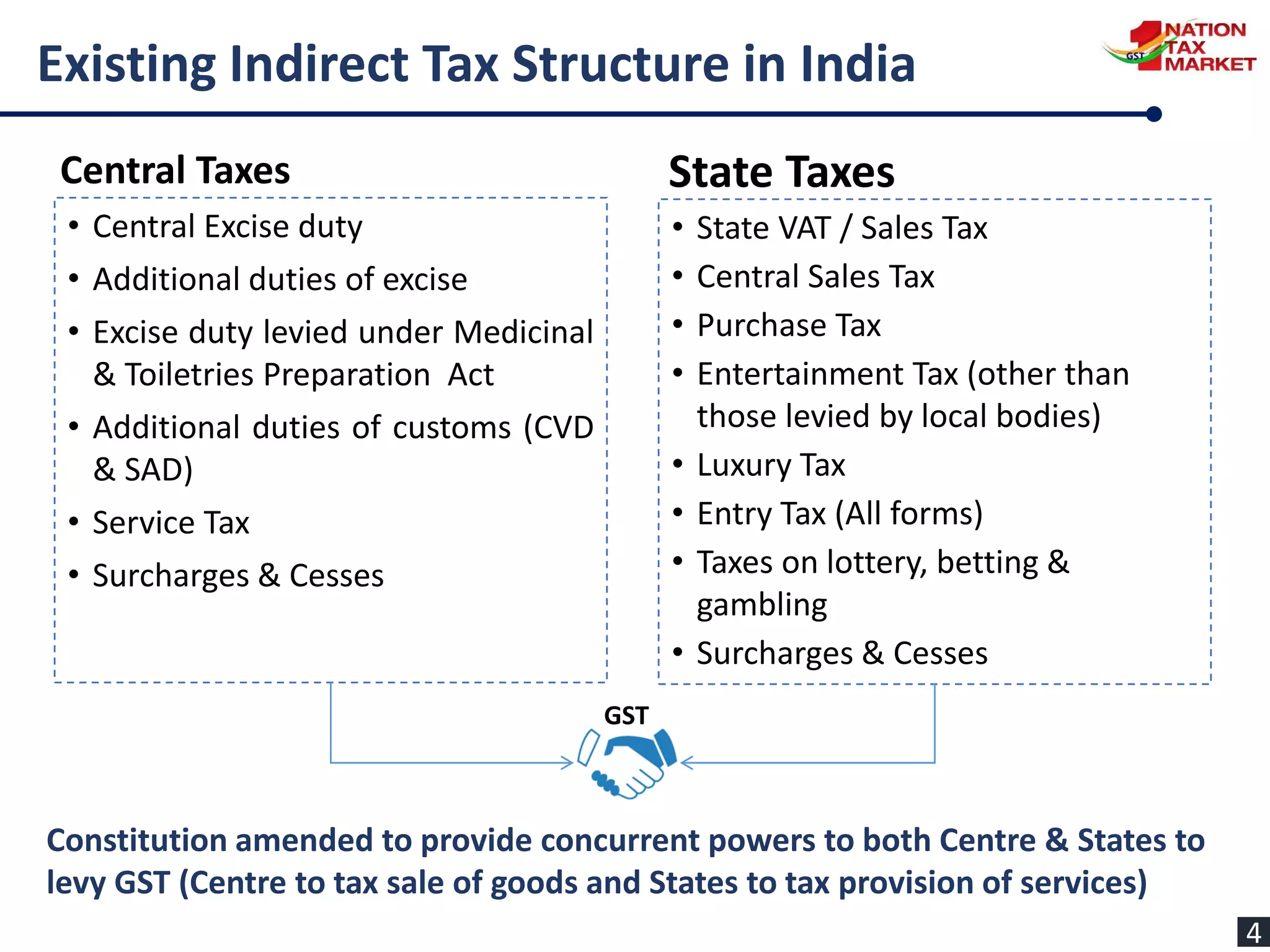
Existing Indirect Tax Structure in India
Constitution amended to provide concurrent powers to both Centre & States to
levy GST (Centre to tax sale of goods and States to tax provision of services)
4
• Central Excise duty
• Additional duties of excise
• Excise duty levied under Medicinal
& Toiletries Preparation Act
• Additional duties of customs (CVD
& SAD)
• Service Tax
• Surcharges & Cesses
• State VAT / Sales Tax
• Central Sales Tax
• Purchase Tax
• Entertainment Tax (other than
those levied by local bodies)
• Luxury Tax
• Entry Tax (All forms)
• Taxes on lottery, betting &
gambling
• Surcharges & Cesses
Central Taxes State Taxes
GST
Understanding CGST, SGST, UTGST & IGST
Foreign Territory
State 1
Union territory
State 2
IGST Credit can be used for payment of IGST, CGST, SGST / UTGST in that order
5
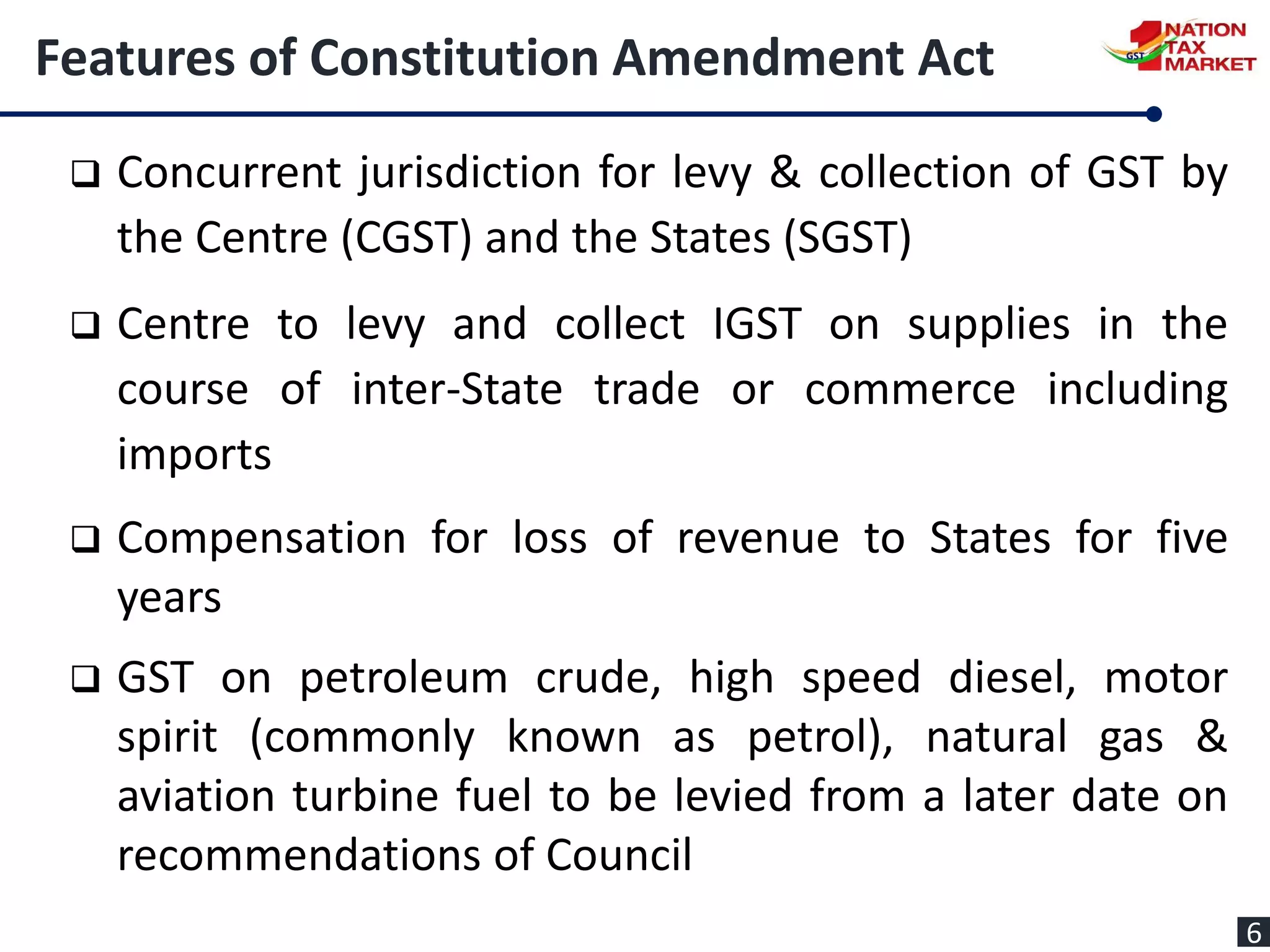
Features of Constitution Amendment Act
 Concurrent jurisdiction for levy & collection of GST by
the Centre (CGST) and the States (SGST)
 Centre to levy and collect IGST on supplies in the
course of inter-State trade or commerce including
imports
 Compensation for loss of revenue to States for five
years
 GST on petroleum crude, high speed diesel, motor
spirit (commonly known as petrol), natural gas &
aviation turbine fuel to be levied from a later date on
recommendations of Council
6
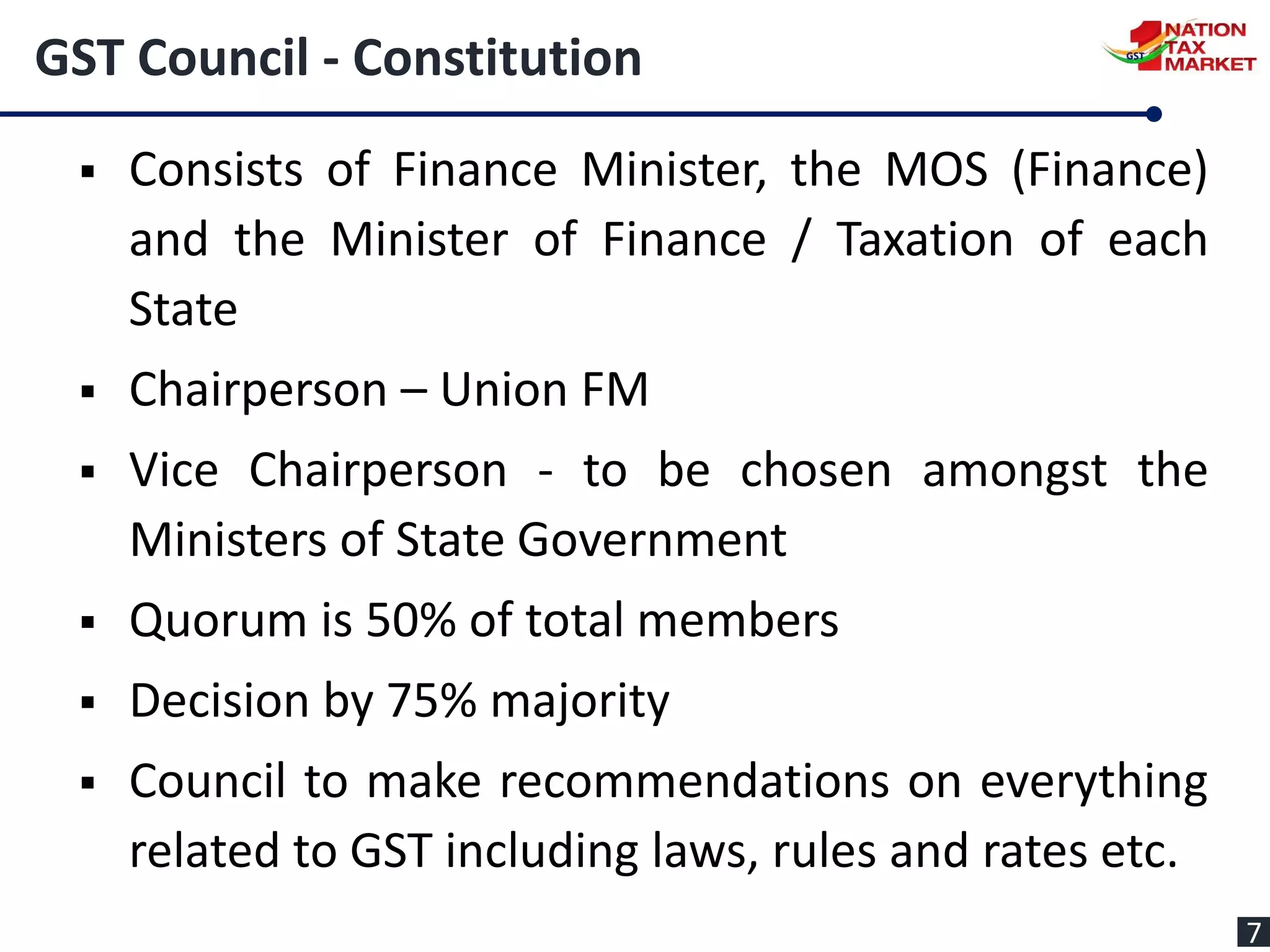
GST Council - Constitution
 Consists of Finance Minister, the MOS (Finance)
and the Minister of Finance / Taxation of each
State
 Chairperson – Union FM
 Vice Chairperson - to be chosen amongst the
Ministers of State Government
 Quorum is 50% of total members
 Decision by 75% majority
 Council to make recommendations on everything
related to GST including laws, rules and rates etc.
7
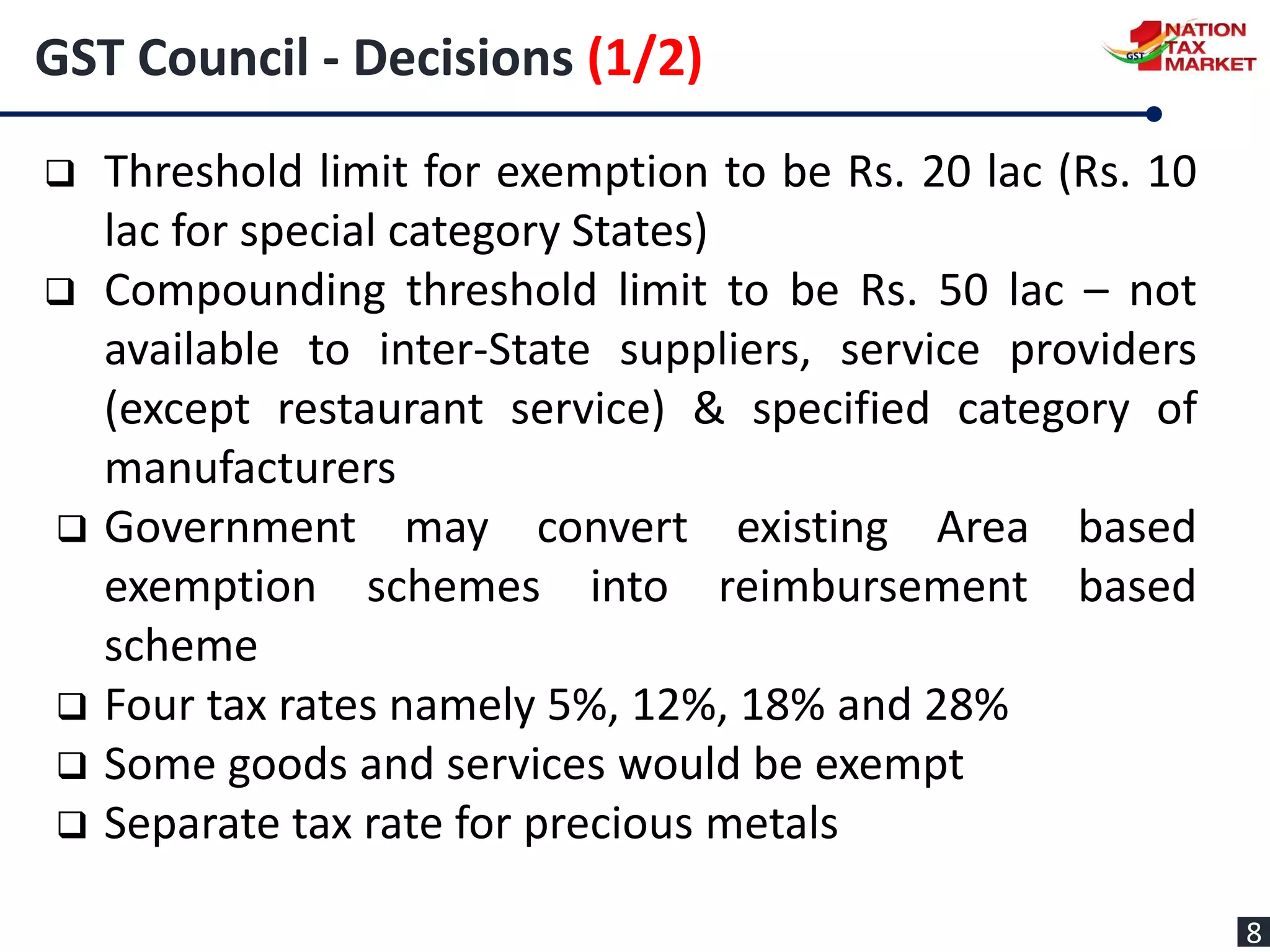
GST Council - Decisions (1/2)
 Threshold limit for exemption to be Rs. 20 lac (Rs. 10
lac for special category States)
 Compounding threshold limit to be Rs. 50 lac – not
available to inter-State suppliers, service providers
(except restaurant service) & specified category of
manufacturers
 Government may convert existing Area based
exemption schemes into reimbursement based
scheme
 Four tax rates namely 5%, 12%, 18% and 28%
 Some goods and services would be exempt
 Separate tax rate for precious metals
8
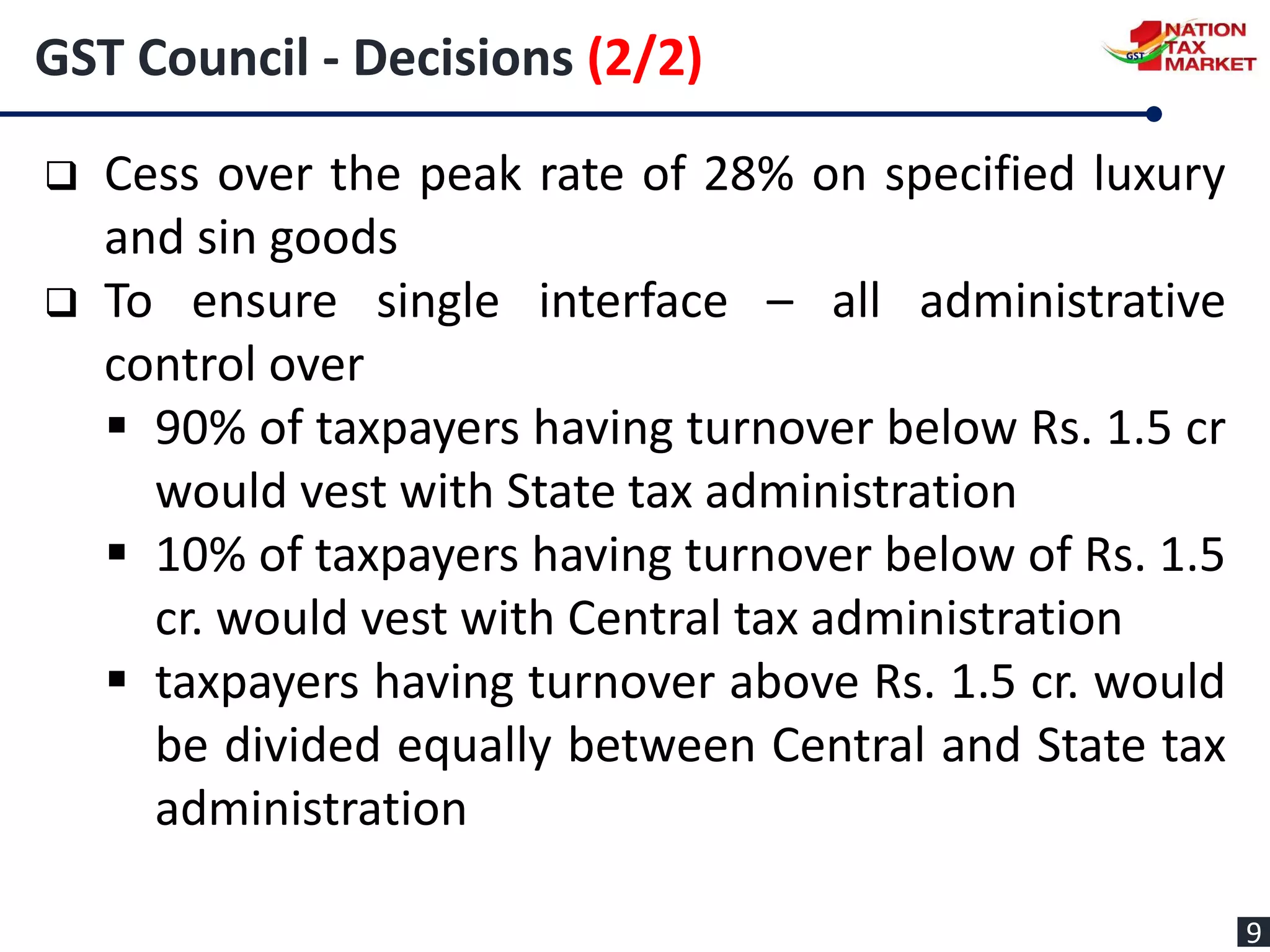
 Cess over the peak rate of 28% on specified luxury
and sin goods
 To ensure single interface – all administrative
control over
 90% of taxpayers having turnover below Rs. 1.5 cr
would vest with State tax administration
 10% of taxpayers having turnover below of Rs. 1.5
cr. would vest with Central tax administration
 taxpayers having turnover above Rs. 1.5 cr. would
be divided equally between Central and State tax
administration
GST Council - Decisions (2/2)
9
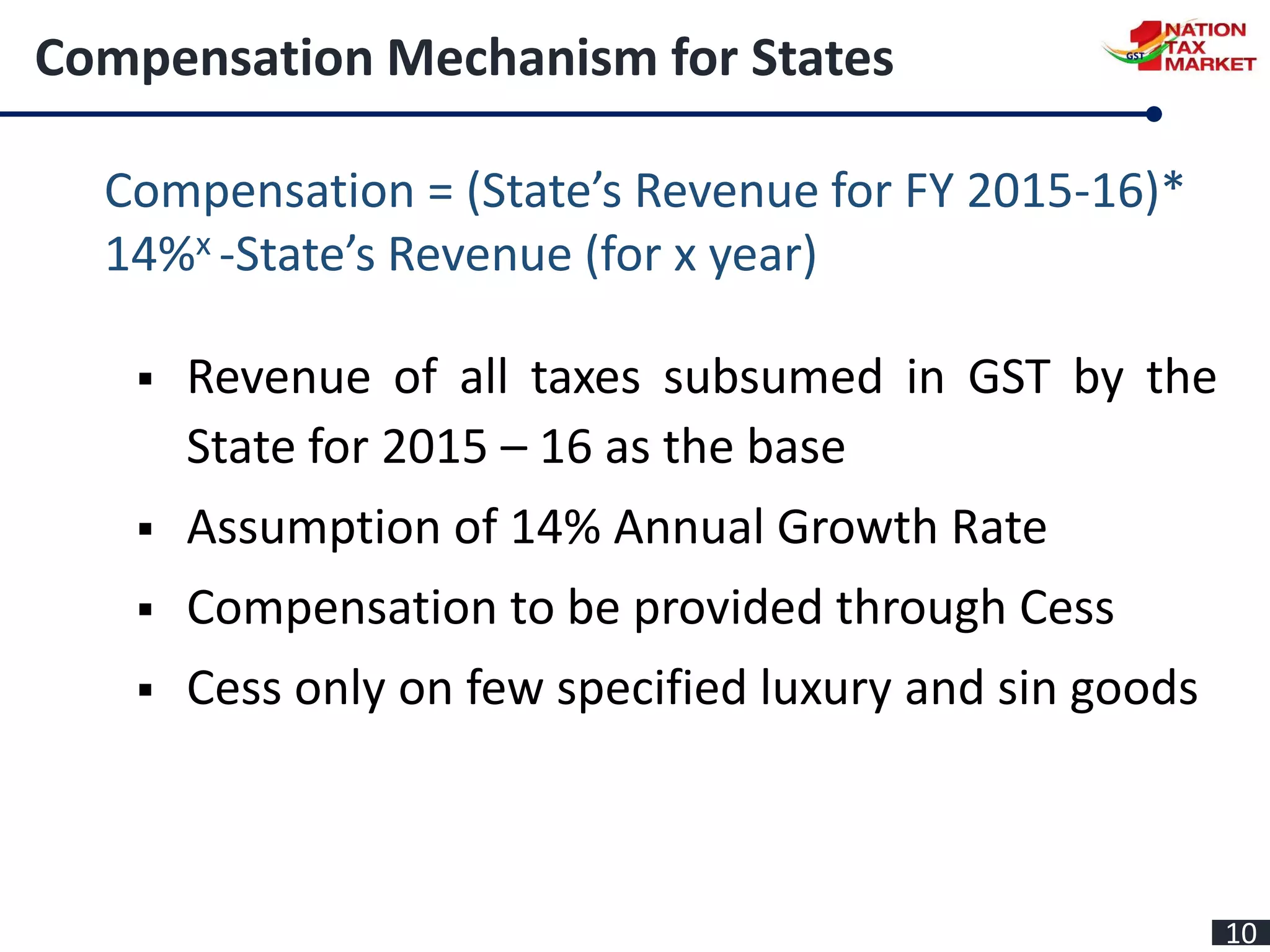
Compensation Mechanism for States
 Revenue of all taxes subsumed in GST by the
State for 2015 – 16 as the base
 Assumption of 14% Annual Growth Rate
 Compensation to be provided through Cess
 Cess only on few specified luxury and sin goods
Compensation = (State’s Revenue for FY 2015-16)*
14%x -State’s Revenue (for x year)
10
Main Features of the GST Act (1/4)
 GST to be levied on supply of goods or services
 All transactions and processes only through
electronic mode – Non-intrusive administration
 PAN Based Registration
 Registration only if turnover more than Rs. 20 lac
 Option of Voluntary Registration
 Deemed Registration in three days
 Input Tax Credit available on taxes paid on all
procurements (except few specified items)
11
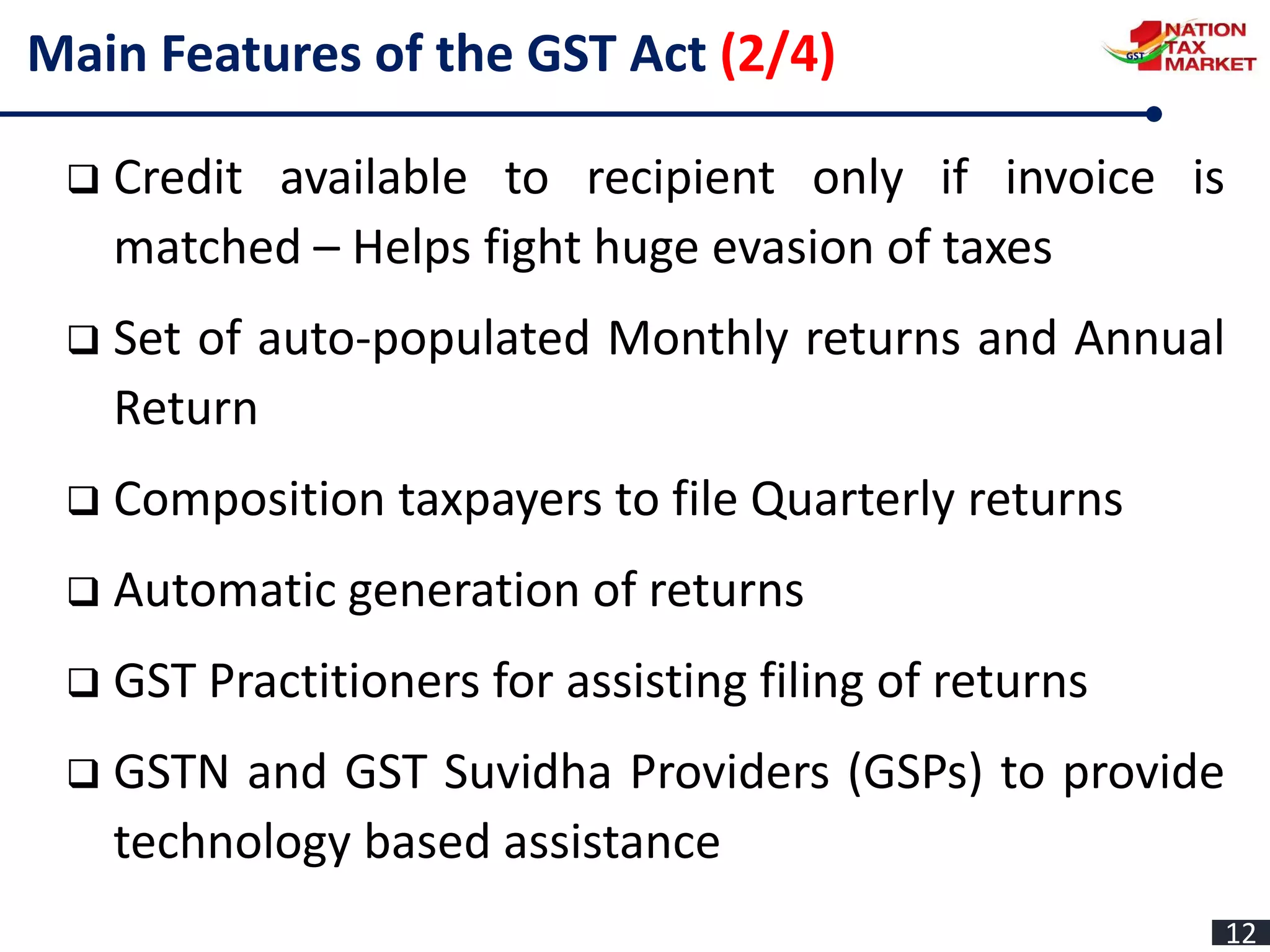
Main Features of the GST Act (2/4)
 Credit available to recipient only if invoice is
matched – Helps fight huge evasion of taxes
 Set of auto-populated Monthly returns and Annual
Return
 Composition taxpayers to file Quarterly returns
 Automatic generation of returns
 GST Practitioners for assisting filing of returns
 GSTN and GST Suvidha Providers (GSPs) to provide
technology based assistance
12
Main Features of the GST Act (3/4)
 Separate electronic ledgers for cash and credit
 Tax can be deposited by internet banking, NEFT / RTGS,
Debit/ credit card and over the counter
 Cross utilization of IGST Credit first as IGST and then as
CGST or SGST /UTGST
 Concept of TDS for Government Departments
 Concept of TCS for E-Commerce Companies
 Refund to be granted within 60 days
 Provisional release of 90% refund to exporters within 7
days
13
Main Features of the GST Act (4/4)
 Interest payable if refund not sanctioned in time
 Refund to be directly credited to bank accounts
 Comprehensive transitional provisions for smooth
transition of existing tax payers to GST regime
 Special procedures for job work
 System of GST Compliance Rating
 Anti-Profiteering provision
14
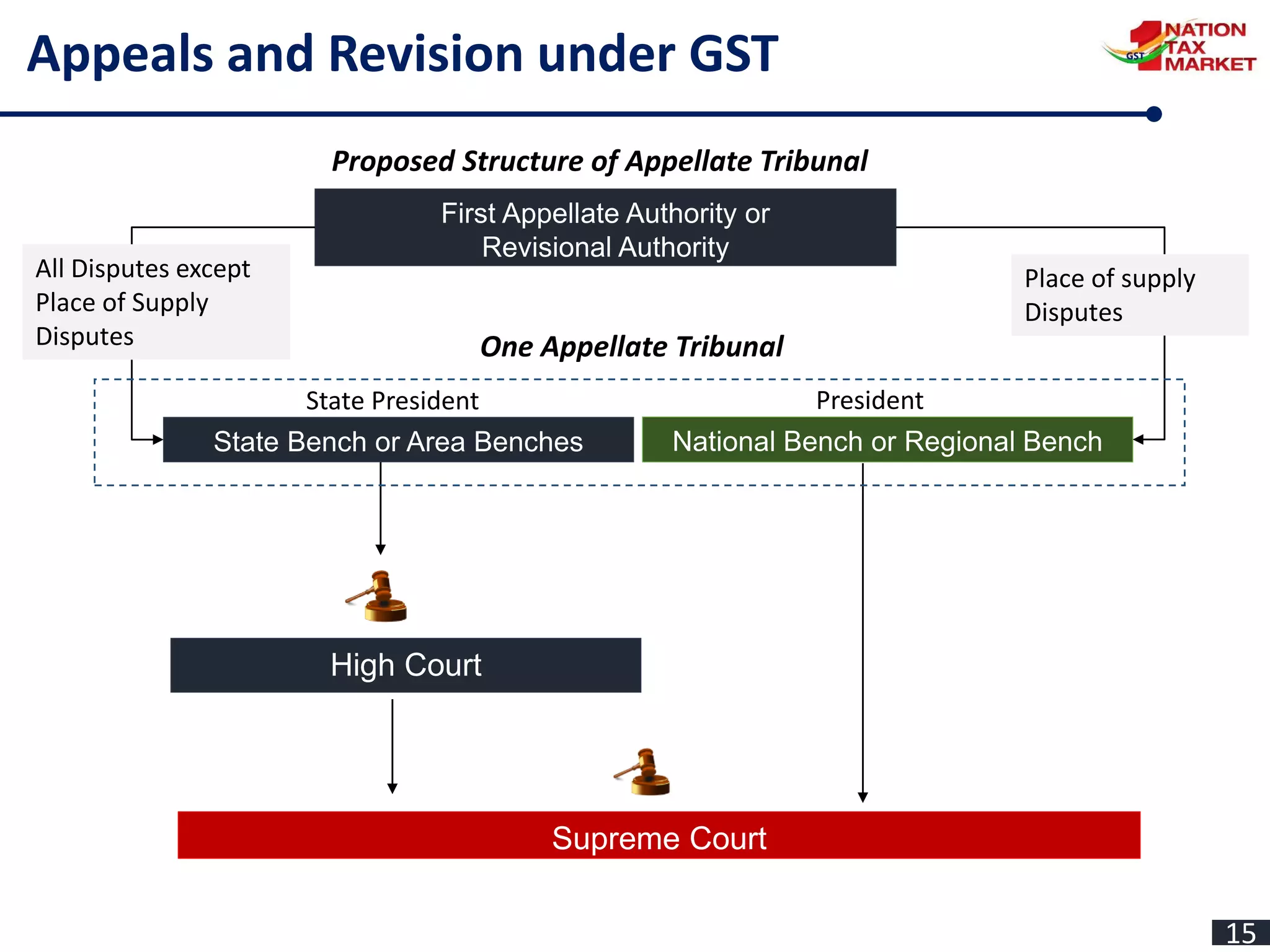
Appeals and Revision under GST
First Appellate Authority or
Revisional Authority
State President
National Bench or Regional BenchState Bench or Area Benches
Proposed Structure of Appellate Tribunal
President
Place of supply
Disputes
All Disputes except
Place of Supply
Disputes
High Court
Supreme Court
One Appellate Tribunal
15
17
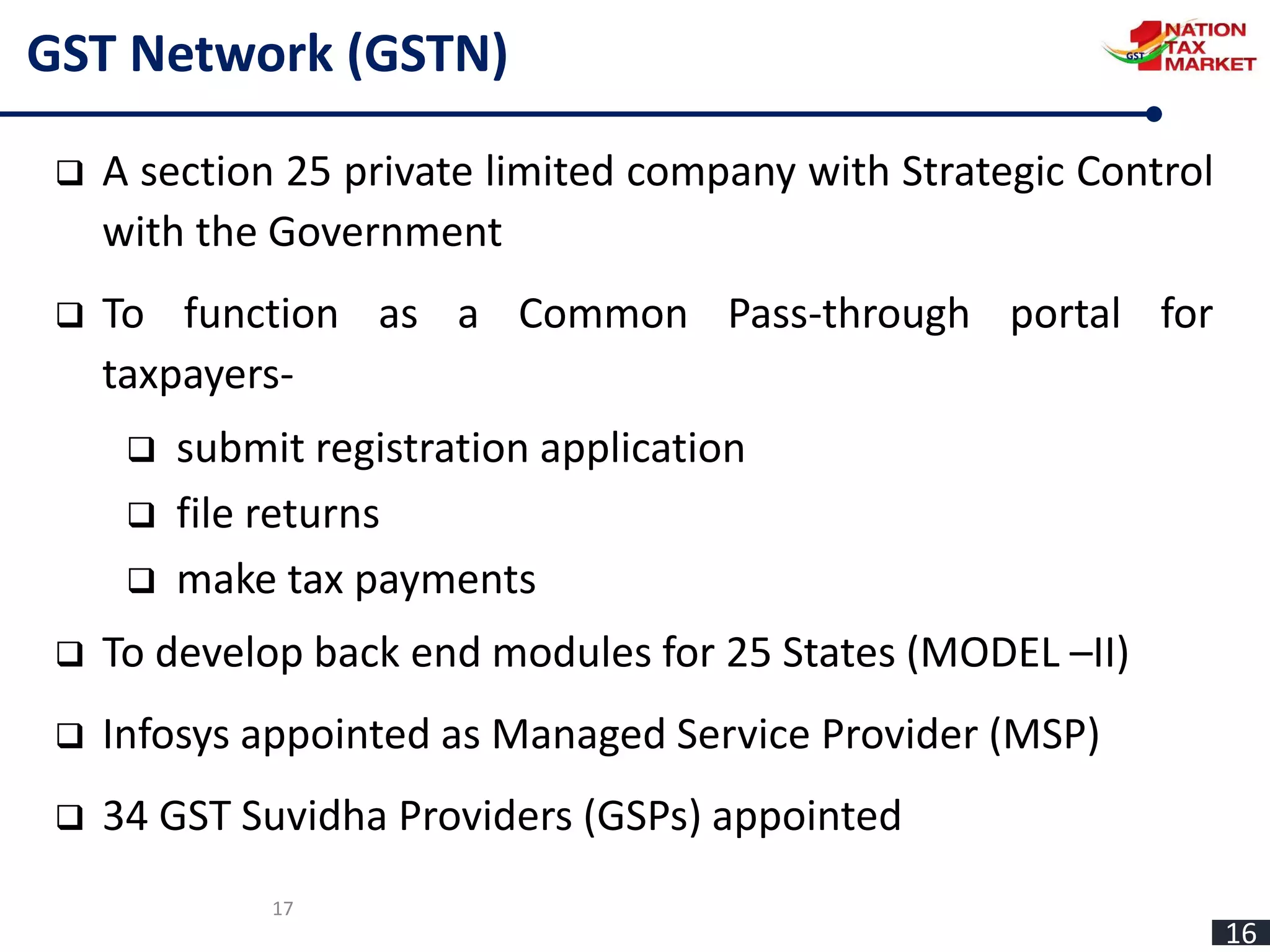
GST Network (GSTN)
 A section 25 private limited company with Strategic Control
with the Government
 To function as a Common Pass-through portal for
taxpayers-
 submit registration application
 file returns
 make tax payments
 To develop back end modules for 25 States (MODEL –II)
 Infosys appointed as Managed Service Provider (MSP)
 34 GST Suvidha Providers (GSPs) appointed
16
18
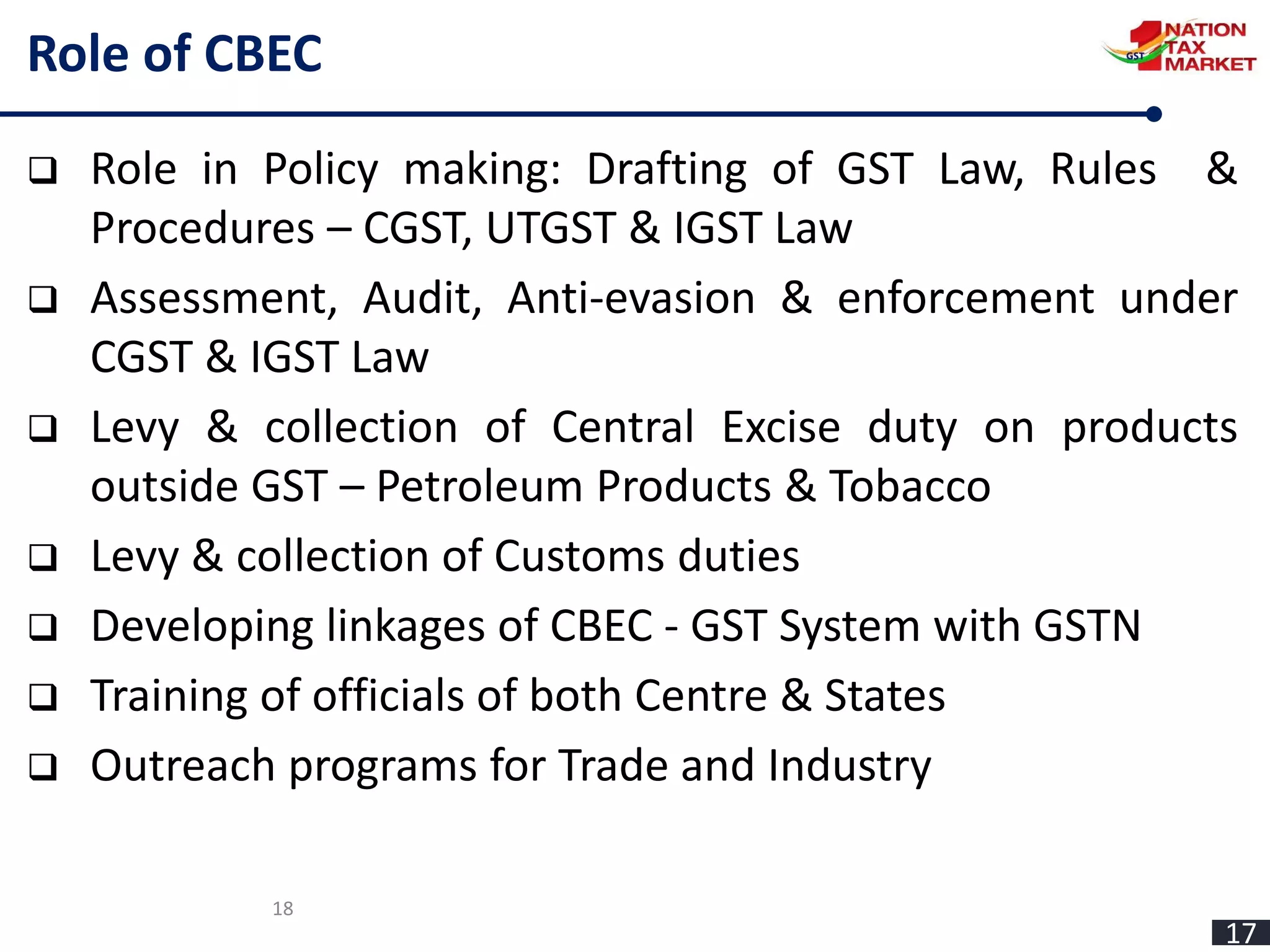
Role of CBEC
 Role in Policy making: Drafting of GST Law, Rules &
Procedures – CGST, UTGST & IGST Law
 Assessment, Audit, Anti-evasion & enforcement under
CGST & IGST Law
 Levy & collection of Central Excise duty on products
outside GST – Petroleum Products & Tobacco
 Levy & collection of Customs duties
 Developing linkages of CBEC - GST System with GSTN
 Training of officials of both Centre & States
 Outreach programs for Trade and Industry
17
Benefits of GST
1
2
3
4
5
Overall reduction in Prices for Consumers
Reduction in Multiplicity of Taxes, Cascading and Double Taxation
Uniform Rate of Tax and Common National Market
Broader Tax Base and decrease in “Black” transactions
Free Flow of Goods and Services – No Checkpoints
6 Non-Intrusive Electronic Tax Compliance System
18
Way Forward
 Passage of CGST, UTGST, IGST & Compensation Law by
Parliament and passing of SGST laws by State
Legislatures
 GST Council to fit tax rates to various categories of
Goods or Services
 Rules relating to registration, returns, valuation,
transitional, Input Credit etc. to be finalized
 Migration and handholding of existing tax payers
 Outreach program for trade and industry
 Change Management
19
Thank You
The following material is available on
www. cbec.gov.in
• Presentation on GST
• GST – Concept & Status
• FAQs on GST in English and ten regional
languages
• Model GST Law
• Draft Rules & Formats
• Constitutional Amendment Act

Understanding Goods and Services Tax (GST) India

  • 1.
  • 2.
    Agenda  Journey sofar  Design of GST  Main features of GST Law  Administration and IT Network  Benefits of GST and Way Forward 1
  • 3.
    The Journey sofar Announcement to introduce GST by 2010 2006 2009 2014 2013 2011 First Discussion Paper (FDP) released by EC Constitution (115th Amendment) Bill introduced Three committees constituted by EC and GSTN set up Constitution (122nd Amendment) Bill (CAB) introduced in Lok Sabha Mar 2017 12 GST Council Meetings CGST, SGST, UTGST, IGST, Compensation Cess Bills recommended 2 Aug 2016 Constitution Amendment Bill passed
  • 4.
    The Effort andWork Done 10 Years… In Making 14 Empowered Committee Meetings 30 + Sub-Groups & Committees 175 + Officers Meetings 31000 + Industry professionals trained 51000 + Officers trained 3 18000 + Man Hours of discussion by GST Council Constitution Amendment and 5 Laws approved by collaborative effort
  • 5.
    Existing Indirect TaxStructure in India Constitution amended to provide concurrent powers to both Centre & States to levy GST (Centre to tax sale of goods and States to tax provision of services) 4 • Central Excise duty • Additional duties of excise • Excise duty levied under Medicinal & Toiletries Preparation Act • Additional duties of customs (CVD & SAD) • Service Tax • Surcharges & Cesses • State VAT / Sales Tax • Central Sales Tax • Purchase Tax • Entertainment Tax (other than those levied by local bodies) • Luxury Tax • Entry Tax (All forms) • Taxes on lottery, betting & gambling • Surcharges & Cesses Central Taxes State Taxes GST
  • 6.
    Understanding CGST, SGST,UTGST & IGST Foreign Territory State 1 Union territory State 2 IGST Credit can be used for payment of IGST, CGST, SGST / UTGST in that order 5
  • 7.
    Features of ConstitutionAmendment Act  Concurrent jurisdiction for levy & collection of GST by the Centre (CGST) and the States (SGST)  Centre to levy and collect IGST on supplies in the course of inter-State trade or commerce including imports  Compensation for loss of revenue to States for five years  GST on petroleum crude, high speed diesel, motor spirit (commonly known as petrol), natural gas & aviation turbine fuel to be levied from a later date on recommendations of Council 6
  • 8.
    GST Council -Constitution  Consists of Finance Minister, the MOS (Finance) and the Minister of Finance / Taxation of each State  Chairperson – Union FM  Vice Chairperson - to be chosen amongst the Ministers of State Government  Quorum is 50% of total members  Decision by 75% majority  Council to make recommendations on everything related to GST including laws, rules and rates etc. 7
  • 9.
    GST Council -Decisions (1/2)  Threshold limit for exemption to be Rs. 20 lac (Rs. 10 lac for special category States)  Compounding threshold limit to be Rs. 50 lac – not available to inter-State suppliers, service providers (except restaurant service) & specified category of manufacturers  Government may convert existing Area based exemption schemes into reimbursement based scheme  Four tax rates namely 5%, 12%, 18% and 28%  Some goods and services would be exempt  Separate tax rate for precious metals 8
  • 10.
     Cess overthe peak rate of 28% on specified luxury and sin goods  To ensure single interface – all administrative control over  90% of taxpayers having turnover below Rs. 1.5 cr would vest with State tax administration  10% of taxpayers having turnover below of Rs. 1.5 cr. would vest with Central tax administration  taxpayers having turnover above Rs. 1.5 cr. would be divided equally between Central and State tax administration GST Council - Decisions (2/2) 9
  • 11.
    Compensation Mechanism forStates  Revenue of all taxes subsumed in GST by the State for 2015 – 16 as the base  Assumption of 14% Annual Growth Rate  Compensation to be provided through Cess  Cess only on few specified luxury and sin goods Compensation = (State’s Revenue for FY 2015-16)* 14%x -State’s Revenue (for x year) 10
  • 12.
    Main Features ofthe GST Act (1/4)  GST to be levied on supply of goods or services  All transactions and processes only through electronic mode – Non-intrusive administration  PAN Based Registration  Registration only if turnover more than Rs. 20 lac  Option of Voluntary Registration  Deemed Registration in three days  Input Tax Credit available on taxes paid on all procurements (except few specified items) 11
  • 13.
    Main Features ofthe GST Act (2/4)  Credit available to recipient only if invoice is matched – Helps fight huge evasion of taxes  Set of auto-populated Monthly returns and Annual Return  Composition taxpayers to file Quarterly returns  Automatic generation of returns  GST Practitioners for assisting filing of returns  GSTN and GST Suvidha Providers (GSPs) to provide technology based assistance 12
  • 14.
    Main Features ofthe GST Act (3/4)  Separate electronic ledgers for cash and credit  Tax can be deposited by internet banking, NEFT / RTGS, Debit/ credit card and over the counter  Cross utilization of IGST Credit first as IGST and then as CGST or SGST /UTGST  Concept of TDS for Government Departments  Concept of TCS for E-Commerce Companies  Refund to be granted within 60 days  Provisional release of 90% refund to exporters within 7 days 13
  • 15.
    Main Features ofthe GST Act (4/4)  Interest payable if refund not sanctioned in time  Refund to be directly credited to bank accounts  Comprehensive transitional provisions for smooth transition of existing tax payers to GST regime  Special procedures for job work  System of GST Compliance Rating  Anti-Profiteering provision 14
  • 16.
    Appeals and Revisionunder GST First Appellate Authority or Revisional Authority State President National Bench or Regional BenchState Bench or Area Benches Proposed Structure of Appellate Tribunal President Place of supply Disputes All Disputes except Place of Supply Disputes High Court Supreme Court One Appellate Tribunal 15
  • 17.
    17 GST Network (GSTN) A section 25 private limited company with Strategic Control with the Government  To function as a Common Pass-through portal for taxpayers-  submit registration application  file returns  make tax payments  To develop back end modules for 25 States (MODEL –II)  Infosys appointed as Managed Service Provider (MSP)  34 GST Suvidha Providers (GSPs) appointed 16
  • 18.
    18 Role of CBEC Role in Policy making: Drafting of GST Law, Rules & Procedures – CGST, UTGST & IGST Law  Assessment, Audit, Anti-evasion & enforcement under CGST & IGST Law  Levy & collection of Central Excise duty on products outside GST – Petroleum Products & Tobacco  Levy & collection of Customs duties  Developing linkages of CBEC - GST System with GSTN  Training of officials of both Centre & States  Outreach programs for Trade and Industry 17
  • 19.
    Benefits of GST 1 2 3 4 5 Overallreduction in Prices for Consumers Reduction in Multiplicity of Taxes, Cascading and Double Taxation Uniform Rate of Tax and Common National Market Broader Tax Base and decrease in “Black” transactions Free Flow of Goods and Services – No Checkpoints 6 Non-Intrusive Electronic Tax Compliance System 18
  • 20.
    Way Forward  Passageof CGST, UTGST, IGST & Compensation Law by Parliament and passing of SGST laws by State Legislatures  GST Council to fit tax rates to various categories of Goods or Services  Rules relating to registration, returns, valuation, transitional, Input Credit etc. to be finalized  Migration and handholding of existing tax payers  Outreach program for trade and industry  Change Management 19
  • 21.
    Thank You The followingmaterial is available on www. cbec.gov.in • Presentation on GST • GST – Concept & Status • FAQs on GST in English and ten regional languages • Model GST Law • Draft Rules & Formats • Constitutional Amendment Act