+

    Grutter v
    Bollinger
     (2003)
                Acting For Affirmative
                       Action
                 Kacey Katzenmeyer and Tori hall
+
                Who was involved?
    Barbara Grutter, a white resident of Michigan, sued the
            University of Michigan’s Law School
    Barbara Grutter                    University of
                                      Michigan’s Law
                                          School
+
                   What Went Down
       Grutter applied to the University of Michigan's Law School
        with a 3.8 undergraduate GPA and an LSAT score of 161,
        but she was denied admission.

        The Law School admits that it uses race as a factor in
        making admissions decisions because it serves a
        "compelling interest in achieving diversity among its student
        body,” so Grutter sued the school in a lower federal court
        charging that its admissions policy was unconstitutional.

       She alleged that the school intentionally discriminated
        against whites, and that this violated the Fourteenth
        Amendment.
+
                     Where and When?

       Grutter sued the University
        of Michigan's Law School
        (specifically, Graduate
        Admissions) in 1997.

       The case was not argued in
        the Supreme Court until
        April of 2003, and not
        decided until that June.

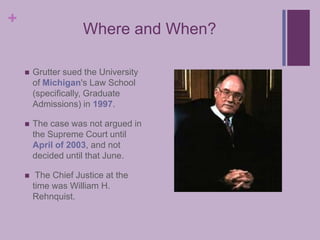
        The Chief Justice at the
        time was William H.
        Rehnquist.
+     The first to hear the             Bollinger appealed, and the
                                        Court of Appeals reversed the
      case, the District
      Court concluded that              lower decision, holding that the
      the Law School's                  opinion in Regents of the
      stated interest in                University of California v.
      achieving diversity in            Bakke (1978) constituted a
      the student body was              binding precedent establishing
      NOT a compelling                  diversity as a compelling
      one and ruled its use             governmental interest which,
      of race in the
      admissions process                under strict scrutiny review,
      unconstitutional.                 justified the use of racial
                                        preferences in admissions.


    Grutter appealed the decision to the Supreme Court, which issued a
    writ of certiorari. The case was added to the docket for the year
    2003.
+
                    Oral Arguments
                            In the oral argument, Grutter’s
                            advocate alleged that the University of
                            Michigan Law School’s use of racial
                            preferences in student admissions
                            violated the Equal Protection Clause of
                            the Fouthteenth Amendment —which
     Grutter                forbids states from denying "to any
                            person within its jurisdiction the equal
                            protection of the law"—and Title VI of
                            the Civil Rights Act of 1964—which
                            prevents discrimination (on grounds of
                            race, color, or national origin) by
                            government agencies that receive
                            federal funds.
    An amicus curiae brief was filed by Theodore B. Olson, an attorney, in
                            support of Grutter.
+
                Oral Arguments
                   The mission of the law school's intensely
                   competitive admission process was to
                   achieve "a mix of students with varying
                   backgrounds and experiences who will
                   respect and learn from one another." In its
                   defense, the university maintained that it did
                   not employ racial quotas or percentages in
                   its admissions process but simply sought a
    Bollinger      "critical mass" of underrepresented
                   minorities in each entering class in order to
                   meet its mission. The school claimed it
                   examined both concrete factors (test
                   scores, undergraduate performance) and a
                   host of subjective factors
                   (race, ethnicity, reputation of undergraduate
                   school) in making its admissions decisions.
+
               After a conference, applying the
               logic of Regents of University of
 Supreme        California v. Bakke (1978), the
Court Ruling        Supreme Court, in a 5-4
                   decision written by Justice
                 Sandra Day O'Connor, ruled
               that the University of Michigan’s
               affirmative action program WAS
                        constitutional.
+
    Opinions of the Court
    Majority Opinion
    in favor of the University of Michigan, held that the Equal
    Protection Clause does not prohibit the Law School's narrowly
    tailored use of race in admissions decisions to further their
    interest in obtaining a diverse student body. The Court reasoned
    that, because the Law School conducts a highly individualized
    review of each applicant, no acceptance or rejection is based
    automatically on a variable such as race; all factors that may
    contribute to diversity are meaningfully considered alongside
    race, so nonminority applicants are not unduly harmed.


    Minority Opinion
    argued the Law School's admissions policy was an attempt to
    achieve an unconstitutional type of racial balancing.
+
             Grutter v Bollinger:
              A Landmark Case
    The Grutter case affirmed and refined the Supreme
      Court's position on affirmative action a quarter
       century after its initial decision in Regents of
    University of California v. Bakke (1978). The Court
      made clear that affirmative action programs are
      only constitutional if they consider race as one
     factor in an individualized evaluation, and only to
            achieve the goal of "class diversity."

      However, this ruling may soon be up for review once
      more in Fisher v. University of Texas, and the results
                        may be different.

Grutter v bollinger

  • 1.
    + Grutter v Bollinger (2003) Acting For Affirmative Action Kacey Katzenmeyer and Tori hall
  • 2.
    + Who was involved? Barbara Grutter, a white resident of Michigan, sued the University of Michigan’s Law School Barbara Grutter University of Michigan’s Law School
  • 3.
    + What Went Down  Grutter applied to the University of Michigan's Law School with a 3.8 undergraduate GPA and an LSAT score of 161, but she was denied admission.  The Law School admits that it uses race as a factor in making admissions decisions because it serves a "compelling interest in achieving diversity among its student body,” so Grutter sued the school in a lower federal court charging that its admissions policy was unconstitutional.  She alleged that the school intentionally discriminated against whites, and that this violated the Fourteenth Amendment.
  • 4.
    + Where and When?  Grutter sued the University of Michigan's Law School (specifically, Graduate Admissions) in 1997.  The case was not argued in the Supreme Court until April of 2003, and not decided until that June.  The Chief Justice at the time was William H. Rehnquist.
  • 5.
    + The first to hear the Bollinger appealed, and the Court of Appeals reversed the case, the District Court concluded that lower decision, holding that the the Law School's opinion in Regents of the stated interest in University of California v. achieving diversity in Bakke (1978) constituted a the student body was binding precedent establishing NOT a compelling diversity as a compelling one and ruled its use governmental interest which, of race in the admissions process under strict scrutiny review, unconstitutional. justified the use of racial preferences in admissions. Grutter appealed the decision to the Supreme Court, which issued a writ of certiorari. The case was added to the docket for the year 2003.
  • 6.
    + Oral Arguments In the oral argument, Grutter’s advocate alleged that the University of Michigan Law School’s use of racial preferences in student admissions violated the Equal Protection Clause of the Fouthteenth Amendment —which Grutter forbids states from denying "to any person within its jurisdiction the equal protection of the law"—and Title VI of the Civil Rights Act of 1964—which prevents discrimination (on grounds of race, color, or national origin) by government agencies that receive federal funds. An amicus curiae brief was filed by Theodore B. Olson, an attorney, in support of Grutter.
  • 7.
    + Oral Arguments The mission of the law school's intensely competitive admission process was to achieve "a mix of students with varying backgrounds and experiences who will respect and learn from one another." In its defense, the university maintained that it did not employ racial quotas or percentages in its admissions process but simply sought a Bollinger "critical mass" of underrepresented minorities in each entering class in order to meet its mission. The school claimed it examined both concrete factors (test scores, undergraduate performance) and a host of subjective factors (race, ethnicity, reputation of undergraduate school) in making its admissions decisions.
  • 8.
    + After a conference, applying the logic of Regents of University of Supreme California v. Bakke (1978), the Court Ruling Supreme Court, in a 5-4 decision written by Justice Sandra Day O'Connor, ruled that the University of Michigan’s affirmative action program WAS constitutional.
  • 9.
    + Opinions of the Court Majority Opinion in favor of the University of Michigan, held that the Equal Protection Clause does not prohibit the Law School's narrowly tailored use of race in admissions decisions to further their interest in obtaining a diverse student body. The Court reasoned that, because the Law School conducts a highly individualized review of each applicant, no acceptance or rejection is based automatically on a variable such as race; all factors that may contribute to diversity are meaningfully considered alongside race, so nonminority applicants are not unduly harmed. Minority Opinion argued the Law School's admissions policy was an attempt to achieve an unconstitutional type of racial balancing.
  • 10.
    + Grutter v Bollinger: A Landmark Case The Grutter case affirmed and refined the Supreme Court's position on affirmative action a quarter century after its initial decision in Regents of University of California v. Bakke (1978). The Court made clear that affirmative action programs are only constitutional if they consider race as one factor in an individualized evaluation, and only to achieve the goal of "class diversity." However, this ruling may soon be up for review once more in Fisher v. University of Texas, and the results may be different.