Agri-Food Research Group (CIA)
Strategic research group from U. Vigo

Linked to Ourense Science Faculty
Index
 •   Scope
 •   Research areas
 •   Strategic Guidelines
 •   Facilities
 •   Infraestructure
 •   Just a few numbers
CIA has founded on 2009 with one objective
“efficient valorization of by-products”

…but nowdays its scope is global.
Global Vision
                    “from Field to Plate”

CIA focus its research activity solving these issues:

1. Sustainable food production
2. Consumers may require safety foods, healthy foods, tasty
   foods and ready to eat.
3. Food industry may valorize food wastes and by-products
CIA is aligned to European Research guidelines

Environmental impacts and total food chain
Transparency along the food value chain

Food processing
Sustainable food and feed processing

Food quality and safety
Combined exposure to pesticides
Prospects for novel foods
Horizon 2020

CIA Group is aligned to Horizon 2020

Smart specialisation strategy

“We strengthen our capabilities on key issues.”

We are focussed on generating excellent science on “food security,
sustainable agriculture, marine and marititime research, and the bio-
economy”
Horizon 2020

Cia Group is aligned to Horizon 2020

Networks

“We must reinforce our international networks”
This is our top priority on the next years..
Agri-Food Research Group (CIA)
Research areas:

   •Bromatology
   •Food Biotechnology
   •Food physical chemistry
   •Environmental agrobiology: soil and plant
   quality
Focus areas:
Bromatology

    •   Determination and characterization of aromas in food matrixes,
        analytical chemistry related to food security
    •   Transport of pollutants in the air-soil-water-crop systems linked to
        water pollution resources and the quality and safety of food
        products.
    •   Effect of postharvest treatments on antioxidant polyphenolic
        compounds of horticultural products.
    •   Determination of POPs in agri environment schemes
Focus areas:
Food Biotechnology

    •   Microbiological and biochemical characterization of the ripening
        process from dairy and meat traditional products to improve the
        development of technology and to increase the quality and
        homogeneous of the final products.
    •   Developing new technologies and biotechnological processes in
        order to obtain food additives and biosurfactants bacteriocins.
        Develop new products for the food industry. Recovery food
        additives (xylitol, lactic acid) from fermented media. Production and
        application of enzymes byproducts for the food industry.
    •   Production and application of probiotics lactic acid bacteria and
        bacteriocins
    •   Exploitation and valorisation of waste materials and byproducts of
        food industry
Focus areas:
Food physical chemistry

    •    Physical properties of foods: thermal stability and viscoelastic
         properties (experimental methods in rheology and differential
         scanning calorimetry)
Focus areas:

Environmental agrobiology: soil and plant quality

    •    Allelopathy: interaction between plant species. Searches
         bioherbicides and plant protection.
    •    Plant Ecophysiology: physiology in adverse conditions. Effects on
         photosynthesis and stress markers.
    •    Plant-microorganisms:     relationship   between      plants    and
         microorganisms in the soil and wood. Search selective fungicides.
First objective of CIA
                  Improvement crop waste and byproducts


                            Two different lines


         No foodstuffs                                    foodstuffs

        e.g. crop waste                           e.g. low quality foodstuffs


    Research oriented to                           Research oriented to

       Bioaccumulation                                   Novel food

          Focus on                                        Focus on
Soil quality                              Functional ingredients from byproducts
Agricultural productivity                 Extend shelf life
Nowadays, the focus is on developing safety, healthy and
functional foods, with high sensory characteristics.

To reach this goal, we work on different strategies
with the aim transferring innovation to the
companies.

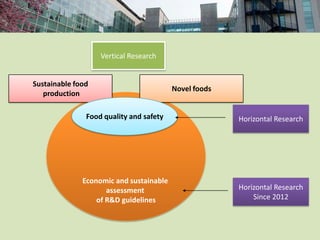
(In 2012 we add a economic assessment of our R&D)


           Vertical Research                  Horizontal Research
Vertical Research


Sustainable food
                                         Novel foods
   production

               Food quality and safety                 Horizontal Research


              Economic and sustainable
                     assessment                        Horizontal Research
                  of R&D guidelines                        Since 2012
Strategic Guidelines

  Sustainable food production

  (Supervised by vegetal production and soil science staff)

     •   Enhance waste and by-products from food to
         agronomic purpose.
     •    Modelling pollutants, water and nutrient dynamics in
         soil-crop systems
     •   Monitoring water quality in forest watershed
     •    Enhance crop yields in volume and qualitiy
Strategic Guidelines

  New Challenges 2012-2015

  Sustainable food production

      •   Studing POPs (Persistent organic pollutants) under Public
          Health point of view.
Strategic Guidelines

  New food products
  (Supervised by specialized biochemisty staff)

     •   Exploring emerging technologies to process food

     •    Modeling, design, optimization, validation and
         application of innovative processes of transformation,
         and conservation systems packing

     •   Application of biotechnology to select, characterize
         and preparation of food
Strategic Guidelines

  New food products

     •   Enhancement waste and by-products of food like source of
         raw material for the production of natural food additives

     •   New functional and healthy foodstuff from by-products
         fishery
Strategic Guidelines

  New Challenges 2012-2015
  New food products

     •   Use of enzyme technology to enhance the functionality of
         food, especially lipases for the synthesis of molecules with
         biological activity.
     •   In the field of white biotechnology, use microorganisms
         capable to increase selectivity and efficiency production of
         natural food nutraceutical additives.
     •   Assessment gel rheology to develop novel foods, with
         functionality ingredients.
     •   Develop food texture taylor made
Strategic Guidelines

  Food Safety and Quality
  (Supervised by chemistry, nutrition and bromatology staff)

      •    Improvement tools and techniques to trace the supply
          chain and raw materials determining origin and authenticity

      •    Improve production systems, handling and feeding to
          increase quality, productivity, stability, nutritional and
          functional characteristic on foodstuffs, aquaculture and
          livestock.
Strategic Guidelines

  Food Safety and Quality

     • Rapid method for the analysis of chemical, physical, biological
     contaminants from foodstuff

     • Effects of human activities on food production

     • Functional foods rich in antioxidants, improved flavor quality
New Challenges 2012-2015
Food Safety and Quality

      • Understanding absorption and metabolism of flavonoids
        and phenolic acids and their biological effects.
      • Understanding the interactions between food components
        affect the bioavailability and bioactivity, especially
        flavonoids and vitamin C
      • Improving processing techniques to increase the
        bioavailability of flavonoids and phenolic acids in food and
        thus develop novel foods.
      • Review scientific evidence about polyphenol DRI (dietary
        reference intakes) in order to asses healh claims
Facilities
    Chromatography systems:
    •GC-MS,
    •HPLC-DAD/Fluorescence
    •HPLC-MS/MS

    Spectrophotometry:
    •Spectrophotometer FTIR/UV-
    Vis/Fluorescence
    •Atomic Absortion-emission
Facilities
    Molecular biology:
    •PCR
    •DGGE

    Proteomics:
    •MALDI-TOF/TOF-MS
    •HPLC-MS/MS
    •FPLC
    •CE
Infraestructure

   Pilot Plant:
   •SFE (Supercritical Fluid Extraction)
   •Biomolecule purification systems
   •high pressure food preservation system
   •bioreactors
   •high pressure reactors

   Greenhouse

   Hydrological station
Just a few numbers.
Thesis


         2011


                                 Sustainable food production
         2010
                                 Food Quality and safety
                                 New food products


         2009


                0   4   8   12
Just a few numbers.

Sci/Ssci publications


     80


     60

                                      New food products
     40                               Food Quality and safety
                                      Sustainable food production


     20


      0
            2009        2010   2011
Just a few numbers.
 Funding framework


     1,200,000 €


       800,000 €


                                        Reports& external sevice
                                        Private Projects
       400,000 €                        R&D Projects


              0€

                   2009
                          2010
                                 2011

GrupoCIA

  • 1.
    Agri-Food Research Group(CIA) Strategic research group from U. Vigo Linked to Ourense Science Faculty
  • 2.
    Index • Scope • Research areas • Strategic Guidelines • Facilities • Infraestructure • Just a few numbers
  • 3.
    CIA has foundedon 2009 with one objective “efficient valorization of by-products” …but nowdays its scope is global.
  • 4.
    Global Vision “from Field to Plate” CIA focus its research activity solving these issues: 1. Sustainable food production 2. Consumers may require safety foods, healthy foods, tasty foods and ready to eat. 3. Food industry may valorize food wastes and by-products
  • 5.
    CIA is alignedto European Research guidelines Environmental impacts and total food chain Transparency along the food value chain Food processing Sustainable food and feed processing Food quality and safety Combined exposure to pesticides Prospects for novel foods
  • 6.
    Horizon 2020 CIA Groupis aligned to Horizon 2020 Smart specialisation strategy “We strengthen our capabilities on key issues.” We are focussed on generating excellent science on “food security, sustainable agriculture, marine and marititime research, and the bio- economy”
  • 7.
    Horizon 2020 Cia Groupis aligned to Horizon 2020 Networks “We must reinforce our international networks” This is our top priority on the next years..
  • 8.
    Agri-Food Research Group(CIA) Research areas: •Bromatology •Food Biotechnology •Food physical chemistry •Environmental agrobiology: soil and plant quality
  • 9.
    Focus areas: Bromatology • Determination and characterization of aromas in food matrixes, analytical chemistry related to food security • Transport of pollutants in the air-soil-water-crop systems linked to water pollution resources and the quality and safety of food products. • Effect of postharvest treatments on antioxidant polyphenolic compounds of horticultural products. • Determination of POPs in agri environment schemes
  • 10.
    Focus areas: Food Biotechnology • Microbiological and biochemical characterization of the ripening process from dairy and meat traditional products to improve the development of technology and to increase the quality and homogeneous of the final products. • Developing new technologies and biotechnological processes in order to obtain food additives and biosurfactants bacteriocins. Develop new products for the food industry. Recovery food additives (xylitol, lactic acid) from fermented media. Production and application of enzymes byproducts for the food industry. • Production and application of probiotics lactic acid bacteria and bacteriocins • Exploitation and valorisation of waste materials and byproducts of food industry
  • 11.
    Focus areas: Food physicalchemistry • Physical properties of foods: thermal stability and viscoelastic properties (experimental methods in rheology and differential scanning calorimetry)
  • 12.
    Focus areas: Environmental agrobiology:soil and plant quality • Allelopathy: interaction between plant species. Searches bioherbicides and plant protection. • Plant Ecophysiology: physiology in adverse conditions. Effects on photosynthesis and stress markers. • Plant-microorganisms: relationship between plants and microorganisms in the soil and wood. Search selective fungicides.
  • 13.
    First objective ofCIA Improvement crop waste and byproducts Two different lines No foodstuffs foodstuffs e.g. crop waste e.g. low quality foodstuffs Research oriented to Research oriented to Bioaccumulation Novel food Focus on Focus on Soil quality Functional ingredients from byproducts Agricultural productivity Extend shelf life
  • 14.
    Nowadays, the focusis on developing safety, healthy and functional foods, with high sensory characteristics. To reach this goal, we work on different strategies with the aim transferring innovation to the companies. (In 2012 we add a economic assessment of our R&D) Vertical Research Horizontal Research
  • 15.
    Vertical Research Sustainable food Novel foods production Food quality and safety Horizontal Research Economic and sustainable assessment Horizontal Research of R&D guidelines Since 2012
  • 16.
    Strategic Guidelines Sustainable food production (Supervised by vegetal production and soil science staff) • Enhance waste and by-products from food to agronomic purpose. • Modelling pollutants, water and nutrient dynamics in soil-crop systems • Monitoring water quality in forest watershed • Enhance crop yields in volume and qualitiy
  • 17.
    Strategic Guidelines New Challenges 2012-2015 Sustainable food production • Studing POPs (Persistent organic pollutants) under Public Health point of view.
  • 18.
    Strategic Guidelines New food products (Supervised by specialized biochemisty staff) • Exploring emerging technologies to process food • Modeling, design, optimization, validation and application of innovative processes of transformation, and conservation systems packing • Application of biotechnology to select, characterize and preparation of food
  • 19.
    Strategic Guidelines New food products • Enhancement waste and by-products of food like source of raw material for the production of natural food additives • New functional and healthy foodstuff from by-products fishery
  • 20.
    Strategic Guidelines New Challenges 2012-2015 New food products • Use of enzyme technology to enhance the functionality of food, especially lipases for the synthesis of molecules with biological activity. • In the field of white biotechnology, use microorganisms capable to increase selectivity and efficiency production of natural food nutraceutical additives. • Assessment gel rheology to develop novel foods, with functionality ingredients. • Develop food texture taylor made
  • 21.
    Strategic Guidelines Food Safety and Quality (Supervised by chemistry, nutrition and bromatology staff) • Improvement tools and techniques to trace the supply chain and raw materials determining origin and authenticity • Improve production systems, handling and feeding to increase quality, productivity, stability, nutritional and functional characteristic on foodstuffs, aquaculture and livestock.
  • 22.
    Strategic Guidelines Food Safety and Quality • Rapid method for the analysis of chemical, physical, biological contaminants from foodstuff • Effects of human activities on food production • Functional foods rich in antioxidants, improved flavor quality
  • 23.
    New Challenges 2012-2015 FoodSafety and Quality • Understanding absorption and metabolism of flavonoids and phenolic acids and their biological effects. • Understanding the interactions between food components affect the bioavailability and bioactivity, especially flavonoids and vitamin C • Improving processing techniques to increase the bioavailability of flavonoids and phenolic acids in food and thus develop novel foods. • Review scientific evidence about polyphenol DRI (dietary reference intakes) in order to asses healh claims
  • 24.
    Facilities Chromatography systems: •GC-MS, •HPLC-DAD/Fluorescence •HPLC-MS/MS Spectrophotometry: •Spectrophotometer FTIR/UV- Vis/Fluorescence •Atomic Absortion-emission
  • 25.
    Facilities Molecular biology: •PCR •DGGE Proteomics: •MALDI-TOF/TOF-MS •HPLC-MS/MS •FPLC •CE
  • 26.
    Infraestructure Pilot Plant: •SFE (Supercritical Fluid Extraction) •Biomolecule purification systems •high pressure food preservation system •bioreactors •high pressure reactors Greenhouse Hydrological station
  • 27.
    Just a fewnumbers. Thesis 2011 Sustainable food production 2010 Food Quality and safety New food products 2009 0 4 8 12
  • 28.
    Just a fewnumbers. Sci/Ssci publications 80 60 New food products 40 Food Quality and safety Sustainable food production 20 0 2009 2010 2011
  • 29.
    Just a fewnumbers. Funding framework 1,200,000 € 800,000 € Reports& external sevice Private Projects 400,000 € R&D Projects 0€ 2009 2010 2011