An Analysis Of Constraints To
 Inclusive Growth In Zambia
            Presented by

        Ngoza Munthali
        IGC Growth Week, LSE
Purpose of the Presentation


   Provide a summary of constraints to inclusive growth in
   Zambia based on the report done by MCA-Zambia on “An
   Analysis of Constraints to Inclusive Growth in Zambia”
Outline of the Presentation


   • Methodology
   • Findings
   • Issues for discussion
Methodology


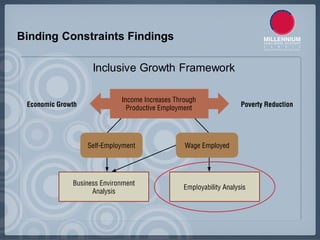
  • Inclusive Growth (IG) diagnostic framework – a
    modification of the Hausmann, Rodrick and Velasco
    (HRV) growth diagnostic framework
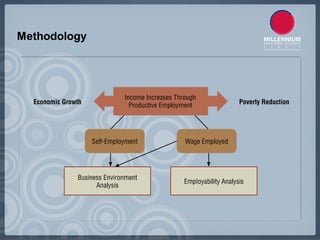
  • IG framework premised on productive employment as the
    main channel for achieving sustainable and inclusive
    growth
Methodology
Methodology


  • Describing the growth process and determining the
    relevant growth story question/s

  • Finding the binding constraints based on the
    employability and business environment analysis

  • Identifying the root cause/s of the binding constraints
Growth Story
Growth Story
Growth Story


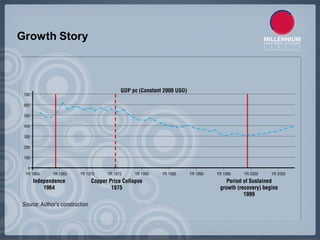
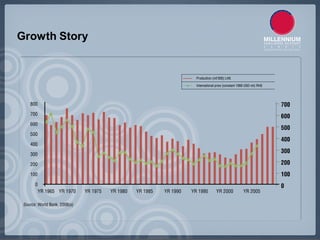
  •   Real GDP growth driven by developments in the international
      price of copper and its impact on the mining sector

  •   Further depression of real GDP growth during the period 1973
      to mid 1990s due to poor response to the large TOT shock

      ✤   Heavy borrowing to finance consumption and investment in
          capital intensive import substitution industries

      ✤   Price controls, subsidies, etc

  •   Late 1990s beginning of diversification by capitalising on
      Zambia’s advantage in land-intensive primary goods
Growth Story


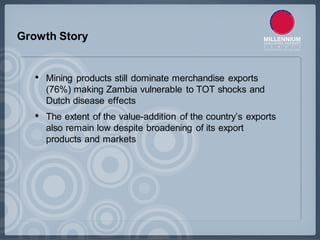
   • Mining products still dominate merchandise exports
     (76%) making Zambia vulnerable to TOT shocks and
     Dutch disease effects
   • The extent of the value-addition of the country’s exports
     also remain low despite broadening of its export
     products and markets
Growth Story


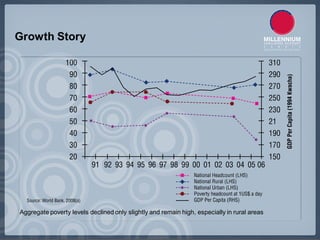
Aggregate poverty levels declined only slightly and remain high, especially in rural areas
Growth Story

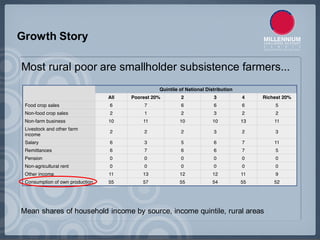
Most rural poor are smallholder subsistence farmers...


Mean shares of household income by source, income quintile, rural areas
Growth Story

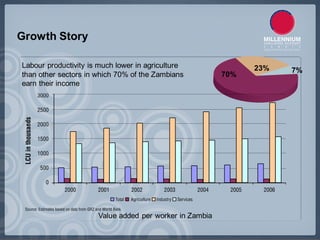
Labour productivity is much lower in agriculture               23%   7%
than other sectors in which 70% of the Zambians          70%
earn their income


                      Value added per worker in Zambia
Growth Story

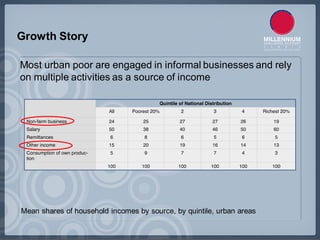
Most urban poor are engaged in informal businesses and rely
on multiple activities as a source of income


Mean shares of household incomes by source, by quintile, urban areas
So What Are The Growth Story Questions?


   • Why has Zambia’s GDP per capita growth not reached
     levels attained in the first years of independence?
   • What is constraining growth from being more inclusive
     and making a serious dent on poverty?
Binding Constraints Findings

             Inclusive Growth Framework
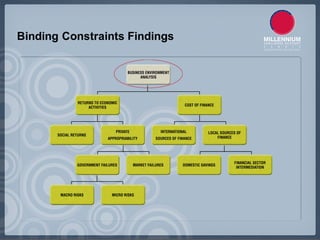
Binding Constraints Findings


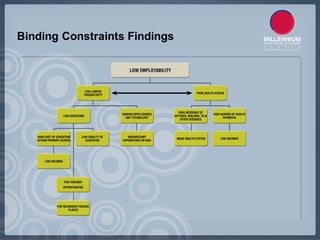
  • Poor health status and low productivity are binding
    constraints

     ✤   HIV/AIDS have lowered annual real GDP growth on
         average by 0.3 percentage points since 1992

     ✤   Access to education beyond primary level a constraint
         to productive employment including specialized skills
Binding Constraints Findings
Finance
Finance

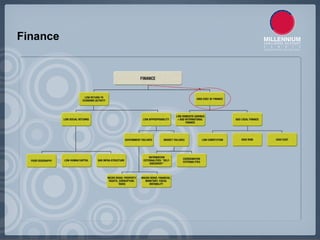
 • Access to finance and high cost of finance a challenge for
   MSMEs
 • Poor financial intermediation attributed to this challenge
   ✤   Small size and coverage of the banking sector
 • Low incomes among MSMEs leading to low demand for
   financial services
 • Overall, access and high cost of finance not a binding
   constraint
   ✤   Private sector credit % of GDP increasing, interest
       rates spreads narrowing, domestic savings as a share
       of GDP increasing
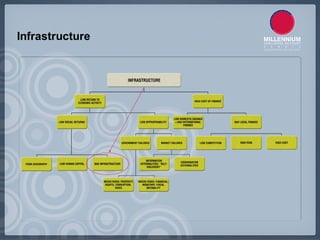
Infrastructure
Infrastructure

 • Infrastructure services are binding constraints in the following
   areas:
   ✤   Electricity supply – access is declining, delays in
       connections (93 days), quality of service is poor
   ✤   Water supply and sanitation – access to piped water on the
       decline, average consumption of water for drinking & other
       domestic use for rural households about 20 litres well
       below the average required for achieving a clean disease
       free environment
   ✤   Feeder roads
   ✤   Poor land transport links and high travel costs
   ✤   Railway transport
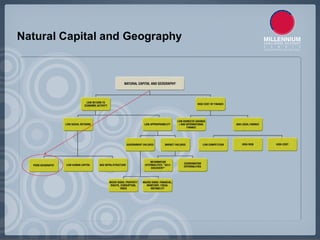
Natural Capital and Geography


   • Natural capital and geography not binding constraints
   • Concerns in the following areas:
     ✤   Future growth risks due to climate change effects
     ✤   Degradation of soils in some parts of the country
     ✤   Unsustainable exploitation of natural capital
     ✤   Difficult to reach export markets and access cheap
         imports because of Zambia’s landlocked status
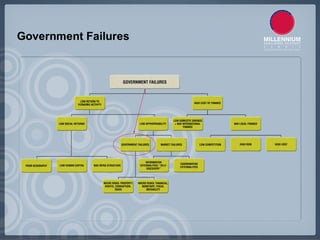
Government Failures
Government Failures

  • Micro risks
   ✤   Not a binding constraint - investment and business
       climate has improved over the last five years
   ✤   Areas of concern – time and cost to export and import
       across borders, high costs of licensing, high redundancy
       costs, low public sector implementation capacity
Government Failures

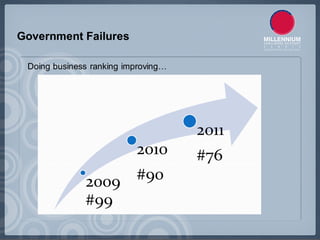
 Doing business ranking improving…
Government Failures

• Macro risks
 ✤   Not a binding constraint
 ✤   Areas of concern – exchange rate fluctuations and
     appreciation pose a challenge to the growth of non-
     traditional exports (the question of the Dutch Disease
     effect), public finance sustainability and governance
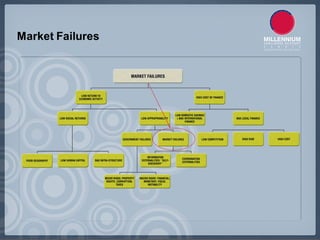
Market Failures
Market Failures


   • Coordination and information failures are binding
     constraints, especially to export sophistication
     ✤   Coordination failures attributed to infrastructure service
         related inputs, energy, transport and water which
         provide a link between producers and consumers and
         information failures such as marketing, research and
         product quality development
   • Coordination and information failures more severe for the
     poor who cannot afford the fixed costs associated with
     finding alternative sources
Recap of the Constraints


   • Low productivity and poor health status are at the root of
     low employability of the Zambian population
   • Poor infrastructure services - electricity, road
     connectivity, rail transport and water supply and
     sanitation especially in rural and peri-urban areas
   • Coordination failures – failure to provide complementary
     goods and services to help private investors to be
     profitable, innovative and competitive
Issues for Discussion


   • High cost of finance not a binding constraint especially for
     MSMEs – heavily contested
   • Railway transport – does it really offer an alternative to the
     current inadequate land transport?
   • Exchange rate appreciation and Dutch disease effects – is
     it a binding constraint?
   • Export diversification versus export sophistication – what
     has happened in the last 17 years?
Thank you for your attention!
CONSTRAINTS TO GROWTH IN
        ZAMBIA


         Anthony M. Simpasa
     Financial Markets Department
           Bank of Zambia

Discussion on Presentation made at the
    Growth Week 2011 Conference
           Zambia Session
     London School of Economics

          September, 2011

                                         1
CONTENTS


1.   Introduction
2.   Overview of macroeconomic performance
3.   Constraints to Growth
4.   Policy Options and Potential Benefits
5.   Conclusion


                                             2
1.0       Introduction

   Zambia’s growth record has been dismal historically, but recent evidence
    shows a strong recovery in economic performance

   Real Gross Domestic Product (GDP) growth has averaged above 5% per
    annum over the past decade.

   The unique feature of this growth momentum is that it has been broad
    based and less variable.

   Underpinned by favourable macroeconomic policy environment coupled
    with strong private sector response

   But accelerated growth hampered various constraints


                                                                               3
2.0       Overview of macroeconomic
                          performance

   Over the past decade years, Zambia’s macroeconomic performance has been
    reflected in:

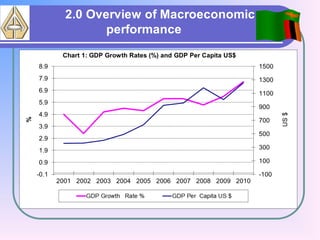
        Positive Real GDP growth, which has averaged 5.6% per annum from 2001-2010
         (see Chart 1);

        Rising per capita GDP to US$1,253 in 2010 from less than US$350 in 2001

        Economic growth has been broad based, signaling efforts for diversification;

        Inflation declined to single digit of 7.9% in 2010 from 18.7% in 2001;

        Declining lending rates to an average of 14.4% in 2010 from 54.6% in 2001; and

        Strong real exchange rate

        Easy of doing business in Zambia ranking from 84 in 2010 to 76 in 2011 (World
         Bank, 2011). Ranked 4th in Africa.


                                                                                          4
2.0 Overview of Macroeconomic
       performance
2.1     Macroeconomic stability and
                    investment
   Due to macroeconomic stability, the country is now building
    resilience to external shocks;
   Evidenced by rapid recovery from the effects of the global economic
    crisis;
   This raises prospect of durable economic growth;
   …as foreign direct investment has increased;
   Driven largely by the boom in the mining industry and the associated
    second order effects (e.g., construction boom);
   Total FDI in 2009 stood at US$7.5 billion, US$4.5 billion of which
    was recorded in the mining industry (GRZ, 2010);
   The current period of expansion is the strongest and lengthiest that
    the Zambian economy has witnessed in recent memory;
   Zambia recently reclassified as a low middle income country;
   Credit rating of B+ by Fitch and, Standard and Poors.
3.0      Constraints to Growth

   Despite the favourable developments, the country still suffers
    from long-standing economic bottlenecks and structural
    impediments;
   Undermined competitiveness, limited job creation and derailed
    poverty reduction efforts;
   Sources:
         high indirect costs related to infrastructure deficiencies and inefficiency
         inadequate skills and costs associated with service-related inputs
   Macroeconomic stability is essential but needs to be supported by
    structural and micro-level policy reforms;
   This will enable the country to reach a high threshold of a
    competitiveness driven growth.
Constraints

•       The fundamental constraint to Zambia’s growth is the inadequacy
        and poor quality of infrastructure, in its broadest sense;

    •   Unavailability and low quality of infrastructure have reduced economic
        returns to private investment;

    •   Hard infrastructure - roads, railways, storage facilities, etc.;

    •   ‘Soft’ infrastructure - information communications and technology,
        institutions;

    •   Laws and other governance related structures (e.g., contract
        enforcement procedures;

    •   Key in enhancing efficient investment and competitiveness

                                                                                 8
Constraints

   Electricity and energy
        Hydropower major source (99.4% in 2006);
        Excess demand, largely driven by mining activity;
        Long delays in providing electricity connection - 100 days to connect;
        Frequent disruptions – result in losses averaging more than 8% of output
        Low use of alternative energy (e.g., solar, wind, etc)


   Transport
        High transportation costs;
        Poor state of the road network and dilapidated railway system.
        Paved road percentage is low and concentrated in the urban areas;
        Poor state of roads (feeder) limits market access and integration;
        This has created obstacles to increases in rural incomes and perpetuated high
         poverty levels;
        Inadequacy of air transport facilities hinders tourism development;


                                                                                         9
Constraints

   Irrigation and large water works
       Most of Zambia’s agriculture production is rain fed;


        Water retention facilities (dams, etc.) and harvesting techniques
         are generally underdeveloped;

        Inadequate irrigation infrastructure;

        As a result, water productivity – GDP/water use – is only $1.6 in
         2000 constant prices;

        This has limited agricultural productivity and the choice of crops in
         the areas lacking irrigation services


                                                                                 10
Constraints

   Water and Sanitation
       Despite advances made in regulating and commercialisation of
        the water supply system;
       Underinvestment in public water and sanitation supply facilities
        due to budget cutback (Dagdeviren, 2008);
       Firms and households self-provide;
       Lack of regulatory enforcement of illegal connections and
        dumping of waste, unplanned installations of water facilities such
        as sinking of boreholes;
       Poor sanitation affects health of the population due to the spread
        of water borne diseases
       Costly treatment of preventative diseases
       Effects on labour productivity as well.


                                                                             11
Constraints


   Labour Productivity
       Zambia is a highly capital intensive economy despite excess
        labour supply;
       Capital use per unit of labour estimated at more than three times
        its East African peers;
       Only 23 cents per dollar of each unit of capital employed is
        translated into value added, compared with Uganda’s 70 cents
        (World Bank, 2003);
       This has resulted in severe diminishing returns to capital;
       Real cost of labour high to due to low levels of labour
        productivity;
       The cost of labour is also high due to high severance and
        redundancy cost of more than 140 weeks of wages.


                                                                            12
Constraints

   Information communication and technology (ICT)
       Over the past few years, there has been considerable growth in the
        telecommunications sector;
       Marked by phenomenal private investment;
       Three service providers, one recently privatised;
       In 2006, 46% of the population was within reach of a mobile signal.
        This rate has increased to above 62%;
       However, fixed line connectivity remains poor, particularly in rural
        areas where it is virtually non-existent;
       Information and technology sub-sector also lagging behind;
       Internet connectivity is characterised by poor coverage - only 1.2
        secure internet servers per 1 million people
       Zambia’s connection is largely through satellite - limited bandwidth and
        transmission delays.

                                                                               13
Constraints


   Undeveloped financial markets and cost of capital
       Financial liberalization has significantly improved the financial
        landscape;
       FSDP I emphasised need to develop financial sector
       FSDP II focusing on competition, accessibility, inclusion, literacy, etc.
       More participants – banks, NBFIs, institutional investors;
       However, the financial sector remains shallow and illiquid;
       Financial sector dominated by the banking industry;
       Capital market still underdeveloped
       Lack of diverse sources of long-term finance
       Cost of credit still high for a majority of private firms, particularly the
        SMEs (World Bank, 2008);
       Wide spreads and high real lending rates (>17% and 12%);
       Credit Reference Bureau established to address information
        asymmetry related constraints to credit access
       FinMark Trust surveys attribute low inclusion to both demand and
        supply factors;


                                                                                      14
Policy Options

   Increasing public investment in infrastructure
   Exploring different financing mechanisms such as PPP;
   One-stop border points part of PPP framework
   Expansion of electricity generation capacity also taking PPP route;
   The government has also placed rural electrification high on the agenda to
    accelerate economic development in rural areas;
   Tariffs revision to attract the private sector in the electricity industry;
   In the transport sector, the government has earmarked to spend more than
    90% of the total transport resource requirements on roads under the SNDP;
   Upgrade airports – Kasaba bay, Mfuwe, Livingstone, etc
   This should help reduce freight costs and improve efficiency of
    transportation services;
   Grading of feeder roads to improve access to agricultural markets


                                                                             15
Policy Options

   Liberalisation of international gate way to reduce connecting tariffs
   Improve quality of infrastructure, particularly ICTs to bridge the rural-
    urban divide and enhance communication and market access;
   Enhancing state capacity to improve efficiency of the public service and
    governance institutions;
   Luiz (2009) provides evidence that African states do not possess this
    level of capacity but it garnered innovative partnerships.
   Reducing commodity dependence and diversifying the economy
   Need to expand the export base, focussing on value adding non-
    traditional exports will raise the country’s foreign exchange earning
    capacity;
   Continued implementation of macroeconomic and structural reforms will
    unlock potential of the country to register higher growth


                                                                            16
Potential benefits

   Absence of data – affects quantification of financial losses to the
    economy from various infrastructure deficiencies;
   Estimates suggest sizable potential benefits that would accrue from
    improvements in infrastructure services.
   In Zambia, increasing investment in infrastructure to the tune of the
    required US$500 million will eliminate the inefficiencies that cause the
    loss of $300 million per annum;
   Improving Zambia’s infrastructure endowment could boost output growth
    by up to 2 percentage points per annum (Foster and Dominguez, 2011);
   Enterprise surveys have also shown that improving infrastructure will
    raise firm productivity by about 50 per cent;
   Removing governance distortions, red tape and slippages will account for
    the remaining half;


                                                                           17
Potential benefits

   Skills upgrade will trigger huge productivity gains and facilitate innovation
    and technology diffusion;
   Need for government to set the agenda for investing in skills enhancing
    areas such as upgrading the technical and vocational training and
    reforming labour laws;
   Improving healthcare services and accessibility, including continued efforts
    at combating the spread of HIV/AIDS will strengthen the human capital
    base;
   This will ensure that the poor benefit from future growth of the non-farm
    economy;
   Tackling market coordination failures must be approached with equal
    vigour in order to avoid interrupted reforms and growth spurts;
   Enhancing state capacity and improving effectiveness of governance
    institutions, would reduce cost of delays, say in, contract enforcement,
    currently 39% of claim;


                                                                                18
5.0       Conclusions

   Infrastructure deficiencies have undermined industrial productivity
    and reduced the potential of the economy to grow at a much faster
    pace;
   High cost of credit stifled growth of SMEs and left economy trapped in
    informality
   Zambia needs to create the right conditions to exploit the advantages
    of information-based technology to enhance productivity and
    competitiveness of the private sector;
   Improving efficiency of the public sector and strengthening state
    capacity in implementing key policies is critical in improving business
    environment;
   Explore new models of financing infrastructure investment;
   Emphasise need for regulatory and institutional change and
    recommending avenues for more efficient planning and delivery of
    infrastructure services;

                                                                          19
Conclusions

   Assess potential cost savings arising from improvements in infrastructure
    services to avoid creating unproductive public investments;

   There is need to rethink the diversification strategy - move away from a
    comparative advantage driven growth to competitive advantage;

   The reasons to take deeper and more meaningful policy measures is simple:-

   Zambia is experiencing unprecedented investment and growth expansion cycle
    – where businesses need access to capital and other input services;

   Failure to sustain this growth momentum would have significant consequences
    to the real economy and poverty reduction.


                                                                                 20
THANK YOU


            21