ZIMBABWE:FINDING A
FINANCING SOLUTION
FOR DEVELOPMENT
FINANCE
April 2017
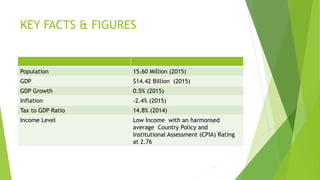
KEY FACTS & FIGURES
Population 15.60 Million (2015)
GDP $14.42 Billion (2015)
GDP Growth 0.5% (2015)
Inflation -2.4% (2015)
Tax to GDP Ratio 14.8% (2014)
Income Level Low Income with an harmonsed
average Country Policy and
Institutional Assessment (CPIA) Rating
at 2.76
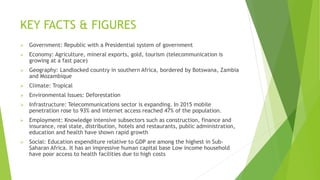
KEY FACTS & FIGURES
 Government: Republic with a Presidential system of government
 Economy: Agriculture, mineral exports, gold, tourism (telecommunication is
growing at a fast pace)
 Geography: Landlocked country in southern Africa, bordered by Botswana, Zambia
and Mozambique
 Climate: Tropical
 Environmental Issues: Deforestation
 Infrastructure: Telecommunications sector is expanding. In 2015 mobile
penetration rose to 93% and internet access reached 47% of the population.
 Employment: Knowledge intensive subsectors such as construction, finance and
insurance, real state, distribution, hotels and restaurants, public administration,
education and health have shown rapid growth
 Social: Education expenditure relative to GDP are among the highest in Sub-
Saharan Africa. It has an impressive human capital base Low income household
have poor access to health facilities due to high costs
An Overview
 Zimbabwe has faced political and economic crisis between 2000 and 2008
which led to the reduction of Gross Domestic Product GDP by half.
 This contraction has raised poverty rates to more than 72%.
 A country that was once a regional model for health, education and other
basic services collapsed.
 This led to a lengthy isolation of the country from the international
community with restricted aid flows and build up of arrears. Significant
progress made for the last five years in stabilizing and revitalizing the
economy
 Progress has been made to regain past performance in social outcomes more
specifically health and education with strong Government commitment,
steady household investment and substantial donor support.
 The recovery from decades of contraction has weakened as a result of a
number of serious challenges facing the country.
Recent Developments
 Trend economic growth is around 2-3% per annum following end on dollarization
boom in 2012.
 Prices have stabilized giving way to a structures Zimbabwean economy
 Agriculture represents a constant share of the total output, it has been affected
by the recent droughts and the El Nino.
 The energy and water supply sectors have a started experiencing the El Nino
effects
 The depreciation of the Rand against the US dollar has weakened Zimbabwe’s
competitiveness against trade partners
 The service sector, comprising the construction, finance, insurance, hotels and
distribution, is in dynamic growth and contributes in building a skilled labour
force.
 The Manufacturing and the mining sectors are suffering from the dynamics of the
exchange rate, making it difficult for them to attract investment.
 There is a shift in the economic activity from industry to service base.
Challenges Facing the Economy
 The country is facing serious challenges as a result of external and policy shocks
 There is an urgency for implementation of policy reforms to strengthen the
financial sector and more importantly to improve the business climate.
 A high public debt exerts pressure on the economy and raises costs of capital for
investment.
 There is a need to clear arrears to multilateral and bilateral partners, in order to
normalize relations with external creditors.
 Zimbabwe has thus proposed a plan to clear arrears from its own resources to
allow resumption of development financing.
 It should be noted that the World Bank’s lending program in Zimbabwe is inactive
due to arrears and the role is now limited to technical assistance and analytical
work.
UNLOCKING THE FINANCIAL
OPPORTUNITIES IN ZIMBABWE
 Public and Private Sources of funds have to be
mobilized for development
 The MDBs and IMF provide assistance in
catalyzing, mobilizing and crowding in public and
private resources of funds for development.
IMPROVING DIRECT RESOURCE
MOBILISATION
 Since the government has taken the commitment to clear the arrears from its
own resources would imply improving direct resource mobilization.
 It must seek the support from Multilateral Development Banks (MDBs) and the
IMF for technical assistance in areas of tax administration and policy reforms.
 The tax to GDP ratio was 14.8% in 2014, domestic resources can be mobilized
through taxes and duties.
 The artisanal and small-scale mining ASM, for example, is an important source
of income for the rural poor, however, it contributes little to fiscal revenues.
Therefore, is a need to capture taxes from such informal sectors.
 Skilled Zimbabwean often seek employment abroad and send remittances
home. Remittances has increased during 2010-2015 are estimated to have
reached almost 7% of Gross National Income in 2015. Taxes on remittances
can be introduced.
IMPROVING DIRECT RESOURCE
MOBILISATION
 Finance may also be captured through bonds.
 Public Sector Efficiency must be improved. There is a need to cut on
wage bill which accounts for a large part of the public expenditure.
The Civil Service Commission of Zimbabwe has already launched a
restructuring and rationalization programme aimed at streamlining
the size of the public service and better aligning staff resources with
agency mandates.
ATTRACTING PRIVATE INVESTMENT
 Firstly the government must put in place policies to create an enabling
environment for doing business.
 This will imply (1) Transparency and rule of Law, (2) Adequate Infrastructure (3)
Political Stability.
 There is a need to review the high administrative costs of cross-border trade,
especially those caused by custom delays. A strategy to reduce costs of paying
taxes and trading across borders has already been adopted.
 The execution of the guidelines for the implementation of the Indigenisation and
Economic Empowerment Act to substitute 50% indigenised equity , hurdle to
private investors, is important
 Regulations are required to allow institutional investors such as sovereign wealth
funds and private pension funds to crowd in the development
 Private Philanthropy can be tapped to unlock sources of finance for providing
improved health facilities to low income households
ATTRACTING PRIVATE INVESTMENT
 Foreign direct investment (FDI) can be increased by exporting professional
services.
 FDI can also be increased by sharing information on niche markets with
manufacturers so that they may contribute in export growth.
 Domestic private finance can be improved to transform the banking sector.
The Reserve Bank of Zimbabwe is already playing a key role.by introducing
measures to reinforce financial stability.
ATTRACTING PRIVATE INVESTMENT
 Private capital is attracted by risk and return.
 There is a need for policies and instruments to lower risk and strengthen
investors confidence over long-term finance.
 Government has a catalytic role by ensuring that incentives, pricing and
regulations are aligned.
 Credit lines for small and medium enterprises can be put in place.
 New climate finance architecture can be used for funding from Green Climate
Funds and National Climate Agencies for example to fund drought relief
projects.
Conclusion
 Zimbabwe can surely boost its economy by:
1. effectively mobilizing domestic resources, mainly through tax administration
2. Ensuring public sector efficiency
3. Creating an enabling and conducive business environment.
References
1. World Bank ,2016. Country. Available on:
http://www.worldbank.org/en/country/zimbabwe [Accessed on 03 April
2017]
2. World Bank. 2016. Zimbabwe Economic Update. Available on
http://documents.worldbank.org/curated/en/184441468195017068/pdf/1030
61-WP-P155915-Box394849B-PUBLIC-Zimbawbe-Economic-Update-Single-
Pages-FINAL-ONLINE-30-01-2016.pdf [Accessed 03 April 2017]