Visit https://ebookultra.com to download the full version and
explore more ebooks
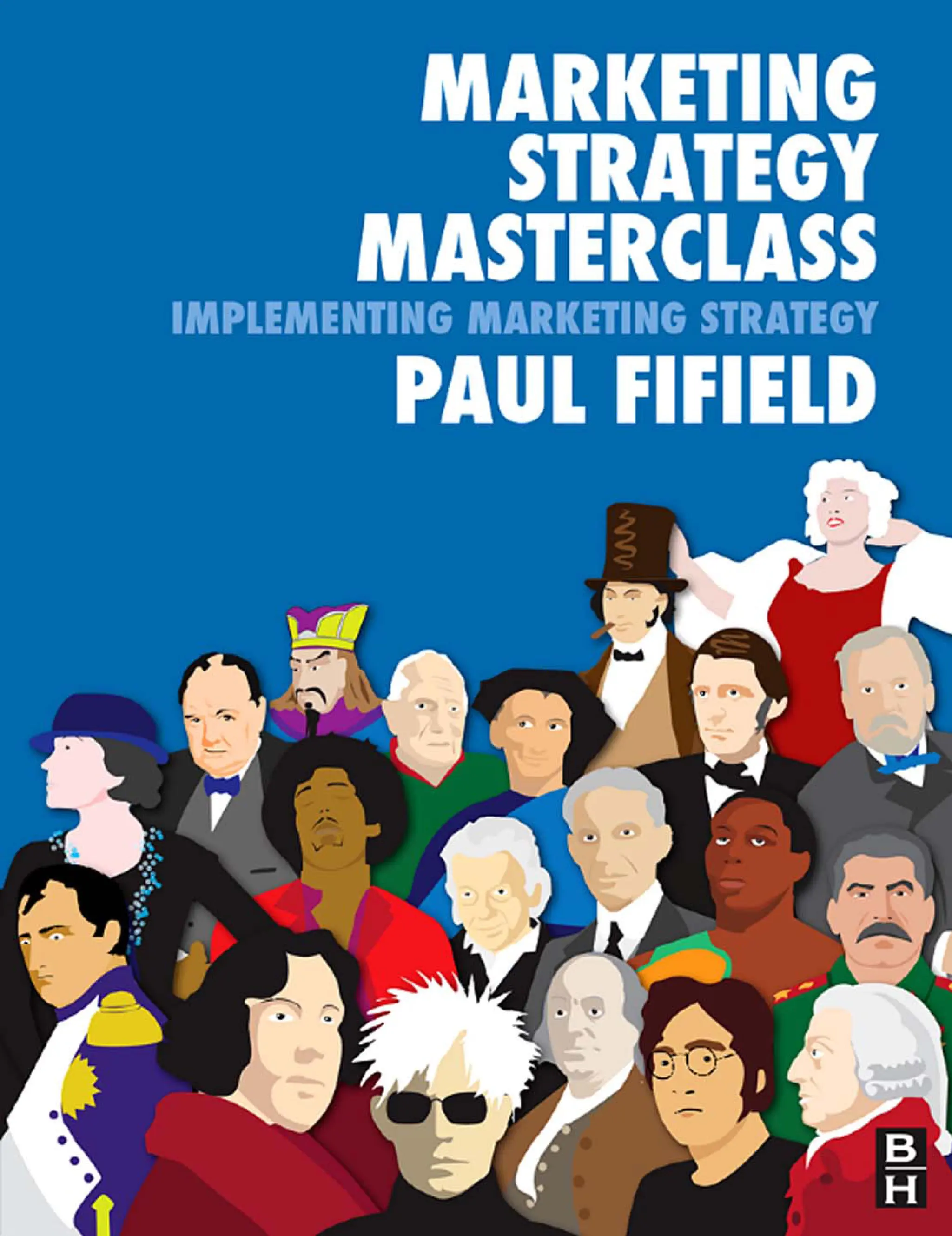
Marketing Strategy Masterclass Implementing
Market Strategies 1st Edition Paul Fifield

_____ Click the link below to download _____
https://ebookultra.com/download/marketing-strategy-
masterclass-implementing-market-strategies-1st-edition-
paul-fifield/
Explore and download more ebooks at ebookultra.com
Here are some suggested products you might be interested in.
Click the link to download
The Marketing Strategy Desktop Guide 1st Edition Norton
Paley
https://ebookultra.com/download/the-marketing-strategy-desktop-
guide-1st-edition-norton-paley/
Digital Marketing Foundations and Strategy Fifth Edition
Debra Zahay
https://ebookultra.com/download/digital-marketing-foundations-and-
strategy-fifth-edition-debra-zahay/
Stock Market Strategies That Work 1st Edition Jake
Bernstein
https://ebookultra.com/download/stock-market-strategies-that-work-1st-
edition-jake-bernstein/
Marketing Strategy Text and Cases 6th Edition O. C.
Ferrell
https://ebookultra.com/download/marketing-strategy-text-and-cases-6th-
edition-o-c-ferrell/
Consumer behavior building marketing strategy 10th Edition
Del I. Hawkins
https://ebookultra.com/download/consumer-behavior-building-marketing-
strategy-10th-edition-del-i-hawkins/
Boomer Marketing Selling to a Recession Resistant Market
1st Edition Ian Chaston
https://ebookultra.com/download/boomer-marketing-selling-to-a-
recession-resistant-market-1st-edition-ian-chaston/
Trading by numbers scoring strategies for every market 1st
Edition Howell
https://ebookultra.com/download/trading-by-numbers-scoring-strategies-
for-every-market-1st-edition-howell/
Masterclass Writing Romantic Fiction 1st Edition Barbara
Samuel
https://ebookultra.com/download/masterclass-writing-romantic-
fiction-1st-edition-barbara-samuel/
A Practical Guide To Market Research 1st Edition Edition
Paul Hague
https://ebookultra.com/download/a-practical-guide-to-market-
research-1st-edition-edition-paul-hague/
Marketing Strategy Masterclass Implementing Market
Strategies 1st Edition Paul Fifield Digital Instant
Download
Author(s): Paul Fifield
ISBN(s): 9780750686310, 0750686316
Edition: 1
File Details: PDF, 7.84 MB
Year: 2008
Language: english
Marketing Strategy
Masterclass
The 100 questions you need
to answer to create your
own winning marketing
strategy
For Jack
This book is much more Jack’s than he will ever believe.
Far more than just ‘being his turn’; to see focus and determination
in one so young has served, more than once, to keep me working on
what has turned out to be a very long project indeed.
Thank you Jack
Marketing Strategy
Masterclass
The 100 questions you need
to answer to create your own
winning marketing strategy
Including the new ‘SCORPIO’
model of Market Strategy
First Edition
Paul Fifield
AMSTERDAM • BOSTON • HEIDELBERG • LONDON • NEW YORK • OXFORD
PARIS • SAN DIEGO • SAN FRANCISCO • SYDNEY • TOKYO
Butterworth-Heinemann is an imprint of Elsevier
Linacre House, Jordan Hill, Oxford OX2 8DP, UK
30 Corporate Drive, Suite 400, Burlington, MA 01803, USA
First edition 2008
Copyright © 2008, Paul Fifield. Published by Elsevier Ltd.
The right of Paul Fifield to be identified as the author of this work has been asserted
in accordance with the Copyright, Designs and Patents Act 1988
No part of this publication may be reproduced, stored in a retrieval system, or
transmitted in any form or by any means, electronic, mechanical, photocopying,
recording, or otherwise, without the prior written permission of the publisher
Permissions may be sought directly from Elsevier’s Science & Technology Rights
Department in Oxford, UK: phone: (44) (0) 1865 843830; fax: (44) (0) 1865 853333,
E-mail: permissions@elsevier.com. Alternatively you can submit your request online
by visiting the Elsevier web site at http:/
/elsevier.com/locate/permissions, and
selecting Obtaining Permission to use Elsevier material
Notice
No responsibility is assumed by the publisher for any injury and/or damage to persons
or property as a matter of products liability, negligence or otherwise, or from any use or
operation of any methods, products, instructions or ideas contained in the material
herein
British Library Cataloguing-in-Publication Data
A catalogue record for this book is available from the British Library
Library of Congress Cataloging-in-Publication Data
A catalog record for this book is available from the Library of Congress
ISBN: 978-0-7506-8631-0
For information on all Butterworth-Heinemann publications visit
our website at elsevierdirect.com
Typeset by Charon Tec Ltd., A Macmillan Company
Printed and bound in Hungary
08 09 10 11 12 10 9 8 7 6 5 4 3 2 1
Contents
(short form)
Preface xi
Introduction xiii
Part One: Preparing for the marketing strategy 1
1 The internal business drivers 3
2 The external environment 19
3 The business strategy 52
4 The marketing objectives 70
Part Two: Developing the marketing strategy 83
5 Industry or Market? (I) 95
6 The Customer (C) 131
7 Segmentation and Targeting (S) 190
8 Positioning and Branding (P) 250
9 Customer Retention (R) 317
10 Organisation: Processes and Culture (O) (with Hamish
Mackay) 357
11 Offerings (O) 423
Part Three: Co-ordinating your marketing strategy stances 483
12 Co-ordinating your marketing strategy 485
Part Four: Implementing your marketing strategy 505
13 Making it happen 507
Appendices 543
Index 591
This page intentionally left blank
Contents
Preface xi
Introduction xiii
Part One: Preparing for the marketing strategy 1
1 The internal business drivers 3
1. What do our shareholders require from us? 4
2. What do our stakeholders require from us? 6
3. Who are the key implementers in the organisation and
what are their personal values and requirements? 8
4. How should we best describe their/our strategic intent? 9
5. Out of these various factors do we have a clear statement
or understanding of the corporate/business mission? 10
6. What (therefore) is the long-term financial objective that the
organisation is dedicated to achieving? 12
7. What are the Financial Hurdles? 13
8. What is the Vision of the organisation? What should it be? 15
2 The external environment 19
9. What resources do we have and how are they being
utilised? 20
10. What are the strengths and weaknesses of the
organisation? 23
11. What is the ‘Environment Audit’ and how do we
create one? 28
12. What opportunities and threats exist in our broad
macro-environment? 34
13. Are we (really) customer focused? 35
14. How is our industry put together? What business are
we in? 36
15. Are there opportunities arising from the structure of
our business/industry? 43
16. Who are our real competitors and what are their
competencies? 45
17. What are the opportunities for our organisation in the
competitive environment? 47
18. Are we internally or externally driven? 48
3 The business strategy 52
19. What is our business/corporate objective? 53
20. What is our business/corporate strategy? 55
viii Contents
21. What are the options for sustainable competitive
advantage? 58
22. What do we believe is the most appropriate sustainable
competitive advantage we should be seeking? – Our
competitive strategy 64
4 The marketing objectives 70
23. What are the marketing objective(s)? 72
24. How do I develop the KPIs from the marketing objectives? 77
Part Two: Developing the marketing strategy 83
25. What is marketing strategy? 84
26. What are the steps involved in developing marketing strategy? 88
27. What does marketing strategy mean for my organisation? 91
28. Should I prepare my organisation for marketing strategy? 92
29. Why do I involve in the marketing strategy process? 92
5 Industry or Market? (I) 95
30. What business are we in (now)? 100
31. What business do we want to be in or should we be in? 105
32. How does this define the market/customer needs we
should be satisfying? 112
33. Where/how should we be growing the business? 115
34. What are our strategic opportunities and threats? 118
35. What competition are we (really) facing? 122
36. What are the boundaries for effort? 125
6 The Customer (C) 131
37. Who are they? 139
38. What do they currently buy from us/our competitors
and why? 142
39. What benefits are they seeking? 146
40. What do they want from us now/will they want in the
future? 161
41. What barriers are getting in the way? 167
42. What will make them come to us? 174
43. Where do customers interface (connect) with our
organisation? 183
7 Segmentation and Targeting (S) 190
44. What is the current state of segmentation in the
organisation? 195
45. What do we want segmentation to do for our organisation? 201
46. What segments exist in our target market (defined business)? 208
47. How durable are the segments identified? 223
48. How can we prioritise the segments for approach? 227
49. Which segments should we target? 235
50. How can we market to different segments? 240
ix
Contents
8 Positioning and Branding (P) 250
51. Differentiation or ‘Commodity’ marketing? 255
52. What market positions exist? 267
53. What market position do we own, or do we want to own? 274
54. How are we going to be different from the competition? 278
55. What is our brand? What are its unique ‘values’ and
‘personality’? 286
56. What are the costs and benefits of building a brand? 301
57. How do we invest in our brand and a differentiated
market position? 309
9 Customer Retention (R) 317
58. How important is ‘Retention’ in our market? 323
59. How big are the ‘problem’ and the potential gains? 327
60. Is retention just about customer satisfaction? 332
61. Do our accounting and reporting systems impede
retention activities? 339
62. How good is our Market(ing) Information Systems (MkIS)? 342
63. What is the strategic role of our Customer Relationships? 347
64. How are we planning to invest in our primary asset? 353
10 Organisation: Processes and Culture (O) (with Hamish
Mackay) 357
65. Is our organisation focused on internal or external issues? 363
66. What is our organisation really good at – and does it matter? 369
67. What is going on with our culture? 377
68. Process – is our organisation joined up? 383
69. Is our organisation driven by the right information? 396
70. Which metrics are used to manage and drive our
organisation? 405
71. Change management – what is that? 413
11 Offerings (O) 423
72. Where is the Customer value? 426
73. What is our Value Proposition? 436
74. What is the most appropriate business design for us? 445
75. Where are our new offerings? 451
76. How do we assess the Risk? 460
77. Are we managing the life cycle? 467
78. How do we take our Offerings to market? 473
Part Three: Co-ordinating your marketing strategy stances 483
12 Co-ordinating your marketing strategy 485
79. What makes ‘good’ strategy? 486
80. How do I plan with SCORPIO? 491
81. What is the minimum SCORPIO – the ‘Strategic Spine’? 494
x Contents
82. What is the defensive SCORPIO? Co-ordinating your
‘defensive marketing strategy’ 497
83. What is the offensive SCORPIO? Co-ordinating your
‘offensive marketing strategy’ 500
Part Four: Implementing your marketing strategy 505
13 Making it happen 507
84. How do we implement the strategy, and turn our
thinking into action? 508
85. What are the barriers that could stop us implementing
the strategy? 510
86. How can we control implementation? 513
87. Which ‘Marketing Mix’ should my organisation use? 516
Product or service policy
88. What jobs are your products or services being ‘hired’
to do? 521
89. What is our product (or service)-market match? 524
90. What are the product or service components that we
need to manage? 524
Pricing policy
91. What are the key drivers behind your pricing decisions? 526
92. What are (will be) the market effects of changing prices? 528
Place/distribution policy
93. What alternative routes-to-market are open to you? 528
94. Are you winning or losing the battle for control of your
customer? 531
Promotion/communications policy
95. Who is the one person you want to talk to? 532
96. What is the one thing you want to say to them? 534
97. Why should they believe you? 534
98. How do you want them to feel as a result? 535
Other VIT (very important tactics)
99. What are the Very Important Tactics that are the Most
Important Thing to do – today? 536
100. Which (if any) of these VITs is a trend, (not just a
bubble) that must be managed strategically? 538
Appendices 543
1. The 100 Questions for your marketing strategy 545
2. FAQS – Frequently asked questions in market(ing)
strategy 559
3. Marketing and sales plan template 575
4. Linking market strategy with market research 588
Index 591
Preface
‘When China wakes it will shake the world’
Napolean Bonaparte
Emperor of the French
I have wanted to write this book for a very long time – but events and
circumstances always prevented me from doing so.
This is a different book from my normal publications – it is much more of
a ‘how to’ version than normal, and unashamedly so.
Rather than try to write a learned tome, I have tried to write a book that:
● Makes sense to the medium-sized business that books, that universi-
ties and professional institutes (mentioning no names) singularly fail
to serve. Good or ‘professional’ marketing is absolutely not the sole
preserve of the Unilevers and Proctor  Gambles of this world, and
must be spread wider.
● Has a beginning, a middle (muddle?) and an end, that can be fol-
lowed by the busy practitioner.
● Is true to the REAL nature of marketing, not what marketing seems to
have become in those larger organisations – advertising and promotion.
● Will (I hope) prove the inspiration for all those UK and European
organisations determined to survive and flourish against ‘unfair’
price competition from China, India and other developing countries –
price is absolutely not the only game in town!
Ultimately then, this book is about do-it-yourself (DIY) Marketing
Strategy. I have worried long and hard over the 100 questions and,
although they are not perfect they are, as far as I can make them for this
edition, the best process for developing your own marketing strategy
that I can devise.
Finally, why the title? Marketing Strategy Masterclass – apart from the
question of perceived value (see Chapter 11), Marketing Strategy is just
too important to be consigned to ‘dummies’ – only ‘masters’ need apply.
xii Preface
Avid readers will notice a small overlap with the ‘sister publication’
‘Marketing Strategy, 3rd edition’, published in 2007. The two volumes
cover the same content but in very different ways, for different
audiences.
I wish you a very profitable time using this book.
Paul Fifield
Winchester
October, 2007
Introduction
This book is not necessarily intended to be a ‘good read’ although
I believe it has its moments. This book is intended, first and foremost, to
be a step-by-step guide to help you to develop a marketing strategy for
your business. In other words, a simple plan that will help you build a
‘safer’ business. By safer I mean building a business that is not focused
primarily on the product or service that you provide but on the custom-
ers who pay you to ‘hire’ your product or service to do a job that they
believe needs doing.
As Joseph Stalin recognised, ideas are far more powerful than guns. Ideas
of how to create new, customer-pleasing offerings will always be more
powerful than cutting prices. This book is about helping you to create
those ideas.
This book is aimed, above all, at ‘marketing’ practitioners, no matter the
title under which they operate, these are the people who have to plan and
implement customer solutions for a profit. In other words, every busi-
ness owner or manager who stands or falls according to whether their
customers decide to buy the product or service offered.
With such an audience in mind I have decided to break down the strat-
egy approach into a three-step process:
● Part One will look at the preparatory analysis that is essential to the
development of any robust, practical marketing strategy
● Part Two looks in more depth at the specific question of how to
develop and plan marketing strategy using the SCORPIO approach
● Part Three considers how your business might co-ordinate the
SCORPIO elements to best effect
● Part Four separates marketing strategy from marketing tactics and
considers how strategy is implemented.
‘Ideas are far more powerful than guns. We don’t let our people
have guns, why should we let them have ideas?’
Joseph Stalin (1878–1953),
General Secretary of the Communist
Party of the Soviet Union’s Central
Committee 1922–1953
xiv Introduction
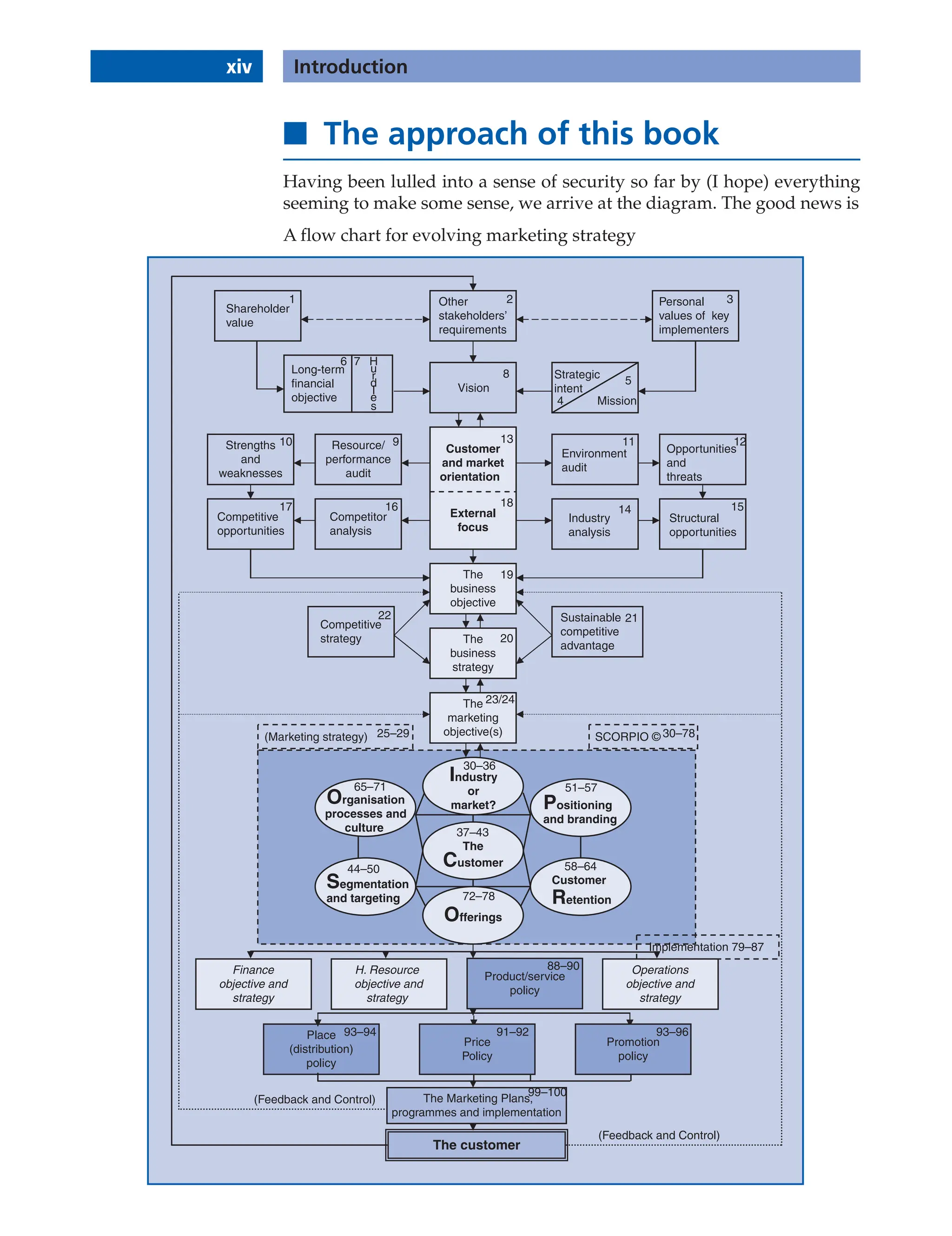
■ The approach of this book
Having been lulled into a sense of security so far by (I hope) everything
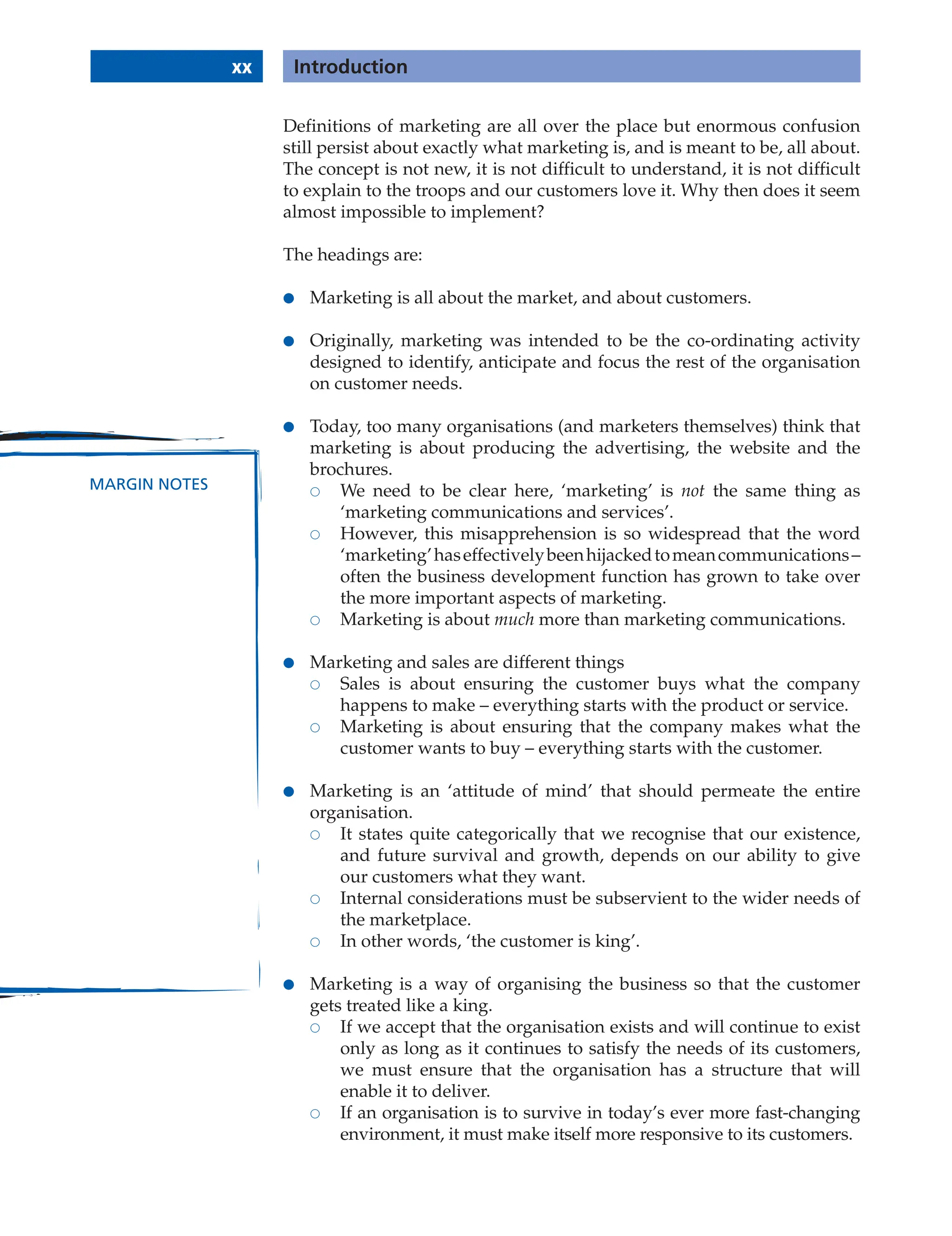
seeming to make some sense, we arrive at the diagram. The good news is
A flow chart for evolving marketing strategy
Vision
Long-term
financial
objective Mission
Strategic
intent
Shareholder
value
Other
stakeholders’
requirements
Personal
values of key
implementers
Customer
and market
orientation
External
focus
Strengths
and
weaknesses
Resource/
performance
audit
Competitive
opportunities
Competitor
analysis
Environment
audit
Opportunities
and
threats
Structural
opportunities
Industry
analysis
The
business
objective
The
business
strategy
The
marketing
objective(s)
Competitive
strategy
Sustainable
competitive
advantage
The customer
The Marketing Plans,
programmes and implementation
Product/service
policy
Place
(distribution)
policy
SCORPIO ©
(Marketing strategy)
(Feedback and Control)
Customer
Retention
The
Customer
Organisation
processes and
culture
Industry
or
market?
Offerings
Positioning
and branding
Segmentation
and targeting
2
1
4
5
6 7
8
9 2
1
1
1
10 13
14 15
16
17 18
21
22
19
20
23/24
30–36
37–43
44–50
51–57
58–64
65–71
72–78
H
u
r
d
l
e
s
3
30–78
25–29
Price
Policy
Promotion
policy
Finance
objective and
strategy
H. Resource
objective and
strategy
Operations
objective and
strategy
88–90
91–92 93–96
93–94
99–100
Implementation 79–87
xv
Introduction
MARGIN NOTES
thatthewholestrategicprocesscanberepresentedinoneflowchart;thebad
news is that it is more than a little complicated and we will need the whole
of the rest of the book to go through it! A firm believer in the need to get all
the pain out of the way at the outset so that we can fully enjoy the recu-
peration, I have laid out the full plan in all its malevolence in the flowchart.
Assuming that your eyes are still focusing, a few points should be made
at this stage:
● This chart is intended to show the approximate relationships between
the various aspects, analyses and decisions that go to make up the
business and market strategy formulation process.
● The arrows are intended to show one possible route for logical thought
through the process.
 However, as we shall see later, this is one, but not the only route
 The numbers in the boxes relate to the 100 questions that form the
basis of this book.
● Since every organisation faces different competitive and market con-
ditions, then no single strategic process can possibly be proposed to
suit all needs.
 This chart should not be viewed as a blueprint.
● Practitioners should feel perfectly free to adapt and amend the dia-
gram to meet their own needs.
 Certainly some sections might be jumped and others emphasised
to meet specific requirements.
● Before you skip or downgrade a stage in the process, make sure that
you fully understand what it is you are leaving out!
● We will use this chart as a guide through the book – I have con-
structed the series of 100 questions based on this diagram.
In the same way that an ant may eat an elephant (a spoonful at a time),
we will have to break the complete diagram down to bite-size pieces,
before we can hope to put any of this into practice. To do this it is prob-
ably easier to see the whole diagram as a composite of the usual steps in
strategy development. The four key stages are:
● Part One: Preparing for the marketing strategy
● Part Two: Developing the marketing strategy (SCORPIO)
● Part Three: Co-ordinating SCORPIO
● Part Four: Implementation, from strategy to tactics
■ Part One: Preparing for the
marketing strategy
Before we can hope to develop even the most rudimentary strategic deci-
sions, a degree of analysis is required. Working with customers may be
xv
Introduction
more art than science but working on gut feeling is not the same thing as
working by the seat of the pants. We should never forget that the qual-
ity of gut feeling or intuition improves with the amount of painstaking
research that goes before. The groundwork preparation stage can be put
into three steps.
● Understand the internal business drivers:
 There are essential forces alive in every organisation that cannot
just be ignored.
 The owners and key managers of the organisation are human
beings and they have needs, wants and demands that your organ-
isation must satisfy.
 You must understand these important forces as many of them can
run directly counter to the needs of the customer.
 It will be your delicate task to manage these often opposing
demands so as to satisfy as many people as possible inside the
organisation while creating unbeatable value for the customer.
 Easy!
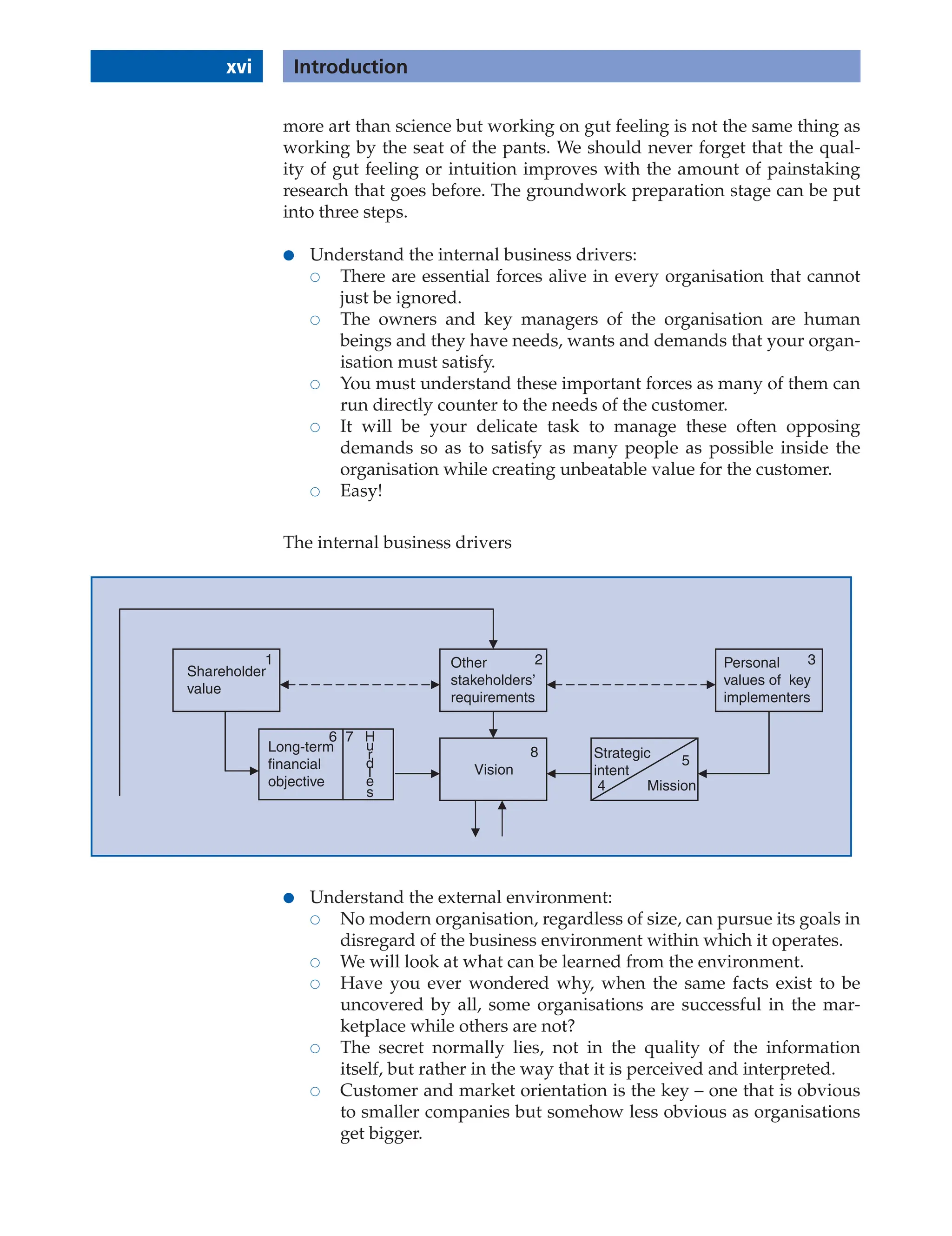
The internal business drivers
Vision
Long-term
financial
objective Mission
Strategic
intent
Shareholder
value
Other
stakeholders’
requirements
Personal
values of key
implementers
2
1
4
5
6 7
8
H
u
r
d
l
e
s
3
● Understand the external environment:
 No modern organisation, regardless of size, can pursue its goals in
disregard of the business environment within which it operates.
 We will look at what can be learned from the environment.
 Have you ever wondered why, when the same facts exist to be
uncovered by all, some organisations are successful in the mar-
ketplace while others are not?
 The secret normally lies, not in the quality of the information
itself, but rather in the way that it is perceived and interpreted.
 Customer and market orientation is the key – one that is obvious
to smaller companies but somehow less obvious as organisations
get bigger.
xvi Introduction
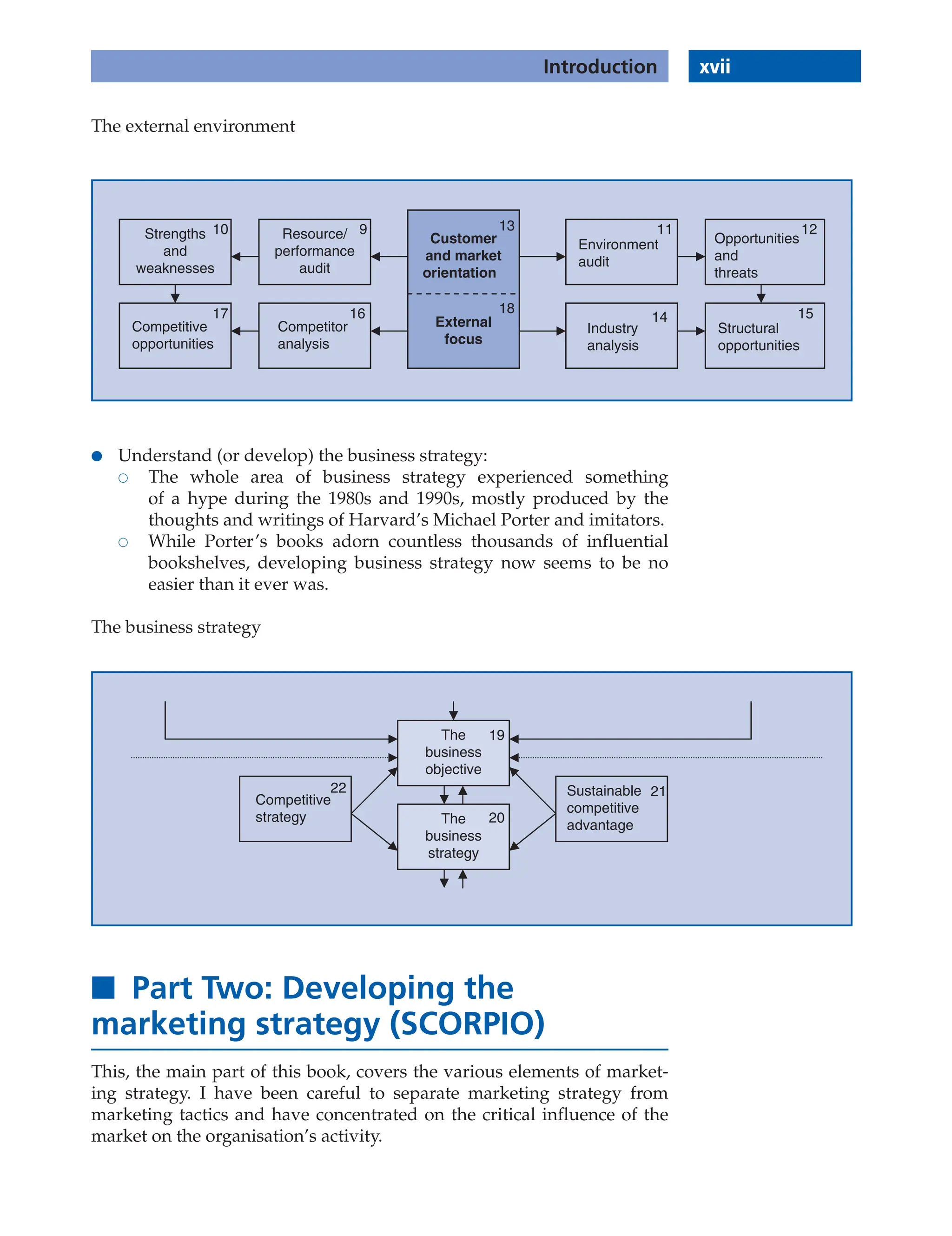
The external environment
xvii
Introduction
Customer
and market
orientation
External
focus
Strengths
and
weaknesses
Resource/
performance
audit
Competitive
opportunities
Competitor
analysis
Environment
audit
Opportunities
and
threats
Structural
opportunities
Industry
analysis
9 2
1
1
1
10 13
14 15
16
17 18
● Understand (or develop) the business strategy:
 The whole area of business strategy experienced something
of a hype during the 1980s and 1990s, mostly produced by the
thoughts and writings of Harvard’s Michael Porter and imitators.
 While Porter’s books adorn countless thousands of influential
bookshelves, developing business strategy now seems to be no
easier than it ever was.
The business strategy
The
business
objective
The
business
strategy
Competitive
strategy
Sustainable
competitive
advantage
21
22
19
20
■ Part Two: Developing the
marketing strategy (SCORPIO)
This, the main part of this book, covers the various elements of market-
ing strategy. I have been careful to separate marketing strategy from
marketing tactics and have concentrated on the critical influence of the
market on the organisation’s activity.
The SCORPIO model of marketing strategy has been many years in
the making, working with real practitioners in real businesses facing
real problems. Many of the headings in this part will be familiar to you
although how they fit together may not. Nobody wants to play the role
of guinea pig when dealing with strategic issues, practitioners want solu-
tions that work; that have worked before, that will produce the results.
As a testimonial for the approach, I can quote the case of a recent client
who sent the SCORPIO model that we had been working with for six
months to an academic friend for his opinion. The blistering email reply
was ‘But is all the stuff we’ve seen before, there’s nothing new here at
all’. Exactly. I couldn’t have put it better myself.
■ Part Three: Co-ordinating your
marketing strategy
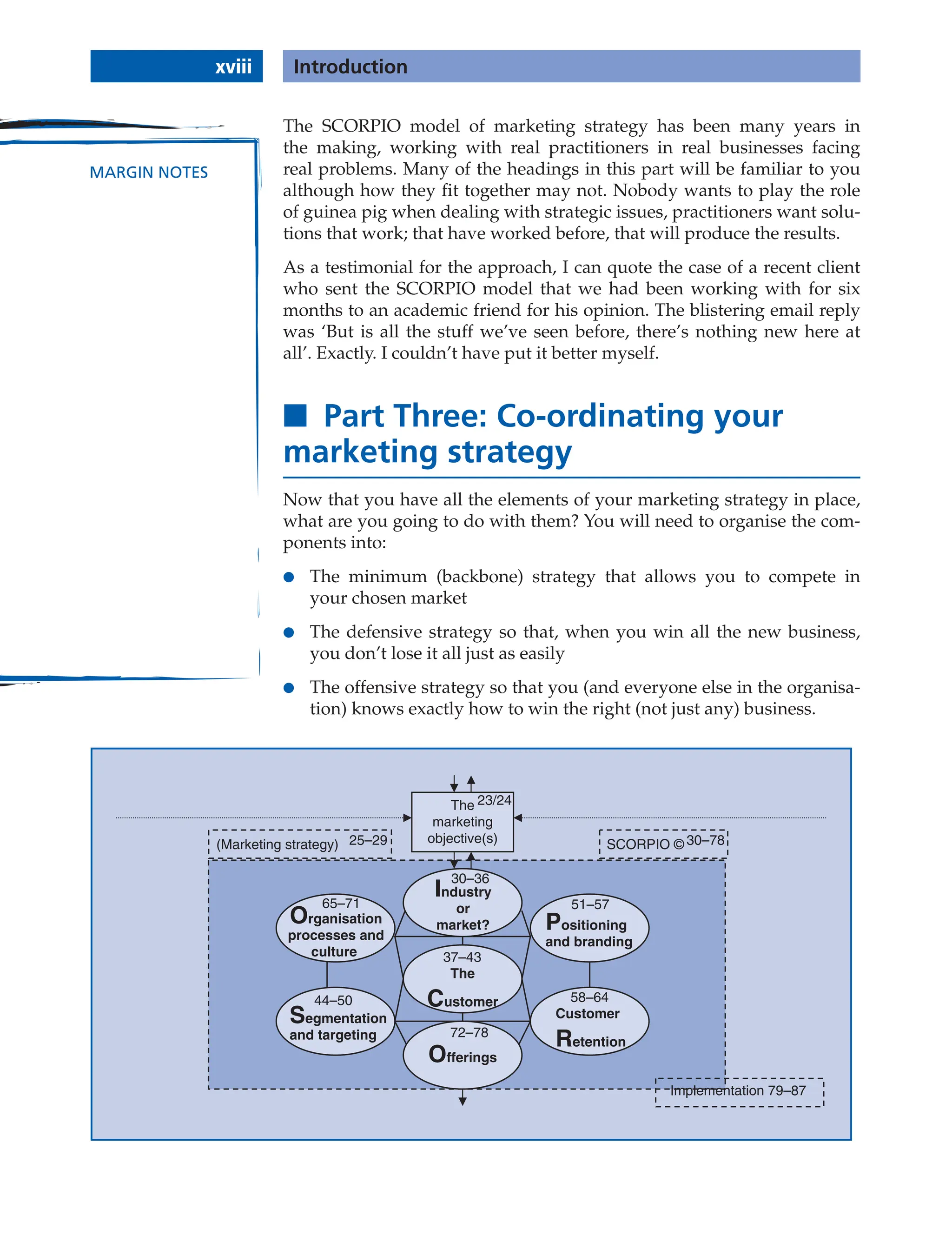
Now that you have all the elements of your marketing strategy in place,
what are you going to do with them? You will need to organise the com-
ponents into:
● The minimum (backbone) strategy that allows you to compete in
your chosen market
● The defensive strategy so that, when you win all the new business,
you don’t lose it all just as easily
● The offensive strategy so that you (and everyone else in the organisa-
tion) knows exactly how to win the right (not just any) business.
The
marketing
objective(s) SCORPIO ©
(Marketing strategy)
Customer
Retention
The
Customer
Organisation
processes and
culture
Industry
or
market?
Offerings
Positioning
and branding
Segmentation
and targeting
23/24
30–36
37–43
44–50
51–57
58–64
65–71
72–78
30–78
25–29
Implementation 79–87
xviii Introduction
MARGIN NOTES
■ Part Four: Implementation, from
strategy to tactics
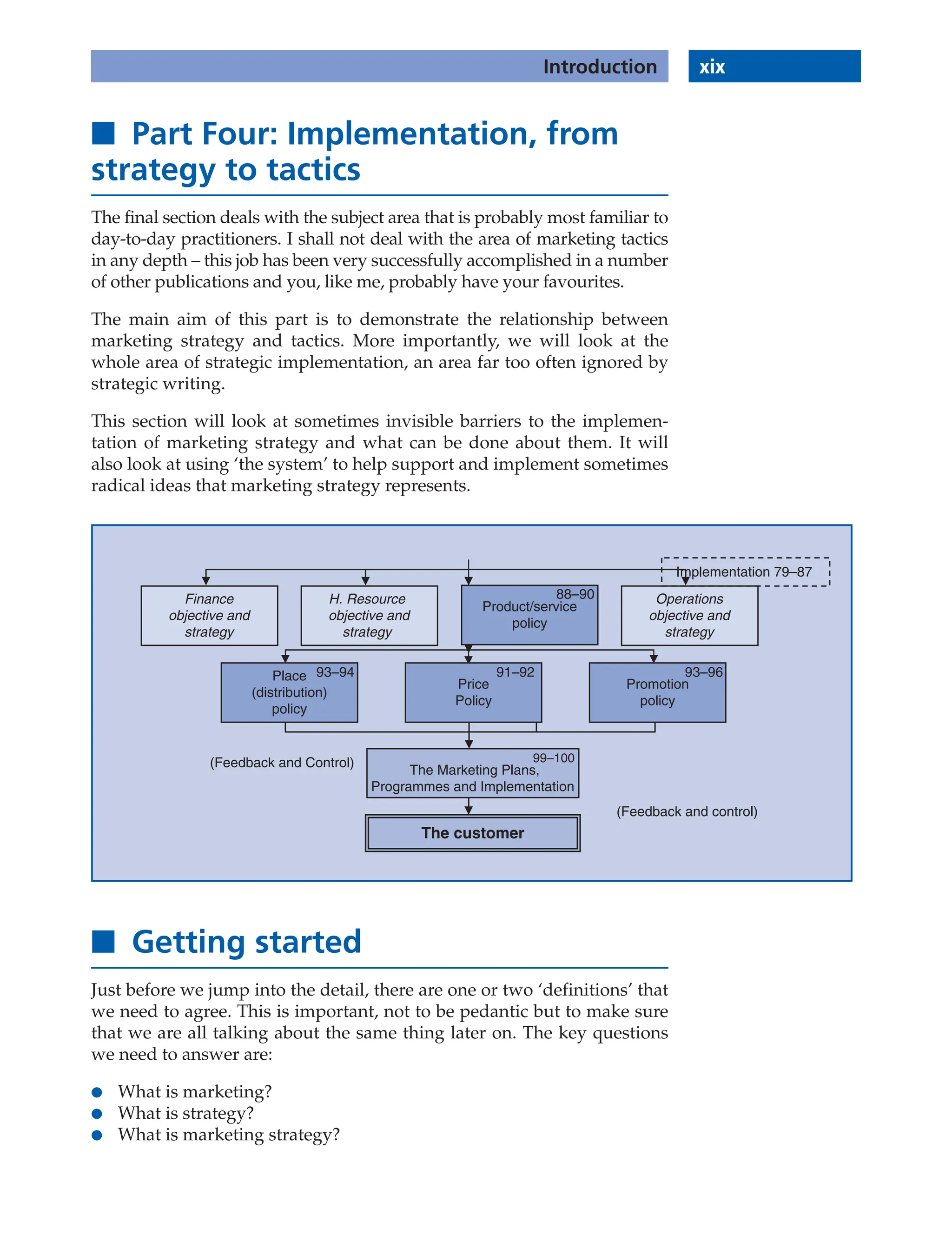
The final section deals with the subject area that is probably most familiar to
day-to-day practitioners. I shall not deal with the area of marketing tactics
in any depth – this job has been very successfully accomplished in a number
of other publications and you, like me, probably have your favourites.
The main aim of this part is to demonstrate the relationship between
marketing strategy and tactics. More importantly, we will look at the
whole area of strategic implementation, an area far too often ignored by
strategic writing.
This section will look at sometimes invisible barriers to the implemen-
tation of marketing strategy and what can be done about them. It will
also look at using ‘the system’ to help support and implement sometimes
radical ideas that marketing strategy represents.
The customer
The Marketing Plans,
Programmes and Implementation
Product/service
policy
Place
(distribution)
policy
(Feedback and Control)
(Feedback and control)
Price
Policy
Promotion
policy
Finance
objective and
strategy
H. Resource
objective and
strategy
Operations
objective and
strategy
88–90
91–92 93–96
93–94
99–100
Implementation 79–87
■ Getting started
Just before we jump into the detail, there are one or two ‘definitions’ that
we need to agree. This is important, not to be pedantic but to make sure
that we are all talking about the same thing later on. The key questions
we need to answer are:
● What is marketing?
● What is strategy?
● What is marketing strategy?
xix
Introduction
xx Introduction
MARGIN NOTES
Definitions of marketing are all over the place but enormous confusion
still persist about exactly what marketing is, and is meant to be, all about.
The concept is not new, it is not difficult to understand, it is not difficult
to explain to the troops and our customers love it. Why then does it seem
almost impossible to implement?
The headings are:
● Marketing is all about the market, and about customers.
● Originally, marketing was intended to be the co-ordinating activity
designed to identify, anticipate and focus the rest of the organisation
on customer needs.
● Today, too many organisations (and marketers themselves) think that
marketing is about producing the advertising, the website and the
brochures.
 We need to be clear here, ‘marketing’ is not the same thing as
‘marketing communications and services’.
 However, this misapprehension is so widespread that the word
‘marketing’haseffectivelybeenhijackedtomeancommunications–
often the business development function has grown to take over
the more important aspects of marketing.
 Marketing is about much more than marketing communications.
● Marketing and sales are different things
 Sales is about ensuring the customer buys what the company
happens to make – everything starts with the product or service.
 Marketing is about ensuring that the company makes what the
customer wants to buy – everything starts with the customer.
● Marketing is an ‘attitude of mind’ that should permeate the entire
organisation.
 It states quite categorically that we recognise that our existence,
and future survival and growth, depends on our ability to give
our customers what they want.
 Internal considerations must be subservient to the wider needs of
the marketplace.
 In other words, ‘the customer is king’.
● Marketing is a way of organising the business so that the customer
gets treated like a king.
 If we accept that the organisation exists and will continue to exist
only as long as it continues to satisfy the needs of its customers,
we must ensure that the organisation has a structure that will
enable it to deliver.
 If an organisation is to survive in today’s ever more fast-changing
environment, it must make itself more responsive to its customers.
xxi
Introduction
MARGIN NOTES
 Typically this will mean
■ Shorter chains of communication and command and fewer
‘levels’ or ‘grades’
■ Fewer people employed in ‘staff’, ‘headquarters’ and other
non-customer related functions and
■ An overall structure and business design that reflects the dif-
ferent needs of the people who buy from the organisation
rather than technical specialisations of the people who work
inside it.
● Marketing is a range of activities used by the marketing department
to meet marketing, marketing and business objectives.
 Centred mainly on the concept of the marketing mix (tradition-
ally accepted as including product, price, place and promotion),
this is the technical ‘how to’ of the discipline.
● Marketing is the producer of profits for the whole organisation.
 Profits are generated by markets.
 Profits are not generated by products, by efficiency, by manage-
ment or even by diligent workforces.
 It is only the customer’s willingness to pay the right (premium)
price for the right product or service, which keeps anyone in
business.
 Marketing, as the primary interface between the organisation and
the markets that it serves, is then the primary producer of the
organisation’s profit stream.
Peter Drucker on marketing:
‘Only marketing and innovation produce profits for an organisation, and
all other areas should be regarded as costs’
It is in the area of profit that we meet what is probably the most critical
role of marketing. In almost every organisation there is likely to be con-
flict between the customer’s need for value and the organisation’s need
for profit and efficiency.
It is the role of marketing to search for and strike the elusive (and changing)
balance between these two demands. We also need to ask ourselves:
● Given that there is more than one way of satisfying customer
demand, which route is the most efficient from the organisation’s cost
point of view?
● How can we best balance customer need for value against the organi-
sation’s need for profits?
Profit is a function of the price that the customer is willing to pay and
the cost of production and sale. Successful and effective marketing
(if measured in profit terms) must pay attention to both these areas.
Marketing is definitely not about satisfying customers at any price.
Marketing is about satisfying customers at a profit.
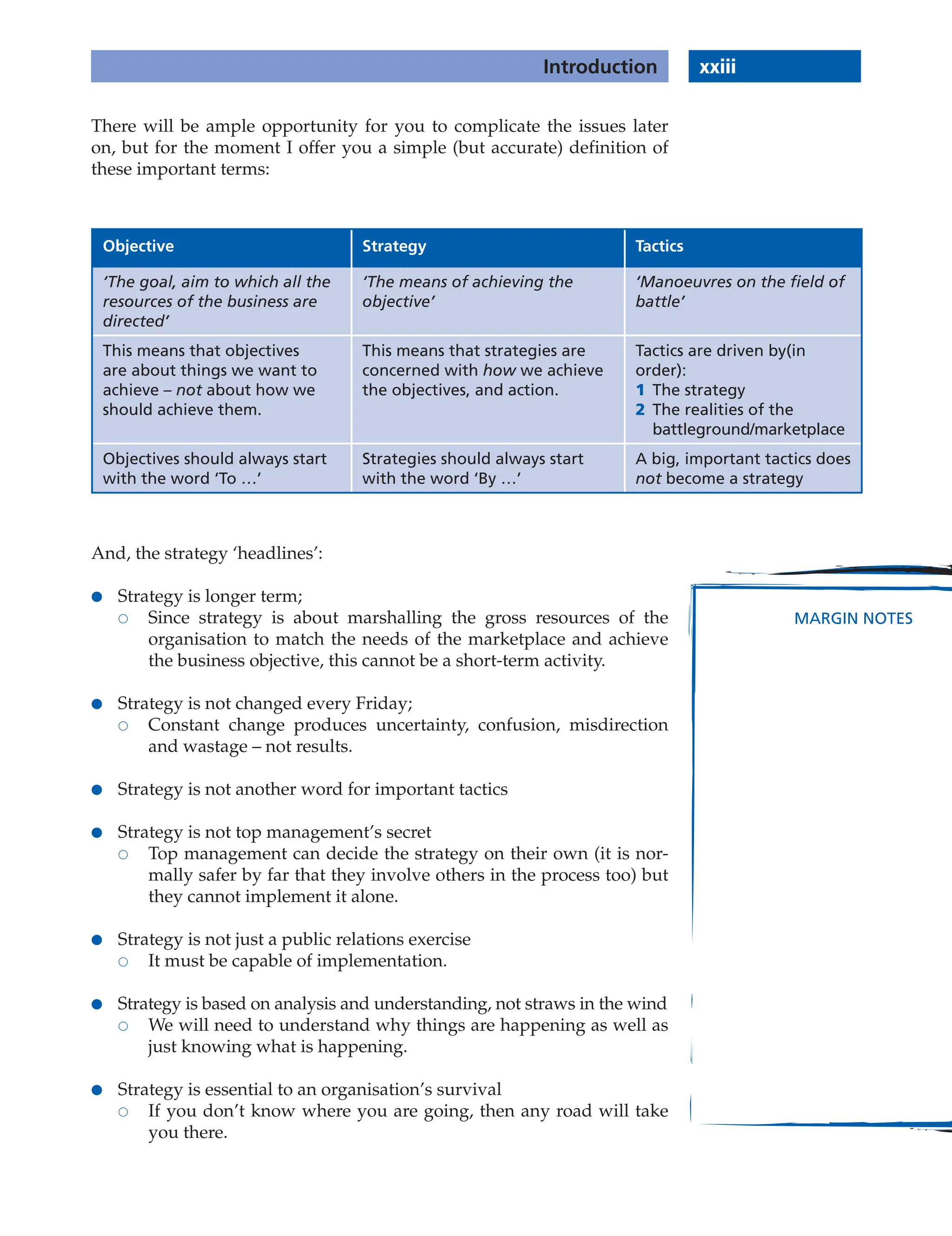
The marketing process
The
organisation
The
customer
Communications
Information
Organisational value (Money) flows from
the customer segment to the organisation
Customer value (benefits/solutions) flows
from the organisation to the customer
I’m glad that’s clear …
■ What is strategy?
The word ‘strategy’ has become one of the most common and badly used
words in business writing. Everywhere we look we see terms such as:
● Business strategy
● Corporate strategy
● Marketing strategy
● Strategic marketing
● Product strategy
● Pricing strategy
● Advertising strategy
● Internet/Online strategy and even
● Discount strategy.
The word strategy is almost synonymous with ‘important’. Overworking
the word in this way helps nobody. It simply serves to confuse.
xxii Introduction
MARGIN NOTES
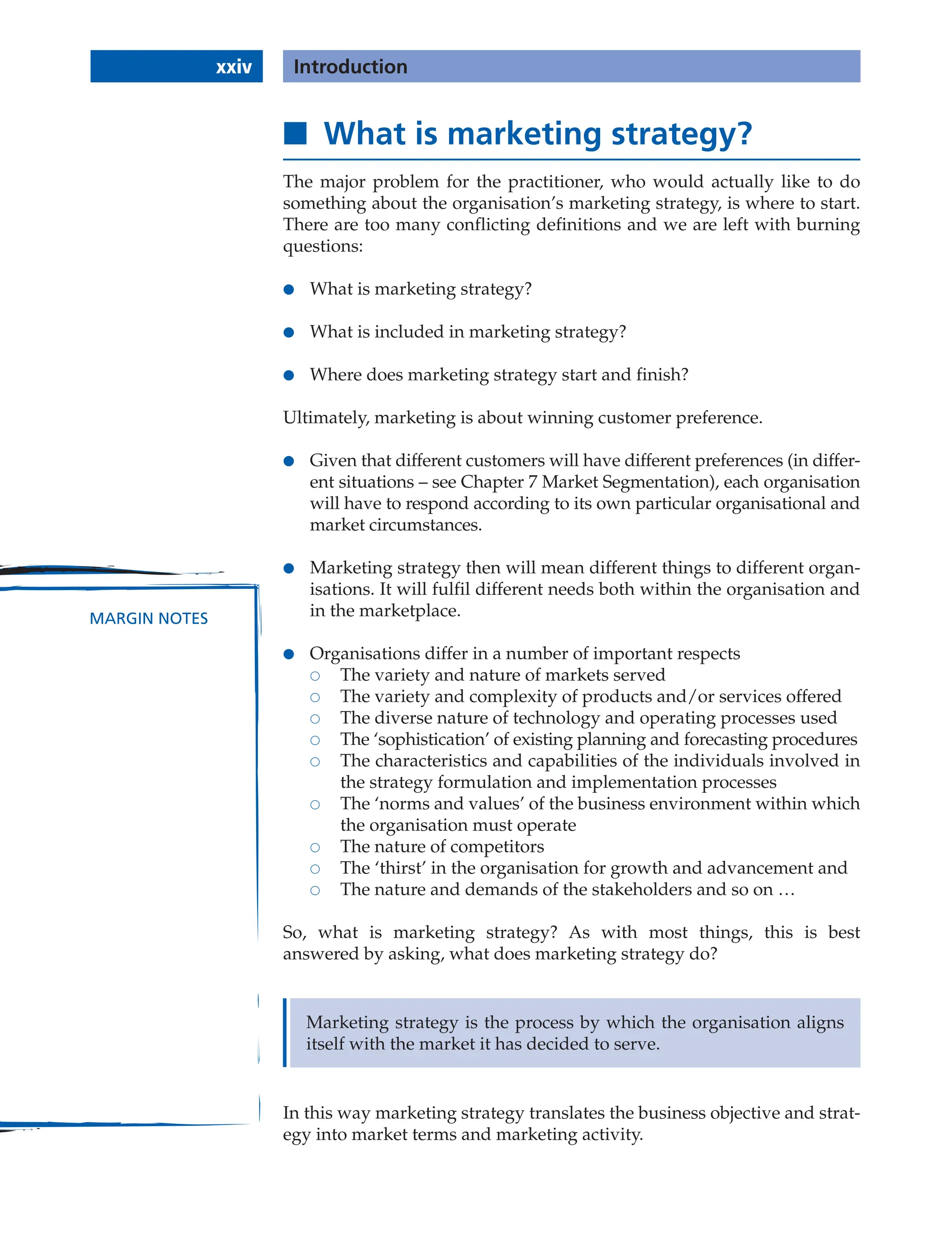
There will be ample opportunity for you to complicate the issues later
on, but for the moment I offer you a simple (but accurate) definition of
these important terms:
Objective Strategy Tactics
‘The goal, aim to which all the
resources of the business are
directed’
‘The means of achieving the
objective’
‘Manoeuvres on the field of
battle’
This means that objectives
are about things we want to
achieve – not about how we
should achieve them.
This means that strategies are
concerned with how we achieve
the objectives, and action.
Tactics are driven by(in
order):
1 The strategy
2 The realities of the
battleground/marketplace
Objectives should always start
with the word ‘To …’
Strategies should always start
with the word ‘By …’
A big, important tactics does
not become a strategy
And, the strategy ‘headlines’:
● Strategy is longer term;
 Since strategy is about marshalling the gross resources of the
organisation to match the needs of the marketplace and achieve
the business objective, this cannot be a short-term activity.
● Strategy is not changed every Friday;
 Constant change produces uncertainty, confusion, misdirection
and wastage – not results.
● Strategy is not another word for important tactics
● Strategy is not top management’s secret
 Top management can decide the strategy on their own (it is nor-
mally safer by far that they involve others in the process too) but
they cannot implement it alone.
● Strategy is not just a public relations exercise
 It must be capable of implementation.
● Strategy is based on analysis and understanding, not straws in the wind
 We will need to understand why things are happening as well as
just knowing what is happening.
● Strategy is essential to an organisation’s survival
 If you don’t know where you are going, then any road will take
you there.
xxiii
Introduction
MARGIN NOTES
xxiv Introduction
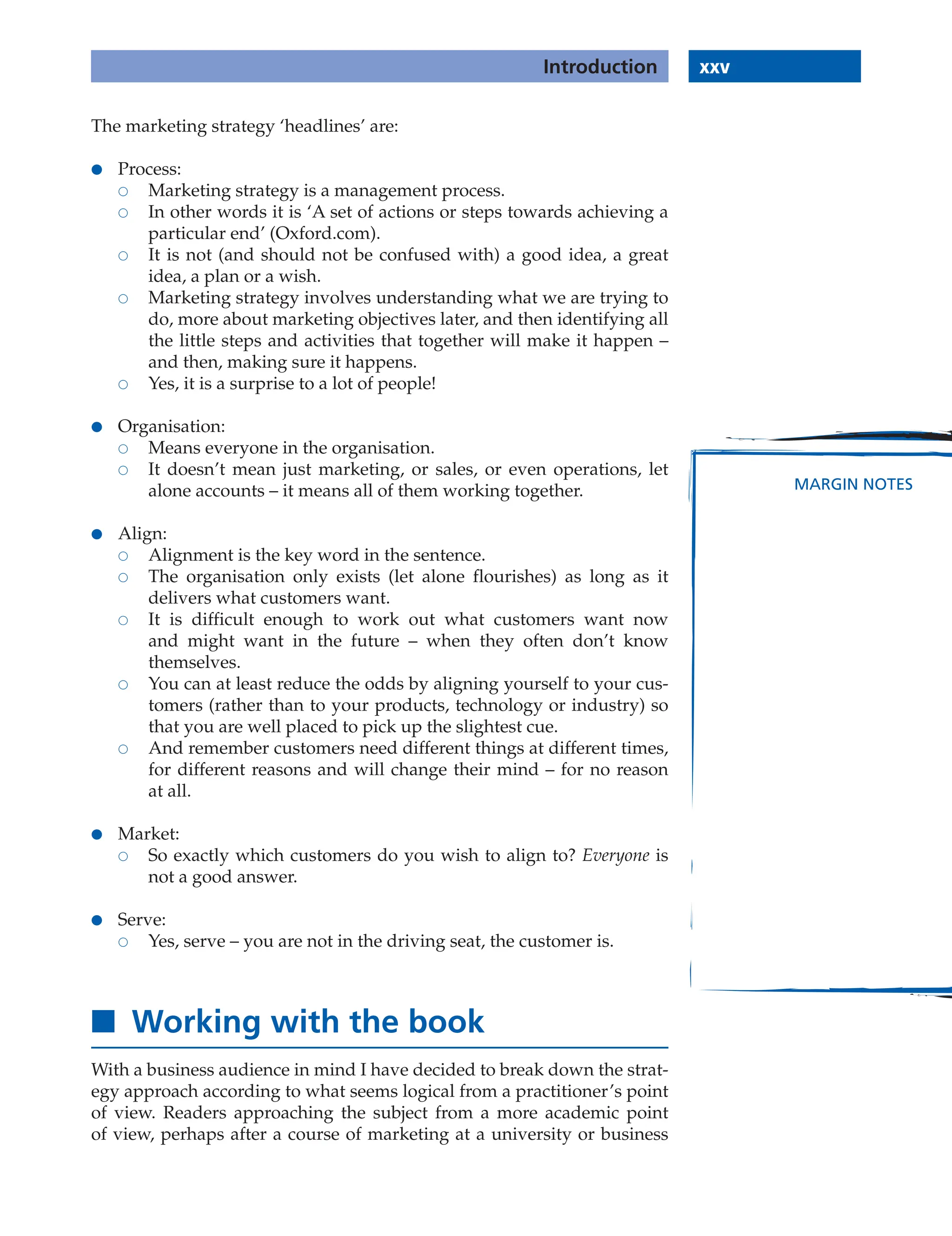
Marketing strategy is the process by which the organisation aligns
itself with the market it has decided to serve.
■ What is marketing strategy?
The major problem for the practitioner, who would actually like to do
something about the organisation’s marketing strategy, is where to start.
There are too many conflicting definitions and we are left with burning
questions:
● What is marketing strategy?
● What is included in marketing strategy?
● Where does marketing strategy start and finish?
Ultimately, marketing is about winning customer preference.
● Given that different customers will have different preferences (in differ-
ent situations – see Chapter 7 Market Segmentation), each organisation
will have to respond according to its own particular organisational and
market circumstances.
● Marketing strategy then will mean different things to different organ-
isations. It will fulfil different needs both within the organisation and
in the marketplace.
● Organisations differ in a number of important respects
 The variety and nature of markets served
 The variety and complexity of products and/or services offered
 The diverse nature of technology and operating processes used
 The ‘sophistication’ of existing planning and forecasting procedures
 The characteristics and capabilities of the individuals involved in
the strategy formulation and implementation processes
 The ‘norms and values’ of the business environment within which
the organisation must operate
 The nature of competitors
 The ‘thirst’ in the organisation for growth and advancement and
 The nature and demands of the stakeholders and so on …
So, what is marketing strategy? As with most things, this is best
answered by asking, what does marketing strategy do?
MARGIN NOTES
In this way marketing strategy translates the business objective and strat-
egy into market terms and marketing activity.
xxv
Introduction
MARGIN NOTES
The marketing strategy ‘headlines’ are:
● Process:
 Marketing strategy is a management process.
 In other words it is ‘A set of actions or steps towards achieving a
particular end’ (Oxford.com).
 It is not (and should not be confused with) a good idea, a great
idea, a plan or a wish.
 Marketing strategy involves understanding what we are trying to
do, more about marketing objectives later, and then identifying all
the little steps and activities that together will make it happen –
and then, making sure it happens.
 Yes, it is a surprise to a lot of people!
● Organisation:
 Means everyone in the organisation.
 It doesn’t mean just marketing, or sales, or even operations, let
alone accounts – it means all of them working together.
● Align:
 Alignment is the key word in the sentence.
 The organisation only exists (let alone flourishes) as long as it
delivers what customers want.
 It is difficult enough to work out what customers want now
and might want in the future – when they often don’t know
themselves.
 You can at least reduce the odds by aligning yourself to your cus-
tomers (rather than to your products, technology or industry) so
that you are well placed to pick up the slightest cue.
 And remember customers need different things at different times,
for different reasons and will change their mind – for no reason
at all.
● Market:
 So exactly which customers do you wish to align to? Everyone is
not a good answer.
● Serve:
 Yes, serve – you are not in the driving seat, the customer is.
■ Working with the book
With a business audience in mind I have decided to break down the strat-
egy approach according to what seems logical from a practitioner’s point
of view. Readers approaching the subject from a more academic point
of view, perhaps after a course of marketing at a university or business
xxvi Introduction
MARGIN NOTES
school, may find parts of the process unusual. If so, the companion book
‘Marketing Strategy’ 3rd edition (Butterworth Heinemann, 2007) will be
a more useful read.
Consequently, I have opted for the ‘bullet list’ approach that you are told
not to use in proper books – but it does make understanding easier. So be
ready for:
● Bullets
● Input
● Some answers to questions I am always asked
● Questions you must focus on
● Checklists to measure your progress.
The 100 Questions:
What are the 100
Marketing Strategy
questions we must
answer?
A practical book for a practitioner audience needs to be driven by con-
sidered action, not just thinking. To that end, I have structured the entire
book around a series of 100 questions that you will need to answer if you
hope to create a workable marketing strategy for your organisation. The
questions drive all of the chapters and sections of the book and are also
included in their own section in the appendix, where they can be used as
a checklist.
All the questions must be asked, although not every question will need to
be answered – different organisations will have different priorities.
To make the approach of this book as practical and as accessible as pos-
sible for everybody, whether from a traditional educational route or
completely ignorant of the popular ‘theories’ that dominate today’s mar-
keting teaching, the book will follow the four-step approach to strategy:
● Part One: Preparing for the market strategy
 Before you can hope to develop even the most rudimentary stra-
tegic decisions, a degree of analysis is required.
xxvii
Introduction
MARGIN NOTES
 Marketing may be more art than science but working on gut feel-
ing is not the same thing as working by the seat of the pants.
 We need to:
■ Understand the internal business drivers
 Customers are important, more important than they are
treated in most organisations, true – but the customer is
not all.
 There are essential forces alive in every organisation that
cannot just be ignored.
■ Understand the external environment
 No man (or organisation) is an island – clichéd but true.
 No 21st century organisation, regardless of size and mar-
ket power, can pursue its goals in disregard of the business
environment within which it operates.
■ Understand (or develop) the business strategy
 While Harvard’s Michael Porter’s books adorn countless
thousands of influential bookshelves, developing business
strategy now seems to be no easier than it ever was.
■ Develop the marketing objectives
 So exactly what are you planning to do over the next few
years?
 Wait and see what turns up?
 Wait and see what the market throws at you?
 Or, take some control …?
● Part Two: Developing the marketing strategy (SCORPIO)
 This, the main part of the book, covers the various elements of
market strategy.
 I have been careful to separate marketing strategy from tactics,
a common fault in too many businesses, and have concentrated
on the critical influence of the market on the organisation’s
activity.
 This section looks at:
■ S: Segmentation and targeting – what are the segments in the
marketplace and which ones should we own?
■ C: The Customer – who are our customers and what do they
want from us?
■ O: Offerings – what is our unique offer to the customer?
■ R: Retention – what are we doing to plan that our customers
come back to us?
■ P: Positioning and branding – how are we ‘unique’ and what
brand values do we support?
■ I: Industry or market thinking – do we describe our business
in industry terms or in customer terms?
■ O: Organisation – what do we do to ensure we have the
organisation structure and processes that will support a
customer approach?
xxviii Introduction
MARGIN NOTES
● Part Three: Co-ordination SCORPIO
 Backbone strategy
 Defensive strategy
 Offensive strategy
● Part Four: From market strategy to tactics
 The main aim of this part is to demonstrate the relationship
between market strategy and tactics and the whole area of stra-
tegic implementation.
 Finally, we will look at the minimum list of marketing issues that
you must control if you want the organisation to implement any-
thing close to what you intended.
Enjoy
Preparing for
the marketing
strategy
PART I
2 Marketing Strategy Masterclass
This is where we start asking the questions …
Over the years, I have found that having the right question is normally
much more effective than trying to come up with an answer that will
work in every organisation or business in every market – answers like
that just do not exist.
Questions, on the other hand, can stimulate thinking in ways that can
defy standard ‘industry’ logic and ‘conventional wisdom’ – both enemies
to good marketing/customer strategy.
The format for the rest of the book is simple; I pose the question, and
then I try to explain what issues, data and concepts you ought to bear
in mind when looking for an answer that works for your organisation.
Of course, not every question will be relevant to your specific organisa-
tion, market target customers or product/service. But, before you jump
over a question that ‘isn’t relevant’, make sure that you aren’t just falling
into the trap of ‘group think’ and conforming to industry and technical/
professional unthinking ‘truths’. Customers like clearly different offer-
ings and to create these you just might have to spend some time on those
irrelevant questions.
Finally, even in a book of this size I can’t be definitive, nor can I cover all
eventualities and all types of market and organisation – but I can try!
‘Chance favours only the prepared mind’
Louis Pasteur (1822–1895),
French chemist
CHAPTER 1
The internal
business drivers
4 Marketing Strategy Masterclass
MARGIN NOTES
Marketing and business strategy, if they are to be practical, must be
based on an assessment of reality not on hopes or wishful thinking. The
successful practitioner/operator/manager is one whose plans work in
the only arena that counts – the marketplace. Plans that are based on
hopes, inaccurate analysis, or worse, no analysis at all cannot expect to
withstand the onslaught of determined competition.
The common thread that binds all these business drivers together is peo-
ple. Apart from the (all-important) customer, there are other people who
also have demands on the business. Like customers, these people expect
their needs to be met. Failure to do so may not mean the failure of the
enterprise but will certainly mean the failure of the marketing strategy.
So, who are these other people?
Question 1
What do our
shareholders
require from us?
Shareholders are the people who own the business or organisation:
● In theory, the relationship here is very simple.
 The investors in the organisation invest in anticipation of a return
on their capital; they are, in fact and in deed, the owners of the
business.
 As owners the investors employ the board to manage the busi-
ness on their behalf and, should the returns not meet their expect-
ations, the investors (as owners) have the power to remove part
or all of the board and replace it with other directors.
‘Drive thy business, let not that drive thee.’
Benjamin Franklin (1706–1790),
American Statesman, Scientist,
Philosopher, Printer, Writer and Inventor
5
The Internal Business Drivers
MARGIN NOTES
● In practice, the relationship is far more complicated; there are invest-
ors and investors.
 In a publicly quoted company the stockholders may be institu-
tions such as insurance companies or pension funds, there may be
private individuals and there may also be other publicly quoted
companies holding stock.
 Also, stockholders may be primarily national or international in
character. It also follows that different investors may have differ-
ent needs.
 Some may be investing for the long term, some for the short
term. Some may require no income – seeking a long-term increase
in the capital value of their stockholding, others may be far less
interested in capital growth but more concerned to secure a regu-
lar income stream from the investment, normally in the form of
dividends.
 Yet others may require a mixture of both capital growth and
income.
 The organisation might also be a smaller part of a larger organisa-
tion – in this instance there is but one owner.
 In the case of the private company the director or directors may
also be the owners, and then the returns required may be for a
steady or rising income stream over the longer-term or for
shorter-term capital accumulation.
● The past 10 years has also shown that (at least some) investors are
willing to exercise their legal rights and take directors to task.
 There have been some lively annual general meetings where
small shareholders have taken the ‘fat cat’ directors to task over
salaries and incentive schemes that seem to pay out even when
sales and profits are in decline.
 Large institutional investors are also flexing their muscles more
and are becoming important players in underperforming organ-
isations when it comes time to re-elect directors or even deal with
potential take-over bids.
 In each case, it is the board’s strategy that is being assessed, not
the directors themselves.
● Apart from the share or stock capital there is also long-term debt
financing normally provided by major institutions such as banks and,
more recently, venture capital (VC) companies.
 The various banks are also the products of their own internal
organisational culture as well as the national culture from which
the organisation operates.
 The different banks’ views will also differ as to what is long and
what is short term.
 Venture capitalists work on a different basis and exist (unlike the
banks) to invest in ‘risk’.
6 Marketing Strategy Masterclass
MARGIN NOTES
 The dot.com escapade showed the power (if not the wisdom) of
the VCs and their willingness to take on all types of ‘risk’.
 Nowadays VCs (the ones that survived the dot.com bust) are a lit-
tle more careful but still often expect only one investment in five
to pay off – which explains why they can look for 35% per annum
return on all their investments.
Action
● The marketing strategy needs to produce the ‘right’ value for the
organisation.
● You will need to understand the makeup of the ownership structure
of the organisation as precisely as possible.
● You, or the person responsibility for the strategy, will only be allowed
freedom to direct as long as the investor is getting what he or she
wants/expects.
● Such expectations may include:
 A return on capital invested
 Employment
 Global market share
 Environmental/social returns, etc.
● And all these are likely to change with political climates and changes
in government (or government policy) over time.
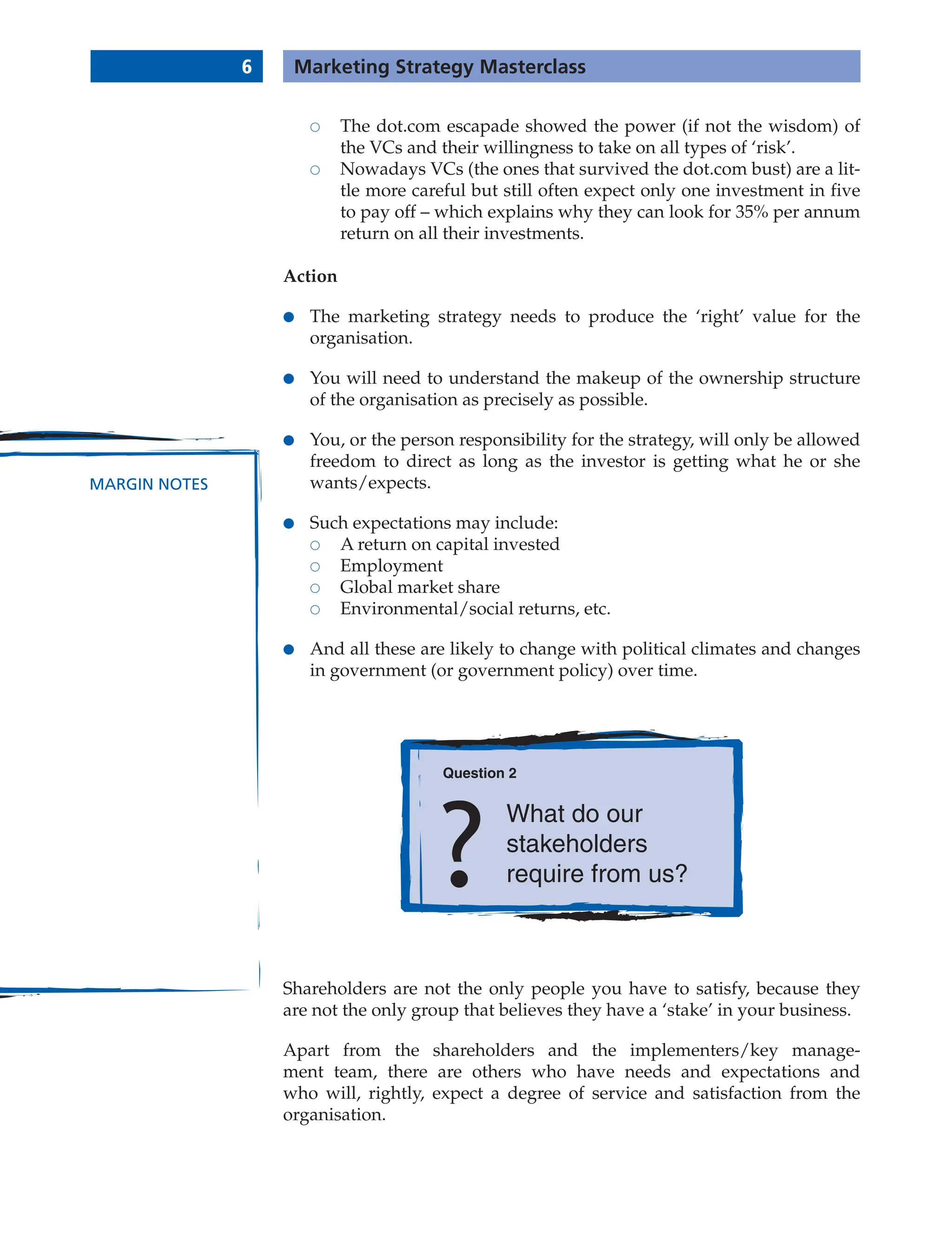
Question 2
What do our
stakeholders
require from us?
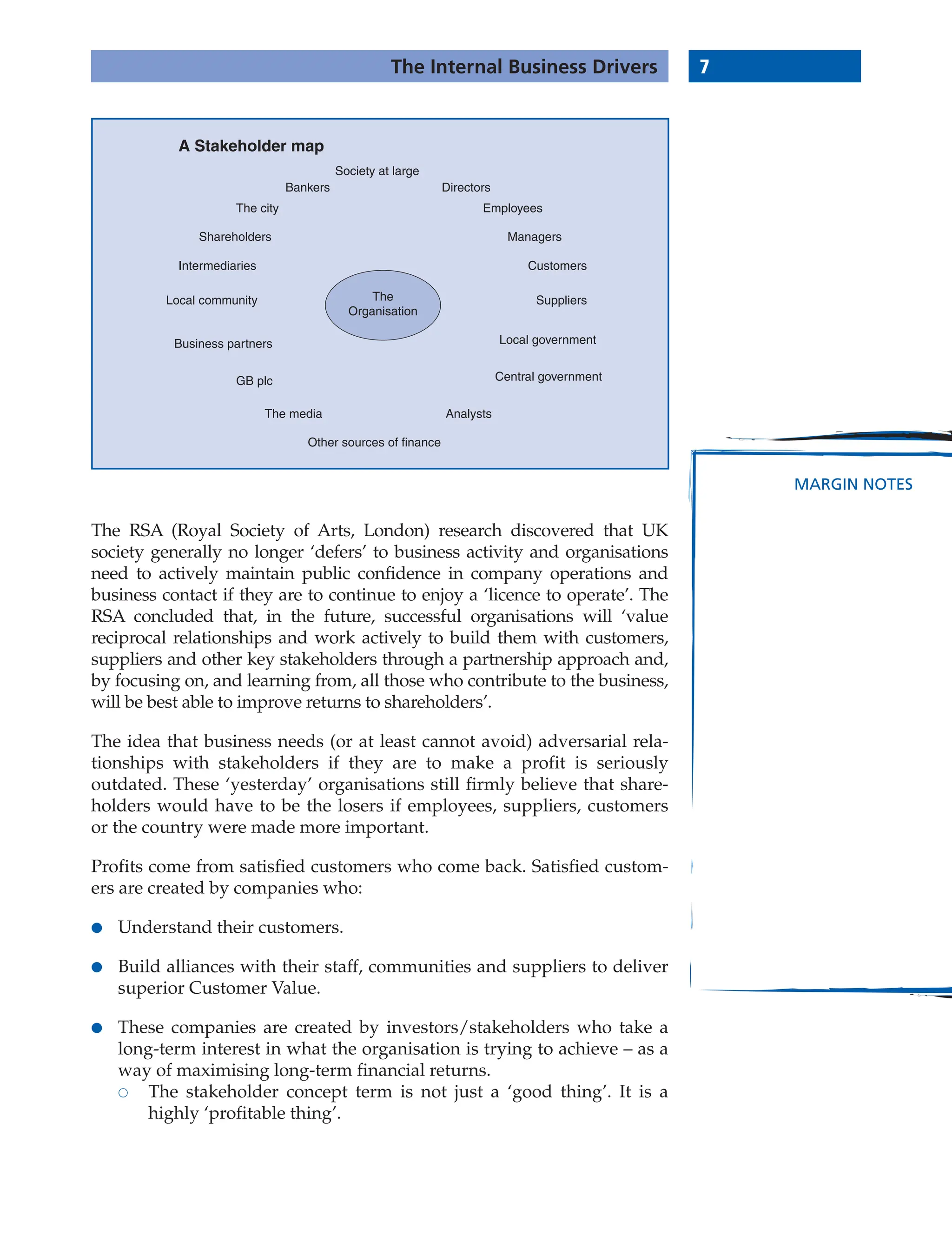
Shareholders are not the only people you have to satisfy, because they
are not the only group that believes they have a ‘stake’ in your business.
Apart from the shareholders and the implementers/key manage-
ment team, there are others who have needs and expectations and
who will, rightly, expect a degree of service and satisfaction from the
organisation.
7
The Internal Business Drivers
MARGIN NOTES
The RSA (Royal Society of Arts, London) research discovered that UK
society generally no longer ‘defers’ to business activity and organisations
need to actively maintain public confidence in company operations and
business contact if they are to continue to enjoy a ‘licence to operate’. The
RSA concluded that, in the future, successful organisations will ‘value
reciprocal relationships and work actively to build them with customers,
suppliers and other key stakeholders through a partnership approach and,
by focusing on, and learning from, all those who contribute to the business,
will be best able to improve returns to shareholders’.
The idea that business needs (or at least cannot avoid) adversarial rela-
tionships with stakeholders if they are to make a profit is seriously
outdated. These ‘yesterday’ organisations still firmly believe that share-
holders would have to be the losers if employees, suppliers, customers
or the country were made more important.
Profits come from satisfied customers who come back. Satisfied custom-
ers are created by companies who:
● Understand their customers.
● Build alliances with their staff, communities and suppliers to deliver
superior Customer Value.
● These companies are created by investors/stakeholders who take a
long-term interest in what the organisation is trying to achieve – as a
way of maximising long-term financial returns.
 The stakeholder concept term is not just a ‘good thing’. It is a
highly ‘profitable thing’.
A Stakeholder map
Shareholders
Bankers Directors
Customers
Employees
Central government
Local government
The media
Business partners
Intermediaries
GB plc
Local community
The city
Analysts
Suppliers
The
Organisation
Other sources of finance
Society at large
Managers
8 Marketing Strategy Masterclass
MARGIN NOTES
 The days of viewing stakeholders as just innocent bystanders is
probably gone.
Action
● Identify your stakeholders (all of them).
● Even the ones who are not ‘active’.
● Identify exactly what you get from your stakeholders and what con-
tribution they make to satisfying your customers (like how would
you manage of they turned against you).
● Talk to them and find out what they expect from you:
 What do they want?
 What must they have?
 What would they be surprised/delighted of they received?
● Carry out a cost/benefit analysis of what more you could give them –
and what you would get for it.
Question 3
Who are the key
implementers in the
organisation and what
are their personal values
and requirements?
The term ‘key implementers’ refers to that select group or body in an
organisation who actually make the decisions and who are central to
what the organisation does. It may or may not include the board in its
entirety. It may mean the board, it may mean the board plus a number
of very senior managers, it may just mean the owner/managing director
and a special friend or colleague, or it may mean the chairman and part
of the board. It may include the owner/chairman’s wife/children/fam-
ily. In any event these are the people who really count:
● The key implementers, individually or probably as a group, will have
a very clear idea of what type of organisation they wish to work for,
what type of organisation they wish to create, the types of products
and services they wish to market, the types of customers they wish to
serve and the types of businesses they wish to be in.
9
The Internal Business Drivers
MARGIN NOTES
● At the same time they will also have a very clear idea of what busi-
nesses and activities they and their organisation will not be involved in.
 It is, if you like, a kind of moral and ethical ‘personal ambition
blueprint’ against which all possible strategic alternatives will be
assessed.
 If a possible strategy contravenes the personal values of this
group it will of course be countered with non-emotional argu-
ments based on good business practice – but it will be countered,
and strongly and then rejected.
 Some organisations (and key implementers) would rather die
than change what they are and what they believe in – this is
human nature and we should accept it.
Human nature is just like that. And there’s no way that we are going to
change human nature. The most profitable route for you and the organ-
isation is not to beat them but to join them. A strong market influence
within the key implementers can do nothing but good.
Action
● The lesson is clear – even when the strategy and the strategic approach
seem to be ‘by the book’, you must talk to and understand the key
implementers and the social system to which they belong.
● Implementation is more important than the plans. Implementation
has to fit what the organisation is.
● The first thing to do is to start sharing your experience and insights
with others.
 Show how marketing is just really common sense, it’s not black
magic nor does it have to be a threat to any of the longer estab-
lished functions in the organisation.
 Try to demonstrate that customers are important to the vision thing.
 If the key implementers hold fast to a vision that’s great. If cus-
tomers could share that vision just imagine what we could do
together.
Question 4
How should we
best describe
their/our
strategic intent?
10 Marketing Strategy Masterclass
MARGIN NOTES
Two professors (Hamel and Prahaled) spoke about what they called
‘Strategic Intent’ in a 1989 edition of The Harvard Business Review. They
argued (before the Japanese bubble burst) that Western companies focus
on trimming their ambitions to match resources and, as a result, search
only for advantages they can sustain. By contrast, Japanese companies
leverage resources by accelerating the pace of organisational learning
and try to attain seemingly impossible goals.
● The idea is simple.
● Don’t be resources driven.
● Be market/customer driven and work out what you want to do.
 And then find the resources to do it.
For good or for bad, this concept of strategic intent has been watered down,
hijacked and generally messed around with so that nowadays it really
means that a company exhibits strategic intent when it relentlessly pursues
a certain long-term strategic objective and concentrates its strategic actions
on achieving that objective. Put the words strategic intent into Google and
see how many brave and stirring (if unbelievable) statements appear.
Action
● Find out what appears to me the driving concept behind your com-
pany/business (remember it might not be written down).
● Ask people what it is that drives them and their thinking (remember
that they might not tell the whole truth, especially of it is a Western or
UK company and most of the managers are male and the motivation
is emotional).
● Don’t just believe what you hear or read – understand what you see.
● Go back to the history of the organisation.
● Understand how you can use the strategic intent to fuel your market-
ing strategy
Question 5
Out of these various
factors do we have a
clear statement or
understanding of the
corporate/business
mission?
11
The Internal Business Drivers
MARGIN NOTES
What seems to drive the organisation? Mission (statements) can give us
another clue as can the leadership style of the organisation. The mission
should bring together the apparently diverse groups that we have dis-
cussed above and give overall direction.
● But what is a mission (statement)?
 At its simplest level, the mission is a statement of the core values
of the organisation and as such is a framework within which staff
and individual business units, divisions or activities prepare their
plans.
 It should be constructed in such a way that it satisfies and can be
subscribed to by the most important groups of people who have
expectations from the organisation.
 It is not the same thing as a business objective.
 Missions are non-specific and are difficult to achieve cleanly on
their own.
 A business objective, by contrast, should be both measurable and
achievable and is normally expressed in quantitative terms.
● A more important question is what does the mission statement actu-
ally do?
 This will influence its content.
 Above all else, the mission statement should do as its name
implies, it should give the organisation a clear mission or purpose.
 It should give all people connected with the organisation a clear
sense of where the organisation is headed.
 If the mission statement is sufficiently motivating, then every-
body should share a sense of direction, opportunities, significance
and ultimately, achievement.
Action
● Search the paperwork for recent mission statements and other declar-
ations of purpose.
● Match these with behaviours that are:
 Overt
 Rewarded by the organisation
 Rewarded by the market (customers).
● Are you going in the right direction?
● Is your strategy right for the market?
● Is your strategy going to meet any resistance?
● What are you going to do about it?
12 Marketing Strategy Masterclass
MARGIN NOTES
It all seems to come down to money in the end doesn’t it?
By the long-term financial objective we don’t mean all the annual, quar-
terly or monthly financial targets that abound in any sizeable organisa-
tion and act primarily as control systems against planned targets.
● The long-term financial objective is that requirement placed on the
organisation, specifically on the board of directors, by the individuals
and institutions who have invested in the organisation in the expect-
ation of a financial return.
 Not being too delicate, this is what you have to achieve if every-
body is to keep their jobs.
 In short, the financial objective is a hurdle to be overcome.
● By translating business performance into numbers we have a conveni-
ent means by which the investors/owners, who have no day-to-day
involvement in the running of the organisation, may understand how
their appointed managers have performed over the past period.
 While it also gives us a fairly good indication of what we must
achieve in future periods, it provides absolutely no indication
at all of how to achieve these future results or how to run the
business.
● The long-term financial objective acts extremely well – as a financial
objective.
 Being a narrow measure it cannot be used as a surrogate business
objective as it lacks the breadth to be an efficient driver of the
business, and the people in it.
 There is more (much more) to running a successful business and
developing a competitive marketing strategy than the long-term
financial objective, but more of that later.
Question 6
What (therefore) is the
long-term financial
objective that the
organisation is
dedicated to achieving?
13
The Internal Business Drivers
MARGIN NOTES
Action
● We must understand who the investors in the organisation are.
● What do they want.
● How (not whether) can we deliver what they want – then, if we are
lucky, we are all left a degree of liberty to run the business.
Question 7
What are the
Financial
Hurdles?
Well, it all comes down to money …
Every organisation has one or more ‘financial imperatives’ that it must
satisfy to remain in business. These are not the same as objectives. These
‘hurdles’ just need to be seen, measured and jumped. They should not
guide the destiny of the organisation.
● Yes, I know – and the Finance Director shouts a lot and everybody
else does seem to accept that x% increase in return on investment
(ROI) is a normal ‘business objective’ but that does not make it right.
● Financial targets are just hurdles that we have to jump – but that
changes nothing.
 To make more money, we need to focus, not on money but on the
business/customer purpose that makes it possible.
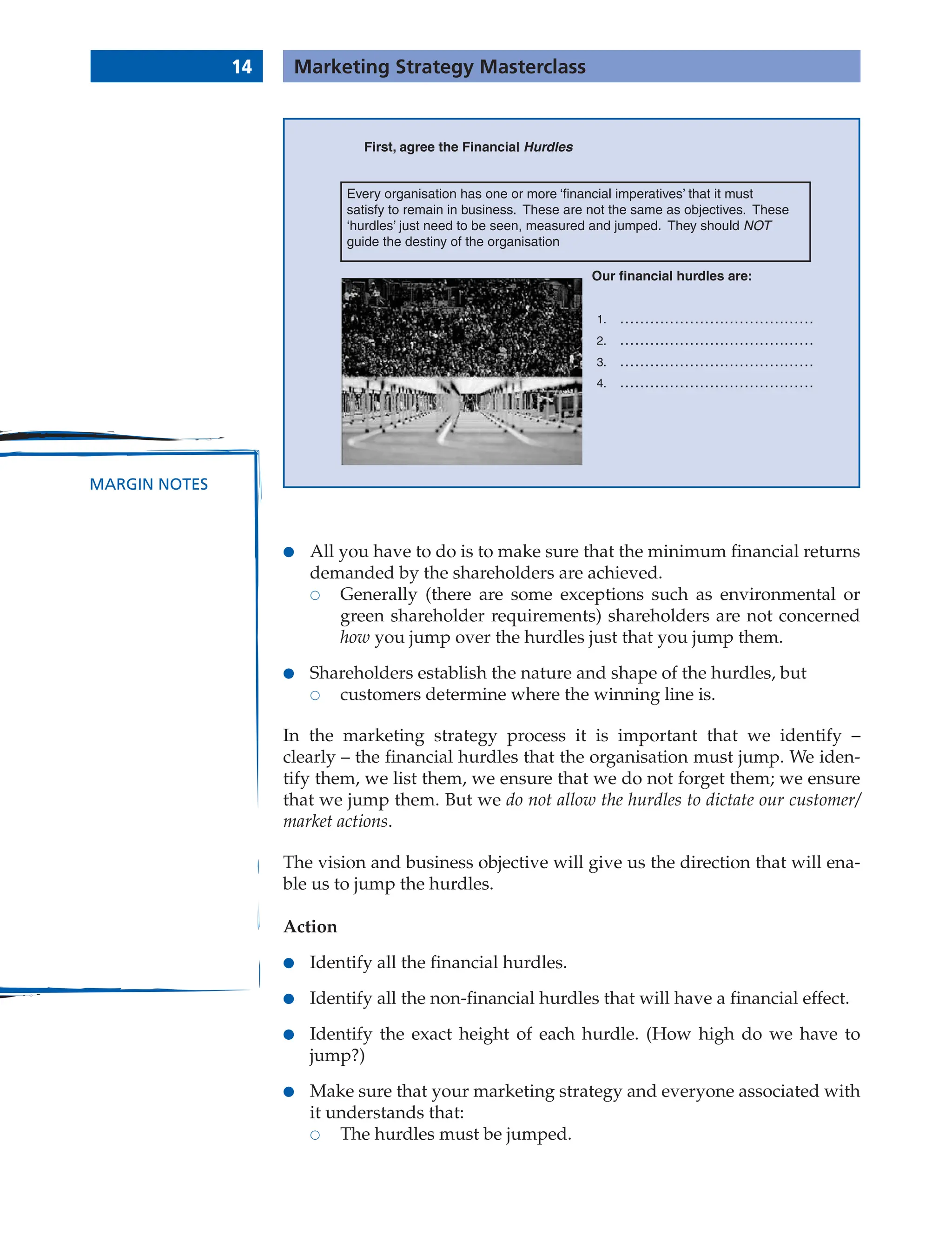
● The use of the word ‘hurdle’ is deliberate.
 You remember the hurdles race at school or the Olympics? Well,
you must also remember who the winner is.
 The first one over the end line wins.
■ The hurdles are just things in the way that you have to jump
over to get to the winning post.
■ There are no prizes for how neatly the hurdles are jumped,
or how high, or how fast or even how many are touched or
knocked down.
■ All this is irrelevant.
■ So it is with financial hurdles.
14 Marketing Strategy Masterclass
MARGIN NOTES
● All you have to do is to make sure that the minimum financial returns
demanded by the shareholders are achieved.
 Generally (there are some exceptions such as environmental or
green shareholder requirements) shareholders are not concerned
how you jump over the hurdles just that you jump them.
● Shareholders establish the nature and shape of the hurdles, but
 customers determine where the winning line is.
In the marketing strategy process it is important that we identify –
clearly – the financial hurdles that the organisation must jump. We iden-
tify them, we list them, we ensure that we do not forget them; we ensure
that we jump them. But we do not allow the hurdles to dictate our customer/
market actions.
The vision and business objective will give us the direction that will ena-
ble us to jump the hurdles.
Action
● Identify all the financial hurdles.
● Identify all the non-financial hurdles that will have a financial effect.
● Identify the exact height of each hurdle. (How high do we have to
jump?)
● Make sure that your marketing strategy and everyone associated with
it understands that:
 The hurdles must be jumped.
First, agree the Financial Hurdles
Our financial hurdles are:
1.
2.
3.
4.
Every organisation has one or more ‘financial imperatives’ that it must
satisfy to remain in business. These are not the same as objectives. These
‘hurdles’ just need to be seen, measured and jumped. They should NOT
guide the destiny of the organisation
15
The Internal Business Drivers
MARGIN NOTES
 The hurdles need not be exceeded.
 Jumping the hurdles is not enough to win the race.
More definitions, more words and more uncertainty: visions, missions,
objectives, where will it end?
The Purpose of Business:
‘To Create, and keep a customer’
Question 8
What is the Vision
of the organisation?
What should it be?
Definitions vary but for our purposes:
● Mission is a statement of the organisation/business values (how it
likes to do business).
 Nice but arguably not essential.
● Vision is a clear(ish) idea of what the organisation/business is going
to be in x years time.
 Important if you want to enthuse people to follow you.
● Objective is a precise (quantified) definition of what the organisation
will achieve by a certain date (depending on the measures chosen).
 Important for investors and bank managers but even quantified
measures have been known to change over time.
● Strategy explains how the objective will be achieved.
Visions are a good thing. They allow emotion to enter business and give
leaders some currency. They also flesh out the story underneath/behind
the boring numbers and give everybody something exciting to belong to.
We are human after all.
But, importantly, the Vision is about much more than the numbers –
because business is about much more than the numbers.
The never-ending debate is all about the purpose of business and the
measures of success, and it gets confusing. Two great business writers
Levitt (Harvard) and Drucker said that:
Which is blindingly obvious really; the more customers we create and
the longer we manage to keep them, the better and bigger the business
gets. So everybody should be focused on creating and keeping custom-
ers, and their jobs defined in these terms – if only.
● Unfortunately, the picture gets confused when we consider the meas-
ure of success – and (possibly the most) important measure of how
well an organisation achieves this is profitability.
 Financial measures then are a measure of success – not the purpose
of the organisation.
 In fact, people in most (especially larger) organisations appear to be
focused on generating profits, and their jobs defined in these terms.
 This is madness, since few people have any direct effect on profits
or any idea what they should be doing to influence them.
● Profits are not only important; they are vital for survival.
 But, the pursuit of short-term profits for their own sake can
destroy an otherwise successful business.
● Visions are a powerful way of breaking out of the ‘any-good-business-
objective-must-be-in-financial-terms’ dead end.
 A lot has been written about ‘the vision thing’ in recent years,
some good and some laughable.
 The personal values of the key implementers, once combined,
create the vision driving the organisation and so what has been
called the ‘strategic intent’ behind the group.
 This vision, sometimes written, more often than not implicit and
mutually understood, needs to be clarified and defined before
taking the process any further.
 The vision is often central to the organisation’s success.
 The Vision is not the same as an objective since it is not normally
quantified.
 Rather it is a picture of what the future of the organisation looks
like.
 Vision enables the organisation to set a broad strategic direction and
leaves the details of its implementation to be worked out later.
 In the absence of a clear vision (articulated or not) the organisa-
tion will probably be in trouble and without some light to guide
it the organisation will flounder aimlessly.
 Having said this, organisations without a vision are really
quite rare.
 The vision may be unclear, ragged around the edges, or even
rather too emotional for senior managers to admit to – but it is
normally there.
 It is often better to dig deep to find what makes people come into
work in the mornings than to go through the (often pointless)
exercise of trying to create a vision from scratch, what people
are happy to put down on paper may not be what they are really
willing to fight for.
16 Marketing Strategy Masterclass
MARGIN NOTES
Another Random Scribd Document
with Unrelated Content
THE KARENS
The Karens found their way in Burma from western China; forced
southward by the Chinese. Then when the Shans were in like
manner driven into Burma, the Karens were pushed on still further
south, like driftwood before the tide. Their original home is
uncertain. It seems evident that at a much earlier period they had
migrated into western China from some place still further north. One
of their own traditions is that their ancestors, in their wanderings,
crossed a river of sand.
The desert of Gobi best answers to their tradition. Other traditions
point to western China as their early home. It is not unlikely that the
tradition of the river of sand is much the older, and these traditions
taken together mark the progress of the Karens in at least two
widely separated migrations southward. The Karens strongly
resemble certain hill-tribes now living in western China; in fact some
of the Karens have identically the same customs, as these China hill-
tribes, who are also said to have the tradition of a river of sand.
There are three main divisions of the Karens, known as Pwo, Sgaw,
and Karennee or Red Karens. This threefold division antedates
their migration to Burma. The Pwos, sometimes called the mother
race, are supposed to have been the first arrivals, working their way
south by the way of the valleys of the Salwen and Mekong Rivers;
followed by the Sgaws, and finally by the Karennees, though it is
doubtful whether there was any interval between these main
divisions in the general migration. But in some way they have—to
this day—maintained the distinction. It is probable that for a time
the Karens held the territory now known as the eastern Shan states,
and all the upper Salwen region. The coming of the Shans, whether
from the north or west, drove them southward, each of these tribal
divisions advancing under compulsion in the same order in which
they first entered the country.
The Pwos are now found in the delta and still farther south in the
Maulmain district; the Karennees farther north, bordering on the
Shan country, and east to the Siam border; the Sgaws keeping to
the central territory, in the Toungoo district and diagonally across to
Bassein, sharing parts of the delta with the Pwos. A large body of
Sgaw Karens, as well as many Pwos, are found in the Tavoy district,
farthest south of all. The Tavoy Karens drifted in from Siam, not
extending to the seacoast until early in the last century.
There is now a continuous chain of Karens from Tavoy far into the
north of Siam. In general, the Karens live in the highlands, the
Burmans occupying the plains. Formerly this was partly from choice,
but unavoidable whether from choice or not, on account of the cruel
oppression suffered at the hands of the more powerful Burmans. But
under British rule many Karens have come down to the plains, and
forming villages of their own, have engaged in cultivation. They still
like to be within easy reach of the mountains, to which they resort
for game and other food.
In the shady ravines they have profitable gardens of betel (areca)
palms, the nut being essential to any native's happiness, and
commanding a ready sale. Some writers have advanced the theory
that the religious traditions of the Karens were derived from their
supposed contact with Nestorian Jews in western China. This can
hardly be true—as it places the migration of the Karens to Burma at
much too late a date.
The Nestorians did not begin their work in western China until 505 a.
d., closing it in 1368, when they were expelled by the Mongols.
It seems certain that the Karens were already in Burma long before
the Nestorian missionaries went to China. (Marco Polo's Roman
Catholic mission-work in western China did not begin until 1271.)
If it is true that the large towns in Shan-land were founded by the
Shans four or five hundred years before the Christian era, the
migration of the Karens must be placed at an even earlier period,—
but that early date is doubtful. The non-Christian Karens are, and
always have been spirit-worshippers. This so-called worship is
limited to propitiatory sacrifice. In this respect they are at one with
all the races of Burma, not excepting the Burman Buddhists, though
the latter have abandoned bloody sacrifice. Before the adoption of
Buddhism the Burmans, Shans and Talaings were spirit-worshippers
pure and simple. Spirit-worshippers they still are, with the forms of
Buddhism for a veneering.
But the Karens have many religious traditions, so closely following
the Bible accounts of the creation, fall, flood, and other events as to
furnish strong evidence that in bygone ages their ancestors
somewhere were in touch with the people of God. In spite of their
spirit-worship they have retained a belief in a Supreme Being, and
long looked forward to the time when God's Word, which they had
lost, should be restored to them. God was believed to be a
benevolent Being, but so far away that he had nothing to do with
men. All spirits were believed to be evil, vengeful and near at hand.
Therefore the Supreme Being was left out of their worship, and
sacrifices offered to propitiate evil spirits who might work harm to
them, by causing sickness, destruction of crops, and many other
possible misfortunes. The Karens contend that in making offerings to
the evil spirits they were not showing disloyalty to the Supreme
Being. They illustrate their position by the following story: Some
children left in a place of supposed safety by their parents, were so
frightened by the approach of a tiger that they threw down the cliff
some pigs that had taken refuge with them. Their eyes, however,
were not fixed on the tiger, but on the path by which they expected
their father to come. Their hands fed the tiger from fear, but their
ears were eagerly listening for the twang of their father's bowstring,
which should send the arrow quivering into the tiger's heart. And
so, although we have to make sacrifices to demons, our hearts are
still true to God. We must throw sops to the demons who afflict us,
but our hearts were looking for God.
The history of the Karens in Burma has been a sad one. For
centuries they had been grievously oppressed by the Burmans, who
robbed them, carried away captives into slavery, and kept the Karens
pent up in the most inaccessible parts of the mountain ranges.
Under British rule the Karens are safe from serious molestation, but
the old feeling still remains, and they hold aloof from the Burman as
much as possible. The coming of the Christian missionary, restoring
to them the knowledge of the true God so vaguely known through
their traditions, was the great event to which the whole Karen nation
had so long looked forward. Multitudes readily accepted Christianity.
By its power they were emancipated from the domination of evil
spirits; the swords and spears of tribal feuds were forged into
pruning hooks; and the whole Christian world rejoiced in the glorious
spectacle of A nation in a day. The census of 1901 gives a total of
nearly 714,000 Karens, of all tribes. Many more are found in Siam. It
has been asserted that more languages are spoken in Assam than
in any other country in the world. The same may be said of Burma.
The recent census recognized fifty-seven indigenous races or tribes,
and as many more non-indigenous. In the Toungoo district the
missionaries meet with several Karen dialects not mentioned in the
census enumeration, but so distinct that one tribe does not
understand the dialect of another.
In some localities one meets with a new dialect in each village
through which he passes in a day's journey. Ye shades of Shinar!
confusion of tongues,—twice confounded. It seems incredible that so
many families of one race, occupying the same territory, and with
practically the same habits, customs, and superstitions,—should
each perpetuate for centuries its own peculiar dialect and clannish
exclusiveness. The missionary or official, to do effective work among
such a people, needs a small army of interpreters at his heels.
THE KACHINS
The Kachins inhabit the extreme northern part of Burma, extending
as far south as the Bhamo and Namkham districts, and east into
China. The Kachins are own cousins to the Nagas of the adjacent hill
tract of Assam, who call themselves Singpho. Kachin is a name
applied to these people by the Burmans. The Kachins of Burma call
themselves Chingpaw. This quite suits their kinsmen of Assam,
who look down upon the Chingpaws as unworthy the grand name of
Singpho. Both terms seem to mean men,—but men in distinction
from the inferior races around them. The census of 1901 gives a
total of 65,510 Kachins in Burma alone. The early missionaries held
that the Kachins and Karens were of the same origin; that the
Kachins were really Karens, from whom the southern Karens had
become separated. This view seemed substantiated by the people
themselves; by some of their customs,—such as the manner in
which their houses are constructed and partitioned off; by a certain
similarity of language—many common nouns said to be common to
both languages, and by their spirit-worship. It is now generally
admitted that the Kachins and Karens are not of the same origin. In
bygone ages they may have been neighbours, if not more closely
related,—in the borders of Tartary,—but at a very remote period.
Certainly they did not migrate to Burma at the same time, nor by the
same route. The Kachins have traditions that they migrated to
Burma by way of the headwaters of the Irrawadi,—that their primal
ancestor lived at Majoi Shingra Pum. In his Handbook of the
Kachin Language, H. F. Hertz says: I have succeeded in obtaining
the views of several old men, Tumsas and Faiwas, who might be
described as Kachin priests. It would seem from these that 'Majoi
Shingra Pum' is a high table-land with very few trees, frequently
covered with snow, and very cold.
Now, the name 'Majoi Shingra Pum,' literally translated is a naturally
flat mountain, or in other words, a plateau, and it does not need any
stretch of the imagination to identify it with some part of eastern
Tibet. Colonel Hannay, writing in 1847, describes tribes residing in
the inaccessible regions bordering on Tartary as closely allied to the
Kachins. This identifies the Kachins more closely with the Burmans
and Chins than with the Karens. Moreover it is said that the Kachin
language has more points in common with the Burmese than with
the Karen. This is especially true of the Marus,—a tribe to the
eastward, allied to the Kachins of Burma. It is not difficult to believe
that all these races, in the very remote past, were neighbours in the
borders of Tibet, and that while the Kachins and Burmese migrated
south direct, the Karens migrating by way of western China,—the
meeting of these races on Burmese soil reveals a few of the many
things they once had in common.
After the Burmans and Chins had migrated to Burma, the Shans,
pressing westward by way of the Namkham valley, blocked the way
of further migrations from the north. The Shans are known to have
been supreme in northern Burma at the beginning of the Christian
era. It is probable that they peopled the Upper Irrawadi several
centuries earlier. In the thirteenth century the Shans overran Assam.
Not until the middle of the sixteenth century were they finally
overcome by the Burmans. Nothing is known of the Kachins in
Burma earlier than the sixteenth century. They seem to be
comparatively recent arrivals, working their way into Burma after the
Shans had been weakened by their struggles with the Burmans. The
Singphos of Assam are said to have drifted into that country but a
little more than a century ago.
The Kachins have gradually forced the Palaungs and Shans before
them, or isolating some of their villages from the main body. Their
sudden development of power is remarkable. Political changes
consequent on the annexation of Upper Burma checked Kachin
aggressions. They are still spreading, but by fairly peaceable means.
The Namkham district, supposedly Shan, is found to contain fully as
many Kachins as Shans. Slowly but surely the Shans will be pressed
southward. Before passing under control of the British the various
tribes of Kachins were ever at war among themselves. Captives were
sold into slavery. Retaliatory raids were constantly expected. Feuds
are still kept up, though they do not have the free hand to execute
vengeance enjoyed in former years.
The Kachin, from habit, is watchful and suspicious of strangers,—
until his confidence is gained. Their villages are usually high up in
the hills, as secluded and inaccessible as possible. But the isolated
situation of the village probably is due to the fear of nats, spirits,—
quite as much as from fear of human enemies. One writer describes
an avenue leading to the village, with bamboo posts at regular
intervals, with rattan ropes, à la clothes-line, from which various
emblems are suspended. Near the village wooden knives, axes,
spears, and swords are fastened to the tree-trunks. All this display is
for the benefit of the nats. Like the Chinese, they do not give their
demons credit for much acuteness. For one thing they believe that
they can only move in a straight line. Therefore the nats avoid going
about in the jungle, and keep to the open paths. A few judicious
turns are made in the avenue, so as to turn the prowling devils off, if
possible, but if he should happen to be cannoned off the tree stems
in the right direction, there are the emblems to show him where the
thing he is in search of may be found. If he is hungry there is the
bullock's skull nailed to a tree, to indicate where food may be found;
if he is thirsty a joint of bamboo points out where a libation of rice
spirit has been made. These spirit-worshippers are more easily
gained than the Buddhist Burmans and Shans, but they have not the
traditions of the Karens to prejudice them in favour of Christianity.
Morally, they rank very low,—and yet their morality must be viewed
in the light of Kachin, rather than English custom. As with the non-
Christian Karens, there are certain unwritten tribal laws governing
family life. Should a Kachin presume to poach on his neighbour's
preserves, there would be one less Kachin the next day.
Courtship, when once the parties have come to an understanding, is
conducted as a probationary marriage. They may separate before
the marriage ceremony takes place, if they weary of each other. But
if they have already started a colony, marriage must follow, or the
man has to kill a bullock and pigs—to appease the nats of the
damsel's house. In addition he has to pay a fine to the parents, of a
spear, a gong, a da, and some pieces of cloth, and sometimes a
bullock or buffalo. The old man is more exacting than the nats.
Such separations do not effect the social standing of either party. It
is claimed that separations or disloyalty after marriage are
practically unknown.
It certainly would not be healthy to have it known. The Kachins have
their own distinctive costume, varying according to tribe and locality.
But Kachin men in touch with Chinese, Shans, or Burmans, usually
adopt the costume of their neighbours. The women hold to their
own costume.
The religion of the Kachins, though gross spirit-worship, contains an
element of truth not found in the Buddhism of the more civilized
Burmans. Rev. Mr. Geis, missionary at Myitkyina says—Above and
beyond all nats to whom Kachins offer sacrifices at one time or
another, they recognize the existence of one great spirit called Karai
Kasang. Altars in his honour are not found in Kachin villages or
houses. No priest has been able to divine what offerings are to be
made to it, but in time of great danger nats and their offerings are
forgotten, and their cry goes out to Karai Kasang for help and
succour.
THE CHINS
The Chins, who number about 180,000, are thought to be of the
same origin as the Burmese,—from the neighbourhood of Tibet. It is
evident that they became separated from kindred tribes at a very
remote period.
The Lushais of Assam, and Bengal, and the Kukis of Manipur have
the same race-characteristics, and probably formed part of the
original migration southward. At present the Chins, occupying the hill
country in the northwest corner of Burma, are slowly pressing
northward, affecting Manipur. The Chins of the hill-country are quite
isolated from other races. For this reason Buddhism has never
reached them. Like their kinsmen, the Kachins, they are spirit-
worshippers, as were their other kinsmen, the Burmese, before the
introduction of Buddhism. The Chins are divided into several tribes.
The northern Chins call themselves Yo, the Tashons call themselves
KaKa; the middle tribes give their names as Lai; the southern
Chins call themselves Shu. Since the annexation of Upper Burma,
securing immunity from oppression by the Burmans many Chins
have drifted down from their own hill-country and formed
agricultural villages in the plains. The Chin country is about 250
miles long by from 100 to 150 miles wide. It is wholly mountainous,
the highest peaks being from 5,000 to 9,000 feet. Liklang peak, the
highest of all, is nearly 10,000 feet. Like all spirit-worshippers, the
Chins dread the power of demons, and offer to them the same left-
handed sort of worship. But their worst enemy is of their own
manufacture, made by fermenting rice, millet, or corn, and called
Zu. The great and wide-spread vice among the Chins is
drunkenness. Men, women, children, even babes in arms—all drink
and glory in intoxication as an accomplishment of which to be proud.
No act is considered a crime if committed when drunk. Many people
I have seen in European and American cities must have been Chins.
No function is complete without liquor. Hospitality is gauged by the
number of cups of spirit dealt out, and appreciation of it—by the
number of cups consumed. Again, how like many of their white
cousins. A man should drink, fight, and hunt, and the portion for
women and slaves is work—is both creed and practice. They have a
peculiar custom, now dying out, of tattooing the faces of the
women, until the whole face, from chin to hair—is dyed a purplish
black. The reason for this custom is in dispute. Some have asserted
that it was to make them unattractive to their enemies, especially
the Burmans, who frequently raided their villages in the foot-hills.
Others claim that the tattooing was in order to increase their
attractiveness to the young men of their own kind. Fortunate indeed
were they if this queer custom served the double purpose of
repelling enemies and attracting friends. To unaccustomed eyes the
tattooed face is hideous in the extreme.
The first attempt by the British to control any part of the Chin Hills
was made in 1859, but was neither continuous nor effective. In 1871
an expedition was sent into the hills to recover captives, and punish
offenders. The Chins remained quiet for ten years, then broke out
again in repeated raids, from 1882 to 1888. The English were
obliged to undertake a systematic subjugation of the whole Chin
country. This was effected in 1889-90. The expedition met with
stubborn resistance, by guerilla methods. Many villages were burned
by the English, as the only means of subduing the wily enemy. Many
villages were burned by the Chins themselves. Near one village a
dog had been killed and disemboweled, and tied by its four legs and
thus stretched on a rope suspended between two sticks across the
path to the village, its entrails being likewise suspended between
two other sticks, thus barring the road. Asking the Chins what this
might mean, they said it was an offering to the war nat to protect
their village, and to ward off our bullets from injuring them. The
work of subjugation had to be continued for some years, before the
Chins were made to realize that the English government must be
respected. The Hakas and others were disarmed in 1895. The Chin
Hills are administered by a political officer at Falam, with a European
assistant at other important points, as Tiddim and Haka. The morals
of these benighted Chins, still further degraded by their drink habit,
are what might be expected. Marriages are governed by the
working-value of the bride, parents expecting compensation for the
loss of her services, according to her capacity for work, and
expectation of life. This seems to have been the custom among all
races of Burma. It is said that when a Chin wife is asked Where is
your husband? she will give the required information in case he is
living,—but if dead she will reply, He is not here, and expects the
subject to be dropped at that. This reminds me of a Shan girl's
answer when I asked her the whereabouts of a former resident—I
don't know,—he is dead. The Chins of the foot-hills and plains
present an encouraging field for missionary work, but missionary
work must be pushed with all possible vigour—to forestall the
influences of Buddhism. To win them from spirit-worship is hard
enough, to win them from Buddhism will be very much harder.
The dialect of the southern Chins has been reduced to writing, and
is found to be strikingly similar to the Burmese, perhaps half of the
words being more or less allied to the Burmese. As the southern
Chins have great difficulty in understanding the speech of the wild
tribes in the northern hills, it is quite probable that their own dialect
has been corrupted by contact with the Burmans since their
migration to Burma. The Chin dialect of the south is also said to
contain many words of Shan origin. This must have come about in
the same way, either by contact with Shans on the Upper Chindwin
at a very early period, or when the Shans occupied Arracan about
eighteen years, towards the end of the tenth century. This later
contact seems much too short to have left a permanent mark on the
southern Chin dialect. The total number of Animists—demon-
worshippers—in Burma, Chin, Kachin, Karen, and other, is about four
hundred thousand. But as we have seen, the Buddhist Burmans,
Shans and Talaings, are at core, demon-worshippers, all races
having in common practically the same superstitions.
V
BUDDHISM AS IT IS
Much has been written on Buddhism, besides the translation of the
Buddhist's sacred books. Little, however, can be learned from books
of Buddhism as one finds it expressed in the life of the people.
Riding one day with a missionary who had a wide acquaintance with
the Burmans and their language, I asked him certain questions as to
their real belief. His reply was, No man can tell, until he finds a way
to get into the Burman mind. The first business of the missionary
seemed to be then to make every effort to get into the Burman
mind; to study him; study his religious habits; ascertain if possible,
his point of view; learn to see things from his point of view; to know
what there is in him that must be eradicated and supplanted by the
gospel of Jesus Christ. We see the country fairly alive;—no, dead
with idols. We see the people kneeling before these idols, and, to
every appearance praying. Are they praying? How can they be
praying, inasmuch as Buddhism knows no God,—does not claim to
have a God? Gautama himself whom all these images represent,
never claimed to have any power to save others, or even to save
himself. These worshippers know that he was only a man, that at
the age of eighty years he died, that his death was due to an attack
of indigestion (from eating too much fresh pork), as any other man
might die. It is supposed that he was born near Benares, about six
hundred years before Christ; that his father was a chief of an Aryan
tribe called the Sakyas. From the sacred books they learn that
Gautama's early life was spent in dissolute pleasure and luxury
common to oriental princes; that after a time becoming dissatisfied
with his own manner of life and the corrupt conditions around him,
he yielded to another his princely prospects, abandoned his wife and
child and gave himself up to a life of meditation and study under
religious teachers; that failing in this to gain the longed-for peace of
soul he for several years led a life of the most severe privation and
affliction of the flesh, until by long continued meditation and self-
concentration the light broke in upon him, and he became the
enlightened one,—a Buddha. Did he not by this enlightenment
become something more than man? Not at all. He had learned
nothing of God, not even that such a being existed. He entertained
no thought that he himself had acquired any supernatural character
or power. And so he died. Even the common people of the jungle
villages know all this, and yet they prostrate themselves before
these images of brass, wood, or stone. Are they praying? Perchance
their hopes are based on what Gautama became, after death.
According to Buddhism, Gautama had now passed through all the
necessary conditions and changes, and entered at once upon the
final state, the highest goal of Buddhism, Nirvana, (Neikban, in
Burmese).
Had he now become a God? Not at all. No Buddhist entertains such
a thought. What then is Neikban? It means, they say, the going
out, like the flame of a candle. By a long-continued process of self-
concentration Gautama is supposed to have become absolutely
oblivious to the world around him, and ultimately to have become
unconscious even of self. His death is believed to have been utter
extinction of both physical and spiritual existence. Some deny that
Neikban is equivalent to annihilation. The best that can be claimed
for it is an impossible existence in which there is neither sensation
nor conscious life.
Fittingly they describe it as a flame which has been blown out.
According to Buddhist teachings and current belief Gautama has
disappeared, body and soul. Brahmins may talk of being absorbed in
the One Supreme Soul, and Theosophists glibly repeat the form of
words, but Buddhists claim nothing of the sort. There is no Supreme
Soul to absorb them, and no human souls to be absorbed. It is not
soul, or life that is perpetuated, but desire merely. Neikban, they
declare, is the cessation of everything, a condition of
unconsciousness, lifeless ease, they do not like to say annihilation.
Then what are these worshippers doing here on their knees before
images which represent no existing being? surely not praying, for
they have no hope, without God in the world; no being higher than
themselves to whom prayer could be addressed; no expectation of
blessing of any sort from any supernatural source; absolutely
nothing in their religious conceptions or experience corresponding to
the communion between the Christian and his God.
There is no such thing as real prayer in the whole Buddhist system.
What, then, are they doing? Here comes in the system of merit on
which Buddhism is built. An instinctive sense of guilt and impending
penalty is universal. Having no Saviour—man must save himself.
From what? Not from sin, as violation of the laws of a Holy Being,
but from their train of evil consequences to himself.
Worshipers
The chief tenets of Buddhism are: (1) Misery is the inevitable
consequence of existence. (2) Misery has its source in desire. (3)
Misery can be escaped only by the extinction of desire. (4) Desire
can be extinguished only by becoming wholly unconscious of the
world and of self. (5) He who attains to such unconsciousness
attains to Neikban. (6) Evil actions constitute demerit. Good actions
constitute merit.
In this deeply grounded belief as to merit and demerit lies the secret
of much that we see in the life of the people. Now we know what
these people are doing,—they are seeking to accumulate merit by
repeating over and over again a certain formula, or portions of their
Law with their faces towards the,—to them,—sacred pagoda or
idol.
But no Buddhist expects to attain to Neikban at the end of this
existence. He realizes that it is utterly hopeless for him to think of
fulfilling the conditions. But he cherishes the groundless hope that in
some future existence under more favourable conditions he may be
able to accumulate sufficient merit, though he cannot now. This
belief presupposes the doctrine of transmigration, or
metempsychosis.
The Buddhist believes that he has passed through countless
existences in the past,—whether as man, animal, or insect, or all
many times over, he knows not; finally, birth into this world as man.
He dies only to be reborn into this or another world,—whether as
man, animal, or insect he knows not; then death again, and so
through countless ages. Even Gautama himself is said to have
passed through five hundred and fifty different phases of existence,
including long ages in hell, before he finally entered this world as
man, and became a Buddha.
Although Buddhism has no God, and no heaven, it has a very vivid
conception of hell, yes,—eight of them, surrounded by over forty
thousand lesser hells,—their terrors limited only by the limitations of
the imagination. But no man can escape—the doctrine of Karma
settles that. A man's own words and deeds pursue him relentlessly,
and there is no city of refuge to which he may flee. Not in the
heavens, not in the midst of the sea, not if thou hidest thyself in the
clefts of the mountains, will thou find a place where thou mayest
escape the force of thy own evil actions. So say their scriptures,
and so every Buddhist believes. Hell is the inevitable penalty of
many deeds or accidents, such as the killing of the smallest insect
under foot. Between the Buddhist and his hopeless hope of Neikban
yawns this awful gulf of existences and sufferings.
Whatsoever a man soweth, that shall he also reap, gives the gist
of Buddhism. He is now reaping from past existences; he will reap in
the next from his deeds in this. In the past each succeeding
existence depended upon the last previous existence. In like manner,
what the next existence shall be depends wholly upon the deeds of
this life.
So the countless series of transmigrations may be, theoretically, in
the ascending or descending scale. But when the awful penalties
assigned to innumerable and unavoidable violations of the Buddhist
law are taken into consideration all hope of future existences in the
ascending scale vanishes. The poor fisherman, beginning at the very
bottom of the lowest of the four chief hells must spend countless
ages in each, before he can hope to be reborn as man.
The man who unwittingly puts his foot on the smallest insect and
crushes out its life must atone for the deed by spending a long
period in torment. Taking the life of any living thing, even to the
killing of poisonous snakes, is held to be the worst of all sins. The
priests, to avoid the possibility of destroying insect life, use a brass
strainer finely perforated, to cleanse their drinking water, in blissful
ignorance of the microbe theory. A native preacher once asked me
to get him a microscope so that he might prove to the priests that
notwithstanding their precautions they were drinking to themselves
perdition.
His motive may have been in part, to convince them as to the futility
of their hope, and in part to get even with them for their harsh
criticisms of animal-killing Christians.
A story told by one of our native preachers vividly illustrates this
dread of future punishment. I had been preaching for about two
hours to a large company in a jungle-village. During all this time an
old woman was sitting on a log near by, counting off her beads, and
devoutly murmuring to herself the customary formula, 'Ah-nas-sa,
Dok-ka, Ah-nat-ta; Paya, Taya, Thinga,—Radana Thón-
ba'—'Transitoriness, Misery, Illusions; Lord, Law, Priest,—the three
Jewels.' When I had finished I approached her saying: 'Why do you
worship so devoutly?' 'To escape the penalty of hell,' she sadly
replied. 'So you fear the future,—what is your notion of hell?' 'Oh, it
is a terrible place. They say it is shaped like a great cauldron, and
full of burning oil in which people suffer endlessly and are not
consumed. And when they try to escape, the evil beings of the place
thrust them back with sharp forks and spears. Oh, it is a terrible
place!' she repeated, fairly trembling as she described its horrors.
'Yes,' I said. 'You seem to understand it very well. Now what are you
doing to escape such an awful fate?' 'Oh, many, many years I have
worshipped before the pagodas and idols; every day I count my
beads over and over, repeating the formula, as Gautama directed.
Do you think that after all I have done I must still go to hell?' 'Yes,' I
said. 'If that is all you have done, you surely must.' 'Oh, then, tell
me,' she said in great distress, 'what can I do to escape, for I greatly
fear the terrors of that place.' Then sitting there on the log, with this
poor old woman on the ground before me, I told the blessed gospel
story over again, as Jesus Christ did with the woman of Samaria.
And then I said: 'You must repent of your sins, and confess them to
the eternal God. You must believe and trust the Lord Jesus Christ,
who died to save you. If you do this He will forgive your sins, and
save you.' Her wrinkled face brightened with hope as she exclaimed,
'If I do as you have said, and believe on Jesus Christ, will He save
me?' 'Yes, He surely will, for He has said, Him that Cometh unto me
I will not cast out.' On her face was an almost heavenly light—as
she replied: 'Then I do believe, and I want to go with you that you
may tell me about Him until I die.' Her friends ridiculed her saying,
'Oho! Grandma wants to go off with the preacher. She is becoming
foolish in her old age.' 'Oh, no,' she said. 'But the preacher has told
me how I may escape the penalty of hell, and I am so glad.'
It has often been asserted that Buddhism has a moral code rivaling,
if not superior to that of Christianity. We had not been at our mission
station a week before we heard the remark, Buddhism is a beautiful
religion,—why do the missionaries try to disturb them in their
belief? That there are noble precepts and commandments all must
admit. But he who expects to see their beauty reflected in the lives
of the people will be doomed to disappointment. Take the
commandment already noticed—Thou shalt not take the life of any
living thing.
This commandment admits of no exceptions whatever, under any
possible circumstances, not even in self-defense; and puts the taking
of a human life and that of the smallest insect in the same category.
But the Burmans, among whom Buddhism is found in its purest
form, have been a more or less warlike race from their earliest
history, often practicing the greatest cruelties. How do they reconcile
this with the teachings of their law? We will suppose that one man
has taken the life of another. According to his own belief and the law
of the land, he is a murderer. To free himself from just and inevitable
penalty he resorts to his doctrine of merit, by which he may
absolve himself from the demerit of his evil act. The building of a
small pagoda of sun-dried brick, or the forming of an idol from a
portion of his fire-wood log will balance the scales, square the
account, restore him to his former prospects, and to future prospects
as bright as though he had kept the whole law. By this convenient
belief he may take his absolution into his own hands, and work it out
to suit himself. But if he be a poor man, unable to perform an
adequate work of merit, he must suffer to the full the consequences
of his act.
A missionary found a man digging for huge beetles. When one was
found it was impaled on a sharp stick along with the others, all to go
into the curry for the morning meal. Then the following conversation
took place: Are you not afraid of punishment in hell for killing these
creatures? I shall go there if I do not kill them. Then you do this
because there is no hope for you, whether you take animal life or
not? It is all the same. Sins beyond his power to counterbalance
by merit had already been committed, until hope had given way to
despair.
One may shoot pigeons in the vicinity of a Buddhist monastery, and
then divide with the priest, who anticipates a savoury meal without
any compunctions of conscience on account of aiding and abetting.
Young Burmans are eager to follow the man with the gun, showing
him the likeliest place to find game, and when the animal is
wounded, will rush in and dispatch it with their dahs.
The fisheries of Burma furnish a livelihood to hundreds of Burmans.
Large sums are paid to government annually for the privilege of
controlling certain specified sections of rivers or streams. The
fisherman makes the taking of animal-life his business and daily
occupation.
Theoretically he is ranked among the very lowest classes. In real life
we find him enjoying the same social position that others of equal
wealth enjoy. But I do not hesitate to say that this general belief that
fearful penalties must be endured in future existences for taking
animal-life in this, has a deeper hold on the Buddhist than any other
commandment.
Take the commandment: Thou shalt speak no false word,—
strikingly like the Christian's commandment, Thou shalt not bear
false witness, Lie not one to another. One would naturally expect
to find among the devotees of a system containing such a
commandment some value placed upon one's word of honour. But if
truthfulness has ever been discovered among non-Christian
Burmans, the discovery has never been reported. But we have not
far to search to find the secret of this general lack of any regard for
truthfulness.
The same Sacred Book that sets forth the commandment, Thou
thalt speak no false word, gives this definition of falsehood: A
statement constitutes a lie when discovered by the person to whom
it is told, to be untrue! See what latitude such a definition gives.
Deceit is at a premium. Children grow up with no higher standard of
honour than a belief that the sin of falsehood and fraud lies entirely
in its discovery. Is it any wonder that these people have become
expert in the art. It is the common practice among themselves,—in
business, in family life, in match-making, and most of all, in their
dealings with foreigners. No European (after the first year) places
the slightest reliance upon the most emphatic promise of a heathen
Burman. In fact, the more emphatic the promise, the greater seems
to be the temptation to do just the other thing. It may have been
Welcome to our website – the ideal destination for book lovers and
knowledge seekers. With a mission to inspire endlessly, we offer a
vast collection of books, ranging from classic literary works to
specialized publications, self-development books, and children's
literature. Each book is a new journey of discovery, expanding
knowledge and enriching the soul of the reade
Our website is not just a platform for buying books, but a bridge
connecting readers to the timeless values of culture and wisdom. With
an elegant, user-friendly interface and an intelligent search system,
we are committed to providing a quick and convenient shopping
experience. Additionally, our special promotions and home delivery
services ensure that you save time and fully enjoy the joy of reading.
Let us accompany you on the journey of exploring knowledge and
personal growth!
ebookultra.com

Marketing Strategy Masterclass Implementing Market Strategies 1st Edition Paul Fifield
  • 1.
    Visit https://ebookultra.com todownload the full version and explore more ebooks Marketing Strategy Masterclass Implementing Market Strategies 1st Edition Paul Fifield _____ Click the link below to download _____ https://ebookultra.com/download/marketing-strategy- masterclass-implementing-market-strategies-1st-edition- paul-fifield/ Explore and download more ebooks at ebookultra.com

  • 2.
    Here are somesuggested products you might be interested in. Click the link to download The Marketing Strategy Desktop Guide 1st Edition Norton Paley https://ebookultra.com/download/the-marketing-strategy-desktop- guide-1st-edition-norton-paley/ Digital Marketing Foundations and Strategy Fifth Edition Debra Zahay https://ebookultra.com/download/digital-marketing-foundations-and- strategy-fifth-edition-debra-zahay/ Stock Market Strategies That Work 1st Edition Jake Bernstein https://ebookultra.com/download/stock-market-strategies-that-work-1st- edition-jake-bernstein/ Marketing Strategy Text and Cases 6th Edition O. C. Ferrell https://ebookultra.com/download/marketing-strategy-text-and-cases-6th- edition-o-c-ferrell/
  • 3.
    Consumer behavior buildingmarketing strategy 10th Edition Del I. Hawkins https://ebookultra.com/download/consumer-behavior-building-marketing- strategy-10th-edition-del-i-hawkins/ Boomer Marketing Selling to a Recession Resistant Market 1st Edition Ian Chaston https://ebookultra.com/download/boomer-marketing-selling-to-a- recession-resistant-market-1st-edition-ian-chaston/ Trading by numbers scoring strategies for every market 1st Edition Howell https://ebookultra.com/download/trading-by-numbers-scoring-strategies- for-every-market-1st-edition-howell/ Masterclass Writing Romantic Fiction 1st Edition Barbara Samuel https://ebookultra.com/download/masterclass-writing-romantic- fiction-1st-edition-barbara-samuel/ A Practical Guide To Market Research 1st Edition Edition Paul Hague https://ebookultra.com/download/a-practical-guide-to-market- research-1st-edition-edition-paul-hague/
  • 5.
    Marketing Strategy MasterclassImplementing Market Strategies 1st Edition Paul Fifield Digital Instant Download Author(s): Paul Fifield ISBN(s): 9780750686310, 0750686316 Edition: 1 File Details: PDF, 7.84 MB Year: 2008 Language: english

  • 7.
    Marketing Strategy Masterclass The 100questions you need to answer to create your own winning marketing strategy
  • 8.
    For Jack This bookis much more Jack’s than he will ever believe. Far more than just ‘being his turn’; to see focus and determination in one so young has served, more than once, to keep me working on what has turned out to be a very long project indeed. Thank you Jack
  • 9.
    Marketing Strategy Masterclass The 100questions you need to answer to create your own winning marketing strategy Including the new ‘SCORPIO’ model of Market Strategy First Edition Paul Fifield AMSTERDAM • BOSTON • HEIDELBERG • LONDON • NEW YORK • OXFORD PARIS • SAN DIEGO • SAN FRANCISCO • SYDNEY • TOKYO Butterworth-Heinemann is an imprint of Elsevier
  • 10.
    Butterworth-Heinemann is animprint of Elsevier Linacre House, Jordan Hill, Oxford OX2 8DP, UK 30 Corporate Drive, Suite 400, Burlington, MA 01803, USA First edition 2008 Copyright © 2008, Paul Fifield. Published by Elsevier Ltd. The right of Paul Fifield to be identified as the author of this work has been asserted in accordance with the Copyright, Designs and Patents Act 1988 No part of this publication may be reproduced, stored in a retrieval system, or transmitted in any form or by any means, electronic, mechanical, photocopying, recording, or otherwise, without the prior written permission of the publisher Permissions may be sought directly from Elsevier’s Science & Technology Rights Department in Oxford, UK: phone: (44) (0) 1865 843830; fax: (44) (0) 1865 853333, E-mail: permissions@elsevier.com. Alternatively you can submit your request online by visiting the Elsevier web site at http:/ /elsevier.com/locate/permissions, and selecting Obtaining Permission to use Elsevier material Notice No responsibility is assumed by the publisher for any injury and/or damage to persons or property as a matter of products liability, negligence or otherwise, or from any use or operation of any methods, products, instructions or ideas contained in the material herein British Library Cataloguing-in-Publication Data A catalogue record for this book is available from the British Library Library of Congress Cataloging-in-Publication Data A catalog record for this book is available from the Library of Congress ISBN: 978-0-7506-8631-0 For information on all Butterworth-Heinemann publications visit our website at elsevierdirect.com Typeset by Charon Tec Ltd., A Macmillan Company Printed and bound in Hungary 08 09 10 11 12 10 9 8 7 6 5 4 3 2 1
  • 11.
    Contents (short form) Preface xi Introductionxiii Part One: Preparing for the marketing strategy 1 1 The internal business drivers 3 2 The external environment 19 3 The business strategy 52 4 The marketing objectives 70 Part Two: Developing the marketing strategy 83 5 Industry or Market? (I) 95 6 The Customer (C) 131 7 Segmentation and Targeting (S) 190 8 Positioning and Branding (P) 250 9 Customer Retention (R) 317 10 Organisation: Processes and Culture (O) (with Hamish Mackay) 357 11 Offerings (O) 423 Part Three: Co-ordinating your marketing strategy stances 483 12 Co-ordinating your marketing strategy 485 Part Four: Implementing your marketing strategy 505 13 Making it happen 507 Appendices 543 Index 591
  • 12.
  • 13.
    Contents Preface xi Introduction xiii PartOne: Preparing for the marketing strategy 1 1 The internal business drivers 3 1. What do our shareholders require from us? 4 2. What do our stakeholders require from us? 6 3. Who are the key implementers in the organisation and what are their personal values and requirements? 8 4. How should we best describe their/our strategic intent? 9 5. Out of these various factors do we have a clear statement or understanding of the corporate/business mission? 10 6. What (therefore) is the long-term financial objective that the organisation is dedicated to achieving? 12 7. What are the Financial Hurdles? 13 8. What is the Vision of the organisation? What should it be? 15 2 The external environment 19 9. What resources do we have and how are they being utilised? 20 10. What are the strengths and weaknesses of the organisation? 23 11. What is the ‘Environment Audit’ and how do we create one? 28 12. What opportunities and threats exist in our broad macro-environment? 34 13. Are we (really) customer focused? 35 14. How is our industry put together? What business are we in? 36 15. Are there opportunities arising from the structure of our business/industry? 43 16. Who are our real competitors and what are their competencies? 45 17. What are the opportunities for our organisation in the competitive environment? 47 18. Are we internally or externally driven? 48 3 The business strategy 52 19. What is our business/corporate objective? 53 20. What is our business/corporate strategy? 55
  • 14.
    viii Contents 21. Whatare the options for sustainable competitive advantage? 58 22. What do we believe is the most appropriate sustainable competitive advantage we should be seeking? – Our competitive strategy 64 4 The marketing objectives 70 23. What are the marketing objective(s)? 72 24. How do I develop the KPIs from the marketing objectives? 77 Part Two: Developing the marketing strategy 83 25. What is marketing strategy? 84 26. What are the steps involved in developing marketing strategy? 88 27. What does marketing strategy mean for my organisation? 91 28. Should I prepare my organisation for marketing strategy? 92 29. Why do I involve in the marketing strategy process? 92 5 Industry or Market? (I) 95 30. What business are we in (now)? 100 31. What business do we want to be in or should we be in? 105 32. How does this define the market/customer needs we should be satisfying? 112 33. Where/how should we be growing the business? 115 34. What are our strategic opportunities and threats? 118 35. What competition are we (really) facing? 122 36. What are the boundaries for effort? 125 6 The Customer (C) 131 37. Who are they? 139 38. What do they currently buy from us/our competitors and why? 142 39. What benefits are they seeking? 146 40. What do they want from us now/will they want in the future? 161 41. What barriers are getting in the way? 167 42. What will make them come to us? 174 43. Where do customers interface (connect) with our organisation? 183 7 Segmentation and Targeting (S) 190 44. What is the current state of segmentation in the organisation? 195 45. What do we want segmentation to do for our organisation? 201 46. What segments exist in our target market (defined business)? 208 47. How durable are the segments identified? 223 48. How can we prioritise the segments for approach? 227 49. Which segments should we target? 235 50. How can we market to different segments? 240
  • 15.
    ix Contents 8 Positioning andBranding (P) 250 51. Differentiation or ‘Commodity’ marketing? 255 52. What market positions exist? 267 53. What market position do we own, or do we want to own? 274 54. How are we going to be different from the competition? 278 55. What is our brand? What are its unique ‘values’ and ‘personality’? 286 56. What are the costs and benefits of building a brand? 301 57. How do we invest in our brand and a differentiated market position? 309 9 Customer Retention (R) 317 58. How important is ‘Retention’ in our market? 323 59. How big are the ‘problem’ and the potential gains? 327 60. Is retention just about customer satisfaction? 332 61. Do our accounting and reporting systems impede retention activities? 339 62. How good is our Market(ing) Information Systems (MkIS)? 342 63. What is the strategic role of our Customer Relationships? 347 64. How are we planning to invest in our primary asset? 353 10 Organisation: Processes and Culture (O) (with Hamish Mackay) 357 65. Is our organisation focused on internal or external issues? 363 66. What is our organisation really good at – and does it matter? 369 67. What is going on with our culture? 377 68. Process – is our organisation joined up? 383 69. Is our organisation driven by the right information? 396 70. Which metrics are used to manage and drive our organisation? 405 71. Change management – what is that? 413 11 Offerings (O) 423 72. Where is the Customer value? 426 73. What is our Value Proposition? 436 74. What is the most appropriate business design for us? 445 75. Where are our new offerings? 451 76. How do we assess the Risk? 460 77. Are we managing the life cycle? 467 78. How do we take our Offerings to market? 473 Part Three: Co-ordinating your marketing strategy stances 483 12 Co-ordinating your marketing strategy 485 79. What makes ‘good’ strategy? 486 80. How do I plan with SCORPIO? 491 81. What is the minimum SCORPIO – the ‘Strategic Spine’? 494
  • 16.
    x Contents 82. Whatis the defensive SCORPIO? Co-ordinating your ‘defensive marketing strategy’ 497 83. What is the offensive SCORPIO? Co-ordinating your ‘offensive marketing strategy’ 500 Part Four: Implementing your marketing strategy 505 13 Making it happen 507 84. How do we implement the strategy, and turn our thinking into action? 508 85. What are the barriers that could stop us implementing the strategy? 510 86. How can we control implementation? 513 87. Which ‘Marketing Mix’ should my organisation use? 516 Product or service policy 88. What jobs are your products or services being ‘hired’ to do? 521 89. What is our product (or service)-market match? 524 90. What are the product or service components that we need to manage? 524 Pricing policy 91. What are the key drivers behind your pricing decisions? 526 92. What are (will be) the market effects of changing prices? 528 Place/distribution policy 93. What alternative routes-to-market are open to you? 528 94. Are you winning or losing the battle for control of your customer? 531 Promotion/communications policy 95. Who is the one person you want to talk to? 532 96. What is the one thing you want to say to them? 534 97. Why should they believe you? 534 98. How do you want them to feel as a result? 535 Other VIT (very important tactics) 99. What are the Very Important Tactics that are the Most Important Thing to do – today? 536 100. Which (if any) of these VITs is a trend, (not just a bubble) that must be managed strategically? 538 Appendices 543 1. The 100 Questions for your marketing strategy 545 2. FAQS – Frequently asked questions in market(ing) strategy 559 3. Marketing and sales plan template 575 4. Linking market strategy with market research 588 Index 591
  • 17.
    Preface ‘When China wakesit will shake the world’ Napolean Bonaparte Emperor of the French I have wanted to write this book for a very long time – but events and circumstances always prevented me from doing so. This is a different book from my normal publications – it is much more of a ‘how to’ version than normal, and unashamedly so. Rather than try to write a learned tome, I have tried to write a book that: ● Makes sense to the medium-sized business that books, that universi- ties and professional institutes (mentioning no names) singularly fail to serve. Good or ‘professional’ marketing is absolutely not the sole preserve of the Unilevers and Proctor Gambles of this world, and must be spread wider. ● Has a beginning, a middle (muddle?) and an end, that can be fol- lowed by the busy practitioner. ● Is true to the REAL nature of marketing, not what marketing seems to have become in those larger organisations – advertising and promotion. ● Will (I hope) prove the inspiration for all those UK and European organisations determined to survive and flourish against ‘unfair’ price competition from China, India and other developing countries – price is absolutely not the only game in town! Ultimately then, this book is about do-it-yourself (DIY) Marketing Strategy. I have worried long and hard over the 100 questions and, although they are not perfect they are, as far as I can make them for this edition, the best process for developing your own marketing strategy that I can devise. Finally, why the title? Marketing Strategy Masterclass – apart from the question of perceived value (see Chapter 11), Marketing Strategy is just too important to be consigned to ‘dummies’ – only ‘masters’ need apply.
  • 18.
    xii Preface Avid readerswill notice a small overlap with the ‘sister publication’ ‘Marketing Strategy, 3rd edition’, published in 2007. The two volumes cover the same content but in very different ways, for different audiences. I wish you a very profitable time using this book. Paul Fifield Winchester October, 2007
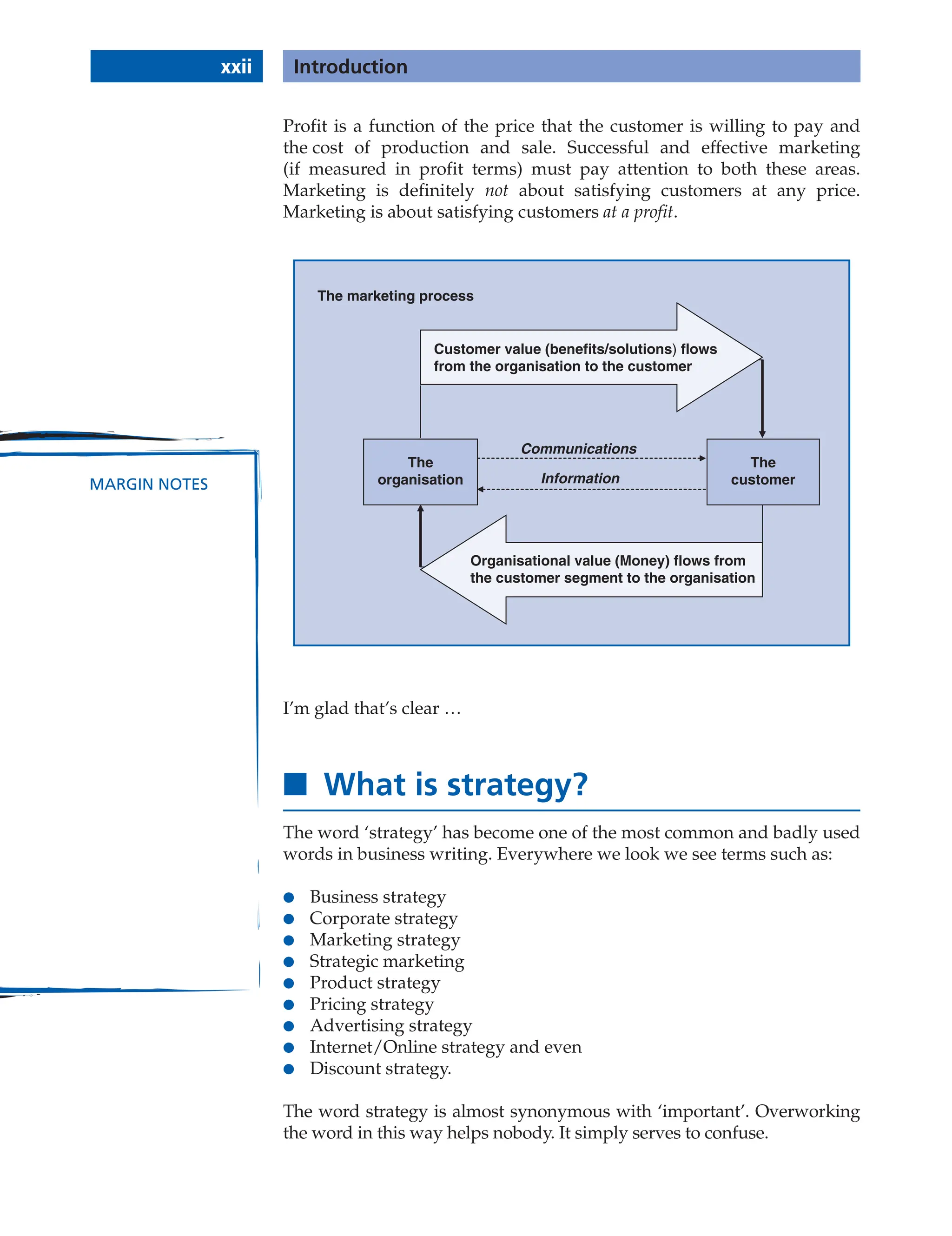
  • 19.
    Introduction This book isnot necessarily intended to be a ‘good read’ although I believe it has its moments. This book is intended, first and foremost, to be a step-by-step guide to help you to develop a marketing strategy for your business. In other words, a simple plan that will help you build a ‘safer’ business. By safer I mean building a business that is not focused primarily on the product or service that you provide but on the custom- ers who pay you to ‘hire’ your product or service to do a job that they believe needs doing. As Joseph Stalin recognised, ideas are far more powerful than guns. Ideas of how to create new, customer-pleasing offerings will always be more powerful than cutting prices. This book is about helping you to create those ideas. This book is aimed, above all, at ‘marketing’ practitioners, no matter the title under which they operate, these are the people who have to plan and implement customer solutions for a profit. In other words, every busi- ness owner or manager who stands or falls according to whether their customers decide to buy the product or service offered. With such an audience in mind I have decided to break down the strat- egy approach into a three-step process: ● Part One will look at the preparatory analysis that is essential to the development of any robust, practical marketing strategy ● Part Two looks in more depth at the specific question of how to develop and plan marketing strategy using the SCORPIO approach ● Part Three considers how your business might co-ordinate the SCORPIO elements to best effect ● Part Four separates marketing strategy from marketing tactics and considers how strategy is implemented. ‘Ideas are far more powerful than guns. We don’t let our people have guns, why should we let them have ideas?’ Joseph Stalin (1878–1953), General Secretary of the Communist Party of the Soviet Union’s Central Committee 1922–1953
  • 20.
    xiv Introduction ■ Theapproach of this book Having been lulled into a sense of security so far by (I hope) everything seeming to make some sense, we arrive at the diagram. The good news is A flow chart for evolving marketing strategy Vision Long-term financial objective Mission Strategic intent Shareholder value Other stakeholders’ requirements Personal values of key implementers Customer and market orientation External focus Strengths and weaknesses Resource/ performance audit Competitive opportunities Competitor analysis Environment audit Opportunities and threats Structural opportunities Industry analysis The business objective The business strategy The marketing objective(s) Competitive strategy Sustainable competitive advantage The customer The Marketing Plans, programmes and implementation Product/service policy Place (distribution) policy SCORPIO © (Marketing strategy) (Feedback and Control) (Feedback and Control) Customer Retention The Customer Organisation processes and culture Industry or market? Offerings Positioning and branding Segmentation and targeting 2 1 4 5 6 7 8 9 2 1 1 1 10 13 14 15 16 17 18 21 22 19 20 23/24 30–36 37–43 44–50 51–57 58–64 65–71 72–78 H u r d l e s 3 30–78 25–29 Price Policy Promotion policy Finance objective and strategy H. Resource objective and strategy Operations objective and strategy 88–90 91–92 93–96 93–94 99–100 Implementation 79–87
  • 21.
    xv Introduction MARGIN NOTES thatthewholestrategicprocesscanberepresentedinoneflowchart;thebad news isthat it is more than a little complicated and we will need the whole of the rest of the book to go through it! A firm believer in the need to get all the pain out of the way at the outset so that we can fully enjoy the recu- peration, I have laid out the full plan in all its malevolence in the flowchart. Assuming that your eyes are still focusing, a few points should be made at this stage: ● This chart is intended to show the approximate relationships between the various aspects, analyses and decisions that go to make up the business and market strategy formulation process. ● The arrows are intended to show one possible route for logical thought through the process. However, as we shall see later, this is one, but not the only route The numbers in the boxes relate to the 100 questions that form the basis of this book. ● Since every organisation faces different competitive and market con- ditions, then no single strategic process can possibly be proposed to suit all needs. This chart should not be viewed as a blueprint. ● Practitioners should feel perfectly free to adapt and amend the dia- gram to meet their own needs. Certainly some sections might be jumped and others emphasised to meet specific requirements. ● Before you skip or downgrade a stage in the process, make sure that you fully understand what it is you are leaving out! ● We will use this chart as a guide through the book – I have con- structed the series of 100 questions based on this diagram. In the same way that an ant may eat an elephant (a spoonful at a time), we will have to break the complete diagram down to bite-size pieces, before we can hope to put any of this into practice. To do this it is prob- ably easier to see the whole diagram as a composite of the usual steps in strategy development. The four key stages are: ● Part One: Preparing for the marketing strategy ● Part Two: Developing the marketing strategy (SCORPIO) ● Part Three: Co-ordinating SCORPIO ● Part Four: Implementation, from strategy to tactics ■ Part One: Preparing for the marketing strategy Before we can hope to develop even the most rudimentary strategic deci- sions, a degree of analysis is required. Working with customers may be xv Introduction
  • 22.
    more art thanscience but working on gut feeling is not the same thing as working by the seat of the pants. We should never forget that the qual- ity of gut feeling or intuition improves with the amount of painstaking research that goes before. The groundwork preparation stage can be put into three steps. ● Understand the internal business drivers: There are essential forces alive in every organisation that cannot just be ignored. The owners and key managers of the organisation are human beings and they have needs, wants and demands that your organ- isation must satisfy. You must understand these important forces as many of them can run directly counter to the needs of the customer. It will be your delicate task to manage these often opposing demands so as to satisfy as many people as possible inside the organisation while creating unbeatable value for the customer. Easy! The internal business drivers Vision Long-term financial objective Mission Strategic intent Shareholder value Other stakeholders’ requirements Personal values of key implementers 2 1 4 5 6 7 8 H u r d l e s 3 ● Understand the external environment: No modern organisation, regardless of size, can pursue its goals in disregard of the business environment within which it operates. We will look at what can be learned from the environment. Have you ever wondered why, when the same facts exist to be uncovered by all, some organisations are successful in the mar- ketplace while others are not? The secret normally lies, not in the quality of the information itself, but rather in the way that it is perceived and interpreted. Customer and market orientation is the key – one that is obvious to smaller companies but somehow less obvious as organisations get bigger. xvi Introduction
  • 23.
    The external environment xvii Introduction Customer andmarket orientation External focus Strengths and weaknesses Resource/ performance audit Competitive opportunities Competitor analysis Environment audit Opportunities and threats Structural opportunities Industry analysis 9 2 1 1 1 10 13 14 15 16 17 18 ● Understand (or develop) the business strategy: The whole area of business strategy experienced something of a hype during the 1980s and 1990s, mostly produced by the thoughts and writings of Harvard’s Michael Porter and imitators. While Porter’s books adorn countless thousands of influential bookshelves, developing business strategy now seems to be no easier than it ever was. The business strategy The business objective The business strategy Competitive strategy Sustainable competitive advantage 21 22 19 20 ■ Part Two: Developing the marketing strategy (SCORPIO) This, the main part of this book, covers the various elements of market- ing strategy. I have been careful to separate marketing strategy from marketing tactics and have concentrated on the critical influence of the market on the organisation’s activity.
  • 24.
    The SCORPIO modelof marketing strategy has been many years in the making, working with real practitioners in real businesses facing real problems. Many of the headings in this part will be familiar to you although how they fit together may not. Nobody wants to play the role of guinea pig when dealing with strategic issues, practitioners want solu- tions that work; that have worked before, that will produce the results. As a testimonial for the approach, I can quote the case of a recent client who sent the SCORPIO model that we had been working with for six months to an academic friend for his opinion. The blistering email reply was ‘But is all the stuff we’ve seen before, there’s nothing new here at all’. Exactly. I couldn’t have put it better myself. ■ Part Three: Co-ordinating your marketing strategy Now that you have all the elements of your marketing strategy in place, what are you going to do with them? You will need to organise the com- ponents into: ● The minimum (backbone) strategy that allows you to compete in your chosen market ● The defensive strategy so that, when you win all the new business, you don’t lose it all just as easily ● The offensive strategy so that you (and everyone else in the organisa- tion) knows exactly how to win the right (not just any) business. The marketing objective(s) SCORPIO © (Marketing strategy) Customer Retention The Customer Organisation processes and culture Industry or market? Offerings Positioning and branding Segmentation and targeting 23/24 30–36 37–43 44–50 51–57 58–64 65–71 72–78 30–78 25–29 Implementation 79–87 xviii Introduction MARGIN NOTES
  • 25.
    ■ Part Four:Implementation, from strategy to tactics The final section deals with the subject area that is probably most familiar to day-to-day practitioners. I shall not deal with the area of marketing tactics in any depth – this job has been very successfully accomplished in a number of other publications and you, like me, probably have your favourites. The main aim of this part is to demonstrate the relationship between marketing strategy and tactics. More importantly, we will look at the whole area of strategic implementation, an area far too often ignored by strategic writing. This section will look at sometimes invisible barriers to the implemen- tation of marketing strategy and what can be done about them. It will also look at using ‘the system’ to help support and implement sometimes radical ideas that marketing strategy represents. The customer The Marketing Plans, Programmes and Implementation Product/service policy Place (distribution) policy (Feedback and Control) (Feedback and control) Price Policy Promotion policy Finance objective and strategy H. Resource objective and strategy Operations objective and strategy 88–90 91–92 93–96 93–94 99–100 Implementation 79–87 ■ Getting started Just before we jump into the detail, there are one or two ‘definitions’ that we need to agree. This is important, not to be pedantic but to make sure that we are all talking about the same thing later on. The key questions we need to answer are: ● What is marketing? ● What is strategy? ● What is marketing strategy? xix Introduction
  • 26.
    xx Introduction MARGIN NOTES Definitionsof marketing are all over the place but enormous confusion still persist about exactly what marketing is, and is meant to be, all about. The concept is not new, it is not difficult to understand, it is not difficult to explain to the troops and our customers love it. Why then does it seem almost impossible to implement? The headings are: ● Marketing is all about the market, and about customers. ● Originally, marketing was intended to be the co-ordinating activity designed to identify, anticipate and focus the rest of the organisation on customer needs. ● Today, too many organisations (and marketers themselves) think that marketing is about producing the advertising, the website and the brochures. We need to be clear here, ‘marketing’ is not the same thing as ‘marketing communications and services’. However, this misapprehension is so widespread that the word ‘marketing’haseffectivelybeenhijackedtomeancommunications– often the business development function has grown to take over the more important aspects of marketing. Marketing is about much more than marketing communications. ● Marketing and sales are different things Sales is about ensuring the customer buys what the company happens to make – everything starts with the product or service. Marketing is about ensuring that the company makes what the customer wants to buy – everything starts with the customer. ● Marketing is an ‘attitude of mind’ that should permeate the entire organisation. It states quite categorically that we recognise that our existence, and future survival and growth, depends on our ability to give our customers what they want. Internal considerations must be subservient to the wider needs of the marketplace. In other words, ‘the customer is king’. ● Marketing is a way of organising the business so that the customer gets treated like a king. If we accept that the organisation exists and will continue to exist only as long as it continues to satisfy the needs of its customers, we must ensure that the organisation has a structure that will enable it to deliver. If an organisation is to survive in today’s ever more fast-changing environment, it must make itself more responsive to its customers.
  • 27.
    xxi Introduction MARGIN NOTES Typicallythis will mean ■ Shorter chains of communication and command and fewer ‘levels’ or ‘grades’ ■ Fewer people employed in ‘staff’, ‘headquarters’ and other non-customer related functions and ■ An overall structure and business design that reflects the dif- ferent needs of the people who buy from the organisation rather than technical specialisations of the people who work inside it. ● Marketing is a range of activities used by the marketing department to meet marketing, marketing and business objectives. Centred mainly on the concept of the marketing mix (tradition- ally accepted as including product, price, place and promotion), this is the technical ‘how to’ of the discipline. ● Marketing is the producer of profits for the whole organisation. Profits are generated by markets. Profits are not generated by products, by efficiency, by manage- ment or even by diligent workforces. It is only the customer’s willingness to pay the right (premium) price for the right product or service, which keeps anyone in business. Marketing, as the primary interface between the organisation and the markets that it serves, is then the primary producer of the organisation’s profit stream. Peter Drucker on marketing: ‘Only marketing and innovation produce profits for an organisation, and all other areas should be regarded as costs’ It is in the area of profit that we meet what is probably the most critical role of marketing. In almost every organisation there is likely to be con- flict between the customer’s need for value and the organisation’s need for profit and efficiency. It is the role of marketing to search for and strike the elusive (and changing) balance between these two demands. We also need to ask ourselves: ● Given that there is more than one way of satisfying customer demand, which route is the most efficient from the organisation’s cost point of view? ● How can we best balance customer need for value against the organi- sation’s need for profits?
  • 28.
    Profit is afunction of the price that the customer is willing to pay and the cost of production and sale. Successful and effective marketing (if measured in profit terms) must pay attention to both these areas. Marketing is definitely not about satisfying customers at any price. Marketing is about satisfying customers at a profit. The marketing process The organisation The customer Communications Information Organisational value (Money) flows from the customer segment to the organisation Customer value (benefits/solutions) flows from the organisation to the customer I’m glad that’s clear … ■ What is strategy? The word ‘strategy’ has become one of the most common and badly used words in business writing. Everywhere we look we see terms such as: ● Business strategy ● Corporate strategy ● Marketing strategy ● Strategic marketing ● Product strategy ● Pricing strategy ● Advertising strategy ● Internet/Online strategy and even ● Discount strategy. The word strategy is almost synonymous with ‘important’. Overworking the word in this way helps nobody. It simply serves to confuse. xxii Introduction MARGIN NOTES
  • 29.
    There will beample opportunity for you to complicate the issues later on, but for the moment I offer you a simple (but accurate) definition of these important terms: Objective Strategy Tactics ‘The goal, aim to which all the resources of the business are directed’ ‘The means of achieving the objective’ ‘Manoeuvres on the field of battle’ This means that objectives are about things we want to achieve – not about how we should achieve them. This means that strategies are concerned with how we achieve the objectives, and action. Tactics are driven by(in order): 1 The strategy 2 The realities of the battleground/marketplace Objectives should always start with the word ‘To …’ Strategies should always start with the word ‘By …’ A big, important tactics does not become a strategy And, the strategy ‘headlines’: ● Strategy is longer term; Since strategy is about marshalling the gross resources of the organisation to match the needs of the marketplace and achieve the business objective, this cannot be a short-term activity. ● Strategy is not changed every Friday; Constant change produces uncertainty, confusion, misdirection and wastage – not results. ● Strategy is not another word for important tactics ● Strategy is not top management’s secret Top management can decide the strategy on their own (it is nor- mally safer by far that they involve others in the process too) but they cannot implement it alone. ● Strategy is not just a public relations exercise It must be capable of implementation. ● Strategy is based on analysis and understanding, not straws in the wind We will need to understand why things are happening as well as just knowing what is happening. ● Strategy is essential to an organisation’s survival If you don’t know where you are going, then any road will take you there. xxiii Introduction MARGIN NOTES
  • 30.
    xxiv Introduction Marketing strategyis the process by which the organisation aligns itself with the market it has decided to serve. ■ What is marketing strategy? The major problem for the practitioner, who would actually like to do something about the organisation’s marketing strategy, is where to start. There are too many conflicting definitions and we are left with burning questions: ● What is marketing strategy? ● What is included in marketing strategy? ● Where does marketing strategy start and finish? Ultimately, marketing is about winning customer preference. ● Given that different customers will have different preferences (in differ- ent situations – see Chapter 7 Market Segmentation), each organisation will have to respond according to its own particular organisational and market circumstances. ● Marketing strategy then will mean different things to different organ- isations. It will fulfil different needs both within the organisation and in the marketplace. ● Organisations differ in a number of important respects The variety and nature of markets served The variety and complexity of products and/or services offered The diverse nature of technology and operating processes used The ‘sophistication’ of existing planning and forecasting procedures The characteristics and capabilities of the individuals involved in the strategy formulation and implementation processes The ‘norms and values’ of the business environment within which the organisation must operate The nature of competitors The ‘thirst’ in the organisation for growth and advancement and The nature and demands of the stakeholders and so on … So, what is marketing strategy? As with most things, this is best answered by asking, what does marketing strategy do? MARGIN NOTES In this way marketing strategy translates the business objective and strat- egy into market terms and marketing activity.
  • 31.
    xxv Introduction MARGIN NOTES The marketingstrategy ‘headlines’ are: ● Process: Marketing strategy is a management process. In other words it is ‘A set of actions or steps towards achieving a particular end’ (Oxford.com). It is not (and should not be confused with) a good idea, a great idea, a plan or a wish. Marketing strategy involves understanding what we are trying to do, more about marketing objectives later, and then identifying all the little steps and activities that together will make it happen – and then, making sure it happens. Yes, it is a surprise to a lot of people! ● Organisation: Means everyone in the organisation. It doesn’t mean just marketing, or sales, or even operations, let alone accounts – it means all of them working together. ● Align: Alignment is the key word in the sentence. The organisation only exists (let alone flourishes) as long as it delivers what customers want. It is difficult enough to work out what customers want now and might want in the future – when they often don’t know themselves. You can at least reduce the odds by aligning yourself to your cus- tomers (rather than to your products, technology or industry) so that you are well placed to pick up the slightest cue. And remember customers need different things at different times, for different reasons and will change their mind – for no reason at all. ● Market: So exactly which customers do you wish to align to? Everyone is not a good answer. ● Serve: Yes, serve – you are not in the driving seat, the customer is. ■ Working with the book With a business audience in mind I have decided to break down the strat- egy approach according to what seems logical from a practitioner’s point of view. Readers approaching the subject from a more academic point of view, perhaps after a course of marketing at a university or business
  • 32.
    xxvi Introduction MARGIN NOTES school,may find parts of the process unusual. If so, the companion book ‘Marketing Strategy’ 3rd edition (Butterworth Heinemann, 2007) will be a more useful read. Consequently, I have opted for the ‘bullet list’ approach that you are told not to use in proper books – but it does make understanding easier. So be ready for: ● Bullets ● Input ● Some answers to questions I am always asked ● Questions you must focus on ● Checklists to measure your progress. The 100 Questions: What are the 100 Marketing Strategy questions we must answer? A practical book for a practitioner audience needs to be driven by con- sidered action, not just thinking. To that end, I have structured the entire book around a series of 100 questions that you will need to answer if you hope to create a workable marketing strategy for your organisation. The questions drive all of the chapters and sections of the book and are also included in their own section in the appendix, where they can be used as a checklist. All the questions must be asked, although not every question will need to be answered – different organisations will have different priorities. To make the approach of this book as practical and as accessible as pos- sible for everybody, whether from a traditional educational route or completely ignorant of the popular ‘theories’ that dominate today’s mar- keting teaching, the book will follow the four-step approach to strategy: ● Part One: Preparing for the market strategy Before you can hope to develop even the most rudimentary stra- tegic decisions, a degree of analysis is required.
  • 33.
    xxvii Introduction MARGIN NOTES Marketingmay be more art than science but working on gut feel- ing is not the same thing as working by the seat of the pants. We need to: ■ Understand the internal business drivers Customers are important, more important than they are treated in most organisations, true – but the customer is not all. There are essential forces alive in every organisation that cannot just be ignored. ■ Understand the external environment No man (or organisation) is an island – clichéd but true. No 21st century organisation, regardless of size and mar- ket power, can pursue its goals in disregard of the business environment within which it operates. ■ Understand (or develop) the business strategy While Harvard’s Michael Porter’s books adorn countless thousands of influential bookshelves, developing business strategy now seems to be no easier than it ever was. ■ Develop the marketing objectives So exactly what are you planning to do over the next few years? Wait and see what turns up? Wait and see what the market throws at you? Or, take some control …? ● Part Two: Developing the marketing strategy (SCORPIO) This, the main part of the book, covers the various elements of market strategy. I have been careful to separate marketing strategy from tactics, a common fault in too many businesses, and have concentrated on the critical influence of the market on the organisation’s activity. This section looks at: ■ S: Segmentation and targeting – what are the segments in the marketplace and which ones should we own? ■ C: The Customer – who are our customers and what do they want from us? ■ O: Offerings – what is our unique offer to the customer? ■ R: Retention – what are we doing to plan that our customers come back to us? ■ P: Positioning and branding – how are we ‘unique’ and what brand values do we support? ■ I: Industry or market thinking – do we describe our business in industry terms or in customer terms? ■ O: Organisation – what do we do to ensure we have the organisation structure and processes that will support a customer approach?
  • 34.
    xxviii Introduction MARGIN NOTES ●Part Three: Co-ordination SCORPIO Backbone strategy Defensive strategy Offensive strategy ● Part Four: From market strategy to tactics The main aim of this part is to demonstrate the relationship between market strategy and tactics and the whole area of stra- tegic implementation. Finally, we will look at the minimum list of marketing issues that you must control if you want the organisation to implement any- thing close to what you intended. Enjoy
  • 35.
  • 36.
    2 Marketing StrategyMasterclass This is where we start asking the questions … Over the years, I have found that having the right question is normally much more effective than trying to come up with an answer that will work in every organisation or business in every market – answers like that just do not exist. Questions, on the other hand, can stimulate thinking in ways that can defy standard ‘industry’ logic and ‘conventional wisdom’ – both enemies to good marketing/customer strategy. The format for the rest of the book is simple; I pose the question, and then I try to explain what issues, data and concepts you ought to bear in mind when looking for an answer that works for your organisation. Of course, not every question will be relevant to your specific organisa- tion, market target customers or product/service. But, before you jump over a question that ‘isn’t relevant’, make sure that you aren’t just falling into the trap of ‘group think’ and conforming to industry and technical/ professional unthinking ‘truths’. Customers like clearly different offer- ings and to create these you just might have to spend some time on those irrelevant questions. Finally, even in a book of this size I can’t be definitive, nor can I cover all eventualities and all types of market and organisation – but I can try! ‘Chance favours only the prepared mind’ Louis Pasteur (1822–1895), French chemist
  • 37.
  • 38.
    4 Marketing StrategyMasterclass MARGIN NOTES Marketing and business strategy, if they are to be practical, must be based on an assessment of reality not on hopes or wishful thinking. The successful practitioner/operator/manager is one whose plans work in the only arena that counts – the marketplace. Plans that are based on hopes, inaccurate analysis, or worse, no analysis at all cannot expect to withstand the onslaught of determined competition. The common thread that binds all these business drivers together is peo- ple. Apart from the (all-important) customer, there are other people who also have demands on the business. Like customers, these people expect their needs to be met. Failure to do so may not mean the failure of the enterprise but will certainly mean the failure of the marketing strategy. So, who are these other people? Question 1 What do our shareholders require from us? Shareholders are the people who own the business or organisation: ● In theory, the relationship here is very simple. The investors in the organisation invest in anticipation of a return on their capital; they are, in fact and in deed, the owners of the business. As owners the investors employ the board to manage the busi- ness on their behalf and, should the returns not meet their expect- ations, the investors (as owners) have the power to remove part or all of the board and replace it with other directors. ‘Drive thy business, let not that drive thee.’ Benjamin Franklin (1706–1790), American Statesman, Scientist, Philosopher, Printer, Writer and Inventor
  • 39.
    5 The Internal BusinessDrivers MARGIN NOTES ● In practice, the relationship is far more complicated; there are invest- ors and investors. In a publicly quoted company the stockholders may be institu- tions such as insurance companies or pension funds, there may be private individuals and there may also be other publicly quoted companies holding stock. Also, stockholders may be primarily national or international in character. It also follows that different investors may have differ- ent needs. Some may be investing for the long term, some for the short term. Some may require no income – seeking a long-term increase in the capital value of their stockholding, others may be far less interested in capital growth but more concerned to secure a regu- lar income stream from the investment, normally in the form of dividends. Yet others may require a mixture of both capital growth and income. The organisation might also be a smaller part of a larger organisa- tion – in this instance there is but one owner. In the case of the private company the director or directors may also be the owners, and then the returns required may be for a steady or rising income stream over the longer-term or for shorter-term capital accumulation. ● The past 10 years has also shown that (at least some) investors are willing to exercise their legal rights and take directors to task. There have been some lively annual general meetings where small shareholders have taken the ‘fat cat’ directors to task over salaries and incentive schemes that seem to pay out even when sales and profits are in decline. Large institutional investors are also flexing their muscles more and are becoming important players in underperforming organ- isations when it comes time to re-elect directors or even deal with potential take-over bids. In each case, it is the board’s strategy that is being assessed, not the directors themselves. ● Apart from the share or stock capital there is also long-term debt financing normally provided by major institutions such as banks and, more recently, venture capital (VC) companies. The various banks are also the products of their own internal organisational culture as well as the national culture from which the organisation operates. The different banks’ views will also differ as to what is long and what is short term. Venture capitalists work on a different basis and exist (unlike the banks) to invest in ‘risk’.
  • 40.
    6 Marketing StrategyMasterclass MARGIN NOTES The dot.com escapade showed the power (if not the wisdom) of the VCs and their willingness to take on all types of ‘risk’. Nowadays VCs (the ones that survived the dot.com bust) are a lit- tle more careful but still often expect only one investment in five to pay off – which explains why they can look for 35% per annum return on all their investments. Action ● The marketing strategy needs to produce the ‘right’ value for the organisation. ● You will need to understand the makeup of the ownership structure of the organisation as precisely as possible. ● You, or the person responsibility for the strategy, will only be allowed freedom to direct as long as the investor is getting what he or she wants/expects. ● Such expectations may include: A return on capital invested Employment Global market share Environmental/social returns, etc. ● And all these are likely to change with political climates and changes in government (or government policy) over time. Question 2 What do our stakeholders require from us? Shareholders are not the only people you have to satisfy, because they are not the only group that believes they have a ‘stake’ in your business. Apart from the shareholders and the implementers/key manage- ment team, there are others who have needs and expectations and who will, rightly, expect a degree of service and satisfaction from the organisation.
  • 41.
    7 The Internal BusinessDrivers MARGIN NOTES The RSA (Royal Society of Arts, London) research discovered that UK society generally no longer ‘defers’ to business activity and organisations need to actively maintain public confidence in company operations and business contact if they are to continue to enjoy a ‘licence to operate’. The RSA concluded that, in the future, successful organisations will ‘value reciprocal relationships and work actively to build them with customers, suppliers and other key stakeholders through a partnership approach and, by focusing on, and learning from, all those who contribute to the business, will be best able to improve returns to shareholders’. The idea that business needs (or at least cannot avoid) adversarial rela- tionships with stakeholders if they are to make a profit is seriously outdated. These ‘yesterday’ organisations still firmly believe that share- holders would have to be the losers if employees, suppliers, customers or the country were made more important. Profits come from satisfied customers who come back. Satisfied custom- ers are created by companies who: ● Understand their customers. ● Build alliances with their staff, communities and suppliers to deliver superior Customer Value. ● These companies are created by investors/stakeholders who take a long-term interest in what the organisation is trying to achieve – as a way of maximising long-term financial returns. The stakeholder concept term is not just a ‘good thing’. It is a highly ‘profitable thing’. A Stakeholder map Shareholders Bankers Directors Customers Employees Central government Local government The media Business partners Intermediaries GB plc Local community The city Analysts Suppliers The Organisation Other sources of finance Society at large Managers
  • 42.
    8 Marketing StrategyMasterclass MARGIN NOTES The days of viewing stakeholders as just innocent bystanders is probably gone. Action ● Identify your stakeholders (all of them). ● Even the ones who are not ‘active’. ● Identify exactly what you get from your stakeholders and what con- tribution they make to satisfying your customers (like how would you manage of they turned against you). ● Talk to them and find out what they expect from you: What do they want? What must they have? What would they be surprised/delighted of they received? ● Carry out a cost/benefit analysis of what more you could give them – and what you would get for it. Question 3 Who are the key implementers in the organisation and what are their personal values and requirements? The term ‘key implementers’ refers to that select group or body in an organisation who actually make the decisions and who are central to what the organisation does. It may or may not include the board in its entirety. It may mean the board, it may mean the board plus a number of very senior managers, it may just mean the owner/managing director and a special friend or colleague, or it may mean the chairman and part of the board. It may include the owner/chairman’s wife/children/fam- ily. In any event these are the people who really count: ● The key implementers, individually or probably as a group, will have a very clear idea of what type of organisation they wish to work for, what type of organisation they wish to create, the types of products and services they wish to market, the types of customers they wish to serve and the types of businesses they wish to be in.
  • 43.
    9 The Internal BusinessDrivers MARGIN NOTES ● At the same time they will also have a very clear idea of what busi- nesses and activities they and their organisation will not be involved in. It is, if you like, a kind of moral and ethical ‘personal ambition blueprint’ against which all possible strategic alternatives will be assessed. If a possible strategy contravenes the personal values of this group it will of course be countered with non-emotional argu- ments based on good business practice – but it will be countered, and strongly and then rejected. Some organisations (and key implementers) would rather die than change what they are and what they believe in – this is human nature and we should accept it. Human nature is just like that. And there’s no way that we are going to change human nature. The most profitable route for you and the organ- isation is not to beat them but to join them. A strong market influence within the key implementers can do nothing but good. Action ● The lesson is clear – even when the strategy and the strategic approach seem to be ‘by the book’, you must talk to and understand the key implementers and the social system to which they belong. ● Implementation is more important than the plans. Implementation has to fit what the organisation is. ● The first thing to do is to start sharing your experience and insights with others. Show how marketing is just really common sense, it’s not black magic nor does it have to be a threat to any of the longer estab- lished functions in the organisation. Try to demonstrate that customers are important to the vision thing. If the key implementers hold fast to a vision that’s great. If cus- tomers could share that vision just imagine what we could do together. Question 4 How should we best describe their/our strategic intent?
  • 44.
    10 Marketing StrategyMasterclass MARGIN NOTES Two professors (Hamel and Prahaled) spoke about what they called ‘Strategic Intent’ in a 1989 edition of The Harvard Business Review. They argued (before the Japanese bubble burst) that Western companies focus on trimming their ambitions to match resources and, as a result, search only for advantages they can sustain. By contrast, Japanese companies leverage resources by accelerating the pace of organisational learning and try to attain seemingly impossible goals. ● The idea is simple. ● Don’t be resources driven. ● Be market/customer driven and work out what you want to do. And then find the resources to do it. For good or for bad, this concept of strategic intent has been watered down, hijacked and generally messed around with so that nowadays it really means that a company exhibits strategic intent when it relentlessly pursues a certain long-term strategic objective and concentrates its strategic actions on achieving that objective. Put the words strategic intent into Google and see how many brave and stirring (if unbelievable) statements appear. Action ● Find out what appears to me the driving concept behind your com- pany/business (remember it might not be written down). ● Ask people what it is that drives them and their thinking (remember that they might not tell the whole truth, especially of it is a Western or UK company and most of the managers are male and the motivation is emotional). ● Don’t just believe what you hear or read – understand what you see. ● Go back to the history of the organisation. ● Understand how you can use the strategic intent to fuel your market- ing strategy Question 5 Out of these various factors do we have a clear statement or understanding of the corporate/business mission?
  • 45.
    11 The Internal BusinessDrivers MARGIN NOTES What seems to drive the organisation? Mission (statements) can give us another clue as can the leadership style of the organisation. The mission should bring together the apparently diverse groups that we have dis- cussed above and give overall direction. ● But what is a mission (statement)? At its simplest level, the mission is a statement of the core values of the organisation and as such is a framework within which staff and individual business units, divisions or activities prepare their plans. It should be constructed in such a way that it satisfies and can be subscribed to by the most important groups of people who have expectations from the organisation. It is not the same thing as a business objective. Missions are non-specific and are difficult to achieve cleanly on their own. A business objective, by contrast, should be both measurable and achievable and is normally expressed in quantitative terms. ● A more important question is what does the mission statement actu- ally do? This will influence its content. Above all else, the mission statement should do as its name implies, it should give the organisation a clear mission or purpose. It should give all people connected with the organisation a clear sense of where the organisation is headed. If the mission statement is sufficiently motivating, then every- body should share a sense of direction, opportunities, significance and ultimately, achievement. Action ● Search the paperwork for recent mission statements and other declar- ations of purpose. ● Match these with behaviours that are: Overt Rewarded by the organisation Rewarded by the market (customers). ● Are you going in the right direction? ● Is your strategy right for the market? ● Is your strategy going to meet any resistance? ● What are you going to do about it?
  • 46.
    12 Marketing StrategyMasterclass MARGIN NOTES It all seems to come down to money in the end doesn’t it? By the long-term financial objective we don’t mean all the annual, quar- terly or monthly financial targets that abound in any sizeable organisa- tion and act primarily as control systems against planned targets. ● The long-term financial objective is that requirement placed on the organisation, specifically on the board of directors, by the individuals and institutions who have invested in the organisation in the expect- ation of a financial return. Not being too delicate, this is what you have to achieve if every- body is to keep their jobs. In short, the financial objective is a hurdle to be overcome. ● By translating business performance into numbers we have a conveni- ent means by which the investors/owners, who have no day-to-day involvement in the running of the organisation, may understand how their appointed managers have performed over the past period. While it also gives us a fairly good indication of what we must achieve in future periods, it provides absolutely no indication at all of how to achieve these future results or how to run the business. ● The long-term financial objective acts extremely well – as a financial objective. Being a narrow measure it cannot be used as a surrogate business objective as it lacks the breadth to be an efficient driver of the business, and the people in it. There is more (much more) to running a successful business and developing a competitive marketing strategy than the long-term financial objective, but more of that later. Question 6 What (therefore) is the long-term financial objective that the organisation is dedicated to achieving?
  • 47.
    13 The Internal BusinessDrivers MARGIN NOTES Action ● We must understand who the investors in the organisation are. ● What do they want. ● How (not whether) can we deliver what they want – then, if we are lucky, we are all left a degree of liberty to run the business. Question 7 What are the Financial Hurdles? Well, it all comes down to money … Every organisation has one or more ‘financial imperatives’ that it must satisfy to remain in business. These are not the same as objectives. These ‘hurdles’ just need to be seen, measured and jumped. They should not guide the destiny of the organisation. ● Yes, I know – and the Finance Director shouts a lot and everybody else does seem to accept that x% increase in return on investment (ROI) is a normal ‘business objective’ but that does not make it right. ● Financial targets are just hurdles that we have to jump – but that changes nothing. To make more money, we need to focus, not on money but on the business/customer purpose that makes it possible. ● The use of the word ‘hurdle’ is deliberate. You remember the hurdles race at school or the Olympics? Well, you must also remember who the winner is. The first one over the end line wins. ■ The hurdles are just things in the way that you have to jump over to get to the winning post. ■ There are no prizes for how neatly the hurdles are jumped, or how high, or how fast or even how many are touched or knocked down. ■ All this is irrelevant. ■ So it is with financial hurdles.
  • 48.
    14 Marketing StrategyMasterclass MARGIN NOTES ● All you have to do is to make sure that the minimum financial returns demanded by the shareholders are achieved. Generally (there are some exceptions such as environmental or green shareholder requirements) shareholders are not concerned how you jump over the hurdles just that you jump them. ● Shareholders establish the nature and shape of the hurdles, but customers determine where the winning line is. In the marketing strategy process it is important that we identify – clearly – the financial hurdles that the organisation must jump. We iden- tify them, we list them, we ensure that we do not forget them; we ensure that we jump them. But we do not allow the hurdles to dictate our customer/ market actions. The vision and business objective will give us the direction that will ena- ble us to jump the hurdles. Action ● Identify all the financial hurdles. ● Identify all the non-financial hurdles that will have a financial effect. ● Identify the exact height of each hurdle. (How high do we have to jump?) ● Make sure that your marketing strategy and everyone associated with it understands that: The hurdles must be jumped. First, agree the Financial Hurdles Our financial hurdles are: 1. 2. 3. 4. Every organisation has one or more ‘financial imperatives’ that it must satisfy to remain in business. These are not the same as objectives. These ‘hurdles’ just need to be seen, measured and jumped. They should NOT guide the destiny of the organisation
  • 49.
    15 The Internal BusinessDrivers MARGIN NOTES The hurdles need not be exceeded. Jumping the hurdles is not enough to win the race. More definitions, more words and more uncertainty: visions, missions, objectives, where will it end? The Purpose of Business: ‘To Create, and keep a customer’ Question 8 What is the Vision of the organisation? What should it be? Definitions vary but for our purposes: ● Mission is a statement of the organisation/business values (how it likes to do business). Nice but arguably not essential. ● Vision is a clear(ish) idea of what the organisation/business is going to be in x years time. Important if you want to enthuse people to follow you. ● Objective is a precise (quantified) definition of what the organisation will achieve by a certain date (depending on the measures chosen). Important for investors and bank managers but even quantified measures have been known to change over time. ● Strategy explains how the objective will be achieved. Visions are a good thing. They allow emotion to enter business and give leaders some currency. They also flesh out the story underneath/behind the boring numbers and give everybody something exciting to belong to. We are human after all. But, importantly, the Vision is about much more than the numbers – because business is about much more than the numbers. The never-ending debate is all about the purpose of business and the measures of success, and it gets confusing. Two great business writers Levitt (Harvard) and Drucker said that:
  • 50.
    Which is blindinglyobvious really; the more customers we create and the longer we manage to keep them, the better and bigger the business gets. So everybody should be focused on creating and keeping custom- ers, and their jobs defined in these terms – if only. ● Unfortunately, the picture gets confused when we consider the meas- ure of success – and (possibly the most) important measure of how well an organisation achieves this is profitability. Financial measures then are a measure of success – not the purpose of the organisation. In fact, people in most (especially larger) organisations appear to be focused on generating profits, and their jobs defined in these terms. This is madness, since few people have any direct effect on profits or any idea what they should be doing to influence them. ● Profits are not only important; they are vital for survival. But, the pursuit of short-term profits for their own sake can destroy an otherwise successful business. ● Visions are a powerful way of breaking out of the ‘any-good-business- objective-must-be-in-financial-terms’ dead end. A lot has been written about ‘the vision thing’ in recent years, some good and some laughable. The personal values of the key implementers, once combined, create the vision driving the organisation and so what has been called the ‘strategic intent’ behind the group. This vision, sometimes written, more often than not implicit and mutually understood, needs to be clarified and defined before taking the process any further. The vision is often central to the organisation’s success. The Vision is not the same as an objective since it is not normally quantified. Rather it is a picture of what the future of the organisation looks like. Vision enables the organisation to set a broad strategic direction and leaves the details of its implementation to be worked out later. In the absence of a clear vision (articulated or not) the organisa- tion will probably be in trouble and without some light to guide it the organisation will flounder aimlessly. Having said this, organisations without a vision are really quite rare. The vision may be unclear, ragged around the edges, or even rather too emotional for senior managers to admit to – but it is normally there. It is often better to dig deep to find what makes people come into work in the mornings than to go through the (often pointless) exercise of trying to create a vision from scratch, what people are happy to put down on paper may not be what they are really willing to fight for. 16 Marketing Strategy Masterclass MARGIN NOTES
  • 51.
    Another Random ScribdDocument with Unrelated Content
  • 52.
    THE KARENS The Karensfound their way in Burma from western China; forced southward by the Chinese. Then when the Shans were in like manner driven into Burma, the Karens were pushed on still further south, like driftwood before the tide. Their original home is uncertain. It seems evident that at a much earlier period they had migrated into western China from some place still further north. One of their own traditions is that their ancestors, in their wanderings, crossed a river of sand. The desert of Gobi best answers to their tradition. Other traditions point to western China as their early home. It is not unlikely that the tradition of the river of sand is much the older, and these traditions taken together mark the progress of the Karens in at least two widely separated migrations southward. The Karens strongly resemble certain hill-tribes now living in western China; in fact some of the Karens have identically the same customs, as these China hill- tribes, who are also said to have the tradition of a river of sand. There are three main divisions of the Karens, known as Pwo, Sgaw, and Karennee or Red Karens. This threefold division antedates their migration to Burma. The Pwos, sometimes called the mother race, are supposed to have been the first arrivals, working their way south by the way of the valleys of the Salwen and Mekong Rivers; followed by the Sgaws, and finally by the Karennees, though it is doubtful whether there was any interval between these main divisions in the general migration. But in some way they have—to this day—maintained the distinction. It is probable that for a time the Karens held the territory now known as the eastern Shan states, and all the upper Salwen region. The coming of the Shans, whether from the north or west, drove them southward, each of these tribal divisions advancing under compulsion in the same order in which they first entered the country.
  • 53.
    The Pwos arenow found in the delta and still farther south in the Maulmain district; the Karennees farther north, bordering on the Shan country, and east to the Siam border; the Sgaws keeping to the central territory, in the Toungoo district and diagonally across to Bassein, sharing parts of the delta with the Pwos. A large body of Sgaw Karens, as well as many Pwos, are found in the Tavoy district, farthest south of all. The Tavoy Karens drifted in from Siam, not extending to the seacoast until early in the last century. There is now a continuous chain of Karens from Tavoy far into the north of Siam. In general, the Karens live in the highlands, the Burmans occupying the plains. Formerly this was partly from choice, but unavoidable whether from choice or not, on account of the cruel oppression suffered at the hands of the more powerful Burmans. But under British rule many Karens have come down to the plains, and forming villages of their own, have engaged in cultivation. They still like to be within easy reach of the mountains, to which they resort for game and other food. In the shady ravines they have profitable gardens of betel (areca) palms, the nut being essential to any native's happiness, and commanding a ready sale. Some writers have advanced the theory that the religious traditions of the Karens were derived from their supposed contact with Nestorian Jews in western China. This can hardly be true—as it places the migration of the Karens to Burma at much too late a date. The Nestorians did not begin their work in western China until 505 a. d., closing it in 1368, when they were expelled by the Mongols. It seems certain that the Karens were already in Burma long before the Nestorian missionaries went to China. (Marco Polo's Roman Catholic mission-work in western China did not begin until 1271.) If it is true that the large towns in Shan-land were founded by the Shans four or five hundred years before the Christian era, the migration of the Karens must be placed at an even earlier period,—
  • 54.
    but that earlydate is doubtful. The non-Christian Karens are, and always have been spirit-worshippers. This so-called worship is limited to propitiatory sacrifice. In this respect they are at one with all the races of Burma, not excepting the Burman Buddhists, though the latter have abandoned bloody sacrifice. Before the adoption of Buddhism the Burmans, Shans and Talaings were spirit-worshippers pure and simple. Spirit-worshippers they still are, with the forms of Buddhism for a veneering. But the Karens have many religious traditions, so closely following the Bible accounts of the creation, fall, flood, and other events as to furnish strong evidence that in bygone ages their ancestors somewhere were in touch with the people of God. In spite of their spirit-worship they have retained a belief in a Supreme Being, and long looked forward to the time when God's Word, which they had lost, should be restored to them. God was believed to be a benevolent Being, but so far away that he had nothing to do with men. All spirits were believed to be evil, vengeful and near at hand. Therefore the Supreme Being was left out of their worship, and sacrifices offered to propitiate evil spirits who might work harm to them, by causing sickness, destruction of crops, and many other possible misfortunes. The Karens contend that in making offerings to the evil spirits they were not showing disloyalty to the Supreme Being. They illustrate their position by the following story: Some children left in a place of supposed safety by their parents, were so frightened by the approach of a tiger that they threw down the cliff some pigs that had taken refuge with them. Their eyes, however, were not fixed on the tiger, but on the path by which they expected their father to come. Their hands fed the tiger from fear, but their ears were eagerly listening for the twang of their father's bowstring, which should send the arrow quivering into the tiger's heart. And so, although we have to make sacrifices to demons, our hearts are still true to God. We must throw sops to the demons who afflict us, but our hearts were looking for God.
  • 55.
    The history ofthe Karens in Burma has been a sad one. For centuries they had been grievously oppressed by the Burmans, who robbed them, carried away captives into slavery, and kept the Karens pent up in the most inaccessible parts of the mountain ranges. Under British rule the Karens are safe from serious molestation, but the old feeling still remains, and they hold aloof from the Burman as much as possible. The coming of the Christian missionary, restoring to them the knowledge of the true God so vaguely known through their traditions, was the great event to which the whole Karen nation had so long looked forward. Multitudes readily accepted Christianity. By its power they were emancipated from the domination of evil spirits; the swords and spears of tribal feuds were forged into pruning hooks; and the whole Christian world rejoiced in the glorious spectacle of A nation in a day. The census of 1901 gives a total of nearly 714,000 Karens, of all tribes. Many more are found in Siam. It has been asserted that more languages are spoken in Assam than in any other country in the world. The same may be said of Burma. The recent census recognized fifty-seven indigenous races or tribes, and as many more non-indigenous. In the Toungoo district the missionaries meet with several Karen dialects not mentioned in the census enumeration, but so distinct that one tribe does not understand the dialect of another. In some localities one meets with a new dialect in each village through which he passes in a day's journey. Ye shades of Shinar! confusion of tongues,—twice confounded. It seems incredible that so many families of one race, occupying the same territory, and with practically the same habits, customs, and superstitions,—should each perpetuate for centuries its own peculiar dialect and clannish exclusiveness. The missionary or official, to do effective work among such a people, needs a small army of interpreters at his heels. THE KACHINS
  • 56.
    The Kachins inhabitthe extreme northern part of Burma, extending as far south as the Bhamo and Namkham districts, and east into China. The Kachins are own cousins to the Nagas of the adjacent hill tract of Assam, who call themselves Singpho. Kachin is a name applied to these people by the Burmans. The Kachins of Burma call themselves Chingpaw. This quite suits their kinsmen of Assam, who look down upon the Chingpaws as unworthy the grand name of Singpho. Both terms seem to mean men,—but men in distinction from the inferior races around them. The census of 1901 gives a total of 65,510 Kachins in Burma alone. The early missionaries held that the Kachins and Karens were of the same origin; that the Kachins were really Karens, from whom the southern Karens had become separated. This view seemed substantiated by the people themselves; by some of their customs,—such as the manner in which their houses are constructed and partitioned off; by a certain similarity of language—many common nouns said to be common to both languages, and by their spirit-worship. It is now generally admitted that the Kachins and Karens are not of the same origin. In bygone ages they may have been neighbours, if not more closely related,—in the borders of Tartary,—but at a very remote period. Certainly they did not migrate to Burma at the same time, nor by the same route. The Kachins have traditions that they migrated to Burma by way of the headwaters of the Irrawadi,—that their primal ancestor lived at Majoi Shingra Pum. In his Handbook of the Kachin Language, H. F. Hertz says: I have succeeded in obtaining the views of several old men, Tumsas and Faiwas, who might be described as Kachin priests. It would seem from these that 'Majoi Shingra Pum' is a high table-land with very few trees, frequently covered with snow, and very cold. Now, the name 'Majoi Shingra Pum,' literally translated is a naturally flat mountain, or in other words, a plateau, and it does not need any stretch of the imagination to identify it with some part of eastern Tibet. Colonel Hannay, writing in 1847, describes tribes residing in the inaccessible regions bordering on Tartary as closely allied to the Kachins. This identifies the Kachins more closely with the Burmans
  • 57.
    and Chins thanwith the Karens. Moreover it is said that the Kachin language has more points in common with the Burmese than with the Karen. This is especially true of the Marus,—a tribe to the eastward, allied to the Kachins of Burma. It is not difficult to believe that all these races, in the very remote past, were neighbours in the borders of Tibet, and that while the Kachins and Burmese migrated south direct, the Karens migrating by way of western China,—the meeting of these races on Burmese soil reveals a few of the many things they once had in common. After the Burmans and Chins had migrated to Burma, the Shans, pressing westward by way of the Namkham valley, blocked the way of further migrations from the north. The Shans are known to have been supreme in northern Burma at the beginning of the Christian era. It is probable that they peopled the Upper Irrawadi several centuries earlier. In the thirteenth century the Shans overran Assam. Not until the middle of the sixteenth century were they finally overcome by the Burmans. Nothing is known of the Kachins in Burma earlier than the sixteenth century. They seem to be comparatively recent arrivals, working their way into Burma after the Shans had been weakened by their struggles with the Burmans. The Singphos of Assam are said to have drifted into that country but a little more than a century ago. The Kachins have gradually forced the Palaungs and Shans before them, or isolating some of their villages from the main body. Their sudden development of power is remarkable. Political changes consequent on the annexation of Upper Burma checked Kachin aggressions. They are still spreading, but by fairly peaceable means. The Namkham district, supposedly Shan, is found to contain fully as many Kachins as Shans. Slowly but surely the Shans will be pressed southward. Before passing under control of the British the various tribes of Kachins were ever at war among themselves. Captives were sold into slavery. Retaliatory raids were constantly expected. Feuds are still kept up, though they do not have the free hand to execute vengeance enjoyed in former years.
  • 58.
    The Kachin, fromhabit, is watchful and suspicious of strangers,— until his confidence is gained. Their villages are usually high up in the hills, as secluded and inaccessible as possible. But the isolated situation of the village probably is due to the fear of nats, spirits,— quite as much as from fear of human enemies. One writer describes an avenue leading to the village, with bamboo posts at regular intervals, with rattan ropes, à la clothes-line, from which various emblems are suspended. Near the village wooden knives, axes, spears, and swords are fastened to the tree-trunks. All this display is for the benefit of the nats. Like the Chinese, they do not give their demons credit for much acuteness. For one thing they believe that they can only move in a straight line. Therefore the nats avoid going about in the jungle, and keep to the open paths. A few judicious turns are made in the avenue, so as to turn the prowling devils off, if possible, but if he should happen to be cannoned off the tree stems in the right direction, there are the emblems to show him where the thing he is in search of may be found. If he is hungry there is the bullock's skull nailed to a tree, to indicate where food may be found; if he is thirsty a joint of bamboo points out where a libation of rice spirit has been made. These spirit-worshippers are more easily gained than the Buddhist Burmans and Shans, but they have not the traditions of the Karens to prejudice them in favour of Christianity. Morally, they rank very low,—and yet their morality must be viewed in the light of Kachin, rather than English custom. As with the non- Christian Karens, there are certain unwritten tribal laws governing family life. Should a Kachin presume to poach on his neighbour's preserves, there would be one less Kachin the next day. Courtship, when once the parties have come to an understanding, is conducted as a probationary marriage. They may separate before the marriage ceremony takes place, if they weary of each other. But if they have already started a colony, marriage must follow, or the man has to kill a bullock and pigs—to appease the nats of the damsel's house. In addition he has to pay a fine to the parents, of a spear, a gong, a da, and some pieces of cloth, and sometimes a bullock or buffalo. The old man is more exacting than the nats.
  • 59.
    Such separations donot effect the social standing of either party. It is claimed that separations or disloyalty after marriage are practically unknown. It certainly would not be healthy to have it known. The Kachins have their own distinctive costume, varying according to tribe and locality. But Kachin men in touch with Chinese, Shans, or Burmans, usually adopt the costume of their neighbours. The women hold to their own costume. The religion of the Kachins, though gross spirit-worship, contains an element of truth not found in the Buddhism of the more civilized Burmans. Rev. Mr. Geis, missionary at Myitkyina says—Above and beyond all nats to whom Kachins offer sacrifices at one time or another, they recognize the existence of one great spirit called Karai Kasang. Altars in his honour are not found in Kachin villages or houses. No priest has been able to divine what offerings are to be made to it, but in time of great danger nats and their offerings are forgotten, and their cry goes out to Karai Kasang for help and succour. THE CHINS The Chins, who number about 180,000, are thought to be of the same origin as the Burmese,—from the neighbourhood of Tibet. It is evident that they became separated from kindred tribes at a very remote period. The Lushais of Assam, and Bengal, and the Kukis of Manipur have the same race-characteristics, and probably formed part of the original migration southward. At present the Chins, occupying the hill country in the northwest corner of Burma, are slowly pressing northward, affecting Manipur. The Chins of the hill-country are quite isolated from other races. For this reason Buddhism has never reached them. Like their kinsmen, the Kachins, they are spirit- worshippers, as were their other kinsmen, the Burmese, before the
  • 60.
    introduction of Buddhism.The Chins are divided into several tribes. The northern Chins call themselves Yo, the Tashons call themselves KaKa; the middle tribes give their names as Lai; the southern Chins call themselves Shu. Since the annexation of Upper Burma, securing immunity from oppression by the Burmans many Chins have drifted down from their own hill-country and formed agricultural villages in the plains. The Chin country is about 250 miles long by from 100 to 150 miles wide. It is wholly mountainous, the highest peaks being from 5,000 to 9,000 feet. Liklang peak, the highest of all, is nearly 10,000 feet. Like all spirit-worshippers, the Chins dread the power of demons, and offer to them the same left- handed sort of worship. But their worst enemy is of their own manufacture, made by fermenting rice, millet, or corn, and called Zu. The great and wide-spread vice among the Chins is drunkenness. Men, women, children, even babes in arms—all drink and glory in intoxication as an accomplishment of which to be proud. No act is considered a crime if committed when drunk. Many people I have seen in European and American cities must have been Chins. No function is complete without liquor. Hospitality is gauged by the number of cups of spirit dealt out, and appreciation of it—by the number of cups consumed. Again, how like many of their white cousins. A man should drink, fight, and hunt, and the portion for women and slaves is work—is both creed and practice. They have a peculiar custom, now dying out, of tattooing the faces of the women, until the whole face, from chin to hair—is dyed a purplish black. The reason for this custom is in dispute. Some have asserted that it was to make them unattractive to their enemies, especially the Burmans, who frequently raided their villages in the foot-hills. Others claim that the tattooing was in order to increase their attractiveness to the young men of their own kind. Fortunate indeed were they if this queer custom served the double purpose of repelling enemies and attracting friends. To unaccustomed eyes the tattooed face is hideous in the extreme. The first attempt by the British to control any part of the Chin Hills was made in 1859, but was neither continuous nor effective. In 1871
  • 61.
    an expedition wassent into the hills to recover captives, and punish offenders. The Chins remained quiet for ten years, then broke out again in repeated raids, from 1882 to 1888. The English were obliged to undertake a systematic subjugation of the whole Chin country. This was effected in 1889-90. The expedition met with stubborn resistance, by guerilla methods. Many villages were burned by the English, as the only means of subduing the wily enemy. Many villages were burned by the Chins themselves. Near one village a dog had been killed and disemboweled, and tied by its four legs and thus stretched on a rope suspended between two sticks across the path to the village, its entrails being likewise suspended between two other sticks, thus barring the road. Asking the Chins what this might mean, they said it was an offering to the war nat to protect their village, and to ward off our bullets from injuring them. The work of subjugation had to be continued for some years, before the Chins were made to realize that the English government must be respected. The Hakas and others were disarmed in 1895. The Chin Hills are administered by a political officer at Falam, with a European assistant at other important points, as Tiddim and Haka. The morals of these benighted Chins, still further degraded by their drink habit, are what might be expected. Marriages are governed by the working-value of the bride, parents expecting compensation for the loss of her services, according to her capacity for work, and expectation of life. This seems to have been the custom among all races of Burma. It is said that when a Chin wife is asked Where is your husband? she will give the required information in case he is living,—but if dead she will reply, He is not here, and expects the subject to be dropped at that. This reminds me of a Shan girl's answer when I asked her the whereabouts of a former resident—I don't know,—he is dead. The Chins of the foot-hills and plains present an encouraging field for missionary work, but missionary work must be pushed with all possible vigour—to forestall the influences of Buddhism. To win them from spirit-worship is hard enough, to win them from Buddhism will be very much harder.
  • 62.
    The dialect ofthe southern Chins has been reduced to writing, and is found to be strikingly similar to the Burmese, perhaps half of the words being more or less allied to the Burmese. As the southern Chins have great difficulty in understanding the speech of the wild tribes in the northern hills, it is quite probable that their own dialect has been corrupted by contact with the Burmans since their migration to Burma. The Chin dialect of the south is also said to contain many words of Shan origin. This must have come about in the same way, either by contact with Shans on the Upper Chindwin at a very early period, or when the Shans occupied Arracan about eighteen years, towards the end of the tenth century. This later contact seems much too short to have left a permanent mark on the southern Chin dialect. The total number of Animists—demon- worshippers—in Burma, Chin, Kachin, Karen, and other, is about four hundred thousand. But as we have seen, the Buddhist Burmans, Shans and Talaings, are at core, demon-worshippers, all races having in common practically the same superstitions.
  • 63.
    V BUDDHISM AS ITIS Much has been written on Buddhism, besides the translation of the Buddhist's sacred books. Little, however, can be learned from books of Buddhism as one finds it expressed in the life of the people. Riding one day with a missionary who had a wide acquaintance with the Burmans and their language, I asked him certain questions as to their real belief. His reply was, No man can tell, until he finds a way to get into the Burman mind. The first business of the missionary seemed to be then to make every effort to get into the Burman mind; to study him; study his religious habits; ascertain if possible, his point of view; learn to see things from his point of view; to know what there is in him that must be eradicated and supplanted by the gospel of Jesus Christ. We see the country fairly alive;—no, dead with idols. We see the people kneeling before these idols, and, to every appearance praying. Are they praying? How can they be praying, inasmuch as Buddhism knows no God,—does not claim to have a God? Gautama himself whom all these images represent, never claimed to have any power to save others, or even to save himself. These worshippers know that he was only a man, that at the age of eighty years he died, that his death was due to an attack of indigestion (from eating too much fresh pork), as any other man might die. It is supposed that he was born near Benares, about six hundred years before Christ; that his father was a chief of an Aryan tribe called the Sakyas. From the sacred books they learn that Gautama's early life was spent in dissolute pleasure and luxury common to oriental princes; that after a time becoming dissatisfied with his own manner of life and the corrupt conditions around him,
  • 64.
    he yielded toanother his princely prospects, abandoned his wife and child and gave himself up to a life of meditation and study under religious teachers; that failing in this to gain the longed-for peace of soul he for several years led a life of the most severe privation and affliction of the flesh, until by long continued meditation and self- concentration the light broke in upon him, and he became the enlightened one,—a Buddha. Did he not by this enlightenment become something more than man? Not at all. He had learned nothing of God, not even that such a being existed. He entertained no thought that he himself had acquired any supernatural character or power. And so he died. Even the common people of the jungle villages know all this, and yet they prostrate themselves before these images of brass, wood, or stone. Are they praying? Perchance their hopes are based on what Gautama became, after death. According to Buddhism, Gautama had now passed through all the necessary conditions and changes, and entered at once upon the final state, the highest goal of Buddhism, Nirvana, (Neikban, in Burmese). Had he now become a God? Not at all. No Buddhist entertains such a thought. What then is Neikban? It means, they say, the going out, like the flame of a candle. By a long-continued process of self- concentration Gautama is supposed to have become absolutely oblivious to the world around him, and ultimately to have become unconscious even of self. His death is believed to have been utter extinction of both physical and spiritual existence. Some deny that Neikban is equivalent to annihilation. The best that can be claimed for it is an impossible existence in which there is neither sensation nor conscious life. Fittingly they describe it as a flame which has been blown out. According to Buddhist teachings and current belief Gautama has disappeared, body and soul. Brahmins may talk of being absorbed in the One Supreme Soul, and Theosophists glibly repeat the form of words, but Buddhists claim nothing of the sort. There is no Supreme Soul to absorb them, and no human souls to be absorbed. It is not
  • 65.
    soul, or lifethat is perpetuated, but desire merely. Neikban, they declare, is the cessation of everything, a condition of unconsciousness, lifeless ease, they do not like to say annihilation. Then what are these worshippers doing here on their knees before images which represent no existing being? surely not praying, for they have no hope, without God in the world; no being higher than themselves to whom prayer could be addressed; no expectation of blessing of any sort from any supernatural source; absolutely nothing in their religious conceptions or experience corresponding to the communion between the Christian and his God. There is no such thing as real prayer in the whole Buddhist system. What, then, are they doing? Here comes in the system of merit on which Buddhism is built. An instinctive sense of guilt and impending penalty is universal. Having no Saviour—man must save himself. From what? Not from sin, as violation of the laws of a Holy Being, but from their train of evil consequences to himself.
  • 66.
    Worshipers The chief tenetsof Buddhism are: (1) Misery is the inevitable consequence of existence. (2) Misery has its source in desire. (3) Misery can be escaped only by the extinction of desire. (4) Desire can be extinguished only by becoming wholly unconscious of the world and of self. (5) He who attains to such unconsciousness attains to Neikban. (6) Evil actions constitute demerit. Good actions constitute merit. In this deeply grounded belief as to merit and demerit lies the secret of much that we see in the life of the people. Now we know what these people are doing,—they are seeking to accumulate merit by repeating over and over again a certain formula, or portions of their Law with their faces towards the,—to them,—sacred pagoda or idol.
  • 67.
    But no Buddhistexpects to attain to Neikban at the end of this existence. He realizes that it is utterly hopeless for him to think of fulfilling the conditions. But he cherishes the groundless hope that in some future existence under more favourable conditions he may be able to accumulate sufficient merit, though he cannot now. This belief presupposes the doctrine of transmigration, or metempsychosis. The Buddhist believes that he has passed through countless existences in the past,—whether as man, animal, or insect, or all many times over, he knows not; finally, birth into this world as man. He dies only to be reborn into this or another world,—whether as man, animal, or insect he knows not; then death again, and so through countless ages. Even Gautama himself is said to have passed through five hundred and fifty different phases of existence, including long ages in hell, before he finally entered this world as man, and became a Buddha. Although Buddhism has no God, and no heaven, it has a very vivid conception of hell, yes,—eight of them, surrounded by over forty thousand lesser hells,—their terrors limited only by the limitations of the imagination. But no man can escape—the doctrine of Karma settles that. A man's own words and deeds pursue him relentlessly, and there is no city of refuge to which he may flee. Not in the heavens, not in the midst of the sea, not if thou hidest thyself in the clefts of the mountains, will thou find a place where thou mayest escape the force of thy own evil actions. So say their scriptures, and so every Buddhist believes. Hell is the inevitable penalty of many deeds or accidents, such as the killing of the smallest insect under foot. Between the Buddhist and his hopeless hope of Neikban yawns this awful gulf of existences and sufferings. Whatsoever a man soweth, that shall he also reap, gives the gist of Buddhism. He is now reaping from past existences; he will reap in the next from his deeds in this. In the past each succeeding existence depended upon the last previous existence. In like manner,
  • 68.
    what the nextexistence shall be depends wholly upon the deeds of this life. So the countless series of transmigrations may be, theoretically, in the ascending or descending scale. But when the awful penalties assigned to innumerable and unavoidable violations of the Buddhist law are taken into consideration all hope of future existences in the ascending scale vanishes. The poor fisherman, beginning at the very bottom of the lowest of the four chief hells must spend countless ages in each, before he can hope to be reborn as man. The man who unwittingly puts his foot on the smallest insect and crushes out its life must atone for the deed by spending a long period in torment. Taking the life of any living thing, even to the killing of poisonous snakes, is held to be the worst of all sins. The priests, to avoid the possibility of destroying insect life, use a brass strainer finely perforated, to cleanse their drinking water, in blissful ignorance of the microbe theory. A native preacher once asked me to get him a microscope so that he might prove to the priests that notwithstanding their precautions they were drinking to themselves perdition. His motive may have been in part, to convince them as to the futility of their hope, and in part to get even with them for their harsh criticisms of animal-killing Christians. A story told by one of our native preachers vividly illustrates this dread of future punishment. I had been preaching for about two hours to a large company in a jungle-village. During all this time an old woman was sitting on a log near by, counting off her beads, and devoutly murmuring to herself the customary formula, 'Ah-nas-sa, Dok-ka, Ah-nat-ta; Paya, Taya, Thinga,—Radana Thón- ba'—'Transitoriness, Misery, Illusions; Lord, Law, Priest,—the three Jewels.' When I had finished I approached her saying: 'Why do you worship so devoutly?' 'To escape the penalty of hell,' she sadly replied. 'So you fear the future,—what is your notion of hell?' 'Oh, it is a terrible place. They say it is shaped like a great cauldron, and
  • 69.
    full of burningoil in which people suffer endlessly and are not consumed. And when they try to escape, the evil beings of the place thrust them back with sharp forks and spears. Oh, it is a terrible place!' she repeated, fairly trembling as she described its horrors. 'Yes,' I said. 'You seem to understand it very well. Now what are you doing to escape such an awful fate?' 'Oh, many, many years I have worshipped before the pagodas and idols; every day I count my beads over and over, repeating the formula, as Gautama directed. Do you think that after all I have done I must still go to hell?' 'Yes,' I said. 'If that is all you have done, you surely must.' 'Oh, then, tell me,' she said in great distress, 'what can I do to escape, for I greatly fear the terrors of that place.' Then sitting there on the log, with this poor old woman on the ground before me, I told the blessed gospel story over again, as Jesus Christ did with the woman of Samaria. And then I said: 'You must repent of your sins, and confess them to the eternal God. You must believe and trust the Lord Jesus Christ, who died to save you. If you do this He will forgive your sins, and save you.' Her wrinkled face brightened with hope as she exclaimed, 'If I do as you have said, and believe on Jesus Christ, will He save me?' 'Yes, He surely will, for He has said, Him that Cometh unto me I will not cast out.' On her face was an almost heavenly light—as she replied: 'Then I do believe, and I want to go with you that you may tell me about Him until I die.' Her friends ridiculed her saying, 'Oho! Grandma wants to go off with the preacher. She is becoming foolish in her old age.' 'Oh, no,' she said. 'But the preacher has told me how I may escape the penalty of hell, and I am so glad.' It has often been asserted that Buddhism has a moral code rivaling, if not superior to that of Christianity. We had not been at our mission station a week before we heard the remark, Buddhism is a beautiful religion,—why do the missionaries try to disturb them in their belief? That there are noble precepts and commandments all must admit. But he who expects to see their beauty reflected in the lives of the people will be doomed to disappointment. Take the commandment already noticed—Thou shalt not take the life of any living thing.
  • 70.
    This commandment admitsof no exceptions whatever, under any possible circumstances, not even in self-defense; and puts the taking of a human life and that of the smallest insect in the same category. But the Burmans, among whom Buddhism is found in its purest form, have been a more or less warlike race from their earliest history, often practicing the greatest cruelties. How do they reconcile this with the teachings of their law? We will suppose that one man has taken the life of another. According to his own belief and the law of the land, he is a murderer. To free himself from just and inevitable penalty he resorts to his doctrine of merit, by which he may absolve himself from the demerit of his evil act. The building of a small pagoda of sun-dried brick, or the forming of an idol from a portion of his fire-wood log will balance the scales, square the account, restore him to his former prospects, and to future prospects as bright as though he had kept the whole law. By this convenient belief he may take his absolution into his own hands, and work it out to suit himself. But if he be a poor man, unable to perform an adequate work of merit, he must suffer to the full the consequences of his act. A missionary found a man digging for huge beetles. When one was found it was impaled on a sharp stick along with the others, all to go into the curry for the morning meal. Then the following conversation took place: Are you not afraid of punishment in hell for killing these creatures? I shall go there if I do not kill them. Then you do this because there is no hope for you, whether you take animal life or not? It is all the same. Sins beyond his power to counterbalance by merit had already been committed, until hope had given way to despair. One may shoot pigeons in the vicinity of a Buddhist monastery, and then divide with the priest, who anticipates a savoury meal without any compunctions of conscience on account of aiding and abetting. Young Burmans are eager to follow the man with the gun, showing him the likeliest place to find game, and when the animal is wounded, will rush in and dispatch it with their dahs.
  • 71.
    The fisheries ofBurma furnish a livelihood to hundreds of Burmans. Large sums are paid to government annually for the privilege of controlling certain specified sections of rivers or streams. The fisherman makes the taking of animal-life his business and daily occupation. Theoretically he is ranked among the very lowest classes. In real life we find him enjoying the same social position that others of equal wealth enjoy. But I do not hesitate to say that this general belief that fearful penalties must be endured in future existences for taking animal-life in this, has a deeper hold on the Buddhist than any other commandment. Take the commandment: Thou shalt speak no false word,— strikingly like the Christian's commandment, Thou shalt not bear false witness, Lie not one to another. One would naturally expect to find among the devotees of a system containing such a commandment some value placed upon one's word of honour. But if truthfulness has ever been discovered among non-Christian Burmans, the discovery has never been reported. But we have not far to search to find the secret of this general lack of any regard for truthfulness. The same Sacred Book that sets forth the commandment, Thou thalt speak no false word, gives this definition of falsehood: A statement constitutes a lie when discovered by the person to whom it is told, to be untrue! See what latitude such a definition gives. Deceit is at a premium. Children grow up with no higher standard of honour than a belief that the sin of falsehood and fraud lies entirely in its discovery. Is it any wonder that these people have become expert in the art. It is the common practice among themselves,—in business, in family life, in match-making, and most of all, in their dealings with foreigners. No European (after the first year) places the slightest reliance upon the most emphatic promise of a heathen Burman. In fact, the more emphatic the promise, the greater seems to be the temptation to do just the other thing. It may have been
  • 72.
    Welcome to ourwebsite – the ideal destination for book lovers and knowledge seekers. With a mission to inspire endlessly, we offer a vast collection of books, ranging from classic literary works to specialized publications, self-development books, and children's literature. Each book is a new journey of discovery, expanding knowledge and enriching the soul of the reade Our website is not just a platform for buying books, but a bridge connecting readers to the timeless values of culture and wisdom. With an elegant, user-friendly interface and an intelligent search system, we are committed to providing a quick and convenient shopping experience. Additionally, our special promotions and home delivery services ensure that you save time and fully enjoy the joy of reading. Let us accompany you on the journey of exploring knowledge and personal growth! ebookultra.com