CHAIR SIDE DIAGNOSTIC
AIDS IN PERIODONTAL
EXAMINATION
Moderator :- Dr.Shivjot Chhina
Perceptor :- Dr.Kumar Saurav
Presented by:- Dr.Fatima Gilani
MDS- (2018-21)
SEMINAR-7
1. Introduction
2. Conventional diagnostic aids and its limitations
3. Advanced diagnostic aids
4. Rationale of chair side diagnostic test
5. Microbiological CST
6. Biochemical CST
7. Genetic CST
8. Diagnostic tests under development.
9. Other CST
10. Conclusion.
CONTENTS
INTRODUCTION
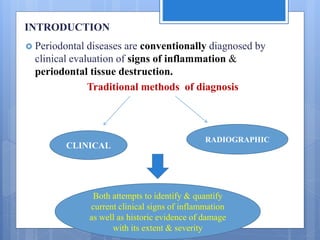
 Periodontal diseases are conventionally diagnosed by
clinical evaluation of signs of inflammation &
periodontal tissue destruction.
Traditional methods of diagnosis
CLINICAL
RADIOGRAPHIC
Both attempts to identify & quantify
current clinical signs of inflammation
as well as historic evidence of damage
with its extent & severity
Limitations of traditional methods of diagnosis
1. Cannot reliably identify sites with ongoing periodontal
destruction.
2. Does not provide information on the cause of the condition
on the patient’s susceptibility to disease, whether the
disease is progressing, its remission & its response to
therapy.
3. Any force >0.25 N may evoke bleeding in healthy sites
(Lang et al)
4. Tobacco smoking masks inflammatory signs in gingivitis
and periodontitis.
5. Substantial volumes of alveolar bone must be destroyed
before the loss is detectable in radiographs. (Goodson,
Haffajee, Socransky 1984)
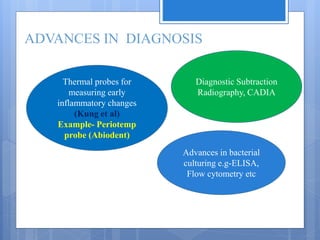
ADVANCES IN DIAGNOSIS
Thermal probes for
measuring early
inflammatory changes
(Kung et al)
Example- Periotemp
probe (Abiodent)
Diagnostic Subtraction
Radiography, CADIA
Advances in bacterial
culturing e.g-ELISA,
Flow cytometry etc
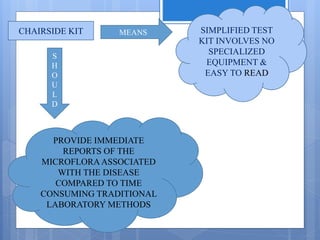
CHAIRSIDE KIT MEANS SIMPLIFIED TEST
KIT INVOLVES NO
SPECIALIZED
EQUIPMENT &
EASY TO READ
S
H
O
U
L
D
PROVIDE IMMEDIATE
REPORTS OF THE
MICROFLORAASSOCIATED
WITH THE DISEASE
COMPARED TO TIME
CONSUMING TRADITIONAL
LABORATORY METHODS
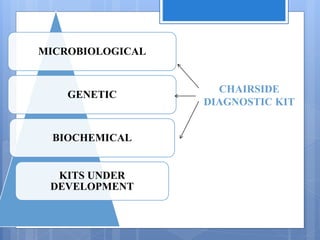
CHAIRSIDE
DIAGNOSTIC KIT
MICROBIOLOGICAL
GENETIC
BIOCHEMICAL
KITS UNDER
DEVELOPMENT
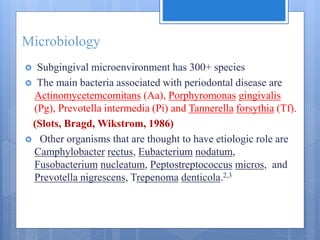
Microbiology
 Subgingival microenvironment has 300+ species
 The main bacteria associated with periodontal disease are
Actinomycetemcomitans (Aa), Porphyromonas gingivalis
(Pg), Prevotella intermedia (Pi) and Tannerella forsythia (Tf).
(Slots, Bragd, Wikstrom, 1986)
 Other organisms that are thought to have etiologic role are
Camphylobacter rectus, Eubacterium nodatum,
Fusobacterium nucleatum, Peptostreptococcus micros, and
Prevotella nigrescens, Trepenoma denticola.2,3
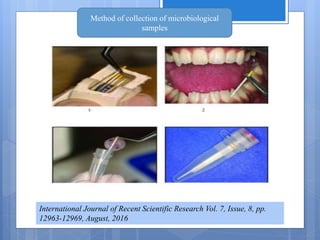
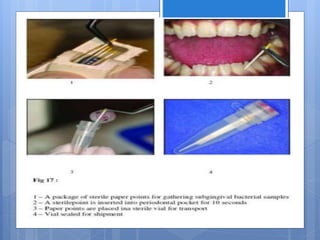
Method of collection of microbiological
samples
International Journal of Recent Scientific Research Vol. 7, Issue, 8, pp.
12963-12969, August, 2016
1. Bana
2. Evalusite
3. Omnigene
4. Perio-2000
5. Perioscan
6. Meridol periodiagnostics
MICROBIOLOGIC TEST KITS
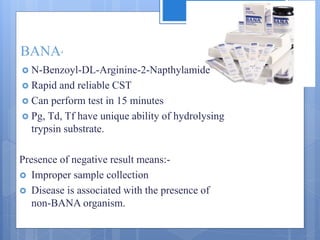
BANA4
 N-Benzoyl-DL-Arginine-2-Napthylamide
 Rapid and reliable CST
 Can perform test in 15 minutes
 Pg, Td, Tf have unique ability of hydrolysing
trypsin substrate.
Presence of negative result means:-
 Improper sample collection
 Disease is associated with the presence of
non-BANA organism.
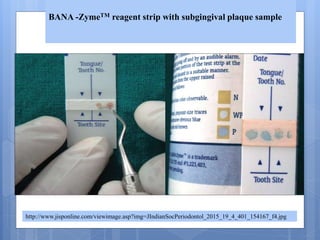
http://www.jisponline.com/viewimage.asp?img=JIndianSocPeriodontol_2015_19_4_401_154167_f4.jpg
BANA -ZymeTM reagent strip with subgingival plaque sample
Evalusite4
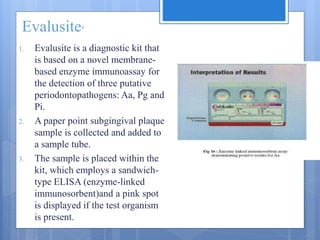
1. Evalusite is a diagnostic kit that
is based on a novel membrane-
based enzyme immunoassay for
the detection of three putative
periodontopathogens: Aa, Pg and
Pi.
2. A paper point subgingival plaque
sample is collected and added to
a sample tube.
3. The sample is placed within the
kit, which employs a sandwich-
type ELISA (enzyme-linked
immunosorbent)and a pink spot
is displayed if the test organism
is present.
`
Omnigene4
(Backman,Van, Arsdal,1996)
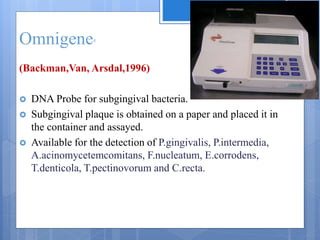
 DNA Probe for subgingival bacteria.
 Subgingival plaque is obtained on a paper and placed it in
the container and assayed.
 Available for the detection of P.gingivalis, P.intermedia,
A.acinomycetemcomitans, F.nucleatum, E.corrodens,
T.denticola, T.pectinovorum and C.recta.
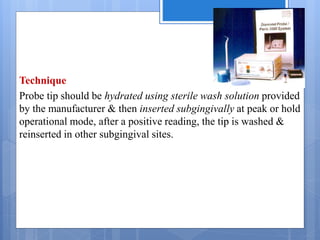
Perio 20005
 Consist of diamond probe which determines sulphide levels
digitally at each site.
 Td, Pg, Pi, Tf – produce sulfates
 These VSC degrade periodontal structure aggravating
periodontitis.
 It is intended to measure probing depths, to evaluate the
presence or absence of bleeding or probing, as well as to
detect the presence of sulfides in periodontal pockets.
Technique
Probe tip should be hydrated using sterile wash solution provided
by the manufacturer & then inserted subgingivally at peak or hold
operational mode, after a positive reading, the tip is washed &
reinserted in other subgingival sites.
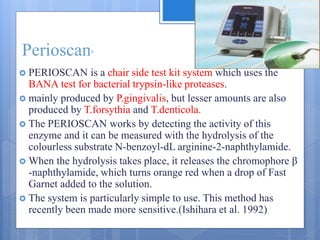
Perioscan6
 PERIOSCAN is a chair side test kit system which uses the
BANA test for bacterial trypsin-like proteases.
 mainly produced by P.gingivalis, but lesser amounts are also
produced by T.forsythia and T.denticola.
 The PERIOSCAN works by detecting the activity of this
enzyme and it can be measured with the hydrolysis of the
colourless substrate N-benzoyl-dL arginine-2-naphthylamide.
 When the hydrolysis takes place, it releases the chromophore β
-naphthylamide, which turns orange red when a drop of Fast
Garnet added to the solution.
 The system is particularly simple to use. This method has
recently been made more sensitive.(Ishihara et al. 1992)
Meridol Periodiagnostics7
Jervoe-storm et al (2005)
 Real time PCR for quantitative determination of 6
important marker organisms of periodontitis and peri-
implantitis (Aa, Pg, Td, Fn, Tf, Pi)
 It combines high specificity with high sensitivity and a
precise quantification.
Biochemical cst
1. Periogard
2. Pocketwatch
3. Periocheck
4. Prognostick
Gingival crevicular fluid
 Collected with paper strips, micro papillary
tubes, micropipettes, microsyringes, plastic
strips.
Saliva
• It is the next most used after GCF -easily collected
Collected from parotid, sub-mand or sub lingual or as ‘Whole
saliva’ (secretions of major and minor salivary glands,No
diagnostic test available in the market although lot of research is
in progress.
Markers to look for in saliva: proteins and enzymes from host,
phenotypic markers, host cells, hormones, bacteria, bacterial
products, volatile compounds, and ions.
Different enzymes involved in both the intracellular &
extracellular pathway of tissue destruction.
Intracellular destruction enzyme:-
1. Aspartate aminotransferase
2. Alkaline phosphate
3. Beta glucoronidase
4. Elastase
Released from dead & dying cells of
PDL Mostly from PMNs ,neutrophils.
• Extracellular destruction enzyme
Matrix metalloproteinases- produced
by inflammatory epithelial &
connective tissue cells at affected
sites.
Aspartate aminotransferase (AST)
 Released from dead cells
 Elevated in GCF in periodontal disease.
 Periogard and Pocket watch commercially available
colorimetric test.
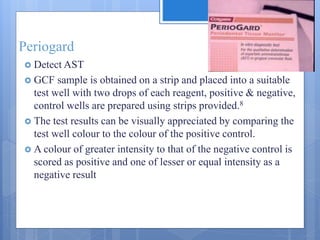
Periogard
 Detect AST
 GCF sample is obtained on a strip and placed into a suitable
test well with two drops of each reagent, positive & negative,
control wells are prepared using strips provided.8
 The test results can be visually appreciated by comparing the
test well colour to the colour of the positive control.
 A colour of greater intensity to that of the negative control is
scored as positive and one of lesser or equal intensity as a
negative result
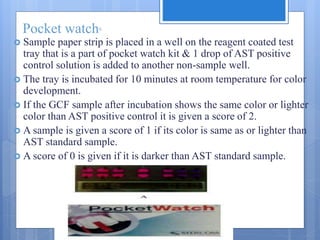
Pocket watch6
 Sample paper strip is placed in a well on the reagent coated test
tray that is a part of pocket watch kit & 1 drop of AST positive
control solution is added to another non-sample well.
 The tray is incubated for 10 minutes at room temperature for color
development.
 If the GCF sample after incubation shows the same color or lighter
color than AST positive control it is given a score of 2.
 A sample is given a score of 1 if its color is same as or lighter than
AST standard sample.
 A score of 0 is given if it is darker than AST standard sample.
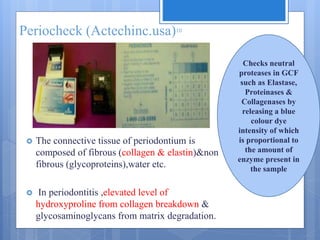
Periocheck (Actechinc.usa)10
 The connective tissue of periodontium is
composed of fibrous (collagen & elastin)&non
fibrous (glycoproteins),water etc.
 In periodontitis ,elevated level of
hydroxyproline from collagen breakdown &
glycosaminoglycans from matrix degradation.
Checks neutral
proteases in GCF
such as Elastase,
Proteinases &
Collagenases by
releasing a blue
colour dye
intensity of which
is proportional to
the amount of
enzyme present in
the sample
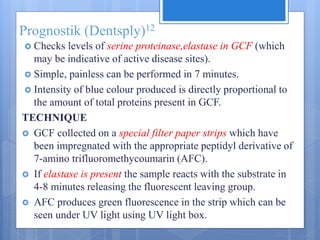
Prognostik (Dentsply)12
 Checks levels of serine proteinase,elastase in GCF (which
may be indicative of active disease sites).
 Simple, painless can be performed in 7 minutes.
 Intensity of blue colour produced is directly proportional to
the amount of total proteins present in GCF.
TECHNIQUE
 GCF collected on a special filter paper strips which have
been impregnated with the appropriate peptidyl derivative of
7-amino trifluoromethycoumarin (AFC).
 If elastase is present the sample reacts with the substrate in
4-8 minutes releasing the fluorescent leaving group.
 AFC produces green fluorescence in the strip which can be
seen under UV light using UV light box.
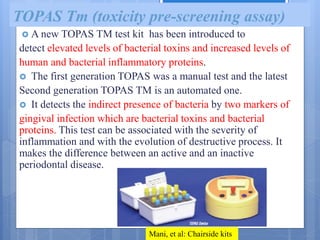
TOPAS Tm (toxicity pre-screening assay)
 A new TOPAS TM test kit has been introduced to
detect elevated levels of bacterial toxins and increased levels of
human and bacterial inflammatory proteins.
 The first generation TOPAS was a manual test and the latest
Second generation TOPAS TM is an automated one.
 It detects the indirect presence of bacteria by two markers of
gingival infection which are bacterial toxins and bacterial
proteins. This test can be associated with the severity of
inflammation and with the evolution of destructive process. It
makes the difference between an active and an inactive
periodontal disease.
Mani, et al: Chairside kits
o It is a simple, painless test which can be performed by any
medical professional in only 7 minutes.
o The intensity of the blue colour produced by the assay is
proportional to the amount of total proteins present in the
GCF.(Puocaou and Dumitriu 2005)
GENETIC Chair
side test kit
Kornman et al 1997
 Found an association between the polymorphism in the
genes encoding IL-1 & increase in severity of periodontitis.10
Periodontal susceptibility test/genetic
susceptibility test
 First and only genetic test that analyses two interleukins
(IL-1α & IL-1β) genes for variations.
 Differentiate between IL-1 genotypes associated with
diverse inflammatory responses with diverse inflammatory
responses to identify subjects at risk for severe periodontitis
even before 60 years of age.
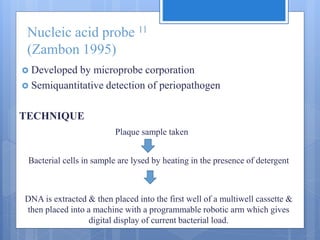
Nucleic acid probe 11
(Zambon 1995)
 Developed by microprobe corporation
 Semiquantitative detection of periopathogen
TECHNIQUE
Plaque sample taken
Bacterial cells in sample are lysed by heating in the presence of detergent
DNA is extracted & then placed into the first well of a multiwell cassette &
then placed into a machine with a programmable robotic arm which gives
digital display of current bacterial load.
DIAGNOSTIC
KITS UNDER
DEVELOPMENT
Beta-glucuronidase
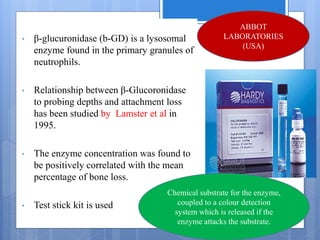
• β-glucuronidase (b-GD) is a lysosomal
enzyme found in the primary granules of
neutrophils.

• Relationship between β-Glucoronidase
to probing depths and attachment loss
has been studied by Lamster et al in
1995.
• The enzyme concentration was found to
be positively correlated with the mean
percentage of bone loss.
• Test stick kit is used
ABBOT
LABORATORIES
(USA)
Chemical substrate for the enzyme,
coupled to a colour detection
system which is released if the
enzyme attacks the substrate.
Cysteine & serine proteinases
 Enzyme System Products/Prototek of Dublin, California
(USA).
 GCF is collected with chromatography filter paper strips.
 Detect proteases in GCF.
 Green fluorescent is produced which can be detected by
UV light.
 Amount of enzyme present is proportional to the intensity
of fluorescence & requires no special apparatus.
Advantage of diagnostic test based on proteolytic
& hydrolytic enzymes
 Convenient
 Can be read within short times.
 Can be shown to the patient.
 Markers are predictors of disease activity.
Disadvantage
 Difficulty in choosing an appropriate biomarker due to insufficient
studies.
 Difficulty in sampling of the sites & the time period of the sample.
 False positive result in Cases of association of a disease with
inflammation
 No account of biological control mechanism which are taken.
 Cost factor
Other diagnostic
aid
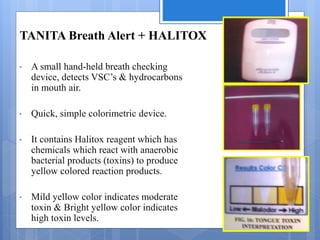
TANITA Breath Alert + HALITOX
• A small hand-held breath checking
device, detects VSC’s & hydrocarbons
in mouth air.
• Quick, simple colorimetric device.
• It contains Halitox reagent which has
chemicals which react with anaerobic
bacterial products (toxins) to produce
yellow colored reaction products.
• Mild yellow color indicates moderate
toxin & Bright yellow color indicates
high toxin levels.
My Perio ID13
This test uses saliva to determine a patient’s genetic susceptibility
to periodontal diseases. It assesses patients which are at higher
risk of more serious periodontal infections. This test requires the
transportation of saliva samples to a laboratory for results.
 Detects (from human DNA) genetic variation/polymorphism
within the IL-1 gene
 IL-1 positive individuals tend to have more aggressive and
more severe infections
 Determines patients that are most susceptible to severe disease,
especially if the patients smoke
 This genetic variation can increase risk for severe disease or
tooth loss by 2–7 times when present.
Electronic Taste Chips14
 They are chemically sensitized bead microreactors within the
lab-on-a-chip system and were applied for measurement of C
reactive protein and other biomarkers of inflammation in saliva.
 The electronic taste chips methodology was compared with the
standard laboratory technology (ELISA) for measuring C
reactive protein in saliva and displayed a 20-fold lower limit of
detection than the ELISA.
 With this technique, it is possible to differentiate in C-reactive
protein levels between healthy individuals and patients with
periodontal diseases quantitatively and can simultaneously
monitor several biomarkers.
Dip Stick Test15
 The matrix metalloproteinase-8 (MMP-8) test stick is based on the
immunochromatography principle that uses two monoclonal antibodies
specific for different epitopes of MMP-8.
 The test stick results can be detected in 5 min.
 The antibody detects both neutrophils and non-PMN-type MMP-8
isoforms.
 The GCF sample collected will be placed in a test tube containing 0.5 ml
of a buffer at pH 7.4.
 When the dip area of dipstick is placed in the extracted sample
the dipstick absorbs liquid, which starts to flow up the dipstick.
 When the sample contains MMP-8, it binds to the antibody attached to the
latex particles. The particles are carried by the liquid flow if MMP-8 is
bound to them; they bind to the catching antibody.
 If the concentration of MMP-8 in the sample exceeds the cutoff value for
the test,a positive line will appear in the result area.
Conclusion
 These recent advances are leading to the development of more
powerful diagnostic tools for practitioners to optimize their
treatment predictability. If a reliable predictive test is developed
then it can be used to predict future periodontal activity & thus
enable administration of the treatments tailored to specific sites
before irreversible damage has occurred. These will provide
practitioners with more effective means of prevention, detection,
& treatment of periodontitis.
REFERENCES
1. Newman Carranza 10th edition.
2. Slots J, Bragd L, Wikström M, Dahlén G. The occurrence of Actinobacillus
actinomycetemcomitans, Bacteroides gingivalis and Bacteroides intermedius in
destructive periodontal disease in adults.
J Clin Periodontol 1986;13:570-7.
3. Sandmeier H, van Winkelhoff AJ, Bär K, Ankli E, Maeder M,Meyer J. Temperate
bacteriophages are common amongActinobacillus actinomycetemcomitans isolates
from periodontal pockets. J Periodontal Res 1995;30:418-25.
4.International Journal of Recent Scientific Research Vol. 7, Issue, 8, pp. 12963-
12969, August, 2016.
5 . Mani A, Anarthe R, Marawar PP, Mustilwar RG, Bhosale A. Diagnostic kits: An
aid to periodontal diagnosis. J Dent Res Rev 2016;3:107-13.
6. Ishihara K, Naito Y, Kato T, Takazoe I, Okuda K,Eguchi T, Nakashima K, Matsuda
N, Yamasaki K,Hasegawa K, Suido H. A sensitive enzymatic method (SK‐013) for
detection and quantification of specific periodontopathogens. Journal of periodontal
research.1992 Mar 1;27(2):81-5.
7.Jervøe‐Storm PM, Koltzscher M, Falk W, Dörfler A, Jepsen S. Comparison of
culture and real‐time PCR for detection and quantification of five putative
periodontopathogenic bacteria in subgingival plaque samples. Journal of clinical
periodontology. 2005 Jul 1;32(7):778-83.
8. Persson GR, Alves ME, Chambers DA, Clark WB, Cohen R, Crawford JM, et al. A
multicenter clinical trial of PerioGard in distinguishing between diseased and healthy
periodontal sites. Study design, methodology and therapeutic outcome. J
ClinPeriodontol 1995;22:794-803. 9.
9. Armitage GC, Jeffcoat MK, Chadwick DE, Taggart EJ Jr., Numabe Y,Landis JR, et
al. Longitudinal evaluation of elastase as a marker forthe progression of periodontitis.
J Periodontol 1994;65:120-8.11
10. Kornman KS, Crane A, Wang HY, Giovlne FS, Newman MG, Pirk FW, Wilson
TG, Higginbottom FL,Duff GW. The interleukin‐1 genotype as a severity factor in
adult periodontal disease. Journal of clinical periodontology. 1997 Jan 1; 24(1):72-7.
11. Zambon JJ, Haraszthy VI. Laboratory diagnosis of periodontal
infections. Periodontology 2000 1995;7:69-82.
12. Eley BM, Cox SW. Advances in periodontal diagnosis 1. Traditional
clinical methods of diagnosis. Br Dent J 1998;184:12-6.
13. Tran J, Malamud D. Salivary diagnostics. Dimens Dent Hyg
2011;9:56-9.
14. Christodoulides N, Mohanty S, Miller CS, Langub MC, Floriano PN,
Dharshan P, et al. Application of microchip assay system for the
measurement of C-reactive protein in human saliva. Lab Chip 2005;5:261-9.
15. Sorsa T, Mäntylä P, Rönkä H, Kallio P, Kallis GB, Lundqvist C, et al.
Scientific basis of a matrix metalloproteinase-8 specific chair-side test for
monitoring periodontal and peri-implant health and disease.Ann N Y Acad Sci
1999;878:130-40.

chairside diagnostic aids

  • 1.
    CHAIR SIDE DIAGNOSTIC AIDSIN PERIODONTAL EXAMINATION Moderator :- Dr.Shivjot Chhina Perceptor :- Dr.Kumar Saurav Presented by:- Dr.Fatima Gilani MDS- (2018-21) SEMINAR-7
  • 2.
    1. Introduction 2. Conventionaldiagnostic aids and its limitations 3. Advanced diagnostic aids 4. Rationale of chair side diagnostic test 5. Microbiological CST 6. Biochemical CST 7. Genetic CST 8. Diagnostic tests under development. 9. Other CST 10. Conclusion. CONTENTS
  • 3.
    INTRODUCTION  Periodontal diseasesare conventionally diagnosed by clinical evaluation of signs of inflammation & periodontal tissue destruction. Traditional methods of diagnosis CLINICAL RADIOGRAPHIC Both attempts to identify & quantify current clinical signs of inflammation as well as historic evidence of damage with its extent & severity
  • 4.
    Limitations of traditionalmethods of diagnosis 1. Cannot reliably identify sites with ongoing periodontal destruction. 2. Does not provide information on the cause of the condition on the patient’s susceptibility to disease, whether the disease is progressing, its remission & its response to therapy. 3. Any force >0.25 N may evoke bleeding in healthy sites (Lang et al) 4. Tobacco smoking masks inflammatory signs in gingivitis and periodontitis. 5. Substantial volumes of alveolar bone must be destroyed before the loss is detectable in radiographs. (Goodson, Haffajee, Socransky 1984)
  • 5.
    ADVANCES IN DIAGNOSIS Thermalprobes for measuring early inflammatory changes (Kung et al) Example- Periotemp probe (Abiodent) Diagnostic Subtraction Radiography, CADIA Advances in bacterial culturing e.g-ELISA, Flow cytometry etc
  • 6.
    CHAIRSIDE KIT MEANSSIMPLIFIED TEST KIT INVOLVES NO SPECIALIZED EQUIPMENT & EASY TO READ S H O U L D PROVIDE IMMEDIATE REPORTS OF THE MICROFLORAASSOCIATED WITH THE DISEASE COMPARED TO TIME CONSUMING TRADITIONAL LABORATORY METHODS
  • 7.
  • 8.
    Microbiology  Subgingival microenvironmenthas 300+ species  The main bacteria associated with periodontal disease are Actinomycetemcomitans (Aa), Porphyromonas gingivalis (Pg), Prevotella intermedia (Pi) and Tannerella forsythia (Tf). (Slots, Bragd, Wikstrom, 1986)  Other organisms that are thought to have etiologic role are Camphylobacter rectus, Eubacterium nodatum, Fusobacterium nucleatum, Peptostreptococcus micros, and Prevotella nigrescens, Trepenoma denticola.2,3
  • 9.
    Method of collectionof microbiological samples International Journal of Recent Scientific Research Vol. 7, Issue, 8, pp. 12963-12969, August, 2016
  • 10.
    1. Bana 2. Evalusite 3.Omnigene 4. Perio-2000 5. Perioscan 6. Meridol periodiagnostics MICROBIOLOGIC TEST KITS
  • 11.
    BANA4  N-Benzoyl-DL-Arginine-2-Napthylamide  Rapidand reliable CST  Can perform test in 15 minutes  Pg, Td, Tf have unique ability of hydrolysing trypsin substrate. Presence of negative result means:-  Improper sample collection  Disease is associated with the presence of non-BANA organism.
  • 12.
  • 13.
    Evalusite4 1. Evalusite isa diagnostic kit that is based on a novel membrane- based enzyme immunoassay for the detection of three putative periodontopathogens: Aa, Pg and Pi. 2. A paper point subgingival plaque sample is collected and added to a sample tube. 3. The sample is placed within the kit, which employs a sandwich- type ELISA (enzyme-linked immunosorbent)and a pink spot is displayed if the test organism is present.
  • 14.
  • 15.
    Omnigene4 (Backman,Van, Arsdal,1996)  DNAProbe for subgingival bacteria.  Subgingival plaque is obtained on a paper and placed it in the container and assayed.  Available for the detection of P.gingivalis, P.intermedia, A.acinomycetemcomitans, F.nucleatum, E.corrodens, T.denticola, T.pectinovorum and C.recta.
  • 16.
    Perio 20005  Consistof diamond probe which determines sulphide levels digitally at each site.  Td, Pg, Pi, Tf – produce sulfates  These VSC degrade periodontal structure aggravating periodontitis.  It is intended to measure probing depths, to evaluate the presence or absence of bleeding or probing, as well as to detect the presence of sulfides in periodontal pockets.
  • 17.
    Technique Probe tip shouldbe hydrated using sterile wash solution provided by the manufacturer & then inserted subgingivally at peak or hold operational mode, after a positive reading, the tip is washed & reinserted in other subgingival sites.
  • 18.
    Perioscan6  PERIOSCAN isa chair side test kit system which uses the BANA test for bacterial trypsin-like proteases.  mainly produced by P.gingivalis, but lesser amounts are also produced by T.forsythia and T.denticola.  The PERIOSCAN works by detecting the activity of this enzyme and it can be measured with the hydrolysis of the colourless substrate N-benzoyl-dL arginine-2-naphthylamide.  When the hydrolysis takes place, it releases the chromophore β -naphthylamide, which turns orange red when a drop of Fast Garnet added to the solution.  The system is particularly simple to use. This method has recently been made more sensitive.(Ishihara et al. 1992)
  • 19.
    Meridol Periodiagnostics7 Jervoe-storm etal (2005)  Real time PCR for quantitative determination of 6 important marker organisms of periodontitis and peri- implantitis (Aa, Pg, Td, Fn, Tf, Pi)  It combines high specificity with high sensitivity and a precise quantification.
  • 20.
    Biochemical cst 1. Periogard 2.Pocketwatch 3. Periocheck 4. Prognostick
  • 21.
    Gingival crevicular fluid Collected with paper strips, micro papillary tubes, micropipettes, microsyringes, plastic strips. Saliva • It is the next most used after GCF -easily collected Collected from parotid, sub-mand or sub lingual or as ‘Whole saliva’ (secretions of major and minor salivary glands,No diagnostic test available in the market although lot of research is in progress. Markers to look for in saliva: proteins and enzymes from host, phenotypic markers, host cells, hormones, bacteria, bacterial products, volatile compounds, and ions.
  • 22.
    Different enzymes involvedin both the intracellular & extracellular pathway of tissue destruction. Intracellular destruction enzyme:- 1. Aspartate aminotransferase 2. Alkaline phosphate 3. Beta glucoronidase 4. Elastase Released from dead & dying cells of PDL Mostly from PMNs ,neutrophils. • Extracellular destruction enzyme Matrix metalloproteinases- produced by inflammatory epithelial & connective tissue cells at affected sites.
  • 23.
    Aspartate aminotransferase (AST) Released from dead cells  Elevated in GCF in periodontal disease.  Periogard and Pocket watch commercially available colorimetric test.
  • 24.
    Periogard  Detect AST GCF sample is obtained on a strip and placed into a suitable test well with two drops of each reagent, positive & negative, control wells are prepared using strips provided.8  The test results can be visually appreciated by comparing the test well colour to the colour of the positive control.  A colour of greater intensity to that of the negative control is scored as positive and one of lesser or equal intensity as a negative result
  • 25.
    Pocket watch6  Samplepaper strip is placed in a well on the reagent coated test tray that is a part of pocket watch kit & 1 drop of AST positive control solution is added to another non-sample well.  The tray is incubated for 10 minutes at room temperature for color development.  If the GCF sample after incubation shows the same color or lighter color than AST positive control it is given a score of 2.  A sample is given a score of 1 if its color is same as or lighter than AST standard sample.  A score of 0 is given if it is darker than AST standard sample.
  • 26.
    Periocheck (Actechinc.usa)10  Theconnective tissue of periodontium is composed of fibrous (collagen & elastin)&non fibrous (glycoproteins),water etc.  In periodontitis ,elevated level of hydroxyproline from collagen breakdown & glycosaminoglycans from matrix degradation. Checks neutral proteases in GCF such as Elastase, Proteinases & Collagenases by releasing a blue colour dye intensity of which is proportional to the amount of enzyme present in the sample
  • 27.
    Prognostik (Dentsply)12  Checkslevels of serine proteinase,elastase in GCF (which may be indicative of active disease sites).  Simple, painless can be performed in 7 minutes.  Intensity of blue colour produced is directly proportional to the amount of total proteins present in GCF. TECHNIQUE  GCF collected on a special filter paper strips which have been impregnated with the appropriate peptidyl derivative of 7-amino trifluoromethycoumarin (AFC).  If elastase is present the sample reacts with the substrate in 4-8 minutes releasing the fluorescent leaving group.  AFC produces green fluorescence in the strip which can be seen under UV light using UV light box.
  • 29.
    TOPAS Tm (toxicitypre-screening assay)  A new TOPAS TM test kit has been introduced to detect elevated levels of bacterial toxins and increased levels of human and bacterial inflammatory proteins.  The first generation TOPAS was a manual test and the latest Second generation TOPAS TM is an automated one.  It detects the indirect presence of bacteria by two markers of gingival infection which are bacterial toxins and bacterial proteins. This test can be associated with the severity of inflammation and with the evolution of destructive process. It makes the difference between an active and an inactive periodontal disease. Mani, et al: Chairside kits
  • 30.
    o It isa simple, painless test which can be performed by any medical professional in only 7 minutes. o The intensity of the blue colour produced by the assay is proportional to the amount of total proteins present in the GCF.(Puocaou and Dumitriu 2005)
  • 31.
  • 32.
    Kornman et al1997  Found an association between the polymorphism in the genes encoding IL-1 & increase in severity of periodontitis.10
  • 33.
    Periodontal susceptibility test/genetic susceptibilitytest  First and only genetic test that analyses two interleukins (IL-1α & IL-1β) genes for variations.  Differentiate between IL-1 genotypes associated with diverse inflammatory responses with diverse inflammatory responses to identify subjects at risk for severe periodontitis even before 60 years of age.
  • 34.
    Nucleic acid probe11 (Zambon 1995)  Developed by microprobe corporation  Semiquantitative detection of periopathogen TECHNIQUE Plaque sample taken Bacterial cells in sample are lysed by heating in the presence of detergent DNA is extracted & then placed into the first well of a multiwell cassette & then placed into a machine with a programmable robotic arm which gives digital display of current bacterial load.
  • 35.
  • 36.
    Beta-glucuronidase • β-glucuronidase (b-GD)is a lysosomal enzyme found in the primary granules of neutrophils. • Relationship between β-Glucoronidase to probing depths and attachment loss has been studied by Lamster et al in 1995. • The enzyme concentration was found to be positively correlated with the mean percentage of bone loss. • Test stick kit is used ABBOT LABORATORIES (USA) Chemical substrate for the enzyme, coupled to a colour detection system which is released if the enzyme attacks the substrate.
  • 37.
    Cysteine & serineproteinases  Enzyme System Products/Prototek of Dublin, California (USA).  GCF is collected with chromatography filter paper strips.  Detect proteases in GCF.  Green fluorescent is produced which can be detected by UV light.  Amount of enzyme present is proportional to the intensity of fluorescence & requires no special apparatus.
  • 38.
    Advantage of diagnostictest based on proteolytic & hydrolytic enzymes  Convenient  Can be read within short times.  Can be shown to the patient.  Markers are predictors of disease activity. Disadvantage  Difficulty in choosing an appropriate biomarker due to insufficient studies.  Difficulty in sampling of the sites & the time period of the sample.  False positive result in Cases of association of a disease with inflammation  No account of biological control mechanism which are taken.  Cost factor
  • 39.
  • 40.
    TANITA Breath Alert+ HALITOX • A small hand-held breath checking device, detects VSC’s & hydrocarbons in mouth air. • Quick, simple colorimetric device. • It contains Halitox reagent which has chemicals which react with anaerobic bacterial products (toxins) to produce yellow colored reaction products. • Mild yellow color indicates moderate toxin & Bright yellow color indicates high toxin levels.
  • 41.
    My Perio ID13 Thistest uses saliva to determine a patient’s genetic susceptibility to periodontal diseases. It assesses patients which are at higher risk of more serious periodontal infections. This test requires the transportation of saliva samples to a laboratory for results.  Detects (from human DNA) genetic variation/polymorphism within the IL-1 gene  IL-1 positive individuals tend to have more aggressive and more severe infections  Determines patients that are most susceptible to severe disease, especially if the patients smoke  This genetic variation can increase risk for severe disease or tooth loss by 2–7 times when present.
  • 42.
    Electronic Taste Chips14 They are chemically sensitized bead microreactors within the lab-on-a-chip system and were applied for measurement of C reactive protein and other biomarkers of inflammation in saliva.  The electronic taste chips methodology was compared with the standard laboratory technology (ELISA) for measuring C reactive protein in saliva and displayed a 20-fold lower limit of detection than the ELISA.  With this technique, it is possible to differentiate in C-reactive protein levels between healthy individuals and patients with periodontal diseases quantitatively and can simultaneously monitor several biomarkers.
  • 43.
    Dip Stick Test15 The matrix metalloproteinase-8 (MMP-8) test stick is based on the immunochromatography principle that uses two monoclonal antibodies specific for different epitopes of MMP-8.  The test stick results can be detected in 5 min.  The antibody detects both neutrophils and non-PMN-type MMP-8 isoforms.  The GCF sample collected will be placed in a test tube containing 0.5 ml of a buffer at pH 7.4.  When the dip area of dipstick is placed in the extracted sample the dipstick absorbs liquid, which starts to flow up the dipstick.  When the sample contains MMP-8, it binds to the antibody attached to the latex particles. The particles are carried by the liquid flow if MMP-8 is bound to them; they bind to the catching antibody.  If the concentration of MMP-8 in the sample exceeds the cutoff value for the test,a positive line will appear in the result area.
  • 44.
    Conclusion  These recentadvances are leading to the development of more powerful diagnostic tools for practitioners to optimize their treatment predictability. If a reliable predictive test is developed then it can be used to predict future periodontal activity & thus enable administration of the treatments tailored to specific sites before irreversible damage has occurred. These will provide practitioners with more effective means of prevention, detection, & treatment of periodontitis.
  • 45.
    REFERENCES 1. Newman Carranza10th edition. 2. Slots J, Bragd L, Wikström M, Dahlén G. The occurrence of Actinobacillus actinomycetemcomitans, Bacteroides gingivalis and Bacteroides intermedius in destructive periodontal disease in adults. J Clin Periodontol 1986;13:570-7. 3. Sandmeier H, van Winkelhoff AJ, Bär K, Ankli E, Maeder M,Meyer J. Temperate bacteriophages are common amongActinobacillus actinomycetemcomitans isolates from periodontal pockets. J Periodontal Res 1995;30:418-25. 4.International Journal of Recent Scientific Research Vol. 7, Issue, 8, pp. 12963- 12969, August, 2016. 5 . Mani A, Anarthe R, Marawar PP, Mustilwar RG, Bhosale A. Diagnostic kits: An aid to periodontal diagnosis. J Dent Res Rev 2016;3:107-13.
  • 46.
    6. Ishihara K,Naito Y, Kato T, Takazoe I, Okuda K,Eguchi T, Nakashima K, Matsuda N, Yamasaki K,Hasegawa K, Suido H. A sensitive enzymatic method (SK‐013) for detection and quantification of specific periodontopathogens. Journal of periodontal research.1992 Mar 1;27(2):81-5. 7.Jervøe‐Storm PM, Koltzscher M, Falk W, Dörfler A, Jepsen S. Comparison of culture and real‐time PCR for detection and quantification of five putative periodontopathogenic bacteria in subgingival plaque samples. Journal of clinical periodontology. 2005 Jul 1;32(7):778-83. 8. Persson GR, Alves ME, Chambers DA, Clark WB, Cohen R, Crawford JM, et al. A multicenter clinical trial of PerioGard in distinguishing between diseased and healthy periodontal sites. Study design, methodology and therapeutic outcome. J ClinPeriodontol 1995;22:794-803. 9. 9. Armitage GC, Jeffcoat MK, Chadwick DE, Taggart EJ Jr., Numabe Y,Landis JR, et al. Longitudinal evaluation of elastase as a marker forthe progression of periodontitis. J Periodontol 1994;65:120-8.11 10. Kornman KS, Crane A, Wang HY, Giovlne FS, Newman MG, Pirk FW, Wilson TG, Higginbottom FL,Duff GW. The interleukin‐1 genotype as a severity factor in adult periodontal disease. Journal of clinical periodontology. 1997 Jan 1; 24(1):72-7.
  • 47.
    11. Zambon JJ,Haraszthy VI. Laboratory diagnosis of periodontal infections. Periodontology 2000 1995;7:69-82. 12. Eley BM, Cox SW. Advances in periodontal diagnosis 1. Traditional clinical methods of diagnosis. Br Dent J 1998;184:12-6. 13. Tran J, Malamud D. Salivary diagnostics. Dimens Dent Hyg 2011;9:56-9. 14. Christodoulides N, Mohanty S, Miller CS, Langub MC, Floriano PN, Dharshan P, et al. Application of microchip assay system for the measurement of C-reactive protein in human saliva. Lab Chip 2005;5:261-9. 15. Sorsa T, Mäntylä P, Rönkä H, Kallio P, Kallis GB, Lundqvist C, et al. Scientific basis of a matrix metalloproteinase-8 specific chair-side test for monitoring periodontal and peri-implant health and disease.Ann N Y Acad Sci 1999;878:130-40.