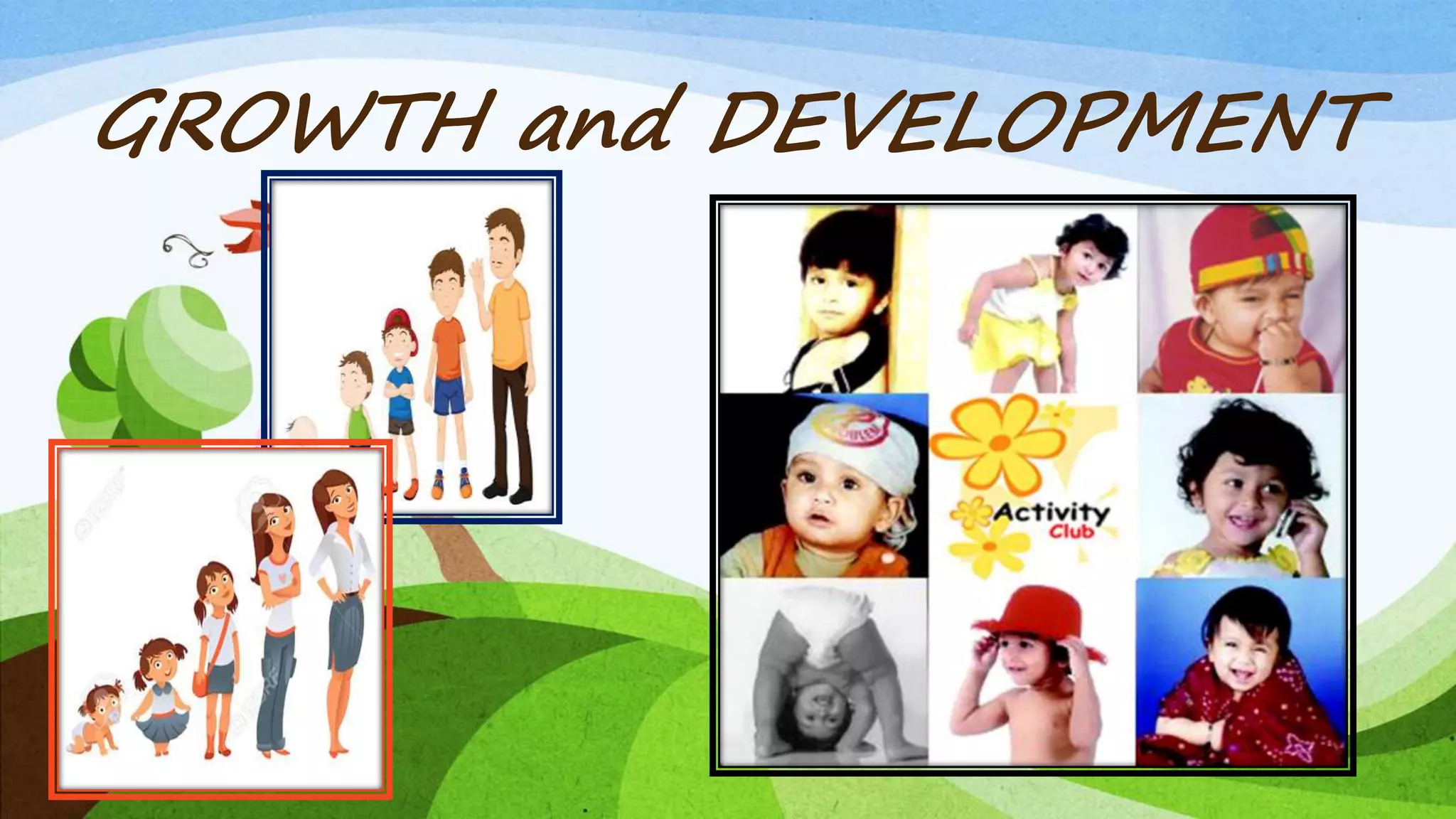
GROWTH and DEVELOPMENT
Activity
HEALTH CHECK!
This activity will check on how
well YOU practice healthy
habits to achieve holistic
health.
1. Read each statement very carefully
2. Put a check (√) mark if the
statement relates to your practice or
habit and X if it does not.
3. Copy the chart in your notebook.
• Procedure
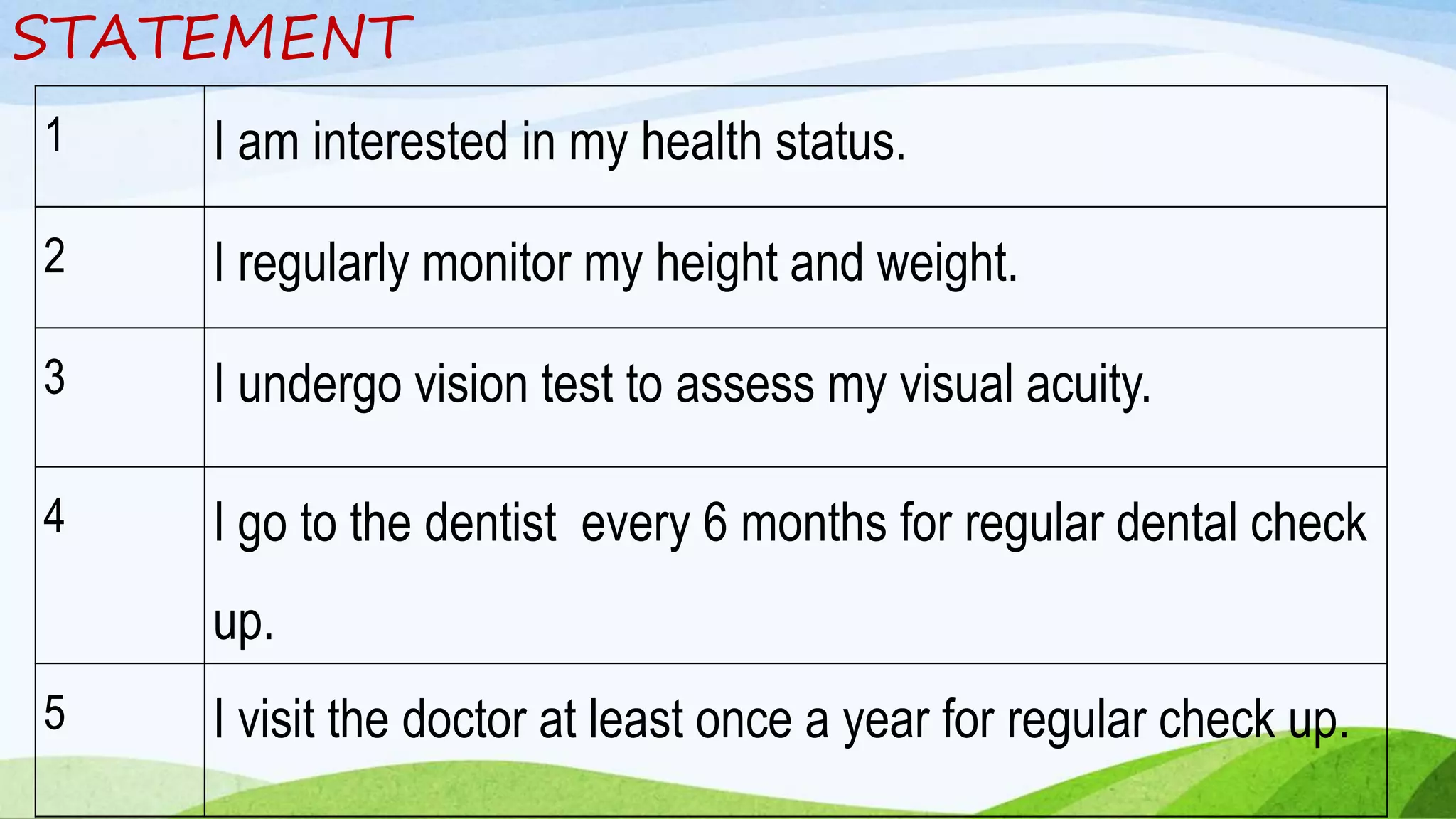
STATEMENT
1 I am interested in my health status.
2 I regularly monitor my height and weight.
3 I undergo vision test to assess my visual acuity.
4 I go to the dentist every 6 months for regular dental check
up.
5 I visit the doctor at least once a year for regular check up.
health.
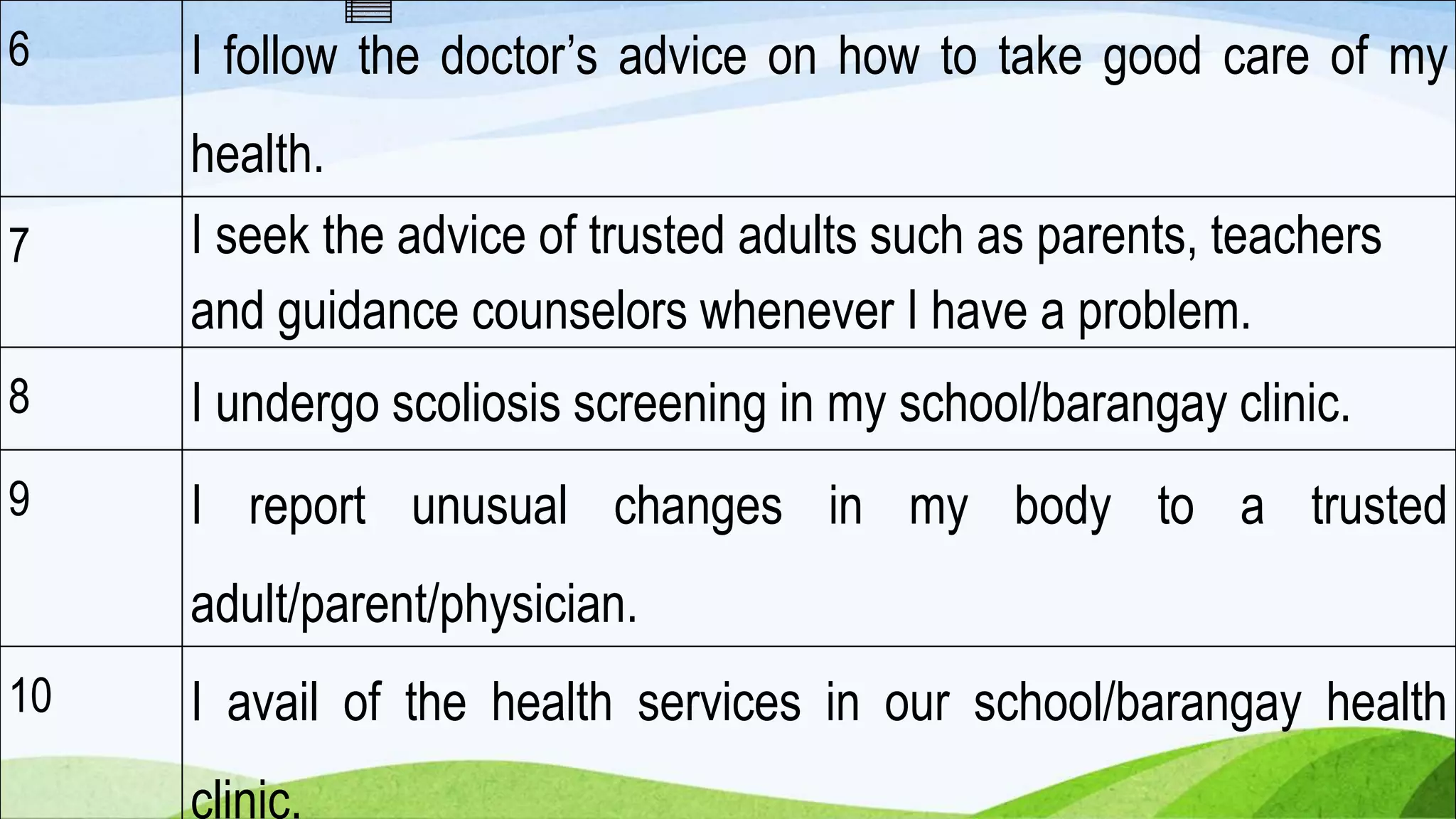
7 I seek the advice of trusted adults such as parents, teachers
and guidance counselors whenever I have a problem.
8 I undergo scoliosis screening in my school/barangay clinic.
9 I report unusual changes in my body to a trusted
adult/parent/physician.
10 I avail of the heal th ser vices in our school/barangay health
clinic.
6 I follow the doctor’s advice on how to take good care of my
health.
7 I seek the advice of trusted adults such as parents, teachers
and guidance counselors whenever I have a problem.
8 I undergo scoliosis screening in my school/barangay clinic.
9 I report unusual changes in my body to a trusted
adult/parent/physician.
10 I avail of the health services in our school/barangay health
clinic.
 The total number of
checkmarks indicate the level
of your health interest and
practices.
• Evaluation
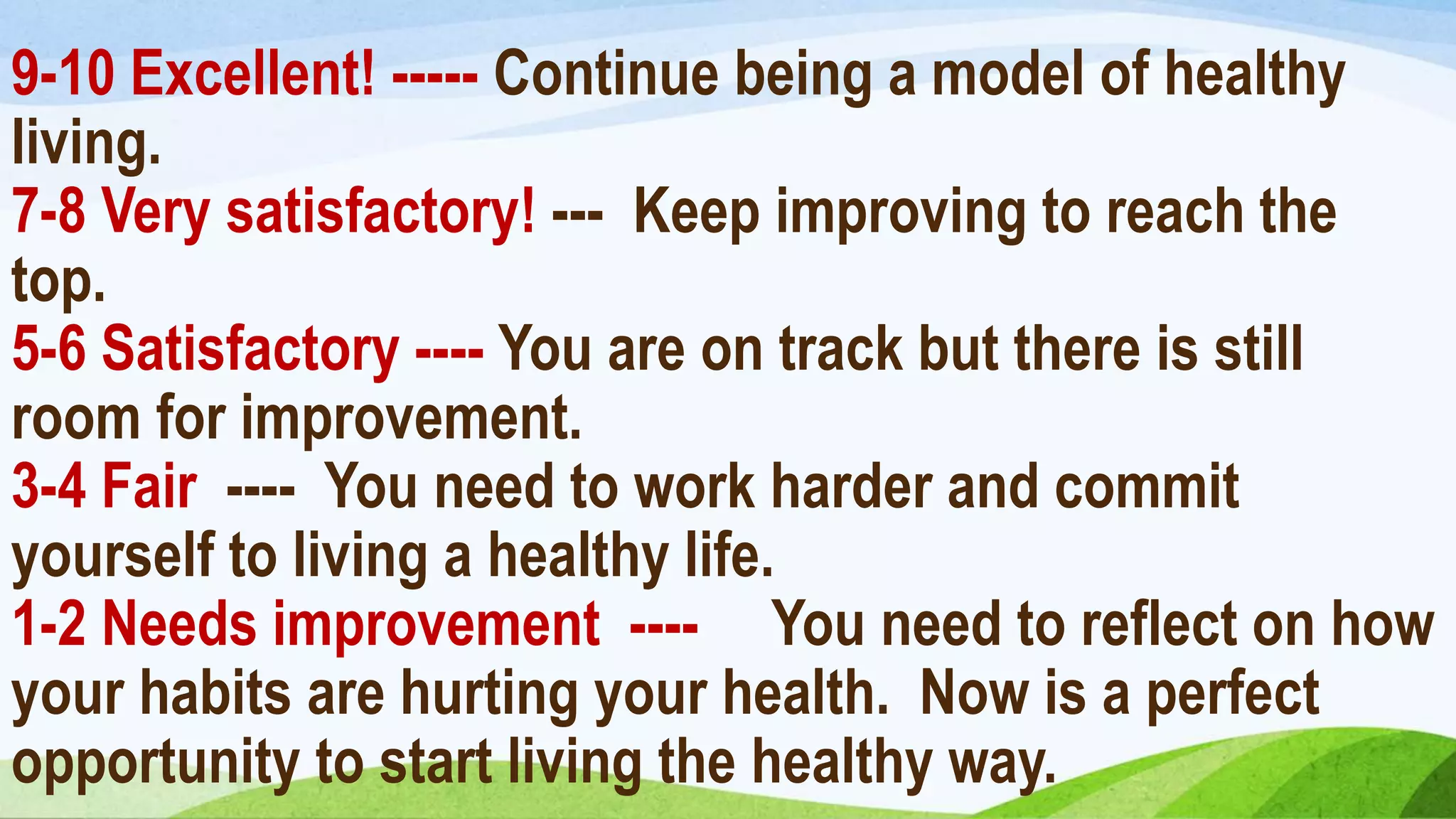
9-10 Excellent! ----- Continue being a model of healthy
living.
7-8 Very satisfactory! --- Keep improving to reach the
top.
5-6 Satisfactory ---- You are on track but there is still
room for improvement.
3-4 Fair ---- You need to work harder and commit
yourself to living a healthy life.
1-2 Needs improvement ---- You need to reflect on how
your habits are hurting your health. Now is a perfect
opportunity to start living the healthy way.
 Human development is a
lifelong process of physical,
mental, emotional, social,
moral-spiritual and
environmental growth and
change.
 In the early stages of life, from
babyhood to childhood,
childhood to adolescence, and
adolescence to adulthood—great
changes take place.
 Throughout the process, each
person develops attitudes and
values that guide choices,
relationships, and
understanding.
 A developmental psychologist Erik
H. Erikson in his theory on social
development of human beings
describes eight stages through which
a healthily developing human should
pass from infancy to late adulthood.
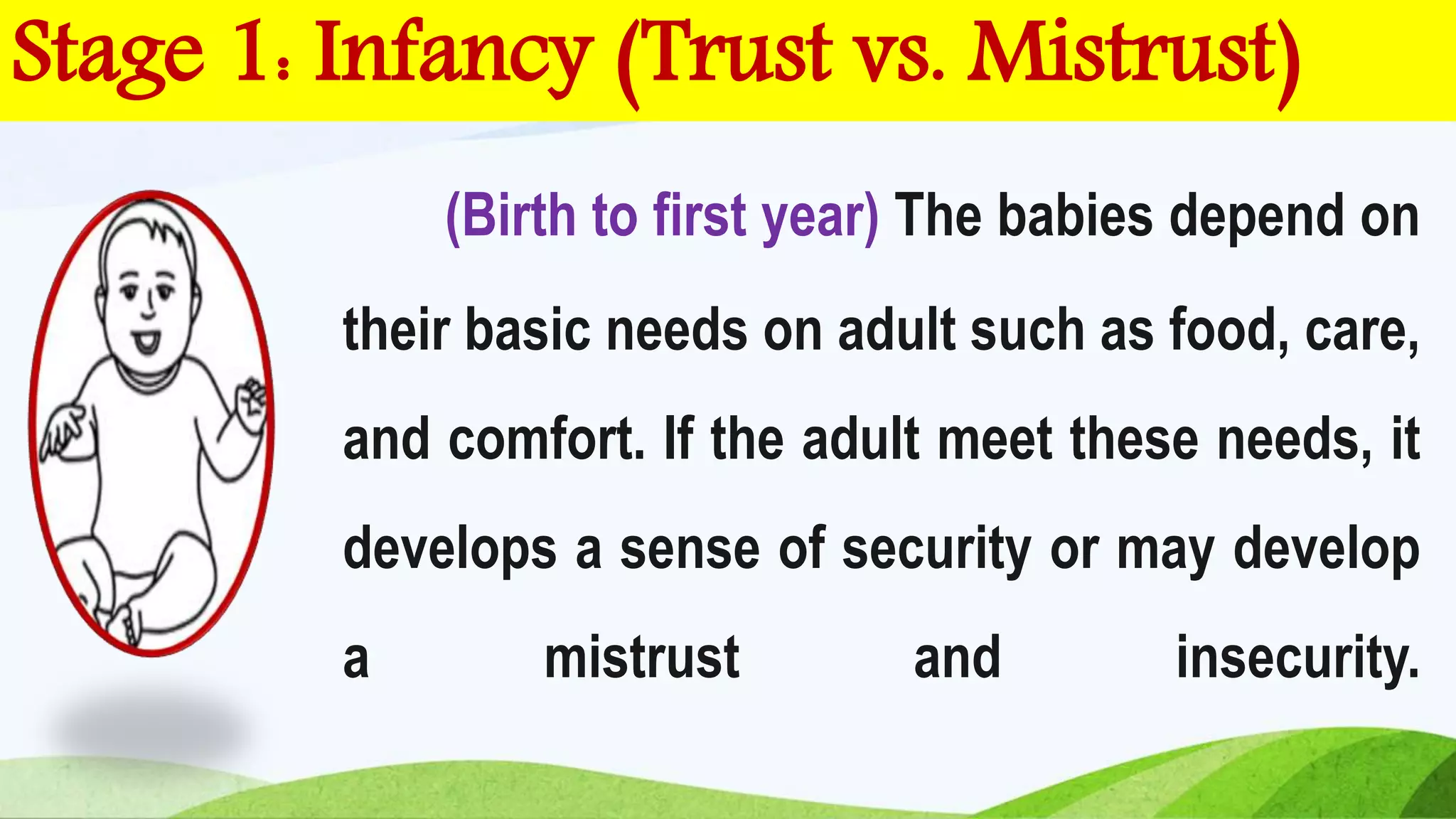
(Birth to first year) The babies depend on
their basic needs on adult such as food, care,
and comfort. If the adult meet these needs, it
develops a sense of security or may develop
a mistrust and insecurity.
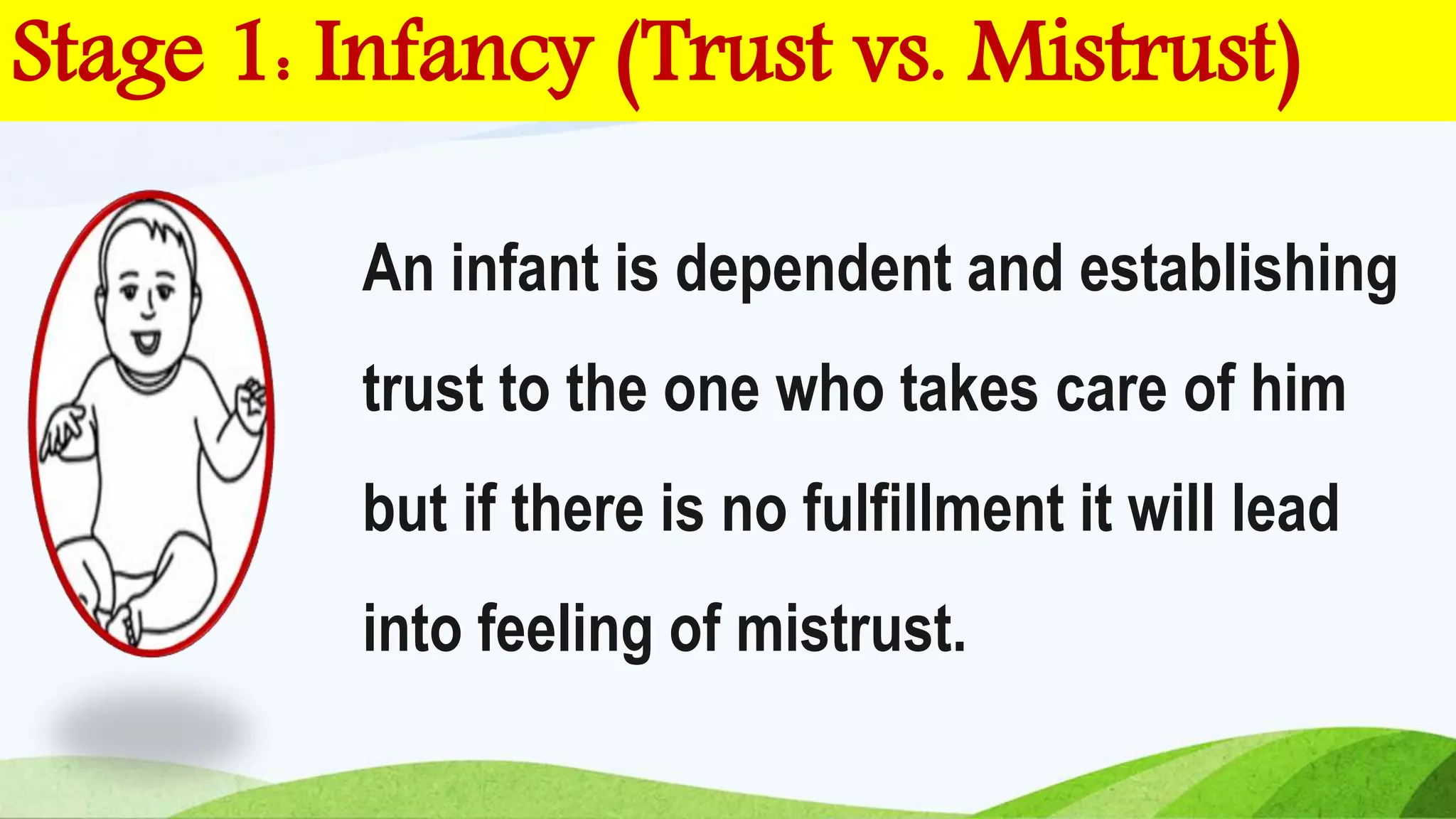
Stage 1: Infancy (Trust vs. Mistrust)
An infant is dependent and establishing
trust to the one who takes care of him
but if there is no fulfillment it will lead
into feeling of mistrust.
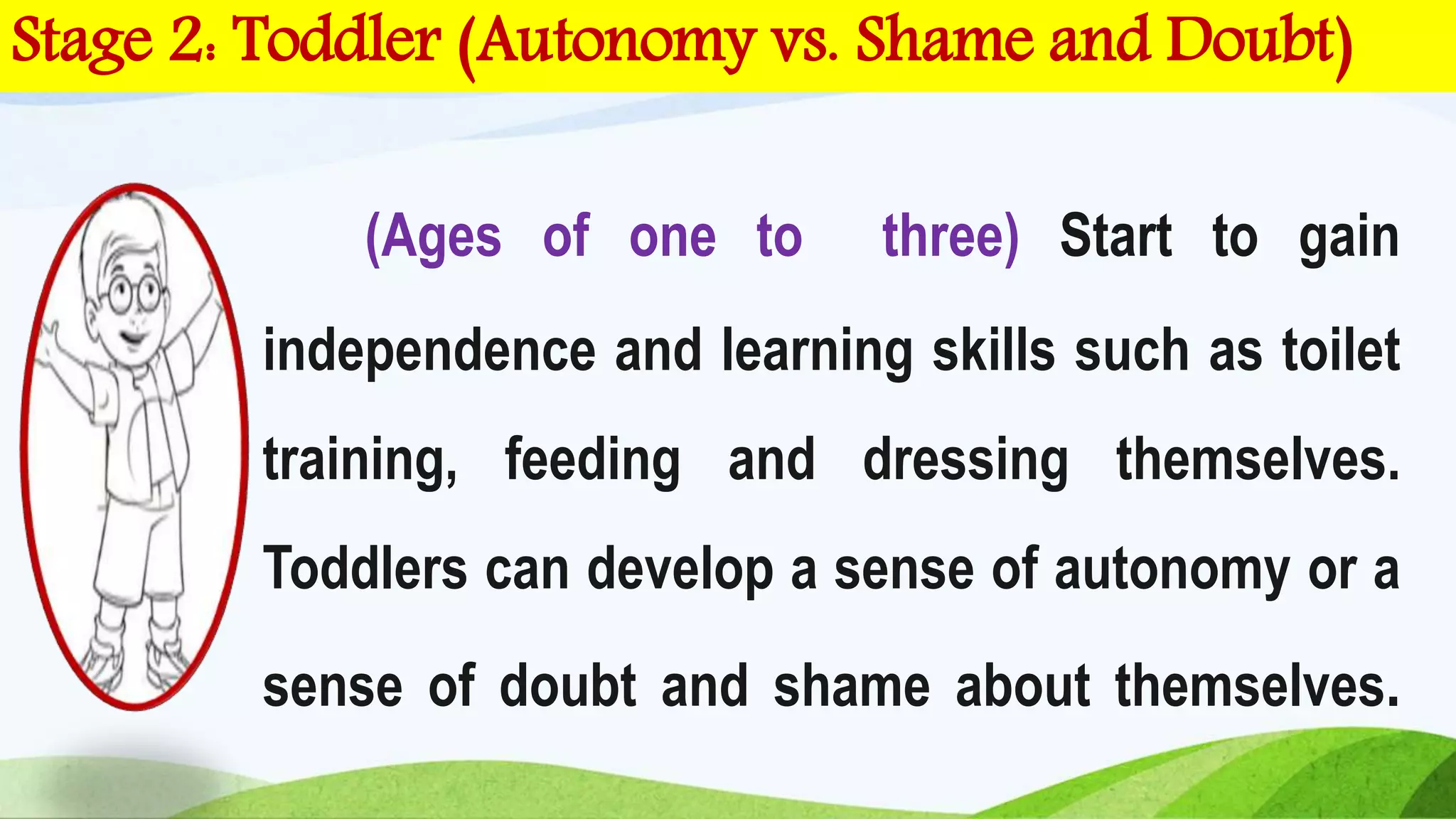
(Ages of one to three) Start to gain
independence and learning skills such as toilet
training, feeding and dressing themselves.
Toddlers can develop a sense of autonomy or a
sense of doubt and shame about themselves.
Stage 2: Toddler (Autonomy vs. Shame and Doubt)
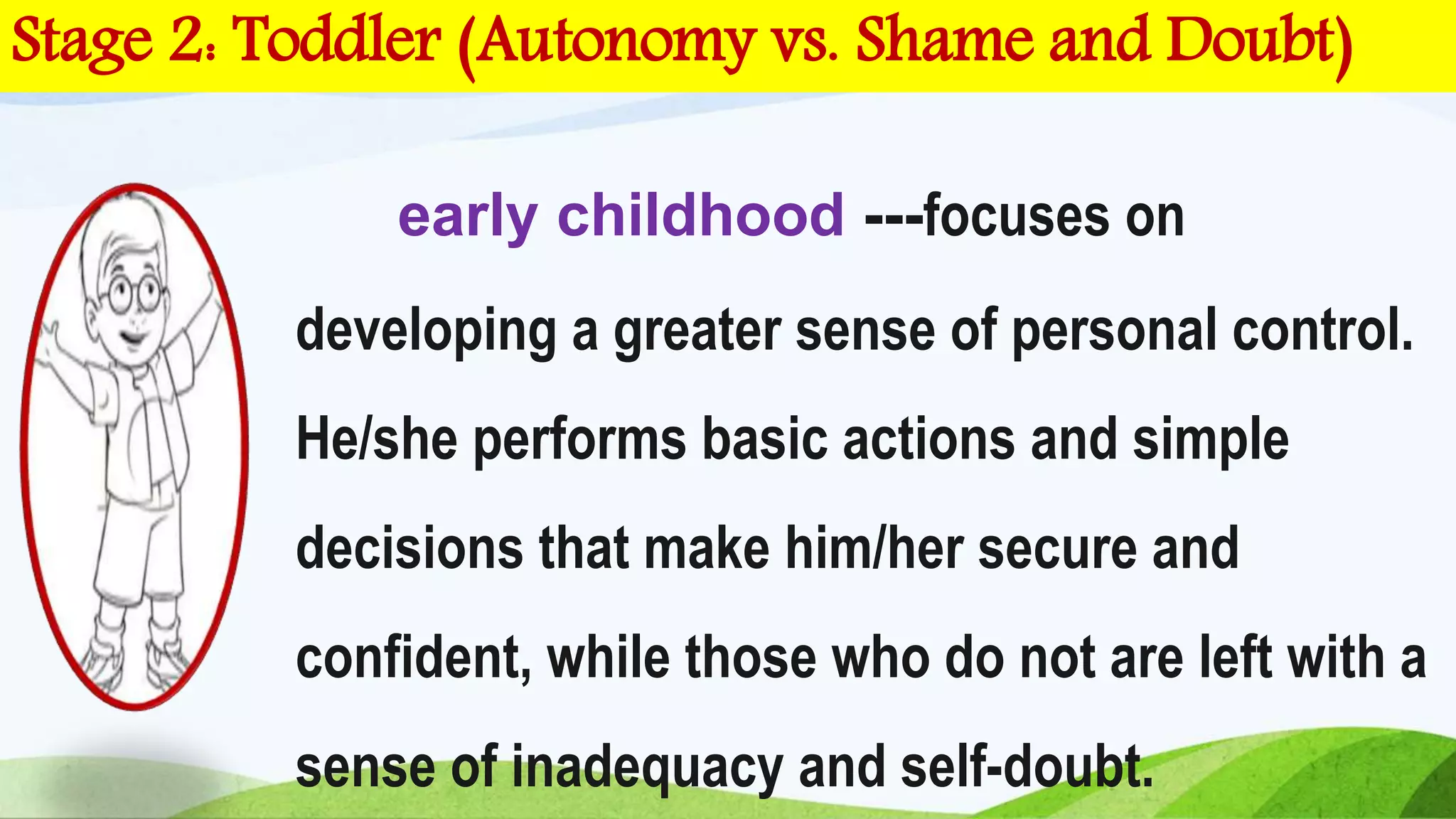
early childhood ---focuses on
developing a greater sense of personal control.
He/she performs basic actions and simple
decisions that make him/her secure and
confident, while those who do not are left with a
sense of inadequacy and self-doubt.
Stage 2: Toddler (Autonomy vs. Shame and Doubt)
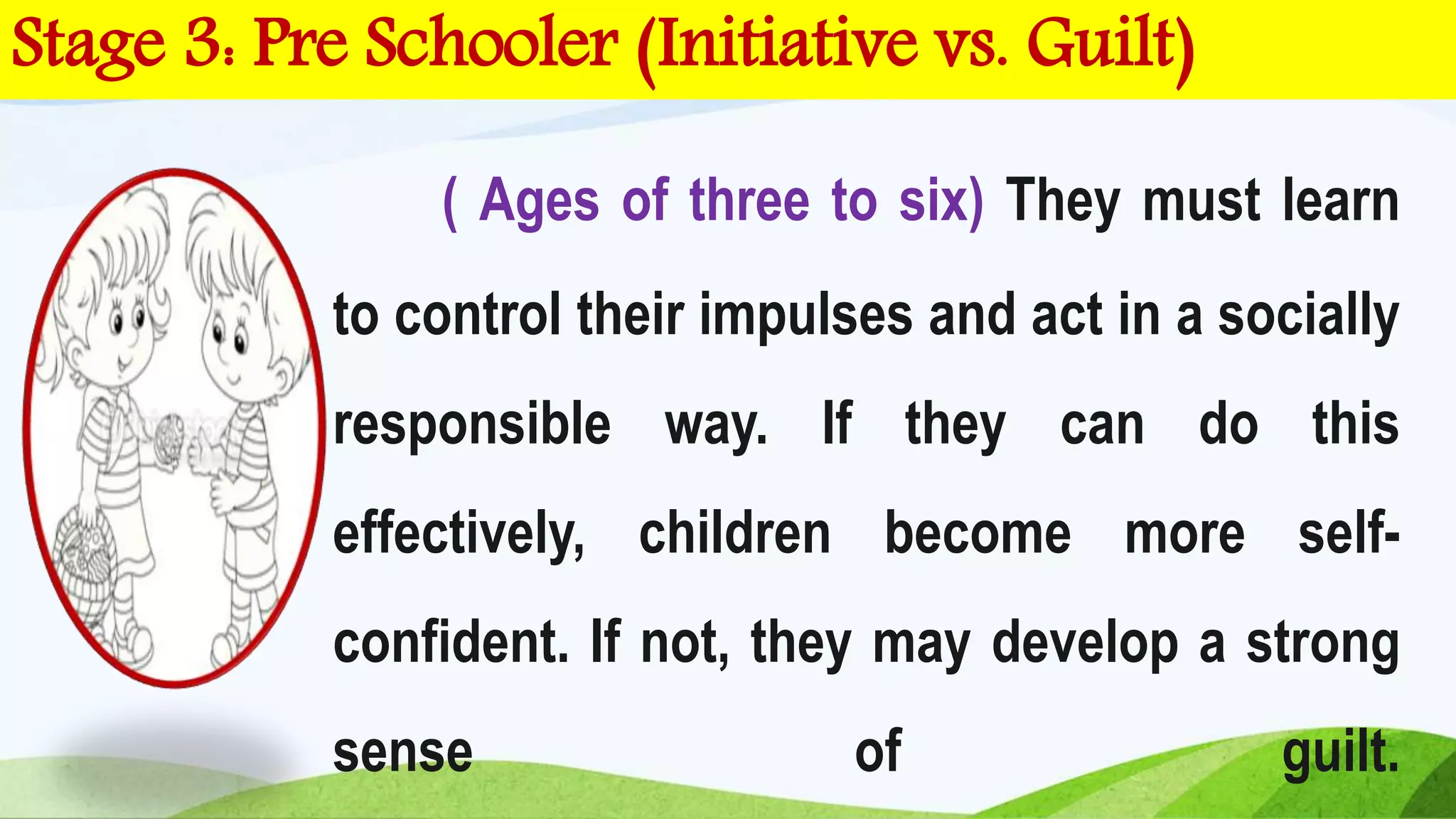
( Ages of three to six) They must learn
to control their impulses and act in a socially
responsible way. If they can do this
effectively, children become more self-
confident. If not, they may develop a strong
sense of guilt.
Stage 3: Pre Schooler (Initiative vs. Guilt)
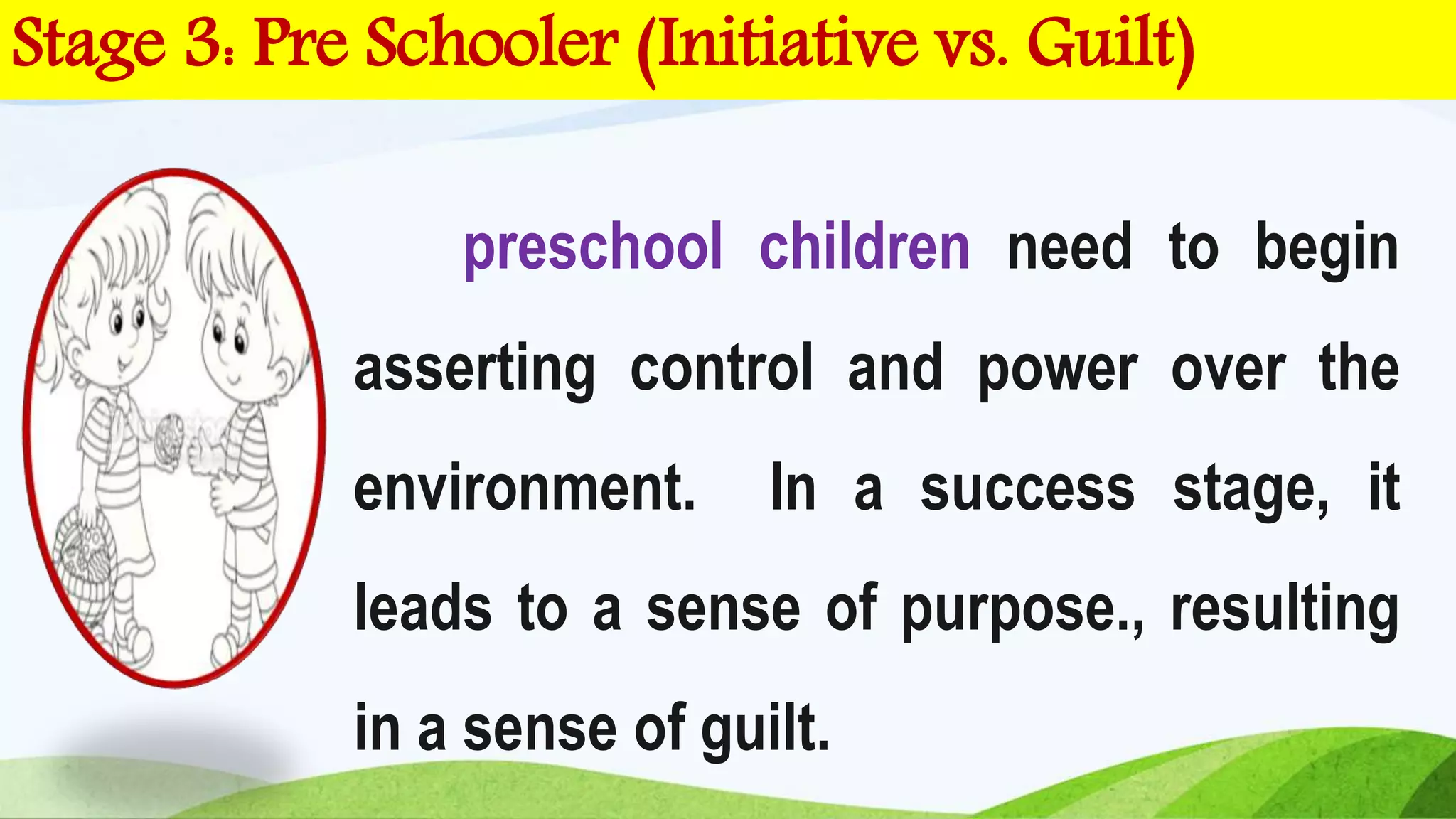
preschool children need to begin
asserting control and power over the
environment. In a success stage, it
leads to a sense of purpose., resulting
in a sense of guilt.
Stage 3: Pre Schooler (Initiative vs. Guilt)
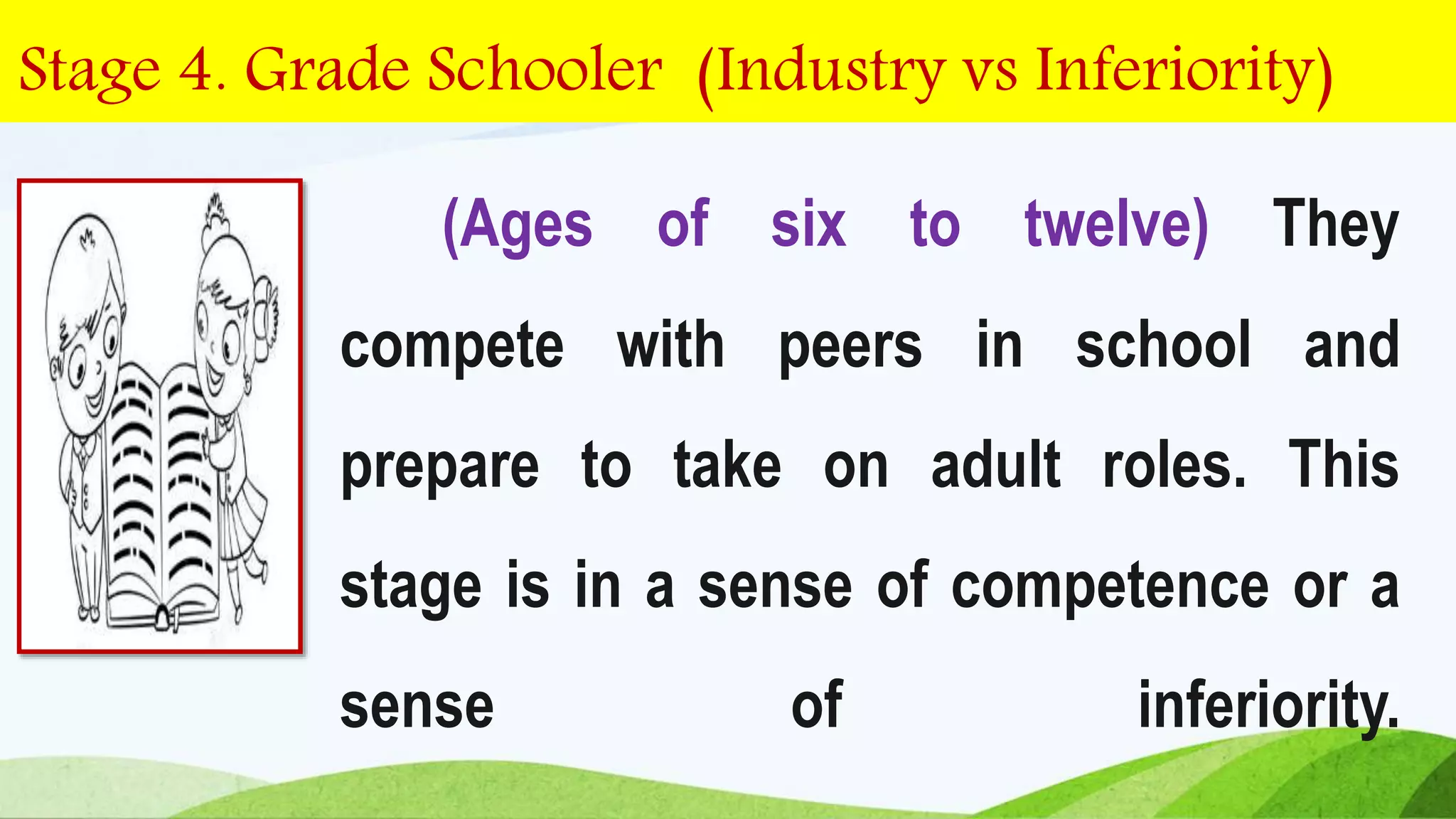
(Ages of six to twelve) They
compete with peers in school and
prepare to take on adult roles. This
stage is in a sense of competence or a
sense of inferiority.
Stage 4. Grade Schooler (Industry vs Inferiority)
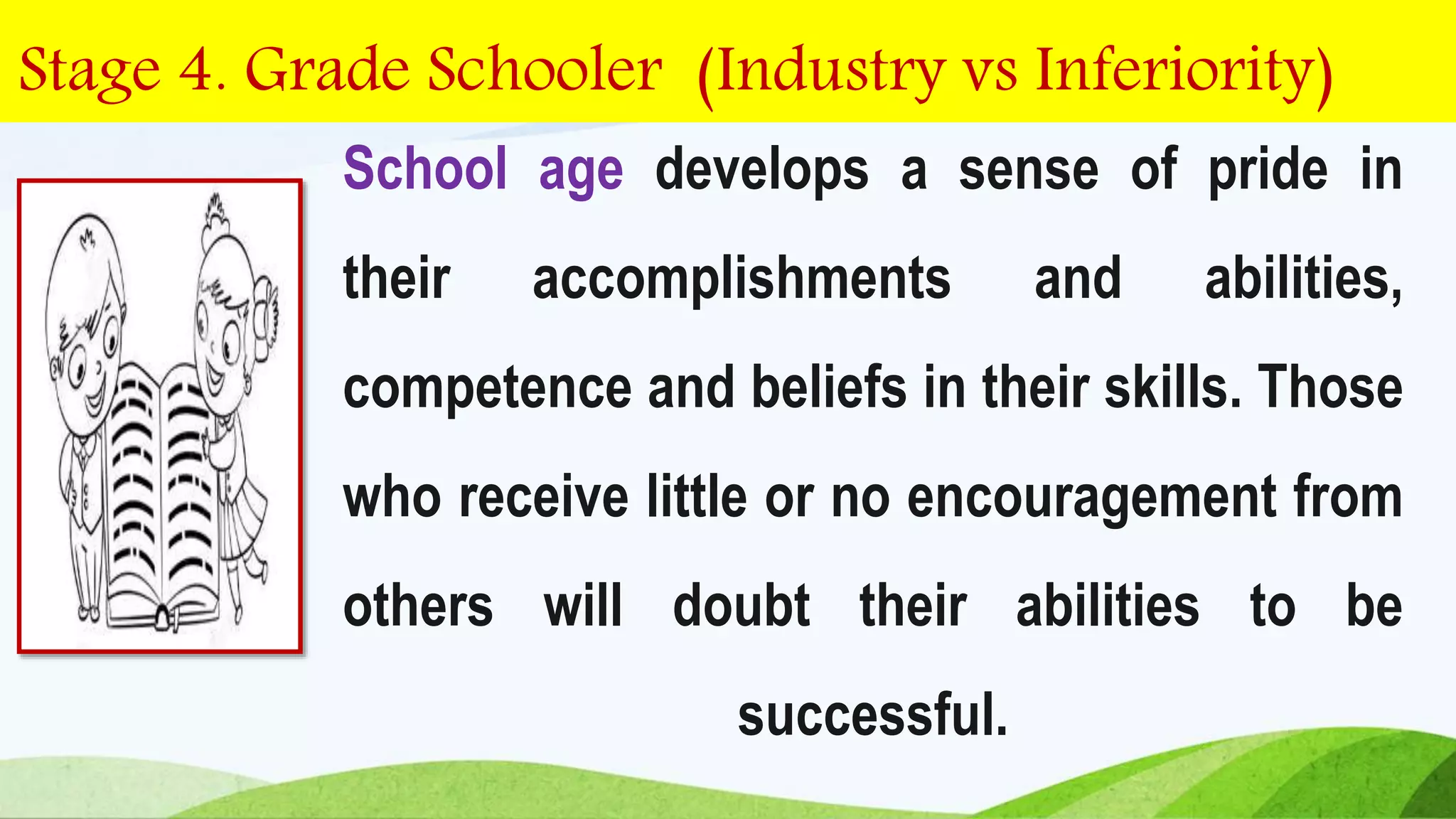
School age develops a sense of pride in
their accomplishments and abilities,
competence and beliefs in their skills. Those
who receive little or no encouragement from
others will doubt their abilities to be
successful.
Stage 4. Grade Schooler (Industry vs Inferiority)
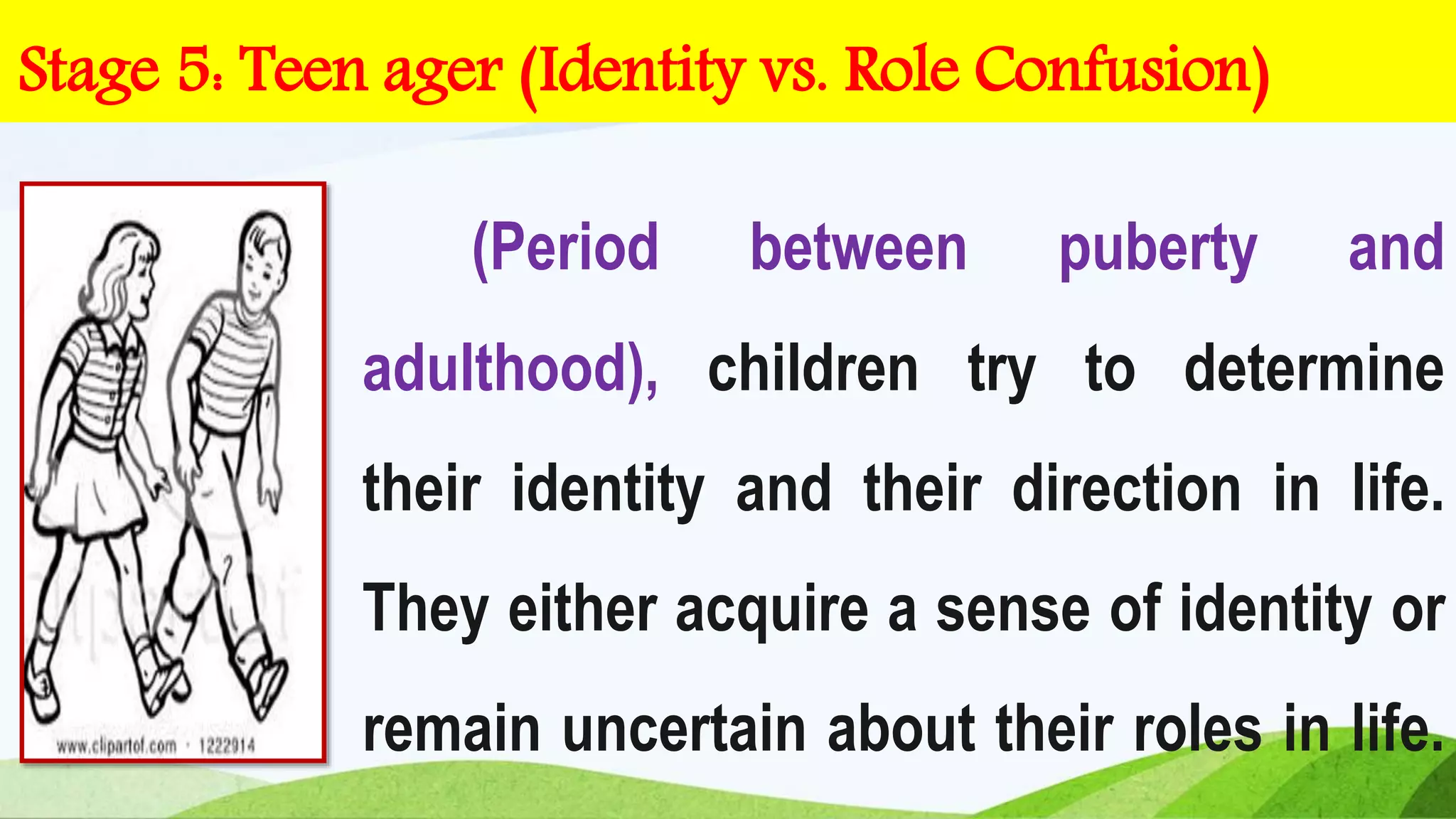
(Period between puberty and
adulthood), children try to determine
their identity and their direction in life.
They either acquire a sense of identity or
remain uncertain about their roles in life.
Stage 5: Teen ager (Identity vs. Role Confusion)
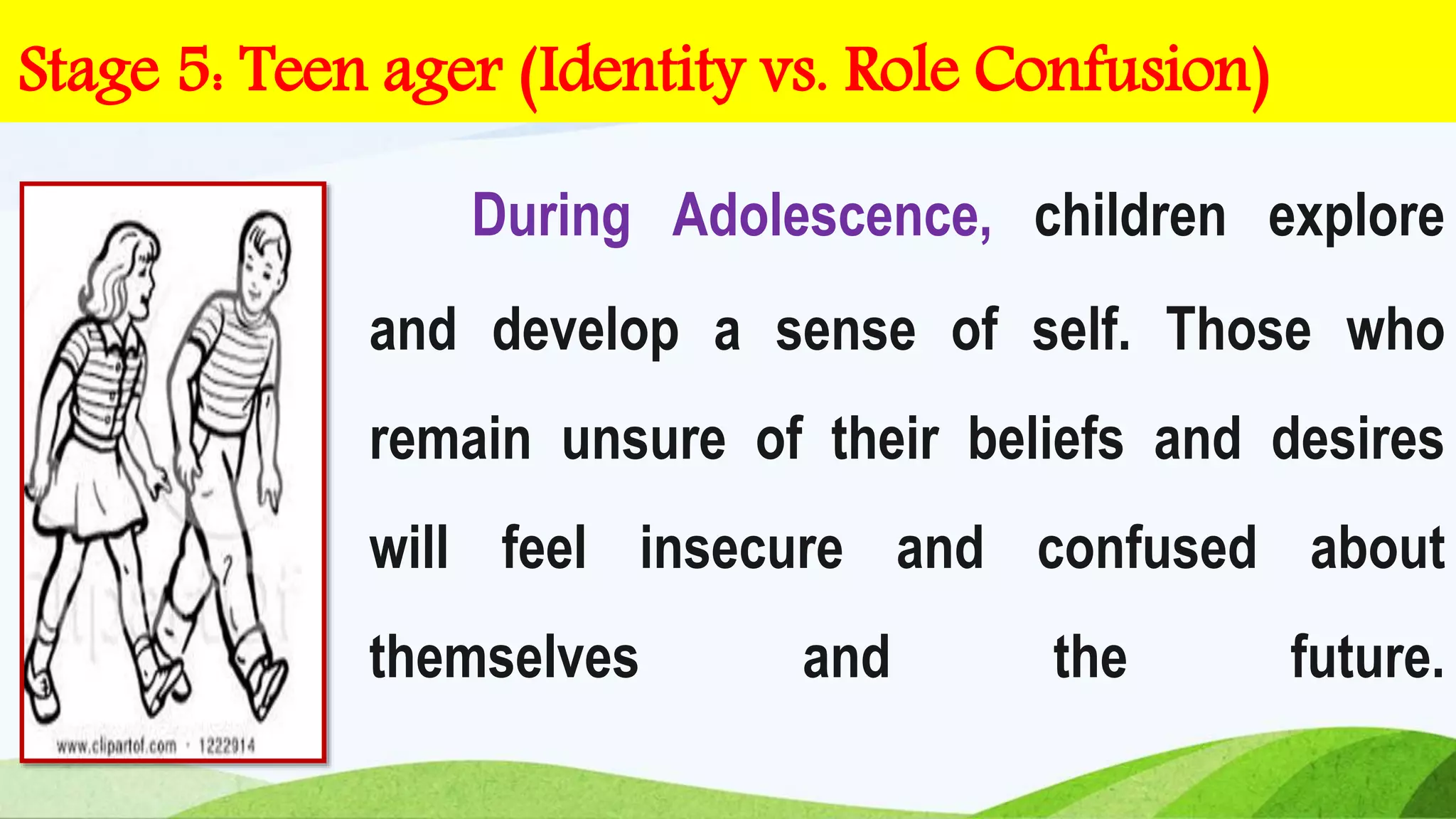
During Adolescence, children explore
and develop a sense of self. Those who
remain unsure of their beliefs and desires
will feel insecure and confused about
themselves and the future.
Stage 5: Teen ager (Identity vs. Role Confusion)
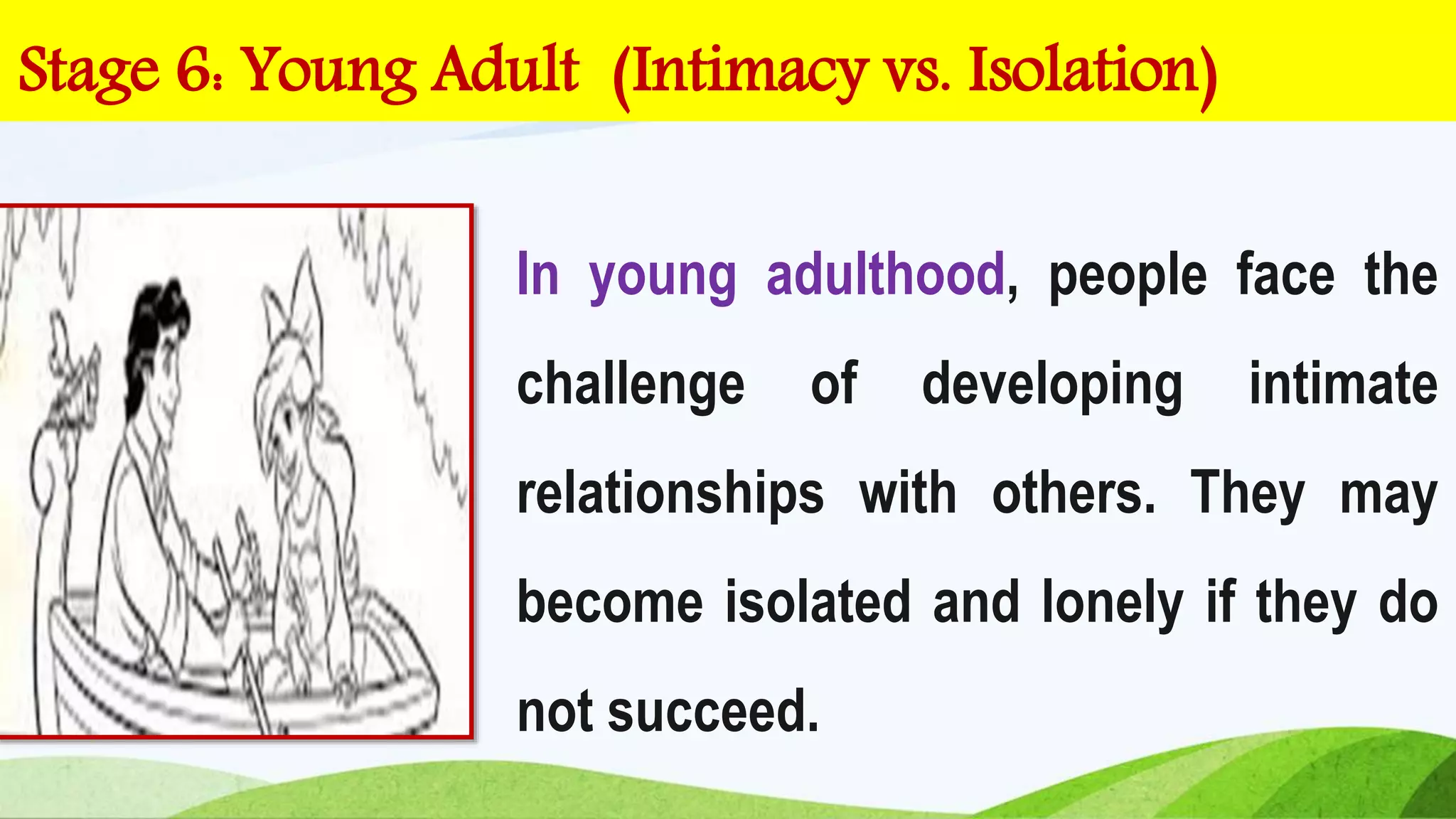
Stage 6: Young Adult (Intimacy vs. Isolation)
In young adulthood, people face the
challenge of developing intimate
relationships with others. They may
become isolated and lonely if they do
not succeed.
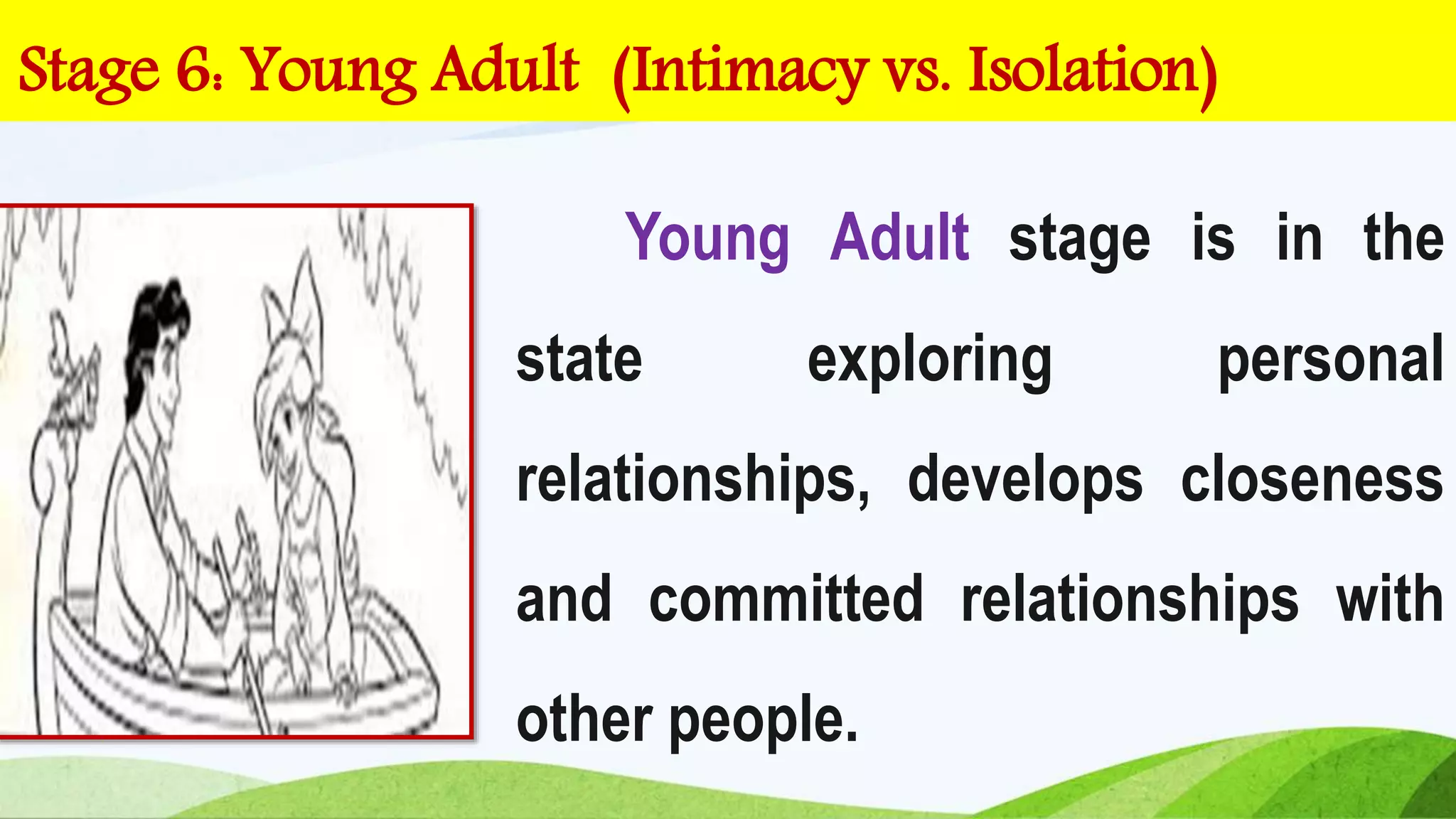
Young Adult stage is in the
state exploring personal
relationships, develops closeness
and committed relationships with
other people.
Stage 6: Young Adult (Intimacy vs. Isolation)
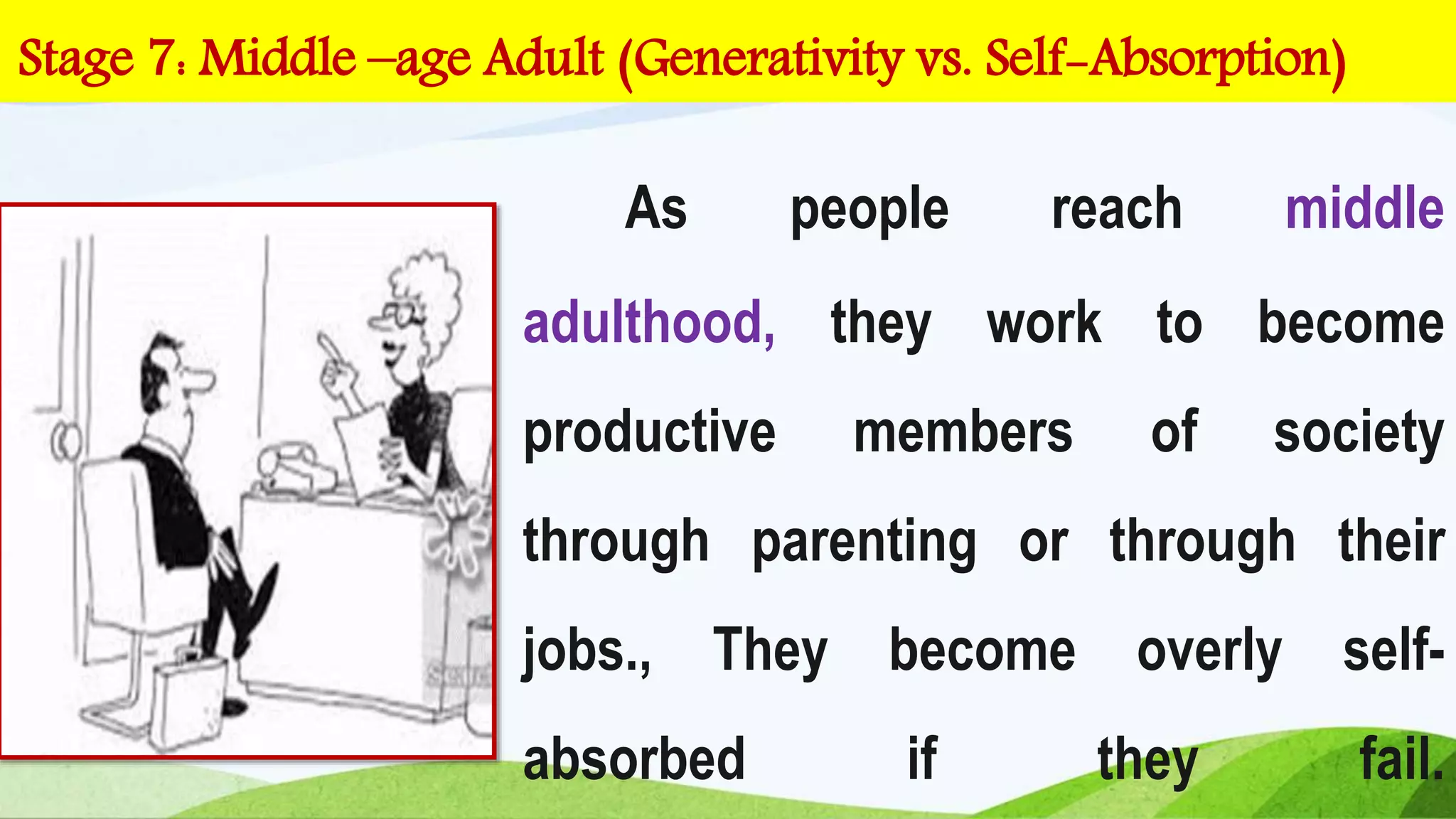
As people reach middle
adulthood, they work to become
productive members of society
through parenting or through their
jobs., They become overly self-
absorbed if they fail.
Stage 7: Middle –age Adult (Generativity vs. Self-Absorption)
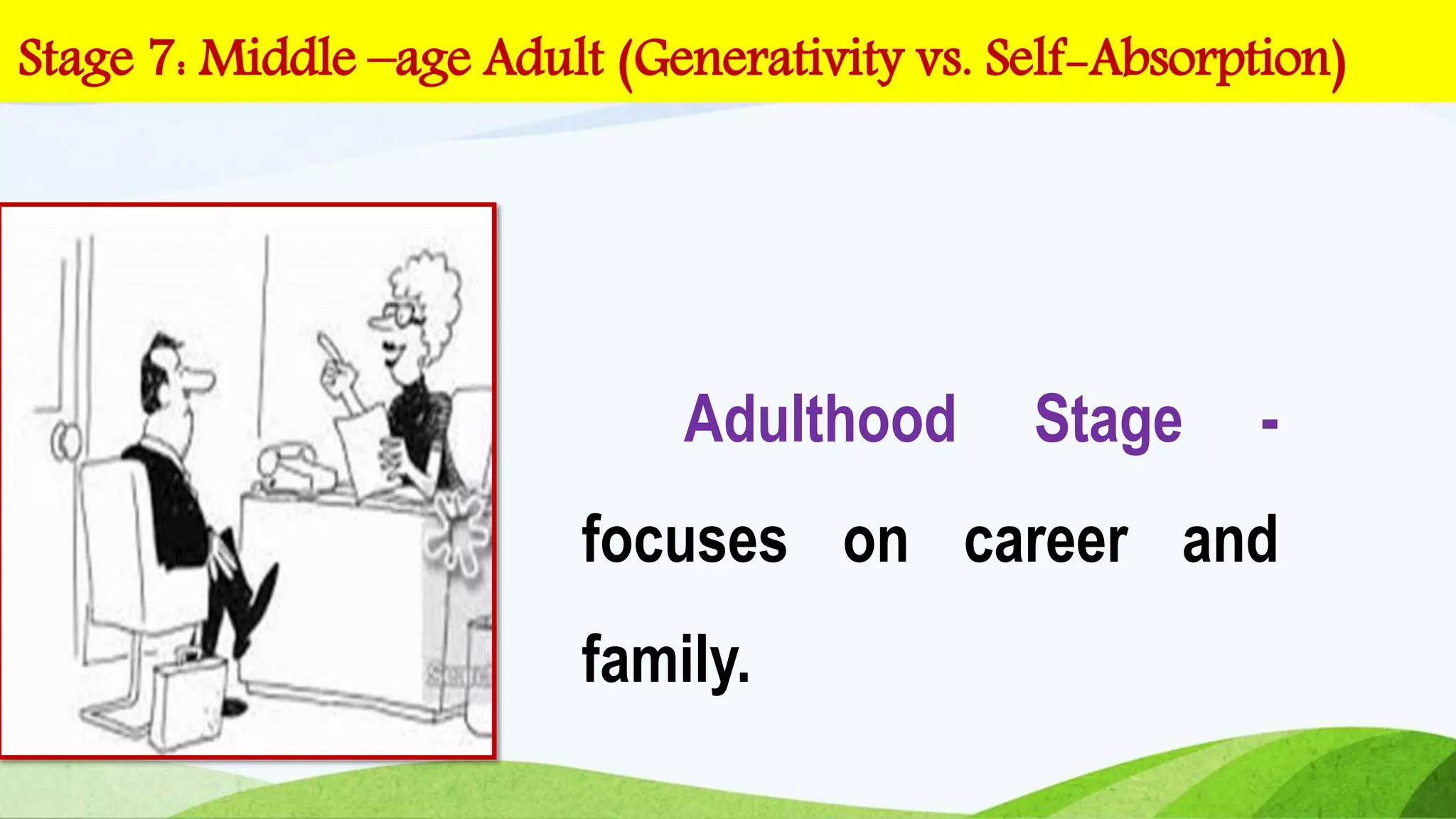
Adulthood Stage -
focuses on career and
family.
Stage 7: Middle –age Adult (Generativity vs. Self-Absorption)
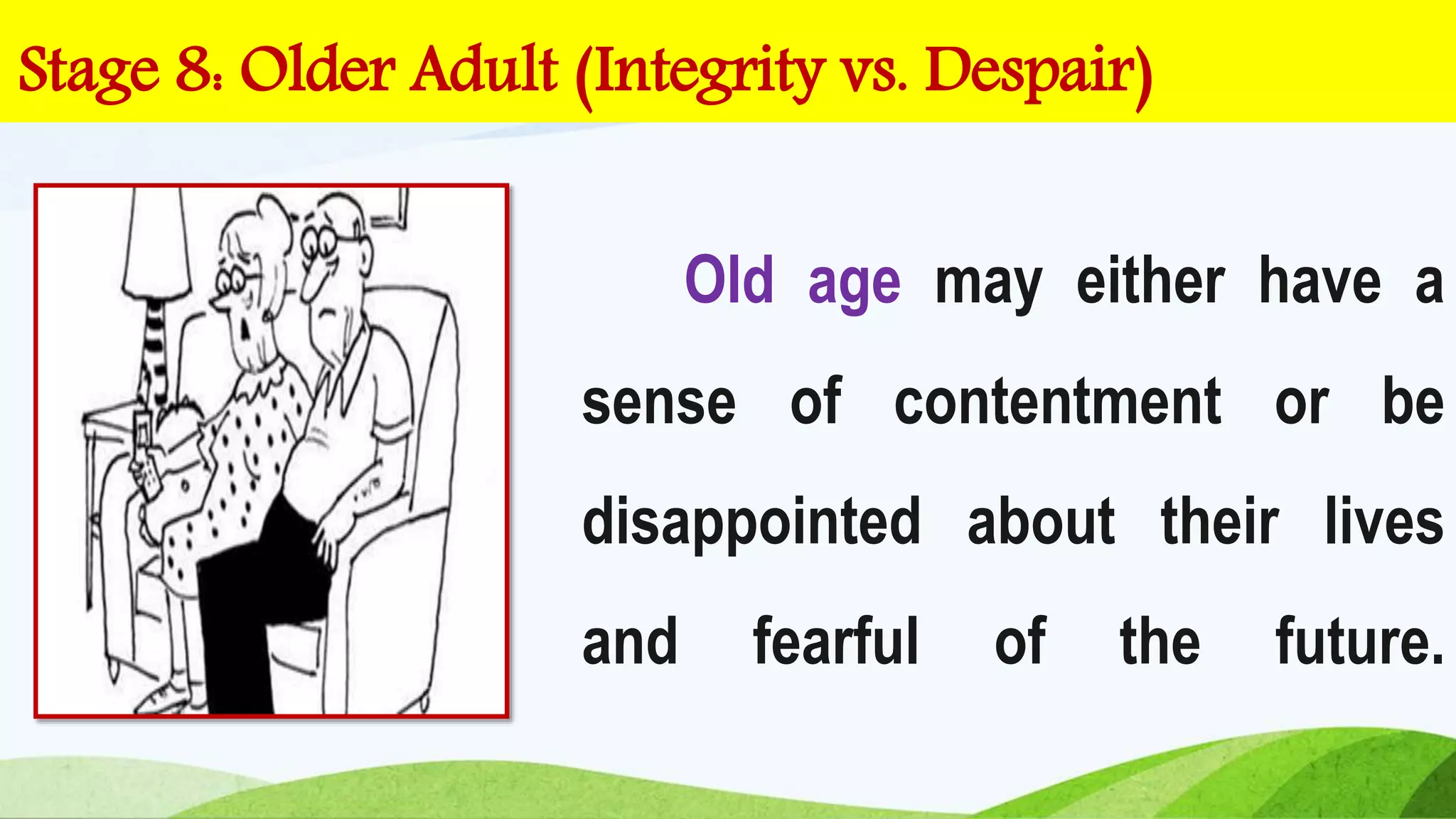
Old age may either have a
sense of contentment or be
disappointed about their lives
and fearful of the future.
Stage 8: Older Adult (Integrity vs. Despair)
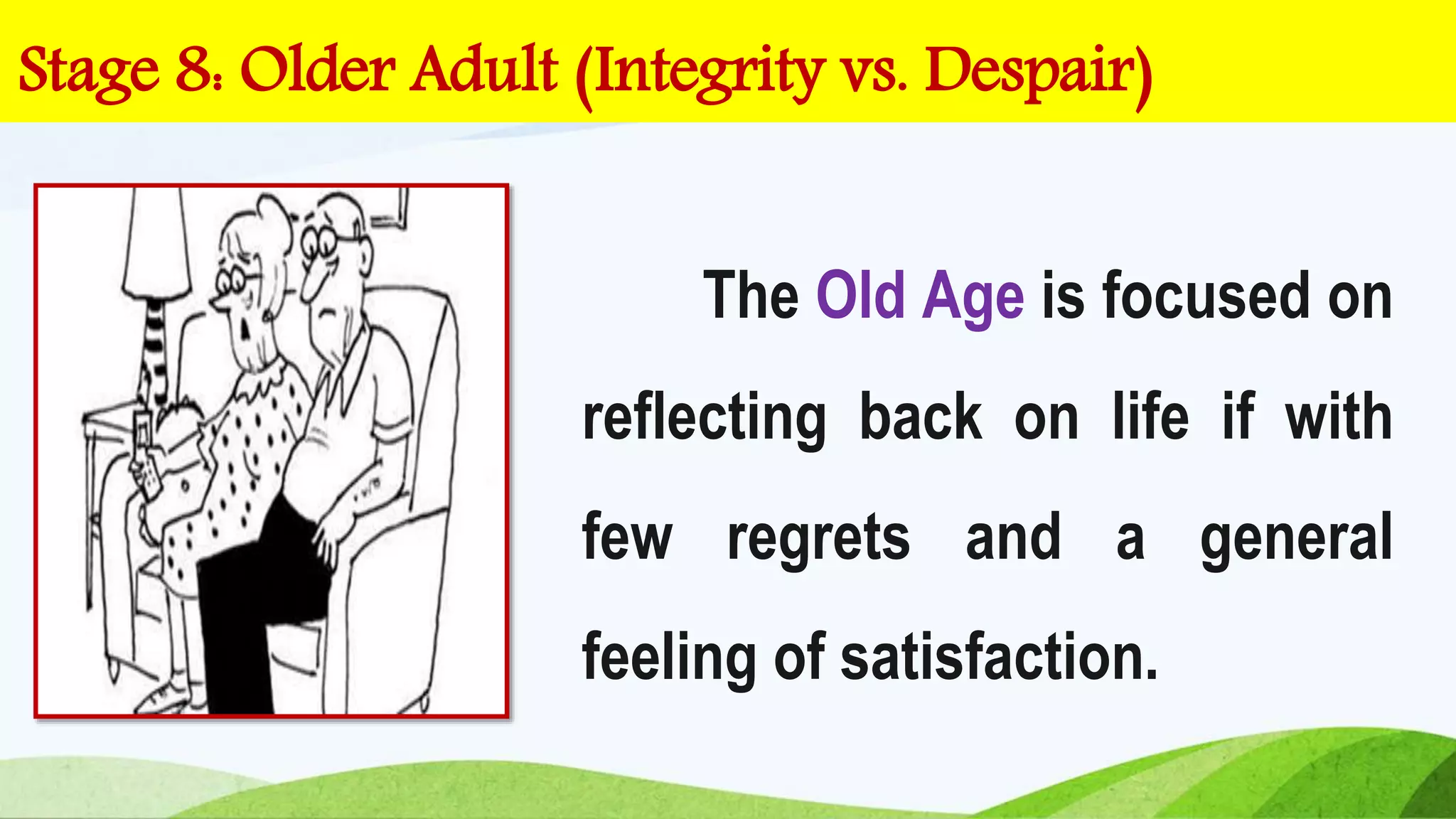
The Old Age is focused on
reflecting back on life if with
few regrets and a general
feeling of satisfaction.
Stage 8: Older Adult (Integrity vs. Despair)
QUIZ
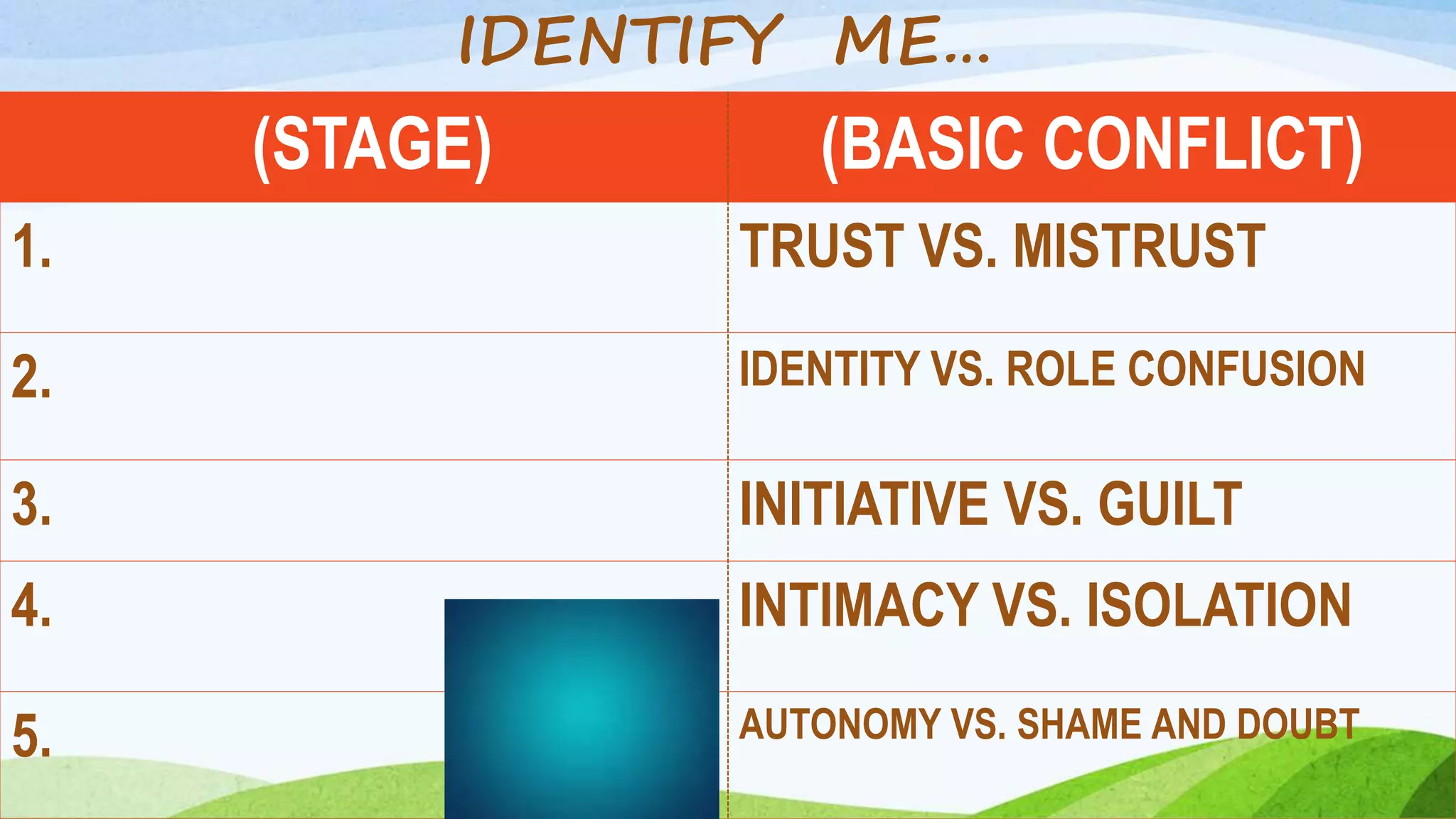
(STAGE) (BASIC CONFLICT)
1. TRUST VS. MISTRUST
2. IDENTITY VS. ROLE CONFUSION
3. INITIATIVE VS. GUILT
4. INTIMACY VS. ISOLATION
5. AUTONOMY VS. SHAME AND DOUBT
IDENTIFY ME…
ANSWER
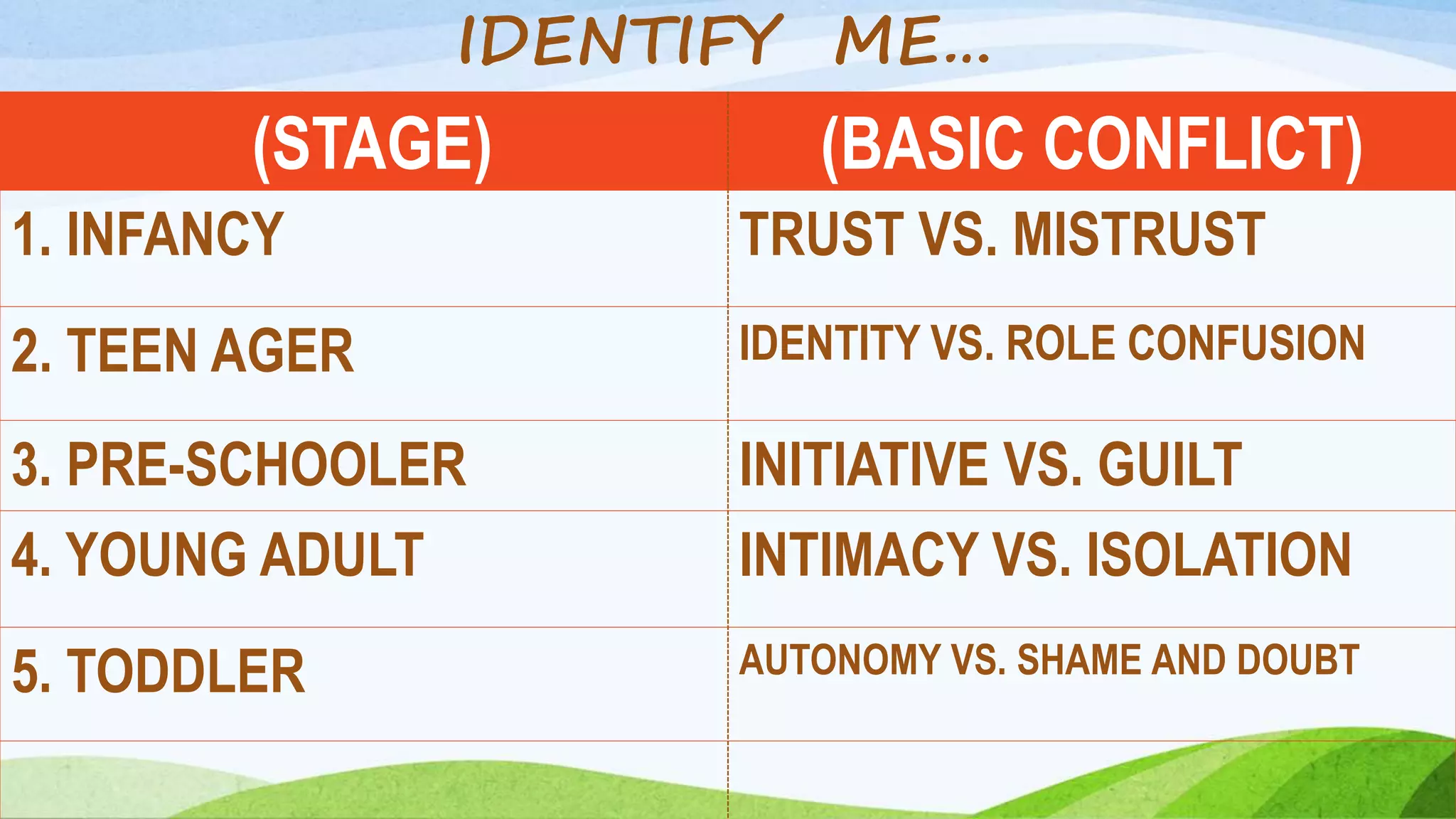
(STAGE) (BASIC CONFLICT)
1. INFANCY TRUST VS. MISTRUST
2. TEEN AGER IDENTITY VS. ROLE CONFUSION
3. PRE-SCHOOLER INITIATIVE VS. GUILT
4. YOUNG ADULT INTIMACY VS. ISOLATION
5. TODDLER AUTONOMY VS. SHAME AND DOUBT
IDENTIFY ME…
For those who got
4 and above…
Thank you
and
God bless…
Amiable Mom

Growth and development (2)

  • 1.
  • 2.
    Activity HEALTH CHECK! This activitywill check on how well YOU practice healthy habits to achieve holistic health.
  • 3.
    1. Read eachstatement very carefully 2. Put a check (√) mark if the statement relates to your practice or habit and X if it does not. 3. Copy the chart in your notebook. • Procedure
  • 4.
    STATEMENT 1 I aminterested in my health status. 2 I regularly monitor my height and weight. 3 I undergo vision test to assess my visual acuity. 4 I go to the dentist every 6 months for regular dental check up. 5 I visit the doctor at least once a year for regular check up.
  • 5.
    health. 7 I seekthe advice of trusted adults such as parents, teachers and guidance counselors whenever I have a problem. 8 I undergo scoliosis screening in my school/barangay clinic. 9 I report unusual changes in my body to a trusted adult/parent/physician. 10 I avail of the heal th ser vices in our school/barangay health clinic. 6 I follow the doctor’s advice on how to take good care of my health. 7 I seek the advice of trusted adults such as parents, teachers and guidance counselors whenever I have a problem. 8 I undergo scoliosis screening in my school/barangay clinic. 9 I report unusual changes in my body to a trusted adult/parent/physician. 10 I avail of the health services in our school/barangay health clinic.
  • 6.
     The totalnumber of checkmarks indicate the level of your health interest and practices. • Evaluation
  • 7.
    9-10 Excellent! -----Continue being a model of healthy living. 7-8 Very satisfactory! --- Keep improving to reach the top. 5-6 Satisfactory ---- You are on track but there is still room for improvement. 3-4 Fair ---- You need to work harder and commit yourself to living a healthy life. 1-2 Needs improvement ---- You need to reflect on how your habits are hurting your health. Now is a perfect opportunity to start living the healthy way.
  • 8.
     Human developmentis a lifelong process of physical, mental, emotional, social, moral-spiritual and environmental growth and change.
  • 9.
     In theearly stages of life, from babyhood to childhood, childhood to adolescence, and adolescence to adulthood—great changes take place.
  • 10.
     Throughout theprocess, each person develops attitudes and values that guide choices, relationships, and understanding.
  • 11.
     A developmentalpsychologist Erik H. Erikson in his theory on social development of human beings describes eight stages through which a healthily developing human should pass from infancy to late adulthood.
  • 13.
    (Birth to firstyear) The babies depend on their basic needs on adult such as food, care, and comfort. If the adult meet these needs, it develops a sense of security or may develop a mistrust and insecurity. Stage 1: Infancy (Trust vs. Mistrust)
  • 14.
    Stage 1: Infancy(Trust vs. Mistrust) An infant is dependent and establishing trust to the one who takes care of him but if there is no fulfillment it will lead into feeling of mistrust.
  • 15.
    (Ages of oneto three) Start to gain independence and learning skills such as toilet training, feeding and dressing themselves. Toddlers can develop a sense of autonomy or a sense of doubt and shame about themselves. Stage 2: Toddler (Autonomy vs. Shame and Doubt)
  • 16.
    early childhood ---focuseson developing a greater sense of personal control. He/she performs basic actions and simple decisions that make him/her secure and confident, while those who do not are left with a sense of inadequacy and self-doubt. Stage 2: Toddler (Autonomy vs. Shame and Doubt)
  • 17.
    ( Ages ofthree to six) They must learn to control their impulses and act in a socially responsible way. If they can do this effectively, children become more self- confident. If not, they may develop a strong sense of guilt. Stage 3: Pre Schooler (Initiative vs. Guilt)
  • 18.
    preschool children needto begin asserting control and power over the environment. In a success stage, it leads to a sense of purpose., resulting in a sense of guilt. Stage 3: Pre Schooler (Initiative vs. Guilt)
  • 19.
    (Ages of sixto twelve) They compete with peers in school and prepare to take on adult roles. This stage is in a sense of competence or a sense of inferiority. Stage 4. Grade Schooler (Industry vs Inferiority)
  • 20.
    School age developsa sense of pride in their accomplishments and abilities, competence and beliefs in their skills. Those who receive little or no encouragement from others will doubt their abilities to be successful. Stage 4. Grade Schooler (Industry vs Inferiority)
  • 21.
    (Period between pubertyand adulthood), children try to determine their identity and their direction in life. They either acquire a sense of identity or remain uncertain about their roles in life. Stage 5: Teen ager (Identity vs. Role Confusion)
  • 22.
    During Adolescence, childrenexplore and develop a sense of self. Those who remain unsure of their beliefs and desires will feel insecure and confused about themselves and the future. Stage 5: Teen ager (Identity vs. Role Confusion)
  • 23.
    Stage 6: YoungAdult (Intimacy vs. Isolation) In young adulthood, people face the challenge of developing intimate relationships with others. They may become isolated and lonely if they do not succeed.
  • 24.
    Young Adult stageis in the state exploring personal relationships, develops closeness and committed relationships with other people. Stage 6: Young Adult (Intimacy vs. Isolation)
  • 25.
    As people reachmiddle adulthood, they work to become productive members of society through parenting or through their jobs., They become overly self- absorbed if they fail. Stage 7: Middle –age Adult (Generativity vs. Self-Absorption)
  • 26.
    Adulthood Stage - focuseson career and family. Stage 7: Middle –age Adult (Generativity vs. Self-Absorption)
  • 27.
    Old age mayeither have a sense of contentment or be disappointed about their lives and fearful of the future. Stage 8: Older Adult (Integrity vs. Despair)
  • 28.
    The Old Ageis focused on reflecting back on life if with few regrets and a general feeling of satisfaction. Stage 8: Older Adult (Integrity vs. Despair)
  • 29.
  • 30.
    (STAGE) (BASIC CONFLICT) 1.TRUST VS. MISTRUST 2. IDENTITY VS. ROLE CONFUSION 3. INITIATIVE VS. GUILT 4. INTIMACY VS. ISOLATION 5. AUTONOMY VS. SHAME AND DOUBT IDENTIFY ME…
  • 31.
  • 32.
    (STAGE) (BASIC CONFLICT) 1.INFANCY TRUST VS. MISTRUST 2. TEEN AGER IDENTITY VS. ROLE CONFUSION 3. PRE-SCHOOLER INITIATIVE VS. GUILT 4. YOUNG ADULT INTIMACY VS. ISOLATION 5. TODDLER AUTONOMY VS. SHAME AND DOUBT IDENTIFY ME…
  • 33.
    For those whogot 4 and above…
  • 34.

Editor's Notes

  • #8 Now, you have determined and discussed your healthy lifestyle, let us discuss about developmental milestone as you grow and develop. How does human grow and develop?  
  • #14 ACTIVITY: FEEDING
  • #16 Autonomy-independence, free will ACTIVITIES: TOILET TRAINING
  • #18 ACTIVITIES: EXPLORATION
  • #19 Initiative-aggressiveness; drive
  • #20 ACTIVITIES: SCHOOL Industry- diligence-the habit of working hard..
  • #22 12-18 ACTIVITIES: SOCIAL RELATIONSHIPS
  • #24 19-40 EVENTS: RELATIONSHIPS
  • #26 40-65 EVENTS: WORK AND PARENTHOOD
  • #28 65 TO DEATH- EVENTS: REFLECTIONS ON LIFE