GROWTH and DEVELOPMENT
GR
O
W
TH
 Can be defined as an
increase in size, length,
height, and weight or the
changes in quantitative
aspects of an organism.
D
E
V
E
L
O
P
M
E
N
T
• is a series of orderly
progression towards
maturity. It implies
overall qualitative
changes resulting in the
improved functioning of
the organism.
Pre-assessment
HEALTH APPRAISAL
Direction:
Write the letter of the correct
answer in your notebook.
1. Which dimension of holistic health
does this belong when you express
your emotions in positive ways?
a. Physical
b. Mental
c. Emotional
d. Social and Moral-spirit
2. How can unpleasant body odor due
to active secretion of sweat glands be
prevented?
a. Change clothes more often
b. Shave the hair of the
armpit
c. Take a bath regularly
d. Use perfume to hide the
odor
3. What stage of psychosocial development
where you are in state of exploring
personal relationships, developing closeness
and committing relationships with other
people?
a. Infancy
b. Child hood
c. Adolescence
d. Old Age
4. Which of the following is not
common physical change to
adolescence?
a. Adam’s apple become bigger
b. Rapid increase in height and
weight.
c. Sweat and oil glands become more
active
d. Sudden increase in hormone
production
5. What skills will help you get along
well with other people?
a. Coping skills
b. Decision –making skills
c. Problem solving skills
d. Social and communication
skills
6. What test will you undergo if you
want to be informed about your
general health status?
a. Hearing Test
b. Dental Examination
c. Medical Examination
d. Vision Test
7. What is the best way to improve
your mental wellbeing?
a. Choose friends who share the
same interest.
b. Get adequate rest and sleep
c. Show respect and affection for
others
d. Spending quality time with your
family and friends
8. When to use the avoiding coping
strategy?
a. As a last resort
b. For long term –issues
c. For short term issues
d. As a substitute for other
coping skills
9. Responsible hormones that create
moodiness among adolescent.
a. adrenaline and
hypothalamus
b. estrogen and testosterone
c. parathyroid and pancreas
d. pituitary gland and thymus
10. The cause of poor posture among
adolescents.
a. Eating less healthy food
b. Doing strenuous exercise
c. Slouching due to their
height
d. Playing computer and video
games
Pre-assessment
ANSWER
1. Which dimension of holistic health
does this belong when you express
your emotions in positive ways?
a. Physical
b. Mental
c. Emotional
d. Social and Moral-spirit
2. How can unpleasant body odor due
to active secretion of sweat glands be
prevented?
a. Change clothes more often
b. Shave the hair of the
armpit
c. Take a bath regularly
d. Use perfume to hide the
odor
3. What stage of psychosocial development
where you are in state of exploring
personal relationships, developing closeness
and committing relationships with other
people?
a. Infancy
b. Child hood
c. Adolescence
d. Old Age
4. Which of the following is not
common physical change to
adolescence?
a. Adam’s apple become bigger
b. Rapid increase in height and
weight.
c. Sweat and oil glands become more
active
d. Sudden increase in hormone
production
5. What skills will help you get along
well with other people?
a. Coping skills
b. Decision –making skills
c. Problem solving skills
d. Social and communication
skills
6. What test will you undergo if you
want to be informed about your
general health status?
a. Hearing Test
b. Dental Examination
c. Medical Examination
d. Vision Test
7. What is the best way to improve
your mental wellbeing?
a. Choose friends who share the
same interest.
b. Get adequate rest and sleep
c. Show respect and affection for
others
d. Spending quality time with your
family and friends
8. When to use the avoiding coping
strategy?
a. As a last resort
b. For long term –issues
c. For short term issues
d. As a substitute for other
coping skills
9. Responsible hormones that create
moodiness among adolescent.
a. adrenaline and
hypothalamus
b. estrogen and testosterone
c. parathyroid and pancreas
d. pituitary gland and thymus
10. The cause of poor posture among
adolescents.
a. Eating less healthy food
b. Doing strenuous exercise
c. Slouching due to their
height
d. Playing computer and video
games
For those who got
6 and above…
Activity 1: Are you really healthy?
Procedure :
1. Identify the activities if related to
physical, mental, social, moral-spiritual
dimension of holistic health.
2. Copy and write your answer inside the chart.
Physical
Health
Social
Health
Moral-
Spiritual
Health
Emotional
Health
Mental
Health
Environ
mental
Health
ACTIVITIES:
> Jogging around the park.
> Practicing Respect to your parents and elders
> Eating a balanced diet regularly
> Going out with family and friends
> Listening to mood music
> Reading educational books
> Expressing love by saying “I love you” to parents.
> Being honest all the time in dealing with people
> Planting vegetables at home.
> Answering crosswords and puzzles
Physical
Health
Social
Health
Moral-
Spiritual
Health
Emotional
Health
Mental
Health
Environ
mental
Health
Jogging
around the
park.
Eating a
balanced
diet regularly
Going out
with family
and friends
Practicing
Respect to
your parents
and elders.
Being honest
all the time
in dealing
with people
Listening to
mood music
Expressing
love by
saying “I
love you” to
parents.
Reading
educational
books
Answering
crosswords
and puzzles
Planting
vegetables at
home.
Evaluate your answer
SCORE COMMENT INDICATIONS
8-10 STRONG You really know and understand the
dimensions of holistic health.
5-7 MODERATELY
STRONG
You need to practice more healthy activities
to complete the dimension.
2-4 IMPROVING You are to learn and practice healthy
activities to complete the dimension.
1 DEVELOPING There is still much room for learning about the
concept of holistic health. I’m sure you’re looking
forward to it.”
When you were
younger, what are
the reminders
that usually being
told by your
parents, teachers
and friends on
how to become
healthy?
When you were younger, you did not
have to think much about your health.
Your parents, teachers and other caring
adults looked out for your health. They
made sure that you ate right food, had
regular medical checked up and
immunizations and other health
practices.
As an adolescent, your
personal health now
becomes your responsibility. It is
therefore, your responsibility to use health
information wisely to guide your day to
day activities. Living a healthy and a
happy life must start early in life. Your
health habits and practices today as well
as in the past will greatly affect the
status of your future health.
WELLNESS
 It is a positive approach that
includes all dimensions of health.
 striving to live your life to achieve
your fullest potential, making
decisions and acting in healthy ways.
HOLISTIC HEALTH
 Holistic concepts of health and maintaining good
health as requiring more than just taking care of
the various singular components that make up
the physical body, additionally incorporating
aspects such as mental, emotional,
social,spiritual-moral and environmental well-
being. The goal is a wellness that encompasses
the entire person, rather than just the lack of
physical pain or disease.
HEALTH
is a state of
complete physical,
mental or
intellectual,
emotional, social,
moral-spiritual and
environmental well-
being, and not
merely the absence
of disease or
infirmity.
HEALTH
D
I
M
E
NS
I
O
NS
PHYSICAL HEALTH O
F
H
E
A
L
T
H
 how well your body
functions. It is a state
of well-being when all
internal and external
body parts, organs,
tissues and cells can
function properly as
they are supposed to
function.
D
I
M
E
NS
I
O
NS
MENTAL HEALTH O
F
H
E
A
L
T
H
being a lifelong learner by
continuously wanting to learn
new things and improve one’s
skills. A mentally healthy
person is open to new ideas
and experiences that can
improve life, family, and
environment.
D
I
M
E
NS
I
O
NS
SOCIAL HEALTH O
F
H
E
A
L
T
H
how well you get along
with other people, how
other people react and
how you interact with
social institutions.
It involves your ability to
form satisfying
interpersonal relationships
with others.
D
I
M
E
NS
I
O
NS
EMOTIONAL
HEALTH
O
F
H
E
A
L
T
H
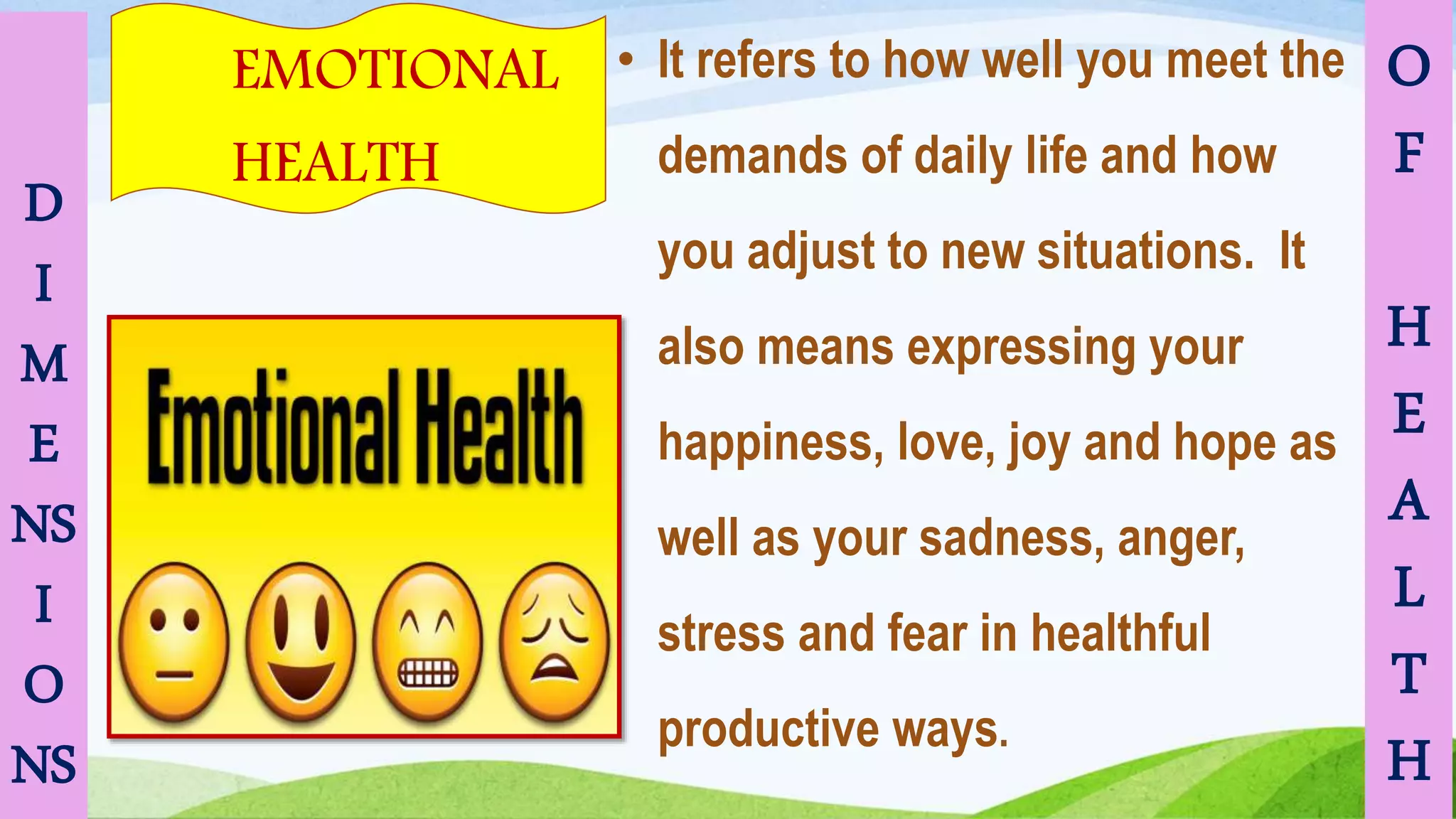
• It refers to how well you meet the
demands of daily life and how
you adjust to new situations. It
also means expressing your
happiness, love, joy and hope as
well as your sadness, anger,
stress and fear in healthful
productive ways.
D
I
M
E
NS
I
O
NS
MORAL-SPIRITUAL
HEALTH
O
F
H
E
A
L
T
H
 being at peace and in
harmony with yourself,
others and a higher
power. It refers to your
religion, principles,
personal beliefs,
values and faith.
D
I
M
E
NS
I
O
NS
ENVIRONMENTAL
HEALTH
O
F
H
E
A
L
T
H
 the understanding
of the effect to
ourselves of the air,
the water and the
land that surrounds
us.
D
I
M
E
NS
I
O
NS
O
F
H
E
A
L
T
H
Overall good health and wellness are inter-
dependent on six dimensions. Health dimensions
are like separate pieces that need to be fitted
together to make meaning.
 Being healthy is much more than not being sick.
Your health is made up of physical, mental, social,
Spiritual-moral and environmental resources that
allow you to live a satisfying and productive life.
Optimal health indicates a high level of
functioning and is often characterized by vitality,
a zest for life and a sense of harmony with nature
and humanity
QUIZ
Identify the
following statement/s
then write your
answer on your
paper.
IDENTIFICATION
1.
It refers to the changes
in quantitative aspects of
an organism.
2.
It is a state of complete
physical, mental or intellectual,
emotional, social, moral-
spiritual and environmental
well-being, and not merely the
absence of disease or infirmity.
3.
It refers to how well you
get along with other
people
4.
It means how well your
body functions.
5.
means being a lifelong
learner by continuously
wanting to learn new
things and improve one’s
skills.
Give at least
5 dimensions of
health.
6-10
ANSWER
1. GROWTH
It refers to the changes
in quantitative aspects of
an organism.
2. HEALTH
a state of complete physical,
mental or intellectual,
emotional, social, moral-
spiritual and environmental
well-being, and not merely
the absence of disease or
infirmity.
3. SOCIAL HEALTH
It refers to how well you
get along with other
people
4. PHYSICAL HEALTH
It means how well your
body functions.
5. MENTAL HEALTH
means being a lifelong
learner by continuously
wanting to learn new
things and improve one’s
skills.
PHYSICAL HEALTH
MENTAL HEALTH
SOCIAL HEALTH
EMOTIONAL HEALTH
SPIRITUAL-MORAL HEALTH
ENVIRONMENTAL HEALTH
5-10
For those who got
8 and above…
Thank you
and
God bless…
Amiable Mom

Growth and development

  • 1.
  • 2.
    GR O W TH  Can bedefined as an increase in size, length, height, and weight or the changes in quantitative aspects of an organism.
  • 3.
    D E V E L O P M E N T • is aseries of orderly progression towards maturity. It implies overall qualitative changes resulting in the improved functioning of the organism.
  • 4.
    Pre-assessment HEALTH APPRAISAL Direction: Write theletter of the correct answer in your notebook.
  • 5.
    1. Which dimensionof holistic health does this belong when you express your emotions in positive ways? a. Physical b. Mental c. Emotional d. Social and Moral-spirit
  • 6.
    2. How canunpleasant body odor due to active secretion of sweat glands be prevented? a. Change clothes more often b. Shave the hair of the armpit c. Take a bath regularly d. Use perfume to hide the odor
  • 7.
    3. What stageof psychosocial development where you are in state of exploring personal relationships, developing closeness and committing relationships with other people? a. Infancy b. Child hood c. Adolescence d. Old Age
  • 8.
    4. Which ofthe following is not common physical change to adolescence? a. Adam’s apple become bigger b. Rapid increase in height and weight. c. Sweat and oil glands become more active d. Sudden increase in hormone production
  • 9.
    5. What skillswill help you get along well with other people? a. Coping skills b. Decision –making skills c. Problem solving skills d. Social and communication skills
  • 10.
    6. What testwill you undergo if you want to be informed about your general health status? a. Hearing Test b. Dental Examination c. Medical Examination d. Vision Test
  • 11.
    7. What isthe best way to improve your mental wellbeing? a. Choose friends who share the same interest. b. Get adequate rest and sleep c. Show respect and affection for others d. Spending quality time with your family and friends
  • 12.
    8. When touse the avoiding coping strategy? a. As a last resort b. For long term –issues c. For short term issues d. As a substitute for other coping skills
  • 13.
    9. Responsible hormonesthat create moodiness among adolescent. a. adrenaline and hypothalamus b. estrogen and testosterone c. parathyroid and pancreas d. pituitary gland and thymus
  • 14.
    10. The causeof poor posture among adolescents. a. Eating less healthy food b. Doing strenuous exercise c. Slouching due to their height d. Playing computer and video games
  • 15.
  • 16.
    1. Which dimensionof holistic health does this belong when you express your emotions in positive ways? a. Physical b. Mental c. Emotional d. Social and Moral-spirit
  • 17.
    2. How canunpleasant body odor due to active secretion of sweat glands be prevented? a. Change clothes more often b. Shave the hair of the armpit c. Take a bath regularly d. Use perfume to hide the odor
  • 18.
    3. What stageof psychosocial development where you are in state of exploring personal relationships, developing closeness and committing relationships with other people? a. Infancy b. Child hood c. Adolescence d. Old Age
  • 19.
    4. Which ofthe following is not common physical change to adolescence? a. Adam’s apple become bigger b. Rapid increase in height and weight. c. Sweat and oil glands become more active d. Sudden increase in hormone production
  • 20.
    5. What skillswill help you get along well with other people? a. Coping skills b. Decision –making skills c. Problem solving skills d. Social and communication skills
  • 21.
    6. What testwill you undergo if you want to be informed about your general health status? a. Hearing Test b. Dental Examination c. Medical Examination d. Vision Test
  • 22.
    7. What isthe best way to improve your mental wellbeing? a. Choose friends who share the same interest. b. Get adequate rest and sleep c. Show respect and affection for others d. Spending quality time with your family and friends
  • 23.
    8. When touse the avoiding coping strategy? a. As a last resort b. For long term –issues c. For short term issues d. As a substitute for other coping skills
  • 24.
    9. Responsible hormonesthat create moodiness among adolescent. a. adrenaline and hypothalamus b. estrogen and testosterone c. parathyroid and pancreas d. pituitary gland and thymus
  • 25.
    10. The causeof poor posture among adolescents. a. Eating less healthy food b. Doing strenuous exercise c. Slouching due to their height d. Playing computer and video games
  • 26.
    For those whogot 6 and above…
  • 27.
    Activity 1: Areyou really healthy? Procedure : 1. Identify the activities if related to physical, mental, social, moral-spiritual dimension of holistic health. 2. Copy and write your answer inside the chart.
  • 28.
  • 29.
    ACTIVITIES: > Jogging aroundthe park. > Practicing Respect to your parents and elders > Eating a balanced diet regularly > Going out with family and friends > Listening to mood music > Reading educational books > Expressing love by saying “I love you” to parents. > Being honest all the time in dealing with people > Planting vegetables at home. > Answering crosswords and puzzles
  • 30.
    Physical Health Social Health Moral- Spiritual Health Emotional Health Mental Health Environ mental Health Jogging around the park. Eating a balanced dietregularly Going out with family and friends Practicing Respect to your parents and elders. Being honest all the time in dealing with people Listening to mood music Expressing love by saying “I love you” to parents. Reading educational books Answering crosswords and puzzles Planting vegetables at home.
  • 31.
    Evaluate your answer SCORECOMMENT INDICATIONS 8-10 STRONG You really know and understand the dimensions of holistic health. 5-7 MODERATELY STRONG You need to practice more healthy activities to complete the dimension. 2-4 IMPROVING You are to learn and practice healthy activities to complete the dimension. 1 DEVELOPING There is still much room for learning about the concept of holistic health. I’m sure you’re looking forward to it.”
  • 32.
    When you were younger,what are the reminders that usually being told by your parents, teachers and friends on how to become healthy?
  • 33.
    When you wereyounger, you did not have to think much about your health. Your parents, teachers and other caring adults looked out for your health. They made sure that you ate right food, had regular medical checked up and immunizations and other health practices.
  • 34.
    As an adolescent,your personal health now becomes your responsibility. It is therefore, your responsibility to use health information wisely to guide your day to day activities. Living a healthy and a happy life must start early in life. Your health habits and practices today as well as in the past will greatly affect the status of your future health.
  • 35.
    WELLNESS  It isa positive approach that includes all dimensions of health.  striving to live your life to achieve your fullest potential, making decisions and acting in healthy ways.
  • 36.
    HOLISTIC HEALTH  Holisticconcepts of health and maintaining good health as requiring more than just taking care of the various singular components that make up the physical body, additionally incorporating aspects such as mental, emotional, social,spiritual-moral and environmental well- being. The goal is a wellness that encompasses the entire person, rather than just the lack of physical pain or disease.
  • 37.
  • 38.
    is a stateof complete physical, mental or intellectual, emotional, social, moral-spiritual and environmental well- being, and not merely the absence of disease or infirmity. HEALTH
  • 39.
    D I M E NS I O NS PHYSICAL HEALTH O F H E A L T H how well your body functions. It is a state of well-being when all internal and external body parts, organs, tissues and cells can function properly as they are supposed to function.
  • 40.
    D I M E NS I O NS MENTAL HEALTH O F H E A L T H beinga lifelong learner by continuously wanting to learn new things and improve one’s skills. A mentally healthy person is open to new ideas and experiences that can improve life, family, and environment.
  • 41.
    D I M E NS I O NS SOCIAL HEALTH O F H E A L T H howwell you get along with other people, how other people react and how you interact with social institutions. It involves your ability to form satisfying interpersonal relationships with others.
  • 42.
    D I M E NS I O NS EMOTIONAL HEALTH O F H E A L T H • It refersto how well you meet the demands of daily life and how you adjust to new situations. It also means expressing your happiness, love, joy and hope as well as your sadness, anger, stress and fear in healthful productive ways.
  • 43.
    D I M E NS I O NS MORAL-SPIRITUAL HEALTH O F H E A L T H  being atpeace and in harmony with yourself, others and a higher power. It refers to your religion, principles, personal beliefs, values and faith.
  • 44.
    D I M E NS I O NS ENVIRONMENTAL HEALTH O F H E A L T H  the understanding ofthe effect to ourselves of the air, the water and the land that surrounds us.
  • 45.
  • 46.
    Overall good healthand wellness are inter- dependent on six dimensions. Health dimensions are like separate pieces that need to be fitted together to make meaning.  Being healthy is much more than not being sick. Your health is made up of physical, mental, social, Spiritual-moral and environmental resources that allow you to live a satisfying and productive life. Optimal health indicates a high level of functioning and is often characterized by vitality, a zest for life and a sense of harmony with nature and humanity
  • 47.
  • 48.
    Identify the following statement/s thenwrite your answer on your paper. IDENTIFICATION
  • 49.
    1. It refers tothe changes in quantitative aspects of an organism.
  • 50.
    2. It is astate of complete physical, mental or intellectual, emotional, social, moral- spiritual and environmental well-being, and not merely the absence of disease or infirmity.
  • 51.
    3. It refers tohow well you get along with other people
  • 52.
    4. It means howwell your body functions.
  • 53.
    5. means being alifelong learner by continuously wanting to learn new things and improve one’s skills.
  • 54.
    Give at least 5dimensions of health. 6-10
  • 55.
  • 56.
    1. GROWTH It refersto the changes in quantitative aspects of an organism.
  • 57.
    2. HEALTH a stateof complete physical, mental or intellectual, emotional, social, moral- spiritual and environmental well-being, and not merely the absence of disease or infirmity.
  • 58.
    3. SOCIAL HEALTH Itrefers to how well you get along with other people
  • 59.
    4. PHYSICAL HEALTH Itmeans how well your body functions.
  • 60.
    5. MENTAL HEALTH meansbeing a lifelong learner by continuously wanting to learn new things and improve one’s skills.
  • 61.
    PHYSICAL HEALTH MENTAL HEALTH SOCIALHEALTH EMOTIONAL HEALTH SPIRITUAL-MORAL HEALTH ENVIRONMENTAL HEALTH 5-10
  • 62.
    For those whogot 8 and above…
  • 63.

Editor's Notes

  • #2 “Psychology” is defined as “the scientific study of the mind and behavior.” In this discipline, it also covers the growth and development of human beings. “Growth” and “development” always come in pairs. But what are exactly the differences between growth and development in the field of psychology?
  • #3 growth” as “the physical change that a particular individual undergoes.” quantitative - capable of being measured.
  • #4 “development” as “the overall growth of humans throughout their lifespan.” Development includes the understanding of how and why people change in terms of physical growth, intellectual, emotional, social, and other aspects of human growth. Qualitative-cant be measured. An example of quantitative differences would be a child who, after two years, has grown two inches and gained 10 pounds. Growth in height and weight indicates a quantitative difference. Qualitative differences focus on changes in the way children think, behave, and perceive the world differently as they mature.
  • #33 After assessing your prior knowledge about the dimension in health, let us discuss about your own healthy practices.
  • #36 Nowadays, health focuses on wellness… It is practicing positive health behaviors based knowledge and healthy attitudes. You are likely to have high degree of wellness if you have a balanced life.
  • #37 Being healthy means having a balance in the dimension of health. This results in attaining holistic health.
  • #40 It includes being physically fit, eating nutritiously, and getting adequate rest and sleep
  • #41 He/she is aware of his or her own abilities, can cope normal stresses in life, able to work regularly and productively, and is also able to contribute for the improvement of community.
  • #42 Each of these relationships should include strong communication skills, empathy for others and a sense of accountability.
  • #43 involves understanding and liking yourself as well as accepting and learning from your mistakes.
  • #44 It involves the quality of personal relationships or a love of nature. It involves a sense that life has meaning and purpose and that you are in harmony with your purpose in life.
  • #45 To recognize the impact of environmental and human –made hazards. The ability to find ways and on how to protect ourselves and the ecological systems against these hazards.
  • #47  A healthy child is active at home and school. He/she is active to do the household routine like cleaning the house and the backyard. He/she has time to join with his/her parents in prayers, attending masses and worship activities. He/she is alert and participative in classroom activities. He/she enjoys being his/her friends, classmates, and other children in the school. He/she is also practicing and active attending the environmental activities in their place like tree planting and waste segregation.