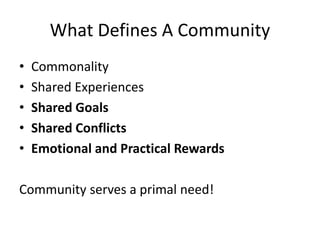
What Defines A Community
• Commonality
• Shared Experiences
• Shared Goals
• Shared Conflicts
• Emotional and Practical Rewards
Community serves a primal need!
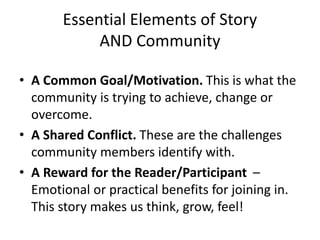
Essential Elements of Story
AND Community
• A Common Goal/Motivation. This is what the
community is trying to achieve, change or
overcome.
• A Shared Conflict. These are the challenges
community members identify with.
• A Reward for the Reader/Participant –
Emotional or practical benefits for joining in.
This story makes us think, grow, feel!
Online vs IRL Community
• Not bound by a physical location
• Potential for more member diversity
• Easier to join and participate
• More difficult to vet members, create trust
Online community members have had different

experiences but share the same story.
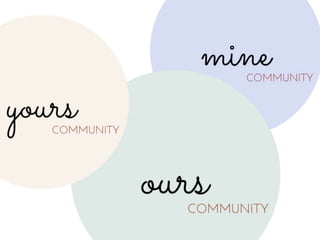
The Three Types of Online
Communities
• Yours – Forums, groups, that provide a space for
conversation. May lack moderation and/or a common story.
Utilitarian. High engagement w/low emotional connection.
Example: Yelp, TripAdvisor, Amazon reviews
• Mine – Single voice, “me-centric” communities that are
moderated by, and revolve around the story of a particular
user. May include comments/engagement from outside
users. Engagement/Emotional Connection may vary.
Example: @FollowmeTraveler #Followmeto
• Ours – Multi voice communities that are driven by a group
goal, shared conflicts. Curated content. High engagement/
High Emotional Connection. #AverageParentProblems
#TMOM
Content Creators
Writers/photographers who create original
social content. Think beyond the “post”
• Recipes
• Playlists,
• DIYs
• Hacks
• Notemaps on @Findery
Experts
• Lend authority, stability.
• Increase community value & trust level.
• Cited authority, can speak publicly.
• Bring an audience.
Influencers
• Attract attention
• Compel action & emulation.
• Serve as ambassadors.
• Can host physical or virtual events
• Speak publicly
Super Sharers
• Amplify and spread the word via social media
and IRL communities.
• May be involved with multiple organizations
and committees both IRL and online.
Some community members are hat swappers!
Picking Platforms
• Know your social media stomping grounds.
• Not all platforms are designed to be “Ours”
community friendly.
• “Mine” platforms can be hacked to be used in a
more “Ours” fashion.
Ask yourself if your people are already organized on
a particular platform – what do they do there? How
can you leverage? How can you cross promote
content on multiple platforms?
Hashtags Are The Glue That Binds
• Your own hashtags help to brand you
• Hashtags help you find like minded people
• Hashtags help others track your community,
find you and participate in your conversation
• Hashtags help you measure your own growth
Instagram Community Strategy
• Curate your content: Invite your community to
contribute – submission via your hashtag.
• Develop fun memes and CTAs (consider the
reward, emotional or practical)
• Consider periodic “account takeovers” –
where a community member takes over the
stream for a period of time.
• Be consistent with post times, develop a
rhythm.
Twitter Community Strategy
• Use a dedicated hashtag (be consistent across
platforms)
• Reward your community members for using the
hashtag too – can be as simple as a shout out on
another platform.
• Host a regular chat – consider the timing.
• Invite guest experts and panelists to the chat
• Share good content created by community
members
• Use Images and Video!
YouTube Community Strategy
• Invite experts to create content for your channel
• Use hashtags in titles, if you plan to tweet
• Create community content playlists
• Ask for response videos (use in playlists)
• Publish new content regularly and consistently.
• Engage in comments
• Leverage live content platforms like Meerkat,
Periscope & cross purpose the video
Pinterest Community Strategy
• Create community group boards
• Pin & Share community content
• Issue clever/creative CTA’s and challenges,
consider the rewards
• Create expert boards, link elsewhere
• Invite influencers to pin to your group boards
• Title your boards with community, and
community story in mind.
Content Is Key! Nurture Your Story
• Create original/unexpected content. Think
beyond the blog post
• Collect and share content from community
members along w/your own
• Stockpile content – you cannot have too much
good content
Good content serves the STORY of your community,
regardless of platform. Stick to the story.
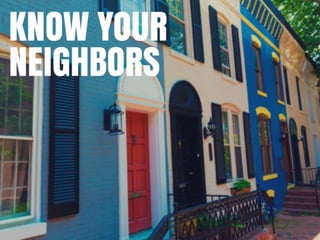
Know Your Community & Neighbors
• Know and nurture your community characters.
• Identify your influencers, experts, super
sharers and content creators.
• Create outreach lists and strategize by
platform
• Form alliances with kindred communities
CTA’s: Keep It Fun
• Consider what’s in it for the participant. Is it
FUN? Is it something they want to share?
Does it make them feel good?
• Does what you are asking people to do
contribute to your community’s story? Does
it strengthen their role?
Don’t forget the emotional and practical
reasons for your community
Your Assignment
• What’s your community’s story? Write down
the common goals/motivations and conflicts
of your community.
• What’s the reward for membership?
• Where will you tell the story online? What
medium?
• Who are your characters?
• Who are your neighbors?
Tools for Tracking and Measuring
• Google Analytics
• Twitter Analytics
• Pinterest Analytics (must sign up for biz
account to access)
• Hashtracking Explorer
• Iconosquare
• Sprout Social ($)
• Hashtracking Personal/Pro ($)

Growing Engaged Communities

  • 3.
    What Defines ACommunity • Commonality • Shared Experiences • Shared Goals • Shared Conflicts • Emotional and Practical Rewards Community serves a primal need!
  • 5.
    Essential Elements ofStory AND Community • A Common Goal/Motivation. This is what the community is trying to achieve, change or overcome. • A Shared Conflict. These are the challenges community members identify with. • A Reward for the Reader/Participant – Emotional or practical benefits for joining in. This story makes us think, grow, feel!
  • 9.
    Online vs IRLCommunity • Not bound by a physical location • Potential for more member diversity • Easier to join and participate • More difficult to vet members, create trust Online community members have had different experiences but share the same story.
  • 13.
    The Three Typesof Online Communities • Yours – Forums, groups, that provide a space for conversation. May lack moderation and/or a common story. Utilitarian. High engagement w/low emotional connection. Example: Yelp, TripAdvisor, Amazon reviews • Mine – Single voice, “me-centric” communities that are moderated by, and revolve around the story of a particular user. May include comments/engagement from outside users. Engagement/Emotional Connection may vary. Example: @FollowmeTraveler #Followmeto • Ours – Multi voice communities that are driven by a group goal, shared conflicts. Curated content. High engagement/ High Emotional Connection. #AverageParentProblems #TMOM
  • 16.
    Content Creators Writers/photographers whocreate original social content. Think beyond the “post” • Recipes • Playlists, • DIYs • Hacks • Notemaps on @Findery
  • 18.
    Experts • Lend authority,stability. • Increase community value & trust level. • Cited authority, can speak publicly. • Bring an audience.
  • 20.
    Influencers • Attract attention •Compel action & emulation. • Serve as ambassadors. • Can host physical or virtual events • Speak publicly
  • 22.
    Super Sharers • Amplifyand spread the word via social media and IRL communities. • May be involved with multiple organizations and committees both IRL and online. Some community members are hat swappers!
  • 24.
    Picking Platforms • Knowyour social media stomping grounds. • Not all platforms are designed to be “Ours” community friendly. • “Mine” platforms can be hacked to be used in a more “Ours” fashion. Ask yourself if your people are already organized on a particular platform – what do they do there? How can you leverage? How can you cross promote content on multiple platforms?
  • 26.
    Hashtags Are TheGlue That Binds • Your own hashtags help to brand you • Hashtags help you find like minded people • Hashtags help others track your community, find you and participate in your conversation • Hashtags help you measure your own growth
  • 29.
    Instagram Community Strategy •Curate your content: Invite your community to contribute – submission via your hashtag. • Develop fun memes and CTAs (consider the reward, emotional or practical) • Consider periodic “account takeovers” – where a community member takes over the stream for a period of time. • Be consistent with post times, develop a rhythm.
  • 31.
    Twitter Community Strategy •Use a dedicated hashtag (be consistent across platforms) • Reward your community members for using the hashtag too – can be as simple as a shout out on another platform. • Host a regular chat – consider the timing. • Invite guest experts and panelists to the chat • Share good content created by community members • Use Images and Video!
  • 33.
    YouTube Community Strategy •Invite experts to create content for your channel • Use hashtags in titles, if you plan to tweet • Create community content playlists • Ask for response videos (use in playlists) • Publish new content regularly and consistently. • Engage in comments • Leverage live content platforms like Meerkat, Periscope & cross purpose the video
  • 35.
    Pinterest Community Strategy •Create community group boards • Pin & Share community content • Issue clever/creative CTA’s and challenges, consider the rewards • Create expert boards, link elsewhere • Invite influencers to pin to your group boards • Title your boards with community, and community story in mind.
  • 37.
    Content Is Key!Nurture Your Story • Create original/unexpected content. Think beyond the blog post • Collect and share content from community members along w/your own • Stockpile content – you cannot have too much good content Good content serves the STORY of your community, regardless of platform. Stick to the story.
  • 39.
    Know Your Community& Neighbors • Know and nurture your community characters. • Identify your influencers, experts, super sharers and content creators. • Create outreach lists and strategize by platform • Form alliances with kindred communities
  • 40.
    CTA’s: Keep ItFun • Consider what’s in it for the participant. Is it FUN? Is it something they want to share? Does it make them feel good? • Does what you are asking people to do contribute to your community’s story? Does it strengthen their role? Don’t forget the emotional and practical reasons for your community
  • 42.
    Your Assignment • What’syour community’s story? Write down the common goals/motivations and conflicts of your community. • What’s the reward for membership? • Where will you tell the story online? What medium? • Who are your characters? • Who are your neighbors?
  • 43.
    Tools for Trackingand Measuring • Google Analytics • Twitter Analytics • Pinterest Analytics (must sign up for biz account to access) • Hashtracking Explorer • Iconosquare • Sprout Social ($) • Hashtracking Personal/Pro ($)

Editor's Notes

  • #29 National Geographic Model – billions of likes. Shared goals of contributors and community.
  • #35 Pinterest is very much a personal “world of me” platform where people create their own collections. It’s not particularly interactive, unless you hack it to be.
  • #42 Important not to ignore that there is an emotional component to community. People want to feel good. Laughter is the best medicine.