Naveed Siddiqui
PhD. M.B.E. PgDip Information Technology
Founder & CEO – Naveed Media Academy
www.facebook.com/NaveedAhmedSiddiqui33
www.linkedin.com/in/dr-naveed-siddiqui-191a4b2b
www.youtube.com/user/nvd30
www.youtube.com/user/NaveedAhmedSiddiqui3
nasiddiqui333@gmail.com
00971 56 237 4597
Groups and Organizations
Social Group
Two or more people who identify and interact with one
another.
• Not every collection of individuals form a
group.
• Many people with a status in common–
Single women, homeowners, soldiers,
millionaires, college graduates, and
Roman Catholics–aren’t groups but
categories.
Primary Groups
• Traits
– Small
1. Personal orientation
• Share activities, spend time together
• Primary relationships
1. Family
• First group experienced in life
2. Members viewed as unique and irreplaceable
Small social groups whose members share personal,
lasting relationships.
Secondary Groups
• Traits
Large membership (impersonal)
Goal or activity orientation
– Formal and polite
• Secondary relationships
Weak emotional ties
Short term
• Examples
– Co-workers and political
organizations
A large, impersonal social group whose
members pursue a specific goal or activity.
Group Leadership
Read Section
• Two roles
– Instrumental: Task-oriented
– Expressive: People-oriented
• Three leadership styles
– Authoritarian: Leader makes decisions;
Compliance from members
– Democratic: Member involvement
– Laissez-faire: Mainly let group function on its
own
Group Conformity Studies
• Asch’s research
– Willingness to compromise our own judgments
– Line experiment
• Milgram’s research
– Role authority plays
– Following orders
Groupthink: Tendency of group members to
conform, resulting in a narrow view of some issue
Reference Group
A social group that serves as a point of reference in
making evaluations and decisions
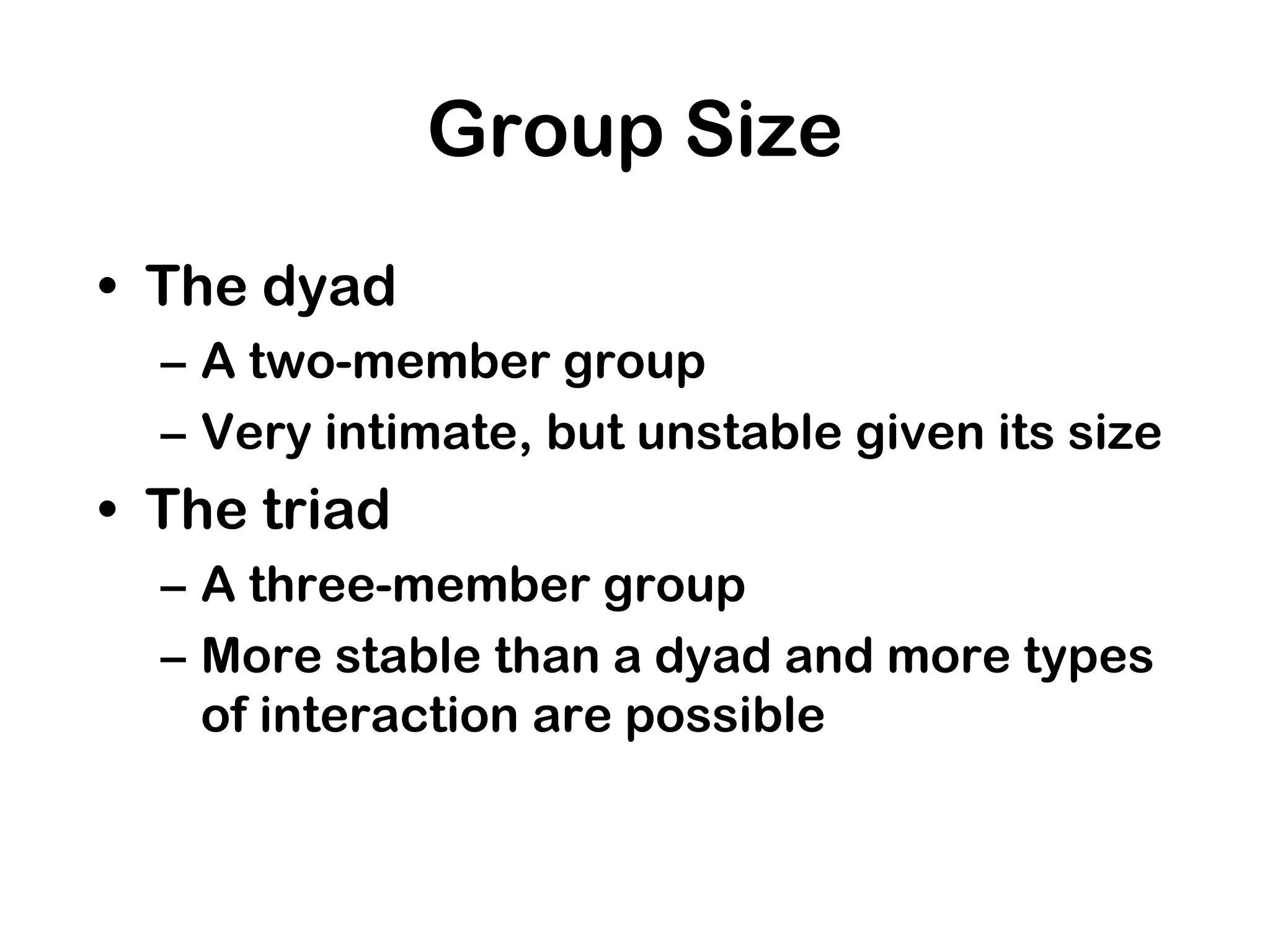
Group Size
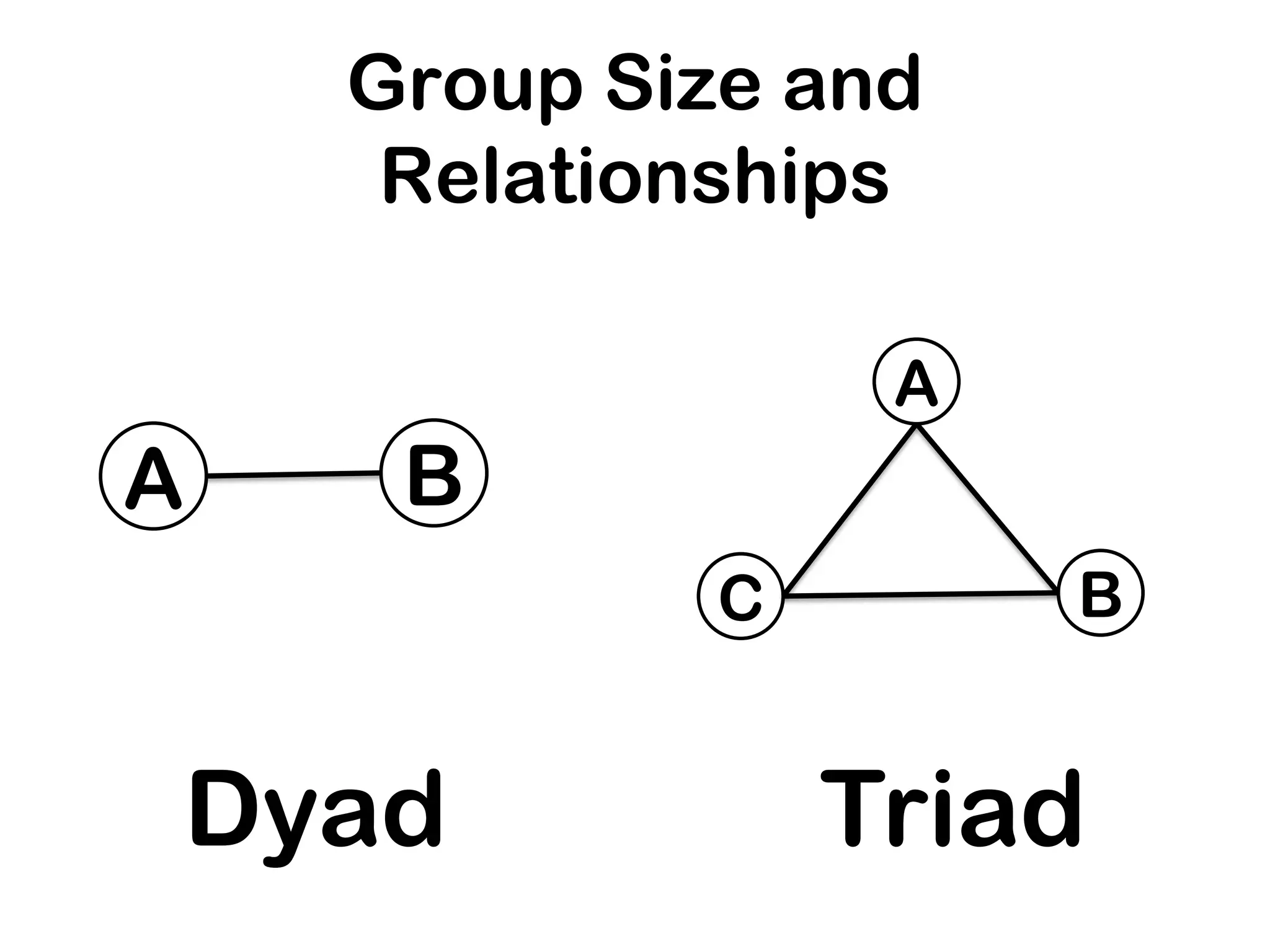
• The dyad
– A two-member group
– Very intimate, but unstable given its size
• The triad
– A three-member group
– More stable than a dyad and more types
of interaction are possible
Group Size and
Relationships
A B
A
BC
Dyad Triad
Group Size and
Relationships
A
BC
D
A
BE
D C
A Group of
Four
A Group of
Five
Formal Organizations
• Utilitarian
– Material rewards for
members
• Normative
– Voluntary organizations
– Ties to personal morality
• Coercive
– Punishment or treatment
– Total institutions
Large secondary groups organized to achieve goals
efficiently; date back thousands of years.

Groups and Organization

  • 1.
    Naveed Siddiqui PhD. M.B.E.PgDip Information Technology Founder & CEO – Naveed Media Academy www.facebook.com/NaveedAhmedSiddiqui33 www.linkedin.com/in/dr-naveed-siddiqui-191a4b2b www.youtube.com/user/nvd30 www.youtube.com/user/NaveedAhmedSiddiqui3 nasiddiqui333@gmail.com 00971 56 237 4597
  • 2.
  • 3.
    Social Group Two ormore people who identify and interact with one another. • Not every collection of individuals form a group. • Many people with a status in common– Single women, homeowners, soldiers, millionaires, college graduates, and Roman Catholics–aren’t groups but categories.
  • 4.
    Primary Groups • Traits –Small 1. Personal orientation • Share activities, spend time together • Primary relationships 1. Family • First group experienced in life 2. Members viewed as unique and irreplaceable Small social groups whose members share personal, lasting relationships.
  • 5.
    Secondary Groups • Traits Largemembership (impersonal) Goal or activity orientation – Formal and polite • Secondary relationships Weak emotional ties Short term • Examples – Co-workers and political organizations A large, impersonal social group whose members pursue a specific goal or activity.
  • 6.
    Group Leadership Read Section •Two roles – Instrumental: Task-oriented – Expressive: People-oriented • Three leadership styles – Authoritarian: Leader makes decisions; Compliance from members – Democratic: Member involvement – Laissez-faire: Mainly let group function on its own
  • 7.
    Group Conformity Studies •Asch’s research – Willingness to compromise our own judgments – Line experiment • Milgram’s research – Role authority plays – Following orders Groupthink: Tendency of group members to conform, resulting in a narrow view of some issue
  • 8.
    Reference Group A socialgroup that serves as a point of reference in making evaluations and decisions
  • 9.
    Group Size • Thedyad – A two-member group – Very intimate, but unstable given its size • The triad – A three-member group – More stable than a dyad and more types of interaction are possible
  • 10.
  • 11.
    Group Size and Relationships A BC D A BE DC A Group of Four A Group of Five
  • 12.
    Formal Organizations • Utilitarian –Material rewards for members • Normative – Voluntary organizations – Ties to personal morality • Coercive – Punishment or treatment – Total institutions Large secondary groups organized to achieve goals efficiently; date back thousands of years.