A Group Selection Pattern optimizing agent-based Virtual Organizations in Grids   Oscar Ardaiz Public University of Navarra, Spain Isaac Chao & Ramon Sanguesa UPC Barcelona, Spain   AWeSOMe'07   Vilamoura, Algarve, Portugal, Nov 26 - 27, 2007
Outline VOS  in the Grid Group Formation mechanisms in MAS Group Selection Pattern Optimizing Policy-based VO management Simulation results Conclusions
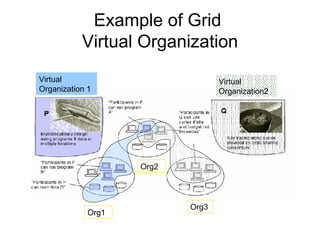
The Grid (definitions) The Grid  consists in coordinated resource sharing and problem solving in dynamic, multi-institutional Virtual Organizations VOs   [FOSTER01]. VO : Virtual entity englobing many physical organizations sharig a common goal. The group structure already exists in Grids
Example of Grid  Virtual Organization Org1 Org2 Org3 Virtual Organization2 Virtual Organization 1
VO management in Grids  Middleware toolkits GT4 [Foster, 2005 ]  provide several low level tools to aggregate resources and management access permissions  Extensions: CAS,VOMS, Akenti  Problem: All focused on supporting large  static  communities and static resources   Require policies as emergent property  of the distributed policies of interacting agents
Exploiting group structure in multiagent systems (MAS)  Coalitions formed by subsets of the population goal oriented and short-lived major limitations high computational complexity unrealistic assumptions regarding the availability of information [Shehory, 2004]. Congregations [Brooks, 2002] release the full autonomy to agents major limitations: Groups are static  Group Selection [this work] :  study dynamics and evolution of groups in poputations.
Group Selection Group Selection refers to a process of natural selection that favors characteristics in individuals that increase the fitness of the group the individuals belong relative to other groups every member of the group depends on a group characteristic that is not isolated in a single individual  [Wilson, 1975] Group Selection can lead to the spread of group beneficial characteristics in many different grouped settings of agent’s populations [Boyd, 2002]
Other Group Selection apps Theoretical Biology: explaining altruism between non kin individuals in human societies [BOYD03], [BOWLES04], [HENRICH04]), Economics: firm’s co-evolution trough inter-firm competition at the group level [CORDES06], [HODGSON04].  Engineering: free-riding in P2P networks [HALES05] (bitorrent success?) & leader elections in groups in A-life [KNOESTER07].
Group Selection applied to the Grid The key idea is that biasing interaction between Grid nodes by arbitrary identifiers enables efficient grouping of agents. Further group’s evolution through Group Selection optimizes groups in performance.  it is adaptive, self-organized, decentralized and highly scalable. can be used to automatically manage Grid VOs lifecycle in the Grid,
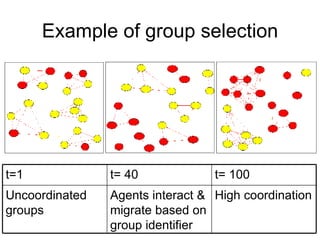
Example of group selection High coordination Agents interact & migrate based on group identifier Uncoordinated groups t= 100 t= 40 t=1
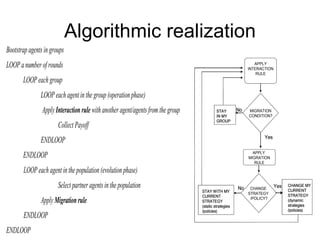
Algorithmic realization
Group Selection pattern Patterns in computer science have been used also coming from other disciplines A relevant case is for bio-inspired computing, see Babaoglu et al. [Babaoglu, 2006].  Another inspiring filed is sociology [Edmonds, 2005].  We provide algorithmic approach to the pattern  can be instantiated in different “flavours” by simple variation of Interaction and Migration rules. synchronous algorithmic realization does not prevent for application in a realistic, asynchronous environment,  no synchronization step required to update agent’s strategies and group membership.
Experiments Scenario For the experiments here we have implemented a collective interactions, corresponding to a  VO policy alignment scenario   The payoff is calculated on the  alignment level over the whole VO  and payoffs are shared collectively. As for the migration phase, the agents compare their performance against their own past performance (internal learning). Migration to a group implies the copying the policy of a random agent in target group.  Experiments conducted in an open source,  agent-based Grid simulator  [AgentGridSim, 2007].  p1,p2 U  ↑ U  ↓ U  ↓ U  ↑
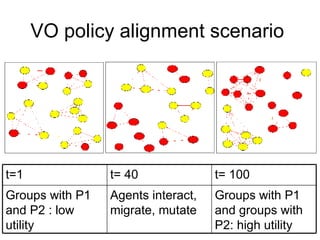
VO policy alignment scenario   Groups with P1 and groups with P2: high utility Agents interact, migrate, mutate Groups with P1 and P2 : low utility t= 100 t= 40 t=1
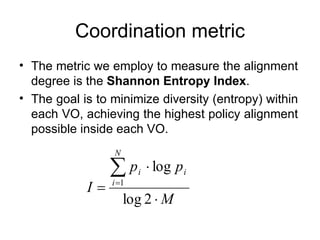
Coordination metric The metric we employ to measure the alignment degree is the  Shannon Entropy Index .  The goal is to minimize diversity (entropy) within each VO, achieving the highest policy alignment possible inside each VO.
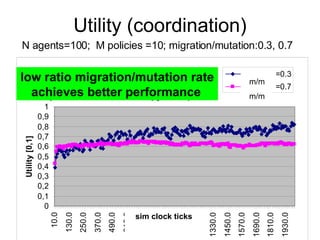
Utility (coordination) N agents=100 ;  M policies =10; migration/mutation:0.3, 0.7   sim clock ticks m/m m/m low ratio migration/mutation rate achieves better performance
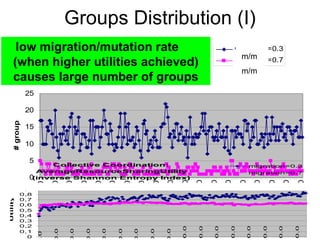
Groups Distribution (I) low migration/mutation rate  (when higher utilities achieved) causes large number of groups m/m m/m
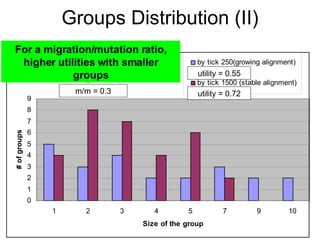
Groups Distribution (II) For a migration/mutation ratio, higher utilities with smaller groups m/m = 0.3 utility = 0.55 utility = 0.72
Conclusions Formalization of a  Group Selection pattern for Grid VOs coordination. Experiments show:“ Group selection evolves  large number of   small and dynamic VOs   into optimized outcomes in a  VO policy alignment scenario”  Future Work: Is the mechanism truly relevant to realistic Grids applications?  If yes, is it possible an implementation in realistic Grid settings ?
References [Foster, 2001] I. Foster, C. Kesselman, S. Tuecke.  The Anatomy of the Grid: Enabling Scalable Virtual Organizations. International J. Supercomputer Applications, 15(3), 2001 [Foster. 2005] Globus Toolkit Version 4: Software for Service-Oriented Systems. I. Foster. IFIP International Conference on Network and Parallel Computing, Springer Verlag LNCS 3779, pp 2-13, 2005 [Babaoglu, 2006] O. Babaoglu, G. Canright, A. Deutsch, G. Di Caro, F. Ducatelle, L. Gambardella, N. Ganguly,  M. Jelasity, R. Montemanni, A. Montresor and T. Urnes.  Design Patterns from Biology for Distributed Computing . In ACM Transactions on Autonomous and Adaptive Systems, vol. 1, no. 1, 26--66, September 2006. [Edmonds, 2005] Edmonds, B., Gilbert, N., Gustafson, S., Hales, D. and Krasnogor, N. (eds.) (2005) Socially Inspired Computing. Proceedings of the  Joint Symposium on Socially Inspired Computing , University of Hertfordshire, Hatfield, UK 12 - 15 April 2005,  Published by AISB   [HODGSON04] Geoffrey M. Hodgson and Thorbjorn Knudsen, "The firm as an interactor: firms as vehicles for habits and routines", Journal of Evolutionary Economics 14 (2004): 281—307 [GOWDY03] Jonh Gowdy and Irmi Seidl. Economic Man and Selfish Genes: The Relevance of Group Selection to Economic Policy,” Journal of Socio-Economics 33(3), 2004, 343-358. [BOWLES04]Bowles S., Gintis H. (2004). The Evolution of Strong Reciprocity, Theoretical Population Biology 65, 2004, 17-28. [BOYD03] R. Boyd, H. Gintis, S. Bowles, and P. J. Richerson. The Evolution of Altruistic Punishment. Proceedings of the National Academy of Sciences (USA) 100: 3531–3535, 2003 [KNOESTER07] David B. Knoester, Philip K. McKinley, Charles Ofria: Using group selection to evolve leadership in populations of self-replicating digital organisms. GECCO 2007: 293-300 [HALES05] Hales, D. & Patarin, S. (2005) Feature: Computational Sociology for Systems "In the Wild": The Case of BitTorrent. IEEE Distributed Systems Online, vol. 6, no. 7, 2005
End Questions?

Group Selection Grid AWeSoMe07

  • 1.
    A Group SelectionPattern optimizing agent-based Virtual Organizations in Grids Oscar Ardaiz Public University of Navarra, Spain Isaac Chao & Ramon Sanguesa UPC Barcelona, Spain AWeSOMe'07 Vilamoura, Algarve, Portugal, Nov 26 - 27, 2007
  • 2.
    Outline VOS in the Grid Group Formation mechanisms in MAS Group Selection Pattern Optimizing Policy-based VO management Simulation results Conclusions
  • 3.
    The Grid (definitions)The Grid consists in coordinated resource sharing and problem solving in dynamic, multi-institutional Virtual Organizations VOs [FOSTER01]. VO : Virtual entity englobing many physical organizations sharig a common goal. The group structure already exists in Grids
  • 4.
    Example of Grid Virtual Organization Org1 Org2 Org3 Virtual Organization2 Virtual Organization 1
  • 5.
    VO management inGrids Middleware toolkits GT4 [Foster, 2005 ] provide several low level tools to aggregate resources and management access permissions Extensions: CAS,VOMS, Akenti Problem: All focused on supporting large static communities and static resources Require policies as emergent property of the distributed policies of interacting agents
  • 6.
    Exploiting group structurein multiagent systems (MAS) Coalitions formed by subsets of the population goal oriented and short-lived major limitations high computational complexity unrealistic assumptions regarding the availability of information [Shehory, 2004]. Congregations [Brooks, 2002] release the full autonomy to agents major limitations: Groups are static Group Selection [this work] : study dynamics and evolution of groups in poputations.
  • 7.
    Group Selection GroupSelection refers to a process of natural selection that favors characteristics in individuals that increase the fitness of the group the individuals belong relative to other groups every member of the group depends on a group characteristic that is not isolated in a single individual [Wilson, 1975] Group Selection can lead to the spread of group beneficial characteristics in many different grouped settings of agent’s populations [Boyd, 2002]
  • 8.
    Other Group Selectionapps Theoretical Biology: explaining altruism between non kin individuals in human societies [BOYD03], [BOWLES04], [HENRICH04]), Economics: firm’s co-evolution trough inter-firm competition at the group level [CORDES06], [HODGSON04]. Engineering: free-riding in P2P networks [HALES05] (bitorrent success?) & leader elections in groups in A-life [KNOESTER07].
  • 9.
    Group Selection appliedto the Grid The key idea is that biasing interaction between Grid nodes by arbitrary identifiers enables efficient grouping of agents. Further group’s evolution through Group Selection optimizes groups in performance. it is adaptive, self-organized, decentralized and highly scalable. can be used to automatically manage Grid VOs lifecycle in the Grid,
  • 10.
    Example of groupselection High coordination Agents interact & migrate based on group identifier Uncoordinated groups t= 100 t= 40 t=1
  • 11.
  • 12.
    Group Selection patternPatterns in computer science have been used also coming from other disciplines A relevant case is for bio-inspired computing, see Babaoglu et al. [Babaoglu, 2006]. Another inspiring filed is sociology [Edmonds, 2005]. We provide algorithmic approach to the pattern can be instantiated in different “flavours” by simple variation of Interaction and Migration rules. synchronous algorithmic realization does not prevent for application in a realistic, asynchronous environment, no synchronization step required to update agent’s strategies and group membership.
  • 13.
    Experiments Scenario Forthe experiments here we have implemented a collective interactions, corresponding to a VO policy alignment scenario The payoff is calculated on the alignment level over the whole VO and payoffs are shared collectively. As for the migration phase, the agents compare their performance against their own past performance (internal learning). Migration to a group implies the copying the policy of a random agent in target group. Experiments conducted in an open source, agent-based Grid simulator [AgentGridSim, 2007]. p1,p2 U ↑ U ↓ U ↓ U ↑
  • 14.
    VO policy alignmentscenario Groups with P1 and groups with P2: high utility Agents interact, migrate, mutate Groups with P1 and P2 : low utility t= 100 t= 40 t=1
  • 15.
    Coordination metric Themetric we employ to measure the alignment degree is the Shannon Entropy Index . The goal is to minimize diversity (entropy) within each VO, achieving the highest policy alignment possible inside each VO.
  • 16.
    Utility (coordination) Nagents=100 ; M policies =10; migration/mutation:0.3, 0.7 sim clock ticks m/m m/m low ratio migration/mutation rate achieves better performance
  • 17.
    Groups Distribution (I)low migration/mutation rate (when higher utilities achieved) causes large number of groups m/m m/m
  • 18.
    Groups Distribution (II)For a migration/mutation ratio, higher utilities with smaller groups m/m = 0.3 utility = 0.55 utility = 0.72
  • 19.
    Conclusions Formalization ofa Group Selection pattern for Grid VOs coordination. Experiments show:“ Group selection evolves large number of small and dynamic VOs into optimized outcomes in a VO policy alignment scenario” Future Work: Is the mechanism truly relevant to realistic Grids applications? If yes, is it possible an implementation in realistic Grid settings ?
  • 20.
    References [Foster, 2001]I. Foster, C. Kesselman, S. Tuecke. The Anatomy of the Grid: Enabling Scalable Virtual Organizations. International J. Supercomputer Applications, 15(3), 2001 [Foster. 2005] Globus Toolkit Version 4: Software for Service-Oriented Systems. I. Foster. IFIP International Conference on Network and Parallel Computing, Springer Verlag LNCS 3779, pp 2-13, 2005 [Babaoglu, 2006] O. Babaoglu, G. Canright, A. Deutsch, G. Di Caro, F. Ducatelle, L. Gambardella, N. Ganguly, M. Jelasity, R. Montemanni, A. Montresor and T. Urnes. Design Patterns from Biology for Distributed Computing . In ACM Transactions on Autonomous and Adaptive Systems, vol. 1, no. 1, 26--66, September 2006. [Edmonds, 2005] Edmonds, B., Gilbert, N., Gustafson, S., Hales, D. and Krasnogor, N. (eds.) (2005) Socially Inspired Computing. Proceedings of the Joint Symposium on Socially Inspired Computing , University of Hertfordshire, Hatfield, UK 12 - 15 April 2005, Published by AISB [HODGSON04] Geoffrey M. Hodgson and Thorbjorn Knudsen, "The firm as an interactor: firms as vehicles for habits and routines", Journal of Evolutionary Economics 14 (2004): 281—307 [GOWDY03] Jonh Gowdy and Irmi Seidl. Economic Man and Selfish Genes: The Relevance of Group Selection to Economic Policy,” Journal of Socio-Economics 33(3), 2004, 343-358. [BOWLES04]Bowles S., Gintis H. (2004). The Evolution of Strong Reciprocity, Theoretical Population Biology 65, 2004, 17-28. [BOYD03] R. Boyd, H. Gintis, S. Bowles, and P. J. Richerson. The Evolution of Altruistic Punishment. Proceedings of the National Academy of Sciences (USA) 100: 3531–3535, 2003 [KNOESTER07] David B. Knoester, Philip K. McKinley, Charles Ofria: Using group selection to evolve leadership in populations of self-replicating digital organisms. GECCO 2007: 293-300 [HALES05] Hales, D. & Patarin, S. (2005) Feature: Computational Sociology for Systems "In the Wild": The Case of BitTorrent. IEEE Distributed Systems Online, vol. 6, no. 7, 2005
  • 21.