Group Replication In MYSQL 8.0
A walk through
Presented by
VIGNESH PRABHU S
www.mydbops.com info@mydbops.com
About Mydbops
● Founded in 2015, HQ in Bangalore India with 450+ customer base across the globe.
● Mydbops is on Database Consulting with core specialization on MySQL ,MongoDB & PostgreSQL
Administration and Support.
● We have expert team with 30+ certified DBA’s providing full time support and currently managing 300+
servers on cloud.
● Mydbops was created with a motto of developing a Devops model for Database administration offering
24*7 expert remote DBA support.
● We help organisations to architect and scale systems in MySQL/Mongo by implementing the advanced
technologies in industry which are completely open source.
● We are a leading solution provider in the market for all sort of cloud based deployments and management.
Agenda
● Group Replication - Introduction
● Group Replication - Architecture
● Group Replication - Monitoring
● Group Replication - Modes
● Primary Member Change - Cases
● Primary Election Algorithm
● Conditions for using online UDF
● Communication Protocol
● Transaction Consistency
Group Replication - Introduction
● High Availability Solution
● To create a fault tolerant System.
● Supports Server side failover.
● Client side failover is not supported by GR.
● Distributed functionality.
● Based on the GCS protocol and paxos algorithm.
● Split brain issue is avoided by Quorum.
Group Replication - Introduction
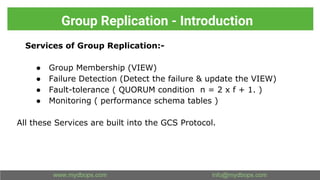
Services of Group Replication:-
● Group Membership (VIEW)
● Failure Detection (Detect the failure & update the VIEW)
● Fault-tolerance ( QUORUM condition n = 2 x f + 1. )
● Monitoring ( performance schema tables )
All these Services are built into the GCS Protocol.
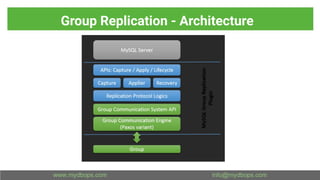
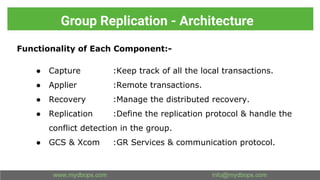
Group Replication - Architecture
Functionality of Each Component:-
● Capture :Keep track of all the local transactions.
● Applier :Remote transactions.
● Recovery :Manage the distributed recovery.
● Replication :Define the replication protocol & handle the
conflict detection in the group.
● GCS & Xcom :GR Services & communication protocol.
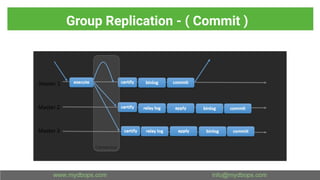
Group Replication - ( Commit )
Group Replication - Monitoring
Tables in Perf schema:-
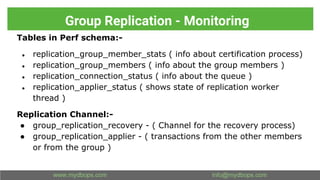
● replication_group_member_stats ( info about certification process)
● replication_group_members ( info about the group members )
● replication_connection_status ( info about the queue )
● replication_applier_status ( shows state of replication worker
thread )
Replication Channel:-
● group_replication_recovery - ( Channel for the recovery process)
● group_replication_applier - ( transactions from the other members
or from the group )
Group Replication - Monitoring
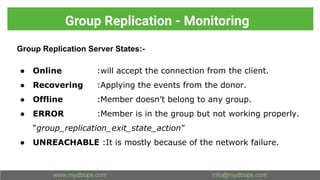
Group Replication Server States:-
● Online :will accept the connection from the client.
● Recovering :Applying the events from the donor.
● Offline :Member doesn’t belong to any group.
● ERROR :Member is in the group but not working properly.
“group_replication_exit_state_action”
● UNREACHABLE :It is mostly because of the network failure.
Group Replication - Modes
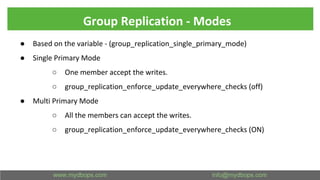
● Based on the variable - (group_replication_single_primary_mode)
● Single Primary Mode
○ One member accept the writes.
○ group_replication_enforce_update_everywhere_checks (off)
● Multi Primary Mode
○ All the members can accept the writes.
○ group_replication_enforce_update_everywhere_checks (ON)
Group Replication - Modes
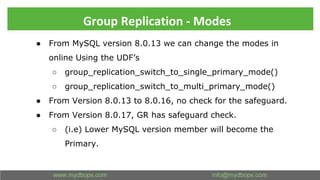
● From MySQL version 8.0.13 we can change the modes in
online Using the UDF’s
○ group_replication_switch_to_single_primary_mode()
○ group_replication_switch_to_multi_primary_mode()
● From Version 8.0.13 to 8.0.16, no check for the safeguard.
● From Version 8.0.17, GR has safeguard check.
○ (i.e) Lower MySQL version member will become the
Primary.
Primary Member Change - Cases
● Primary leaves the group .
● While Changing the primary member manually using UDF.
● While Changing the multi primary to single primary.
Primary Election Algorithm
First Election Check:-
● Ordering based on MySQL major Version & patch Version.
Second Election Check:-
● Based on lowest member weight. ( group_replication_member_weight ).
Third Election Check:-
● Based on the lowest server UUID.
Conditions for using online UDF
1. All members must be in ONLINE state
2. No members can join in the group during a configuration change.
3. Only one configuration at once.
4. All members must be running MySQL 8.0.13 or higher
Communication Protocol
● From MySQL 8.0.16, Configure different versions of MySQL members.
● Group must use same communication protocol Version.
Reason:-
● From MySQL 5.7.14, allow compression of messages
● From MySQL 8.0.16, allow fragmentation of messages
Functions:-
● group_replication_get_communication_protocol();
● group_replication_set_communication_protocol(“version”);
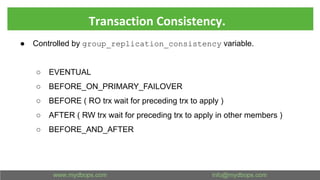
Transaction Consistency.
● Controlled by group_replication_consistency variable.
○ EVENTUAL
○ BEFORE_ON_PRIMARY_FAILOVER
○ BEFORE ( RO trx wait for preceding trx to apply )
○ AFTER ( RW trx wait for preceding trx to apply in other members )
○ BEFORE_AND_AFTER
Email Us : Info@mydbops.com
Thank you

Group Replication in MySQL 8.0 ( A Walk Through )

  • 1.
    Group Replication InMYSQL 8.0 A walk through Presented by VIGNESH PRABHU S www.mydbops.com info@mydbops.com
  • 2.
    About Mydbops ● Foundedin 2015, HQ in Bangalore India with 450+ customer base across the globe. ● Mydbops is on Database Consulting with core specialization on MySQL ,MongoDB & PostgreSQL Administration and Support. ● We have expert team with 30+ certified DBA’s providing full time support and currently managing 300+ servers on cloud. ● Mydbops was created with a motto of developing a Devops model for Database administration offering 24*7 expert remote DBA support. ● We help organisations to architect and scale systems in MySQL/Mongo by implementing the advanced technologies in industry which are completely open source. ● We are a leading solution provider in the market for all sort of cloud based deployments and management.
  • 3.
    Agenda ● Group Replication- Introduction ● Group Replication - Architecture ● Group Replication - Monitoring ● Group Replication - Modes ● Primary Member Change - Cases ● Primary Election Algorithm ● Conditions for using online UDF ● Communication Protocol ● Transaction Consistency
  • 4.
    Group Replication -Introduction ● High Availability Solution ● To create a fault tolerant System. ● Supports Server side failover. ● Client side failover is not supported by GR. ● Distributed functionality. ● Based on the GCS protocol and paxos algorithm. ● Split brain issue is avoided by Quorum.
  • 5.
    Group Replication -Introduction Services of Group Replication:- ● Group Membership (VIEW) ● Failure Detection (Detect the failure & update the VIEW) ● Fault-tolerance ( QUORUM condition n = 2 x f + 1. ) ● Monitoring ( performance schema tables ) All these Services are built into the GCS Protocol.
  • 6.
    Group Replication -Architecture
  • 7.
    Group Replication -Architecture Functionality of Each Component:- ● Capture :Keep track of all the local transactions. ● Applier :Remote transactions. ● Recovery :Manage the distributed recovery. ● Replication :Define the replication protocol & handle the conflict detection in the group. ● GCS & Xcom :GR Services & communication protocol.
  • 8.
  • 9.
    Group Replication -Monitoring Tables in Perf schema:- ● replication_group_member_stats ( info about certification process) ● replication_group_members ( info about the group members ) ● replication_connection_status ( info about the queue ) ● replication_applier_status ( shows state of replication worker thread ) Replication Channel:- ● group_replication_recovery - ( Channel for the recovery process) ● group_replication_applier - ( transactions from the other members or from the group )
  • 10.
    Group Replication -Monitoring Group Replication Server States:- ● Online :will accept the connection from the client. ● Recovering :Applying the events from the donor. ● Offline :Member doesn’t belong to any group. ● ERROR :Member is in the group but not working properly. “group_replication_exit_state_action” ● UNREACHABLE :It is mostly because of the network failure.
  • 11.
    Group Replication -Modes ● Based on the variable - (group_replication_single_primary_mode) ● Single Primary Mode ○ One member accept the writes. ○ group_replication_enforce_update_everywhere_checks (off) ● Multi Primary Mode ○ All the members can accept the writes. ○ group_replication_enforce_update_everywhere_checks (ON)
  • 12.
    Group Replication -Modes ● From MySQL version 8.0.13 we can change the modes in online Using the UDF’s ○ group_replication_switch_to_single_primary_mode() ○ group_replication_switch_to_multi_primary_mode() ● From Version 8.0.13 to 8.0.16, no check for the safeguard. ● From Version 8.0.17, GR has safeguard check. ○ (i.e) Lower MySQL version member will become the Primary.
  • 13.
    Primary Member Change- Cases ● Primary leaves the group . ● While Changing the primary member manually using UDF. ● While Changing the multi primary to single primary.
  • 14.
    Primary Election Algorithm FirstElection Check:- ● Ordering based on MySQL major Version & patch Version. Second Election Check:- ● Based on lowest member weight. ( group_replication_member_weight ). Third Election Check:- ● Based on the lowest server UUID.
  • 15.
    Conditions for usingonline UDF 1. All members must be in ONLINE state 2. No members can join in the group during a configuration change. 3. Only one configuration at once. 4. All members must be running MySQL 8.0.13 or higher
  • 16.
    Communication Protocol ● FromMySQL 8.0.16, Configure different versions of MySQL members. ● Group must use same communication protocol Version. Reason:- ● From MySQL 5.7.14, allow compression of messages ● From MySQL 8.0.16, allow fragmentation of messages Functions:- ● group_replication_get_communication_protocol(); ● group_replication_set_communication_protocol(“version”);
  • 17.
    Transaction Consistency. ● Controlledby group_replication_consistency variable. ○ EVENTUAL ○ BEFORE_ON_PRIMARY_FAILOVER ○ BEFORE ( RO trx wait for preceding trx to apply ) ○ AFTER ( RW trx wait for preceding trx to apply in other members ) ○ BEFORE_AND_AFTER
  • 18.
    Email Us :Info@mydbops.com Thank you