PostgreSQL Schema Changes with
pg_osc
PGConf India, 29th Feb 2024
- Aakash M
About Us
Our Services
Focus on MySQL, MongoDB, PostgreSQL, TiDB, Cassandra
Consulting
Services
Consulting
Services
Managed
Support
Services
24*7
DBA Team
Targeted
Engagement
What is pg_osc ?
● Tool for making schema changes
● Minimal lock and zero downtime
● Similar to pt_osc (MySQL) and pg_repack
● Not an extension
Problems with Alter
● ALTER - Requires locks, downtime
● CDC - Complex to use
Requirement to Use
● PostgreSQL version >= 9.6
● DB User with trigger access or a Superuser
Installation
● Using gem command
● Docker Installation
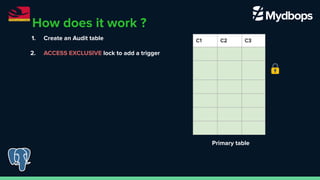
How does it work ?
1. Create an Audit table
Audit table
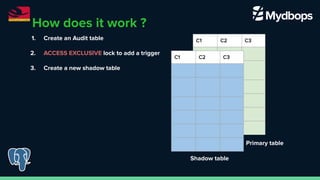
1. Create an Audit table
2. ACCESS EXCLUSIVE lock to add a trigger
C1 C2 C3
Primary table
How does it work ?
1. Create an Audit table
2. ACCESS EXCLUSIVE lock to add a trigger
3. Create a new shadow table
C1 C2 C3
C1 C2 C3
Primary table
Shadow table
How does it work ?
1. Create an Audit table
2. ACCESS EXCLUSIVE lock to add a trigger
3. Create a new shadow table
4. Execute ALTER on shadow table
C1 C2 C3 C4
ALTER TABLE SHADOW
TABLE ADD COLUMN C4 ;
Shadow table
How does it work ?
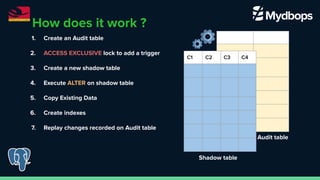
1. Create an Audit table
2. ACCESS EXCLUSIVE lock to add a trigger
3. Create a new shadow table
4. Execute ALTER on shadow table
5. Copy Existing Data
C1 C2 C3
C1 C2 C3 C4
Shadow table
Primary table
How does it work ?
1. Create an Audit table
2. ACCESS EXCLUSIVE lock to add a trigger
3. Create a new shadow table
4. Execute ALTER on shadow table
5. Copy Existing Data
6. Create indexes
C1 C2 C3 C4
Shadow table
CREATING INDEXES
How does it work ?
1. Create an Audit table
2. ACCESS EXCLUSIVE lock to add a trigger
3. Create a new shadow table
4. Execute ALTER on shadow table
5. Copy Existing Data
6. Create indexes
7. Replay changes recorded on Audit table
C1 C2 C3 C4
Shadow table
Audit table
How does it work ?
1. Create an Audit table
2. ACCESS EXCLUSIVE lock to add a trigger
3. Create a new shadow table
4. Execute ALTER on shadow table
5. Copy Existing Data
6. Create indexes
7. Replay changes recorded on Audit table
8. Finally Swap table inside a transaction
How does it work ?
C1 C2 C3
C1 C2 C3 C4
Shadow table
Primary table
1. Create an Audit table
2. ACCESS EXCLUSIVE lock to add a trigger
3. Create a new shadow table
4. Execute ALTER on shadow table
5. Copy Existing Data
6. Create indexes
7. Replay changes recorded on Audit table
8. Finally Swap table inside a transaction
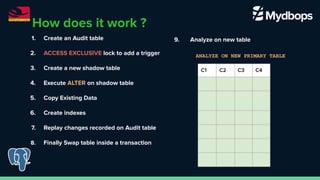
9. Analyze on new table
How does it work ?
C1 C2 C3 C4
ANALYZE ON NEW PRIMARY TABLE
1. Create an Audit table
2. ACCESS EXCLUSIVE lock to add a trigger
3. Create a new shadow table
4. Execute ALTER on shadow table
5. Copy Existing Data
6. Create indexes
7. Replay changes recorded on Audit table
8. Finally Swap table inside a transaction
9. Analyze on new table
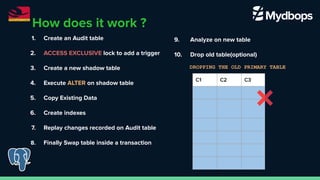
10. Drop old table(optional)
How does it work ?
C1 C2 C3
DROPPING THE OLD PRIMARY TABLE
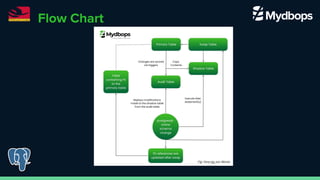
Flow Chart
Prominent Features
● Minimal Lock throughout the process
● No chance of data loss
● Table rebuild, reduce bloat
● Finetune Replay
● Custom SQL to copy data
Few Considerations
● Mandate to have primary key
● No support for Partitioned Table
● Need minimal locks
● Need of more storage
● Index, constraint, Sequence name lose their naming
● Avoid parallel DDLs
References
● GitHub : shayonj/pg-osc : https://github.com/shayonj/pg-osc
● Revolutionizing PostgreSQL Schema Changes with pg_osc :
https://www.mydbops.com/blog/postgresql-schema-changes-with-pg_osc/
Thank You !
PgConf India 2024

PostgreSQL Schema Changes with pg-osc - Mydbops @ PGConf India 2024

  • 1.
    PostgreSQL Schema Changeswith pg_osc PGConf India, 29th Feb 2024 - Aakash M
  • 2.
  • 3.
    Our Services Focus onMySQL, MongoDB, PostgreSQL, TiDB, Cassandra Consulting Services Consulting Services Managed Support Services 24*7 DBA Team Targeted Engagement
  • 4.
    What is pg_osc? ● Tool for making schema changes ● Minimal lock and zero downtime ● Similar to pt_osc (MySQL) and pg_repack ● Not an extension
  • 5.
    Problems with Alter ●ALTER - Requires locks, downtime ● CDC - Complex to use
  • 6.
    Requirement to Use ●PostgreSQL version >= 9.6 ● DB User with trigger access or a Superuser
  • 7.
    Installation ● Using gemcommand ● Docker Installation
  • 8.
    How does itwork ? 1. Create an Audit table Audit table
  • 9.
    1. Create anAudit table 2. ACCESS EXCLUSIVE lock to add a trigger C1 C2 C3 Primary table How does it work ?
  • 10.
    1. Create anAudit table 2. ACCESS EXCLUSIVE lock to add a trigger 3. Create a new shadow table C1 C2 C3 C1 C2 C3 Primary table Shadow table How does it work ?
  • 11.
    1. Create anAudit table 2. ACCESS EXCLUSIVE lock to add a trigger 3. Create a new shadow table 4. Execute ALTER on shadow table C1 C2 C3 C4 ALTER TABLE SHADOW TABLE ADD COLUMN C4 ; Shadow table How does it work ?
  • 12.
    1. Create anAudit table 2. ACCESS EXCLUSIVE lock to add a trigger 3. Create a new shadow table 4. Execute ALTER on shadow table 5. Copy Existing Data C1 C2 C3 C1 C2 C3 C4 Shadow table Primary table How does it work ?
  • 13.
    1. Create anAudit table 2. ACCESS EXCLUSIVE lock to add a trigger 3. Create a new shadow table 4. Execute ALTER on shadow table 5. Copy Existing Data 6. Create indexes C1 C2 C3 C4 Shadow table CREATING INDEXES How does it work ?
  • 14.
    1. Create anAudit table 2. ACCESS EXCLUSIVE lock to add a trigger 3. Create a new shadow table 4. Execute ALTER on shadow table 5. Copy Existing Data 6. Create indexes 7. Replay changes recorded on Audit table C1 C2 C3 C4 Shadow table Audit table How does it work ?
  • 15.
    1. Create anAudit table 2. ACCESS EXCLUSIVE lock to add a trigger 3. Create a new shadow table 4. Execute ALTER on shadow table 5. Copy Existing Data 6. Create indexes 7. Replay changes recorded on Audit table 8. Finally Swap table inside a transaction How does it work ? C1 C2 C3 C1 C2 C3 C4 Shadow table Primary table
  • 16.
    1. Create anAudit table 2. ACCESS EXCLUSIVE lock to add a trigger 3. Create a new shadow table 4. Execute ALTER on shadow table 5. Copy Existing Data 6. Create indexes 7. Replay changes recorded on Audit table 8. Finally Swap table inside a transaction 9. Analyze on new table How does it work ? C1 C2 C3 C4 ANALYZE ON NEW PRIMARY TABLE
  • 17.
    1. Create anAudit table 2. ACCESS EXCLUSIVE lock to add a trigger 3. Create a new shadow table 4. Execute ALTER on shadow table 5. Copy Existing Data 6. Create indexes 7. Replay changes recorded on Audit table 8. Finally Swap table inside a transaction 9. Analyze on new table 10. Drop old table(optional) How does it work ? C1 C2 C3 DROPPING THE OLD PRIMARY TABLE
  • 18.
  • 19.
    Prominent Features ● MinimalLock throughout the process ● No chance of data loss ● Table rebuild, reduce bloat ● Finetune Replay ● Custom SQL to copy data
  • 20.
    Few Considerations ● Mandateto have primary key ● No support for Partitioned Table ● Need minimal locks ● Need of more storage ● Index, constraint, Sequence name lose their naming ● Avoid parallel DDLs
  • 21.
    References ● GitHub :shayonj/pg-osc : https://github.com/shayonj/pg-osc ● Revolutionizing PostgreSQL Schema Changes with pg_osc : https://www.mydbops.com/blog/postgresql-schema-changes-with-pg_osc/
  • 22.