LESSON 1: THEDEPED SCIENCE
FRAMEWORK & CURRICULUM KEY STAGES
IN K TO 12
Lesson Outcomes
At the end of the lesson, the learner should
have:
1. Described the science conceptual framework
and the curriculum key stages in K-12.
2. Discussed the key stages relative to the
grade levels and the two branches of science.
2
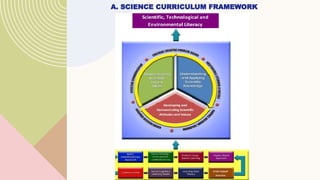
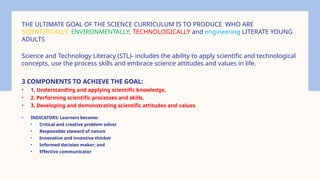
THE ULTIMATE GOALOF THE SCIENCE CURRICULUM IS TO PRODUCE WHO ARE
SCIENTIFICALLY, ENVIRONMENTALLY, TECHNOLOGICALLY and engineering LITERATE YOUNG
ADULTS
Science and Technology Literacy (STL)- includes the ability to apply scientific and technological
concepts, use the process skills and embrace science attitudes and values in life.
3 COMPONENTS TO ACHIEVE THE GOAL:
• 1. Understanding and applying scientific knowledge,
• 2. Performing scientific processes and skills,
• 3. Developing and demonstrating scientific attitudes and values.
• INDICATORS: Learners become-
• Critical and creative problem solver
• Responsible steward of nature
• Innovative and inventive thinker
• Informed decision maker; and
• Effective communicator
5.
5
WHAT ARE THECOMPONENTS AT THE CORE OF THE FRAMEWORK?
1. Understanding and Applying Scientific Knowledge
A science literate learner UNDERSTANDS what science is and APPLIES processes to
know more about science.
As a body of knowledge, science is divided into different branches-CHEMISTRY,
BIOLOGY, PHYSICS and EARTH AND SPACE.
2. Performing Scientific Inquiry Skills
In Science, it is not all about knowledge, concepts, ideas, theories, principles that
are memorized and understood.
The science-oriented mind is a questioning mind. It continues to inquire or
wonder.
It continues to search for an answer to the question the framework
provides.
6.
6
WHAT ARE THECOMPONENTS AT THE CORE OF THE FRAMEWORK?
3. Developing and Demonstrating Scientific Attitudes and Values
Positive attitudes that a young science learner should develop:
CURIOSITY - an attitude that implies inquisitiveness. A desire for exploration and
investigation to learn new knowledge.
OPEN-MINDEDNESS – means the willingness to search for evidence before making
conclusions.
PERSEVERANCE – A positive attitude characterized by patience in doing something
persistently even how difficult it is to achieve a goal.
SKEPTICISM – a science literate person always leaves a DOUBT BEFORE TOTALLY
BELIEVING. The search for EVIDENCE prior to BELIEVING is a rule of thumb.
CREATIVITY AND INNOVATION – maximizes the use of an imaginative mind to
produce something new.
OBJECTIVITY – an attitude that removes bias. A personal opinion or feelings are not
considered to represent facts or ideas.
7.
7
WHAT ARE THEAPPROACHES, MODELS AND PRACTICES
RECOMMENDED BY THE FRAMEWORK?
1 . MULTI-DISCIPLINARY – interrelationships and interaction of
different discplines like science and mathematics, science and social
studies, science and history and many more.
2. CONTEXTUALLY-BASED – the science curriculum is approached
within the context of the learning environment. TECHNOLOGY AND
SOCIETY play a great role in designing learning activities.
3. PROBLEM/ISSUES BASED – believes that science learners should
focus not only on the WHAT, but on HOW and WHY they learn.
4. INQUIRY-BASED – based on the idea of seeking information,
knowledge or truth. Asking questions to find answers will lead to a
better understanding of facts, ideas or information.
8.
8
TIME-TESTED AND EMERGINGSOUND EDUCATIONAL PEDAGOGY ARE
RECOMMENDED:
1. CONSTRUCTIVISM- a learning theory that explains how individuals
construct understanding and knowledge through prior learning and
reflection. ACTIVE LEARNING or USE OF EXPERIENTAL SCIENCE
ACTIVITIES is a nature of constructivism in science.
2. SOCIAL COGNITION- introduced by LEV VYGOTSKY, who asserted that
CULTURE is the foundation of individual development. Culture teaches
learners both WHAT TO THINK and HOW TO THINK on their own or in
groups.
3. LEARNING STYLES – anchored on the premise that learners are created
equally but learn differently. The VARK model indentifies Visual,
Auditory, Reading and Kinesthetic learners who respond to different
kinds of learning.
9.
9
TIME-TESTED AND EMERGINGSOUND EDUCATIONAL PEDAGOGY ARE
RECOMMENDED:
- LEARNING STYLES – differentiated instruction and
individualized learning.
Most common categories of learning style:
Visual
Auditory
Kinesthetic (tactile)
4. BRAIN-BASED LEARNING- a student-centered learning that
utilizes the whole brain and recognizes that not all learners
learn the same way. It centers around neuroplasticity or
remapping of the brain connections when learning concepts.
10.
B. KEY STAGESIN SCIENCE CURRICULUM
KEY STAGE 1 Standards-Kindergarten to G4
• Acquires understanding of the properties of objects around them
• Practices basic science process skills necessary for the conduct of
scientific investigations; and
• Exhibits curiosity and appreciation of the natural world.
KEY STAGE 2 Standards-Grade 5-Grade 8
• Acquires knowledge and skills necessary to explain
natural phenomena
• Understands and recalls science concepts and connects
them with the information
• Conducts investigation safely using appropriate
equipment; and
• Communicates scientific observations and ideas
accurately
10
11.
B. KEY STAGESIN SCIENCE CURRICULUM
• KEY STAGE 3 Standards-Grade 9-Grade 12
• Applies scientific concepts in designing
scientific investigations and or possible
solutions to real-world problems;
• Evaluates scientific evidence in drawing
interpretations and conclusions;
• Exhibits ethical and analytical thinking in
making decisions in scientific contexts; and
• Demonstrates desirable attitudes and skills
in conducting scientific investigation.
11
12.
12
SHORT QUIZ
I. Answerthe following questions:
1. What are the most important knowledge, skills and values that I learned based on Lesson
1?
2. As a future teacher, what will I do with what I know?
II. Choose the correct answer from the options given.
1. In the basic components of the framework, all imply that science involves
action or doing. Which is not emphasized in the learning of science?
A. Memorizing facts, concepts, principles and theories.
B. Understanding and Applying Scientific Knowledge
C. Developing and Demonstrating Scientific Attitude and Values
D. Performing Scientific Inquiry Skills.
2. As future science teacher, what is the ultimate goal of science in the framework that
each learner should achieve?
A. 21st
Century Literacy
B. Science and Technology Literacy
C. Science, Technology and Society
D. Develop innovators and inventors
13.
13
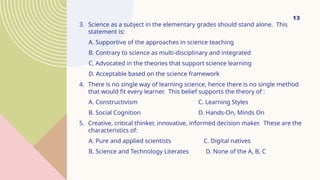
3. Science asa subject in the elementary grades should stand alone. This
statement is:
A. Supportive of the approaches in science teaching
B. Contrary to science as multi-disciplinary and integrated
C. Advocated in the theories that support science learning
D. Acceptable based on the science framework
4. There is no single way of learning science, hence there is no single method
that would fit every learner. This belief supports the theory of :
A. Constructivism C. Learning Styles
B. Social Cognition D. Hands-On, Minds On
5. Creative, critical thinker, innovative, informed decision maker. These are the
characteristics of:
A. Pure and applied scientists C. Digital natives
B. Science and Technology Literates D. None of the A, B, C




![谷歌留痕技术 [ 𝙩𝙤𝙥 𝟮𝟯𝟯. 𝙘 𝙤𝙢 ]](https://cdn.slidesharecdn.com/ss_thumbnails/top233-260130174328-3833018c-thumbnail.jpg?width=640&height=640&fit=bounds)


