Webinar Series 2
Curriculum Studies
DEPARTMENT OF EDUCATION
MANONMANIAM SUNDARANAR UNIVERSITY
Trinelveli, Tamil Nadu
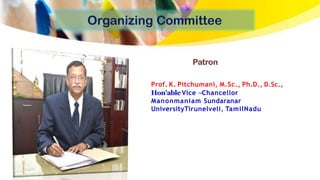
Prof. K. Pitchumani, M.Sc., Ph.D., D.Sc.,
Hon’able Vice –Chancellor
Manonmaniam Sundaranar
UniversityTirunelveli, TamilNadu
Patron
Organizing Committee
Prof. B.William Dharma Raja
Organizing Secretary
Dean, Faculty of Arts
Head, Department of Education
Manonmaniam Sundaranar University
Tirunelveli, Tamilnadu
Committee Members
Dr A. Veliappan
Mr S. Lenin
Dr S. R. Sundaravalli
Committee Co-members
Dr V. Sasikala
Ms B. Viji
Programme Host
Ms. J. Rawoofu Nisha
Research Scholar
MODELS OF CURRICULUM
A. Jancy Rose
Mary Department of Education
Manonmaniam Sundaranar
University
Tirunelveli
CURRICUL
UM
Curriculum
i
s
a design plan for learning that requires the
purposeful and proactive organization, sequencing, and
management of the interactions among the teacher,
students, and the content knowledge we want students
to acquire.
Department of Education,Manonmaniam Sundaranar University, Tirunelveli, T.N
CURRICULUM
MODEL
A curriculum model is a format for
curriculum design developed
to meet unique needs,
contexts and purposes. In
order to address
these goals, curricular
developers design,
reconfigure or rearrange one
Sundaranar University, Tirunelveli,
TRADITIONAL
MODEL
Department of Education,
Manonmaniam
Ralph Tyler – first - traditional model in 1949 - his
book “Basicprinciplesof Curriculumand
Instruction”.
 In general, the principle way to form a
concept of curriculum development
 Widely used in schools –world
 Many Teacher and students – familiar concepts
 Has subject centred orientation
 Knowledgeand skills cannot be photo copied but
instead taught in a sequence over time
 Spiral approach – learners returns to topics.
Department of Education,
Manonmaniam
EXAMPLES
OF TRADITIONAL
MODEL
Department of Education,
Manonmaniam
1. Subject design - stresses entirely on content
2. Discipline design - Promotes knowledge to study specific content
3. Correlation design - links individual subject to reduce
fragmentation
4. Broad field / Interdisciplinary - prevents
categorization of subjects
-best design
Advantag
es
 Widely available for
learners
Department of Education,
Manonmaniam
 Promote elasticity of learning
new
knowledge
 Learningdistinct skills in a
systematic fashion
 Lending well to mass production
 It is much more competent
 Easy for volunteer tutors and
teachers
Disadvantag
es
 Lacks integration
 Focuses on one particular subject
 Students are passive learner
 Students are not part of authority
hierarchy
CONTEMPORARY
MODEL OR FRAMEWORK OF
CURRICULUM DEVELOPMENT
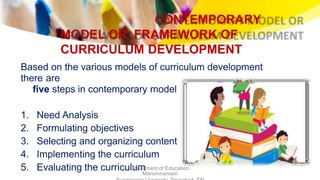
Based on the various models of curriculum development
there are
five steps in contemporary model
1. Need Analysis
2. Formulating objectives
3. Selecting and organizing content
4. Implementing the curriculum
5. Evaluating the curriculumDepartment of Education,
Manonmaniam
1. Need
Analysis
It may include analyzing the
needs of
Students
Graduates
Stakeholders
National and globalDepartment of Education,
Manonmaniam
2. Formulating of
Objectives
It could be formulated from the needs /
opinions of
 Lecturers
 Students
 National
 Social
 Global Department of Education,
Manonmaniam
3. Selection of
ContentSources of
 Lecturers
 External examiners
 Politicians
 Students
 Academic advisors
 Professional boarder
 Alumni, Graduates
 Governmental policies
 Academicians
 Comparisons and bench
marking
Department of Education,
Manonmaniam
4.
Implementation
Teaching and learning
process
 Teaching styles and
strategies
 Learning styles and
strategies
Department of Education,
Manonmaniam
5.Evaluati
on
Department of Education,
Manonmaniam
 Determine the method to measure whether the
curriculum is achieving the desired objectives or results.
 It involves an appraisal of the students actual behaviour
 It should be carried out at several different times to
secure evidence of the permanence of the learning
achieved.
ACADEMIC BASED
MODEL
Department of Education,
Manonmaniam
 It is based on subject. All knowledge is transferred to
students through the subjects
 Subject matter taught should reflect basic areas that
are
essentials and agreed upon content for learner
attainment
OBJECTI
VES
To transfer cultural
heritage
To represent knowledge
To impact information
Department of Education,
Manonmaniam
DRAWBAC
KS
Department of Education,
Manonmaniam
Ignores interest of students
No process of insight or thinking
Rote Memory
Neglect social problems and
demands
Passive learning
COMPETENCY BASED
MODEL
Department of Education,
Manonmaniam
Competence is defined as ability to adequately
perform a task duty or role.
Competence integrates knowledge skills, personal
values and attitudes
Competencebuilds on knowledge and skills
acquired through work experience and learning by
doing.
 Competency based curriculum is directed to develop
knowledge, understanding, abilities, values attitudes, and
interests of students in order to be able to do something
in the form of skill, accuracy and success with full
responsibility.
 It requires qualified and professional teachers to
collaborate in order to improve the quality of education.Department of Education,
Manonmaniam
CHARACTERISTICS
OF CBC
Department of Education,
Manonmaniam
 Learning system with modules
 Using all learning resources
 Field experience
 Individual personal learning
strategies
 Ease of learning
 Study thoroughly
COMPONEN
TS
Department of Education,
Manonmaniam
Curriculum and learning outcomes
Class- Based Assessment
Teaching and Learning Activities
Management of School – based
Curriculum
SOCIAL FUNCTIONS
DESIGN
Department of Education,
Manonmaniam
Focused heavily on society
Social functions or problems became the
centre
This design is more subjective
Co- operative planning occurs more
frequently
ACTIVITIES
MODEL
Department of Education,
Manonmaniam
Focuses on student interest
Integration of content from any subject
Emphasis is on learning as an active, dynamic
process
Specific skills and knowledge are acquired
Difficult to build a systematic system of
INDIVIDUAL NEEDS
AND
INTEREST
MODEL
Department of Education,
Manonmaniam
 It is according to the interest and tendency of the learner.
 It facilitate the mind of children because it fulfils their
psychological and mental requirements
 In 18th centaury “Rolso” highlight the importance of
individualneeds and interest of students
 Next “Pestalozzi”and “John
Davi”
of this concept.
further enhance the
excellence
• To know about the interest of student and to fulfil their
needs was developed as the central part of the course
by John Davi
• More and more practical activity included so that
children their own choice.
• Classroom is often noisy and busy
• Students have some choice of topicsDepartment of Education,
Manonmaniam
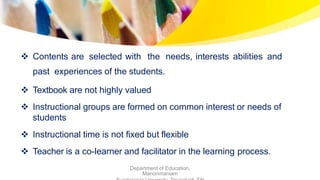
 Contents are selected with the needs, interests abilities and
past experiences of the students.
 Textbook are not highly valued
 Instructional groups are formed on common interest or needs of
students
 Instructional time is not fixed but flexible
 Teacher is a co-learner and facilitator in the learning process.
Department of Education,
Manonmaniam
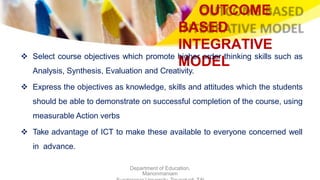
OUTCOME
BASED
INTEGRATIVE
MODEL
Department of Education,
Manonmaniam
 Select course objectives which promote higher order thinking skills such as
Analysis, Synthesis, Evaluation and Creativity.
 Express the objectives as knowledge, skills and attitudes which the students
should be able to demonstrate on successful completion of the course, using
measurable Action verbs
 Take advantage of ICT to make these available to everyone concerned well
in advance.
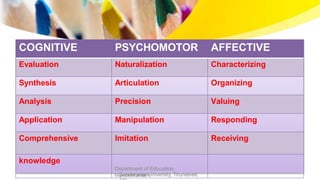
COGNITIVE PSYCHOMOTOR AFFECTIVE
Evaluation Naturalization Characterizing
Synthesis Articulation Organizing
Analysis Precision Valuing
Application Manipulation Responding
Comprehensive Imitation Receiving
knowledge
Department of Education,
ManonmaniamSundaranar University, Tirunelveli,
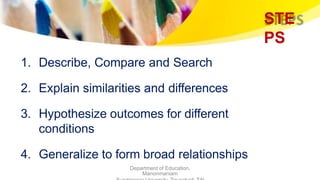
STE
PS
Department of Education,
Manonmaniam
1. Describe, Compare and Search
2. Explain similarities and differences
3. Hypothesize outcomes for different
conditions
4. Generalize to form broad relationships
INTERVENTION
MODEL
Department of Education,
Manonmaniam
Designed as a blueprint for improving abilities to
provide research – based curriculum and evidence
based intervention to all k-12 learners
Curricular implications and Interventions will
empower educators to select, implement,
differentiate and evaluate the curricula and
interventions
CIPP
MODEL
Department of Education,
Manonmaniam
• Develops by Daniel Stufflebeam and colleagues in 1960’s
• Evaluation of Context, Input, Process and Product in
judging a programmed value
• It is a decision focused approach to evaluation
• Cycle of Planning, structuring implementing and
reviewing
CONTEXT
EVALUATION
Department of Education,
Manonmaniam
Often referred as needs
assessment
Help assess problems, assets
and within defined community
opportunitie
s
The methods are system analyses,
surveys, document reviews, interviews,
diagnostic tests
INPUT
EVALUATION
Department of Education,
Manonmaniam
 Identifies procedural designs and educational strategies
 The result is a project design to meet the needs.
 Methods are inventory, analysis, proposed budgets
and schedules, and procedural designs
 Once a project plan is developed. It can be evaluated
using cost analysis, logic models, PERT and various
scales.
PROCESS
EVALUATION
Department of Education,
Manonmaniam
 Ongoing check on the process.
 Documenting the process and providing feedback
 To asses the extent to which participants accept and out their
roles.
 Techniques include on-site observation, participant
interviews,
ratin
gscales, questionnaires ,record analysis, case studies of participants,
focus group, self- reflection sessions with staff and tracking of
expenditures
PRODUCT
EVALUATION
Department of Education,
Manonmaniam
 To measure, interpret and judge project’s outcome by assessing their
merit, worth, significance and probity
 Main purpose to ascertain the extent to which the needs of all the
participants were met
 Techniques include logs, diaries, interviews, case, studies, hearings,
focus group , analysis of photographic records, achievement tests,
rating scales comparison of project costs and outcomes and
longitudinal comparisons.
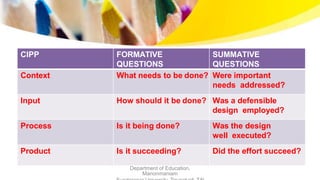
CIPP FORMATIVE
QUESTIONS
SUMMATIVE
QUESTIONS
Context What needs to be done? Were important
needs addressed?
Input How should it be done? Was a defensible
design employed?
Process Is it being done? Was the design
well executed?
Product Is it succeeding? Did the effort succeed?
Department of Education,
Manonmaniam
“Curriculum is considered
the heart of any
educational institution”
Department of Education,
Manonmaniam
Jancy curriculum models converted

Jancy curriculum models converted

  • 1.
    Webinar Series 2 CurriculumStudies DEPARTMENT OF EDUCATION MANONMANIAM SUNDARANAR UNIVERSITY Trinelveli, Tamil Nadu
  • 2.
    Prof. K. Pitchumani,M.Sc., Ph.D., D.Sc., Hon’able Vice –Chancellor Manonmaniam Sundaranar UniversityTirunelveli, TamilNadu Patron Organizing Committee
  • 3.
    Prof. B.William DharmaRaja Organizing Secretary Dean, Faculty of Arts Head, Department of Education Manonmaniam Sundaranar University Tirunelveli, Tamilnadu
  • 4.
    Committee Members Dr A.Veliappan Mr S. Lenin Dr S. R. Sundaravalli Committee Co-members Dr V. Sasikala Ms B. Viji Programme Host Ms. J. Rawoofu Nisha Research Scholar
  • 5.
    MODELS OF CURRICULUM A.Jancy Rose Mary Department of Education Manonmaniam Sundaranar University Tirunelveli
  • 6.
    CURRICUL UM Curriculum i s a design planfor learning that requires the purposeful and proactive organization, sequencing, and management of the interactions among the teacher, students, and the content knowledge we want students to acquire. Department of Education,Manonmaniam Sundaranar University, Tirunelveli, T.N
  • 7.
    CURRICULUM MODEL A curriculum modelis a format for curriculum design developed to meet unique needs, contexts and purposes. In order to address these goals, curricular developers design, reconfigure or rearrange one Sundaranar University, Tirunelveli,
  • 8.
    TRADITIONAL MODEL Department of Education, Manonmaniam RalphTyler – first - traditional model in 1949 - his book “Basicprinciplesof Curriculumand Instruction”.  In general, the principle way to form a concept of curriculum development  Widely used in schools –world  Many Teacher and students – familiar concepts
  • 9.
     Has subjectcentred orientation  Knowledgeand skills cannot be photo copied but instead taught in a sequence over time  Spiral approach – learners returns to topics. Department of Education, Manonmaniam
  • 10.
    EXAMPLES OF TRADITIONAL MODEL Department ofEducation, Manonmaniam 1. Subject design - stresses entirely on content 2. Discipline design - Promotes knowledge to study specific content 3. Correlation design - links individual subject to reduce fragmentation 4. Broad field / Interdisciplinary - prevents categorization of subjects -best design
  • 11.
    Advantag es  Widely availablefor learners Department of Education, Manonmaniam  Promote elasticity of learning new knowledge  Learningdistinct skills in a systematic fashion  Lending well to mass production  It is much more competent  Easy for volunteer tutors and teachers Disadvantag es  Lacks integration  Focuses on one particular subject  Students are passive learner  Students are not part of authority hierarchy
  • 12.
    CONTEMPORARY MODEL OR FRAMEWORKOF CURRICULUM DEVELOPMENT Based on the various models of curriculum development there are five steps in contemporary model 1. Need Analysis 2. Formulating objectives 3. Selecting and organizing content 4. Implementing the curriculum 5. Evaluating the curriculumDepartment of Education, Manonmaniam
  • 13.
    1. Need Analysis It mayinclude analyzing the needs of Students Graduates Stakeholders National and globalDepartment of Education, Manonmaniam
  • 14.
    2. Formulating of Objectives Itcould be formulated from the needs / opinions of  Lecturers  Students  National  Social  Global Department of Education, Manonmaniam
  • 15.
    3. Selection of ContentSourcesof  Lecturers  External examiners  Politicians  Students  Academic advisors  Professional boarder  Alumni, Graduates  Governmental policies  Academicians  Comparisons and bench marking Department of Education, Manonmaniam
  • 16.
    4. Implementation Teaching and learning process Teaching styles and strategies  Learning styles and strategies Department of Education, Manonmaniam
  • 17.
    5.Evaluati on Department of Education, Manonmaniam Determine the method to measure whether the curriculum is achieving the desired objectives or results.  It involves an appraisal of the students actual behaviour  It should be carried out at several different times to secure evidence of the permanence of the learning achieved.
  • 18.
    ACADEMIC BASED MODEL Department ofEducation, Manonmaniam  It is based on subject. All knowledge is transferred to students through the subjects  Subject matter taught should reflect basic areas that are essentials and agreed upon content for learner attainment
  • 19.
    OBJECTI VES To transfer cultural heritage Torepresent knowledge To impact information Department of Education, Manonmaniam
  • 20.
    DRAWBAC KS Department of Education, Manonmaniam Ignoresinterest of students No process of insight or thinking Rote Memory Neglect social problems and demands Passive learning
  • 21.
    COMPETENCY BASED MODEL Department ofEducation, Manonmaniam Competence is defined as ability to adequately perform a task duty or role. Competence integrates knowledge skills, personal values and attitudes Competencebuilds on knowledge and skills acquired through work experience and learning by doing.
  • 22.
     Competency basedcurriculum is directed to develop knowledge, understanding, abilities, values attitudes, and interests of students in order to be able to do something in the form of skill, accuracy and success with full responsibility.  It requires qualified and professional teachers to collaborate in order to improve the quality of education.Department of Education, Manonmaniam
  • 23.
    CHARACTERISTICS OF CBC Department ofEducation, Manonmaniam  Learning system with modules  Using all learning resources  Field experience  Individual personal learning strategies  Ease of learning  Study thoroughly
  • 24.
    COMPONEN TS Department of Education, Manonmaniam Curriculumand learning outcomes Class- Based Assessment Teaching and Learning Activities Management of School – based Curriculum
  • 25.
    SOCIAL FUNCTIONS DESIGN Department ofEducation, Manonmaniam Focused heavily on society Social functions or problems became the centre This design is more subjective Co- operative planning occurs more frequently
  • 26.
    ACTIVITIES MODEL Department of Education, Manonmaniam Focuseson student interest Integration of content from any subject Emphasis is on learning as an active, dynamic process Specific skills and knowledge are acquired Difficult to build a systematic system of
  • 27.
    INDIVIDUAL NEEDS AND INTEREST MODEL Department ofEducation, Manonmaniam  It is according to the interest and tendency of the learner.  It facilitate the mind of children because it fulfils their psychological and mental requirements  In 18th centaury “Rolso” highlight the importance of individualneeds and interest of students  Next “Pestalozzi”and “John Davi” of this concept. further enhance the excellence
  • 28.
    • To knowabout the interest of student and to fulfil their needs was developed as the central part of the course by John Davi • More and more practical activity included so that children their own choice. • Classroom is often noisy and busy • Students have some choice of topicsDepartment of Education, Manonmaniam
  • 29.
     Contents areselected with the needs, interests abilities and past experiences of the students.  Textbook are not highly valued  Instructional groups are formed on common interest or needs of students  Instructional time is not fixed but flexible  Teacher is a co-learner and facilitator in the learning process. Department of Education, Manonmaniam
  • 30.
    OUTCOME BASED INTEGRATIVE MODEL Department of Education, Manonmaniam Select course objectives which promote higher order thinking skills such as Analysis, Synthesis, Evaluation and Creativity.  Express the objectives as knowledge, skills and attitudes which the students should be able to demonstrate on successful completion of the course, using measurable Action verbs  Take advantage of ICT to make these available to everyone concerned well in advance.
  • 31.
    COGNITIVE PSYCHOMOTOR AFFECTIVE EvaluationNaturalization Characterizing Synthesis Articulation Organizing Analysis Precision Valuing Application Manipulation Responding Comprehensive Imitation Receiving knowledge Department of Education, ManonmaniamSundaranar University, Tirunelveli,
  • 32.
    STE PS Department of Education, Manonmaniam 1.Describe, Compare and Search 2. Explain similarities and differences 3. Hypothesize outcomes for different conditions 4. Generalize to form broad relationships
  • 33.
    INTERVENTION MODEL Department of Education, Manonmaniam Designedas a blueprint for improving abilities to provide research – based curriculum and evidence based intervention to all k-12 learners Curricular implications and Interventions will empower educators to select, implement, differentiate and evaluate the curricula and interventions
  • 34.
    CIPP MODEL Department of Education, Manonmaniam •Develops by Daniel Stufflebeam and colleagues in 1960’s • Evaluation of Context, Input, Process and Product in judging a programmed value • It is a decision focused approach to evaluation • Cycle of Planning, structuring implementing and reviewing
  • 35.
    CONTEXT EVALUATION Department of Education, Manonmaniam Oftenreferred as needs assessment Help assess problems, assets and within defined community opportunitie s The methods are system analyses, surveys, document reviews, interviews, diagnostic tests
  • 36.
    INPUT EVALUATION Department of Education, Manonmaniam Identifies procedural designs and educational strategies  The result is a project design to meet the needs.  Methods are inventory, analysis, proposed budgets and schedules, and procedural designs  Once a project plan is developed. It can be evaluated using cost analysis, logic models, PERT and various scales.
  • 37.
    PROCESS EVALUATION Department of Education, Manonmaniam Ongoing check on the process.  Documenting the process and providing feedback  To asses the extent to which participants accept and out their roles.  Techniques include on-site observation, participant interviews, ratin gscales, questionnaires ,record analysis, case studies of participants, focus group, self- reflection sessions with staff and tracking of expenditures
  • 38.
    PRODUCT EVALUATION Department of Education, Manonmaniam To measure, interpret and judge project’s outcome by assessing their merit, worth, significance and probity  Main purpose to ascertain the extent to which the needs of all the participants were met  Techniques include logs, diaries, interviews, case, studies, hearings, focus group , analysis of photographic records, achievement tests, rating scales comparison of project costs and outcomes and longitudinal comparisons.
  • 39.
    CIPP FORMATIVE QUESTIONS SUMMATIVE QUESTIONS Context Whatneeds to be done? Were important needs addressed? Input How should it be done? Was a defensible design employed? Process Is it being done? Was the design well executed? Product Is it succeeding? Did the effort succeed? Department of Education, Manonmaniam
  • 40.
    “Curriculum is considered theheart of any educational institution” Department of Education, Manonmaniam