COLLEGE OF HORTICULTURE, MUNIRABAD
Course Tittle: Protected cultivation of vegetables,VSC202(0+1)
Presentation Topic: Climate regulation in greenhouse
Presentation By :
UHS21UG5940
UHS21UG5941
UHS21UG5963
1
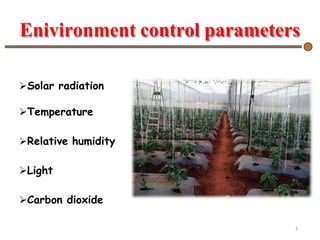
Enivironment control parameters
Solar radiation
Temperature
Relative humidity
Light
Carbon dioxide
2
Temperature
 Temperature has a direct impact on the
physiological
development phases of the plant.
 Regulates the transpiration rate and plant
water status through stomatal control during
the photosynthesis.
 Average temperatures ranges between 20o-
30oC
3
 Relative humidity within the range 60-90
% is suitable to plant growth
 RH above 95 % for long periods,
particularly at night as this favours the
rapid development of fungus diseases
Relative humidity
4
Light intensity
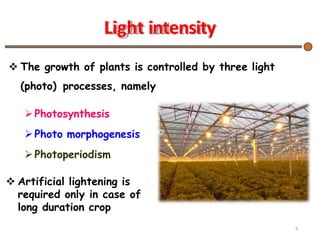
 The growth of plants is controlled by three light
(photo) processes, namely
Photosynthesis
Photo morphogenesis
Photoperiodism
 Artificial lightening is
required only in case of
long duration crop
5
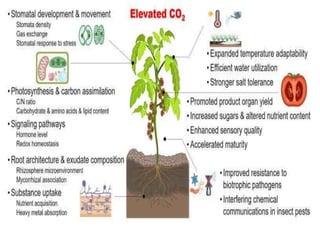
Carbon dioxide
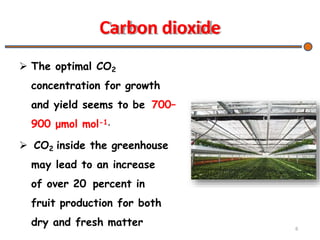
 The optimal CO2
concentration for growth
and yield seems to be 700–
900 μmol mol-1,
 CO2 inside the greenhouse
may lead to an increase
of over 20 percent in
fruit production for both
dry and fresh matter 6
Control system
 Ventilation
 Shading
 Cooling
 Greenhouse heating
 Solar radiation filtration
 Internal air circulation
system
 CO2 enrichment
 The lighting system
 Air humidification
 Dehumidification 7
Ventilation
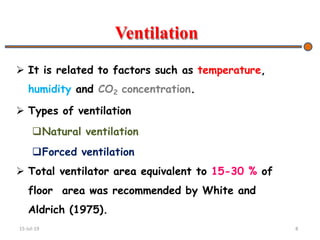
 It is related to factors such as temperature,
humidity and CO2 concentration.
 Types of ventilation
Natural ventilation
Forced ventilation
 Total ventilator area equivalent to 15-30 % of
floor area was recommended by White and
Aldrich (1975).
15-Jul-19 8
Natural ventilation
9
 Efficiency of natural ventilation depends on factors such
as
 Wind speed and direction,
 Temperature differences between the outside and the
inside of the greenhouse,
 Greenhouse design and the presence or absence of
crops
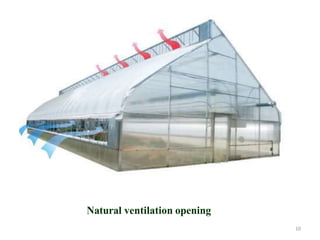
The external cool air enters the GH through
the lower side openings while the hot
internal air exits through the roof openings
due to density difference, lowering of
temperature in the GH.
10
Natural ventilation opening
Forced ventilation
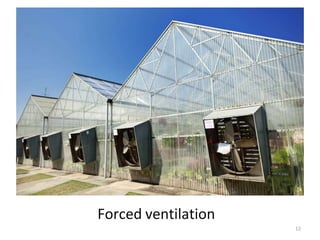
 Fans suck air out on the one side and openings on
the other side let air in.
 Ventilation fans should be located on the wind side
of
the greenhouse
11
Distance between two fans should not exceed
8-10 m
 Inlet opening on the opposite side of a fan
should be at least
1.25 times of the fan area.
12
Forced ventilation
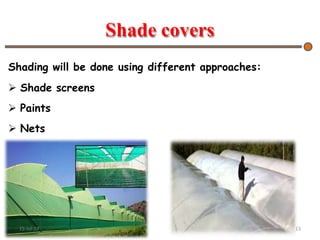
Shade covers
Shading will be done using different approaches:
 Shade screens
 Paints
 Nets
15-Jul-19 13
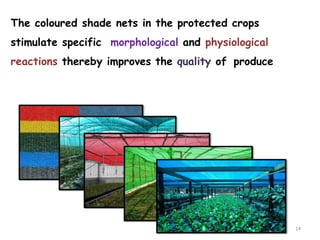
The coloured shade nets in the protected crops
stimulate specific morphological and physiological
reactions thereby improves the quality of produce
14
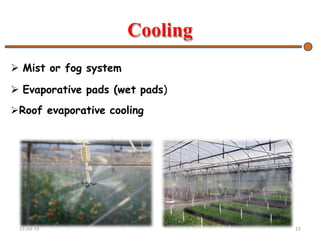
Cooling
 Mist or fog system
 Evaporative pads (wet pads)
15-Jul-19 15
Roof evaporative cooling
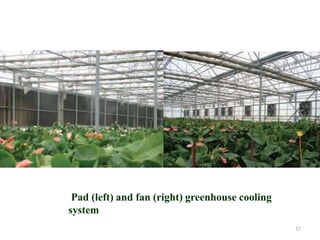
Fan-pad system
• This system consists of a fan on one sidewall
and pad on
the other sidewall of the GH.
• The principle of evaporative cooling is
applied by running a water stream over
the pad and consequent withdrawal of air
through it by fans on the opposite side.
• The air becomes cooler and its humidity is
also raised. More effective when outside air
humidity is low.
17
Pad (left) and fan (right) greenhouse cooling
system
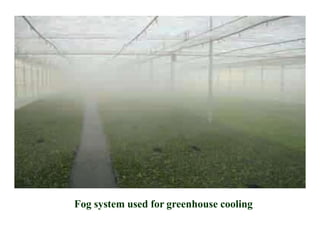
Fog/misting system
• It is based on spraying water as small droplets
(droplet diameter of 2–60 micro meters) with high
pressure nozzles.
• Cooling is achieved by evaporation of droplets. Free
fall velocity of these droplets is slow and the air
streams inside the GH easily carry the drops.
• This can result in high efficiency of water evaporation
combined with keeping the foliage dry.
• Provides more uniform spatial air temperature and
RH than fan-pad system. Less expensive to install and
operate.
Fog system used for greenhouse cooling
Heating
 Greenhouse heating is required in cold climate regions
such as Himalayan region of the country.
 The heating system should provide heat to the
greenhouse at the same rate at which it is lost.
 The most common and least expensive is the unit heater
system.
 Heaters are located throughout the greenhouse, each
heating system has a floor area of 180 to 500 m2.
20
21
Unit heaters
Central heating
Wall pipes coils
Overhead pipes coils
In bed-pipe coils
Pipe/Rail heating systems
Heating for anti frost protection
Different types of heating
systems
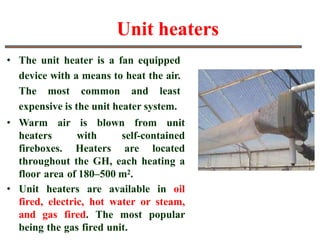
Unit heaters
• The unit heater is a fan equipped
device with a means to heat the air.
The most common and least
expensive is the unit heater system.
• Warm air is blown from unit
heaters with self-contained
fireboxes. Heaters are located
throughout the GH, each heating a
floor area of 180–500 m2.
• Unit heaters are available in oil
fired, electric, hot water or steam,
and gas fired. The most popular
being the gas fired unit.
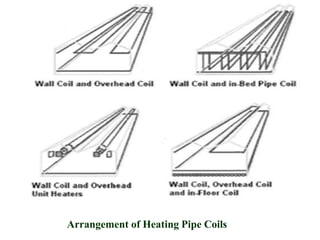
Arrangement of Heating Pipe Coils
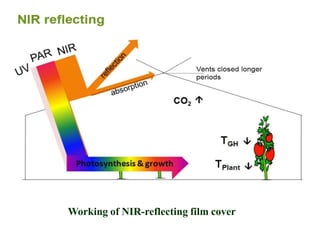
Solar radiation filtration
 Global solar radiation entering in a greenhouse
composed of three types of radiation,
Ultraviolet radiation (UV)
 Photosynthetic active radiation (PAR)
 Near infrared radiation (NIR)
 NIR filtering is also done by using specific
plastic cellophanes, moveable screens or NIR
filtering shading paint
24
Working of NIR-reflecting film cover
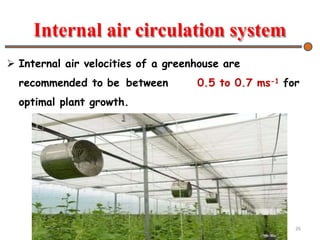
Internal air circulation system
 Internal air velocities of a greenhouse are
recommended to be between 0.5 to 0.7 ms-1 for
optimal plant growth.
26
CO2 Enrichment
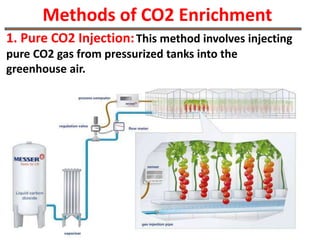
• Pure liquid CO2 pumping from containers to the
greenhouse is the purest type of CO2
enrichment
• A better CO2 distribution within the greenhouse
can be accomplished with a pipeline network,
similar to the fertigation system.
27
Methods of CO2 Enrichment
1. Pure CO2 Injection:This method involves injecting
pure CO2 gas from pressurized tanks into the
greenhouse air.
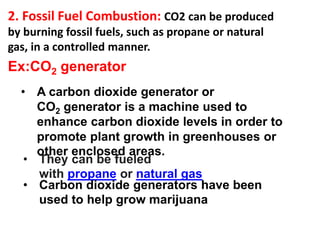
2. Fossil Fuel Combustion: CO2 can be produced
by burning fossil fuels, such as propane or natural
gas, in a controlled manner.
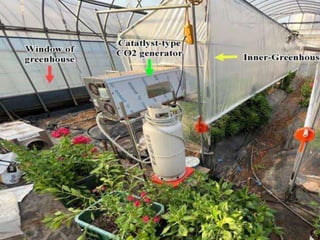
• A carbon dioxide generator or
CO2 generator is a machine used to
enhance carbon dioxide levels in order to
promote plant growth in greenhouses or
other enclosed areas.
Ex:CO2 generator
• They can be fueled
with propane or natural gas
• Carbon dioxide generators have been
used to help grow marijuana
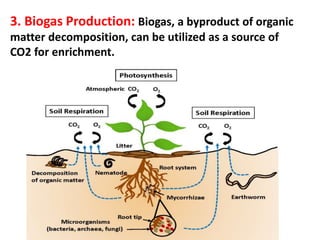
3. Biogas Production: Biogas, a byproduct of organic
matter decomposition, can be utilized as a source of
CO2 for enrichment.
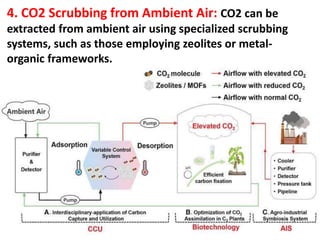
4. CO2 Scrubbing from Ambient Air: CO2 can be
extracted from ambient air using specialized scrubbing
systems, such as those employing zeolites or metal-
organic frameworks.
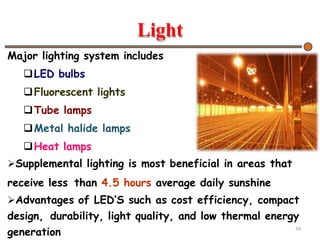
Light
Major lighting system includes
LED bulbs
Fluorescent lights
Tube lamps
Metal halide lamps
Heat lamps
Supplemental lighting is most beneficial in areas that
receive less than 4.5 hours average daily sunshine
Advantages of LED’S such as cost efficiency, compact
design, durability, light quality, and low thermal energy
generation 34
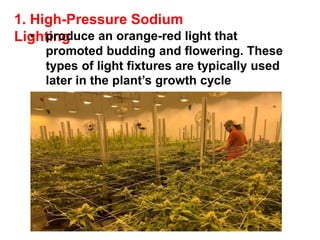
1. High-Pressure Sodium
Lighting
• produce an orange-red light that
promoted budding and flowering. These
types of light fixtures are typically used
later in the plant’s growth cycle
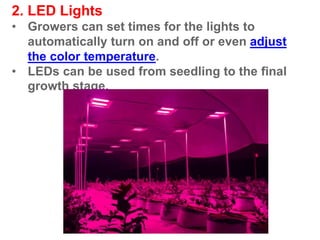
2. LED Lights
• Growers can set times for the lights to
automatically turn on and off or even adjust
the color temperature.
• LEDs can be used from seedling to the final
growth stage.
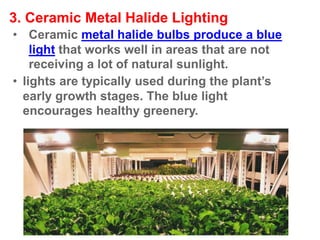
3. Ceramic Metal Halide Lighting
• Ceramic metal halide bulbs produce a blue
light that works well in areas that are not
receiving a lot of natural sunlight.
• lights are typically used during the plant’s
early growth stages. The blue light
encourages healthy greenery.
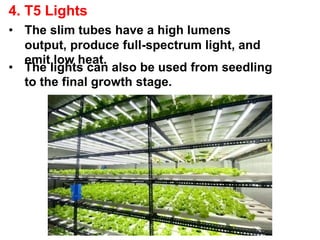
4. T5 Lights
• The slim tubes have a high lumens
output, produce full-spectrum light, and
emit low heat.
• The lights can also be used from seedling
to the final growth stage.
greenhouse-190715061604.pptx

greenhouse-190715061604.pptx

  • 1.
    COLLEGE OF HORTICULTURE,MUNIRABAD Course Tittle: Protected cultivation of vegetables,VSC202(0+1) Presentation Topic: Climate regulation in greenhouse Presentation By : UHS21UG5940 UHS21UG5941 UHS21UG5963 1
  • 2.
    Enivironment control parameters Solarradiation Temperature Relative humidity Light Carbon dioxide 2
  • 3.
    Temperature  Temperature hasa direct impact on the physiological development phases of the plant.  Regulates the transpiration rate and plant water status through stomatal control during the photosynthesis.  Average temperatures ranges between 20o- 30oC 3
  • 4.
     Relative humiditywithin the range 60-90 % is suitable to plant growth  RH above 95 % for long periods, particularly at night as this favours the rapid development of fungus diseases Relative humidity 4
  • 5.
    Light intensity  Thegrowth of plants is controlled by three light (photo) processes, namely Photosynthesis Photo morphogenesis Photoperiodism  Artificial lightening is required only in case of long duration crop 5
  • 6.
    Carbon dioxide  Theoptimal CO2 concentration for growth and yield seems to be 700– 900 μmol mol-1,  CO2 inside the greenhouse may lead to an increase of over 20 percent in fruit production for both dry and fresh matter 6
  • 7.
    Control system  Ventilation Shading  Cooling  Greenhouse heating  Solar radiation filtration  Internal air circulation system  CO2 enrichment  The lighting system  Air humidification  Dehumidification 7
  • 8.
    Ventilation  It isrelated to factors such as temperature, humidity and CO2 concentration.  Types of ventilation Natural ventilation Forced ventilation  Total ventilator area equivalent to 15-30 % of floor area was recommended by White and Aldrich (1975). 15-Jul-19 8
  • 9.
    Natural ventilation 9  Efficiencyof natural ventilation depends on factors such as  Wind speed and direction,  Temperature differences between the outside and the inside of the greenhouse,  Greenhouse design and the presence or absence of crops The external cool air enters the GH through the lower side openings while the hot internal air exits through the roof openings due to density difference, lowering of temperature in the GH.
  • 10.
  • 11.
    Forced ventilation  Fanssuck air out on the one side and openings on the other side let air in.  Ventilation fans should be located on the wind side of the greenhouse 11 Distance between two fans should not exceed 8-10 m  Inlet opening on the opposite side of a fan should be at least 1.25 times of the fan area.
  • 12.
  • 13.
    Shade covers Shading willbe done using different approaches:  Shade screens  Paints  Nets 15-Jul-19 13
  • 14.
    The coloured shadenets in the protected crops stimulate specific morphological and physiological reactions thereby improves the quality of produce 14
  • 15.
    Cooling  Mist orfog system  Evaporative pads (wet pads) 15-Jul-19 15 Roof evaporative cooling
  • 16.
    Fan-pad system • Thissystem consists of a fan on one sidewall and pad on the other sidewall of the GH. • The principle of evaporative cooling is applied by running a water stream over the pad and consequent withdrawal of air through it by fans on the opposite side. • The air becomes cooler and its humidity is also raised. More effective when outside air humidity is low.
  • 17.
    17 Pad (left) andfan (right) greenhouse cooling system
  • 18.
    Fog/misting system • Itis based on spraying water as small droplets (droplet diameter of 2–60 micro meters) with high pressure nozzles. • Cooling is achieved by evaporation of droplets. Free fall velocity of these droplets is slow and the air streams inside the GH easily carry the drops. • This can result in high efficiency of water evaporation combined with keeping the foliage dry. • Provides more uniform spatial air temperature and RH than fan-pad system. Less expensive to install and operate.
  • 19.
    Fog system usedfor greenhouse cooling
  • 20.
    Heating  Greenhouse heatingis required in cold climate regions such as Himalayan region of the country.  The heating system should provide heat to the greenhouse at the same rate at which it is lost.  The most common and least expensive is the unit heater system.  Heaters are located throughout the greenhouse, each heating system has a floor area of 180 to 500 m2. 20
  • 21.
    21 Unit heaters Central heating Wallpipes coils Overhead pipes coils In bed-pipe coils Pipe/Rail heating systems Heating for anti frost protection Different types of heating systems
  • 22.
    Unit heaters • Theunit heater is a fan equipped device with a means to heat the air. The most common and least expensive is the unit heater system. • Warm air is blown from unit heaters with self-contained fireboxes. Heaters are located throughout the GH, each heating a floor area of 180–500 m2. • Unit heaters are available in oil fired, electric, hot water or steam, and gas fired. The most popular being the gas fired unit.
  • 23.
  • 24.
    Solar radiation filtration Global solar radiation entering in a greenhouse composed of three types of radiation, Ultraviolet radiation (UV)  Photosynthetic active radiation (PAR)  Near infrared radiation (NIR)  NIR filtering is also done by using specific plastic cellophanes, moveable screens or NIR filtering shading paint 24
  • 25.
  • 26.
    Internal air circulationsystem  Internal air velocities of a greenhouse are recommended to be between 0.5 to 0.7 ms-1 for optimal plant growth. 26
  • 27.
    CO2 Enrichment • Pureliquid CO2 pumping from containers to the greenhouse is the purest type of CO2 enrichment • A better CO2 distribution within the greenhouse can be accomplished with a pipeline network, similar to the fertigation system. 27
  • 29.
    Methods of CO2Enrichment 1. Pure CO2 Injection:This method involves injecting pure CO2 gas from pressurized tanks into the greenhouse air.
  • 30.
    2. Fossil FuelCombustion: CO2 can be produced by burning fossil fuels, such as propane or natural gas, in a controlled manner. • A carbon dioxide generator or CO2 generator is a machine used to enhance carbon dioxide levels in order to promote plant growth in greenhouses or other enclosed areas. Ex:CO2 generator • They can be fueled with propane or natural gas • Carbon dioxide generators have been used to help grow marijuana
  • 32.
    3. Biogas Production:Biogas, a byproduct of organic matter decomposition, can be utilized as a source of CO2 for enrichment.
  • 33.
    4. CO2 Scrubbingfrom Ambient Air: CO2 can be extracted from ambient air using specialized scrubbing systems, such as those employing zeolites or metal- organic frameworks.
  • 34.
    Light Major lighting systemincludes LED bulbs Fluorescent lights Tube lamps Metal halide lamps Heat lamps Supplemental lighting is most beneficial in areas that receive less than 4.5 hours average daily sunshine Advantages of LED’S such as cost efficiency, compact design, durability, light quality, and low thermal energy generation 34
  • 35.
    1. High-Pressure Sodium Lighting •produce an orange-red light that promoted budding and flowering. These types of light fixtures are typically used later in the plant’s growth cycle
  • 36.
    2. LED Lights •Growers can set times for the lights to automatically turn on and off or even adjust the color temperature. • LEDs can be used from seedling to the final growth stage.
  • 37.
    3. Ceramic MetalHalide Lighting • Ceramic metal halide bulbs produce a blue light that works well in areas that are not receiving a lot of natural sunlight. • lights are typically used during the plant’s early growth stages. The blue light encourages healthy greenery.

  • 38.
    4. T5 Lights •The slim tubes have a high lumens output, produce full-spectrum light, and emit low heat. • The lights can also be used from seedling to the final growth stage.