1. Cultivation inProblematic Agriculture
Zones
• About 75 million hectares of land in India face challenges like being
barren, fallow, desert, or severely cold. Greenhouse technology can
make a portion of this land cultivable, significantly boosting local
income.
2. Greenhouse Complexes around Metropolitan and Other Big Cities
Major cities have year-round demand for vegetables, fruits, and ornamental
plants, including off-season and high-value crops. Greenhouse farming is
ideal to meet this consistent urban demand.
3.
3. Export ofAgricultural Produce
• India's agricultural exports, especially in horticulture and flowers,
have strong international demand. Greenhouses near export hubs
can enhance quality, reduce transport costs, and improve foreign
trade balance.
Greenhouses offer controlled environments ideal for seedlings and cuttings. Existing
nurseries can be upgraded to improve both the capacity and quality of plant materials.
4. Greenhouse for Plant Propagation
4.
5. Greenhouse Technologyas Base for Other
Biotechnology
• Controlled environments in greenhouses support hydroponics, tissue
culture, and other biotech processes, making them essential for
modern agricultural research and production.
6. Cultivation of Rare and Medicinal Plants
India has a wide variety of orchids/herbs, which have been identified
for large scale cultivation. The greenhouse could provide the right type
of environmental condition for the intensive cultivation of these plants.
5.
ADVANTAGES
• The yieldmay be 10-12 times higher than that of out door cultivation
depending upon the type of greenhouse, type of crop, environmental
control facilities.
• Reliability of crop increases under greenhouse cultivation.
• Ideally suited for vegetables and flower crops. Year round production
of floricultural crops.
• Off-season production of vegetable and fruit crops.
6.
• Disease-free andgenetically superior transplants can be produced
continuously.
• Efficient utilisation of chemicals, pesticides to control pest and
diseases.
• Water requirement of crops very limited and easy to control.
• Maintenance of stock plants, cultivating grafted plant-lets and micro
propagated plant- lets.
Greenhouse
• Framed structurescovered with UV stabilized plastic films for crop
growth under controlled conditions.
• Advantages:
• - Moderates temperature & humidity
• - Effective plant propagation
• - Improves quality and quantity of produce
• - Reduces disease/pest infestation
• - Saves water & fertilizer
• - Reduces gestation period
9.
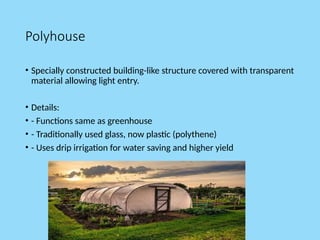
Polyhouse
• Specially constructedbuilding-like structure covered with transparent
material allowing light entry.
• Details:
• - Functions same as greenhouse
• - Traditionally used glass, now plastic (polythene)
• - Uses drip irrigation for water saving and higher yield
10.
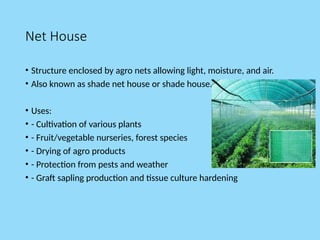
Net House
• Structureenclosed by agro nets allowing light, moisture, and air.
• Also known as shade net house or shade house.
• Uses:
• - Cultivation of various plants
• - Fruit/vegetable nurseries, forest species
• - Drying of agro products
• - Protection from pests and weather
• - Graft sapling production and tissue culture hardening
11.
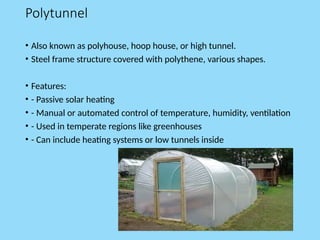
Polytunnel
• Also knownas polyhouse, hoop house, or high tunnel.
• Steel frame structure covered with polythene, various shapes.
• Features:
• - Passive solar heating
• - Manual or automated control of temperature, humidity, ventilation
• - Used in temperate regions like greenhouses
• - Can include heating systems or low tunnels inside
Light in ProtectedCulture
• • UV light (<400 nm) is harmful to plants; glass blocks light below 325
nm
• • Visible light (400–700 nm) is used in photosynthesis; highest
activity in red & blue
• • Far red light (700–750 nm) affects plant growth
• • Infrared rays are not involved in plant processes
• • Light intensity ranges: 129.6 klux (summer) to 3.2 klux (winter)
• • Lux is the unit of light intensity
14.
Temperature in Greenhouses
•• Day temp is 3–6°C higher than night on cloudy days; 8°C higher on
clear days
• • With CO₂ enrichment, day temp can be 3°C higher
• • Night temperature range: 7 to 21°C
• • Controlled temperature helps optimize crop growth
15.
Relative Humidity
• •Higher RH inside greenhouses due to evapotranspiration
• • Managed by ventilation, humidifiers & dehumidifiers
• • Optimal RH for most crops: 50–80%; for propagation: up to 90%
• • Tools: cooling pads, fogging systems, ventilators, chemicals
16.
Mist Systems
• •Low-pressure mist (<7 kg/cm²): larger droplets, less evaporation,
risk of nutrient leaching
• • High-pressure mist (35–70 kg/cm²): fine mist, better evaporation,
5–10°C cooling
• • High-pressure is more effective during hot days
17.
CO₂ Enrichment
• •Carbon makes up ~40% of plant dry matter
• • Natural CO₂ in atmosphere: ~345 ppm (0.03%)
• • In greenhouses, photosynthesis reduces CO₂ to below 200 ppm
during the day
• • Supplementation improves plant growth and yield
18.
Greenhouse Cladding /Glazing / Covering and
Roofing Materials & Ventilation Systems
• Greenhouse Covering Materials
• Types:
• Single/Double Glazing
• Single/Double Plastic Sheets/Films
• Material Combinations
• Functions:
• Structural Support
• Light Transmission
• Thermal Control
19.
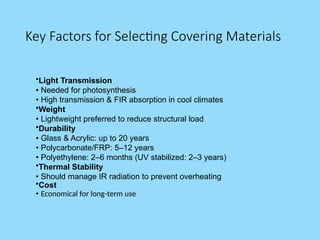
Key Factors forSelecting Covering Materials
•Light Transmission
• Needed for photosynthesis
• High transmission & FIR absorption in cool climates
•Weight
• Lightweight preferred to reduce structural load
•Durability
• Glass & Acrylic: up to 20 years
• Polycarbonate/FRP: 5–12 years
• Polyethylene: 2–6 months (UV stabilized: 2–3 years)
•Thermal Stability
• Should manage IR radiation to prevent overheating
•Cost
• Economical for long-term use
20.
• Conclusion
• Choiceof material affects greenhouse strength, temperature, and
crop performance.
• Balance needed between structural, mechanical, and crop-specific
needs.
Cladding / Glazing/ Covering Materials
• Glass:
• Single / double glazing
• High light transmission
• Durable but expensive and heavy
• Plastic Films:
• Polyethylene (PE), PVC, EVA
• Lightweight and economical
• Needs replacement every 2–5 years
• Polycarbonate Sheets:
• Twin-wall or multi-wall panels
• Good insulation and impact resistance
• Long-lasting and UV-resistant
Installation & Structure
•Proper tensioning of films
• Structural strength is critical for resisting wind and snow loads
• Use of aluminum or galvanized steel frames
25.
Ventilation Systems
• NaturalVentilation:
• Ridge vents, side vents, roof vents
• Utilizes wind and temperature differences
• Mechanical Ventilation:
• Exhaust fans, circulation fans
• Controlled by sensors (temperature, humidity)
• Shading & Cooling:
• Shade nets
• Evaporative cooling pads
26.
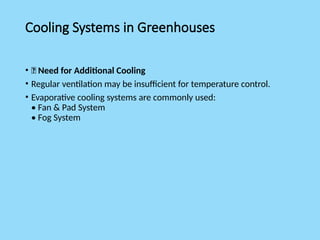
Cooling Systems inGreenhouses
• 🌿 Need for Additional Cooling
• Regular ventilation may be insufficient for temperature control.
• Evaporative cooling systems are commonly used:
• Fan & Pad System
• Fog System
27.
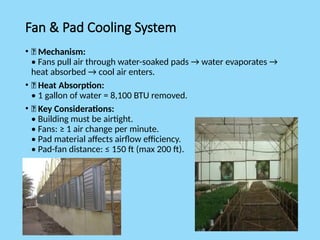
Fan & PadCooling System
• 🔹 Mechanism:
• Fans pull air through water-soaked pads → water evaporates →
heat absorbed → cool air enters.
• 🔹 Heat Absorption:
• 1 gallon of water = 8,100 BTU removed.
• 🔹 Key Considerations:
• Building must be airtight.
• Fans: ≥ 1 air change per minute.
• Pad material affects airflow efficiency.
• Pad-fan distance: ≤ 150 ft (max 200 ft).
28.
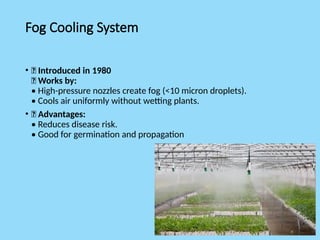
Fog Cooling System
•🔸 Introduced in 1980
🔸 Works by:
• High-pressure nozzles create fog (<10 micron droplets).
• Cools air uniformly without wetting plants.
• 🔸 Advantages:
• Reduces disease risk.
• Good for germination and propagation
29.
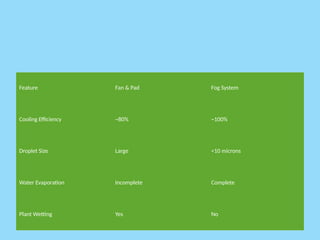
Feature Fan &Pad Fog System
Cooling Efficiency ~80% ~100%
Droplet Size Large <10 microns
Water Evaporation Incomplete Complete
Plant Wetting Yes No
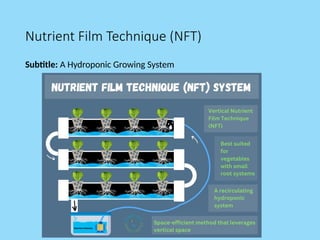
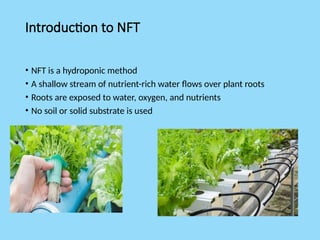
Introduction to NFT
•NFT is a hydroponic method
• A shallow stream of nutrient-rich water flows over plant roots
• Roots are exposed to water, oxygen, and nutrients
• No soil or solid substrate is used
32.
How NFT Works
•Nutrient solution flows through channels
• Roots absorb nutrients directly from the flowing film
• Water recirculates back to the reservoir
• Channels are usually made of PVC or similar plastic
33.
Key Components
• Reservoir:Stores nutrient solution
• Pump: Pushes nutrient water through system
• Channels/Gullies: Where plants are placed
• Tubing: For water circulation
• Return System: Sends used solution back
• Net pots/Starter cubes: Hold seedling
34.
• Flow Rateand Channel Slope
• Recommended Flow Rate:
• Ideal: 1 L/min per channel
• Minimum: 0.5 L/min
• Maximum: 2 L/min
• Slope Recommendation:
• 1:30 to 1:40 ratio (1 inch drop every 30–40 inches)
• Adjustable slope is ideal
35.
• Important DesignConsiderations
• Channels must not sag → avoid water pooling
• Maintain hygienic conditions
• Avoid heavy metal contamination
• Use plastic or stainless steel components only
• Advantages of NFT
• Efficient nutrient and water use
• Continuous oxygen supply to roots
• Recirculating system → cost-effective
• Fast growth and high yield potential
36.
• Limitations
• Vulnerableto power failures
• Sensitive to clogging or uneven flow
• Root mat can cause water damming
• Requires precise design and maintenance
37.
• Summary
• NFTis a clean, efficient, and scalable hydroponic method
• Proper flow, slope, and hygiene are critical
• Ideal for leafy greens like lettuce, spinach, herbs
• Widely used in modern greenhouse system
38.
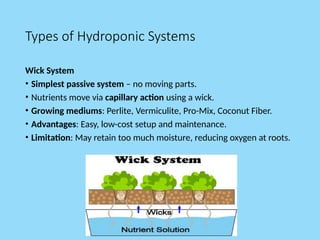
Types of HydroponicSystems
Wick System
• Simplest passive system – no moving parts.
• Nutrients move via capillary action using a wick.
• Growing mediums: Perlite, Vermiculite, Pro-Mix, Coconut Fiber.
• Advantages: Easy, low-cost setup and maintenance.
• Limitation: May retain too much moisture, reducing oxygen at roots.
39.
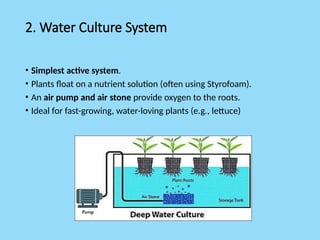
2. Water CultureSystem
• Simplest active system.
• Plants float on a nutrient solution (often using Styrofoam).
• An air pump and air stone provide oxygen to the roots.
• Ideal for fast-growing, water-loving plants (e.g., lettuce)
40.
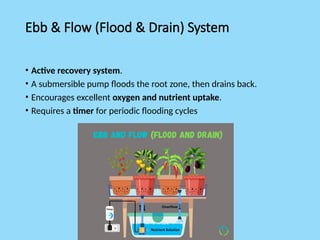
Ebb & Flow(Flood & Drain) System
• Active recovery system.
• A submersible pump floods the root zone, then drains back.
• Encourages excellent oxygen and nutrient uptake.
• Requires a timer for periodic flooding cycles
41.
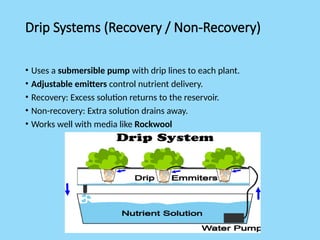
Drip Systems (Recovery/ Non-Recovery)
• Uses a submersible pump with drip lines to each plant.
• Adjustable emitters control nutrient delivery.
• Recovery: Excess solution returns to the reservoir.
• Non-recovery: Extra solution drains away.
• Works well with media like Rockwool
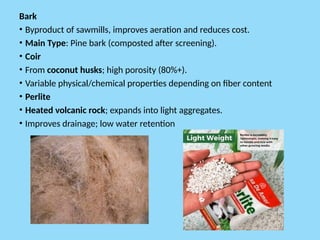
Bark
• Byproduct ofsawmills, improves aeration and reduces cost.
• Main Type: Pine bark (composted after screening).
• Coir
• From coconut husks; high porosity (80%+).
• Variable physical/chemical properties depending on fiber content
• Perlite
• Heated volcanic rock; expands into light aggregates.
• Improves drainage; low water retention
45.
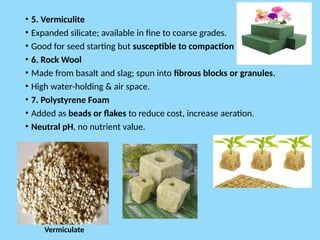
• 5. Vermiculite
•Expanded silicate; available in fine to coarse grades.
• Good for seed starting but susceptible to compaction
• 6. Rock Wool
• Made from basalt and slag; spun into fibrous blocks or granules.
• High water-holding & air space.
• 7. Polystyrene Foam
• Added as beads or flakes to reduce cost, increase aeration.
• Neutral pH, no nutrient value.
Vermiculate
46.
8. Tuff
• Volcanicmaterial with 60–80% TPS.
• Lightweight and porous; used globally in greenhouses.
9. Sand
• Enhances drainage.
• Inexpensive and widely used in desert regions
10. Zeolite
• Natural silicate minerals with high cation exchange capacity.
• Varies in hardness and composition.
CANOPY MANAGEMENT
• howbest we manipulate the tree vigour and use the available sunlight
and temperature to increase the productivity and quantity and minimize
the adverse effects of weather parameters.
Basic principles:
• Maximum utilization of the light
• Avoidance of the build up of micro-climate congenial for the diseases
and pests
• Convenience in varying out the cultural operations, maximizing the
productivity and quality
• Economy in obtaining the required canopy architecture.
49.
Importance of Light
•Essential for flower induction and fruit development
• Drives carbohydrate synthesis – critical for flowering (e.g., in mango)
Light Interception & Distribution
• Yield depends on light interception
• Quality depends on light distribution
50.
Light & CanopyManagement
• Light intensity decreases inside the canopy
• Outer canopy shades inner leaves
• Light exposure affects:
• 🌼 Flower bud differentiation
• 🍈 Fruit set
• 🍎 Fruit colour & quality
51.
MICRO IRRIGATION
• Microirrigation is a modern method of irrigation; by this method
water is irrigated through drippers, sprinklers, foggers and by other
emitters on surface or subsurface of the land. Major components of a
micro irrigation system is as follows.
52.
✅ Merits ofMicro-Irrigation
• 💧 Water Savings: Reduces evaporation, runoff, and irrigates only
target soil volume.
• 📉 Water Efficiency: Saves 25–40% over overhead and 45–60% over
surface irrigation.
• 💸 Low Application Rates: Cost-effective system components and
longer run-times.
• 📊 Uniform Water Application: Consistent supply to all plants.
• ⚡ Energy Saving: Operates at low pressure (2–4 bar), requiring less
power.
• 🌱 Efficient Fertilizer Use: Precise chemical application via fertigation.
• 🚫 Reduced Weeds & Diseases: Minimal wet area restricts weed and
disease spread
53.
⚠️
Demerits of Micro-Irrigation
•💰 High Initial Cost
• ️
🛠️Requires Skilled Management
• 🚿 Clogging Issues (emitters sensitive to blockages)
• 🧂 Salt Build-up near root zones
• 🌱 Poor Seed Germination for some crops
• 📉 Limited Moisture Distribution depending on soil type
54.
Types of Micro-IrrigationSystems
• Drip Irrigation – Slow, targeted water delivery via emitters.
• Spray Irrigation – Pressurized sprinkling for wider areas.
• Subsurface Drip (SDI) – Underground water delivery, efficient for
permanent setups.
• Bubbler System – High-discharge point-source system using small
basins
55.
Fertigation Systems andInjection Methods
• Types, Techniques, and Equipment Used in Modern Irrigation
56.
Fertigation Application Methods
•Four Systems Used:
• Continuous Application
• Constant fertilizer application throughout irrigation.
• Independent of discharge rate.
• Three-Stage Application
• Fertilizer starts after soil is wet and stops before irrigation ends.
• Final water flushes out nutrients.
• Proportional Application
• Fixed ratio (e.g. 1:1000) with water flow.
• Increases fertigation during high demand.
• Quantitative Application
• Fixed amount per block (e.g., 20 L to Block A).
• Ideal for automation and accuracy.
Suction Injection Method
HowIt Works:
• Fertilizer drawn into the pump via suction pipe from a stock tank.
✅ Advantages:
• Simple and low maintenance.
• Easy to install.
• Ideal for dry fertilizers.
⚠️Disadvantages:
• Uneven concentration during operation.
• Risk of air entry if not sealed.
• Not suitable for proportional fertigation.
• Limited capacity.
59.
Pressure Differential Injection
WorkingPrinciple:
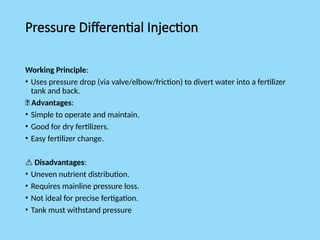
• Uses pressure drop (via valve/elbow/friction) to divert water into a fertilizer
tank and back.
✅ Advantages:
• Simple to operate and maintain.
• Good for dry fertilizers.
• Easy fertilizer change.
⚠️Disadvantages:
• Uneven nutrient distribution.
• Requires mainline pressure loss.
• Not ideal for precise fertigation.
• Tank must withstand pressure
60.
Pump Injection Method
HowIt Works:
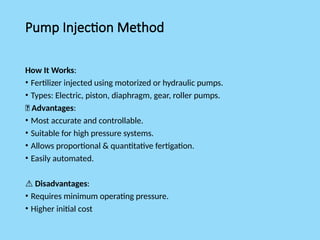
• Fertilizer injected using motorized or hydraulic pumps.
• Types: Electric, piston, diaphragm, gear, roller pumps.
✅ Advantages:
• Most accurate and controllable.
• Suitable for high pressure systems.
• Allows proportional & quantitative fertigation.
• Easily automated.
⚠️Disadvantages:
• Requires minimum operating pressure.
• Higher initial cost
61.
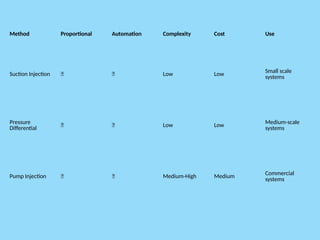
Method Proportional AutomationComplexity Cost Use
Suction Injection ❌ ❌ Low Low
Small scale
systems
Pressure
Differential ❌ ❌ Low Low Medium-scale
systems
Pump Injection ✅ ✅ Medium-High Medium Commercial
systems