Green
Accounting
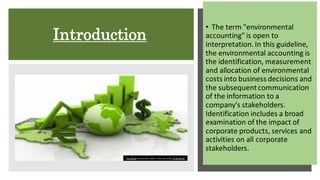
• The term "environmental
accounting" is open to
interpretation. In this guideline,
the environmental accounting is
the identification, measurement
and allocation of environmental
costs into business decisions and
the subsequentcommunication
of the information to a
company's stakeholders.
Identification includes a broad
examination of the impact of
corporate products, services and
activities on all corporate
stakeholders.
This Photo by Unknown author is licensed under CC BY-SA-NC.
Introduction
Meaning:
• Green Accounting is a type of
accounting that attempts to factor
environmental costs into the
financial results of operations. It is
considered as a subset or superset
of accounting proper. It aims to
incorporateboth the economic
and environmental information.
Purpose
• The major purpose of green
accounting is to help businesses
understand and manage the
potential substitute between
traditional economic goals and
environmental goals.
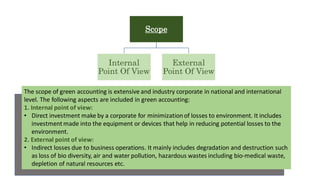
The scope of green accounting is extensive and industry corporate in national and international
level. The following aspects are included in green accounting:​
1. Internal point of view:
• Direct investment make by a corporate for minimizationof losses to environment. It includes
investment made into the equipment or devices that help in reducing potential losses to the
environment.​
2. External point of view:
• Indirect losses due to business operations. It mainly includes degradation and destruction such
as loss of bio diversity, air and water pollution, hazardous wastes including bio-medical waste,
depletion of natural resources etc.
Scope
Internal
Point Of View
External
Point Of View
Objectives of Green accounting:​
• Taking the total stock of assets or reserves related to
environmental issueand changes therein.​
• Estimationof the totalexpenditure protection
or enhancement of environment.​
• To identify the part of the gross domestic product which
reflects the cost necessary to compensate for the negative
impact of economic growth i.e. the so-called defensive
expenditure to protect environment.​
• Assessment of environmentalcosts and benefits:​
1. The decrease(depletion)in naturalresources due to
their use in productionand final demand and​
2. The changes in environmentalquality resulting from
pollutionand other impacts of productionand consumption
and other naturalevents on one hand, and the expenditure
for environmental protectionand enhancement of
environmenton the other hand.
Types of Green accounting:​
1. EnvironmentManagement
Accounting: EMA incorporatesthe
environmental andeconomic
information by identifyingresource
usage and the cost of
the organization'seconomic impact on
the environment.​
2. EnvironmentalFinancial
Accounting: EFA is concerned with
accountingfor environment
transactionsthat have an impact on
the financialperformance of the
company.​
3. EnvironmentalNational
Accounting: ENA involvesNational-
level accountingwith a focus on
naturalresource and green costs.
• To help managers make decisions that will
reduce or eliminate their environmental costs
• To better track environmental costs that may
have been previously obscured in overhead
accounts or otherwise overlooked.
• To better understand the environmental costs
and performance of processes and products for
more accurate costing and pricing of products
• To broaden and improve the investment analysis
and appraisal process to include potential
environmental impacts.
• To support and development and operation of
an overall environmental managementsystem.
Reasons why we
must opt Green
accounting
Green accounting considers and records the
cost and benefit of the ecosystem for a
company which arises through environment
protection and its arrival in developing
countries like India helps greater for the
economy as it creates awareness about the
environmental pollution, its protection
and development of environment for
a sustainable future. It serves the purpose of
creating awareness and educating corporate
firms and public the importance of
environment in development of the economy .
ROLES OF
GREEN
ACCOUNTING
IN DEVELOPING
INDIA
Financial Accounting Green Accounting
1. Supervision and guidance
• Ministry of Finance:National Taxation Bureau.
• FinancialSupervisory Commission:Securities
and Futures Bureau.
• GAAP
• GAAS
• Users of statement.
2. Compelling
• FinancialInformation and statement
3. Followingof current laws
• Avoidanceof corporate social responsibility.
• Acquistionof Maximum benefits of
shareholders.
4. Result
• Deteriorating environment
• Resource fighting of enterprises.
1. Promotion and education.
• Environemtal protectionAdministration,
Taiwan
• Ministry of Environment,Japan
• US Enviornmental Protection Agency
• InternationalFederationof Accountants(IFAC)
• UN Division for SustainableDevelopment
2. Non-Compelling
• General disclosure statementof Green
accounting
3. Formationof lawsand regulations
• Internalizationof external cost
• Reconsideration ofproduct design.
4. Result
• Economic sustainabledevelopment
• Sustainabilityof enterprises

GreenAccounting

  • 1.
  • 2.
    • The term"environmental accounting" is open to interpretation. In this guideline, the environmental accounting is the identification, measurement and allocation of environmental costs into business decisions and the subsequentcommunication of the information to a company's stakeholders. Identification includes a broad examination of the impact of corporate products, services and activities on all corporate stakeholders. This Photo by Unknown author is licensed under CC BY-SA-NC. Introduction
  • 3.
    Meaning: • Green Accountingis a type of accounting that attempts to factor environmental costs into the financial results of operations. It is considered as a subset or superset of accounting proper. It aims to incorporateboth the economic and environmental information. Purpose • The major purpose of green accounting is to help businesses understand and manage the potential substitute between traditional economic goals and environmental goals.
  • 4.
    The scope ofgreen accounting is extensive and industry corporate in national and international level. The following aspects are included in green accounting:​ 1. Internal point of view: • Direct investment make by a corporate for minimizationof losses to environment. It includes investment made into the equipment or devices that help in reducing potential losses to the environment.​ 2. External point of view: • Indirect losses due to business operations. It mainly includes degradation and destruction such as loss of bio diversity, air and water pollution, hazardous wastes including bio-medical waste, depletion of natural resources etc. Scope Internal Point Of View External Point Of View
  • 5.
    Objectives of Greenaccounting:​ • Taking the total stock of assets or reserves related to environmental issueand changes therein.​ • Estimationof the totalexpenditure protection or enhancement of environment.​ • To identify the part of the gross domestic product which reflects the cost necessary to compensate for the negative impact of economic growth i.e. the so-called defensive expenditure to protect environment.​ • Assessment of environmentalcosts and benefits:​ 1. The decrease(depletion)in naturalresources due to their use in productionand final demand and​ 2. The changes in environmentalquality resulting from pollutionand other impacts of productionand consumption and other naturalevents on one hand, and the expenditure for environmental protectionand enhancement of environmenton the other hand. Types of Green accounting:​ 1. EnvironmentManagement Accounting: EMA incorporatesthe environmental andeconomic information by identifyingresource usage and the cost of the organization'seconomic impact on the environment.​ 2. EnvironmentalFinancial Accounting: EFA is concerned with accountingfor environment transactionsthat have an impact on the financialperformance of the company.​ 3. EnvironmentalNational Accounting: ENA involvesNational- level accountingwith a focus on naturalresource and green costs.
  • 6.
    • To helpmanagers make decisions that will reduce or eliminate their environmental costs • To better track environmental costs that may have been previously obscured in overhead accounts or otherwise overlooked. • To better understand the environmental costs and performance of processes and products for more accurate costing and pricing of products • To broaden and improve the investment analysis and appraisal process to include potential environmental impacts. • To support and development and operation of an overall environmental managementsystem. Reasons why we must opt Green accounting
  • 7.
    Green accounting considersand records the cost and benefit of the ecosystem for a company which arises through environment protection and its arrival in developing countries like India helps greater for the economy as it creates awareness about the environmental pollution, its protection and development of environment for a sustainable future. It serves the purpose of creating awareness and educating corporate firms and public the importance of environment in development of the economy . ROLES OF GREEN ACCOUNTING IN DEVELOPING INDIA
  • 8.
    Financial Accounting GreenAccounting 1. Supervision and guidance • Ministry of Finance:National Taxation Bureau. • FinancialSupervisory Commission:Securities and Futures Bureau. • GAAP • GAAS • Users of statement. 2. Compelling • FinancialInformation and statement 3. Followingof current laws • Avoidanceof corporate social responsibility. • Acquistionof Maximum benefits of shareholders. 4. Result • Deteriorating environment • Resource fighting of enterprises. 1. Promotion and education. • Environemtal protectionAdministration, Taiwan • Ministry of Environment,Japan • US Enviornmental Protection Agency • InternationalFederationof Accountants(IFAC) • UN Division for SustainableDevelopment 2. Non-Compelling • General disclosure statementof Green accounting 3. Formationof lawsand regulations • Internalizationof external cost • Reconsideration ofproduct design. 4. Result • Economic sustainabledevelopment • Sustainabilityof enterprises