NPO/NGO

Suppliers
Materials and parts for
production

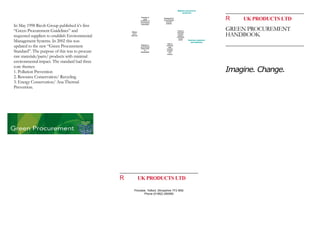
In May 1998 Ricoh Group published it’s first
“Green Procurement Guidelines” and
requested suppliers to establish Environmental
Management Systems. In 2002 this was
updated to the new “Green Procurement
Standard”. The purpose of this was to procure
raw materials/parts/ products with minimal
environmental impact. The standard had three
core themes:
1. Pollution Prevention
2. Resource Conservation/ Recycling
3. Energy Conservation/ Ana Thermal
Prevention.

Promotion of
social
contribution on
environmental
conservation

Recycling
companies

Efficient
use of
resources

Ricoh Group
Reduction in
environmental
impact cause
by
transportation

Logistics
Companies

R

Development of
environmentally
conscious
products

Promotion of
environmental
conservation
through the
purchase of
environmentally
conscious
products

Sales of
environme
ntally
conscious
products
and
services

Customers

UK PRODUCTS LTD
Priorslee, Telford, Shropshire TF2 9NS
Phone (01952) 290090

Suppliers

R

UK PRODUCTS LTD

GREEN PROCUREMENT
HANDBOOK

Business equipment
and stationary

Imagine. Change.
RICOH’S GREEN
PROCURE
STANDARDS

OUR SUPPLIERS OBLIGATIONS

Ricoh group not only recognises
environmental conservation as a mission for
all global citizens to fulfil but as a core
underlying activity that is linked to every part
of business.

Banned Substances
A key element of the Green Procurement
Standard is to ensure the exclusion of the 18
banned substances in Ricoh Products. These
include, asbestos, DBT, Ozone depleting
products and 6 substances banned by RoHS
EU Directive.

Not only do Ricoh comply with the EU
legislation and laws surrounding
Environmental practices but they set goals far
exceeding those expected of them, become
almost role-models for other business who
aim to achieve such results. Each business
activity is analysed in terms of environmental
impact and improvement on previous
methods is ongoing to ensure these targets are
met and even surpassed.
Ricoh prides themselves on becoming pillars
of the local society; they encourage each
employee to become environmentally aware
and responsible, as well as supporting local
conservation projects and schools.
It is vital that as a manufacturing organisation,
the efforts to reduce environmental impacts
are present throughout the process. For this
reason Ricoh work with suppliers and
customers as well as their own factories in
order to produce fully sustainable and low
impact products.

As a result of EU legislation as well as Ricoh’s
own high standards, our suppliers have a
number of obligations

REACH
The Regulation, Evaluation, Authorisation
and restriction or CHemicals regulation
(REACH) deals with the control of all
chemical substances produced or imported
into the EU. There are a number of
obligations that Ricoh must follow regarding
this, the most important being the sharing of
substance information down the supply chain.
RoHS
The Restriction of certain Hazardous
Substances in electrical and electronic
equipment is important EU legislation relation
to Ricoh Products Ltd. RoHS bans six
substances from being used in electrical and
electronic equipment. These are: lead,
mercury, cadmium, Haxavalent Chromium,
Polybrominated Biphenyls and
Polybrominated biphenyl ether.

CMS
Chemical Management Systems (CMS) are
sometimes required of our suppliers dependant
on the sort of products they handle. The CMS is
a number of requirements that establishes
control and best practices regarding substances
in order to ensure that Ricoh products are free
from any banned chemicals. Suppliers are
audited every two years to ensure consistency.
EMS
As with CMS only suppliers that fall into scope
are asked to introduce Environmental
Management Systems (EMS). Most UK
companies have already implemented an EMS
and gained ISO14001 accreditation. An EMS is
a system implemented for companies to reduce
waste, CO2 and their overall environmental
impact.
Conflict Minerals
Conflict minerals are Gold, Tin, Tungsten or
Tantalite that are mined in Democratic Republic
of the Congo or its 9 neighbouring countries.
These are mined inhumanely, usually by
children who work more than 18 hours at a time
and the profits from these minerals are used to
fund the second Congo war. In conjunction
with EICC and GeSI, Ricoh have started to
address this issue.
As you can see, Ricoh’s high Standards are
throughout the production system from the raw
materials to the overall product and the
customer advice provided. Ricoh aims to be a
leader in innovative and environmentally
friendly products and services and in order to
attain this all employees, suppliers and
customers are involved.

Green procurement handout

  • 1.
    NPO/NGO Suppliers Materials and partsfor production In May 1998 Ricoh Group published it’s first “Green Procurement Guidelines” and requested suppliers to establish Environmental Management Systems. In 2002 this was updated to the new “Green Procurement Standard”. The purpose of this was to procure raw materials/parts/ products with minimal environmental impact. The standard had three core themes: 1. Pollution Prevention 2. Resource Conservation/ Recycling 3. Energy Conservation/ Ana Thermal Prevention. Promotion of social contribution on environmental conservation Recycling companies Efficient use of resources Ricoh Group Reduction in environmental impact cause by transportation Logistics Companies R Development of environmentally conscious products Promotion of environmental conservation through the purchase of environmentally conscious products Sales of environme ntally conscious products and services Customers UK PRODUCTS LTD Priorslee, Telford, Shropshire TF2 9NS Phone (01952) 290090 Suppliers R UK PRODUCTS LTD GREEN PROCUREMENT HANDBOOK Business equipment and stationary Imagine. Change.
  • 2.
    RICOH’S GREEN PROCURE STANDARDS OUR SUPPLIERSOBLIGATIONS Ricoh group not only recognises environmental conservation as a mission for all global citizens to fulfil but as a core underlying activity that is linked to every part of business. Banned Substances A key element of the Green Procurement Standard is to ensure the exclusion of the 18 banned substances in Ricoh Products. These include, asbestos, DBT, Ozone depleting products and 6 substances banned by RoHS EU Directive. Not only do Ricoh comply with the EU legislation and laws surrounding Environmental practices but they set goals far exceeding those expected of them, become almost role-models for other business who aim to achieve such results. Each business activity is analysed in terms of environmental impact and improvement on previous methods is ongoing to ensure these targets are met and even surpassed. Ricoh prides themselves on becoming pillars of the local society; they encourage each employee to become environmentally aware and responsible, as well as supporting local conservation projects and schools. It is vital that as a manufacturing organisation, the efforts to reduce environmental impacts are present throughout the process. For this reason Ricoh work with suppliers and customers as well as their own factories in order to produce fully sustainable and low impact products. As a result of EU legislation as well as Ricoh’s own high standards, our suppliers have a number of obligations REACH The Regulation, Evaluation, Authorisation and restriction or CHemicals regulation (REACH) deals with the control of all chemical substances produced or imported into the EU. There are a number of obligations that Ricoh must follow regarding this, the most important being the sharing of substance information down the supply chain. RoHS The Restriction of certain Hazardous Substances in electrical and electronic equipment is important EU legislation relation to Ricoh Products Ltd. RoHS bans six substances from being used in electrical and electronic equipment. These are: lead, mercury, cadmium, Haxavalent Chromium, Polybrominated Biphenyls and Polybrominated biphenyl ether. CMS Chemical Management Systems (CMS) are sometimes required of our suppliers dependant on the sort of products they handle. The CMS is a number of requirements that establishes control and best practices regarding substances in order to ensure that Ricoh products are free from any banned chemicals. Suppliers are audited every two years to ensure consistency. EMS As with CMS only suppliers that fall into scope are asked to introduce Environmental Management Systems (EMS). Most UK companies have already implemented an EMS and gained ISO14001 accreditation. An EMS is a system implemented for companies to reduce waste, CO2 and their overall environmental impact. Conflict Minerals Conflict minerals are Gold, Tin, Tungsten or Tantalite that are mined in Democratic Republic of the Congo or its 9 neighbouring countries. These are mined inhumanely, usually by children who work more than 18 hours at a time and the profits from these minerals are used to fund the second Congo war. In conjunction with EICC and GeSI, Ricoh have started to address this issue. As you can see, Ricoh’s high Standards are throughout the production system from the raw materials to the overall product and the customer advice provided. Ricoh aims to be a leader in innovative and environmentally friendly products and services and in order to attain this all employees, suppliers and customers are involved.