
Save power, Save money,
         and
       Save lives
Table of Content
•   Why should we built Sustainable Buildings?
•   Power consumption sectors.
•   Prerequisite building studies.
•   Power saving techniques.
Why should we built Sustainable Buildings?
          Why do we need energy saving?
Why should we built Sustainable Buildings?
 Why do we need energy
 saving?:
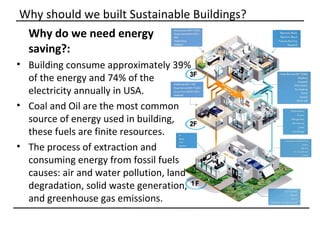
• Building consume approximately 39%
  of the energy and 74% of the
  electricity annually in USA.
• Coal and Oil are the most common
  source of energy used in building,
  these fuels are finite resources.
• The process of extraction and
  consuming energy from fossil fuels
  causes: air and water pollution, land
  degradation, solid waste generation,
  and greenhouse gas emissions.
Why should we built Sustainable Buildings?
 Why do we need energy
 saving?:
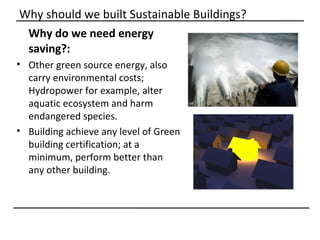
• Other green source energy, also
  carry environmental costs;
  Hydropower for example, alter
  aquatic ecosystem and harm
  endangered species.
• Building achieve any level of Green
  building certification; at a
  minimum, perform better than
  any other building.
•   Why should we built Sustainable Buildings?

• Power consumption sectors.
•   Prerequisite building studies.
•   Power saving techniques.
Power consumption sectors

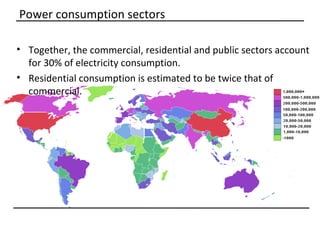
• Together, the commercial, residential and public sectors account
  for 30% of electricity consumption.
• Residential consumption is estimated to be twice that of
  commercial.
Power consumption sectors
 The barriers to energy efficiency
 in developing countries namely:
• Consumers are not familiar with energy-
  efficient products.
• Many energy-efficient products, are not
  widely available.
• Building contractors, and architectural &
  Engineering firms, are not familiar with
  the basic techniques which could
  improve the energy efficiency of the
  building.
Power consumption sectors
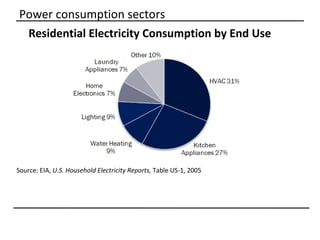
 Residential Electricity Consumption by End Use


Source: EIA, U.S. Household Electricity Reports, Table US-1, 2005
Power consumption sectors
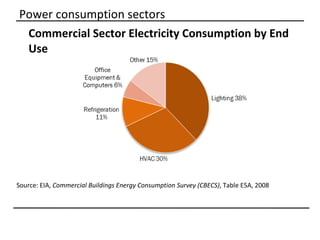
 Commercial Sector Electricity Consumption by End
 Use


Source: EIA, Commercial Buildings Energy Consumption Survey (CBECS), Table E5A, 2008
Power consumption sectors
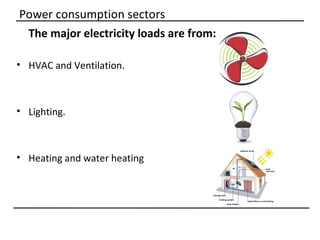
 The major electricity loads are from:

• HVAC and Ventilation.


• Lighting.


• Heating and water heating
•   Why should we built Sustainable Buildings?
•   Power consumption sectors.

• Prerequisite building studies.
•   Power saving techniques.
Building design studies

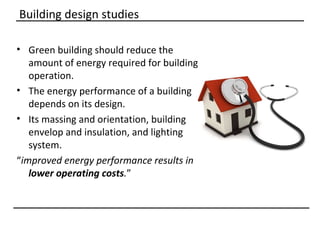
• Green building should reduce the
   amount of energy required for building
   operation.
• The energy performance of a building
   depends on its design.
• Its massing and orientation, building
   envelop and insulation, and lighting
   system.
“improved energy performance results in
   lower operating costs.”
Building design studies
 Building form and orientation:
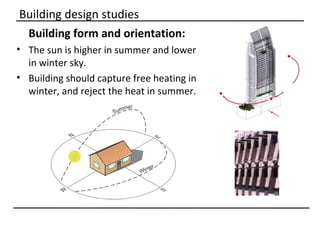
• The sun is higher in summer and lower
  in winter sky.
• Building should capture free heating in
  winter, and reject the heat in summer.
Building design studies
 Building form and orientation:
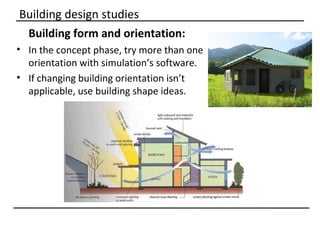
• In the concept phase, try more than one
  orientation with simulation’s software.
• If changing building orientation isn’t
  applicable, use building shape ideas.
Building design studies
 Building envelop and insulation:
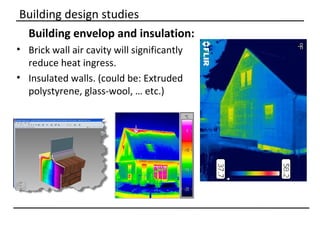
• Brick wall air cavity will significantly
  reduce heat ingress.
• Insulated walls. (could be: Extruded
  polystyrene, glass-wool, … etc.)
Building design studies
 Building envelop and insulation:
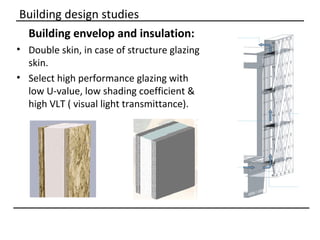
• Double skin, in case of structure glazing
  skin.
• Select high performance glazing with
  low U-value, low shading coefficient &
  high VLT ( visual light transmittance).
Building design studies
 Building envelop and insulation:
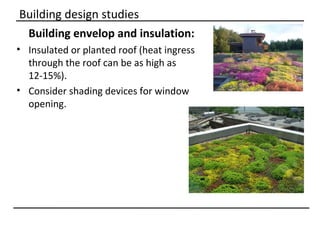
• Insulated or planted roof (heat ingress
  through the roof can be as high as
  12-15%).
• Consider shading devices for window
  opening.
Building design studies
 Natural lighting and view:
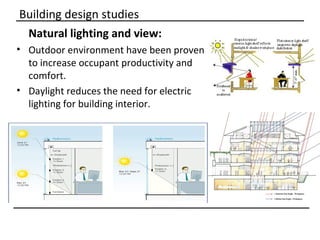
• Outdoor environment have been proven
  to increase occupant productivity and
  comfort.
• Daylight reduces the need for electric
  lighting for building interior.
Building design studies
  Natural lighting and view:
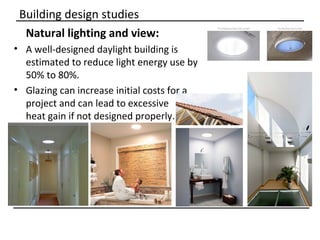
• A well-designed daylight building is
  estimated to reduce light energy use by
  50% to 80%.
• Glazing can increase initial costs for a
  project and can lead to excessive
  heat gain if not designed properly.
•   Why should we built Sustainable Buildings?
•   Power consumption sectors.
•   Prerequisite building studies.

• Power saving techniques.
Power saving techniques
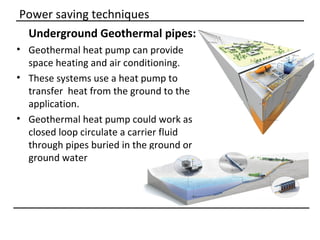
 Underground Geothermal pipes:
• Geothermal heat pump can provide
  space heating and air conditioning.
• These systems use a heat pump to
  transfer heat from the ground to the
  application.
• Geothermal heat pump could work as
  closed loop circulate a carrier fluid
  through pipes buried in the ground or
  ground water
Power saving techniques
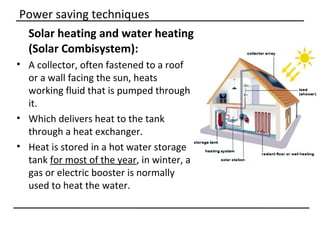
 Solar heating and water heating
 (Solar Combisystem):
• A collector, often fastened to a roof
  or a wall facing the sun, heats
  working fluid that is pumped through
  it.
• Which delivers heat to the tank
  through a heat exchanger.
• Heat is stored in a hot water storage
  tank for most of the year, in winter, a
  gas or electric booster is normally
  used to heat the water.
Power saving techniques
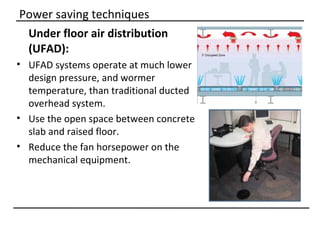
 Under floor air distribution
 (UFAD):
• UFAD systems operate at much lower
  design pressure, and wormer
  temperature, than traditional ducted
  overhead system.
• Use the open space between concrete
  slab and raised floor.
• Reduce the fan horsepower on the
  mechanical equipment.
Power saving techniques
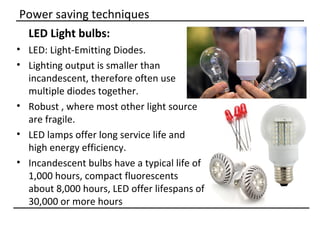
 LED Light bulbs:
• LED: Light-Emitting Diodes.
• Lighting output is smaller than
  incandescent, therefore often use
  multiple diodes together.
• Robust , where most other light source
  are fragile.
• LED lamps offer long service life and
  high energy efficiency.
• Incandescent bulbs have a typical life of
  1,000 hours, compact fluorescents
  about 8,000 hours, LED offer lifespans of
  30,000 or more hours
Power saving techniques
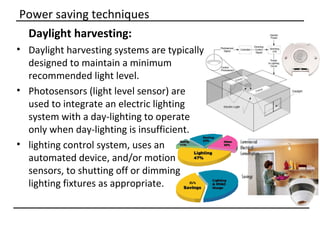
 Daylight harvesting:
• Daylight harvesting systems are typically
  designed to maintain a minimum
  recommended light level.
• Photosensors (light level sensor) are
  used to integrate an electric lighting
  system with a day-lighting to operate
  only when day-lighting is insufficient.
• lighting control system, uses an
  automated device, and/or motion
  sensors, to shutting off or dimming
  lighting fixtures as appropriate.
•   Why should we built Sustainable Buildings?
•   How could we define Green Building?
•   Power consumption sectors.
•   Prerequisite building studies.
•   Power saving techniques.
Thank You

   ?

Power saving

  • 1.
    Save power, Savemoney, and Save lives
  • 2.
    Table of Content • Why should we built Sustainable Buildings? • Power consumption sectors. • Prerequisite building studies. • Power saving techniques.
  • 3.
    Why should webuilt Sustainable Buildings? Why do we need energy saving?
  • 4.
    Why should webuilt Sustainable Buildings? Why do we need energy saving?: • Building consume approximately 39% of the energy and 74% of the electricity annually in USA. • Coal and Oil are the most common source of energy used in building, these fuels are finite resources. • The process of extraction and consuming energy from fossil fuels causes: air and water pollution, land degradation, solid waste generation, and greenhouse gas emissions.
  • 5.
    Why should webuilt Sustainable Buildings? Why do we need energy saving?: • Other green source energy, also carry environmental costs; Hydropower for example, alter aquatic ecosystem and harm endangered species. • Building achieve any level of Green building certification; at a minimum, perform better than any other building.
  • 6.
    Why should we built Sustainable Buildings? • Power consumption sectors. • Prerequisite building studies. • Power saving techniques.
  • 7.
    Power consumption sectors •Together, the commercial, residential and public sectors account for 30% of electricity consumption. • Residential consumption is estimated to be twice that of commercial.
  • 8.
    Power consumption sectors The barriers to energy efficiency in developing countries namely: • Consumers are not familiar with energy- efficient products. • Many energy-efficient products, are not widely available. • Building contractors, and architectural & Engineering firms, are not familiar with the basic techniques which could improve the energy efficiency of the building.
  • 9.
    Power consumption sectors Residential Electricity Consumption by End Use Source: EIA, U.S. Household Electricity Reports, Table US-1, 2005
  • 10.
    Power consumption sectors Commercial Sector Electricity Consumption by End Use Source: EIA, Commercial Buildings Energy Consumption Survey (CBECS), Table E5A, 2008
  • 11.
    Power consumption sectors The major electricity loads are from: • HVAC and Ventilation. • Lighting. • Heating and water heating
  • 12.
    Why should we built Sustainable Buildings? • Power consumption sectors. • Prerequisite building studies. • Power saving techniques.
  • 13.
    Building design studies •Green building should reduce the amount of energy required for building operation. • The energy performance of a building depends on its design. • Its massing and orientation, building envelop and insulation, and lighting system. “improved energy performance results in lower operating costs.”
  • 14.
    Building design studies Building form and orientation: • The sun is higher in summer and lower in winter sky. • Building should capture free heating in winter, and reject the heat in summer.
  • 15.
    Building design studies Building form and orientation: • In the concept phase, try more than one orientation with simulation’s software. • If changing building orientation isn’t applicable, use building shape ideas.
  • 16.
    Building design studies Building envelop and insulation: • Brick wall air cavity will significantly reduce heat ingress. • Insulated walls. (could be: Extruded polystyrene, glass-wool, … etc.)
  • 17.
    Building design studies Building envelop and insulation: • Double skin, in case of structure glazing skin. • Select high performance glazing with low U-value, low shading coefficient & high VLT ( visual light transmittance).
  • 18.
    Building design studies Building envelop and insulation: • Insulated or planted roof (heat ingress through the roof can be as high as 12-15%). • Consider shading devices for window opening.
  • 19.
    Building design studies Natural lighting and view: • Outdoor environment have been proven to increase occupant productivity and comfort. • Daylight reduces the need for electric lighting for building interior.
  • 20.
    Building design studies Natural lighting and view: • A well-designed daylight building is estimated to reduce light energy use by 50% to 80%. • Glazing can increase initial costs for a project and can lead to excessive heat gain if not designed properly.
  • 21.
    Why should we built Sustainable Buildings? • Power consumption sectors. • Prerequisite building studies. • Power saving techniques.
  • 22.
    Power saving techniques Underground Geothermal pipes: • Geothermal heat pump can provide space heating and air conditioning. • These systems use a heat pump to transfer heat from the ground to the application. • Geothermal heat pump could work as closed loop circulate a carrier fluid through pipes buried in the ground or ground water
  • 23.
    Power saving techniques Solar heating and water heating (Solar Combisystem): • A collector, often fastened to a roof or a wall facing the sun, heats working fluid that is pumped through it. • Which delivers heat to the tank through a heat exchanger. • Heat is stored in a hot water storage tank for most of the year, in winter, a gas or electric booster is normally used to heat the water.
  • 24.
    Power saving techniques Under floor air distribution (UFAD): • UFAD systems operate at much lower design pressure, and wormer temperature, than traditional ducted overhead system. • Use the open space between concrete slab and raised floor. • Reduce the fan horsepower on the mechanical equipment.
  • 25.
    Power saving techniques LED Light bulbs: • LED: Light-Emitting Diodes. • Lighting output is smaller than incandescent, therefore often use multiple diodes together. • Robust , where most other light source are fragile. • LED lamps offer long service life and high energy efficiency. • Incandescent bulbs have a typical life of 1,000 hours, compact fluorescents about 8,000 hours, LED offer lifespans of 30,000 or more hours
  • 26.
    Power saving techniques Daylight harvesting: • Daylight harvesting systems are typically designed to maintain a minimum recommended light level. • Photosensors (light level sensor) are used to integrate an electric lighting system with a day-lighting to operate only when day-lighting is insufficient. • lighting control system, uses an automated device, and/or motion sensors, to shutting off or dimming lighting fixtures as appropriate.
  • 27.
    Why should we built Sustainable Buildings? • How could we define Green Building? • Power consumption sectors. • Prerequisite building studies. • Power saving techniques.
  • 28.